Note: Today I am releasing the first of four pieces in a long-gestating project on the greatest athletes of all time. Like all lists, I am fully aware that this will engender disagreement, and that’s part of the point. My criteria include sporting accomplishments — championships, MVPs, world records — as well as off-the-field impact and historical significance. Some figures, like Michael Jordan, have a mixed legacy; others, like Pelé, have an almost unblemished one. I would love to hear your thoughts, so please do consider dropping a comment whether you agree or disagree. This piece will be followed by numbers six through ten for the men, and then a separate top ten for women.
1. Babe Ruth
Babe Ruth remains the number one choice. He completely changed the game of baseball with his power hitting and his two-way play. America’s game would never be the same. From humble beginnings in Baltimore, he became the highest-paid and most visible athlete in the world. His larger-than-life personality — the booze, the women, the cigars — all contribute to his myth.
The 1927 Yankees remain shorthand for the greatest team ever assembled, and Ruth’s pairing with Lou Gehrig gave baseball one of its most iconic duos. The relatively early deaths of both men add a certain pathos to the story. Ruth won seven World Series titles, hit 714 home runs in an era when power was rare, and essentially invented the modern slugger. He even has an iconic candy bar named after him. Unassailable.
2. Muhammad Ali
Next to Ruth, Ali is 1A. You could argue Jordan for pure dominance and brand success, but Ali was not only great in the ring — he intersects with 20th-century history in ways that put him over the top.
From his origins as Olympic gold medalist Cassius Clay to his name change, his foregrounding of Muslim identity, his refusal to fight in the Vietnam War, and his connections to the Black Power movement and Malcolm X, Ali became far more than a boxer. He later paid a tragic physical price for fighting too long, and his public battle with Parkinson’s disease only deepened his stature.
Ali talked better than anyone before or since, floated like a butterfly, stung like a bee, and was a three-time heavyweight champion of the world. He looms large not just in sport, but in global cultural memory. A clear number two.
3. Michael Jordan
Jordan comes in at number three — though among younger generations he is arguably better remembered than Ruth or Ali, which suggests that his status may continue to rise.
From his famous early cut from his high school varsity team, to the game-winning shot as a freshman at North Carolina in 1982, to his early playoff frustrations against Boston and Detroit, Jordan’s arc is mythically clean. Once he broke through, the dominance was total: six NBA championships, five MVPs, ten scoring titles, and an undefeated Finals record.
Off the court, Jordan became the most successful sports marketer in history. His shoe deals and advertising footprint dwarfed anything that came before. His legacy is not without complications — gambling rumors, the David Stern suspension theories, a rocky tenure as owner of the Charlotte Hornets, and an ongoing public feud with Scottie Pippen — but none of that erases what he was on the court. An undeniable number three.
4. Pelé
Pelé belongs at number four because he remains the single greatest icon in what is almost certainly the world’s most popular sport. I grew up on basketball, baseball, and football, yet even I knew who Pelé was by the age of six.
For people like my son — a soccer fan and influencer — Pelé is bigger than Ruth or Ali. Other players, Messi included, may rival or surpass him on pure technical grounds, and Maradona has a competing mythos, but Pelé’s status as a hero from the global south remains unmatched.
He won three World Cups with Brazil, scored over 1,000 career goals depending on how one counts, and became the first truly global sports celebrity. By all accounts, he was also a gracious and generous human being. There is little that detracts from his legacy. A natural number four.
5. Jackie Robinson
Jackie Robinson belongs on this list for his brave and immensely graceful breaking of baseball’s color barrier — and by extension, professional team sports in America.
Credit is due to Branch Rickey for taking the risk, but it was Robinson who carried the weight. Through his base stealing, his hitting, his defense, and above all his composure, Robinson became a model of quiet strength and dignity under pressure. He won the inaugural Rookie of the Year award, an MVP, a World Series title, and was a perennial All-Star.
One may admire Jordan without loving him, but Robinson is universally — and rightly — beloved. He helped reshape not just baseball, but American race relations more broadly. A fitting number five.
Dedication:
For Steve Treader, the greatest sportswriter I know.
Note: This is the third and for now final position of the Trans-Pacific Political Partnership known as The Splinter Fraction. Our first position is about the Age of Consent in the U.S. Our second position is about privileged access for Medecins Sans Frontieres to all war zones and protection from the powers that be for their operations. Our final position is to spread karaoke as widely as possible. We are entirely serious.
We affirm karaoke as one of the last remaining civic rituals in which strangers meet without preconditions and leave with fewer barriers than they arrived with. A microphone passed between an office worker, an American traveler, an Indian engineer, an older Japanese gentleman, a young woman finding her voice again — this is not entertainment alone. It is a brief suspension of hierarchy, suspicion, and self-protection. In these small rooms people remember how easy it is to be together.
Karaoke is not mandatory, nor do we idealize it. We simply encourage every citizen — once in a while, or for the first time — to step into a space where age, gender, profession, and political commitments dissolve for the length of a verse. It is a civic practice hiding in plain sight: a low-cost, low-risk release valve healthier than most vices and far more generous in its returns.
Society is fraying at the edges. But give people one Tom Petty track, one “What’s Up” howl, one chance to sing badly but sincerely, and cohesion begins again — not through policy, but through the ordinary bravery of shared song. The Splinter Fraction supports public encouragement and, where possible, public subsidy of these communal singing rooms, as engines of ease and democratic belonging.
Karaoke will not fix the world. But it will bring us back into easy congress with one another, which is more than most programs can claim.
I’ve been trying, lately, to understand the early spaces in my life where safety and memory intersect — the brief rooms in time that opened something in me before I even had language for it. Some moments don’t turn into stories, but they still leave a shape. This is one of those moments.
The Christmas Dance wasn’t held in the high school that year at all. It was downtown, in one of those Spokane venues that tried to look older than the city around it — chandeliers, carpeted floors, bathrooms with real mirrors. We had been dancing all night, the kind of teenage drifting where everyone is shy and bold by turns. And then it was over, and people were peeling away, breaking into rides and carpools and winter air.
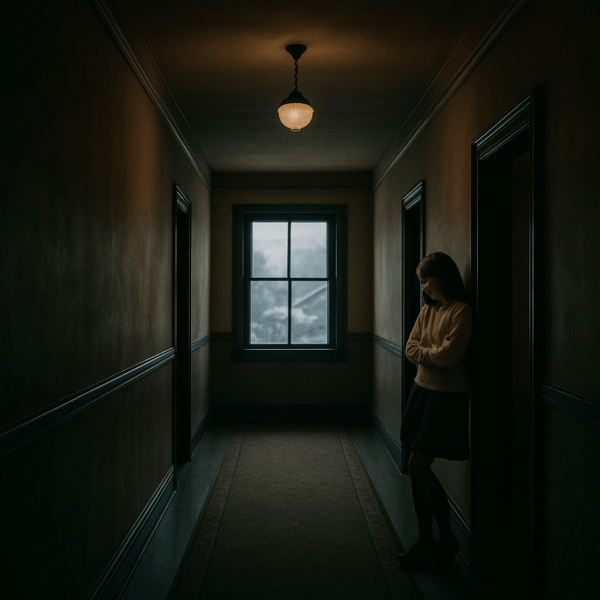
She and I ended up in the hallway.
We were already wrapped into each other — that soft, accidental teenage cuddle that feels both unplanned and absolutely right. The near-near kiss wasn’t something either of us aimed for. It was just the way our faces happened to be turned, the warmth, the pause, the sense that one more inch would have turned the moment into something else entirely. Instead it stayed suspended, held in the exact shape it needed to take.
Her name was Blythe.
I used to say I wrote poems “for girls who told me they were pearls,” but that was just self-mythology. In truth, I only ever wrote for one girl. And she never asked for anything.
Most of the real fun we had wasn’t during dances at all. It was in the gym at Saint George’s in Spokane. For high school games, boys and girls, the gym would be packed, and during the boys games she would sit in the front-row, and every single time I did anything even vaguely ok — a decent pass, a shot that actually went in, a little rebound — I’d look over mid-play and smile, and she’d already be smiling. She was in my corner before I understood what that meant. She didn’t push. She didn’t need to. She just stayed.
There was a suspended electricity in those years — innocent, unclaimed, lightly glowing. We never really dated. We never made a move beyond the moment that almost happened and didn’t. But she calibrated me. She was my corner girl. And that mattered.
The ending came the way some endings do when you’re young — clean as scissors. She graduated. Life tilted. The season shifted. Nothing dramatic, nothing painful. Just a quiet snap. A door that didn’t slam but simply shut.
I miss what we could have been, but I don’t regret a thing. Some connections aren’t meant to become stories. They’re meant to become orientation.
I don’t go back to that time for longing. I go back because that was the first time safety arrived before desire — and because that pattern stayed with me. It’s how I know when something is real.
I don’t need anyone to remind me how it ends. A hallway, a graduation, a clean break. What I keep going back for isn’t the ending anyway. It’s the part before — the girl in my corner, the room that opened in front of me, the feeling I carried forward.
Dedication
For Blythe, who stood in my corner before I even understood what that meant.
Note: If you enjoyed this piece, you might also enjoy the ones below which take up somewhat similar themes.
Well it’s always been my nature/ to take chances/ my left hand drawn back/ while my left hand advances.
Bob Dylan, Angelina
Epigraph II:
I’m glad I did it all then you know that I didn’t listen/ glad I went and got it all outta my system.
My Morning Jacket, Outta My System
Epigraph III:
It’s never been a fair fight.
Craig Finn. It’s Never Been a Fair Fight
Note: What follows is a direct and somewhat graphic account of my experience of being badly abused as a child. The abuse happened at the hands of my aunt’s (father’s side) first husband when I was six and seven years old in the very early 1980s. As I will recount, the abuse had deep and lasting impacts on me and it took me years, decades, to process and understand what it did to me.
I make absolutely no claim to be an expert on childhood abuse or to speak to anyone else’s experience of this all too common problem. My experience is my own, and that’s all I can really speak to. In addition, although he conducted what I consider to be vicious abuse of my brother, I understand that anyone impacted by abuse may categorize events in different ways. Therefore, I will allude only glancingly to these aspects, and only through the lens of how this impacted me personally. I will, inevitably, make reference to the role of my parents and my aunt in the events, and as I mention below when I began to fully process the abuse I directed a certain degree of anger at these adults. As time has passed, however, I have come to understand that although they were not able, for whatever reason, to stop the abuse, and although it was conducted, at least in my case, in their direct view, the primary responsibility lies with the abuser himself.
In early 2024 I did seek out legal advice from a firm that specializes in childhood sexual abuse, and they gave me a professional and compassionate hearing, however in the end declined to take up my case and directed me instead to the Washington State public system. I will detail those events below. I am not currently pursuing legal avenues, and instead am hoping that by making this public I can finally fully exorcise the lasting damage that was done to me. I take full responsibility for the content of this piece.
I was born in South Bend, Indiana in June of 1974. My father was pursuing a master’s degree at the University of Notre Dame at the time, however when I was around six months old my parents moved back to Santa Clara, California, where my mother’s parents were living. My father did not finish his master’s at Notre Dame because of some issue with the faculty there, however I believe that he did later finish at Santa Cruz University in California. In an interesting side note I also pursued a master’s degree, in History at the University of Northern Arizona in the late 1990s, and did not finish because of a conflict, or disagreement, with my thesis advisor. Life has a funny way of repeating itself.
We lived in Santa Clara until I was, I believe, two years old, and then my parents moved us to Gig Harbor, Washington. My understanding is that my father wanted to move to Washington State to be closer to his sister, Nancy (Nan) Thomas. Nancy is my father’s younger sister and it was she, I believe, that introduced my father to my mother, who was Nancy’s friend when they all attended Santa Clara University.
It just so happened that Nancy was then married to a man who would become my abuser. My first memory of this guy, just some fucking guy as far as I’m concerned, is also my first real memory in life (Note: This has since been revised to happier memories when I was two in California. I will detail these at a later date). It goes like this:
When I was very small, two going on three, (I know I was three in Gig Harbor because my brother Mike was born there in June of 1977), we lived in a small house right next to the Pacific Ocean. What I recall about this time was, we had a dog. My father was working at a nearby lumberyard which I occasionally visited, and, I think, was sort of seeking what would be the next stage of his life. My parents had no money, but I didn’t understand this at the time.
My first vivid memory is of playing a game called “Shovelman” on the beach of the Pacific Ocean right by our house. I don’t remember the rules of Shovelman, but it involved a frisbee. However I do recall, with absolute precision, that one time the frisbee was thrown out into the ocean, which, in western Washington, was very cold. This guy ordered me to swim for the frisbee, and when, predictably, I struggled mightily to reach the frisbee in the freezing water and came out gasping for breath, he laughed and laughed, like a total sadist. Of course I didn’t know what a sadist was at the time, but I recognized his essential nature even then. I knew for sure at that moment that he was a bad guy. Now I don’t fully know if my father and mother liked this guy or considered him a friend. All I know is, he was around some. I later learned that my uncle Kim did not like him. Hated him in fact. Kim has had an interesting and varied life, and is my godfather. I love Kim, and salute him here for his instincts.
While my first memory is a negative one, presaging as we will see later events, I also have positive memories from this time. I recall right around this time the days after my brother was born that some of my mother’s family visited us including her mother Barbara and her youngest sister Leslie. My mother has nine siblings, all, fortunately, still alive and all wonderful people. Leslie was quite young at the time and is only a few years older than myself I believe. Anyway, I looked up to Leslie and thought she was cool, so when we all went to a restaurant I sneaked under the table and pulled on her leg, like little children do. I wanted her attention, but I’m not sure if I got it. As I mentioned above, I also recall visiting my father at the lumberyard and thinking he also was cool and had a cool job. I don’t know if he would remember that line of work the same way or not.
In any case, my family did not stay in Gig Harbor very long, and pretty soon we were back in California, this time in Palo Alto, which is a town adjacent to Santa Clara. These days, Palo Alto, Santa Clara, and the nearby San Jose are well known for being sort of the heart of Silicon Valley, but back then they were not really on the map in that way. My mother was working as a swim coach at Stanford University and my father was working at a school in town. This was a wonderful period of my life as I spent time at Stanford hanging around the pool while my mother was coaching which was a total blast. I may recount this time in more detail at a later date. Suffice it to say I was an outgoing, curious, and happy child, eager to see what the world had in store for me. As I will detail below, I believe I was at this time essentially an extravert, and the primary, from my perspective, impact of the later abuse would be to turn me into a somewhat serious introvert. Over and above all other impacts of the abuse, this is the one I resent the most. It is my belief that my natural extraversion, my interest in and ability to trust and like people, was deeply damaged by the actions of my abuser. I will never fully get over this aspect of the situation, and have had to work very, very hard to overcome what I see as a kind of inversion of my essential nature.
In the year 1980 my family moved once again, this time to Spokane, Washington. And again, this was, as I understand it, for my father to be closer to his sister who was by that time working as a young lawyer in the same city. My abuser was also, I believe, a lawyer. It is certainly true that, although younger, Nancy was on the upswing of her career much more quickly than my father. Other than that I don’t know the exact reasons for this following of his sister, however my father found a teaching job at St. George’s school in Spokane WA. I would attend St. George’s from grade 1 through 12, and have written rather extensively about my time there. Interested readers can find these pieces on this blog.
St. George’s was great, and overall, although my parents were still broke, I had a good childhood. However, there was one dark aspect, which was we would regularly visit Nancy and this guy at their home on the South Hill in Spokane. On occasion, but much less regularly, this couple would visit us at our house on the outskirts of the city. I believe that all of the incidents recounted below occurred in 1980 and 1981. I know this for a couple of reasons, first of all because the volcano Mount Saint Helens erupted in 1980 and at Nancy’s house in the backyard there was a big craggly rock which had pockets of ash residue from the eruption and this event was a big topic at the time. Secondly, I know that I was enrolled in first grade at St. George’s so I must have been six. My brother Mike then would have been three going on four. I wrote about my wonderful brother Mike before here.
The action at the Thomas household there was not all bad–there was the ash and a nearby park called Cannon Hill Park which was pretty cool. The house on the South Hill was pretty large, certainly larger than our own, and I got to know my cousins, both of whom were even younger than myself. I would say we visited dozens of times over the course of a year or two, and I remember the house and its environs well. In any case, ash and parks aside, the main event at the Thomas house turned out to be regular and vicious abuse from this guy which was conducted in full view of everyone in the living room of the house. After a little dinner or whatever, he would “tickle” myself, my brother, for extended periods of time, 20-30 minutes at a time or so or more. This “tickling” was not in any form playing; it was, instead, a totally vicious fully body attack.
It was absolutely excruciating and horrible, and he would touch every single part of my body and dig his fingers in as deep as possible and screw them around. At first I didn’t know what to make of this or what to do, but overtime I came to hate this so much that I began to fight back. My bother Mike, at three, was obviously in no position to do so, and so he, in my recollection, absolutely got the worst of this. The amazing thing, amazing to me to this day, is that the three other adults, my mother and father and this guy’s wife, would just stand there and watch. There is something deeply sad about adults that cannot, for whatever reason, stand up to a bully.
Later, much later, I would confront my mother about all this, and she has since said that her inability to intervene is one of her deepest regrets.
What I think happened was, when I began to fight back he gave up on abusing me. Also, I suspect, from my understanding of abuser psychology, that I had, essentially, “aged out” of whatever his mindframe was. My sense is that he preferred his victims to be as helpless and defenseless as possible, and I was no longer fitting the bill.
Now I should note that I don’t know what his problem was or what he thought he was getting out of this abuse. And, I don’t wish to research it really, because I would prefer to spend as little time as possible engaging with people of this sort. What I know for certain is that in the early 1980s he was a brutal man. That’s a flat fact.
I will detail what I understand to be the effects on myself and some of the later repercussions of his abuse a little later, but first of all I will recount my attempts to engage with the legal system over this issue, as well as indicate, in a compressed form, how I came to process and understand the abuse. Now I wish to tread carefully here because I do not want to get sucked into a discussion of, or really even take a position on, what is known as repressed memory. I understand that this topic is highly controversial, with strong opinions on all sides. Although I have read a lot, I am not an expert on psychology, much less a topic as fraught as this. What I will say is that I never repressed the memory of the abuse; if you had asked me at any given time in my life if I was brutally attacked by this guy, in full view of other adults, I would have said absolutely yes, that happened. However, what took time was to fully work out how deeply and negatively it impacted me, and in what ways. I think I always intuited it, however it took a some very difficult life experiences to get to the bottom of it.
The first of these was in 2010, when I was already 36 years old. It was at that time that I began spiraling into my memories and trying to uncover some kind of nugget that would unlock a range of issues that I was encountering at the time. In this year, and on a few other occasions after, I would, somewhat obsessively, go over events from my sixth and seventh year, always centering around my aunt Nancy, her house, and what I perceived to be my essential ambidexterity. More on this point later. At some point I intuited, in some way, that Nancy may have had a miscarriage before the birth of her first child. My mother, when I asked her, confirmed that this had taken place, and asked how I knew it. I didn’t, but somehow worked it out, just because I was spending so much time thinking this constellation of issues. It was also during this times that I was also trying to get to the bottom of my sexuality, my introversion, and my inability to learn to play the piano because of seriously weak left hand. I will detail these, and other aspects of the situation, later.
In any case, it was in 2022 that I fully worked out the effects that the abuse had had on me over time, and began, for the first time, to identify as a sexual abuse survivor. This was not something that I wanted to have to incorporate into my personal narrative, however it became inevitable. I looked into the law in Washington State, and as I recall, as I understood it at the time, the statute of limitations was three years which began at the moment that the victim became fully aware of their injury. From my point of view, I became fully aware of my injury in 2022, and therefore, after thinking about it, I contacted a law firm in Washington State in early 2024. This firm specialized in sexual abuse cases, however they were pretty high-powered and I got the impression from their website that they specialized in suing institution, schools, churches, and the like. On this basis I felt that it was somewhat unlikely they would take up my case–there was probably just not enough percentage in it. Nonetheless, their website indicated that they meant business, so I contacted them and a little while later had a call with an associate from the firm. He told me that all the lawyers were all in court, but gave me a full and proper hearing and said that he believed my story. He also asked me an interesting question, which was, did the abuse happen more or less than 20 times? I said my recollection was that yes, it was over 20 times, and he took a note of this. My impression was that for a case like mine, 20 times was some kind of legal threshold.
A few weeks later the associate got back to me via email. As mentioned above, he said that the firm would decline to take my case, and recommended I pursue the public legal system. He also said that he hoped that I got justice. I thanked him in response, and was not overly disappointed because it was clear that their focus was on institutions and I had done my best.
Now I should mention that before I contacted the law firm, I did Google this fucking guy to see what came up. It is true that I didn’t want to, and still don’t really want to, research this guy, however I wanted to see at a minimum what internet footprint he had. It turned out that he had a website where he described himself as some kind of elite international mediator and the site had a picture of him climbing a mountain.
So I guess he leveraged his legal background into some kind of mediation role, which is guess is all related. And I have no idea, he may have had success as a mediator. In actual fact, it is not even my intention to comment at any length on who or what he is today (I do believe he is still alive). Is it possible that he cleaned himself up in some respect? Maybe. But actually I doubt it. It is my opinion that someone as twisted as he was in his early adulthood doesn’t really get over that. I can forgive a lot of things–for example taking a life when drunk driving or something of that nature. Mistakes are made, and mistakes of that sort are basically unintentional. However, this guy, with his Shovelman action and his subsequent brutality, in my estimation, doesn’t really ever get better. Am I being unfair? Perhaps. It’s really hard to say.
In any case, although the firm turned me down, reaching out to them was one of the best decisions I have ever made. By attempting to work through the legal system I had engaged, fairly and properly, with the available channels, and I felt immeasurably better about the whole thing. I did not at that time decide to pursue the public option, because I am not located in Washington State, and I didn’t feel that taking this route any further would be feasible. Instead, I thought about using the only real platform I have, my blog, to discuss my thoughts on the matter. Aside from the legal system, this seemed to me to be the next best thing. And so here we are.
In what follows I wish to enumerate what I understand to be the long-term effects of my abuse. I will, in the interest of my own privacy and that of others, somewhat undersell these, and it is not my intention to burden the reader with my own issues over time. In addition, I would like to make clear that my encounter with the legal system as well as my somewhat long-gestating decision to go public with my story and my conversations with a few trusted friends, has ameliorated, to a significant degree, the effects of my personal abuse. In any case, here is what I feel:
From my earliest memories I wanted to play the piano. When I was in first or second grade I asked my mother to enroll me in piano lessons, and she declined, saying that she had no money. A few years later my brother Mike was allowed to take cello lessons, and he became very good very fast. I would wait in the car while my brother and my mother attended cello lessons there on the South Hill in Spokane. Naturally, I never held this against my brother, who was an awesome musician and I was proud of him, however I did resent, for a very long time, being denied the opportunity to pursue music. It is my understanding that although people can learn music at different times in life, the earlier the better. I have subsequently tried to learn the keyboard by myself, and somehow was able to play “Ocean Rain” by Echo and the Bunnymen and “Someone I Care About” by the Modern Lovers. I didn’t dominate Ocean Rain, but it was least passable. But I still can’t really read or play music. I wish, beyond almost anything, that I would have had the chance to learn music at an early age.
However, my strong feeling, underlined by years of reflection and memory spiraling, is that the abuse from this guy essentially crippled my left hand. I don’t know exactly how I know this, but I have always known it. So I probably wouldn’t have been that great at piano anyway, because the left hand is pretty important. And, the destruction of my left hand is intimately and directly connected to my crippled ambidexterity, the inversion of my extraversion, as well as my somewhat ambiguous sexuality. I will take up these issues in turn.
First, as mentioned above, there was as a result of the abuse, a long-term impact on my left hand. When I was very young, maybe four, I learned to swim in the pool at Stanford, and my strong memory is that I was developing a certain ambidexterity. Ambidexterity is related in some respects to dyslexia, which I also have a very mild case of, however it also has some salubrious aspects, for example in sports and music. I understand this intuitively and experientially, that I could have been a good piano player if I had been able to take lessons and if I had not been, essentially, crippled from the repeated abuse. Thus, the epigraph from Dylan at the top. It’s been forty-five years since I was first abused by this guy, and only now is my left hand, so to speak, advancing.
Second, as mentioned above, I was an extravert until I was six years old when I suddenly turned into a pretty serious introvert. Now, I absolutely don’t wish to imply at all that one orientation is better than another–both have great strengths. However, the issue here is that I was one thing, and then became another. And this corresponded to, and was directly triggered by, the abuse that I suffered. Somehow, the repeated and protracted abuse turned me inward. I no longer trusted people, essentially, and although I still liked, and still do, many people, something went off track. This is the reality.
Third, I know for an absolute fact that my sexuality was deeply damaged by this guy. I can’t speak to any other form of abuse, however my case of male on male abuse, which I experienced (and yes I absolutely categorize my experience as sexual abuse because he violated every part of my body including my genitals) led to a situation where it became for me, once I hit puberty, somewhat difficult to work out what my sexuality was and in what direction it ran. I was, without doubt, attracted to girls, however in the back of my mind there was some kind of lingering, and for me uncomfortable, ambiguity, as well as a distinct inability to approach women. Now, I fully understand that the inability to approach women is a pretty normal aspect of heterosexual teenagers, who are awkward at the best of times, but I always sort of knew that there was something else going on. And what was going on was, my genitalia was first touched, without my consent obviously, for lack of a better term, by an adult male when I was six years old. And that damaged me.
In essence, and again I know instinctively this to be the case, the abuse was so brutal and so protracted that it in essence re-wired my brain. As with repressed memory, I don’t wish to take a strong position on the issue of the left-brain and the right-brain, although I have read and deeply integrated the book The Master and His Emissary, by Iain McGilchrist, which goes into this matter in far greater detail, and with far greater insight, than I will ever achieve. What I know is the connections within my brain were compromised, indeed fractured, by the abuse. Although it took years for me to fully work this out, I have absolutely no doubt that this is the case. It was, in my belief, something about the pure digging of his fingers that did the damage. Some light tickling would not, I think, have had this effect, however the intensity and depth of his action were, I know, of a completely different level.
Basically, I have been dealing with long-term PTSD from his attacks, dealing with it for 45 years in one way or another, and 15 years more intensely. And you might say “hey there Matty baby, how do you know that your supposed ambidexterity, for example, was so compromised by this guy’s actions?” In answer to that I wish to make an analogy to the trans issue. Now I understand that the trans issue is highly political, and, I guess, pretty complex. However my basic stance is as follows: I do not believe that people who experience feelings of transsexuality or gender dysphoria, basically, are “making it up.” A few may be for various reasons, however I believe that, generally speaking, the set of feelings they experience are real, and also because I have never had them, I cannot speak to them with any authority. Such it is with sexual abuse. The feelings and understandings of sexual abuse victims are, I believe, valid and need to be understood in the context of they know best what the effects of the abuse were. While I cannot perhaps fully explain how I know what I know, I know.
I have a few final thoughts. The first is, as mentioned above and now underlined, my bother also received similar treatment from this guy. I mention this only because I have, ever since, suffered from a great degree of guilt for my inability to protect my brother at that time. Indeed, it was primarily this aspect of the situation, more so than the damage to myself alone, that caused me to direct my anger at my abuse to my mother, and by extension my father and Nancy. I still carry this guilt, and don’t suppose I will ever really get over it. Once again, there is a good deal more to the story, but that’s all I really wish to say at this point.
The second refers to what I described above as the re-wiring of my entire mind and body. Perhaps there is a more clinical term for this, and I think that psychologically alert readers will be able add understanding around this, however this is the best description I can offer. As the second quote at the top of this piece alludes to, the life we have led has been what it has been. I strongly wish I had never suffered the abuse that I did, and have had as a consequence, some of the most painful imaginable situations, however the mere fact that I cannot turn back the clock means that the life I have lived will have to stand, in all of its glory and messiness. This is true, I think, for everyone.
Finally, and I am in no way being facetious, I want to express my deep indebtedness to the great Craig Finn. Craig Finn is the lead singer and songwriter from the bands Lifter Puller and The Hold Steady, and has also had a substantial solo career. One of my very favorite songs of all time is “It’s Never Been a Fair Fight,” by Finn, which I have written about at some length here, and from which the third epigraph for this piece comes from. I am not exaggerating when I say that Finn saved my life, probably more than once, and has, over time, helped me overcome the damage done by my abuse. Thank you Mr. Finn sir. I love you.
I will choose to close this narrative here. As alluded to above, there is a lot more to the story, however in the interest of the privacy of a range of people, not the least of which myself, I will desist. What I would like to say at the end of the day is, abusing a child is never a fair fight. And so I am deploying the only real tool that I have at my disposal, my pen. Thank you for reading.
Dedication:
For all my friends and family who have taken such good care of me over the years.I wouldn’t be here without you.And for Spencer Krug, the greatest piano player I am aware of.
Note: It you enjoyed this piece, you may also enjoy the other pieces below which take up somewhat similar themes.
This is my third piece dealing with the songwriter Craig Finn. I wrote at length about his song “It’s Never Been a Fair Fight,” and a little more in my piece on Katie Park and The Bad Moves. Although my primary allegiance will always be to Dylan, if I am totally honest Finn is my favorite songwriter. Dylan is a transcendent force, world-historical, and therefore also sort of unapproachable. Finn is down-to-earth—I can imagine having a drink or three with Finn, whereas Dylan would probably have his hoodie up.
So, for the record: my favorite band is Luna, my favorite songwriter is Craig Finn, and the greatest is Dylan. My three favorite Finn songs are “It’s Never Been a Fair Fight,”“A Bathtub in the Kitchen,” and “Killer Parties.” This post takes a close look at “A Bathtub in the Kitchen,” with the aim of explicating both the song and Finn’s delivery.
II. Premise and Setup
“A Bathtub in the Kitchen” is track three on Craig Finn’s 2019 album I Need a New War, released by Partisan Records. For my money, it is not only the standout track on the record, but one of the three greatest songs of my all-time favorite songwriter. The song is ostensibly about an old friend of the narrator (I will refer to him as C.) called Francis, but it’s also about trying to make it in the big city, and about moving on from the past. Making it—or not making it—in the big city is a classic Finn theme.
III. Verse One — The Accident and the Past
The song opens with a report of an accident. The nature of the event is unspecified, but my best guess is an overdose.
The lightning clarity typical of Finn is all over these four lines. We learn that C. and Francis have a relationship shaded by deception, that they still move in overlapping circles, and that both originally came from somewhere else. The final line delivers one of those Finn-isms that cut both ways: city transplants trying to recreate a tiny town, while C. himself is still entangled in the very past he’s trying to escape.
IV. Verse Two — Money, Health, and Elegance
By the second part of the verse it seems Francis has recovered somewhat, and C. has met with him again.
Finn’s concision is astonishing. In eight lines we understand the dynamic completely: C. has money he could give, but knows it’s probably enabling; Francis is perhaps an addict, though neither man states it. We also glimpse Francis in better days—The Parkside, elegant companions, a life C. once aspired toward. And already C. is trying, gently, to pass responsibility to someone else.
This touches something universal: the friend who needs more than we can sustainably give. Or the times we’ve been that friend ourselves.
V. The Chorus — Youth, Longing, and New York
The chorus arrives, one of Finn’s most moving and beautiful. His voice rises on I was drinking, I was dancing, packed with emotion.
This is a flashback to young C. in New York—broke, naive, crashing on Francis’s couch. Finn underlines C.’s passivity three times: waiting,hoping,desperate for New York to ask me out. That phrasing is brilliant. It captures the essential vulnerability of arriving in New York with dreams, no plan, and a subway map.
The memory sends me to my own first visit to New York. Stepping out of the station at 42nd Street into the noise, I felt the shock of sensation—an energy I still feel every time I return. I’ve been to many great cities—Tokyo, London, Singapore, Amsterdam, Melbourne, Hong Kong, Kuala Lumpur—but there is nowhere like New York.
And in a city like that, it can be nearly impossible to get your footing. Everyone is already in motion. Finn evokes that perfectly.
VI. Verse Three — Present-Day Francis
Back to the present:
Francis has been in New York for twenty-three years, and C. nearly as long, since he knows the number by heart. The “bathtub in the kitchen” signals the classic New York starter apartment—a detail so iconic it becomes the song’s title. Francis still goes to the roof for better reception. Phones get disconnected. Life is fraying. C. registers all of this without overt judgment, but with distance. A sense of “there but for the grace of God go I.”
VII. Chorus Reprise — Guilt and Gratitude
The chorus returns with slight changes—“doing things I shouldn’t”—and doubled gratitude: Francis let me crash out on his couch. Repetition becomes confession.
My father read my “Fair Fight” draft and, not knowing anything about Craig Finn, immediately said he sensed a strong midwestern Catholic vibe. He was spot-on. Finn grew up Catholic in Minnesota; guilt, forgiveness, and redemption run through almost everything he writes.
There is also a phenomenal YouTube video of Finn performing this at the Murmrr Theatre, and during the post-chorus especially the performance takes on a spiritual intensity you can’t miss.
VIII. Post-Chorus — The Confession
The lines:
I can’t keep saying thank you, Francis…
These cut two ways. C. is saying:
The couch surfing was long ago, and he has done what he can.
And simultaneously: I’m not the person who can save you.
The confession is directed at Francis—but maybe just as much at himself.
IX. Verse Four — The Old Ropes and the New Distance
The final verse returns briefly to the past: Francis teaching C. how to navigate New York nightlife—befriend bartenders, tip big on the first round. These are the rules of the game. C. remembers them vividly.
Then we snap to the present: Francis’s job rumors, his terrible landlord, the $200 that will “help him breathe a bit easy.” And the repeated question: Francis, do you even have a plan? C. has given him money, but not much, and not with much faith. The trust between them has frayed into obligation.
X. Outro — The Spiritual Release
The outro repeats the confession. Again, it’s worth watching the Murmrr Theatre live version to feel how Finn leans into this. It becomes a kind of secular prayer, a release and a resignation all at once.
XI. Closing Thoughts
“A Bathtub in the Kitchen” is about youth and aging, about friendship and how it lasts and decays, about guilt and human selfishness in the face of real need. More than anything, it captures what it feels like to try to survive in New York.
I think this song, like “It’s Never Been a Fair Fight,” is more personal for Finn than some of his strictly narrative pieces. The narrator here has “made it.” Finn himself is an immigrant to New York, from Minnesota, and has sampled deeply from the nightlife he writes about. Few songwriters have chronicled nightlife with more range, consistency, or compassion.
Even if C. can’t keep saying thank you, I can. This song moves me in ways I’ve tried to describe here but still can’t fully encompass.
New Note (2025): Since this piece was first published, Japanese Breakfast the band has gotten even bigger, Michelle Zauner wrote another book, and the cultural universe has shifted enough times that some aspects of this essay may be outdated. I’ve kept the original text intact because the dream-logic and breakfast-logic still stand.
I live in Kyoto, Japan, and after many years here I’ve traveled pretty widely—especially in the greater Tokyo area. Traveling in Japan is pretty easy as long as you can manage a little spoken Japanese and read a train map. The trains are famously efficient and connect most of the country, including every major city.
I haven’t driven a car here in more than fifteen years and don’t miss it at all. Trains and taxis get the job done just fine. Overall, I love traveling in Japan and I love exploring Tokyo, a city that contains worlds within worlds. I have almost no complaints about Japanese travel.
Except for one.
It is nearly impossible to get a good breakfast—or really any breakfast—when you’re on the road.
Now, it’s not that Japanese people don’t eat breakfast. They do. The archetypal morning meal—rice, miso soup, maybe a little fish—is as recognizable in its way as the “full English” of sausages and beans. But the Japanese breakfast is overwhelmingly a home operation. Once you’re traveling, the options narrow to two—two and a half, if we’re being generous.
I. The Hotel Breakfast
Mid-price and nicer hotels usually offer a breakfast buffet with “Japanese” (rice, miso, maybe grilled fish) and “Western” (toast, jam, and some ambivalent eggs) selections. Except at the truly top-tier hotels, these buffets manage to be both overpriced and bad. A traveler is lucky to escape for ¥1,500–¥1,800 (about fifteen dollars before the yen weakened), and more commonly pays north of ¥2,000 for a pretty uninspired spread.
Budget hotels often don’t offer breakfast at all.
In my experience, Japanese hotel breakfasts are among the weakest anywhere in the world. I take this as symptomatic of a broader truth: Japanese people simply don’t care about breakfast when they’re on the road—and maybe not all that much at home either.
II. The Convenience Store (“Combini”) Breakfast
When I have raised the issue of the lack of decent breakfast in Japan, Japanese people usually point me to the convenience store. And it’s true: you can purchase food and coffee at any of the ubiquitous combinis—Family Mart, 7/11, Daily, Lawson, and the rest. They’re open 24 hours, and they stock a range of items that theoretically qualify as breakfast. Hard-boiled eggs, yogurt, rice balls, steamed buns, fried chicken, sometimes bananas, and of course hot and cold coffee.
I’ve certainly been in situations where I had no choice but to fall back on the combini for breakfast while traveling. And this is…fine, to an extent. But most combinis have nowhere to actually sit and eat, and in any case you can’t really call a combini breakfast nice.
Most Japanese folks seem to regard a combini breakfast as perfectly acceptable—desirable even. And while one can admire the low expectations, or the cultural pragmatism behind them, it’s possible to admire those qualities and still wish for more.
III. Starbucks or a Local Coffee Shop
Starbucks are fairly common in major cities and usually open at 7 a.m. (if you’re lucky) or, more commonly, 8 a.m. They should really open at 6. The food offerings are overpriced, and Starbucks has never truly figured out its food—which remains baffling. Still, one can grab a few combini items and smuggle them in, or settle for a four-dollar fragment of quiche with your Americano. I would not classify Starbucks as having breakfast, per se, but they are pleasant enough to sit in, and one can create a simulacrum of breakfast there.
Then there are the local coffee shops. These, fortunately, often open at 7 a.m. or even earlier, and serve strong coffee—often brewed by hand at the counter with a drip filter—and a breakfast that nearly always consists of a single piece of white toast and an egg. White toast, egg, and handmade coffee with old guys reading the paper around you is, I admit, at least an approximation of breakfast, and I have certainly relied on this setup while on the road.
But it’s still not quite what we are looking for if we want a hearty, balanced breakfast. There is no French toast, no fruit bowl, no omelette, and only very occasionally a strip of bacon. None of the staples one might reasonably expect from a decent, full breakfast.
And that’s more or less the list. You can also find 24-hour beef-bowl restaurants, but they are cheap as and not exactly the sort of thing you look forward to when greeting the day. Beyond that, most restaurants simply don’t open until 11:00 or 11:30 for lunch. The concept of brunch—dicey even under ideal circumstances—barely exists outside the swankiest of upmarket hotels.
It is, put bluntly, really hard to find a proper breakfast in Japan unless you make it yourself. And that fact continues to puzzle me. I understand that most people here eat rice and miso at home, or grab something at the convenience store. Fine. But metropolitan Tokyo has roughly 30 million people. None of these 30 million want a real breakfast at 7:00 or 7:30 a.m.? Not even a few hundred thousand?
It seems incomprehensible. And yet, incomprehensible or not, this is simply the reality. There is no broad Japanese market for breakfast. I mean, I’m in the market—but apparently one man does not a demographic make.
Go figure.
Now, I’ve covered the issue of Japanese breakfast—its scarcity, its odd cultural positioning—to the best of my ability. But before we move on, I want to add a few details that may seem unrelated. Let’s see if we can get them to connect.
Because the truth is, I dream about getting breakfast in Japan. And in a surprising number of these dreams, the Trumpster shows up.
More precisely: the dreams focus on the fact that the Trumpster and I share a birthday (June 14th), which makes us both late Geminis. Late Geminis, I have good reason to believe, are uniquely dangerous and slippery. But in my dreams the Trumpster isn’t dangerous at all. He shows up as basically an empty suit.
Trump/ Breakfast Dream I:
I am at a breakfast buffet in Japan. This is at a hotel that I am not staying at, and I may indeed be attempting to crash the buffet while masquerading as a hotel guest. Trump is there with an entourage, and he sees me staking out the buffet. I make a comment to him that we are both late Gemini, and he nods, curtly but with some minimal consideration. He sees me trying to steal the breakfast, does not care, and would probably provide cover if it came to that. He and I are not aligned, but nor are we enemies.
Trump/ Breakfast Dream II:
I am outside in the morning, standing on a dock or something of that nature. I am looking for breakfast, and not finding it. There is a commotion above me to the east, and I realize that Trump is being rolled out, literally on like coaster wheels, for a speech. He is on some kind of sliding seat and when this seat hits the balcony he stands up and postures about like Mussolini. I am watching and he sees me watching, but continues with his Mussolini act. I realize quickly that this is a total act and that he doesn’t even want to be there. He is not dangerous in this moment or in this speech, just faintly ridiculous. Still, no breakfast.
=====
What do Trump and breakfast have to do with one another? I’m not sure yet. But I do know that Trump, although maligned by nearly everyone I know (I know a bunch of liberals), and apart from being an egotistical, mafia-adjacent, easily flattered, shape-shifting sociopath, is also pretty funny. Before I lose half of my readership, I’ll just nod to the comedian Shane Gillis, who made this point several months after Trump left office.
Has enough time passed that we can admit Trump was funny? Can we finally admit that he was funny? (…) He was funny (…) I saw it. I’d show my friends I’d say look at that. They’d be like “what?”
“It’s funny.”
“There’s nothing funny about Donald Trump.”
I don’t know, during Hurricane Dorian he was like “maybe we should nuke it” (…) Like that was a real suggestion from the President (…) “Hey we got a big storm coming, you want me to blow it up?”
They were like “no, what the fuck are you talking about?”
“I fuck around, it’s what I do,” is a great summary of Trump’s whole approach to governing. Now, is there anything funny about his terrible immigration policies, his attempted pressure of the Georgia secretary of state to “find” 1800 votes, his total disregard of democratic norms? No, not really. But is there anything funny about his speculation that maybe a little light and a little bleach could cure COVID? Why yes, there is. Is there anything funny about his noting that Frederick Douglas is getting bigger and bigger these days? Yes indeed. Is the way he pronounces “huge” funny? It’s funny to me anyway. And in my dreams, the two above being part of a series of about four or five total Trump breakfast dreams, he always shows up as semi-defanged, basically neutered, and non-dangerous. I think this is because, as a fellow late Gemini, I kind of have Trump’s number. It takes a late Gemini to know one, and I know this guy. In fact, I see right through him, to the extent that I know he’s not even there.
One other salient piece of data, there is an indie rock band called Japanese Breakfast that is getting bigger and bigger these days (they tell me “sir, this Japanese Breakfast is getting bigger and bigger these days, and I say look at that, wow, this Japanese Breakfast is really getting huge”). I don’t know them that well, but they sound like the kind of band I would like. I do wonder though if their name is not an ironic nod to the fact that Japanese breakfast is not a thing. Is the band name self-effacing, or even self-erasing? Does Japanese Breakfast the band exist at all? Does Trump? There is a way in which the Trump presidential term has come to feel like a fever dream or collective delusion, a set of events that cannot really have occurred as we recall them. In this sense, the Trump presidency may in the future be subject to Phantom Time Hypothesis speculation. And he and his handlers have already played right into this speculation what with their first lady doubles, the totally unhinged press conferences with the ubiquitous helicopter waiting in the wings, and the classic Trumpism, “we’ll see what happens.”
Here is what I think. Japanese Breakfast as a band exists. The Trumpster exists, but his wife spent most of her time in the White House being doubled. Trump and I are dream doubles, and I have his number. Japanese people don’t care about breakfast. And I am always starving at around 9 AM when on the road in Japan. Someone should look into the matter. I hear the Trumpster is free these days, maybe he’s the guy for the job.
Note: If you enjoyed this piece, you may also like the pieces below which also deal with American politics, albeit from a slightly different angle.