What Ever Happened to the ACLU?

Note: This essay reflects a personal memory of what the American civil libertarian tradition once represented to many people who came of age politically in the late twentieth century. Organizations evolve, and the American Civil Liberties Unionhas played an important role in many areas of constitutional law and civil rights over the past century.

The purpose of the piece is not to dismiss that legacy but to reflect on a perceived cultural shift in how civil liberties—particularly free speech—are understood within contemporary progressive politics. The older civil libertarian framework emphasized neutral principles that applied equally to all speakers, even those whose views were widely considered offensive or dangerous.

Whether that framework still holds the same cultural authority today is an open question. This essay is simply one observer’s reflection on how that shift has felt from the inside.

Epigraph:

F the CC

Steve Earle

When I was younger, the American Civil Liberties Union had a certain reputation among politically attentive Americans.

They had balls.

The ACLU was the organization that defended people nobody liked. Neo-Nazis marching in small Midwestern towns. Communists during the Cold War. Religious cranks, fringe activists, offensive speakers. The principle was simple and bracing: civil liberties matter most when they protect speech we find offensive.

I admired that. Many people did.

In the 1990s the ACLU seemed to embody a kind of austere civil libertarianism. The idea was that the Constitution protected everyone equally, and that civil liberties meant very little if they only applied to people we already agreed with.

And there were plenty of examples that made the point vividly.

The most famous was the controversy over whether a small group of neo-Nazis had the right to march in the Chicago suburb of Skokie in the late 1970s.

National Socialist Party of America v. Village of Skokie

Skokie was home to many Holocaust survivors, which made the proposed march especially painful and inflammatory. But the ACLU nevertheless defended the Nazis’ right to demonstrate, arguing that the First Amendment could not be applied selectively. Free speech, if it existed at all, had to apply even to people whose ideas were repellent.

That case became a kind of civic legend among civil libertarians.

There were many others.

During the Cold War the ACLU repeatedly defended the rights of individuals accused of Communist sympathies, arguing that political belief alone could not be grounds for government punishment. In later decades the organization defended the speech rights of controversial artists, religious minorities, and political extremists across the ideological spectrum.

Every once in a while a case would appear that tested the principle in uncomfortable ways. I remember reading about things like the aftermath of Ruby Ridge and the legal questions surrounding the government’s conduct toward Randy Weaver. Weaver himself was hardly a sympathetic figure to most Americans, but the civil liberties questions raised by the incident were serious enough that organizations committed to constitutional rights had to pay attention.

That, at least in my memory, was the ACLU’s zone of operation: defending civil liberties even when the individual involved was politically or culturally radioactive.

For a long time that seemed like the organization’s defining characteristic.

Then something began to feel different.

My moment of realization came around 2017 at a conference at Case Western Reserve University. The event was filled with what felt like an entire arena of fucking international liberals—academics, activists, policy types, the whole familiar ecosystem.

At one point a speaker took the stage and launched into a full-throated denunciation of Donald Trump.

Now, criticizing a president is of course perfectly legitimate speech. But as I sat there listening, something about the moment felt off.

The energy in the room was not about civil liberties. It was about political opposition. The speech had the tone of a campaign rally rather than a lecture about constitutional rights.

And I remember thinking very clearly: this is not the ACLU I admired in the 1990s.

Something about the mission had shifted.

To be fair, institutions rarely change because they suddenly become foolish. They change because the culture around them changes first.

The older civil libertarian tradition that shaped organizations like the ACLU grew out of a very specific intellectual climate. It emphasized neutral principles, distrust of government power, and a willingness to defend speech even when that speech was deeply unpopular.

The logic was austere but powerful: the moment we begin deciding which speech deserves protection, the principle itself begins to erode.

But the dominant strain of progressive politics today often approaches these questions differently. Instead of asking whether a principle applies equally to everyone, the question increasingly becomes whether a particular form of speech contributes to harm, inequality, or social injustice.

That shift in moral emphasis naturally changes how civil liberties are understood.

Speech that once would have been defended in the name of neutral principle may now be evaluated in terms of its social consequences. And organizations that operate inside a particular political culture tend to absorb the assumptions of that culture over time.

The ACLU did not necessarily set out to abandon its older civil libertarian posture. It may simply have followed the broader ideological current of the progressive world in which it operates.

Still, for those of us who grew up admiring the older model, the change can feel disorienting.

The ACLU once stood for the uncomfortable proposition that freedom of speech requires defending people whose views we might find offensive, foolish, or even dangerous.

It is not entirely clear whether the culture that once sustained that belief still exists.
On Why Sicario Is the Greatest Film of the 2010s

Note: This essay reflects on the film Sicario and its place within the cinema of the 2010s. It is written in the spirit of cultural criticism rather than formal film scholarship. My aim is not to produce a definitive ranking of the decade’s films, but to articulate why Sicario stands out as a particularly revealing work about power, violence, and the uneasy moral landscape of contemporary geopolitics.

The film’s depiction of the U.S.–Mexico borderlands and the covert war against drug cartels resonated strongly with me because it refuses many of the narrative comforts typical of American action cinema. Instead of heroic triumphs or clear moral resolutions, Sicario presents a world in which institutional power often operates through ambiguous methods and morally troubling compromises.

In that sense the film belongs to a small tradition of American cinema willing to look directly at the realities of U.S. involvement in Latin America. An earlier example is Salvador, which similarly attempted to depict American policy in the region without the usual patriotic framing.

Readers who disagree with the claim that Sicario is the greatest film of the 2010s are very much invited to do so. Film arguments are part of the pleasure of cinephile culture. The claim here is intentionally bold because bold claims tend to produce interesting conversations.

At the very least, the border extraction sequence alone earns Sicario a place among the most unforgettable cinematic moments of the past decade.

I first watched Sicario on Netflix.

Which is not the way great films are supposed to enter one’s life. Great films are meant to arrive in dark theaters, on enormous screens, in the company of strangers who feel the tension at the same moment you do. Netflix, by contrast, offers films casually, like items on a digital buffet.

But sometimes a movie survives even that.

Sicario does.

Within half an hour it becomes clear that the film is operating at a different frequency from most thrillers. The dialogue is spare. The pacing is deliberate. The camera lingers on landscapes and silences. Something about the atmosphere suggests that the story is heading somewhere morally uncomfortable.

Then comes the border crossing.


The Extraction

The convoy moves slowly toward the border crossing at Juárez. The mission seems straightforward: extract a prisoner from Mexico and return him to the United States. The vehicles move through traffic in tight formation. Nothing dramatic is happening yet.

And yet everything feels wrong. Cars begin to surround the convoy. Drivers stare from their windshields. Traffic slows to a crawl. The camera—guided by the extraordinary eye of Roger Deakins—cuts between glances, mirrors, steering wheels, hands resting near weapons. The tension builds with almost mathematical precision.

What makes the scene so powerful is not the violence itself but the certainty of its arrival. Everyone in the vehicles understands what is about to happen. The operators watch the surrounding cars with an eerie calm, as if they are simply waiting for a timer to run out.

Disaster is not possible. It is inevitable.

When the gunfire finally erupts it is sudden, efficient, and disturbingly professional. The scene ends almost as quickly as it began.

By the time the convoy crosses back into the United States, the viewer understands that the film is not interested in the usual heroics of the crime thriller. It is interested in something darker.


The Line Between Law and Power

Part of what makes Sicario extraordinary is the way it gradually dissolves the moral categories the audience expects.

Emily Blunt’s character, FBI agent Kate Macer, begins the film believing she is participating in a legitimate law enforcement operation. But as the mission unfolds, she begins to realize that the institutions she represents are operating according to rules that have very little to do with the law.

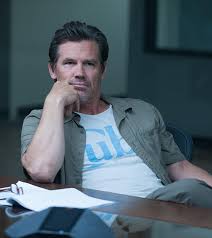
The key figure in this realization is the relaxed, almost cheerful CIA operative called Matt Graver played by Josh Brolin.

Graver is one of the film’s most fascinating characters because he openly blurs the lines between legality and strategy. He treats the war against the cartels not as a legal battle but as a geopolitical game in which certain rules simply no longer apply.

He jokes. He smiles. He reassures Kate that everything is under control. And yet the deeper the operation goes, the clearer it becomes that the “control” he represents has very little to do with justice.


Alejandro

If Matt Graver represents the pragmatic face of American power, Alejandro, played wonderfully by Benicio Del Toro, represents something older and more elemental. Alejandro is not a police officer or a soldier in any conventional sense. He is a weapon deployed inside the machinery of the state.

His presence reveals the film’s central truth: the war on drugs, as depicted here, is not really about drugs. It is about power, revenge, and the maintenance of geopolitical equilibrium through violence.

The final dinner-table scene—quiet, controlled, almost polite—delivers one of the most chilling moments in modern cinema.

Alejandro does not rage. He simply completes the task.


A Film Without Illusions

The reason Sicario stands above most films of the 2010s is that it refuses to decorate its subject with comforting illusions.

American cinema has often struggled to portray U.S. foreign policy in Latin America with any degree of honesty. Films frequently soften the narrative with patriotic framing or moral reassurance. Sicario does the opposite.

In that sense it belongs to a small tradition of films willing to examine American power without the usual gloss. One earlier example is
Salvador.

Like SalvadorSicario presents U.S. involvement in the politics and violence of the region not as a heroic intervention but as a complicated and morally ambiguous system of influence.

The film does not sermonize about this reality. It simply shows it.


The Craft

What elevates the film from strong political thriller to masterpiece is its extraordinary craftsmanship. Director Denis Villeneuve constructs the story with remarkable restraint. Exposition is minimal. Dialogue is sparse. Much of the narrative unfolds through mood and implication rather than explanation.

Roger Deakins’ cinematography turns the borderlands into a stark visual landscape of highways, deserts, and shadowy tunnels.

And the score by Jóhann Jóhannsson provides the film’s subterranean heartbeat—deep, rumbling tones that feel less like music than like distant artillery beneath the earth.

Together these elements create an atmosphere that is almost hypnotic.


The Film of the Decade

Every decade produces films that entertain, and a smaller number that capture the psychological mood of their time. Sicario belongs to the second category.

The 2010s were a decade in which institutions increasingly appeared opaque, power operated through indirect mechanisms, and the line between legality and strategy often seemed disturbingly thin.

Sicario does not attempt to solve these problems. It simply looks at them without flinching.

And that honesty may be precisely why it stands as the greatest film of its decade.