My Time in Kumamoto Japan I: NOVA and Meeting Sachie

Note: This is the first entry in a new series about my time in Kumamoto, Japan between April of 1997 and December of 1998. What began as a recollection of a short, chaotic teaching stint but became an excavation of place, power, and early adult identity under surveillance. Set against the compressed social ecosystem of a small Japanese city in the late 1990s, the piece moves through NOVA’s glass-room culture, its porous rules, and the peculiar cast of lifers, bosses, and drifters who inhabited it. What emerges is not a complaint but a tonal study: of being watched, of improvising freedom within constraint, and of the quiet luck of finding something real—Sachie—amid a system that often felt artificial.

Epigraph:

Kim You Bore Me to Death

Grandaddy

I arrived in Kumamoto in April of 1997 to teach English at NOVA, which at the time felt like a pretty wild thing to be doing. Kumamoto is not Tokyo. It’s a smaller city, slower, and NOVA was right at the north end of the Shotengai, basically downtown. Everyone knew everyone, or at least knew of them, which I didn’t fully understand yet.

What I also didn’t fully understand was that I would be living with one of my bosses.

Her name was Sam. She was about 35, from Wales, and she had this story she loved to tell—more like boast—that Donovan had written a song for her mother. I never quite figured out which one. She was in the apartment with me and another teacher, Heather, and she was there all the time. Not just physically there, but present. Observing. Asking. Not in a relaxed roommate way, but in a way that felt like she was always slightly checking something.

NOVA had a loose rule about no fraternization between students and teachers. Loose being the key word. It happened all the time. Another teacher, Cameron, told me a lot of the young women came to find a boyfriend. Whether that was true or not, relationships were constant. There was this big izakaya on the Shotengai where everyone went, and it was basically understood that whatever the rule was, it wasn’t really enforced.

By early June I was seeing Sachie, who had been my student. She was my girlfriend then and is my wife now. I went to her house pretty early on. Her father, Tetsuyo, a gruff, older, very conservative Japanese dad, said he would meet me, but then he went to take a “bath” and didn’t. So I didn’t meet him for months. Her mother, Kazuko, was lovely then and is lovely now.

We couldn’t really spend time together at my place, obviously, so we’d drive around in her car. That was our space. We’d park wherever passed for lovers’ lane in Kumamoto, which, thankfully, was not the Zodiac. No Zodiac in Kyushu, thankfully. We’d sit there, windows cracked, the car quiet, the whole thing feeling both secret and completely ordinary at the same time. That was just how it worked.

At some point I told Joy, another teacher, that I was seeing Sachie, and I told her not to say anything because it was technically against the rules. She said of course. And then, of course, she immediately went and told John G., and from there it got around.

By that point it didn’t really matter. I had to leave, but I also wanted to leave. NOVA felt like a factory. The hours, the structure, the constant low-level supervision—it wasn’t for me. I gave my one month’s notice and in July of 1997 I moved to Washington. Better hours, easier gig, and a lot more freedom.


There were a couple of long-term guys at NOVA, both Brits, both lifers in a way I couldn’t really imagine.

Cameron was the more interesting of the two. We’d go to the big izakaya on the Shotengai—yakitori, big beers in frosty mugs, the usual—but his real place was Madam’s Bar, also on the Shotengai. Madam was the owner, a transvestite, and Cameron loved her. Absolutely loved her. He went there every night.

He took me a few times. It was small and dark, always smoky, with Queen playing on a loop. I drank White Russians and, for reasons that made sense at the time, felt like a bit of a stud. It had its own rules, though. You could feel that pretty quickly.

By Halloween of 1997 I was already at Washington, but I was still around Kumamoto a fair bit, still seeing people. The week before Halloween I went back to Madam’s with Cameron.

“Matty baby, T-shirt time,” Madam said. “You will buy the bar T-shirt. Halloween theme. ¥4000.”

¥4000 was a lot for me then.

“Madam baby, that’s a bit steep,” I said. “I’ve already got plenty of T-shirts. Maybe next year.”

She and Cameron had a quick whispered conversation off to the side. We finished our drinks and left. Outside, Cameron turned to me.

“Matty baby, there’s not going to be a next year. You’re banned. 86’d. Hit the bricks, pal. You’re out.”

“For not buying a T-shirt?”

“Oh yeah,” he said. “T-shirts are serious business.”

And that was it. Never went back.


Mark was the other lifer. Late thirties, married, one daughter. Solid guy. He loved his wife in a way that was both sincere and slightly odd in its phrasing.

“I can hack this job,” he’d say, “as long as I can go home each night to my little mouse’s ear.”

I never heard that expression before or since.

John E. was our boss, technically over Sam. He was always in and out—Osaka, Fukuoka, training sessions, that kind of thing. When he was around, though, he had a habit.

When we drank, he would smack Mark on the butt. All the time. Didn’t ask. Just did it. Mark would try to laugh it off.

“John E. baby, maybe not tonight,” he’d say.

Didn’t matter. It kept happening.

One night John E. turned to me. “Matty baby, can I smack your ass?”

“John E. baby, no way,” I said. “Thanks, but no thanks.”

At least he asked.


John G. was an anomaly. Everyone else was in their twenties or thirties; he was in his sixties. He said—said, mind you—that he had made and lost six fortunes, mostly in gold in South Africa. Maybe. By the time I met him he was broke as fuck.

He would fall asleep in class. Not subtly either. Full-on snoring, loud enough that you could hear it through the glass walls. And these were small classes, three or four students at most, everyone sitting there while he just drifted off. You could see it happen in real time.

John E. had a number of supervisory conversations with him. Nothing changed.


Then there was Paul, who wasn’t even at Kumamoto—he worked out of Osaka. I met him during training in late April of ’97, and he was a strange guy from the jump.

He told this whole story about growing up in Arkansas, parents who were abusive, into drugs, no money. Said he ran away at sixteen and found God on the road shortly after. Compared himself—without irony—to St. Paul on the road to Damascus. Claimed he made a living hustling poker, which might have been true, but there was something else in there too. Not exactly dishonest, but… flexible.

He wanted to convert me. That was clear immediately.

We walked all night. Ten hours, maybe more, all over Osaka. Through neighborhoods, through stations, at one point through a huge homeless encampment—post-bubble Japan, a lot of salarymen who had fallen hard. It stuck with me. Paul talked and listened in equal measure, which is its own kind of technique, but there was always one direction to it.

The goal was simple: Matty finds Jesus tonight, come hell or high water.

I didn’t.

A couple of months later he came down to visit Kumamoto. We went to the izakaya on the Shotengai, then another bar—not Madam’s. Different energy.

There was a girl there, Yoko, and she was very clearly interested in me. So she’s all over me and Young Mr. Johnson is getting, uh, perky. I’m kind of nuzzling her neck and all, and Sachie and I are barely dating, not exclusive yet. Cameron leans over.

“Uh, Matty baby, YMJ is looking a little perky there.”

“Ruh roh,” I said. “Gotta go.”

There were a few good reasons for that.

One, I wanted to date Sachie only. I wanted to be exclusive. I told her the next day what had happened and she was like, “Good. Let’s go exclusive then.” So that was that.

Two, Yoko was like nineteen and I was twenty-three, and she had tons and tons of pancake makeup, which just wasn’t my thing.

So I jetted. Walked fifteen minutes home.

On the way I passed Fumachi. Of course, “machi” means street in Japanese, so to me it read FU-machi, which I found hilarious. I tried to explain this to Sachie once and she was like, “Yeah, machi just means street.”

“Yeah, I know,” I said. “That’s why it’s funny.”

Didn’t really translate.

By the river, as always, hammered dudes were out there pissing into the water. Just part of the scenery.

I get home, it’s around eleven, I’m getting ready for bed, and a taxi pulls up.

Out step Paul and Yoko.

Ruh roh.

Paul’s staying over, sleeping on a futon in the living room, and I’m thinking, what’s the plan here—hook up with Yoko right there while me, Heather, and Sam are all in the apartment? Outta control. Maybe that’s just how he rolled.

Anyway, Yoko takes one look at me and jets. She’s gone.

Paul shrugs it off.

“Easy come, easy go.”

We end up playing poker instead. For a little money. I’d played all through childhood, in college, figured I was about a B+.

He wiped the floor with me. Took all my lunch money and didn’t lose a hand.

That’s when I started to believe him.


Looking back, those first two months in Kumamoto feel both chaotic and oddly contained, like everything was happening all at once but also exactly as it was supposed to. NOVA was a factory, no doubt—bad bosses, strange rules, glass rooms, and the occasional existential crisis over whether a black turtleneck and a white short-sleeved shirt constituted a violation of “regs.” I smoked Mild Sevens like it was part of the job description, drifted between pool halls and izakayas, and tried to make sense of a place where everyone seemed to know more about what I was doing than I did. And in the middle of all that, somehow, I met Sachie. That part feels less like chance the older I get, more like the one thing that cut cleanly through all the noise.

It didn’t last long—April to July, just a couple of months—but it stuck. The people, the rhythms, the small absurdities, the feeling of being watched and not quite fitting and also not really caring. I left because I had to, and because I wanted to, and both things were true at the same time. Better hours, easier life, more freedom. But Kumamoto was the start of something, even if I didn’t know what at the time. I never did get that T-shirt.

Dedication:

For my wife Sachie. Glad I met ya baby.

Note: If you like this piece, you may like the pieces below, which take up my time just before moving from the US to Japan.

The Adventures of the Thin Man and Andrea Available Now!

Well everyone, today is the day. My first novel, The Adventures of the Thin Man and Andrea is now available on Amazon and wherever books are sold.

This one took a while—written in fits and starts, in bars and hotel lobbies here in Kyoto—but it finally found its shape. More than anything, today I just want to thank all the readers of The Kyoto Kibbitzer, wherever you hail from; I’ve always thought of this as an ongoing conversation, and a lot of this book grew out of that exchange.

If you do pick it up, I hope you enjoy the ride—and if it lands for you, a quick review on Amazon would mean a great deal. Thank you, as always, for reading.

Matt

On the Other City

Note: This piece grew out of a long fascination of mine with what might be called the “night economy” — the network of bartenders, servers, managers, taxi drivers, and late-shift workers who keep a city alive after most people have gone home. If the daytime city is governed by office hours and commuter rhythms, the nighttime city runs on a different clock entirely.

The two figures mentioned here, Haku and Haru, are part of that world in Kyoto. Haku runs the bar at ING and seems to operate on a schedule that would puzzle most daylight citizens, opening in the evening and closing well into the small hours while somehow producing food, music, and atmosphere in a space not much larger than a good-sized living room. Haru manages a shisha lounge in eastern Gion and moves easily between the daytime and nighttime rhythms of that neighborhood, which has its own distinct ecosystem of bars, touts, and late-night wanderers.

The small bar Ishimaru Shoten, tucked down an alley off Pontocho in the Kiyamachi district, serves in the essay as a kind of neutral ground — one of those places where the various inhabitants of the nocturnal city briefly cross paths once their shifts end.

The central idea is simple enough: most cities contain two cities. The first is the one that tourists and office workers see during the day. The second comes into view only after midnight, when the people who keep the lights on, the drinks pouring, and the plates spinning begin their own quieter rounds.

Epigraph:

Last night, I told a stranger all about you
They smiled patiently with disbelief
I always knew you would succeed no matter what you tried
And I know you did it all
In spite of me

Morphine, In Spite of Me


Most people believe a city goes to sleep around midnight. This is not true. Around that time a city simply changes populations.

The day city winds down: office workers, shopkeepers, commuters heading home, lights switching off floor by floor. But another population wakes up. The bartenders. The shisha managers. The taxi drivers. The people who work the strange hours when the streets are quieter but the human drama is often louder.

This is the other city.

If you spend enough nights wandering around it, you begin to recognize its citizens. They are the people who actually know how the place works after midnight.

One of them is Haku.

Haku runs the bar at ING. He opens around seven in the evening and closes somewhere between three and four in the morning. Prep starts around six. By the time the first customers wander in, the night has already begun for him.

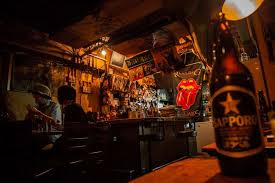
He has long greying hair and rotates through a collection of Rolling Stones T-shirts, something like twenty-eight of them. I have never seen him wear anything else. He smokes constantly, drinks Sapporo if he is drinking at all, and otherwise survives on black coffee.

Somehow he produces a full menu in a kitchen that appears to consist primarily of a Bunsen burner and sheer stubbornness.

Haku’s bar has rules. No Japanese music is the main one. The other rule is that the bar itself is reserved for singles. Groups can sit elsewhere. The bar is for individuals who have come out into the night alone.

But Haku’s real gift is music. He reads the room the way a card player reads a table.

If the crowd is German he might throw on Rammstein. If Scandinavians wander in the speakers might suddenly fill with black metal. Australians get The Saints. If I’m there he might put on My Morning Jacket. The world rotates through the speakers depending on who happens to be occupying the stools that night.

Simply and totally the original man.

Another citizen of the other city is Haru.

Haru manages the shisha lounge in eastern Gion, a part of town where the nightlife becomes a little more ambiguous. The streets there are full of micro-touts, men and women both, gently trying to guide passersby into Thai or Japanese dancer clubs. Small space heaters glow outside doorways and mama-sans smile from behind them like patient spiders.

I never go into those places, though the invitations are often persuasive.

Haru opens the shisha lounge most days at noon sharp. If she is not there, someone named B. or a long-haired young guy handles things until she arrives. She tends the charcoal, mixes my Malibu Milk, and quietly extends the session when the official time runs out.

She knows my habits well enough by now that when I head up the stairs she doesn’t assume I am leaving. She knows I am just stepping outside to smoke.

For a long time she existed in my mind simply as the shisha girl, one of the many figures who keep the other city functioning. But then one night I ran into her somewhere unexpected.

The place was Ishimaru Shoten, a tiny late-night bar down an alley just west of Pontocho in the heart of Kiyamachi. Outside the entrance hang bright red, green, and blue lamps that glow like a small carnival in the dark.

I first discovered the place at four in the morning on a very long night. I was broke that evening, absolutely skint, and there was a very aggressive Japanese guy at the bar who clearly believed the entire establishment belonged to him.

The bar woman, who is about forty-five and still hot as blazes, was batting her eyes at me with what seemed like professional enthusiasm. Meanwhile I realized with growing clarity that I did not actually have the money to pay for the large bottle of beer I had just ordered.

But men are predictable creatures.

I understood immediately that if I played my cards right the territorial guy would buy the drink for me. So I joked with him, gave him a friendly punch on the shoulder, made it clear I recognized him as the reigning emperor of the room. He razzed me a little but saw that I was no threat to his throne.

Sure enough, he covered the beer.

I stumbled home to the Royal Park Hotel on Sanjo Street as the sky was turning pale, crashing into bed around five-thirty in the morning.

Weeks later I returned to Ishimaru and found Haru sitting there.

I teased her gently about sometimes opening the shisha lounge five or ten minutes late when she bikes over from home. I suggested she must be hungover. She laughed, not the polite laugh people sometimes use for customers but a bright, real laugh.

She said she was happy to see me.

And that was when I learned her name. Haru.

We talked for a while. I drank a White Russian and ate dashi maki while she sipped something that might have been shochu or nihon-shu. I felt a strange rush of adrenaline the whole time, those goosebumps that run up both arms when the night suddenly opens into possibility.

Not necessarily romantic possibility. Just the larger sense that anything could happen.

Anything can come.

After twenty or thirty minutes she said goodnight and promised we would meet there again sometime. We did run into each other once more about a week and a half later, though the evening remained just as light and brief as the first.

But something had shifted.

She was no longer simply the shisha worker in my mental map of the city. She was Haru, a fellow traveler in the other city.

And that is the thing about the people who live their lives after midnight. They know parts of the city the rest of us never really see. They watch the celebrations and the arguments, the flirtations and the quiet breakdowns. They see who walks home alone and who finds someone to share the long dark streets.

Every city has two maps.

The one everyone uses during the day.

And the other one that only appears after midnight.

Dedication:

For the men and women of the night. Who keep the drinks coming and the plates spinning. It’s a rocky world, and you rock it baby.

Note: If you enjoyed this essay, you may also enjoy the two essays below, which also feature Kyoto and Osaka nightlife in all it’s beautiful glory.

The Night of Fucking Adam

Note: This piece is part of an informal series of essays and stories about nights out in Japan that begin innocently enough and gradually drift into something closer to accidental anthropology. The settings vary—Kyoto bars, Osaka clubs, late-night taxis, shotengai corridors—but the structure is often the same: a few friends meet for drinks, the evening unfolds without much planning, and somewhere along the way the ordinary rules of social behavior begin to loosen.

The events described here took place during a long evening wandering through Osaka, eventually ending in the nightclub district of Shinsaibashi. Like many such nights, it contained a mixture of small cultural misunderstandings, unexpected friendships, minor chaos, and the strange solidarity that sometimes develops among strangers in bars after midnight.

The character known here as “Adam” was a young British traveler we met that evening and never saw again. The nickname “Fucking Adam” reflects the affectionate exasperation with which the phrase was used throughout the night rather than any serious judgment about the person himself. Anyone who has spent time traveling, drinking in unfamiliar cities, or navigating the unpredictable social ecosystems of late-night nightlife will likely recognize the type.

The intention of the piece is not to document a perfectly accurate timeline of events—after fifteen or so drinks spread across many hours, accuracy becomes a flexible concept—but rather to capture the texture of a particular kind of night: the slow drift from casual afternoon drinks into the surreal territory that sometimes appears around two or three in the morning when strangers collide and small incidents escalate into memorable stories.

In that sense, Adam becomes less an individual than a type. Every city has them. Every traveler eventually meets one. Occasionally, if the night runs long enough, we become one ourselves.

Epigraph:

“A ruinous eyesore, oh what is a mind for?
Just a knife in a lake, just an arrow in space.”
—The Swans

We met around four in the afternoon near Osaka Station, the three of us: Philip, Jack, and me. The plan, such as it was, was simple—have a few drinks and see where the night took us. Osaka is good for that. The city doesn’t require much in the way of planning. If you just start walking and follow the lights, something eventually happens.

Our first stop was a subterranean craft beer joint somewhere beneath the station complex. One of those places down a set of anonymous stairs where the ceiling is low, the taps are numerous, and everyone looks faintly conspiratorial, like they’ve all agreed to drink underground together.

We had a couple rounds there and then drifted through the shotengai behind the Hilton. Early evening shoppers were moving through with that unhurried Osaka pace. Nothing felt like the beginning of a legendary night. It just felt like a pleasant afternoon.

From there we crossed over to a classic American hamburger joint opposite the station. Vinyl booths, neon beer signs, and a bartender who had tattoos running down both forearms like vines. American rock played softly in the background. It felt like a movie set version of America dropped into central Osaka.

We ate burgers, drank more beer, and talked about absolutely nothing of consequence.

At some point Philip announced that what he really wanted that night was to go to a middle-aged club. To be clear, Philip was not shy about his intentions. He was, as he put it, “looking for MILFs.”

So we took a taxi down to Shinsaibashi.

The middle-aged club, unfortunately, was closed. It was only about eight and apparently the MILF scene doesn’t really get going until later.

So we did what you do in that situation: we wandered.

For the next four and a half hours we drifted around Shinsaibashi, moving from bar to bar in that loose, happy way nights sometimes unfold. By midnight we had covered a lot of territory. Between the three of us we had consumed something like fifteen drinks over thirteen hours. And yet only Philip seemed even remotely affected by them.

Around 1:30 we arrived at Sam and Dave’s, a legendary dive of a nightclub tucked into the chaos of Shinsaibashi. The security guy at the door looked us over and shrugged.

“Maybe dead now,” he said. “But gets good later.”

Inside it was a haze of smoke and terrible techno beats pounding from the speakers. The crowd was an odd mixture of people who were extremely drunk and people who appeared to be completely sober and studying the situation with curiosity. It was cooking by one-thirty.

Somewhere along the way we met a jovial twenty-year-old British guy named Adam.

Adam and Jack bonded almost immediately. They were trading insults in that cheerful British way—“you tosser,” “you old wanker,” that sort of thing—and it seemed harmless enough.

Meanwhile a group of Filipino girls had arrived, one of whom—Beverly—was extremely drunk and getting progressively more chaotic. Her friends were trying, without much success, to keep things under control.

At this moment Philip stepped in.

Philip has a well-developed instinct for white-knighting in situations where white-knighting is absolutely not required. He began talking to Beverly, which quickly escalated into something resembling a full-scale courtship right there on the dance floor.

Meanwhile Jack and Adam had begun dancing.

The problem was that they gradually migrated off the dance floor and onto a small raised stage that contained a drum kit and various musical equipment.

Within seconds drums were tipping over. Tables were sliding. A cymbal crashed onto the floor.

Security arrived immediately.

They pushed Jack aside and dragged Adam feet-first off the stage and into what appeared to be a small holding room behind the bar where, judging by the noises coming out of it, Adam was receiving a fairly vigorous beating.

Things deteriorated quickly after that.

Philip decided to treat everyone to Irish car bombs. Unfortunately the bartender had no idea how to make one, so Philip instructed him. The Guinness component somehow disappeared from the process and we ended up with small glasses of Baileys and Jameson.

Adam drank one.

At this point Adam completely lost his mind. He began loudly explaining how terrible the UK was, how he wanted to die, how the American guy earlier had stolen the chesty nurse he loved, and a variety of other philosophical positions.

Security eventually threw us out with minimal ceremony.

Outside the situation became even stranger.

Philip was pouring champagne into Beverly’s mouth near the elevator while her increasingly frantic friends asked me if he was a good person. Jack was trying to figure out where Adam was staying so he could get him into a taxi.

Adam responded by pushing Jack into a decorative pond.

Then he began throwing a water bottle at him like he was Bob Gibson pitching in the World Series.

At this point it was around five in the morning.

Philip abruptly announced he was leaving to meet some Brazilians. Adam remained in the pond shouting curses about our mothers. Jack climbed out, soaking wet.

We left.

Mackenzie took a taxi back to his hotel by the river. I caught the first train home from Shinsaibashi as the sun was coming up, completely exhausted.

And that was the night of Fucking Adam.

We never saw him again.

Dedication:

For Fucking Adams everywhere.
Long may you burn.

Note: if you like this essay, you may also like the essay below. It covers a similar slice of nightlife, this time in Kyoto.