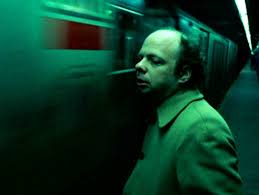
Note: Opening a multi-part early series from my first blog Classical Sympathies back in 2009, this piece takes up the beginning of Wallace Shawn’s walk through New York en route to his meeting with André Gregory in My Dinner with Andre, using Wally’s voice-over as a lens on artistic precarity, everyday survival, and the comic disproportion between existential weight and mundane errands. The note situates the film’s opening movement as both narrative setup and philosophical framing: a winter city of post offices, xerox shops, and unanswered calls becomes the psychological prelude to a conversation that will later expand into memory, performance, and self-mythology. This installment follows Wally up to his arrival at the restaurant for the pre-dinner drink, where the film’s central encounter is still suspended in anticipation, and meaning is generated less by action than by the act of getting there.
My Dinner with Andre is the famous, or infamous, 1981 film of a dinner conversation between Wallace Shawn, the actor and playwright, and Andre Gregory, the theater director. If I were to make a twofold claim for the film: i) that it is one of the most action packed films ever made, and ii) that it effectively encapsulates the thematics of the entire 20th century, I do not think this would be overstatement. My intent here, however, is not to establish either of these postulates, but rather to simply “blog” the script in the hopes that what needs to be said works its way to the surface. Fair warning: the undertaking will require several posts.
Money crops up on two of the first three pages of the script, and because money, and the lack of it, is a theme that runs beneath the entire script: Andre has money, has the freedom to travel and to spend several years trying to “find himself”; Wally does not. Still, “having money” is, as ever, a relative concept. At the opening of the film, Wally is seen walking through the streets of New York, heading for the restaurant where he is to meet Andre. It appears to be winter, maybe February. In the opening voice-over, Wally ruminates on the life of the artist: The life of a playwright is tough. It’s not easy, as some people seem to think. You work hard writing plays, and nobody puts them on. You take up other lines of work to try to make a living–acting, in my case–and people don’t hire you. So you spend your days crossing the city back and forth doing the errands of your trade. Today wasn’t any easier than any other day. I’d had to be up by ten to make some important phone calls, then I’d gone to the stationary store to buy envelopes, and then to the xerox shop. There were dozens of things to do. By five o’clock I’d finally made it to the post office and mailed off several copies of my plays, meanwhile checking constantly with my answering service to see if my agent had called with any acting work. In the morning, the mailbox had been stuffed with bills. What was I supposed to do? How was I supposed to pay them? After all, I was doing my best (17).
One of the marvelous things about the film is the tongue-in-cheek humor that is rarely, if ever, directly alluded to. A deeply serious film, Andre is also a comedy, a fact which we can recognize because we see that the writers are having fun with the characters who are in turn themselves. That is, Wally and Andre are playing versions of themselves–we assume that most of the experiences that Andre recounts in the film are based on real experiences, and that Wally’s account of his home life is more or less true to life–but exaggerated versions. As Shawn says in the preface to the script, “I knew immediately that {…} I’d have to distort us both slightly–our conflicts would have to become sharpened–we’d have to become–well–characters {…} It would be an enormously elaborate piece of construction” (14). In this initial passage, the humor lies in Wally’s conception of a difficult life: “I’d had to be up by ten to make some important phone calls.”
Wally’s sense of pressure is, from the outset, deliberately out of proportion to the scale of his circumstances. The tone is one of genuine complaint, but the complaint itself is almost comically domestic: the architecture of a “hard day” is built out of errands, envelopes, xerox shops, and an answering service that may or may not contain salvation in the form of an acting job. What Shawn achieves here, and what the film quietly sustains, is a recalibration of seriousness—where existential weight is not attached to grand events but to the texture of administrative survival. Wally’s New York is not a place of romance or revelation, but of circulation: between post office, mailbox, and telephone, as though modern artistic life has been reduced to a loop of deferred contact with recognition.
At the same time, the humor is never fully separable from sincerity. Wally is not merely being mocked; he is also articulating a recognisable condition of artistic precarity, one that the film refuses to glamorize. The genius of the opening monologue lies in this double register: we are invited to laugh at the disproportion between emotional tone and material fact, but we are also made to recognise how easily that disproportion becomes a lived reality. The “dozens of things to do” are not nothing; they are just insufficiently legible as crisis, which is precisely what makes them feel like crisis.
By the time Wally finally moves through the city toward the restaurant, the structure of the film has already been quietly established: this is a world in which meaning is not delivered through events but through the way events are narrated to oneself while walking between obligations. New York, in this sense, is not a backdrop but a medium of self-composition—an environment in which thought is constantly being assembled under mild pressure, as though consciousness itself were an errand.
He checks the time again, as he has been doing throughout the afternoon, and adjusts his route slightly, not out of urgency so much as orientation. The meeting with André already exists in his mind as something slightly unreal, a fixed appointment that has not yet been granted substance by arrival. He crosses another block, passes into the thinning evening light, and begins to approach the restaurant where, for the first time that day, the structure of waiting will shift from solitary to shared.
Note: This piece is a five-act play based loosely on a week I spent in Oxford in 2018. Unlike my previous narrative essays on the same material, (here, here, and here), this is written as a staged work, with dialogue, silence, and structure doing the heavy lifting. At its core, the play explores the tension between experience and narration—what happens when a person tries to turn a living moment into a story too quickly, and what is gained (and lost) in that process. While grounded in real events, it is not strictly autobiographical; it is a shaped and curated version of those experiences. As with all my work, the hope is that it resonates beyond its immediate context. Thank you for reading.
A Five-Act Play
EPIGRAPH
I can’t believe all the good things that you do for me Sat back in a chair Like a princess from a faraway place Nobody’s nice When you’re older your heart turns to ice
Illustrations presented with thanks by Riko Kusahara
Note: This piece was written for the Psiber Dreaming Conference offered by IASD in September 2018, under a strict word limit that forced a level of compression I don’t always allow myself. It draws on a series of lucid dreaming experiences to explore how we determine whether we are dreaming or awake, and why those determinations so often fail under pressure. Looking back, I’m less interested in the specific techniques of lucidity than in the broader question the paper circles: what happens when our usual markers of reality—stability, plausibility, even self-awareness—prove unreliable? The result is less a theory of dreaming than a compact record of trying to think clearly inside a system that continually revises its own ground.
Epigraph I:
The difference between most people and myself is that for me the “dividing walls” are transparent. That is my peculiarity.
—Carl Jung
Epigraph II:
The conventional scientific sentiment has become that—while we don’t totally understand why dreaming happens—the dreams themselves are meaningless. They’re images and sounds we unconsciously collect, almost at random {…} Which seems like a potentially massive misjudgement.
—Chuck Klosterman
Dream I: I awake in a warehouse. The bed is against one wall–on the other is a thirty-foot mountain of cantaloupes. I realize I am dreaming. I get up and run my hands over the cantaloupes. They feel absolutely real—as tangible as in life. I remember that tangibility is not a viable reality test—I’ve made that mistake before. Now fully lucid, I decide to levitate. The room dissolves, and I float suspended somewhere in dense, colourless space. Eventually, I feel the need to come back to earth but cannot locate it. I feel something beneath me. This is my bed, and I awake back in the warehouse, relieved yet exhilarated. The cantaloupes are still there, however I don’t question them. I just happen to live in a room full of fruit. Moments later I awake again, this time in diurnal “reality.”
The most common dream experience is of waking from a dream we take to be real, only to understand that it was “just a dream.” However, a subset of dreamers, probably more than we generally imagine, have experienced lucid dreams, dreams in which, to some degree, they are aware they are dreaming. Lucid dreamers may also experience “false awakenings”[1]— the sensation of waking progressively through dream “levels.” False awakenings can be disorienting (Robert Waggoner writes that after seven successive false awakenings he “would accept {…} any reality {…} as long as it stayed put”[2]), or sought after (Daniel Love and Keith Hearne have independently developed techniques to induce false awakenings[3]). Regardless of the desirability of the experience, the existence of dream levels, far from a simple oddity, provides a potential window into massive metaphysical questions.
First, we need to understand how dreamers use evidence to establish whether they are dreaming or awake.
II:I am in a dreaming contest with another dreamer. The contest begins and slimy amphibians begin to appear. Some resemble frogs;others are in shapes that don’t exist in nature. Their size varies from that of a pinky to that of a fist and they are verycolourful.I am nottryingto dream them, rather they are spilling everywhere around my feet. I sense this is a dream and check on the other dreamer. He is standing to my right in empty space. He looks just like me and hasn’t begun his dream.
This dream is non-lucid at first and becomes lucid because of the bright color and absurd number of the amphibians. An awareness beyond the dream senses a non-natural situation.
III: I am picking out fruit at a fruit stand. There are some huge avocados, almost too good looking. I wonder if I am in a dream, and touch an avocado to check. The one I choose is ripe and soft—I squeeze it a little. There is no doubt that I am having a tactile experience, and I conclude I am not dreaming. Of course, I am.
Two dreams, two types of evidence. In Dream II, I correctly identify the amphibians as anomalous, and become lucid. In Dream III, my attempt to test the lifelikeness of the avocado as an indicator fails. Simply put, realistic sensation is not sufficiently indicative of reality. Love agrees: “we are not looking for a qualitative difference in how realistic the experience feels {…} we are {…} on the lookout for issues with stability and plausibility.”[4] In Dream I, at first the huge pile of melons in my bedroom appears implausible and triggers lucidity; after moving up a dream level, my mind overrides the implausibility by “justifying”[5] the anomaly.
Because we awake from sleep and dreams every morning, we are very familiar with the experience of awakening. It is therefore unsurprising that when we wake inside a dream we accept the new reality as the waking world, even if it contains anomalous elements.
IV: I am in a huge house where a large group of families on motorcycles arrive. The families are making noise all night. I realize I am dreaming and levitate over to the families. Later I decide to wake up. I ease myself out of bed, bumping my nose into an ironing board. The room looks and feels exactly like my room. I don’t recall theironingboard being there, but whatever. Moments later I awake again—the situation is identical, only, the ironing board is gone. I feel a pit in my stomach, wondering what is ultimately real.
Dream IV is a good example of how dream levels can become increasingly realistic as we move through them. An ironing board in front of the bed is (for me) more plausible than a house full of bikers. Dreams such as this beg the question of how we can ever be sure we are awake. I have dreamt of getting up, walking to the front door, opening it, and emerging into the sunshine in my neighbourhood. At every point, this dream felt entirely realistic with no anomalies. After experiences like this, is it wholly unrealistic that we could dream an entire morning? An entire day?
There are different ways to approach this kind of question. The first is to use rigorous reality tests.[6] Using reality tests after each fresh awakening can help us filter anomalies in what may be an increasingly realistic dream state. The second is to open ourselves to a wider set of questions. Although space limitations make full exploration of these questions impossible, modern dreamers would do well to recall that throughout recorded history people have speculated on the meaning of the dream state and what it can tell us about space, time, life after death, and the nature of reality.
As dreamers, we know that dreamtime behaves very differently than waking time. Robert Moss distinguishes between Chronos (“linear time”) and Kairos (the “spacious now.”) He writes that when Kairos operates in waking life, “ordinary time is {…} suspended or elastic,” and that the world can “quiver or shimmer.”[7] Moss’ Kairos time sounds a great deal like dreamtime. Jung in his memoir writes “our concepts of space and time have only approximate validity,”[8] and “there are indications that at least a part of the psyche is not subject to the laws of space and time.”[9] Jung makes multiple connections between dreams and life after death, suggesting that our waking world,
in which we are “conscious,” may in fact be a projection of a more “real” and permanent, even timeless, unconscious.[10]
In the Tibetan tradition of dream yoga, the yogi prepares for death through dreams and meditation, entering death consciously by releasing the bodily energy in such a way that the body partially or entirely dissolves into pure light. This “rainbow body” is well-documented in Tibet and China, and cases of this phenomenon have been reported across multiple religious traditions.[11] Finally, Moss connects dreams with the much discussed Many Worlds theory, as does, in popular culture, Richard Linklater. [12]
V:I am among a large group ofpeople on the top floor of a building. We lie down on our backs and formbundles. The molecular structure of these bundles begins to dissolve, webecome lighter, thentotally empty. This process is dictated by a power outside of us which doesn’t speak. Once empty, we have the choice to become anything we want. I choose to become white light. Suddenly I am transported through space in a burst of pure white light, my old body left entirely behind. This is the most peaceful and thrilling feeling in the world. Then, I am back into a new bundle, trying again to become empty. I make progress, but it is hard and I am over-concentrating. Progress ceases; I wake up.
Although I have thought at length about dreams, I am a normal person with a normal job, dreaming anonymously night after night. I don’t belong to a spiritual tradition, am not a yogi or a meditating hermit. As a lucid dreamer, like many of us, I am self-taught. While we anonymous dreamers are wise to suspend judgement about the particularities of a theory as mind-boggling as dreams as an interface to infinite parallel universes, it is perhaps not by chance that my dreams of ascending to a state of pure white light bear close resemblance to innumerable near-death experiences or the reported manifestations of a lifetime of dream yoga. Although admittedly outside of our normal rational mode of apprehension, the experience of journeying through multiple dream levels, and the energy and amazement which often accompany these experiences, may point the way toward worlds far above, below, or beyond our own.
Who are we in our trek through life? Are we the maker, or the made? The writer, or the page? The actor, or the stage? The happening, or the happened to? Perhaps, our ability to exercise agency in the vastness of forever depends in part on learning to navigate levels of “reality,” however we encounter them. Or, perhaps, journeying to the far side of the dream can bring us face to face with that which is actually dreaming us.
Elizabeth Holmes emerges in Silicon Valley with the full prodigy package: Stanford dropout, world-changing ambition, and a carefully constructed persona. She leans hard into the comparison with Steve Jobs — black turtlenecks, minimalist language, intense seriousness — and presents herself as the young visionary who will revolutionize medicine. The pitch behind Theranos is irresistible: hundreds of diagnostic tests from a single finger prick. Investors, politicians, and media figures line up. The board fills with heavyweight names including George Shultz, and the company’s valuation soars to roughly $9 billion. Holmes becomes, on paper, the youngest self-made female billionaire. It’s classic Silicon Valley moonshot energy — bold claims, secrecy, and belief outrunning reality.
The problem, as insiders begin to realize, is that the technology doesn’t work at all. Engineers and lab staff struggle to produce reliable results, while Holmes and her partner Ramesh Balwani continue presenting the system as revolutionary. The company begins quietly using conventional lab equipment while maintaining the illusion. Whistleblowers emerge, including Shultz’s own grandson, who raises concerns at significant personal cost. The leadership circles the wagons. Meanwhile, John Carreyrou of The Wall Street Journal begins investigating, encountering secrecy, evasive answers, and mounting contradictions. His reporting — later expanded into the book Bad Blood — becomes the turning point. The narrative collapses, regulators move in, partnerships evaporate, and the once-mythic startup implodes.
Legal consequences follow. Holmes and Balwani are charged with fraud, and after a long, high-profile trial she is convicted on multiple counts. She delays reporting to prison after becoming pregnant, later giving birth with partner Billy Evans. Eventually she begins serving her sentence in a minimum-security federal facility. Even there, the mythology lingers — supporters, critics, and observers debating whether she was a calculating fraud, a true believer, or some combination of both. The arc is striking: Stanford prodigy, Jobs imitation, $9 billion valuation, total collapse, and prison. Less chaotic than John McAfee, less creepy than Keith Raniere, but still unmistakably outta control — a billion-dollar story built on belief, performance, and a technology that never worked.
Steve Jobs represents the template Elizabeth Holmes tried to emulate. Jobs cultivated a minimalist aesthetic, black turtlenecks, product mystique, and a “reality distortion field” that persuaded investors, employees, and customers to believe in things before they fully existed. But the crucial difference is that Jobs ultimately delivered. From the original Macintosh launch in 1984 to the iPod in 2001 and the iPhone in 2007, Apple shipped real, transformative products. Jobs bent reality rhetorically, not technically; Holmes attempted to bend reality where physics and chemistry refused. The comparison highlights both the ambition and the failure — she borrowed the style, but not the substance.
Bernie Madoff represents the classic institutional fraud parallel. A former NASDAQ chairman, Madoff operated a decades-long Ponzi scheme through Bernard L. Madoff Investment Securities, promising steady returns that attracted elite clients, charities, and feeder funds. By the mid-2000s, billions were under management, including investments tied to major institutions and wealthy families. In December 2008, amid the financial crisis, Madoff confessed to his sons, was arrested, and the scheme collapsed, revealing losses estimated at roughly $65 billion in paper value. The deception persisted largely through reputation and trust — investors assumed competence because of his stature. Holmes operated similarly: prestigious board members, high-profile endorsements, and a narrative of inevitability masked a system that didn’t work. Like Madoff, she benefited from credibility cascading downward — once enough influential people believed, the illusion sustained itself.
Sam Bankman-Fried provides the modern startup-era comparison. Bankman-Fried founded the cryptocurrency exchange FTX in 2019, and within a few years it was valued at around $32 billion. He cultivated a quirky, disheveled persona and promoted “effective altruism,” pledging to donate vast sums to global causes. FTX attracted major investors including venture firms and high-profile endorsements, while its sister trading firm Alameda Research operated closely behind the scenes. In November 2022, liquidity concerns triggered a rapid collapse, revealing commingled funds and massive shortfalls. Bankman-Fried was arrested in December 2022 and later convicted in 2023 on fraud and conspiracy charges. The arc mirrors Holmes: meteoric rise, media fascination, complexity masking weakness, and sudden implosion once scrutiny arrived. Where Jobs built something real and Madoff ran a traditional financial fraud, Bankman-Fried and Holmes sit in the same modern category — startup mythology outrunning reality.
In the end, the most astonishing thing about Elizabeth Holmes is not just the scale of the deception but the audacity of it. How, exactly, did she think she was going to get away with it? Blood testing is not social media. It’s not software. It’s chemistry, biology, physics — things that eventually either work or don’t. Yet she and Ramesh Balwani kept pushing forward, covering, deflecting, and doubling down as the gap between claim and reality widened. That’s the outta-control element: the belief that charisma, secrecy, and prestige could override science indefinitely. At some point, the story had to collapse. But like many figures in this series, Holmes seems to have inhabited a gray zone between calculation and belief — part fraud, part self-hypnosis — which made the whole thing both more dangerous and more surreal.
Then there’s the broader cultural context, including the willingness of powerful people to buy in. Even Barack Obama publicly embraced the Theranos narrative early on, holding Holmes up as a symbol of innovation and entrepreneurial promise. Chump. In retrospect, it’s striking how easily the image worked: the black turtleneck, the calm intensity, the world-changing pitch. Smart people — very smart people — saw what they wanted to see. It’s a reminder that charisma plus narrative can override skepticism, especially when wrapped in Silicon Valley optimism. The episode becomes a cautionary tale: will future founders learn from this, or will the same hubris reappear in new forms? The myth of the visionary is powerful, and the temptation to believe in it hasn’t gone away.
The quiet hero of the story, meanwhile, remains the Theranos whistleblower — George Shultz’s grandson — who raised concerns when doing so meant alienating family, risking his career, and standing against a multibillion-dollar narrative. He saw that the technology didn’t work, said so, and held his ground. In a story dominated by hype, status, and belief, that kind of stubborn insistence on reality stands out. Holmes’s rise is outta control, her fall inevitable, but the ending belongs to the people who refused to play along.
Note: If you liked this piece, you may also like the other ones in out “You’re Outta Control” series.
Note: This second installment in The Most Insane People of All Time (aka You’re Outta Control) looks at John McAfee, tracing his evolution from software pioneer to global fugitive, crypto evangelist, and online cult figure. The piece emphasizes the improvisational chaos of his later life and contrasts it with more conventional tech figures like Elon Musk and Bill Gates, arguing that McAfee’s volatility places him in a category of his own. The tone is impressionistic, comparative, and intentionally informal.
Epigraph:
“I fought the law and the law won…”
— I Fought the Law, The Clash
John McAfee starts in relatively conventional fashion: brilliant programmer, eccentric personality, builds the first widely adopted consumer antivirus software in the late 1980s, and becomes extremely wealthy when McAfee Associates takes off. But even in the early years there’s instability, and a foreshadowing of things to come — drug use, paranoia, erratic business decisions, and a growing anti-authority streak. He sells his stake, drifts through various ventures, and by the late 2000s relocates to Central America, eventually settling in Belize. There he buys beachfront property, hires armed guards, collects dogs, experiments with quasi-scientific projects, and begins acting like a semi-autonomous local strongman. It’s the first fully “outta control” phase: money, isolation, guns, and a man already well inclined toward paranoia.
Then comes the neighbor incident. In 2012, McAfee’s American neighbor, Gregory Faull, is found murdered. McAfee is named a person of interest — never charged — and instead of lying low, he goes fully theatrical. He claims the authorities are targeting him, allegedly evades police by hiding, disguising himself, and moving between safe houses, all while giving interviews and live-tweeting the saga. With girlfriend (later wife) Janice McAfee and various associates in tow, he flees Belize, surfaces in Guatemala, is detained, then ultimately allowed back to the United States. The whole episode is surreal: a tech millionaire allegedly on the run for murder, narrating the chase in real time on social media. It’s not just outta control — it’s performance art.
Back in the U.S., McAfee briefly lands in Florida but quickly re-enters chaos. He promotes cryptocurrencies, launches bizarre tokens, courts publicity, and cultivates a global cult following. He posts paranoid threads about surveillance, claims he lives inside Faraday cages, talks about government plots, and offers wild schemes — including promises to evade arrest by sea, air, or even paragliding into New Mexico to meet with fans! He pops up in unexpected places, from Caribbean boats to European cities, always accompanied by Janice and a rotating cast of loyalists. At one point he tattoos crypto branding onto himself, predicts conspiracies, and positions himself as both fugitive and prophet. The line between performance and belief dissolves completely.
Eventually, legal trouble catches up. U.S. authorities charge him with tax evasion and crypto-related fraud, and he’s arrested in Spain in 2020. From prison he continues tweeting through intermediaries, hinting at conspiracies and insisting he’ll never kill himself. In June 2021, shortly after a Spanish court approves extradition to the United States, McAfee is found dead in his cell — ruled a suicide. His supporters, including Janice, immediately dispute the finding, pointing to earlier posts and tattoos as supposed foreshadowing. The ending is as chaotic as the life: software pioneer turned fugitive, Twitter antihero, crypto evangelist, paranoid showman, and finally a death that only deepened the mythology. Outta control doesn’t even begin to cover it.
Compared to John McAfee, figures like Elon Musk and Bill Gates still look almost conventional — even when they drift into odd territory. Musk’s public persona is chaotic in a very modern way: late-night posting, impulsive announcements, awkward humor, and personal-life theatrics. The relationship with Grimes, the bizarre naming of children, and the infamous weekend when Azealia Banks claimed she was stranded at Musk’s house amid talk of LSD and general weirdness all add to the sense of volatility. Then there are the dad-joke moments — hauling a sink into Twitter headquarters and posting “let that sink in,” which is either performance art or just terrible humor. It’s eccentric, sometimes cringe, occasionally outta control — but the companies still run, rockets still launch, and the chaos never fully escapes the bounds of reality.
Gates, by contrast, is a more old-school eccentric. Bill Gates has the reputation of a hyper-competitive young executive who mellowed into a philanthropic technocrat, but the quirks linger. The awkward dancing, the slightly rumpled appearance, the perennial jokes about dandruff — he has always projected a kind of brilliant-but-uncool energy. The later-life turbulence — divorce from Melinda after decades, scrutiny over his contacts with Jeffrey Epstein, and the general aura of a private billionaire navigating public controversy — adds complexity but not chaos. Gates remains structured, Musk volatile, but both operate within functioning systems. McAfee, meanwhile, is something else entirely: not just eccentric but improvisationally unstable, a man who turned paranoia, fugitivity, and spectacle into a lifestyle. Musk may be chaotic, Gates may be awkward, but McAfee is outta control in a different register altogether.
In the end, John McAfee feels more outta control than Keith Raniere, Elon Musk, or Bill Gates — and that’s saying something. Raniere was creepy and manipulative but small; Musk is chaotic but still tethered to real-world outcomes; Gates is eccentric but fundamentally structured. McAfee, by contrast, seemed to live entirely outside normal constraints. Guns, boats, dogs, girlfriends, crypto tokens, Faraday cages, live-tweeting alleged manhunts, promising wild escapes, drifting between countries — the whole thing reads less like a biography and more like a fever dream. He wasn’t just eccentric; he appeared to improvise his life day by day, escalating the spectacle each time. That kind of volatility is rare. It’s also why he became a cult hero: he embodied a fantasy of total freedom, however reckless, however unsustainable.
Years after his death, the mythology hasn’t faded. Supporters still debate the circumstances, quote his tweets, and treat him as a kind of outlaw technologist who refused to play by the rules. Whether you see him as mad genius, performance artist, or cautionary tale, the scale of the chaos is undeniable. There may have been more dangerous figures, more powerful figures, even more tragic figures — but few as consistently, flamboyantly outta control. That’s what makes McAfee a legend. Not admirable, not necessarily likable, but unforgettable. And like all true originals, there probably won’t be another. So RIP, prayers up, and pour one out for a real one, John Motherfucking McAfee.
Note: If you liked this piece, you may also like the other ones in out “You’re Outta Control” series.
Well everyone, today is the day. My first novel, The Adventures of the Thin Man and Andrea is now available on Amazon and wherever books are sold.
This one took a while—written in fits and starts, in bars and hotel lobbies here in Kyoto—but it finally found its shape. More than anything, today I just want to thank all the readers of The Kyoto Kibbitzer, wherever you hail from; I’ve always thought of this as an ongoing conversation, and a lot of this book grew out of that exchange.
If you do pick it up, I hope you enjoy the ride—and if it lands for you, a quick review on Amazon would mean a great deal. Thank you, as always, for reading.
Note: This piece overlaps my three essays on my week with Isobel series (I–III), though it approaches that week from a different direction. Where those pieces follow the arc, this one lingers on the moment before it resolves—the pre-game, as I’ve come to understand it. It is also a direct response to the book The Game, by Neil Strauss. In what follows I don’t intend to rebut Strauss so much as correct what I see as a fundamental weakness in the subculture he dissects. The reader will judge whether I succeed.
Epigraph
“No one else could play that tune, you know it was up to me.”
— Bob Dylan, Up to Me
Part I: Ippei
I’m at Zaza, the club on Kiyamachi in Kyoto. It’s around 11 PM and just getting going. Zaza is a late night place. It doesn’t peak until well past midnight, and at this hour it’s still stretching, still finding its rhythm.
I’m there by myself, drinking a White Russian.
A Japanese guy comes up to me. He’s about fifty-five. No preamble, no easing into it. He introduces himself—let’s call him Ippei—and within seconds it’s on.
“See those two ladies over by the window,” he says. “Wanna help me pick them up?”
I’m intrigued. Not because I’m especially interested in the outcome, but because I’m a curious guy and I want to see what he’s doing.
“Ok,” I say. “What’s the play?”
He doesn’t hesitate.
“You’re my old friend from California. I haven’t seen you in twenty years. I just ran into you by chance here. Take it from there.”
That’s it. That’s the entire setup. Handed to me fully formed.
I ask him, just to check, “Is this going to work?”
He smiles, completely unbothered.
“Yeah,” he says. “I do this every night. Had a threesome last night.”
Well alright then.
We walk over. He starts talking immediately, in Japanese, smooth, fast, confident. “This is Matt, my best friend from California. Would you believe I just found him here?”
I met him five minutes ago.
It doesn’t matter.
In no time the two women are completely engaged. Smiling, leaning in, laughing. The story has landed. The reality has been accepted. They’re not being approached. They’ve been included.
And I’m there, but I’m not really there. I’m not trying to win anything. I’m not trying to escalate. I’m watching. Taking it in. The nightlife anthropologist, just observing the field.
After a while I step out to the balcony to smoke.
Twenty minutes pass.
When I come back down, he’s still there. Still going strong. Still inside the same story.
That’s when it clicks.
He didn’t need me.
He needed the role I filled.
He needed a premise.
Part II: Neil Strauss
Neil Strauss’ The game
That night at Zaza stuck with me, not because of what happened, but because of what it revealed.
There is a whole body of writing—call it a subculture, call it a system—that attempts to explain and formalize moments like that. The most famous version of it is The Game, by Neil Strauss, which I’ve read twice.
I want to be clear about something before I go any further.
I’m not anti–Neil Strauss. In fact, I respect him. He’s an elite investigator of subcultures, and I love subcultures. He embedded himself in a world, learned its language, mapped its hierarchies, and reported it out with real precision. That’s not easy to do. It’s a serious piece of work.
What follows is not a dismissal of Strauss.
It’s a response to what the game represents.
Because once you move from observing a system to adopting it, something changes.
At its core, the game assumes that attraction can be engineered. That with the right language, the right sequence, the right calibrated signals, you can break down a woman’s resistance and get to the desired outcome, which is of course bed.
It’s a kind of a linguistic technology and NLP at its worst. A system designed to move someone from one state to another.
And for me, that’s where I part ways.
For me The Game is a massive turnoff, because it flattens everything and kills any chance at romance.
It scripts what should be alive. It reduces seduction to a manual and turns something unpredictable into something repeatable. And in doing so, it drains it of the very thing that makes it worth pursuing in the first place.
There’s no space for real connection. No space for the unexpected. No space for the moment where something happens that neither person could have predicted. No space for the kind of encounter that might actually change your life.
And beyond that, it produces a life that I don’t want.
The guys in The Game end up living together in this kind of shared house—Mystery, Strauss, Courtney Love—surrounded by other guys, talking about women, thinking about women, analyzing women. It’s a sausage fest. And it’s not cool.
The Gamers think they’re players. I prefer to think of them as incel-adjacent. They’ve optimized the system, but they’ve lost the thing itself. They’ve mastered the game and stepped outside of life.
Part III: On Action
I’ve had a handful of sexual partners that I’ve gone all the way with. The precise number is under an NDA. I’ve made out with more. But I haven’t been especially active, at least not in the way the game would define it.
What I have done is, flirt with, connect with, and have crushes on dozens of women.
And the truth is, I enjoy it.
I actively enjoy the pre-game.
I enjoy getting close. The moment before something becomes something else. The tension. The ambiguity. The recognition that something might be there, and neither of you has named it yet.
The thrill of newness and the possibility of a spark. If it burns, great. If it flickers, that’s also good. For most men, the pre-game is a means to an end. For me, it’s the end.
And that’s the difference.
This doesn’t mean I’m not interested in action. I am. Very much so. In fact, I’m something of an action junkie. But I’m a highly specific kind of action junkie. Like Wittgenstein, who was said to have manufactured his own oxygen, I manufacture my own action.
I don’t chase it blindly. I don’t optimize for it. I don’t try to force it into existence through systems or scripts. I generate it. Selectively. Intentionally. And in moments where it actually means something.
Part III: Luna
I’m at Umineko with a friend—call him Mr. Editor. It’s early, maybe six in the evening. We’re mid-bar, having a beer, when I notice a woman sitting off to the side.
She’s stunning. And I HAVE to go talk to her. Not because I expect anything to happen. Not because I’ve calculated the odds. But because the moment demands it.
I tell Mr. Editor what I’m about to do. He nods. “Go for it,” he says. “I’ll watch.” I walk over and ask her name. She smiles. “Call me Luna.”
We speak in Japanese. The conversation flows. I bring everything I have to the moment—attention, presence, curiosity—and it lands. There’s a spark. Not forced. Not engineered. Just there.
We talk for a while. Long enough for the room to shift slightly around us. Eventually I ask for her Instagram. She gives it to me. I walk back to the bar and sit down next to Mr. Editor. I’m on Cloud 9. The next day, in the late afternoon, carefully timed, I send her a message but she doesn’t reply.
Failure? Not for the pre-gamer. Because the pre-gamer already got what he came for. The moment. The spark. The approach. The brief, electric possibility that something might happen. That was the action. That was the point. For the Strauss guys, the night ends when the text goes unanswered. For me, the night ended at the bar.
Up to this point, the pre-game is contained. Safe, even. A space where things can happen or not happen without consequence.
But sometimes it doesn’t stay that way.
Isobel Revisited:
I have written about my week with Isobel extensively elsewhere, however part of that story is relevant to what we are discussing here. I met her at the Faculty of Astrological Studies, held at Exter College, Oxford, in late August 2018. We spent the week together and I fell in love. But I didn’t sleep with her. My choice. What follows is a light re-write from my essay “On My Week with Isobel: Part II”:
Wednesday.
I wake up early and we have breakfast together in the dining hall. By this point, people are noticing us. Comments here and there, snickers, sideways smiles.
Morning and lunch blur into one long conversation—the garden, the bench, a little grass, nothing hidden. We’re finishing each other’s thoughts. I’m in deeper than I’ve ever been.
We don’t attend much of anything.
In the afternoon break she goes to change. I go back to my room and put on The Mendoza Line with the full weight of obsession. She comes back after and tells me, without shame, that she had pleasured herself during the break. Just fucking states it.
This is a complication.
That night she changes again. A red dress. Short, but not careless. Stunning. We sit at dinner whispering, touching lightly, laughing against each other. Everyone knows by now.
After dinner there’s wine again, talking with the tutors, the long courtyard. I meet Darby Costello in person for the first time. She’s fully alive, drinking wine, holding the room effortlessly. I’m so happy she’s my astrologer. But I’m elsewhere.
We stay late. Clear the courtyard. Around two in the morning we part. Cheeks touched. No bedroom. No act. No close. Back in my room, lights low, Mendoza Line still in my ears, I lie on the narrow bed and I know exactly where I am standing.
I will keep going. I will see where this leads. But I will not sleep with her. I can’t.
It’s not that I don’t want to. I do. Totally and much more. But I can see it. The complications. For her, for me. The chain of events that would follow. I’m old enough to see it coming. And I know, standing there in the courtyard, with the last of the wine and a cigarette burning down, that it’s on me.
I have to be the one to say no. That’s the shape. That’s the decision.
=====
Up to this point, the pre-game has been something I could enter and exit at will. A space I could step into, generate action, feel the spark, and leave intact.
With Ippei, the action was scripted. With Strauss, it was systematized. With Luna, it was self-contained.
But there’s another version of the pre-game, and it’s the one that matters most. The one where the moment doesn’t stay light. The one where it deepens. Where the spark doesn’t just flicker—it starts to take shape. And at that point, something shifts. Because now it’s not just about whether something will happen. It’s about whether it should.
This is where the line from Dylan starts to carry real weight. No one else could play that tune. There’s no system here. No script. No borrowed language. No Ippei handing you a premise. There is only the moment as it actually exists, and your ability to see it clearly.
And then the second part. It was up to me. Not to escalate. Not to optimize. But to decide. The game ends when something happens. The pre-game ends when you decide it should.
Dedication
For pre-gamers everywhere. May you get a little action tonight baby.
Note: If you liked this piece, you may also like the following pieces that also take up the themes of romance and seduction.
Note: This recollection dates to June 2010, when I traveled to Adelaide, Australia for my first IB Theory of Knowledge workshop. At the time our school’s governing body, officially Ritsumeikan, but semi-affectionately known around town as “Keichimeikan,” (the cheap school) had begun investing heavily in International Baccalaureate training, and for a brief but memorable stretch I found myself traveling widely across the Asia-Pacific region attending workshops and conferences. Adelaide happened to be the first stop on that circuit.
The encounter described here took place midway through that week. Like many moments that occur while traveling, it was both ordinary and oddly memorable — a short conversation, a near-comic personal embarrassment narrowly avoided, and then a small gap in memory that I still cannot fully explain.
For privacy I refer to the person involved simply as “M.”, and a few identifying details have been softened. The strange behavior of my phone afterward — messages arriving out of sequence and the device occasionally insisting it was in Adelaide or Nagoya — was quite real, though I have never had a satisfying explanation for it.
In Japanese there is a phrase that captures the mood of such moments perfectly: cho fushigi — very mysterious.
Epigraph
Half hours on earth
What are they worth?
I don’t know.
David Berman
I. Adelaide
I was in Adelaide for my first IB Theory of Knowledge workshop, sometime around June of 2010. In those years our principal had suddenly decided that IB travel was a worthwhile investment, and so for a brief and glorious period I was dispatched all over the Asia-Pacific region like a slightly rumpled educational attaché. Workshops in Singapore, Hong Kong, Kuala Lumpur, and, in this case, Adelaide.
The school hosting the workshop was one of those extremely well-appointed Australian private schools — immaculate rugby grounds, manicured lawns, a cafeteria that would have put many universities to shame. The workshop itself was perfectly pleasant. TOK people tend to be reflective types and reasonably good company, though after two days of epistemology everyone is usually ready for a drink.
Which is how, on the second evening, a small group of us ended up at a bar a few minutes from the hotel.
II. M.
At some point the table thinned out until it was just the two of us talking. She was from San Francisco. Let’s call her M.
We were sitting close, leaning in the way people do in bars when the music is slightly too loud and the conversation slightly too interesting to abandon. I told her about my small blog, Classical Sympathies, which at the time was still young and full of ambition. She told me she wrote long travel essays and posted them on Facebook where, she said with a shrug, they had gathered a modest but loyal readership.
Like a complete peon, I offered to host them on my site.
She smiled politely and said she’d probably keep them where they were for now.
Which was entirely reasonable.
The conversation moved on. We started talking about family — fathers, specifically — and the strange emotional weather that tends to gather around that subject. It was one of those unexpectedly intimate bar conversations that sometimes appear between near-strangers and then vanish again.
III. A Minor Emergency
There was, however, a complication.
Let us say that during the course of this conversation Young Mr. Johnson began to make his presence known.
Nothing dramatic. But enough that standing up suddenly would have created a situation. So I employed the classic defensive maneuver familiar to men everywhere: crossed legs, careful posture, strategic angles.
A small but significant crisis was unfolding beneath the table.
Eventually the situation resolved itself through patience and good fortune. When the moment seemed safe, I made my exit with what I hoped was dignity intact. We exchanged Facebook information, said our goodbyes, and I stepped out into the alley behind the bar on the way back to the hotel.
At that moment I felt something close to relief.
By the grace of God, I had narrowly avoided making a spectacular fool of myself.
IV. The Missing Ten Minutes
And then something strange happened.
I remember stepping into the alley.
The next thing I remember is being back in my hotel room.
Fully clothed. Completely sober. The evening still early — maybe ten-thirty, eleven at the latest.
What I did not remember was the ten minutes in between.
No walk back to the hotel. No elevator ride. No keycard in the door.
Just a small, clean gap in the record.
V. The Phone
The truly odd part came later.
For the next year and a half my phone behaved as though it had lost its grip on reality.
Texts appeared months after they had supposedly been sent. Messages from April surfaced in October. Time stamps were wrong. Location data wandered.
Sometimes the phone seemed to believe it was still in Adelaide.
More often it insisted it was in Nagoya, a city I had visited only once for a consulting visit to a school in the hills.
It was never anything dramatic — just enough small glitches to make me raise an eyebrow every now and then.
VI. Cho Fushigi
I never saw M. again.
We remained distant Facebook acquaintances for a while. She became, I believe, an English teacher back in San Francisco. Her essays continued to appear occasionally in the feed, and then eventually they stopped.
The phone eventually sorted itself out as well.
Technology, like memory, tends to repair its own small fractures over time.
Still, every once in a while I think about that short walk down the Adelaide alley and the ten missing minutes afterward.
And the only phrase that really fits is the one the Japanese use for such things.
Cho fushigi.
Very mysterious
Dedication:
For Molly. Thanks for the half hour baby.
Note: If you enjoyed this essay, you may enjoy the two essays linked below, both of which take up similar themes or charged, fleeting, and romantic encounters.
Note: This essay is a reflection on the ideas of Julian Jaynes and his remarkable 1976 book The Origin of Consciousness in the Breakdown of the Bicameral Mind. Jaynes’ theory—that human beings once experienced divine voices guiding their actions before the emergence of modern introspective consciousness—remains controversial and widely debated. The purpose of this essay is not to prove or disprove Jaynes’ neurological model but to explore the enduring power of the questions he raised.
In particular, I am interested in two aspects of Jaynes’ work that remain deeply suggestive: his interpretation of early literature such as the Iliad, where modern psychological interiority appears strangely absent, and his observations about how mobility—travelers, shepherds, merchants, and wanderers moving between cultures—may have destabilized older systems of divine authority. These figures, operating in uncertain cultural terrain, may have been among the first people forced into the improvisational reasoning that resembles modern consciousness.
The essay also touches on institutions like the Oracle of Delphi and on the persistence of voice phenomena in modern contexts, ranging from hypnagogic states and exhaustion to more troubling historical cases such as the assassination of Robert F. Kennedy by Sirhan Sirhan. These examples are not presented as proof of Jaynes’ theory but as reminders that the boundary between internal thought and perceived external command may be more complex than we sometimes assume.
Finally, the brief personal anecdote involving an MRI scan is included not as evidence but as illustration: a small modern echo of the ambiguous mental territory Jaynes explored. Moments in which voices seem to arise from somewhere between the inner and outer mind remain part of human experience.
Whether Jaynes was ultimately correct in his sweeping historical claims is still an open question. But his work continues to provoke a fascinating possibility: that consciousness itself has a history, and that the modern reflective self emerged gradually out of older forms of human experience.
If nothing else, Jaynes reminds us that the human mind is not a finished structure. It is something still unfolding—shaped by culture, language, movement, and time.
“She keeps coming closer saying I can feel it in my bones Schizophrenia is taking me home.” — Sonic Youth
There are certain books that never quite disappear. They do not settle comfortably into the academic canon, nor are they fully dismissed. They linger. They circulate quietly among curious readers, occasionally resurfacing in conversation decades after publication, as if waiting for another generation to discover them.
One such book is The Origin of Consciousness in the Breakdown of the Bicameral Mind.
Its author, Julian Jaynes, was a psychologist who spent much of his career outside the central institutions of modern neuroscience. When the book appeared in 1976 it created an immediate sensation. Reviewers alternately described it as brilliant, bizarre, visionary, or simply impossible. The theory it proposed was breathtaking in scope. Jaynes suggested that the subjective, introspective consciousness modern people take for granted—the inner sense of “I,” the reflective voice narrating our own thoughts—was not an ancient human constant. It had emerged, he argued, only a few thousand years ago.
According to Jaynes, the minds of early civilizations functioned differently. People did not experience themselves as the authors of their own decisions. Instead they heard the voices of gods.
Not metaphorically. Literally.
Commands issued in auditory form—voices that appeared to come from outside the self—guided action. These voices, Jaynes argued, were generated by one hemisphere of the brain and experienced by the other as divine instruction. He called this earlier mentality the bicameral mind.
The theory has never been accepted in its full neurological form. Archaeologists, classicists, and neuroscientists have raised serious objections. And yet the book continues to circulate, discussed by philosophers, psychologists, historians of religion, and the occasional curious reader who stumbles across it in a used bookstore or late-night internet search.
Why?
Part of the answer is simple: Jaynes was asking a question that remains deeply unsettling.
What if human consciousness has a history?
What if the inner voice we experience as our own—our private mental narrator—was not always there?
I first encountered Jaynes sometime around 2012 or 2013, during a period when I was reading deeply in the work of Carl Jung and writing a small series of reflections that I called Jungian Intimations. Like many readers drawn to Jung, I was interested in symbolism, archetypes, and the strange persistence of mythic imagery in the modern psyche. I briefly considered enrolling in an online course with the Jungian analyst Michael Conforti, though in the end I took a class from his wife, Nancy Qualls-Corbett, on Jung and visual art. Around that time I read the slim but remarkable volume Jung on Art, which argues that artistic creation often emerges when archetypal material pushes through the individual psyche into symbolic form.
Jaynes appeared in my reading not long afterward. At first glance he seemed to be asking a related but far more radical question. Jung had treated mythic figures as symbolic expressions of the psyche. Jaynes suggested that the gods of ancient literature might once have been experienced as genuine voices—psychological events interpreted as divine command.
Whether or not one ultimately accepts his neurological model, Jaynes assembled a body of evidence that continues to provoke thought. In particular, he pointed to a striking feature of early literature. Characters in ancient texts often act without the kind of introspective self-reflection modern readers expect. Decisions appear suddenly, attributed not to inner deliberation but to divine intervention.
Nowhere is this more visible than in the world of the Iliad. When Achilles restrains himself from killing Agamemnon, it is not because he pauses to analyze his emotions. Athena appears beside him and tells him what to do. The boundary between divine command and human action is porous.
Jaynes argued that such passages were not merely literary conventions but traces of an earlier mentality.
Yet perhaps the most fascinating part of his theory lies elsewhere—in the margins of ancient societies, among the people least anchored to a single cultural world.
The wanderers.
Ancient civilizations were more mobile than we sometimes imagine. Even in the Bronze Age there were shepherds drifting across borderlands, merchants following caravan routes between cities, sailors moving from port to port across the Mediterranean and Near East. These figures lived at the edges of cultural systems that otherwise depended on stability and hierarchy.
For Jaynes, such wanderers may have played an unexpected role in the transformation of the human mind.
The bicameral system, as he described it, functioned best within tightly structured societies. Authority flowed downward through clear hierarchies: gods to kings, kings to priests, priests to ordinary people. Ritual, language, and shared myth reinforced the system. The divine voices guiding behavior were embedded within a familiar cultural environment.
But travelers moved beyond those environments.
A shepherd leaving his village might cross into territory where different gods were worshipped. A merchant arriving in a foreign city encountered unfamiliar laws, languages, and customs. A sailor might spend months among people whose rituals and social expectations bore little resemblance to those of home.
In such situations the guiding voices of one’s own culture could become unreliable.
If a divine command urged action in a place where the surrounding society operated under entirely different assumptions, the voice might cease to function as a stable guide. The traveler found himself in a new psychological situation—cut loose from the authority structures that had previously organized experience.
This was not a comfortable position.
To survive, wanderers had to develop different skills. They had to negotiate, observe, and interpret. They had to learn foreign languages and read unfamiliar social signals. They had to improvise.
In other words, they had to think.
Jaynes speculated that these mobile figures—shepherds, traders, sailors—may have been among the first people forced into something like modern reflective consciousness. The birthplaces of that consciousness may not have been temples or palaces but the messy contact zones of ancient trade: caravan routes crossing deserts, harbor towns where languages mingled, frontier markets where strangers bargained with one another under uncertain rules.
If the bicameral system required cultural enclosure to function, then mobility threatened its stability.
And the ancient world was becoming increasingly mobile.
Even as this transformation unfolded, remnants of the earlier mentality persisted in institutional form.
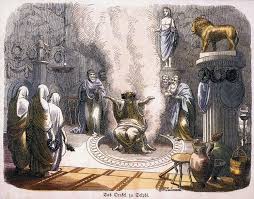
One of the most famous examples was the Oracle of Delphi. For centuries Greek leaders traveled to Delphi seeking divine guidance on matters of war, colonization, and political decision-making. The oracle’s pronouncements—often delivered in trance-like states by the Pythia—were treated as authoritative messages from the god Apollo.
From a Jaynesian perspective, institutions like Delphi may represent cultural technologies designed to preserve the authority of divine voices even as the underlying psychological system weakened. Kings and city-states continued to seek guidance from gods because the tradition of divine command remained embedded in social life.
Gradually, however, new forms of decision-making emerged.
Written law codes appeared. Philosophical reflection developed. Greek drama explored the tensions between divine authority and human responsibility. The shift was not sudden or uniform, but over time a new psychological landscape became visible—one in which individuals increasingly experienced themselves as authors of their own thoughts.
This transition was not simply intellectual. It may have been neurological, cultural, linguistic, and historical all at once.
Jaynes placed the decisive phase of the transformation during the turmoil of the late Bronze Age collapse, roughly between 1200 and 800 BCE—a period when many ancient societies experienced widespread disruption. Cities were destroyed, trade networks collapsed, and populations migrated. In the midst of this upheaval, older forms of authority may have faltered, forcing new modes of self-organization to emerge.
Whether or not Jaynes correctly identified the precise mechanism, he was surely right about one thing: consciousness as we experience it today may not be a timeless given.
It may be an achievement—fragile, historically contingent, and still evolving.
Yet if the bicameral mind truly vanished, one might expect the phenomenon of hearing commanding voices to disappear entirely from modern experience.
It has not.
Under certain conditions, people still report experiences remarkably similar to those Jaynes described. In states of extreme exhaustion, during moments of sensory deprivation, or in the liminal territory between waking and sleep, voices sometimes appear that are difficult to classify as either internal or external.
I had an experience of this kind several years ago while undergoing an MRI scan in a hospital.
Anyone who has had an MRI knows the strange psychological environment it creates. You lie alone inside a narrow tube, immobilized, while the machine produces a sequence of loud mechanical pulses and vibrations. The noise is rhythmic and relentless. There is little sensory input beyond the sound and the awareness of one’s own breathing.
Somewhere in the midst of that experience, a voice appeared.
It was not loud or dramatic. It was simply there—a calm male voice with the unmistakable tone of a father speaking to a child. The message itself was simple, almost reassuring. But what struck me most was the ambiguity of the experience. The voice did not feel exactly like a thought, yet it did not feel entirely external either. It occupied a strange borderland between inner and outer perception.
The moment passed quickly, but the memory lingered.
Experiences of this sort are not uncommon. Psychologists studying hypnagogic states—the transitional zone between waking and sleep—have documented similar phenomena. Auditory hallucinations appear in certain psychiatric conditions, most famously schizophrenia. Hypnotic suggestion can also produce experiences in which subjects perceive commands or messages that seem to originate outside their conscious control.
Jaynes believed such phenomena represented vestiges of the older bicameral mentality.
The voices of the gods, in his view, had not entirely vanished. They had simply retreated to the margins of modern consciousness.
Occasionally these phenomena intersect with darker episodes of modern history.
The assassination of Robert F. Kennedy by Sirhan Sirhan remains one of the most disturbing cases often discussed in connection with hypnosis and altered states of consciousness. Some researchers have argued that Sirhan may have been unusually susceptible to hypnotic suggestion, raising unsettling questions about the relationship between external influence and voluntary action.
It would be irresponsible to claim that Jaynes’ theory explains such events. Human behavior is far too complex for any single model to capture fully. Yet cases like Sirhan’s remind us that the boundary between autonomous decision and externally shaped impulse is not always as clear as modern assumptions suggest.
The mind remains a mysterious territory.
Half a century after its publication, The Origin of Consciousness in the Breakdown of the Bicameral Mind continues to provoke debate not because it solved the problem of consciousness but because it reframed it. Jaynes forced readers to confront the possibility that the human mind has undergone profound historical transformations.
Even if the details of his neurological model prove incorrect, the broader insight may endure. Literature, religion, and psychology all suggest that the experience of selfhood has changed over time. The ancient world did not necessarily perceive the mind in the same way we do.
Something was gained in the transition to modern consciousness.
We gained introspection, philosophical reflection, and the capacity to examine our own motives. We gained the intellectual freedom that made science, democracy, and modern literature possible.
But something may also have been lost.
In the world Jaynes described, human beings lived in a landscape animated by voices of divine authority. Decisions arrived not through anxious deliberation but through commands experienced as sacred guidance. That world may have been more constrained, but it may also have felt more certain.
Modern consciousness offers freedom, but it also brings doubt and solitude. The voices of the gods have largely fallen silent, replaced by the quieter and often less confident voice we call our own.
Perhaps the most we can say is that consciousness, like culture itself, continues to evolve. The wanderers of ancient caravan routes helped shape the first emergence of reflective thought. Today we inhabit a global world of constant movement, translation, and negotiation—a world not entirely unlike those early contact zones where cultures once collided.
We are all wanderers now.
And somewhere, perhaps, the faint echoes of older voices still remain.
Dedication:
For dreamers and wanderers everywhere.
Note: If you enjoyed this piece, you might also like the pieces below, which take up somewhat similar themes.
Note: This essay is written in the spirit of amused inquiry rather than firm conclusion. Human history is filled with reports of strange visions, unexplained lights, divine visitations, and unidentified aerial phenomena. The interpretation of such experiences has tended to shift with the cultural vocabulary of the time. Medieval Europeans often described encounters with saints or angels. In the twentieth century the language of extraterrestrials became available.
The psychologist Carl Jung famously suggested that UFO sightings may function partly as modern mythologies—symbolic attempts by societies to understand mysterious experiences in technological terms. Jung also observed, with characteristic dry humor, that UFOs often appear to be “somehow not photogenic.”
The present investigation was prompted by my brother Mike, who recently asserted via text message that extraterrestrials are currently residing in Earth’s oceans. His wife Coleen agreed. “They are everywhere,” she said. While this claim remains unverified, the oceans themselves are vast, poorly explored, and capable of sustaining a wide range of speculative hypotheses.
The purpose of the essay is therefore not to prove or disprove the existence of extraterrestrial life in the ocean. Rather, it is to examine why such ideas persist, how they resemble earlier historical visions—from medieval religious phenomena to modern UFO culture—and why the possibility continues to feel strangely plausible to otherwise reasonable adults.
Epigraph
There are aliens in our midst.
Wussy
The Jung Problem
At this point in the investigation one is reminded of a dry observation by the Swiss psychiatrist Carl Jung.
Jung noted that UFOs possess a curious property: they are “somehow not photogenic.” Sightings multiply, witnesses speak with conviction, yet the documentation remains just slightly blurry.
Jung’s larger argument was that such phenomena often behave like modern myths. They appear at moments when societies are under stress, technological change is accelerating, and people are searching for new symbolic explanations of the world.
In other words, the sky fills with things.
Medieval Precedents
This pattern is not entirely new.
During certain periods of medieval Europe, particularly when grain supplies were contaminated by the fungus ergot, communities reported vivid religious visions: glowing figures in the sky, saints appearing in fields, the Virgin Mary materializing in unexpected places.
Ergot poisoning, now understood scientifically, can produce powerful hallucinations. But to the people experiencing them the visions were not chemical side effects. They were divine manifestations.
Entire crowds could witness miraculous shapes in the heavens or detect holy images in the crust of bread. A modern observer might diagnose environmental intoxication or collective suggestion. The participants experienced revelation.
The important point is that the content of the vision reflected the cultural vocabulary available at the time.
Medieval Europe saw saints. Modern America sees aliens.
One can see this dynamic clearly in the case of Joan of Arc. Joan reported hearing voices and receiving instructions from heavenly figures whom she identified as saints.
Historians generally accept that Joan sincerely believed these visions were divine communications.
But it is difficult not to notice that saints were the most advanced category of non-human intelligence available in fifteenth-century France. The conceptual vocabulary for extraterrestrials would not be invented for several hundred years.
Had Joan lived in the late twentieth century, it is at least possible that the same experience might have been interpreted somewhat differently.
She might have reported a craft.
The Cold War Sky
By the late 1940s the heavens had acquired a new cast of characters.
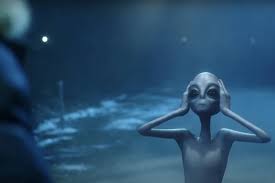
The famous incident near Roswell occurred in 1947, just as the Cold War was beginning to reorganize the world’s imagination. Reports of flying saucers multiplied. The mysterious visitors were described with increasing consistency: small grey beings with large heads and enormous eyes.
The explanation most often offered by the authorities was considerably less glamorous.
Weather balloons.
Strange objects falling from the sky during the early Cold War often turned out to be classified surveillance equipment. Unfortunately, the phrase “weather balloon” never fully satisfied the public imagination.
Aliens, after all, are much more interesting than meteorology.
The Mulder Doctrine
By the 1990s the entire mythology had been carefully systematized by American television.
The X-Files:
In the series, FBI agent Fox Mulder dedicates his career to investigating extraterrestrial activity after his sister Samantha is abducted from their home during childhood.
The abduction occurs at night. A strange light fills the room. The sister disappears.
Mulder spends the rest of his life attempting to prove that what he witnessed was real.
His partner, Dana Scully, is assigned to bring scientific skepticism to the enterprise. Their relationship gradually becomes one of the most beloved partnerships in television history, built on the productive tension between belief and doubt.
Entire generations of viewers absorbed the idea that somewhere in the sky—or possibly beneath the ocean—extraterrestrial activity might be quietly unfolding.
A Modern Lens
Seen from a slightly greater distance, the pattern begins to look familiar.
Medieval villagers saw saints because saints were the explanatory language available to them. Cold War Americans saw aliens because aliens had become the new vocabulary of the unknown.
Both phenomena may reflect the same basic human impulse: when confronted with mysterious experiences, we populate the heavens with the most compelling figures our culture provides.
Which brings us back to Mike.
So Are There Aliens In Our Oceans?
It must be admitted that if an advanced civilization from another planet wished to observe humanity without attracting attention, the deep ocean would offer several practical advantages. The environment is dark, difficult to access, and rarely visited by surface-dwelling primates equipped with submarines that can only remain operational for limited periods of time.
From a strategic standpoint, it would be an excellent hiding place.
This possibility has occurred to more than one observer, including my friend Mason, who recently suggested that a technologically sophisticated off-world civilization might simply have decided that the bottom of the ocean was the most convenient place to avoid the rest of us.
Provisional Conclusions
My brother Mike believes there are aliens in the ocean.
Carl Jung might have suggested that mysterious phenomena often adopt the symbolic clothing of their era. The Middle Ages had saints. The twentieth century produced extraterrestrials.
Mike has simply moved the story offshore.
The oceans remain vast and poorly explored. The woods remain dark and occasionally unsettling at night. Both environments have the correct atmospheric conditions for unexpected encounters.
If extraterrestrials are present, they may well prefer the sea.
But it would be a mistake to rule out the woods.
In either case, it seems wise to remain polite.
Footnote: The Ocean Logic
It must be admitted that if extraterrestrials wished to establish a long-term observational presence on Earth, the ocean would offer several advantages. Humans rarely visit the deep sea, and when we do we tend to leave fairly quickly due to crushing pressure, darkness, and the general inconvenience of breathing water.
From the perspective of an advanced extraterrestrial civilization attempting to avoid unnecessary interaction with our species, the ocean may therefore represent the single most sensible real estate on the planet.
Mike may, in other words, be thinking strategically.
POSTSCRIPT: Supplemental Testimony
Shortly after the investigation began, the primary witness—my brother Mike—provided additional clarification regarding his position.
According to Mike, extraterrestrial life has not only visited Earth’s oceans but has been present there for a considerable period of time. The aliens, he explained, appear to prefer the environment and have constructed bases beneath the sea.
When asked for supporting evidence, Mike cited the well-known Navy pilot videos showing unidentified aerial objects performing unusual maneuvers.
These videos—often referred to as the “Tic Tac” incidents—have circulated widely in recent years and are frequently interpreted as evidence of advanced technology of unknown origin.
Mike considers them decisive.
A second observer, his wife Colleen, agreed with this general assessment while expanding the hypothesis somewhat.
In her view, extraterrestrials may not be confined to the ocean at all. Rather, they may be present around us at all times.
According to Colleen, it is entirely possible that aliens walk among us.
At this stage of the investigation, these claims remain under review.
Dedication: For my brother Mike. I love you bro, but I still thinks them shits are in the woods.
Note: If you liked this piece, you may also like the pieces below, which also discuss the famous psychologist Carl Jung.