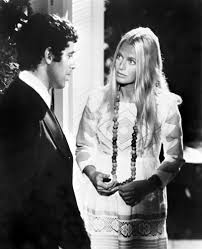
Note: Nina Van Pallandt moves through this piece as a kind of drifting hinge figure between art and biography, cinema and scandal, half-real and half-mythologised: from her striking, uncanny presence in Robert Altman’s The Long Goodbye—where she plays the abused, luminous spouse of Roger Wade and becomes, briefly, a kind of muse/anima figure for Philip Marlowe—to her earlier life in the Danish pop duo The Baronets, through her entanglement with Clifford Irving and the great Howard Hughes hoax that later reverberates through Orson Welles’ F for Fake, and onward into the quieter aftermath of fame, reinvention, and partial retreat. The essay follows her not as a stable “character” but as a site where male-authored narratives—Hollywood noir, literary fraud, journalistic myth-making—keep trying (and failing) to fix her meaning, while she keeps slipping free in ways that are at once accidental and oddly deliberate. In the end she becomes something like a case study in cinematic and cultural afterlives: a woman repeatedly written by others, occasionally complicit, sometimes resistant, and finally legible only as a residue of performance, gossip, and unfinished stories that refuse to settle.
I first became aware of Nina Van Pallandt the way most people probably do: not through biography, but through atmosphere—specifically Robert Altman’s The Long Goodbye (1973, The Long Goodbye), a film that feels less like a narrative than a slow collapse of narrative reliability itself. It is a film in which people drift through scenes as if they have forgotten whether they are supposed to be characters or witnesses, and Nina arrives inside it already slightly misfiled, already too composed for the emotional weather she is asked to endure.
She plays Roger Wade’s wife, but “plays” is almost the wrong verb. Altman’s casting logic is not psychological realism in the classical sense; it is something closer to behavioral residue. People are dropped into the frame and asked not to perform identity but to inhabit proximity—to money, to violence, to desire, to failure. Nina’s presence has that peculiar Altman quality: she does not dominate the scene, but she stabilizes it just enough to make everything else look unstable.
Roger Wade (the blocked writer, the alcoholic genius-in-decline) is already collapsing before the plot admits it. Nina is the counterweight that never quite becomes balance. She is care without resolution, intimacy without clarity, the kind of emotional presence that suggests there is a story somewhere but refuses to confirm what it is. And then there is Marlowe, Elliott Gould’s version of Marlowe—half-stoned, half-wandering, permanently a few seconds behind the moral implications of what he is witnessing.
The film keeps staging small ruptures in epistemology. One of the most famous arrives early and feels almost accidental in its perfection: Terry Lennox appearing at 4 AM, asking for a ride to Tijuana. There is a moment—“Tijuana now?”—where Gould’s Marlowe is briefly jolted out of his procedural fog into genuine surprise, as if even he cannot believe how far the plot is willing to drift from explanation. That tonal instability is the world Nina inhabits as well, except she does not get Marlowe’s ironic distance. She gets consequence.
There is a domestic sequence—one of the film’s most disarming—that feels almost out of register with the noir frame: Nina cooking, the soft logic of food and attention, a candlelit dinner shared with Marlowe, where violence and absence are temporarily suspended by something as ordinary as butter and chicken. It is precisely the kind of scene that should resolve emotional ambiguity, but in Altman it does the opposite: it deepens it. Intimacy here is not revelation; it is another form of deferral.
What the film keeps doing, quietly and persistently, is refusing to assign stable moral weight to anyone. Roger Wade is both victim and self-destroyer. Marlowe is both agent and sleepwalker. Nina is both witness and participant, but never allowed the comfort of explanation. Even her suffering—when it arrives—is not narratively sanctified; it is simply another event in a world where events do not accumulate into meaning.
And this is where Nina becomes interesting beyond the film itself. Because she does not resolve into a character arc, she persists as something else: a figure who has been “used” by multiple narrative systems without ever fully belonging to them. In a conventional noir, she would be femme fatale or redemption object or tragic spouse. In Altman, she is none of these cleanly. She is what remains when genre stops enforcing coherence.
What begins to emerge, if one steps back slightly from her, is that she belongs to a broader category of women who are not simply “in” cultural narratives but are written into them by proximity to men who are doing the narrating. The pattern is subtle but persistent: women become legible to the public through the structural gravity of male projects—films, scandals, bands, memoirs—while simultaneously attempting, with varying degrees of success, to assert an interior life that resists that formatting.
It is difficult not to think here of Marianne Faithfull, who occupies a parallel register in the British version of the same phenomenon. Marianne Faithfull is initially rendered publicly intelligible through association—romantic, cultural, chemical—with the Rolling Stones orbit, and specifically through a media ecosystem eager to translate her into a kind of emblem: muse, fallen angel, tragic accessory to male genius. But what is striking about her trajectory is not the initial inscription but the long, stubborn insistence on rewriting it from within.
In both cases—Faithfull and Van Pallandt—the question is not simply “agency” in the abstract liberal sense, but something more structurally constrained: how does a person reassert authorship of self once they have already been written as a function in someone else’s story? Faithfull does this through survival, reinvention, and the eventual authority of her own voice as an artist. Nina does it more quietly, less performatively, by simply not continuing to cooperate with the demand that her life be endlessly narrativized into legible arcs.
And this is where Nina stops being just a cinematic presence and becomes entangled with a second, more volatile narrative system: the world of Clifford Irving and manufactured truth. I remain, in a slightly persistent way, puzzled by Clifford Irving—not in the sense that his actions are obscure, but in the sense that the scale of the gamble still feels oddly disproportionate to the era in which it occurred. Clifford Irving occupies that 1970s threshold where narrative fraud still had room to breathe: before the internet, before instantaneous archival correction, before every claim arrived already cross-checked by a thousand invisible clerks. The rope, in other words, was longer. Not infinitely elastic—but long enough that someone could plausibly believe they might walk it all the way across.
What he did, of course, was fabricate the authorized autobiography of Howard Hughes and briefly convince a publishing system that this fiction was fact. And one cannot quite shake the sense that this sits in a parallel register to Orson Welles’ late-career meditation on forgery and authorship, F for Fake, where the art forger is not simply a criminal but a kind of metaphysical irritant—someone who reveals how fragile the category of “authenticity” already is, even before it is attacked. In Welles’ world, the faker is almost honest about the fact that everyone is faking something. In Irving’s world, the system briefly forgets to notice.
The irony, of course, is that Irving’s fraud depended on a very pre-digital faith in paper trails, intermediaries, and the general slowness of institutional verification. Today it feels almost quaintly physical: forged documents, publishing contracts, phone calls that had to be believed in real time. One can imagine the same scheme now collapsing within hours, not because people are more moral, but because the feedback loops are instantaneous.
And then there is prison. Irving did time—real time, not narrative time—and emerged into a world that had already moved on to other, faster deceptions. Yeah, I mean what did you expect, dude. The arc compresses there in a way that feels almost unsatisfying: scandal, exposure, incarceration, partial reinvention. One wants something more operatic, but what you get is the bureaucratic version of consequence.
The interesting part is not that he was punished, but that for a brief historical window the system was even buildable enough that his plan could function as a kind of temporary reality. That is the shared atmosphere he has with Nina Van Pallandt: not guilt, not innocence, but proximity to narrative systems that were still slow enough to be fooled by their own assumptions.
In later life, Nina becomes harder to place in any of the familiar compartments that earlier decades tried to assign her. The cinematic afterglow fades into cult memory, and the Irving episode recedes into archival texture. What remains is a quietness that feels deliberate rather than accidental—not disappearance, but refusal of continued amplification. She does not convert notoriety into permanent self-mythology in the way later media ecosystems would almost require. Instead, she settles into a lower frequency of visibility: remembered, cited, intermittently revived, but no longer authored by the same pressures that once pulled her forward.
And here the comparison widens again, because what she resembles is not a “sidekick” at all—that word is too structurally comic, too dependent on hierarchy—but something closer to an attendant presence: a figure whose job, in other people’s stories, is to make emotional or moral instability legible without ever fully resolving it.
There is a related category, more neutral and slightly more precise: the faithful interlocutor. Not in the devotional sense, but in the structural one—the person who remains close enough to the main character’s instability to render it speakable, without ever becoming fully absorbed into its explanatory system. Nina performs this function in The Long Goodbyewithout being granted interpretive authority over it.
And there is another: the witness who does not testify cleanly. Not unreliable, but resistant to conversion into stable narrative fact.
We all make mistakes; that much is banal. The more interesting question is what kind of cultural weather those mistakes occur in, and how much agency is genuinely available inside it. Nina Van Pallandt seems, in retrospect, to have lived inside a period when men were still doing a great deal of the writing—of scripts, scandals, explanations—and women were often expected to appear inside those scripts as if they had authored them themselves. Her resistance to that framing is not always loud or declarative. Sometimes it is simply a matter of stepping out of the demand to be continuously interpretable.
And in that sense, what she ultimately carved out is not a grand public myth but something more modest and, arguably, more durable: a minor legacy, lightly held, slightly resistant to over-definition. Not central, not erased, not simplified—just there, in a way that feels unexpectedly intact.
I really like Nina Van Pallandt. In The Long Goodbye, and in the shadow of the Clifford Irving story, it is impossible not to root for her—not because she is resolved, but because she is never fully reducible. She drifts through systems built by men who are busy writing meaning onto the world, and she does not quite consent to being finalized inside any of them. We all make mistakes. She was written into a few. She was also, quietly, a drifter inside Hollywood’s narrative machinery, and what she ultimately leaves behind is a minor but distinct and instinctively cool legacy: not the center of anyone’s story, but one of the few figures who never fully became owned by it.