My Favorite Songs of All Time: 1-20 With Commentary

Music motherfucking rules

Me

I hear the aged footsteps
Like a motion on the sea
Sometimes I turn there’s someone there
Other times it’s only me

Bob Dylan

They say that victory’s sweet
Even deep in the cheap seats

Conor Obrest

Note: This list speaks for itself, it is simply my 20 favorite songs of all time that include lyrics. For this list I have included extended commentary on each song. When I first published this list it was 110 songs long, and I will publish a full 250 this time in several installments. With the first publication, several people let me know that they had discovered new songs from it, and honestly that is the best outcomes I could have hoped for. This list does not include ambient music or jazz, two genres I also love. The list is a product of nearly 40 years of intensive music listening, so it is, at a minimum, highly curated. Thank you for reading, and may you find a new favorite somewhere here.

1. Cape Canaveral — Conor Oberst

For the first time since I began making versions of this list, I have a new number one. Conor Obrest’s Cape Canaveral has slowly, almost imperceptibly, worked its way past every other song I love. I didn’t exactly wake up one morning and decide that it was the greatest song ever. I simply noticed that I had already begun treating it that way. I return to it constantly, and it still gives me full-body chills and moves me to tears almost every time I hear it. After nearly forty years of obsessive music listening, Cape is as good of a number that I can come up with.

Conor is my number five artist of all time, and the fact that Cape Canaveral has become the song above all others that explains why. Number one. There it is. Man oh man. I didn’t see this one coming.

I have loved Cope for about eight years since I first heard it shorty after the release of the record it is on, Conor’s solo self titled debut from 2008. It is in my opinion his most beautiful and moving song. Conor also wrote my number 13 favorite song, Easy/Lucky/Free, which I write about below. Cape Canaveral uses the space program—those televised launches from decades ago, the spectacle of rockets lifting off into the unknown—as a proxy for growing up in America in the latter part of the 20th century. It’s about distance, aspiration, and the strange way in which memory reshapes people and moments over time.

It is one of the most gorgeous American songs ever written. “I watched your face age backwards / changing shape in my memory / you told me victory’s sweet / even deep in the cheap seats.” This is one of the loveliest passages ever set to music. Oberst is doing something subtle and devastating here—he’s taking the language of triumph and reframing it from the margins. Victory’s sweet even deep in the cheap seats is not a grand statement, however it is oddly triumphant. It’s about making meaning over time, with partial access, and moving from watching to participating.

That’s what the whole song feels like: an attempt to construct something lasting out of fragments—TV images, half-remembered conversations, the emotional residue of growing up. The rockets go up, but the song stays grounded in what it felt like to watch them, to want something more without knowing exactly what that “more” was. Full body chills every time. Conor is my number three artist of all time, and Cape Canaveral is exactly why.

2. Leaving LA — Father John Misty 

As of recently, “Leaving L.A.” is my second favorite song of all time. I first heard it when Father John Misty released Pure Comedy in 2017, and I can remember almost exactly where I was. I was walking after work, headphones on, going down the stairs at a train station on my way to a Starbucks. I have had exactly two genuine musical epiphanies in my life. The first came in the summer of 1991, when I heard Bob Dylan’s acoustic “Every Grain of Sand”—the famous barking-dog version—on The Bootleg Series Volumes 1–3. The second came walking down those stairs listening to “Leaving L.A.” The song absolutely fucking flooded me.

And it is a motherfucker of a song. Thirteen minutes long, mostly acoustic, essentially one enormous unfolding narrative, and utterly unconcerned with whether you have the patience to follow it. Misty moves through his accelerating fame and his profound ambivalence about the same; Los Angeles and the absurdity of being a successful singer-songwriter there; marriage; self-mythology; artistic pretension; mortality; and his own suspicion that perhaps writing a thirteen-minute acoustic song about all of this is itself ridiculous. He even takes a drive-by at Amy Grant and contemporary Christian music along the way. Nobody is safe, least of all Father John Misty.

One of the song’s funniest passages is his description of music that sounds like “dollar signs and Amy Grant,” part of a larger assault on commercially manufactured profundity. But the jokes never exist merely as jokes. Misty keeps using comedy to approach things he cannot quite approach straight on. The strangest and best example is his childhood story about nearly choking to death on watermelon candy while shopping with his mother. An apparently ridiculous memory suddenly opens onto mortality: the adult artist looking backward at the child who could simply have ceased to exist right there, before any of the fame, records, marriage, drinking, jokes, or bullshit ever happened.

That movement—from comic digression into something unexpectedly frightening or tender—is the song’s great trick. “Leaving L.A.” keeps wandering away from its subject only to reveal that the wandering is its subject. This is a song about the stories we construct around ourselves, and about the increasingly absurd position of a man becoming famous for constructing stories about himself while simultaneously distrusting the entire enterprise.

And then the song closes movingly by bringing all that sprawl back down to two people and the possibility of another life: he could quit drinking; she could write her script. Yeah, right. As of this writing, I have no real clue whether Father John Misty has quit drinking, and no idea whether his best girl ever wrote that script. I hope so. What matters inside the song is that for a moment another version of their lives becomes imaginable—less spectacular, perhaps, but also less ridiculous. After thirteen minutes spent exploding his own mythology, Misty ends with something remarkably small and human.

I keep this one beside me at all times. It is one of the handful of songs I love falling asleep to, partly because its length and pace allow me simply to disappear inside it. Sometimes I make it to the end and sometimes I don’t. It hardly matters. I love this song and every line in it.

“Leaving L.A.” is the towering centerpiece of Pure Comedy, and it is by some distance my favorite Father John Misty song. There are plenty of others I greatly enjoy—“I’m Writing a Novel,” “The Night Josh Tillman Came to Our Apt.,” “Hollywood Forever Cemetery Sings,” “Chateau Lobby #4 (in C for Two Virgins),” “Mr. Tillman,” and “Nancy From Now On” among them—but none has ever hit me remotely like this one.

Thirteen-minute acoustic songs are not generally how one goes about acquiring casual listeners. Fine. If you are a literate music fan with any tolerance at all for the long, digressive, dirge-like form, give it thirteen minutes and let the bastard work on you. It has been working on me since the first time I heard it walking down those train-station stairs.

Number two. Father John Misty fucking rules.

3. Cruiser — Red House Painters

“Cruiser” is my third favorite song of all time. It narrowly nudges out Whiskeytown’s glorious “Houses on the Hill” and Craig Finn’s absolutely amazing “It’s Never Been a Fair Fight.” Right now I have it placed just behind “Leaving L.A.,” but damn, is it close. Full-body goosebumps. Tears. The whole fucking thing.

Like “Leaving L.A.,” “Cruiser” is a long song, and it has absolutely no interest in hurrying. It seems to be about the singer’s love for, or fascination with, a Japanese woman living in Los Angeles. According to the song, she possesses the “biggest smile from Tokyo,” and she came out to Los Angeles five years earlier. So there we are: Kozelek, a recent Japanese transplant, Los Angeles, and a car. That is more than enough to build a world.

The song meanders and takes its time. Along the way we get a tour of Los Angeles as it existed when Kozelek wrote it: driving around, streets and neighborhoods passing by, the city experienced not as a collection of landmarks but from inside a moving car. That matters. “Cruiser” really does cruise. It has the strange floating quality of driving around a city with nowhere particularly urgent to be, when the person beside you and whatever is coming through the speakers become more important than the destination.

And naturally, music is part of the landscape. One of the things I have always loved about artists like Kozelek is that beneath all the songwriting, mythology, and accumulated weirdness, they remain genuine music fans. Kozelek has spent his entire career listening, absorbing, interpreting, and arguing with other people’s songs. He has covered AC/DC, Modest Mouse, John Denver, Kris Kristofferson, Paul McCartney, and many others, often transforming the source material so completely that the cover becomes a Kozelek song.

I especially love his version of AC/DC’s “Rock ’n’ Roll Singer.” The original is a little too goofy for me; Kozelek strips away the attempted humor and plays the thing completely straight. Under the Red House Painters name, he recorded an acoustic version, and later, under his Sun Kil Moon moniker, he returned to it electrically. Suddenly what had been a cocky young rock song becomes something closer to a statement of purpose: this is what I wanted to become, and this is what I became. His cover of Modest Mouse’s “Never Ending Math Equation” is similarly amazing. Kozelek is an incredible singer, but he is also an extraordinary interpreter of the rock-and-roll canon.

And that musical consciousness matters in “Cruiser,” because the song feels partly like Kozelek constructing his own little canon in real time: the woman, the car, Los Angeles, whatever is playing, memory already forming while the experience itself is still happening. The city becomes inseparable from the music, and the music becomes inseparable from the person sitting beside him.

There are many Kozelek songs I love, and several more will appear below. “Have You Forgotten,” “Michigan,” “Japanese to English,” “Rock ’n’ Roll Singer,” and others all have legitimate claims on me. But “Cruiser,” for my money, stands head and shoulders above the rest.

It is romantic without being sentimental, sprawling without becoming shapeless, and beautiful without seeming to work particularly hard at being beautiful. It just rolls along until somehow you realize it has completely fucking destroyed you.

Number three. My man.

4 (t). Houses on the Hill

“Houses on the Hill” appears on Whiskeytown’s 1997 masterpiece Strangers Almanac. Until about a month ago, I was convinced that Strangers Almanac was by far Whiskeytown’s best record. Their final album, Pneumonia, is great too, of course, and contains “Jacksonville Skyline” as well as the absolutely glorious and unbelievably beautiful ballad “My Hometown.” But recently I’ve been getting deep into their 1995 debut, Faithless Street, and today I consider it every bit as good as Strangers Almanac. Songs such as the title track, “Lo-Fi Tennessee Mountain Angel,” and “Mining Town” stand out, along with many others.

However, it is “Houses on the Hill” that remains my very favorite Whiskeytown song.

The lyric is simply wonderful. The song reaches backward into another generation and constructs an entire vanished life out of photographs, letters, houses, war, and memory. My favorite moment comes when the narrator describes a young man being sent off to World War II. He leaves behind the woman he loves and carries her picture with him when he goes ashore. That tiny sequence absolutely destroys me. Ryan Adams can toss off an image like that almost casually and suddenly an entire life—love, separation, war, mortality—is sitting there inside a couple of lines.

Motherfucking full-body goosebumps. Full-body tears.

A lot of songs make me cry, and “Houses on the Hill” is right near the top of the list. Part of its power is how little it insists upon itself. There is no giant emotional announcement. Adams and Caitlin Cary, who co-wrote the song, simply let these remnants of somebody else’s life accumulate until the emotional weight becomes almost unbearable. It is a song about what survives people: houses, photographs, letters, stories—and the people who come afterward trying to reconstruct what those objects once meant.

I especially love the live-in-the-studio version included with the deluxe Strangers Almanac. The studio version is great. I love the studio versions of virtually all my favorite songs, obviously. But for whatever reason, I tend to love live versions even more, and this one is no exception. The performance was recorded for KCRW in September 1997, and it opens the song up beautifully; even the instrumental ending seems to let some additional air into the story. 

Ryan Adams has gone on to have an almost absurdly prolific career. His official discography already runs to dozens of releases, beginning with his solo debut Heartbreaker in 2000 and continuing right through new music in 2026. Heartbreaker contains “Oh My Sweet Carolina,” another of my favorite Adams songs and one that appears later in this list. There are many, many others.

But for now, “Houses on the Hill” remains my favorite Whiskeytown/Ryan Adams song by a little ways.

It simply fucking rules. Stay tuned.

4 (t). It’s Never Been a Fair Fight

5. Tulsa Queen — Emmylou Harris.

For years, “Tulsa Queen” was my answer to the question “what is the greatest song ever.” It was number one I thought. Don’t bother asking me again. And then, eventually, Cape Canaveral by Conor Obrest slipped past it. Barely. This isn’t really a demotion so much as the smallest possible movement inside the topmost tier: Tulsa Queen remains one of the most overwhelming pieces of music I have ever heard, and Emmylou Harris remains, for my money, the greatest vocalist who ever lived.

Then straight into:

I get full body chills and my eyes well up with tears every time I hear it…

The existing conclusion needs the corresponding tiny adjustment. Instead of “The GOAT. Pure legend. Full stop,” which contradicts #2, I’d go:

For a very long time, Tulsa Queen was the GOAT. Now it is number five. Nothing about the song has changed. I did. It is still absolutely legendary. Always will be.

I get full body chills and my eyes well up with tears every time I hear Tulsa Queen. Emmylou is the greatest vocalist of all time by far, and Tulsa presents the clearest evidence—not because it’s flashy or showy, but because it is so perfectly, devastatingly controlled. She doesn’t overpower the song; she becomes it. The song starts—“I saw the train/ in the Tulsa night/ calling out my name/ looking for a fight”—and it’s just pure magic. Just unbelievable. The phrasing, the restraint, the sense that the story is already in motion before you’ve even arrived—there is nothing like it. You’re not being introduced to a narrative; you’re being dropped into the middle of one that already feels lived-in and already carries weight.

What makes Tulsa Queen so overwhelming is that it distills everything that makes Emmylou Harris who she is as an artist across her entire career: the fusion of country, folk, and rock sensibilities; the emotional clarity; the ability to inhabit a character without ever losing the self; the sense that every line has been earned. From her earliest work through her later records, she has always been able to locate the emotional center of a song with uncanny precision, but here she doesn’t just locate it—she holds it, perfectly, for the entire duration. It exists in the same emotional universe as something like “Boulder to Birmingham”—another wonderful, better-known masterpiece—but Tulsa Queen goes deeper.

Where “Boulder” is open grief, expansive and communal, Tulsa Queen is interior, private, almost dangerous in how close it lets you get to the narrator’s unrest. It feels less like a performance and more like a confession you were never meant to overhear. There are no words in any language to fully describe the feeling of listening to Tulsa Queen. That’s not hyperbole; it’s recognition. The song operates at a level that bypasses explanation and goes straight to the nervous system. It doesn’t ask to be analyzed—it insists on being felt. Emmylou baby you remain the GOAT.

6. Faded — Afghan Whigs.

The Afghan Whigs’ lead singer Greg Dulli does something remarkable of Faded, which is blend swagger, menace, mystery, bravado, and also deep insecurity in one package. Seeing the Whigs play this as the encore at the Paradiso in Amsterdam in 2017 was one of the highlights of my life. It lands as an encore because it has to—it’s the only place a song like this can go. It doesn’t just end a set; it empties it out. Faded closes Black Love, which is not just an album but a fully realized world—cinematic, shadowy, saturated with urban crime, bad decisions, and the kind of late-night moral drift that never quite resolves.

Across the record, songs like Going to Town and Honky’s Ladder are all forward motion and attitude, pure swagger on the surface. But that swagger always feels a little overextended, like it’s covering something fragile underneath. By the time you get to Faded, the cover is gone. What’s been hinted at all along—doubt, damage, a kind of spiritual exhaustion—comes fully into view. There is no mystery as to why this has been the encore for every Whigs show for 30 years.

When Dulli asks to be lifted out of the night, to have someone look down and see the mess he’s in, it doesn’t feel performative. It feels exposed. The bravado is still there, but it’s cracked open, and what comes through is something far more human and far more dangerous. Not only is this the best Afghan Whigs song, Black Love is their best album by a mile. Everything they do well converges there—the mood, the storytelling, the tension between control and collapse—and Faded is the final, perfect release of that tension. He is a genius and the motherfucking man, and Faded is the best of many great Whigs songs. A worthy inclusion at number seven.

7. My Life Is Sweet — Simon Joyner.

“Met the drinker for a drink/ back when I was drinking everything but the kitchen sink”—and sure enough this song is about drinking, and drunks. Joyner’s friend is an alcoholic, and at the time of writing so is Joyner. They go to a bar and sit together, talking a little, mostly not, letting the night pass in that particular way that only two people who know each other well can manage.

Ultimately, this song is about male companionship, and how a quiet drink with a quiet friend can be life-saving when you really need it. Joyner takes a taxi home—drunk, or hungover, or somewhere in between—and collapses on the floor. And then the song ends with that extraordinary sequence where the city drops away, becomes something almost beautiful from a distance, and he arrives at that fragile, hard-won conclusion: my life is sweet. Anyone who is, or has been, a drinker will immediately recognize what Joyner is doing here—he is rationalizing the unrationalizable, but at the same time he’s not lying about it.

Is drinking so, so sweet? Yes and no, of course—and that tension is the point of this truly magnificent song. Part of what makes Joyner so compelling is how deeply rooted he is in the Omaha scene that would later produce Conor Oberst. Joyner is the elder figure there—born in 1971, a few years ahead of Oberst, who came up in the early ’80s generation—and his influence on Conor is both documented and unmistakable. Oberst has cited Joyner as a major influence, and you can hear it: the diaristic honesty, the willingness to let a song feel unfinished, the comfort with contradiction.

Joyner was mapping that terrain before it had a name, and before it had an audience beyond the local. He’s also massively underrated. He has other great songs—Fearful ManOne for the Catholic Girls—but My Life Is Sweet feels like the purest distillation of what he does best. There’s no artifice, no attempt to resolve the contradictions he’s living inside. Just a voice, a night, a friend, and the uneasy grace of getting through it. Anyone who’s been there knows: that’s more than enough.

8 (T). Never Aim to Please — Bash and Pop

Tommy Stinson, the bassist from The Replacements—went on to have, in my opinion, an even better solo career than the band’s lead singer Paul Westerberg. And considering that Westerberg is a genius and an absolute legend, this is saying something.

Stinson was barely out of childhood when the Replacements were at their peak—a teenager holding down the low end in one of the most chaotic, brilliant bands of their era. That early immersion shows up everywhere in his later work: the instinct for melody, the looseness, the sense that a song should feel lived-in rather than perfected. But what’s striking about his post-Replacements career—through Bash & Pop and his solo records—is how much he refines that instinct. The pure thrash and glorious sloppiness of early Replacements material gives way to something sweeter, more polished, but never sanitized. The edges are still there; they’re just better framed.

Never Aim to Please comes from Bash & Pop’s first record, Friday Night Is Killing Me, and Stinson has alternated between Bash & Pop releases and solo records over the 35 years since the Replacements broke up. In the first verse, Stinson sings about the absence of a point of view, and that marvelous line always reminds me of Westerberg’s writing on “Someone Take the Wheel”—that same sense of dislocation, of trying to find footing in a world that keeps shifting under you. There’s a great anecdote from Westerberg that early on, the Replacements pretended to hate The Rolling Stones—it was part of the pose, the punk posture. But it was just that: a pose. They actually loved the Stones.

And you can hear that lineage clearly in Stinson’s work. For all of his originality, he’s very much working in that classic rock tradition—songcraft, groove, emotional directness—but he does it in the best possible way, without nostalgia or mimicry. It feels inherited, not borrowed. Stinson may not claim to have a point of view in this song, but he’s been a remarkable curator and keeper of the Replacements’ legacy, especially as Westerberg has retreated from the music scene over the last decade. There’s a quiet authority in that, a sense of continuity that runs through his work. And the song itself? It just fucking kicks. It hits me in all the feels every time, and it is a worthy number nine.

9. A Bathtub in the Kitchen — Craig Finn.

My favorite of many possible Finn contendersBathtub is about friendship, guilt, redemption, betrayal, and mostly about thankfulness. It’s the greatest song ever written about New York City and also about moving to a big city in general. Finn compresses an entire early chapter of a life into a few lines—the arrival, the uncertainty, the desperation to be claimed by the city, and the friend who makes that possible by opening his door. That friend—Francis—is the emotional center of the song. Twenty years earlier, he’s the one who shows the narrator the ropes, lets him crash on the couch, gives him a foothold when he doesn’t have one. He is, in a very real sense, the reason the narrator makes it at all. And now, in the present of the song, Francis is down and out, struggling, a diminished version of the figure who once seemed stable and generous.

What makes the song hit so hard is the narrator’s response to that reversal. There’s hesitation, even avoidance. He tries, briefly, to pass the responsibility off—to suggest that someone else, someone more put-together, might be in a better position to help. It’s a small moment, almost throwaway, but it reveals everything: the discomfort, the guilt, the instinct to deflect when confronted with a debt that can’t really be repaid. Because that’s the truth the song circles around—some debts can’t be repaid. Not cleanly, not proportionally.

In the end, the narrator does give Francis money—two hundred bucks—but it lands with a kind of quiet insufficiency. It’s something, but it’s not enough, and it never could be. You can’t square that kind of ledger. You can only acknowledge it. And that’s where the thankfulness comes in. Not as a resolution, not as a way of tying things up neatly, but as a recognition that what was given mattered, even if what is returned will always fall short. Finn doesn’t offer redemption in the traditional sense. He offers something more honest: awareness, discomfort, and the attempt—however partial—to do right by someone who once did right by you. It’s a stunning, stunning song and an absolutely worthy number nine.

10. Dreadful — The Violet Burning

“Dreadful” by The Violet Burning fucking slaps. That’s really all there is to it. It just slaps. So damn hard.

The song is only two minutes and twenty-eight seconds long, and it is just totally dialed in. There’s no wasted motion, no long setup, no attempt to turn itself into something grander than it needs to be. It comes in, kicks ass, and gets out. I spend a lot of time in hotels and if “Dreadful” is playing when I leave the room, I usually leave it playing as loud as I can for, as I like to say, my good angels. Angels rule. Why not?

The Violet Burning are a criminally underrated band. Basically nobody today knows who they are, but I do, and I have loved them for years. The band began around 1990 in Orange County, California, and from the beginning the central figure has been singer, guitarist, and songwriter Michael Pritzl. The musicians around him have changed repeatedly over the decades, but Pritzl has remained the constant—the voice, songwriter, guitarist, and creative mainspring of the whole enterprise. 

And what an enterprise it has been. Pritzl has made more than twenty albums, EPs, and live recordings under The Violet Burning and related names, toured relentlessly through the United States and Europe, and somehow maintained a fiercely loyal audience while remaining almost completely outside the mainstream. Their early sound drew from post-punk and alternative rock—The Cure, U2, Echo & the Bunnymen—and over time expanded into the huge, atmospheric guitar music that has over time became unmistakably theirs. 

The Violet Burning came out of the Christian alternative-rock world, although Pritzl has never exactly fit comfortably inside that box. That puts him in the same broad lineage as people like Larry Norman, Gene Eugene, and Michael Knott: artists for whom faith was part of the work but never sufficient to explain the work. The music is too strange, too wounded, too beautiful, and often simply too fucking loud for that. Pritzl himself has always seemed interested in the collision between devotion and doubt, beauty and damage, transcendence and straight-up rock and roll.

R.I.P. Gene Eugene, the man. And R.I.P. Michael Knott, the motherfucking badass of all badasses.

In addition to being hugely underrated, parts of The Violet Burning catalog remain frustratingly difficult to find on the major streaming services. That is a real shame, because this is precisely the sort of band that should be continually rediscovered. They built an enormous body of work without ever becoming remotely as famous as the quality of that work deserved. Even at their commercial peak they were essentially an independent proposition, building their audience through touring and word of mouth rather than anything resembling mainstream success. 

I wish more people knew The Violet Burning. I wish more people heard these songs.

My number two Violet Burning song is “Gorgeous,” which we’ll get to a little later. That song is enormous, emotional, and glorious in an entirely different way. But for now, “Dreadful” is the one.

Two minutes and twenty-eight seconds. Nothing wasted.

Number ten.

This bad boy fucking slaps.

11. The Traitor — Leonard Cohen

Cohen’s early career began not as a songwriter but as a poet and novelist—already established in literary circles before he ever stepped into popular music. When he moved into song, it wasn’t a reinvention so much as a translation. Early breakthroughs like Suzanne and later Bird on the Wire introduced a voice that felt unlike anything in contemporary pop: formally literary, emotionally restrained, but spiritually enormous.

Across a career that stretches from that early poetic minimalism to late-period gravity, Cohen repeatedly returned to the same emotional territory in different registers. Seems So Long Ago, Nancy carries quiet tragedy without spectacle. Death of a Ladies’ Man leans into chaos and contradiction. Alexandra Leaving and That Don’t Make It Junk show a late-career clarity—less ornament, more acceptance. And then, right at the end, The Night of Santiago from Thank You for the Dance—completed after his death by his son Adam—feels like a final echo rather than a conclusion, as if the voice is still resolving even after it has stopped.

But it is this passage that sits at the center of everything: “I told my mother, mother I must leave you / preserve my room and do not shed a tear / should rumor of a shabby ending reach you / it was half my fault and half the atmosphere.” Quite possibly the greatest verse ever set to paper.

There is something almost unbearable in its tenderness—the attempt to leave without destroying what you came from, to depart without turning departure into permanent damage. “Preserve my room” is not a realistic request; it is a desire for time to stop, for memory to remain untouched while the self moves forward into uncertainty, drift, and likely failure.

Cohen does something very few writers ever manage: he distributes responsibility without dissolving it. “Half my fault and half the atmosphere” is not an excuse—it is an ethics of existence. The self is accountable, but so is the world that formed it. There is guilt here, but no self-pity. There is clarity, but no absolution. He is naming the condition of being human with a precision that feels almost too large to hold. And what makes the song extraordinary is that it refuses resolution. Cohen never tries to solve the tension he has introduced. Instead, he inhabits it fully.

Across his work—from the early poetic breakthrough to the late songs of acceptance and erosion—he speaks to the quester, the striver, the poet, and the mystic in each of us. Not by offering answers, but by dignifying the act of searching itself. Leaving, longing, failing, seeking—these are not problems to resolve, but conditions to endure with awareness. His voice carries all of it: resignation, yearning, and a kind of quiet, unbreakable grace.

His best by a mile. Simply marvelous.

12. Gorgeous (live)— The Violet Burning

“Gorgeous” is gorgeous. It is gorgeous, as indicated by the title, and probably one of the most gorgeous songs ever recorded. This is my number two favorite Violet Burning song, as indicated in my discussion of “Dreadful” above. The Violet Burning is a criminally underrated band. I will never understand how they don’t have a bigger footprint. They deserve to be widely recognized and appreciated.

While Dreadful is almost certainly the slappiest song of all time, if that is a thing, Gorgeous is absolutely one of the sweetest. It starts with Michael Pritzl, the band’s lead singer and creative center, singing, “I swear it was the Fourth of July.” Oh yeah, Michael? Are you sure? Okay, baby, whatever you say. So yeah, it’s the Fourth of July: patriotism, mom and pop, apple pie, fireworks—the whole nine. But Pritzl immediately turns all of that American iconography into the language of romantic awe. The fireworks aren’t really the point. The person he is looking at is.

And then the song eventually delivers its payoff: baby, you’re so gorgeous.

Motherfucker.

Of course.

Gorgeous originally appeared on Demonstrates Plastic and Elastic, released in 2001, one of the strangest and more adventurous records in The Violet Burning catalog. The album moves between glam, alternative rock, electronics, enormous guitars, and quieter atmospheric material, with Gorgeous arriving towards the end. It is a perfect example of what makes Michael Pritzl such an unusual songwriter: underneath all the sonic experimentation is a deeply sincere romantic. He can build a wall of noise around a feeling, but he never seems embarrassed by the feeling itself.

Pritzl has described honesty and vulnerability—including honest conversations about God and ordinary human life—as central to what the band does. He specifically included Gorgeous among the songs on Demonstrates Plastic and Elastic that embody that impulse. That combination—spiritual yearning, romantic yearning, distortion, beauty—is basically the Violet Burning universe in miniature.

And Gorgeous has endured. It remained important enough to the band to appear late in sets and sometimes close them many years after its release. I particularly love the live versions because Pritzl can stretch the song outward until what begins as a simple declaration of attraction becomes something much larger. The sweetness survives the volume. If anything, the volume makes it sweeter.

That is also why I can put Dreadful and Gorgeous this high on the same list without feeling remotely repetitive. They represent opposite poles of what I love about this band. Dreadful fucking slaps. Gorgeous fucking glows. One makes me want to turn the stereo up until the walls shake; the other reminds me that sometimes the most effective thing a songwriter can do is look at another human being and say the simplest possible thing: you are gorgeous.

And Michael Pritzl makes me believe him every goddamn time.

13. Albuquerque Mark Kozelek (Neil Young Cover)

Well, they say that Santa Fe
Is less than ninety miles away
And I got time to roll another number and rent a car
Oh, Albuquerque.

Oh my God, Neil. What are you doing to me? Neil, baby, you’re breaking my heart. Neil, shut the fuck up.

“Albuquerque” appears on the back end of Neil Young’s 1975 record Tonight’s the Night, immediately before “New Mama.” “Roll Another Number (For the Road),” with which I constantly confuse it for reasons that will shortly become obvious, appears a few songs earlier. Tonight’s the Night, as many readers will remember, is Neil’s record most haunted by death. It was largely recorded in 1973 but held back until 1975, and the deaths of Crazy Horse guitarist, singer, and songwriter Danny Whitten and Young’s roadie Bruce Berry hang over the entire thing.

Berry is famously eulogized in the two versions of “Tonight’s the Night” that bookend the record: “Bruce Berry was a working man / He used to load that Econoline van.” Neil, my man.

Obviously Neil Young loved Bruce Berry and Danny Whitten. He basically wrote an entire record out of the grief that followed their deaths. Tonight’s the Night is consequently a strange, ragged, drunken, grief-stricken motherfucker of a record. It sounds at times as though everybody involved is barely holding the thing together, which is exactly why it works.

Tonight’s the Night also includes one of the first Neil Young songs I ever heard, “Tired Eyes,” with the stone-cold classic opening: “Well, he shot four men in a cocaine deal / And he left them lying in an open field / Full of old cars with bullet holes in the mirrors.”

Neil. Bullet holes in the mirrors? Really, baby? Again: oh my.

In any case, I often get “Albuquerque” and “Roll Another Number” confused, simply because “Albuquerque” itself contains the line, “So I’ll roll another number for the road / I feel able to get under any load.” Obviously Mr. Young was rolling his own during this period.

Probably other periods too.

But my favorite lines from “Albuquerque” are these: “So I’ll stop when I can / Find some fried eggs and country ham / I’ll find somewhere where they don’t care who I am.”

Motherfucker.

By 1975, Neil Young was already a global superstar. He was massive in his native Canada, massive in the United States, and increasingly massive around the world. In his wonderful song “Don’t Be Denied,” Young writes about reaching that point—record executives suddenly all over him and the band when all he really wanted to do was play rock and roll. Neil, fucking do it.

And that context is part of what makes “Albuquerque” so moving. This is a famous man singing about wanting to disappear. He doesn’t want the record company, the expectations, the mythology, or apparently anybody asking where the hell Neil Young is. He wants to get into a car, roll another number, eat some fried eggs and country ham, and go somewhere where nobody cares who he is. It is an almost comically modest fantasy of escape, which is precisely why it works.

And then there is Mark Kozelek. I love Neil Young’s original, obviously, but it is Kozelek’s cover that gets the spot on this list. Kozelek has always been a magnificent interpreter of other people’s songs—AC/DC, John Denver, Modest Mouse, Paul McCartney, Kris Kristofferson, and many others—and he understands exactly what makes “Albuquerque” work. He doesn’t try to improve Neil Young. He slows everything down, opens up the spaces between the words, and lets the loneliness that was already buried in the song come completely to the surface.

That is what the best covers do. They don’t replace the original; they reveal something that was already there. Neil Young wrote a great song about escape. Mark Kozelek heard the loneliness inside the escape and made it almost unbearably beautiful.

Fried eggs. Country ham. Nobody caring who you are. Sometimes that is the whole fucking dream.

Neil, my man. My god what an amazing song.

14. Oh My Sweet Carolina — Ryan Adams

One of the most beautiful and sad songs in modern American songwriting. The record Heartbreaker—Adams’ solo debut after his run fronting Whiskeytown—remains his peak for many listeners. It’s also the album where everything still feels unforced: the writing, the pacing, the emotional exposure. Later records like Gold brought wider recognition, and something like Chris gets close in flashes, but Heartbreaker has a coherence of mood that he never quite replicated.

What defines Oh My Sweet Carolina is its dual perspective. On the surface, it’s a travel song—young man on the road, drifting through cities like Cleveland, accumulating damage, spending energy and money with a kind of reckless momentum that feels both chosen and inevitable. But underneath that motion is something much older: a pull backward, toward origin, toward a place that isn’t just geographic but emotional. North Carolina isn’t just home—it’s coherence.

The Cleveland passages (“So I went on to Cleveland and I ended up insane/ I bought a borrowed suit and learned to dance/ And I was spending money like the way it likes to rain/ Man, I ended up with pockets full of cane”) carry that classic Ryan Adams contradiction: charm and collapse in the same breath. The narrator moves through instability with the confidence of someone still convinced that motion equals meaning, even as that belief is starting to fail him. It’s the sound of someone learning, mid-stream, that movement alone doesn’t resolve anything. And then the emotional center of the song reveals itself: (Oh mw sweet Carolina/ what compels me to go/ oh, my sweet disposition/ may you one day carry me home), the longing not just to return, but to be returned in one piece. Not improved, not transformed—just intact.

This is where the collaboration with Emmylou Harris matters. Her voice doesn’t decorate the song; it stabilizes it. It sounds like witness. Adams has written other songs that brush this same emotional territory—English Girls ApproximatelyOh My God, Whatever, Etc.Still a CageBirmingham—but none of them quite hold the same balance of youth and exhaustion, romance and reckoning. Oh My Sweet Carolina feels like a hinge between those states: a young man already speaking like he understands what the older version of himself will miss. It’s a debut record moment that feels strangely final. A song about going forward that only makes sense when you understand what it costs to leave things behind. A truly majestic entry—and a worthy entry here at fifteen.

15. (T) Montreal Rock Band Somewhere — Happyness

“Montreal Rock Band Somewhere” is totally out of control. Of course it is. What else can you say about a song that contains the lyric, “I’m wearing Win Butler’s hair / There’s a scalpless singer of a Montreal rock band somewhere”? Win Butler is, of course, the lead singer of Arcade Fire, who suck.

They suck.

Arcade Fire hit the big time with Funeral, released in 2004. I like Funeral okay, but I haven’t listened to it in more than a decade, and I probably never will again. It just isn’t my speed. It sounds to me like a concept record: operatic, overblown, and the production lets it down at every turn.

So yeah, I don’t like Arcade Fire.

However, Happyness is massively underrated. Other than The Violet Burning and maybe Daddy Issues, Happyness is, to my mind, the most underrated band of all time. And that is saying something.

“Montreal Rock Band Somewhere” runs 5:04, and it is a sprawling guitar workout that somehow feels much bigger than its running time. The Happyness boys can really fucking play. That sometimes gets obscured by how funny they are, and by the deliberately tossed-off quality of the whole operation. The songs can sound as though three guys wandered into a room, made each other laugh, picked up their instruments, and accidentally recorded something brilliant. But listen underneath the jokes: these guys know exactly what they are doing.

There is also some weird history surrounding the song’s placement. Weird Little Birthday was originally released in the UK in 2014 as a 13-song record without “Montreal Rock Band Somewhere.” The expanded 2015 release added four bonus songs, with “Montreal” coming immediately after what had originally been the album closer, “Monkey in the City.” That expanded record also contains “Orange Luz” and the wonderfully titled “Refrigerate Her,” but those were already part of the original album. 

I am fascinated by song order on records, and I spend a ridiculous amount of time thinking and writing about it. “Janie Jones” goes first. “Rocks Off” goes first. Some songs simply announce themselves as openers or closers. “Montreal Rock Band Somewhere” feels to me like a closer: sprawling, funny, strange, guitar-heavy, and just unresolved enough to leave the record hanging in the air after it ends.

There are plenty of other great songs on Weird Little Birthday, including the title track and “Leave the Party.” In “Leave the Party,” for example, the narrator proposes killing everyone at the party and then heading home.

Really, baby? You’re going to murder the whole party and just jet like that? Settle down. Take a shower. Think things through. Not the best move perhaps.

They followed the debut with Write In in 2017 and eventually Floatr in 2020, a much slower, denser, stranger record. I like Floatr, but it is not an easy record to get into. The immediacy and wiseass humor of Weird Little Birthday are still there in places, but everything feels more submerged. It is the sort of record that asks you to come toward it rather than coming toward you.

And maybe that helps explain why Happyness never really broke through. They were always slightly sideways to whatever might have made them commercially successful. They can write hooks, they can make enormous guitar noise, the songs are genuinely beautiful, and they are extremely funny. However for some reason they never seemed particularly interested in making things easy for their audience. Even their best songs tend to wander around, stop somewhere unexpected, make a joke, get sad, and then suddenly fucking explode.

“Montreal Rock Band Somewhere” contains almost the entire Happyness proposition in five minutes. It is funny without being a novelty song, melancholy without announcing itself as melancholy, and loose without actually being sloppy. Beneath the Win Butler joke is a genuinely beautiful piece of guitar music made by a band that understood exactly how much room a song sometimes needs.

They never became Arcade Fire. Good. I’ll take Happyness every day of the week.

15. (T) Crushed Out — Bad Moves

17. Caribbean Wind — Bob Dylan

18. (T) Center of Asia — Paul Pena 

19. (T) Rocket and a Bomb — Michael Knott

This is Knott’s best-known—and, for many people, only known—song. It’s the one that traveled beyond the small, fractured world he spent his career navigating, the one that people who don’t know the rest of his catalog can still recognize. And that’s fitting, because it captures almost everything that made him singular. Knott never fit comfortably inside the Christian rock community that was supposed to be his home. He clashed with labels, bounced from one situation to another, tried repeatedly to start his own imprints just to maintain control of his work, and spent much of his career existing in the margins of an already marginal scene. There were too many expectations, too many rules about what a “Christian artist” was supposed to sound like, what he was supposed to say, how cleanly he was supposed to resolve things. Knott refused all of it.

You can hear the lineage—artists like Larry Norman laid some of the groundwork—but Knott is no inheritor in the traditional sense. He’s a total original. Where Norman and others often leaned toward proclamation, Knott leaned into contradiction, mess, unresolved tension. He wasn’t interested in presenting faith as an answer; he was interested in showing what it felt like to live inside it when the answers didn’t come.

His career reflects that restlessness. From the early chaos of Popsicle and Popsavers, through the darker, more aggressive phases of L.S. Underground and LSU, into his solo work and projects like Aunt Betty’s, Knott kept shifting forms, refusing to settle into anything that could be easily categorized. The sound changed, the bands changed, the labels changed—but the core impulse didn’t: tell the truth as he experienced it, even if it didn’t line up with what anyone wanted to hear. Rocket and a Bomb distills all of that into something deceptively simple. There’s humor in it, almost absurdity—“Mr. God, is there a Ms. God? Can she help me find a job?”—but it lands because it’s so nakedly real. This is a man of Christ who is also a man of the world, standing in the gap between those identities, not reconciling them but living them both at once. He’s not asking for salvation in the abstract; he’s asking for something immediate, practical, human. He just needs a goddam job.

That tension runs through everything he ever said and did. His line—“I know Christ. It doesn’t make me good; it doesn’t make me bad; it doesn’t make me anything. It just means I know Christ.”—might be the clearest articulation of his entire ethos. Faith is not a moral upgrade, not a solution, not a transformation you can point to and quantify. It’s a relationship, and relationships are messy. So what is a rocket and a bomb? They’re things most people don’t get to touch. Power, transcendence, impact—forces that exist beyond the everyday. The narrator wants a job, something stable, something achievable. But he also wants more. He wants access to something larger, something explosive, something that breaks the limits of an ordinary life. Knott lived that contradiction. He lived fast, pushed hard, refused to smooth out the edges that made him difficult to categorize or contain. He burned through systems that couldn’t hold him, left behind a body of work that feels both deeply personal and strangely universal. He had to.

20. There Must Be More Than Blood — Car Seat Headrest.

This is a tricky one, because it forces us to deal with a shift—not just in a song, but in an artist. My thesis is that this is Will Toledo going into a kind of relative hiding, and the song reads like a document of that transition in real time. His early work—from Beach Life-in-Death through Nervous Young Man to Sleeping with Strangers—was as direct, as exposed, as heart-on-the-sleeve as anything in the last decade of rock music. He wasn’t just confessional; he was incapable of not being confessional. He was the heart on his sleeve songwriter of his generation. You didn’t have to work to understand him—you just had to be willing to feel what he was feeling.

And then you put that next to someone like John Darnielle—super prolific, deeply lofi in his early approach, but always a little more mediated, a little more constructed. Darnielle throws his material against the wall and lets it accumulate into narrative. Toledo, at his best, just bleeds. So when Making a Door Less Open arrives, even the title signals a shift. Something is closing. Something is being sealed off. The masks—first the normal face coverings, then the Trait mask, then the gas mask—aren’t just stagecraft. They’re statements. The question isn’t “what is he hiding?” but “why does he suddenly feel the need to hide at all?” There Must Be More Than Blood sits right in the middle of that tension. You get these images of dislocation—of a life that used to feel rooted and now doesn’t. The delta, the shoreline, the houses stripped away—it doesn’t read like a literal disaster so much as an internal one. The sense of ground disappearing. Of structures—family, identity, whatever “home” used to mean—losing their coherence. He talks about wasting time, but you know that’s not true. He’s one of the most prolific songwriters around. What he’s really describing is a shift in how that time feels from the inside.

And then there’s the second movement—the red-eye flight, the self-recognition that barely qualifies as recognition at all. He sees himself, but only as an outline, a set of lines without substance. That’s the real break from the early work. The old Toledo was hyper-present, almost overwhelmingly so. This Toledo is thinning out, becoming harder even for himself to locate. So what do you do when you can’t see yourself clearly anymore? You disappear further. You become, in a sense, the Invisible Man. That’s what the masks start to feel like—not affectation, but adaptation. A way of dealing with a self that no longer feels stable enough to present directly. And if you follow that thread forward, you get to The Scholars—The Scholars—his most recent record. It’s even more oblique than Door. There are great songs there—Stay With Me (I Don’t Want to Be Alone)Equals—but they’re harder to parse, less immediately accessible. The emotional core is still there, but it’s buried deeper, refracted through more layers.

Part of that may simply be life catching up with him. Toledo dealt with serious health issues in the lead-up to that record—long COVID, histamine intolerance—and the process became more collaborative, less singularly driven. That alone changes the texture of the work. The lone voice becomes one voice among several. The signal diffuses.So There Must Be More Than Blood starts to feel like a hinge point. The moment where the old mode—pure exposure, pure immediacy—begins to give way to something more guarded, more fragmented, more difficult to access. But the core hasn’t disappeared. It’s just harder to reach. And that’s why the song matters. It captures an artist in the act of losing something essential—or at least transforming it into something less direct, less available, maybe even less comforting. Will Toledo is a mysterious guy. Deep, fragile, a little haunted, clearly carrying more than he lets on. He’s dealt with some tough stuff, and you can feel it in the way the work shifts over time. And for anyone still saying “rock is dead”—they can fuck off. There is still The Hold Steady and Car Seat Headrest making records that matter, records that wrestle with something real. You just have to be willing to meet them where they are now, not where they used to be.

The Genius Razzlekhan and the Phony Nassim Nicholas Taleb

I went home with the waitress/ the way I always do/ how was I to know/ she was with the Russians too.

Warren Zevon

Author’s Note:

Some essays begin with a thesis. This one began with me laughing so hard I nearly fell out of my chair.

When Heather Morgan—better known as Razzlekhan—was accused of participating in what was then described as the largest cryptocurrency heist in history, nearly every media outlet converged on the same joke: look how terrible her rap videos are. I saw something different. Behind all the memes was someone making deeply strange, completely sincere outsider art. Whether you think it’s brilliant, awful, or somehow both at once, there is no mistaking its originality. I have always had a soft spot for artists who refuse to color inside the lines.

The surprise, though, was Nicholas Nassim Taleb. He wandered into the story for reasons best known to himself and, in my opinion, emerged looking far sillier than the alleged crypto queen ever did. Years later I still think the real story wasn’t the memes. It was how quickly the internet decided who deserved ridicule—and how often it picked the wrong target. Razzlekhan may have been the weirdest person in the room, but weird has never bothered me. Poseurs always have. This is their story.

===== =====

This is the saga of the queen of crypto hacking Heather Morgan, aka Razzlekhan, and the shameless tail chaser and phony public intellectual (is there any other kind) Nicholas Nassim Taleb. Just so we are clear about who is who here, Taleb, the bestselling author “The Black Swan” and “Antifragile” is the villain, and Morgan, who along with her husband is accused of pulling off the largest heist in human history ($4.5 billion dollars) is the heroine. Morgan was briefly a Twitter star in late February 2022 when her alleged crimes were revealed; however her stardom was not based on her hacking prowess, but rather on what was perceived (incorrectly) to be her world-historically awful rap videos, including, but not limited, her banger “Versace Bedouin,” in which, among other things, she names herself “the crocodile of Wall Street.” Here is a taste of her work (note that the real Heather Morgan appears to be in her early 30’s, and is certainly not a grandmother. Also, the video depicts Morgan rapping around the Wall Street district of New York City with three women “dancing” behind her, one wearing large green gardening gloves and carrying a flag with a design we are unable to clearly see for the entire video):

Razzlekhan’s the name/ the hot grandma you really wanna bang/ always run the gilf game/ ever since I was fif-taneee

I’m many things/ a rapper, an economist, a journalist, a writer, a CEO/ and a dirty dirty dirty dirty ho

Better than most writers/ creepier than most girls/ weirder than most rappers/ but I still rock pearls.

Alert listeners will note the apparent Liz Phair reference to Razz’s sexual maneuvering in her teens, suggesting that there may be at least a little guile to her lyrics. But what impresses me (and I’ll just state this right out-I think Razzlekhan is a misunderstood genius) is the straight ahead sincerity of the lyrics. I mean Versace Bedouin was released before Morgan was implicated in the crypto hack and here is her dedication at the top of the song:

Never forget, weirdest is the most original/ this song is for the entrepreneurs and hackers/ all the misfits and smart slackers.

The really hardcore music fan may pick up a possible Drugstore reference from “Say Hello”:

I say hello/ to all the junkies/ the sinners and the creeps/ I say hello to all the people in this place/ I say hello /to all the drug heads/ the prostitutes and freaks/ I say hello/ to all the people in the world!

But even I don’t think Morgan is a Drugstore fan, so the resemblance is most likely coincidental. What I love about Razz’s work here is that Versace Bedouin is a simple and totally sincere statement of intent. She tells the listener exactly who she is and what she’s about. She’s a weirdo and misfit, a hacker, a probable criminal, a business owner, and a dirty ho, and she is just letting the world know. She is, as the kids say, putting the motherfucking world on blast. Razzlekhan is coming for your bitcoin, baby, lock that shit down.

And the media loved it. The Guardian wrote a long (and pretty helpful) article on Morgan with the lead “Is this the new face of organized crime? Decoding Razzlekhan, the rapping bitcoin fraudster.”

“Who is this Bitcoin crime queen” they write breathlessly “and what does she tell us about the future of organized crime?” Well Mr. Guardian, that’s a good question that maybe I can shed some light on. Morgan and her husband (who, like the rest of the uncaring world didn’t care for her rap career-Heather I’m here for you man, just reach out) stole the money, allegedly, from the platform Bitfinix but were unable to convert much of into cash or liquid assets and had to settle for Walmart gift cards instead. So that might tell you something-I’m not sure how organized the pair was.

Mr. Guardian again:

“It is hard to articulate how it feels to be alive in an age of massive wealth disparity and multiple deregulatory lines of questionable crypto minting, but I think watching an alleged Bitcoin embezzler struggle through painful rap bars in a flat-billed cap that reads ‘0FCKS’ is a good summation of the overwhelming confusion.”

But it really isn’t hard to articulate at all-it feels great, because while Heather Morgan the journalist, CEO, and dirty ho may be facing a little legal trouble, Razzlekhan the artist, in my opinion, stands unbloodied and unbowed atop the pinnacle of outsider art along with Daniel Johnston, Mayo Thompson, and the handful of other transcendent geniuses so far ahead of their time they were subject to as much ridicule as they were celebration.

(My favorite piece of music criticism ever comes from a Pitchfork review which doesn’t seem to be online anymore of The Red Krayola’s 1989 album malefactor, ade-it must have been a re-release because Pitchfork wasn’t around in ’89 of course-where the critic accuses Mayo Thompson of “playing the guitar badly, on purpose.” And it’s pretty true. The Red Krayola is out there.)

Razz herself embraces the outsider role and speaks directly to her artistic origins and sensibilities in her artistic biography:

Razzlekhan is like Genghis Khan, but with more pizzazz… No one knows for sure where this rapper’s from — could be the North African desert, the jungles of Vietnam, or another universe. All that matters is she’s here to stick up for misfits and underdogs everywhere (…) Because Razz has synesthesia, her art often resembles something in between an acid trip and a delightful nightmare. Definitely not for the faint of heart or easily offended, Razz likes to push the limits of what people are comfortable with. Her style has often been described as “sexy horror-comedy,” because of her fondness for combining dark and disturbing concepts with dirty jokes and gestures. Just like her fearless entrepreneurial spirit and hacker mindset, Razz shamelessly explores new frontiers of art, pushing the limit of what’s possible. Whether that leads to something wonderful or terrible is unclear; the only thing that’s certain is it won’t be boring or mediocre.

To my knowledge, no major media outlet even gave Razzlekhan a fighting chance; however I invite you to read the above self-description again with care. She is not in the least bit joking around. She identifies variously as a Bedouin, Turkish, a nomad, and an alien. Later in the same piece she identifies her influences as: Die Antwoord, Tierra Whack, Mickey Avalon, Salvador Dali, Diane Arbus, Hunter S. Thompson, Roald Dahl, and Charles Bukowski. This is a consistent, real, list of artists that a true outsider might well identify with. At the Razzlekhan level, the distance between greatness and awfulness is razor thin, artistic merit being, like everything else really, a circle not a line. In any case, judge for yourself — pull up a Razzlekhan video on You Tube (they are still there) and see what you think.

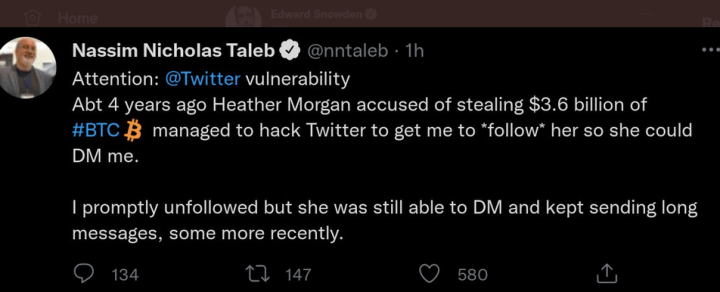
But what does any of this have to do with the author Nicholas Nassim Taleb? Well, it would have had nothing to do with him if our boy hadn’t chosen, with exquisitely poor judgment, to interject himself into the Heather Morgan/ Razzlekhan drama. Within hours of the heist news breaking, Mr. Taleb posted the following:

I have several things to say about this nonsense:

I. Check his use of “Attention” and the scare word “vulnerability.” Taleb thinks this message is super important and even urgent. He’s got to get it out there RIGHT NOW.

II. The story is obviously total BS. Taleb seems to have no sense of how Twitter works, and his narrative is so bizarre that he is basically begging us to roast him, which users in the hundreds did, of course.

III. Taleb gives no insight into why Morgan was DMing him. What did she want? Well, users, myself included, had a theory as to what might actually have occurred here. Occam’s Razor would suggest that at some point Morgan and Taleb began exchanging DMs, possibly on her initiative, as she was writing extensively for Business Insider and Forbes I believe, and maybe she wanted to ask Taleb something about one of his books. Taleb then pivoted into a bit of tail chasing, or, as one Twitter denizen put it slightly less crudely, he was looking for a little “bobs and vagine.” When Morgan was arrested, Taleb got spooked that somehow their DMs would leak, so he concocted a ridiculous cover story almost (but not quite) as stupid and unbelievable as Joy Reid’s claim that her fifteen year old blog with homophobic jokes and comments was hacked by Russians.

IV. The use of “some more recently” is a pure “tell.” Taleb’s bobs and vagineing has been going on for some time, it seems. But why in the world would Taleb think that the messages would leak just because Morgan was arrested (she was later released and her husband was held in custody, and I haven’t been able to get a status update on where she is today)? I mean there are really only two options: i) that the messages would be released by the FBI or something as pertinent to the case, in which case Taleb and Morgan would have been discussing her hacking. This seems highly unlikely; ii) Morgan would choose to release them herself in an effort to incriminate Taleb. But Nicholas baby, this is just not going to be a priority for Morgan after her arrest. I mean, she is accused of stealing 4.5 billion, and she’s got her rap career, and her husband is in prison. She has got stuff going on man; your DMs are way down the list.

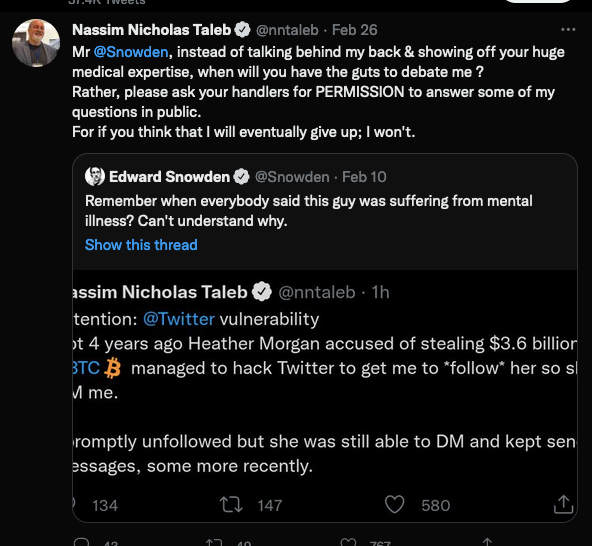
All and all, this message shows that Taleb is an idiot and a complete joke. And people took note, including Edward Snowden, piping up from Russia. Check this out:

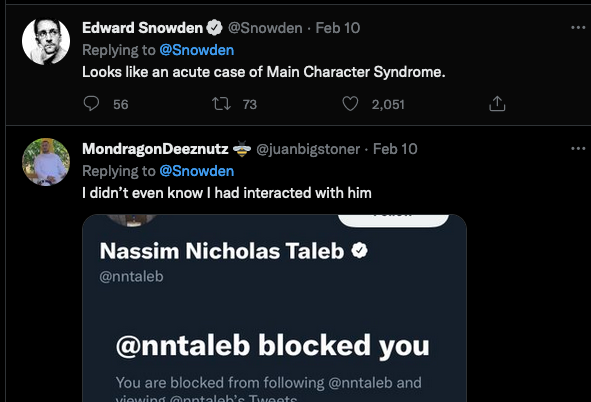
Snowden comes in with the savage take down here, and Taleb punches back with an offer to debate, what exactly? It’s not clear if this the debate challenge was issued prior by Taleb nor is it clear, at least to me, what is to be debated. Are they supposed to talk medical issues? Mental health? Hacking? Bobs and vagine? Taleb continues to make no sense, and Snowden let’s him know with another zinger:

Main Character Syndrome indeed. I would add Major Asshat Syndrome and Big Phony Fraud and Fragile Loser Syndrome as well. Because this is the guy who wrote Antifragile! Which is supposed to be about things that thrive during chaos, or in other words, things which are resilient. And nothing says resilient like faking a hacking narrative to cover your tail chasing, issuing an incomprehensible debate challenge to someone way out of your league, and tripling down with blocking random twitter users who question you. And I would know, because after I liked the bobs and vagine comment and added something like “Methinks Mr. Taleb doth protest too much,” the fucker blocked me too! Sadly that Twitter account is history so I can’t post a screenshot, however it was obvious that this huge baby was scrolling chats and mass blocking to distract from his disastrous piece of public relations. Honestly, the whole thing was super funny and Taleb showed his ass in the worst possible way.

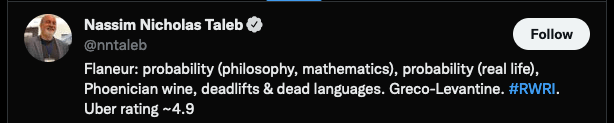
Taleb obviously thinks he is hotshit. Check out his Twitter bio.

What a poser. A flaneur is a French term for someone who walks the streets taking things in, and Walter Benjamin wrote extensively about the flaneur in his epic, and epically unfinished “Arcades Project.” Actually, a flaneur is a lot like a kibitzer. I am the Kyotokibbitzer (two b’s baby), and I love Benjamin’s work, including the Arcades Project. I bet Taleb is aware of Benjamin and fancies himself a fan. But he doesn’t know the first thing about Benjamin, because Benjamin was a humble guy who did great work and Taleb is a braggart, a tail chaser, and a bum. Deadlifts and dead languages my ass. Text is dead there Nicholas, at least your texts are, because you made a complete fool of yourself and you suck. Taleb exemplifies precisely why I dislike anyone who calls themselves a public intellectual or an expert. He is a poser and I’ll bet you 10 to 1 his ideas are stolen just like Neil DeGrasse Tyson’s, another total loser who piggybacks on people who know something to pump up his image. (A sure sign of a loser is a “public intellectual” who insists on using three names. What’s wrong with Nicholas Taleb or Neil Tyson? The only people who need three names are serial killers; I mean even public intellectual number one Malcolm Gladwell only uses two names. Gladwell is known to pilfer ideas as well, but The Tipping Point is a pretty good read and the dude genuinely knows a tremendous amount about the sport of running. And he doesn’t call himself “Malcolm Julius Gladwell” or whatever. This is because he’s just a writer and knows that using his middle name would make him a prat.) Anyway, it’s totally fine to fake it ’til you make it, and most of us do to a greater or lesser degree, but you can’t fake your way into being an expert. Never trust “experts,” full stop.

So that’s the story of Razzlehan, the misunderstood genius, and Nicholas Taleb, the big phony. And in case you are asking, yes I did ask Razz to get in touch with me above. I’d say “I can fix her,” but she needs no fixing. She can DM me all she wants, and she doesn’t even have to get the Russians involved.

Dedication:

For Razz. You rule baby. So damn hard.

The Days and Nights of the 50s, 7/25/26. He Gets on Base.

Epigraphs:

So you wanna get out?
Let me draw a map

–Superchunk

Good sex it never makes you feel hollow
Good sex it never makes you clean

–Kevin Drew

I watched your face die backwards
Little baby in my memory
You told me victory’s sweet
Even deep in the cheap seats

–Conor Obrest

I. Morning

I slept better than I have in a long time. As best as I can recall, I went to bed around 12:40 AM. and woke up around 6:40 AM. Six hours is not necessarily a full night’s sleep, but lately it has felt like a luxury. I woke up clear-headed, made coffee in my room, and headed down to the Lawson around the corner for another one. I picked up some potato chips while I was there, wandered back to the hotel, and settled into the morning.

The first order of business was practical. I checked my messages, replied to my son Hugh, and told him I’d be happy to swing by home on Monday as long as he let me know what time he expected to be home. “Love, Papa,” as always. I checked in on Elliott as well. Nothing had changed. As of this writing, we’re still meeting at 6:30 this evening at a beer bar in southern Osaka, and I am looking forward to it.

Once these logistics were out of the way, my mind drifted, as it sometimes does, toward movies and television.

I started thinking about The Sopranos. I’ve watched this show all the way through twice, and I’ve revisited a number of episodes over the years. I think James Gandolfini and Michael Imperioli both give remarkable performances, and there are many individual scenes I genuinely love. Even so, I’ve gradually realised that David Chase’s aesthetic simply isn’t mine. Whether the repetition is intentional or not—and I suspect it is—I find both the storytelling and the character arcs to be cyclical.

The performances remain compelling, but the show continually circles back over the same emotional territory. I understand why so many people consider it one of the greatest television dramas ever made. I don’t. I like it and I’m glad I watched it, but I don’t imagine I’ll ever watch the series again.

Thinking about The Sopranos naturally led me to the dialogue that has stayed with me over the years. Not necessarily the greatest lines ever written, but the ones I find myself returning to.

Roger Wade, in The Long Goodbye, pours two glasses of anisette and says to Philip Marlowe, “Take that goddamn J. C. Penney tie off.”

Marlowe calmly replies, “I’m happy to drink with you, but I’m not taking my tie off.”

I don’t know why I love that exchange so much, but I always have.

Another favorite comes from Godfather II. Michael Corleone’s sister comes to him with her new boyfriend Merle to ask Michael for money.

“Connie, I don’t know this Merle. I don’t know what he does. I don’t know what he lives on. Tell him you’re never going to see him again, and come and live with me in Tahoe.” She does of course. It’s funny, oddly romantic, a little menacing, and super funny.

Then there’s The Wire. Bodie has always been my favourite character, and one of my favourite exchanges comes in Seasons 3 shortly after Cutty gets out of prison.

“I’m surprised Avon lets y’all get your heads up.”

Bodie shrugs.

“Sometimes you got to.”

Four words. An entire philosophy.

Seinfeld contributes one as well. Kramer proudly shows Jerry his silk boxer shorts and encourages him to buy a pair. Jerry politely declines.

“No thank you. They’re just a little too delectable for me.”

Perfect.

Finally, there’s Michael Clayton. Arthur Edens has come apart at the seams strips off in the deposition room. Michael flies to Wisconsin to rescue him, and after a brief argument simply says,

“Let’s get out of Milwaukee and we’ll talk about it.”

Sometimes a single sentence can contain an entire friendship.

As I thought about these great quotes, I realized something that hadn’t quite crystallized before. I don’t dislike slow films. I dislike static ones. I love Tarkovsky, but I don’t love all of Tarkovsky equally. Mirror and Stalker feel alive to me. Nostalghia does not. Likewise, I don’t need constant action, but I do need movement—emotional, philosophical, psychological, narrative. I want to feel that a story is becoming something different from where it began.

That, I think, is the aesthetic I’m really chasing. After that my thoughts wandered to Craig Finn, the singer-songwriter who heads the Hold Steady.

The first Hold Steady song I ever heard was “Sequestered in Memphis.” At the time I misunderstood the entire premise. I thought the narrator was giving an interview to a journalist rather than being questioned by the police. Looking back, it seems obvious, but it never occurred to me then.

What always stayed with me, though, was a single line:

In barlight she looked alright. In daylight she looked desperate.

I’ve know exactly what Craig means here. I’ve been there too.

By then the morning had slipped away from me. As of this writing, I’m still working on my essay, Am I Bisexual? It should probably have been published two days ago. It’s one of the more complicated pieces I’ve written in a while, and I’d rather finish the edit properly than rush it out simply to keep the daily streak alive.

The plan from here is straightforward. I’m going upstairs to keep editing for another hour or two. I’ll get organised, probably grab a short nap later this afternoon, and then head down to southern Osaka in plenty of time to meet Elliott at 6:30.

Everything else can wait.

II. Afternoon

By nine I’d finally stopped putzing about I was about to start. I rearranged the room one more time, put on Neil Halstead instead of Ryan Adams, then Ryan Adams instead of Neil Halstead, opened three browser tabs, closed two of them, looked at hotel dates, thought about escorts for exactly as long as I had promised myself I wouldn’t, and somehow convinced myself this counted as preparation.

It did, in a way. Every writer has their rituals. Mine mostly involve avoiding the sentence I’m about to write.

I remembered a much loved Superchunk lyric:

“So you wanna get out / well I’ll draw you a map.”

This turned out to be the whole morning. Dude if this place sucks so bad just jet. I’ll buy you and Amtrak ticket. Seriously bro. Hit the brinks.^

The next few days existed only as pencil marks: maybe Osaka until Monday, maybe longer, maybe Pattaya, maybe Litz, maybe Hugh, maybe Mio. None of it fixed. Just possible roads branching away from the same hotel room.

The night before, Litz had mentioned how much she loved the ending of piece I wrote about her. I had already mostly forgotten this part, so I took another look. It went like this:

The challenges in our relationship are the product of two imperfect people, each bringing old habits, old fears, old hopes, and old wounds into something new. This is not failure. It is simply the complicated business of being human.

I made it halfway through before I started crying. Not dramatic crying. Just enough that I had to stop reading. Sometimes a paragraph waits until you’re ready to understand what you wrote.

III. Early Evening:

Around 6:30 this evening, after working for about an hour and a half on the edit of yesterday’s journal, I walked a few minutes from my new hotel to a nearby convenience store to get something to drink.

Several hours earlier, I had texted my friend Elliott to ask whether he wanted to grab a drink tomorrow night. As I walked to the store, he replied that he was up for it and suggested a beer bar in southern Osaka. I told him I would meet him there.

Thinking about Elliott, I reflected on how much I admire his intelligence. I am a high school teacher, and Elliott used to be one of my colleagues. He left the school years ago and now tutors economics online and manages various investments. He also used to teach mathematics.

I am a social studies teacher. Over the years, I have taught a wide variety of classes, and I feel that I could adequately instruct students in almost any area of social studies. Elliott’s mathematical intelligence, however, has always struck me as remarkable.

In fact, I sometimes envy the mathematics teachers I have known, because mathematics is simply not one of my strengths. I was a decent math student for a time, but I hit the wall with calculus during my junior year of high school and never took another math class. Today, I almost never use mathematics except for the calculator on my phone and a little basic financial housekeeping.

This does not mean that Elliott is smarter than I am. I consider myself highly intelligent. Nonetheless, several times over the years, I have wondered whether he might indeed be smarter than me.

Thinking about it today, I realized that this is probably because his intelligence expresses itself very differently from mine. If I absolutely had to, I could probably relearn enough mathematics to teach middle school. That would be about my limit. Elliott is whip-smart and could probably teach most of the social studies classes I have taught without too much difficulty.

I often reflect on how strongly my intelligence expresses itself in certain areas of life, while in others I am essentially incompetent. I have a solid understanding of subjects such as history, politics, philosophy, psychology, religion, and metaphysics. However, I could not change a tire to save my life.

Although I am not exactly made of money, I almost always call a professional to handle household tasks such as fixing a faucet or clearing a drain. I find these jobs to be a tremendous hassle. In fact, they piss me off. I am happy to pay someone a few dollars to come and sort them out.

As I entered the convenience store, my thoughts turned to the screenwriter Aaron Sorkin. Sorkin is one of the greatest television and film writers of all time. I love The West Wing and The Social Network, and I have enjoyed much of his other work. For reasons of his own, however, Sorkin insists on directing some of his films.

He wrote and directed Molly’s GameMolly’s Game sucks ass. The script is incomprehensible and all over the place. It is, without question, the worst piece of writing he has ever produced. The direction is equally terrible. The characterization is weak, the emotional beats are overdone, and the entire film is syrupy and sappy. I cannot stand it.

A second film of interest here is The Trial of the Chicago 7, which Sorkin also wrote and directed. The script is actually quite good, and the acting is strong. Once again, however, Sorkin’s direction is awful.

The film concerns the protests surrounding the 1968 Democratic National Convention in Chicago. I was not alive at the time, but my understanding is that thousands of protesters gathered in the city, largely in opposition to the Vietnam War and to the Democratic Party’s handling of it. The police responded with tear gas, clubs, arrests, and widespread violence. Some protesters fought back, and things became extremely ugly.

There are only a few major action sequences in the movie. Sorkin’s handling of them is pure trash. He has no idea how to direct physical chaos. The cameras are always in the wrong place. It is difficult to tell where anyone is or what is happening. The entire thing feels out of control, and not in an intentional way.

Molly’s Game is a bad movie, and I do not care. The Trial of the Chicago 7 could have been a good movie with competent direction. Sorkin was simply not the man for the job.

As I walked back to my hotel, I began thinking about how strange it is that otherwise intelligent people, for reasons of ego, ambition, or simple misjudgment, sometimes insist on doing things at which they are obviously bad.

Then I thought: Well, I have probably done this too.

There have certainly been times when I believed I could handle something and ended up over my skis. I suspect this is true of everyone. We all have strengths and weaknesses, and intelligence manifests itself in different ways.

Over time, I have tried to learn how to pick my spots and stay in my lane. I do not always succeed. However, I hope I do a better job of it than Aaron Sorkin.

IV: Evening Back at My Hotel

As I walked to the train station to go meet Elliot I called Annie. Annie has always been completely outta control, and she absolutely loves it. Within five minutes she’d decided to crash her ex-husband’s wedding in a tent, seduce one of the guests, reminisced about working at Spokane’s Mars Casino, told me stories involving cocaine, dresses, gambling, and an older gay man who’d taught her “everything about sex,” invited me to her hypothetical future wedding, and, after I jokingly suggested we skip straight to sex ourselves, said she’d think about it. Talking to Annie has always been like standing beside a fire hose. The stories don’t really have beginnings or endings. They simply arrive.

The morning passed quietly. I answered a message from my brother Hugh, who was planning to stop by the house in Kyoto sometime during the coming week, and sent a few encouraging replies to several women I’d been chatting with online. One woman in the Philippines was hoping to find work overseas in Singapore or Malaysia. Another, somewhere in Thailand, simply wanted to know how my morning was going. Others had drifted into that peculiar limbo occupied by most dating-app conversations: friendly enough to continue, but unlikely ever to become anything more.

After a while I found myself scrolling through far more conversations than I probably should have. Dating apps create the illusion that your social world is constantly expanding, when in reality most interactions simply fade away after a few messages. Every now and then somebody surprises you, but most conversations end not with an argument or rejection, but with simple inertia. Nobody does anything wrong. Life just moves on.

Perhaps that’s why I no longer find the process frustrating. Years ago I probably would have chased every lead, replied to every message immediately, and wondered why nothing seemed to develop. These days I treat it more like browsing a bookstore than shopping for groceries. If something genuinely interesting appears, wonderful. If not, I’ll probably enjoy my coffee just as much.

My musical companion for the morning was Craig Finn. I first discovered him through “Sequestered in Memphis,” and, like many first-time listeners, completely misunderstood the song. I thought the narrator was speaking to a journalist after a reckless night in Memphis. Only later did I realize he was being questioned by the police. Somehow that misunderstanding didn’t lessen the song; if anything, it made me appreciate Finn’s writing even more. His characters are so vividly drawn that they feel real even when you’ve misunderstood the plot.

One line has always stayed with me: “In bar light she looked alright. In daylight she looked desperate.” Finn is ostensibly describing someone else, but the brilliance of the lyric is that it cuts both ways. By dawn, they’re both desperate. We’ve all had moments where the previous night’s confidence evaporates with the morning light. Finn simply found the perfect sentence to describe it.

V: On the Way to See Elliot

After finally giving up on the day’s editing, I showered, threw on a clean shirt, and hurried toward Taishō, where I was meeting Elliott at a craft beer pub called TNT. I was running a few minutes behind schedule—as usual—but Elliott has never struck me as the sort of person who minds waiting over a pint. I figured I’d make up the time somewhere between the hotel and the station, although experience suggested otherwise.

The train ride became one of those familiar periods of suspended possibility. While checking directions and changing lines, I also found myself checking dating apps, replying to messages, and idly wondering what the rest of the evening might bring. If everything went perfectly, I’d spend a few hours drinking good beer with Elliott, head back toward my hotel, and perhaps finish the night with a date. It wasn’t exactly a plan so much as several loosely connected possibilities competing for my attention.

Somewhere between stations my thoughts drifted to Tomoyo, one of my former students whom I’d seen again at the book launch. We’d nearly gone out together once before, years after she’d graduated, but circumstances had gotten in the way. Twenty years have now passed since I first taught her, which removes any ethical hesitation I might once have felt. I found myself wondering whether I should simply ask her out the next time I am in Tokyo. Sometimes life becomes unnecessarily complicated because we spend too much time calculating the odds instead of asking straightforward questions.

That seemed to be the theme of the journey. I checked my bank balance, priced a few possibilities for later that evening, briefly reconsidered future trips to Thailand and even South Korea, nearly walked the wrong way through a station, and at one point came within a few feet of being clipped by a taxi while jaywalking. None of it mattered very much. My mind was simply ricocheting from one possibility to another while my body steadily carried me toward a beer with a friend.

By the time I emerged from Taishō Station, the mental static had largely disappeared. Elliott was waiting, the pub was less than a minute away, and for the next few hours the only decision I intended to make was which beer to order first.

=====

The Osaka Loop Line has a hypnotic quality after a while. Every minute or two another calm recorded voice announces the next station, another transfer, another reminder to mind the gap. After ten or fifteen minutes the words stop meaning anything. They become part of the rhythm of the journey, almost musical, drifting in and out beneath whatever happens to be occupying your thoughts.

Mine, for reasons I still can’t explain, wandered toward negative igloos.

I have absolutely no idea what a negative igloo is. I have never knowingly encountered one before or since. It arrived fully formed, demanded my attention for perhaps fifteen seconds, and then disappeared forever, leaving me no wiser than before. If someone were to ask me today what a negative igloo might actually be, I honestly couldn’t begin to answer. Nonetheless, somewhere between Kitahama and Taishō, negative igloos briefly became the most important concept in my universe.

The rest of my brain was scarcely more coherent. Ryan Adams was singing Drank Like a River, and I found myself thinking about the tiny crack in his voice—that moment where it sounds less like he’s performing a song than remembering something he’d rather forget. Some singers sound polished. Ryan often sounds wounded. There’s a difference, and it’s one of the reasons I keep returning to his records.

Then, just as suddenly, I realized I had absolutely no idea where I was.

I’d somehow missed my stop, wandered out the wrong exit, and was now standing in a station that looked vaguely familiar while possessing almost no useful geographical knowledge whatsoever. Google Maps insisted I was only two minutes away from Elliott. My instincts insisted otherwise. My instincts, it should be noted, have an unfortunate habit of arguing with Google.

For a few minutes I experienced what I can only describe as a minor travel panic. Not real panic—nothing so dramatic—but that familiar sensation every traveller knows, where every street begins to resemble every other street and every directional arrow seems specifically designed to send you somewhere else. I walked one way, doubled back, checked Google again, ignored Google, trusted Google, ignored it again, and somehow managed to end up exactly where I’d started.

Meanwhile my thoughts continued their usual pinball routine. Was the Sony credit card finally on its way? Should I spend part of August in South Korea instead of Bali? Would Yo still be available later that evening? Why hadn’t Jennifer replied? Why did Meinster have time to send me promotional emails but apparently not royalty statements? None of these questions had anything whatsoever to do with finding a pub in Taishō, but my mind saw no reason to separate one subject from another.

Eventually I admitted defeat and messaged Elliott. Dude I am totally lost. His reply arrived almost immediately.

Where are you?

It was the perfect question because I genuinely didn’t know.

Google claimed I was standing practically on top of TNT Craft Beer Pub. My own eyes suggested I was standing outside an Irish bar that definitely wasn’t TNT. For a brief moment I began to wonder whether the pub existed only as a cartographical rumour.

I texted him back and said I was looking at Taisho Station. He said he would be right there. One minute later I saw him across the street and crossed to meet him.

When Elliott finally rescued me from my navigational incompetence, TNT turned out to be exactly where Google had insisted it was all along. The fault, as usual, lay somewhere between the phone and the human operating it.

“You’re hopeless,” he said.

“I prefer ‘geographically imaginative.'”

He laughed. “Come on.”

One minute later we were golden.

VI: TNT Craft Beer with Elliot

The pub was everything I hoped it would be: a long wooden bar, a dozen taps of rotating local craft beers, a cheerful bartender in a baseball cap who somehow managed to keep everybody’s glass full without ever looking hurried. When one of the kegs kicked halfway through pouring my pint, she apologized and handed me the remainder for free.

“Sorry” she said.

“No worries,” I said. “I’ll always take half a beer for free.”

She laughed.

“I like your hat,” I said.

“I get that a lot,” she said.

I turned to Elliot and asked if he wanted to hear a joke.

“A shepherd is in bed with his girlfriend for the first time. She asks him, ‘How experienced are you?’ He closes his eyes…starts counting…and falls asleep.”

The bartender laughed.

Elliott buried his face in his hands.

“Please,” he said, “never change.”

“I make no promises” I said.

By the time the quizmaster welcomed everyone, we’d accumulated enough empty glasses to suggest we were taking the evening seriously while simultaneously possessing almost no confidence in our ability to answer questions about anything.

“What’s are name?” Elliot asked me.

“How about the Glorious Mofos?”

“Of course.”

“Ladies and gentlemen,” the quizmaster announced, “welcome!”

“He seems enthusiastic,” I whispered.

“He’s paid to be.”

We were spectacularly mediocre.

Spain had won something. Bananas were radioactive. Kobe Bryant was apparently named after Japanese beef. Beyond that we entered a sort of intellectual free fall.

“What do you think?”

“No idea.”

“You?”

“Less than no idea.”

“Write banana.”

“I already did.”

“Excellent.”

Our strategy rapidly evolved into letting Elliott answer the questions that sounded plausible while I concentrated on drinking beer, admiring the bartender, and periodically checking whether Yo had confirmed our appointment.

At one point Elliott looked over my shoulder.

“You’re really going after this?”

“I think so.”

“You ever think about…you know…not?”

I considered that.

“For about three seconds.”

He laughed.

“I thought so.”

That was one of the things I’d always appreciated about Elliott. He never judges. He asked questions. Usually he agrees with me. Other times now. Occasionally he looks at me as though I’ve completely lost my mind. But whatever I do he never tries to become my conscience. Old friendships eventually settle into that rhythm. You stop trying to improve each other and simply learn to enjoy each other’s company.

The conversation drifted from Japan to Canada, from the weather to my girlfriends, from travel plans to parents. I vented a little about my mother bitching about my writing. Elliott listened more than he spoke, occasionally nodding, occasionally smiling in that understated Canadian way that somehow communicated, I don’t entirely agree, but I understand why you’re upset.

By the time the second round ended, I’d glanced at my watch three or four times.

“You’ve got somewhere to be,” Elliott said.

“I might.”

“You definitely do.”

“Indeed I do.”

He grinned.

“Go lose your T-card.”

I laughed so hard I nearly spilled my beer.

“I’ll report back.”

“You’d better.”

We settled the bill, shook hands outside TNT, and headed in opposite directions. Elliott toward another ordinary Saturday night. Me toward Umeda, where Yo-chan was waiting.

VII: On the Way to See Yo Chan

As I entered Taisho Station the JR announcements began their familiar chant once again.

The next stop is…

Somewhere between stations my mind wandered back to negative igloos. I still have absolutely no idea what one is.

The JR announcer continued serenely informing us that the next stop was Kyobashi, or Osaka Castle Park, or somewhere that probably existed. In my head it became:

“Please enjoy negative igloos. Transfer here for the glorious nonsense line. Please exit on the right.”

“Yeah, yeah,” I muttered. “I got it.”

I did not, in fact, have it.

Somewhere between the craft beer and the heat, I’d managed to convince myself I’d fallen asleep on the train. Maybe I had. Maybe I hadn’t. Either way, I suddenly had absolutely no idea where I was.

Oh, shit.

I checked Google Maps again. Every time I opened it, it confidently gave me a different answer.

“Seventeen minutes.”

I calculated that I would get to the shop about five minutes early. This turned out to be off. The announcer cheerfully reminded us to mind the gap.

“I’m trying to mind all the gaps.”

I got off the train and looked around. Then decided getting off had been exactly the right decision. I checked the train map on the station board. I was also seventeen minutes past Umeda. Oh great. Back we go.

I thought to myself: I need cash. Then a taxi. Then a cigarette. Possibly in that order. First I had to get back to Umeda.

The train came and I rode the short distance back. The instant I stepped onto the street, I lit a cigarette and hailed a cab. I had just a fee drags when a cab pulled up and I had to toss the cig.

The taxi driver nodded when I said, “Umeda.” Progress. Seven minutes, Google claimed. For once, we agreed. As the cab rolled through the humid Osaka evening, I realized I was no longer worried about getting lost. I was worried cause I was a little late.

I’d spent the entire afternoon imagining meeting Yo chan, and now my grand entrance was shaping up to be me arriving slightly sweaty, smelling faintly of cigarettes and carrying too little cash.

Great first impression I thought.

The driver dropped me exactly where Google said he would. Google immediately betrayed me again.

Fourth floor. I found the fourth floor. Everything was locked. No people. No reception. No Yo-chan. No nothing.

Just an eerily quiet hallway that felt like the set of a film where everyone had disappeared moments before I arrived.

I called the shop.

“I’m here.”

A reply came back almost instantly.

“First floor. It’s hard to find.”

No shit.

A guy walked over and picked me up. We walked five minutes to where the shop really was, no where near where Google said it was. Typical. This guy knows nothing. Apparently.

Five minutes later I found the place.

VIII: Yo Chan

The shop staff took me up in the elevator to the 7th and opened the door to room 701. For some reason I found this number to be fitting. There was a shower but no sink. I took my own clothes and began to rinse off. Yo chan soon entered the room. She looked like her picture, but not quite. The agency website said she 24, a fact she confirmed in person. She looked about 28 to me, and I supposed her life was perhaps not the easiest.

I found her attractive, and knew I would be able to cum. She joined me in the shower, soaped up, and began to stroke my dick. In general, I prefer to handle my equipment. It is a sensitive area, and I just know it best. I turned my back to her, and then a minute later I stepped out and toweled off. She followed shortly thereafter.

As we stepped out of the shower, she assessed my naked body. She said, “You look like Boris Johnson.” I laughed away and didn’t reply. I decided then that there were some conversations not worth extending.

We climbed onto to bed. I was already erect, and she was at half mast. She unwrapped a condom and slid it on my dick. I had never sucked anyone’s dick before, and I was both exited and just a little nervous.

We began kissing. I like a bit of tongue during kissing, however, her tongue was a little aggressive. Oh well I thought, kissing, at least tonight, would not the main event. I broke the kiss, and went down on her. She was semi-erect, however I was able to fit her full penis into my mouth. The first thing I noticed was her large foreskin. The second thing was, the act was neither pleasant nor unpleasant, and she tasted neither good nor bad. I was eager to make her cum.

After a bit, she motioned for me to come back up to the head of the bed. She climbed back on top of me, and slid my dick into her ass. She had applied lube to her asshole, and hard dick slid in easily. After a short amount of time, I asked her to turn around and entered her from the rear. She began to moan and pant, and I found this very sexy. I was about to cum, and then, as I usually, do, I pulled and finished on a towel while sitting on my knees.

I then collapsed back the bed. She also sat on her knees, and came on the towel. Some of her cum landed on my leg, which I found faintly amusing. After this, I needed a cigarette. There was no smoking in the room so I asked her if I could go downstairs. She said sure, just pick me up a Pocari Sweat and call reception to get back up. I told her I would be back in five minutes, however I knew this was a lie. The fact was I would smoke three of four cigarettes and decompress for a while. This was about an hour into our date, and I had paid for ninety minutes. I did not want to re-engage in sex, so smoking and thinking quietly seemed like a good plan.

When I stepped back onto the street, the wind had gone out of my sails. Not in a bad way. Just…gone. For most of the day I’d been propelled by anticipation. Catch the train. Find Elliott. Don’t get lost. Meet Yo chan. Get the cash. Find the building. Try not to make an idiot of yourself. Then, just like that, there was nothing left to chase.

Osaka was still humming around me, but I’d become a spectator again. I checked the time on my phone. It was 12:30 AM. This immediately made me think of the Katheryn Bigalow film Zero Dark Thirty. I found myself thinking about Zero Dark Thirty. I’d never understood the criticism that it somehow endorsed torture. Showing something ugly isn’t the same as celebrating it. A film can portray violence honestly without recommending it, just as Goodfellas isn’t an argument for joining the Mafia. Sometimes a story simply trusts the audience to tell the difference.

I ducked into a nearby convenience store and bought two Pocaris, two beers, a burrito, and a pack of pack of cigarettes. I smoke another heater and drank one of the beers on the street. Then I called up to reception. There was no security, and I did not see any other customers the whole time I was there, however, at least time, I did what I was told.

Back in bed with Yo, we both undressed again and she fell asleep. I found our legs entwined. He body was very comfortable, and I can honestly say this was the sweetest part of the evening.

She woke up and pointed at the clock. It was time to go. We dressed and walked to the elevator. I leaned to give her a goodnight kiss, and she kissed me back, lightly. This was goodbye.

=====

It was after last train, so I got a taxi back my hotel near Yodoyabashi Station. The taxi rolled silently through the warm Osaka night I leaned my head against the window and watched the city slide by. Tomorrow I’d probably throw myself into another impossible plan, another train, another woman, another glorious and bizarre day. I was, by this point, quite tired.

A few hours earlier I’d been arguing with Google Maps, inventing negative igloos, convincing myself I’d missed stations that probably never existed, and experiencing a full-blown case of what I can only describe as travel boggle. Now all that urgency seemed faintly ridiculous. The date had happened. It had gone OK. I lost my T-card. I’d survived.

Travel does that. What feels catastrophic at eight o’clock becomes a mildly amusing anecdote by twelve-thirty.

But for the moment, there was nowhere I needed to be.

IX: Late Night Hotel and Bed

Back in my room I took off my shirt, washed up, and prepared for bed. For reasons I can’t entirely explain, my thoughts eventually wandered toward football. I’ve always enjoyed the sport, even if basketball remains my first love, and one of my earliest football memories comes from a Washington State game against Stanford. My mother, Claudia—CL to longtime readers—was friendly with Janet Elway, John’s mother, and at one point Janet served as something of a mentor to her. Through that connection, we ended up at the game while John Elway was still Stanford’s quarterback.

Before kickoff, Elway apparently told my mother that if he threw a touchdown, he would point toward us in the stands. Naturally, he did throw one. He was John Elway, after all. And after the score, he looked up and pointed in our direction while we yelled ourselves hoarse. I was still rooting for Washington State, which complicated the moment slightly, but even then I understood that we were watching somebody exceptional.

Elway went on to become one of the defining quarterbacks of his generation, first at Stanford and then during a long NFL career with Denver. What stays with me, though, isn’t the statistics or the championships. It’s the strange intimacy of that afternoon: my mother’s connection to his family, the promise made before the game, and the tiny gesture toward the stands after the touchdown. Sports are full of enormous public moments, but the memories that survive are often the small private ones folded inside them.

I claimed into bed, and indulged in one final reflection for the day. I thought about how funny it was that one minute you are deep in the throes of passion, moaning and panting your partner’s name, and the next you are smoking a cigarette, drinking a beer, and thinking about Zero Dark Thirty on the street. Sex, which feels so wonderful and necessary at the time, does tend to recede pretty quickly. However, the power of good sex, as Kevin Drew says in out epigraph, cannot be beat.

Dedication:

For Yo chan. Thank you for taking my T card baby. Godspeed. You rule.

The Days and Nights of My 50s I: 7/20/26, the Unwritten Libretto.

Author’s Note:

Five days ago, I made what may prove to be the most important professional decision of my life.

For months—years really—I had been thinking about giving up my teaching career and becoming a full-time writer. I have talked to many of my family and friends about this and taken several small steps in this direction. I recently published a novel, have written and published hundreds of essays, and written almost every day for eighteen years. I have hundreds of pages of dream records, journals and letters, some sent and some only in draft form. I am hard at work on the sequel to my first novel, and am currently working on five books with many more in the making.

Over this time I have also become very good at making excuses. School is too busy. Life is complicated. The timing isn’t quite right. Next month. Next term. Next year. One day. It was all true, and yet it barely matters. A few days ago, I finally admitted what had been staring me in the face for a long time: if I wanted to call myself a writer, I had to stop waiting for someone else to make that decision for me. Whether I eventually succeed or fail is almost beside the point. The decision itself changed something in me. I stopped thinking about the life I wished I had and started taking responsibility for the one I actually have.

Today wasn’t the happiest day of my life, nor the saddest. It wasn’t the day I got married, the day my son was born, the day I published my first book, or the day I realized my marriage was ending. Objectively speaking, it was an ordinary Monday in Osaka. I listened to music. I wandered the city. I shared dinner and my bed with a woman whose path happened to cross mine for a couple of hours before diverging forever. By tomorrow morning she would be somewhere else, and so would I. Yet somewhere between checking into a modest hotel, thinking about my future, and sitting alone quietly after she left, something finally clicked. My teaching career is rapidly coming to a close. The marriage that defined most of my adult life is over. The books I dream about haven’t been written yet. The cities I may someday call home are still only possibilities. The people who will matter most over the next twenty years are, at this moment, complete strangers.

For the first time since I was a young man, there is no obvious script. That realization is exhilarating. It is also terrifying. Most of all, it is deeply liberating.

So this seems as good a place as any to begin this series.

Epigraph:

Yesterday is history. Tomorrow is a mystery.

Anonymous

Anything could happen.

Bash and Pop

I: My General Situation As of Today

For the better part of thirty years, my life had possessed a remarkable amount of structure. I graduated from college. I moved to Japan. I found a teaching career almost by accident and stuck with it for a quarter of a century. I got married, and my wife and I bought a house together in Kyoto. We raised a wonderful son together who we both love more than words can say. We have paid bills, argued over groceries, worried about our dear dog Daisy, taken vacations when we could afford to, and slowly accumulated the ordinary rituals that eventually become a life. There were wonderful years and there were difficult ones, but there was almost always a next step waiting patiently in front of me. Whether I liked the script or not, there was a some kind of a script.

Then, almost imperceptibly at first, it disappeared.

My marriage ended not with a single dramatic explosion but with the gradual realization that two decent people could simply reach the end of the road together. My teaching career, once the defining feature of my adult identity, began to quietly recede into the background. Friends scattered across countries and continents. My parents grew older. I turned fifty-two without feeling especially old, but with the unmistakable sense that I had entered the second half of whatever story remained.

It is a peculiar thing to discover that freedom and uncertainty are twins. For years I imagined freedom as something uncomplicated. Finish work. Write books. Travel. Meet interesting people. Drink coffee in strange cities. Listen to music until two in the morning. Wake up whenever I pleased. Answer to no one.

There is truth in that fantasy. There is another truth as well.

Freedom also means that no one hands you tomorrow. No institution is waiting to promote you. No family obligation automatically determines your next decision. No invisible current carries you downstream. Every meaningful choice becomes your responsibility. Every success belongs to you. Every failure belongs to you too.

That realization can feel less like opening a door than standing on the edge of a cliff. You can step forward. Or you can spend the rest of your life admiring the view. Five days before the evening you’re about to read about, I decided I was done standing still.

I wasn’t retiring, not yet anyway. I wasn’t exactly reinventing myself. I wasn’t chasing some impossible dream. I was simply acknowledging something that had probably been true for twenty years. I am a writer. I feel like I was born to be one. Whether anyone else eventually agrees is, in many ways, beside the point. The work itself has become the destination. Everything else—the cities, the books, the women, the music, the bars, the victories, the humiliations, the friendships, the failures—is simply material for my work.

This series is an attempt to pay attention to the contours of my daily life, in whatever form the may take. And, perhaps for the first time in my life, to trust that the story doesn’t need an outline before it begins.

II: Osaka

Osaka has always felt different to me than Kyoto.

Kyoto is the city where I built my adult life. It is where I have worked, and lived for more than twenty years with my life and son. It is where the mortgage was paid and our dog was walked, where ordinary afternoons quietly accumulated slowly into decades. I know its rhythms inside and out. I know which coffee shops open early, which bridges are worth crossing at sunset, and where to stand beside the Kamogawa when I need to remember that almost everything eventually passes.

Osaka has always been to me something else entirely.

It has never asked me to be responsible. When I come here, I feel somehow lighter. Less like a teacher. Less like a husband. Less like the man who spent twenty-four years inside the same corporate institution. Osaka has always given me permission to become, if only for a day or two, a slightly different version of myself. Not a better man or a worse one. Just someone with fewer expectations resting on his shoulders.

Perhaps every city we visit has a role to play in our lives. Kyoto has been my home. Tokyo has often been a dream. Singapore has long been my favorite escape. Osaka, though, has become my intermission. A place where I can step off the stage for a little while before the next act begins. A place to just get away.

This Monday afternoon I checked into a small APA Hotel not far from Shinsaibashi Station, which I affectionally call Mr. Shin. Like most APA hotels, it is clean, efficient, and just a little too compact. The room isn’t exactly designed for lingering. It is designed for sleeping, showering, and moving on. My suitcase for neatly against one wall. The desk is barely large enough for my laptop and a cup of coffee. The large television in front of my bed I will barely use. It suits my current mood perfectly.

I took a taxi to the hotel from Shin-Osaka Station and arrived around 7:30 PM. I dropped my overnight bag on the floor, drew the curtains apart, and looked out over another slice of Osaka. Nothing spectacular. Just traffic, apartment buildings, and the quiet machinery of a city getting on with its day.

I remember thinking how strange it felt to have absolutely nowhere I needed to be. No lesson to prepare. No meeting to attend. No papers to grade. No one waiting for me at all.

That realization no longer frightened me the way it once might have. It felt… spacious. There are moments in life when freedom announces itself with fireworks. This wasn’t one of them. It arrived almost silently. Like an empty afternoon. Like a city that has never asked me to explain myself. My hotel room is simple. It is what I can afford.

Outside, Osaka continued exactly as it always had. Inside, almost without me realizing it, the next stage of my life had already begun.

III: Meeting Yuki

I should flash back briefly here to introduce my date for the evening. There are evenings that require months of planning. This was not one of them.

The plan, such as it was, consisted of very little. Conversation. Sex. Cigarettes. Dinner. That was enough. As I stepped out of the taxi, I saw her standing quietly on the street.

She was slightly built, dressed in a simple black skirt, and carried herself with the quiet confidence of someone accustomed to meeting complete strangers. There was no dramatic meeting, no cinematic slow motion, no instant thunderbolt. We smiled, introduced ourselves, and within a minute or two were walking side by side into the hotel through the warm Osaka evening as though we had agreed to meet as old friends rather than someone we had never laid eyes on before.

Her name was Yuki.

We went up to my room and made the sort of awkward conversation that strangers always make at first. Where are you from? Where do you live today? Had I been to Osaka often? Was I enjoying the summer?

Nothing remarkable. Which, in retrospect, was itself remarkable. There is something deeply comforting about ordinary conversation. For a little while, neither of us had to be anything more than two people just getting to know each other.

Eventually, because pretending otherwise would have been absurd, the reason we had met entered the conversation. She is thirty-six and works as an escort. I had hired her for the evening.

There is no point dressing those facts up in prettier language. They are neither the whole story nor something I feel any particular need to defend. They simply belong to it. Human lives are untidy. We make decisions for reasons that are sometimes noble, sometimes lonely, sometimes curious, and sometimes impossible even to explain to ourselves. This was one of mine.

I went into the bathroom to wash up, took my clothes off, and hung them neatly on the hangers on the wall. By the time I came out of the bathroom she was naked too. That was what we were there for. I put on one of my favorite bands Whiskeytown, lay back on the bed for a few minutes, listened hard, and let the sweet sweet sounds of Ryan Adams’ voice wash over me. I was, briefly, in heaven.

Then, inevitably, we began to kiss. She is a smoker and tasted like stale tobacco and faintly like green peas. I am a smoker too so I am sure I tasted the same. She unwrapped one of the condoms that I had bought earlier for occasions just like this and began to pleasure me with her mouth. While I do enjoy oral sex to some extent, it is far from my favorite sexual act and I have never been able to cum this way. Not for lack of trying, I simply find that the women who have performed the act on me can never sufficiently been able to get their teeth out of the way. It is not their fault at all, but it is just that simple.

Soon enough, I asked her to climb on top of me. My penis was already erect and she was slick as well, and I entered her cleanly and easily. After a little while, we flipped around and began to engage in the missionary position. I was on the urge of cumming when I pulled out, turned over on my back, and finished my self off with two hands. Nine times out of ten I finish this way if I finish at all. After all, I know my own equipment better than else, so to speak. Before we began to have sex I put on some porn. I chose very quickly as we were on the clock. I selected some perfectly nun priest porn, totally chalk. Of course we both barely watched it as our eyes were mostly closed. The moment I came I toweled off, shut off the porn, and immediately pressed play on the Whiskeytown video I had paused before sex.

Then a funny thing happened. During sex she had repeatedly asked me to turn down the porn and to shush in general. She said we were at a business hotel and that we were bothering the other guests. Although I love to be babied. I do not like to mothered at all. It is just not my thing, and I have written about this at some length here. I already knew that I would not book Yuki again, and this moment helped crystalize my decision. She is sweet and cool, and I am glad I met her for one night, however she is just not my jam. And also, nobody shushes my boy.

Anyway, she asked me to turn my music down. I just laughed and cranked it. Then she laughed too and the mood lifted and passed. Neither of us was yet in the mood for a shower, mostly because we were on the clock and by this point only had about 40 minutes left in our appointment. I did not feel like a round two, so I suggested we head down to the street to smoke for a smoke and then get a little dinner. Although we had less than an hour left and the hotel restaurant was a little busy, she agreed to have dinner with me.

We finished our cigarette and entered the first floor hotel restaurant. We sat down and briefly consulted the menu. The restaurant specializes in pasta, so I ordered tomato pasta with eggplant and she ordered the zucchini linguine. The food took a while to arrive, so halfway through the meal she asked for a doggie bag. I quickly finished my meal and we went upstairs so she could pack her bag.

The evening had never pretended to be anything it wasn’t. Neither of us confused it with romance. Neither of us imagined it was the beginning of some extraordinary love story. It was simply two lives crossing for a few hours before continuing in different directions. There is something quietly beautiful about that too.

Outside, Osaka was still very much alive. Trains rattled somewhere in the distance. Traffic rolled steadily beneath the hotel windows. Thousands of strangers were beginning nights that had nothing to do with ours. Ours, quietly and without complaint, was coming to an end.

I told her I was going to wash up for a minute. She said through the door that she had to leave. I said goodbye babes and she replied in the same fashion. When I came back out, she was already gone.

And I didn’t even kiss her goodbye.

IV: Coda

For most of my adult life, my future had always arrived with an outline. There was always another semester to teach. Another report to write. Another mortgage payment to make. Another family holiday to plan. Another school year waiting just over the horizon. Even when life became difficult, I almost always had a sense of what would come next. The details may change, but the broad shape of the story had already been sketched.

And now it hadn’t.

As I write this the marriage that defined nearly half my life has come to an end. My teaching career, after almost thirty years, is slowly coming to an end. My son is a grown man, trying his best making his own way in the world and earning his own money. My wife and I are immensely proud of him as well we should be. Our house of 19 years will soon belong to someone else. My life is rapidly becoming quite different and everything that had once seemed permanent has become part of the past.

This all may sound just a bit sad. Some of it may be, sure. It also happens to be exhilarating. Tomorrow I might wake up in Kyoto. Next month I might find myself in Singapore. A year from now I may be living in Osaka. Anything could happen.

Perhaps I’ll write ten more books. Perhaps no one will read them. Perhaps I’ll fall in love again. Perhaps I won’t. There will be close friends I haven’t made yet. There are cities I have not yet wandered. There are songs I haven’t fallen in love with, thank god.

There are mistakes waiting patiently for me. There are joys I cannot yet possibly imagine. For the first time since I was in my early twenties, the next chapter of my life has not yet been written.

As I stood there in that little Osaka hotel room, listening to Whiskeytown waft through the room, I finally understood what life had trying to tell me for days.

My life hadn’t fallen apart. It had, in fact, opened up. And somewhere beyond everything I thought I knew, waiting patiently for me, was the unfinished libretto.

Dedication:

For Yuki. Thanks for a lovely evening. I’ll never see you again, babe. Go with God.

The Adventures of the Thin Man and Andrea II: The Thin Man’s Son. CHAPTER 3: The Thin Man in Costa Rica

Matt texts the Thin Man before he has even fully decided to.

There is a kind of threshold in sending a message like that, where intention arrives slightly after action. The screen shows the name and then the words appear as if they were always going to exist.

Found her.

There is no immediate reply.

Matt goes to the hotel rooftop pool instead, because the body refuses to remain still when the mind is doing work it cannot complete. The city below is a port city, functional rather than beautiful, ships moving like punctuation marks across water that does not care about narrative.

He swims slowly. Not exercise. Just repetition. Something to keep him inside himself.

The Thin Man arrives without announcement.

Matt sees him later in the lobby, as if he has always been there and only now decided to become visible. There is nothing theatrical about his movement. He is dressed simply, unremarkable in a way that only becomes noticeable after you have already started paying attention.

They do not greet each other like friends. They never have. They greet each other like continuity.

Matt watches him cross the space and feels, not for the first time, that proximity to him changes the temperature of events.

LUCÍANA

The café is near the port, where the air carries salt and fuel in equal measure. Luciana arrives slightly early, not because she is nervous, but because she is efficient. She chooses a table where she can see the entrance without appearing to be watching it.

When Niko arrives, she recognizes him immediately, though recognition does not translate into welcome. Time has done what time does, which is soften edges without removing structure. He is older now, but not unfamiliar in the way she expects him to be unfamiliar.

They sit.

For a long moment, neither of them performs memory. When they finally speak, it is careful, almost formal. He asks about her life. She answers without inviting him into it. There is warmth in her tone, but it is bounded. Controlled.

She tells him about their son. He listens without interrupting.

“He is in Dubai,” she says after a time. “He is working in media. Content. Travel. He is doing well for himself.”

Niko nods once. No visible reaction beyond that. But something in the air shifts slightly, as if a long thread has been acknowledged without being pulled.

Luciana continues. She has a daughter now. A marriage. A life that has moved forward without apology. When Niko asks nothing more, and she is briefly grateful. Then she tells him, clearly and without cruelty, that this is not something she wants reopened.

He understands. He does not argue. He never argues with time.

MATT THOMAS AT THE HOTEL

I am still at the hotel when he returns. He does not look like a man who has just been refused something. He looks like a man who has confirmed a hypothesis and chosen not to act on it. There is a difference, and I am beginning to understand it.

I ask him if he saw her. He says yes.

I ask what she said. He does not answer immediately. Then he tells me about Dubai, about the son, about the fact that life has continued in a direction that does not require his permission.

I wait for more. There is no more.

That is when I realize how little I actually know about him, even now. Later that night, I finally ask the question I have been circling since Tokyo.

“What is your real name?”

He does not look surprised.

He never looks surprised.

He says he is from Georgia. That his name is Niko. That he was born in 1977.

Nothing more.

And somehow that is enough to change the entire shape of what I thought I was holding.

CODA — MATT THOMAS IN KOYTO

I am back in Kyoto, but I am not fully back in anything that resembles ordinary life. The school still exists. I still teach. I still perform the version of myself that can explain narrative voice to students who are mostly thinking about lunch. I have had readings now—one in Kyoto, one in Tokyo—and people are starting to treat me as if I might become something recognizable.

It does not go to my head. But the Thin Man does. He’s always there.

We talk on Signal in fragments. Nothing structured. No schedule. Just interruptions in time that feel more real than the rest of the day. I sit in shisha places after work and try to write, but what I am actually doing is waiting for the next message.

Book II is already taking shape in my head.

I am just not sure yet whether I am writing it is writing me.

On Nina Van Pallandt: Muse, Witness, Residual Character, and Her Own Woman

Note: Nina Van Pallandt moves through this piece as a kind of drifting hinge figure between art and biography, cinema and scandal, half-real and half-mythologised: from her striking, uncanny presence in Robert Altman’s The Long Goodbye—where she plays the abused, luminous spouse of Roger Wade and becomes, briefly, a kind of muse/anima figure for Philip Marlowe—to her earlier life in the Danish pop duo The Baronets, through her entanglement with Clifford Irving and the great Howard Hughes hoax that later reverberates through Orson Welles’ F for Fake, and onward into the quieter aftermath of fame, reinvention, and partial retreat. The essay follows her not as a stable “character” but as a site where male-authored narratives—Hollywood noir, literary fraud, journalistic myth-making—keep trying (and failing) to fix her meaning, while she keeps slipping free in ways that are at once accidental and oddly deliberate. In the end she becomes something like a case study in cinematic and cultural afterlives: a woman repeatedly written by others, occasionally complicit, sometimes resistant, and finally legible only as a residue of performance, gossip, and unfinished stories that refuse to settle.

I first became aware of Nina Van Pallandt the way most people probably do: not through biography, but through atmosphere—specifically Robert Altman’s The Long Goodbye (1973, The Long Goodbye), a film that feels less like a narrative than a slow collapse of narrative reliability itself. It is a film in which people drift through scenes as if they have forgotten whether they are supposed to be characters or witnesses, and Nina arrives inside it already slightly misfiled, already too composed for the emotional weather she is asked to endure.

She plays Roger Wade’s wife, but “plays” is almost the wrong verb. Altman’s casting logic is not psychological realism in the classical sense; it is something closer to behavioral residue. People are dropped into the frame and asked not to perform identity but to inhabit proximity—to money, to violence, to desire, to failure. Nina’s presence has that peculiar Altman quality: she does not dominate the scene, but she stabilizes it just enough to make everything else look unstable.

Roger Wade (the blocked writer, the alcoholic genius-in-decline) is already collapsing before the plot admits it. Nina is the counterweight that never quite becomes balance. She is care without resolution, intimacy without clarity, the kind of emotional presence that suggests there is a story somewhere but refuses to confirm what it is. And then there is Marlowe, Elliott Gould’s version of Marlowe—half-stoned, half-wandering, permanently a few seconds behind the moral implications of what he is witnessing.

The film keeps staging small ruptures in epistemology. One of the most famous arrives early and feels almost accidental in its perfection: Terry Lennox appearing at 4 AM, asking for a ride to Tijuana. There is a moment—“Tijuana now?”—where Gould’s Marlowe is briefly jolted out of his procedural fog into genuine surprise, as if even he cannot believe how far the plot is willing to drift from explanation. That tonal instability is the world Nina inhabits as well, except she does not get Marlowe’s ironic distance. She gets consequence.

There is a domestic sequence—one of the film’s most disarming—that feels almost out of register with the noir frame: Nina cooking, the soft logic of food and attention, a candlelit dinner shared with Marlowe, where violence and absence are temporarily suspended by something as ordinary as butter and chicken. It is precisely the kind of scene that should resolve emotional ambiguity, but in Altman it does the opposite: it deepens it. Intimacy here is not revelation; it is another form of deferral.

What the film keeps doing, quietly and persistently, is refusing to assign stable moral weight to anyone. Roger Wade is both victim and self-destroyer. Marlowe is both agent and sleepwalker. Nina is both witness and participant, but never allowed the comfort of explanation. Even her suffering—when it arrives—is not narratively sanctified; it is simply another event in a world where events do not accumulate into meaning.

And this is where Nina becomes interesting beyond the film itself. Because she does not resolve into a character arc, she persists as something else: a figure who has been “used” by multiple narrative systems without ever fully belonging to them. In a conventional noir, she would be femme fatale or redemption object or tragic spouse. In Altman, she is none of these cleanly. She is what remains when genre stops enforcing coherence.

What begins to emerge, if one steps back slightly from her, is that she belongs to a broader category of women who are not simply “in” cultural narratives but are written into them by proximity to men who are doing the narrating. The pattern is subtle but persistent: women become legible to the public through the structural gravity of male projects—films, scandals, bands, memoirs—while simultaneously attempting, with varying degrees of success, to assert an interior life that resists that formatting.

It is difficult not to think here of Marianne Faithfull, who occupies a parallel register in the British version of the same phenomenon. Marianne Faithfull is initially rendered publicly intelligible through association—romantic, cultural, chemical—with the Rolling Stones orbit, and specifically through a media ecosystem eager to translate her into a kind of emblem: muse, fallen angel, tragic accessory to male genius. But what is striking about her trajectory is not the initial inscription but the long, stubborn insistence on rewriting it from within.

In both cases—Faithfull and Van Pallandt—the question is not simply “agency” in the abstract liberal sense, but something more structurally constrained: how does a person reassert authorship of self once they have already been written as a function in someone else’s story? Faithfull does this through survival, reinvention, and the eventual authority of her own voice as an artist. Nina does it more quietly, less performatively, by simply not continuing to cooperate with the demand that her life be endlessly narrativized into legible arcs.

And this is where Nina stops being just a cinematic presence and becomes entangled with a second, more volatile narrative system: the world of Clifford Irving and manufactured truth. I remain, in a slightly persistent way, puzzled by Clifford Irving—not in the sense that his actions are obscure, but in the sense that the scale of the gamble still feels oddly disproportionate to the era in which it occurred. Clifford Irving occupies that 1970s threshold where narrative fraud still had room to breathe: before the internet, before instantaneous archival correction, before every claim arrived already cross-checked by a thousand invisible clerks. The rope, in other words, was longer. Not infinitely elastic—but long enough that someone could plausibly believe they might walk it all the way across.

What he did, of course, was fabricate the authorized autobiography of Howard Hughes and briefly convince a publishing system that this fiction was fact. And one cannot quite shake the sense that this sits in a parallel register to Orson Welles’ late-career meditation on forgery and authorship, F for Fake, where the art forger is not simply a criminal but a kind of metaphysical irritant—someone who reveals how fragile the category of “authenticity” already is, even before it is attacked. In Welles’ world, the faker is almost honest about the fact that everyone is faking something. In Irving’s world, the system briefly forgets to notice.

The irony, of course, is that Irving’s fraud depended on a very pre-digital faith in paper trails, intermediaries, and the general slowness of institutional verification. Today it feels almost quaintly physical: forged documents, publishing contracts, phone calls that had to be believed in real time. One can imagine the same scheme now collapsing within hours, not because people are more moral, but because the feedback loops are instantaneous.

And then there is prison. Irving did time—real time, not narrative time—and emerged into a world that had already moved on to other, faster deceptions. Yeah, I mean what did you expect, dude. The arc compresses there in a way that feels almost unsatisfying: scandal, exposure, incarceration, partial reinvention. One wants something more operatic, but what you get is the bureaucratic version of consequence.

The interesting part is not that he was punished, but that for a brief historical window the system was even buildable enough that his plan could function as a kind of temporary reality. That is the shared atmosphere he has with Nina Van Pallandt: not guilt, not innocence, but proximity to narrative systems that were still slow enough to be fooled by their own assumptions.

In later life, Nina becomes harder to place in any of the familiar compartments that earlier decades tried to assign her. The cinematic afterglow fades into cult memory, and the Irving episode recedes into archival texture. What remains is a quietness that feels deliberate rather than accidental—not disappearance, but refusal of continued amplification. She does not convert notoriety into permanent self-mythology in the way later media ecosystems would almost require. Instead, she settles into a lower frequency of visibility: remembered, cited, intermittently revived, but no longer authored by the same pressures that once pulled her forward.

And here the comparison widens again, because what she resembles is not a “sidekick” at all—that word is too structurally comic, too dependent on hierarchy—but something closer to an attendant presence: a figure whose job, in other people’s stories, is to make emotional or moral instability legible without ever fully resolving it.

There is a related category, more neutral and slightly more precise: the faithful interlocutor. Not in the devotional sense, but in the structural one—the person who remains close enough to the main character’s instability to render it speakable, without ever becoming fully absorbed into its explanatory system. Nina performs this function in The Long Goodbyewithout being granted interpretive authority over it.

And there is another: the witness who does not testify cleanly. Not unreliable, but resistant to conversion into stable narrative fact.

We all make mistakes; that much is banal. The more interesting question is what kind of cultural weather those mistakes occur in, and how much agency is genuinely available inside it. Nina Van Pallandt seems, in retrospect, to have lived inside a period when men were still doing a great deal of the writing—of scripts, scandals, explanations—and women were often expected to appear inside those scripts as if they had authored them themselves. Her resistance to that framing is not always loud or declarative. Sometimes it is simply a matter of stepping out of the demand to be continuously interpretable.

And in that sense, what she ultimately carved out is not a grand public myth but something more modest and, arguably, more durable: a minor legacy, lightly held, slightly resistant to over-definition. Not central, not erased, not simplified—just there, in a way that feels unexpectedly intact.

I really like Nina Van Pallandt. In The Long Goodbye, and in the shadow of the Clifford Irving story, it is impossible not to root for her—not because she is resolved, but because she is never fully reducible. She drifts through systems built by men who are busy writing meaning onto the world, and she does not quite consent to being finalized inside any of them. We all make mistakes. She was written into a few. She was also, quietly, a drifter inside Hollywood’s narrative machinery, and what she ultimately leaves behind is a minor but distinct and instinctively cool legacy: not the center of anyone’s story, but one of the few figures who never fully became owned by it.

Don’t Pump Me Man!

Note: Spokane, early 1983: minor league baseball, cheap seats, and kids living in the gaps between innings. This piece recalls Spokane Indians games, chasing balls during batting practice, and a strange collision of childhood mischief and adult volatility at the edge of the outfield fence. Sandy Alomar Jr.—then a local catcher on his way to a long MLB career—signs a baseball in handwriting so precise it feels like a signature on a future already underway, while a moment of chaos involving thrown persimmons and a furious adult named Mike Trowbridge becomes the kind of story that sticks far longer than the season itself.


Epigraph:

Do you know who you’re fucking with?/ You’re fucking with a stallion mange.

Ween

It was 1983 in Spokane, the kind of summer that felt permanently suspended in late light and dry heat, where the air at night still carried the dust of the day like it had nowhere else to go. We played Little League baseball in uniforms that never quite fit right, and then on weekends we graduated to something bigger and looser and more important: Spokane Indians games at the old stadium, Single A ball, where the dreams were real and still close enough to touch.

The Spokane Indians were a kind of civic promise back then. It was a small town, and in the early 1980s there wasn’t always a lot going on. The Indians were not quite big league, but not quite nothing. Just enough baseball to make you believe that something important was always one bus ride away. The seats were cheap, the beer cheaper, and the fences closer than they should have been. The whole place had that slightly improvised feel—like the city had built it thinking, this will do for now.

We didn’t go to games like spectators. We went like we belonged.

Behind the outfield wall during batting practice, kids gathered like scavengers. We chased homers, argued over balls, sprinted through patches of grass worn down by repetition. Sometimes we were the only ones back there. Sometimes there were older kids, or dads, or random locals who knew the angles better than we did. It was a loose territory. Not quite policed. Not quite ours. Something in between.

That summer, the Indians had a catcher everyone knew. Local kid. Quiet confidence. Clean mechanics. The kind of player adults already talked about like he had a future attached to him.

Sandy Alomar Jr. was that guy even then—before the long MLB career, before the All-Star years, before anyone outside Spokane would know the name properly. He was already different. You could see it in the way he stood when he wasn’t moving, like he was always half a second ahead of the next pitch.

I got his autograph once. It wasn’t dramatic. Just a moment after BP, when he signed a ball for a cluster of kids leaning too far over a rail. His handwriting was unexpectedly beautiful—controlled, deliberate, almost elegant in a way that didn’t match the dirt and sweat of the field. I remember thinking even then: this is what someone looks like when they’re going somewhere.

I kept that ball for years.

Because baseball wasn’t just baseball. It was a hierarchy you could see. You had the guys who were going to make it, the guys who might make it, and the rest of us orbiting the idea that proximity alone might transfer something.

Most of them wouldn’t go anywhere. That was obvious even then, though nobody said it out loud. But that day, none of that mattered yet. What mattered was the fence.

Our party was up high in the stands on the first base side, just beyond where the stadium fence met a thin strip of wild space. A tree had grown there—some kind of fruit tree, nobody was ever fully sure what it was. Persimmons, maybe. Something orange-red and heavy-looking, the kind of fruit that doesn’t look like it should be thrown but absolutely is.

Some kids started throwing them. Just kids, just fucking around. But they didn’t know who they were fucking with. Fuck with me and I’ll fuck with you.

The fruit flew. Not carefully. Not aimlessly either. More like experimentation. Testing distance. Testing reactions. Some of them were aiming at fans, others just launching them over the fence because it felt like something you could do if no one stopped you.

It was mildly funny at first. Then mildly annoying. Then mildly dangerous in a way that nobody fully acknowledged.

Because persimmons, if that’s what they were, aren’t soft. They hit like small decisions.

I remember one bouncing near a row of seats and rolling under a foot. Someone laughed. Someone else shouted. But nobody moved with urgency yet. It was still in the category of “kids being kids.”

Until Mike Trowbridge noticed.

Mike T was there with his kids—David Trowbridge and his sister Dawn. David had been a teammate of mine in Little League, a few years younger, outfield guy, quiet in the way younger kids sometimes are when they’re still deciding how loud they’re allowed to be. Dawn was just there in the background of everything, observing.

Their dad, Mike, was not background.

He was one of those adults you noticed before you understood why. Volatile energy. Tight posture. Goatee, black tank top, gold chains around his neck. A bit of a greaser; drove a Harley. Always slightly too close to losing his temper. He wasn’t a bad guy exactly—he could laugh, he could talk—but you always felt like there was a second version of him sitting just under the surface.

He saw the fruit being thrown. And something in him snapped into motion. He walked straight to the fence line, fast enough that it changed the temperature of the moment.

“Knock that shit off right now,” he yelled.

The kids paused. Not because they were scared exactly, but because the voice had weight.

Then one of them—small kid, maybe ten, sunburned confidence, the kind of kid who doesn’t fully understand consequences yet—looked up and said:

“Don’t pump me, man.”

It was such a strange sentence. Too casual for the situation. Too confident for the speaker. Like he had borrowed it from somewhere older and wasn’t sure how it fit yet.

There was a beat of silence where the entire stadium noise seemed to pull back slightly.

Mike T looked at him.

“Don’t pump me?” he said.

Then his voice shifted.

“You want me to pump you? I’ll pump you.”

And in that moment—this is the part that still feels unreal even now—he climbed the fence. Not slowly. Not theatrically. Just decisively. Like the boundary wasn’t a boundary at all.

Everything changed at once.

Me, David, Dawn—everyone nearby—we all froze in that wide-eyed way kids do when they realize the rules might not hold. It wasn’t comedy anymore. It wasn’t baseball anymore.

It was just: Mikey baby don’t kill that kid.

That’s what it felt like in my head. Not words were spoken, just panic translated into something almost verbal.

The kids scattered instantly. Full sprint. No hesitation. The fruit stopped mid-air and dropped forgotten. The stadium behind us suddenly felt far away, like it belonged to a different scene entirely.

Mike T took a step forward, still inside the fenced edge of this improvised battlefield, breathing hard, still locked in that strange overlap between anger and disbelief.

And then—somehow—it was over. No actual violence. No contact. Just the threat of it, large enough to erase the mischief that had caused it.

The kids were gone. The fruit stopped flying. The tree stood there like nothing had happened. Afterwards, the stadium noise came back slowly, like a system rebooting.

My dad, Ross, had seen the whole thing. He was laughing, hard. Not the kind of polite laugh adults do when they think they’re supposed to. This was involuntary. Almost helpless. The kind of laugh that tries to stay respectful but can’t quite hold the line.

Because it was funny. In that terrible, chaotic way childhood sometimes is when it brushes up against adult intensity and survives without breaking.

Ross would tell that story for years after. The kid. The fence. The persimmons. The line: don’t pump me man. He never stopped laughing at that part.

Neither did I.

But at the time, I just stood there thinking about Sandy Alomar Jr. somewhere on that field, already on his way to something else entirely, signing baseballs in beautiful handwriting, while right behind the stadium wall the rest of us were learning the difference between games and consequences in real time.

Most of us wouldn’t make it to the Bigs. But for one afternoon in 1983, it all felt like it might matter just the same.was 1983 in Spokane, the kind of summer that felt permanently suspended in late light and dry heat, where the air at night still carried the dust of the day like it had nowhere else to go.

But for one afternoon in 1983, it all felt like it might matter just the same.

Dedication:

For Mike T. And for the kid. You got balls young man, I’ll say that.

On the Film “My Dinner with Andre” Part I: Wally in New York

Note: Opening a multi-part early series from my first blog Classical Sympathies back in 2009, this piece takes up the beginning of Wallace Shawn’s walk through New York en route to his meeting with André Gregory in My Dinner with Andre, using Wally’s voice-over as a lens on artistic precarity, everyday survival, and the comic disproportion between existential weight and mundane errands. The note situates the film’s opening movement as both narrative setup and philosophical framing: a winter city of post offices, xerox shops, and unanswered calls becomes the psychological prelude to a conversation that will later expand into memory, performance, and self-mythology. This installment follows Wally up to his arrival at the restaurant for the pre-dinner drink, where the film’s central encounter is still suspended in anticipation, and meaning is generated less by action than by the act of getting there.

My Dinner with Andre is the famous, or infamous, 1981 film of a dinner conversation between Wallace Shawn, the actor and playwright, and Andre Gregory, the theater director. If I were to make a twofold claim for the film: i) that it is one of the most action packed films ever made, and ii) that it effectively encapsulates the thematics of the entire 20th century, I do not think this would be overstatement. My intent here, however, is not to establish either of these postulates, but rather to simply “blog” the script in the hopes that what needs to be said works its way to the surface. Fair warning: the undertaking will require several posts.

Money crops up on two of the first three pages of the script, and because money, and the lack of it, is a theme that runs beneath the entire script: Andre has money, has the freedom to travel and to spend several years trying to “find himself”; Wally does not. Still, “having money” is, as ever, a relative concept. At the opening of the film, Wally is seen walking through the streets of New York, heading for the restaurant where he is to meet Andre. It appears to be winter, maybe February. In the opening voice-over, Wally ruminates on the life of the artist: The life of a playwright is tough. It’s not easy, as some people seem to think. You work hard writing plays, and nobody puts them on. You take up other lines of work to try to make a living–acting, in my case–and people don’t hire you. So you spend your days crossing the city back and forth doing the errands of your trade. Today wasn’t any easier than any other day. I’d had to be up by ten to make some important phone calls, then I’d gone to the stationary store to buy envelopes, and then to the xerox shop. There were dozens of things to do. By five o’clock I’d finally made it to the post office and mailed off several copies of my plays, meanwhile checking constantly with my answering service to see if my agent had called with any acting work. In the morning, the mailbox had been stuffed with bills. What was I supposed to do? How was I supposed to pay them? After all, I was doing my best (17).

One of the marvelous things about the film is the tongue-in-cheek humor that is rarely, if ever, directly alluded to. A deeply serious film, Andre is also a comedy, a fact which we can recognize because we see that the writers are having fun with the characters who are in turn themselves. That is, Wally and Andre are playing versions of themselves–we assume that most of the experiences that Andre recounts in the film are based on real experiences, and that Wally’s account of his home life is more or less true to life–but exaggerated versions. As Shawn says in the preface to the script, “I knew immediately that {…} I’d have to distort us both slightly–our conflicts would have to become sharpened–we’d have to become–well–characters {…} It would be an enormously elaborate piece of construction” (14). In this initial passage, the humor lies in Wally’s conception of a difficult life: “I’d had to be up by ten to make some important phone calls.”

Wally’s sense of pressure is, from the outset, deliberately out of proportion to the scale of his circumstances. The tone is one of genuine complaint, but the complaint itself is almost comically domestic: the architecture of a “hard day” is built out of errands, envelopes, xerox shops, and an answering service that may or may not contain salvation in the form of an acting job. What Shawn achieves here, and what the film quietly sustains, is a recalibration of seriousness—where existential weight is not attached to grand events but to the texture of administrative survival. Wally’s New York is not a place of romance or revelation, but of circulation: between post office, mailbox, and telephone, as though modern artistic life has been reduced to a loop of deferred contact with recognition.

At the same time, the humor is never fully separable from sincerity. Wally is not merely being mocked; he is also articulating a recognisable condition of artistic precarity, one that the film refuses to glamorize. The genius of the opening monologue lies in this double register: we are invited to laugh at the disproportion between emotional tone and material fact, but we are also made to recognise how easily that disproportion becomes a lived reality. The “dozens of things to do” are not nothing; they are just insufficiently legible as crisis, which is precisely what makes them feel like crisis.

By the time Wally finally moves through the city toward the restaurant, the structure of the film has already been quietly established: this is a world in which meaning is not delivered through events but through the way events are narrated to oneself while walking between obligations. New York, in this sense, is not a backdrop but a medium of self-composition—an environment in which thought is constantly being assembled under mild pressure, as though consciousness itself were an errand.

He checks the time again, as he has been doing throughout the afternoon, and adjusts his route slightly, not out of urgency so much as orientation. The meeting with André already exists in his mind as something slightly unreal, a fixed appointment that has not yet been granted substance by arrival. He crosses another block, passes into the thinning evening light, and begins to approach the restaurant where, for the first time that day, the structure of waiting will shift from solitary to shared.

to be continued…

Review of the Film Code 46

Note: We don’t do a lot of film reviews here, but Code 46 earns the exception—partly because Michael Winterbottom is one of my very favorite directors, and still wildly underrated, and partly because this film quietly seeps into you in a way that feels unshakable; set in a world that is clearly not ours but just similar enough to be discomforting—real Shanghai that isn’t quite real, deserts that feel earned, a system of “cover” and genetic law that replaces freedom without ever announcing itself—the film follows William, a kind of intuitive investigator who lives more than feels, and Maria, who works in a bureaucratic “fate factory” and senses, before she knows, that something is already off; their connection unfolds in fragments—interrogation as flirtation, impulse as rebellion, intimacy as violation—until the central truth emerges: in a world where memory can be edited and biology legislated, even love itself can be illegal; the genius of the film is its restraint.

Tim Robbins and Samantha Morton don’t overwhelm you with chemistry, which actually makes the relationship feel more provisional, more real, more doomed—and by the time the system reasserts itself (memory erased, lives restored, Maria exiled with the burden of remembering), you realize the film hasn’t been building to a climax so much as a quiet erasure; it’s less than 90 minutes, barely announces its futurism beyond small details (languages blending, empathy viruses, low-fi surveillance), and yet it lingers in a way much louder films don’t; it also clearly fed into the DNA of the Thin Man—this idea of movement through controlled spaces, of intuition over evidence, of relationships that feel both fated and structurally impossible—and in that sense it’s not just a film I admire, it’s one that got under the skin and stayed there.

Michael Winterbottom’s Code 46 is less a conventional sci-fi film than a drifting, half-lucid meditation on love, control, and memory. It runs under 90 minutes, but it feels strangely elongated—like a dream you keep slipping back into.

The hero, William (Tim Robbins), isn’t exactly living—he’s existing. A kind of insurance investigator, a “driver” moving through a world defined by pollution, restriction, and bureaucratic control. This isn’t the neon overload of something like Blade Runner—Shanghai here feels real, but off. The deserts outside the cities are harsh and empty; if people can’t get “cover” to move, there’s a reason. The world is closed, stratified, quietly oppressive.

William is established early as compassionate—at a checkpoint, he shows a kind of human softness that marks him apart. But he’s also slippery. He bluffs and charms his way through situations, his “cunning” explicitly noted as one of his professional tools. He doesn’t rely on evidence so much as intuition: “It’s intuition you’re paying for.”

Maria (Samantha Morton) narrates parts of the film, grounding it in something more intimate and unstable. Her sense of time is fractured—lucid dreaming, recurring visions, a sense that something is about to happen. “Every year I have this dream… is this the night I wake?” There’s a constant feeling that fate is closing in. She works in what is essentially a “fate factory,” issuing the cover documents that determine where people can go and what they can do. In this world, fate substitutes for freedom.

When William meets Maria, there’s an immediate sense of déjà vu—she feels she’s met him before. Their early interactions blend interrogation and flirtation. The dynamic is unusual: older man, younger woman, but the aesthetic—her shaved head, the stripped-down environments—blunts the cliché. Their connection feels tentative, exploratory. She tests him; he reads her. There’s attraction, but it’s not fully trusted on either side.

Their relationship develops in fragments: subway encounters, shared meals, small rule-breaking gestures. William knows she’s impulsive—she admits it. The film introduces the idea of engineered “viruses” that alter human ability—perfect pitch, empathy. It’s a strange, understated sci-fi touch that reinforces how mediated everything is, even emotion.

There’s a looseness to their chemistry. Robbins and Morton don’t generate overwhelming heat, but that actually works. The relationship feels uncertain, provisional—two people circling something they don’t fully understand. Their intimacy is uneven, sometimes tentative, sometimes urgent. Maria seems to need William more than he needs her, or at least she feels the stakes more sharply.

The world around them continues to intrude. There are hints of smuggling, of bureaucratic corruption, of quiet desperation. Maria has lived “outside” for ten years—without cover, presumably—which raises questions the film never fully answers. William’s moral stance, when it emerges, feels weak, almost performative.

When he returns home, he tries to reassert control—rejecting Maria, then calling her back. But the narrative destabilizes. A colleague dies; William is sent back to investigate. The technology—video links, surveillance—feels oddly low-fi, as if the future never quite fully arrived.

As William digs deeper, the film’s central taboo emerges. Maria has violated Code 46—a genetic restriction law. Through fragments of dialogue and investigation, William pieces together the truth: they are biologically too similar. A “50% match.” Worse, her mother was a clone—one of many. The implications are quietly devastating.

Maria’s past is altered—an illegal pregnancy erased, along with the associated “memory cluster.” Identity itself becomes unstable. Memory, love, and experience can all be edited, removed, rewritten.

Their attempts to escape—to flee together, to build something outside the system—feel almost doomed from the start. The idea of Jebel Ali, drawn from her father’s stories, becomes a kind of imagined refuge. But the system closes in. A car crash. Memory erasure. Reintegration.

In the end, William is returned home, restored to his life, his wife, his routine. Covered for. Maria, by contrast, is exiled—sent out into the desert with her memories intact. She becomes the one who remembers, who carries the weight of what happened.

The final note is pure loss. Lost love, stripped of even the possibility of reunion. Maria staring out into the distance, holding onto something the world has decided should not exist.

Code 46 is not a perfect film. It’s uneven, sometimes opaque, and emotionally muted in ways that can frustrate. But its ideas linger. It captures something rare: a future where control is soft but absolute, where love is possible but prohibited, and where memory itself becomes the final battleground.

It doesn’t hit you all at once. It seeps in.

Craig Finn on Nightlife and Adult Relationships III: Jessamine (Craig Finn’s Miniature Masterpiece)

Epigraph:

Jessamine must have had some dreams/ but she never really said what they were.

Craig Finn

Note: This is the third entry in my little ongoing series on Craig Finn / The Hold Steady songs that take up nightlife, messy adult relationships, and the long shadows cast by fleeting encounters. Part I and Part II are available. I’ve also written at length about what I consider Finn’s two greatest songs: A Bathtub in a Kitchen and It’s Never Been a Fair Fight.

Jessamine is track 8 off of A Legacy of Rentals, Finn’s 2022 solo record distributed on his own label, Positive Jam Records. It clocks in at a tight 3 minutes and 25 seconds, and once again I am simply overawed by Finn’s concision and his ability to tell a whole story in just a few words. It is my opinion, and I do not say this lightly, that Finn is the greatest short story writer to have ever lived. 

Jessamine tells the story of a three week relationship between the narrator, who we will continue to call C. for convenience, and a goth girl with a need for speed. A Legacy of Rentals contains at least three excellent songs, the crime caper “The Amarillo Kid,” the gorgeous “The Year We Fell Behind,” and Jessamine. I would love to write about The Year We Fell Behind as well, however Jessamine falls neatly into our conceit of nightlife and adult relationships, although this one seems to depict more of a young person’s relationship. Close enough. 

Jessamine is folky and lilting, of a piece with Finn’s later work which tends toward folk and country as opposed to Lifter Puller’s indie fever dreams and The Hold Steady’s soaring rock anthems. The Finn song that it most closely resembles is “Esther,” from a 2018 EP by The Hold Steady which also depicts an intense and short-lived relationship. “The party ended suddenly, suddenly it’s over/ That left me and Esther all alone and getting older/ All alone and getting older smoking in the street/ Now everything is Esther and it’s been that way all week.”

Jessamine opens thusly:

I met Jessamine in Cherry Hill

Her dress all done in daffodils

The sticker on her skateboard said, “Speed kills”

And yeah, it probably did just what it said

Cherry Hill is in New Jersey, where the song is set. Jessamine is probably a younger woman, and a skater. The first verse foreshadows her ultimate fate. Incidentally, the first time I visited New Jersey was junior year of college with my Asian Art History class. It was also on this trip that I first visited New York City, the most intoxicating place on earth which I have written about relatively extensively. I wrote about my Art professor in my piece on my senior year at Hamilton College, in relation to a girl I had a total crush on, called L. L. was not exactly goth, but she might have been goth-adjacent. And she was totally intense. More on goths in a minute.

Verse II adds a little more context.

I only knew her for like three weeks straight

And the whole time we were wide awake

You know “Trenton Makes, the World Takes?”

She had it spray-painted over her bed

It is my experience that short-term relationships can be, probably are, the most intense and intoxicating type of relationships in a sense. The depth that comes with a true crush, while of a completely different valance from a long-term relationship, is, I believe, without parallel. But then again, I’m an action junkie, as is Finn. I wrote about the power of a crush in my Bad Moves piece where I confessed to a serious crush on their lead singer, Katie Park. I actually sent the piece to the band via Instagram, and they responded saying “Thanks for the write-up.” I don’t know, but I like to believe Katie read, or at least saw, my piece! Unfortunately, Bad Moves are disbanding and are, I believe, on their farewell tour.

The wording “three weeks straight” implies that C. and Jessamine were, temporarily, inseparable, sleep deprived, and deep into each other. Trenton is, of course, also in New Jersey, and though I hadn’t heard of the exact phrase quoted until I listened to the song, it is apparently well known locally and appears in neon on a bridge.

Verses III and IV introduce Jessamine’s death obsession, and to me anyway suggest that she is what I would call a kind of a goth.

We used to hang around her room

Getting off on all the gloom and the doom

Watching cavemen in the cartoons

Playing xylophones made out of bones

She was sexy, but still death-obsessed

She said the bloodshed makes such a mess

But you really don’t even have to market it

Yeah, it pretty much sells itself

Now I am not really into a lot of bones and blood personally, but I do like me some goth girls. In fact, in the course of my life I have sort of quasi-dated a few, and for whatever reason they are just my speed. I find goth girls sexy, like Jessamine, caring, and deeply intriguing. And mysterious, of course. I have a weakness for crazy women; I cannot lie. And already I can totally see Jessamine’s appeal.

Jessamine has a number of semi-chourses, and the first one goes like this: 

I should’ve asked her before she departed

How did all these wars get started?

Why do rival crews show up to the same parties

If they hate each other so much?

It’s like they’re secretly in love

Again, we foresee Jessamine’s demise up front. Why would Jessamine have insight into the origins of global conflicts? I’m not quite sure, however the image of rival gangs being secretly in love is oddly compelling. However, it is with the next verse and chorus that the song really gets going.

Verse V and Chorus II go like this:

She said, “Suspicion isn’t wisdom

And the drones look just like doves”

And there was something laying siege to her kingdom

But she never really said what it was

While the incense turned to ashes

And the sunrise was unsure

Jessamine musta had some dreams

But she never really said what they were

Yeah, she never really said what they were

Here we learn that our goth girl heroine has something going on that is unarticulated, or perhaps inarticulable. “Jessamine musta had some dreams/ But she never really said what they were” is such a wonderful and moving line. We all have dreams, I suppose; some come to fruition and some don’t. But Finn is in no way judging Jessamine’s relative inability to describe her dreams; instead this aspect of her character only adds to her obliqueness, her mystery.

The next verse and chorus show that Jessamine in the end, and probably in the beginning, had the upper hand in the relationship.

We kinda ended how we began

With Jessamine meeting a man

And liking that man just a little bit more

Than the boy she had before

I hadn’t even seen her since

I guess this new guy was some kind of prince

I guess his castle was a front for some fence

And then the whole damn city got warm

And they were trying to ride out that storm

Again, Finn is a total master of precision and compression. C. is immature, Jessamine is, to some extent, on the make, her new boyfriend is crime-adjacent (so many of Finn’s songs feature characters on the margins of the legal world), and the whole damn city mirrors Jessamine’s flightiness. The crush is over; C. is dumped and he never sees her again. That’s a weird and kind of almost frightening part of short-lived relationships–while their depths are as intoxicating as anything in life, people will just move on and the moment exists only in memory, burned into the fabric of time, but still fleeting.

The next verse points toward C. getting over Jessamine, and alludes to the idea that what may seem for a time to be a storm will pass; a crush, with all its power, is also somewhat illusory.

‘Cause the rain is inconsistent

And the thunder is insincere

‘Cause it makes a big commotion

But eventually it clears

The next verse and chorus puts a pin in Jessamine’s story, and Finn employs his classic penchant for alliteration along the way. Maybe to get away from the scene, or perhaps for some other reason, C. moves out west, loses his shirt, metaphorically, and literally perhaps, and gets word of Jessamine’s demise.

I went out to San Francisco

And some sailor stole my shirt

I was sitting on the passenger side in a taxi

The first time that I heard

That she was probably speeding

And no one else was hurt

Jessamine must’ve had some dreams

But she never really said what they were

Yeah, she never really said what they were

I love the line here “and no one else was hurt.” It’s hard to fully explain why, but it’s oddly moving that Jessamine, on her way out, with all her attraction to blood and bones, didn’t take anyone with her. Finn doesn’t even really register what C.’s reaction is to Jessamine’s death is, he simply repeats the lines about dreams such that she dies as she lived, unknown to herself and unknowable to others.

Overall, Jessamine might seem like kind of a minor song. It’s short, and maybe doesn’t have the deep metaphorical richness as a song like A Bathtub in the Kitchen. Nonetheless, I love it. My sense is that a writer has to write for years and years before they can get to a song like Jessamine. Finn is a few years older than me, and has accumulated the wisdom and compassion to make a song like this look easy. It is not.

I wish her to say a brief word about AI, which may seem unrelated. The other night I met up with a few friends and some friends of friends were there as well. One of them, a slightly older gentleman who used to work in tech, started talking about how much he loved AI music, especially some kind of mash-up of two well-known bands. I appreciated that fact that he liked this “music,” but I have to confess that I could not have cared less. The idea of AI music, especially music with lyrics, interests me not at all. And this is, essentially, because I like people better than machines, but also because I don’t think AI, at least at this point, can come close to writing a song like Jessamine. I won’t get super political here, however the idea that AI can replace, or even duplicate a Jessamine, or Return of the Grievous Angel by Gram Parsons, or Come in from the Cold by Joni Mitchell, for example, just seems absurd to me. As implied above, Finn had to live 50 years, listen to tens of thousands of songs, and write hundreds to get to Jessamine. At 3 minutes and 25 seconds it is a mini-masterpiece.

Dedication:

For goth girls everywhere.


Note: If you enjoyed this piece you might also enjoy the pieces below, which also cover the singer-songwriter Craig Finn.