On David Bazan’s Crisis of Faith, and Mine

Note: This essay makes several references to my time as a teacher, coordinator, and administrator at Ritsumeikan Uji in Kyoto, Japan. I have written about my time at Ritsumeikan prior in my piece about good and great talkers, and in my piece about hiding in a hotel room for 36 hours after being seriously overworked for months in 2012.

In case parts of the timeline referred to above are not clear, I began working at Rits Uji in 2002, started with the IB program at Rits in 2008, left my job temporarily in 2018, and rejoined after COVID was settling down in 2021. Also, if you like this essay you will like my longform analysis of the great Michael Knott’s album “A Rocket and a Bomb.”

Epigraph:
“There’s real people in them big, big trucks…” 

David Bazan

I’ve always experienced David Bazan (the Christian-adjacent singer songwriter with Pedro the Lion and later solo) not as a songwriter but as a kind of emotional barometer for whatever stage of adulthood I’m in. Every few years I realize he’s already written the song I need, long before I know I need it. He’s not confessional; he’s just brutally, unfussily truthful in a way that feels like being read by somebody who doesn’t care whether you agree with him.


This is a field report on five Bazan songs—what they meant, what they revealed, and how they secretly mapped the last twenty plus years of my interior life.

1. BIG TRUCKS

I first heard “Big Trucks” in my early Ritsumeikan Uji years—2003 or 2004 when I was digging deeply on the site eMusic. The song was first released in 1998 on Pedro the Lion’s It’s Hard to Find a Friend on Made in Mexico records, and is track 3 of 12. There is also a single version which is track 6 on the 1999 EP The Only Reason I Feel Secure. I was into Pedro the Lion back when the air was still clean and my responsibilities hadn’t yet calcified into the adult structures that would come later. I was living in a rental apartment, and still had that sense that life was flexible: the rhythms of teaching, the long days, the long nights, all of it felt new and fresh.

The thing about “Big Trucks” is that it’s so effortlessly literal you almost miss the emotional charge. A child asking his father why he doesn’t respond when another driver flips him off. A parent trying to explain something unexplainable with reference to the humanity of truck drivers. The gap between innocence and knowledge opening in real time.

When I was 28, the resonance was simple: the world is bigger and harder than we think, and adulthood arrives the moment you realize you don’t get to choose the scale of the forces that hit you.

Even then, before IB coordination, before butting heads with my principal, before everything that happened in 2018 which led to me leaving my job, the line felt like a premonition. The big trucks are always coming after all.

2. BANDS WITH MANAGERS
Bands with Managers is the lead off track on Pedro the Lion’s 2004 record Achilles Heel. I was already into the band as mentioned above by this time, and Achilles Heel would prove critical listening in the years that followed. By 2007 the IB tidal wave was approaching, and my days were already starting to feel compressed. I was “going places,” as Bazan mocks himself for saying, which is exactly the problem: I actually was going places. I was acquiring managers, and then heavier managers, and then the structural expectations that come with being the adult in the room.

That’s why I love this song so much—because it’s funny, cutting, self-aware, and self-disparaging all at once:

“Bands with managers are going places.”

He’s laughing at the absurdity of ambition, the ridiculousness of believing your ascent is meaningful, and at the same time he’s wincing, because he knows he’s been swept up in the same machinery.

By 2007, I felt that too. The joke was aimed at me, but gently.

The line I lived was this:

“I’m going places, apparently — and it’s funny, and it’s ridiculous, and I think I’m about to be crushed.”

Ambition and pressure make strange bedfellows. Bazan gets that. He names what most adults won’t: that sometimes “success” feels like being hauled upward by a crane you didn’t ask for.

3. FOREGONE CONCLUSIONS
Foregone Conclusions is track two on Achilles Heel. This is one of his most devastating songs because of its simplicity. The line that gets me every time:

“I don’t wanna believe that all of the above is true.”

This is Bazan calling out doctrinaire Christianity and he’s not subtle about it. It’s almost embarrassingly plain. But middle-aged truth is often embarrassingly plain. For me the line hits in two places: first, in that long stretch where adulthood felt like a narrowing of options; and second, in the recognition of how many “beliefs” I’d inherited and carried long after they’d stopped serving me.


One idea that slowly died in me—over years, not months—was the belief that I could be happy in some uncomplicated, stable way. I don’t mean not depressed. I mean the fantasy that happiness arrives and then stays. By my early forties I knew better.


Happiness is local, flickering. It’s take what you can get. What lasts, perhaps, is meaning, purpose. Bazan already understood that twenty years ago. It took me a little longer.

4. YELLOW BIKE
Yellow Bike is track 2 on Pedro the Lion’s 2019 record Phoenix. If there’s a perfect adult loneliness song, this is it.

“My kingdom for someone to ride with me.”

This line is not necessarily about wanting a partner or romantic longing, although it could be. It’s about pace—finding someone who can move at the same internal speed as you without distorting your life. After 2018, I didn’t trust the world to ride with me in a clean way. Not institutions. Not leadership structures. Not women. The only sane posture was self-containment.


And then came Mela. Mela was first my Periscope friend (Twitter’s discontinued video live-streaming platform), and then my text buddy and then phone buddy in late fall and early winter, 2018. This was not a romance, nothing really other than hours on the phone, day after day. Neither of us were working, and we covered every subject under the sun, including prominently the boys she was with, the boys she was chasing, and the boys that were chasing here.

Mela was the first person after 2018 who matched my internal rhythm without triggering anything. She didn’t need anything from me; she didn’t misread me; she didn’t overstep. She just rode beside me lightly for a window of about six weeks.

That’s what Bazan means by “someone to ride with me.” Not permanence—just pacing. Not dependence—just parallel motion. A few blocks of shared speed. Enough to remember you’re not built for solitude.

5. LITTLE HELP
Little Help is track 3 on Pedro the Lion’s 2024 album Santa Cruz. This is the one that lands hardest in midlife.


“All I needed was a godsend/ All I needed was a little help from a friend.”

For me, that friend was Tommy. During COVID I was on sick leave, drifting, half-collapsed inside myself. Wine in bed, online chess all day, the sense of dissolving in slow motion. It wasn’t dramatic, but it was real. I wasn’t moving toward anything; I was sinking.

And it was Tommy who refused to let me disappear. Not gently. Not metaphorically. Literally. Texting. Calling. Telling me he’d drag me out of my house if he had to. Making me come out with him twice a week in Kyoto, even when I barely had a pulse.


One night we were in a tiny reggae club, drinking Red Stripe, and at around 10:30 p.m., in the restroom of all places, I felt happy for two seconds. Not enlightened. Not healed. Just briefly, unmistakably alive.

That moment didn’t save me. Tommy didn’t “fix” anything. But he interrupted the slide. He held me upright until I could stand on my own again. In the end, that’s what Bazan means. Not salvation. Not heroism. Just stubborn companionship. That moment when someone refuses to let you lose it. And that’s when the line stops being metaphor and becomes plain fact: All I needed was a little help from a friend.

6. CONCLUSION
Overall, I really like Pedro the Lion/ David Bazan. Even more so than Michael Knott, he is a kind of black sheep of the Christian rock movement, and he may even be cancelled by some, I’m not sure, but I think other people, even some of faith, appreciate his relentless questioning, his searing honesty. I don’t know what the state of his faith is today, but it’s been a fascinating and fruitful experience following along the twists and turns of his art and career.

Dedication:
For Tommy — I’ll knock down your door anytime.

On the Ump

The old line about how it’s “better to burn bright than slowly fade” still haunts me.
after Neil Young

That old feeling — being strapped to the dynamite truck of your own luck — still rings true.
after Breaking Circus

Anything can come

John O’Donohue

New Note: I first wrote and published this piece in September of 2018, after I left my job, temporarily, and was casting about in a somewhat indistinct way. It’s about 1200 words, and I wrote in about 12 minutes on my phone, which is not normal. What was happening of course was, I was recovering my childhood abuse through PTSD symptoms, and this led me, at least at this moment, to a kind of hyper-clarity. PTSD is really quite interesting, in that it can lead to hyper-clarity and the total opposite, sometimes within the course of a pretty short amount of time. Such it was with this time period.

This piece was about me trying to enlist my father, specifically, into understanding and taking some kind of action, on the abuse that I had suffered. This was not happening at the time, and I was a little frustrated by it, but then I hadn’t fully worked out all the pieces, so how could he have, I guess? Basically, I was saying “read what I have to say and you be the judge.” Instead, other things occurred, which I won’t get into at this time; I got over the immediate PTSD phase, and went to New York to see rock bands. 

I am still working on getting my father to come up to the plate on this whole issue, and I think he is getting there. The other night I discussed with him Oedipus at Colonus, the play by Sophocles, written between 406 and 405 BCE. That’s a while back. Here is the AI summary (yes I’m giving way to AI summaries):

Oedipus at Colonus is a Greek tragedy by Sophocles that follows the blind and exiled king Oedipus as he arrives in Colonus, near Athens. Accompanied by his devoted daughter Antigone, Oedipus learns that this sacred ground is prophesied to be the place of his death, and his burial there will bring blessings to Athens. The play chronicles his final days as he confronts his past, is threatened by his brother-in-law Creon, and is unlimitedly received by King Theseus of Athens, who helps him find a peaceful end.

That’s a pretty heavy plot; the ancients knew their business for sure. My own father is neither blind nor exiled, although he is a little deaf and tends to repeat himself from time to time, but I think he is still on top of things, or has the capacity to be. What I believe is, there is still time, because there is always time.
=====

Original Preface: This little piece alighted on the author a few weeks ago when he was undergoing a bit of a midlife re-orientation.  The piece is presented as it presented itself, with edits for cleanliness only. 

Karma is simply the field of what you put in place in your last lifetime.  As a person you arrange your life in such a way that it leaves clues as to the road you took.  When it’s time to switchback, all you have to do is have the courage to take the turn.  After the turn, it’s basically just a matter of reading the tree markers in the forest.  The challenge is, some of the tree makers have fallen in the leaves, been washed out by rain, or moved by the wind.  So you are in new territory.  The map, the degraded set of markers you left behind, is not the territory.  However the last path was so densely specific that we keep trying to use our old map on the new path.  We need that old map for a bit because those markers are the only ones we have.   However we need to find our footing pretty darn quick in order to learn to navigate the new territory.  Otherwise, we follow the markers and mistake them for fresh signs.  Very quickly, the old signals become noise. And then we are in a deep dark wood and are in danger of over-exposure, or, worse, pure confusion and terror about where the path may lie.

The individual is mortal, and beyond mortality is the mystery.  Tribes and societies are forms of collectives, and collectives form a spiral pattern that we call a system. Collectives, and spirals, are mortal as well, and when a spiral approaches its switch back point, the map begins to degrade and the particles of the spiral, the people in the current incarnation of the pattern, must attempt to discriminate the signal from the noise.  Of course this is a much more difficult task than it is for an individual because there are many more tree markers and the winds and rains are howling all about.  This is simply because the field is larger to accommodate so many souls.  So instead of just having to read a few old tree markers, folks must try to receive the field.

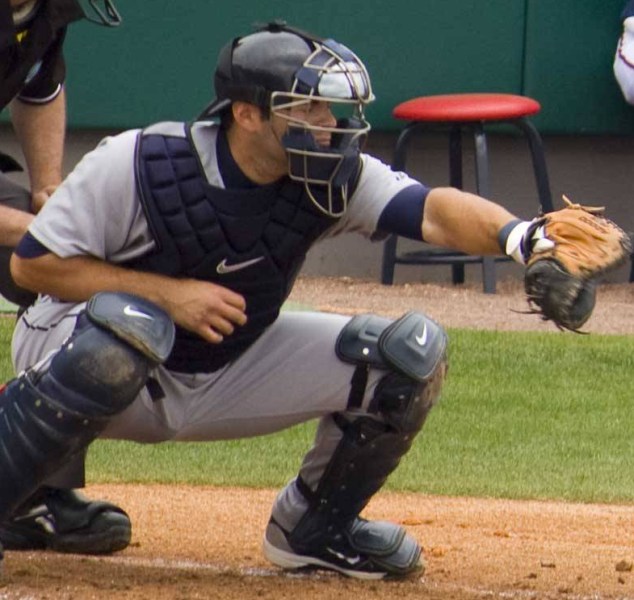
To receive the field you have to read the field, and the only way to read the field is to be looking right at it.  In baseball, there is only one position that can see the field and this is the catcher.  That’s why catchers are said to be good management material in general. Another way to say this is they have a wider view of the constraint set.  However, although the catcher can see the field and understand the constraint set in front of him, there is one variable he cannot control.  And this is, of course, the umpire.  The ump.

The ump calls the balls and strikes and the ump is a court of no appeal.  After all, he has the power to toss you from the ballgame altogether.  The only way to deal with this particular variable is to hone the craft of a catcher.  The first piece of craft is the act of framing a pitch.  Here the catcher subtly adjusts his glove in order to obstruct the ump’s view of the location of the pitch.  It is easy for the catcher to whip his glove on a ball in the dirt back to the strike zone, but the ump will spot that in a second.  So a catcher, if he wants to be any good, has to learn a little guile.

This guile can taken pretty far; and there are other ways to work an ump as well.  The classic, “ah come on ump,” is OK, but it’s the same as whipping the bill out of the dirt really.  A more effective trick is chatting the ump up.  Becoming his friend and letting him think you are actually on his side.  This is effective to a point as well, and extends the craft.   However here is where we need to remember our Dylan.  From “Just Like the Tom Thumb Blues,” we learn the following:

As Dylan once sang, you can start out soft and end up hitting the hard stuff — thinking people will stand behind you when things get rough, only to find out the bluff was your own. Sometimes you just want to go back to New York City and say you’ve had enough.
after Bob Dylan

Dylan is saying that though the use of guile helps you work the ump, you can start to mistake guile for the deeper craft.  You start to fall into your own trick.  You start to think you are the ump.  And these are deeper waters indeed.  In fact, this is the most dangerous game.  And in this zone, we need a secret weapon.

The idea of a secret weapon is apparently popular in many superhero movies these days, and we can read the field just a little to see why.  These so-called secret weapons may take the outward form of a literal weapon, one which defends against the apparent enemy and leaves death and destruction in its wake.  However when we use this kind of weapon, the forest we are in is in fact that of the irreal, where the furies shriek and howl.  However the superhero’s true secret weapon is something altogether different.  His true secret weapon is the light within, which can be transmuted into gold and used to navigate the irreal, and hunt the most dangerous game.  Where is that light within?  To find it, the catcher has to go pretty far back into things to find it.  In certain eras, folks may need to do something a little difficult to get there—as the Chinese say, may you live in interesting times.  The catcher, here, has to remember.

The first song I remember my own father singing, and one of the only ones I head from him, was from Bob Dylan.  I didn’t know who Dylan was, nor did I know the name of the song. The line my father sang was one of those old Dylan riddles — something about a pump that won’t work because someone stole the handles. I didn’t understand it then, but it landed in me like a talisman.
after Bob Dylan .

If the catcher is blessed to have such a talisman, he has a fighting chance.  The thing to do here is to keep your eyes and ears on the field and your gut and your body tuned into the ump.  Only this way can the little catcher tell when it’s time to play his card, which is of course the joker.  People have sought Dylan in all his guises to the ends of the earth and no one, to my knowledge, has caught onto his tricks.  I can’t say for sure that I’m onto all of them either, but I knew one thing.  When the vandals have those handles, the pump ain’t working. This is the moment the catcher makes his break with the ump. This is when he calls his bluff.

Dedication: For my Father, who caught me how to catch.

On Kris Kristofferson’s “To Beat the Devil”

This piece takes a look at Kris Kristofferson’s “To Beat the Devil.” The song appears on Kristofferson’s self-titled debut album from 1970 on Monument, which is, by any standard, an astonishingly good record. The album features “Me and Bobby McGee,” “Sunday Morning Coming Down,” and “Just the Other Side of Nowhere,” along with the ol’ Devil. That’s four absolute classics right there for ya.

Sunday Morning features an opening quatrain that most other songwriters would trade their career for:

Well I woke up Sunday morning/ with no way to hold my head that didn’t hurt/ and the beer I had for breakfast wasn’t bad/ so I had one more for dessert

(I could play this game all day—Jason Isbell’s Southeastern features another couple life-work worthy couplets:

The first two lines of “Super 8”:

Don’t wanna die in a super 8 motel/ just because somebody’s evening didn’t go so well

And from “Different Days”:

Time went by and I left and I left again/ Jesus loves a sinner but the highway loves a sin.

If I’d written lines that great I’d call it a career and sip martinis on the house for the duration.)

Sunday Morning and Bobby are probably objectively better songs than To Beat the Devil, yet what I like about this one is that Kristofferson states very clearly a kind of founding intention for his life in song and art, right out of the gate. The only parallel I can think of is Craig Finn’s The Hold Steady, whose first album Almost Killed Me kicks off with “A Positive Jam.”

(Here’s Finn telling it like it is:

I got bored when I didn’t have a band/ so I started a band/ we’re gonna start it with a positive jam/ hold steady.

Rock on Craig baby.)

Anyway, let’s get to the focus of this piece. Kristofferson opens with a spoken intro.:

A couple of years back I come across a great and wasted friend of mine in the hallway of a recording studio. And while he was reciting some poetry to me that he had written, I saw that he was about a step away from dying, and I couldn’t help but wonder why. And the lines of this song occurred to me.

Here the singer is looking up at his idol who is both “great and wasted.” I wasn’t around quite yet in 1970, yet I can easily imagine Ginsberg’s “best minds” line hanging over talented folks across a lot of zones. Klosterman wasn’t quite there either (June 5, 1972–a mid Gemini of course), but he was close, and to indulge not for the last time in a little Klostermania, the zeitgeist seemed to be making people thirsty.

The singer receives some scraps of poetry, shards of shattered inspiration, and a song “occurs” to him. He doesn’t state it directly, however we imagine the song arrives fully formed, like “Pancho and Lefty,” or “Kubla Khan.” Thus, To Beat the Devil is also both an answer and an offer of redemption to his idol, who here is John(ny) Cash.

I’m happy to say he’s no longer wasted, and he’s got him a good woman. And I’d like to dedicate this to John and June, who helped showed me how to beat the devil.

The singer takes up the mantle of the master, and in so doing opens a possibility window onto redemption for his senior. This is no exaggeration—Cash also recorded To Beat the Devil in 1970 and we are basically stipulating that Kristofferson’s genius, descended from Cash while also original to himself, helped rescue Cash from addiction and the whole deal there. We won’t be deep diving into the archive on this one—as we said we’re just keeping it local and breaking it down, so you’ll have to take my word on it or search it up your own self.

Here’s the first verse; the words speak for themselves:

It was wintertime in Nashville/ down on Music City Row/ and I was looking for a place/ and to get myself out of the cold/ to warm the frozen feeling that was eating at my soul/ keep the chilly wind off my guitar

A classic down and out in the big city piece of scene-setting. The singer is physiologically and psychologically frozen, a cold wind gusts across his art. The man needs a break.

My thirsty wanted whiskey/ my hungry needed beans/ but it had been a month of paydays/ since I’d heard that eagle scream/ so with a stomach full of empty/ and a pocket full of dreams/ I left my pride and stepped inside a bar

You might think that the operative nouns here would be “thirst” and “hunger,” but no. This is not a man with a thirst; this is a thirsty man. We also hear an echo of a now-ancient American past where a man with an empty stomach would go in search of, of all things, “beans.”

Anyway, he’s got no money, can’t really bring himself to care. So, a singer walks into a bar.

Actually I’d guess you’d call it a tavern/ cigarette smoke to the ceiling
and sawdust on the floor/ friendly shadows/ I saw that there was just one old man sitting at the bar/ and in the mirror I could see him checking me and my guitar/ and he turned and said/ come up here, boy, and show us what you are/ I said I’m dry, and he bought me a beer

The man in the mirror, the devil himself. The singer comes face to face with the man who checks him out and summons him over. Kristofferson then enters into a bargain–offers up the terms of an encounter: a beer on the old man’s tab. Score one for the thirsty man. The singer faces the old man; it’s to be a showdown. He doesn’t have much, but he’s got some “friendly shadows,” traces of an older map perhaps, an older memory.

I can’t help here but engage in a bit of presumption. When I play the song in my head, I want to hear “in the mirror I saw him casing me and my guitar,” (listen to the way he pronounces “guitar” on the track. Kristofferson was born in Brownsville, Texas in ‘36 and behind the laid back folksinger you can here some roots here baby).

If I could make one edit to the song, it would be to replace “checking me,” with “casing me.” What a great verb “to case” is.

Lexical Interlude: “To case the joint”

1. slang To observe a place in order to familiarize oneself with its workings in preparation for some criminal activity (often robbery). Judging from the security footage, those men cased the joint hours before robbing it.

2. slang By extension, to thoroughly examine a place. In this usage, no devious motive is implied. As soon as my kids walking into the hotel room, they started casing the joint, exclaiming about everything from the TV to the mini-fridge.

The seminal use of this verb phrase comes from Bill Callahan, formerly of Smog. Callahan is an odd duck—he is so artificial, so obviously self-created as an entertainer, that he has become almost post-authentic.  Callahan contains multitudes.

My favorite Smog album, well in the top two, is Red Apple Falls, which features “Ex-Con,” on which Callahan sings: 

Jean jacket and tie/ feel like such a lie/ when I go to your house/ I feel like I’m/ casing the joint

Devious motive implied.

=====

He nodded at my guitar and said/ it’s a tough life, ain’t it?/ I just looked at him/ he said “you ain’t making any money, are you?/ I said, you been reading my mail/ he just smiled and said, let me see that guitar/ I got something you ought to hear/ and then he laid it on me

The devil has a bead on the singer, and he’s not far off.  Yes he’s broke.  Yes he’s down and out.  Whaddaya want?

=====

Filmic Interlude I: The Long Goodbye

In Robert Altman The Long Goodbye, written by Leigh Brackett, the main character Philip Marlowe gets out of jail somewhere in the first act and heads to a all-purpose pit stop restaurant who’s owner apparently collects Marlowe’s mail. The dialogue is exquisite.

Marlowe: You got any messages for me?

Owner: Believe we’ve got a few over there. As a matter of fact, you’ll find my phone bill in there too.

Marlowe: I wouldn’t worry about that.

When you ain’t got nothing you got nothing to lose. Kristofferson’s got nothing to hide in his mail. Those bills go straight to the wastebasket.

=====

If you waste your time a talkin’ / to the people who don’t listen/ to the things that you are saying/ who do you thinks gonna hear?/ and if you should die explaining how/ the things that they complain about/ are things they could be changing/ who do you thinks gonna care?

there were other lonely singers/ in a world turned deaf and blind/ who were crucified for what they tried to show/ and their voices have been scattered by the swirling winds of time/ ‘cause the truth remains that no one wants to know

The devil’s words speak for themselves. The path of the troubadour is a dead end. The world has not ears to hear nor eyes to see. Truth tellers meet a bad end. Whiners gonna whine. It’s a strong opening bet, made, we presume, with his red right hand.

Well the old man was a stranger/ but I’d heard his song before/ back when failure had me locked out/ on the wrong side of the door/ when no one stood behind me/ but my shadow on the floor/ and lonesome was more than a state of mind

The singer is on familiar territory; he’s has been tempted by this cynical incantation, he’s not immune to tuning out his calling when out in the cold. Who is?

You see, the devil haunts a hungry man/ if you don’t want to join him/ you gotta beat him/ I ain’t saying I beat the devil/ but I drank his beer for nothing/ then I stole his song

This is the key verse in our little tale. You see, when we tango with the devil the devil usually gets to lead. That’s just the way it goes. But the thing about the devil is, his game is a bit of a bluff. A couple of low pairs, maybe. You just gotta call.

and you still can hear me singing/ to the people who don’t listen/ to the things that I am saying/ praying someone’s gonna hear/ and I guess I’ll die explaining how/ the things that they complain about/ are things they could be changing/ hoping someone’s gonna care

I was born a lonely singer/ and I’m bound to die the same/ but I’ve gotta feed the hunger in my soul/ and if I never have a nickel/ I won’t ever die ashamed/ ‘cause I don’t believe that no one wants to know

Kristoffeson flips it right around. The devil’s got a point; the singer may die dead broke, that’s fine. Songs are borne on the wind in any case. The thing is to have faith in your audience. To believe someone is out there, heart in their hands and ear to the wind. And to hold this faith as a mantra. That’ll keep ‘em guessing, cause then you’re not playing their game, you’re playing your own.

Overall, To Beat the Devil is a young man’s song. It’s got a confidence, a swagger, even a hubris. So, after drafting most of this piece I wanted to find a recent live version, see how it’s aged. I stumbled on a version from a live set with Lou Reed released in 2017. The set is part of The Bottom Line Archive, and it finds Kristofferson in a Waitsian stage of life. The voice is richer than ever, but he’s not exactly singing. Then again, that’s what they said about Dylan and it’s B.S. The voice is the voice; singing is just a category.

The set is interspersed with short interviews of the two songwriters. Here is Kristofferson’s spoken introduction that precedes To Beat the Devil. It is instructive.

Interviewer: The devil figures in some of your songs, you know there’s that silver tongued devil and he pops up from time to time. Who’s the devil? What’s the devil for you? What are your demons?

K.K.: Well, I, I’ll do that song then. Ahhh…

Interviewer: Is that a metaphor or is that something real for you?

K.K.: Well here’s a song called To Beat the Devil. Maybe it’ll explain it. I can’t.