The Great Roast of Bill Simmons, The Podcasting GOAT

Note: Bill Simmons has many gifts, but none more enduring than his ability to take a perfectly good idea and turn it into a totalizing worldview. Chief among these is his obsession with “who gets the keys,” a concept that began as a useful shorthand for late-game NBA hierarchy and has since metastasized into a governing principle for all human activity. In Simmons’ hands, the question is no longer who closes Game 7, but who closes anything: marriages, movies, bands, revolutions, and possibly even the Enlightenment. It is a framework so elastic that it explains everything and therefore, in a quiet and almost admirable way, explains nothing. Yet Simmons returns to it again and again, like a man who has discovered fire and insists on using it to cook every meal. The result is less analysis than ritual: a familiar incantation that reassures both host and listener that control exists, that someone always has it, and that identifying that person is the highest form of understanding. Whether this is insight or compulsion is an open question, but in the meantime, Simmons has the keys—and he’s not giving them back.

I. The Obsessive With the Keys

Bill Simmons is a strange and singular figure in American media, a man whose greatest innovation may have been to take the interior monologue of a slightly obsessive sports fan and publish it wholesale, unfiltered, and then slowly convince an entire industry that this was not only acceptable but essential. He is not quite a journalist, not quite a commentator, and not quite a comedian, but rather a hybrid form: a “Sportish Guy,” as Cousin Sal once put it, who treats every game, every movie, and every stray anecdote as part of a single, ongoing argument about how the world works. Central to that argument is his enduring fixation on control, on agency, on the question he returns to again and again with the devotion of a man checking the locks before bed: who gets the keys?

It is tempting to dismiss this as a bit, and in some sense it is, but like all of Simmons’ best bits, it has metastasized into something larger and more revealing. What began as a useful shorthand for late-game NBA hierarchy—who has the ball, who takes the shot—has expanded into a general theory of human behavior. Quarterbacks have the keys. Movie characters have the keys. Entire bands, dynasties, and historical figures are evaluated based on whether they had, lost, or never quite secured the keys. That Mark Sanchez could, for a brief and inexplicable moment, be discussed in these terms tells you less about Sanchez than it does about Simmons’ commitment to the framework. He does not particularly care if the fit is perfect. The system must be applied.

This is what makes Simmons both compelling and faintly ridiculous. He is, at heart, a “who’s on my team” guy, a loyalist who rewards proximity, familiarity, and shared history, sometimes to a fault. Former colleagues have occasionally noted that he can cool on people once they leave his orbit, a tendency that reads less as malice than as a kind of emotional sorting mechanism: you are either in the ecosystem or you are not. Some, like Kevin O’Connor, speak warmly of early generosity—gifted shirts, guidance, a foothold in Los Angeles when money was tight. Others have been less charitable, and the occasional critique, including a much-circulated piece in The New York Times, has tried to frame Simmons’ blind spots, particularly around race, as more systemic. These critiques are not wholly without merit, but they often feel slightly overdetermined, flattening a personality that is better understood as idiosyncratic rather than ideological. Simmons himself tends to respond not with grand rebuttals but with motion—hiring voices like Van Lathan, insisting, plausibly, that such moves were already in progress, and continuing on as if the conversation will resolve itself over time.

There is also, undeniably, an ego in play. Simmons has built an empire—Grantland, then The Ringer—largely on the strength of his own voice, and he is not shy about asserting it. Stories persist, as they do in any media ecosystem, including the long-running rumor that he played a role in Magic Johnson’s exit from NBA Countdown, a claim Simmons has repeatedly and emphatically denied. More verifiable is the moment that effectively ended his ESPN tenure: a live broadcast of NBA Countdown in which, after a colleague spoke at length, Simmons leaned in with heavy, unmistakable sarcasm—“Oh, is it my turn to talk now?”—a line that was funny, revealing, and, in the context of corporate television, fatal. It was the voice of the columnist breaking through the format, the irrepressible instinct to comment on the comment, to seize the keys even when the structure said otherwise.

What makes Simmons unique, and worth writing about at all, is that these contradictions—generous and insular, insightful and reductive, earnest and performative—are not bugs but features. He is a weird obsessive who has turned his obsessions into a career, and in doing so has given us a language that is at once clarifying and absurd. He loves the game, he loves the conversation around the game, and above all he loves the feeling that somewhere, in any given moment, someone has the keys.

II: The Bits That Ate the Brain

If the keys are the theory, the bits are the practice. Simmons has always understood that repetition is power: say something often enough, with just enough conviction, and it graduates from joke to canon. Thus “greatest stickman,” a phrase that should have died in a driveway, becomes a legitimate category, and suddenly Burgess Meredith is being floated as an all-timer. “Sal, Sal, BM was the greatest stickman of all time. Every lady wanted a ride.” It is ridiculous, obviously, but also irresistible. The specificity disarms you. The confidence sells it. The framework expands.

This is the Simmons trick: take a private-language riff and run it until it becomes a public one. It does not matter that no one else has ever considered ranking “stickmen.” What matters is that Simmons has, and that he will return to it, again and again, until you find yourself half-convinced that you, too, should have an opinion. It is analysis as inside joke, inside joke as analysis.

III. The Ecosystem

No system survives without a supporting cast, and Simmons has assembled one of the most durable in podcasting.

There is Cousin Sal, the indispensable counterweight, quicker and often funnier, whose primary function is to puncture Simmons at exactly the right moment. The Vegas trips are their shared masterpiece: two grown men insisting, year after year, that this time they will behave differently, and then not. Simmons, improbably, claims that he only smokes in Vegas. No one believes this. The morning-after pod is the payoff—hungover, frayed, the truth leaking out in fragments. “I only had three cigarettes last night,” Simmons offers. Sal, without missing a beat goes: “Yeah, more like three lighters.” It is the kind of line that ends the discussion because it cannot be improved.

There is Joe House, lawyer by day, chaos agent by night, who turns every appearance into a small act of self-destruction. “House Eats” remains a high-water mark: an adult man consuming Chinese food until he vomits, captured and distributed as legitimate sports media content. It should not work. It works perfectly. Drunk House—slurring, swearing, denouncing Daniel Snyder with operatic intensity—is not a bug but a feature. Simmons does not rein him in; he amplifies him. The ecosystem thrives on this permissiveness.

And then there is Nephew Kyle, the quietly essential, publicly baffling producer whose qualifications are, at best, opaque. The nepotism is acknowledged, even embraced. Simmons does not pretend otherwise. He does not have to. The show goes on. The levels are sometimes off. The energy is always on.

IV. The Interviews: High Risk, High Variance

Simmons as interviewer is a study in range. At his best, he is disarming, patient, and genuinely curious, capable of extracting moments that feel both candid and consequential. His conversation with Al Michaels is a case in point: Michaels, relaxed, recounts the day of the O.J. chase, including the now-legendary call-in where a supposed eyewitness punctuates his tip with “Baba Booey.” The co-host takes it seriously. Michaels does not. “It’s a joke, dude,” he essentially says, and in that moment you see the difference between professionals. Simmons knows enough to step back and let the story land. It is radio as it should be: a master talking, a host listening.

The interview with John Skipper is another apex moment. Post-ESPN, Skipper speaks with a level of openness that borders on the shocking—cocaine use, morning routines, the normalization of behavior that would end most careers. Simmons guides rather than pushes, and the result is a “huge get,” the kind of conversation that justifies the entire enterprise.

At the other end of the spectrum sits the Denzel Washington interview, a minor classic of mismatch. Washington arrives as if for one kind of conversation; Simmons is clearly expecting another. The opening is awkward, the rhythms off. To his credit, Simmons does not retreat. He leans in, tries to find common ground, and eventually does, or at least something like it. It is not a triumph, but it is revealing: the limits of the format, the limits of the host, the persistence of the effort.

V. Homerism as Method

Simmons’ greatest cultural contribution may be the legitimization of homerism. Before him, fandom was something to be managed, disclosed, occasionally apologized for. With him, it becomes the point. He is, unapologetically, a Boston guy: the Boston Celtics are not just a team but a lineage, a narrative, a near-mythological entity anchored by figures like Larry Bird, whose legend grows incrementally with each retelling. The takes are, at times, outta control. They are also, in their way, coherent. Simmons is not pretending to objectivity. He is offering a perspective, and trusting that the audience will meet him there.

This approach extends beyond basketball. Baseball, once a central obsession—AL keeper leagues, granular analysis—fades over time, dismissed as too long, too slow, no longer aligned with the rhythms of his life or his listeners’. Basketball remains the core competency, the area where his knowledge is both deep and defensible. Everything else orbits around it.

VI. Family and Formation

The personal mythology is never far from the surface. Simmons’ father, a longtime Celtics season-ticket holder, is both character and audience, the origin point of the fandom that would become a career. The pride is evident, even when unspoken. The access—courtside seats in the 1970s—becomes part of the narrative, a credential as meaningful as any byline.

His mother, less present on the pod but frequently referenced, provides another axis: a love of movies, a different kind of cultural literacy that feeds into Simmons’ broader interests. The recurring mention of being a child of divorce functions as a kind of grounding note, a reminder that the voice, however confident, has origins in something more fragile. He seems, by most measures, to have come out fine.

VII. Drift and Discipline

As the empire grows—Grantland, then The Ringer, now under the umbrella of Spotify—Simmons changes in ways both subtle and obvious. He fades certain voices who no longer fit the evolving brand: Adam Carolla, once a regular presence, becomes less so; Michael Rapaport, similarly, drifts out of the rotation. The official reasons are varied—tone, fit, the simple passage of time—but the underlying dynamic is familiar. Simmons is, at heart, a “who’s on my team” operator. The team changes. The roster turns over.

And yet, it is hard to shake the sense that the affection remains. These are not clean breaks so much as quiet reassignments, the byproduct of a system that requires a certain level of control. Spotify money, corporate expectations, the need to maintain a particular tone—these exert their own pressure. The outta-control energy that defined earlier iterations of the pod is still there, but it is managed, channeled, occasionally held back.

VIII. The Countdown Moment

If there is a single scene that captures Simmons in miniature, it is the one that ends his ESPN tenure. On NBA Countdown, a colleague speaks at length. Simmons waits. And waits. And then, with a level of sarcasm that is both unmistakable and, in context, disastrous, he interjects: “Oh, is it my turn to talk now?” It is funny. It is honest. It is, within the rigid structure of live television, unacceptable.

He is removed not long after.

The moment endures because it reveals the core tension: Simmons the columnist versus Simmons the employee, the impulse to comment versus the requirement to conform. He cannot quite suppress the former, even when the latter demands it. He reaches for the keys, even when they are not his to take.


VIII. Conclusion

Bill Simmons is the GOAT podcaster, full stop, and it’s worth saying that clearly at the outset because we only roast the ones we love. Bill Simmons has given us an entire language—keys, stickman, Vegas nights, Sal lines, Drunk House—and if you’ve been along for the ride, those bits don’t wear out, they compound. They get funnier with time, richer with context, a kind of private shorthand that becomes, almost accidentally, a shared culture. You either hear “three lighters” and laugh immediately or you don’t, and if you don’t, there’s not much point explaining it.

This is part of what makes Simmons both beloved and, in certain circles, a little contentious. He has clearly made enemies—inside ESPN, across the broader media landscape, and occasionally among former employees—and while it’s easy to chalk this up to ego or looseness, the better read is that the looseness is largely performative. Underneath the hangout vibe, the teasing, the Nephew Kyle chaos and the Drunk House indulgence, there is a very real set of standards, and Simmons enforces them. He is, at heart, a “who’s on my team” operator, and the team matters. People drift out. Some of that isn’t pretty. Most of it, however, is consistent with how he’s always operated: loyal, selective, and ultimately in control of the room.

At the same time, there is a sense now that Simmons is, if not slowing down, then at least rounding off the sharper edges. He talks openly about retirement in a way he didn’t a decade ago, and you get the feeling that he is aware, at some level, of the limits of the bit. Will he be seventy-five, still ranking stickmen and assigning keys? It’s hard to see it. He’s a boss now, a central figure inside Spotify, with responsibilities that extend well beyond the pod. The insurgent has become the institution, and while the voice is still there, it’s necessarily more managed than it once was.

There’s also the simple fact that Simmons is no longer a writer in the way he once was, and he knows it. The old columns—the mailbags, the trade value pieces, the obsessive digressions—have given way to the pod, to conversation, to rhythm. He jokes that his fingers don’t work anymore, and like most of his best lines, it’s funny because it’s partly true. The Book of Basketball stands as the monument to that earlier phase: long, ambitious, slightly out of control in the best way, complete with the famous pyramid (Jordan at the top, Magic above Bird, a decision that still tells you everything you need to know about him). But the shift from writing to talking isn’t a decline so much as an evolution. Simmons was always more voice than text anyway. The medium finally caught up to the man.

If and when he does step back, what we lose is not just a podcast or a brand but something rarer: a genuinely original voice that bent an entire corner of the media world toward itself. Plenty of people analyze sports. Plenty of people talk about culture. Almost no one has managed to fuse the two into a single, durable, endlessly riffable system the way Simmons has. The keys, for all their absurdity, are real in that sense. He found them early, used them often, and built something that will outlast the bit itself.

And if he eventually decides to set them down, or even just hold them a little more loosely, it will mark the end of a run that, for all its contradictions, was unmistakably his.

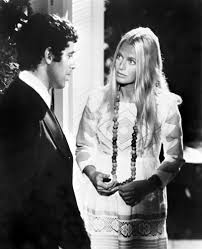
On Nina Van Pallandt: Muse, Witness, Residual Character, and Her Own Woman

Note: Nina Van Pallandt moves through this piece as a kind of drifting hinge figure between art and biography, cinema and scandal, half-real and half-mythologised: from her striking, uncanny presence in Robert Altman’s The Long Goodbye—where she plays the abused, luminous spouse of Roger Wade and becomes, briefly, a kind of muse/anima figure for Philip Marlowe—to her earlier life in the Danish pop duo The Baronets, through her entanglement with Clifford Irving and the great Howard Hughes hoax that later reverberates through Orson Welles’ F for Fake, and onward into the quieter aftermath of fame, reinvention, and partial retreat. The essay follows her not as a stable “character” but as a site where male-authored narratives—Hollywood noir, literary fraud, journalistic myth-making—keep trying (and failing) to fix her meaning, while she keeps slipping free in ways that are at once accidental and oddly deliberate. In the end she becomes something like a case study in cinematic and cultural afterlives: a woman repeatedly written by others, occasionally complicit, sometimes resistant, and finally legible only as a residue of performance, gossip, and unfinished stories that refuse to settle.

I first became aware of Nina Van Pallandt the way most people probably do: not through biography, but through atmosphere—specifically Robert Altman’s The Long Goodbye (1973, The Long Goodbye), a film that feels less like a narrative than a slow collapse of narrative reliability itself. It is a film in which people drift through scenes as if they have forgotten whether they are supposed to be characters or witnesses, and Nina arrives inside it already slightly misfiled, already too composed for the emotional weather she is asked to endure.

She plays Roger Wade’s wife, but “plays” is almost the wrong verb. Altman’s casting logic is not psychological realism in the classical sense; it is something closer to behavioral residue. People are dropped into the frame and asked not to perform identity but to inhabit proximity—to money, to violence, to desire, to failure. Nina’s presence has that peculiar Altman quality: she does not dominate the scene, but she stabilizes it just enough to make everything else look unstable.

Roger Wade (the blocked writer, the alcoholic genius-in-decline) is already collapsing before the plot admits it. Nina is the counterweight that never quite becomes balance. She is care without resolution, intimacy without clarity, the kind of emotional presence that suggests there is a story somewhere but refuses to confirm what it is. And then there is Marlowe, Elliott Gould’s version of Marlowe—half-stoned, half-wandering, permanently a few seconds behind the moral implications of what he is witnessing.

The film keeps staging small ruptures in epistemology. One of the most famous arrives early and feels almost accidental in its perfection: Terry Lennox appearing at 4 AM, asking for a ride to Tijuana. There is a moment—“Tijuana now?”—where Gould’s Marlowe is briefly jolted out of his procedural fog into genuine surprise, as if even he cannot believe how far the plot is willing to drift from explanation. That tonal instability is the world Nina inhabits as well, except she does not get Marlowe’s ironic distance. She gets consequence.

There is a domestic sequence—one of the film’s most disarming—that feels almost out of register with the noir frame: Nina cooking, the soft logic of food and attention, a candlelit dinner shared with Marlowe, where violence and absence are temporarily suspended by something as ordinary as butter and chicken. It is precisely the kind of scene that should resolve emotional ambiguity, but in Altman it does the opposite: it deepens it. Intimacy here is not revelation; it is another form of deferral.

What the film keeps doing, quietly and persistently, is refusing to assign stable moral weight to anyone. Roger Wade is both victim and self-destroyer. Marlowe is both agent and sleepwalker. Nina is both witness and participant, but never allowed the comfort of explanation. Even her suffering—when it arrives—is not narratively sanctified; it is simply another event in a world where events do not accumulate into meaning.

And this is where Nina becomes interesting beyond the film itself. Because she does not resolve into a character arc, she persists as something else: a figure who has been “used” by multiple narrative systems without ever fully belonging to them. In a conventional noir, she would be femme fatale or redemption object or tragic spouse. In Altman, she is none of these cleanly. She is what remains when genre stops enforcing coherence.

What begins to emerge, if one steps back slightly from her, is that she belongs to a broader category of women who are not simply “in” cultural narratives but are written into them by proximity to men who are doing the narrating. The pattern is subtle but persistent: women become legible to the public through the structural gravity of male projects—films, scandals, bands, memoirs—while simultaneously attempting, with varying degrees of success, to assert an interior life that resists that formatting.

It is difficult not to think here of Marianne Faithfull, who occupies a parallel register in the British version of the same phenomenon. Marianne Faithfull is initially rendered publicly intelligible through association—romantic, cultural, chemical—with the Rolling Stones orbit, and specifically through a media ecosystem eager to translate her into a kind of emblem: muse, fallen angel, tragic accessory to male genius. But what is striking about her trajectory is not the initial inscription but the long, stubborn insistence on rewriting it from within.

In both cases—Faithfull and Van Pallandt—the question is not simply “agency” in the abstract liberal sense, but something more structurally constrained: how does a person reassert authorship of self once they have already been written as a function in someone else’s story? Faithfull does this through survival, reinvention, and the eventual authority of her own voice as an artist. Nina does it more quietly, less performatively, by simply not continuing to cooperate with the demand that her life be endlessly narrativized into legible arcs.

And this is where Nina stops being just a cinematic presence and becomes entangled with a second, more volatile narrative system: the world of Clifford Irving and manufactured truth. I remain, in a slightly persistent way, puzzled by Clifford Irving—not in the sense that his actions are obscure, but in the sense that the scale of the gamble still feels oddly disproportionate to the era in which it occurred. Clifford Irving occupies that 1970s threshold where narrative fraud still had room to breathe: before the internet, before instantaneous archival correction, before every claim arrived already cross-checked by a thousand invisible clerks. The rope, in other words, was longer. Not infinitely elastic—but long enough that someone could plausibly believe they might walk it all the way across.

What he did, of course, was fabricate the authorized autobiography of Howard Hughes and briefly convince a publishing system that this fiction was fact. And one cannot quite shake the sense that this sits in a parallel register to Orson Welles’ late-career meditation on forgery and authorship, F for Fake, where the art forger is not simply a criminal but a kind of metaphysical irritant—someone who reveals how fragile the category of “authenticity” already is, even before it is attacked. In Welles’ world, the faker is almost honest about the fact that everyone is faking something. In Irving’s world, the system briefly forgets to notice.

The irony, of course, is that Irving’s fraud depended on a very pre-digital faith in paper trails, intermediaries, and the general slowness of institutional verification. Today it feels almost quaintly physical: forged documents, publishing contracts, phone calls that had to be believed in real time. One can imagine the same scheme now collapsing within hours, not because people are more moral, but because the feedback loops are instantaneous.

And then there is prison. Irving did time—real time, not narrative time—and emerged into a world that had already moved on to other, faster deceptions. Yeah, I mean what did you expect, dude. The arc compresses there in a way that feels almost unsatisfying: scandal, exposure, incarceration, partial reinvention. One wants something more operatic, but what you get is the bureaucratic version of consequence.

The interesting part is not that he was punished, but that for a brief historical window the system was even buildable enough that his plan could function as a kind of temporary reality. That is the shared atmosphere he has with Nina Van Pallandt: not guilt, not innocence, but proximity to narrative systems that were still slow enough to be fooled by their own assumptions.

In later life, Nina becomes harder to place in any of the familiar compartments that earlier decades tried to assign her. The cinematic afterglow fades into cult memory, and the Irving episode recedes into archival texture. What remains is a quietness that feels deliberate rather than accidental—not disappearance, but refusal of continued amplification. She does not convert notoriety into permanent self-mythology in the way later media ecosystems would almost require. Instead, she settles into a lower frequency of visibility: remembered, cited, intermittently revived, but no longer authored by the same pressures that once pulled her forward.

And here the comparison widens again, because what she resembles is not a “sidekick” at all—that word is too structurally comic, too dependent on hierarchy—but something closer to an attendant presence: a figure whose job, in other people’s stories, is to make emotional or moral instability legible without ever fully resolving it.

There is a related category, more neutral and slightly more precise: the faithful interlocutor. Not in the devotional sense, but in the structural one—the person who remains close enough to the main character’s instability to render it speakable, without ever becoming fully absorbed into its explanatory system. Nina performs this function in The Long Goodbyewithout being granted interpretive authority over it.

And there is another: the witness who does not testify cleanly. Not unreliable, but resistant to conversion into stable narrative fact.

We all make mistakes; that much is banal. The more interesting question is what kind of cultural weather those mistakes occur in, and how much agency is genuinely available inside it. Nina Van Pallandt seems, in retrospect, to have lived inside a period when men were still doing a great deal of the writing—of scripts, scandals, explanations—and women were often expected to appear inside those scripts as if they had authored them themselves. Her resistance to that framing is not always loud or declarative. Sometimes it is simply a matter of stepping out of the demand to be continuously interpretable.

And in that sense, what she ultimately carved out is not a grand public myth but something more modest and, arguably, more durable: a minor legacy, lightly held, slightly resistant to over-definition. Not central, not erased, not simplified—just there, in a way that feels unexpectedly intact.

I really like Nina Van Pallandt. In The Long Goodbye, and in the shadow of the Clifford Irving story, it is impossible not to root for her—not because she is resolved, but because she is never fully reducible. She drifts through systems built by men who are busy writing meaning onto the world, and she does not quite consent to being finalized inside any of them. We all make mistakes. She was written into a few. She was also, quietly, a drifter inside Hollywood’s narrative machinery, and what she ultimately leaves behind is a minor but distinct and instinctively cool legacy: not the center of anyone’s story, but one of the few figures who never fully became owned by it.

Don’t Pump Me Man!

Note: Spokane, early 1983: minor league baseball, cheap seats, and kids living in the gaps between innings. This piece recalls Spokane Indians games, chasing balls during batting practice, and a strange collision of childhood mischief and adult volatility at the edge of the outfield fence. Sandy Alomar Jr.—then a local catcher on his way to a long MLB career—signs a baseball in handwriting so precise it feels like a signature on a future already underway, while a moment of chaos involving thrown persimmons and a furious adult named Mike Trowbridge becomes the kind of story that sticks far longer than the season itself.


Epigraph:

Do you know who you’re fucking with?/ You’re fucking with a stallion mange.

Ween

It was 1983 in Spokane, the kind of summer that felt permanently suspended in late light and dry heat, where the air at night still carried the dust of the day like it had nowhere else to go. We played Little League baseball in uniforms that never quite fit right, and then on weekends we graduated to something bigger and looser and more important: Spokane Indians games at the old stadium, Single A ball, where the dreams were real and still close enough to touch.

The Spokane Indians were a kind of civic promise back then. It was a small town, and in the early 1980s there wasn’t always a lot going on. The Indians were not quite big league, but not quite nothing. Just enough baseball to make you believe that something important was always one bus ride away. The seats were cheap, the beer cheaper, and the fences closer than they should have been. The whole place had that slightly improvised feel—like the city had built it thinking, this will do for now.

We didn’t go to games like spectators. We went like we belonged.

Behind the outfield wall during batting practice, kids gathered like scavengers. We chased homers, argued over balls, sprinted through patches of grass worn down by repetition. Sometimes we were the only ones back there. Sometimes there were older kids, or dads, or random locals who knew the angles better than we did. It was a loose territory. Not quite policed. Not quite ours. Something in between.

That summer, the Indians had a catcher everyone knew. Local kid. Quiet confidence. Clean mechanics. The kind of player adults already talked about like he had a future attached to him.

Sandy Alomar Jr. was that guy even then—before the long MLB career, before the All-Star years, before anyone outside Spokane would know the name properly. He was already different. You could see it in the way he stood when he wasn’t moving, like he was always half a second ahead of the next pitch.

I got his autograph once. It wasn’t dramatic. Just a moment after BP, when he signed a ball for a cluster of kids leaning too far over a rail. His handwriting was unexpectedly beautiful—controlled, deliberate, almost elegant in a way that didn’t match the dirt and sweat of the field. I remember thinking even then: this is what someone looks like when they’re going somewhere.

I kept that ball for years.

Because baseball wasn’t just baseball. It was a hierarchy you could see. You had the guys who were going to make it, the guys who might make it, and the rest of us orbiting the idea that proximity alone might transfer something.

Most of them wouldn’t go anywhere. That was obvious even then, though nobody said it out loud. But that day, none of that mattered yet. What mattered was the fence.

Our party was up high in the stands on the first base side, just beyond where the stadium fence met a thin strip of wild space. A tree had grown there—some kind of fruit tree, nobody was ever fully sure what it was. Persimmons, maybe. Something orange-red and heavy-looking, the kind of fruit that doesn’t look like it should be thrown but absolutely is.

Some kids started throwing them. Just kids, just fucking around. But they didn’t know who they were fucking with. Fuck with me and I’ll fuck with you.

The fruit flew. Not carefully. Not aimlessly either. More like experimentation. Testing distance. Testing reactions. Some of them were aiming at fans, others just launching them over the fence because it felt like something you could do if no one stopped you.

It was mildly funny at first. Then mildly annoying. Then mildly dangerous in a way that nobody fully acknowledged.

Because persimmons, if that’s what they were, aren’t soft. They hit like small decisions.

I remember one bouncing near a row of seats and rolling under a foot. Someone laughed. Someone else shouted. But nobody moved with urgency yet. It was still in the category of “kids being kids.”

Until Mike Trowbridge noticed.

Mike T was there with his kids—David Trowbridge and his sister Dawn. David had been a teammate of mine in Little League, a few years younger, outfield guy, quiet in the way younger kids sometimes are when they’re still deciding how loud they’re allowed to be. Dawn was just there in the background of everything, observing.

Their dad, Mike, was not background.

He was one of those adults you noticed before you understood why. Volatile energy. Tight posture. Goatee, black tank top, gold chains around his neck. A bit of a greaser; drove a Harley. Always slightly too close to losing his temper. He wasn’t a bad guy exactly—he could laugh, he could talk—but you always felt like there was a second version of him sitting just under the surface.

He saw the fruit being thrown. And something in him snapped into motion. He walked straight to the fence line, fast enough that it changed the temperature of the moment.

“Knock that shit off right now,” he yelled.

The kids paused. Not because they were scared exactly, but because the voice had weight.

Then one of them—small kid, maybe ten, sunburned confidence, the kind of kid who doesn’t fully understand consequences yet—looked up and said:

“Don’t pump me, man.”

It was such a strange sentence. Too casual for the situation. Too confident for the speaker. Like he had borrowed it from somewhere older and wasn’t sure how it fit yet.

There was a beat of silence where the entire stadium noise seemed to pull back slightly.

Mike T looked at him.

“Don’t pump me?” he said.

Then his voice shifted.

“You want me to pump you? I’ll pump you.”

And in that moment—this is the part that still feels unreal even now—he climbed the fence. Not slowly. Not theatrically. Just decisively. Like the boundary wasn’t a boundary at all.

Everything changed at once.

Me, David, Dawn—everyone nearby—we all froze in that wide-eyed way kids do when they realize the rules might not hold. It wasn’t comedy anymore. It wasn’t baseball anymore.

It was just: Mikey baby don’t kill that kid.

That’s what it felt like in my head. Not words were spoken, just panic translated into something almost verbal.

The kids scattered instantly. Full sprint. No hesitation. The fruit stopped mid-air and dropped forgotten. The stadium behind us suddenly felt far away, like it belonged to a different scene entirely.

Mike T took a step forward, still inside the fenced edge of this improvised battlefield, breathing hard, still locked in that strange overlap between anger and disbelief.

And then—somehow—it was over. No actual violence. No contact. Just the threat of it, large enough to erase the mischief that had caused it.

The kids were gone. The fruit stopped flying. The tree stood there like nothing had happened. Afterwards, the stadium noise came back slowly, like a system rebooting.

My dad, Ross, had seen the whole thing. He was laughing, hard. Not the kind of polite laugh adults do when they think they’re supposed to. This was involuntary. Almost helpless. The kind of laugh that tries to stay respectful but can’t quite hold the line.

Because it was funny. In that terrible, chaotic way childhood sometimes is when it brushes up against adult intensity and survives without breaking.

Ross would tell that story for years after. The kid. The fence. The persimmons. The line: don’t pump me man. He never stopped laughing at that part.

Neither did I.

But at the time, I just stood there thinking about Sandy Alomar Jr. somewhere on that field, already on his way to something else entirely, signing baseballs in beautiful handwriting, while right behind the stadium wall the rest of us were learning the difference between games and consequences in real time.

Most of us wouldn’t make it to the Bigs. But for one afternoon in 1983, it all felt like it might matter just the same.was 1983 in Spokane, the kind of summer that felt permanently suspended in late light and dry heat, where the air at night still carried the dust of the day like it had nowhere else to go.

But for one afternoon in 1983, it all felt like it might matter just the same.

Dedication:

For Mike T. And for the kid. You got balls young man, I’ll say that.

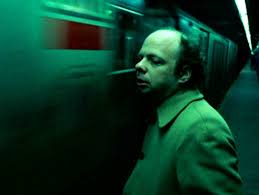
On the Film “My Dinner with Andre” Part I: Wally in New York

Note: Opening a multi-part early series from my first blog Classical Sympathies back in 2009, this piece takes up the beginning of Wallace Shawn’s walk through New York en route to his meeting with André Gregory in My Dinner with Andre, using Wally’s voice-over as a lens on artistic precarity, everyday survival, and the comic disproportion between existential weight and mundane errands. The note situates the film’s opening movement as both narrative setup and philosophical framing: a winter city of post offices, xerox shops, and unanswered calls becomes the psychological prelude to a conversation that will later expand into memory, performance, and self-mythology. This installment follows Wally up to his arrival at the restaurant for the pre-dinner drink, where the film’s central encounter is still suspended in anticipation, and meaning is generated less by action than by the act of getting there.

My Dinner with Andre is the famous, or infamous, 1981 film of a dinner conversation between Wallace Shawn, the actor and playwright, and Andre Gregory, the theater director. If I were to make a twofold claim for the film: i) that it is one of the most action packed films ever made, and ii) that it effectively encapsulates the thematics of the entire 20th century, I do not think this would be overstatement. My intent here, however, is not to establish either of these postulates, but rather to simply “blog” the script in the hopes that what needs to be said works its way to the surface. Fair warning: the undertaking will require several posts.

Money crops up on two of the first three pages of the script, and because money, and the lack of it, is a theme that runs beneath the entire script: Andre has money, has the freedom to travel and to spend several years trying to “find himself”; Wally does not. Still, “having money” is, as ever, a relative concept. At the opening of the film, Wally is seen walking through the streets of New York, heading for the restaurant where he is to meet Andre. It appears to be winter, maybe February. In the opening voice-over, Wally ruminates on the life of the artist: The life of a playwright is tough. It’s not easy, as some people seem to think. You work hard writing plays, and nobody puts them on. You take up other lines of work to try to make a living–acting, in my case–and people don’t hire you. So you spend your days crossing the city back and forth doing the errands of your trade. Today wasn’t any easier than any other day. I’d had to be up by ten to make some important phone calls, then I’d gone to the stationary store to buy envelopes, and then to the xerox shop. There were dozens of things to do. By five o’clock I’d finally made it to the post office and mailed off several copies of my plays, meanwhile checking constantly with my answering service to see if my agent had called with any acting work. In the morning, the mailbox had been stuffed with bills. What was I supposed to do? How was I supposed to pay them? After all, I was doing my best (17).

One of the marvelous things about the film is the tongue-in-cheek humor that is rarely, if ever, directly alluded to. A deeply serious film, Andre is also a comedy, a fact which we can recognize because we see that the writers are having fun with the characters who are in turn themselves. That is, Wally and Andre are playing versions of themselves–we assume that most of the experiences that Andre recounts in the film are based on real experiences, and that Wally’s account of his home life is more or less true to life–but exaggerated versions. As Shawn says in the preface to the script, “I knew immediately that {…} I’d have to distort us both slightly–our conflicts would have to become sharpened–we’d have to become–well–characters {…} It would be an enormously elaborate piece of construction” (14). In this initial passage, the humor lies in Wally’s conception of a difficult life: “I’d had to be up by ten to make some important phone calls.”

Wally’s sense of pressure is, from the outset, deliberately out of proportion to the scale of his circumstances. The tone is one of genuine complaint, but the complaint itself is almost comically domestic: the architecture of a “hard day” is built out of errands, envelopes, xerox shops, and an answering service that may or may not contain salvation in the form of an acting job. What Shawn achieves here, and what the film quietly sustains, is a recalibration of seriousness—where existential weight is not attached to grand events but to the texture of administrative survival. Wally’s New York is not a place of romance or revelation, but of circulation: between post office, mailbox, and telephone, as though modern artistic life has been reduced to a loop of deferred contact with recognition.

At the same time, the humor is never fully separable from sincerity. Wally is not merely being mocked; he is also articulating a recognisable condition of artistic precarity, one that the film refuses to glamorize. The genius of the opening monologue lies in this double register: we are invited to laugh at the disproportion between emotional tone and material fact, but we are also made to recognise how easily that disproportion becomes a lived reality. The “dozens of things to do” are not nothing; they are just insufficiently legible as crisis, which is precisely what makes them feel like crisis.

By the time Wally finally moves through the city toward the restaurant, the structure of the film has already been quietly established: this is a world in which meaning is not delivered through events but through the way events are narrated to oneself while walking between obligations. New York, in this sense, is not a backdrop but a medium of self-composition—an environment in which thought is constantly being assembled under mild pressure, as though consciousness itself were an errand.

He checks the time again, as he has been doing throughout the afternoon, and adjusts his route slightly, not out of urgency so much as orientation. The meeting with André already exists in his mind as something slightly unreal, a fixed appointment that has not yet been granted substance by arrival. He crosses another block, passes into the thinning evening light, and begins to approach the restaurant where, for the first time that day, the structure of waiting will shift from solitary to shared.

to be continued…

Review of the Film Code 46

Note: We don’t do a lot of film reviews here, but Code 46 earns the exception—partly because Michael Winterbottom is one of my very favorite directors, and still wildly underrated, and partly because this film quietly seeps into you in a way that feels unshakable; set in a world that is clearly not ours but just similar enough to be discomforting—real Shanghai that isn’t quite real, deserts that feel earned, a system of “cover” and genetic law that replaces freedom without ever announcing itself—the film follows William, a kind of intuitive investigator who lives more than feels, and Maria, who works in a bureaucratic “fate factory” and senses, before she knows, that something is already off; their connection unfolds in fragments—interrogation as flirtation, impulse as rebellion, intimacy as violation—until the central truth emerges: in a world where memory can be edited and biology legislated, even love itself can be illegal; the genius of the film is its restraint.

Tim Robbins and Samantha Morton don’t overwhelm you with chemistry, which actually makes the relationship feel more provisional, more real, more doomed—and by the time the system reasserts itself (memory erased, lives restored, Maria exiled with the burden of remembering), you realize the film hasn’t been building to a climax so much as a quiet erasure; it’s less than 90 minutes, barely announces its futurism beyond small details (languages blending, empathy viruses, low-fi surveillance), and yet it lingers in a way much louder films don’t; it also clearly fed into the DNA of the Thin Man—this idea of movement through controlled spaces, of intuition over evidence, of relationships that feel both fated and structurally impossible—and in that sense it’s not just a film I admire, it’s one that got under the skin and stayed there.

Michael Winterbottom’s Code 46 is less a conventional sci-fi film than a drifting, half-lucid meditation on love, control, and memory. It runs under 90 minutes, but it feels strangely elongated—like a dream you keep slipping back into.

The hero, William (Tim Robbins), isn’t exactly living—he’s existing. A kind of insurance investigator, a “driver” moving through a world defined by pollution, restriction, and bureaucratic control. This isn’t the neon overload of something like Blade Runner—Shanghai here feels real, but off. The deserts outside the cities are harsh and empty; if people can’t get “cover” to move, there’s a reason. The world is closed, stratified, quietly oppressive.

William is established early as compassionate—at a checkpoint, he shows a kind of human softness that marks him apart. But he’s also slippery. He bluffs and charms his way through situations, his “cunning” explicitly noted as one of his professional tools. He doesn’t rely on evidence so much as intuition: “It’s intuition you’re paying for.”

Maria (Samantha Morton) narrates parts of the film, grounding it in something more intimate and unstable. Her sense of time is fractured—lucid dreaming, recurring visions, a sense that something is about to happen. “Every year I have this dream… is this the night I wake?” There’s a constant feeling that fate is closing in. She works in what is essentially a “fate factory,” issuing the cover documents that determine where people can go and what they can do. In this world, fate substitutes for freedom.

When William meets Maria, there’s an immediate sense of déjà vu—she feels she’s met him before. Their early interactions blend interrogation and flirtation. The dynamic is unusual: older man, younger woman, but the aesthetic—her shaved head, the stripped-down environments—blunts the cliché. Their connection feels tentative, exploratory. She tests him; he reads her. There’s attraction, but it’s not fully trusted on either side.

Their relationship develops in fragments: subway encounters, shared meals, small rule-breaking gestures. William knows she’s impulsive—she admits it. The film introduces the idea of engineered “viruses” that alter human ability—perfect pitch, empathy. It’s a strange, understated sci-fi touch that reinforces how mediated everything is, even emotion.

There’s a looseness to their chemistry. Robbins and Morton don’t generate overwhelming heat, but that actually works. The relationship feels uncertain, provisional—two people circling something they don’t fully understand. Their intimacy is uneven, sometimes tentative, sometimes urgent. Maria seems to need William more than he needs her, or at least she feels the stakes more sharply.

The world around them continues to intrude. There are hints of smuggling, of bureaucratic corruption, of quiet desperation. Maria has lived “outside” for ten years—without cover, presumably—which raises questions the film never fully answers. William’s moral stance, when it emerges, feels weak, almost performative.

When he returns home, he tries to reassert control—rejecting Maria, then calling her back. But the narrative destabilizes. A colleague dies; William is sent back to investigate. The technology—video links, surveillance—feels oddly low-fi, as if the future never quite fully arrived.

As William digs deeper, the film’s central taboo emerges. Maria has violated Code 46—a genetic restriction law. Through fragments of dialogue and investigation, William pieces together the truth: they are biologically too similar. A “50% match.” Worse, her mother was a clone—one of many. The implications are quietly devastating.

Maria’s past is altered—an illegal pregnancy erased, along with the associated “memory cluster.” Identity itself becomes unstable. Memory, love, and experience can all be edited, removed, rewritten.

Their attempts to escape—to flee together, to build something outside the system—feel almost doomed from the start. The idea of Jebel Ali, drawn from her father’s stories, becomes a kind of imagined refuge. But the system closes in. A car crash. Memory erasure. Reintegration.

In the end, William is returned home, restored to his life, his wife, his routine. Covered for. Maria, by contrast, is exiled—sent out into the desert with her memories intact. She becomes the one who remembers, who carries the weight of what happened.

The final note is pure loss. Lost love, stripped of even the possibility of reunion. Maria staring out into the distance, holding onto something the world has decided should not exist.

Code 46 is not a perfect film. It’s uneven, sometimes opaque, and emotionally muted in ways that can frustrate. But its ideas linger. It captures something rare: a future where control is soft but absolute, where love is possible but prohibited, and where memory itself becomes the final battleground.

It doesn’t hit you all at once. It seeps in.

Craig Finn on Nightlife and Adult Relationships III: Jessamine (Craig Finn’s Miniature Masterpiece)

Epigraph:

Jessamine must have had some dreams/ but she never really said what they were.

Craig Finn

Note: This is the third entry in my little ongoing series on Craig Finn / The Hold Steady songs that take up nightlife, messy adult relationships, and the long shadows cast by fleeting encounters. Part I and Part II are available. I’ve also written at length about what I consider Finn’s two greatest songs: A Bathtub in a Kitchen and It’s Never Been a Fair Fight.

Jessamine is track 8 off of A Legacy of Rentals, Finn’s 2022 solo record distributed on his own label, Positive Jam Records. It clocks in at a tight 3 minutes and 25 seconds, and once again I am simply overawed by Finn’s concision and his ability to tell a whole story in just a few words. It is my opinion, and I do not say this lightly, that Finn is the greatest short story writer to have ever lived. 

Jessamine tells the story of a three week relationship between the narrator, who we will continue to call C. for convenience, and a goth girl with a need for speed. A Legacy of Rentals contains at least three excellent songs, the crime caper “The Amarillo Kid,” the gorgeous “The Year We Fell Behind,” and Jessamine. I would love to write about The Year We Fell Behind as well, however Jessamine falls neatly into our conceit of nightlife and adult relationships, although this one seems to depict more of a young person’s relationship. Close enough. 

Jessamine is folky and lilting, of a piece with Finn’s later work which tends toward folk and country as opposed to Lifter Puller’s indie fever dreams and The Hold Steady’s soaring rock anthems. The Finn song that it most closely resembles is “Esther,” from a 2018 EP by The Hold Steady which also depicts an intense and short-lived relationship. “The party ended suddenly, suddenly it’s over/ That left me and Esther all alone and getting older/ All alone and getting older smoking in the street/ Now everything is Esther and it’s been that way all week.”

Jessamine opens thusly:

I met Jessamine in Cherry Hill

Her dress all done in daffodils

The sticker on her skateboard said, “Speed kills”

And yeah, it probably did just what it said

Cherry Hill is in New Jersey, where the song is set. Jessamine is probably a younger woman, and a skater. The first verse foreshadows her ultimate fate. Incidentally, the first time I visited New Jersey was junior year of college with my Asian Art History class. It was also on this trip that I first visited New York City, the most intoxicating place on earth which I have written about relatively extensively. I wrote about my Art professor in my piece on my senior year at Hamilton College, in relation to a girl I had a total crush on, called L. L. was not exactly goth, but she might have been goth-adjacent. And she was totally intense. More on goths in a minute.

Verse II adds a little more context.

I only knew her for like three weeks straight

And the whole time we were wide awake

You know “Trenton Makes, the World Takes?”

She had it spray-painted over her bed

It is my experience that short-term relationships can be, probably are, the most intense and intoxicating type of relationships in a sense. The depth that comes with a true crush, while of a completely different valance from a long-term relationship, is, I believe, without parallel. But then again, I’m an action junkie, as is Finn. I wrote about the power of a crush in my Bad Moves piece where I confessed to a serious crush on their lead singer, Katie Park. I actually sent the piece to the band via Instagram, and they responded saying “Thanks for the write-up.” I don’t know, but I like to believe Katie read, or at least saw, my piece! Unfortunately, Bad Moves are disbanding and are, I believe, on their farewell tour.

The wording “three weeks straight” implies that C. and Jessamine were, temporarily, inseparable, sleep deprived, and deep into each other. Trenton is, of course, also in New Jersey, and though I hadn’t heard of the exact phrase quoted until I listened to the song, it is apparently well known locally and appears in neon on a bridge.

Verses III and IV introduce Jessamine’s death obsession, and to me anyway suggest that she is what I would call a kind of a goth.

We used to hang around her room

Getting off on all the gloom and the doom

Watching cavemen in the cartoons

Playing xylophones made out of bones

She was sexy, but still death-obsessed

She said the bloodshed makes such a mess

But you really don’t even have to market it

Yeah, it pretty much sells itself

Now I am not really into a lot of bones and blood personally, but I do like me some goth girls. In fact, in the course of my life I have sort of quasi-dated a few, and for whatever reason they are just my speed. I find goth girls sexy, like Jessamine, caring, and deeply intriguing. And mysterious, of course. I have a weakness for crazy women; I cannot lie. And already I can totally see Jessamine’s appeal.

Jessamine has a number of semi-chourses, and the first one goes like this: 

I should’ve asked her before she departed

How did all these wars get started?

Why do rival crews show up to the same parties

If they hate each other so much?

It’s like they’re secretly in love

Again, we foresee Jessamine’s demise up front. Why would Jessamine have insight into the origins of global conflicts? I’m not quite sure, however the image of rival gangs being secretly in love is oddly compelling. However, it is with the next verse and chorus that the song really gets going.

Verse V and Chorus II go like this:

She said, “Suspicion isn’t wisdom

And the drones look just like doves”

And there was something laying siege to her kingdom

But she never really said what it was

While the incense turned to ashes

And the sunrise was unsure

Jessamine musta had some dreams

But she never really said what they were

Yeah, she never really said what they were

Here we learn that our goth girl heroine has something going on that is unarticulated, or perhaps inarticulable. “Jessamine musta had some dreams/ But she never really said what they were” is such a wonderful and moving line. We all have dreams, I suppose; some come to fruition and some don’t. But Finn is in no way judging Jessamine’s relative inability to describe her dreams; instead this aspect of her character only adds to her obliqueness, her mystery.

The next verse and chorus show that Jessamine in the end, and probably in the beginning, had the upper hand in the relationship.

We kinda ended how we began

With Jessamine meeting a man

And liking that man just a little bit more

Than the boy she had before

I hadn’t even seen her since

I guess this new guy was some kind of prince

I guess his castle was a front for some fence

And then the whole damn city got warm

And they were trying to ride out that storm

Again, Finn is a total master of precision and compression. C. is immature, Jessamine is, to some extent, on the make, her new boyfriend is crime-adjacent (so many of Finn’s songs feature characters on the margins of the legal world), and the whole damn city mirrors Jessamine’s flightiness. The crush is over; C. is dumped and he never sees her again. That’s a weird and kind of almost frightening part of short-lived relationships–while their depths are as intoxicating as anything in life, people will just move on and the moment exists only in memory, burned into the fabric of time, but still fleeting.

The next verse points toward C. getting over Jessamine, and alludes to the idea that what may seem for a time to be a storm will pass; a crush, with all its power, is also somewhat illusory.

‘Cause the rain is inconsistent

And the thunder is insincere

‘Cause it makes a big commotion

But eventually it clears

The next verse and chorus puts a pin in Jessamine’s story, and Finn employs his classic penchant for alliteration along the way. Maybe to get away from the scene, or perhaps for some other reason, C. moves out west, loses his shirt, metaphorically, and literally perhaps, and gets word of Jessamine’s demise.

I went out to San Francisco

And some sailor stole my shirt

I was sitting on the passenger side in a taxi

The first time that I heard

That she was probably speeding

And no one else was hurt

Jessamine must’ve had some dreams

But she never really said what they were

Yeah, she never really said what they were

I love the line here “and no one else was hurt.” It’s hard to fully explain why, but it’s oddly moving that Jessamine, on her way out, with all her attraction to blood and bones, didn’t take anyone with her. Finn doesn’t even really register what C.’s reaction is to Jessamine’s death is, he simply repeats the lines about dreams such that she dies as she lived, unknown to herself and unknowable to others.

Overall, Jessamine might seem like kind of a minor song. It’s short, and maybe doesn’t have the deep metaphorical richness as a song like A Bathtub in the Kitchen. Nonetheless, I love it. My sense is that a writer has to write for years and years before they can get to a song like Jessamine. Finn is a few years older than me, and has accumulated the wisdom and compassion to make a song like this look easy. It is not.

I wish her to say a brief word about AI, which may seem unrelated. The other night I met up with a few friends and some friends of friends were there as well. One of them, a slightly older gentleman who used to work in tech, started talking about how much he loved AI music, especially some kind of mash-up of two well-known bands. I appreciated that fact that he liked this “music,” but I have to confess that I could not have cared less. The idea of AI music, especially music with lyrics, interests me not at all. And this is, essentially, because I like people better than machines, but also because I don’t think AI, at least at this point, can come close to writing a song like Jessamine. I won’t get super political here, however the idea that AI can replace, or even duplicate a Jessamine, or Return of the Grievous Angel by Gram Parsons, or Come in from the Cold by Joni Mitchell, for example, just seems absurd to me. As implied above, Finn had to live 50 years, listen to tens of thousands of songs, and write hundreds to get to Jessamine. At 3 minutes and 25 seconds it is a mini-masterpiece.

Dedication:

For goth girls everywhere.


Note: If you enjoyed this piece you might also enjoy the pieces below, which also cover the singer-songwriter Craig Finn.

My Time in Kumamoto Japan I: NOVA and Meeting Sachie

Note: This is the first entry in a new series about my time in Kumamoto, Japan between April of 1997 and December of 1998. What began as a recollection of a short, chaotic teaching stint but became an excavation of place, power, and early adult identity under surveillance. Set against the compressed social ecosystem of a small Japanese city in the late 1990s, the piece moves through NOVA’s glass-room culture, its porous rules, and the peculiar cast of lifers, bosses, and drifters who inhabited it. What emerges is not a complaint but a tonal study: of being watched, of improvising freedom within constraint, and of the quiet luck of finding something real—Sachie—amid a system that often felt artificial.

Epigraph:

Kim You Bore Me to Death

Grandaddy

I arrived in Kumamoto in April of 1997 to teach English at NOVA, which at the time felt like a pretty wild thing to be doing. Kumamoto is not Tokyo. It’s a smaller city, slower, and NOVA was right at the north end of the Shotengai, basically downtown. Everyone knew everyone, or at least knew of them, which I didn’t fully understand yet.

What I also didn’t fully understand was that I would be living with one of my bosses.

Her name was Sam. She was about 35, from Wales, and she had this story she loved to tell—more like boast—that Donovan had written a song for her mother. I never quite figured out which one. She was in the apartment with me and another teacher, Heather, and she was there all the time. Not just physically there, but present. Observing. Asking. Not in a relaxed roommate way, but in a way that felt like she was always slightly checking something.

NOVA had a loose rule about no fraternization between students and teachers. Loose being the key word. It happened all the time. Another teacher, Cameron, told me a lot of the young women came to find a boyfriend. Whether that was true or not, relationships were constant. There was this big izakaya on the Shotengai where everyone went, and it was basically understood that whatever the rule was, it wasn’t really enforced.

By early June I was seeing Sachie, who had been my student. She was my girlfriend then and is my wife now. I went to her house pretty early on. Her father, Tetsuyo, a gruff, older, very conservative Japanese dad, said he would meet me, but then he went to take a “bath” and didn’t. So I didn’t meet him for months. Her mother, Kazuko, was lovely then and is lovely now.

We couldn’t really spend time together at my place, obviously, so we’d drive around in her car. That was our space. We’d park wherever passed for lovers’ lane in Kumamoto, which, thankfully, was not the Zodiac. No Zodiac in Kyushu, thankfully. We’d sit there, windows cracked, the car quiet, the whole thing feeling both secret and completely ordinary at the same time. That was just how it worked.

At some point I told Joy, another teacher, that I was seeing Sachie, and I told her not to say anything because it was technically against the rules. She said of course. And then, of course, she immediately went and told John G., and from there it got around.

By that point it didn’t really matter. I had to leave, but I also wanted to leave. NOVA felt like a factory. The hours, the structure, the constant low-level supervision—it wasn’t for me. I gave my one month’s notice and in July of 1997 I moved to Washington. Better hours, easier gig, and a lot more freedom.


There were a couple of long-term guys at NOVA, both Brits, both lifers in a way I couldn’t really imagine.

Cameron was the more interesting of the two. We’d go to the big izakaya on the Shotengai—yakitori, big beers in frosty mugs, the usual—but his real place was Madam’s Bar, also on the Shotengai. Madam was the owner, a transvestite, and Cameron loved her. Absolutely loved her. He went there every night.

He took me a few times. It was small and dark, always smoky, with Queen playing on a loop. I drank White Russians and, for reasons that made sense at the time, felt like a bit of a stud. It had its own rules, though. You could feel that pretty quickly.

By Halloween of 1997 I was already at Washington, but I was still around Kumamoto a fair bit, still seeing people. The week before Halloween I went back to Madam’s with Cameron.

“Matty baby, T-shirt time,” Madam said. “You will buy the bar T-shirt. Halloween theme. ¥4000.”

¥4000 was a lot for me then.

“Madam baby, that’s a bit steep,” I said. “I’ve already got plenty of T-shirts. Maybe next year.”

She and Cameron had a quick whispered conversation off to the side. We finished our drinks and left. Outside, Cameron turned to me.

“Matty baby, there’s not going to be a next year. You’re banned. 86’d. Hit the bricks, pal. You’re out.”

“For not buying a T-shirt?”

“Oh yeah,” he said. “T-shirts are serious business.”

And that was it. Never went back.


Mark was the other lifer. Late thirties, married, one daughter. Solid guy. He loved his wife in a way that was both sincere and slightly odd in its phrasing.

“I can hack this job,” he’d say, “as long as I can go home each night to my little mouse’s ear.”

I never heard that expression before or since.

John E. was our boss, technically over Sam. He was always in and out—Osaka, Fukuoka, training sessions, that kind of thing. When he was around, though, he had a habit.

When we drank, he would smack Mark on the butt. All the time. Didn’t ask. Just did it. Mark would try to laugh it off.

“John E. baby, maybe not tonight,” he’d say.

Didn’t matter. It kept happening.

One night John E. turned to me. “Matty baby, can I smack your ass?”

“John E. baby, no way,” I said. “Thanks, but no thanks.”

At least he asked.


John G. was an anomaly. Everyone else was in their twenties or thirties; he was in his sixties. He said—said, mind you—that he had made and lost six fortunes, mostly in gold in South Africa. Maybe. By the time I met him he was broke as fuck.

He would fall asleep in class. Not subtly either. Full-on snoring, loud enough that you could hear it through the glass walls. And these were small classes, three or four students at most, everyone sitting there while he just drifted off. You could see it happen in real time.

John E. had a number of supervisory conversations with him. Nothing changed.


Then there was Paul, who wasn’t even at Kumamoto—he worked out of Osaka. I met him during training in late April of ’97, and he was a strange guy from the jump.

He told this whole story about growing up in Arkansas, parents who were abusive, into drugs, no money. Said he ran away at sixteen and found God on the road shortly after. Compared himself—without irony—to St. Paul on the road to Damascus. Claimed he made a living hustling poker, which might have been true, but there was something else in there too. Not exactly dishonest, but… flexible.

He wanted to convert me. That was clear immediately.

We walked all night. Ten hours, maybe more, all over Osaka. Through neighborhoods, through stations, at one point through a huge homeless encampment—post-bubble Japan, a lot of salarymen who had fallen hard. It stuck with me. Paul talked and listened in equal measure, which is its own kind of technique, but there was always one direction to it.

The goal was simple: Matty finds Jesus tonight, come hell or high water.

I didn’t.

A couple of months later he came down to visit Kumamoto. We went to the izakaya on the Shotengai, then another bar—not Madam’s. Different energy.

There was a girl there, Yoko, and she was very clearly interested in me. So she’s all over me and Young Mr. Johnson is getting, uh, perky. I’m kind of nuzzling her neck and all, and Sachie and I are barely dating, not exclusive yet. Cameron leans over.

“Uh, Matty baby, YMJ is looking a little perky there.”

“Ruh roh,” I said. “Gotta go.”

There were a few good reasons for that.

One, I wanted to date Sachie only. I wanted to be exclusive. I told her the next day what had happened and she was like, “Good. Let’s go exclusive then.” So that was that.

Two, Yoko was like nineteen and I was twenty-three, and she had tons and tons of pancake makeup, which just wasn’t my thing.

So I jetted. Walked fifteen minutes home.

On the way I passed Fumachi. Of course, “machi” means street in Japanese, so to me it read FU-machi, which I found hilarious. I tried to explain this to Sachie once and she was like, “Yeah, machi just means street.”

“Yeah, I know,” I said. “That’s why it’s funny.”

Didn’t really translate.

By the river, as always, hammered dudes were out there pissing into the water. Just part of the scenery.

I get home, it’s around eleven, I’m getting ready for bed, and a taxi pulls up.

Out step Paul and Yoko.

Ruh roh.

Paul’s staying over, sleeping on a futon in the living room, and I’m thinking, what’s the plan here—hook up with Yoko right there while me, Heather, and Sam are all in the apartment? Outta control. Maybe that’s just how he rolled.

Anyway, Yoko took one look at me and jets. She’s gone.

Paul shrugged it off.

“Easy come, easy go.”

We end up playing poker instead. For a little money. I’d played all through childhood, in college, figured I was about a B+.

He wiped the floor with me. Took all my lunch money and didn’t lose a hand.

That’s when I started to believe him.


Looking back, those first two months in Kumamoto feel both chaotic and oddly contained, like everything was happening all at once but also exactly as it was supposed to. NOVA was a factory, no doubt—bad bosses, strange rules, glass rooms, and the occasional existential crisis over whether a black turtleneck and a white short-sleeved shirt constituted a violation of “regs.” I smoked Mild Sevens like it was part of the job description, drifted between pool halls and izakayas, and tried to make sense of a place where everyone seemed to know more about what I was doing than I did. And in the middle of all that, somehow, I met Sachie. That part feels less like chance the older I get, more like the one thing that cut cleanly through all the noise.

It didn’t last long—April to July, just a couple of months—but it stuck. The people, the rhythms, the small absurdities, the feeling of being watched and not quite fitting and also not really caring. I left because I had to, and because I wanted to, and both things were true at the same time. Better hours, easier life, more freedom. But Kumamoto was the start of something, even if I didn’t know what at the time. I never did get that T-shirt.

Dedication:

For my wife Sachie. Glad I met ya baby.

Note: If you like this piece, you may like the pieces below, which take up my time just before moving from the US to Japan.

The Splinter Fraction: Male Circumcision Should Be Outlawed — 1 Million Percent

Note: This piece argues that male circumcision should be strictly outlawed for non-consenting minors. It approaches the topic from a strict bodily autonomy framework regarding non-consensual, non-therapeutic interventions on minors, and treats irreversible bodily alteration without consent as the central ethical issue. It is not addressing medically necessary or emergency procedures, nor situations where an intervention is required to prevent serious immediate harm, which are outside its scope. The argument also focuses on principle rather than comparative cultural practice, and is intended as a normative claim about legal consistency in liberal systems rather than a commentary on individual intent, belief, or identity.

Epigraph:

Jesus don’t touch my baby.

Ryan Adams

Male Circumcision Should Be Outlawed — 1 Million Percent

Male circumcision of non-consenting minors should be outlawed globally, with legal penalties applied to those who perform or facilitate it, and civil penalties imposed on parents who authorise it. I was circumcised in infancy in a Catholic family in 1974. The issue is not medical ambiguity or cultural discomfort but a basic question of bodily autonomy: whether irreversible, non-therapeutic alteration of a child’s body can ever be justified without consent. In a liberal legal system that claims to prioritise individual rights, the answer should be consistent and categorical. Anything less relies on inherited exemptions—religious, medical, or cultural—that do not withstand ethical scrutiny once the principle is stated plainly.

The core objection is simple: irreversible bodily modification without consent is impermissible when it is not medically necessary. A child cannot consent, and parental authority is not unlimited; it is a delegated responsibility bounded by the child’s future autonomy. Circumcision is not an emergency intervention. It is not a life-saving procedure in the vast majority of cases. It is the removal of healthy tissue from an individual who will live the entirety of their life with that alteration imposed before they had any capacity to participate in the decision.

This is where liberal societies already reveal a partial but incomplete consistency. We accept that consent is not static across childhood. We do not allow children to make binding decisions about sexual activity, because we recognise developmental thresholds of agency and understanding. That is why age of consent laws exist at all, and why they sit at or near adulthood in most jurisdictions. But the same logic applies more fundamentally to irreversible bodily alteration. If we accept that certain domains require maturity before consent is meaningful, then permanent physical modification must fall under the same principle. The difference is not moral category; it is legal lag.

The counter-case is not weak in structure, even if it fails ethically. It rests on four main claims: parental rights, medical justification, religious freedom, and social normalisation. Parents are routinely empowered to make medical decisions on behalf of children under a “best interests” standard. Circumcision is often placed within this framework as a preventive health measure. Some studies are cited to suggest reduced risks of urinary tract infections or sexually transmitted infections later in life, and complication rates in clinical settings are presented as low. On this basis, it is framed not as cosmetic alteration but as permissible preventive medicine.

Religion provides a second pillar. In Judaism, circumcision is a covenantal rite central to religious identity. In Islam, it is widely practiced as a tradition of purification and belonging. Liberal states are deeply reluctant to interfere with such practices, treating them as protected expressions of religious freedom. On this view, banning circumcision would represent not neutrality but intrusion into foundational religious life.

The third pillar is cultural and social integration. In societies where circumcision is widespread, particularly where it is near-universal within certain populations, deviation can create stigma or perceived abnormality. The argument follows that enforcing prohibition could impose social harm on children by marking them as different within their communities. Finally, legal systems distinguish male circumcision from female genital cutting on the basis of severity, medical context, and institutionalisation within healthcare systems, arguing that harm is not equivalent and therefore regulation need not be symmetrical.

Taken together, these arguments form a sort of a defense of permissibility under existing liberal frameworks: parental discretion within medical norms, protected religious practice, and harm-based legal classification.

But each of these pillars collapses under a stricter application of bodily autonomy.

Parental authority is real, but it is not sovereign. It exists only insofar as it serves the future autonomy and welfare of the child. It does not extend to irreversible, non-therapeutic bodily alteration where no immediate necessity exists. The “best interests of the child” standard is not a blank cheque; it is a constraint. We already recognise this in other domains where the state intervenes against parental choice when irreversible harm or violation of fundamental rights is at stake. The question is whether we apply that constraint consistently.

Medical justification also fails the threshold test when examined carefully. Even if certain population-level benefits exist, they are statistical, not essential. They can be achieved through far less invasive means—hygiene, education, barrier protection—without permanently altering the body of an individual who has not consented. Preventive possibility is not sufficient justification for irreversible intervention. Medicine does not normally operate on the principle that minor statistical risk reduction permits non-consensual surgery on healthy individuals.

Religious justification is where liberal systems most visibly reveal their tension. Freedom of religion is a foundational principle, but it is not absolute. It has never been interpreted as permitting unlimited parental action upon a child’s body. The critical distinction is between belief and irreversible physical imposition. Religious freedom protects the right to believe, to practice, and to transmit culture—but it cannot logically extend to authorising permanent bodily modification of an individual who has not consented to participate in that covenant. A child is born into a tradition, not owned by it.

The social integration argument similarly confuses descriptive normativity with ethical justification. That a practice is common within a group does not mean deviation is harmful in a way that justifies irreversible intervention. Social discomfort is not equivalent to bodily violation. Otherwise, any culturally dominant practice could immunise itself from ethical scrutiny simply by achieving prevalence.

The legal distinction between male circumcision and female genital cutting is often defended on the basis of harm severity and medical framing. But this distinction, while operationally convenient, becomes unstable when the underlying principle is examined. If the governing value is bodily integrity and consent, then sex-based differences do not determine permissibility. The relevant question is not comparative severity alone, but whether irreversible non-consensual alteration is being authorised at all. Harm thresholds may differ in degree, but the structural violation—altering a child’s body without consent—remains.

Once these counter-arguments are reduced to their core, what remains is not a justification but a set of accommodations: to tradition, to institutional history, to religious continuity, and to cultural inertia. None of these constitute a moral defence of the act itself; they constitute reasons why it persists.

This is why enforcement matters. A principle without enforcement is not a principle in practice. If bodily autonomy is to mean anything in a liberal legal system, it must be protected even when the practice is culturally embedded or religiously significant. That requires prohibition of the act itself, accountability for those who perform it in violation of the rule, and civil liability for those who authorise it on behalf of non-consenting minors. The aim is not punishment for its own sake, but alignment of law with the ethical principle it already claims to uphold in other domains of bodily autonomy.

What makes this issue more than historical critique is that it persists into the present as a live inconsistency. It is 2026. Liberal legal systems already recognise that bodily autonomy is foundational in adulthood. They already recognise that consent has developmental thresholds. They already prohibit non-consensual genital alteration in other contexts. The remaining question is whether they are prepared to apply the same principle consistently when tradition, religion, and medical normalisation converge.

A system that protects bodily autonomy only after adulthood has not resolved the ethical question; it has merely deferred it. The principle either applies universally to the body of the individual, or it does not. If it does, then non-therapeutic circumcision of minors cannot stand as an exception. 1 million percent.

Note: This piece is part of the Splinter Fraction series of political positions that the two-person Trans-Pacific political party has taken. You can find some of the others below.

Levels of Lucidity in Dreams: A Close Reading

Illustrations presented with thanks by Riko Kusahara

Note: This piece was written for the Psiber Dreaming Conference offered by IASD in September 2018, under a strict word limit that forced a level of compression I don’t always allow myself. It draws on a series of lucid dreaming experiences to explore how we determine whether we are dreaming or awake, and why those determinations so often fail under pressure. Looking back, I’m less interested in the specific techniques of lucidity than in the broader question the paper circles: what happens when our usual markers of reality—stability, plausibility, even self-awareness—prove unreliable? The result is less a theory of dreaming than a compact record of trying to think clearly inside a system that continually revises its own ground.

Epigraph I:

The difference between most people and myself is that for me the “dividing walls” are transparent.  That is my peculiarity.

—Carl Jung

Epigraph II:

The conventional scientific sentiment has become that—while we don’t totally understand why dreaming happens—the dreams themselves are meaningless. They’re images and sounds we unconsciously collect, almost at random {…} Which seems like a potentially massive misjudgement.

—Chuck Klosterman

Dream I: I awake in a warehouse.  The bed is against one wall–on the other is a thirty-foot mountain of cantaloupes.  I realize I am dreaming.  I get up and run my hands over the cantaloupes.  They feel absolutely real—as tangible as in life.  I remember that tangibility is not a viable reality test—I’ve made that mistake before.  Now fully lucid, I decide to levitate.  The room dissolves, and I float suspended somewhere in dense, colourless space.  Eventually, I feel the need to come back to earth but cannot locate it.  I feel something beneath me.  This is my bed, and I awake back in the warehouse, relieved yet exhilarated.  The cantaloupes are still there, however I don’t question them.  I just happen to live in a room full of fruit.  Moments later I awake again, this time in diurnal “reality.”

The most common dream experience is of waking from a dream we take to be real, only to understand that it was “just a dream.”  However, a subset of dreamers, probably more than we generally imagine, have experienced lucid dreams, dreams in which, to some degree, they are aware they are dreaming.  Lucid dreamers may also experience “false awakenings”[1]— the sensation of waking progressively through dream “levels.”  False awakenings can be disorienting (Robert Waggoner writes that after seven successive false awakenings he “would accept {…} any reality {…} as long as it stayed put[2]), or sought after (Daniel Love and Keith Hearne have independently developed techniques to induce false awakenings[3]).  Regardless of the desirability of the experience, the existence of dream levels, far from a simple oddity, provides a potential window into massive metaphysical questions.   

First, we need to understand how dreamers use evidence to establish whether they are dreaming or awake.  

II: I am in a dreaming contest with another dreamer.  The contest begins and slimy amphibians begin to appear.  Some resemble frogs; others are in shapes that dont exist in nature.  Their size varies from that of a pinky to that of a fist and they are very colourful.  I am not trying to dream them, rather they are spilling everywhere around my feet.  I sense this is a dream and check on the other dreamer.  He is standing to my right in empty space.  He looks just like me and hasnt begun his dream. 

This dream is non-lucid at first and becomes lucid because of the bright color and absurd number of the amphibians.  An awareness beyond the dream senses a non-natural situation.  

III: I am picking out fruit at a fruit stand.  There are some huge avocados, almost too good looking.  I wonder if I am in a dream, and touch an avocado to check.  The one I choose is ripe and soft—I squeeze it a little.  There is no doubt that I am having a tactile experience, and I conclude I am not dreaming.  Of course, I am. 

Two dreams, two types of evidence.  In Dream II, I correctly identify the amphibians as anomalous, and become lucid.  In Dream III, my attempt to test the lifelikeness of the avocado as an indicator fails.  Simply put, realistic sensation is not sufficiently indicative of reality.  Love agrees: “we are not looking for a qualitative difference in how realistic the experience feels {…} we are {…} on the lookout for issues with stability and plausibility.”[4]  In Dream I, at first the huge pile of melons in my bedroom appears implausible and triggers lucidity; after moving up a dream level, my mind overrides the implausibility by “justifying”[5] the anomaly.  

Because we awake from sleep and dreams every morning, we are very familiar with the experience of awakening.  It is therefore unsurprising that when we wake inside a dream we accept the new reality as the waking world, even if it contains anomalous elements.  

IV: I am in a huge house where a large group of families on motorcycles arrive.  The families are making noise all night.  I realize I am dreaming and levitate over to the families.  Later I decide to wake up.  I ease myself out of bed, bumping my nose into an ironing board.  The room looks and feels exactly like my room.  I dont recall the ironing board being there, but whatever.  Moments later I awake again—the situation is identical, only, the ironing board is gone.  I feel a pit in my stomach, wondering what is ultimately real.

Dream IV is a good example of how dream levels can become increasingly realistic as we move through them.  An ironing board in front of the bed is (for me) more plausible than a house full of bikers.  Dreams such as this beg the question of how we can ever be sure we are awake.  I have dreamt of getting up, walking to the front door, opening it, and emerging into the sunshine in my neighbourhood.  At every point, this dream felt entirely realistic with no anomalies.  After experiences like this, is it wholly unrealistic that we could dream an entire morning?  An entire day?

There are different ways to approach this kind of question.  The first is to use rigorous reality tests.[6]  Using reality tests after each fresh awakening can help us filter anomalies in what may be an increasingly realistic dream state. The second is to open ourselves to a wider set of questions.  Although space limitations make full exploration of these questions impossible, modern dreamers would do well to recall that throughout recorded history people have speculated on the meaning of the dream state and what it can tell us about space, time, life after death, and the nature of reality. 

As dreamers, we know that dreamtime behaves very differently than waking time.  Robert Moss distinguishes between Chronos (“linear time”) and Kairos (the “spacious now.”)  He writes that when Kairos operates in waking life, “ordinary time is {…} suspended or elastic,” and that the world can “quiver or shimmer.”[7]  Moss’ Kairos time sounds a great deal like dreamtime.  Jung in his memoir writes “our concepts of space and time have only approximate validity,”[8]  and “there are indications that at least a part of the psyche is not subject to the laws of space and time.”[9]  Jung makes multiple connections between dreams and life after death, suggesting that our waking world,

in which we are “conscious,” may in fact be a projection of a more “real” and permanent, even timeless, unconscious.[10] 

In the Tibetan tradition of dream yoga, the yogi prepares for death through dreams and meditation, entering death consciously by releasing the bodily energy in such a way that the body partially or entirely dissolves into pure light.  This “rainbow body” is well-documented in Tibet and China, and cases of this phenomenon have been reported across multiple religious traditions.[11]  Finally, Moss connects dreams with the much discussed Many Worlds theory, as does, in popular culture, Richard Linklater. [12]

V:  I am among a large group of people on the top floor of a building.  We lie down on our backs and form bundles.  The molecular structure of these bundles begins to dissolve, we become lighter, then totally empty.  This process is dictated by a power outside of us which doesnt speak.  Once empty, we have the choice to become anything we want.  I choose to become white light.  Suddenly I am transported through space in a burst of pure white light, my old body left entirely behind.  This is the most peaceful and thrilling feeling in the world.  Then, I am back into a new bundle, trying again to become empty.  I make progress, but it is hard and I am over-concentrating.  Progress ceases; I wake up. 

Although I have thought at length about dreams, I am a normal person with a normal job, dreaming anonymously night after night.  I don’t belong to a spiritual tradition, am not a yogi or a meditating hermit.  As a lucid dreamer, like many of us, I am self-taught.  While we anonymous dreamers are wise to suspend judgement about the particularities of a theory as mind-boggling as dreams as an interface to infinite parallel universes, it is perhaps not by chance that my dreams of ascending to a state of pure white light bear close resemblance to innumerable near-death experiences or the reported manifestations of a lifetime of dream yoga.  Although admittedly outside of our normal rational mode of apprehension, the experience of journeying through multiple dream levels, and the energy and amazement which often accompany these experiences, may point the way toward worlds far above, below, or beyond our own.  

Who are we in our trek through life?  Are we the maker, or the made?  The writer, or the page?  The actor, or the stage?  The happening, or the happened to?  Perhaps, our ability to exercise agency in the vastness of forever depends in part on learning to navigate levels of “reality,” however we encounter them.  Or, perhaps, journeying to the far side of the dream can bring us face to face with that which is actually dreaming us.

Bibliography

Jung, Carl. Memories, Dreams, Reflections. Vintage Books, 1989.

Linklater, Richard, director. Slacker. Orion Classics, 1990.

Love, Daniel. Are you Dreaming? Enchanted Loom Publishing, 2013.

Moss, Robert. Sidewalk Oracles. New World Library, 2015.

Rinpoche, Gyalwai Nyugu.  “About Rainbow Body.” http://www.gyalwai-nyugu.com/about-rainbow-body/.  Accessed 24 July 2018.

Rinpoche, Tenzin Wangyal. The Tibetan Yogas of Dream and Sleep. Snow Lion Publications, 1998.

Thomas, Matthew.  “On Coming Through”: A New Meditation on Intention. https://craftfollowsconcept.com/2013/05/13/on-coming-through-statement-of-intent-on-the-approach-of-my-39th-birthday/#more-11. Accessed 24 July 2018.

Waggoner, Robert. Lucid Dreaming. Moment Point Press, 2009.


[1] Waggoner, 61

[2] ibid., 63

[3] Love, 131

[4] Love, 71

[5] Love cites “poor reasoning skills” as one common reason for failing to recognize dream signs and achieve lucidity.  Love, 73.

[6] Love, 78-79; Waggoner, 259.  (Wagonner uses the term “reality check” instead of “reality test.”)

[7] Moss, 49

[8] Jung, 300

[9] ibid., 304

[10] ibid., 324

[11] Tenzin Wangyal Rinpoche, 314; Gyalwai Nyugu Rinpoche

[12] Moss, 74-74; Linklater

Scenes from Hamilton College VI: Junior Year in New Zealand

Note: This is Part VI of the Hamilton series. Part I, Part II, Part III, and Part IV and Part V are available.

Epigraph:

They all come and peep through a hole in the wall
Keep the bastards guessing
He likes to take the long way home,
It’s another fine decision

Peter Jefferies

I spent a full academic year, the second semester of my junior year and the first of my senior year, at The University of Otago in Dunedin, New Zealand. Otago is a pretty good university, but Dunedin is pretty small and kind of country. Overall, it was a good experience, but I was flat broke and not on a meal plan due to an oversight by I guess myself and my parents. More on that later.

After I landed, I spent one night at a hotel and bought a bottle of wine, for the first time in my life. I was of legal drinking age in New Zealand. I drank about three-quarters of it and was a little hungover the next day. At Hamilton people did not drink wine.

The first few days I was on a homestay in the country with a sheep farming family. The father spent the day watching cricket, and then would rouse and take the sheep out and move them around, with sheepdogs and all. I remember going to a local pub with two of his sons and their friends and we had five or six beers and they drove home. On the drive home they tried to run over rabbits on the road, and roared with delight when they got close. That was a scene.

Then, I went back to Dunedin, and met my roommates who were all in graduate school studying to be teachers. These were Tim, Ho (who was of Maori descent), Sharlene, and Donna. Tim was a musician and there was a large piano in his room. The roommates were good folks, however I think I disappointed them a little because they asked for an American roommate and were apparently expecting someone really flamboyant and loud. I was not that, and kept to myself much of the year. One time though that I lived up to their expectations was when Tim once again said “you’re from Washington D.C.” and I said “I’m not from fucking Washington D.C., I told you before I’m from Washington State!” Tim said to the roommates, “I told you rooming with an American would be fun.”

There were a number of other exchange students from the U.S. there and I got to know some of them a bit at first, but for some reason I was a little standoffish, and we didn’t hang out much after the first week or so. I was back into running, not smoking and barely drinking, although I did go out once with Ho and his Maori friends and got blasted. I would run 8-10 miles a day, sometimes more, and was in training for a marathon.

As I mentioned, my food situation was bad. We had neglected to put me on a meal plan, and I think my parents didn’t even know this, and at first I chipped in what I could to the communal roommate shopping. However, they ate very poor quality mutton all the time and I just couldn’t hack it. Mutton is pretty bad at the best of times, and cheap mutton is awful. So I went off the roommate plan and ate mostly trail mix for dinner. Trail mix, it turns out, is among the best value for money food around. I would buy raisins, peanuts, and carob chips and that’s what I ate at the flat. For lunch I would eat one apricot yoghurt bar and a cup of coffee, costing around $3.50 NZD. I would eat super slowly, taking about 45 minutes to finish the apricot bar and somehow this made me feel like I’d had a meal. I was living on about $7 NZD a day and was hungry all the time. With this and the running, I was also super thin.

At Otago I studied some more literature, and also a lot of Indian History, with a focus on Ghandi. I learned a great deal about Gandhi this year, and found him interesting. One incident I recall was in one class on Buddhism the professor assigned a paper on Zen. I had the bright idea to turn in an empty paper, which I thought would be symbolic, but the professor was a step ahead of me. “Don’t try and turn in an empty paper for this,” he said, “I’ve seen that move before.”

One more interesting thing that happened was when I was invited to the faculty club for drinks by my Australian literature professor. He was in his 60’s and was an Otago lifer. At first I was kind of flattered to be invited, however on arrival it was clear he had other motives. He started hitting on me in a most egregious manner, and it was obvious he had done this many, many times. I had two drinks and politely removed myself. To his credit this had no impact on how he treated me in class, and things went on as normal. I guess it was all par for the course.

The Otago campus was on the north side of town, and the south side was said to be pretty rough. “Don’t go down there,” I was told more than once, “it’s dangerous.” But I thought it couldn’t be that dangerous, so one day I walked down there by myself to check it out. There were a lot of industrial areas and such, and it was a little run-down, but I got home safe just fine. I suspected that “dangerous” in a New Zealand context might mean something a little different than in a U.S. context.

My roommate Sharlene had a friend who just had a breakup and Sharlene wanted us to get together. She invited us both to a party, and sure enough we started making out, under a table as I recall. It just lasted that one night, but Sharlene thought it was hilarious. “They were pashing,” she cried, “pashing away.” Pashing is apparently Kiwi slang for kissing, or maybe it was a Sharlene original.

Sharlene had a stepfather and I visited his house once. He had a nice car and complained on and on about how many tickets he would get from traffic cameras. Traffic cameras were on the scene in 1995. This appeared to be his only topic. He should have driven more carefully.

After the pashing incident, there was another girl who was interested in me. I forget her name, but it started with an M. M. was really into me, maybe because I read a lot and so did she. There was a kind of club place for students with TVs (I remember watching the O.J. Simpson car chase there), and I would hang out there. M. would come in and lob a snickers bar from over my shoulder for me and buy me a coke. This was really nice and super helpful because I needed all the calories I could get. M. wanted to get together, but I wasn’t into it. We did spend a fair amount of time together, at the club and going to the bookstore with another friend of hers.

As I mentioned, I was in good running shape this year and actually went out for a marathon. I was doing great through the first half, but started to fade really bad around the 20 mile mark. I had terrible blisters and pulled my groin and couldn’t imagine doing another 6 miles, so I pulled up. I asked a couple with a car for a ride to the finish line where there were buses, and they gave it to me but made it clear they were not impressed with me packing it in. I wasn’t impressed with myself either, but marathons hurt like hell.

In addition to running, and starving, I also went out for Aikido. Aikido is a Japanese martial art, and I was already well on my way to my Asian Studies minor and was getting into all things Asian. Aikido was taught by a white couple, and this was their life. They were ok teachers, but the atmosphere was just a little culty. Despite my father’s fears, I have never been amenable to cults-like scenes. I stuck with it for a number of months however, and managed to get my first belt.

I don’t remember listening to a lot of music that year because I don’t think I had a stereo in my room, however, one day on the radio I did hear a song I immediately fell in love with. This was “The Fate of the Human Carbine,” by a Dunedin artist called Peter Jefferies. It was spooky and weird and totally captivating. Cat Power would later cover it, and lines from this song serve as the epigraph for this piece.

One more thing that happened this year was that Jenny from Hamilton visited. I don’t think she came specifically to see me, but I’m not sure. I was traveling, with god knows what money, in the New Zealand Alps which are on the South Island there and are really lovely. Jenny and I stayed at a hostel, and hung out which was really cool. That’s the same trip when I went for a walk in deep snow and almost died when the snow suddenly came up to my neck. Deep snow is almost as dangerous as the ocean, it turns out.

Those are my memories of New Zealand. Despite being so broke I had to eat a 45 minute apricot bar, it was a good year and I got really good grades. My academic focus would fall off, however, when I got back to Hamilton, but that’s a story for the next post.

Dedication:

For apricot bars and trail mix. You literally saved my life.