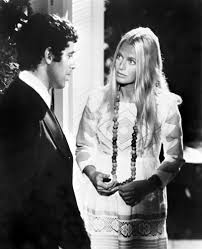
On Nina Van Pallandt: Muse, Witness, Residual Character, and Her Own Woman

Note: Nina Van Pallandt moves through this piece as a kind of drifting hinge figure between art and biography, cinema and scandal, half-real and half-mythologised: from her striking, uncanny presence in Robert Altman’s The Long Goodbye—where she plays the abused, luminous spouse of Roger Wade and becomes, briefly, a kind of muse/anima figure for Philip Marlowe—to her earlier life in the Danish pop duo The Baronets, through her entanglement with Clifford Irving and the great Howard Hughes hoax that later reverberates through Orson Welles’ F for Fake, and onward into the quieter aftermath of fame, reinvention, and partial retreat. The essay follows her not as a stable “character” but as a site where male-authored narratives—Hollywood noir, literary fraud, journalistic myth-making—keep trying (and failing) to fix her meaning, while she keeps slipping free in ways that are at once accidental and oddly deliberate. In the end she becomes something like a case study in cinematic and cultural afterlives: a woman repeatedly written by others, occasionally complicit, sometimes resistant, and finally legible only as a residue of performance, gossip, and unfinished stories that refuse to settle.

I first became aware of Nina Van Pallandt the way most people probably do: not through biography, but through atmosphere—specifically Robert Altman’s The Long Goodbye (1973, The Long Goodbye), a film that feels less like a narrative than a slow collapse of narrative reliability itself. It is a film in which people drift through scenes as if they have forgotten whether they are supposed to be characters or witnesses, and Nina arrives inside it already slightly misfiled, already too composed for the emotional weather she is asked to endure.

She plays Roger Wade’s wife, but “plays” is almost the wrong verb. Altman’s casting logic is not psychological realism in the classical sense; it is something closer to behavioral residue. People are dropped into the frame and asked not to perform identity but to inhabit proximity—to money, to violence, to desire, to failure. Nina’s presence has that peculiar Altman quality: she does not dominate the scene, but she stabilizes it just enough to make everything else look unstable.

Roger Wade (the blocked writer, the alcoholic genius-in-decline) is already collapsing before the plot admits it. Nina is the counterweight that never quite becomes balance. She is care without resolution, intimacy without clarity, the kind of emotional presence that suggests there is a story somewhere but refuses to confirm what it is. And then there is Marlowe, Elliott Gould’s version of Marlowe—half-stoned, half-wandering, permanently a few seconds behind the moral implications of what he is witnessing.

The film keeps staging small ruptures in epistemology. One of the most famous arrives early and feels almost accidental in its perfection: Terry Lennox appearing at 4 AM, asking for a ride to Tijuana. There is a moment—“Tijuana now?”—where Gould’s Marlowe is briefly jolted out of his procedural fog into genuine surprise, as if even he cannot believe how far the plot is willing to drift from explanation. That tonal instability is the world Nina inhabits as well, except she does not get Marlowe’s ironic distance. She gets consequence.

There is a domestic sequence—one of the film’s most disarming—that feels almost out of register with the noir frame: Nina cooking, the soft logic of food and attention, a candlelit dinner shared with Marlowe, where violence and absence are temporarily suspended by something as ordinary as butter and chicken. It is precisely the kind of scene that should resolve emotional ambiguity, but in Altman it does the opposite: it deepens it. Intimacy here is not revelation; it is another form of deferral.

What the film keeps doing, quietly and persistently, is refusing to assign stable moral weight to anyone. Roger Wade is both victim and self-destroyer. Marlowe is both agent and sleepwalker. Nina is both witness and participant, but never allowed the comfort of explanation. Even her suffering—when it arrives—is not narratively sanctified; it is simply another event in a world where events do not accumulate into meaning.

And this is where Nina becomes interesting beyond the film itself. Because she does not resolve into a character arc, she persists as something else: a figure who has been “used” by multiple narrative systems without ever fully belonging to them. In a conventional noir, she would be femme fatale or redemption object or tragic spouse. In Altman, she is none of these cleanly. She is what remains when genre stops enforcing coherence.

What begins to emerge, if one steps back slightly from her, is that she belongs to a broader category of women who are not simply “in” cultural narratives but are written into them by proximity to men who are doing the narrating. The pattern is subtle but persistent: women become legible to the public through the structural gravity of male projects—films, scandals, bands, memoirs—while simultaneously attempting, with varying degrees of success, to assert an interior life that resists that formatting.

It is difficult not to think here of Marianne Faithfull, who occupies a parallel register in the British version of the same phenomenon. Marianne Faithfull is initially rendered publicly intelligible through association—romantic, cultural, chemical—with the Rolling Stones orbit, and specifically through a media ecosystem eager to translate her into a kind of emblem: muse, fallen angel, tragic accessory to male genius. But what is striking about her trajectory is not the initial inscription but the long, stubborn insistence on rewriting it from within.

In both cases—Faithfull and Van Pallandt—the question is not simply “agency” in the abstract liberal sense, but something more structurally constrained: how does a person reassert authorship of self once they have already been written as a function in someone else’s story? Faithfull does this through survival, reinvention, and the eventual authority of her own voice as an artist. Nina does it more quietly, less performatively, by simply not continuing to cooperate with the demand that her life be endlessly narrativized into legible arcs.

And this is where Nina stops being just a cinematic presence and becomes entangled with a second, more volatile narrative system: the world of Clifford Irving and manufactured truth. I remain, in a slightly persistent way, puzzled by Clifford Irving—not in the sense that his actions are obscure, but in the sense that the scale of the gamble still feels oddly disproportionate to the era in which it occurred. Clifford Irving occupies that 1970s threshold where narrative fraud still had room to breathe: before the internet, before instantaneous archival correction, before every claim arrived already cross-checked by a thousand invisible clerks. The rope, in other words, was longer. Not infinitely elastic—but long enough that someone could plausibly believe they might walk it all the way across.

What he did, of course, was fabricate the authorized autobiography of Howard Hughes and briefly convince a publishing system that this fiction was fact. And one cannot quite shake the sense that this sits in a parallel register to Orson Welles’ late-career meditation on forgery and authorship, F for Fake, where the art forger is not simply a criminal but a kind of metaphysical irritant—someone who reveals how fragile the category of “authenticity” already is, even before it is attacked. In Welles’ world, the faker is almost honest about the fact that everyone is faking something. In Irving’s world, the system briefly forgets to notice.

The irony, of course, is that Irving’s fraud depended on a very pre-digital faith in paper trails, intermediaries, and the general slowness of institutional verification. Today it feels almost quaintly physical: forged documents, publishing contracts, phone calls that had to be believed in real time. One can imagine the same scheme now collapsing within hours, not because people are more moral, but because the feedback loops are instantaneous.

And then there is prison. Irving did time—real time, not narrative time—and emerged into a world that had already moved on to other, faster deceptions. Yeah, I mean what did you expect, dude. The arc compresses there in a way that feels almost unsatisfying: scandal, exposure, incarceration, partial reinvention. One wants something more operatic, but what you get is the bureaucratic version of consequence.

The interesting part is not that he was punished, but that for a brief historical window the system was even buildable enough that his plan could function as a kind of temporary reality. That is the shared atmosphere he has with Nina Van Pallandt: not guilt, not innocence, but proximity to narrative systems that were still slow enough to be fooled by their own assumptions.

In later life, Nina becomes harder to place in any of the familiar compartments that earlier decades tried to assign her. The cinematic afterglow fades into cult memory, and the Irving episode recedes into archival texture. What remains is a quietness that feels deliberate rather than accidental—not disappearance, but refusal of continued amplification. She does not convert notoriety into permanent self-mythology in the way later media ecosystems would almost require. Instead, she settles into a lower frequency of visibility: remembered, cited, intermittently revived, but no longer authored by the same pressures that once pulled her forward.

And here the comparison widens again, because what she resembles is not a “sidekick” at all—that word is too structurally comic, too dependent on hierarchy—but something closer to an attendant presence: a figure whose job, in other people’s stories, is to make emotional or moral instability legible without ever fully resolving it.

There is a related category, more neutral and slightly more precise: the faithful interlocutor. Not in the devotional sense, but in the structural one—the person who remains close enough to the main character’s instability to render it speakable, without ever becoming fully absorbed into its explanatory system. Nina performs this function in The Long Goodbyewithout being granted interpretive authority over it.

And there is another: the witness who does not testify cleanly. Not unreliable, but resistant to conversion into stable narrative fact.

We all make mistakes; that much is banal. The more interesting question is what kind of cultural weather those mistakes occur in, and how much agency is genuinely available inside it. Nina Van Pallandt seems, in retrospect, to have lived inside a period when men were still doing a great deal of the writing—of scripts, scandals, explanations—and women were often expected to appear inside those scripts as if they had authored them themselves. Her resistance to that framing is not always loud or declarative. Sometimes it is simply a matter of stepping out of the demand to be continuously interpretable.

And in that sense, what she ultimately carved out is not a grand public myth but something more modest and, arguably, more durable: a minor legacy, lightly held, slightly resistant to over-definition. Not central, not erased, not simplified—just there, in a way that feels unexpectedly intact.

I really like Nina Van Pallandt. In The Long Goodbye, and in the shadow of the Clifford Irving story, it is impossible not to root for her—not because she is resolved, but because she is never fully reducible. She drifts through systems built by men who are busy writing meaning onto the world, and she does not quite consent to being finalized inside any of them. We all make mistakes. She was written into a few. She was also, quietly, a drifter inside Hollywood’s narrative machinery, and what she ultimately leaves behind is a minor but distinct and instinctively cool legacy: not the center of anyone’s story, but one of the few figures who never fully became owned by it.
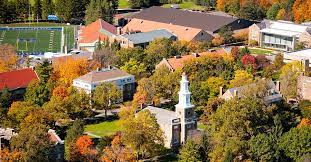
Scenes from Hamilton College II: Freshman Year Continued (with cameos from Honey, the Print Shop, and Billy Bragg)

Note: In Part I of this series I wrote about my freshman year at Hamilton, focusing on two friends, Ian and Jake. Part II will branch out and cover a fairly wide, and somewhat random, set of memories.

Epigraph:

I had an uncle who once played for Red Star Belgrade
He said some things are really best left unspoken
But I prefer it all to be out in the open

Billy Bragg

I have already written quite a bit about the characters who lived in the North Dorm freshman year at Hamilton, however there are a few more to cover. First were the first floor stoners. Basmo was a stoner, and he lived on my side of the dorm, but on the other side of the first floor lived the hardcore stoners. This consisted of a quad of guys whose names I don’t totally recall, but one was Peter Kimber, and who got baked at all waking hours and played Roger Waters’ Amused to Death solo on repeat. Next to them, in a double I believe, lived Keys. Keys’ actual name was Caleb, but everyone called him Keys because of the six to eight keys he had dangling from around his neck at all times. What on earth did he need all those keys for? One for the dorm, maybe one for a car (although he should not have been driving at all because he was the single biggest stoner in the dorm and perhaps on campus), what else? I can’t imagine.

Keys and I were not that close, but I did see a lot of him because we had the same job, which was in the school print shop. I don’t know if print shops still exist in the same form in this digital age, but back then the print shop was busy as. We held the campus down. There were two slightly older women who worked at the print shop full-time and three of us students helping out. The full-timers were Sally and Deb. Deb was the boss, and she was kind of motherly and kind to the students. Sally was nice too, but she could be tough. She would bark at us when we made mistakes, which was often because we were running large machines that would glitch pretty frequently. Sally was both the little sister to Deb and also the enforcer. I liked them both, even though Deb ended up firing me, which I’ll get to later.

So Keys would come in lit every day and sort of fumble through his work, which consisted mostly of stapling and collating. I was trusted more than Keys, with good reason, so I ran the machines, but I also did stapling and collating. We printed things for professors, menus for the dining halls, the school newsletter, and a bunch of other stuff. The third student was a girl whose name I don’t recall, and she was a super-hardcore feminist. Everything in the world that was wrong was men’s fault, and it was her only topic. She didn’t seem to dislike me so much as just want to lecture Keys and I all through work, which usually lasted two to three hours in the afternoon, about the ills of men. I was, and am, up for a little feminist theory but Keys was no help and I don’t even think he noticed her, so it was kind of just me and her. Serious feminism and collating are, perhaps, not best paired.

I didn’t originally want the print shop job. I needed work, and there was kind of an intake for all working students where you put your first choice. I put library, but didn’t get the gig. John Innes put audio/video and he got it, which meant he often had to get up early to set up videos for professor’s classes. I would not have been good at that. The print shop was more my speed, but eventually it got really repetitive and I started skipping work more and more. I would go walk in the woods behind campus, or just drink coffee with about a half cup of honey and hang around after class. I also improved as a student through the year, and took my English classes pretty seriously so I was spending more time in the library, although still not sleeping much.

My money situation was tight, although not as bad as it would later be during my junior year abroad in New Zealand where it was super tight. I had a little income from the print shop and my parents sent a small allowance once in a while, but I usually didn’t have more than about 15 bucks in my pocket at any one time. What money I did have went mostly to CDs, as many as I could afford. I had a dining hall pass, but the dining hall food was not really my style so I mostly lived on toast and coffee with honey. Then at night people would order pizza from a local shop, but that was too expensive for me so I would get “friend dough.” Fried dough is just what it sounds like–deep friend pizza dough with powdered sugar, and it cost about $1.50 for a big box. Not the best diet, but it was what I could afford.

One time the father of one of my classmates from high school visited for some reason; he must have been in the area. We met for lunch, and when he left he handed me $100 bucks. This was a serious windfall, and I immediately blew it on CDs, perhaps Neil Young’s Harvest Moon and others. My CD collection, although no rival to Ian’s was slowly increasing and I liked it.

Back in the dorm, in addition to the guys I have discussed, there were also girls, who lived on the second and fourth floor. I got to know the girls directly above us on the second floor pretty well, although not many of the others in the dorm. Among these was Rochelle, who was the girl I was closest to. Rochelle was, I think, from New York, and when she arrived on campus she made a big deal about having a boyfriend. This didn’t last long however, and although I didn’t want her to be my girlfriend I did like hanging out with her. She kind of mothered me a bit though, which I wasn’t so into, because I was going to do what I was going to do. I still have her contact, and I believe she might even read this piece! I think I also met Marie Bishko freshman year, and Marie is someone I thought was really cool.

I don’t really remember any us North guys hooking up with the second floor girls, but it must of happened. Another incident which occurred around this time had to do with my roommate B. and his girlfriend from high school. Like Rochelle, and even more so, he made a big deal of his girlfriend and told us all kind of semi-salacious details. Then one day he told us she was coming to visit and he wanted the three of us in the quad to go to a hotel for a night. I told him sure, if you pay, but he said no. He was dead serious but we told him to forget it, so sure enough she arrived and they hooked up while we all pretended to sleep. That only happened once, thankfully, and it still strikes me as pretty odd. He later broke up with her and fell in love with a Jewish girl, but that didn’t last either because he wasn’t Jewish.

I mentioned in Part I that Jake pledged the fraternity Sig. Ian and John Slack also pledged, Chi Psi (I had to Google the spelling). I spent some time at Chi Psi as well as, where I was alleged to sit on the steps in my trench coat, but I preferred Sig. There was another frat called Deke, and that was where the wildest, and the worst parties were. At Deke there was copious amounts of Milwaukee’s Best (the fabled Beast) and jungle juice. The parties were terrible, but there was a pool table which was a bonus. I didn’t drink much at college, mostly because I had no money, but I did drink some at Deke, with exactly the results you would imagine. I believe it was at Deke where Marc Campbell pulled off his famous pacification move. I didn’t pledge a frat, and I was and remain glad I didn’t. Greek life wasn’t for me.

One guy who I believe lived in North was called Gabe. Gabe was super popular at first in freshman year, and he played guitar on the grass outside the dorm. He was pretty good and he would play “Sexuality” by Billy Bragg which was surprisingly popular in 1992. People, including girls, would flock around him, but over time something seemed to happen to Gabe. He ran for class president and lost to a guy called Kerry who was African American. Kerry lived down the hill in a different part of campus, and he ran really hard for the job. I think Gabe’s ran mostly on a music ticket, and although he got a lot of votes I think he came in second. He may have taken this hard, because he kind of faded into the background, or maybe he just changed up his action. I think I voted, but may have voted for Kerry.

As I mentioned, Jake and I saw less of one another once he started pledging, however we still saw each other in English class and in the English building. We overlapped professors, although he knew some I did not. The two best professors in the English department were George Balkhe and Fred Wagner. Balkhe was still in his prime, maybe late 50’s, whereas Wagner was older and I believe in a semi-emeritus role. I wasn’t even sure I ever took a class from Wagner, but it’s been confirmed that I did, Modern British and American Drama, which makes sense. I didn’t much like 20th century American plays, as plays are mostly blueprints anyway. In any case, Mr. Wagner knew me early in the year because Balkhe praised my reading knowledge to him. Jake and I would go to Wagner’s house, also down the hill toward the town of Clinton (the closest town to Hamilton, about a 15 minute walk), and I recall once we played him the song “Marlene Dietrich’s Favorite Poem” by Peter Murphy, formerly of Bauhaus, with Peter Murphy murmuring “sad-eyed pearl and drop lips…”

Peter Murphy is super underrated by the way, and Wagner liked the song, which just showed how cool he was.

I took a few classes with Balkhe, and we studied poems, and novels–typical choices mostly. I enjoyed these and read most of them, even Faulkner who is really dense. For the ones I didn’t I just faked it. Like I said, Balkhe thought I was amazing because on the first day of class he asked for a list of books we had read and I listed like 200. These were mostly Agatha Christie and John LeCarre and such, but I guess it was good enough. Balhke liked the singer Donovan and the song “Mellow Yellow.”

Electrical banana
Is gonna be a sudden craze

(I later saw Donovan at a new age convention in Boston when I was visiting Ian after college, which I will recount later).

Wagner and Balkhe are both passed away now, so rest in peace to two great English teachers and mentors.

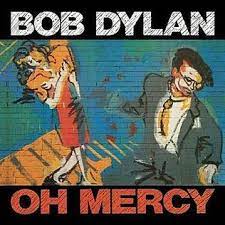
That’s about all I have on freshman year. The last thing is about the featured image for this post, which is the album cover for Bob Dylan’s Oh Mercy. I have written about The Pogues quite a bit, but the album I listened to most freshman year was Oh Mercy. After geology class had a break before lunch and would go back and semi-sleep to Oh Mercy. The quad was always empty at that time of day, and this was the best rest I would get. The album still makes me sleepy to this day, and features excellent production from the famed producer Daniel Lanois. So thank you Bob and Daniel.

Dedication: For Fred. And for George–I hope you are enjoying a little electrical banana up there in heaven.

to be continued…

Scenes from Hamilton College I: Meeting Ian and Jake

New Note: It’s been a while since I last posted this piece, and I’m glad to bring it back here as a republication. “Hamilton I” remains one of my favorite entries on the Kyoto Kibbitzer—an early chapter built around friendship, music, and the strange, formative textures of freshman year, especially the central presence of my good friends Ian and Jake, who shaped so much of that time. It’s also one of the more widely read pieces on the site, which I appreciate. Re-reading it now, I’m struck by how much of what came later was already there in embryo: the scenes, the sounds, the late nights, and the people who mattered. As always, thanks for reading.

And I recall the moment
More distant than it seems
When five green queens
On a black bin bag
Meant all the world to me

The Pogues

I attended Hamilton College, and managed to graduate–possibly in linen. At Hamilton I was an English major, and intended to be from when I enrolled. This was a decent choice; however both Hamilton and English were kind of my father’s choices. I also managed to cobble together an Asian Studies minor through the good auspices of my advisor who checked out my credits and told me I could put that together. This was a good call on his part, and even though I kind of stumbled into it, The Asian Studies minor was my choice.

I was pretty unprepared for college. Before going I was asked to fill out a kind of questionnaire to help the college place me with roommates. One of the questions was, are you clean, messy, or in the middle. I chose in the middle, which was sort of a mistake because it turns out men are pigs, and I was cleaner than most. At the same time though it wasn’t a mistake because if I had selected clean I may not have met Ian and Jake. Jake was my roommate, and we lived in a quad. The other two roommates were Brian and Geoff, and although I had a relationship of a sort with both of them freshman year, we were not really on the same page. Jake and I were. Ian was our next door neighbor, and he roomed with Marc Campbell, and two other people. Ian, Jake, and Marc are still in my life.

My parents came with me to upstate New York, and before I moved into the dorm we stayed for a few days in a hotel near campus. I was kind of apprehensive, and spent the days listening to The Pogues and quietly stressing. But when I moved into the quad things were fine. This was mostly because of Jake.

Jake was a bit of a wild character. He was from either New York or Connecticut as I recall, and I think he came from decent money. When I visited his house later that year it was very patrician, for lack of a better word. His father seemed like a super old-school WASP patriarch, and his mother didn’t work I don’t believe. His younger brother held right-wing political views at the time, while Jake was a lefty. This was a point of serious disagreement between the brothers, but other than that the family seemed pretty solid. I believe that his brother has since switched his political views.

I didn’t meet Jake’s family until Thanksgiving however, and got to know him first in the context of the quad. We lived in a dorm called North, on the first floor right by the door. (My buddy John Innes, who joined me at Hamilton from our high school lived in the neighboring dorm Kirkland, and next to that was South.) The door to North would be locked at night, and other dorm folks would regularly misplace their key and crawl through our always open window. Jake and I rarely slept, and I got in the habit of staying up until about five AM. After that I would get a little sleep before first period English class. Then I would attend Geology class, which satisfied some kind of Science graduation credit. For English class I was alert and on top of it, although I was still hand-writing my papers, which changed once I got in the habit of using the computers in the library. English class was small, maybe 12-15 people, whereas Geology was huge and held in a lecture hall. I would go lay down in the back in the aisle and try and sleep. I ended up getting As in almost all my English classes, and a C- in Geology, which was deserved to an extent because of the sleeping. However, the main question on the final was brutal and pretty unfair, which was to draw a seismograph. Literally, draw one, which we had never studied and I did cram for the final. Brutal action. Somehow I still made the honor roll that year, and every year, because of my performance in the humanities.

Jake was an English major as well as far as I recall, I kind of forget, but he knew a lot of the teachers I knew. In any case, we did not bond primarily in the classroom, but in the dorm and then at “Sig,” the frat he was associated with and later pledged. Sig was the alternative frat. I hung out there a bit, but when pledge season started they kind of cracked down on non-pledges attending parties. For Halloween, Jake snuck me in early, and although that night I got a few looks I was good with Jake’s blessing. That night I wore all black with a turtleneck and a paper sign on my back saying “No future for you.” As in the Sex Pistols. I was talking with an older guy, an alum (there were always some alums that hung at the frat parties at Sig) at the party and he said something to the effect of “I like you, but I don’t like your shirt.” OK dude.

That was the same night I believe that inspired the following little ditty I later shared with Jake:

I pissed in the toilet

He pissed in the sink

He said I haven’t got a god above

I haven’t got a drink

Jake later took umbrage with the lines, not the sink part, which was and remains credible, but the god part. I think he is, or was, a believer. In any case, he’s my friend and won’t sue.

I appreciated Jake showing me the ropes at Sig and elsewhere. In the dorm we would play his music–he was into the classics, Beatles and Stones, Kinks, Bowie. We would sing “The Ballad of John and Yoko,” and “Come Together,” mostly the former over and over, no doubt to the annoyance of our roommates. Jake also liked The Pogues, and this made me think even more highly of him.

Jake smoked, Marlboro Reds, and I soon started smoking too, the same brand. This was not out of a desire to be a smoker, but rather as a way to keep my hands occupied and look busy at parties, where I had some difficulty mixing. I picked up, or invented, a little trick where I would fold up the flaps of a cigarette pack so they looked like a paper airplane, and then lob the cigs around the room, usually to any girl that wanted one. This got me some attention and some affection, and I kind of became known for the move. It didn’t get me laid, but at least it was something. Jake and I were fast friends, and hung out a lot in the early part of the year, before he began to branch out. Once he started pledging Sig though I saw less of him, naturally enough I guess.

By the time Jake started pledging, and even before, I was spending more time with Ian. Ian was from Boston and his father was a medical doctor. He lived in a nice house in the suburbs–both Jake and Ian had quite a bit more money than I, a common feature at Hamilton where pretty much everyone had money expect me. I was on a pretty decent scholarship, despite my not so impressive high school record, and could not have afforded the school without the scholarship. I visited Ian once or twice I believe in college, and then stayed with his family for a few months in the fall after college, but that’s a story for a future post.

Ian had a massive record collection in his quad, next door to mine as I have said. I liked Jake’s music, especially “Rebel Rebel,” “Come Dancing,” and The Stones, however his selection was somewhat limited. Ian’s was capacious. He was into bands like The Stone Roses, The Charlatans, Ride, and a bunch of other British bands I didn’t know at the time. But he was really into everything. I spent hours in Ian’s room soaking up his music, and my association with him kind of took over where Dyche Alsaker’s left off. I think it was Ian who also introduced me to Luna, who was coming up at the time and is still one of my favorite bands to this day. Later, in senior year I think, Ian and I had a radio show together and one night we got to play records all night long when a few other people canceled suddenly. I would play The Replacements and the Pogues, and Ian would play his music, but I was also getting deep into the 4AD label and bands like Big Star, This Mortal Coil, and a little known band called The Binsey Poplars (who I’m not sure were even on 4AD), named after a Hopkins poem. But my favorite around that time was Nick Drake, who was on Rykodisc.

Drake is now pretty well known, mostly on the back of his song “Pink Moon,” which was featured on a Volkswagen commercial, but back then he was not well known outside serious music circles. I loved his song “Rider on the Wheel,” and was an evangelist for him, telling all and sundry to listen. Most people didn’t, of course, but the whole move was just odd enough to get a little attention, which I was definitely seeking. (Another friend from that time John mentioned to me a few years ago that I would sit on the front steps of his frat in my trench coat and read a book. I don’t really remember this, but if it’s true it was for sure for attention.) I remember one evening Ian had a kind of band that was playing and I “opened” for them. My act was simply talking about Nick Drake, painting him as a forgotten genius, which he was, and pleading with the crowd to listen. It went over pretty well, like I said probably just because it was different.

Later on, mostly the next year I think, Ian and I went to a few shows in Boston, including The Red House Painters, The Fall, and Love Spit Love. Ian would drive, and blast The Pogues with the window down to stay awake on the way home. Before one of these shows we managed to source a little green, which was enjoyable. We would park, illegally, in some lot Ian knew. In the lot, there were rats.

Jake and I were sort of on the same level–both semi-degenerate English majors–but Ian I looked up to. He was definitely the leader in the friendship, although he must have seen something in me because we hung out a fair bit. Ian was also friends with Marc, but he was perhaps closer to another group of guys who lived in two adjacent quads on the third floor. This included John and a guy called Will. I would go up there too, and Will would ask “what Dead do you want to listen to?” I always went with Reckoning because I liked the country-folk sound and the song “It Must Have Been the Roses.” I liked the third floor guys too, especially John.

Next door to Jake and my quad was Adam and Basmo. Adam and Basmo (a nickname) were seniors who for some reason decided to stay in what was basically a freshman dorm. Adam was cool, but pretty grown up. Basmo was still a kid, and loved to get high. Loved to get high. Early on in the year he would come over and ask “anyone want to get stoned and session?” A session, it turned out, was you would smoke, put on The Beatles, and watch Bugs Bunny or something with the sound down. The idea was the music would synch up with the cartoon and it would be hysterical. It totally worked, although I just liked to listen to music and bullshit rather than session. Real heads will remember the session. (Jake told me that sadly Basmo later took his own life as a result of the worsening effects of ef. That was really too bad because Basmo was just a pure open-hearted soul.) So basically we would get stoned when we could, smoke Reds, and stay up all night and listen to music, which was a pretty decent life all in all. Jake and Ian took me in, and made the first part of freshman year so much better in all ways than it would have been if I hadn’t known them.

Dedication: For Ian and Jake, for seeing something in me, and helping make me a little somebody.

to be continued…

Note: If you liked this piece, you may other like the other pieces below in the Hamilton series.