Note: Spokane, early 1983: minor league baseball, cheap seats, and kids living in the gaps between innings. This piece recalls Spokane Indians games, chasing balls during batting practice, and a strange collision of childhood mischief and adult volatility at the edge of the outfield fence. Sandy Alomar Jr.—then a local catcher on his way to a long MLB career—signs a baseball in handwriting so precise it feels like a signature on a future already underway, while a moment of chaos involving thrown persimmons and a furious adult named Mike Trowbridge becomes the kind of story that sticks far longer than the season itself.
Epigraph:
Do you know who you’re fucking with?/ You’re fucking with a stallion mange.
Ween
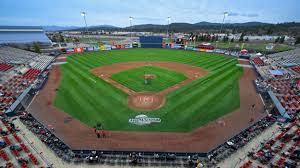
It was 1983 in Spokane, the kind of summer that felt permanently suspended in late light and dry heat, where the air at night still carried the dust of the day like it had nowhere else to go. We played Little League baseball in uniforms that never quite fit right, and then on weekends we graduated to something bigger and looser and more important: Spokane Indians games at the old stadium, Single A ball, where the dreams were real and still close enough to touch.
The Spokane Indians were a kind of civic promise back then. It was a small town, and in the early 1980s there wasn’t always a lot going on. The Indians were not quite big league, but not quite nothing. Just enough baseball to make you believe that something important was always one bus ride away. The seats were cheap, the beer cheaper, and the fences closer than they should have been. The whole place had that slightly improvised feel—like the city had built it thinking, this will do for now.
We didn’t go to games like spectators. We went like we belonged.
Behind the outfield wall during batting practice, kids gathered like scavengers. We chased homers, argued over balls, sprinted through patches of grass worn down by repetition. Sometimes we were the only ones back there. Sometimes there were older kids, or dads, or random locals who knew the angles better than we did. It was a loose territory. Not quite policed. Not quite ours. Something in between.
That summer, the Indians had a catcher everyone knew. Local kid. Quiet confidence. Clean mechanics. The kind of player adults already talked about like he had a future attached to him.
Sandy Alomar Jr. was that guy even then—before the long MLB career, before the All-Star years, before anyone outside Spokane would know the name properly. He was already different. You could see it in the way he stood when he wasn’t moving, like he was always half a second ahead of the next pitch.
I got his autograph once. It wasn’t dramatic. Just a moment after BP, when he signed a ball for a cluster of kids leaning too far over a rail. His handwriting was unexpectedly beautiful—controlled, deliberate, almost elegant in a way that didn’t match the dirt and sweat of the field. I remember thinking even then: this is what someone looks like when they’re going somewhere.
I kept that ball for years.
Because baseball wasn’t just baseball. It was a hierarchy you could see. You had the guys who were going to make it, the guys who might make it, and the rest of us orbiting the idea that proximity alone might transfer something.
Most of them wouldn’t go anywhere. That was obvious even then, though nobody said it out loud. But that day, none of that mattered yet. What mattered was the fence.
Our party was up high in the stands on the first base side, just beyond where the stadium fence met a thin strip of wild space. A tree had grown there—some kind of fruit tree, nobody was ever fully sure what it was. Persimmons, maybe. Something orange-red and heavy-looking, the kind of fruit that doesn’t look like it should be thrown but absolutely is.
Some kids started throwing them. Just kids, just fucking around. But they didn’t know who they were fucking with. Fuck with me and I’ll fuck with you.
The fruit flew. Not carefully. Not aimlessly either. More like experimentation. Testing distance. Testing reactions. Some of them were aiming at fans, others just launching them over the fence because it felt like something you could do if no one stopped you.
It was mildly funny at first. Then mildly annoying. Then mildly dangerous in a way that nobody fully acknowledged.
Because persimmons, if that’s what they were, aren’t soft. They hit like small decisions.
I remember one bouncing near a row of seats and rolling under a foot. Someone laughed. Someone else shouted. But nobody moved with urgency yet. It was still in the category of “kids being kids.”
Until Mike Trowbridge noticed.
Mike T was there with his kids—David Trowbridge and his sister Dawn. David had been a teammate of mine in Little League, a few years younger, outfield guy, quiet in the way younger kids sometimes are when they’re still deciding how loud they’re allowed to be. Dawn was just there in the background of everything, observing.
Their dad, Mike, was not background.
He was one of those adults you noticed before you understood why. Volatile energy. Tight posture. Goatee, black tank top, gold chains around his neck. A bit of a greaser; drove a Harley. Always slightly too close to losing his temper. He wasn’t a bad guy exactly—he could laugh, he could talk—but you always felt like there was a second version of him sitting just under the surface.
He saw the fruit being thrown. And something in him snapped into motion. He walked straight to the fence line, fast enough that it changed the temperature of the moment.
“Knock that shit off right now,” he yelled.
The kids paused. Not because they were scared exactly, but because the voice had weight.
Then one of them—small kid, maybe ten, sunburned confidence, the kind of kid who doesn’t fully understand consequences yet—looked up and said:
“Don’t pump me, man.”
It was such a strange sentence. Too casual for the situation. Too confident for the speaker. Like he had borrowed it from somewhere older and wasn’t sure how it fit yet.
There was a beat of silence where the entire stadium noise seemed to pull back slightly.
Mike T looked at him.
“Don’t pump me?” he said.
Then his voice shifted.
“You want me to pump you? I’ll pump you.”
And in that moment—this is the part that still feels unreal even now—he climbed the fence. Not slowly. Not theatrically. Just decisively. Like the boundary wasn’t a boundary at all.
Everything changed at once.
Me, David, Dawn—everyone nearby—we all froze in that wide-eyed way kids do when they realize the rules might not hold. It wasn’t comedy anymore. It wasn’t baseball anymore.
It was just: Mikey baby don’t kill that kid.
That’s what it felt like in my head. Not words were spoken, just panic translated into something almost verbal.
The kids scattered instantly. Full sprint. No hesitation. The fruit stopped mid-air and dropped forgotten. The stadium behind us suddenly felt far away, like it belonged to a different scene entirely.
Mike T took a step forward, still inside the fenced edge of this improvised battlefield, breathing hard, still locked in that strange overlap between anger and disbelief.
And then—somehow—it was over. No actual violence. No contact. Just the threat of it, large enough to erase the mischief that had caused it.
The kids were gone. The fruit stopped flying. The tree stood there like nothing had happened. Afterwards, the stadium noise came back slowly, like a system rebooting.
My dad, Ross, had seen the whole thing. He was laughing, hard. Not the kind of polite laugh adults do when they think they’re supposed to. This was involuntary. Almost helpless. The kind of laugh that tries to stay respectful but can’t quite hold the line.
Because it was funny. In that terrible, chaotic way childhood sometimes is when it brushes up against adult intensity and survives without breaking.
Ross would tell that story for years after. The kid. The fence. The persimmons. The line: don’t pump me man. He never stopped laughing at that part.
Neither did I.
But at the time, I just stood there thinking about Sandy Alomar Jr. somewhere on that field, already on his way to something else entirely, signing baseballs in beautiful handwriting, while right behind the stadium wall the rest of us were learning the difference between games and consequences in real time.
Most of us wouldn’t make it to the Bigs. But for one afternoon in 1983, it all felt like it might matter just the same.was 1983 in Spokane, the kind of summer that felt permanently suspended in late light and dry heat, where the air at night still carried the dust of the day like it had nowhere else to go.
But for one afternoon in 1983, it all felt like it might matter just the same.
Dedication:
For Mike T. And for the kid. You got balls young man, I’ll say that.
Note: This is a new piece about my dad, Ross Thomas (RO), and his truly unbelievable climbing strategies. The central episode took place in Stehekin, Washington, many years ago, when RO led my brothers and me on an attempt to reach Castle Rock that quickly devolved into heat, dense forest, no water, and general mayhem. There is also a later coda involving a climbing gym in Portland that is, in its own way, even more outta control. This piece is comic in nature, but also affectionate. My dad is a great man, a brave man, and a very game climber. He is just not, in this one specific domain, a planner.
Send lawyers, guns and money — the shit has hit the fan — Warren Zevon, refracted
RO, is a great man and a terrible climbing strategist. He is brave, energetic, physically game, and in most areas of life basically well organized. He was a good high school English teacher, a very good administrator, and for many years an excellent and meticulous girls’ basketball coach. He is not, in other words, some kind of general life-space incompetent. Quite the opposite. Which is what makes his climbing strategies so difficult to understand.
They are ridiculous. They are unbelievable. They are officially, historically, and totally outta control.
I say this with love.
The central case study here took place in the mid-2000s, let’s say 2005, when our family was staying in Stehekin, Washington, out on Lake Chelan. If you have never been to Stehekin, it is a beautiful and slightly improbable place, the kind of place that already feels like the beginning of a story. Lake Chelan is huge, and you get out there by ferry, which means from the jump there is a sense that you are committing to something. People camp there or stay in cabins. We were in a cabin. My mom Claudia (CL), stayed behind. RO, meanwhile, had a plan.
The plan was that RO and his sons — Mike (MI), Pat (PA), and me — would hike up toward Castle Rock.
Now, one thing about family expeditions is that “the plan” is often not really a collective possession. It belongs to one person. The rest of the group is more or less there to follow along. In this case, the plan belonged entirely to RO. MI and PA and I were, broadly speaking, along for the ride.
As I remember it, we started from Stehekin and walked about three miles just to get to the trailhead, then hiked a few more hours uptrail to where we stopped and camped the first night. It was already a decent undertaking just to get there, but this was, in a sense, merely the prelude. The true RO strategy had not yet fully revealed itself.
At around dusk, after we got to camp and set up the tent and got ourselves sorted for dinner, RO decided he was going to scout the route for the next day. This seemed reasonable enough. It is in fact the sort of thing a prudent leader might do. Only instead of scouting further up the trail, or perhaps generally uphill toward the place we were trying to go, RO for some reason headed downriver.
Why did he do this? We did not know. It was back downhill. It seemed unrelated to the objective. Even at the time it had the feel of one of those decisions that makes perfect sense only to the person making it.
Ross Thomas: The trail kind of petered out eventually and didn’t really lead to Castle Rock anyway.
Fair enough. I want RO’s side of the record included here. But even granting this, and I do grant it, going downriver in the late evening did not strike the rest of us as a strong opening move.
Sure enough, RO fell in the river and got completely soaked.
This was the first of many mistakes he would make on the trip.
He came back to camp late and dripping wet, having apparently developed an immediate a bizarre attachment to that river. The water was cold. The evening was cool. He changed clothes, we had dinner, and we went to bed. At this point, there was still some chance that the next day might somehow become normal.
It did not.
The next morning we got up early, had breakfast, and prepared to head out. My assumption — based on reason, precedent, and the literal existence of trails — was that we would continue on the trail. Instead, RO decided that we were going to bushwhack straight uphill through an extremely dense forest in the blazing heat.
This struck me as a bad plan.
It was a bad plan.
The forest was thick enough that you could not really move with any rhythm. We were not hiking so much as negotiating, arguing, and physically contesting with the landscape. Every movement took extra energy. Progress was incredibly slow. The heat was serious. And the main problem, which quickly became the only problem, was that there was no water. Not a stream. Not a trickle. Not a suspicious puddle. Nothing.
Now, RO for reasons that remain mysterious to me is not a big water drinker. He prefers beer and tea. Under ordinary conditions this is merely a personality trait. On a hot uphill bushwhack through dense forest it becomes a strategic liability.
Naturally, we asked where the water was.
Ross Thomas: I had read in a Fred Beckey book that there was a way to get up to Castle Rock, although I think Beckey had only heard about it and never actually done it himself.
This is, in its way, a perfect Ross Thomas detail. Fred Beckey, the legendary climber, had perhaps heard there was some route, though he had not personally taken it. This was enough for RO. A rumor in a book by a famous climber became an operating plan.
As for the water situation, RO told us — and I remember this vividly — that there might be some in about five miles.
Five miles!!!
We were already fighting for our lives up there, and this crazy man was calmly informing us that in only another five miles there might, possibly, perhaps, be water.
He’s totally outta control.
At some point, after what I recall as roughly three miles of this lunacy, we basically mutinied. Or perhaps mutiny is too strong; let’s call it collective realism. We told RO the obvious, which was that this was not going to work. The route was no good. The heat was too much. There was no water. We had to turn back.
And so we did.
Now the descent was interesting because it brought out our distinct styles. RO, MI, and PA were making their way down carefully, gingerly, responsibly. I, on the other hand, was absolutely flying. Swinging from tree to tree like some kind of deranged monkey, just ripping downhill through the forest. This part RO loves to tell to this day, and I admit it was one of my better athletic showings. I was not going to die of thirst in that forest and I was not going to descend politely either.
Eventually we made it back to camp. Or rather, most of us made it back to camp together. RO, in one of those small but meaningful complications that tend to gather around him in climbing situations, got separated from us and somehow ended up down by the river again.
And yes, he fell in again.
He really must have loved that river.
So now here he comes back to camp once more, drenched, and by this point we are all in total agreement that the trip is over. We are done. It is time to 86 the hell out of there.
So we break camp and head down toward the lake shore. But this presents a new problem. We still have a significant walk to get home — something like another two miles down to the shore and then, as I remember it, another three miles around the lake. And by now it is dusk. So this is not really viable either. We are hot, tired, and in no mood for an elegant final act.
At this point RO does what he often does in these situations, which is simply assume that reality will provide.
He found a guy with a motorboat and asked if he would take us back to Stehekin.
The guy said sure. Fifty bucks.
RO then informed him that he did not actually have fifty dollars on him, but could get it from his wife once we got back to the cabin.
Somehow, by what can only be described as grace, audacity, or a temporary breakdown in the boatman’s judgment, this worked. We got in the boat, got home safely, and made it back in time for dinner.
That was Stehekin.
CODA
You might think the lesson here would have been: bring water, stick to trails, do not base wilderness plans on rumor, avoid rivers if possible, and maybe do not lead your sons into dense forests in the hot sun in search of a semi-mythical route described secondhand by Fred Beckey.
You would be mistaken.
Many years later, when RO was Principal of Valley Catholic High School, he got really into climbing at a gym in Portland. It is a cool place, run by a father and son, and it has beginner, intermediate, and advanced climbs. He took me and MI and PA there, and later my son Hugh as well. Hugh loved it. He scampered up the walls like he had been waiting for exactly this sort of thing his whole life. I like climbing too, though my arms get tired pretty quickly and I tend to fade. MI and PA are both good climbers. RO, to his credit, also has strong stamina.
So one day my wife and Hugh and I were there with him. We’d been climbing for a few hours. I was on the mats, faded, taking a break. Hugh was still going. RO was showing him some moves. Then RO started up one of the big walls — one of the long climbs, the kind where you need the harness.
Only he had forgotten to put the harness on.
Hugh saw this before anyone else did and yelled out:
RO, get down now!
And RO did.
For the next year, RO loved telling the story of how Hugh had saved his life. Quite right too. It is a great story. My son saved my dad from one of my dad’s own ridiculous climbing strategies. The circle was complete.
But then, about a year later, shortly before RO retired from the principal job in 2018, he was back at the gym by himself. This time the only other people there were the owner and his son. And somehow — incredibly, impossibly, yet also in a way entirely consistently with the established Ross Thomas climbing tradition — he forgot the harness again, started up the big wall, and fell.
He crashed all the way down onto the mat.
The mat saved his life, no question. But his feet and knees and legs got absolutely busted up. He was in a wheelchair for months. It was so bad that he had to move temporarily out of the country house in the woods where he lives with CL and into a little bungalow on the Valley Catholic campus owned by the nuns that founded and still run the school. He could barely work. To this day his feet remain a total mess. He has trouble driving and has to drive with his shoes off and wearing some sort of thick sock or something.
At one point we wondered whether he might sue the gym owner for negligence. But RO wanted no part of that. He said it was his own fault, not the owner’s.
Fair enough.
And then, after many months, he mostly recovered. Which means this story has, if not exactly a happy ending, at least a decent one. Better still, as soon as he was recovered he went right back to the gym and started climbing again!
This is what I mean.
His climbing strategies are ridiculous. They are unbelievable. They are officially, historically, and totally outta control. He does not plan for basic things such as the route, the water, or how exactly one might avoid miles of dense forest. He does not always remember the harness. He seems, in climbing situations, to operate according to a distinct internal logic unavailable to the rest of us.
And yet outside of climbing, this makes almost no sense. He is, as I said, a basically well-organized guy. He planned lessons. He coached meticulously. He ran a school. In most areas of life he is not slapdash at all. Which makes the climbing thing not just reckless but anomalous. It is a localized mystery. A glitch in an otherwise coherent system. I do not understand it and at this point I do not expect to.
What I do know is this: to this day I avoid climbing with him because in this one particular area I do not trust his judgment at all.
I love the man. But when it comes to climbing, he is not to be trusted.
Dedication:
For my dad. I love you baby but you are totally outta control.
Note: Some stories get better in the telling. This one doesn’t need to. It arrives fully formed—one line, perfectly placed—and has stayed that way ever since. I’ve told it for years and it still lands exactly the same. No embellishment required.
It’s September, 1989.
Two new teachers had just arrived at St. George’s School in Spokane, WA. These are Paul Hogan and Pete Aiken. Paul would go on to have a long and distinguished career, eventually becoming Principal of Jesuit High School in Portland—a major job, the kind that makes a life. I have no idea where Pete is today.
That night, my dad Ross invited them over to the house for dinner. It was one of those late-summer evenings that still carried a little warmth but hinted at the coming turn. Ross was out back at the grill, working over the barbecue with a beer in hand. The adults clustered nearby, talking, drinking, getting to know the new arrivals. There was that particular tone of adult conversation—half-professional, half-social, everyone just slightly aware of roles and impressions.
Out in the yard, it was just the three of us: Pat, Mike, and me. We were playing catch with a tennis ball. Nothing serious. Just throwing it around, loose, casual, the way kids do when the game isn’t really the point. At some point, either Mike or I made a bad throw. It sailed wide of Pat—too far, too high—and rolled past him.
A completely ordinary moment. The kind of thing that happens a hundred times in a backyard, in a summer, in a childhood.
Pat was six. He didn’t chase the ball. He didn’t complain. He didn’t turn to us. Instead, he turned—calmly, deliberately—and looked over at Pete Aiken, one of the brand-new teachers, a guest in our home, a man he had just met. And in a tone of quiet assurance, as if assigning responsibility in a meeting, he just said:
“On it, Pete.”
That was it. No smile. No wink. No awareness of what had just happened. The ball was recovered. The game went on. The adults kept talking. The evening continued. But something had shifted, just slightly, just enough.
Because in that moment, a six-year-old child had somehow crossed the boundary between worlds—between kids and adults, between play and work—and issued a line that did not belong to him, but fit him perfectly.
I don’t remember what happened next. I only remember that line. And I remember that we have been laughing about it ever since.
The On It Pete Blues (Pete’s POV)
I was new to the city, new shirt, new street,
Standing in a backyard trying hard to be discreet,
Ross on the grill and the talk running deep,
Just another first night—then I heard, “On it, Pete.”
I hadn’t been briefed, hadn’t learned the terrain,
Didn’t know the house or the shape of the game,
Just a beer in my hand, trying not to overreach,
Then a six-year-old turned and delegated to Pete.
Now I’ve worked in schools, I’ve handled my share,
Rooms full of noise, moments needing repair,
But nothing quite like that clean little feat—
Being calmly assigned by a kid in bare feet.
No panic, no pause, no doubt in his beat,
Just a glance and a nod—“On it, Pete.”
And the ball got found, and the night rolled on,
But I knew right then something strange had gone on—
In a yard full of voices, one line cut through the heat:
I wasn’t just visiting.
I was on it.
Pete.
Dedication:
For my brother Pat. And for Pete. Just get on it already baby.
Note: If you liked this story you may also like the stories below, which also cover my time at St. George’s High School.
Well it’s always been my nature/ to take chances/ my left hand drawn back/ while my left hand advances.
Bob Dylan, Angelina
Epigraph II:
I’m glad I did it all then you know that I didn’t listen/ glad I went and got it all outta my system.
My Morning Jacket, Outta My System
Epigraph III:
It’s never been a fair fight.
Craig Finn. It’s Never Been a Fair Fight
Note: What follows is a direct and somewhat graphic account of my experience of being badly abused as a child. The abuse happened at the hands of my aunt’s (father’s side) first husband when I was six and seven years old in the very early 1980s. As I will recount, the abuse had deep and lasting impacts on me and it took me years, decades, to process and understand what it did to me.
I make absolutely no claim to be an expert on childhood abuse or to speak to anyone else’s experience of this all too common problem. My experience is my own, and that’s all I can really speak to. In addition, although he conducted what I consider to be vicious abuse of my brother, I understand that anyone impacted by abuse may categorize events in different ways. Therefore, I will allude only glancingly to these aspects, and only through the lens of how this impacted me personally. I will, inevitably, make reference to the role of my parents and my aunt in the events, and as I mention below when I began to fully process the abuse I directed a certain degree of anger at these adults. As time has passed, however, I have come to understand that although they were not able, for whatever reason, to stop the abuse, and although it was conducted, at least in my case, in their direct view, the primary responsibility lies with the abuser himself.
In early 2024 I did seek out legal advice from a firm that specializes in childhood sexual abuse, and they gave me a professional and compassionate hearing, however in the end declined to take up my case and directed me instead to the Washington State public system. I will detail those events below. I am not currently pursuing legal avenues, and instead am hoping that by making this public I can finally fully exorcise the lasting damage that was done to me. I take full responsibility for the content of this piece.
I was born in South Bend, Indiana in June of 1974. My father was pursuing a master’s degree at the University of Notre Dame at the time, however when I was around six months old my parents moved back to Santa Clara, California, where my mother’s parents were living. My father did not finish his master’s at Notre Dame because of some issue with the faculty there, however I believe that he did later finish at Santa Cruz University in California. In an interesting side note I also pursued a master’s degree, in History at the University of Northern Arizona in the late 1990s, and did not finish because of a conflict, or disagreement, with my thesis advisor. Life has a funny way of repeating itself.
We lived in Santa Clara until I was, I believe, two years old, and then my parents moved us to Gig Harbor, Washington. My understanding is that my father wanted to move to Washington State to be closer to his sister, Nancy (Nan) Thomas. Nancy is my father’s younger sister and it was she, I believe, that introduced my father to my mother, who was Nancy’s friend when they all attended Santa Clara University.
It just so happened that Nancy was then married to a man who would become my abuser. My first memory of this guy, just some fucking guy as far as I’m concerned, is also my first real memory in life (Note: This has since been revised to happier memories when I was two in California. I will detail these at a later date). It goes like this:
When I was very small, two going on three, (I know I was three in Gig Harbor because my brother Mike was born there in June of 1977), we lived in a small house right next to the Pacific Ocean. What I recall about this time was, we had a dog. My father was working at a nearby lumberyard which I occasionally visited, and, I think, was sort of seeking what would be the next stage of his life. My parents had no money, but I didn’t understand this at the time.
My first vivid memory is of playing a game called “Shovelman” on the beach of the Pacific Ocean right by our house. I don’t remember the rules of Shovelman, but it involved a frisbee. However I do recall, with absolute precision, that one time the frisbee was thrown out into the ocean, which, in western Washington, was very cold. This guy ordered me to swim for the frisbee, and when, predictably, I struggled mightily to reach the frisbee in the freezing water and came out gasping for breath, he laughed and laughed, like a total sadist. Of course I didn’t know what a sadist was at the time, but I recognized his essential nature even then. I knew for sure at that moment that he was a bad guy. Now I don’t fully know if my father and mother liked this guy or considered him a friend. All I know is, he was around some. I later learned that my uncle Kim did not like him. Hated him in fact. Kim has had an interesting and varied life, and is my godfather. I love Kim, and salute him here for his instincts.
While my first memory is a negative one, presaging as we will see later events, I also have positive memories from this time. I recall right around this time the days after my brother was born that some of my mother’s family visited us including her mother Barbara and her youngest sister Leslie. My mother has nine siblings, all, fortunately, still alive and all wonderful people. Leslie was quite young at the time and is only a few years older than myself I believe. Anyway, I looked up to Leslie and thought she was cool, so when we all went to a restaurant I sneaked under the table and pulled on her leg, like little children do. I wanted her attention, but I’m not sure if I got it. As I mentioned above, I also recall visiting my father at the lumberyard and thinking he also was cool and had a cool job. I don’t know if he would remember that line of work the same way or not.
In any case, my family did not stay in Gig Harbor very long, and pretty soon we were back in California, this time in Palo Alto, which is a town adjacent to Santa Clara. These days, Palo Alto, Santa Clara, and the nearby San Jose are well known for being sort of the heart of Silicon Valley, but back then they were not really on the map in that way. My mother was working as a swim coach at Stanford University and my father was working at a school in town. This was a wonderful period of my life as I spent time at Stanford hanging around the pool while my mother was coaching which was a total blast. I may recount this time in more detail at a later date. Suffice it to say I was an outgoing, curious, and happy child, eager to see what the world had in store for me. As I will detail below, I believe I was at this time essentially an extravert, and the primary, from my perspective, impact of the later abuse would be to turn me into a somewhat serious introvert. Over and above all other impacts of the abuse, this is the one I resent the most. It is my belief that my natural extraversion, my interest in and ability to trust and like people, was deeply damaged by the actions of my abuser. I will never fully get over this aspect of the situation, and have had to work very, very hard to overcome what I see as a kind of inversion of my essential nature.
In the year 1980 my family moved once again, this time to Spokane, Washington. And again, this was, as I understand it, for my father to be closer to his sister who was by that time working as a young lawyer in the same city. My abuser was also, I believe, a lawyer. It is certainly true that, although younger, Nancy was on the upswing of her career much more quickly than my father. Other than that I don’t know the exact reasons for this following of his sister, however my father found a teaching job at St. George’s school in Spokane WA. I would attend St. George’s from grade 1 through 12, and have written rather extensively about my time there. Interested readers can find these pieces on this blog.
St. George’s was great, and overall, although my parents were still broke, I had a good childhood. However, there was one dark aspect, which was we would regularly visit Nancy and this guy at their home on the South Hill in Spokane. On occasion, but much less regularly, this couple would visit us at our house on the outskirts of the city. I believe that all of the incidents recounted below occurred in 1980 and 1981. I know this for a couple of reasons, first of all because the volcano Mount Saint Helens erupted in 1980 and at Nancy’s house in the backyard there was a big craggly rock which had pockets of ash residue from the eruption and this event was a big topic at the time. Secondly, I know that I was enrolled in first grade at St. George’s so I must have been six. My brother Mike then would have been three going on four. I wrote about my wonderful brother Mike before here.
The action at the Thomas household there was not all bad–there was the ash and a nearby park called Cannon Hill Park which was pretty cool. The house on the South Hill was pretty large, certainly larger than our own, and I got to know my cousins, both of whom were even younger than myself. I would say we visited dozens of times over the course of a year or two, and I remember the house and its environs well. In any case, ash and parks aside, the main event at the Thomas house turned out to be regular and vicious abuse from this guy which was conducted in full view of everyone in the living room of the house. After a little dinner or whatever, he would “tickle” myself, my brother, for extended periods of time, 20-30 minutes at a time or so or more. This “tickling” was not in any form playing; it was, instead, a totally vicious fully body attack.
It was absolutely excruciating and horrible, and he would touch every single part of my body and dig his fingers in as deep as possible and screw them around. At first I didn’t know what to make of this or what to do, but overtime I came to hate this so much that I began to fight back. My bother Mike, at three, was obviously in no position to do so, and so he, in my recollection, absolutely got the worst of this. The amazing thing, amazing to me to this day, is that the three other adults, my mother and father and this guy’s wife, would just stand there and watch. There is something deeply sad about adults that cannot, for whatever reason, stand up to a bully.
Later, much later, I would confront my mother about all this, and she has since said that her inability to intervene is one of her deepest regrets.
What I think happened was, when I began to fight back he gave up on abusing me. Also, I suspect, from my understanding of abuser psychology, that I had, essentially, “aged out” of whatever his mindframe was. My sense is that he preferred his victims to be as helpless and defenseless as possible, and I was no longer fitting the bill.
Now I should note that I don’t know what his problem was or what he thought he was getting out of this abuse. And, I don’t wish to research it really, because I would prefer to spend as little time as possible engaging with people of this sort. What I know for certain is that in the early 1980s he was a brutal man. That’s a flat fact.
I will detail what I understand to be the effects on myself and some of the later repercussions of his abuse a little later, but first of all I will recount my attempts to engage with the legal system over this issue, as well as indicate, in a compressed form, how I came to process and understand the abuse. Now I wish to tread carefully here because I do not want to get sucked into a discussion of, or really even take a position on, what is known as repressed memory. I understand that this topic is highly controversial, with strong opinions on all sides. Although I have read a lot, I am not an expert on psychology, much less a topic as fraught as this. What I will say is that I never repressed the memory of the abuse; if you had asked me at any given time in my life if I was brutally attacked by this guy, in full view of other adults, I would have said absolutely yes, that happened. However, what took time was to fully work out how deeply and negatively it impacted me, and in what ways. I think I always intuited it, however it took a some very difficult life experiences to get to the bottom of it.
The first of these was in 2010, when I was already 36 years old. It was at that time that I began spiraling into my memories and trying to uncover some kind of nugget that would unlock a range of issues that I was encountering at the time. In this year, and on a few other occasions after, I would, somewhat obsessively, go over events from my sixth and seventh year, always centering around my aunt Nancy, her house, and what I perceived to be my essential ambidexterity. More on this point later. At some point I intuited, in some way, that Nancy may have had a miscarriage before the birth of her first child. My mother, when I asked her, confirmed that this had taken place, and asked how I knew it. I didn’t, but somehow worked it out, just because I was spending so much time thinking this constellation of issues. It was also during this times that I was also trying to get to the bottom of my sexuality, my introversion, and my inability to learn to play the piano because of seriously weak left hand. I will detail these, and other aspects of the situation, later.
In any case, it was in 2022 that I fully worked out the effects that the abuse had had on me over time, and began, for the first time, to identify as a sexual abuse survivor. This was not something that I wanted to have to incorporate into my personal narrative, however it became inevitable. I looked into the law in Washington State, and as I recall, as I understood it at the time, the statute of limitations was three years which began at the moment that the victim became fully aware of their injury. From my point of view, I became fully aware of my injury in 2022, and therefore, after thinking about it, I contacted a law firm in Washington State in early 2024. This firm specialized in sexual abuse cases, however they were pretty high-powered and I got the impression from their website that they specialized in suing institution, schools, churches, and the like. On this basis I felt that it was somewhat unlikely they would take up my case–there was probably just not enough percentage in it. Nonetheless, their website indicated that they meant business, so I contacted them and a little while later had a call with an associate from the firm. He told me that all the lawyers were all in court, but gave me a full and proper hearing and said that he believed my story. He also asked me an interesting question, which was, did the abuse happen more or less than 20 times? I said my recollection was that yes, it was over 20 times, and he took a note of this. My impression was that for a case like mine, 20 times was some kind of legal threshold.
A few weeks later the associate got back to me via email. As mentioned above, he said that the firm would decline to take my case, and recommended I pursue the public legal system. He also said that he hoped that I got justice. I thanked him in response, and was not overly disappointed because it was clear that their focus was on institutions and I had done my best.
Now I should mention that before I contacted the law firm, I did Google this fucking guy to see what came up. It is true that I didn’t want to, and still don’t really want to, research this guy, however I wanted to see at a minimum what internet footprint he had. It turned out that he had a website where he described himself as some kind of elite international mediator and the site had a picture of him climbing a mountain.
So I guess he leveraged his legal background into some kind of mediation role, which is guess is all related. And I have no idea, he may have had success as a mediator. In actual fact, it is not even my intention to comment at any length on who or what he is today (I do believe he is still alive). Is it possible that he cleaned himself up in some respect? Maybe. But actually I doubt it. It is my opinion that someone as twisted as he was in his early adulthood doesn’t really get over that. I can forgive a lot of things–for example taking a life when drunk driving or something of that nature. Mistakes are made, and mistakes of that sort are basically unintentional. However, this guy, with his Shovelman action and his subsequent brutality, in my estimation, doesn’t really ever get better. Am I being unfair? Perhaps. It’s really hard to say.
In any case, although the firm turned me down, reaching out to them was one of the best decisions I have ever made. By attempting to work through the legal system I had engaged, fairly and properly, with the available channels, and I felt immeasurably better about the whole thing. I did not at that time decide to pursue the public option, because I am not located in Washington State, and I didn’t feel that taking this route any further would be feasible. Instead, I thought about using the only real platform I have, my blog, to discuss my thoughts on the matter. Aside from the legal system, this seemed to me to be the next best thing. And so here we are.
In what follows I wish to enumerate what I understand to be the long-term effects of my abuse. I will, in the interest of my own privacy and that of others, somewhat undersell these, and it is not my intention to burden the reader with my own issues over time. In addition, I would like to make clear that my encounter with the legal system as well as my somewhat long-gestating decision to go public with my story and my conversations with a few trusted friends, has ameliorated, to a significant degree, the effects of my personal abuse. In any case, here is what I feel:
From my earliest memories I wanted to play the piano. When I was in first or second grade I asked my mother to enroll me in piano lessons, and she declined, saying that she had no money. A few years later my brother Mike was allowed to take cello lessons, and he became very good very fast. I would wait in the car while my brother and my mother attended cello lessons there on the South Hill in Spokane. Naturally, I never held this against my brother, who was an awesome musician and I was proud of him, however I did resent, for a very long time, being denied the opportunity to pursue music. It is my understanding that although people can learn music at different times in life, the earlier the better. I have subsequently tried to learn the keyboard by myself, and somehow was able to play “Ocean Rain” by Echo and the Bunnymen and “Someone I Care About” by the Modern Lovers. I didn’t dominate Ocean Rain, but it was least passable. But I still can’t really read or play music. I wish, beyond almost anything, that I would have had the chance to learn music at an early age.
However, my strong feeling, underlined by years of reflection and memory spiraling, is that the abuse from this guy essentially crippled my left hand. I don’t know exactly how I know this, but I have always known it. So I probably wouldn’t have been that great at piano anyway, because the left hand is pretty important. And, the destruction of my left hand is intimately and directly connected to my crippled ambidexterity, the inversion of my extraversion, as well as my somewhat ambiguous sexuality. I will take up these issues in turn.
First, as mentioned above, there was as a result of the abuse, a long-term impact on my left hand. When I was very young, maybe four, I learned to swim in the pool at Stanford, and my strong memory is that I was developing a certain ambidexterity. Ambidexterity is related in some respects to dyslexia, which I also have a very mild case of, however it also has some salubrious aspects, for example in sports and music. I understand this intuitively and experientially, that I could have been a good piano player if I had been able to take lessons and if I had not been, essentially, crippled from the repeated abuse. Thus, the epigraph from Dylan at the top. It’s been forty-five years since I was first abused by this guy, and only now is my left hand, so to speak, advancing.
Second, as mentioned above, I was an extravert until I was six years old when I suddenly turned into a pretty serious introvert. Now, I absolutely don’t wish to imply at all that one orientation is better than another–both have great strengths. However, the issue here is that I was one thing, and then became another. And this corresponded to, and was directly triggered by, the abuse that I suffered. Somehow, the repeated and protracted abuse turned me inward. I no longer trusted people, essentially, and although I still liked, and still do, many people, something went off track. This is the reality.
Third, I know for an absolute fact that my sexuality was deeply damaged by this guy. I can’t speak to any other form of abuse, however my case of male on male abuse, which I experienced (and yes I absolutely categorize my experience as sexual abuse because he violated every part of my body including my genitals) led to a situation where it became for me, once I hit puberty, somewhat difficult to work out what my sexuality was and in what direction it ran. I was, without doubt, attracted to girls, however in the back of my mind there was some kind of lingering, and for me uncomfortable, ambiguity, as well as a distinct inability to approach women. Now, I fully understand that the inability to approach women is a pretty normal aspect of heterosexual teenagers, who are awkward at the best of times, but I always sort of knew that there was something else going on. And what was going on was, my genitalia was first touched, without my consent obviously, for lack of a better term, by an adult male when I was six years old. And that damaged me.
In essence, and again I know instinctively this to be the case, the abuse was so brutal and so protracted that it in essence re-wired my brain. As with repressed memory, I don’t wish to take a strong position on the issue of the left-brain and the right-brain, although I have read and deeply integrated the book The Master and His Emissary, by Iain McGilchrist, which goes into this matter in far greater detail, and with far greater insight, than I will ever achieve. What I know is the connections within my brain were compromised, indeed fractured, by the abuse. Although it took years for me to fully work this out, I have absolutely no doubt that this is the case. It was, in my belief, something about the pure digging of his fingers that did the damage. Some light tickling would not, I think, have had this effect, however the intensity and depth of his action were, I know, of a completely different level.
Basically, I have been dealing with long-term PTSD from his attacks, dealing with it for 45 years in one way or another, and 15 years more intensely. And you might say “hey there Matty baby, how do you know that your supposed ambidexterity, for example, was so compromised by this guy’s actions?” In answer to that I wish to make an analogy to the trans issue. Now I understand that the trans issue is highly political, and, I guess, pretty complex. However my basic stance is as follows: I do not believe that people who experience feelings of transsexuality or gender dysphoria, basically, are “making it up.” A few may be for various reasons, however I believe that, generally speaking, the set of feelings they experience are real, and also because I have never had them, I cannot speak to them with any authority. Such it is with sexual abuse. The feelings and understandings of sexual abuse victims are, I believe, valid and need to be understood in the context of they know best what the effects of the abuse were. While I cannot perhaps fully explain how I know what I know, I know.
I have a few final thoughts. The first is, as mentioned above and now underlined, my bother also received similar treatment from this guy. I mention this only because I have, ever since, suffered from a great degree of guilt for my inability to protect my brother at that time. Indeed, it was primarily this aspect of the situation, more so than the damage to myself alone, that caused me to direct my anger at my abuse to my mother, and by extension my father and Nancy. I still carry this guilt, and don’t suppose I will ever really get over it. Once again, there is a good deal more to the story, but that’s all I really wish to say at this point.
The second refers to what I described above as the re-wiring of my entire mind and body. Perhaps there is a more clinical term for this, and I think that psychologically alert readers will be able add understanding around this, however this is the best description I can offer. As the second quote at the top of this piece alludes to, the life we have led has been what it has been. I strongly wish I had never suffered the abuse that I did, and have had as a consequence, some of the most painful imaginable situations, however the mere fact that I cannot turn back the clock means that the life I have lived will have to stand, in all of its glory and messiness. This is true, I think, for everyone.
Finally, and I am in no way being facetious, I want to express my deep indebtedness to the great Craig Finn. Craig Finn is the lead singer and songwriter from the bands Lifter Puller and The Hold Steady, and has also had a substantial solo career. One of my very favorite songs of all time is “It’s Never Been a Fair Fight,” by Finn, which I have written about at some length here, and from which the third epigraph for this piece comes from. I am not exaggerating when I say that Finn saved my life, probably more than once, and has, over time, helped me overcome the damage done by my abuse. Thank you Mr. Finn sir. I love you.
I will choose to close this narrative here. As alluded to above, there is a lot more to the story, however in the interest of the privacy of a range of people, not the least of which myself, I will desist. What I would like to say at the end of the day is, abusing a child is never a fair fight. And so I am deploying the only real tool that I have at my disposal, my pen. Thank you for reading.
Dedication:
For all my friends and family who have taken such good care of me over the years.I wouldn’t be here without you.And for Spencer Krug, the greatest piano player I am aware of.
Note: It you enjoyed this piece, you may also enjoy the other pieces below which take up somewhat similar themes.
New Note (2025): Since this piece was first published, Japanese Breakfast the band has gotten even bigger, Michelle Zauner wrote another book, and the cultural universe has shifted enough times that some aspects of this essay may be outdated. I’ve kept the original text intact because the dream-logic and breakfast-logic still stand.
I live in Kyoto, Japan, and after many years here I’ve traveled pretty widely—especially in the greater Tokyo area. Traveling in Japan is pretty easy as long as you can manage a little spoken Japanese and read a train map. The trains are famously efficient and connect most of the country, including every major city.
I haven’t driven a car here in more than fifteen years and don’t miss it at all. Trains and taxis get the job done just fine. Overall, I love traveling in Japan and I love exploring Tokyo, a city that contains worlds within worlds. I have almost no complaints about Japanese travel.
Except for one.
It is nearly impossible to get a good breakfast—or really any breakfast—when you’re on the road.
Now, it’s not that Japanese people don’t eat breakfast. They do. The archetypal morning meal—rice, miso soup, maybe a little fish—is as recognizable in its way as the “full English” of sausages and beans. But the Japanese breakfast is overwhelmingly a home operation. Once you’re traveling, the options narrow to two—two and a half, if we’re being generous.
I. The Hotel Breakfast
Mid-price and nicer hotels usually offer a breakfast buffet with “Japanese” (rice, miso, maybe grilled fish) and “Western” (toast, jam, and some ambivalent eggs) selections. Except at the truly top-tier hotels, these buffets manage to be both overpriced and bad. A traveler is lucky to escape for ¥1,500–¥1,800 (about fifteen dollars before the yen weakened), and more commonly pays north of ¥2,000 for a pretty uninspired spread.
Budget hotels often don’t offer breakfast at all.
In my experience, Japanese hotel breakfasts are among the weakest anywhere in the world. I take this as symptomatic of a broader truth: Japanese people simply don’t care about breakfast when they’re on the road—and maybe not all that much at home either.
II. The Convenience Store (“Combini”) Breakfast
When I have raised the issue of the lack of decent breakfast in Japan, Japanese people usually point me to the convenience store. And it’s true: you can purchase food and coffee at any of the ubiquitous combinis—Family Mart, 7/11, Daily, Lawson, and the rest. They’re open 24 hours, and they stock a range of items that theoretically qualify as breakfast. Hard-boiled eggs, yogurt, rice balls, steamed buns, fried chicken, sometimes bananas, and of course hot and cold coffee.
I’ve certainly been in situations where I had no choice but to fall back on the combini for breakfast while traveling. And this is…fine, to an extent. But most combinis have nowhere to actually sit and eat, and in any case you can’t really call a combini breakfast nice.
Most Japanese folks seem to regard a combini breakfast as perfectly acceptable—desirable even. And while one can admire the low expectations, or the cultural pragmatism behind them, it’s possible to admire those qualities and still wish for more.
III. Starbucks or a Local Coffee Shop
Starbucks are fairly common in major cities and usually open at 7 a.m. (if you’re lucky) or, more commonly, 8 a.m. They should really open at 6. The food offerings are overpriced, and Starbucks has never truly figured out its food—which remains baffling. Still, one can grab a few combini items and smuggle them in, or settle for a four-dollar fragment of quiche with your Americano. I would not classify Starbucks as having breakfast, per se, but they are pleasant enough to sit in, and one can create a simulacrum of breakfast there.
Then there are the local coffee shops. These, fortunately, often open at 7 a.m. or even earlier, and serve strong coffee—often brewed by hand at the counter with a drip filter—and a breakfast that nearly always consists of a single piece of white toast and an egg. White toast, egg, and handmade coffee with old guys reading the paper around you is, I admit, at least an approximation of breakfast, and I have certainly relied on this setup while on the road.
But it’s still not quite what we are looking for if we want a hearty, balanced breakfast. There is no French toast, no fruit bowl, no omelette, and only very occasionally a strip of bacon. None of the staples one might reasonably expect from a decent, full breakfast.
And that’s more or less the list. You can also find 24-hour beef-bowl restaurants, but they are cheap as and not exactly the sort of thing you look forward to when greeting the day. Beyond that, most restaurants simply don’t open until 11:00 or 11:30 for lunch. The concept of brunch—dicey even under ideal circumstances—barely exists outside the swankiest of upmarket hotels.
It is, put bluntly, really hard to find a proper breakfast in Japan unless you make it yourself. And that fact continues to puzzle me. I understand that most people here eat rice and miso at home, or grab something at the convenience store. Fine. But metropolitan Tokyo has roughly 30 million people. None of these 30 million want a real breakfast at 7:00 or 7:30 a.m.? Not even a few hundred thousand?
It seems incomprehensible. And yet, incomprehensible or not, this is simply the reality. There is no broad Japanese market for breakfast. I mean, I’m in the market—but apparently one man does not a demographic make.
Go figure.
Now, I’ve covered the issue of Japanese breakfast—its scarcity, its odd cultural positioning—to the best of my ability. But before we move on, I want to add a few details that may seem unrelated. Let’s see if we can get them to connect.
Because the truth is, I dream about getting breakfast in Japan. And in a surprising number of these dreams, the Trumpster shows up.
More precisely: the dreams focus on the fact that the Trumpster and I share a birthday (June 14th), which makes us both late Geminis. Late Geminis, I have good reason to believe, are uniquely dangerous and slippery. But in my dreams the Trumpster isn’t dangerous at all. He shows up as basically an empty suit.
Trump/ Breakfast Dream I:
I am at a breakfast buffet in Japan. This is at a hotel that I am not staying at, and I may indeed be attempting to crash the buffet while masquerading as a hotel guest. Trump is there with an entourage, and he sees me staking out the buffet. I make a comment to him that we are both late Gemini, and he nods, curtly but with some minimal consideration. He sees me trying to steal the breakfast, does not care, and would probably provide cover if it came to that. He and I are not aligned, but nor are we enemies.
Trump/ Breakfast Dream II:
I am outside in the morning, standing on a dock or something of that nature. I am looking for breakfast, and not finding it. There is a commotion above me to the east, and I realize that Trump is being rolled out, literally on like coaster wheels, for a speech. He is on some kind of sliding seat and when this seat hits the balcony he stands up and postures about like Mussolini. I am watching and he sees me watching, but continues with his Mussolini act. I realize quickly that this is a total act and that he doesn’t even want to be there. He is not dangerous in this moment or in this speech, just faintly ridiculous. Still, no breakfast.
=====
What do Trump and breakfast have to do with one another? I’m not sure yet. But I do know that Trump, although maligned by nearly everyone I know (I know a bunch of liberals), and apart from being an egotistical, mafia-adjacent, easily flattered, shape-shifting sociopath, is also pretty funny. Before I lose half of my readership, I’ll just nod to the comedian Shane Gillis, who made this point several months after Trump left office.
Has enough time passed that we can admit Trump was funny? Can we finally admit that he was funny? (…) He was funny (…) I saw it. I’d show my friends I’d say look at that. They’d be like “what?”
“It’s funny.”
“There’s nothing funny about Donald Trump.”
I don’t know, during Hurricane Dorian he was like “maybe we should nuke it” (…) Like that was a real suggestion from the President (…) “Hey we got a big storm coming, you want me to blow it up?”
They were like “no, what the fuck are you talking about?”
“I fuck around, it’s what I do,” is a great summary of Trump’s whole approach to governing. Now, is there anything funny about his terrible immigration policies, his attempted pressure of the Georgia secretary of state to “find” 1800 votes, his total disregard of democratic norms? No, not really. But is there anything funny about his speculation that maybe a little light and a little bleach could cure COVID? Why yes, there is. Is there anything funny about his noting that Frederick Douglas is getting bigger and bigger these days? Yes indeed. Is the way he pronounces “huge” funny? It’s funny to me anyway. And in my dreams, the two above being part of a series of about four or five total Trump breakfast dreams, he always shows up as semi-defanged, basically neutered, and non-dangerous. I think this is because, as a fellow late Gemini, I kind of have Trump’s number. It takes a late Gemini to know one, and I know this guy. In fact, I see right through him, to the extent that I know he’s not even there.
One other salient piece of data, there is an indie rock band called Japanese Breakfast that is getting bigger and bigger these days (they tell me “sir, this Japanese Breakfast is getting bigger and bigger these days, and I say look at that, wow, this Japanese Breakfast is really getting huge”). I don’t know them that well, but they sound like the kind of band I would like. I do wonder though if their name is not an ironic nod to the fact that Japanese breakfast is not a thing. Is the band name self-effacing, or even self-erasing? Does Japanese Breakfast the band exist at all? Does Trump? There is a way in which the Trump presidential term has come to feel like a fever dream or collective delusion, a set of events that cannot really have occurred as we recall them. In this sense, the Trump presidency may in the future be subject to Phantom Time Hypothesis speculation. And he and his handlers have already played right into this speculation what with their first lady doubles, the totally unhinged press conferences with the ubiquitous helicopter waiting in the wings, and the classic Trumpism, “we’ll see what happens.”
Here is what I think. Japanese Breakfast as a band exists. The Trumpster exists, but his wife spent most of her time in the White House being doubled. Trump and I are dream doubles, and I have his number. Japanese people don’t care about breakfast. And I am always starving at around 9 AM when on the road in Japan. Someone should look into the matter. I hear the Trumpster is free these days, maybe he’s the guy for the job.
Note: If you enjoyed this piece, you may also like the pieces below which also deal with American politics, albeit from a slightly different angle.