Music motherfucking rules
Me
I hear the aged footsteps
Like a motion on the sea
Sometimes I turn there’s someone there
Other times it’s only me
Bob Dylan
They say that victory’s sweet
Even deep in the cheap seats
Conor Obrest
Note: This list speaks for itself, it is simply my 20 favorite songs of all time that include lyrics. For this list I have included extended commentary on each song. When I first published this list it was 110 songs long, and I will publish a full 250 this time in several installments. With the first publication, several people let me know that they had discovered new songs from it, and honestly that is the best outcomes I could have hoped for. This list does not include ambient music or jazz, two genres I also love. The list is a product of nearly 40 years of intensive music listening, so it is, at a minimum, highly curated. Thank you for reading, and may you find a new favorite somewhere here.
1. Cape Canaveral — Conor Oberst
For the first time since I began making versions of this list, I have a new number one. Conor Obrest’s Cape Canaveral has slowly, almost imperceptibly, worked its way past every other song I love. I didn’t exactly wake up one morning and decide that it was the greatest song ever. I simply noticed that I had already begun treating it that way. I return to it constantly, and it still gives me full-body chills and moves me to tears almost every time I hear it. After nearly forty years of obsessive music listening, Cape is as good of a number that I can come up with.
Conor is my number five artist of all time, and the fact that Cape Canaveral has become the song above all others that explains why. Number one. There it is. Man oh man. I didn’t see this one coming.
I have loved Cope for about eight years since I first heard it shorty after the release of the record it is on, Conor’s solo self titled debut from 2008. It is in my opinion his most beautiful and moving song. Conor also wrote my number 13 favorite song, Easy/Lucky/Free, which I write about below. Cape Canaveral uses the space program—those televised launches from decades ago, the spectacle of rockets lifting off into the unknown—as a proxy for growing up in America in the latter part of the 20th century. It’s about distance, aspiration, and the strange way in which memory reshapes people and moments over time.
It is one of the most gorgeous American songs ever written. “I watched your face age backwards / changing shape in my memory / you told me victory’s sweet / even deep in the cheap seats.” This is one of the loveliest passages ever set to music. Oberst is doing something subtle and devastating here—he’s taking the language of triumph and reframing it from the margins. Victory’s sweet even deep in the cheap seats is not a grand statement, however it is oddly triumphant. It’s about making meaning over time, with partial access, and moving from watching to participating.
That’s what the whole song feels like: an attempt to construct something lasting out of fragments—TV images, half-remembered conversations, the emotional residue of growing up. The rockets go up, but the song stays grounded in what it felt like to watch them, to want something more without knowing exactly what that “more” was. Full body chills every time. Conor is my number three artist of all time, and Cape Canaveral is exactly why.
2. Leaving LA — Father John Misty
As of recently, “Leaving L.A.” is my second favorite song of all time. I first heard it when Father John Misty released Pure Comedy in 2017, and I can remember almost exactly where I was. I was walking after work, headphones on, going down the stairs at a train station on my way to a Starbucks. I have had exactly two genuine musical epiphanies in my life. The first came in the summer of 1991, when I heard Bob Dylan’s acoustic “Every Grain of Sand”—the famous barking-dog version—on The Bootleg Series Volumes 1–3. The second came walking down those stairs listening to “Leaving L.A.” The song absolutely fucking flooded me.
And it is a motherfucker of a song. Thirteen minutes long, mostly acoustic, essentially one enormous unfolding narrative, and utterly unconcerned with whether you have the patience to follow it. Misty moves through his accelerating fame and his profound ambivalence about the same; Los Angeles and the absurdity of being a successful singer-songwriter there; marriage; self-mythology; artistic pretension; mortality; and his own suspicion that perhaps writing a thirteen-minute acoustic song about all of this is itself ridiculous. He even takes a drive-by at Amy Grant and contemporary Christian music along the way. Nobody is safe, least of all Father John Misty.
One of the song’s funniest passages is his description of music that sounds like “dollar signs and Amy Grant,” part of a larger assault on commercially manufactured profundity. But the jokes never exist merely as jokes. Misty keeps using comedy to approach things he cannot quite approach straight on. The strangest and best example is his childhood story about nearly choking to death on watermelon candy while shopping with his mother. An apparently ridiculous memory suddenly opens onto mortality: the adult artist looking backward at the child who could simply have ceased to exist right there, before any of the fame, records, marriage, drinking, jokes, or bullshit ever happened.
That movement—from comic digression into something unexpectedly frightening or tender—is the song’s great trick. “Leaving L.A.” keeps wandering away from its subject only to reveal that the wandering is its subject. This is a song about the stories we construct around ourselves, and about the increasingly absurd position of a man becoming famous for constructing stories about himself while simultaneously distrusting the entire enterprise.
And then the song closes movingly by bringing all that sprawl back down to two people and the possibility of another life: he could quit drinking; she could write her script. Yeah, right. As of this writing, I have no real clue whether Father John Misty has quit drinking, and no idea whether his best girl ever wrote that script. I hope so. What matters inside the song is that for a moment another version of their lives becomes imaginable—less spectacular, perhaps, but also less ridiculous. After thirteen minutes spent exploding his own mythology, Misty ends with something remarkably small and human.
I keep this one beside me at all times. It is one of the handful of songs I love falling asleep to, partly because its length and pace allow me simply to disappear inside it. Sometimes I make it to the end and sometimes I don’t. It hardly matters. I love this song and every line in it.
“Leaving L.A.” is the towering centerpiece of Pure Comedy, and it is by some distance my favorite Father John Misty song. There are plenty of others I greatly enjoy—“I’m Writing a Novel,” “The Night Josh Tillman Came to Our Apt.,” “Hollywood Forever Cemetery Sings,” “Chateau Lobby #4 (in C for Two Virgins),” “Mr. Tillman,” and “Nancy From Now On” among them—but none has ever hit me remotely like this one.
Thirteen-minute acoustic songs are not generally how one goes about acquiring casual listeners. Fine. If you are a literate music fan with any tolerance at all for the long, digressive, dirge-like form, give it thirteen minutes and let the bastard work on you. It has been working on me since the first time I heard it walking down those train-station stairs.
Number two. Father John Misty fucking rules.
3. Cruiser — Red House Painters
“Cruiser” is my third favorite song of all time. It narrowly nudges out Whiskeytown’s glorious “Houses on the Hill” and Craig Finn’s absolutely amazing “It’s Never Been a Fair Fight.” Right now I have it placed just behind “Leaving L.A.,” but damn, is it close. Full-body goosebumps. Tears. The whole fucking thing.
Like “Leaving L.A.,” “Cruiser” is a long song, and it has absolutely no interest in hurrying. It seems to be about the singer’s love for, or fascination with, a Japanese woman living in Los Angeles. According to the song, she possesses the “biggest smile from Tokyo,” and she came out to Los Angeles five years earlier. So there we are: Kozelek, a recent Japanese transplant, Los Angeles, and a car. That is more than enough to build a world.
The song meanders and takes its time. Along the way we get a tour of Los Angeles as it existed when Kozelek wrote it: driving around, streets and neighborhoods passing by, the city experienced not as a collection of landmarks but from inside a moving car. That matters. “Cruiser” really does cruise. It has the strange floating quality of driving around a city with nowhere particularly urgent to be, when the person beside you and whatever is coming through the speakers become more important than the destination.
And naturally, music is part of the landscape. One of the things I have always loved about artists like Kozelek is that beneath all the songwriting, mythology, and accumulated weirdness, they remain genuine music fans. Kozelek has spent his entire career listening, absorbing, interpreting, and arguing with other people’s songs. He has covered AC/DC, Modest Mouse, John Denver, Kris Kristofferson, Paul McCartney, and many others, often transforming the source material so completely that the cover becomes a Kozelek song.
I especially love his version of AC/DC’s “Rock ’n’ Roll Singer.” The original is a little too goofy for me; Kozelek strips away the attempted humor and plays the thing completely straight. Under the Red House Painters name, he recorded an acoustic version, and later, under his Sun Kil Moon moniker, he returned to it electrically. Suddenly what had been a cocky young rock song becomes something closer to a statement of purpose: this is what I wanted to become, and this is what I became. His cover of Modest Mouse’s “Never Ending Math Equation” is similarly amazing. Kozelek is an incredible singer, but he is also an extraordinary interpreter of the rock-and-roll canon.
And that musical consciousness matters in “Cruiser,” because the song feels partly like Kozelek constructing his own little canon in real time: the woman, the car, Los Angeles, whatever is playing, memory already forming while the experience itself is still happening. The city becomes inseparable from the music, and the music becomes inseparable from the person sitting beside him.
There are many Kozelek songs I love, and several more will appear below. “Have You Forgotten,” “Michigan,” “Japanese to English,” “Rock ’n’ Roll Singer,” and others all have legitimate claims on me. But “Cruiser,” for my money, stands head and shoulders above the rest.
It is romantic without being sentimental, sprawling without becoming shapeless, and beautiful without seeming to work particularly hard at being beautiful. It just rolls along until somehow you realize it has completely fucking destroyed you.
Number three. My man.
4 (t). Houses on the Hill
“Houses on the Hill” appears on Whiskeytown’s 1997 masterpiece Strangers Almanac. Until about a month ago, I was convinced that Strangers Almanac was by far Whiskeytown’s best record. Their final album, Pneumonia, is great too, of course, and contains “Jacksonville Skyline” as well as the absolutely glorious and unbelievably beautiful ballad “My Hometown.” But recently I’ve been getting deep into their 1995 debut, Faithless Street, and today I consider it every bit as good as Strangers Almanac. Songs such as the title track, “Lo-Fi Tennessee Mountain Angel,” and “Mining Town” stand out, along with many others.
However, it is “Houses on the Hill” that remains my very favorite Whiskeytown song.
The lyric is simply wonderful. The song reaches backward into another generation and constructs an entire vanished life out of photographs, letters, houses, war, and memory. My favorite moment comes when the narrator describes a young man being sent off to World War II. He leaves behind the woman he loves and carries her picture with him when he goes ashore. That tiny sequence absolutely destroys me. Ryan Adams can toss off an image like that almost casually and suddenly an entire life—love, separation, war, mortality—is sitting there inside a couple of lines.
Motherfucking full-body goosebumps. Full-body tears.
A lot of songs make me cry, and “Houses on the Hill” is right near the top of the list. Part of its power is how little it insists upon itself. There is no giant emotional announcement. Adams and Caitlin Cary, who co-wrote the song, simply let these remnants of somebody else’s life accumulate until the emotional weight becomes almost unbearable. It is a song about what survives people: houses, photographs, letters, stories—and the people who come afterward trying to reconstruct what those objects once meant.
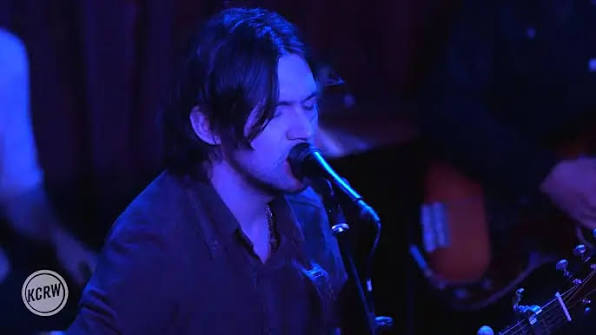
I especially love the live-in-the-studio version included with the deluxe Strangers Almanac. The studio version is great. I love the studio versions of virtually all my favorite songs, obviously. But for whatever reason, I tend to love live versions even more, and this one is no exception. The performance was recorded for KCRW in September 1997, and it opens the song up beautifully; even the instrumental ending seems to let some additional air into the story.
Ryan Adams has gone on to have an almost absurdly prolific career. His official discography already runs to dozens of releases, beginning with his solo debut Heartbreaker in 2000 and continuing right through new music in 2026. Heartbreaker contains “Oh My Sweet Carolina,” another of my favorite Adams songs and one that appears later in this list. There are many, many others.
But for now, “Houses on the Hill” remains my favorite Whiskeytown/Ryan Adams song by a little ways.
It simply fucking rules. Stay tuned.
4 (t). It’s Never Been a Fair Fight
5. Tulsa Queen — Emmylou Harris.
For years, “Tulsa Queen” was my answer to the question “what is the greatest song ever.” It was number one I thought. Don’t bother asking me again. And then, eventually, Cape Canaveral by Conor Obrest slipped past it. Barely. This isn’t really a demotion so much as the smallest possible movement inside the topmost tier: Tulsa Queen remains one of the most overwhelming pieces of music I have ever heard, and Emmylou Harris remains, for my money, the greatest vocalist who ever lived.
Then straight into:
I get full body chills and my eyes well up with tears every time I hear it…
The existing conclusion needs the corresponding tiny adjustment. Instead of “The GOAT. Pure legend. Full stop,” which contradicts #2, I’d go:
For a very long time, Tulsa Queen was the GOAT. Now it is number five. Nothing about the song has changed. I did. It is still absolutely legendary. Always will be.
I get full body chills and my eyes well up with tears every time I hear Tulsa Queen. Emmylou is the greatest vocalist of all time by far, and Tulsa presents the clearest evidence—not because it’s flashy or showy, but because it is so perfectly, devastatingly controlled. She doesn’t overpower the song; she becomes it. The song starts—“I saw the train/ in the Tulsa night/ calling out my name/ looking for a fight”—and it’s just pure magic. Just unbelievable. The phrasing, the restraint, the sense that the story is already in motion before you’ve even arrived—there is nothing like it. You’re not being introduced to a narrative; you’re being dropped into the middle of one that already feels lived-in and already carries weight.
What makes Tulsa Queen so overwhelming is that it distills everything that makes Emmylou Harris who she is as an artist across her entire career: the fusion of country, folk, and rock sensibilities; the emotional clarity; the ability to inhabit a character without ever losing the self; the sense that every line has been earned. From her earliest work through her later records, she has always been able to locate the emotional center of a song with uncanny precision, but here she doesn’t just locate it—she holds it, perfectly, for the entire duration. It exists in the same emotional universe as something like “Boulder to Birmingham”—another wonderful, better-known masterpiece—but Tulsa Queen goes deeper.
Where “Boulder” is open grief, expansive and communal, Tulsa Queen is interior, private, almost dangerous in how close it lets you get to the narrator’s unrest. It feels less like a performance and more like a confession you were never meant to overhear. There are no words in any language to fully describe the feeling of listening to Tulsa Queen. That’s not hyperbole; it’s recognition. The song operates at a level that bypasses explanation and goes straight to the nervous system. It doesn’t ask to be analyzed—it insists on being felt. Emmylou baby you remain the GOAT.
6. Faded — Afghan Whigs.
The Afghan Whigs’ lead singer Greg Dulli does something remarkable of Faded, which is blend swagger, menace, mystery, bravado, and also deep insecurity in one package. Seeing the Whigs play this as the encore at the Paradiso in Amsterdam in 2017 was one of the highlights of my life. It lands as an encore because it has to—it’s the only place a song like this can go. It doesn’t just end a set; it empties it out. Faded closes Black Love, which is not just an album but a fully realized world—cinematic, shadowy, saturated with urban crime, bad decisions, and the kind of late-night moral drift that never quite resolves.
Across the record, songs like Going to Town and Honky’s Ladder are all forward motion and attitude, pure swagger on the surface. But that swagger always feels a little overextended, like it’s covering something fragile underneath. By the time you get to Faded, the cover is gone. What’s been hinted at all along—doubt, damage, a kind of spiritual exhaustion—comes fully into view. There is no mystery as to why this has been the encore for every Whigs show for 30 years.
When Dulli asks to be lifted out of the night, to have someone look down and see the mess he’s in, it doesn’t feel performative. It feels exposed. The bravado is still there, but it’s cracked open, and what comes through is something far more human and far more dangerous. Not only is this the best Afghan Whigs song, Black Love is their best album by a mile. Everything they do well converges there—the mood, the storytelling, the tension between control and collapse—and Faded is the final, perfect release of that tension. He is a genius and the motherfucking man, and Faded is the best of many great Whigs songs. A worthy inclusion at number seven.
7. My Life Is Sweet — Simon Joyner.
“Met the drinker for a drink/ back when I was drinking everything but the kitchen sink”—and sure enough this song is about drinking, and drunks. Joyner’s friend is an alcoholic, and at the time of writing so is Joyner. They go to a bar and sit together, talking a little, mostly not, letting the night pass in that particular way that only two people who know each other well can manage.
Ultimately, this song is about male companionship, and how a quiet drink with a quiet friend can be life-saving when you really need it. Joyner takes a taxi home—drunk, or hungover, or somewhere in between—and collapses on the floor. And then the song ends with that extraordinary sequence where the city drops away, becomes something almost beautiful from a distance, and he arrives at that fragile, hard-won conclusion: my life is sweet. Anyone who is, or has been, a drinker will immediately recognize what Joyner is doing here—he is rationalizing the unrationalizable, but at the same time he’s not lying about it.
Is drinking so, so sweet? Yes and no, of course—and that tension is the point of this truly magnificent song. Part of what makes Joyner so compelling is how deeply rooted he is in the Omaha scene that would later produce Conor Oberst. Joyner is the elder figure there—born in 1971, a few years ahead of Oberst, who came up in the early ’80s generation—and his influence on Conor is both documented and unmistakable. Oberst has cited Joyner as a major influence, and you can hear it: the diaristic honesty, the willingness to let a song feel unfinished, the comfort with contradiction.
Joyner was mapping that terrain before it had a name, and before it had an audience beyond the local. He’s also massively underrated. He has other great songs—Fearful Man, One for the Catholic Girls—but My Life Is Sweet feels like the purest distillation of what he does best. There’s no artifice, no attempt to resolve the contradictions he’s living inside. Just a voice, a night, a friend, and the uneasy grace of getting through it. Anyone who’s been there knows: that’s more than enough.
8 (T). Never Aim to Please — Bash and Pop
Tommy Stinson, the bassist from The Replacements—went on to have, in my opinion, an even better solo career than the band’s lead singer Paul Westerberg. And considering that Westerberg is a genius and an absolute legend, this is saying something.
Stinson was barely out of childhood when the Replacements were at their peak—a teenager holding down the low end in one of the most chaotic, brilliant bands of their era. That early immersion shows up everywhere in his later work: the instinct for melody, the looseness, the sense that a song should feel lived-in rather than perfected. But what’s striking about his post-Replacements career—through Bash & Pop and his solo records—is how much he refines that instinct. The pure thrash and glorious sloppiness of early Replacements material gives way to something sweeter, more polished, but never sanitized. The edges are still there; they’re just better framed.
Never Aim to Please comes from Bash & Pop’s first record, Friday Night Is Killing Me, and Stinson has alternated between Bash & Pop releases and solo records over the 35 years since the Replacements broke up. In the first verse, Stinson sings about the absence of a point of view, and that marvelous line always reminds me of Westerberg’s writing on “Someone Take the Wheel”—that same sense of dislocation, of trying to find footing in a world that keeps shifting under you. There’s a great anecdote from Westerberg that early on, the Replacements pretended to hate The Rolling Stones—it was part of the pose, the punk posture. But it was just that: a pose. They actually loved the Stones.
And you can hear that lineage clearly in Stinson’s work. For all of his originality, he’s very much working in that classic rock tradition—songcraft, groove, emotional directness—but he does it in the best possible way, without nostalgia or mimicry. It feels inherited, not borrowed. Stinson may not claim to have a point of view in this song, but he’s been a remarkable curator and keeper of the Replacements’ legacy, especially as Westerberg has retreated from the music scene over the last decade. There’s a quiet authority in that, a sense of continuity that runs through his work. And the song itself? It just fucking kicks. It hits me in all the feels every time, and it is a worthy number nine.
9. A Bathtub in the Kitchen — Craig Finn.
My favorite of many possible Finn contenders. Bathtub is about friendship, guilt, redemption, betrayal, and mostly about thankfulness. It’s the greatest song ever written about New York City and also about moving to a big city in general. Finn compresses an entire early chapter of a life into a few lines—the arrival, the uncertainty, the desperation to be claimed by the city, and the friend who makes that possible by opening his door. That friend—Francis—is the emotional center of the song. Twenty years earlier, he’s the one who shows the narrator the ropes, lets him crash on the couch, gives him a foothold when he doesn’t have one. He is, in a very real sense, the reason the narrator makes it at all. And now, in the present of the song, Francis is down and out, struggling, a diminished version of the figure who once seemed stable and generous.
What makes the song hit so hard is the narrator’s response to that reversal. There’s hesitation, even avoidance. He tries, briefly, to pass the responsibility off—to suggest that someone else, someone more put-together, might be in a better position to help. It’s a small moment, almost throwaway, but it reveals everything: the discomfort, the guilt, the instinct to deflect when confronted with a debt that can’t really be repaid. Because that’s the truth the song circles around—some debts can’t be repaid. Not cleanly, not proportionally.
In the end, the narrator does give Francis money—two hundred bucks—but it lands with a kind of quiet insufficiency. It’s something, but it’s not enough, and it never could be. You can’t square that kind of ledger. You can only acknowledge it. And that’s where the thankfulness comes in. Not as a resolution, not as a way of tying things up neatly, but as a recognition that what was given mattered, even if what is returned will always fall short. Finn doesn’t offer redemption in the traditional sense. He offers something more honest: awareness, discomfort, and the attempt—however partial—to do right by someone who once did right by you. It’s a stunning, stunning song and an absolutely worthy number nine.
10. Dreadful — The Violet Burning
“Dreadful” by The Violet Burning fucking slaps. That’s really all there is to it. It just slaps. So damn hard.
The song is only two minutes and twenty-eight seconds long, and it is just totally dialed in. There’s no wasted motion, no long setup, no attempt to turn itself into something grander than it needs to be. It comes in, kicks ass, and gets out. I spend a lot of time in hotels and if “Dreadful” is playing when I leave the room, I usually leave it playing as loud as I can for, as I like to say, my good angels. Angels rule. Why not?
The Violet Burning are a criminally underrated band. Basically nobody today knows who they are, but I do, and I have loved them for years. The band began around 1990 in Orange County, California, and from the beginning the central figure has been singer, guitarist, and songwriter Michael Pritzl. The musicians around him have changed repeatedly over the decades, but Pritzl has remained the constant—the voice, songwriter, guitarist, and creative mainspring of the whole enterprise.
And what an enterprise it has been. Pritzl has made more than twenty albums, EPs, and live recordings under The Violet Burning and related names, toured relentlessly through the United States and Europe, and somehow maintained a fiercely loyal audience while remaining almost completely outside the mainstream. Their early sound drew from post-punk and alternative rock—The Cure, U2, Echo & the Bunnymen—and over time expanded into the huge, atmospheric guitar music that has over time became unmistakably theirs.
The Violet Burning came out of the Christian alternative-rock world, although Pritzl has never exactly fit comfortably inside that box. That puts him in the same broad lineage as people like Larry Norman, Gene Eugene, and Michael Knott: artists for whom faith was part of the work but never sufficient to explain the work. The music is too strange, too wounded, too beautiful, and often simply too fucking loud for that. Pritzl himself has always seemed interested in the collision between devotion and doubt, beauty and damage, transcendence and straight-up rock and roll.
R.I.P. Gene Eugene, the man. And R.I.P. Michael Knott, the motherfucking badass of all badasses.
In addition to being hugely underrated, parts of The Violet Burning catalog remain frustratingly difficult to find on the major streaming services. That is a real shame, because this is precisely the sort of band that should be continually rediscovered. They built an enormous body of work without ever becoming remotely as famous as the quality of that work deserved. Even at their commercial peak they were essentially an independent proposition, building their audience through touring and word of mouth rather than anything resembling mainstream success.
I wish more people knew The Violet Burning. I wish more people heard these songs.
My number two Violet Burning song is “Gorgeous,” which we’ll get to a little later. That song is enormous, emotional, and glorious in an entirely different way. But for now, “Dreadful” is the one.
Two minutes and twenty-eight seconds. Nothing wasted.
Number ten.
This bad boy fucking slaps.
11. The Traitor — Leonard Cohen
Cohen’s early career began not as a songwriter but as a poet and novelist—already established in literary circles before he ever stepped into popular music. When he moved into song, it wasn’t a reinvention so much as a translation. Early breakthroughs like Suzanne and later Bird on the Wire introduced a voice that felt unlike anything in contemporary pop: formally literary, emotionally restrained, but spiritually enormous.
Across a career that stretches from that early poetic minimalism to late-period gravity, Cohen repeatedly returned to the same emotional territory in different registers. Seems So Long Ago, Nancy carries quiet tragedy without spectacle. Death of a Ladies’ Man leans into chaos and contradiction. Alexandra Leaving and That Don’t Make It Junk show a late-career clarity—less ornament, more acceptance. And then, right at the end, The Night of Santiago from Thank You for the Dance—completed after his death by his son Adam—feels like a final echo rather than a conclusion, as if the voice is still resolving even after it has stopped.
But it is this passage that sits at the center of everything: “I told my mother, mother I must leave you / preserve my room and do not shed a tear / should rumor of a shabby ending reach you / it was half my fault and half the atmosphere.” Quite possibly the greatest verse ever set to paper.
There is something almost unbearable in its tenderness—the attempt to leave without destroying what you came from, to depart without turning departure into permanent damage. “Preserve my room” is not a realistic request; it is a desire for time to stop, for memory to remain untouched while the self moves forward into uncertainty, drift, and likely failure.
Cohen does something very few writers ever manage: he distributes responsibility without dissolving it. “Half my fault and half the atmosphere” is not an excuse—it is an ethics of existence. The self is accountable, but so is the world that formed it. There is guilt here, but no self-pity. There is clarity, but no absolution. He is naming the condition of being human with a precision that feels almost too large to hold. And what makes the song extraordinary is that it refuses resolution. Cohen never tries to solve the tension he has introduced. Instead, he inhabits it fully.
Across his work—from the early poetic breakthrough to the late songs of acceptance and erosion—he speaks to the quester, the striver, the poet, and the mystic in each of us. Not by offering answers, but by dignifying the act of searching itself. Leaving, longing, failing, seeking—these are not problems to resolve, but conditions to endure with awareness. His voice carries all of it: resignation, yearning, and a kind of quiet, unbreakable grace.
His best by a mile. Simply marvelous.
12. Gorgeous (live)— The Violet Burning
“Gorgeous” is gorgeous. It is gorgeous, as indicated by the title, and probably one of the most gorgeous songs ever recorded. This is my number two favorite Violet Burning song, as indicated in my discussion of “Dreadful” above. The Violet Burning is a criminally underrated band. I will never understand how they don’t have a bigger footprint. They deserve to be widely recognized and appreciated.
While Dreadful is almost certainly the slappiest song of all time, if that is a thing, Gorgeous is absolutely one of the sweetest. It starts with Michael Pritzl, the band’s lead singer and creative center, singing, “I swear it was the Fourth of July.” Oh yeah, Michael? Are you sure? Okay, baby, whatever you say. So yeah, it’s the Fourth of July: patriotism, mom and pop, apple pie, fireworks—the whole nine. But Pritzl immediately turns all of that American iconography into the language of romantic awe. The fireworks aren’t really the point. The person he is looking at is.
And then the song eventually delivers its payoff: baby, you’re so gorgeous.
Motherfucker.
Of course.
Gorgeous originally appeared on Demonstrates Plastic and Elastic, released in 2001, one of the strangest and more adventurous records in The Violet Burning catalog. The album moves between glam, alternative rock, electronics, enormous guitars, and quieter atmospheric material, with Gorgeous arriving towards the end. It is a perfect example of what makes Michael Pritzl such an unusual songwriter: underneath all the sonic experimentation is a deeply sincere romantic. He can build a wall of noise around a feeling, but he never seems embarrassed by the feeling itself.
Pritzl has described honesty and vulnerability—including honest conversations about God and ordinary human life—as central to what the band does. He specifically included Gorgeous among the songs on Demonstrates Plastic and Elastic that embody that impulse. That combination—spiritual yearning, romantic yearning, distortion, beauty—is basically the Violet Burning universe in miniature.
And Gorgeous has endured. It remained important enough to the band to appear late in sets and sometimes close them many years after its release. I particularly love the live versions because Pritzl can stretch the song outward until what begins as a simple declaration of attraction becomes something much larger. The sweetness survives the volume. If anything, the volume makes it sweeter.
That is also why I can put Dreadful and Gorgeous this high on the same list without feeling remotely repetitive. They represent opposite poles of what I love about this band. Dreadful fucking slaps. Gorgeous fucking glows. One makes me want to turn the stereo up until the walls shake; the other reminds me that sometimes the most effective thing a songwriter can do is look at another human being and say the simplest possible thing: you are gorgeous.
And Michael Pritzl makes me believe him every goddamn time.
13. Albuquerque — Mark Kozelek (Neil Young Cover)
Well, they say that Santa Fe
Is less than ninety miles away
And I got time to roll another number and rent a car
Oh, Albuquerque.
Oh my God, Neil. What are you doing to me? Neil, baby, you’re breaking my heart. Neil, shut the fuck up.
“Albuquerque” appears on the back end of Neil Young’s 1975 record Tonight’s the Night, immediately before “New Mama.” “Roll Another Number (For the Road),” with which I constantly confuse it for reasons that will shortly become obvious, appears a few songs earlier. Tonight’s the Night, as many readers will remember, is Neil’s record most haunted by death. It was largely recorded in 1973 but held back until 1975, and the deaths of Crazy Horse guitarist, singer, and songwriter Danny Whitten and Young’s roadie Bruce Berry hang over the entire thing.
Berry is famously eulogized in the two versions of “Tonight’s the Night” that bookend the record: “Bruce Berry was a working man / He used to load that Econoline van.” Neil, my man.
Obviously Neil Young loved Bruce Berry and Danny Whitten. He basically wrote an entire record out of the grief that followed their deaths. Tonight’s the Night is consequently a strange, ragged, drunken, grief-stricken motherfucker of a record. It sounds at times as though everybody involved is barely holding the thing together, which is exactly why it works.
Tonight’s the Night also includes one of the first Neil Young songs I ever heard, “Tired Eyes,” with the stone-cold classic opening: “Well, he shot four men in a cocaine deal / And he left them lying in an open field / Full of old cars with bullet holes in the mirrors.”
Neil. Bullet holes in the mirrors? Really, baby? Again: oh my.
In any case, I often get “Albuquerque” and “Roll Another Number” confused, simply because “Albuquerque” itself contains the line, “So I’ll roll another number for the road / I feel able to get under any load.” Obviously Mr. Young was rolling his own during this period.
Probably other periods too.
But my favorite lines from “Albuquerque” are these: “So I’ll stop when I can / Find some fried eggs and country ham / I’ll find somewhere where they don’t care who I am.”
Motherfucker.
By 1975, Neil Young was already a global superstar. He was massive in his native Canada, massive in the United States, and increasingly massive around the world. In his wonderful song “Don’t Be Denied,” Young writes about reaching that point—record executives suddenly all over him and the band when all he really wanted to do was play rock and roll. Neil, fucking do it.
And that context is part of what makes “Albuquerque” so moving. This is a famous man singing about wanting to disappear. He doesn’t want the record company, the expectations, the mythology, or apparently anybody asking where the hell Neil Young is. He wants to get into a car, roll another number, eat some fried eggs and country ham, and go somewhere where nobody cares who he is. It is an almost comically modest fantasy of escape, which is precisely why it works.
And then there is Mark Kozelek. I love Neil Young’s original, obviously, but it is Kozelek’s cover that gets the spot on this list. Kozelek has always been a magnificent interpreter of other people’s songs—AC/DC, John Denver, Modest Mouse, Paul McCartney, Kris Kristofferson, and many others—and he understands exactly what makes “Albuquerque” work. He doesn’t try to improve Neil Young. He slows everything down, opens up the spaces between the words, and lets the loneliness that was already buried in the song come completely to the surface.
That is what the best covers do. They don’t replace the original; they reveal something that was already there. Neil Young wrote a great song about escape. Mark Kozelek heard the loneliness inside the escape and made it almost unbearably beautiful.
Fried eggs. Country ham. Nobody caring who you are. Sometimes that is the whole fucking dream.
Neil, my man. My god what an amazing song.
14. Oh My Sweet Carolina — Ryan Adams
One of the most beautiful and sad songs in modern American songwriting. The record Heartbreaker—Adams’ solo debut after his run fronting Whiskeytown—remains his peak for many listeners. It’s also the album where everything still feels unforced: the writing, the pacing, the emotional exposure. Later records like Gold brought wider recognition, and something like Chris gets close in flashes, but Heartbreaker has a coherence of mood that he never quite replicated.
What defines Oh My Sweet Carolina is its dual perspective. On the surface, it’s a travel song—young man on the road, drifting through cities like Cleveland, accumulating damage, spending energy and money with a kind of reckless momentum that feels both chosen and inevitable. But underneath that motion is something much older: a pull backward, toward origin, toward a place that isn’t just geographic but emotional. North Carolina isn’t just home—it’s coherence.
The Cleveland passages (“So I went on to Cleveland and I ended up insane/ I bought a borrowed suit and learned to dance/ And I was spending money like the way it likes to rain/ Man, I ended up with pockets full of cane”) carry that classic Ryan Adams contradiction: charm and collapse in the same breath. The narrator moves through instability with the confidence of someone still convinced that motion equals meaning, even as that belief is starting to fail him. It’s the sound of someone learning, mid-stream, that movement alone doesn’t resolve anything. And then the emotional center of the song reveals itself: (Oh mw sweet Carolina/ what compels me to go/ oh, my sweet disposition/ may you one day carry me home), the longing not just to return, but to be returned in one piece. Not improved, not transformed—just intact.
This is where the collaboration with Emmylou Harris matters. Her voice doesn’t decorate the song; it stabilizes it. It sounds like witness. Adams has written other songs that brush this same emotional territory—English Girls Approximately, Oh My God, Whatever, Etc., Still a Cage, Birmingham—but none of them quite hold the same balance of youth and exhaustion, romance and reckoning. Oh My Sweet Carolina feels like a hinge between those states: a young man already speaking like he understands what the older version of himself will miss. It’s a debut record moment that feels strangely final. A song about going forward that only makes sense when you understand what it costs to leave things behind. A truly majestic entry—and a worthy entry here at fifteen.
15. (T) Montreal Rock Band Somewhere — Happyness
“Montreal Rock Band Somewhere” is totally out of control. Of course it is. What else can you say about a song that contains the lyric, “I’m wearing Win Butler’s hair / There’s a scalpless singer of a Montreal rock band somewhere”? Win Butler is, of course, the lead singer of Arcade Fire, who suck.
They suck.
Arcade Fire hit the big time with Funeral, released in 2004. I like Funeral okay, but I haven’t listened to it in more than a decade, and I probably never will again. It just isn’t my speed. It sounds to me like a concept record: operatic, overblown, and the production lets it down at every turn.
So yeah, I don’t like Arcade Fire.
However, Happyness is massively underrated. Other than The Violet Burning and maybe Daddy Issues, Happyness is, to my mind, the most underrated band of all time. And that is saying something.
“Montreal Rock Band Somewhere” runs 5:04, and it is a sprawling guitar workout that somehow feels much bigger than its running time. The Happyness boys can really fucking play. That sometimes gets obscured by how funny they are, and by the deliberately tossed-off quality of the whole operation. The songs can sound as though three guys wandered into a room, made each other laugh, picked up their instruments, and accidentally recorded something brilliant. But listen underneath the jokes: these guys know exactly what they are doing.
There is also some weird history surrounding the song’s placement. Weird Little Birthday was originally released in the UK in 2014 as a 13-song record without “Montreal Rock Band Somewhere.” The expanded 2015 release added four bonus songs, with “Montreal” coming immediately after what had originally been the album closer, “Monkey in the City.” That expanded record also contains “Orange Luz” and the wonderfully titled “Refrigerate Her,” but those were already part of the original album.
I am fascinated by song order on records, and I spend a ridiculous amount of time thinking and writing about it. “Janie Jones” goes first. “Rocks Off” goes first. Some songs simply announce themselves as openers or closers. “Montreal Rock Band Somewhere” feels to me like a closer: sprawling, funny, strange, guitar-heavy, and just unresolved enough to leave the record hanging in the air after it ends.
There are plenty of other great songs on Weird Little Birthday, including the title track and “Leave the Party.” In “Leave the Party,” for example, the narrator proposes killing everyone at the party and then heading home.
Really, baby? You’re going to murder the whole party and just jet like that? Settle down. Take a shower. Think things through. Not the best move perhaps.
They followed the debut with Write In in 2017 and eventually Floatr in 2020, a much slower, denser, stranger record. I like Floatr, but it is not an easy record to get into. The immediacy and wiseass humor of Weird Little Birthday are still there in places, but everything feels more submerged. It is the sort of record that asks you to come toward it rather than coming toward you.
And maybe that helps explain why Happyness never really broke through. They were always slightly sideways to whatever might have made them commercially successful. They can write hooks, they can make enormous guitar noise, the songs are genuinely beautiful, and they are extremely funny. However for some reason they never seemed particularly interested in making things easy for their audience. Even their best songs tend to wander around, stop somewhere unexpected, make a joke, get sad, and then suddenly fucking explode.
“Montreal Rock Band Somewhere” contains almost the entire Happyness proposition in five minutes. It is funny without being a novelty song, melancholy without announcing itself as melancholy, and loose without actually being sloppy. Beneath the Win Butler joke is a genuinely beautiful piece of guitar music made by a band that understood exactly how much room a song sometimes needs.
They never became Arcade Fire. Good. I’ll take Happyness every day of the week.
15. (T) Crushed Out — Bad Moves
17. Caribbean Wind — Bob Dylan
18. (T) Center of Asia — Paul Pena
19. (T) Rocket and a Bomb — Michael Knott
This is Knott’s best-known—and, for many people, only known—song. It’s the one that traveled beyond the small, fractured world he spent his career navigating, the one that people who don’t know the rest of his catalog can still recognize. And that’s fitting, because it captures almost everything that made him singular. Knott never fit comfortably inside the Christian rock community that was supposed to be his home. He clashed with labels, bounced from one situation to another, tried repeatedly to start his own imprints just to maintain control of his work, and spent much of his career existing in the margins of an already marginal scene. There were too many expectations, too many rules about what a “Christian artist” was supposed to sound like, what he was supposed to say, how cleanly he was supposed to resolve things. Knott refused all of it.
You can hear the lineage—artists like Larry Norman laid some of the groundwork—but Knott is no inheritor in the traditional sense. He’s a total original. Where Norman and others often leaned toward proclamation, Knott leaned into contradiction, mess, unresolved tension. He wasn’t interested in presenting faith as an answer; he was interested in showing what it felt like to live inside it when the answers didn’t come.
His career reflects that restlessness. From the early chaos of Popsicle and Popsavers, through the darker, more aggressive phases of L.S. Underground and LSU, into his solo work and projects like Aunt Betty’s, Knott kept shifting forms, refusing to settle into anything that could be easily categorized. The sound changed, the bands changed, the labels changed—but the core impulse didn’t: tell the truth as he experienced it, even if it didn’t line up with what anyone wanted to hear. Rocket and a Bomb distills all of that into something deceptively simple. There’s humor in it, almost absurdity—“Mr. God, is there a Ms. God? Can she help me find a job?”—but it lands because it’s so nakedly real. This is a man of Christ who is also a man of the world, standing in the gap between those identities, not reconciling them but living them both at once. He’s not asking for salvation in the abstract; he’s asking for something immediate, practical, human. He just needs a goddam job.
That tension runs through everything he ever said and did. His line—“I know Christ. It doesn’t make me good; it doesn’t make me bad; it doesn’t make me anything. It just means I know Christ.”—might be the clearest articulation of his entire ethos. Faith is not a moral upgrade, not a solution, not a transformation you can point to and quantify. It’s a relationship, and relationships are messy. So what is a rocket and a bomb? They’re things most people don’t get to touch. Power, transcendence, impact—forces that exist beyond the everyday. The narrator wants a job, something stable, something achievable. But he also wants more. He wants access to something larger, something explosive, something that breaks the limits of an ordinary life. Knott lived that contradiction. He lived fast, pushed hard, refused to smooth out the edges that made him difficult to categorize or contain. He burned through systems that couldn’t hold him, left behind a body of work that feels both deeply personal and strangely universal. He had to.
20. There Must Be More Than Blood — Car Seat Headrest.
This is a tricky one, because it forces us to deal with a shift—not just in a song, but in an artist. My thesis is that this is Will Toledo going into a kind of relative hiding, and the song reads like a document of that transition in real time. His early work—from Beach Life-in-Death through Nervous Young Man to Sleeping with Strangers—was as direct, as exposed, as heart-on-the-sleeve as anything in the last decade of rock music. He wasn’t just confessional; he was incapable of not being confessional. He was the heart on his sleeve songwriter of his generation. You didn’t have to work to understand him—you just had to be willing to feel what he was feeling.
And then you put that next to someone like John Darnielle—super prolific, deeply lofi in his early approach, but always a little more mediated, a little more constructed. Darnielle throws his material against the wall and lets it accumulate into narrative. Toledo, at his best, just bleeds. So when Making a Door Less Open arrives, even the title signals a shift. Something is closing. Something is being sealed off. The masks—first the normal face coverings, then the Trait mask, then the gas mask—aren’t just stagecraft. They’re statements. The question isn’t “what is he hiding?” but “why does he suddenly feel the need to hide at all?” There Must Be More Than Blood sits right in the middle of that tension. You get these images of dislocation—of a life that used to feel rooted and now doesn’t. The delta, the shoreline, the houses stripped away—it doesn’t read like a literal disaster so much as an internal one. The sense of ground disappearing. Of structures—family, identity, whatever “home” used to mean—losing their coherence. He talks about wasting time, but you know that’s not true. He’s one of the most prolific songwriters around. What he’s really describing is a shift in how that time feels from the inside.
And then there’s the second movement—the red-eye flight, the self-recognition that barely qualifies as recognition at all. He sees himself, but only as an outline, a set of lines without substance. That’s the real break from the early work. The old Toledo was hyper-present, almost overwhelmingly so. This Toledo is thinning out, becoming harder even for himself to locate. So what do you do when you can’t see yourself clearly anymore? You disappear further. You become, in a sense, the Invisible Man. That’s what the masks start to feel like—not affectation, but adaptation. A way of dealing with a self that no longer feels stable enough to present directly. And if you follow that thread forward, you get to The Scholars—The Scholars—his most recent record. It’s even more oblique than Door. There are great songs there—Stay With Me (I Don’t Want to Be Alone), Equals—but they’re harder to parse, less immediately accessible. The emotional core is still there, but it’s buried deeper, refracted through more layers.
Part of that may simply be life catching up with him. Toledo dealt with serious health issues in the lead-up to that record—long COVID, histamine intolerance—and the process became more collaborative, less singularly driven. That alone changes the texture of the work. The lone voice becomes one voice among several. The signal diffuses.So There Must Be More Than Blood starts to feel like a hinge point. The moment where the old mode—pure exposure, pure immediacy—begins to give way to something more guarded, more fragmented, more difficult to access. But the core hasn’t disappeared. It’s just harder to reach. And that’s why the song matters. It captures an artist in the act of losing something essential—or at least transforming it into something less direct, less available, maybe even less comforting. Will Toledo is a mysterious guy. Deep, fragile, a little haunted, clearly carrying more than he lets on. He’s dealt with some tough stuff, and you can feel it in the way the work shifts over time. And for anyone still saying “rock is dead”—they can fuck off. There is still The Hold Steady and Car Seat Headrest making records that matter, records that wrestle with something real. You just have to be willing to meet them where they are now, not where they used to be.