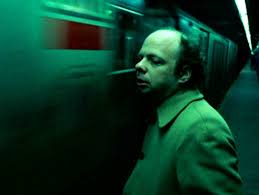
On the Film “My Dinner with Andre” Part I: Wally in New York

Note: Opening a multi-part early series from my first blog Classical Sympathies back in 2009, this piece takes up the beginning of Wallace Shawn’s walk through New York en route to his meeting with André Gregory in My Dinner with Andre, using Wally’s voice-over as a lens on artistic precarity, everyday survival, and the comic disproportion between existential weight and mundane errands. The note situates the film’s opening movement as both narrative setup and philosophical framing: a winter city of post offices, xerox shops, and unanswered calls becomes the psychological prelude to a conversation that will later expand into memory, performance, and self-mythology. This installment follows Wally up to his arrival at the restaurant for the pre-dinner drink, where the film’s central encounter is still suspended in anticipation, and meaning is generated less by action than by the act of getting there.

My Dinner with Andre is the famous, or infamous, 1981 film of a dinner conversation between Wallace Shawn, the actor and playwright, and Andre Gregory, the theater director. If I were to make a twofold claim for the film: i) that it is one of the most action packed films ever made, and ii) that it effectively encapsulates the thematics of the entire 20th century, I do not think this would be overstatement. My intent here, however, is not to establish either of these postulates, but rather to simply “blog” the script in the hopes that what needs to be said works its way to the surface. Fair warning: the undertaking will require several posts.

Money crops up on two of the first three pages of the script, and because money, and the lack of it, is a theme that runs beneath the entire script: Andre has money, has the freedom to travel and to spend several years trying to “find himself”; Wally does not. Still, “having money” is, as ever, a relative concept. At the opening of the film, Wally is seen walking through the streets of New York, heading for the restaurant where he is to meet Andre. It appears to be winter, maybe February. In the opening voice-over, Wally ruminates on the life of the artist: The life of a playwright is tough. It’s not easy, as some people seem to think. You work hard writing plays, and nobody puts them on. You take up other lines of work to try to make a living–acting, in my case–and people don’t hire you. So you spend your days crossing the city back and forth doing the errands of your trade. Today wasn’t any easier than any other day. I’d had to be up by ten to make some important phone calls, then I’d gone to the stationary store to buy envelopes, and then to the xerox shop. There were dozens of things to do. By five o’clock I’d finally made it to the post office and mailed off several copies of my plays, meanwhile checking constantly with my answering service to see if my agent had called with any acting work. In the morning, the mailbox had been stuffed with bills. What was I supposed to do? How was I supposed to pay them? After all, I was doing my best (17).

One of the marvelous things about the film is the tongue-in-cheek humor that is rarely, if ever, directly alluded to. A deeply serious film, Andre is also a comedy, a fact which we can recognize because we see that the writers are having fun with the characters who are in turn themselves. That is, Wally and Andre are playing versions of themselves–we assume that most of the experiences that Andre recounts in the film are based on real experiences, and that Wally’s account of his home life is more or less true to life–but exaggerated versions. As Shawn says in the preface to the script, “I knew immediately that {…} I’d have to distort us both slightly–our conflicts would have to become sharpened–we’d have to become–well–characters {…} It would be an enormously elaborate piece of construction” (14). In this initial passage, the humor lies in Wally’s conception of a difficult life: “I’d had to be up by ten to make some important phone calls.”

Wally’s sense of pressure is, from the outset, deliberately out of proportion to the scale of his circumstances. The tone is one of genuine complaint, but the complaint itself is almost comically domestic: the architecture of a “hard day” is built out of errands, envelopes, xerox shops, and an answering service that may or may not contain salvation in the form of an acting job. What Shawn achieves here, and what the film quietly sustains, is a recalibration of seriousness—where existential weight is not attached to grand events but to the texture of administrative survival. Wally’s New York is not a place of romance or revelation, but of circulation: between post office, mailbox, and telephone, as though modern artistic life has been reduced to a loop of deferred contact with recognition.

At the same time, the humor is never fully separable from sincerity. Wally is not merely being mocked; he is also articulating a recognisable condition of artistic precarity, one that the film refuses to glamorize. The genius of the opening monologue lies in this double register: we are invited to laugh at the disproportion between emotional tone and material fact, but we are also made to recognise how easily that disproportion becomes a lived reality. The “dozens of things to do” are not nothing; they are just insufficiently legible as crisis, which is precisely what makes them feel like crisis.

By the time Wally finally moves through the city toward the restaurant, the structure of the film has already been quietly established: this is a world in which meaning is not delivered through events but through the way events are narrated to oneself while walking between obligations. New York, in this sense, is not a backdrop but a medium of self-composition—an environment in which thought is constantly being assembled under mild pressure, as though consciousness itself were an errand.

He checks the time again, as he has been doing throughout the afternoon, and adjusts his route slightly, not out of urgency so much as orientation. The meeting with André already exists in his mind as something slightly unreal, a fixed appointment that has not yet been granted substance by arrival. He crosses another block, passes into the thinning evening light, and begins to approach the restaurant where, for the first time that day, the structure of waiting will shift from solitary to shared.

to be continued…

Scenes from Hamilton College IV: Sophomore Year II: The Sports Show, Ann, Getting Fired

Note: This is Part IV of the Hamilton series. Part I, Part II and Part III are available. This post will take up my friendship with Ann, the Sports Show John Innes and friends had, and losing my job at the print short.

I was living in the delta
Wasting most of my time

Car Seat Headrest

I mentioned in Part III that I was on a sports talk show on the college radio station, WHCL. This was called Sports Corner. John Innes was the leader; it was his show. A friend of ours called Jeff Kingsley was on the show, as well as myself. Kingsley was a huge Buffalo Bills fan, and he stayed on top of the sports news, especially the NFL. Innes was always super prepared, and taped the shows which he would later play for his dad when we got back to Washington State. I sort of kept up with the sports scene, but I was mostly there for comic relief. I would crack jokes and make fun of stuff, but was definitely the third banana on the show.

The radio station didn’t have a lot of bandwidth so the listeners were mostly on campus and Clinton locals, but I recall Sports Corner having a number of regular listeners who would call in. From my point of view, the callers were the best part of the show. We treasured our listeners and gave them plenty of airtime. I never told any of them to “cold compress ma’am.” I was a regular as a sophomore and the first half of junior year until I went abroad to New Zealand. When I came back as a senior I think I just guested. I remember one show where Innes asked me what kind of sports were big in New Zealand. I said “marbles, marbles are really big.” I was just fucking around, but it was pretty funny. Although I was only marginally prepared, Sports Corner was a blast and Innes was a great host. He totally could have done it professionally.

I also talked in Part III about Ann. Ann was Ian’s girlfriend sophomore year, and I got to know her pretty well. Ann sort of took over where Rochelle left off in the mothering department, but she was really different from Rochelle. More intense. Ann didn’t like smoking and she tried to stop me from doing so, to no effect. I remember once, I think it was junior year actually, where at a dorm party she grabbed my cigarette from me and threw it out the window. I just shrugged and lit another one.

If Ann was intense, she thought I was. Innes and Ann and I were hanging out once and Innes said “M.A. (that was my nickname at college) is the chillest guy I know,” and Ann replied “I think he is the most intense.” Well, someone will maybe eventually get to the bottom of that one. One day I dropped by Ann’s room and there was a big jigsaw puzzle partially done. I started picking at it, and she stopped me. “That’s for me and Ian,” she said. Must have been some puzzle. Another time I went to Ann’s house with Ian and she tried, I guess, to pair me up with one of her friends. This wasn’t going to take, but we all did sleep, clothed, in the same bed that night. I don’t think I got a lot of sleep.

While some friends came and went at Hamilton, Ann I was close to sophomore, junior and senior year. After graduation she moved to the U.K. for a bit. I wrote about this elsewhere and will reprint it here.

“My friend Ann from Hamilton College went to England after graduation and she and I exchanged a few letters, back when people still wrote letters. She wrote me that she was drinking some, so I wrote a poem about my image of her over there. The original poem had two or three more verses, but they were terrible. Then a little while back I reconnected with Ann, which was great, and re-worked the poem, which wasn’t. It might have been a little better, but it was still bad. These two stanzas, on the other hand, are awesome, and maybe that’s all there ever needs to be said about Ann in England, you know?” Here is that poem fragment:

Ann belle princess of the isles
the orbs whisper your name even if you’ve gotten piles
or if you’re on the game

Buxom barmaid or bellicose barfly
begs the inevitable question
booze improves the poet’s eye. but ruins her digestion

I still like it.

Ann has read some of this blog, and even contributed a piece as a guest writer, which is not currently live.

The other big event sophomore year was when Deb fired me. I mentioned that as a freshman I skipped work some, and the next year this pattern was exacerbated. I still had no money, however work was becoming really tough. This was not Deb and Sally’s fault at all–I just couldn’t hack walking all the way up the hill just to collate. Instead, I spent time in the woods jumping off little cliffs and messing around in the late afternoon. No hard feelings; looking back I should have done things differently. I don’t remember exactly when I was fired, but I think it was about two thirds of the way through the year.

That’s it–this is a short one. There are a bunch of other things that may have happened this year or the next, so I’ll cover some of these in my upcoming junior year pieces.

Dedication: For Ann, the belle princess.

to be continued…

Scenes from Hamilton College I: Meeting Ian and Jake

New Note: It’s been a while since I last posted this piece, and I’m glad to bring it back here as a republication. “Hamilton I” remains one of my favorite entries on the Kyoto Kibbitzer—an early chapter built around friendship, music, and the strange, formative textures of freshman year, especially the central presence of my good friends Ian and Jake, who shaped so much of that time. It’s also one of the more widely read pieces on the site, which I appreciate. Re-reading it now, I’m struck by how much of what came later was already there in embryo: the scenes, the sounds, the late nights, and the people who mattered. As always, thanks for reading.

And I recall the moment
More distant than it seems
When five green queens
On a black bin bag
Meant all the world to me

The Pogues

I attended Hamilton College, and managed to graduate–possibly in linen. At Hamilton I was an English major, and intended to be from when I enrolled. This was a decent choice; however both Hamilton and English were kind of my father’s choices. I also managed to cobble together an Asian Studies minor through the good auspices of my advisor who checked out my credits and told me I could put that together. This was a good call on his part, and even though I kind of stumbled into it, The Asian Studies minor was my choice.

I was pretty unprepared for college. Before going I was asked to fill out a kind of questionnaire to help the college place me with roommates. One of the questions was, are you clean, messy, or in the middle. I chose in the middle, which was sort of a mistake because it turns out men are pigs, and I was cleaner than most. At the same time though it wasn’t a mistake because if I had selected clean I may not have met Ian and Jake. Jake was my roommate, and we lived in a quad. The other two roommates were Brian and Geoff, and although I had a relationship of a sort with both of them freshman year, we were not really on the same page. Jake and I were. Ian was our next door neighbor, and he roomed with Marc Campbell, and two other people. Ian, Jake, and Marc are still in my life.

My parents came with me to upstate New York, and before I moved into the dorm we stayed for a few days in a hotel near campus. I was kind of apprehensive, and spent the days listening to The Pogues and quietly stressing. But when I moved into the quad things were fine. This was mostly because of Jake.

Jake was a bit of a wild character. He was from either New York or Connecticut as I recall, and I think he came from decent money. When I visited his house later that year it was very patrician, for lack of a better word. His father seemed like a super old-school WASP patriarch, and his mother didn’t work I don’t believe. His younger brother held right-wing political views at the time, while Jake was a lefty. This was a point of serious disagreement between the brothers, but other than that the family seemed pretty solid. I believe that his brother has since switched his political views.

I didn’t meet Jake’s family until Thanksgiving however, and got to know him first in the context of the quad. We lived in a dorm called North, on the first floor right by the door. (My buddy John Innes, who joined me at Hamilton from our high school lived in the neighboring dorm Kirkland, and next to that was South.) The door to North would be locked at night, and other dorm folks would regularly misplace their key and crawl through our always open window. Jake and I rarely slept, and I got in the habit of staying up until about five AM. After that I would get a little sleep before first period English class. Then I would attend Geology class, which satisfied some kind of Science graduation credit. For English class I was alert and on top of it, although I was still hand-writing my papers, which changed once I got in the habit of using the computers in the library. English class was small, maybe 12-15 people, whereas Geology was huge and held in a lecture hall. I would go lay down in the back in the aisle and try and sleep. I ended up getting As in almost all my English classes, and a C- in Geology, which was deserved to an extent because of the sleeping. However, the main question on the final was brutal and pretty unfair, which was to draw a seismograph. Literally, draw one, which we had never studied and I did cram for the final. Brutal action. Somehow I still made the honor roll that year, and every year, because of my performance in the humanities.

Jake was an English major as well as far as I recall, I kind of forget, but he knew a lot of the teachers I knew. In any case, we did not bond primarily in the classroom, but in the dorm and then at “Sig,” the frat he was associated with and later pledged. Sig was the alternative frat. I hung out there a bit, but when pledge season started they kind of cracked down on non-pledges attending parties. For Halloween, Jake snuck me in early, and although that night I got a few looks I was good with Jake’s blessing. That night I wore all black with a turtleneck and a paper sign on my back saying “No future for you.” As in the Sex Pistols. I was talking with an older guy, an alum (there were always some alums that hung at the frat parties at Sig) at the party and he said something to the effect of “I like you, but I don’t like your shirt.” OK dude.

That was the same night I believe that inspired the following little ditty I later shared with Jake:

I pissed in the toilet

He pissed in the sink

He said I haven’t got a god above

I haven’t got a drink

Jake later took umbrage with the lines, not the sink part, which was and remains credible, but the god part. I think he is, or was, a believer. In any case, he’s my friend and won’t sue.

I appreciated Jake showing me the ropes at Sig and elsewhere. In the dorm we would play his music–he was into the classics, Beatles and Stones, Kinks, Bowie. We would sing “The Ballad of John and Yoko,” and “Come Together,” mostly the former over and over, no doubt to the annoyance of our roommates. Jake also liked The Pogues, and this made me think even more highly of him.

Jake smoked, Marlboro Reds, and I soon started smoking too, the same brand. This was not out of a desire to be a smoker, but rather as a way to keep my hands occupied and look busy at parties, where I had some difficulty mixing. I picked up, or invented, a little trick where I would fold up the flaps of a cigarette pack so they looked like a paper airplane, and then lob the cigs around the room, usually to any girl that wanted one. This got me some attention and some affection, and I kind of became known for the move. It didn’t get me laid, but at least it was something. Jake and I were fast friends, and hung out a lot in the early part of the year, before he began to branch out. Once he started pledging Sig though I saw less of him, naturally enough I guess.

By the time Jake started pledging, and even before, I was spending more time with Ian. Ian was from Boston and his father was a medical doctor. He lived in a nice house in the suburbs–both Jake and Ian had quite a bit more money than I, a common feature at Hamilton where pretty much everyone had money expect me. I was on a pretty decent scholarship, despite my not so impressive high school record, and could not have afforded the school without the scholarship. I visited Ian once or twice I believe in college, and then stayed with his family for a few months in the fall after college, but that’s a story for a future post.

Ian had a massive record collection in his quad, next door to mine as I have said. I liked Jake’s music, especially “Rebel Rebel,” “Come Dancing,” and The Stones, however his selection was somewhat limited. Ian’s was capacious. He was into bands like The Stone Roses, The Charlatans, Ride, and a bunch of other British bands I didn’t know at the time. But he was really into everything. I spent hours in Ian’s room soaking up his music, and my association with him kind of took over where Dyche Alsaker’s left off. I think it was Ian who also introduced me to Luna, who was coming up at the time and is still one of my favorite bands to this day. Later, in senior year I think, Ian and I had a radio show together and one night we got to play records all night long when a few other people canceled suddenly. I would play The Replacements and the Pogues, and Ian would play his music, but I was also getting deep into the 4AD label and bands like Big Star, This Mortal Coil, and a little known band called The Binsey Poplars (who I’m not sure were even on 4AD), named after a Hopkins poem. But my favorite around that time was Nick Drake, who was on Rykodisc.

Drake is now pretty well known, mostly on the back of his song “Pink Moon,” which was featured on a Volkswagen commercial, but back then he was not well known outside serious music circles. I loved his song “Rider on the Wheel,” and was an evangelist for him, telling all and sundry to listen. Most people didn’t, of course, but the whole move was just odd enough to get a little attention, which I was definitely seeking. (Another friend from that time John mentioned to me a few years ago that I would sit on the front steps of his frat in my trench coat and read a book. I don’t really remember this, but if it’s true it was for sure for attention.) I remember one evening Ian had a kind of band that was playing and I “opened” for them. My act was simply talking about Nick Drake, painting him as a forgotten genius, which he was, and pleading with the crowd to listen. It went over pretty well, like I said probably just because it was different.

Later on, mostly the next year I think, Ian and I went to a few shows in Boston, including The Red House Painters, The Fall, and Love Spit Love. Ian would drive, and blast The Pogues with the window down to stay awake on the way home. Before one of these shows we managed to source a little green, which was enjoyable. We would park, illegally, in some lot Ian knew. In the lot, there were rats.

Jake and I were sort of on the same level–both semi-degenerate English majors–but Ian I looked up to. He was definitely the leader in the friendship, although he must have seen something in me because we hung out a fair bit. Ian was also friends with Marc, but he was perhaps closer to another group of guys who lived in two adjacent quads on the third floor. This included John and a guy called Will. I would go up there too, and Will would ask “what Dead do you want to listen to?” I always went with Reckoning because I liked the country-folk sound and the song “It Must Have Been the Roses.” I liked the third floor guys too, especially John.

Next door to Jake and my quad was Adam and Basmo. Adam and Basmo (a nickname) were seniors who for some reason decided to stay in what was basically a freshman dorm. Adam was cool, but pretty grown up. Basmo was still a kid, and loved to get high. Loved to get high. Early on in the year he would come over and ask “anyone want to get stoned and session?” A session, it turned out, was you would smoke, put on The Beatles, and watch Bugs Bunny or something with the sound down. The idea was the music would synch up with the cartoon and it would be hysterical. It totally worked, although I just liked to listen to music and bullshit rather than session. Real heads will remember the session. (Jake told me that sadly Basmo later took his own life as a result of the worsening effects of ef. That was really too bad because Basmo was just a pure open-hearted soul.) So basically we would get stoned when we could, smoke Reds, and stay up all night and listen to music, which was a pretty decent life all in all. Jake and Ian took me in, and made the first part of freshman year so much better in all ways than it would have been if I hadn’t known them.

Dedication: For Ian and Jake, for seeing something in me, and helping make me a little somebody.

to be continued…

Note: If you liked this piece, you may other like the other pieces below in the Hamilton series.

On Subcultures and Scenes in Craig Finn’s “It’s Never Been a Fair Fight”

New Note: It has been a little while since I last posted this piece, and I’m glad to bring it back into view. It remains my very favorite essay on the Kyoto Kibbitzer, and has continued to circulate far beyond what I ever expected, with many hundreds of reads over time. In an entirely unscientific but pleasingly persistent corner of the internet, it still seems to rank #2 in search results for the term “Katie Park Bad Moves,” just behind Wikipedia, which is pretty cool. I have no idea what to make of that, but I’m not complaining.

The piece itself—on Craig Finn’s “It’s Never Been a Fair Fight”—has always felt to me like one of the most complete things I’ve written about music, scenes, and subcultures, and I’m grateful for the continued readership and responses it has received. Reposting here in full for anyone who missed it the first time around, or wants to revisit it.

Original Note: This piece is about an absolutely amazing song by Craig Finn called “It’s Never Been a Fair Fight” released in 2020 on All These Perfect Crosses from Partisan Records. We will also expand on the song’s theme, which is how subcultures (and “scenes”) operate. Finn is, in my opinion, the greatest lyricist working today (not the greatest living lyricist, that’s still Dylan). I’ve written about about Finn before here, and here.

Craig Finn himself has commented on this song and says that “It’s Never Been A Fair Fight”:

“Is about the extreme difficulty of staying true to the rigid rules of a subculture as you get older. The character in the song revisits an old peer and finds struggle and disappointment in the place he left behind.”

In this case, the narrator had been part of the punk/hardcore scene in the 1980’s and 1990’s, has left the scene, and reflects on his time there and what it meant as he meets his old friend—and we suppose former lover—Vanessa. I’m not sure I understand the entire chronology of the song, as it engages in some apparent time jumps that can be a little hard to follow. Overall however, it is pretty clear what the song is about.

The opening verse sees the narrator (let’s call him C., because while we will grant Finn the understanding as an artist that his characters are characters, in this case the song feels pretty autobiographical) checking in with Vanessa. The song opens in the present day.

Finn has C. meet her “right in front of her building,” Vanessa “vague in taste and drowning,” telling him she’s “got a new man…in a new band,” and “they’ve got a new sound.”

We get the impression that C. has been out of the scene for a while, while Vanessa is very much still in it: new man, new band, new sound, same old place. Vanessa’s man, we assume, is in a hardcore band, and I believe it is the case that Finn came up through the hardcore scene before forming his first band Lifter Puller. Lifter Puller is not a hardcore band, and I don’t know if Finn was actually in a hardcore band or just in the scene.

Then comes one of Finn’s perfect little deadpan truths. C. shrugs that “hardcore’s in the eye of the beholder,” a funny line for a number of reasons (it also reminds me of the classic David Berman line: “punk rock died when the first kid said / punk’s not dead.”) The humor hits because it’s both self-aware and scene-aware.

After C. recalls his “broken heart from 1989,” Finn pivots the timeline. The song shifts back—back to when C. was attending hardcore shows, hot and sweaty, elbows in his eyes. The chronology bends, but the emotional logic stays firm.

Vanessa says there are “threads that connect us,” and “flags and wars we should never accept.” Angelo’s off seeing “snakes in the smoke” from someone’s cigarette. And Ivan? He isn’t concerned at all — for him it’s mostly just about “what you wear to the show.” C. admits he “heard a song…on the radio” that he liked, which we can assume violates at least one of Vanessa’s unwritten rules.

Finn is an absolute master of sketching characters in just a line or two. Here, he uses a sort of pointillistic approach to introduce us to two additional members of the scene, Angelo and Ivan. With just a few short verses we already understand a great deal about “the scene.” Here is what we can deduce:

i) All four members of the scene have very differently valenced loyalties. Put another way, they want different things from it. Vanessa is a purist; for her being part of the scene is like being part of an tribe, an army, and we take her to be a fierce protector of the in-group/ out-group aspects that tend to arise in subcultures. Angelo, it seems, is a little out there; he’s seeing snakes in the cigarette smoke and probably not all that interested in the ultimate nature or meaning of the scene. Ivan likes the t-shirts and jeans, likes the look. He’s not a purist either. And C., well he likes a little pop music, an inclination we assume is strictly verboten for folks like Vanessa.

ii) Probably because of the differences in ideas and ideologies between the scene members, C. sees things coming to an end, both with the scene and between he and Vanessa. Here we are reminded of the difficulty of keeping any kind of group together, whether a scene, a band, or just a group of friends. Everyone knows the feeling of having a group of friends who tell each other they will be tight forever, however life doesn’t usually work that way. The best film about this dynamic is Whit Stillman’s Metropolitan, which depicts a young group of friends in Manhattan who come together and then slowly, but inevitably, come apart over the course of a winter. There is a great moment in Metropolitan where the main character, Tom, looks around and realizes the scene is dead. Where did it go? It was here one day, gone the next. Scenes are like that, and this is what Finn is writing about.

iii) The inherent differences between people which make keeping the scene together are also something that Finn celebrates to a certain extent I think. One of the most salient features of Finn’s writing is his compassion. Finn has compassion for Angelo and his snakes, Ivan and his jeans, and for Vanessa, in all of her rigidity. As of the time of the song we know for sure that Vanessa is still in the scene and C. is not. I guess that neither Angelo nor Ivan is still around, however if only one of them is my money’s on Angelo, if he’s still alive.

Through the course of my own life, I have been involved, for a shorter or longer time, with a variety of subcultures. One category of subculture that I have frequented is what we could broadly call “new age.” My explorations of this category have been reasonably extensive. Back in my early 20s, I was involved for about 4–5 months with a Tibetan Buddhist group back in Washington State. I would get up at 4 AM, drive an hour across town to a beautiful old house on the hill, and meditate with the folks there. This group also organized some outings, such as mountain hiking.

I enjoyed the group and the meditation. The group leader, a slightly older woman who was lovely, asked me to pay like 6 dollars for a little book with chants in it, which I did. There was a total cross-section of people in the group of different ages and backgrounds, and all in all I liked it there. However, I peeled off from the group after a time for reasons very similar to those discussed by Finn. There were two specific things that led to me leaving. The second I’ll discuss a little later. The first was one day I was chatting with one of the members on the street outside after meditation. He was telling me how his daughter used to play chess, however he would no longer allow her to do so because it was interfering with her studies of Tibetan Buddhism. “There’s just not enough time,” he told me.

I had talked with this guy before and he was a perfectly nice guy, but I didn’t agree with his approach. I felt, in fact, that it was bad action. Now, I understood that people joined the group for different reasons and had different levels of investment. I was not looking to become a Tibetan Buddhist or anything—I was just “checking it out.” To circle back to Finn, the valence gap between this fellow’s take on the subculture and my own was vast, and his entire approach turned me off. This was the first step in my deciding to leave.

The next three verses of “It’s Never Been a Fair Fight” see C. trying to keep the door open to Vanessa even as he edges out of the scene. He wants to meet her and if she agrees he will know that she like him feels that “punk is not a fair fight.” Finn doesn’t say, but I’m guessing Vanessa doesn’t show.

If things change quickly/ just remember I still love you/ and I’ll circle ’round the block tonight/ between 9 and 10 o’clock tonight

If you’re still standing here, I’ll take that as a sign/ that you agree it was a sucker punch/ punk is not a fair fight/ it’s never been a fair fight

We said there weren’t any rules/ but there were so many goddamn rules/ we said that they’d be cool/ but then there were so many goddamn rules

Verse VII is the hinge-point of the song and basically its thesis. Finn’s point is straightforward: the appeal of the scene is the potential for freedom, exploration, rebellion, however once inside the subculture C. finds himself increasingly hemmed in by the strictures of that culture and the requirements necessary to remain within it. The very thing that drew C. to the subculture (flight from an over-determined social reality) is that thing that ultimately drives him away. “It’s Never Been a Fair Fight,” appears in two versions on All These Perfect Crosses; the main version is horn driven and upbeat, and there is also an acoustic version. On the main version, Finn, realizing perhaps that the repeated line is a bit poetically unorthodox, spits out a laugh on the “then” in “but then there were so many goddamn rules,” and in the process underlines the centrality of the sentiment to the song as a whole. It’s a great verse, and one which tells us something fundamental about C.’s nature: he likes the action, and as such needs to be free to pursue it wherever it may be. Action is not limited to the Minneapolis hardcore scene, after all.

Read more

On George Santos (aka The Fabulous Kitara)

Note: This piece uses the figure of George Santos as a kind of cultural parable. The story of Santos—his improbable congressional run on Long Island, the famous unraveling of his résumé (including the legendary and totally outta control Baruch volleyball claim), the rapid collapse of political support from fellow New York Republicans, his eventual expulsion from Congress, and his strange second act as a Cameo celebrity—forms one of the more surreal public morality plays of recent American politics.

The apartment story that frames the essay is not meant as a literal equivalence. Kitara is not Santos, and roommates are not members of Congress. The comparison operates at the level of archetype: the charismatic figure who arrives full of sunshine, quickly becomes central to a small social world, and then—through one small but revealing detail—forces everyone around them to confront the uneasy coexistence of charm and opportunism.

The name “Kitara,” Santos’ drag name from back in Brazil where he if from (Santos is gay of course) is used here in the spirit of narrative shorthand rather than biography. Anyone who has lived with roommates long enough will recognize the basic situation. Shared apartments are small republics built on trust, improvisation, and the quiet hope that everyone involved is playing roughly the same game. Most of the time that hope is justified. Occasionally it is not.

If the tone of the piece drifts toward amusement, and even affection, rather than outrage, that is deliberate. Characters like Santos—and the occasional fabulous roommate—have a peculiar ability to provoke both exasperation and reluctant admiration. The performance can be infuriating. But it can also be oddly entertaining.

Such people rarely disappear completely. They simply move on to the next stage. Sometimes that stage is Congress. Sometimes it is Cameo (get that scratch Georgie baby!). And sometimes it is just the memory of a roommate who once seemed almost too good to be true.

Epigraph

“People seldom do what they believe in.
They just do what is convenient, then repent.”

— Bob Dylan


I. The Fabulous Roommate

Every apartment has its mythology.

The quiet one who never emerges from his room except to microwave things at strange hours. The earnest one who tries to establish chore charts that everyone pretends to follow for about ten days. The one who adopts pets with a confidence that suggests the rest of the household has already agreed to care for them.

And then, once in a while, there is the fabulous roommate. Kitara was that roommate.

She arrived with the sort of personality that immediately rearranges the emotional furniture of a place. Cheerful without being cloying. Social without being exhausting. Organized without being smug about it. She seemed to understand, instinctively, the delicate social contract of shared living: when to chat, when to disappear, when to clean something quietly so no one felt guilty.

Visitors loved her. Friends who came by would inevitably say some version of the same thing: “Your roommate is amazing.”

And she was. At least at first.

She was the sort of person who made the apartment feel like a small, cheerful republic. There were occasional dinners, occasional drinks, occasional pets that appeared temporarily in the orbit of the household. Nothing dramatic. Just the easy, slightly improvised domestic life that happens when a handful of semi-adults share a roof and try to keep the machinery of living running smoothly.

There are people who move through life like that—people who bring lightness with them. People who make small environments work better simply by being present. You think, when you meet someone like this: what a lucky break.


II. The Sunshine Personality

There is another category of person, however, that resembles the fabulous roommate from a distance. These people also arrive with sunshine. They are charming. They are energetic. They seem to know how to move through rooms with effortless confidence. They shake hands warmly. They remember names. They tell stories. They radiate the sort of friendliness that makes everyone feel briefly like a co-conspirator in something cheerful.

The difference is subtle, and it often takes time to notice. These are not merely charming people.

These are the performers. And, one of the most remarkable recent examples of this type in American public life was George Santos.

Santos appeared, seemingly out of nowhere, in the political ecosystem of Long Island. His run for Congress was, at least initially, improbable in the way that many modern political stories can be. The district had long been competitive, but his rise through the local Republican apparatus was unusually smooth. There was little serious opposition within the party. The campaign itself unfolded with the sort of confident momentum that often accompanies candidates who seem, at least on paper, to possess a compelling life story.

And what a life story it was.

Santos presented himself as the son of immigrants who had risen through the financial world, a man with an impressive résumé and a philanthropic sensibility. He spoke of professional success, cultural fluency, and various achievements that painted a portrait of upward mobility and cosmopolitan competence.

The voters of Long Island sent him to Congress. And then, almost immediately, the details began to unravel.


III. The Volleyball Player

The first cracks appeared through the ordinary mechanism of local journalism. Reporters from Long Island newspapers began to do what reporters traditionally do: verify things.

The résumé turned out to be an imaginative document. The professional history did not quite match reality. The educational claims were questionable. Various details that had seemed impressive during the campaign began to dissolve under scrutiny.

One of the most memorable revelations involved an oddly specific athletic claim. Santos had described himself as a standout volleyball player during his time at Baruch College. Not merely a participant, but something close to a star—someone whose record-setting performance had been part of his biography.

There was just one problem. Baruch College had no record of him playing volleyball. None at all. Outta control. The story collapsed on that small detail. It is often the small details that do that.

A résumé can contain many large claims, and those claims can hover in a kind of vague plausibility for a surprisingly long time. But one precise, checkable fact—the volleyball team roster, the game statistics, the athletic department archives—can puncture an entire narrative.

The reporters pulled the thread and the sweater unraveled.


IV. The Grifter Archetype

Once the unraveling began, it accelerated. Claims about employment at major financial firms proved dubious. Educational credentials evaporated. Personal history mutated in various directions depending on which previous statement one examined.

Soon the story had migrated from the political pages into the broader theater of American spectacle. Late-night comedians noticed. Cable news panels convened. Social media filled with the strange, almost baroque details of the saga. Members of his own party began to distance themselves.

Several Republican members of the New York congressional delegation—figures who had initially welcomed a new colleague—publicly called for him to resign as the scope of the fabrications became clear. The situation became untenable. The House of Representatives eventually voted to expel him, a rare and historically notable step.

It was a dramatic fall.

And yet even during the collapse, Santos retained something remarkable.

Charm.

He gave interviews. He sparred with reporters. He adopted, at times, an almost mischievous tone about the entire affair. There was a faint air of theatricality to the proceedings, as though the story had become a kind of performance art about the boundaries of credibility.

The grifter archetype has a peculiar resilience. Even when the illusion collapses, the performer often remains oddly entertaining.


V. The Apartment

Watching the Santos saga unfold, I found myself thinking more about Kitara.

Because the thing about grifters is not simply that they deceive.

It is that they charm.

They charm their way into rooms, into institutions, into social networks. They radiate warmth. They build small communities of goodwill around themselves. And for quite a while, everything feels perfectly normal.

Until one day something small happens. Something missing.

In the apartment it was GM’s silver. Not a vast treasure. Not an heirloom of historic significance. Just a small, familiar object that lived in a particular drawer and had always lived there.

One morning it was gone. The initial reaction in situations like this is always practical. Maybe you moved it. Maybe it fell behind something. Maybe someone borrowed it.

The mind runs through a series of benign explanations, each one slightly less convincing than the last.

And then a thought appears.

Quietly.

Oh shit.


VI. The Knowledge You Don’t Want

Roommate life operates on a fragile form of trust.

You share space. You share kitchens. Sometimes you share pets, groceries, furniture, phone bills, music, stories. The arrangement functions because everyone tacitly agrees not to test the boundaries of that trust too aggressively.

When something disappears, the entire structure trembles.

But there is another complication.

Sometimes you realize what probably happened. And you also realize that confirming it would destroy the social equilibrium of the apartment.

So you do a strange psychological maneuver.

You know. But you decide not to know.

Life continues.

The dishes are washed. Conversations occur. The roommate remains charming. The apartment continues to function as a small republic of semi-functional adults.

But a hairline crack now runs through the arrangement.


VII. The Fall

For Santos the crack widened into a canyon.

The congressional investigation intensified. Ethical questions multiplied. Party support evaporated. Eventually the House voted to expel him, ending one of the most surreal political tenures in recent memory.

Yet even after the fall, Santos demonstrated a familiar trait of the charismatic grifter.

He adapted. He appeared on podcasts. He commented on political scandals involving others. He expressed a certain moral indignation about the ethical lapses of fellow politicians—including members of his own party—sometimes with a tone that was almost hilariously sanctimonious given the circumstances.

The performer remained on stage. And then came the truly modern twist.

Santos joined Cameo. And he’s fucking great on it!

For a fee, he would record personalized video messages: birthday greetings, congratulations, small performances of his peculiar brand of post-scandal celebrity.

The internet, as it often does, embraced the absurdity.


VIII. The Cameo

At some point I watched a few of his videos.

There he was, smiling warmly into the camera, delivering a cheerful greeting to a stranger somewhere in America. The tone was friendly, relaxed, slightly mischievous.

And I laughed.

Because the performance was genuinely funny. The charm, infuriatingly, still worked. It reminded me of the old fable about the scorpion and the frog.

The scorpion asks for a ride across the river. The frog hesitates, noting that scorpions have a reputation for stinging frogs. The scorpion assures him that such a thing would be irrational; if he stung the frog mid-crossing, both of them would drown.

The frog agrees.

Halfway across the river the scorpion stings him.

“Why?” the frog asks as they sink.

“I can’t help it,” the scorpion replies. “It’s my nature.”

The scorpion cannot help himself.

But every now and then the scorpion also sends someone a birthday message on Cameo, smiling warmly and wishing them a fantastic year ahead.

And you find yourself laughing anyway.

The truth about characters like Santos—and perhaps about certain roommates—is that their charm is not an illusion.

It’s real.

The trouble is that it coexists quite comfortably with everything else.

Dedication:

For Kitara. May you make a fucking mint on Cameo and look totally gorgeous while doing it.

Note: If you enjoyed this story, you might also enjoy these other pieces about American grifters.