The Theory of Catalyzed Emergency

Note: The concept presented here emerged from a recurring observation: certain events appear to produce consequences vastly disproportionate to their scale. Assassinations, attacks, epidemics, or even seemingly minor encounters can trigger transformations that reshape entire systems. Yet these events rarely create the underlying crisis themselves. More often, they activate tensions that already exist beneath the surface of an apparently stable order.

The Theory of Catalyzed Emergency proposes that many systems operate in a state of provisional equilibrium that conceals latent instability. Political alliances, institutions, and social relationships often persist through the management or postponement of unresolved tensions. Under such conditions, relatively small incidents can function as catalysts, accelerating processes that were already structurally possible.

Historical examples illustrate the pattern. The Assassination of Archduke Franz Ferdinand triggered a general war within a European system already strained by militarization and alliance commitments. The September 11 attacks catalyzed geopolitical tensions that rapidly transformed global security policy. The emergence of HIV/AIDS likewise revealed vulnerabilities embedded in medical, social, and political institutions.

What these events share is structural rather than causal similarity: a relatively small catalyst activates latent instability, compresses decision time, and forces a system into crisis. The theory proposed here attempts to describe this recurring pattern.

A Structural Model of Crisis Activation

Abstract

This paper develops a formal framework termed the Theory of Catalyzed Emergency, which explains how large-scale transformations in social, political, and interpersonal systems often arise from relatively minor triggering events. Rather than treating these events as primary causes, the theory proposes that they function as catalysts that activate latent instabilities already present within complex systems. Once activated, these instabilities compress the temporal horizon of decision-making and produce what may be termed a decision emergency, in which actors must rapidly commit to positions that reveal underlying structural relationships. Historical cases—including the Assassination of Archduke Franz Ferdinand, the emergence of HIV/AIDS, the September 11 attacks, and the 2008 global financial crisis—demonstrate recurring patterns in which catalytic incidents transform latent structural tensions into overt crises. The model integrates insights from historical sociology, crisis theory, and complex systems analysis.


1. Introduction

Major historical transformations are frequently narrated through trigger events: assassinations, terrorist attacks, market collapses, or disease outbreaks. Yet these explanations often obscure the deeper structural conditions that render systems vulnerable to crisis.

The Theory of Catalyzed Emergency proposes that crises arise when pre-existing instabilities within complex systems are activated by catalytic events that dramatically accelerate underlying processes. The catalyst itself is rarely proportional to the transformation it produces. Rather, it functions as a structural ignition point, collapsing decision horizons and forcing actors to reveal latent alignments.

This perspective intersects with several intellectual traditions. The sociology of knowledge associated with Peter L. Berger and Thomas Luckmann highlights how social realities are actively maintained through everyday institutional practices. Similarly, the philosophy of history articulated by Walter Benjamin emphasizes moments in which historical time is suddenly ruptured, exposing underlying tensions previously masked by routine order.

The present framework seeks to formalize these insights by identifying the structural conditions under which catalytic events generate systemic crises.


2. Latent Instability

All complex systems contain internal tensions. Political alliances, economic networks, institutional hierarchies, and interpersonal relationships operate through temporary equilibria maintained by norms, expectations, and procedural delays.

Latent instability emerges when such systems exhibit:

  • unresolved structural contradictions
  • suppressed or deferred conflicts
  • asymmetrical power distributions
  • unresolved decision pathways

These tensions do not immediately produce crisis because systems possess mechanisms of equilibrium maintenance—diplomatic negotiation, bureaucratic inertia, cultural norms, or emotional restraint.

However, this equilibrium remains contingent rather than permanent.


3. Catalysts

A catalytic event is defined as a relatively small incident that dramatically accelerates the activation of pre-existing structural tensions.

Unlike direct causes, catalysts function through activation rather than creation. They do not introduce instability into the system; rather, they trigger the release of instability already embedded within it.

Historical examples illustrate this mechanism.


3.1 Geopolitical Catalysis

The Assassination of Archduke Franz Ferdinand is widely treated as the immediate cause of the First World War. Yet the European political system in 1914 was already characterized by rigid alliance structures, militarization, and nationalist tensions. The assassination catalyzed these conditions, triggering rapid mobilization across the alliance network.

Similarly, the September 11 attacks activated structural tensions surrounding transnational terrorism, Middle Eastern geopolitics, and global security policy, initiating a prolonged transformation of international relations.


3.2 Epidemiological Catalysis

The emergence of HIV/AIDS catalyzed profound transformations in public health, sexuality, and medical research. The virus interacted with pre-existing social and epidemiological structures—dense urban sexual networks, stigmatized communities, and fragmented health infrastructures—producing a global crisis that reshaped cultural and scientific discourse.


3.3 Economic Catalysis

The 2008 global financial crisis similarly illustrates catalytic activation. Years of accumulated financial risk within global credit markets were activated by the collapse of mortgage-backed securities, rapidly transforming localized financial instability into a systemic crisis.


4. Temporal Compression

A defining feature of catalyzed emergencies is temporal compression.

Before the catalytic event, systems operate under conditions of extended decision time, allowing actors to defer commitments. Once the catalyst occurs, however, the system enters a phase in which decisions must be made rapidly.

Actors suddenly confront binary choices:

  • mobilize or delay
  • intervene or abstain
  • acknowledge or suppress
  • cooperate or defect

The system thus enters what may be termed a decision emergency, in which the range of possible actions narrows dramatically.


5. Structural Revelation

Catalyzed emergencies perform an important epistemic function: they reveal the underlying structure of systems.

During periods of equilibrium, alliances and loyalties may remain ambiguous. Crisis moments force actors to declare positions, thereby exposing hidden relationships of power, ideology, or affinity.

In this sense, catalyzed emergencies serve as diagnostic events that illuminate structural features otherwise concealed by routine stability.


6. Formal Propositions of the Theory

The Theory of Catalyzed Emergency can be summarized through six formal propositions.

Proposition 1: Latent Instability

All complex social systems contain latent instabilities arising from unresolved structural tensions.

Proposition 2: Equilibrium Maintenance

Such systems maintain temporary stability through institutional norms, procedural delays, and conflict suppression.

Proposition 3: Catalytic Activation

A catalytic event activates latent instability when it triggers processes already embedded within the system.

Proposition 4: Disproportion

The magnitude of systemic transformation following a catalytic event is often disproportionate to the scale of the triggering event.

Proposition 5: Temporal Compression

Catalytic activation compresses the temporal horizon of decision-making, forcing actors into rapid commitments.

Proposition 6: Structural Revelation

During catalyzed emergencies, underlying structures of power, alliance, and vulnerability become visible through the actions taken by actors under pressure.


7. The Catalytic Cycle

The dynamics of catalyzed emergency can be represented as a cyclical process.

LATENT INSTABILITY

STRUCTURAL EQUILIBRIUM

CATALYTIC EVENT

TEMPORAL COMPRESSION

DECISION EMERGENCY

STRUCTURAL REVELATION

SYSTEM TRANSFORMATION

NEW EQUILIBRIUM

This cycle explains why many historical transformations appear both sudden and inevitable: the underlying tensions accumulate gradually, yet the catalytic moment that activates them may occur abruptly.


8. Scale Invariance

One of the most striking features of catalyzed emergency is scale invariance. The same structural pattern appears across multiple levels of social organization.

At the civilizational level, catalytic events may trigger wars, revolutions, or global crises.

At the institutional level, leadership changes or policy decisions may catalyze organizational transformation.

At the interpersonal level, seemingly minor encounters may activate latent emotional dynamics that permanently reshape relationships.

This cross-scale recurrence suggests that catalyzed emergency may represent a general structural property of complex adaptive systems.


9. Conclusion

The Theory of Catalyzed Emergency reframes the relationship between events and historical transformation. Rather than treating crises as the direct consequences of triggering incidents, the theory emphasizes the role of latent instability and catalytic activation in producing systemic change.

By identifying the structural conditions that make catalytic activation possible, the theory offers a more nuanced account of why certain events produce transformative consequences while others do not. In doing so, it highlights the importance of analyzing not only the catalysts themselves but also the underlying tensions that render systems susceptible to catalytic rupture.

Note: This essay is Part I of our series on the concept of the “Catalyzed Emergency.” You can read the other two essays below.


On the Shisha Girls and Shisha Boys of Kyoto: Field Observations

Epigraph: Where is my nurse, my nurse with the pills? — Ryan Adams

When the world is too sharp, too fast, too opinionated, I do not go to bars.
I go underground.

Down the low-lit stairs in Gion — where tourists drift past overhead and never notice the door — there is a basement shisha den that looks closed even when it isn’t. Noon to 3:00 a.m. daily, 5:00 a.m. on weekends. A place you would miss unless you were meant to find it. Shoes off at the threshold. Warm air, low music, no urgency of any kind. Just couches — three of them — a handful of curtained recesses where people lie fully horizontal like monks or patients or dreamers, and a second floor with several cubbies up steep wooden stairs.

I take a couch, the one I always take — long enough to fully stretch out. Because I am a serious regular, the staff will bump me ahead of others in line to make sure I get my couch. I never asked for this privilege; the staff simply decided on my behalf.

Shisha here is not an accessory; it is the medium. A cappuccino-cinnamon-berry bowl — number four, Turkish — smooth draw, no burn, warmed through cassis if I want the smoke heavier on the lungs. One gin and tonic, maybe two over the course of a session and a glass of water. After thirty minutes, I’m steady. After two hours, I am gone — dissolved but aware, body slow, mind open like a lens on long exposure. Six hours is half a day and feels like two minutes.

This is how I work. I write here. I talk on the phone here. Parallel processing is possible here in a way the world never allows — one half of the brain in conversation, the other spilling sentences into the phone notes without friction. Time softens. Thoughts move without edges. I do not come here to escape the world. I come here to metabolize it.

And always — there are Shisha Girls, and occasionally Shisha Boys.

The girls are not bartenders. They are not hostesses. They are ritual nurses, the so-called nurse with the goods.

The first one I met — call her B. — recognized me early as a serious regular. Light build, hair tied back, barefoot, comfortable like someone who lives inside her own body without apology. She bends into the couch alcove, refills the charcoal, and takes two or three tester pulls through the mouthpiece she wears on a lanyard. That detail matters: they share your bowl to tend it properly. Their breath meets your breath. Their lungs judge the temperature. They diagnose by inhalation.

No plastic tips if you don’t want them — the gold mouthpiece direct to mouth, warm, personal, intimate in the way only unspoken trust is intimate.

K. is older — early thirties — and the one who opens at precisely noon. I give her three or four minutes to descend the stairs and switch on the lights. She’s the quiet boss, not by authority, but by ritual competence. She alone recommended berry + cinnamon when I asked for something special. She knows my bowl, my drink, my couch, my tempo. When she works, I settle in with the confidence of someone returning to a familiar bed in a hotel room booked under a different name.

There are Shisha Boys too. One rotates charcoal with the same practiced inhalation, hair slicked back, present but not overly personal. Another is stationed at the front like soft-security — staff-adjacent — always smoking, rarely speaking, cashing out customers with a nod. They do not socialize. They do not pitch stories. They do not extract biography. You might visit for years and never know their names, and this is deliberate.

In bars, the first currency traded is information: What’s your name? Where are you from?What do you do? Identity is the entry ticket; personality is the product.

But shisha does not trade identity. Shisha trades nervous systems.

You don’t bond through story —you bond through shared respiration.

The intimacy is somatic, not verbal. They watch breath, not face. They regulate heat, not conversation. They calibrate you the way a nurse adjusts an IV — quietly, competently, without inserting themselves. Bars escalate. Shisha deepens. Bars push energy outward. Shisha draws it inward like a tide at night. In bars, you hold yourself up. In Shisha, the room holds you.

After three or six hours, only one thing pulls me back to the surface — nicotine. Shisha gives without demanding, but you are not allowed to smoke a cigarette. A single drawback. So I rise, shoes on, payment made, nod to K. or B. or whichever quiet caretaker tended the bowl. I climb the dim stairs and push into daylight or dark, immediately searching for a legal ashtray on the street.

The re-entry cigarette is the punctuation mark. Shisha is the sentence.

Why do I go? Because here I can chill, dissolve, write, speak, breathe. Because every part of the ritual feels earned — the bowl, the gin, the charcoal refreshes taken communally through their own mouthpieces. Because I belong here in a way that requires nothing.

They are not my friends. They are not therapists. They are not bartenders.

They are my extended other family of lungs and smoke, a household without biography, without narrative — only breath.

Dedication: For B. and K., sneaky babes both of them.

On Staying in Business Hotels (Featuring a Little 9-ball)

A hotel room: the same cell in a different city — clean towels, a window, and the sense of being contained but cared for

Mark Sandman, refracted

A haunted hotel room, unblessed, charged with static; objects shifting on their own.

The Church, refracted

New Note: On the kibbitzer (two b’s there Mr. Auto-Correct baby), I am re-printing certain select pieces for a little while while I work on another writing project. Today I am re-printing this piece on hotels. This piece has gone through several iterations over time, it is in fact probably my most heavily edited piece, and concerns the experience of staying at business hotels. In a way this is perhaps my very best piece in that it is one of only three that survive from my first blog Classical Sympathies, which I started in 2008, right around the time I began working to build the IB Course at our school. Of course given later (and earlier) events, this was no coincidence. Essentially, the blogs were, for lack of a better phrase “trauma blogs,” or, to put it more positively, recovery blogs. I like that–let’s stick with it. So this piece was about finding safety, physical and psychological, in a hotel room, while at the same time knowing, paradoxically, that hotels, especially fancy ones, are sometimes, or even often, the target of violence for various reasons.

Note: I have stayed in a number of such hotels over the years and engaged deeply with the room-space in each case. At this point, I am prepared to say that I am “good at” staying in hotels (an absurd claim that I advance nonetheless), and feel authorized to advance some notes toward a general hotel theory. Facility as a hotel guest though not exactly a marketable skill, has yielded some insights about the general, perhaps archetypal, nature of the modern hotel stay. Despite at this point considerable experience in the field, I continue to find the hotel experience at once comforting and bizarre, and hotel rooms, when properly apportioned, womb-like and exercising a specific and fascinating gravity. Also, the first draft of this piece was completed when Larry King was still alive.

This piece also mentions my “fugue state,” and it is true that as a PTSD response to childhood sexual abuse I would sometimes, more than once for sure, slip into a kind of state of taking automatic actions which I recall, but only somewhat. During these states I would arrange and re-arrange the room, the things in my bag, etc. in a way to place little reminders to myself in the future. It is a little hard to explain, however once again psychologically literate folks will follow along.

Finally, in my opinion, this is a pretty funny piece. Not as funny as Mason Anderson but still not bad. And it advances the absurd, yet still somehow defensible, position that I am “good at” staying in hotels. I hope you enjoy it.

Part I:

The TV was turned to CNN, which was focused on violence somewhere. I could not tell where. The experts in their suits and hairsprayed hair presented the conflict as if conflict was inevitable. They agreed it was happening now and could be prevented, but at the same time at the conclusion of the piece they smiled politely and signed off as if the violence was also occurring in a land so distant it might as well be the past.

Emily Maloney

I have stayed in quite a number of business hotels, in quite a number of countries. This piece provides, in essence, a sort of “psychograph” of the business hotel experience. Three features of business hotels that we may want to consider are: i) like airports, all business hotels share a single ethos, an un-pindownable character that feels, wherever one happens to be geographically speaking, of a piece; ii) the effect of the television offerings, in particular CNN International, on the business traveler, is one of overwhelming relaxation, bordering on complacency and even numbness; iii) as a corollary to i), it is far easier to enumerate how business hotels resemble one another than to lay out any salient differences.

Oddly, minor local variations only seem to further reinforce a central sameness. Checking into an 11th floor room at a classic example of the species, for instance the Numzau Tokyu Hotel, half an hour south of Tokyo, Japan, one is affected at once by that strangely pleasant fugue state, a state of mind almost exactly halfway between bliss and malaise, attendant on “business” hotels. Once inside a business hotel, especially those neither top-of-the-line nor quite down-and-out, one is confronted with a kind of disembodied space which seems at once connected to a global network of similar hotels (accomplished in part through the simultaneously soothing and hypnotizing effect of CNN International) and disconnected from the local environment. The traveler is sucked into global weirdness through a combination of the flat, post-political window of CNN, the persistent low hum of the air conditioner, and the anodyne staleness, almost spartan, quality of the decor.

Oddly, any “artwork” or decorative flourishes that a hotel room may possess only serves to further a sense of featurelessness; the art in question being almost exclusively of the most banal nature–bland seascapes, abstracts denuded of all edge or verve, and those odd non-paintings that, try as you might, you forget the second you exit your room. One has to remind oneself that a business trip means that there is work to be done–the TV, the slight high resulting from contact with the bowing attendants, the men in black, and the blushing young lady who carries your bag, the knowledge that your company is footing the bill–all this lulls you into a kind of sleep of the spirit.

Turning on the TV, you feel that you could spend years, lifetimes even, staring at CNN’s Larry King (the long-dessicated one), the post-racial female anchors who bring that special Code 46 feel of the non-overt future, or the exquisitely paralyzing “World Weather,” before awakening in another age, the Rip Van Winkle of the travel world. When CNN finally wears out its welcome, one’s choices of pay channels open up the fascinating worlds of…golf (the Golf Channel), silicone starlets (the Playboy Channel), intimate acts in close-up (the “adult channel”), and, most fittingly, drama set in outer space (the Battlstar Galatica channel). This profile of options, golf, softcore, hardcore, and outer space, the result, presumably, of reams of data on the tastes of business travelers like me, the mobile working male, I want to find depressing, but the menu has something beautifully efficient about it. Not wanting to get sucked into the anesthesizing vortex of any of these choices, I have to force myself to rise from the supine contemplation of the only-vaguely Chinese news anchor and move on with the day.

My senses are momentarily quickened by a report of an attack on a hotel in Pakistan: a horrific assault which has taken place at a Marriott in Islamabad. Oddly, the reality of this event quickly fades, and what Richard Todd calls the “non-ness” of the Marriott up the road strangely becomes the non-ness of violence–the attack in Islamabad conveys, through the lens of the CNN International, not exactly shock, but a continuing and deepening sense of global weirdness only slightly tinged by fear resting on the realization that as a business traveler in exactly this kind of hotel, I am the target. Oddly, this realization is not as disturbing as it ought to be: my fugue state is such that I am more in, more of, Islamabad than Numazu, but not wholly there either. Instead, I am poised somewhere between Islamabad and Battlestar Galactica, cavorting with post-racial android news anchors who bring me news of a planet this 11th floor, air-conditioned bubble of a non-space has left far behind.

Part II:

In part II of this essay will we delve a little deeper into the business hotel experience using as a lens “J.G. Ballard: Conversations.” Ballard probably needs no introduction, but for those who have yet to fall until his influence, he is the author of “Empire of the Sun” and “Crash” who wrote dozens of fantastic semi-Sci Fi short stories in the late 1950s and through the 1960s including “Prima Belladonna,” Thirteen to Centaurus,” and “The Terminal Beach.” Ballard novels, in my opinion, are not as uniformly satisfying as his short stories; at novel length his “obsessions,” beach resorts, empty swimming pools, gated communities, plastic surgery, car crashes, the interplay of sexuality and technology, tend to wear a little thin.

In “Conversations,” Ballard offers the following defense of his insularity and thematic repetition: “I think the values of bourgeois society by and large have triumphed. We’re living in a world where people at the age of 22 and 23 are thinking about their mortgages. It is a fact, and there’s nothing much on can do about it, except cultivate one’s obsessions and one’s own imagination” (144), but this approach works better in his short stories (which Ballard has not written for nearly two decades now), where his limited set of concerns are reflected and replayed through a panoply of settings and situations such that he resembles a virtuoso musician building off of certain stable base elements to create endless riffs and improvisations.

As a boy, Ballard was, famously, incarcerated in a Japanese prison camp in Shanghai, and this formative experience informs both his autobiographical “Empire of the Sun” and his short stories. But instead of literal prisons with externally imposed walls and limitations, Ballard’s characters seem over and over again to be immured within prisons of their own creation. Story after story features some variation on one of two related themes; scientists careening off on private quests that eventually destroy them or people seemingly sequestered or restrained who turn out to be acting in psychic complicity with their imprisonment. Ballard himself admits to the centrality of the prison experience in “Conversations” when Mark Pauline asks him “Writing Empire of the Sun hasn’t helped you forget those horrible years in the camp” and Ballard responds “But I’ve been writing about it all the time–I just wrote about it in disguise” (138).

“J.G. Ballard: Conversations” was overseen by one V. Vale, who, to all appearances, is a full-fledged Ballard maniac, and contains a number of Vale’s telephone conversations with Ballard and other Ballardians including the composer Graeme Revell and Ballard archivist, David Pringle. Ballard has a lot to say about that particular semi-reality fugue state described in my earlier post. As noted above, Ballard has a special fascination with self-imposed psychic incarceration: “I have a nightmare vision of a gated community of extremely expensive houses inside a larger gated community. It’s bizarre” (72). Ballard is also concerned with the dual themes of self-immurement and the mind-meld that occurs between the individual and their media systems. These two themes may not seem to be obviously related, but after reading 300 pages of Ballard on the telephone, all of his particular obsessions do seem intertwined, and connect with my experience of staying in business hotels. Take for example Ballard on why Surrealism no longer obtains:

“Classical surrealism, beginning after the First World War, made a very clear distinction between the outer world of reality {…} and the inner world of imagination {…} But after the Second World War, particularly as the media landscape developed enormously–thanks to television, mass advertising and the whole consumer goods landscape–the distinction between our reality and inner fantasy began to break down {…} This means that it’s very difficult to maintain the dichotomy, that contrast that the Surrealists required {…} As I’ve said before, in the last 20 years if you stop somebody in the street and ask the time, you might look at a watch with Mickey Mouse on the dial {…} It cuts the ground from under classical Surrealism” (166).

When viewing CNN International at a business hotel, I realize, pace Ballard, that the world as reflected does have aspects of the surreal, especially in the consummately inoffensive manner in which it presents horrific international incidents interlaced with “the exquisitely paralyzing World Weather” and 9-ball tournaments from Bangkok replayed several times a day. This approach effectively colonizes my own imagination by rendering the unthreatening creepy and and the unbearable passe.

The oddest thing about CNN International is that the news itself is actually not all that bad. Real news about real, important, global events, comes across the airwaves, but it gets somehow stripped on much of its impact through the presentation. Ballard in 1991: “We get the Newzak all the time. It’s been homogenized, trivialized, and there’s too much filler added to smooth it down so that it comes out like paste from a tube” (178). It’s not that the news isn’t there, it’s just that, pace Ballard, there is no room for either surrealism or real impact. Ballard explains that the Dali/ Bunuel films (Un chien andalou and L’ Âge d’or), so shocking at the time, would not work today: “The sight of people dragging dead donkeys through a dining room would {seem to be} some sort of advertising stunt–a beer commercial” (166). Here is David Pringle on why Ballard is not a Marxist:

“Ballard, being a good Freudian, is much more interested in the individual’s–yours and mine–collusion with what’s going on, our secret wishes, that in the idea of conspiracy–that there are conspiratorial entities out there trying to ‘get us’ {…} Ballard asks, ‘What are you out to do to yourself? What are you own darkest wishes? What are we all doing to ourselves collectively?'” (226).

Ballard also writes “I accept the Surrealist formula: the need to place the logic of the visible at the service of the invisible, to remake the world around us by the power of one’s imagination, which after all is all we’ve got. I mean, the central nervous system is faced with a world of Mariott hotels and ex-actors turned world leaders, dangerous medicines and you name it. The individual central nervous system can only attempt to make sense of this” (276).

Eventually, if she has even the slightest modicum of self-awareness, the business traveler comes face to face with Ballard’s question: “‘What are you out to do to yourself? What are you own darkest wishes? What are we all doing to ourselves collectively?’ This is because the enervating lassitudinal comfort of your standard Mariott is, in the worst possible sense, addictive. When you begin to run down the list of hotel features: airport pickup, bowing attendants, elevators, room service, air conditioning, permanently locked windows, security barrier, ubiquitous carpeting, fresh towels and soap, overpriced but almost appetizing meals, pool and hot tub, 9-ball on a loop, world weather, all these items add up to a simulacrum of a total existence that very quickly begins to edge out the rest of the world–there is no need to leave the compound and submission to the soft tyranny of over-priced conveniences sets in almost immediately.

At the same time, CNN International allows the illusion of connectedness while in fact only furthering one’s suspension in the high-rise ether of the business hotel complex. “One has the illusion you’ve seen a place in fact when you haven’t seen it at all. All you’ve seen are the airports and the hotels” (288). Ballard here hints at something I have long felt to be the case: all airports actually belong to a single country, and the vast majority of business hotels likewise sit uneasily within their supposed national confines; they are more like each other than they are like the buildings or community around them. The overpriced airport hotel in Tokyo resembles nothing so much as the overpriced airport hotel in Vancouver, which in turn is the kissing cousin of the airport hotel in Beijing, etc. Here again, local differences only seem to accentuate a basic central identicalness.

Ballard again: “People use mental formulas that they’ve learned from TV. Even in ordinary conversation, if you’re talking to the mechanic at the garage about whether you need new tires for your car, you and he probably talk in a way that his equivalent thirty years ago would never have done. You use–not catch phrases but verbal formulas. Suddenly you realize you’re hearing echoes of some public-information, accident-prevention commercial. It’s uncanny” (83).

(Ballard has the strange habit of ending thought after thought with “It’s bizarre;” “It’s strange;” “It’s uncanny”–this verbal tick serves as a running indicator of the way that Ballard sees the world and helps explain how, over the course of a novel, he can focus on a certain object, a tennis machine for example, or swimming pool, with such relentless obsessed focus that the formerly normal becomes invested with a kind of pathological creepiness that entirely transcends simplistic one-to-one correlative symbolism.)

Ballard’s central point here hints again at the colonizing power of certain ideas and turns of phrases which seep into our everyday speech, tempered only by feeble attempts to ironize. Thus, when in the course of normal conversation one refers to a storm as “an extreme climatological event,” to a sign as “singage,” or to a car crash as “a simultaenous intersection of vehicular components” the use of such terms, although masked with a patina of apparently self-knowing irony is still, in its own way, perfectly sincere. Here, submission to the linguistic idiocy of corporate non-speak marries submission to the blissful “non-ness” of the business hotel, a paradise of our own collective fantasy where the towels are always clean, the windows are always closed, and 9-ball is always on.

Dedication: For the APA chain. I know it’s kind of a cult, but man are they reasonable, conveniently located, and comfy.

Works Cited:

J.G. Ballard, J.G. Ballard: Conversations, ed. V. Vale (San Francisco: RE/Search Publications, 2005).

Emily Maloney, from an essay in an early-2000s political anthology (exact source lost to time)

On “Shortcuts” and “Backways”

Some folks swear by one fighter, others by a different guitarist or a different singer; tastes split and recombine in funny ways. I’ve always had room for all of them.

Mark Kozelek, refracted

New Note: For the time being, the Kibbitzer will be in reprint mode. There are a few reasons for this, the primary being I am working on a new writing project which is a little longer term and will take up most of my time for the foreseeable future. So, I will try to reprint only those pieces that seem of the moment we are in any given day or week. The first of these is this short, but for me very meaningful, piece on shortcuts and back ways. Sometimes the shortest pieces say the most, you know.

This piece is basically about ways to get somewhere, specifically some of the potential traps of shortcuts, and the charms of back ways. I believe the piece pretty much speaks for itself however I will say I have made some medium big life moves recently, and when you do do that it is important to stay alert and minimize mistakes. Shortcuts get you there quicker, but they can be a little dicey. I think, generally speaking, shortcuts are not so scary, the fear, such as it is, is mostly in your head. As for back ways, at all the houses I can remember my parents living at there is the “normal way” and the “backway.” I suspect my parents of being a little sneaky in this respect; I believe they intentionally chose places based to live on this basis. But that’s just my theory.

The epigraph for this piece features the two guitarists for Judas Priest, Glenn Tipton and K.K. Downing. Kozelek is a big music fan, like most musicians, and appreciates both men unlike some. I am not a huge Priest fan, however my friends in high school were, and we would drive around with the Priest blaring. I like “Turning Circles” from 1981’s Point of Entry (track 4 of 11 by the way, batting cleanup), and I have no opinion on the guitarist issue. Both are fine with me.

There are a lot of items in the world. Two of those items are “shortcuts” and “backways.”

Shortcuts and backways are far from identical, however I posit that they belong in the same general category. What is this category? Well, they are both alternative paths to an intended destination. In other words, they are minor (perhaps) but still important navigational options. And, both have unique, and in my opinion potentially attractive, features.

I like both shortcuts and backways. However other folks may well like one and not the other. This is because in a certain sense shortcuts and backways are opposites, or at least on different ends of a continuum. Shortcuts take less time, clearly, and backways usually take more time. The midpoint of this continuum I guess would be “the normal way,” or just “the way.” A lot of folks will just take the normal way because it’s normal. Or, they may not even be aware of a shortcut or a backway. Sometimes we have to scout around a bit to find these items.

What might a shortcut look like in practice? Could be jumping a fence, maybe an alleyway, a tunnel, perhaps cutting through someone’s backyard. Could be a path through the trees on a ski slope, or a secret set of stairs in a mansion (the servants’ stairs perhaps). I would suggest, just float, the hypothesis that shortcuts always, or at least almost always, have a degree of real or perceived danger or risk to them. Alleyways are known to harbor RATS. Paths through the trees may have BUMPS and EXPOSED ROOTS. Sneaking through a backyard, we may encounter AN IRATE PROPERTY OWNER with a BIG FAT GUN. Even the servants’ stairs may have GHOSTS, DARK SECRETS, or even ECTOPLASM floating about. When you take a shortcut it’s best to be a bit on your guard.

What about backways? What do these look like? Here we are in slightly more complex waters. A short cut, as mentioned above, when executed properly, takes less time. That’s kind of the point. But while backways often take more time, they need not. In other words, it’s not definitional. Indeed, if there is a normal way and a backway to your home from your work, for example, you may time the two routes and find they are in fact fairly similar. However, the backway is likely to feel longer. This is because the backway, and I believe this to be more definitional, is more scenic. And scenery (scenicness?), being absorbing, can sort of mentally slow us down. Is that right? I’m not sure, but it’s in the neighborhood of right.

After all, what is a backway really “back” of? I mean, a backway doesn’t like automatically lead to a “back door” or anything. Also, we don’t call the normal way the “frontway,” now do we? It’s just the way. Therefore, the backway is back of the way. In other words, again, it’s kind of minor, less populated, or in some other way odd. That’s why it’s the backway.

Now, an interesting difference between a shortcut and a backway is that a shortcut is not only applicable when navigating physical space, but is also applicable when navigating all other kinds of spaces. You can find shortcuts in decision making, in writing, in computer coding, in all types of places. According to Mr. Google a shortcut is:

1. an alternative route that is shorter than the one usually taken.

2. an accelerated way of doing or achieving something.

You see what I mean. On the other hand a backway is mostly applicable to physical space. Mr. Google in fact simply defines backway as “a back alley.” But Mr. Google is way off here. As outlined above, I don’t even think a back alley is a backway per se. I think it’s a subset of shortcut. Mr. Google needs to re-examine the situation. Mr. Google needs to read this blog. Nonetheless, we don’t generally refer to “a backway to a decision,” we might instead say we took a longer time (time not space), or used an unconventional method to reach a conclusion (process not space). Therefore, “shortcut” as a term is much more capacious than “backway.”

That’s about it on shortcuts and backways. Like Mr. Kozelek, I like ‘em all.

Dedication: For Julian Jaynes.

On the Ump

The old line about how it’s “better to burn bright than slowly fade” still haunts me.
after Neil Young

That old feeling — being strapped to the dynamite truck of your own luck — still rings true.
after Breaking Circus

Anything can come

John O’Donohue

New Note: I first wrote and published this piece in September of 2018, after I left my job, temporarily, and was casting about in a somewhat indistinct way. It’s about 1200 words, and I wrote in about 12 minutes on my phone, which is not normal. What was happening of course was, I was recovering my childhood abuse through PTSD symptoms, and this led me, at least at this moment, to a kind of hyper-clarity. PTSD is really quite interesting, in that it can lead to hyper-clarity and the total opposite, sometimes within the course of a pretty short amount of time. Such it was with this time period.

This piece was about me trying to enlist my father, specifically, into understanding and taking some kind of action, on the abuse that I had suffered. This was not happening at the time, and I was a little frustrated by it, but then I hadn’t fully worked out all the pieces, so how could he have, I guess? Basically, I was saying “read what I have to say and you be the judge.” Instead, other things occurred, which I won’t get into at this time; I got over the immediate PTSD phase, and went to New York to see rock bands. 

I am still working on getting my father to come up to the plate on this whole issue, and I think he is getting there. The other night I discussed with him Oedipus at Colonus, the play by Sophocles, written between 406 and 405 BCE. That’s a while back. Here is the AI summary (yes I’m giving way to AI summaries):

Oedipus at Colonus is a Greek tragedy by Sophocles that follows the blind and exiled king Oedipus as he arrives in Colonus, near Athens. Accompanied by his devoted daughter Antigone, Oedipus learns that this sacred ground is prophesied to be the place of his death, and his burial there will bring blessings to Athens. The play chronicles his final days as he confronts his past, is threatened by his brother-in-law Creon, and is unlimitedly received by King Theseus of Athens, who helps him find a peaceful end.

That’s a pretty heavy plot; the ancients knew their business for sure. My own father is neither blind nor exiled, although he is a little deaf and tends to repeat himself from time to time, but I think he is still on top of things, or has the capacity to be. What I believe is, there is still time, because there is always time.
=====

Original Preface: This little piece alighted on the author a few weeks ago when he was undergoing a bit of a midlife re-orientation.  The piece is presented as it presented itself, with edits for cleanliness only. 

Karma is simply the field of what you put in place in your last lifetime.  As a person you arrange your life in such a way that it leaves clues as to the road you took.  When it’s time to switchback, all you have to do is have the courage to take the turn.  After the turn, it’s basically just a matter of reading the tree markers in the forest.  The challenge is, some of the tree makers have fallen in the leaves, been washed out by rain, or moved by the wind.  So you are in new territory.  The map, the degraded set of markers you left behind, is not the territory.  However the last path was so densely specific that we keep trying to use our old map on the new path.  We need that old map for a bit because those markers are the only ones we have.   However we need to find our footing pretty darn quick in order to learn to navigate the new territory.  Otherwise, we follow the markers and mistake them for fresh signs.  Very quickly, the old signals become noise. And then we are in a deep dark wood and are in danger of over-exposure, or, worse, pure confusion and terror about where the path may lie.

The individual is mortal, and beyond mortality is the mystery.  Tribes and societies are forms of collectives, and collectives form a spiral pattern that we call a system. Collectives, and spirals, are mortal as well, and when a spiral approaches its switch back point, the map begins to degrade and the particles of the spiral, the people in the current incarnation of the pattern, must attempt to discriminate the signal from the noise.  Of course this is a much more difficult task than it is for an individual because there are many more tree markers and the winds and rains are howling all about.  This is simply because the field is larger to accommodate so many souls.  So instead of just having to read a few old tree markers, folks must try to receive the field.

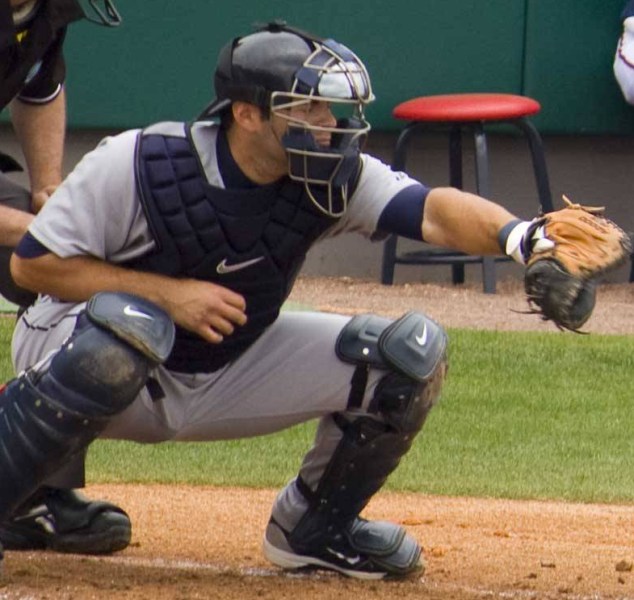
To receive the field you have to read the field, and the only way to read the field is to be looking right at it.  In baseball, there is only one position that can see the field and this is the catcher.  That’s why catchers are said to be good management material in general. Another way to say this is they have a wider view of the constraint set.  However, although the catcher can see the field and understand the constraint set in front of him, there is one variable he cannot control.  And this is, of course, the umpire.  The ump.

The ump calls the balls and strikes and the ump is a court of no appeal.  After all, he has the power to toss you from the ballgame altogether.  The only way to deal with this particular variable is to hone the craft of a catcher.  The first piece of craft is the act of framing a pitch.  Here the catcher subtly adjusts his glove in order to obstruct the ump’s view of the location of the pitch.  It is easy for the catcher to whip his glove on a ball in the dirt back to the strike zone, but the ump will spot that in a second.  So a catcher, if he wants to be any good, has to learn a little guile.

This guile can taken pretty far; and there are other ways to work an ump as well.  The classic, “ah come on ump,” is OK, but it’s the same as whipping the bill out of the dirt really.  A more effective trick is chatting the ump up.  Becoming his friend and letting him think you are actually on his side.  This is effective to a point as well, and extends the craft.   However here is where we need to remember our Dylan.  From “Just Like the Tom Thumb Blues,” we learn the following:

As Dylan once sang, you can start out soft and end up hitting the hard stuff — thinking people will stand behind you when things get rough, only to find out the bluff was your own. Sometimes you just want to go back to New York City and say you’ve had enough.
after Bob Dylan

Dylan is saying that though the use of guile helps you work the ump, you can start to mistake guile for the deeper craft.  You start to fall into your own trick.  You start to think you are the ump.  And these are deeper waters indeed.  In fact, this is the most dangerous game.  And in this zone, we need a secret weapon.

The idea of a secret weapon is apparently popular in many superhero movies these days, and we can read the field just a little to see why.  These so-called secret weapons may take the outward form of a literal weapon, one which defends against the apparent enemy and leaves death and destruction in its wake.  However when we use this kind of weapon, the forest we are in is in fact that of the irreal, where the furies shriek and howl.  However the superhero’s true secret weapon is something altogether different.  His true secret weapon is the light within, which can be transmuted into gold and used to navigate the irreal, and hunt the most dangerous game.  Where is that light within?  To find it, the catcher has to go pretty far back into things to find it.  In certain eras, folks may need to do something a little difficult to get there—as the Chinese say, may you live in interesting times.  The catcher, here, has to remember.

The first song I remember my own father singing, and one of the only ones I head from him, was from Bob Dylan.  I didn’t know who Dylan was, nor did I know the name of the song. The line my father sang was one of those old Dylan riddles — something about a pump that won’t work because someone stole the handles. I didn’t understand it then, but it landed in me like a talisman.
after Bob Dylan .

If the catcher is blessed to have such a talisman, he has a fighting chance.  The thing to do here is to keep your eyes and ears on the field and your gut and your body tuned into the ump.  Only this way can the little catcher tell when it’s time to play his card, which is of course the joker.  People have sought Dylan in all his guises to the ends of the earth and no one, to my knowledge, has caught onto his tricks.  I can’t say for sure that I’m onto all of them either, but I knew one thing.  When the vandals have those handles, the pump ain’t working. This is the moment the catcher makes his break with the ump. This is when he calls his bluff.

Dedication: For my Father, who caught me how to catch.

Andrea’s Travels, Part I: The Flight to Seoul

She’s got the Eye of Fatima/ on the wall of her motel room.

Camper Van Beethoven

Dateline Buenos Aries: Friday Morning

The plane eases into its docking point, 15 minutes late. Andrea wasn’t fretting; she’d been around a bit and knew that things sometimes worked. Other times, well they didn’t.

She is not on the run, not exactly anyway. Nonetheless, the 27 hour trip from Buenos Aries to Seoul via Atlanta will put half a world of distance between her and M. Azur. Welcome distance for Andrea, as the formerly desultory attentions of her blue friend have recently taken a turn for the more incessant. In short, he’s been calling her daily, one thin pretext after another. “Everything’s thin,” she mused, and M. Azur could thin paint. A classy guy who makes decisions and implements is what she needs, not some milquetoast beta-male in the medical tubing industry.  For Christ’s sake already. So Seoul beckoned, and the plane, the plane was late.

Andrea scratches her nose, adjusts her glasses. The turnaround crew would need 20, 25 minutes minimum to turn the plane over for the flight. A quick scan of her messages shows three new bleats from her would-be paramour. Pretext, text, context—still a no. She could handle herself, could Andrea. “Many apologies, I have been so busy,” she texts. “Dinner meeting is not possible this week. Tubing sales are up—talk again.” M.Azur would be a blue mist in no time. Ground staff opens pre-boarding, and Andrea, zoned in section 4, makes a lateral move into zone 3 to make sure her carry-on has the room it needed. “Who’s better than me?”

Andrea settles into 14A, a window seat. Bottle of water, headphones and a sleeping mask. Structured correctly, a plane flight can be made to feel like an undersea journey. All it requires is a little imagination.

Andrea has all she needs to swim a little up there in the ether. Her phone is set to airplane mode and the seat next to her is vacant. Bonus, she tells herself. A non-descript business traveler has the aisle. He looks more like a brown than a blue. Won’t be an issue.

Andrea is a lady, a women really, somewhere in her later 20s, probably. We won’t ask. Attractive, but no waif, she enjoys fine dining and a glass or three of wine. When she drinks her cheeks get rosy red which accentuates her dimples. The gym is not the place to find a girl of her kind; the Mr. Blues of the world are advised to try the patisserie instead. Buy her a piece of pie. Cherry, lemon, coconut cream. Pumpkin, peach, pecan. Andrea might be a little picky with her guys; her pie game is more omnivorous.

Without really trying, she has the attention of a half-dozen men within a thirty-year age range, all of whom she deflects with the grace of a fencer. Buenos Aries, Rome, Tampa, Algiers it doesn’t seem to matter where she goes there will be a guy or two. Boys on board and boys on deck. What’s the opposite of a chick magnet? Andrea might not be quite that, but she has options. A passing funny thought, so she dials up an early Bitch Magnet record on her phone.  That was Sooyoung Park’s first band, pre-Seam. Little Park, big city, Korean heritage. Going to Seoul, apropos. Bitch Magnet rocks.

What does Andrea do? It’s a question she can’t quite answer herself. Broadly speaking, she is in sales, a cog in the vast machinery of deal making between multi-nationals. In other words, she is around transactions, helps to facilitate them. An “industry conference” awaits in Seoul. The Korean word for blue is “puleun.” Will there be any puleuns at the industry event? almost surely. Andrea sighs at the smallness of it all. White wine please, make it a double.

The plane is well up over the Pacific by now and Andrea is tipsy at thirty-thousand feet. Where is she really from? It would take a month of pies to get that out of her.  A month of pies and a month of Sundays. So we shall say she is post-racial, like the women in Code 46.

“In a dystopian future, insurance fraud investigator William Gold (Tim Robbins) arrives in Shanghai to investigate a forgery ring for “papelles,” futuristic passports that record people’s identities and genetics. Gold falls for Maria Gonzalez (Samantha Morton), the woman in charge of the forgeries.”

Is “topian” the opposite of dystopian, she wonders? Three drinks and an hour of Bitch Magnet in and she’s feeling a little topian herself. Andrea would be fine in the world of Code 46. Hell, she’d probably thrive.

to be continued…

Dedication: For a good friend who gave me some pieces.