On Nina Van Pallandt: Muse, Witness, Residual Character, and Her Own Woman

Note: Nina Van Pallandt moves through this piece as a kind of drifting hinge figure between art and biography, cinema and scandal, half-real and half-mythologised: from her striking, uncanny presence in Robert Altman’s The Long Goodbye—where she plays the abused, luminous spouse of Roger Wade and becomes, briefly, a kind of muse/anima figure for Philip Marlowe—to her earlier life in the Danish pop duo The Baronets, through her entanglement with Clifford Irving and the great Howard Hughes hoax that later reverberates through Orson Welles’ F for Fake, and onward into the quieter aftermath of fame, reinvention, and partial retreat. The essay follows her not as a stable “character” but as a site where male-authored narratives—Hollywood noir, literary fraud, journalistic myth-making—keep trying (and failing) to fix her meaning, while she keeps slipping free in ways that are at once accidental and oddly deliberate. In the end she becomes something like a case study in cinematic and cultural afterlives: a woman repeatedly written by others, occasionally complicit, sometimes resistant, and finally legible only as a residue of performance, gossip, and unfinished stories that refuse to settle.

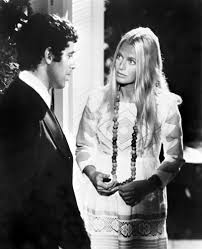
I first became aware of Nina Van Pallandt the way most people probably do: not through biography, but through atmosphere—specifically Robert Altman’s The Long Goodbye (1973, The Long Goodbye), a film that feels less like a narrative than a slow collapse of narrative reliability itself. It is a film in which people drift through scenes as if they have forgotten whether they are supposed to be characters or witnesses, and Nina arrives inside it already slightly misfiled, already too composed for the emotional weather she is asked to endure.

She plays Roger Wade’s wife, but “plays” is almost the wrong verb. Altman’s casting logic is not psychological realism in the classical sense; it is something closer to behavioral residue. People are dropped into the frame and asked not to perform identity but to inhabit proximity—to money, to violence, to desire, to failure. Nina’s presence has that peculiar Altman quality: she does not dominate the scene, but she stabilizes it just enough to make everything else look unstable.

Roger Wade (the blocked writer, the alcoholic genius-in-decline) is already collapsing before the plot admits it. Nina is the counterweight that never quite becomes balance. She is care without resolution, intimacy without clarity, the kind of emotional presence that suggests there is a story somewhere but refuses to confirm what it is. And then there is Marlowe, Elliott Gould’s version of Marlowe—half-stoned, half-wandering, permanently a few seconds behind the moral implications of what he is witnessing.

The film keeps staging small ruptures in epistemology. One of the most famous arrives early and feels almost accidental in its perfection: Terry Lennox appearing at 4 AM, asking for a ride to Tijuana. There is a moment—“Tijuana now?”—where Gould’s Marlowe is briefly jolted out of his procedural fog into genuine surprise, as if even he cannot believe how far the plot is willing to drift from explanation. That tonal instability is the world Nina inhabits as well, except she does not get Marlowe’s ironic distance. She gets consequence.

There is a domestic sequence—one of the film’s most disarming—that feels almost out of register with the noir frame: Nina cooking, the soft logic of food and attention, a candlelit dinner shared with Marlowe, where violence and absence are temporarily suspended by something as ordinary as butter and chicken. It is precisely the kind of scene that should resolve emotional ambiguity, but in Altman it does the opposite: it deepens it. Intimacy here is not revelation; it is another form of deferral.

What the film keeps doing, quietly and persistently, is refusing to assign stable moral weight to anyone. Roger Wade is both victim and self-destroyer. Marlowe is both agent and sleepwalker. Nina is both witness and participant, but never allowed the comfort of explanation. Even her suffering—when it arrives—is not narratively sanctified; it is simply another event in a world where events do not accumulate into meaning.

And this is where Nina becomes interesting beyond the film itself. Because she does not resolve into a character arc, she persists as something else: a figure who has been “used” by multiple narrative systems without ever fully belonging to them. In a conventional noir, she would be femme fatale or redemption object or tragic spouse. In Altman, she is none of these cleanly. She is what remains when genre stops enforcing coherence.

What begins to emerge, if one steps back slightly from her, is that she belongs to a broader category of women who are not simply “in” cultural narratives but are written into them by proximity to men who are doing the narrating. The pattern is subtle but persistent: women become legible to the public through the structural gravity of male projects—films, scandals, bands, memoirs—while simultaneously attempting, with varying degrees of success, to assert an interior life that resists that formatting.

It is difficult not to think here of Marianne Faithfull, who occupies a parallel register in the British version of the same phenomenon. Marianne Faithfull is initially rendered publicly intelligible through association—romantic, cultural, chemical—with the Rolling Stones orbit, and specifically through a media ecosystem eager to translate her into a kind of emblem: muse, fallen angel, tragic accessory to male genius. But what is striking about her trajectory is not the initial inscription but the long, stubborn insistence on rewriting it from within.

In both cases—Faithfull and Van Pallandt—the question is not simply “agency” in the abstract liberal sense, but something more structurally constrained: how does a person reassert authorship of self once they have already been written as a function in someone else’s story? Faithfull does this through survival, reinvention, and the eventual authority of her own voice as an artist. Nina does it more quietly, less performatively, by simply not continuing to cooperate with the demand that her life be endlessly narrativized into legible arcs.

And this is where Nina stops being just a cinematic presence and becomes entangled with a second, more volatile narrative system: the world of Clifford Irving and manufactured truth. I remain, in a slightly persistent way, puzzled by Clifford Irving—not in the sense that his actions are obscure, but in the sense that the scale of the gamble still feels oddly disproportionate to the era in which it occurred. Clifford Irving occupies that 1970s threshold where narrative fraud still had room to breathe: before the internet, before instantaneous archival correction, before every claim arrived already cross-checked by a thousand invisible clerks. The rope, in other words, was longer. Not infinitely elastic—but long enough that someone could plausibly believe they might walk it all the way across.

What he did, of course, was fabricate the authorized autobiography of Howard Hughes and briefly convince a publishing system that this fiction was fact. And one cannot quite shake the sense that this sits in a parallel register to Orson Welles’ late-career meditation on forgery and authorship, F for Fake, where the art forger is not simply a criminal but a kind of metaphysical irritant—someone who reveals how fragile the category of “authenticity” already is, even before it is attacked. In Welles’ world, the faker is almost honest about the fact that everyone is faking something. In Irving’s world, the system briefly forgets to notice.

The irony, of course, is that Irving’s fraud depended on a very pre-digital faith in paper trails, intermediaries, and the general slowness of institutional verification. Today it feels almost quaintly physical: forged documents, publishing contracts, phone calls that had to be believed in real time. One can imagine the same scheme now collapsing within hours, not because people are more moral, but because the feedback loops are instantaneous.

And then there is prison. Irving did time—real time, not narrative time—and emerged into a world that had already moved on to other, faster deceptions. Yeah, I mean what did you expect, dude. The arc compresses there in a way that feels almost unsatisfying: scandal, exposure, incarceration, partial reinvention. One wants something more operatic, but what you get is the bureaucratic version of consequence.

The interesting part is not that he was punished, but that for a brief historical window the system was even buildable enough that his plan could function as a kind of temporary reality. That is the shared atmosphere he has with Nina Van Pallandt: not guilt, not innocence, but proximity to narrative systems that were still slow enough to be fooled by their own assumptions.

In later life, Nina becomes harder to place in any of the familiar compartments that earlier decades tried to assign her. The cinematic afterglow fades into cult memory, and the Irving episode recedes into archival texture. What remains is a quietness that feels deliberate rather than accidental—not disappearance, but refusal of continued amplification. She does not convert notoriety into permanent self-mythology in the way later media ecosystems would almost require. Instead, she settles into a lower frequency of visibility: remembered, cited, intermittently revived, but no longer authored by the same pressures that once pulled her forward.

And here the comparison widens again, because what she resembles is not a “sidekick” at all—that word is too structurally comic, too dependent on hierarchy—but something closer to an attendant presence: a figure whose job, in other people’s stories, is to make emotional or moral instability legible without ever fully resolving it.

There is a related category, more neutral and slightly more precise: the faithful interlocutor. Not in the devotional sense, but in the structural one—the person who remains close enough to the main character’s instability to render it speakable, without ever becoming fully absorbed into its explanatory system. Nina performs this function in The Long Goodbyewithout being granted interpretive authority over it.

And there is another: the witness who does not testify cleanly. Not unreliable, but resistant to conversion into stable narrative fact.

We all make mistakes; that much is banal. The more interesting question is what kind of cultural weather those mistakes occur in, and how much agency is genuinely available inside it. Nina Van Pallandt seems, in retrospect, to have lived inside a period when men were still doing a great deal of the writing—of scripts, scandals, explanations—and women were often expected to appear inside those scripts as if they had authored them themselves. Her resistance to that framing is not always loud or declarative. Sometimes it is simply a matter of stepping out of the demand to be continuously interpretable.

And in that sense, what she ultimately carved out is not a grand public myth but something more modest and, arguably, more durable: a minor legacy, lightly held, slightly resistant to over-definition. Not central, not erased, not simplified—just there, in a way that feels unexpectedly intact.

I really like Nina Van Pallandt. In The Long Goodbye, and in the shadow of the Clifford Irving story, it is impossible not to root for her—not because she is resolved, but because she is never fully reducible. She drifts through systems built by men who are busy writing meaning onto the world, and she does not quite consent to being finalized inside any of them. We all make mistakes. She was written into a few. She was also, quietly, a drifter inside Hollywood’s narrative machinery, and what she ultimately leaves behind is a minor but distinct and instinctively cool legacy: not the center of anyone’s story, but one of the few figures who never fully became owned by it.

The Splinter Fraction: Male Circumcision Should Be Outlawed — 1 Million Percent

Note: This piece argues that male circumcision should be strictly outlawed for non-consenting minors. It approaches the topic from a strict bodily autonomy framework regarding non-consensual, non-therapeutic interventions on minors, and treats irreversible bodily alteration without consent as the central ethical issue. It is not addressing medically necessary or emergency procedures, nor situations where an intervention is required to prevent serious immediate harm, which are outside its scope. The argument also focuses on principle rather than comparative cultural practice, and is intended as a normative claim about legal consistency in liberal systems rather than a commentary on individual intent, belief, or identity.

Epigraph:

Jesus don’t touch my baby.

Ryan Adams

Male Circumcision Should Be Outlawed — 1 Million Percent

Male circumcision of non-consenting minors should be outlawed globally, with legal penalties applied to those who perform or facilitate it, and civil penalties imposed on parents who authorise it. I was circumcised in infancy in a Catholic family in 1974. The issue is not medical ambiguity or cultural discomfort but a basic question of bodily autonomy: whether irreversible, non-therapeutic alteration of a child’s body can ever be justified without consent. In a liberal legal system that claims to prioritise individual rights, the answer should be consistent and categorical. Anything less relies on inherited exemptions—religious, medical, or cultural—that do not withstand ethical scrutiny once the principle is stated plainly.

The core objection is simple: irreversible bodily modification without consent is impermissible when it is not medically necessary. A child cannot consent, and parental authority is not unlimited; it is a delegated responsibility bounded by the child’s future autonomy. Circumcision is not an emergency intervention. It is not a life-saving procedure in the vast majority of cases. It is the removal of healthy tissue from an individual who will live the entirety of their life with that alteration imposed before they had any capacity to participate in the decision.

This is where liberal societies already reveal a partial but incomplete consistency. We accept that consent is not static across childhood. We do not allow children to make binding decisions about sexual activity, because we recognise developmental thresholds of agency and understanding. That is why age of consent laws exist at all, and why they sit at or near adulthood in most jurisdictions. But the same logic applies more fundamentally to irreversible bodily alteration. If we accept that certain domains require maturity before consent is meaningful, then permanent physical modification must fall under the same principle. The difference is not moral category; it is legal lag.

The counter-case is not weak in structure, even if it fails ethically. It rests on four main claims: parental rights, medical justification, religious freedom, and social normalisation. Parents are routinely empowered to make medical decisions on behalf of children under a “best interests” standard. Circumcision is often placed within this framework as a preventive health measure. Some studies are cited to suggest reduced risks of urinary tract infections or sexually transmitted infections later in life, and complication rates in clinical settings are presented as low. On this basis, it is framed not as cosmetic alteration but as permissible preventive medicine.

Religion provides a second pillar. In Judaism, circumcision is a covenantal rite central to religious identity. In Islam, it is widely practiced as a tradition of purification and belonging. Liberal states are deeply reluctant to interfere with such practices, treating them as protected expressions of religious freedom. On this view, banning circumcision would represent not neutrality but intrusion into foundational religious life.

The third pillar is cultural and social integration. In societies where circumcision is widespread, particularly where it is near-universal within certain populations, deviation can create stigma or perceived abnormality. The argument follows that enforcing prohibition could impose social harm on children by marking them as different within their communities. Finally, legal systems distinguish male circumcision from female genital cutting on the basis of severity, medical context, and institutionalisation within healthcare systems, arguing that harm is not equivalent and therefore regulation need not be symmetrical.

Taken together, these arguments form a sort of a defense of permissibility under existing liberal frameworks: parental discretion within medical norms, protected religious practice, and harm-based legal classification.

But each of these pillars collapses under a stricter application of bodily autonomy.

Parental authority is real, but it is not sovereign. It exists only insofar as it serves the future autonomy and welfare of the child. It does not extend to irreversible, non-therapeutic bodily alteration where no immediate necessity exists. The “best interests of the child” standard is not a blank cheque; it is a constraint. We already recognise this in other domains where the state intervenes against parental choice when irreversible harm or violation of fundamental rights is at stake. The question is whether we apply that constraint consistently.

Medical justification also fails the threshold test when examined carefully. Even if certain population-level benefits exist, they are statistical, not essential. They can be achieved through far less invasive means—hygiene, education, barrier protection—without permanently altering the body of an individual who has not consented. Preventive possibility is not sufficient justification for irreversible intervention. Medicine does not normally operate on the principle that minor statistical risk reduction permits non-consensual surgery on healthy individuals.

Religious justification is where liberal systems most visibly reveal their tension. Freedom of religion is a foundational principle, but it is not absolute. It has never been interpreted as permitting unlimited parental action upon a child’s body. The critical distinction is between belief and irreversible physical imposition. Religious freedom protects the right to believe, to practice, and to transmit culture—but it cannot logically extend to authorising permanent bodily modification of an individual who has not consented to participate in that covenant. A child is born into a tradition, not owned by it.

The social integration argument similarly confuses descriptive normativity with ethical justification. That a practice is common within a group does not mean deviation is harmful in a way that justifies irreversible intervention. Social discomfort is not equivalent to bodily violation. Otherwise, any culturally dominant practice could immunise itself from ethical scrutiny simply by achieving prevalence.

The legal distinction between male circumcision and female genital cutting is often defended on the basis of harm severity and medical framing. But this distinction, while operationally convenient, becomes unstable when the underlying principle is examined. If the governing value is bodily integrity and consent, then sex-based differences do not determine permissibility. The relevant question is not comparative severity alone, but whether irreversible non-consensual alteration is being authorised at all. Harm thresholds may differ in degree, but the structural violation—altering a child’s body without consent—remains.

Once these counter-arguments are reduced to their core, what remains is not a justification but a set of accommodations: to tradition, to institutional history, to religious continuity, and to cultural inertia. None of these constitute a moral defence of the act itself; they constitute reasons why it persists.

This is why enforcement matters. A principle without enforcement is not a principle in practice. If bodily autonomy is to mean anything in a liberal legal system, it must be protected even when the practice is culturally embedded or religiously significant. That requires prohibition of the act itself, accountability for those who perform it in violation of the rule, and civil liability for those who authorise it on behalf of non-consenting minors. The aim is not punishment for its own sake, but alignment of law with the ethical principle it already claims to uphold in other domains of bodily autonomy.

What makes this issue more than historical critique is that it persists into the present as a live inconsistency. It is 2026. Liberal legal systems already recognise that bodily autonomy is foundational in adulthood. They already recognise that consent has developmental thresholds. They already prohibit non-consensual genital alteration in other contexts. The remaining question is whether they are prepared to apply the same principle consistently when tradition, religion, and medical normalisation converge.

A system that protects bodily autonomy only after adulthood has not resolved the ethical question; it has merely deferred it. The principle either applies universally to the body of the individual, or it does not. If it does, then non-therapeutic circumcision of minors cannot stand as an exception. 1 million percent.

Note: This piece is part of the Splinter Fraction series of political positions that the two-person Trans-Pacific political party has taken. You can find some of the others below.

On My Dad’s Ridiculous Climbing Strategies

Note: This is a new piece about my dad, Ross Thomas (RO), and his truly unbelievable climbing strategies. The central episode took place in Stehekin, Washington, many years ago, when RO led my brothers and me on an attempt to reach Castle Rock that quickly devolved into heat, dense forest, no water, and general mayhem. There is also a later coda involving a climbing gym in Portland that is, in its own way, even more outta control. This piece is comic in nature, but also affectionate. My dad is a great man, a brave man, and a very game climber. He is just not, in this one specific domain, a planner.

Send lawyers, guns and money — the shit has hit the fan
— Warren Zevon, refracted

RO, is a great man and a terrible climbing strategist. He is brave, energetic, physically game, and in most areas of life basically well organized. He was a good high school English teacher, a very good administrator, and for many years an excellent and meticulous girls’ basketball coach. He is not, in other words, some kind of general life-space incompetent. Quite the opposite. Which is what makes his climbing strategies so difficult to understand.

They are ridiculous. They are unbelievable. They are officially, historically, and totally outta control.

I say this with love.

The central case study here took place in the mid-2000s, let’s say 2005, when our family was staying in Stehekin, Washington, out on Lake Chelan. If you have never been to Stehekin, it is a beautiful and slightly improbable place, the kind of place that already feels like the beginning of a story. Lake Chelan is huge, and you get out there by ferry, which means from the jump there is a sense that you are committing to something. People camp there or stay in cabins. We were in a cabin. My mom Claudia (CL), stayed behind. RO, meanwhile, had a plan.

The plan was that RO and his sons — Mike (MI), Pat (PA), and me — would hike up toward Castle Rock.

Now, one thing about family expeditions is that “the plan” is often not really a collective possession. It belongs to one person. The rest of the group is more or less there to follow along. In this case, the plan belonged entirely to RO. MI and PA and I were, broadly speaking, along for the ride.

As I remember it, we started from Stehekin and walked about three miles just to get to the trailhead, then hiked a few more hours uptrail to where we stopped and camped the first night. It was already a decent undertaking just to get there, but this was, in a sense, merely the prelude. The true RO strategy had not yet fully revealed itself.

At around dusk, after we got to camp and set up the tent and got ourselves sorted for dinner, RO decided he was going to scout the route for the next day. This seemed reasonable enough. It is in fact the sort of thing a prudent leader might do. Only instead of scouting further up the trail, or perhaps generally uphill toward the place we were trying to go, RO for some reason headed downriver.

Why did he do this? We did not know. It was back downhill. It seemed unrelated to the objective. Even at the time it had the feel of one of those decisions that makes perfect sense only to the person making it.

Ross Thomas: The trail kind of petered out eventually and didn’t really lead to Castle Rock anyway.

Fair enough. I want RO’s side of the record included here. But even granting this, and I do grant it, going downriver in the late evening did not strike the rest of us as a strong opening move.

Sure enough, RO fell in the river and got completely soaked.

This was the first of many mistakes he would make on the trip.

He came back to camp late and dripping wet, having apparently developed an immediate a bizarre attachment to that river. The water was cold. The evening was cool. He changed clothes, we had dinner, and we went to bed. At this point, there was still some chance that the next day might somehow become normal.

It did not.

The next morning we got up early, had breakfast, and prepared to head out. My assumption — based on reason, precedent, and the literal existence of trails — was that we would continue on the trail. Instead, RO decided that we were going to bushwhack straight uphill through an extremely dense forest in the blazing heat.

This struck me as a bad plan.

It was a bad plan.

The forest was thick enough that you could not really move with any rhythm. We were not hiking so much as negotiating, arguing, and physically contesting with the landscape. Every movement took extra energy. Progress was incredibly slow. The heat was serious. And the main problem, which quickly became the only problem, was that there was no water. Not a stream. Not a trickle. Not a suspicious puddle. Nothing.

Now, RO for reasons that remain mysterious to me is not a big water drinker. He prefers beer and tea. Under ordinary conditions this is merely a personality trait. On a hot uphill bushwhack through dense forest it becomes a strategic liability.

Naturally, we asked where the water was.

Ross Thomas: I had read in a Fred Beckey book that there was a way to get up to Castle Rock, although I think Beckey had only heard about it and never actually done it himself.

This is, in its way, a perfect Ross Thomas detail. Fred Beckey, the legendary climber, had perhaps heard there was some route, though he had not personally taken it. This was enough for RO. A rumor in a book by a famous climber became an operating plan.

As for the water situation, RO told us — and I remember this vividly — that there might be some in about five miles.

Five miles!!!

We were already fighting for our lives up there, and this crazy man was calmly informing us that in only another five miles there might, possibly, perhaps, be water.

He’s totally outta control.

At some point, after what I recall as roughly three miles of this lunacy, we basically mutinied. Or perhaps mutiny is too strong; let’s call it collective realism. We told RO the obvious, which was that this was not going to work. The route was no good. The heat was too much. There was no water. We had to turn back.

And so we did.

Now the descent was interesting because it brought out our distinct styles. RO, MI, and PA were making their way down carefully, gingerly, responsibly. I, on the other hand, was absolutely flying. Swinging from tree to tree like some kind of deranged monkey, just ripping downhill through the forest. This part RO loves to tell to this day, and I admit it was one of my better athletic showings. I was not going to die of thirst in that forest and I was not going to descend politely either.

Eventually we made it back to camp. Or rather, most of us made it back to camp together. RO, in one of those small but meaningful complications that tend to gather around him in climbing situations, got separated from us and somehow ended up down by the river again.

And yes, he fell in again.

He really must have loved that river.

So now here he comes back to camp once more, drenched, and by this point we are all in total agreement that the trip is over. We are done. It is time to 86 the hell out of there.

So we break camp and head down toward the lake shore. But this presents a new problem. We still have a significant walk to get home — something like another two miles down to the shore and then, as I remember it, another three miles around the lake. And by now it is dusk. So this is not really viable either. We are hot, tired, and in no mood for an elegant final act.

At this point RO does what he often does in these situations, which is simply assume that reality will provide.

He found a guy with a motorboat and asked if he would take us back to Stehekin.

The guy said sure. Fifty bucks.

RO then informed him that he did not actually have fifty dollars on him, but could get it from his wife once we got back to the cabin.

Somehow, by what can only be described as grace, audacity, or a temporary breakdown in the boatman’s judgment, this worked. We got in the boat, got home safely, and made it back in time for dinner.

That was Stehekin.

CODA

You might think the lesson here would have been: bring water, stick to trails, do not base wilderness plans on rumor, avoid rivers if possible, and maybe do not lead your sons into dense forests in the hot sun in search of a semi-mythical route described secondhand by Fred Beckey.

You would be mistaken.

Many years later, when RO was Principal of Valley Catholic High School, he got really into climbing at a gym in Portland. It is a cool place, run by a father and son, and it has beginner, intermediate, and advanced climbs. He took me and MI and PA there, and later my son Hugh as well. Hugh loved it. He scampered up the walls like he had been waiting for exactly this sort of thing his whole life. I like climbing too, though my arms get tired pretty quickly and I tend to fade. MI and PA are both good climbers. RO, to his credit, also has strong stamina.

So one day my wife and Hugh and I were there with him. We’d been climbing for a few hours. I was on the mats, faded, taking a break. Hugh was still going. RO was showing him some moves. Then RO started up one of the big walls — one of the long climbs, the kind where you need the harness.

Only he had forgotten to put the harness on.

Hugh saw this before anyone else did and yelled out:

RO, get down now!

And RO did.

For the next year, RO loved telling the story of how Hugh had saved his life. Quite right too. It is a great story. My son saved my dad from one of my dad’s own ridiculous climbing strategies. The circle was complete.

But then, about a year later, shortly before RO retired from the principal job in 2018, he was back at the gym by himself. This time the only other people there were the owner and his son. And somehow — incredibly, impossibly, yet also in a way entirely consistently with the established Ross Thomas climbing tradition — he forgot the harness again, started up the big wall, and fell.

He crashed all the way down onto the mat.

The mat saved his life, no question. But his feet and knees and legs got absolutely busted up. He was in a wheelchair for months. It was so bad that he had to move temporarily out of the country house in the woods where he lives with CL and into a little bungalow on the Valley Catholic campus owned by the nuns that founded and still run the school. He could barely work. To this day his feet remain a total mess. He has trouble driving and has to drive with his shoes off and wearing some sort of thick sock or something.

At one point we wondered whether he might sue the gym owner for negligence. But RO wanted no part of that. He said it was his own fault, not the owner’s.

Fair enough.

And then, after many months, he mostly recovered. Which means this story has, if not exactly a happy ending, at least a decent one. Better still, as soon as he was recovered he went right back to the gym and started climbing again!

This is what I mean.

His climbing strategies are ridiculous. They are unbelievable. They are officially, historically, and totally outta control. He does not plan for basic things such as the route, the water, or how exactly one might avoid miles of dense forest. He does not always remember the harness. He seems, in climbing situations, to operate according to a distinct internal logic unavailable to the rest of us.

And yet outside of climbing, this makes almost no sense. He is, as I said, a basically well-organized guy. He planned lessons. He coached meticulously. He ran a school. In most areas of life he is not slapdash at all. Which makes the climbing thing not just reckless but anomalous. It is a localized mystery. A glitch in an otherwise coherent system. I do not understand it and at this point I do not expect to.

What I do know is this: to this day I avoid climbing with him because in this one particular area I do not trust his judgment at all.

I love the man. But when it comes to climbing, he is not to be trusted.

Dedication:

For my dad. I love you baby but you are totally outta control.

On George Santos (aka The Fabulous Kitara)

Note: This piece uses the figure of George Santos as a kind of cultural parable. The story of Santos—his improbable congressional run on Long Island, the famous unraveling of his résumé (including the legendary and totally outta control Baruch volleyball claim), the rapid collapse of political support from fellow New York Republicans, his eventual expulsion from Congress, and his strange second act as a Cameo celebrity—forms one of the more surreal public morality plays of recent American politics.

The apartment story that frames the essay is not meant as a literal equivalence. Kitara is not Santos, and roommates are not members of Congress. The comparison operates at the level of archetype: the charismatic figure who arrives full of sunshine, quickly becomes central to a small social world, and then—through one small but revealing detail—forces everyone around them to confront the uneasy coexistence of charm and opportunism.

The name “Kitara,” Santos’ drag name from back in Brazil where he if from (Santos is gay of course) is used here in the spirit of narrative shorthand rather than biography. Anyone who has lived with roommates long enough will recognize the basic situation. Shared apartments are small republics built on trust, improvisation, and the quiet hope that everyone involved is playing roughly the same game. Most of the time that hope is justified. Occasionally it is not.

If the tone of the piece drifts toward amusement, and even affection, rather than outrage, that is deliberate. Characters like Santos—and the occasional fabulous roommate—have a peculiar ability to provoke both exasperation and reluctant admiration. The performance can be infuriating. But it can also be oddly entertaining.

Such people rarely disappear completely. They simply move on to the next stage. Sometimes that stage is Congress. Sometimes it is Cameo (get that scratch Georgie baby!). And sometimes it is just the memory of a roommate who once seemed almost too good to be true.

Epigraph

“People seldom do what they believe in.
They just do what is convenient, then repent.”

— Bob Dylan


I. The Fabulous Roommate

Every apartment has its mythology.

The quiet one who never emerges from his room except to microwave things at strange hours. The earnest one who tries to establish chore charts that everyone pretends to follow for about ten days. The one who adopts pets with a confidence that suggests the rest of the household has already agreed to care for them.

And then, once in a while, there is the fabulous roommate. Kitara was that roommate.

She arrived with the sort of personality that immediately rearranges the emotional furniture of a place. Cheerful without being cloying. Social without being exhausting. Organized without being smug about it. She seemed to understand, instinctively, the delicate social contract of shared living: when to chat, when to disappear, when to clean something quietly so no one felt guilty.

Visitors loved her. Friends who came by would inevitably say some version of the same thing: “Your roommate is amazing.”

And she was. At least at first.

She was the sort of person who made the apartment feel like a small, cheerful republic. There were occasional dinners, occasional drinks, occasional pets that appeared temporarily in the orbit of the household. Nothing dramatic. Just the easy, slightly improvised domestic life that happens when a handful of semi-adults share a roof and try to keep the machinery of living running smoothly.

There are people who move through life like that—people who bring lightness with them. People who make small environments work better simply by being present. You think, when you meet someone like this: what a lucky break.


II. The Sunshine Personality

There is another category of person, however, that resembles the fabulous roommate from a distance. These people also arrive with sunshine. They are charming. They are energetic. They seem to know how to move through rooms with effortless confidence. They shake hands warmly. They remember names. They tell stories. They radiate the sort of friendliness that makes everyone feel briefly like a co-conspirator in something cheerful.

The difference is subtle, and it often takes time to notice. These are not merely charming people.

These are the performers. And, one of the most remarkable recent examples of this type in American public life was George Santos.

Santos appeared, seemingly out of nowhere, in the political ecosystem of Long Island. His run for Congress was, at least initially, improbable in the way that many modern political stories can be. The district had long been competitive, but his rise through the local Republican apparatus was unusually smooth. There was little serious opposition within the party. The campaign itself unfolded with the sort of confident momentum that often accompanies candidates who seem, at least on paper, to possess a compelling life story.

And what a life story it was.

Santos presented himself as the son of immigrants who had risen through the financial world, a man with an impressive résumé and a philanthropic sensibility. He spoke of professional success, cultural fluency, and various achievements that painted a portrait of upward mobility and cosmopolitan competence.

The voters of Long Island sent him to Congress. And then, almost immediately, the details began to unravel.


III. The Volleyball Player

The first cracks appeared through the ordinary mechanism of local journalism. Reporters from Long Island newspapers began to do what reporters traditionally do: verify things.

The résumé turned out to be an imaginative document. The professional history did not quite match reality. The educational claims were questionable. Various details that had seemed impressive during the campaign began to dissolve under scrutiny.

One of the most memorable revelations involved an oddly specific athletic claim. Santos had described himself as a standout volleyball player during his time at Baruch College. Not merely a participant, but something close to a star—someone whose record-setting performance had been part of his biography.

There was just one problem. Baruch College had no record of him playing volleyball. None at all. Outta control. The story collapsed on that small detail. It is often the small details that do that.

A résumé can contain many large claims, and those claims can hover in a kind of vague plausibility for a surprisingly long time. But one precise, checkable fact—the volleyball team roster, the game statistics, the athletic department archives—can puncture an entire narrative.

The reporters pulled the thread and the sweater unraveled.


IV. The Grifter Archetype

Once the unraveling began, it accelerated. Claims about employment at major financial firms proved dubious. Educational credentials evaporated. Personal history mutated in various directions depending on which previous statement one examined.

Soon the story had migrated from the political pages into the broader theater of American spectacle. Late-night comedians noticed. Cable news panels convened. Social media filled with the strange, almost baroque details of the saga. Members of his own party began to distance themselves.

Several Republican members of the New York congressional delegation—figures who had initially welcomed a new colleague—publicly called for him to resign as the scope of the fabrications became clear. The situation became untenable. The House of Representatives eventually voted to expel him, a rare and historically notable step.

It was a dramatic fall.

And yet even during the collapse, Santos retained something remarkable.

Charm.

He gave interviews. He sparred with reporters. He adopted, at times, an almost mischievous tone about the entire affair. There was a faint air of theatricality to the proceedings, as though the story had become a kind of performance art about the boundaries of credibility.

The grifter archetype has a peculiar resilience. Even when the illusion collapses, the performer often remains oddly entertaining.


V. The Apartment

Watching the Santos saga unfold, I found myself thinking more about Kitara.

Because the thing about grifters is not simply that they deceive.

It is that they charm.

They charm their way into rooms, into institutions, into social networks. They radiate warmth. They build small communities of goodwill around themselves. And for quite a while, everything feels perfectly normal.

Until one day something small happens. Something missing.

In the apartment it was GM’s silver. Not a vast treasure. Not an heirloom of historic significance. Just a small, familiar object that lived in a particular drawer and had always lived there.

One morning it was gone. The initial reaction in situations like this is always practical. Maybe you moved it. Maybe it fell behind something. Maybe someone borrowed it.

The mind runs through a series of benign explanations, each one slightly less convincing than the last.

And then a thought appears.

Quietly.

Oh shit.


VI. The Knowledge You Don’t Want

Roommate life operates on a fragile form of trust.

You share space. You share kitchens. Sometimes you share pets, groceries, furniture, phone bills, music, stories. The arrangement functions because everyone tacitly agrees not to test the boundaries of that trust too aggressively.

When something disappears, the entire structure trembles.

But there is another complication.

Sometimes you realize what probably happened. And you also realize that confirming it would destroy the social equilibrium of the apartment.

So you do a strange psychological maneuver.

You know. But you decide not to know.

Life continues.

The dishes are washed. Conversations occur. The roommate remains charming. The apartment continues to function as a small republic of semi-functional adults.

But a hairline crack now runs through the arrangement.


VII. The Fall

For Santos the crack widened into a canyon.

The congressional investigation intensified. Ethical questions multiplied. Party support evaporated. Eventually the House voted to expel him, ending one of the most surreal political tenures in recent memory.

Yet even after the fall, Santos demonstrated a familiar trait of the charismatic grifter.

He adapted. He appeared on podcasts. He commented on political scandals involving others. He expressed a certain moral indignation about the ethical lapses of fellow politicians—including members of his own party—sometimes with a tone that was almost hilariously sanctimonious given the circumstances.

The performer remained on stage. And then came the truly modern twist.

Santos joined Cameo. And he’s fucking great on it!

For a fee, he would record personalized video messages: birthday greetings, congratulations, small performances of his peculiar brand of post-scandal celebrity.

The internet, as it often does, embraced the absurdity.


VIII. The Cameo

At some point I watched a few of his videos.

There he was, smiling warmly into the camera, delivering a cheerful greeting to a stranger somewhere in America. The tone was friendly, relaxed, slightly mischievous.

And I laughed.

Because the performance was genuinely funny. The charm, infuriatingly, still worked. It reminded me of the old fable about the scorpion and the frog.

The scorpion asks for a ride across the river. The frog hesitates, noting that scorpions have a reputation for stinging frogs. The scorpion assures him that such a thing would be irrational; if he stung the frog mid-crossing, both of them would drown.

The frog agrees.

Halfway across the river the scorpion stings him.

“Why?” the frog asks as they sink.

“I can’t help it,” the scorpion replies. “It’s my nature.”

The scorpion cannot help himself.

But every now and then the scorpion also sends someone a birthday message on Cameo, smiling warmly and wishing them a fantastic year ahead.

And you find yourself laughing anyway.

The truth about characters like Santos—and perhaps about certain roommates—is that their charm is not an illusion.

It’s real.

The trouble is that it coexists quite comfortably with everything else.

Dedication:

For Kitara. May you make a fucking mint on Cameo and look totally gorgeous while doing it.

Note: If you enjoyed this story, you might also enjoy these other pieces about American grifters.