In Defense of Mark Kozelek

Note: This essay addresses the artistic approach of Mark Kozelek as a songwriter. It does not attempt to evaluate or adjudicate the various personal controversies that have circulated around him in recent years, many of which remain publicly disputed and complex.

The focus here is narrower: how Kozelek’s long-form, diaristic songwriting works as a musical method — particularly in songs like “Ali/Spinks II,” where ordinary details accumulate into something emotionally larger. Whatever one thinks of the artist as a person, the question of how the music itself functions remains worth examining on its own terms.

For several years now it has been fashionable to treat Mark Kozelek as something like an exhausted case: a brilliant songwriter who wandered too far into self-absorption, whose songs became too long, too diaristic, too willing to linger on the small debris of daily life. Even some longtime listeners have adopted the shorthand. Early records were masterpieces; later ones were indulgent. The verdict sounds tidy. But like most tidy verdicts in music, it collapses as soon as you start listening again.

The basic complaint about Kozelek’s later work is well known. The songs stretch past ten minutes. The lyrics catalog ordinary events: hotel rooms, meals, airports, old friends, television shows, half-remembered conversations. The narrator seems to be narrating his own day in real time, occasionally pausing to note a basketball score or a passing cloud of melancholy. To critics raised on the discipline of verse-chorus songwriting, this can sound like navel-gazing elevated to an art form.

But the strange thing about Kozelek’s music is that the minutiae are not actually the point. They are the atmosphere. His songs work less like traditional compositions and more like extended walks through consciousness. The grocery lists, the memories of old bands, the stray anecdotes about touring musicians — all of it forms the texture through which something else slowly emerges. A mood. A sense of time passing. The feeling of being a person moving through an ordinary day while carrying decades of memory.

The best way to understand this approach is to listen carefully to “Ali/Spinks II,” one of the central tracks from Benji. The song begins almost casually, recounting the death of Kozelek’s cousin and drifting through fragments of memory connected to that loss. There is no obvious structure, no chorus that arrives to organize the material. Instead the narrative moves the way memory moves: sideways, unpredictably, circling back on itself. The details accumulate slowly until the emotional core of the story becomes unavoidable. What begins as a series of seemingly unrelated observations eventually reveals itself as a meditation on grief, family history, and the strange ways tragedy ripples through ordinary life. The song is long, messy, and digressive — and it works precisely because of those qualities. “Ali/Spinks II” is not merely an example of Kozelek’s method; it is the test case. If the listener accepts the logic of that song, the entire later catalog suddenly makes sense.

This approach did not come out of nowhere. Kozelek has always been a writer drawn to the long arc of a song. Even in the early days of Red House Painters, the music moved at a patient pace, letting chords hang in the air while the lyrics circled around regret, nostalgia, and quiet observation. What changed later was not the impulse but the level of exposure. The lens moved closer. The songs stopped pretending to be about characters and admitted they were about the singer himself.

For some listeners that shift felt like a loss of mystery. But there is another way to hear it. Kozelek’s later records are essentially field recordings of a mind at work. They capture the strange mixture of memory, boredom, humor, irritation, and melancholy that makes up ordinary consciousness. Most songwriters edit this material down to the highlights. Kozelek leaves it mostly intact. The result is less like reading a poem and more like sitting beside someone during a long drive while they talk about whatever crosses their mind.

The famous outbursts that circulate online tend to obscure this. Kozelek has never been particularly careful about public performance of personality, and that roughness often dominates the narrative around him. When he released the song “War on Drugs: Suck My Dick,” a public feud with The War on Drugs instantly became the headline. The track was petty, funny, abrasive, and entirely unnecessary — which is to say it was perfectly consistent with the same impulsive candor that fuels his songwriting. Kozelek has never seemed particularly interested in polishing the public version of himself.

But the deeper argument about his music usually centers on the accusation of self-indulgence. Why should listeners care about the details of a songwriter’s daily routine? Why should a song wander through anecdotes about hotels, meals, or aging friends? Why should anyone sit through ten or twelve minutes of conversational narrative when a tight three-minute composition could deliver the emotional payload more efficiently?

Kozelek himself once answered that question in a line that perfectly captures his stubborn philosophy: he said he liked playing shows for “dudes in tennis shoes.” The phrase sounds casual, almost dismissive, but it carries a small manifesto inside it. He is not writing for critics parsing lyrical elegance or for industry tastemakers deciding what counts as proper songcraft. He is writing for ordinary listeners who recognize the shape of everyday life — the boredom, the odd digressions, the strange humor that creeps into conversation when people talk long enough.

In that sense Kozelek’s songs resemble a certain kind of late-night storytelling more than traditional music. Imagine someone sitting across the table recounting a memory that begins in one place, wanders through several unrelated details, circles back to a childhood story, and eventually lands somewhere unexpectedly moving. The emotional impact arrives not through compression but through accumulation. You spend time inside the story until its meaning quietly surfaces.

The length of the songs, which so many critics treat as evidence of indulgence, is actually central to the effect. Time itself becomes part of the composition. The listener settles into the rhythm of the narration. Small details begin to gather weight simply because they have been allowed to exist long enough. By the time the song ends, the ordinary events that seemed trivial at the beginning have become part of a larger emotional landscape.

This is not the only way to write songs, and it is certainly not the most efficient one. But efficiency has never been Kozelek’s artistic goal. His music belongs to a tradition of artists who treat the everyday as worthy of sustained attention. The diary becomes the canvas. The passing moment becomes the subject. Instead of distilling experience into a polished metaphor, the songwriter simply records the experience itself and trusts that meaning will accumulate over time.

If that approach sometimes borders on excess, it also produces moments that feel uncannily real. A stray observation about a friend can suddenly open into a meditation on aging. A casual mention of a hotel room can turn into a reflection on the strange loneliness of touring musicians. The emotional truth arrives sideways, hidden among the details of ordinary life.

Which brings us back to the central criticism: that the songs are too long, too detailed, too inward. All of that is true. But it may also be precisely why they matter. Kozelek’s music asks listeners to do something that modern culture rarely encourages anymore — to slow down, to sit with the flow of another person’s thoughts, to accept that meaning often appears gradually rather than in a neatly packaged chorus.

Not every listener will have patience for that. But for those willing to spend time inside the songs, the reward is a strangely intimate experience: the feeling of inhabiting someone else’s memory stream for a while. The tennis shoes crowd, in other words, may understand something that critics occasionally miss. Sometimes the most honest art does not arrive in the form of a perfectly shaped statement. Sometimes it arrives as a long conversation that refuses to end too quickly.


On a run-in with Damon Krukowski in a Kyoto Basement

New Note: I am republishing this piece with a new note because I just finished a full piece on the breakup of the band Galaxie 500 which is mentioned in this piece on two of the three members of that band, Damon Krukowski and Naomi Yang. In addition, I wanted to add a few comments on how the venue of the gig I attended around 2006, Cafe Independents in Kyoto, has changed since that time. I have also slightly edited the title of this piece.

This is one of my favorite pieces in a sense because it was early in the life of my blog and it focussed on Kyoto. The original intention of this blog was to document my explorations of Kyoto, however it has evolved in several different directions since then. So this is sort of “bringing it all back home.” As for Cafe Independents, it is still the same place, however they no longer allow smoking and I don’t know that they have live gigs anymore. The food is kind of the same but dinner specifically has been upgraded and has also become more expensive. It’s still a decent place for lunch, or a dinner date, and one of the sets of stairs is still intact but I think the other one is blocked off or something. In any case, while I have dropped in on occasion recently, I don’t frequent the place as much as I used to. There are a few other, and better, live houses in Kyoto, specifically Urbanguild, which I will write about at another time. If you are stumbling on this one for the first time I do hope you enjoy it.

What follows is a true story.  Or, in the words of Damon Krukowski, formerly of Galaxie 500 and presently of Damon and Naomi, “here are the dirty facts.”

It was sometime in the first decade of the 21st century.  I was minding my own business in my fair adopted city of Kyoto.  You see, I live in North Kyoto and unless I have good reason, prefer to stay in orb of the north-central part of the city.  The south is for business, the east for the occasional mountain jaunt, and the west too wild and forbidding for a humble man such as myself.  Mostly, I just try to stay north of Shijo Dori (positively 4th street, so to speak).  That’s my zone.

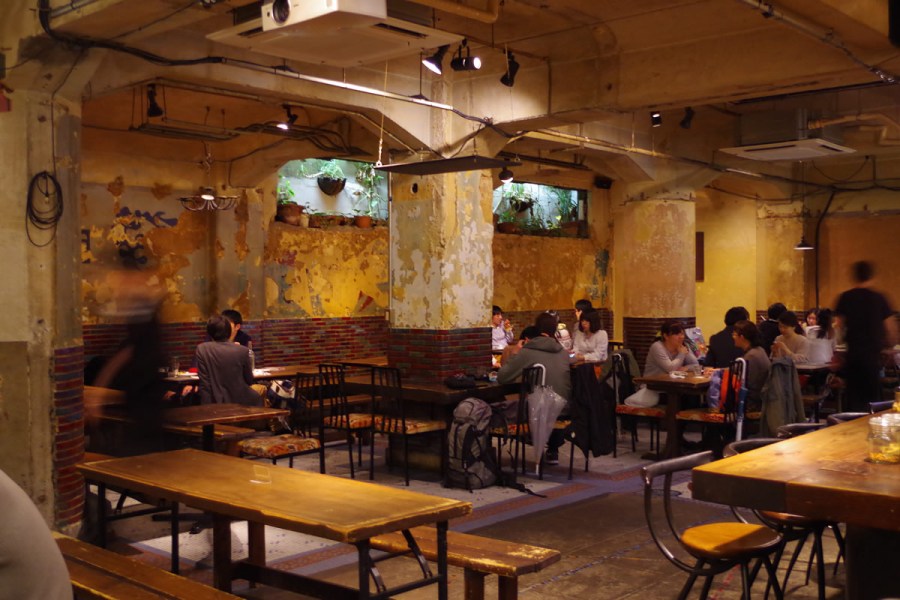
As with any excellent locality, there is plenty to explore in North Kyoto.  One place that the locals know is Cafe Independants–a cafe with a small bar which from time to time hosts shows.  Cafe Independants is located in a basement with exposed white pipes and stone walls.  It’s hip if you’re into that kind of thing, certainly not trendy though.  And, it features a kick-ass pair of sneaky staircases that are worlds into themselves.  I have enjoyed those staircases many a time my own self.

I have had the pleasure of seeing the great Bill Callahan open for the immaculate harpist Joanna Newsom there when Newsom was just breaking through.  Callahan was the bigger name, and his generosity in opening for her was striking.  That was a great night.  I may have even smoked a rare cigarette.  I also saw my mate Darren Hannah play bass there with a bow.  That was something–and the dude executed a beauty of a bow toss at the end of the show.  A bow toss for a bassist is like a mic drop for an MC.  Show’s over folks.  So you see, I’d had some nights there.

The Cafe runs an open kitchen which serves right through gigs and back in the day also had a record shop open in the back.  It’s a small place, seating maybe 35 on a good day, and when a show is on people tend to pack around the big pole in the center and squeeze into communal tables.  Smoking is allowed.  The Cafe, at the best of times, is not a quiet place.  This is to be borne in mind with what followed.

So one evening I had secured tickets to see Damon and Naomi play.  Damon and Naomi were members of the late 80s/ early 90’s band Galaxie 500 with Dean Wareham.  The band didn’t really know what it was doing at first, like many a band before, and kind of stumbled into near-greatness before Wareham walked and started Luna, the world’s greatest band.  Wareham details the reasons behind the break-up in his memoir Black Postcards.  Poe is supposed to have said that any man who tells the simple truth of his life would write a masterpiece.  Wareham gets pretty close to following Poe’s dictum.

The ending of Galaxie 500 came about, according to Wareham, essentially because Wareham was tired of being treated like a child by the other two, a long-time couple.  I think he wanted his own band, and wanted to chill a little.  From Black Postcards:

Traveling is stressful.  And with Damon tour-managing, it seemed like every hotel check-in, every seat assignment, and every rental car was a problem.  Damon would argue about what floor his room was on.  He would get annoyed if he didn’t get the seat he wanted on the flight.  I shouldn’t have let this bother me.  I should have minded my own business.  But traveling together highlights your differences.

At one show in late 1990, a techie shone a spotlight on Dean as he stepped downstage for a solo.  This seems to have been the breaking point.  Black Postcards again:

Damon: “In retrospect I notice that Dean chose the L.A. show to launch this new trick, when the audience was full of music industry people.  We hadn’t had any spotlights in Columbus or Dallas!”

Dean in his contemporaneous tour diary: “Damon said he doesn’t like me walking in front of his drum kit–it throws him off.  I didn’t tell him to go f*** himself.”

Things were rough, and Dean split in 1991.  (Wareham quotes a Damon interview saying “Here are the dirty facts!  What happened was simply that Dean quit, more or less out of the blue, on the telephone one day.”  Ah oui, les sales faits.)  Galaxie 500 is still an interesting band and has a handful of great songs.  Then, Damon and Naomi formed their own group, named eponymously.  They are pretty good.  I like “This Car Climbed Mount Washington,” from More Sad Hits, and the whole record Playback Singers is strong.  Still, they are a far cry from Galaxie, much less Luna.

Nevertheless, I was excited to hear they were coming to little old North Kyoto in fact to play the Independants.  I showed up early with a friend and we had a few drinks, as you do.  There were 30 or 40 people there, as normal.  People were chatting, eating, smoking, and a local warm-up act started preparing on stage.  Actually, there is no stage at the Cafe, just floor space.  The show, from my point of view, HAD NOT STARTED.  Additionally, I WAS BEHIND THE POLE.  I wish at this time to stipulate this very clearly in light of what followed.  I also wish to stipulate that no-one is a bigger fan of the idea of the local warm up act than my good self.  Nobody.  By god, I remember seeing the Tenniscoats, a much beloved Japanese band that you won’t have heard of, open up in Kyoto for someone, Bonnie Prince Billy maybe, and saw the great Saya Ueno play in her barefeet.  I support the local art community with a whole heart.  And no blasted interloper will tell me otherwise.

Anyway, on the night in question I will admit I was talking to my buddy while the local artist was getting set up.  And yes, she may have said something into the microphone.  I don’t really know.  Because before I could do anything, here comes Damon bounding across the room, right in my face, and shushed me.  “Don’t speak when the ARTIST is talking,” he hissed.  Right…in…my…face.

Now, the human mind is a remarkable deal.  When Damon shushed me, two simulataneous and equally strong thoughts came into my head.  The first was, “wow, Damon from Galaxie 500 just shushed me.  Cool.”  The second was, “dude, fuck you!  This is my city you pompous SOB, the show HAS NOT STARTED, there is a room full of chattering people, and you are going to lecture me about the ARTIST.”

What did I do next, you will ask? Well, in my mind I like to think I produced a gesture equivalent to Dave Moss’s finger flips in Glengarry Glen Ross, the single best fuck you even put on screen. Or, I may have stared dumbly at the guy.  One or the other.

On the Velvet Underground’s Live at Max’s Kansas City, the future poet and songwriter Jim Carroll famously “ruins” the recording of “Sweet Jane” by asking for a double Pernod. You can find reference to this incident in works as scholarly as The Encyclopedia of Popular Music, published by Oxford Press: “‘Excuse me can I have a Pernod, get me a Pernod’. Poet and author Jim Carroll’s boorish demands for a bloody Pernod ruined (this) illegal cassette taping.”

Well, let’s look at the (dirty) facts.  Carroll’s supposedly boorish demands are almost entirely heard between songs when the band is tuning.  He doesn’t know that the show is being taped. On Sweet Jane, for example, Reed finishes the song and then we hear Carroll:

“Oh yeah, I wrote it, but it’s pretty new, yeah.  Did you get the Pernod?  You had to get the, you had to go to the downstairs floor.”

Sure, he is a little lit.  Sure he is close to the mic.  But the song is over.  There is downtime.  The man is thirsty.  The recording is “illegal.”  Now I ask you, is this “ruining” the song?  Only if you are an honest to god prat.  Otherwise, this is called local color.  Guess what Damon, buddy?  I’m a local.  This is my city.  I’m colorful.  And I’ll take my bloody Pernod whenever I goddamn well feel like it.

Stylistic Note: The style of this piece is deeply indebted to Eric Ambler’s The Intercom Conspiracy.  Inspiration from this master of form is acknowledged, with deep gratitude.

The Respectable Man (A Poem)

Note: I wrote this poem when I was in my twenties and it shows. Back then I wrote poems really fast. Today I still write really fast, but can barely write poetry at all. Anyway, this is sort of my version of a punk tune. It’s called “The Respectable Man,” and kind of speaks for itself.

The respectable man
reflects if he can
but the world won’t wait for reflectors
the respectable man
sits on the can
sits on the board of directors

The respectable man
hawks wares to the clan
who cannot tell shit from shinola
the respectable man
sees a water ban
and irrigates crops with a cola

The respectable man
works on his tan
en route to his room at the Hilton
the respectable man
is pimping a plan
with robust tax-giveaways built-in

The respectable man
spits on his hands
and scurries his way up the ladder
the respectable man
looks over the land
and respectfully empties his bladder