
The Most Insane People of All Time (aka You’re Outta Control!): #2 John McAfee

Note: This second installment in The Most Insane People of All Time (aka You’re Outta Control) looks at John McAfee, tracing his evolution from software pioneer to global fugitive, crypto evangelist, and online cult figure. The piece emphasizes the improvisational chaos of his later life and contrasts it with more conventional tech figures like Elon Musk and Bill Gates, arguing that McAfee’s volatility places him in a category of his own. The tone is impressionistic, comparative, and intentionally informal.

Epigraph: 

“I fought the law and the law won…”

— I Fought the Law, The Clash

John McAfee starts in relatively conventional fashion: brilliant programmer, eccentric personality, builds the first widely adopted consumer antivirus software in the late 1980s, and becomes extremely wealthy when McAfee Associates takes off. But even in the early years there’s instability, and a foreshadowing of things to come — drug use, paranoia, erratic business decisions, and a growing anti-authority streak. He sells his stake, drifts through various ventures, and by the late 2000s relocates to Central America, eventually settling in Belize. There he buys beachfront property, hires armed guards, collects dogs, experiments with quasi-scientific projects, and begins acting like a semi-autonomous local strongman. It’s the first fully “outta control” phase: money, isolation, guns, and a man already well inclined toward paranoia.

Then comes the neighbor incident. In 2012, McAfee’s American neighbor, Gregory Faull, is found murdered. McAfee is named a person of interest — never charged — and instead of lying low, he goes fully theatrical. He claims the authorities are targeting him, allegedly evades police by hiding, disguising himself, and moving between safe houses, all while giving interviews and live-tweeting the saga. With girlfriend (later wife) Janice McAfee and various associates in tow, he flees Belize, surfaces in Guatemala, is detained, then ultimately allowed back to the United States. The whole episode is surreal: a tech millionaire allegedly on the run for murder, narrating the chase in real time on social media. It’s not just outta control — it’s performance art.

Back in the U.S., McAfee briefly lands in Florida but quickly re-enters chaos. He promotes cryptocurrencies, launches bizarre tokens, courts publicity, and cultivates a global cult following. He posts paranoid threads about surveillance, claims he lives inside Faraday cages, talks about government plots, and offers wild schemes — including promises to evade arrest by sea, air, or even paragliding into New Mexico to meet with fans! He pops up in unexpected places, from Caribbean boats to European cities, always accompanied by Janice and a rotating cast of loyalists. At one point he tattoos crypto branding onto himself, predicts conspiracies, and positions himself as both fugitive and prophet. The line between performance and belief dissolves completely.

Eventually, legal trouble catches up. U.S. authorities charge him with tax evasion and crypto-related fraud, and he’s arrested in Spain in 2020. From prison he continues tweeting through intermediaries, hinting at conspiracies and insisting he’ll never kill himself. In June 2021, shortly after a Spanish court approves extradition to the United States, McAfee is found dead in his cell — ruled a suicide. His supporters, including Janice, immediately dispute the finding, pointing to earlier posts and tattoos as supposed foreshadowing. The ending is as chaotic as the life: software pioneer turned fugitive, Twitter antihero, crypto evangelist, paranoid showman, and finally a death that only deepened the mythology. Outta control doesn’t even begin to cover it.

Compared to John McAfee, figures like Elon Musk and Bill Gates still look almost conventional — even when they drift into odd territory. Musk’s public persona is chaotic in a very modern way: late-night posting, impulsive announcements, awkward humor, and personal-life theatrics. The relationship with Grimes, the bizarre naming of children, and the infamous weekend when Azealia Banks claimed she was stranded at Musk’s house amid talk of LSD and general weirdness all add to the sense of volatility. Then there are the dad-joke moments — hauling a sink into Twitter headquarters and posting “let that sink in,” which is either performance art or just terrible humor. It’s eccentric, sometimes cringe, occasionally outta control — but the companies still run, rockets still launch, and the chaos never fully escapes the bounds of reality.

Gates, by contrast, is a more old-school eccentric. Bill Gates has the reputation of a hyper-competitive young executive who mellowed into a philanthropic technocrat, but the quirks linger. The awkward dancing, the slightly rumpled appearance, the perennial jokes about dandruff — he has always projected a kind of brilliant-but-uncool energy. The later-life turbulence — divorce from Melinda after decades, scrutiny over his contacts with Jeffrey Epstein, and the general aura of a private billionaire navigating public controversy — adds complexity but not chaos. Gates remains structured, Musk volatile, but both operate within functioning systems. McAfee, meanwhile, is something else entirely: not just eccentric but improvisationally unstable, a man who turned paranoia, fugitivity, and spectacle into a lifestyle. Musk may be chaotic, Gates may be awkward, but McAfee is outta control in a different register altogether.

In the end, John McAfee feels more outta control than Keith Raniere, Elon Musk, or Bill Gates — and that’s saying something. Raniere was creepy and manipulative but small; Musk is chaotic but still tethered to real-world outcomes; Gates is eccentric but fundamentally structured. McAfee, by contrast, seemed to live entirely outside normal constraints. Guns, boats, dogs, girlfriends, crypto tokens, Faraday cages, live-tweeting alleged manhunts, promising wild escapes, drifting between countries — the whole thing reads less like a biography and more like a fever dream. He wasn’t just eccentric; he appeared to improvise his life day by day, escalating the spectacle each time. That kind of volatility is rare. It’s also why he became a cult hero: he embodied a fantasy of total freedom, however reckless, however unsustainable.

Years after his death, the mythology hasn’t faded. Supporters still debate the circumstances, quote his tweets, and treat him as a kind of outlaw technologist who refused to play by the rules. Whether you see him as mad genius, performance artist, or cautionary tale, the scale of the chaos is undeniable. There may have been more dangerous figures, more powerful figures, even more tragic figures — but few as consistently, flamboyantly outta control. That’s what makes McAfee a legend. Not admirable, not necessarily likable, but unforgettable. And like all true originals, there probably won’t be another. So RIP, prayers up, and pour one out for a real one, John Motherfucking McAfee.

Note: If you liked this piece, you may also like the other ones in out “You’re Outta Control” series.

Stringer Bell: Middle Manager

Note: This essay reflects on the character of Stringer Bell from The Wire, one of the most carefully written figures in modern television drama. Like many viewers, I first experienced the show simply as a gripping crime story. Only later did I begin to appreciate how deeply it is really about institutions—how they work, how they resist reform, and how the people inside them often misunderstand the systems they inhabit.

The reflections here are not meant as a definitive interpretation of the series, but rather as one viewer’s attempt to think through what makes Stringer Bell such a haunting figure. His intelligence, ambition, and curiosity make him unusually sympathetic for a character who is also capable of ruthless decisions. That tension is part of what makes his story linger long after the episode ends.

If this essay encourages even a few readers who have never seen The Wire to give it a try, it will have done its job.

Epigraph

“Problems go away because someone does something about them.”
— Peter Drucker

“Are you taking notes on a criminal fuckin’ conspiracy?”
— Stringer Bell


When people first enter the world of The Wire, the Barksdale organization appears to be run by two men.

Avon Barksdale and Stringer Bell.

But the first time the audience—and the Baltimore Police Department—really sees the organization up close, it is not Avon who appears.

It is Stringer.

Early in the first season, Detective Jimmy McNulty begins digging into the Barksdale crew after the murder trial of D’Angelo Barksdale. The courtroom scene is deceptively quiet. The defense attorneys maneuver. Witnesses crumble. The case falls apart.

And sitting calmly in the courtroom, overseeing the entire operation, is Stringer Bell.

Avon Barksdale is nowhere to be seen.

It takes McNulty, Kima Greggs, Lester Freamon and the rest of the detail several episodes just to figure out who Avon even is. The name circulates through the investigation like a rumor. The man himself remains hidden.

That arrangement is not accidental.

Avon’s power depends on distance. He is the sovereign, and sovereigns are not meant to be easily found.

Stringer, meanwhile, is everywhere.

He attends the meetings. He coordinates the lawyers. He moves through the organization like a senior executive walking the floor of a factory.

To the police, Stringer looks like the boss.

To the young dealers on the corner, Stringer looks like the boss.

But he is not.

Inside the Barksdale organization, Avon Barksdale is the sovereign.

Stringer Bell is the middle manager.


The Face of the Organization

One of the most fascinating dynamics in the early seasons of The Wire is the way the younger dealers perceive Stringer.

For Bodie Broadus, Poot Carr, and Wallace—the kids working the Pit—Stringer Bell is a kind of mythic figure.

When the SUVs pull up and Stringer steps out in dark glasses, the reaction is immediate. The security guys spread out. The conversations stop. Bodie and Poot straighten up.

It is like watching a celebrity arrive.

Stringer has the clothes, the posture, the quiet authority. He moves through the neighborhood with a calm confidence that suggests total control.

Avon inspires fear.

Stringer inspires admiration.

That difference matters.

Because for the people actually living inside the organization, Stringer looks like the boss.

But the real power structure tells a different story.

Avon is the sovereign.

Stringer is the administrator.

He handles the money. He organizes the meetings. He manages the supply lines. He solves the problems.

Stringer Bell, in other words, is the middle manager of a criminal enterprise.

And for a long time, the arrangement works perfectly.


The Wallace Problem

One of the earliest hints of Stringer’s managerial mindset appears in the tragedy of Wallace.

Wallace is young, sensitive, and increasingly disturbed by the violence surrounding the drug trade. After the brutal murder of Brandon, Wallace begins unraveling. He disappears from the Pit. When he eventually returns, he is clearly not the same person.

Stringer recognizes the problem immediately.

Wallace is unstable.

In a normal organization, instability might mean poor performance reviews or termination.

In the Barksdale organization, instability means something else entirely.

Wallace becomes a liability.

And liabilities are removed.

The decision that follows—Bodie and Poot carrying out Wallace’s execution—is one of the most haunting moments in the series. Wallace is not a rival. He is not a traitor. He is simply a young man who cannot psychologically survive inside the system.

Stringer sees the weakness clearly.

And acts accordingly.

It is a brutally rational decision.

It is also a glimpse of the darker side of managerial thinking: the moment when people begin to look like components in a machine.


The D’Angelo Decision

If Wallace’s death hints at Stringer’s managerial instincts, the fate of D’Angelo Barksdale reveals them in full.

D’Angelo is not just another soldier in the organization. He is Avon’s nephew. His position inside the crew is both familial and political.

But prison changes him.

Separated from the streets and increasingly disillusioned with the life he has been living, D’Angelo begins questioning the entire system. He reads books. He reflects. He talks openly about the violence and the futility of the drug trade.

From Stringer’s perspective, this creates an intolerable risk.

D’Angelo might talk.

D’Angelo might cooperate.

D’Angelo might bring the entire organization crashing down.

So Stringer makes a decision.

D’Angelo must be removed.

The murder in the prison library—staged as a suicide—is one of the most chilling scenes in the show. It is also the moment where Stringer Bell fully commits himself to the logic of the organization he hopes one day to escape.

D’Angelo becomes a problem.

And problems, as Peter Drucker might say, go away because someone does something about them.

Stringer does something.

The consequences will follow him for the rest of the series.


The Education of Stringer Bell

One of the most extraordinary details in The Wire is Stringer’s quiet pursuit of education.

While running one of the most powerful drug organizations in Baltimore, Stringer enrolls in community college economics courses.

The image borders on the surreal.

By day, he sits in a classroom discussing supply and demand curves.

By night, he oversees one of the city’s most lucrative heroin distribution networks.

But Stringer takes the lessons seriously.

He studies the language of markets. He begins speaking about product elasticity and supply chains. He becomes fascinated with the idea that organizations can be structured rationally—that chaos can be replaced with systems.

At one point he attempts to introduce Robert’s Rules of Order to a meeting of drug dealers.

The result is both comic and strangely admirable.

Stringer genuinely believes the world can be organized.

Violence is inefficient.

War disrupts business.

Stability produces profit.

These ideas will shape everything he attempts to build in the seasons that follow.


The Co-Op

By the third season, Stringer has begun putting his theories into practice.

Working with Proposition Joe, the careful and pragmatic East Baltimore kingpin, he helps create a cooperative arrangement among several drug organizations.

The goal is simple: stabilize the market.

Under the Co-Op system, competing crews share access to high-quality product and reduce unnecessary warfare. Prices stabilize. Territories become less important. Profits increase.

From a managerial perspective, it is a brilliant solution.

The Co-Op is essentially a cartel.

And it represents the closest Stringer Bell ever comes to successfully rationalizing the drug trade.

But the Co-Op also reveals the limits of Stringer’s power.

Because while Stringer is busy building alliances and managing markets, Avon is thinking about something else entirely.

Reputation.

Territory.

War.


Avon Returns

When Avon is released from prison, the delicate balance between sovereign and minister begins to collapse.

Avon quickly realizes that Stringer has been running the organization.

More troublingly, he has been running it according to rules Avon does not fully respect.

Negotiation instead of dominance.

Cooperation instead of conquest.

To Avon, this looks dangerously close to weakness.

The emergence of Marlo Stanfield only sharpens the conflict.

Marlo represents the future of the street—pure sovereignty, stripped of managerial compromise. His only concern is power and reputation.

Stringer sees Marlo as a business problem.

Avon sees Marlo as a challenge.

The difference is fatal.


Clay Davis

While this conflict is unfolding on the street, Stringer begins pursuing what he believes will be his final transition: legitimacy.

Through Proposition Joe, he enters the orbit of Baltimore politics and real-estate development. The meetings take place in offices rather than abandoned row houses. The language shifts from territory and product to zoning permits and development projects.

For Stringer, this looks like the next step.

The doorway out.

But the world he is entering operates according to rules he does not yet understand.

State Senator Clay Davis greets Stringer warmly. He speaks the language of political access and investment opportunities. He promises permits, influence, connections.

And Stringer believes him.

The moment of realization arrives slowly and then all at once.

The money is gone.

The development deals are illusions.

And Clay Davis responds to Stringer’s anger with one of the most surreal pieces of advice ever delivered in the series.

If Stringer wants to find the money, the senator explains, he should get himself some running shoes.

Because the faucet has already been turned on.

And the money has already flowed away.

The respectable world Stringer hoped to enter turns out not to be more rational than the drug trade.

It is simply corrupt in a different vocabulary.


A Small Recognition

Watching Stringer struggle with these systems, I sometimes feel a small flicker of recognition.

At one point in my own professional life I became deeply interested in the development of strong child protection policies in schools. From my perspective the issue seemed straightforward: the risks involved were serious, the international standards were clear, and the responsible course of action was to align institutional practice with those standards.

So I did what people like Stringer Bell often do when they encounter complicated systems.

I went looking for expertise.

I attended conferences and studied international best practices in child protection. One particularly influential experience was a conference at the Western Academy of Beijing, where I met the child protection expert Jim Hulbert.

I came away convinced that the issue was both urgent and solvable.

My assumption—naive, as it turned out—was that if I could simply demonstrate the seriousness of the issue and show how other institutions were addressing it through clear policies and professional standards, the system would naturally move in that direction.

That was not what happened.

Large organizations, like criminal enterprises, develop internal logics of their own. And once those logics become embedded in everyday practice, they can be remarkably resistant to rational reform.

Stringer Bell is discovering the same lesson, only under far more dangerous circumstances.


The Final Exchanges

By the end of the third season, the web of betrayals has fully formed.

Stringer gives up Avon’s location to Major Bunny Colvin, hoping the police will remove the sovereign whose instincts threaten the stability of the organization.

Avon, in turn, quietly provides Omar Little and Brother Mouzone with Stringer’s location.

And somewhere above them all, Clay Davis continues collecting money and smiling.

The systems Stringer tried to manage—street power, political corruption, organizational loyalty—close in around him.


The End of the Manager

In the final scene, Stringer stands alone in a half-constructed building.

Omar Little and Brother Mouzone walk slowly toward him.

For three seasons Stringer Bell tried to manage the world he lived in.

He studied economics.

He built alliances.

He created the Co-Op.

He tried to rationalize both the corners of West Baltimore and the offices of Baltimore politics.

But the systems he moved through were never built for management.

They were built for sovereigns.

And by the time Stringer Bell finally understands that lesson, the meeting is already over.

The middle manager has finally run out of problems he can solve.

On Why Sicario Is the Greatest Film of the 2010s

Note: This essay reflects on the film Sicario and its place within the cinema of the 2010s. It is written in the spirit of cultural criticism rather than formal film scholarship. My aim is not to produce a definitive ranking of the decade’s films, but to articulate why Sicario stands out as a particularly revealing work about power, violence, and the uneasy moral landscape of contemporary geopolitics.

The film’s depiction of the U.S.–Mexico borderlands and the covert war against drug cartels resonated strongly with me because it refuses many of the narrative comforts typical of American action cinema. Instead of heroic triumphs or clear moral resolutions, Sicario presents a world in which institutional power often operates through ambiguous methods and morally troubling compromises.

In that sense the film belongs to a small tradition of American cinema willing to look directly at the realities of U.S. involvement in Latin America. An earlier example is Salvador, which similarly attempted to depict American policy in the region without the usual patriotic framing.

Readers who disagree with the claim that Sicario is the greatest film of the 2010s are very much invited to do so. Film arguments are part of the pleasure of cinephile culture. The claim here is intentionally bold because bold claims tend to produce interesting conversations.

At the very least, the border extraction sequence alone earns Sicario a place among the most unforgettable cinematic moments of the past decade.

I first watched Sicario on Netflix.

Which is not the way great films are supposed to enter one’s life. Great films are meant to arrive in dark theaters, on enormous screens, in the company of strangers who feel the tension at the same moment you do. Netflix, by contrast, offers films casually, like items on a digital buffet.

But sometimes a movie survives even that.

Sicario does.

Within half an hour it becomes clear that the film is operating at a different frequency from most thrillers. The dialogue is spare. The pacing is deliberate. The camera lingers on landscapes and silences. Something about the atmosphere suggests that the story is heading somewhere morally uncomfortable.

Then comes the border crossing.


The Extraction

The convoy moves slowly toward the border crossing at Juárez. The mission seems straightforward: extract a prisoner from Mexico and return him to the United States. The vehicles move through traffic in tight formation. Nothing dramatic is happening yet.

And yet everything feels wrong. Cars begin to surround the convoy. Drivers stare from their windshields. Traffic slows to a crawl. The camera—guided by the extraordinary eye of Roger Deakins—cuts between glances, mirrors, steering wheels, hands resting near weapons. The tension builds with almost mathematical precision.

What makes the scene so powerful is not the violence itself but the certainty of its arrival. Everyone in the vehicles understands what is about to happen. The operators watch the surrounding cars with an eerie calm, as if they are simply waiting for a timer to run out.

Disaster is not possible. It is inevitable.

When the gunfire finally erupts it is sudden, efficient, and disturbingly professional. The scene ends almost as quickly as it began.

By the time the convoy crosses back into the United States, the viewer understands that the film is not interested in the usual heroics of the crime thriller. It is interested in something darker.


The Line Between Law and Power

Part of what makes Sicario extraordinary is the way it gradually dissolves the moral categories the audience expects.

Emily Blunt’s character, FBI agent Kate Macer, begins the film believing she is participating in a legitimate law enforcement operation. But as the mission unfolds, she begins to realize that the institutions she represents are operating according to rules that have very little to do with the law.

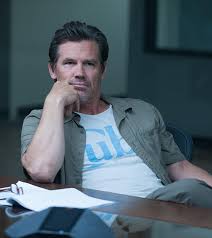
The key figure in this realization is the relaxed, almost cheerful CIA operative called Matt Graver played by Josh Brolin.

Graver is one of the film’s most fascinating characters because he openly blurs the lines between legality and strategy. He treats the war against the cartels not as a legal battle but as a geopolitical game in which certain rules simply no longer apply.

He jokes. He smiles. He reassures Kate that everything is under control. And yet the deeper the operation goes, the clearer it becomes that the “control” he represents has very little to do with justice.


Alejandro

If Matt Graver represents the pragmatic face of American power, Alejandro, played wonderfully by Benicio Del Toro, represents something older and more elemental. Alejandro is not a police officer or a soldier in any conventional sense. He is a weapon deployed inside the machinery of the state.

His presence reveals the film’s central truth: the war on drugs, as depicted here, is not really about drugs. It is about power, revenge, and the maintenance of geopolitical equilibrium through violence.

The final dinner-table scene—quiet, controlled, almost polite—delivers one of the most chilling moments in modern cinema.

Alejandro does not rage. He simply completes the task.


A Film Without Illusions

The reason Sicario stands above most films of the 2010s is that it refuses to decorate its subject with comforting illusions.

American cinema has often struggled to portray U.S. foreign policy in Latin America with any degree of honesty. Films frequently soften the narrative with patriotic framing or moral reassurance. Sicario does the opposite.

In that sense it belongs to a small tradition of films willing to examine American power without the usual gloss. One earlier example is
Salvador.

Like SalvadorSicario presents U.S. involvement in the politics and violence of the region not as a heroic intervention but as a complicated and morally ambiguous system of influence.

The film does not sermonize about this reality. It simply shows it.


The Craft

What elevates the film from strong political thriller to masterpiece is its extraordinary craftsmanship. Director Denis Villeneuve constructs the story with remarkable restraint. Exposition is minimal. Dialogue is sparse. Much of the narrative unfolds through mood and implication rather than explanation.

Roger Deakins’ cinematography turns the borderlands into a stark visual landscape of highways, deserts, and shadowy tunnels.

And the score by Jóhann Jóhannsson provides the film’s subterranean heartbeat—deep, rumbling tones that feel less like music than like distant artillery beneath the earth.

Together these elements create an atmosphere that is almost hypnotic.


The Film of the Decade

Every decade produces films that entertain, and a smaller number that capture the psychological mood of their time. Sicario belongs to the second category.

The 2010s were a decade in which institutions increasingly appeared opaque, power operated through indirect mechanisms, and the line between legality and strategy often seemed disturbingly thin.

Sicario does not attempt to solve these problems. It simply looks at them without flinching.

And that honesty may be precisely why it stands as the greatest film of its decade.