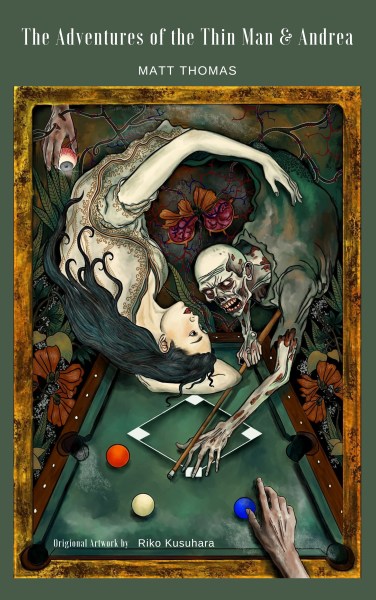
Well everyone, today is the day. My first novel, The Adventures of the Thin Man and Andrea is now available on Amazon and wherever books are sold.
This one took a while—written in fits and starts, in bars and hotel lobbies here in Kyoto—but it finally found its shape. More than anything, today I just want to thank all the readers of The Kyoto Kibbitzer, wherever you hail from; I’ve always thought of this as an ongoing conversation, and a lot of this book grew out of that exchange.
If you do pick it up, I hope you enjoy the ride—and if it lands for you, a quick review on Amazon would mean a great deal. Thank you, as always, for reading.
Note: This essay is a reflection on the ideas of Julian Jaynes and his remarkable 1976 book The Origin of Consciousness in the Breakdown of the Bicameral Mind. Jaynes’ theory—that human beings once experienced divine voices guiding their actions before the emergence of modern introspective consciousness—remains controversial and widely debated. The purpose of this essay is not to prove or disprove Jaynes’ neurological model but to explore the enduring power of the questions he raised.
In particular, I am interested in two aspects of Jaynes’ work that remain deeply suggestive: his interpretation of early literature such as the Iliad, where modern psychological interiority appears strangely absent, and his observations about how mobility—travelers, shepherds, merchants, and wanderers moving between cultures—may have destabilized older systems of divine authority. These figures, operating in uncertain cultural terrain, may have been among the first people forced into the improvisational reasoning that resembles modern consciousness.
The essay also touches on institutions like the Oracle of Delphi and on the persistence of voice phenomena in modern contexts, ranging from hypnagogic states and exhaustion to more troubling historical cases such as the assassination of Robert F. Kennedy by Sirhan Sirhan. These examples are not presented as proof of Jaynes’ theory but as reminders that the boundary between internal thought and perceived external command may be more complex than we sometimes assume.
Finally, the brief personal anecdote involving an MRI scan is included not as evidence but as illustration: a small modern echo of the ambiguous mental territory Jaynes explored. Moments in which voices seem to arise from somewhere between the inner and outer mind remain part of human experience.
Whether Jaynes was ultimately correct in his sweeping historical claims is still an open question. But his work continues to provoke a fascinating possibility: that consciousness itself has a history, and that the modern reflective self emerged gradually out of older forms of human experience.
If nothing else, Jaynes reminds us that the human mind is not a finished structure. It is something still unfolding—shaped by culture, language, movement, and time.
“She keeps coming closer saying I can feel it in my bones Schizophrenia is taking me home.” — Sonic Youth
There are certain books that never quite disappear. They do not settle comfortably into the academic canon, nor are they fully dismissed. They linger. They circulate quietly among curious readers, occasionally resurfacing in conversation decades after publication, as if waiting for another generation to discover them.
One such book is The Origin of Consciousness in the Breakdown of the Bicameral Mind.
Its author, Julian Jaynes, was a psychologist who spent much of his career outside the central institutions of modern neuroscience. When the book appeared in 1976 it created an immediate sensation. Reviewers alternately described it as brilliant, bizarre, visionary, or simply impossible. The theory it proposed was breathtaking in scope. Jaynes suggested that the subjective, introspective consciousness modern people take for granted—the inner sense of “I,” the reflective voice narrating our own thoughts—was not an ancient human constant. It had emerged, he argued, only a few thousand years ago.
According to Jaynes, the minds of early civilizations functioned differently. People did not experience themselves as the authors of their own decisions. Instead they heard the voices of gods.
Not metaphorically. Literally.
Commands issued in auditory form—voices that appeared to come from outside the self—guided action. These voices, Jaynes argued, were generated by one hemisphere of the brain and experienced by the other as divine instruction. He called this earlier mentality the bicameral mind.
The theory has never been accepted in its full neurological form. Archaeologists, classicists, and neuroscientists have raised serious objections. And yet the book continues to circulate, discussed by philosophers, psychologists, historians of religion, and the occasional curious reader who stumbles across it in a used bookstore or late-night internet search.
Why?
Part of the answer is simple: Jaynes was asking a question that remains deeply unsettling.
What if human consciousness has a history?
What if the inner voice we experience as our own—our private mental narrator—was not always there?
I first encountered Jaynes sometime around 2012 or 2013, during a period when I was reading deeply in the work of Carl Jung and writing a small series of reflections that I called Jungian Intimations. Like many readers drawn to Jung, I was interested in symbolism, archetypes, and the strange persistence of mythic imagery in the modern psyche. I briefly considered enrolling in an online course with the Jungian analyst Michael Conforti, though in the end I took a class from his wife, Nancy Qualls-Corbett, on Jung and visual art. Around that time I read the slim but remarkable volume Jung on Art, which argues that artistic creation often emerges when archetypal material pushes through the individual psyche into symbolic form.
Jaynes appeared in my reading not long afterward. At first glance he seemed to be asking a related but far more radical question. Jung had treated mythic figures as symbolic expressions of the psyche. Jaynes suggested that the gods of ancient literature might once have been experienced as genuine voices—psychological events interpreted as divine command.
Whether or not one ultimately accepts his neurological model, Jaynes assembled a body of evidence that continues to provoke thought. In particular, he pointed to a striking feature of early literature. Characters in ancient texts often act without the kind of introspective self-reflection modern readers expect. Decisions appear suddenly, attributed not to inner deliberation but to divine intervention.
Nowhere is this more visible than in the world of the Iliad. When Achilles restrains himself from killing Agamemnon, it is not because he pauses to analyze his emotions. Athena appears beside him and tells him what to do. The boundary between divine command and human action is porous.
Jaynes argued that such passages were not merely literary conventions but traces of an earlier mentality.
Yet perhaps the most fascinating part of his theory lies elsewhere—in the margins of ancient societies, among the people least anchored to a single cultural world.
The wanderers.
Ancient civilizations were more mobile than we sometimes imagine. Even in the Bronze Age there were shepherds drifting across borderlands, merchants following caravan routes between cities, sailors moving from port to port across the Mediterranean and Near East. These figures lived at the edges of cultural systems that otherwise depended on stability and hierarchy.
For Jaynes, such wanderers may have played an unexpected role in the transformation of the human mind.
The bicameral system, as he described it, functioned best within tightly structured societies. Authority flowed downward through clear hierarchies: gods to kings, kings to priests, priests to ordinary people. Ritual, language, and shared myth reinforced the system. The divine voices guiding behavior were embedded within a familiar cultural environment.
But travelers moved beyond those environments.
A shepherd leaving his village might cross into territory where different gods were worshipped. A merchant arriving in a foreign city encountered unfamiliar laws, languages, and customs. A sailor might spend months among people whose rituals and social expectations bore little resemblance to those of home.
In such situations the guiding voices of one’s own culture could become unreliable.
If a divine command urged action in a place where the surrounding society operated under entirely different assumptions, the voice might cease to function as a stable guide. The traveler found himself in a new psychological situation—cut loose from the authority structures that had previously organized experience.
This was not a comfortable position.
To survive, wanderers had to develop different skills. They had to negotiate, observe, and interpret. They had to learn foreign languages and read unfamiliar social signals. They had to improvise.
In other words, they had to think.
Jaynes speculated that these mobile figures—shepherds, traders, sailors—may have been among the first people forced into something like modern reflective consciousness. The birthplaces of that consciousness may not have been temples or palaces but the messy contact zones of ancient trade: caravan routes crossing deserts, harbor towns where languages mingled, frontier markets where strangers bargained with one another under uncertain rules.
If the bicameral system required cultural enclosure to function, then mobility threatened its stability.
And the ancient world was becoming increasingly mobile.
Even as this transformation unfolded, remnants of the earlier mentality persisted in institutional form.
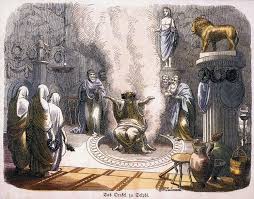
One of the most famous examples was the Oracle of Delphi. For centuries Greek leaders traveled to Delphi seeking divine guidance on matters of war, colonization, and political decision-making. The oracle’s pronouncements—often delivered in trance-like states by the Pythia—were treated as authoritative messages from the god Apollo.
From a Jaynesian perspective, institutions like Delphi may represent cultural technologies designed to preserve the authority of divine voices even as the underlying psychological system weakened. Kings and city-states continued to seek guidance from gods because the tradition of divine command remained embedded in social life.
Gradually, however, new forms of decision-making emerged.
Written law codes appeared. Philosophical reflection developed. Greek drama explored the tensions between divine authority and human responsibility. The shift was not sudden or uniform, but over time a new psychological landscape became visible—one in which individuals increasingly experienced themselves as authors of their own thoughts.
This transition was not simply intellectual. It may have been neurological, cultural, linguistic, and historical all at once.
Jaynes placed the decisive phase of the transformation during the turmoil of the late Bronze Age collapse, roughly between 1200 and 800 BCE—a period when many ancient societies experienced widespread disruption. Cities were destroyed, trade networks collapsed, and populations migrated. In the midst of this upheaval, older forms of authority may have faltered, forcing new modes of self-organization to emerge.
Whether or not Jaynes correctly identified the precise mechanism, he was surely right about one thing: consciousness as we experience it today may not be a timeless given.
It may be an achievement—fragile, historically contingent, and still evolving.
Yet if the bicameral mind truly vanished, one might expect the phenomenon of hearing commanding voices to disappear entirely from modern experience.
It has not.
Under certain conditions, people still report experiences remarkably similar to those Jaynes described. In states of extreme exhaustion, during moments of sensory deprivation, or in the liminal territory between waking and sleep, voices sometimes appear that are difficult to classify as either internal or external.
I had an experience of this kind several years ago while undergoing an MRI scan in a hospital.
Anyone who has had an MRI knows the strange psychological environment it creates. You lie alone inside a narrow tube, immobilized, while the machine produces a sequence of loud mechanical pulses and vibrations. The noise is rhythmic and relentless. There is little sensory input beyond the sound and the awareness of one’s own breathing.
Somewhere in the midst of that experience, a voice appeared.
It was not loud or dramatic. It was simply there—a calm male voice with the unmistakable tone of a father speaking to a child. The message itself was simple, almost reassuring. But what struck me most was the ambiguity of the experience. The voice did not feel exactly like a thought, yet it did not feel entirely external either. It occupied a strange borderland between inner and outer perception.
The moment passed quickly, but the memory lingered.
Experiences of this sort are not uncommon. Psychologists studying hypnagogic states—the transitional zone between waking and sleep—have documented similar phenomena. Auditory hallucinations appear in certain psychiatric conditions, most famously schizophrenia. Hypnotic suggestion can also produce experiences in which subjects perceive commands or messages that seem to originate outside their conscious control.
Jaynes believed such phenomena represented vestiges of the older bicameral mentality.
The voices of the gods, in his view, had not entirely vanished. They had simply retreated to the margins of modern consciousness.
Occasionally these phenomena intersect with darker episodes of modern history.
The assassination of Robert F. Kennedy by Sirhan Sirhan remains one of the most disturbing cases often discussed in connection with hypnosis and altered states of consciousness. Some researchers have argued that Sirhan may have been unusually susceptible to hypnotic suggestion, raising unsettling questions about the relationship between external influence and voluntary action.
It would be irresponsible to claim that Jaynes’ theory explains such events. Human behavior is far too complex for any single model to capture fully. Yet cases like Sirhan’s remind us that the boundary between autonomous decision and externally shaped impulse is not always as clear as modern assumptions suggest.
The mind remains a mysterious territory.
Half a century after its publication, The Origin of Consciousness in the Breakdown of the Bicameral Mind continues to provoke debate not because it solved the problem of consciousness but because it reframed it. Jaynes forced readers to confront the possibility that the human mind has undergone profound historical transformations.
Even if the details of his neurological model prove incorrect, the broader insight may endure. Literature, religion, and psychology all suggest that the experience of selfhood has changed over time. The ancient world did not necessarily perceive the mind in the same way we do.
Something was gained in the transition to modern consciousness.
We gained introspection, philosophical reflection, and the capacity to examine our own motives. We gained the intellectual freedom that made science, democracy, and modern literature possible.
But something may also have been lost.
In the world Jaynes described, human beings lived in a landscape animated by voices of divine authority. Decisions arrived not through anxious deliberation but through commands experienced as sacred guidance. That world may have been more constrained, but it may also have felt more certain.
Modern consciousness offers freedom, but it also brings doubt and solitude. The voices of the gods have largely fallen silent, replaced by the quieter and often less confident voice we call our own.
Perhaps the most we can say is that consciousness, like culture itself, continues to evolve. The wanderers of ancient caravan routes helped shape the first emergence of reflective thought. Today we inhabit a global world of constant movement, translation, and negotiation—a world not entirely unlike those early contact zones where cultures once collided.
We are all wanderers now.
And somewhere, perhaps, the faint echoes of older voices still remain.
Dedication:
For dreamers and wanderers everywhere.
Note: If you enjoyed this piece, you might also like the pieces below, which take up somewhat similar themes.
Note: This essay reflects on the film Sicario and its place within the cinema of the 2010s. It is written in the spirit of cultural criticism rather than formal film scholarship. My aim is not to produce a definitive ranking of the decade’s films, but to articulate why Sicario stands out as a particularly revealing work about power, violence, and the uneasy moral landscape of contemporary geopolitics.
The film’s depiction of the U.S.–Mexico borderlands and the covert war against drug cartels resonated strongly with me because it refuses many of the narrative comforts typical of American action cinema. Instead of heroic triumphs or clear moral resolutions, Sicario presents a world in which institutional power often operates through ambiguous methods and morally troubling compromises.
In that sense the film belongs to a small tradition of American cinema willing to look directly at the realities of U.S. involvement in Latin America. An earlier example is Salvador, which similarly attempted to depict American policy in the region without the usual patriotic framing.
Readers who disagree with the claim that Sicario is the greatest film of the 2010s are very much invited to do so. Film arguments are part of the pleasure of cinephile culture. The claim here is intentionally bold because bold claims tend to produce interesting conversations.
At the very least, the border extraction sequence alone earns Sicario a place among the most unforgettable cinematic moments of the past decade.
I first watched Sicario on Netflix.
Which is not the way great films are supposed to enter one’s life. Great films are meant to arrive in dark theaters, on enormous screens, in the company of strangers who feel the tension at the same moment you do. Netflix, by contrast, offers films casually, like items on a digital buffet.
But sometimes a movie survives even that.
Sicario does.
Within half an hour it becomes clear that the film is operating at a different frequency from most thrillers. The dialogue is spare. The pacing is deliberate. The camera lingers on landscapes and silences. Something about the atmosphere suggests that the story is heading somewhere morally uncomfortable.
Then comes the border crossing.
The Extraction
The convoy moves slowly toward the border crossing at Juárez. The mission seems straightforward: extract a prisoner from Mexico and return him to the United States. The vehicles move through traffic in tight formation. Nothing dramatic is happening yet.
And yet everything feels wrong. Cars begin to surround the convoy. Drivers stare from their windshields. Traffic slows to a crawl. The camera—guided by the extraordinary eye of Roger Deakins—cuts between glances, mirrors, steering wheels, hands resting near weapons. The tension builds with almost mathematical precision.
What makes the scene so powerful is not the violence itself but the certainty of its arrival. Everyone in the vehicles understands what is about to happen. The operators watch the surrounding cars with an eerie calm, as if they are simply waiting for a timer to run out.
Disaster is not possible. It is inevitable.
When the gunfire finally erupts it is sudden, efficient, and disturbingly professional. The scene ends almost as quickly as it began.
By the time the convoy crosses back into the United States, the viewer understands that the film is not interested in the usual heroics of the crime thriller. It is interested in something darker.
The Line Between Law and Power
Part of what makes Sicario extraordinary is the way it gradually dissolves the moral categories the audience expects.
Emily Blunt’s character, FBI agent Kate Macer, begins the film believing she is participating in a legitimate law enforcement operation. But as the mission unfolds, she begins to realize that the institutions she represents are operating according to rules that have very little to do with the law.
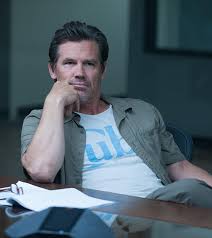
The key figure in this realization is the relaxed, almost cheerful CIA operative called Matt Graver played by Josh Brolin.
Graver is one of the film’s most fascinating characters because he openly blurs the lines between legality and strategy. He treats the war against the cartels not as a legal battle but as a geopolitical game in which certain rules simply no longer apply.
He jokes. He smiles. He reassures Kate that everything is under control. And yet the deeper the operation goes, the clearer it becomes that the “control” he represents has very little to do with justice.
Alejandro
If Matt Graver represents the pragmatic face of American power, Alejandro, played wonderfully by Benicio Del Toro, represents something older and more elemental. Alejandro is not a police officer or a soldier in any conventional sense. He is a weapon deployed inside the machinery of the state.
His presence reveals the film’s central truth: the war on drugs, as depicted here, is not really about drugs. It is about power, revenge, and the maintenance of geopolitical equilibrium through violence.
The final dinner-table scene—quiet, controlled, almost polite—delivers one of the most chilling moments in modern cinema.
Alejandro does not rage. He simply completes the task.
A Film Without Illusions
The reason Sicario stands above most films of the 2010s is that it refuses to decorate its subject with comforting illusions.
American cinema has often struggled to portray U.S. foreign policy in Latin America with any degree of honesty. Films frequently soften the narrative with patriotic framing or moral reassurance. Sicario does the opposite.
In that sense it belongs to a small tradition of films willing to examine American power without the usual gloss. One earlier example is Salvador.
Like Salvador, Sicario presents U.S. involvement in the politics and violence of the region not as a heroic intervention but as a complicated and morally ambiguous system of influence.
The film does not sermonize about this reality. It simply shows it.
The Craft
What elevates the film from strong political thriller to masterpiece is its extraordinary craftsmanship. Director Denis Villeneuve constructs the story with remarkable restraint. Exposition is minimal. Dialogue is sparse. Much of the narrative unfolds through mood and implication rather than explanation.
Roger Deakins’ cinematography turns the borderlands into a stark visual landscape of highways, deserts, and shadowy tunnels.
And the score by Jóhann Jóhannsson provides the film’s subterranean heartbeat—deep, rumbling tones that feel less like music than like distant artillery beneath the earth.
Together these elements create an atmosphere that is almost hypnotic.
The Film of the Decade
Every decade produces films that entertain, and a smaller number that capture the psychological mood of their time. Sicario belongs to the second category.
The 2010s were a decade in which institutions increasingly appeared opaque, power operated through indirect mechanisms, and the line between legality and strategy often seemed disturbingly thin.
Sicario does not attempt to solve these problems. It simply looks at them without flinching.
And that honesty may be precisely why it stands as the greatest film of its decade.
I will lay laid open… I do it ’cause I’m a family man… With the beat in now… And your chest came out ’Cause you weren’t too scared.
Big Red Machine — “Deep Green / Deep Dream”
There is transference. There just is.
Matthew Thomas
I. — The Pull That Isn’t Personal
It’s real because it’s grounded. It’s real because the adult self is the one in the room.
That sentence might sound simple, but it marks a fault line between two entirely different ways of collaborating. The younger version of me would have blurred this difference almost immediately — not out of desire in any straightforward sense, but out of hunger. Out of the impulse to turn recognition into destiny, resonance into narrative inevitability, voltage into myth.
In earlier years, artistic encounters carried an undertow of idealization. When someone appeared whose sensibility aligned, whose aesthetic instincts felt familiar yet surprising, whose presence produced that unmistakable flicker of creative electricity, the experience was difficult to contain inside ordinary frames. Recognition felt like revelation. Shared language felt like intimacy. Creative energy felt like evidence of something larger than collaboration — something fated, symbolic, charged with meaning beyond the work itself.
But time has taught me that this interpretive inflation is not depth. It is transference — not as pathology, but as architecture. A current running through collaboration that invites projection, narrative layering, and emotional over-interpretation. A dynamic that can produce beautiful work, but also confusion, distortion, and boundary collapse when left unexamined.
What has changed is not the presence of that current but my relationship to it.
The boundary is no longer defensive; it is intelligent. It is not erected to keep the other person out but to keep the work alive. It is the condition that allows collaboration to breathe without suffocating inside symbolic noise.
And the boundary itself is deceptively simple:
We stand side by side, not on top of each other’s meaning.
We remain in our own psyches. We allow resonance without fusion. We allow voltage without blur. We allow openness without myth-making.
This distinction may appear subtle, but it carries enormous implications. It is the difference between collaboration as encounter and collaboration as reenactment. The difference between creative exchange and symbolic entanglement. The difference between working together and unconsciously attempting to resolve unfinished narratives through one another.
In this sense, transference is neither villain nor obstacle. It is part of the terrain — inevitable wherever humans meet in creative space. The danger lies not in its presence but in its invisibility.
History offers cautionary examples. Jung’s relationship with Sabina Spielrein, initially framed as therapeutic, evolved into a complex emotional and intellectual entanglement in which transference blurred professional boundaries and personal identities. Toni Wolff later entered Jung’s life as collaborator and intellectual partner, yet the triangular dynamic that formed illustrates how symbolic roles can quickly overtake relational clarity. None of these figures lacked insight or integrity; what they lacked was a boundary capable of containing the symbolic intensity generated by their shared work.
That boundary — the one Jung struggled to hold, the one Sabina never had the power to define, the one Toni inhabited with both strength and vulnerability — is precisely the boundary that matters in artistic collaboration. Not a line of separation but a line of differentiation, one that preserves psychological sovereignty while allowing creative permeability.
The collaboration that underlies this piece has tested that boundary in productive ways. The work carries voltage. The exchange of ideas, images, and aesthetic intuition generates moments of recognition that could easily be misinterpreted as evidence of deeper narrative convergence. The temptation toward symbolic overreach is real, as it always is when creative chemistry emerges unexpectedly.
But the boundary holds.
Not through suppression or distance, but through integration. Through the adult self’s capacity to remain present without narrativizing the encounter into something it is not. Through a commitment to form — not as rigidity, but as container. Through an understanding that artistic collaboration thrives when the symbolic field remains clear enough for the work to speak in its own voice.
Openness with form. Exposure with spine. Laid open, but not laid bare.
This is not restraint for its own sake. It is creative hygiene. It is the discipline that keeps collaboration from dissolving into projection, keeps admiration from mutating into idealization, keeps creative voltage from being mistaken for emotional destiny.
The boundary is not what limits the collaboration; it is what makes it possible.
And in that sense, the boundary is not a line between collaborators at all. It is a line that keeps the field clear so the work can keep happening.
This is how adults collaborate: with clarity, with shape, with mutual sovereignty intact, with symbolic noise turned down, with the quiet confidence that resonance need not imply fusion. The trio remains intact — internal voices aligned rather than fragmented — allowing openness without collapse and connection without reenactment.
Music has offered a parallel language for this dynamic. The Big Red Machine ethos — stepping forward without fear while remaining rooted in personal identity — models a form of creative openness that resists mythic inflation. The lines echo not as romantic declaration but as psychological instruction:
I will lay laid open… I do it ’cause I’m a family man… And your chest came out ’cause you weren’t too scared…
Openness is not the danger. Losing oneself inside openness is.
This brings the piece to its quieter question, one that underlies all collaboration, all transference, all creative exchange:
Can I remain open without giving myself away? Can I step into voltage without mistaking it for destiny? Can I meet clarity without dissolving into it? Can I collaborate without collapsing? Can I inhabit a resonant field and still leave it as myself?
The answer, tentatively but firmly, is yes.
Not because discipline has replaced feeling, not because detachment has replaced intimacy, not because protection has replaced vulnerability, but because integration has replaced fragmentation. Because the internal architecture is stable enough to allow openness without fear. Because the dream that once blurred boundaries now functions as threshold rather than invitation. Because the symbolic layer — what I sometimes describe as the Draco grounding — operates not as mystical escape but as orientation, a reminder that identity persists across shifting relational fields.
Transference remains part of the architecture. It always will. A subtle undercurrent running beneath creative interaction, capable of enriching perception when acknowledged and distorting reality when ignored. The adult task is not to eliminate it but to refuse its authority as narrative director.
The adult self leads. The trio leads. The work leads.
And so the closing question emerges, less dramatic than the fears that once accompanied it, but more meaningful:
What does it mean to stay laid open and still stay mine?
That is the adult version of transference — not avoidance, not collapse, but clarity held with a steady hand.
Dedication
For the collaborators: the drifters, the drop-ins, the ones who catch the tune mid-air and don’t flinch.
You keep the corners loose and the truth a little crooked. My kind of people.
Note: If you like this piece, you may also like “Elodie and Matt: A Modern Fairy Tale.” You can read it below.
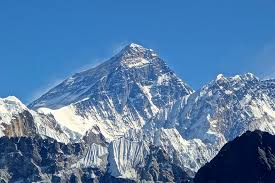
The night of December 31, 2012: Long dream about climbing Mt. Everest. This third Everest dream was very different from the first two. First, I was at a school and then climbed up a small opening, kind of a snowy slit barely big enough to fit through. There were some basketball games going on and I planned to be back in 20 minutes or so. Therefore, the school was probably my high school. At first, the slit was just itself, but then Everest loomed up over me to my left. I entered the frame, from the left. Everest was enormous, black, and composed of huge blocks of ice-like mini-mountains such that it was difficult to discern where the actual peak was, or the possible way up.
I was all alone and it seemed to be dawn, then two figures sleeping on the ice in orange suits started to stir. They arose and then there were 20-30 more, mostly kids led my two overweight men. We all spilled down to a kind of small clearing that may also have been a breakfast space. The men explained that they could take the group only to 11’000 feet, no higher. There was some disappointment, not much. Everyone looked very well outfitted, except the speaker who was plump and wearing a kind of jersey.
This group went away and there were other climbers, one or two of whom I spoke to. It all started to take a rather long time and I knew I would be late getting back. I started to head back up to the ridge that would lead back to the slit, but realized that I had forgotten a shoe in the clearing. Eventually I got back to the ridge with the shoe, looked up, and saw what was probably Everest’s peak. It was rounded and covered in black ice. It looked very far away, although at one point in the dream, perhaps before, I had analyzed what looked like a viable path toward the top. Back at the snowy slit, I ran back down it at full speed, cheerfully.
First Interpretations: The Everest dream is the third in a series. The first Everest dream I climbed Everest overnight. It took about 12 hours. Everest was covered in asphalt and climbing it was a breeze. The second one I was with my son. We did not get to the top, and the mountain was somewhat more realistic, craggly with ravines. There were shops alongside the ravine we were climbing made of wood and we ate there and also climbed around through the shops that were all connected and made up a kind of maze.
There was no pressure to get to the top, lots of climbers on the mountain. In this most recent one, Everest was at its most interesting and symbolic. It was massive and loomed above me with presence. It was to be revered, feared, awed. The access is interesting as well–the slit almost like a birth canal, covered back over itself and very narrow. Then, it opened unto another world entirely.
Impressions: The birth canal to a spiritual world. Most people, even well equipped, cannot go above 11’000 feet (you can do this in a day hike). Also, 11 could signal the 11th house, with the 12 house of mystery being difficult to access. I could make out the top, but didn’t have the time and wasn’t equipped just now. Still, it was an honor to have been there, and I came back exhilarated.
Note: If you enjoyed this piece, you may also enjoy “Border Dream.” Available below.
“All we need is just a little patience.” — Guns N’ Roses
I. Leaving Anyway
The wedding was in June, which was just a little inconvenient for me. School was still in session, and I had to miss work to go. I remember wishing that it had been in August. But once I decided I was going, the resistance fell away. I locked it in, and then I was genuinely excited—mostly to see my family.
I hadn’t seen my mom, Mike, or Pat since January 2018, before COVID. I hadn’t seen my dad since October of that year. That mattered more to me than the logistics or the calendar. So my wife Sachie and I flew from Japan to Seattle, and my son Hugh flew in separately from New Zealand, via Auckland and Los Angeles.
We landed at Sea-Tac and cleared international arrivals quickly. We had a few hours before my parents arrived to pick us up. They had rented a van, partly because it was a three-day event and partly because they were making breakfast on the last morning, which required supplies. While we waited, Sachie and I sat in the only open area we could find outside arrivals. We both needed a cigarette, so we took turns—one of us watching the bags while the other smoked. We bought two Starbuckscoffees, which cost sixteen dollars. I ordered an extra shot in each, not realizing the Americanos already contained doubles.
While we were there, a man nearby was clearly overdosing—probably fentanyl, maybe heroin. He was nodding, drooling. The police came first, then EMTs. They all knew him by name. Sylvester. After about an hour, they took him away on a stretcher. No one around reacted much. It felt routine. I was just sad, thinking about how much damage fentanyl has done in the U.S.
I texted my mom. They were running late. Hugh arrived through domestic customs and joined us. When my parents finally came, they looked good—just older, of course. We hugged and walked back through the airport to the van. My dad had forgotten where he’d parked it, so that took a while too.
Once we got moving, things settled. Sachie, Hugh, and I loaded into the van and drove north to Anacortes, about two and a half hours. It was mid-afternoon. Hugh slept most of the way. Conversation came easily. It felt natural, like time hadn’t broken anything, just stretched it.
We had an early dinner at a restaurant on the water in Anacortes. Pat and Sarah drove up from Portland with their three girls and joined us. John Innes and Kristi had been invited but were tired from the drive and didn’t come. I had raw oysters, another seafood dish, and a margarita. My dad ordered one beer and then told the server, “Please bring another one in exactly twelve minutes.” He always does this. He usually has two beers this way; that day he had a third later. I find the whole thing very funny.
I ordered a second drink—a Negroni, which wasn’t on the menu. The waitress said she thought the bartender could figure it out. It arrived with no ice. I considered sending it back but she was busy, so I let it go.
It was sunny. I sat in the sun so Sachie could have the shade. After dinner, Pat, Hugh, the two older girls, and I walked down over some stones to the water for a while. Then we went to a supermarket for beer, wine, and light provisions. I wasn’t sure how I’d sleep—I don’t always sleep well when traveling—so I bought a bottle of wine just in case.
We drove to the lodge where we were staying. It was really nice. Sachie, Hugh, and I had our own apartment. I took a walk behind the lodge to sneak a cigarette. Sachie probably found somewhere to smoke too, but I’m not sure.
Later that evening, we went down to Pat’s room for beers. The girls played on the lawn outside, and Pat chased them around until they were breathless and laughing. Watching him with them, I was struck again by what a great dad he is. I drank wine instead of beer—I was still dealing with a lingering COVIDhangover and a newer gluten intolerance—and eventually drifted off and fell asleep on the couch.
That was the first night.
II. Crossing Over
In the morning, I woke first. No one else was up yet. Eventually my mom got up too, and we drove back to the supermarket for coffee. She bought me a pair of sunglasses—nothing fancy, just functional—and it was good to have time with her, talking at length. The coffee place sold Turkish coffee and tried to upsell me on baklava, which I regretted again not being able to eat because of gluten.
We all had breakfast later. It was underwhelming. I had yogurt. Around eleven, we drove out to the ferry terminal and got into a long line of cars. Sarah handed me one of those popular sparkling drinks in the U.S.—sweet, artificial—and I couldn’t finish it. The wrong kind of sweet.
On the ferry, I fell asleep. People were working on puzzles at tables. My parents stood outside because my mom has vertigo and gets dizzy. When we arrived at Friday Harbor, we went straight to the supermarket. There was no food at the camp except the rehearsal dinner and the wedding dinner, so I stocked up: hummus, corn chips—my mom handed me a huge bag of them—cheese, olives. I also had some soup at the market, which was excellent. I tried to get as much as I could because I knew options would be limited. I also bought wine.
The drive to the camp was supposed to be ten minutes, but the sign was tiny and we missed it. We overshot the turn and had to double back using Google Maps. We arrived mid-afternoon.
The camp was down a dirt road off the highway and much larger than I expected. There was a main lodge, a big lawn, a collection of cabins in different shapes and sizes, a barn where the wedding would be held, and a garden set up for the rehearsal dinner. We used metal push carts to haul our things from the parking lot to the cabins.
My parents were staying in the main lodge. Our cabin was about 150 meters away, next to Pat’s family. It was clean but very small: a tiny kitchen, a bedroom, a cramped closet you could barely move around in, a loft for Hugh, and a bathroom awkwardly placed between the kitchen and the bedroom. Kelly, his wife Courtney, and their kids Jacob and Ang were in another cabin. John and Kristi were nearby as well. Mason was staying in some kind of shared space. Between our cabin and Pat’s was a fire pit, and Sarah had already hung laundry over the chairs.
Smoking was allowed, but only at a few designated ashtrays—those tall black plastic ones on poles. The signs said that if you littered, the fine was one thousand dollars per cigarette butt.
I was a little concerned about whether the food I’d bought would last. I ate chips and hummus. Sachie went into the woods to smoke and put her cigarette butts on top of our garbage can. I told her about the rule and asked her to use the ashtray instead. She did.
Later, we gathered at the lodge. I brought wine. One of the camp staff asked if we wanted to hear the house rules. Mike said, “Lay them on us.” The rule was one open drink at a time in the lodge. It closed at ten, but we could use the nearby fire pits and deck afterward. I put my bottle of wine out of sight. Mike responded to the rule with a polite “Uh-huh, sure,” and I got the impression he had no intention of following it.
My dad, Hugh, and I drove back into town to pick up pizza for dinner. I ordered a cauliflower-crust pizza because of my gluten intolerance. We ordered too much—one pizza each plus one for my mom and Sachie—but that was fine. We ate, talked, and I drank wine. Mike, Colleen, and Felix were there. Colleen took Felix to bed. Later, Sachie asked me to go back to the cabin to get a bottle of white wine. I did, and we drank it. The rule wasn’t enforced. It was a relaxed evening.
That was also when I saw Eric Hillyard for the first time.
III. The FIRST NIGHT AND NEXT MORNING
Eric Hillyard is a character and a half. He’s one of Mike’s good friends from high school at Saint George’s, and one of only two people from that era who were there. The other was Dan Clarke—known as Jerry—who was officiating the wedding. Eric didn’t have a formal role. He didn’t need one.
I gave Eric a big hug when I saw him. I hadn’t seen him since high school. He razzes Mike like nobody else, but he was polite and warm with me and bowed to Sachie. He was drinking quite a bit. After ten, my parents went to bed, and Eric, Mike, and I gathered around the fire pit between the cabins.
Eric smoked a cigarette. I smoked two. We tossed them into the fire pit. Later, back at the cabin, it occurred to me that the cigarettes probably wouldn’t burn up completely. I was pretty cooked, but I walked back in the dark with my phone light, dug around in the ashes, found all three cigarette butts, and put them in the ashtray. I figured I’d just saved Mike and Colleen three thousand dollars.
Eric had told a joke that landed too close to home with Mike. Mike said it went too far. I got the impression this wasn’t the first time. It didn’t blow up, but it didn’t land well either.
I went to bed. Sachie and Hugh were already asleep. I slept fine.
The next morning I woke up first again. I ate more hummus and corn chips and went down to the lodge for coffee to see who was around. Free coffee was available. It was rehearsal day.
I don’t remember much of the day before the rehearsal itself. Earlier, when Hugh and I had gone into town on the pizza run, we’d stopped at a hardware store and bought a frisbee. Hugh played with the little kids—Colleen’s brother’s kids and others—on the lawn. I mostly hung around. Food was running low, and I was looking forward to dinner, which was scheduled for around five.
Before dinner there were family pictures, but before that something happened that I didn’t witness directly. Mike told me about it afterward.
They had hired a photographer, a makeup artist, and a band. All freelancers. The food was provided by the camp staff. Colleen was getting her makeup done and had asked for it to be light. Apparently it wasn’t. Mike saw it and said, “Babe, she pancaked you.” Colleen initially wanted to let it go, but they talked and then fired the makeup artist on the spot. Mike told me about it calmly and said that decision was kind of on him.
I didn’t judge it. What I found myself wondering was how much of her fee she got paid. I didn’t ask. I assumed she was paid for the day. The photographer had traveled a long way. I didn’t know whether the makeup artist was local. I hoped she was.
That evening, people gathered in the garden. Both sides of my family were there, along with Eric, Jerry, Mason, Kelly, John Innes, and others, as well as Colleen’s friends and family. The mood was good. But John was in bad shape.
By his own admission, John was pretty depressed. Both his parents had died, and something unresolved involving his father had happened before his death. He hadn’t been able to say goodbye properly. He’d had to have a few just to get ready to come to dinner and face people.
John and Kristi left early and Mason and I walked to the parking lot for a cigarette. There were ashtrays there, and I didn’t want to risk a fine. Colleen’s friends were smoking weed cigarettes back in the garden. Mason told me about a recent breakup that had been serious. He said he’d been immature for a long time and that the relationship and life had forced him to grow up. From his demeanor, it was clear that was true.
That night I also saw my Uncle Jeff’s third wife for the first time—she is from Mexico. Hugh talked with Jeff about his soccer influencer work. Jeff was impressed and invited Hugh to stay at his place in California anytime, for any length of time. Hugh was flattered and grateful.
Things wrapped up early. There was no repeat of the fire pit scene from the night before. I talked a lot with Amy, but mostly I was with Mason. Then we went back to the cabin and went to bed.
IV. DAN CLARKE/ BILL CLARKE DREAM
Wedding day morning felt like more of the same. I was low on cigarettes. I ate more corn chips and hummus from the seemingly endless bag and got coffee in the lodge and waited. Jerry was around. We talked. He’s had an interesting life—some wildness there—and I could see why Mike likes him so much.
Dan Clarke’s father is Bill Clarke, brother of Janet Mann and brother-in-law of Paul Mann. All Saint George’s power brokers. My dad and Bill Clarke were friendly once, but it went sideways. After that, my dad would complain about him endlessly in the car to my mom. Typical Ross behavior at the time, although I never understood the core issue
At some point that morning I thought about a dream I had years earlier, one that has stuck with me. I’m including it here as I wrote it at the time.
2/27/18:
Two intersecting and yet separate dreams about Bill Clark. These will take some unpacking.
I. I am with my father and someone else in a car on a rainy day. We are parked and Bill Clark is there. He looks like the real Bill Clark as I remember him, overweight and not too smooth. Bill Clark was an intermittent arch-enemy and then sometimes ally of my father at Saint George’s in the 90s. The encounter in the car is the culmination of several encounters with Bill in the dream and some of these have been just he and I. Bill is telling me through these encounters how much he admires our IB program and what I am doing with it. He stresses how important it is that I keep going. At the car, he does this again and looks a little desperate. Because he is so clearly sincere even my father who was his enemy gives him the space to say his piece. For my part, I am grateful for his kind words however the car kind of needs to get moving. I thank him from the window. I think he is about to get wet from the rain.
II. I am meeting with Bill Clark again, however a very different looking Bill Clark. Here he is trim with a wire grey beard cut short and a nice suit. He looks very distinguished and a little intimidating. This Bill Clark is also supportive however is much more firm with me. He tells me that I need to get on my hands and knees and beg and plead for resources. Somehow I get the image of a turtle on its back, open to the sky. This is the posture I need to adopt according to Bill. Nothing can be taken for granted and I have to beg. He is quite clear and I understand the wisdom in what he says.
Comment: This is a super interesting dream that bears unpacking. The two Bill Clarks are polar opposites and the second one is more regal and correct in every way. Why the former enemy of my father? This dream is so packed with symbolism.
Not long after that, it was time to shift gears and get ready for the ceremony.
V. The Ceremony
Before the ceremony began, I practiced rope-tying with Colleen’s brother and Pat. I hadn’t mentioned it earlier, but I had been enlisted to help tie Mike and Colleen’s hands together at the end of the ceremony. I was nervous. I had to go first, and as with the e. e. cummings poem years earlier at Mike’s first weeding, I had limited information. Mike told me it would be fine. Colleen’s brother Kevin and I made a joke of it together. Don’t fuck the whole wedding, bro. We got on well.
The rope was thin. There were several strands, intertwined.
Around four, people gathered again at the lodge. Only certain people had drinks. The rehearsal had gone smoothly. We had a clear walk-out order. My family walked out right after Mike and Colleen so I could be in the front row and step forward when it was my turn.
Everyone took their places. Jerry gave a classic, funny speech about being unprepared. Mike’s vows were sincere. Colleen received a huge round of applause when she walked out.
The ceremony was short. The moment came quickly. I stepped forward and did the tying. The ropes were longer than I expected and hung down toward the ground. I stumbled and nearly tripped over them, but I didn’t fall. Thank God.
The ceremony ended, and we moved directly into the barn for dinner.
VI. The WEDDING DINNER
Dinner started with oysters and a watermelon margarita, which I passed on. I drank red wine and hit it pretty hard. Dinner proper was pasta with sauce made by Colleen’s dad. I couldn’t eat it. I was hungry and ate oysters until there were literally none left. I got the last ones.
I spent some time standing outside with Kelly and his kids, Jacob and Ang. We talked. Inside, I sat with family. Hugh had the pasta and then went over to Colleen’s father to thank him for the sauce, which was a classy move.
After dinner, Kelly, Mason, Sachie, and I went out back for a cigarette. I was out and bummed one from Sachie, and it was the first time I’d ever seen Kelly smoke. I got to know Jacob, who was almost done with high school, and Ang, who was a couple of years younger.
I was wiped and left early. Sachie and Hugh came back later. Colleen’s dad gave a speech. My dad didn’t. Katie—my cousin through Amy—gave a great speech. Katie has Down syndrome, and everyone applauded.
That was the night.
VII. Dispersal
The next morning my parents were making breakfast, and the relatives who had stayed in town came back for it. My mom was prepping food. Amy brought gluten-free bagels. I had half a bagel, some fruit, and coffee and talked with people as they moved in and out. Breakfast was a performance, and it justified the van rental entirely.
We packed up and said goodbye to Mike, Colleen, and Felix. They were heading to a nearby island for a short honeymoon. From there, we drove first to the rental house where Pam and Steve were staying. I did laundry while everyone else went whale watching. I was keyed up about it—laundry had accumulated, and I don’t like traveling with dirty clothes. The door was left open, so I walked to the market for more soup and found my way back.
That evening we went back to the same pizza place. I had another cauliflower-crust pizza, a gluten-free beer that was just okay, and a glass of wine. I sat with Amy, her husband David, Sachie, Hugh, and Katie. I paid attention to Katie—she’s been developing early-onset dementia and I wanted to see how she was doing. My mom paid for dinner, which I appreciated.
We stayed at a hotel five minutes away that my parents had pre-booked. It was a large suite. Sachie and I took one room, my parents took the other, and Hugh slept on a cot in the living room. Hugh, my dad, and I played shuffleboard downstairs. I won. It was very relaxed. I had what was left of a small bottle of vodka, drank some, and poured the rest out.
The next morning we went to the ferry terminal. We ran into Jeff’s family again. My parents talked with them while Sachie, Hugh, and I got coffee and bought chocolates as omiyage. On the ferry back, a young naturalist gave a talk about whales. I listened and didn’t fall asleep this time.
Once we reached Anacortes, we drove the wrong way for about half an hour before my dad realized it. We turned around and headed toward Sea-Tac, staying near the airport. I was starving. We said goodbye to my parents. I cried a little. My mom did too.
At three in the afternoon we went straight to a steakhouse. I had steak, fries, and a Negroni. Hugh and Sachie ate as well. We sat in the regular dining section, not the bar, because Hugh was still twenty. We slept early.
The next morning we took a bus to the airport. Hugh left earlier, and Sachie went with him while I tried to sleep. At the airport, Sachie wanted to buy a specific bottle of whisky as a gift. The plane was already boarding. She ran off and made it back just in time. I was anxious, but she made it.
We flew back to Japan. I went back to work the next day and thanked everyone for covering for me while I was gone.
Dedication
For my family, with love and gratitude.
Note: If you enjoyed this piece, you may also enjoy the pieces below which also take up the topic of weddings.
March 7th, 1990. Mitchell Grey waits at a make-shift roadblock on the Iranian side of the Iranian/ Azerbaijani border at Astara. The Azerbaijani populace has been on a 40 day general strike since a desperate and cornered Gorbachev ordered a crackdown on the citizens of Baku. Nerves on the border are stretched thin, to say the least. Grey takes his time, keeps his head down. He turned 30 in November, a mid-Sagittarius, born adventurer. Not that he’d had much choice. Of course, Grey is no more his name than it is yours, unless that is your name happens to be Grey.
Four or five people, all men, are processed and it is Grey’s turn. He turns over his passport for inspection. The customs officer looks it over, gingerly.
“What is your profession?” he asks, in perfectly inflected English.
“Engineer,” replies Grey.
He had settled on this option after much thought. Grey stands 5 foot 10, with clipped hair, three-day stubble, and work boots. He is operating on a $1500 advance paid three weeks ago in Milan by his handler whom he had met for 10 minutes. Precious little remains, and Grey is in no position, no mood to pretty himself up for the Astara crossing. He does not look like a businessman or financier, and is not about to take the risk of trying. Nor does he look like a writer, despite the capaciousness of that particular category. He looks like what he is, a hand for hire, a mercenary. Engineers are scientists, more or less, and he hoped that at least a patina of respect would be accorded his proffered status.
“Engineer of what? You are here to steal our oil, yes.”
Not a question. The border guard gives Grey a look somewhere between a sneer and a smirk. A game player, thought Grey, a patriot perhaps, but a game player first. This is usable information. Grey takes a low deep breath, forces himself to relax.
“A structural engineer. I specialize in basements and aqueducts,” he replies.
Grey hoped that the word “aqueduct” would escape the guard and that he would tire of the game soon. However the young man was not such an easy mark.
“Basements,” says the guard, with heavy sarcastic emphasis. He turns to the man to his right, an older man, long past fed up with the conversation. “You have business in our country about basements?”
It was time for Grey to fall back on the cover story. “I am not here on business. I am meeting an elderly couple in the countryside. They are passionate hunters, and we will be hunting your famous Caucasian snowcock. As well as of course quail and pheasant.”
“So you are on holiday,” askes the guard. “Holiday, now, after the brutal crackdown of the Russians, you are here to shoot birds on holiday.”
“That’s correct,” replies Grey.
He produces a letter of introduction to the couple, one Mr. and Mrs. Verlandier. There is indeed such a couple, extant, with a villa in the hills. They had received $500 through a cut-out of a cut-out of a friend of a friend. Essential plausibility, the first principal of trade craft. Now, a letter of introduction is just a piece of paper, as the border guard was well aware. Nonetheless, the scruffy looking traveler had produced paper, and paper suggests organization. And organization, well organization suggests friends. The Soviet Union was in tatters, matters were moving fast. Who knew who was with whom? The guard has no wish to inadvertently insert himself in a game any larger than hassling an apparent criminal drifter. Still, he can not resist making his feelings known to this Mr. Grey.
“That sounds like a very interesting pastime,” he says placidly. “I know a little bit about Caucasian cocks myself. In fact, I have a reputation of being able to spot them from hundreds of meters away. Just something people have said.”
Mr. Grey takes this in stride, nods, and thanks the man for his passport back. Eyes low and feet slow, he tells himself. Don’t fuck up; “go see the Verlandiers.” He crosses the border and takes his first steps on Azerbaijani soil. He has three hours before his appointment. Every minute matters.