
Levels of Lucidity in Dreams: A Close Reading

Illustrations presented with thanks by Riko Kusahara

Note: This piece was written for the Psiber Dreaming Conference offered by IASD in September 2018, under a strict word limit that forced a level of compression I don’t always allow myself. It draws on a series of lucid dreaming experiences to explore how we determine whether we are dreaming or awake, and why those determinations so often fail under pressure. Looking back, I’m less interested in the specific techniques of lucidity than in the broader question the paper circles: what happens when our usual markers of reality—stability, plausibility, even self-awareness—prove unreliable? The result is less a theory of dreaming than a compact record of trying to think clearly inside a system that continually revises its own ground.

Epigraph I:

The difference between most people and myself is that for me the “dividing walls” are transparent.  That is my peculiarity.

—Carl Jung

Epigraph II:

The conventional scientific sentiment has become that—while we don’t totally understand why dreaming happens—the dreams themselves are meaningless. They’re images and sounds we unconsciously collect, almost at random {…} Which seems like a potentially massive misjudgement.

—Chuck Klosterman

Dream I: I awake in a warehouse.  The bed is against one wall–on the other is a thirty-foot mountain of cantaloupes.  I realize I am dreaming.  I get up and run my hands over the cantaloupes.  They feel absolutely real—as tangible as in life.  I remember that tangibility is not a viable reality test—I’ve made that mistake before.  Now fully lucid, I decide to levitate.  The room dissolves, and I float suspended somewhere in dense, colourless space.  Eventually, I feel the need to come back to earth but cannot locate it.  I feel something beneath me.  This is my bed, and I awake back in the warehouse, relieved yet exhilarated.  The cantaloupes are still there, however I don’t question them.  I just happen to live in a room full of fruit.  Moments later I awake again, this time in diurnal “reality.”

The most common dream experience is of waking from a dream we take to be real, only to understand that it was “just a dream.”  However, a subset of dreamers, probably more than we generally imagine, have experienced lucid dreams, dreams in which, to some degree, they are aware they are dreaming.  Lucid dreamers may also experience “false awakenings”[1]— the sensation of waking progressively through dream “levels.”  False awakenings can be disorienting (Robert Waggoner writes that after seven successive false awakenings he “would accept {…} any reality {…} as long as it stayed put[2]), or sought after (Daniel Love and Keith Hearne have independently developed techniques to induce false awakenings[3]).  Regardless of the desirability of the experience, the existence of dream levels, far from a simple oddity, provides a potential window into massive metaphysical questions.   

First, we need to understand how dreamers use evidence to establish whether they are dreaming or awake.  

II: I am in a dreaming contest with another dreamer.  The contest begins and slimy amphibians begin to appear.  Some resemble frogs; others are in shapes that dont exist in nature.  Their size varies from that of a pinky to that of a fist and they are very colourful.  I am not trying to dream them, rather they are spilling everywhere around my feet.  I sense this is a dream and check on the other dreamer.  He is standing to my right in empty space.  He looks just like me and hasnt begun his dream. 

This dream is non-lucid at first and becomes lucid because of the bright color and absurd number of the amphibians.  An awareness beyond the dream senses a non-natural situation.  

III: I am picking out fruit at a fruit stand.  There are some huge avocados, almost too good looking.  I wonder if I am in a dream, and touch an avocado to check.  The one I choose is ripe and soft—I squeeze it a little.  There is no doubt that I am having a tactile experience, and I conclude I am not dreaming.  Of course, I am. 

Two dreams, two types of evidence.  In Dream II, I correctly identify the amphibians as anomalous, and become lucid.  In Dream III, my attempt to test the lifelikeness of the avocado as an indicator fails.  Simply put, realistic sensation is not sufficiently indicative of reality.  Love agrees: “we are not looking for a qualitative difference in how realistic the experience feels {…} we are {…} on the lookout for issues with stability and plausibility.”[4]  In Dream I, at first the huge pile of melons in my bedroom appears implausible and triggers lucidity; after moving up a dream level, my mind overrides the implausibility by “justifying”[5] the anomaly.  

Because we awake from sleep and dreams every morning, we are very familiar with the experience of awakening.  It is therefore unsurprising that when we wake inside a dream we accept the new reality as the waking world, even if it contains anomalous elements.  

IV: I am in a huge house where a large group of families on motorcycles arrive.  The families are making noise all night.  I realize I am dreaming and levitate over to the families.  Later I decide to wake up.  I ease myself out of bed, bumping my nose into an ironing board.  The room looks and feels exactly like my room.  I dont recall the ironing board being there, but whatever.  Moments later I awake again—the situation is identical, only, the ironing board is gone.  I feel a pit in my stomach, wondering what is ultimately real.

Dream IV is a good example of how dream levels can become increasingly realistic as we move through them.  An ironing board in front of the bed is (for me) more plausible than a house full of bikers.  Dreams such as this beg the question of how we can ever be sure we are awake.  I have dreamt of getting up, walking to the front door, opening it, and emerging into the sunshine in my neighbourhood.  At every point, this dream felt entirely realistic with no anomalies.  After experiences like this, is it wholly unrealistic that we could dream an entire morning?  An entire day?

There are different ways to approach this kind of question.  The first is to use rigorous reality tests.[6]  Using reality tests after each fresh awakening can help us filter anomalies in what may be an increasingly realistic dream state. The second is to open ourselves to a wider set of questions.  Although space limitations make full exploration of these questions impossible, modern dreamers would do well to recall that throughout recorded history people have speculated on the meaning of the dream state and what it can tell us about space, time, life after death, and the nature of reality. 

As dreamers, we know that dreamtime behaves very differently than waking time.  Robert Moss distinguishes between Chronos (“linear time”) and Kairos (the “spacious now.”)  He writes that when Kairos operates in waking life, “ordinary time is {…} suspended or elastic,” and that the world can “quiver or shimmer.”[7]  Moss’ Kairos time sounds a great deal like dreamtime.  Jung in his memoir writes “our concepts of space and time have only approximate validity,”[8]  and “there are indications that at least a part of the psyche is not subject to the laws of space and time.”[9]  Jung makes multiple connections between dreams and life after death, suggesting that our waking world,

in which we are “conscious,” may in fact be a projection of a more “real” and permanent, even timeless, unconscious.[10] 

In the Tibetan tradition of dream yoga, the yogi prepares for death through dreams and meditation, entering death consciously by releasing the bodily energy in such a way that the body partially or entirely dissolves into pure light.  This “rainbow body” is well-documented in Tibet and China, and cases of this phenomenon have been reported across multiple religious traditions.[11]  Finally, Moss connects dreams with the much discussed Many Worlds theory, as does, in popular culture, Richard Linklater. [12]

V:  I am among a large group of people on the top floor of a building.  We lie down on our backs and form bundles.  The molecular structure of these bundles begins to dissolve, we become lighter, then totally empty.  This process is dictated by a power outside of us which doesnt speak.  Once empty, we have the choice to become anything we want.  I choose to become white light.  Suddenly I am transported through space in a burst of pure white light, my old body left entirely behind.  This is the most peaceful and thrilling feeling in the world.  Then, I am back into a new bundle, trying again to become empty.  I make progress, but it is hard and I am over-concentrating.  Progress ceases; I wake up. 

Although I have thought at length about dreams, I am a normal person with a normal job, dreaming anonymously night after night.  I don’t belong to a spiritual tradition, am not a yogi or a meditating hermit.  As a lucid dreamer, like many of us, I am self-taught.  While we anonymous dreamers are wise to suspend judgement about the particularities of a theory as mind-boggling as dreams as an interface to infinite parallel universes, it is perhaps not by chance that my dreams of ascending to a state of pure white light bear close resemblance to innumerable near-death experiences or the reported manifestations of a lifetime of dream yoga.  Although admittedly outside of our normal rational mode of apprehension, the experience of journeying through multiple dream levels, and the energy and amazement which often accompany these experiences, may point the way toward worlds far above, below, or beyond our own.  

Who are we in our trek through life?  Are we the maker, or the made?  The writer, or the page?  The actor, or the stage?  The happening, or the happened to?  Perhaps, our ability to exercise agency in the vastness of forever depends in part on learning to navigate levels of “reality,” however we encounter them.  Or, perhaps, journeying to the far side of the dream can bring us face to face with that which is actually dreaming us.

Bibliography

Jung, Carl. Memories, Dreams, Reflections. Vintage Books, 1989.

Linklater, Richard, director. Slacker. Orion Classics, 1990.

Love, Daniel. Are you Dreaming? Enchanted Loom Publishing, 2013.

Moss, Robert. Sidewalk Oracles. New World Library, 2015.

Rinpoche, Gyalwai Nyugu.  “About Rainbow Body.” http://www.gyalwai-nyugu.com/about-rainbow-body/.  Accessed 24 July 2018.

Rinpoche, Tenzin Wangyal. The Tibetan Yogas of Dream and Sleep. Snow Lion Publications, 1998.

Thomas, Matthew.  “On Coming Through”: A New Meditation on Intention. https://craftfollowsconcept.com/2013/05/13/on-coming-through-statement-of-intent-on-the-approach-of-my-39th-birthday/#more-11. Accessed 24 July 2018.

Waggoner, Robert. Lucid Dreaming. Moment Point Press, 2009.


[1] Waggoner, 61

[2] ibid., 63

[3] Love, 131

[4] Love, 71

[5] Love cites “poor reasoning skills” as one common reason for failing to recognize dream signs and achieve lucidity.  Love, 73.

[6] Love, 78-79; Waggoner, 259.  (Wagonner uses the term “reality check” instead of “reality test.”)

[7] Moss, 49

[8] Jung, 300

[9] ibid., 304

[10] ibid., 324

[11] Tenzin Wangyal Rinpoche, 314; Gyalwai Nyugu Rinpoche

[12] Moss, 74-74; Linklater
On Julian Jaynes and the Origins of Consciousness: A Modern Look

Note: This essay is a reflection on the ideas of Julian Jaynes and his remarkable 1976 book The Origin of Consciousness in the Breakdown of the Bicameral Mind. Jaynes’ theory—that human beings once experienced divine voices guiding their actions before the emergence of modern introspective consciousness—remains controversial and widely debated. The purpose of this essay is not to prove or disprove Jaynes’ neurological model but to explore the enduring power of the questions he raised.

In particular, I am interested in two aspects of Jaynes’ work that remain deeply suggestive: his interpretation of early literature such as the Iliad, where modern psychological interiority appears strangely absent, and his observations about how mobility—travelers, shepherds, merchants, and wanderers moving between cultures—may have destabilized older systems of divine authority. These figures, operating in uncertain cultural terrain, may have been among the first people forced into the improvisational reasoning that resembles modern consciousness.

The essay also touches on institutions like the Oracle of Delphi and on the persistence of voice phenomena in modern contexts, ranging from hypnagogic states and exhaustion to more troubling historical cases such as the assassination of Robert F. Kennedy by Sirhan Sirhan. These examples are not presented as proof of Jaynes’ theory but as reminders that the boundary between internal thought and perceived external command may be more complex than we sometimes assume.

Finally, the brief personal anecdote involving an MRI scan is included not as evidence but as illustration: a small modern echo of the ambiguous mental territory Jaynes explored. Moments in which voices seem to arise from somewhere between the inner and outer mind remain part of human experience.

Whether Jaynes was ultimately correct in his sweeping historical claims is still an open question. But his work continues to provoke a fascinating possibility: that consciousness itself has a history, and that the modern reflective self emerged gradually out of older forms of human experience.

If nothing else, Jaynes reminds us that the human mind is not a finished structure. It is something still unfolding—shaped by culture, language, movement, and time.

“She keeps coming closer saying I can feel it in my bones
Schizophrenia is taking me home.”
— Sonic Youth


There are certain books that never quite disappear. They do not settle comfortably into the academic canon, nor are they fully dismissed. They linger. They circulate quietly among curious readers, occasionally resurfacing in conversation decades after publication, as if waiting for another generation to discover them.

One such book is The Origin of Consciousness in the Breakdown of the Bicameral Mind.

Its author, Julian Jaynes, was a psychologist who spent much of his career outside the central institutions of modern neuroscience. When the book appeared in 1976 it created an immediate sensation. Reviewers alternately described it as brilliant, bizarre, visionary, or simply impossible. The theory it proposed was breathtaking in scope. Jaynes suggested that the subjective, introspective consciousness modern people take for granted—the inner sense of “I,” the reflective voice narrating our own thoughts—was not an ancient human constant. It had emerged, he argued, only a few thousand years ago.

According to Jaynes, the minds of early civilizations functioned differently. People did not experience themselves as the authors of their own decisions. Instead they heard the voices of gods.

Not metaphorically. Literally.

Commands issued in auditory form—voices that appeared to come from outside the self—guided action. These voices, Jaynes argued, were generated by one hemisphere of the brain and experienced by the other as divine instruction. He called this earlier mentality the bicameral mind.

The theory has never been accepted in its full neurological form. Archaeologists, classicists, and neuroscientists have raised serious objections. And yet the book continues to circulate, discussed by philosophers, psychologists, historians of religion, and the occasional curious reader who stumbles across it in a used bookstore or late-night internet search.

Why?

Part of the answer is simple: Jaynes was asking a question that remains deeply unsettling.

What if human consciousness has a history?

What if the inner voice we experience as our own—our private mental narrator—was not always there?

I first encountered Jaynes sometime around 2012 or 2013, during a period when I was reading deeply in the work of Carl Jung and writing a small series of reflections that I called Jungian Intimations. Like many readers drawn to Jung, I was interested in symbolism, archetypes, and the strange persistence of mythic imagery in the modern psyche. I briefly considered enrolling in an online course with the Jungian analyst Michael Conforti, though in the end I took a class from his wife, Nancy Qualls-Corbett, on Jung and visual art. Around that time I read the slim but remarkable volume Jung on Art, which argues that artistic creation often emerges when archetypal material pushes through the individual psyche into symbolic form.

Jaynes appeared in my reading not long afterward. At first glance he seemed to be asking a related but far more radical question. Jung had treated mythic figures as symbolic expressions of the psyche. Jaynes suggested that the gods of ancient literature might once have been experienced as genuine voices—psychological events interpreted as divine command.

Whether or not one ultimately accepts his neurological model, Jaynes assembled a body of evidence that continues to provoke thought. In particular, he pointed to a striking feature of early literature. Characters in ancient texts often act without the kind of introspective self-reflection modern readers expect. Decisions appear suddenly, attributed not to inner deliberation but to divine intervention.

Nowhere is this more visible than in the world of the Iliad. When Achilles restrains himself from killing Agamemnon, it is not because he pauses to analyze his emotions. Athena appears beside him and tells him what to do. The boundary between divine command and human action is porous.

Jaynes argued that such passages were not merely literary conventions but traces of an earlier mentality.

Yet perhaps the most fascinating part of his theory lies elsewhere—in the margins of ancient societies, among the people least anchored to a single cultural world.

The wanderers.


Ancient civilizations were more mobile than we sometimes imagine. Even in the Bronze Age there were shepherds drifting across borderlands, merchants following caravan routes between cities, sailors moving from port to port across the Mediterranean and Near East. These figures lived at the edges of cultural systems that otherwise depended on stability and hierarchy.

For Jaynes, such wanderers may have played an unexpected role in the transformation of the human mind.

The bicameral system, as he described it, functioned best within tightly structured societies. Authority flowed downward through clear hierarchies: gods to kings, kings to priests, priests to ordinary people. Ritual, language, and shared myth reinforced the system. The divine voices guiding behavior were embedded within a familiar cultural environment.

But travelers moved beyond those environments.

A shepherd leaving his village might cross into territory where different gods were worshipped. A merchant arriving in a foreign city encountered unfamiliar laws, languages, and customs. A sailor might spend months among people whose rituals and social expectations bore little resemblance to those of home.

In such situations the guiding voices of one’s own culture could become unreliable.

If a divine command urged action in a place where the surrounding society operated under entirely different assumptions, the voice might cease to function as a stable guide. The traveler found himself in a new psychological situation—cut loose from the authority structures that had previously organized experience.

This was not a comfortable position.

To survive, wanderers had to develop different skills. They had to negotiate, observe, and interpret. They had to learn foreign languages and read unfamiliar social signals. They had to improvise.

In other words, they had to think.

Jaynes speculated that these mobile figures—shepherds, traders, sailors—may have been among the first people forced into something like modern reflective consciousness. The birthplaces of that consciousness may not have been temples or palaces but the messy contact zones of ancient trade: caravan routes crossing deserts, harbor towns where languages mingled, frontier markets where strangers bargained with one another under uncertain rules.

If the bicameral system required cultural enclosure to function, then mobility threatened its stability.

And the ancient world was becoming increasingly mobile.


Even as this transformation unfolded, remnants of the earlier mentality persisted in institutional form.

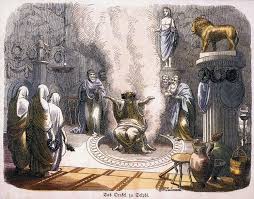
One of the most famous examples was the Oracle of Delphi. For centuries Greek leaders traveled to Delphi seeking divine guidance on matters of war, colonization, and political decision-making. The oracle’s pronouncements—often delivered in trance-like states by the Pythia—were treated as authoritative messages from the god Apollo.

From a Jaynesian perspective, institutions like Delphi may represent cultural technologies designed to preserve the authority of divine voices even as the underlying psychological system weakened. Kings and city-states continued to seek guidance from gods because the tradition of divine command remained embedded in social life.

Gradually, however, new forms of decision-making emerged.

Written law codes appeared. Philosophical reflection developed. Greek drama explored the tensions between divine authority and human responsibility. The shift was not sudden or uniform, but over time a new psychological landscape became visible—one in which individuals increasingly experienced themselves as authors of their own thoughts.

This transition was not simply intellectual. It may have been neurological, cultural, linguistic, and historical all at once.

Jaynes placed the decisive phase of the transformation during the turmoil of the late Bronze Age collapse, roughly between 1200 and 800 BCE—a period when many ancient societies experienced widespread disruption. Cities were destroyed, trade networks collapsed, and populations migrated. In the midst of this upheaval, older forms of authority may have faltered, forcing new modes of self-organization to emerge.

Whether or not Jaynes correctly identified the precise mechanism, he was surely right about one thing: consciousness as we experience it today may not be a timeless given.

It may be an achievement—fragile, historically contingent, and still evolving.


Yet if the bicameral mind truly vanished, one might expect the phenomenon of hearing commanding voices to disappear entirely from modern experience.

It has not.

Under certain conditions, people still report experiences remarkably similar to those Jaynes described. In states of extreme exhaustion, during moments of sensory deprivation, or in the liminal territory between waking and sleep, voices sometimes appear that are difficult to classify as either internal or external.

I had an experience of this kind several years ago while undergoing an MRI scan in a hospital.

Anyone who has had an MRI knows the strange psychological environment it creates. You lie alone inside a narrow tube, immobilized, while the machine produces a sequence of loud mechanical pulses and vibrations. The noise is rhythmic and relentless. There is little sensory input beyond the sound and the awareness of one’s own breathing.

Somewhere in the midst of that experience, a voice appeared.

It was not loud or dramatic. It was simply there—a calm male voice with the unmistakable tone of a father speaking to a child. The message itself was simple, almost reassuring. But what struck me most was the ambiguity of the experience. The voice did not feel exactly like a thought, yet it did not feel entirely external either. It occupied a strange borderland between inner and outer perception.

The moment passed quickly, but the memory lingered.

Experiences of this sort are not uncommon. Psychologists studying hypnagogic states—the transitional zone between waking and sleep—have documented similar phenomena. Auditory hallucinations appear in certain psychiatric conditions, most famously schizophrenia. Hypnotic suggestion can also produce experiences in which subjects perceive commands or messages that seem to originate outside their conscious control.

Jaynes believed such phenomena represented vestiges of the older bicameral mentality.

The voices of the gods, in his view, had not entirely vanished. They had simply retreated to the margins of modern consciousness.


Occasionally these phenomena intersect with darker episodes of modern history.

The assassination of Robert F. Kennedy by Sirhan Sirhan remains one of the most disturbing cases often discussed in connection with hypnosis and altered states of consciousness. Some researchers have argued that Sirhan may have been unusually susceptible to hypnotic suggestion, raising unsettling questions about the relationship between external influence and voluntary action.

It would be irresponsible to claim that Jaynes’ theory explains such events. Human behavior is far too complex for any single model to capture fully. Yet cases like Sirhan’s remind us that the boundary between autonomous decision and externally shaped impulse is not always as clear as modern assumptions suggest.

The mind remains a mysterious territory.


Half a century after its publication, The Origin of Consciousness in the Breakdown of the Bicameral Mind continues to provoke debate not because it solved the problem of consciousness but because it reframed it. Jaynes forced readers to confront the possibility that the human mind has undergone profound historical transformations.

Even if the details of his neurological model prove incorrect, the broader insight may endure. Literature, religion, and psychology all suggest that the experience of selfhood has changed over time. The ancient world did not necessarily perceive the mind in the same way we do.

Something was gained in the transition to modern consciousness.

We gained introspection, philosophical reflection, and the capacity to examine our own motives. We gained the intellectual freedom that made science, democracy, and modern literature possible.

But something may also have been lost.

In the world Jaynes described, human beings lived in a landscape animated by voices of divine authority. Decisions arrived not through anxious deliberation but through commands experienced as sacred guidance. That world may have been more constrained, but it may also have felt more certain.

Modern consciousness offers freedom, but it also brings doubt and solitude. The voices of the gods have largely fallen silent, replaced by the quieter and often less confident voice we call our own.

Perhaps the most we can say is that consciousness, like culture itself, continues to evolve. The wanderers of ancient caravan routes helped shape the first emergence of reflective thought. Today we inhabit a global world of constant movement, translation, and negotiation—a world not entirely unlike those early contact zones where cultures once collided.

We are all wanderers now.

And somewhere, perhaps, the faint echoes of older voices still remain.


Dedication:

For dreamers and wanderers everywhere.

Note: If you enjoyed this piece, you might also like the pieces below, which take up somewhat similar themes.

In Partial Defense of Reddit

Note: This essay is not intended as a blanket endorsement of Reddit. The platform has many well-documented flaws: trolling, pile-ons, misinformation, and a general tendency toward chaos. Much of its reputation as one of the rougher corners of the internet is entirely deserved.

The point here is narrower.

Despite its disorder, Reddit also preserves something that has become rarer elsewhere on the modern web: large, open conversations among people who possess small but real pockets of knowledge about highly specific subjects. When these fragments accumulate—through correction, argument, memory, and curiosity—they can occasionally produce surprisingly informative results.

The examples in this essay range from the internal royalty disputes of Jane’s Addiction to a map of alleged sightings compiled by the Bigfoot Field Researchers Organization. In both cases the same phenomenon appears: individuals contributing small pieces of cultural memory that gradually assemble into something resembling a collective understanding.

This is the limited claim of the essay. Reddit is frequently messy and unreliable, but it also functions as a peculiar kind of public knowledge commons—one where curiosity, enthusiasm, and the occasional obsessive hobbyist can still combine to produce insights that might otherwise remain scattered or forgotten.

Everyone knows that Reddit is terrible.

It is chaotic. It is full of profanity, bad jokes, half-informed opinions, and the occasional theory that appears to have been typed at three in the morning by someone who has not slept since the Clinton administration. Entire careers have been built explaining why Reddit represents the worst tendencies of the modern internet.

And yet.

The other day I was reading a thread about the latest implosion of Jane’s Addiction, the once-great Los Angeles group whose internal tensions have been simmering since roughly the Reagan administration. The immediate subject was the collapse of a reunion tour following an onstage altercation involving frontman Perry Farrell. The comments were exactly what one would expect from Reddit: profanity, gallows humor, and several variations of “this band has been breaking up since 1991.”

But as the thread continued something interesting happened.

Between the jokes and one-line reactions, the users began reconstructing the band’s internal history. Someone noted that Jane’s had already declared itself finished several times across the decades. Someone else pointed out that the early sound of the band had been shaped heavily by bassist Eric Avery. Another commenter raised the eternal rock-band problem: royalties.

And this, as it turns out, is where the story becomes interesting.

Money has a way of dissolving even the most inspired musical partnerships. Bands begin as small utopian experiments—four or five people creating something new together—and then the checks begin to arrive. Once that happens, questions emerge that are almost impossible to resolve cleanly. Who wrote the song? Who contributed the riff? Who deserves the lion’s share of the publishing?

Rock history is essentially a graveyard of groups destroyed by arguments over fractions of ownership.

In the thread I was reading, one user mentioned a detail I had not known: a claim that Avery at one point wore or promoted merchandise suggesting a 51 percent stake in the band’s identity. Whether literally true or not, the anecdote captured something fundamental about how these disputes unfold. Creative partnerships may begin democratically, but the distribution of credit rarely stays that way.

The remarkable part was that I had learned all of this not from a music journalist or a band biography, but from a chaotic conversation among strangers.

Which brings me to the modest defense of Reddit.

The platform’s reputation is built on its worst features: trolling, argument, and endless bad takes. All of those things exist, of course. But what critics often miss is that Reddit also contains something else: an enormous micro-density of cultural knowledge.

The process is messy. Someone posts a half-remembered fact. Someone else corrects it. Another person adds a detail from an interview they once read fifteen years ago. Gradually, through the collision of dozens of small contributions, something resembling a coherent picture emerges.

It is not elegant. It is rarely authoritative in the traditional sense. But it is often surprisingly informative.

What Reddit does, at its best, is something the modern media ecosystem sometimes struggles to replicate: it gathers together thousands of people who care obsessively about very specific things. Musicians. Gearheads. Amateur historians. Programmers. Aviation nerds. Movie buffs. Backyard astronomers.

And when those people start talking, knowledge begins to accumulate.

The phenomenon becomes even clearer when the subject matter becomes absurd.

Consider a thread from the cryptozoology corner of Reddit devoted to a map of Bigfoot sightings. At first glance the discussion appears to be pure nonsense. The premise itself—tracking sightings of a large unidentified forest creature—is hardly the sort of topic one expects to produce serious information.

And yet the map itself is strangely compelling.

People immediately begin checking their regions. Someone from Maine wonders why Bigfoot seems to avoid the state despite its endless forests. Another user proposes that two “alpha Bigfoots” are fighting for territorial dominance between Maine and Canada. Someone else links to the sightings database maintained by the Bigfoot Field Researchers Organization. A commenter from rural Illinois notices that two reported sightings occurred along the same river that runs behind his property and proceeds to describe the terrain—swampy woods surrounded by miles of farmland where, he notes, something large might plausibly remain hidden.

The subject is ridiculous.

The conversation, however, is oddly informative.

You learn about geography. You learn about folklore. You learn where people live, how they interpret the landscapes around them, and how stories circulate through local communities. What begins as a joke about Bigfoot gradually becomes something like amateur field anthropology.

This is the strange virtue of Reddit.

The platform functions as a kind of digital commons in which thousands of small fragments of knowledge collide in public. No single commenter possesses the full story. But collectively they often assemble something larger than any individual source might provide.

Which leads to the modest conclusion of this essay.

If you want perfectly verified information delivered in polished and authoritative form, Reddit is not the place to go. But if you want to watch curiosity, memory, obsession, and local knowledge combine in unpredictable ways, it can be surprisingly useful.

It turns out that when enough ordinary people gather in one place to talk about the things they care about—even Jane’s Addiction royalty disputes or the migratory patterns of an imaginary forest giant—they occasionally produce something that the official channels of culture struggle to replicate.

Not perfection.

But knowledge, nonetheless.