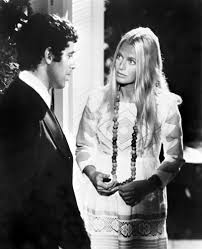
On Nina Van Pallandt: Muse, Witness, Residual Character, and Her Own Woman

Note: Nina Van Pallandt moves through this piece as a kind of drifting hinge figure between art and biography, cinema and scandal, half-real and half-mythologised: from her striking, uncanny presence in Robert Altman’s The Long Goodbye—where she plays the abused, luminous spouse of Roger Wade and becomes, briefly, a kind of muse/anima figure for Philip Marlowe—to her earlier life in the Danish pop duo The Baronets, through her entanglement with Clifford Irving and the great Howard Hughes hoax that later reverberates through Orson Welles’ F for Fake, and onward into the quieter aftermath of fame, reinvention, and partial retreat. The essay follows her not as a stable “character” but as a site where male-authored narratives—Hollywood noir, literary fraud, journalistic myth-making—keep trying (and failing) to fix her meaning, while she keeps slipping free in ways that are at once accidental and oddly deliberate. In the end she becomes something like a case study in cinematic and cultural afterlives: a woman repeatedly written by others, occasionally complicit, sometimes resistant, and finally legible only as a residue of performance, gossip, and unfinished stories that refuse to settle.

I first became aware of Nina Van Pallandt the way most people probably do: not through biography, but through atmosphere—specifically Robert Altman’s The Long Goodbye (1973, The Long Goodbye), a film that feels less like a narrative than a slow collapse of narrative reliability itself. It is a film in which people drift through scenes as if they have forgotten whether they are supposed to be characters or witnesses, and Nina arrives inside it already slightly misfiled, already too composed for the emotional weather she is asked to endure.

She plays Roger Wade’s wife, but “plays” is almost the wrong verb. Altman’s casting logic is not psychological realism in the classical sense; it is something closer to behavioral residue. People are dropped into the frame and asked not to perform identity but to inhabit proximity—to money, to violence, to desire, to failure. Nina’s presence has that peculiar Altman quality: she does not dominate the scene, but she stabilizes it just enough to make everything else look unstable.

Roger Wade (the blocked writer, the alcoholic genius-in-decline) is already collapsing before the plot admits it. Nina is the counterweight that never quite becomes balance. She is care without resolution, intimacy without clarity, the kind of emotional presence that suggests there is a story somewhere but refuses to confirm what it is. And then there is Marlowe, Elliott Gould’s version of Marlowe—half-stoned, half-wandering, permanently a few seconds behind the moral implications of what he is witnessing.

The film keeps staging small ruptures in epistemology. One of the most famous arrives early and feels almost accidental in its perfection: Terry Lennox appearing at 4 AM, asking for a ride to Tijuana. There is a moment—“Tijuana now?”—where Gould’s Marlowe is briefly jolted out of his procedural fog into genuine surprise, as if even he cannot believe how far the plot is willing to drift from explanation. That tonal instability is the world Nina inhabits as well, except she does not get Marlowe’s ironic distance. She gets consequence.

There is a domestic sequence—one of the film’s most disarming—that feels almost out of register with the noir frame: Nina cooking, the soft logic of food and attention, a candlelit dinner shared with Marlowe, where violence and absence are temporarily suspended by something as ordinary as butter and chicken. It is precisely the kind of scene that should resolve emotional ambiguity, but in Altman it does the opposite: it deepens it. Intimacy here is not revelation; it is another form of deferral.

What the film keeps doing, quietly and persistently, is refusing to assign stable moral weight to anyone. Roger Wade is both victim and self-destroyer. Marlowe is both agent and sleepwalker. Nina is both witness and participant, but never allowed the comfort of explanation. Even her suffering—when it arrives—is not narratively sanctified; it is simply another event in a world where events do not accumulate into meaning.

And this is where Nina becomes interesting beyond the film itself. Because she does not resolve into a character arc, she persists as something else: a figure who has been “used” by multiple narrative systems without ever fully belonging to them. In a conventional noir, she would be femme fatale or redemption object or tragic spouse. In Altman, she is none of these cleanly. She is what remains when genre stops enforcing coherence.

What begins to emerge, if one steps back slightly from her, is that she belongs to a broader category of women who are not simply “in” cultural narratives but are written into them by proximity to men who are doing the narrating. The pattern is subtle but persistent: women become legible to the public through the structural gravity of male projects—films, scandals, bands, memoirs—while simultaneously attempting, with varying degrees of success, to assert an interior life that resists that formatting.

It is difficult not to think here of Marianne Faithfull, who occupies a parallel register in the British version of the same phenomenon. Marianne Faithfull is initially rendered publicly intelligible through association—romantic, cultural, chemical—with the Rolling Stones orbit, and specifically through a media ecosystem eager to translate her into a kind of emblem: muse, fallen angel, tragic accessory to male genius. But what is striking about her trajectory is not the initial inscription but the long, stubborn insistence on rewriting it from within.

In both cases—Faithfull and Van Pallandt—the question is not simply “agency” in the abstract liberal sense, but something more structurally constrained: how does a person reassert authorship of self once they have already been written as a function in someone else’s story? Faithfull does this through survival, reinvention, and the eventual authority of her own voice as an artist. Nina does it more quietly, less performatively, by simply not continuing to cooperate with the demand that her life be endlessly narrativized into legible arcs.

And this is where Nina stops being just a cinematic presence and becomes entangled with a second, more volatile narrative system: the world of Clifford Irving and manufactured truth. I remain, in a slightly persistent way, puzzled by Clifford Irving—not in the sense that his actions are obscure, but in the sense that the scale of the gamble still feels oddly disproportionate to the era in which it occurred. Clifford Irving occupies that 1970s threshold where narrative fraud still had room to breathe: before the internet, before instantaneous archival correction, before every claim arrived already cross-checked by a thousand invisible clerks. The rope, in other words, was longer. Not infinitely elastic—but long enough that someone could plausibly believe they might walk it all the way across.

What he did, of course, was fabricate the authorized autobiography of Howard Hughes and briefly convince a publishing system that this fiction was fact. And one cannot quite shake the sense that this sits in a parallel register to Orson Welles’ late-career meditation on forgery and authorship, F for Fake, where the art forger is not simply a criminal but a kind of metaphysical irritant—someone who reveals how fragile the category of “authenticity” already is, even before it is attacked. In Welles’ world, the faker is almost honest about the fact that everyone is faking something. In Irving’s world, the system briefly forgets to notice.

The irony, of course, is that Irving’s fraud depended on a very pre-digital faith in paper trails, intermediaries, and the general slowness of institutional verification. Today it feels almost quaintly physical: forged documents, publishing contracts, phone calls that had to be believed in real time. One can imagine the same scheme now collapsing within hours, not because people are more moral, but because the feedback loops are instantaneous.

And then there is prison. Irving did time—real time, not narrative time—and emerged into a world that had already moved on to other, faster deceptions. Yeah, I mean what did you expect, dude. The arc compresses there in a way that feels almost unsatisfying: scandal, exposure, incarceration, partial reinvention. One wants something more operatic, but what you get is the bureaucratic version of consequence.

The interesting part is not that he was punished, but that for a brief historical window the system was even buildable enough that his plan could function as a kind of temporary reality. That is the shared atmosphere he has with Nina Van Pallandt: not guilt, not innocence, but proximity to narrative systems that were still slow enough to be fooled by their own assumptions.

In later life, Nina becomes harder to place in any of the familiar compartments that earlier decades tried to assign her. The cinematic afterglow fades into cult memory, and the Irving episode recedes into archival texture. What remains is a quietness that feels deliberate rather than accidental—not disappearance, but refusal of continued amplification. She does not convert notoriety into permanent self-mythology in the way later media ecosystems would almost require. Instead, she settles into a lower frequency of visibility: remembered, cited, intermittently revived, but no longer authored by the same pressures that once pulled her forward.

And here the comparison widens again, because what she resembles is not a “sidekick” at all—that word is too structurally comic, too dependent on hierarchy—but something closer to an attendant presence: a figure whose job, in other people’s stories, is to make emotional or moral instability legible without ever fully resolving it.

There is a related category, more neutral and slightly more precise: the faithful interlocutor. Not in the devotional sense, but in the structural one—the person who remains close enough to the main character’s instability to render it speakable, without ever becoming fully absorbed into its explanatory system. Nina performs this function in The Long Goodbyewithout being granted interpretive authority over it.

And there is another: the witness who does not testify cleanly. Not unreliable, but resistant to conversion into stable narrative fact.

We all make mistakes; that much is banal. The more interesting question is what kind of cultural weather those mistakes occur in, and how much agency is genuinely available inside it. Nina Van Pallandt seems, in retrospect, to have lived inside a period when men were still doing a great deal of the writing—of scripts, scandals, explanations—and women were often expected to appear inside those scripts as if they had authored them themselves. Her resistance to that framing is not always loud or declarative. Sometimes it is simply a matter of stepping out of the demand to be continuously interpretable.

And in that sense, what she ultimately carved out is not a grand public myth but something more modest and, arguably, more durable: a minor legacy, lightly held, slightly resistant to over-definition. Not central, not erased, not simplified—just there, in a way that feels unexpectedly intact.

I really like Nina Van Pallandt. In The Long Goodbye, and in the shadow of the Clifford Irving story, it is impossible not to root for her—not because she is resolved, but because she is never fully reducible. She drifts through systems built by men who are busy writing meaning onto the world, and she does not quite consent to being finalized inside any of them. We all make mistakes. She was written into a few. She was also, quietly, a drifter inside Hollywood’s narrative machinery, and what she ultimately leaves behind is a minor but distinct and instinctively cool legacy: not the center of anyone’s story, but one of the few figures who never fully became owned by it.

Don’t Pump Me Man!

Note: Spokane, early 1983: minor league baseball, cheap seats, and kids living in the gaps between innings. This piece recalls Spokane Indians games, chasing balls during batting practice, and a strange collision of childhood mischief and adult volatility at the edge of the outfield fence. Sandy Alomar Jr.—then a local catcher on his way to a long MLB career—signs a baseball in handwriting so precise it feels like a signature on a future already underway, while a moment of chaos involving thrown persimmons and a furious adult named Mike Trowbridge becomes the kind of story that sticks far longer than the season itself.


Epigraph:

Do you know who you’re fucking with?/ You’re fucking with a stallion mange.

Ween

It was 1983 in Spokane, the kind of summer that felt permanently suspended in late light and dry heat, where the air at night still carried the dust of the day like it had nowhere else to go. We played Little League baseball in uniforms that never quite fit right, and then on weekends we graduated to something bigger and looser and more important: Spokane Indians games at the old stadium, Single A ball, where the dreams were real and still close enough to touch.

The Spokane Indians were a kind of civic promise back then. It was a small town, and in the early 1980s there wasn’t always a lot going on. The Indians were not quite big league, but not quite nothing. Just enough baseball to make you believe that something important was always one bus ride away. The seats were cheap, the beer cheaper, and the fences closer than they should have been. The whole place had that slightly improvised feel—like the city had built it thinking, this will do for now.

We didn’t go to games like spectators. We went like we belonged.

Behind the outfield wall during batting practice, kids gathered like scavengers. We chased homers, argued over balls, sprinted through patches of grass worn down by repetition. Sometimes we were the only ones back there. Sometimes there were older kids, or dads, or random locals who knew the angles better than we did. It was a loose territory. Not quite policed. Not quite ours. Something in between.

That summer, the Indians had a catcher everyone knew. Local kid. Quiet confidence. Clean mechanics. The kind of player adults already talked about like he had a future attached to him.

Sandy Alomar Jr. was that guy even then—before the long MLB career, before the All-Star years, before anyone outside Spokane would know the name properly. He was already different. You could see it in the way he stood when he wasn’t moving, like he was always half a second ahead of the next pitch.

I got his autograph once. It wasn’t dramatic. Just a moment after BP, when he signed a ball for a cluster of kids leaning too far over a rail. His handwriting was unexpectedly beautiful—controlled, deliberate, almost elegant in a way that didn’t match the dirt and sweat of the field. I remember thinking even then: this is what someone looks like when they’re going somewhere.

I kept that ball for years.

Because baseball wasn’t just baseball. It was a hierarchy you could see. You had the guys who were going to make it, the guys who might make it, and the rest of us orbiting the idea that proximity alone might transfer something.

Most of them wouldn’t go anywhere. That was obvious even then, though nobody said it out loud. But that day, none of that mattered yet. What mattered was the fence.

Our party was up high in the stands on the first base side, just beyond where the stadium fence met a thin strip of wild space. A tree had grown there—some kind of fruit tree, nobody was ever fully sure what it was. Persimmons, maybe. Something orange-red and heavy-looking, the kind of fruit that doesn’t look like it should be thrown but absolutely is.

Some kids started throwing them. Just kids, just fucking around. But they didn’t know who they were fucking with. Fuck with me and I’ll fuck with you.

The fruit flew. Not carefully. Not aimlessly either. More like experimentation. Testing distance. Testing reactions. Some of them were aiming at fans, others just launching them over the fence because it felt like something you could do if no one stopped you.

It was mildly funny at first. Then mildly annoying. Then mildly dangerous in a way that nobody fully acknowledged.

Because persimmons, if that’s what they were, aren’t soft. They hit like small decisions.

I remember one bouncing near a row of seats and rolling under a foot. Someone laughed. Someone else shouted. But nobody moved with urgency yet. It was still in the category of “kids being kids.”

Until Mike Trowbridge noticed.

Mike T was there with his kids—David Trowbridge and his sister Dawn. David had been a teammate of mine in Little League, a few years younger, outfield guy, quiet in the way younger kids sometimes are when they’re still deciding how loud they’re allowed to be. Dawn was just there in the background of everything, observing.

Their dad, Mike, was not background.

He was one of those adults you noticed before you understood why. Volatile energy. Tight posture. Goatee, black tank top, gold chains around his neck. A bit of a greaser; drove a Harley. Always slightly too close to losing his temper. He wasn’t a bad guy exactly—he could laugh, he could talk—but you always felt like there was a second version of him sitting just under the surface.

He saw the fruit being thrown. And something in him snapped into motion. He walked straight to the fence line, fast enough that it changed the temperature of the moment.

“Knock that shit off right now,” he yelled.

The kids paused. Not because they were scared exactly, but because the voice had weight.

Then one of them—small kid, maybe ten, sunburned confidence, the kind of kid who doesn’t fully understand consequences yet—looked up and said:

“Don’t pump me, man.”

It was such a strange sentence. Too casual for the situation. Too confident for the speaker. Like he had borrowed it from somewhere older and wasn’t sure how it fit yet.

There was a beat of silence where the entire stadium noise seemed to pull back slightly.

Mike T looked at him.

“Don’t pump me?” he said.

Then his voice shifted.

“You want me to pump you? I’ll pump you.”

And in that moment—this is the part that still feels unreal even now—he climbed the fence. Not slowly. Not theatrically. Just decisively. Like the boundary wasn’t a boundary at all.

Everything changed at once.

Me, David, Dawn—everyone nearby—we all froze in that wide-eyed way kids do when they realize the rules might not hold. It wasn’t comedy anymore. It wasn’t baseball anymore.

It was just: Mikey baby don’t kill that kid.

That’s what it felt like in my head. Not words were spoken, just panic translated into something almost verbal.

The kids scattered instantly. Full sprint. No hesitation. The fruit stopped mid-air and dropped forgotten. The stadium behind us suddenly felt far away, like it belonged to a different scene entirely.

Mike T took a step forward, still inside the fenced edge of this improvised battlefield, breathing hard, still locked in that strange overlap between anger and disbelief.

And then—somehow—it was over. No actual violence. No contact. Just the threat of it, large enough to erase the mischief that had caused it.

The kids were gone. The fruit stopped flying. The tree stood there like nothing had happened. Afterwards, the stadium noise came back slowly, like a system rebooting.

My dad, Ross, had seen the whole thing. He was laughing, hard. Not the kind of polite laugh adults do when they think they’re supposed to. This was involuntary. Almost helpless. The kind of laugh that tries to stay respectful but can’t quite hold the line.

Because it was funny. In that terrible, chaotic way childhood sometimes is when it brushes up against adult intensity and survives without breaking.

Ross would tell that story for years after. The kid. The fence. The persimmons. The line: don’t pump me man. He never stopped laughing at that part.

Neither did I.

But at the time, I just stood there thinking about Sandy Alomar Jr. somewhere on that field, already on his way to something else entirely, signing baseballs in beautiful handwriting, while right behind the stadium wall the rest of us were learning the difference between games and consequences in real time.

Most of us wouldn’t make it to the Bigs. But for one afternoon in 1983, it all felt like it might matter just the same.was 1983 in Spokane, the kind of summer that felt permanently suspended in late light and dry heat, where the air at night still carried the dust of the day like it had nowhere else to go.

But for one afternoon in 1983, it all felt like it might matter just the same.

Dedication:

For Mike T. And for the kid. You got balls young man, I’ll say that.

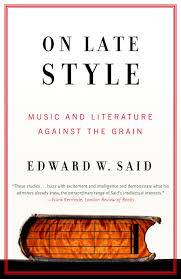
On Edward Said’s “On Late Style.”

Note: This piece takes up On Late Style, the posthumously published and deliberately unfinished work by Edward Said on what he, following Theodor Adorno, calls “lateness”—not serenity or resolution at the end of a career, but tension, contradiction, and a refusal to reconcile. It’s a short book that opens out into large questions, and this will be less a full treatment than an attempt to think alongside it, particularly around the strange fact that a book about unresolvedness arrives in a form that is itself, in some essential way, unresolved.

Edward Said’s On Late Style is as rich a book as an unfinished work can be.  Published posthumously, On Late Style expands on Theodor Adorno’s concept of “late works.”  Late works are works with fall toward the end of an artist’s career, but not those like The Winter’s Tale or The Tempest which “reflect a special maturity, a new spirit of reconciliation and serenity often expressed in terms of a miraculous transfiguration of common reality” (6), but those like Beethoven’s Missa Solemnis or Lampedusa’s The Leopard–works which, in Adorno’s words are “devoid of sweetness, bitter and spiny, they do not surrender themselves to mere delectation,” or, in Said’s phrasing, are “uncoopted by a higher synthesis: they do not fit any scheme, and they cannot be reconciled or resolved” (12).

Said died in September 2003, before On Late Style was completed.  In the foreward, his wife, Miriam writes of how Said was planning to get to work and get it done: “{In late August} he said to me as we were having breakfast that morning, ‘Today I will write the acknowledgments and preface to Humanism and Democratic Criticism {…} The introduction to From Oslo to Iraq and the Road Map I’ll finish by Sunday.  And next week I’ll concentrate on completing On Late Style, which will be finished by December” (vii).  He didn’t make it, and the little quote is a moving reminder that we never know how much time we have left.  But Michael Wood, who arranged the various fragments Said had written on the topic of late style into this nearly seamless finished product, says that he doesn’t believe that Said ever wanted to finish the book: “Or rather, he wanted to finish it but was waiting for a time that would perhaps never have come.  There would have been a time for this book about untimeliness, but this time was always: not quite yet” (xvi-xvii).

What does Adorno, and Said, mean by “late style,” and why would Said perhaps have not wanted to finish his work on this topic?  Again, to understand what the term means we need to understand that late style is not simply synonomous with work accomplished late in life.  Wood puts it this way, the “type of lateness {that Said was interested in} is quite different {…} from the unearthly serenity we find in the last works of Sophocles and Shakespeare.  Oedipus at ColonusThe Tempest, and The Winter Tale are late enough in their way, but they have settled their quarrel with time” (xiii).  In other words, these works are transcendent yet resigned–the author, knowing perhaps that death is coming to claim them, moves to preempt death by surrendering his grasp on reality and moving in the direction of a “higher synthesis,” and in the process attaining “a remarkable holiness and sense of resolution” (6).  Said has nothing against such works at peace with themselves and with time, but these are not his subject.  Lateness here seems to take its raison d’etre from Dylan Thomas; it rages against the dying of the light.  As Said puts it, “Late style is what happens if art does not abdicate its rights in favor of reality” (9) and is “a form of exile” (8).

But if late style finds its power in a righteous rage against resignation, senescence, and serenity, it is at the same time complicit with disintegration and ultimately with death. In other words, an artist can embrace lateness in Said’s conception of the term, but can never be quit of it. Said writes: “For Adorno, lateness is the idea of surviving beyond what is acceptable and normal; in addition, lateness includes the idea that one cannot really go beyond lateness at all, cannot transcend or lift oneself out of lateness, but can only deepen the lateness” (13). Here, we understand why it was the Said, though he worked on the idea of lateness for over a decade, was not able to finish off what at only 160 pages is still a relatively slight work–only death itself can put a period on lateness. Wood writes: “for all his deep interest in lateness {…} Said was not attracted by the idea of a late, dissolving self. {…} Said wanted to continue with the self’s making, and if we divide a life into early middle, and late periods, he was still in the middle when he died at the age of sixty-seven {…} Still a little too early, I think he would have said, for real lateness” (xviii).

Another reason why On Late Style cannot exactly be classified as a “late” work is the urbane depth of its learning and its lightness of touch. Though deeply serious, Said in On Late Style wears his learning lightly, as only a true elitist can. For the fact is that despite its topic the book is oddly comforting; I can open it to any page in the moments before sleep and feel a rush of almost narcotic satisfaction and harmony. This effect is obtained not because Said takes an oppositional stance to his topic but because the extent of his learning is so colossal that it seems to achieve “a remarkable holiness and sense of resolution” based on its own gravitational force, even though acting in opposition to Said’s own thesis.

Thus, although we have only begun to scratch the surface of what Said has to say about lateness, it is already clear that while the relation between late style and classicism must for the moment remain unresolved, On Late Style as a text is a deeply classical enterprise, and this classicism is rooted in the remarkable range and depth of Said’s mind. Wood reminds us that being in opposition need not always mean manning the barricades–and this at least sets up the question raised in an earlier post about the ability of leftism and classicism to co-exist: “It is part of the generosity of Said’s critical imagination that he sees ‘amusement’ as a form of resistance. He can do this because amusement, like pleasure and privacy, does not require reconciliation with a status quo or a dominant regime” (xiv).

So perhaps On Late Style is complete in the only way a book about lateness can be. It circles, it deepens, it resists arriving. Edward Said writes against resolution, and the book quietly enacts that refusal, never quite allowing itself the satisfaction of a final statement. There is something fitting in this. Lateness, as he and Theodor Adorno understand it, is not a stage one passes through and exits, but a condition one can only move further into. Said, still “in the middle” by his own reckoning, never closed the circle. And so the book remains open—not unfinished in the sense of lacking something, but unfinished because its subject will not permit an end.

Craig Finn on Nightlife and Adult Relationships IV: “Soft in the Center”

Note: This piece will take up “Soft in the Center,” track 2 on Heaven is Whenever (Vagrant Records, 2010) by The Hold Steady. This one will be a little different for a couple of reasons. First, Heaven is Whenever was the first Hold Steady record after the departure of their keyboard player Franz Nicolay, and Nicolay was (and is, because he rejoined in 2016) a huge part of the Hold Steady sound. Therefore, I will look briefly at the personal dynamics of the band, insofar as they’ve been made public. Second, I will take up song order, something I intend to return to in future pieces. Third—and maybe most importantly—I am using this piece to set an intention. A serious one.

Epigraph:

You can’t tell people what they want to hear

If you also want to tell the truth

Craig Finn

I want to be a music writer.

I have always wanted to play music, and I remain fascinated with the role of the frontman or frontwoman. There are so many great ones—Finn, Mick Jagger, Bret Michaels (I really just want to perform “Shelter Me”), Joan Jett, Cherie Currie, and many others. But I am not, at this moment, a songwriter or a singer, and I am still working on understanding songwriting from the inside.

So my goal is simpler and, in some ways, harder: to be the best music writer that I can be.

I don’t think I can be as good as Chuck Klosterman, who is amazing, and I am not really a reviewer. I don’t write reviews; I write analysis. I’m less interested in telling you whether something is good than in understanding what it is doing—how it works, what it reveals, and what it becomes when placed next to a life.

So I’m not competitive with Klosterman, and I’m not competitive with reviewers generally. But I am competitive with myself, and in a narrower sense, I am competitive with myself to be the best Craig Finn analyst around. Finn has, in my opinion, leveled up his songwriting several times across his career, and I want to level up alongside him as a writer.

That’s the goal. Let’s take up “Soft in the Center.”


The Hold Steady’s on and off again keyboardist Franz Nicolay joined The Hold Steady in 2005, after the release of 2004’s Almost Killed MeAlmost Killed Me may be my personal favorite Hold Steady record, but it is also true that the band’s sound took a major step forward with Nicolay. Some of their most iconic songs depend on his presence as much as on Finn’s voice.

There isn’t a great deal of publicly available detail about Nicolay’s departure in 2010. Compared to famously volatile bands—Jane’s Addiction, The Rolling Stones, Galaxie 500—this one seems almost restrained. Finn described it as amicable. Nicolay described it as a “closed book.” Both statements feel composed, even careful, which in itself tells you something about the people involved.

What matters for our purposes is the effect. Without Nicolay, the band’s sound on Heaven is Whenever is leaner. The keys are still there, but diminished, less central, less cinematic. There is more space, and that space exposes Finn a bit more.

For a long time, I misheard this record. I thought the highlights were the obvious ones—“The Weekenders,” “Sweet Part of the City.” Recent listening corrected that. My favorite, by a ways, is “Soft in the Center,” with “Our Whole Lives” in second place. The latter contains the line, “We’re good guys, but we can’t be good all the time,” which could stand as a thesis for much of Finn’s writing.

The fact that I missed both songs initially is not trivial. It suggests that some of Finn’s best work doesn’t announce itself immediately. It waits.


Which brings us to song order.

“Soft in the Center” is, to my ear, the best song on the record and one of its most immediate. I tend to favor leading with your strongest statement, and I think there’s a case that it should have opened the album. There is a long tradition of bands doing exactly that—“Janie Jones” by The Clash, “Teenage Riot” by Sonic Youth, “Rocks Off” by The Rolling Stones. These are not just songs; they are openings that define tone and intent.

Finn has acknowledged that “Soft in the Center” has a certain built-in audience response, particularly around its chorus. He can feel when a line is going to land, when a certain type of listener is going to raise a fist. That’s not calculation so much as familiarity—he understands the emotional economy of his audience because he helped build it.


The song itself unfolds as a conversation, and more specifically, as advice. It is an older voice speaking to a younger one. In that sense, it mirrors earlier Hold Steady material like “Killer Parties,” but from the opposite side. In those earlier songs, Finn is inside the chaos, narrating in real time. Here, he stands outside it, looking back, trying—gently, imperfectly—to intervene.

The opening image is stark: a young man leaving a hospital, returning to a city that has not changed. The implication is clear without being over-explained. Something went wrong—an overdose, an accident, a night that tipped too far. And yet the conditions that produced that moment are all still in place. The city remains. The temptations remain. The system resets.

Finn’s great line—“You can’t tell people what they want to hear / if you also want to tell the truth”—lands here as a kind of thesis. It is a statement about songwriting, but also about mentorship, about friendship, about any attempt to guide someone who is not yet ready to be guided. The truth, in Finn’s world, is rarely what anyone wants to hear in the moment.

When he follows it with a direct address—“I’m just trying to tell the truth, kid”—the dynamic becomes explicit. He is the older figure now. Not removed, not sanctimonious, but positioned. He has been through something. He has survived something. And survival, in Finn’s writing, tends to confer not authority exactly, but a certain obligation to speak.


The chorus distills the advice into something almost disarmingly simple: you can’t have everything; you learn to love what you have. Finn himself has noted that he knows lines like this will hit. They scan as universal, almost cliché at first glance. But in context, they are not glib. They are corrective. They push back against a younger worldview built on accumulation—of experiences, of people, of intensity.

This is one of Finn’s recurring moves: to take a sentiment that could sound obvious and place it in a context that makes it necessary.


The second verse introduces the song’s central metaphor: the frozen lake. Finn, being from Minnesota, grounds it in lived experience—“a place with lots of lakes”—but the image does more than local color. It becomes diagnostic.

On the surface, everything looks stable. Solid. Safe. But “sometimes they get soft in the center,” and that center is “a dangerous place.”

This is the song’s title, and its key. The “center” here is not just the literal middle of the lake; it is the middle of the action, the heart of the scene, the dead center of the city, the place where things feel most alive. It is also the place where the structure is weakest. The danger is not at the edges, where you might expect it, but at the point of maximum immersion.

That is a sophisticated inversion, and it maps cleanly onto the nightlife world Finn has chronicled for years from his albums with his first bands Lifter Puller through to today. The parties, the drugs, the endless nights—they are not dangerous because they are marginal. They are dangerous because they are central, because they feel like the point.

Finn frames the young man’s situation with unusual generosity: “you can probably do anything, if you can get yourself right.” This is not moralizing. It is not even particularly prescriptive. It is conditional. The possibility is there, but it depends on an internal realignment that the speaker cannot perform for the listener.

There is also, quietly, autobiography here. Finn writes in the great song “Most People Are DJs” about his own youthful excess—“I was a Twin Cities trash bin/ I’d jam it all into my system”—and the process of pulling back from that edge. What matters is not just that he got himself right, but that he remembers what it was like not to be.


From there, the song largely reiterates its central ideas, but with increasing insistence. The chorus returns. The advice is repeated. And then comes the bridge: “I know what you’re going through / I had to go through that too.”

This is where the song earns its authority. Not in the cleverness of its lines, or even in the sharpness of its metaphors, but in its identification. Finn is not speaking from above. He is speaking from experience. The distance between the older voice and the younger listener is real, but it is not absolute.

And yet—and this is crucial—that identification does not guarantee transmission. The younger figure may still ignore the advice. He may return to the city, to the center, to the unsafe ice. Finn knows this. The song does not resolve that tension. It simply articulates it.


What makes “Soft in the Center” so effective is its clarity. Finn is not being coy about the theme. He is saying, in essence: the action is real, the lights are bright, and the pull is powerful. You will want to stay in it as long as you can. But there are costs. There are limits. There is time.

You age. You win and lose people. You push your system until it pushes back. You end up in rooms—hospitals, apartments, empty bars—where the energy has drained out and something quieter, and less negotiable, remains.

“Take your time,” the song seems to say, but also: think it through.

That balance—between permission and warning, between empathy and clarity—is where Finn’s later songwriting lives. It is a long way from the breathless immediacy of Lifter Puller, but it is not a rejection of it. It is a reframing. The same world, seen from a different distance.

“Soft in the Center” is, to my ear, the best song on Heaven is Whenever and one of the strongest in Finn’s catalog. It is direct without being simplistic, reflective without losing momentum, generous without losing edge.

Simply marvelous.

Note: If you enjoyed this piece, you may also like the pieces below which also deal with the songs of Craig Finn.

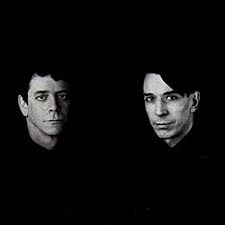
On Lou Reed and John Cale’s Album Songs for Drella (aka The Trouble With Classicists)

Note: This post takes up Songs for Drella (1990), Lou Reed and John Cale’s uneasy reunion album/biographical song-cycle about Andy Warhol, moving track by track through Warhol’s trajectory from Pittsburgh outsider to Factory-era icon to post-shooting isolation and mythic afterlife. Along the way it reads the record not just as tribute or elegy, but as a sustained meditation on work, style, and the thin boundary between populist gesture and aesthetic theory—especially in the pointed figure of “classicists” versus Warhol’s downtown anti-orthodoxy. What emerges is less a linear album review than a set of reflections on art, authorship, and cultural literacy, with Warhol as both subject and pretext for thinking about what it means to make anything count as art in the first place.

3

In 1990, Lou Reed and John Cale, formerly of the Velvet Underground, latterly famously not getting along, reunited to make Songs for Drella, a tribute/ musical biography of their first patron, Andy Warhol. Drella is a 15 song cycle which takes the listener through Andy’s life and career, from his early days in Pittsburgh, through success in New York, getting shot, latter-day isolation and and loneliness, and ending with an epitaph. The songs fit loosely together in chronological order. Here is the basic scheme: “Smalltown” sees Andy unhappy in Pittsburgh and dreaming of the big city; “Open House” describes the early days of the factory, when all and sundry stopped by and provided Andy with inspiration; “Style it Takes” gives an overview of some of Andy’s famous works and his working method; “Work” explains the considerable work ethic that underlay Warhol’s success; “Trouble with Classicists,” in what is presumably Andy’s voice, provides a series of opinions about “classicists”, “impressionists”, and “personalities”; “Starlight” appears to consider Andy’s flirtation with Hollywood, or Hollywood’s flirtation with him; “Faces and Names” kicks off the second section of the record and finds Andy in despair, something like a midlife crisis; “Images” details Andy’s philosophy of art and hits back at the critics of his method; “Slip Away,” “It Wasn’t Me,” and “I Believe” represent the nadir of the record in which Andy is warned about the people he associates with, confronts a junkie, and is shot by Valerie Solanis; “Nobody But You” sees Andy bereft of companionship hanging out and paying the price of dinner of a nobody; “A Dream” synthesizes all which has come before and puts Andy’s life into fuller perspective; “Forever Changed” sees Andy’s past slipping away; and “Hello It’s Me” represents Reed’s epitaph and apology to Warhol.

Some of the songs are better than others; specifically, I get comparatively little out of “Starlight,” “It Wasn’t Me” and “Forever Changed,” but every song has its place in the story of Warhol’s life and his influence on Reed and Cale, his circle, New York city, and the art world in general. This post will take up the first five songs as a bridge into a wider discussion of the meaning of “classicism” today. There may or may not be a part two to this post.

“Smalltown” is about leaving Pittsburgh, and introduces us to the fact that Andy was gay:

When you’re growing up in a small town
Bad skin, bad eyes – gay and fatty
People look at you funny
When you’re in a small town

New York is more to his liking, and provides a context for his art to flourish:

Where did Picasso come from
There’s no Michelangelo coming from Pittsburgh

I hate being odd in a small town
If they stare let them stare in New York City

The theme of small town boy (girl) made good in the big city is classic and well worn, of course, but Andy thrives in NYC, and soon “The Factory” is open to all comers (“Open House”):

Come over to 81st street I’m in the apartment above the bar
You know you can’t miss it, it’s across from the subway
and the tacky store with the Mylar scarves


Andy wants people around him, and this is one of the major themes of the record; his ability to work is dependent on company and inspiration from associates, peers, and even hangers-on:

It’s a Czechoslovakian custom my mother passed on to me
The way to make friends Andy is invite them up for tea

It’s a Czechoslovakian custom my mother passed on to me
Give people little presents so they remember me

Whereas “Smalltown” is loud and bracing, the music on “Open House” is soft, elegant, gentle even. But even in his halcyon early days in NYC Andy cannot entirely escape the demands of the market or of other people’s ideas of what he should be doing:

I think I got a job today they want me to draw shoes
The ones I drew were old and used
They told me — draw something new
Open house, open house 

You scared yourself with music, I scared myself with paint
I drew five-hundred fifty different shoes today
It almost made me faint
Open house, open house

Andy’s career takes off, and he clearly has something that people want–he has “The Style It Takes.”

You’ve got connections and I’ve got the art
You like attention and I like your looks
and I have the style it takes and you know the people it takes

I’ve got a Brillo box and I say it’s art
It’s the same one you can buy at any supermarket
‘Cause I’ve got the style it takes

Here, Reed and Cale delve into the perennial question of the definition of art–what’s good, what’s bad, and how do we know the difference? The answer which “Style It Takes” seems to offer is: the status of something as “art” is dependent upon someone with “style” telling so. This observation is at once banal (we know art is art because it hangs in a museum and because of the reverent hush of the patrons), and somehow inspiring (a kid from Pittsburgh, “bad skin, bad eyes – gay and fatty,” can take the New York art world by storm simply be possessing some quicksilver attribute called “style,” something so powerful that a simple box of soap pads becomes accepted as art less on its own merit and more on the strength of its association with Warhol, who by 1964 was rapidly ascending to the status of an icon). This song also sees the first appearance on the record of a little group called The Velvet Underground, who Andy “shows movies on.”

“I’ve got a Brillo box and I say it’s art”–is this a populist claim or an elitist one? Is it classical? Certainly not classically classical, but is there not a way in which Warhol’s “pop art”–which is often read as representing the “emptiness” of modern popular culture, is perfectly sincere and actually uninflected with irony? Another major theme of the record is Andy’s work ethic–he was a working artist on whose sweat the whole Factory scene was dependent. Andy’s work ethic, according to Reed and Cale, even had a religious aspect. “Work” starts with Andy in prayer, and despite the neat twist on the phrase “Protestant ethic” here, we are left with the strong feeling that Andy was no self-ironizing dilettante, and that his blue-collar background stuck with him throughout his life:

Andy was a Catholic,
the ethic ran through his bones
He lived alone with his mother,
collecting gossip and toys
Every Sunday when he went to church
He’d kneel in his pew and he’d say,
“It’s work,
all that matters is work.”

He was a lot of things,
what I remember most
He’d say, “I’ve got to bring home the bacon,
someone’s got to bring home the roast.”
He’d get to the factory early
If you asked him he’d told you straight out
It’s work 

In “Work,” Andy stresses quantity over quality; just as he had painted 550 different shoes in “Open House,” here he advises Reed to write like there is no tomorrow:

No matter what I did it never seemed enough
He said I was lazy, I said I was young
He said, “How many songs did you write?”
I’d written zero, I’d lied and said, “Ten.”
“You won’t be young forever
You should have written fifteen”
It’s work

But despite his working artist approach, Andy is not content to merely record the surface of what he sees. Neither, however, is he given to too much soul-searching or self-analysis about why he is who he is, or why he does what he does. “The Trouble with Classicists” is the central song on the record, the song where Reed and Cale get closest to defining Warhol’s attitude toward art. It is also here from which I was moved to take on the issue of classicism in our times:

The trouble with a classicist he looks at a tree
That’s all he sees, he paints a tree
The trouble with a classicist he looks at the sky
He doesn’t ask why, he just paints a sky

The trouble with an impressionist, he looks at a log
He doesn’t know who he is,
standing, staring, at this log {…}
That’s the trouble with impressionists 

If neither classicism nor impressionism, than who or what is Warhol drawn to? The answer is graffiti artists, of all things:

I like the druggy downtown kids who spray paint walls and trains
I like their lack of training, their primitive technique
I think sometimes it hurts you when you stay too long in school
I think sometimes it hurts you when you’re afraid to be called a fool
That’s the trouble with classicists

Let’s dig a little deeper. Cale, who sings “Classicists,” is himself famously a “classically trained” musician, who has drunk heavily of modernism and dissonance without surrendering what I still see as a fundamentally classical musical and aesthetic sensibility. Moreover, writing a song called “The Trouble with Classicists” in this day and age is in itself a classical act. This I think is a key point; whereas once upon a time a Romantic poet could have defined himself or herself in violent opposition to Classicism and made it stick, today, and perhaps even in Warhol’s day, the ability to criticize classicism as a form or style is evidence of a degree of learning and cultural literacy which can only be described as classical, and, yes, a little elitist.

Is this right? It sounds right, at least, and I would add the following: a) the vagueness with which I am approaching the question of a modern definition for classicism in these paragraphs is symptomatic of the generally pitiable state of true learning on that part of what Edward Said calls “the general intellectual”; b) Said’s general intellectual today tends also to be as Dean Williams has said a “profound modernist”–which is a nice way of saying someone who knows, and cares, very little about Western culture’s classical roots, very little about the Bible, very little about the great religion (at least in any fine grained way), probably very little about Shakespeare for that matter; c) today’s general intellectual knows very little about music compared with his 18th or 19th century counterpart. This is a point which Said makes in his chapter on Glenn Gould in On Late Style: “Today’s literary or general intellectual has little practical knowledge of music as an art, has hardly any experience playing an instrument or studying solfege or theory, and except for buying records or collecting a few names like Karajan and Callas, does not as a matter of course have a sustained literacy–whether that concerns being able to relate performance, interpretation, and style to one another, or recognizing the difference between harmonic and rhythmical characteristics in Mozart, Berg, and Messiaen–in the actual practice of music” (115). Any of my general intellectual readership care to take this argument on? If so, please produce 100 words on solfege without reference to Wikipedia before wading in.

My point, which is, I fear, on the verge of getting lost, is less that Warhol or for that matter Reed and Cale are in any specific way “classical,” but that because what Said calls the lack of “sustained literacy” in music on the part of the general intellectual is not confined to music, but extends to art, classical and great literature (how many of us who name drop Aristotle have actually spent any time reading him? how many of us who attempt to evince first-hand knowledge of Marx have actually broached Capital?), and philosophy. That is to say that the general intellectual today is apt not only to be a profound modernist, but also to be a profound generalist, who knows a miniscule amount about a huge number of things, a little bit about a few things, and knows almost nothing is any truly extensive or impressive detail. In this context, not only is “The Trouble with Classicists” deeply classical, not only is Classical Sympathies, by very virtue of its being and intent, classical, but any attempt to engage in a serious way with issues of aesthetic definition marks one out as both a classicist, and at least a minor elitist. Certainly Said, for all his “oppositional” stances and leftist politics, was both–but the question of how leftism and classicism can co-exist is best left for a latter date; it is time to stop work on this post and risk being called a fool.

On the Concept of “Role Drift” in Laud Humphrey’s The Tearoom Trade and the US Military and Paul the Apostle

Note: This piece is a wide-ranging meditation on Laud Humphreys’ notion of “role drift” in his book The Tearoom Trade, drawn outward into unexpected but structurally suggestive parallels with the historical conversion the Apostle Paul and lived military hierarchy through an interview with an ex-US solider. Beginning from Humphreys’ account of observational immersion and the tendency for participants and observers alike to “go over” through sustained proximity, the piece tracks how identity can be reshaped by exposure to institutional logics and repeated social frames. A military anecdote from the First Gulf War anchors the theory in lived experience, while the figure of Paul becomes an extreme historical case of allegiance reversal that tests the limits of the model. The result is a speculative sociology of affiliation and transformation, where roles are not merely performed but slowly internalized until the boundary between observer and participant, or “they” and “we,” begins to dissolve.

Epigraph:

I believe in this/ and it’s been tested by research/ that he who fucks nuns/ will later join the church.

The Clash

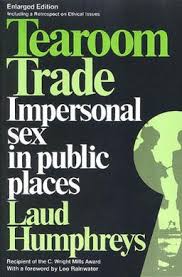
This post takes up that sexiest of subjects, “role-drift.”  In this post I will connect Laud Humphreys’ investigation of “the Tearoom Trade,” that is, casual homosexual encounters in public toilets, the initiation process in the United States military, and the conversion of Paul the Apostle.  Those easily offended by sociological explanations of religion, of sexual preference, or of the comradeship among soldiers should cease reading immediately.

Recently, I finished reading a book–which, as my next post will detail, is a somewhat rare occurrence.  The book was Laud Humphreys’ “The Tearoom Trade,” published in 1970.  It concerns men hooking up with other men, usually strangers, in the public restroom facilities in St. Louis, and it is an eye-opening read.  The blurb on the book jacket pretty much tells the story: “Many American men seek impersonal sex in public restrooms.  Called ‘tearooms’ in the argot of the homosexual subculture, these restrooms are accessible to and easily recognized by those who wish to engage in anonymous sexual encounters {…} By passing as deviant, the author was able to engage in systematic observations of homosexual acts in public settings.  Methodologists will be interested {…} in this unusual application of participant-observation strategies.”  Indeed, methodologists everywhere, I can say without hesitation, were and are all ears.  But the odd thing is that Humphreys, married and purportedly straight when he conducted his research, later divorced his wife and came out as gay.

Now, it may not be considered particularly odd that someone, sociologist or no, who spends several months or years in public toilets observing “insertors” and “insertees” would himself come out eventually, and Humphreys’ persistent use of “us” and “we” to refer to the denizens of the restrooms of St. Louis appears, in retrospect, to be something of a “tell.”  Consider, for instance, sentences such as the following: “when a group of us were locked in a restroom and attacked by several youths, we spoke in defense and out of fear {…} This event ruptured the reserve among us and resulted in a series of conversations among those who shared this adventure for several days afterward” (12), and several other similar uses of plural pronouns.  (It may be of interest here that Humphreys and his study of tearooms enjoyed a brief week in the sun a few years ago when Senator Larry Craig of Idaho was arrested in an airport bathroom stall for foot-tapping–Humphreys covered this topic as well, making clear that foot-tapping was, in 1970, a well-established method of making contact from stall to stall, and already in use by police decoys so many decades ago (20, 87).)

Indeed, the whole study is fascinating, and peppered with wonderfully matter-of-fact passages such as: “There is a great deal of difference in the volumes of homosexual activity that these accommodations shelter.  In some, one might wait for months before observing a deviant act.  In others, the volume approaches orgiastic dimensions.  One summer afternoon, for instance, I witnessed twenty acts of fellatio is the course of an hour while waiting out a thunderstorm in a tearoom.  For one who wishes to participate in (or study) such activity, the primary consideration is one of finding where the action is” (6) (alert readers will recognize the influence of Erving Goffman here; Goffman’s study of gambling establishments is titled “Where the Action Is”).  But the passage which really caught my attention deals with what Humphreys calls “role instability” or “role drift.”  He makes two major points; i) those who start out pitching tend to end up catching; “It appears that, during the career of any one participant, the role of insertor tends to be transposed into that of insertee” (55) (Humphreys attributes this tendency to “the aging crisis” common to tearoom participants); ii) “If {straights} remain exposed ‘too long’ to the action, they cease to operate as straights” (56).  Humphreys here is not referring to men who one day, by accident, may wander into an operational tearoom, but rather to members of the parks department or vice squad who, over time, may be exposed to a wider swath of tearoom activity.  Here is the key passage:

“When some communication continues to exist, parents tend to be ‘turned on’ by their pot-smoking offspring.  Spectators tend to be drawn into mob action, and kibitzers into card games.  Even police may adopt the roles they are assigned to eliminate:

‘It is a well-known phenomenon that when officers are left too long on the vice-squad–the maximum allowable at  any one time being four to five years–they begin to ‘go over’, adopting the behaviorisms and mores 0f the criminals with whom they are dealing, and shifting their primary allegiance’” (Here, Humphreys is quoting from Elliot Liebow’s Tally’s Corner from 1967.  My emphasis).

It is a well-known phenomenon that when officers are left too long on the vice-squad they begin to ‘go over’. The moment I read this, having known of Humphreys’ own history before I read his book, I immediately recognized either a brilliant justification for future defection or an alternative, sociologically-based, theory for how sexual preference is formed.  After all, Humphreys himself spent several years researching and writing “The Tearoom Trade,” over which time he subjected himself to sufficient “action” to push him into shifting his primary allegiance, and to “go over.”  This theory, it goes without saying, flies in the face of the idea that sexual preference is genetic or established in the womb–and just as obviously it cannot explain all instances of same-sex attraction.  But, as a sociologically fascinating explanation for Humphreys own conversion, it remained in the back of my mind.

Several weeks later I was reading Robert Wright’s Atlantic article “One World, Under God,” about the relationship between religion and globalization.  Much of the article deals with the Apostle Paul, and I read something I had long known but never fully processed–Paul persecuted Christians right up until his conversion.  Here’s Wright: “The ‘Apostle Paul’ wasn’t one of Jesus’ 12 apostles.  Quite the opposite: after the Crucifixion he seems to have persecuted followers of Jesus.  According to the book of Acts, he was ‘ravaging the church by entering house after house: dragging off both men and women, he committed them to prison.’  But then, while on his way to treat Syrian followers of Jesus in this fashion, he underwent his ‘road to Damascus’ conversion.  He was blinded by the light and heard the voice of Jesus” (40).  The rest is history, of course, as Paul went on to establish ministries across the Near East, and, according to Wright, recast Jesus’ message as one of love and peace.  There are a couple of classic explanations for Paul’s conversion–first, as Wright says, that he heard the voice of Jesus or God and converted–simple enough.  Second, that Paul was epileptic and had a seizure in which he imagined he heard Jesus.  The first explanation is religious or mystical; the second medical.  But when I read this paragraph, the first thing I thought of was Humphreys–‘It is a well-known phenomenon that when officers are left too long on the vice-squad–the maximum allowable at any one time being four to five years–they begin to ‘go over’, adopting the behaviorisms and mores 0f the criminals with whom they are dealing, and shifting their primary allegiance.’” Had Paul spent too much time on the vice-squad exposed to this rogue new faith and fallen prone to “role-drift”?  This post is not a polemic, and I would not want to rule out religious, medical, or genetic explanations of human behavior–but the unifying thread excited me.

The general topic of role-drift has, in one form or another, been on my mind for several years, and I recently posted an extract of a conversation I had with my editor Dean Williams several years ago.  The narrow topic is how men in the military adapt to the culture–the wider topic is social adaptation and investment in an ideology over time.

===== =====

In the interview below “MT” is the author Matt Thomas and DW is Dean Williams, my editor, who served in the US military in the early 1990s during the First Gulf War.

MT: We’re here with U.S. army lieutenant Dean Williams, and he’s going to tell us a story from his military career. Dean, set the scene for us.

DW: OK, so I was a lieutenant back in the 19–early 90′s in Germany and there was an officer party. And a group of lieutenants, with me among them, we’re sitting next to a very famous general, his name was General Michael Kelly. And he was famous because he had become a one star general in a faster time than any other general in the signal corps. So we were very honored to be sitting there, and having a drink or two, with this kind of military celebrity.

MT: So you’d never talked to a one star general before in such a close setting?

DW: Yes, right, not a nice close setting. Not at a kind of a party where–he was being very open and honest with us, and we really got the sense that he had taken off his, kind of, stars, you know his general stars, he felt like more of a human being than is normally the case. And then I just, I felt this honesty and I felt it was a chance to tell him something that I had always felt in the last few years of being an officer and that was that you really got the sense that there was this vast, you know, impersonal, very powerful “they” that was above you; you had to do things, but “they” were up there controlling things, watching you, sometimes praising you, sometimes yelling at you, but they were there and you were here and there really wasn’t, there wasn’t much of a connection. And yet here was this general, he was part of the “they,” but here he was sitting right in front of us having a beer. And I said that to him; I said “so I really feel this gap between us so this is a good, you know, interesting chance,” and then I’ll never forget, he sat back and he put–he was smoking a cigar, by the way he was a very small man, like a lot of generals are…

MT: Were you smoking a cigar?

DW: No, I was not smoking a cigar ’cause I would have gotten sick, but he was a very small, but very dynamic and powerful guy, with piercing blue eyes, drinking his beer and just very animated and dynamic and energetic, and he leaned back and he actually put his cigar down, and he said “young lieutenant, let me tell you something,” he said “I’ve been in the army around thirty years, and I know exactly what you mean.” But he said, “and I went through as a lieutenant, in Vietnam, and did many many things, and I’ve done many field problems and solved many problems, and yelled and gotten yelled at, and in all my long career, as I went through, at some point, that “they” you speak of became a “we.” And now I feel that I am that “we.” And we were all very impressed with that, and I’ve never–I’ve forgotten many things from that evening; I’ve forgotten many things from the military…

MT: But not that? Not that moment?

DW: Yeah. It seems to me the most powerful statement of what it’s like to be part of an organization and to feel either powerless or have power…

MT: So what he meant is that over time, that you too would become part of that thing that you described as a “they,” you’d be part of it?

DW: Yeah…

MT: You would become it.

DW: You would, and as you spend time and invest in an organization, and as the organization gives you more power, more money, more reasons to stay, it doesn’t become–it gets nearer and nearer–it’s almost like some alien force but then it finally goes into you and you are part of it, actually, which is a very…at that time it was very positive. Now I’m more, I’m thinking was it positive or negative? For all of us.

===== =====

The vice-squad officer “goes over”

the straight becomes queer

the jailer of the faithful becomes an apostle of the faith

the hipster sells out

“every cheap hood makes a bargain with the world and ends up making payments on a sofa or a girl”

the would-be uncommitted passive intellectual confronts the realization that action is ideology and the personal is political

the they becomes a we

the world turns, stays pretty much the same.

Dedication:

For Puritano

Note; If you enjoyed this piece, you may also enjoy the pieces below which also deal with my editor, the Souther Man and one and only Motherfucking Dean Williams.

On the Film My Dinner with Andre Part II: Andre in Poland

Note: This is the second in our series on the 1981 Film My Dinner with Andre. An early installment from first blog Classical Sympathies in 2009, this essay takes the Poland episode of My Dinner with Andre as a way into Andre Gregory’s search for “impulse” as a criterion of authenticity, moving carefully through the beehive workshop, Grotowski’s theatrical provocations, and the film’s broader tension between structured performance and lived spontaneity. Reading Andre’s retreat into experimental theatre, ceremony, and liminal group exercises, the piece argues that what appears to be a flight from social form is in fact only possible through highly artificial frames that permit “authentic” behavior to be staged, bracketed, and later resumed as ordinary life. Alongside close attention to the screenplay’s language of impulse, the essay folds in autobiographical reflection to test the boundary between experiment and everyday constraint, ultimately suggesting that Andre’s quest for unmediated action exposes both the appeal and the fundamental instability of authenticity as a lived ideal.

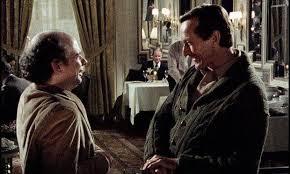
When we left off, Wally was just arriving at the fancy restaurant to which Andre had invited him. While Andre seems quite comfortable in his immediate surroundings throughout the film, he has not been well; in fact it is clear that he has experienced a prolonged period of painful self-questioning. Wally tells us in the voice-over that he re-connected with Andre only after a mutual friend (George Grassfield) found Andre weeping in the street:

George had been out walking his dog in some odd section of town when he had suddenly come upon a solitary man leaning against a crumbling building, sobbing uncontrollably. Well, George was about to walk by rapidly, as one does in New York, when he suddenly realized that the man was Andre {…} Andre explained to him that he’d been watching the Igmar Bergman movie Autumn Sonata about twenty-five blocks away, and he’d been seized by a fit of ungovernable crying when the character played by Ingrid Bergman had said, “I could always live in my art, but never in my life” (19).

It turns out that a few years previously Andre had lost the ability to “live in his art,” and began to struggle with living his life as well. Wally meets Andre, they embrace (“I remember, when I first started working with Andre’s company, I couldn’t get over the way actors would hug when they greeted people. ‘Now I’m really in the theater’, I thought” (20)) and move to the bar. Wally tells Andre that he looks “terrific” to which Andre responds “Well, thank you. I feel terrible” (20). 

This exchange is a touchstone for the entire film, and also stands as a joke that can only be appreciated after seeing the whole film as the issue between how we read the surface expressions of our friends or lovers and how surface impressions often mask deeper issues and problems pervades the film. The exchange also indicates the shallowness of Wally’s observation of Andre at this point in the film, and his desire to simply get through the evening, even if this requires a reliance on cliche. Wally’s uncertainty about the state of his friendship with Andre and the state of the evening leads him to fall back on his “secret profession” as a private investigator. He begins to question Andre about his experiences and Andre begins his tale, which, from the very beginning, oscillates between profundity and absurdity, and between self-knowledge and self-pity.

About five years previous Andre had been invited to Poland to teach a workshop by a fellow director Jerzy Grotowski. He didn’t want to go “because, really, I had nothing left to teach. I had nothing left to say. I didn’t know anything. I couldn’t teach anything. Exercises meant nothing to me anymore. Working on scenes from plays seemed ridiculous. I didn’t know what to do” (22). Grotowski tells Andre to ask for anything he’d like as an attempt to lure him, and Andre responds: “If you could give me forty Jewish women who spoke neither English nor French, either women who have been in the theater for a long time and want to leave it but don’t know why, or young women who love the theater but have never seen a theater they could love, and if these women could play the trumpet or the harp, and if I could work in a forest, I’d come” (22). Grotowski can’t come up with forty Jewish women, but he comes close and finds forty women, plus some men, all of whom are questioning the theater and none of whom speak English. He also finds for Andre a forest which is populated by only “some wild boar and a hermit” (23). Andre agrees to go to Poland.

What we see here is that Andre, unable to live in his life or his art, is looking to get out of his comfort zone; he courts discomfort and discombobulation. He is, in short, a seeker. Once in the forest, Andre is adrift: “technically, of course, technically, the situation was a very interesting one, because if you find yourself in a forest with a group of forty people who don’t speak your language, then all your moorings are gone” (24). This potentially scary situation forces the participants back onto themselves in the absence of familiar structure, organization, hierarchy, or character. Andre likens what occurred in the forest to improvisation, but “in this case you’re the character, so you have no imaginary situation to hide behind. What you’re doing, in fact, is asking those questions that Stanislavski said that the actor should constantly ask himself as a character–Who am I? Why am I here? Where do I come from? and Where am I going?–but instead of applying them to a role, you apply them to yourself” (25-26). 

And indeed the first three quarters of the film is primarily dedicated to the story of Andre’s travels as he tries to answer precisely these questions. The Polish episode, which lasts for several minutes in the film and several pages in the script, has two parts; Andre attends a “beehive” in town and then decamps to the forest with his “workshop”. Grotowski tells Andre about the beehive which Andre decides to attend. Grotowski then asks Andre to lead the beehive: “And I got very nervous, you know, and I said, ‘Well, what is a beehive?’ And he said, ‘Well, a beehive is, at eight o’clock a hundred strangers come into a room.’ And I said, ‘Yes?’ And he said, ‘Yes, and then whatever happens is a beehive” (27).

The beehive begins with a women singing a song of St. Francis and the hundred strangers join in; when this runs its course Andre breaks up the activity. One woman in the group had brought a teddy bear, and Andre uses the bear as a means of breaking the frame of the beehive. The way he describes his action is revealing, and leads us into the main point of this post: “Now there is, of course, as in any improvisation or a performance, an instinct for when it’s going to get boring. So, at a certain point, but I think it may have taken an hour to get there, or an hour and a half, I suddenly grabbed this teddy bear and threw it into the air” (29-30). The singing ends, and the group re-forms into two circles doing a rhythmic dance; the teddy bear flies around the room; Andre “{gives} the teddy bear suck” (31); and a number of people cluster around some candles. “I felt in that moment I could go with my own impulse, you know, and follow my impulse instead of trying to be aware of the whole thing–I saw that Grotowski had his hand right in the flame and was holding it there {…} and I wondered if I could do it” (32-33). Andre succeeds in keeping his left hand, but not his right hand, in the flame, and in due time, the beehive having gone well, Andre wants to wrap it up. Again, he uses the word impulse: “My impulse is that if the show’s been good–get out and leave them laughing” (33). But what differs with this performance is that the participants won’t leave at any determined time, but rather “the farewell took two hours, at least, because nobody left until they had a true impulse to leave” (34). 

In the span of just a few minutes, Andre uses the word “impulse” four separate times. People leave the beehive at their own speed and on their own terms, and for Andre, in retrospect, this seems to have been the point of the exercise: “You see, also we’re talking about trying to find the truthful impulse, to not do what you should do or ought to do or what is expected of you, but trying to find what it is that you really want to do or need to do or have to do” (34).

The whole discussion of Poland, the beehive, and the forest is predicated upon Andre’s insecurity and inability to live either in his art or in his life. Thus, he is seeking some kind of liminal band where art and life meet and in which authentic action can be achieved. The key point here is that this liminal band, this performance space on the margins of art, where art bleeds into life and vice versa, is very much a constructed space. Andre is aware of this, and introduces the beehive explicitly as a type of performance: “I remember watching people preparing for this evening, and of course there was no makeup, there were no costumes, but it was exactly the way people prepare for a performance. You know, people sort of taking off their jewelry and their watches and stowing them away and making sure it’s all secure” (29). Likewise, at the end of the evening “everyone put on their earrings and their wristwatches and went off to the railroad station to drink a lot of beer and have a good dinner” (35). Presumably, over dinner and drinks the beehivers reverted to their “normal,” non-performative selves; after all, they were wearing their jewelry and their watches.

The point here is that although Andre’s account of the beehive suggests something both exciting and moving, the energy required to run the beehive, as well as the freedom required to act on impulse, are only made possible by the very artificiality of the scenario. The shedding of jewelry and watches is an indicator of the intentionality of the evening, a marker that tells us that the normal rules of daily life and human interactions will be suspended. So, while the beehive is not exactly theater, and not exactly performance, for most adults the impulse to throw teddy bears and hold one’s hands in candle flames can only be acted upon under deliberately constructed and constrained conditions. The challenge for Andre throughout his travels is how to “find the truthful impulse” within the context of everyday life.

Throughout the first three-quarters of the film Wally’s input into the conversation is limited almost entirely to “uh-huh,” “ha ha,” “God, really” and “So, what happened then?” We will see in a later post, however, that when Wally does become comfortable enough with the conversation he challenges Andre on exactly this point, asking if it is necessary to travel to the ends of the earth to have an authentic and “real” experience. Indeed, the issue of authenticity arises again and again throughout the film; one way that Andre and his group in Poland attempts to create authenticity is through ceremony. Ceremony, baptisms, mock funerals, sacraments, these are central features of “My Dinner with Andre,” and as Andre and his company prepare to leave the Polish forest his group engages in ceremony in order to celebrate his leadership: “On the final day in the forest the whole group did something so wonderful for me, Wally. They arranged a christening–a baptism–for me. And they filled the castle with flowers. And it was just a miracle of light, because they had set up literally hundreds of candles and torches. I mean, no church could have looked more beautiful” (36). One of the things which strikes me when watching the film is the extent to which Andre in his years of wandering seems to have depended on such ceremonial interludes–it is almost as if simple diurnal existence without explicit indexing of exceptionality and consecrated ceremony was not sufficient to satisfy his longing for authentic, meaningful experience.

So, where does this leave us? Certainly, we can relate to Andre’s desire to forge from ordinary experience a sense of life as sacrament and ceremony, can relate to the urge to transcend the mundanity of the daily grind, whether, as for Andre, this be embodied by “working on scenes” or by the routine of the office and one’s commute. But it is not as easy as all that. At the end of the film, Andre himself admits as much when he says: “I can imagine a life, Wally, in which each day would become an incredible, monumental creative task–a life in which everybody would just go with their impulses, all day long–they would just be themselves every moment, with others. And we’re not necessarily up to it” (109). But perhaps the problem lies deeper yet, and closer to the bone–the very strictures which Andre seeks to escape, those of form, of structure, of organizational reality, of hierarchy and deference, of repression of impulses and desires, these are what make social life in fact possible in the first place. Read thusly, Andre’s quest has about it an element of fundamental futility, of quixotic insistence on a purity of action that is unsustainable within the context of actual social life.

And yet, this is only one side of the argument. I fully understand the impulse behind the desire to act on impulse, understand as well the urge to create a space where anything goes, a space at once dangerous (in the range of actions that can be sanctioned by a sequestered zone which recognizes the viability of non-normal activity) and safe (in the fact that the other participants are trusted to remain “in-group,” and therefore to “behave” within the broadest definition of the term). When I was in university, some friends and I engineered an evening of “pants down.” Four of us sat around a friend’s dorm room sans trousers etc. and then attempted to act as normal as possible. One of us was gay. The exact rationale for the stunt now escapes me, but the general idea was to test to what degree pants were necessary for normal life to proceed. While nothing particularly memorable was said or done, the evening remains memorable: my primary memory is the initial frisson which accompanied the experiment–it felt like we were putting something on the line. Andre through the film suffers from a similar need to put himself on the line.

The trouble with authenticity and living on impulse is, simply, that one person’s authenticity is another’s callousness; one person’s impulse is another’s betrayal; one person’s honesty is another’s arrogance. Believe me on this last point, dear reader, for I know of what I write. Still, even for the more responsibly minded among us there are moments when the tissue which constrains our behavior within the realm of social acceptability begins to fray, and the liminal zone between life and art, between normality and some version of outre performance, may appear on our event horizon. In “My Dinner with Andre,” Andre moves from the intentional structuring of events in which the barrier between acceptable and bizarre may be broached, to simply ignoring this barrier altogether, and finally back to more class-appropriate activities such as telling tall tales of lost years over fine wines in a Manhattan restaurant. This is not to suggest, however, that Andre’s concerns are rendered in any way passe by the film–indeed the issues which his relentless self-questioning brings to bear haunt one past bedtime, and deep into the night.

* This post deals with pages 19-37 of the screenplay.

to be continued…

On the Film “My Dinner with Andre” Part I: Wally in New York

Note: Opening a multi-part early series from my first blog Classical Sympathies back in 2009, this piece takes up the beginning of Wallace Shawn’s walk through New York en route to his meeting with André Gregory in My Dinner with Andre, using Wally’s voice-over as a lens on artistic precarity, everyday survival, and the comic disproportion between existential weight and mundane errands. The note situates the film’s opening movement as both narrative setup and philosophical framing: a winter city of post offices, xerox shops, and unanswered calls becomes the psychological prelude to a conversation that will later expand into memory, performance, and self-mythology. This installment follows Wally up to his arrival at the restaurant for the pre-dinner drink, where the film’s central encounter is still suspended in anticipation, and meaning is generated less by action than by the act of getting there.

My Dinner with Andre is the famous, or infamous, 1981 film of a dinner conversation between Wallace Shawn, the actor and playwright, and Andre Gregory, the theater director. If I were to make a twofold claim for the film: i) that it is one of the most action packed films ever made, and ii) that it effectively encapsulates the thematics of the entire 20th century, I do not think this would be overstatement. My intent here, however, is not to establish either of these postulates, but rather to simply “blog” the script in the hopes that what needs to be said works its way to the surface. Fair warning: the undertaking will require several posts.

Money crops up on two of the first three pages of the script, and because money, and the lack of it, is a theme that runs beneath the entire script: Andre has money, has the freedom to travel and to spend several years trying to “find himself”; Wally does not. Still, “having money” is, as ever, a relative concept. At the opening of the film, Wally is seen walking through the streets of New York, heading for the restaurant where he is to meet Andre. It appears to be winter, maybe February. In the opening voice-over, Wally ruminates on the life of the artist: The life of a playwright is tough. It’s not easy, as some people seem to think. You work hard writing plays, and nobody puts them on. You take up other lines of work to try to make a living–acting, in my case–and people don’t hire you. So you spend your days crossing the city back and forth doing the errands of your trade. Today wasn’t any easier than any other day. I’d had to be up by ten to make some important phone calls, then I’d gone to the stationary store to buy envelopes, and then to the xerox shop. There were dozens of things to do. By five o’clock I’d finally made it to the post office and mailed off several copies of my plays, meanwhile checking constantly with my answering service to see if my agent had called with any acting work. In the morning, the mailbox had been stuffed with bills. What was I supposed to do? How was I supposed to pay them? After all, I was doing my best (17).

One of the marvelous things about the film is the tongue-in-cheek humor that is rarely, if ever, directly alluded to. A deeply serious film, Andre is also a comedy, a fact which we can recognize because we see that the writers are having fun with the characters who are in turn themselves. That is, Wally and Andre are playing versions of themselves–we assume that most of the experiences that Andre recounts in the film are based on real experiences, and that Wally’s account of his home life is more or less true to life–but exaggerated versions. As Shawn says in the preface to the script, “I knew immediately that {…} I’d have to distort us both slightly–our conflicts would have to become sharpened–we’d have to become–well–characters {…} It would be an enormously elaborate piece of construction” (14). In this initial passage, the humor lies in Wally’s conception of a difficult life: “I’d had to be up by ten to make some important phone calls.”

Wally’s sense of pressure is, from the outset, deliberately out of proportion to the scale of his circumstances. The tone is one of genuine complaint, but the complaint itself is almost comically domestic: the architecture of a “hard day” is built out of errands, envelopes, xerox shops, and an answering service that may or may not contain salvation in the form of an acting job. What Shawn achieves here, and what the film quietly sustains, is a recalibration of seriousness—where existential weight is not attached to grand events but to the texture of administrative survival. Wally’s New York is not a place of romance or revelation, but of circulation: between post office, mailbox, and telephone, as though modern artistic life has been reduced to a loop of deferred contact with recognition.

At the same time, the humor is never fully separable from sincerity. Wally is not merely being mocked; he is also articulating a recognisable condition of artistic precarity, one that the film refuses to glamorize. The genius of the opening monologue lies in this double register: we are invited to laugh at the disproportion between emotional tone and material fact, but we are also made to recognise how easily that disproportion becomes a lived reality. The “dozens of things to do” are not nothing; they are just insufficiently legible as crisis, which is precisely what makes them feel like crisis.

By the time Wally finally moves through the city toward the restaurant, the structure of the film has already been quietly established: this is a world in which meaning is not delivered through events but through the way events are narrated to oneself while walking between obligations. New York, in this sense, is not a backdrop but a medium of self-composition—an environment in which thought is constantly being assembled under mild pressure, as though consciousness itself were an errand.

He checks the time again, as he has been doing throughout the afternoon, and adjusts his route slightly, not out of urgency so much as orientation. The meeting with André already exists in his mind as something slightly unreal, a fixed appointment that has not yet been granted substance by arrival. He crosses another block, passes into the thinning evening light, and begins to approach the restaurant where, for the first time that day, the structure of waiting will shift from solitary to shared.

to be continued…

Some Older Poems

Note: These four poems come from an early era of my writing life—where satire, associative logic, and linguistic mischief are all still operating at full voltage and without much concern for genre stability. They move freely between cultural detritus, private irritation, and comic metaphysics, as if trying to test how far language can bend before it either collapses into nonsense or reveals a hidden structure underneath it. What holds them together is less any single theme than a consistent tone of alert instability: a mind watching itself generate connections in real time, amused by its own excesses but also half-suspicious of what they might mean. Read together, they sit somewhere between parody, dream-logic, and cognitive overproduction—early signals of a style that treats thought not as expression of meaning, but as an event that happens in language.

Inspired by Robyn Hitchcock

The urge to pen nonsense descending

This seems an appropriate forum

For all my synapses are blending

And my skull has become rather warm

Hurrah for men in long white beards

Kris Kringle and Komani

Who, hypnotized, disclose deep fears

Of the seamstress Miss Delany

‘Cause there’s a mistake with a head-cold

There’s a death-wish with nine lives

There’s a blowpipe with a blindfold

And it’s stalking both your wives

There’s my niece in a wave function

A control freak in a kilt

And they waltz without compunction

On the philosophy you built

When skeletons meet

Bones get up on their feet

For square dancing

The mandibular dreamers

Mirrored a phalanx of femurs

And they all started prancing

Yes, the babe he loves best is his manageress

But she’s frigid

Everytime she comes round

His spirits get down

But he’s rigid 

The houses she owns

Are deliberate clones

Of the suburbs

Lights go on with a clap

Every mouse to its trap

In the cupboards

I found a crème-egg in a fern

It was hatching and snatching in turn

I chose not to come all that close

For fear that it might be verbose

Oh, I wish I could write an acrostic

And that chemicals weren’t so caustic.

I wish that my lunch-trays were blue

Or speckled like they are at the zoo

But quarrels came as quarrels will

Concerning pilfered cherries

When I got up to press a pill

Some bastard thieved my necessaries

A creaking neck, a morbid thought

The story of an evening

We wish we were what we are not

And now I must be leaving

The Paperless Office

The paperless office is dead

It’s long since been put to bed

Though we claim to ‘ave gone green

You must know what I mean

The paperless office’s been stood on it’s head

The paperless office has flipped

The idea was just a blip

We print quite promiscuously

Use A4 insistently

The paperless office papers on at a clip

The paperless office’s defunct

The concept has flat-out flunked

The paradox being

We’re surrounded by screens

But the paperless office is sunk

The Present

a form is filled

money is sent

a conscience is salved

a small difference is made

while somewhere

under the cover of darkness

or in the light of day

the beat down goes on

Limerick

A pious reformer named Mather

was frequently known to blather

about the great judgment hour

but the word from the shower

was that Mather knew his way around lather

On the Song Prince Hal’s Dirge: Confidence, Reformation, and the Politics of Self-Making

Note: This short essay takes Loudon Wainwright III’s song “Prince Hal’s Dirge” as a lens through which to revisit Shakespeare’s Prince Hal in Henry IV, focusing on the idea of self-fashioning across time. It reads Hal’s apparent debauchery and later reform not simply as moral transformation, but as a theory of confidence—either consciously staged, in Shakespeare’s version, or more instinctively internalized in Wainwright’s. Moving between text and song, the piece explores how both versions hinge on the same underlying question: what kind of inner structure allows a self to pass through disorder, delay, and social misreading without collapsing, and to reconstitute itself as effective action when the moment arrives.

Epigraph:

Take me to the ale house
Take me to the whorehouse.
If I vomit, keep me off of my back.

Loudon Wainwright

This piece takes as its source the song “Prince Hal’s Dirge” by Loudon Wainwright III, itself based on Shakespeare’s character Prince Hal from Henry IV. The figure of Hal is one of Shakespeare’s most carefully constructed political selves: a young man who deliberately inhabits disorder in order to make his eventual reformation into kingship appear all the more legitimate, even necessary.

In Henry IV, Hal openly announces this strategy to Falstaff and the other tavern companions:

I know you all, and will awhile uphold
The unyoked humor of your idleness.
Yet herein will I imitate the sun,
Who doth permit the base contagious clouds
To smother up his beauty from the world,
That, when he please again to be himself,
Being wanted, he may be more wondered at
By breaking through the foul and ugly mists
Of vapors that did seem to strangle him.

And again:

So when this loose behavior I throw off
And pay the debt I never promised,
By how much better that my word I am,
By so much shall I falsify men’s hopes;
And, like bright metal on a sullen ground,
My reformation, glitt’ring o’er my fault,
Shall show more goodly and attract more eyes
Than that which hath no foil to set it off.
I’ll so offend to make offense a skill,
Redeeming time when men think least I will.

Hal’s logic is explicit: he will cultivate disorder as a kind of aesthetic and political foil. His apparent immersion in low company is not failure but strategy. Falstaff and the tavern world become, in effect, instruments in the staging of legitimacy.

Paraphrased, Hal is saying: I will live among you for a time, but only in order to abandon you later in a way that maximizes my transformation into kingship. He is a political animal who understands reputation as something staged across time.

Loudon Wainwright III’s “Prince Hal’s Dirge” takes up this same figure, but shifts the emphasis in a revealing way. Wainwright—still best known to many for novelty songs like “Dead Skunk,” though his broader body of work is far more substantial—reimagines Hal less as calculating strategist and more as self-contained performer of confidence within disorder.

The song opens in full immersion in debauchery:

Give me a capon
And some roguish companion,
A wench and a bottle of sack.
Take me to the ale house
Take me to the whorehouse.
If I vomit, keep me off of my back.

Here Hal is not yet strategy, but appetite. The political mask is absent; what remains is the world of consumption, drink, sex, and collapse.

But Wainwright then pivots:

My father, he thinks I’m a good for nothing
that I won’t amount to much.
But he’s not aware of my secret weapon.
I can count on myself in the clutch.

This is the key transformation. Shakespeare’s Hal is self-consciously future-oriented: he plans his reformation as spectacle. Wainwright’s Hal, by contrast, carries an interiorized assurance that he will simply “come through.” The emphasis shifts from calculation to instinctive resilience.

This continues in the song’s martial register:

Show me a breach,
I’ll once more unto it.
I’ll be ready for action any day.
I’ll straighten up, and fly most righteous.
In a fracas, I’ll be right in the fray.
I can drink you under twenty-five tables,
Fight and be a ladies man.
But all this will change,
When I’m good and ready,
To become the king of this land.

The phrase “any day” is doing important work here. It carries the rhetoric of readiness without commitment to timing. It suggests immediacy while quietly deferring it indefinitely. The transformation is always available, never enacted.

What emerges is a different psychological structure from Shakespeare’s original. Shakespeare gives us a political actor who consciously engineers perception over time. Wainwright gives us a man who believes in a durable inner core of competence—someone who can be disordered without being undone.

And yet both versions converge on the same underlying mechanism: confidence as political force. Whether staged (Shakespeare) or internalized (Wainwright), Hal’s power rests on the belief that identity can survive its own contradictions and ultimately reorganize them into legitimacy.

Singing “Prince Hal’s Dirge” before work, I find myself struck less by the irony of Hal’s transformation than by the necessity of something like an unbreakable interior core—something sealed enough to survive fluctuation, failure, and delay, but still flexible enough to return to action when required.

That, ultimately, is what both Shakespeare and Wainwright are circling: not morality, not reform, but the strange political psychology of self-belief under time pressure.

Dedication:

For my father, the biggest Shakespeare lover I know.

Note: If you liked this piece, you may also like the pieces below which also take up various literary works.