Note: We don’t do a lot of film reviews here, but Code 46 earns the exception—partly because Michael Winterbottom is one of my very favorite directors, and still wildly underrated, and partly because this film quietly seeps into you in a way that feels unshakable; set in a world that is clearly not ours but just similar enough to be discomforting—real Shanghai that isn’t quite real, deserts that feel earned, a system of “cover” and genetic law that replaces freedom without ever announcing itself—the film follows William, a kind of intuitive investigator who lives more than feels, and Maria, who works in a bureaucratic “fate factory” and senses, before she knows, that something is already off; their connection unfolds in fragments—interrogation as flirtation, impulse as rebellion, intimacy as violation—until the central truth emerges: in a world where memory can be edited and biology legislated, even love itself can be illegal; the genius of the film is its restraint.
Tim Robbins and Samantha Morton don’t overwhelm you with chemistry, which actually makes the relationship feel more provisional, more real, more doomed—and by the time the system reasserts itself (memory erased, lives restored, Maria exiled with the burden of remembering), you realize the film hasn’t been building to a climax so much as a quiet erasure; it’s less than 90 minutes, barely announces its futurism beyond small details (languages blending, empathy viruses, low-fi surveillance), and yet it lingers in a way much louder films don’t; it also clearly fed into the DNA of the Thin Man—this idea of movement through controlled spaces, of intuition over evidence, of relationships that feel both fated and structurally impossible—and in that sense it’s not just a film I admire, it’s one that got under the skin and stayed there.
Michael Winterbottom’s Code 46 is less a conventional sci-fi film than a drifting, half-lucid meditation on love, control, and memory. It runs under 90 minutes, but it feels strangely elongated—like a dream you keep slipping back into.
The hero, William (Tim Robbins), isn’t exactly living—he’s existing. A kind of insurance investigator, a “driver” moving through a world defined by pollution, restriction, and bureaucratic control. This isn’t the neon overload of something like Blade Runner—Shanghai here feels real, but off. The deserts outside the cities are harsh and empty; if people can’t get “cover” to move, there’s a reason. The world is closed, stratified, quietly oppressive.
William is established early as compassionate—at a checkpoint, he shows a kind of human softness that marks him apart. But he’s also slippery. He bluffs and charms his way through situations, his “cunning” explicitly noted as one of his professional tools. He doesn’t rely on evidence so much as intuition: “It’s intuition you’re paying for.”
Maria (Samantha Morton) narrates parts of the film, grounding it in something more intimate and unstable. Her sense of time is fractured—lucid dreaming, recurring visions, a sense that something is about to happen. “Every year I have this dream… is this the night I wake?” There’s a constant feeling that fate is closing in. She works in what is essentially a “fate factory,” issuing the cover documents that determine where people can go and what they can do. In this world, fate substitutes for freedom.
When William meets Maria, there’s an immediate sense of déjà vu—she feels she’s met him before. Their early interactions blend interrogation and flirtation. The dynamic is unusual: older man, younger woman, but the aesthetic—her shaved head, the stripped-down environments—blunts the cliché. Their connection feels tentative, exploratory. She tests him; he reads her. There’s attraction, but it’s not fully trusted on either side.
Their relationship develops in fragments: subway encounters, shared meals, small rule-breaking gestures. William knows she’s impulsive—she admits it. The film introduces the idea of engineered “viruses” that alter human ability—perfect pitch, empathy. It’s a strange, understated sci-fi touch that reinforces how mediated everything is, even emotion.
There’s a looseness to their chemistry. Robbins and Morton don’t generate overwhelming heat, but that actually works. The relationship feels uncertain, provisional—two people circling something they don’t fully understand. Their intimacy is uneven, sometimes tentative, sometimes urgent. Maria seems to need William more than he needs her, or at least she feels the stakes more sharply.
The world around them continues to intrude. There are hints of smuggling, of bureaucratic corruption, of quiet desperation. Maria has lived “outside” for ten years—without cover, presumably—which raises questions the film never fully answers. William’s moral stance, when it emerges, feels weak, almost performative.
When he returns home, he tries to reassert control—rejecting Maria, then calling her back. But the narrative destabilizes. A colleague dies; William is sent back to investigate. The technology—video links, surveillance—feels oddly low-fi, as if the future never quite fully arrived.
As William digs deeper, the film’s central taboo emerges. Maria has violated Code 46—a genetic restriction law. Through fragments of dialogue and investigation, William pieces together the truth: they are biologically too similar. A “50% match.” Worse, her mother was a clone—one of many. The implications are quietly devastating.
Maria’s past is altered—an illegal pregnancy erased, along with the associated “memory cluster.” Identity itself becomes unstable. Memory, love, and experience can all be edited, removed, rewritten.
Their attempts to escape—to flee together, to build something outside the system—feel almost doomed from the start. The idea of Jebel Ali, drawn from her father’s stories, becomes a kind of imagined refuge. But the system closes in. A car crash. Memory erasure. Reintegration.
In the end, William is returned home, restored to his life, his wife, his routine. Covered for. Maria, by contrast, is exiled—sent out into the desert with her memories intact. She becomes the one who remembers, who carries the weight of what happened.
The final note is pure loss. Lost love, stripped of even the possibility of reunion. Maria staring out into the distance, holding onto something the world has decided should not exist.
Code 46 is not a perfect film. It’s uneven, sometimes opaque, and emotionally muted in ways that can frustrate. But its ideas linger. It captures something rare: a future where control is soft but absolute, where love is possible but prohibited, and where memory itself becomes the final battleground.
Note: The disintegration model in Enneagram theory is often presented as a stable directional map—types “move” under stress into predictable neighboring patterns. But in lived experience, this model can become overly schematic and psychologically flattening.
What it risks missing is that what looks like “disintegration” is often not a movement into another type, but a loss of functional integration across multiple systems at once: attention, affect regulation, impulse control, social adaptation, and narrative coherence do not shift in a single vector. They fragment unevenly.
In practice, what gets labeled as disintegration may include: regression into earlier learned coping strategies rather than type-specific movement; situational adaptation under constraint (not structural change); nervous system overload presenting as behavioral inconsistency; or simply fatigue states misread as typological drift.
The model also assumes a kind of psychological symmetry between integration and disintegration paths that is not always empirically supported. Integration often feels like increased flexibility and coherence, but “disintegration” can be indistinguishable from stress, grief, substance effects, sleep deprivation, or environmental pressure.
The core critique is therefore structural: The disintegration pathway is better understood as a metaphor for destabilization under load, not a reliable map of personality transformation.
Which means its value is poetic and heuristic, but limited as a diagnostic or predictive framework for actual human behavior over time.
Epigraph
These days I feel immune To all the sadness and the gloom If things fall into place Get onto the right side of grace
— The Jesus and Mary Chain
Introduction and Thesis
This paper takes a direct and critical look at the Enneagram concept of the “direction of disintegration,” more recently reframed as the “stress point.” While various authors and teachers—including Don Richard Riso and Russ Hudson—have attempted to soften or reinterpret this terminology, the underlying assumption remains largely intact: that movement in one direction represents growth, while movement in the other reflects regression under stress.
This paper challenges that assumption directly. I argue that if one of the central aims of Enneagram work is to evolve through the full set of connecting points (for example, 5–8–2–4–1–7), then the so-called “direction of disintegration” cannot coherently be understood as purely regressive. On the contrary, it may represent a necessary and even ultimate phase of development—one that completes the circuit rather than deviating from it.
More specifically, I propose that what is commonly termed “disintegration” is better understood as the destabilizing emergence of previously repressed or underdeveloped capacities. Movement along these lines—particularly under conditions of stress—may therefore appear chaotic or maladaptive in the short term, while in fact reflecting the early stages of a deeper and more comprehensive integration. In this sense, the concept of “disintegration” does not merely mislabel the process; it obscures its developmental significance.
This perspective may be further illuminated by comparison with cyclical models of development, including certain strands of Buddhist thought, in which the movement from undifferentiated being through structured identity and back toward a more integrated state is understood as a continuous process. From this vantage point, the so-called “direction of disintegration” may be interpreted not as a fall from development, but as a return toward a more foundational mode of experience—one that has been obscured, rather than lost, in the formation of personality.
Personal and Theoretical Grounding
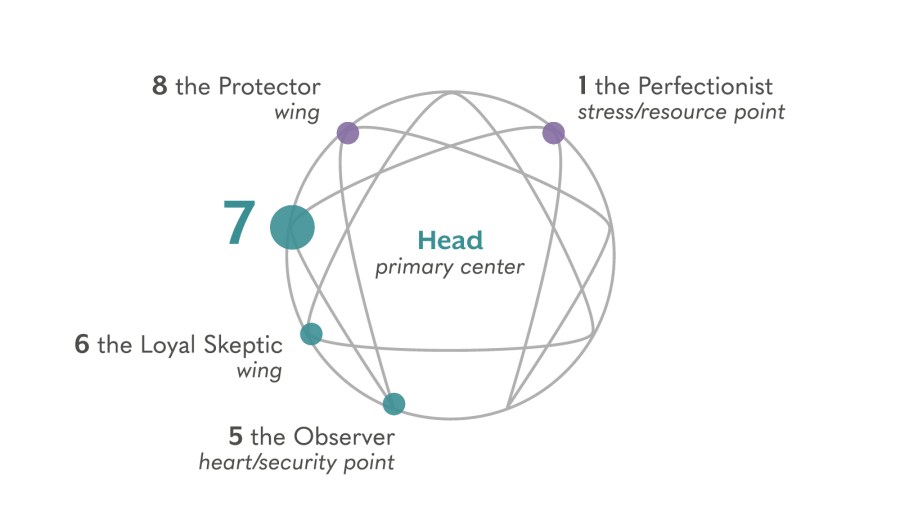
My interest in this question is not purely theoretical. From the outset, I found the concept of “disintegration” difficult to reconcile with lived experience—particularly in relation to my own type, Type 5. In the standard model, the Five is said to disintegrate toward Type 7, exhibiting scattered, excessive, or escapist tendencies under stress. While I recognize the descriptive accuracy of this account at certain levels of functioning, it does not fully capture the experiential reality of the movement.
In my own case, the movement toward 7 has not been merely regressive. On the contrary, it has often represented access to states that feel more expansive, embodied, and alive than the constrained intellectualism of the core Five structure. This raises a fundamental question: if the experiential quality of this movement can be described as more “whole” rather than less, in what sense can it be understood as disintegration?
One possible answer lies in the developmental origins of type itself. If personality structure is understood, as Don Richard Riso and Russ Hudson suggest, as a provisional adaptation formed in early childhood, then it is reasonable to ask what precedes that adaptation. It is at least conceivable that what emerges in the movement toward the so-called disintegration point is not simply dysfunction, but the reactivation of capacities that were present prior to the consolidation of type—capacities that were subsequently repressed in the service of psychological survival.
In this light, the apparent instability of “disintegration” may reflect not breakdown, but overload: the sudden return of domains of experience—such as sensation, spontaneity, or emotional intensity—that the personality has not yet learned to integrate. What appears as regression is, in this sense, the difficulty of expansion. The task is not to avoid this movement, but to engage it consciously, such that what begins as turbulence may ultimately become integration.
Literature Review: The Problem of Directionality in Enneagram Theory
The question of directional movement along the Enneagram’s lines of connection remains one of the least resolved and most inconsistently articulated aspects of the system. While widely taught using the language of “integration” and “disintegration,” there is no clear consensus in the literature regarding the precise meaning, function, or developmental significance of these movements. A review of major contributors to the field reveals a pattern of partial reformulation without full theoretical resolution.
The most influential articulation of directional movement appears in the work of Don Richard Riso and Russ Hudson, particularly in Personality Types (1987/1996) and The Wisdom of the Enneagram(1999). In this model, each type is understood to move along two lines: one toward “integration” (growth) and one toward “disintegration” (stress). Movement in the direction of integration is said to require conscious effort and corresponds to psychological health, while movement toward disintegration is described as automatic, reactive, and associated with declining levels of functioning.
However, this model contains an important and often overlooked tension. Riso and Hudson also suggest that the broader aim of Enneagram development is to move “around the circle,” integrating the positive capacities of all types over time. This implies that the points reached via the so-called direction of disintegration are not inherently pathological, but form part of a larger developmental sequence. The result is a structural ambiguity: movement toward a given point may be framed as regressive in one context and developmental in another, depending on whether it is understood locally (single-step movement) or globally (full-cycle integration). This inconsistency has not been fully resolved within their framework.
Subsequent authors have attempted to refine or reframe this model, often by softening the negative connotations of “disintegration” without fundamentally altering the underlying directional asymmetry. Sandra Maitri, for example, rejects the terminology of stress and disintegration and instead proposes an “inner flow” governed by what she describes as a “logic of the soul.” In her model, forward movement along the lines is driven by a search for fulfillment that ultimately proves unsatisfying, while backward movement leads toward what she terms the “heart point,” associated with a deeper layer of the self or “soul child.” While this approach usefully destabilizes the purely negative interpretation of one directional line, it replaces it with a different asymmetry, privileging backward movement as more essential to growth. Moreover, the conceptual basis of this model remains insufficiently specified, particularly in its account of how and why one direction should be considered developmentally primary.
Beatrice Chestnut builds on and systematizes aspects of Maitri’s approach, offering a more structured reinterpretation of the lines of connection. In her model, movement along both lines can be either constructive or maladaptive, depending on the level of awareness and integration involved. Terms such as “growth through stress” and “security point” attempt to capture the complexity of these dynamics, acknowledging that development may occur through challenge as well as stability. While this represents a significant advance in clarifying the bidirectional potential of the lines, it nevertheless retains an implicit directional logic and does not fully resolve the question of whether one direction should be considered primary, or whether the distinction itself is theoretically necessary.
Other contributors, including Tom Condon, have explicitly questioned the stability of unified directional models. Condon argues that individuals routinely access both connecting points under a range of conditions and that attempts to impose a single, consistent directional pathway oversimplify what is, in practice, a complex and dynamic psychological process. From this perspective, the notion of a fixed “direction of disintegration” becomes increasingly difficult to sustain, as both lines appear capable of expressing high and low functioning depending on context.
Across successive editions and public teachings, Russ Hudson has made a clear and commendable effort to soften the language surrounding the Enneagram’s directional model. Terms such as “disintegration” have increasingly been reframed as “stress,” and there is greater emphasis on the idea that no movement within the system is wholly negative. This shift toward more “warm” and less judgmental language reflects a broader maturation within the field and has undoubtedly made the system more accessible and psychologically usable.
At the same time, this evolution in terminology has not been matched by a corresponding clarification of the underlying theory. The central asymmetry—where one direction is implicitly associated with growth and the other with regression—remains largely intact, even as the language used to describe it has become more neutral. As a result, the model continues to carry an unresolved tension: it acknowledges that all points contain both higher and lower expressions, yet continues to treat movement toward certain points as fundamentally stress-based rather than developmentally necessary.
As other contributors have begun to explore more symmetrical and developmentally integrated interpretations of the lines, the persistence of the traditional asymmetry begins to feel less like a settled conclusion and more like an inherited assumption that has yet to be fully re-examined.
In this respect, the field appears to have reached a transitional stage. The vocabulary has evolved, the teaching has broadened, and important correctives have been introduced. Yet the underlying structure of the model—particularly with respect to directional movement—remains theoretically underdeveloped. For a system that places such emphasis on precision of language and clarity of inner dynamics, this gap is not insignificant. It suggests that what has often been treated as a foundational principle of the Enneagram may, in fact, remain an open question—one that calls for more direct and systematic reconsideration.
Applications: Reconsidering the Nine Directional Movements
If the preceding analysis is correct, then the implications must be demonstrated concretely across the system itself. What follows is a re-examination of each of the nine directional movements traditionally described as “disintegration.” In each case, I argue that what has been labeled regression can be more accurately understood as the activation of a higher function—a necessary but often turbulent phase of integration.
Type 1 → Type 4: Emotional Depth as Higher Function
In the conventional model, Type 1 “disintegrates” to Type 4, becoming moody, self-absorbed, and emotionally volatile. The principled, rule-oriented One—committed to order and correctness—appears to lose stability and fall into irrational feeling states.
However, this interpretation overlooks the rigidity inherent in the One’s structure. Ones tend to operate within strict internal frameworks, often fearing deviation from what is “right.” This can produce clarity and integrity, but also emotional constriction and black-and-white thinking.
Movement toward Type 4 introduces a necessary counterbalance: emotional depth, nuance, and subjectivity. The Four’s capacity for feeling, imagination, and romantic engagement allows the One to move beyond mere correctness into lived experience. What appears as instability may, in fact, be the early and uneven integration of emotional life. A One who cannot access this domain risks becoming brittle and overly moralistic. The 1 → 4 movement, properly integrated, expands the One’s humanity.
Type 2 → Type 8: Assertion as Higher Function
Type 2 is traditionally understood to “disintegrate” to Type 8, becoming aggressive, domineering, and self-centered. The caring, other-oriented Two is seen to abandon empathy in favor of force.
Yet the Two’s structure often involves excessive attunement to others at the expense of the self. Twos may defer, accommodate, and seek approval, losing touch with their own needs and convictions.
Movement toward Type 8 activates the capacity for directness, strength, and self-assertion. The Eight’s willingness to say “this is what I think” or “this is what I need” is precisely what the Two lacks when overextended. While this shift may initially appear abrupt or even confrontational, it represents a critical step toward autonomy. The 2 → 8 movement allows the Two to embody their own authority rather than living exclusively through others.
Type 3 → Type 9: Grounded Presence as Higher Function
In the standard model, Type 3 “disintegrates” to Type 9, becoming disengaged, complacent, and apathetic. The driven, success-oriented Three is seen to lose momentum and fall into inertia.
However, the Three’s relentless focus on achievement can lead to over-identification with external validation and performance. The constant pursuit of success may obscure deeper questions of meaning, connection, and being.
Movement toward Type 9 introduces stillness, acceptance, and presence. The Nine’s capacity to step out of striving and into being offers a necessary counterweight to the Three’s forward drive. This shift can soften the ego’s edge, allowing the individual to reconnect with others and with themselves beyond performance. What appears as loss of ambition may, at a higher level, represent the integration of humility and peace—qualities often observed in mature leaders who transition from personal success to collective contribution.
Type 4 → Type 2: Relational Engagement as Higher Function
Type 4 is said to “disintegrate” to Type 2, becoming needy, dependent, and overly focused on others for validation. The introspective, emotionally rich Four appears to lose depth and become externally fixated.
Yet the Four’s structure can incline toward solipsism—an intense inward focus on personal identity, feeling, and uniqueness. This can limit engagement with others and reinforce a sense of separation.
Movement toward Type 2 opens the Four to relational connection. The Two’s outward orientation—its attentiveness to the needs and feelings of others—provides a pathway out of self-absorption. While this may initially manifest as dependency, it also represents the development of empathy, generosity, and shared experience. The 4 → 2 movement enables the Four to participate in relationship rather than merely reflect upon it.
Type 5 → Type 7: Embodiment and Expansion as Higher Function
Type 5 “disintegrates” to Type 7 in the traditional model, becoming scattered, impulsive, and escapist. The focused, analytical Five is seen to lose coherence and retreat into distraction.
In practice, however, the Five’s core challenge lies in over-withdrawal into the mind. The Five often privileges thought over experience, constructing elaborate internal systems while remaining detached from immediate reality.
Movement toward Type 7 activates sensation, spontaneity, and engagement with life. The Seven’s openness to experience allows the Five to step out of abstraction and into embodied presence. In my own experience, this movement has not been merely destabilizing but profoundly enlivening—an entry into states of being that feel more whole and integrated than the Five’s default stance. The initial excesses of this shift reflect the difficulty of integrating long-repressed domains, not their inherent dysfunction.
Type 6 → Type 3: Self-Confidence and Agency as Higher Function
Type 6 is said to “disintegrate” to Type 3, becoming competitive, image-conscious, and arrogant. The loyal, cautious Six appears to abandon its grounded nature in favor of performance.
However, the Six’s strengths—commitment, vigilance, and reliability—can become limiting when accompanied by self-doubt and over-reliance on external validation. Sixes may hesitate to act decisively, seeking reassurance rather than asserting direction.
Movement toward Type 3 introduces confidence, initiative, and forward momentum. The Three’s capacity to act, to lead, and to project capability is precisely what the Six requires to move beyond hesitation. While this may initially appear as overcompensation, it represents the development of self-trust. The 6 → 3 movement allows the Six to step into authority rather than continually deferring it.
Type 7 → Type 1: Structure and Discipline as Higher Function
Type 7 “disintegrates” to Type 1, becoming critical, rigid, and constrained. The free-spirited, pleasure-seeking Seven is seen to lose joy and become moralistic.
Yet the Seven’s pursuit of experience can lead to fragmentation—constant movement without depth or completion. Avoidance of discomfort may prevent sustained engagement with reality.
Movement toward Type 1 provides structure, discipline, and ethical grounding. The One’s capacity for focus and follow-through allows the Seven to channel its energy into meaningful action. While this shift may feel restrictive at first, it enables coherence and purpose. Real-life trajectories often reflect this movement, as individuals transition from restless seeking to grounded commitment, finding stability where previously there was only motion.
Type 8 → Type 5: Reflection and Restraint as Higher Function
Type 8 is said to “disintegrate” to Type 5, becoming withdrawn, secretive, and overly cerebral. The powerful, action-oriented Eight appears to retreat into isolation.
However, the Eight’s strength can become overextended, leading to dominance and a lack of reflection. Constant outward force may limit the ability to process experience or consider alternative perspectives.
Movement toward Type 5 introduces introspection, analysis, and restraint. The Five’s capacity to step back allows the Eight to refine its actions with insight. This shift does not diminish strength but deepens it, transforming immediate power into considered leadership. The 8 → 5 movement enables the Eight to lead with both force and understanding.
Type 9 → Type 6: Engagement and Commitment as Higher Function
Type 9 “disintegrates” to Type 6, becoming anxious, reactive, and worried. The calm, accommodating Nine appears to lose peace and stability.
Yet the Nine’s desire for harmony can lead to passivity and avoidance. By minimizing conflict, the Nine may disengage from necessary challenges and from their own priorities.
Movement toward Type 6 activates engagement, vigilance, and commitment. The Six’s attentiveness to potential problems encourages the Nine to confront rather than avoid difficulty. While this may introduce anxiety, it also fosters responsibility and active participation. The 9 → 6 movement transforms passive peace into engaged stability, grounded in awareness rather than avoidance.
Conclusion
This paper does not claim to offer a final or definitive resolution to the question of directional movement within the Enneagram. The system itself remains, by the admission of its most influential contributors, a work in progress. What has been offered here is a more limited but, I would argue, necessary intervention: a direct challenge to the prevailing assumption that one line of connection represents “integration” while the other represents “disintegration” or regression under stress.
The analysis presented suggests that this distinction, while historically influential, is conceptually unstable and developmentally incomplete.At a broader level, the persistence of this framework points to a certain hesitation within the field. There remains, at times, a noticeable deference to the foundational formulations of Don Richard Riso and Russ Hudson—a deference that is understandable given their substantial contributions, but which may also inhibit more direct re-examination of their assumptions.
Foundational work deserves respect; it does not require preservation in its original form. In a living field, even the most influential models must remain open to revision where they no longer adequately account for observed experience.The evidence considered here—both theoretical and experiential—suggests that movement along the so-called “direction of disintegration” is not inherently regressive, but often represents the activation of underdeveloped capacities essential for full psychological integration. While this movement may initially appear chaotic or destabilizing, it is better understood as the early phase of expansion rather than contraction. To continue to frame it primarily in terms of breakdown risks obscuring one of the Enneagram’s most valuable insights: that growth frequently occurs through precisely those domains the personality has learned to avoid.If this paper has a broader aim, it is simply to encourage a more direct and less deferential conversation about this aspect of Enneagram theory.
The language of “integration” and “disintegration” has had a long and influential run, but its limitations are increasingly apparent. All theoretical systems, if they are to remain vital, must be willing to outgrow their earlier formulations. It is in that spirit that this argument is offered—not as a final word, but as a contribution toward moving the discussion forward.
Dedication.:
For Tom Condon, the GOAT. And for Lynn.
Note: If you enjoyed this piece you may also like the piece below which also takes up the topic of the Enneagram.
I wrote all night Like the fire of my words could burn a hole up to heaven I don’t write all night burning holes up to heaven no more
Phosphorescent
Note:These reflections were written in March 2019, in the immediate aftermath of a personal experience that destabilized me more than anything I had previously encountered. They were never intended for publication and have not been revised.I’m sharing them now as a record of that moment—not as a finished account, but as a document of what it felt like to be inside it: heightened, contradictory, and often unclear even to myself.
I have written at length about my experiences with the woman I am calling Isobel. You can find the narrative series here, here, and here. You can also find the play I wrote about this time here.
3/28/19:
I went too far. I cannot tell if I went too far on purpose; certainly I pushed and pushed until I came to the end of the line. Like an explorer bent on reaching the furthest possible point, I pushed my mind and body until they could take no more. Now, the wind has gone out of my sails, for how long I cannot say. Perhaps for a long time. Yet I am not at peace, not yet, not now. “I came so far for beauty/ I left so much behind.”
Why was it that I had to roam so far out? What was I running from? Why did I lock my heart up so tightly that it had to explode in order to feel? Was there a point at which I could have taken another turn, or was it all slated to occur just as it did? You can ask why forever and get nowhere. This I know.
So I met a woman and this shook me up. She shook me up. She wasn’t trying to, but she did. My carefully balanced psyche, assembled and jury-rigged over decades, came apart in a matter of days. Anything could have happened, and by the grace of god I was able to retain some kind of governing function, however weak, which helped me stay safe. Over seven weeks everything that could be thrown at me was. I was under massive physical and psychological strain and only my years of amateur study of consciousness and the unconsciousness saved me from succumbing entirely. If I could do it over again (a terrifying notion), I would do almost nothing the same. However, I understand why I made the choices I did. There is little point, really, in interrogating the choices that we made in the light of the circumstances that were in place. Things were, and I reacted to them as I did. There is no getting around this.
Still, I made every mistake in the book. A classic mid-life crisis. Stereo-fucking-typical, scripted to the t. The funny thing is, I knew all about the blueprint and it still happened. “My Dinner with Andre” was a foundation text. I’d read Jung and James Hollis on midlife, extensively. Paradoxically perhaps, the very knowledge of the blueprint may have helped bring the symptoms into being. Or not, maybe I was semi-consciously gathering resources with the implicit foreknowledge that one day they would be needed. Either way, advance information about the terrain only allowed me to stay on my feet—it did not allow me to change course.
I was a Gemini warrior on a private quest, one unseeable from the outside and barely even discernible to myself. So many windmills, so much striving for the grail. To what end? A window seat—a temporary sinacure—and a chance to draw breath at sea level. That’s about it. Can I learn to live as it seems others do, with a little less metaphysical strum und drang, present in the world of the senses, just living? I don’t know what it is like not to live in my head and don’t remember when I started living this way. What I know now though it, it’s a trap. A mire. An maze with no exit. A road to nowhere.
In five years time will this all seem to have been necessary—just part of the process of being a human? God I hope so. That’s what the literature says—the final stage is acceptance. How I am doing with that? I accept that what happened happened. I accept that I made choices that made sense in the moment. I accept that that my personality was in large part a construct and that I am better off without a lot of it. And, I accept the possibility of a silver lining somewhere down the line. The magnitude of the experience and its ripple effects, these are things I am still coming to terms with.
I have seen some things that many will never see. Beautiful and fantastic things, awful things. As a result, I am shaken and somewhat unsteady. That’ll happen when you stray too close to the light. But those things are not mine—they do not belong to me. They have their own location, their own zone, at the edges of the known. I was granted, or gained, access to a sliver of another realm, yet I do not know how deep or how wide that realm is. Right now it is enough to know that it is there, more than enough. Both climbers and divers may feel sick when returning to sea level. I don’t know if I have been climbing or diving or, somehow, both, and in the end it does not matter. Leonard Cohen’s ladies man dies again and again throughout the ages. “It’s like a visit to the moon or to that other star/ I guess you’d go for nothing/ if you really want to go that far.” I didn’t want to go that far, not really, but I did anyway.
===== =====
3/29/19:
Why did I give up on my job? Because let’s face it, I gave up. Let’s get some things out in the open. I managed my energy very poorly for a long time. I was using shortcuts and papering over energetic issues to keep going at the pace I was working. For the last three or four years I was also withdrawing bit by bit—taking more half days off, shrugging more off, and putting off longer term planning that was necessary for the program. I was basically exhausted on an energetic level and this led to taking more time for myself and spending too much money just to get a space to reset—to feel something.
What was it that was so exhausting? As I’ve spoken about to many, the constant pushing of the stone uphill, the constant battle to get needs listened to, was certainly tiring. The feeling that it was really just me, a middle man, at the top of a huge operation and I didn’t have the tools or the power to do the things I needed to. The feeling that there were so many program areas that were not as good as they could be. The growing gap in my marriage which allowed me to seek feeling connections recklessly and a little randomly.
After a while, my psyche was being held together by string, by a thread. I was carrying deep wounds from the past which I hardly knew existed, had hardly ever looked at. I was an unitegrated personality in many ways and have no real root here in Japan. The sense of being included in an extended family that existed when I met my wife was long gone. My dream life was giving me warnings and maybe I could have done something with them. I was primed for a crack-up.
What was it about Elodie that enraptured me so entirely? I think it was the combination and sexuality and motherliness, her openness, her painful past which she was so open about, and some kind of deep inherent similarity that we both felt, and proceeded to blow out of all proportion. And she wanted to spend every minute with me! I was around the bend about her within a day. There are funny parts to the story—man I knew I was in trouble. That’s why I was listening to the Mendoza Line non-stop. “Mistakes were made tonight” indeed. I recognized that I was right on the edge and programmed myself not to step over it on the conference. And then I got on the plane and proceeded to step right off the cliff in another way. Long term, I guess it was a better cliff but how I thought I was in the right frame of mind to make that kind of decision, I’ll never understand. The correct move I made was to put people around me to keep me safe. The mistake I made was to recruit them into my plan to leave my job when I should have sought advice and depended on them to guide my decisions.
I feel like I want to say this—school leadership was poor. My decision to leave was not a direct result of the lack of leadership; it was a result of a massive energy change/ charge that took my system by storm and caused me to lose all perspective. However, the energy issues were in many ways a result of stress and repression of anger and frustration over how things were being handled, both over the short and the longer term. The issues were deep—still today my body is not right. I’m fragile, I’m weak, I’m a shell of my former self.
“This is the new not normal”—I’m listening to the new Lambchop album. It’s good of course, but kind of all sounds the same. That’s OK though. How can I get used to this new not normal at this office? There is nothing to do. Maybe that will change, and maybe I can make it change. Right now I am the definition of a clock-watcher. I know I put myself in this position and I’ll endure, but at what cost? Something needs to change, but I know I can’t push myself back into a bunch of old patterns even if I could. Maybe I was acting like an INTP—maybe feeling was the most buried function of all. This is probable.
My damage is deep, generational. If I am right in imagining that for some bizarre reason I had a role to play in clearing up or shouldering this burden and sort of resolving it, well that’s something I did. I certainly felt this way last fall, and that sense, that notion is still present. And now what? I am not special just because I have begun to own up to my damage. The best thing I can do now is to pass on as little as I can to my son—to be as present as I can with him as often as I can.
I also need to extend my working lifespan. This is a priority, and I need to be realistic about this. However, I’ve been stressing myself out to figure this out like today and that I can’t do. My priorities have to be: i) to minimize spending and pay the bills; ii) to cut way back on drinking; iii) to network and think positively about the future little by little. Anything can come. Tell yourself, anything can come. Anything can come.
FIN
===== =====
3/30/19:
There is no point in trying to write well right now. I am writing just to pass the time and continue to process my guilt and my heartache. The sense that somehow I was wired wrong is persistent, despite people who care about me trying to tell me otherwise. I mean, I have not been practical, have not made ordered decisions about securing my life and that of my family. I have made ordered decisions in so many other areas, not this one. How could that even be? I have no real answer to this—magical thinking, arrogance, the feeling that I could somehow tread water forever. I don’t know.
Ann wrote that I might have a form of PTSD from the collision with Elodie. This rings true. Meeting her shook up my mind and body at a core level. The ideas of animating archetypes are not just ideas. They are real. When Elodie and I fell into one another, I lost all sense of self. I wanted to give everything and anything to her, falling over myself to do so, to explain, to unburden myself. She was attracted and fascinated by some of this, but was also overwhelmed by the extent and speed of it all. On my end, I was overwhelmed too, overwhelmed by the depth of the attraction and how far I fell into her. We talked, and I could not figure out was this an ascent or a descent. So strange that it could be both. It was more a trip into the infinite. A trip for sure. I exited London and I was undone. I was terrified and thought I was bulletproof at the same time. I should have leaned more into the terror—I should have slowed down and assessed. This I did not do.
Calling Lynn and getting the idea of the kundalini was helpful. This was another juncture I could have turned for the better—tried to get grounded in a more appropriate way. Like the runner I once was, I just thought I could run the energy to ground. In the end I did, too late and with too much cost. So here I sit in a purgatory of my own making, bereft. Is this what I was destined to have to deal with—the emptiness, the total lack of self without the worldly tasks that were set me? I am having new thoughts—thoughts about the break up of extended families and that this is one of the core problems in modern life, perhaps the core one. Loneliness is probably an epidemic, almost certainly.
For a moment there was music, there was dance and movement, there was sexual confidence, there was bravodo. No longer. Why can’t those feelings, those urges, be regulated and controlled? I suppose they can, with practice. Apply myself, that’s something I’ve always had difficulty doing toward a skill. Variety seeking—always on the lookout to change direction. How boring.
I know I need to focus on my health, but how can I do that with these days stretching in front of me like this? I am in a tough situation. This is a fact. I can’t write my way out of this. What am I supposed to be learning? What is it even possible to learn here? Patience, humility? Patience for what, for reinstatement to the culture that pushed me over the edge? I read about principles under stress in Australia and no one wanting the job. I can understand why. I never wanted to be that high up either—really didn’t. I only accepted it because I was apparently the best person. What could have been different? I did all I could to delegate, well, I tried. I felt guilt over my classes being below-par, could not stop working on the weekend, got worn down.
There has to be a silver lining. Well, one is the conference lifestyle is over. That had to end, and an end was forced on me. That’s a net positive. I may be able to address my habits. This is going to be super hard because of the sleep and because I gain pleasure from the pub. Can I keep the pub and drop the rest? That has to be the goal.
Dedication:
For Elodie. I love you.
=====
Note: If you liked this piece, you may also like the pieces below which also take up the difficulties of modern romance.
Note: This piece is a five-act play based loosely on a week I spent in Oxford in 2018. Unlike my previous narrative essays on the same material, (here, here, and here), this is written as a staged work, with dialogue, silence, and structure doing the heavy lifting. At its core, the play explores the tension between experience and narration—what happens when a person tries to turn a living moment into a story too quickly, and what is gained (and lost) in that process. While grounded in real events, it is not strictly autobiographical; it is a shaped and curated version of those experiences. As with all my work, the hope is that it resonates beyond its immediate context. Thank you for reading.
A Five-Act Play
EPIGRAPH
I can’t believe all the good things that you do for me Sat back in a chair Like a princess from a faraway place Nobody’s nice When you’re older your heart turns to ice
Note: This piece takes up the 2008 record The Sunset Tree by The Mountain Goats as a tightly structured emotional sequence rather than a loose collection of autobiographical songs, tracing how John Darnielle moves from childhood survival through adolescent endurance, imagined justice, outward identification with others’ suffering, and finally a grounded, unsettling encounter with memory and partial reconciliation.
Epigraph:
I leaned my head in close to the little record player on the floor
So this is what the volume knob’s for.
Released in 2005, The Sunset Tree is widely regarded as the defining record by The Mountain Goats and the most directly autobiographical work by John Darnielle. The album centers on his childhood and adolescence under an abusive stepfather, and the long, uneven emotional project of trying—never quite succeeding—to understand or forgive that past. It has become the band’s best-known record, both for its clarity and its force, with songs like This Year and “No Children” forming its core identity in the wider culture.
Dance Music
“Dance Music” opens in a small, specific place—Johnson Avenue in San Luis Obispo—and immediately establishes the strange clarity of childhood memory: precise details without full understanding. A television hums with the Watergate hearings, a child senses that something is wrong but cannot name it, and a record player becomes an unlikely refuge. From that point, the song moves with quiet precision between moments of violence, escape, and interior unraveling, compressing years of experience into just over two minutes.
What strikes me is how firmly he anchors the song in space and time: Johnson Avenue, San Luis Obispo, five or six years old, Watergate hearings on TV. It’s precise enough to feel real, but not over-described. This isn’t abstraction—it’s memory with edges.
The child doesn’t understand what’s happening, but senses it. That “spidy sense” of something wrong is exactly right. The record player becomes a kind of accidental sanctuary. And then the line about the volume knob—discovering control for the first time—still hits hard. It’s a moment of agency inside chaos.
Cut forward, and nothing has resolved. The same house, the same structure, but now adolescence, relationships, internal damage. The “secret sickness” feels like a slow internalisation of everything that could not be processed earlier. The movement language—twisting roads, cul-de-sacs—suggests trying to find exits that don’t exist, or lead back into themselves.
And then the final image: police, dance music still playing. No resolution, just continuation under pressure. The refusal to close is part of the point.
This Year
If “Dance Music” shows how survival begins, “This Year” shows how it is sustained. Still rooted in the same autobiographical terrain of John Darnielle’s adolescence, the song shifts from memory to immediacy. It is one of the most recognizable songs by The Mountain Goats, defined by urgency, repetition, and forward motion.
This song is about survival and grit. The details—an older car, struggling engine, movement through space—create a physical sense of instability. You can feel the effort of motion.
The repetition is not optimism—it’s insistence. Saying something until it becomes structurally real. “Manifest” is the right word. This is survival being constructed in real time.
The narrative sections imply violence without naming it. Everything is loaded, but never fully articulated. That restraint is what makes it powerful.
And the ending—moving toward a distant, almost mythic place like Jerusalem—carries the sense of escape not as fantasy, but as direction.
Up the Wolves
Placed mid-record, “Up the Wolves” becomes the pivot between endurance and imagination. Where This Year insists on survival and Song for Dennis Brown expands suffering outward, this song introduces the possibility of emotional reordering—of imagining forgiveness, escape, and restructured power.
The key idea here is that damage is not escapable—it follows you. But alongside that is the introduction of imagined relief. The more aggressive imagery is not literal—it’s emotional escalation, the mind testing what justice might feel like if it were unconstrained.
The Roman myth framing matters: origin stories built from violence and absence. It lifts the personal into something archetypal. This is the first time the album seriously considers not just survival, but transformation of structure.
Song for Dennis Brown
At first glance, this appears to be a departure—a tribute song placed late in a deeply personal record. But it functions instead as expansion. The focus shifts from autobiography to shared human conditions of mortality, damage, and endurance.
Dennis Brown died in 1999, widely associated with Rastafari culture and a life shaped by both musical legacy and personal struggle.
This is not just about Dennis Brown—it is identification. The song places him and the speaker inside the same pattern of fragility and consequence.
The world is not paused by death. It continues. That’s the structural point. The imagery of decay alongside innocence creates dissonance—life continuing in spite of damage.
The violent reworking of natural imagery reinforces that nothing remains untouched. This is the album’s outward turn. Not introspection, but scale.
Pale Green Things
As the final track, this returns to specificity. The stepfather is no longer a looming figure of power but a weakened, aging man after a heart attack, still performing small routines at the racetrack. The focus is observational rather than symbolic.
We are grounded in physical detail: racetrack, stopwatch, Racing Form. A man reduced but still engaged with structure The “pale green things” recur as quiet markers of life continuing—small growth, persistence, indifference.
The shift is subtle but crucial: the speaker is now present with him in this space. Not outside it. Memory returns not to violence but to observation. That is the emotional pivot. What remains is not resolution, but recognition. The mind returns to this moment rather than others.
Closing reflection
Across these five songs, The Sunset Tree traces a coherent emotional progression: from childhood survival in “Dance Music,” to adolescent insistence in This Year, to imagined restructuring in Up the Wolves, to outward identification in Song for Dennis Brown, and finally to direct, grounded confrontation in Pale Green Things.
What makes the record so enduring is not that it resolves the question of abuse or forgiveness, but that it refuses to simplify it. Survival is shown as repetition, will, imagination, projection, and finally memory itself. Forgiveness appears not as an endpoint, but as something unstable, partial, and deeply contested.
It is also worth noting—without collapsing interpretation into autobiography—that these questions are not abstract. Many listeners carry their own histories of harm and difficulty in forgiving those histories fully. I would include myself in that broader human category. What makes this record remarkable is not that it answers forgiveness, but that it shows how seriously it must be attempted, even when it remains unresolved.
That is why The Sunset Tree endures: it treats survival and forgiveness not as conclusions, but as ongoing acts of attention.
Note: This is the first entry in a new series about my time in Kumamoto, Japan between April of 1997 and December of 1998. What began as a recollection of a short, chaotic teaching stint but became an excavation of place, power, and early adult identity under surveillance. Set against the compressed social ecosystem of a small Japanese city in the late 1990s, the piece moves through NOVA’s glass-room culture, its porous rules, and the peculiar cast of lifers, bosses, and drifters who inhabited it. What emerges is not a complaint but a tonal study: of being watched, of improvising freedom within constraint, and of the quiet luck of finding something real—Sachie—amid a system that often felt artificial.
Epigraph:
Kim You Bore Me to Death
—Grandaddy
I arrived in Kumamoto in April of 1997 to teach English at NOVA, which at the time felt like a pretty wild thing to be doing. Kumamoto is not Tokyo. It’s a smaller city, slower, and NOVA was right at the north end of the Shotengai, basically downtown. Everyone knew everyone, or at least knew of them, which I didn’t fully understand yet.
What I also didn’t fully understand was that I would be living with one of my bosses.
Her name was Sam. She was about 35, from Wales, and she had this story she loved to tell—more like boast—that Donovan had written a song for her mother. I never quite figured out which one. She was in the apartment with me and another teacher, Heather, and she was there all the time. Not just physically there, but present. Observing. Asking. Not in a relaxed roommate way, but in a way that felt like she was always slightly checking something.
NOVA had a loose rule about no fraternization between students and teachers. Loose being the key word. It happened all the time. Another teacher, Cameron, told me a lot of the young women came to find a boyfriend. Whether that was true or not, relationships were constant. There was this big izakaya on the Shotengai where everyone went, and it was basically understood that whatever the rule was, it wasn’t really enforced.
By early June I was seeing Sachie, who had been my student. She was my girlfriend then and is my wife now. I went to her house pretty early on. Her father, Tetsuyo, a gruff, older, very conservative Japanese dad, said he would meet me, but then he went to take a “bath” and didn’t. So I didn’t meet him for months. Her mother, Kazuko, was lovely then and is lovely now.
We couldn’t really spend time together at my place, obviously, so we’d drive around in her car. That was our space. We’d park wherever passed for lovers’ lane in Kumamoto, which, thankfully, was not the Zodiac. No Zodiac in Kyushu, thankfully. We’d sit there, windows cracked, the car quiet, the whole thing feeling both secret and completely ordinary at the same time. That was just how it worked.
At some point I told Joy, another teacher, that I was seeing Sachie, and I told her not to say anything because it was technically against the rules. She said of course. And then, of course, she immediately went and told John G., and from there it got around.
By that point it didn’t really matter. I had to leave, but I also wanted to leave. NOVA felt like a factory. The hours, the structure, the constant low-level supervision—it wasn’t for me. I gave my one month’s notice and in July of 1997 I moved to Washington. Better hours, easier gig, and a lot more freedom.
There were a couple of long-term guys at NOVA, both Brits, both lifers in a way I couldn’t really imagine.
Cameron was the more interesting of the two. We’d go to the big izakaya on the Shotengai—yakitori, big beers in frosty mugs, the usual—but his real place was Madam’s Bar, also on the Shotengai. Madam was the owner, a transvestite, and Cameron loved her. Absolutely loved her. He went there every night.
He took me a few times. It was small and dark, always smoky, with Queen playing on a loop. I drank White Russians and, for reasons that made sense at the time, felt like a bit of a stud. It had its own rules, though. You could feel that pretty quickly.
By Halloween of 1997 I was already at Washington, but I was still around Kumamoto a fair bit, still seeing people. The week before Halloween I went back to Madam’s with Cameron.
“Matty baby, T-shirt time,” Madam said. “You will buy the bar T-shirt. Halloween theme. ¥4000.”
¥4000 was a lot for me then.
“Madam baby, that’s a bit steep,” I said. “I’ve already got plenty of T-shirts. Maybe next year.”
She and Cameron had a quick whispered conversation off to the side. We finished our drinks and left. Outside, Cameron turned to me.
“Matty baby, there’s not going to be a next year. You’re banned. 86’d. Hit the bricks, pal. You’re out.”
“For not buying a T-shirt?”
“Oh yeah,” he said. “T-shirts are serious business.”
And that was it. Never went back.
Mark was the other lifer. Late thirties, married, one daughter. Solid guy. He loved his wife in a way that was both sincere and slightly odd in its phrasing.
“I can hack this job,” he’d say, “as long as I can go home each night to my little mouse’s ear.”
I never heard that expression before or since.
John E. was our boss, technically over Sam. He was always in and out—Osaka, Fukuoka, training sessions, that kind of thing. When he was around, though, he had a habit.
When we drank, he would smack Mark on the butt. All the time. Didn’t ask. Just did it. Mark would try to laugh it off.
“John E. baby, maybe not tonight,” he’d say.
Didn’t matter. It kept happening.
One night John E. turned to me. “Matty baby, can I smack your ass?”
“John E. baby, no way,” I said. “Thanks, but no thanks.”
At least he asked.
John G. was an anomaly. Everyone else was in their twenties or thirties; he was in his sixties. He said—said, mind you—that he had made and lost six fortunes, mostly in gold in South Africa. Maybe. By the time I met him he was broke as fuck.
He would fall asleep in class. Not subtly either. Full-on snoring, loud enough that you could hear it through the glass walls. And these were small classes, three or four students at most, everyone sitting there while he just drifted off. You could see it happen in real time.
John E. had a number of supervisory conversations with him. Nothing changed.
Then there was Paul, who wasn’t even at Kumamoto—he worked out of Osaka. I met him during training in late April of ’97, and he was a strange guy from the jump.
He told this whole story about growing up in Arkansas, parents who were abusive, into drugs, no money. Said he ran away at sixteen and found God on the road shortly after. Compared himself—without irony—to St. Paul on the road to Damascus. Claimed he made a living hustling poker, which might have been true, but there was something else in there too. Not exactly dishonest, but… flexible.
He wanted to convert me. That was clear immediately.
We walked all night. Ten hours, maybe more, all over Osaka. Through neighborhoods, through stations, at one point through a huge homeless encampment—post-bubble Japan, a lot of salarymen who had fallen hard. It stuck with me. Paul talked and listened in equal measure, which is its own kind of technique, but there was always one direction to it.
The goal was simple: Matty finds Jesus tonight, come hell or high water.
I didn’t.
A couple of months later he came down to visit Kumamoto. We went to the izakaya on the Shotengai, then another bar—not Madam’s. Different energy.
There was a girl there, Yoko, and she was very clearly interested in me. So she’s all over me and Young Mr. Johnson is getting, uh, perky. I’m kind of nuzzling her neck and all, and Sachie and I are barely dating, not exclusive yet. Cameron leans over.
“Uh, Matty baby, YMJ is looking a little perky there.”
“Ruh roh,” I said. “Gotta go.”
There were a few good reasons for that.
One, I wanted to date Sachie only. I wanted to be exclusive. I told her the next day what had happened and she was like, “Good. Let’s go exclusive then.” So that was that.
Two, Yoko was like nineteen and I was twenty-three, and she had tons and tons of pancake makeup, which just wasn’t my thing.
So I jetted. Walked fifteen minutes home.
On the way I passed Fumachi. Of course, “machi” means street in Japanese, so to me it read FU-machi, which I found hilarious. I tried to explain this to Sachie once and she was like, “Yeah, machi just means street.”
“Yeah, I know,” I said. “That’s why it’s funny.”
Didn’t really translate.
By the river, as always, hammered dudes were out there pissing into the water. Just part of the scenery.
I get home, it’s around eleven, I’m getting ready for bed, and a taxi pulls up.
Out step Paul and Yoko.
Ruh roh.
Paul’s staying over, sleeping on a futon in the living room, and I’m thinking, what’s the plan here—hook up with Yoko right there while me, Heather, and Sam are all in the apartment? Outta control. Maybe that’s just how he rolled.
Anyway, Yoko took one look at me and jets. She’s gone.
Paul shrugged it off.
“Easy come, easy go.”
We end up playing poker instead. For a little money. I’d played all through childhood, in college, figured I was about a B+.
He wiped the floor with me. Took all my lunch money and didn’t lose a hand.
That’s when I started to believe him.
Looking back, those first two months in Kumamoto feel both chaotic and oddly contained, like everything was happening all at once but also exactly as it was supposed to. NOVA was a factory, no doubt—bad bosses, strange rules, glass rooms, and the occasional existential crisis over whether a black turtleneck and a white short-sleeved shirt constituted a violation of “regs.” I smoked Mild Sevens like it was part of the job description, drifted between pool halls and izakayas, and tried to make sense of a place where everyone seemed to know more about what I was doing than I did. And in the middle of all that, somehow, I met Sachie. That part feels less like chance the older I get, more like the one thing that cut cleanly through all the noise.
It didn’t last long—April to July, just a couple of months—but it stuck. The people, the rhythms, the small absurdities, the feeling of being watched and not quite fitting and also not really caring. I left because I had to, and because I wanted to, and both things were true at the same time. Better hours, easier life, more freedom. But Kumamoto was the start of something, even if I didn’t know what at the time. I never did get that T-shirt.
Dedication:
For my wife Sachie. Glad I met ya baby.
Note: If you like this piece, you may like the pieces below, which take up my time just before moving from the US to Japan.
Note: This piece argues that male circumcision should be strictly outlawed for non-consenting minors. It approaches the topic from a strict bodily autonomy framework regarding non-consensual, non-therapeutic interventions on minors, and treats irreversible bodily alteration without consent as the central ethical issue. It is not addressing medically necessary or emergency procedures, nor situations where an intervention is required to prevent serious immediate harm, which are outside its scope. The argument also focuses on principle rather than comparative cultural practice, and is intended as a normative claim about legal consistency in liberal systems rather than a commentary on individual intent, belief, or identity.
Epigraph:
Jesus don’t touch my baby.
Ryan Adams
Male Circumcision Should Be Outlawed — 1 Million Percent
Male circumcision of non-consenting minors should be outlawed globally, with legal penalties applied to those who perform or facilitate it, and civil penalties imposed on parents who authorise it. I was circumcised in infancy in a Catholic family in 1974. The issue is not medical ambiguity or cultural discomfort but a basic question of bodily autonomy: whether irreversible, non-therapeutic alteration of a child’s body can ever be justified without consent. In a liberal legal system that claims to prioritise individual rights, the answer should be consistent and categorical. Anything less relies on inherited exemptions—religious, medical, or cultural—that do not withstand ethical scrutiny once the principle is stated plainly.
The core objection is simple: irreversible bodily modification without consent is impermissible when it is not medically necessary. A child cannot consent, and parental authority is not unlimited; it is a delegated responsibility bounded by the child’s future autonomy. Circumcision is not an emergency intervention. It is not a life-saving procedure in the vast majority of cases. It is the removal of healthy tissue from an individual who will live the entirety of their life with that alteration imposed before they had any capacity to participate in the decision.
This is where liberal societies already reveal a partial but incomplete consistency. We accept that consent is not static across childhood. We do not allow children to make binding decisions about sexual activity, because we recognise developmental thresholds of agency and understanding. That is why age of consent laws exist at all, and why they sit at or near adulthood in most jurisdictions. But the same logic applies more fundamentally to irreversible bodily alteration. If we accept that certain domains require maturity before consent is meaningful, then permanent physical modification must fall under the same principle. The difference is not moral category; it is legal lag.
The counter-case is not weak in structure, even if it fails ethically. It rests on four main claims: parental rights, medical justification, religious freedom, and social normalisation. Parents are routinely empowered to make medical decisions on behalf of children under a “best interests” standard. Circumcision is often placed within this framework as a preventive health measure. Some studies are cited to suggest reduced risks of urinary tract infections or sexually transmitted infections later in life, and complication rates in clinical settings are presented as low. On this basis, it is framed not as cosmetic alteration but as permissible preventive medicine.
Religion provides a second pillar. In Judaism, circumcision is a covenantal rite central to religious identity. In Islam, it is widely practiced as a tradition of purification and belonging. Liberal states are deeply reluctant to interfere with such practices, treating them as protected expressions of religious freedom. On this view, banning circumcision would represent not neutrality but intrusion into foundational religious life.
The third pillar is cultural and social integration. In societies where circumcision is widespread, particularly where it is near-universal within certain populations, deviation can create stigma or perceived abnormality. The argument follows that enforcing prohibition could impose social harm on children by marking them as different within their communities. Finally, legal systems distinguish male circumcision from female genital cutting on the basis of severity, medical context, and institutionalisation within healthcare systems, arguing that harm is not equivalent and therefore regulation need not be symmetrical.
Taken together, these arguments form a sort of a defense of permissibility under existing liberal frameworks: parental discretion within medical norms, protected religious practice, and harm-based legal classification.
But each of these pillars collapses under a stricter application of bodily autonomy.
Parental authority is real, but it is not sovereign. It exists only insofar as it serves the future autonomy and welfare of the child. It does not extend to irreversible, non-therapeutic bodily alteration where no immediate necessity exists. The “best interests of the child” standard is not a blank cheque; it is a constraint. We already recognise this in other domains where the state intervenes against parental choice when irreversible harm or violation of fundamental rights is at stake. The question is whether we apply that constraint consistently.
Medical justification also fails the threshold test when examined carefully. Even if certain population-level benefits exist, they are statistical, not essential. They can be achieved through far less invasive means—hygiene, education, barrier protection—without permanently altering the body of an individual who has not consented. Preventive possibility is not sufficient justification for irreversible intervention. Medicine does not normally operate on the principle that minor statistical risk reduction permits non-consensual surgery on healthy individuals.
Religious justification is where liberal systems most visibly reveal their tension. Freedom of religion is a foundational principle, but it is not absolute. It has never been interpreted as permitting unlimited parental action upon a child’s body. The critical distinction is between belief and irreversible physical imposition. Religious freedom protects the right to believe, to practice, and to transmit culture—but it cannot logically extend to authorising permanent bodily modification of an individual who has not consented to participate in that covenant. A child is born into a tradition, not owned by it.
The social integration argument similarly confuses descriptive normativity with ethical justification. That a practice is common within a group does not mean deviation is harmful in a way that justifies irreversible intervention. Social discomfort is not equivalent to bodily violation. Otherwise, any culturally dominant practice could immunise itself from ethical scrutiny simply by achieving prevalence.
The legal distinction between male circumcision and female genital cutting is often defended on the basis of harm severity and medical framing. But this distinction, while operationally convenient, becomes unstable when the underlying principle is examined. If the governing value is bodily integrity and consent, then sex-based differences do not determine permissibility. The relevant question is not comparative severity alone, but whether irreversible non-consensual alteration is being authorised at all. Harm thresholds may differ in degree, but the structural violation—altering a child’s body without consent—remains.
Once these counter-arguments are reduced to their core, what remains is not a justification but a set of accommodations: to tradition, to institutional history, to religious continuity, and to cultural inertia. None of these constitute a moral defence of the act itself; they constitute reasons why it persists.
This is why enforcement matters. A principle without enforcement is not a principle in practice. If bodily autonomy is to mean anything in a liberal legal system, it must be protected even when the practice is culturally embedded or religiously significant. That requires prohibition of the act itself, accountability for those who perform it in violation of the rule, and civil liability for those who authorise it on behalf of non-consenting minors. The aim is not punishment for its own sake, but alignment of law with the ethical principle it already claims to uphold in other domains of bodily autonomy.
What makes this issue more than historical critique is that it persists into the present as a live inconsistency. It is 2026. Liberal legal systems already recognise that bodily autonomy is foundational in adulthood. They already recognise that consent has developmental thresholds. They already prohibit non-consensual genital alteration in other contexts. The remaining question is whether they are prepared to apply the same principle consistently when tradition, religion, and medical normalisation converge.
A system that protects bodily autonomy only after adulthood has not resolved the ethical question; it has merely deferred it. The principle either applies universally to the body of the individual, or it does not. If it does, then non-therapeutic circumcision of minors cannot stand as an exception. 1 million percent.
Note: This piece is part of the Splinter Fraction series of political positions that the two-person Trans-Pacific political party has taken. You can find some of the others below.
Illustrations presented with thanks by Riko Kusahara
Note: This piece was written for the Psiber Dreaming Conference offered by IASD in September 2018, under a strict word limit that forced a level of compression I don’t always allow myself. It draws on a series of lucid dreaming experiences to explore how we determine whether we are dreaming or awake, and why those determinations so often fail under pressure. Looking back, I’m less interested in the specific techniques of lucidity than in the broader question the paper circles: what happens when our usual markers of reality—stability, plausibility, even self-awareness—prove unreliable? The result is less a theory of dreaming than a compact record of trying to think clearly inside a system that continually revises its own ground.
Epigraph I:
The difference between most people and myself is that for me the “dividing walls” are transparent. That is my peculiarity.
—Carl Jung
Epigraph II:
The conventional scientific sentiment has become that—while we don’t totally understand why dreaming happens—the dreams themselves are meaningless. They’re images and sounds we unconsciously collect, almost at random {…} Which seems like a potentially massive misjudgement.
—Chuck Klosterman
Dream I: I awake in a warehouse. The bed is against one wall–on the other is a thirty-foot mountain of cantaloupes. I realize I am dreaming. I get up and run my hands over the cantaloupes. They feel absolutely real—as tangible as in life. I remember that tangibility is not a viable reality test—I’ve made that mistake before. Now fully lucid, I decide to levitate. The room dissolves, and I float suspended somewhere in dense, colourless space. Eventually, I feel the need to come back to earth but cannot locate it. I feel something beneath me. This is my bed, and I awake back in the warehouse, relieved yet exhilarated. The cantaloupes are still there, however I don’t question them. I just happen to live in a room full of fruit. Moments later I awake again, this time in diurnal “reality.”
The most common dream experience is of waking from a dream we take to be real, only to understand that it was “just a dream.” However, a subset of dreamers, probably more than we generally imagine, have experienced lucid dreams, dreams in which, to some degree, they are aware they are dreaming. Lucid dreamers may also experience “false awakenings”[1]— the sensation of waking progressively through dream “levels.” False awakenings can be disorienting (Robert Waggoner writes that after seven successive false awakenings he “would accept {…} any reality {…} as long as it stayed put”[2]), or sought after (Daniel Love and Keith Hearne have independently developed techniques to induce false awakenings[3]). Regardless of the desirability of the experience, the existence of dream levels, far from a simple oddity, provides a potential window into massive metaphysical questions.
First, we need to understand how dreamers use evidence to establish whether they are dreaming or awake.
II:I am in a dreaming contest with another dreamer. The contest begins and slimy amphibians begin to appear. Some resemble frogs;others are in shapes that don’t exist in nature. Their size varies from that of a pinky to that of a fist and they are verycolourful.I am nottryingto dream them, rather they are spilling everywhere around my feet. I sense this is a dream and check on the other dreamer. He is standing to my right in empty space. He looks just like me and hasn’t begun his dream.
This dream is non-lucid at first and becomes lucid because of the bright color and absurd number of the amphibians. An awareness beyond the dream senses a non-natural situation.
III: I am picking out fruit at a fruit stand. There are some huge avocados, almost too good looking. I wonder if I am in a dream, and touch an avocado to check. The one I choose is ripe and soft—I squeeze it a little. There is no doubt that I am having a tactile experience, and I conclude I am not dreaming. Of course, I am.
Two dreams, two types of evidence. In Dream II, I correctly identify the amphibians as anomalous, and become lucid. In Dream III, my attempt to test the lifelikeness of the avocado as an indicator fails. Simply put, realistic sensation is not sufficiently indicative of reality. Love agrees: “we are not looking for a qualitative difference in how realistic the experience feels {…} we are {…} on the lookout for issues with stability and plausibility.”[4] In Dream I, at first the huge pile of melons in my bedroom appears implausible and triggers lucidity; after moving up a dream level, my mind overrides the implausibility by “justifying”[5] the anomaly.
Because we awake from sleep and dreams every morning, we are very familiar with the experience of awakening. It is therefore unsurprising that when we wake inside a dream we accept the new reality as the waking world, even if it contains anomalous elements.
IV: I am in a huge house where a large group of families on motorcycles arrive. The families are making noise all night. I realize I am dreaming and levitate over to the families. Later I decide to wake up. I ease myself out of bed, bumping my nose into an ironing board. The room looks and feels exactly like my room. I don’t recall theironingboard being there, but whatever. Moments later I awake again—the situation is identical, only, the ironing board is gone. I feel a pit in my stomach, wondering what is ultimately real.
Dream IV is a good example of how dream levels can become increasingly realistic as we move through them. An ironing board in front of the bed is (for me) more plausible than a house full of bikers. Dreams such as this beg the question of how we can ever be sure we are awake. I have dreamt of getting up, walking to the front door, opening it, and emerging into the sunshine in my neighbourhood. At every point, this dream felt entirely realistic with no anomalies. After experiences like this, is it wholly unrealistic that we could dream an entire morning? An entire day?
There are different ways to approach this kind of question. The first is to use rigorous reality tests.[6] Using reality tests after each fresh awakening can help us filter anomalies in what may be an increasingly realistic dream state. The second is to open ourselves to a wider set of questions. Although space limitations make full exploration of these questions impossible, modern dreamers would do well to recall that throughout recorded history people have speculated on the meaning of the dream state and what it can tell us about space, time, life after death, and the nature of reality.
As dreamers, we know that dreamtime behaves very differently than waking time. Robert Moss distinguishes between Chronos (“linear time”) and Kairos (the “spacious now.”) He writes that when Kairos operates in waking life, “ordinary time is {…} suspended or elastic,” and that the world can “quiver or shimmer.”[7] Moss’ Kairos time sounds a great deal like dreamtime. Jung in his memoir writes “our concepts of space and time have only approximate validity,”[8] and “there are indications that at least a part of the psyche is not subject to the laws of space and time.”[9] Jung makes multiple connections between dreams and life after death, suggesting that our waking world,
in which we are “conscious,” may in fact be a projection of a more “real” and permanent, even timeless, unconscious.[10]
In the Tibetan tradition of dream yoga, the yogi prepares for death through dreams and meditation, entering death consciously by releasing the bodily energy in such a way that the body partially or entirely dissolves into pure light. This “rainbow body” is well-documented in Tibet and China, and cases of this phenomenon have been reported across multiple religious traditions.[11] Finally, Moss connects dreams with the much discussed Many Worlds theory, as does, in popular culture, Richard Linklater. [12]
V:I am among a large group ofpeople on the top floor of a building. We lie down on our backs and formbundles. The molecular structure of these bundles begins to dissolve, webecome lighter, thentotally empty. This process is dictated by a power outside of us which doesn’t speak. Once empty, we have the choice to become anything we want. I choose to become white light. Suddenly I am transported through space in a burst of pure white light, my old body left entirely behind. This is the most peaceful and thrilling feeling in the world. Then, I am back into a new bundle, trying again to become empty. I make progress, but it is hard and I am over-concentrating. Progress ceases; I wake up.
Although I have thought at length about dreams, I am a normal person with a normal job, dreaming anonymously night after night. I don’t belong to a spiritual tradition, am not a yogi or a meditating hermit. As a lucid dreamer, like many of us, I am self-taught. While we anonymous dreamers are wise to suspend judgement about the particularities of a theory as mind-boggling as dreams as an interface to infinite parallel universes, it is perhaps not by chance that my dreams of ascending to a state of pure white light bear close resemblance to innumerable near-death experiences or the reported manifestations of a lifetime of dream yoga. Although admittedly outside of our normal rational mode of apprehension, the experience of journeying through multiple dream levels, and the energy and amazement which often accompany these experiences, may point the way toward worlds far above, below, or beyond our own.
Who are we in our trek through life? Are we the maker, or the made? The writer, or the page? The actor, or the stage? The happening, or the happened to? Perhaps, our ability to exercise agency in the vastness of forever depends in part on learning to navigate levels of “reality,” however we encounter them. Or, perhaps, journeying to the far side of the dream can bring us face to face with that which is actually dreaming us.
There’s something between us And it’s changing my words
His Name is Alive
After I got back to Hamilton from New Zealand I was in a pretty good place mentally and physically, but re-entering the Hamilton matrix with a side of senioritis would change that pretty quickly. I was set to room with John Innes, Jonathan Cooper (who was also from Washington), and one more guy who I think was also from Washington. I was fine with this arrangement, as I loved Innes and Cooper, but circumstances would quickly put an end to this configuration.
Possibly the very first night I was back on campus I met up with Ian and we went to a party in the woods. There I met Elana, and maybe also her roommate Kate. Kate and Elana were freshman, and Elana and Ian were tight, although it was kind of hard to say what the exact parameters of their relationship was. In any case I didn’t know any of that yet, and simply found Elana completely captivating. She was from Russia and I believe her father was related to the diplomatic service in some way, although I’m not totally sure.
This first night there may or may not have been a bonfire, as there were several bonfire parties that term. I remember at one of these several people got super drunk, predictably, and the President of the College had to issue a statement to the school newspaper. He said something like, “after investigation, we believe there may have been alcohol provided to minors in the woods.” May have been. Just possibly. Anyway, that was a different night. This night I met Elana, hung out with her for a while, and then lost track of her, which can happen in the woods. I spent the rest of the night searching for her, going from quad to quad on the Kirkland side of the campus (where I was set to live) asking after her. It just so turned out that she spent that same night looking for me.
I was so captivated by Elana, and also Kate and their whole set, that I left the Innes/ Cooper rooms and moved onto Ian’s couch, who was rooming with Miche back on the older side of campus. Innes and Cooper had a whole different set of friends by this time, and there wasn’t going to be a lot of overlap, so I essentially moved out. This was kind of a shitty thing to do, but I did what I did, and another guy who wanted the room just sort of took it over.
The group of people I was running with were basically “co-op” people. In addition to the fraternities and sororities on campus, there was a co-op which was full of alternative types. It was kind of a reverse frat, with vegans, druggies, environmentalists, LGBT folks and the like. At that time in my life I was sort of that ilk and gravitated heavily. One other girl who was around the scene was Nadine. I wrote about her a bit before and will re-print that here:
When I was in university I was trying to hang around some artsy chicks, and was lucky enough to know a few. One day I was hanging out with them and a few girls I didn’t know came over. One of them was called Nadine. These new girls were super cool, and Nadine in particular was so cool as to be a little intimidating. She was from Eastern Europe. I definitely wanted to hang out with Nadine, and sure enough she invited me, right away, to accompany them all somewhere. I hesitated, for some reason. Maybe I didn’t know the first rule of improvisational theater, which is “yes and…” Yes and means, basically, follow the person that goes before you. I would have followed Nadine pretty much anywhere, however I said “I don’t really know you guys,” I said. “Well,” she replied, “this is how you get to know us.”
(The Nadine incident confirms one aspect of my social relations. I’m a Gemini sun with Mars in Leo in my 10th house. I am, basically speaking, not afraid of people. At the same time, I must admit that there is a certain class of beautiful women whom were I to meet them it might take me a second or two to find my tounge. This would include Brit Marling, actress and creator of The OA, Emily Haines, lead singer of Metric, and Kristin Stewart, actress in Personal Shopper. Nadine was not quite in this stratosphere, however she was pretty close.)
Nadine was right of course; I just wasn’t used to making friends quite so quickly. I came to my senses and went with Nadine and the crew. That was a good move.
I find Nadine’s approach to new people fantastic. It can be a little risky to apply it all the time, but in general it’s a good starting point.
It was at this first meeting with Nadine that we all watched about 25 minutes of The Little Toaster, which was the very favorite movie of one of the girls. The Little Toaster is the story of a brave toaster who leads a group of appliances across the country to reunite with the family that left them behind when they moved. The Little Toaster is a trip.
Another girl I met early that semester was Francine. Francine was actually someone I think I met though Innes (Innes and I still hung out and I guested on his sports talk show, as I have mentioned). She was a lesbian, and had a hip-hop radio show on WHCL. Francine kind of hung out with the co-op people too now that I think about it, so I guess there was more friend crossover than I thought. Francine was also a freshman and was really cool. I would later re-encounter Francine when I visited Hamilton after graduation, which I’ll get to later.
One day in the campus coffee shop on the Kirkland side (which I think was new senior year), I picked up a book by the Polish writer Bruno Schulz. I happened to liberate it, and Schulz became my very favorite writer for a time as I read all of his works and his biography as well.
I mentioned that Ian and Elana had a kind of equivocal relationship, and this is true. I won’t go into too much of the details to, for once, respect people’s privacy, however it was equivocal enough that I felt I could seek out time with Elana, at least as a friend. I think I came on a little too strong though, because although we did hang out, she also periodically pushed me away. I was listening quite a lot to a band called His Name is Alive, and their record Home Is In Your Head. The band’s leader, Warren Defever, is from Livonia, Michigan, however their record first came out on 4AD in the U.K. in 1991 and was re-issued on Rykodisc in 1992 in the U.S. HNIA is art pop, very abstract and very good. The have a song called “There’s Something Between Us,” and the lyrics go like this: “There’s something between us/ And it’s changing my words/ Please don’t listen/ It’s not what I mean to say.” I was often kind of tongue-tied with Elana and I felt a lot like the narrator of “There’s Something Between Us.”
To take a break from all that action, I would take Chris’ car which I mentioned in my junior year piece and drive to clear my head. One day I got stuck in the deep mud on some farm and spent an hour trying to extract myself. I think it was not long after this that Chris finally got fed up and took away my key privileges. This was overdue; I was overdoing it. Nonetheless, I was pretty bummed because for reasons passing understanding I really loved borrowing his car.
I did help L. though with her art class, which I have written about elsewhere. Here is that story, slightly edited from the original.
At university I was a pretty good student, but I was sometimes lazy or preoccupied and didn’t always finish my papers on time. When this happened, I would write, or just talk to, my professor and spin an elaborate tale. My style was not to make anything up, not to lie about a sick grandmother or anything like that, but rather to take whatever kernel or truth applied (for example I wanted to talk a long walk in the woods instead of studying), and build it up. This might sound something like:
“I started working on your paper, and got a good way into it, but then I remembered when we were looking at Thoreau and I got really inspired. I needed to get out of my head and into the woods, just like Thoreau. As I was walking so many ideas came into my head and I just couldn’t help but write them down, and that started to become this whole long thing that kind of displaced your essay. I’m really sorry about that, and I think I can maybe apply some of my Thoreau thinking to the essay and come up with something really good.”
Something like this would usually buy me a week or two. College professors, it turns out, don’t really give a damn and enjoy a good story as much as the next person. So I leaned into this, and, to give myself a little credit, usually delivered on the essay in the end. Anyway, word got around that I was pretty good at getting extensions, and other students started coming to me asking me to write excuses for them. I said sure—the ghostwriter instinct was in place early—and would ask them “what excuse do you want to go with?” They would feed me something and I’d spin a one or two page tale out of it. “Go with this,” I’d tell them, and it usually worked.
There was one female student that I had a crush on and would basically have done anything for. And it turned out that she was taking a class in Art History from a woman professor I had also studied with. This professor was a little prickly, but cared about her subject and liked me for some reason. I knew this, and used it. My girl friend (sadly not girlfriend) was dealing with some personal issues and I had already written a few elaborate excuses for her. The shelf-life on these guys was running out however, and she asked me if I would speak with the professor in person on her behalf. Although I was not currently a student in the professor’s class, I agreed and went to the professor’s office. I went with something like this:
“As you know, my friend ‘L.’ has had a lot going on and has had a hard time meeting her deadlines. She feels really bad about this and knows she needs to get back up to speed with your class soon. I remember well what an interesting and enlivening class you teach, and know that L. feels the same. We are just looking for a little more flexibility so that she get can things sorted out and get all her work done. Do you think there is anything we can do about this?”
Of course the professor said sure, she can have all the time she needs.
I pulled a related move to the extension begging in Political Theory class, which was a freshman class I had to take as a senior for graduating credit. The professor was called David, and he had on-his-sleeve ambitions to be President of the College. He talked about it openly, and regularly, which I thought was interesting. He never made it, but he give it his all.
Now I mentioned I had a bit of senioritis, and this is true. After excelling at Otago, suddenly classes were the last thing on my mind. But for some reason David interested me and I would often go to his office hours and chat. There, he told me more about his political ambitions, and we kind of became buds. To his great credit he recognized that I was a senior moonlighting in a freshman class and cut me a lot of slack. For the final presentation we were assigned a group and it was like 25% percent of the grade, or even more. It was supposed to be an in-class presentation worked on over weeks on an aspect of political theory, and I was partnered with one poor freshman guy who was in over his head with me. I told David we were not going to do the presentation in the classroom, and we weren’t going to do a traditional presentation at all.
Instead, I said we would present on Gandhi’s theory of non-violence through a demonstration. As I mentioned in my New Zealand piece, I had read a lot of Gandhi and could pretty much talk off the cuff. So on the appointed day, I took the whole class to a kind of semi-outdoor amphitheater area and somehow procured a dog and a knife. I rattled on about Gandhi for a bit and then handed the knife to my partner and said “now he could stab the dog with the knife if he was in a dire emergency and starving, but Gandhian non-violence teaches us that even in that circumstance not to use violence.” The whole thing was totally absurd and I was milking my friendship with David, but he gave me an A-, which was pretty much the fairest piece of grading I’ve ever received. I was and remain grateful to David for probably saving my honor roll status and for seeing me for who and what I was at the time.
The actual President of Hamilton at this time was called Eugene Tobin. I didn’t really know Eugene, and from my perspective he didn’t have a big impact on my time at Hamilton. The president when I enrolled was a guy called Hank Payne, and I thought he was kind of a suit, but I didn’t really have strong feelings one way or the other. President Hank later threw himself out a window in New York City I believe, so he some issues I didn’t know about and his sad ending gives me some perspective, and compassion, for him. Anyway, after graduation, as I have mentioned, I came back to visit and saw Francine. She was embroiled in an issue where someone had allegedly carved an anti-gay slur into the door of an LGBT person on campus, and she and others felt Eugene was not doing anything about it. She took me to a town hall where we staged a kind of protest and someone directly called him out on his lack of action. He replied with a highly hedged statement that between the lines made clear he did not believe the story. This did give me pause, because I had to admit I was just visiting and did not know all the facts.
Anyway, with the help of David and my advisor I got through the semester and was set to graduate. Mason Anderson visited just before graduation and he and I drove up to Montreal. This time we did not visit a gentleman’s club, but we did drop in at a pub and request the house band to play The Pogues. They kind of laughed at us, but then broke out a decent version of Dirty Old Town. This was the same trip that I got my one and only speeding ticket, driving John Innes’ car “The Grabber.” I got pulled over at the bottom of a massive downhill where the cop was hiding in the bushes. He totally ambushed me and I told him so. “My radar just got checked,” he said, which I’m sure was true but was not the point. Then, it turned out that The Grabber was uninsured, probably as a result of lack of funds on Innes’ part, and I thought I was in real trouble. The cop though waived the insurance thing and just wrote me a speeding ticket–presumably because he knew he had pulled a fast one with the downhill trick. So I guess I got off easy.
At graduation I wore a little purple flower in my hair and a photographer from the local paper took a picture and ran it. Innes says I graduated in linen of course, but that may or may not be true. For better or worse there are a lot of fables floating around about my time at Hamilton.
Overall, I had a good time at Hamilton. If I had had more money I would have liked to go to NYC or Boston, Emerson perhaps, but that would have been pretty useless given my lack of funds. I met a lot of great people, Ian and Jake, Marc Campbell and John Slack, Brett and Miche, L. and Kate, Jen and Jenny, Nadine and Francine, Ann and Rochelle, Jonathan Cooper, and many more. For some high school years are the best, for some college–I sort of muddled through both sets of years but there are many memories that stick with me still. I hope I have done justice to a few of these in this little series.
Dedication: For Hamilton. I was an early decision admit (probably the only way I was getting it), and it wasn’t too bad of a decision.
They all come and peep through a hole in the wall Keep the bastards guessing He likes to take the long way home, It’s another fine decision
Peter Jefferies
I spent a full academic year, the second semester of my junior year and the first of my senior year, at The University of Otago in Dunedin, New Zealand. Otago is a pretty good university, but Dunedin is pretty small and kind of country. Overall, it was a good experience, but I was flat broke and not on a meal plan due to an oversight by I guess myself and my parents. More on that later.
After I landed, I spent one night at a hotel and bought a bottle of wine, for the first time in my life. I was of legal drinking age in New Zealand. I drank about three-quarters of it and was a little hungover the next day. At Hamilton people did not drink wine.
The first few days I was on a homestay in the country with a sheep farming family. The father spent the day watching cricket, and then would rouse and take the sheep out and move them around, with sheepdogs and all. I remember going to a local pub with two of his sons and their friends and we had five or six beers and they drove home. On the drive home they tried to run over rabbits on the road, and roared with delight when they got close. That was a scene.
Then, I went back to Dunedin, and met my roommates who were all in graduate school studying to be teachers. These were Tim, Ho (who was of Maori descent), Sharlene, and Donna. Tim was a musician and there was a large piano in his room. The roommates were good folks, however I think I disappointed them a little because they asked for an American roommate and were apparently expecting someone really flamboyant and loud. I was not that, and kept to myself much of the year. One time though that I lived up to their expectations was when Tim once again said “you’re from Washington D.C.” and I said “I’m not from fucking Washington D.C., I told you before I’m from Washington State!” Tim said to the roommates, “I told you rooming with an American would be fun.”
There were a number of other exchange students from the U.S. there and I got to know some of them a bit at first, but for some reason I was a little standoffish, and we didn’t hang out much after the first week or so. I was back into running, not smoking and barely drinking, although I did go out once with Ho and his Maori friends and got blasted. I would run 8-10 miles a day, sometimes more, and was in training for a marathon.
As I mentioned, my food situation was bad. We had neglected to put me on a meal plan, and I think my parents didn’t even know this, and at first I chipped in what I could to the communal roommate shopping. However, they ate very poor quality mutton all the time and I just couldn’t hack it. Mutton is pretty bad at the best of times, and cheap mutton is awful. So I went off the roommate plan and ate mostly trail mix for dinner. Trail mix, it turns out, is among the best value for money food around. I would buy raisins, peanuts, and carob chips and that’s what I ate at the flat. For lunch I would eat one apricot yoghurt bar and a cup of coffee, costing around $3.50 NZD. I would eat super slowly, taking about 45 minutes to finish the apricot bar and somehow this made me feel like I’d had a meal. I was living on about $7 NZD a day and was hungry all the time. With this and the running, I was also super thin.
At Otago I studied some more literature, and also a lot of Indian History, with a focus on Ghandi. I learned a great deal about Gandhi this year, and found him interesting. One incident I recall was in one class on Buddhism the professor assigned a paper on Zen. I had the bright idea to turn in an empty paper, which I thought would be symbolic, but the professor was a step ahead of me. “Don’t try and turn in an empty paper for this,” he said, “I’ve seen that move before.”
One more interesting thing that happened was when I was invited to the faculty club for drinks by my Australian literature professor. He was in his 60’s and was an Otago lifer. At first I was kind of flattered to be invited, however on arrival it was clear he had other motives. He started hitting on me in a most egregious manner, and it was obvious he had done this many, many times. I had two drinks and politely removed myself. To his credit this had no impact on how he treated me in class, and things went on as normal. I guess it was all par for the course.
The Otago campus was on the north side of town, and the south side was said to be pretty rough. “Don’t go down there,” I was told more than once, “it’s dangerous.” But I thought it couldn’t be that dangerous, so one day I walked down there by myself to check it out. There were a lot of industrial areas and such, and it was a little run-down, but I got home safe just fine. I suspected that “dangerous” in a New Zealand context might mean something a little different than in a U.S. context.
My roommate Sharlene had a friend who just had a breakup and Sharlene wanted us to get together. She invited us both to a party, and sure enough we started making out, under a table as I recall. It just lasted that one night, but Sharlene thought it was hilarious. “They were pashing,” she cried, “pashing away.” Pashing is apparently Kiwi slang for kissing, or maybe it was a Sharlene original.
Sharlene had a stepfather and I visited his house once. He had a nice car and complained on and on about how many tickets he would get from traffic cameras. Traffic cameras were on the scene in 1995. This appeared to be his only topic. He should have driven more carefully.
After the pashing incident, there was another girl who was interested in me. I forget her name, but it started with an M. M. was really into me, maybe because I read a lot and so did she. There was a kind of club place for students with TVs (I remember watching the O.J. Simpson car chase there), and I would hang out there. M. would come in and lob a snickers bar from over my shoulder for me and buy me a coke. This was really nice and super helpful because I needed all the calories I could get. M. wanted to get together, but I wasn’t into it. We did spend a fair amount of time together, at the club and going to the bookstore with another friend of hers.
As I mentioned, I was in good running shape this year and actually went out for a marathon. I was doing great through the first half, but started to fade really bad around the 20 mile mark. I had terrible blisters and pulled my groin and couldn’t imagine doing another 6 miles, so I pulled up. I asked a couple with a car for a ride to the finish line where there were buses, and they gave it to me but made it clear they were not impressed with me packing it in. I wasn’t impressed with myself either, but marathons hurt like hell.
In addition to running, and starving, I also went out for Aikido. Aikido is a Japanese martial art, and I was already well on my way to my Asian Studies minor and was getting into all things Asian. Aikido was taught by a white couple, and this was their life. They were ok teachers, but the atmosphere was just a little culty. Despite my father’s fears, I have never been amenable to cults-like scenes. I stuck with it for a number of months however, and managed to get my first belt.
I don’t remember listening to a lot of music that year because I don’t think I had a stereo in my room, however, one day on the radio I did hear a song I immediately fell in love with. This was “The Fate of the Human Carbine,” by a Dunedin artist called Peter Jefferies. It was spooky and weird and totally captivating. Cat Power would later cover it, and lines from this song serve as the epigraph for this piece.
One more thing that happened this year was that Jenny from Hamilton visited. I don’t think she came specifically to see me, but I’m not sure. I was traveling, with god knows what money, in the New Zealand Alps which are on the South Island there and are really lovely. Jenny and I stayed at a hostel, and hung out which was really cool. That’s the same trip when I went for a walk in deep snow and almost died when the snow suddenly came up to my neck. Deep snow is almost as dangerous as the ocean, it turns out.
Those are my memories of New Zealand. Despite being so broke I had to eat a 45 minute apricot bar, it was a good year and I got really good grades. My academic focus would fall off, however, when I got back to Hamilton, but that’s a story for the next post.
Dedication:
For apricot bars and trail mix. You literally saved my life.