On The Death of the Second Life

Subtitle: Why Nobody Can Disappear Anymore

There’s a one in a billion chance we’re in base reality.

—Elon Musk

You’re a quick study, aren’t you?

—Freddie Miles, The Talented Mr. Ripley

I fought the law and the law won.

—Sonny Curtis

On Disappearing

It used to be possible to disappear. Not easy, exactly, and rarely clean. You needed nerve, mobility, a little money, a plausible story, perhaps a talent for accents, and the good sense not to return to the same bar every Thursday. You needed to understand that most identity was local. A man was the person his neighbors recognized, his employer paid, his landlord tolerated and the woman across the street remembered seeing come home. If he crossed an ocean, a mountain range or sometimes merely a state line, he passed through an interval in which nobody knew him well enough to contradict him. That interval was the birthplace of the second life.

The interval has nearly closed. A person may still abandon a marriage, occupation, city or circle of friends. He may stop answering the telephone and go silent on social media. The difficulty begins when he wants an apartment, salary, bank account, prescription, airline ticket or hotel room. The machinery that enables ordinary existence is now the machinery that identifies us. Every convenience asks the same question in a different form: are you still the person you were yesterday? The modern fugitive may escape a room, but eventually he needs an ATM.

This is not merely a criminal fantasy for me. Years ago I invented the Thin Man, the central figure in The Thin Man and Andrea, as an alter ego and doppelgänger. He is Niko, although the first book withholds even that. He carries an ambiguous face and an American-seeming education acquired elsewhere. He moves through the world of corporate espionage, which is partly a MacGuffin and partly an excuse to put him aboard a cruise ship, in hotel bars, and within striking distance of Andrea, Jessica, Maya, Desiree and women who sense that his absence of a past is also a kind of invitation. The submarine in the earliest version became a cruise ship because a cruise ship can plausibly contain a temporary world: flags, ports, false intimacies, a cabin to abandon and another country waiting in the morning.

The Thin Man was never fundamentally an alien or a figure composed of negative space, although traces of those early ideas remain. The governing fantasy was simpler. He was me without social, professional or familial responsibility. He could love somebody without joining her calendar. He could enter a city without owing the city an explanation. The plot offered him passports, handlers and invented business, but his real superpower was exemption. He lived without the claims that make an ordinary person locatable.

I now possess fewer of those claims than I once did. My professional responsibilities have diminished. My marriage has ended. My son is grown. In some respects I am living the Thin Man dream, although with less espionage and considerably more concern about hotel credits. The discovery is predictable but still worth making: relief from responsibility does not make a man somebody else. It simply leaves him alone with a clearer version of the same man.

Daniel Defoe understood the mechanical version of the fantasy three centuries ago. When I was fifteen, several friends and I discussed burning or drowning Moll Flanders. We meant the physical book, naturally, not Moll herself. The novel seemed interminable. Moll acquired another name, husband, lover, crime, punishment, jurisdiction and source of money; then the process began again. At fifteen this felt less like structure than clerical error. At fifty-two I can see that the repetition is the structure. “Moll Flanders” announces that the name is not her own. Her identity consists of whatever biography can survive the next room.

Moll is born in Newgate Prison, passes through households and marriages, becomes a thief, evades execution through transportation, returns to Virginia and eventually obtains prosperity and something resembling repentance. She can repeatedly become another woman because identity in her world is portable. It is held in clothing, speech, manners, money and the testimony of the few people nearby. A past can be defeated by distance.

John McAfee tried to perform the same operation in a world that already made it ridiculous. Wanted for questioning in Belize after the 2012 murder of his neighbor Gregory Faull, McAfee hid, fled and simultaneously turned his flight into a media production. He claimed that he buried himself in sand for hours with a cardboard box over his head. He dyed his hair repeatedly and stuffed chewing gum beneath his upper lip as a disguise. The founder of an antivirus company attempted to defeat recognition by making his mouth slightly lumpier.

McAfee possessed money, technical knowledge, mobility, paranoia and an almost supernatural resistance to embarrassment. He nevertheless contacted journalists, issued updates and supplied the public with a running commentary on his disappearance. A photograph posted by the Vice reporters accompanying him contained location metadata pointing toward Guatemala. McAfee wanted to vanish and receive credit for vanishing. That contradiction will return. For now it is enough to say that Moll Flanders could escape because nobody in Virginia had read the London file. McAfee carried the file with him, broadcasting all the way.

The Portable Self

The literature of disappearance flourished before the administrative state completed its map. Luigi Pirandello’s The Late Mattia Pascal, published in 1904, supplies the cleanest philosophical version. Mattia, trapped in an unhappy life, discovers that a corpse has been mistaken for his own. The world has accidentally released him. He takes another name and attempts to enjoy the freedom of a man officially dead.

But a man without a past possesses no enforceable future. Mattia’s second identity cannot securely marry, own, complain to the police or participate in the institutions through which personality becomes social fact. He has escaped the first life without acquiring the legal substance required for a second. Pirandello arrives at the modern paradox before biometrics: identity is a burden until one needs its protection.

Jean Valjean and Edmond Dantès offer opposing French solutions. Valjean becomes Monsieur Madeleine through moral action. He builds an industry, employs a town, practices generosity and becomes mayor. He changes so completely that the humane judgment is to regard him as a different man. Javert refuses. For Javert, the file is the man, and goodness performed under an alias is merely a fugitive’s more sophisticated disguise. Les Misérables places grace in conflict with administrative continuity.

Dantès, in The Count of Monte Cristo, builds identity through theater and money. Wealth buys clothes, servants, property, introductions, silence and the assumption of prior importance. Nobody asks the Count for a childhood photograph because aristocratic confidence authenticates itself. Dantès does not erase his first life so much as return with a second one powerful enough to prosecute it.

James Gatz performs the American variation. He becomes Jay Gatsby not primarily to evade the law but to escape poverty, embarrassment and the intolerable smallness of his assigned place. Gatsby manufactures manner, history and spectacle. His tragedy is not that the new identity convinces nobody. It convinces almost everybody. Daisy remains dangerous because she knew him before the costume was complete. The person who remembers the original name possesses veto power over the second life.

These stories depend upon a portable self: an identity capable of crossing a boundary and being accepted on the strength of performance. Sometimes the transformation is moral, sometimes theatrical and sometimes criminal. Each assumes that a society contains blank spaces. The traveler enters one and begins supplying information before contradictory information arrives.

You’re a Quick Study, Aren’t You?

Tom Ripley is the great student of the portable self. In Patricia Highsmith’s novel and Anthony Minghella’s 1999 film, Tom begins as a watcher. He studies wealth before he attempts to inhabit it. He studies jazz, handwriting, clothes, gestures, voices and the particular freedom enjoyed by people whose money causes strangers to complete their stories for them. Dickie Greenleaf possesses everything Tom lacks: beauty, ease, inheritance and the right to become bored with other people.

Tom’s desire is not reducible to robbery. He wants proximity to Dickie, then recognition from Dickie, then the life of Dickie. When those desires become incompatible, murder provides the transition. Tom can imitate Dickie because he has watched with the concentration of the excluded. The peeping is apprenticeship.

Freddie Miles recognizes the dangerous speed of Tom’s education. Visiting Dickie’s Roman apartment, he notices that Tom suddenly understands the geography, furnishings and habits of a life in which he supposedly remains a guest. “You’re a quick study, aren’t you?” Freddie asks. It is a brilliant accusation because it identifies the one part of imitation that cannot be disguised: the curve of improvement. Yesterday Tom did not know where anything was. Today he gives directions.

Seconds later, Tom kills him with the stone head of Hadrian. A Roman emperor becomes the instrument by which the social climber removes a witness. The joke is almost too exact. Freddie does not possess fingerprints or facial-recognition software. He possesses memory, class instinct and contempt. He knows what Tom looked like before Tom learned the role.

Tom’s impersonation is fraudulent, but it is also emotionally sincere. Being Dickie feels more authentic to him than remaining Tom. That is why Ripley endures beyond the machinery of the thriller. He embodies the suspicion that our socially verified identity may be less true than the person we could convincingly perform if nobody interrupted us. He also demonstrates the price. Each new witness becomes a threat because the second life demands the permanent editing of the first.

The criminal achievement eventually becomes less impressive than the psychological imprisonment. Tom escapes particular investigations, but he cannot stop monitoring the room. He must hear every hesitation in his adopted name and see every glance toward the piano, ring or signature. A successful second life is not freedom. It is a part one can never stop playing.

Dick Whitman and Don Draper

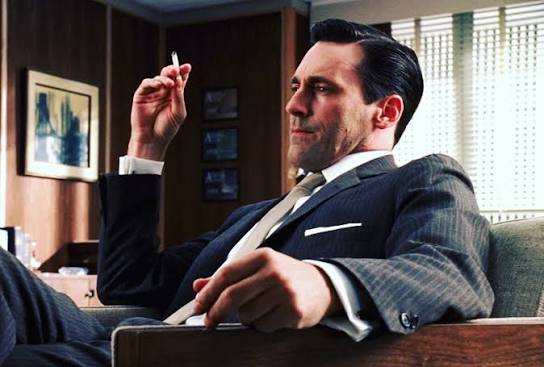
Dick Whitman performs the most durable modern transformation in American television. During the Korean War, an explosion kills Lieutenant Donald Draper beside him. Dick exchanges identification tags with the dead officer, survives under Draper’s name and returns to the United States inside a clerical conclusion. War supplies the confusion, body and paperwork. The dead man exits; the living man acquires his place.

Unlike Ripley, Don does not live permanently at the edge of exposure. The new identity accumulates institutional weight. Don works, pays taxes, marries, buys property, fathers children and builds a career. Time itself begins authenticating him. After enough years, the invented man possesses more documentary substance than the abandoned one.

Advertising is the ideal profession because Don’s labor reproduces his own transformation. He takes an ordinary product, suppresses its manufacturing history and gives it a story people prefer. He does the same with himself. The handsome executive, suburban husband and creative genius are not wholly false. They are real accomplishments attached to stolen paperwork.

Yet Mad Men understands that the administrative victory cannot settle the psychological case. Dick is not chiefly afraid that a camera will recognize him. He is afraid that intimacy will. Every person who approaches Don closely eventually reaches the locked room containing Dick Whitman: his poverty, family, desertion, shame and the knowledge that another man’s death financed his ascent.

The Thin Man fantasy and the Don Draper fantasy meet here. Remove the obligations, choose the wardrobe, enter the next room with a name nobody questions. What remains is the person who performed the removal. The Eagles’ old line is unavoidable: “You can check out any time you like, but you can never leave.” One may leave a home, spouse, profession and nation. The ghosts keep the original booking.

The Missing and the Dead

Ambrose Bierce entered Mexico in 1913 and disappeared. That is nearly everything we know about this paritcular case. He may have joined Pancho Villa’s forces, reached Chihuahua and died quickly. He may have been executed, killed himself, succumbed to illness or continued traveling. The absence of evidence has generated a century of endings because disappearance makes authors of the people left behind.

Bierce had already written one of literature’s cruelest imaginary escapes. In “An Occurrence at Owl Creek Bridge,” Peyton Farquhar falls from a bridge with a rope around his neck, escapes into the water, runs home and approaches his wife—only for the narrative to reveal that the journey occurred inside the final instant before his broken body swings beneath the bridge. The mind creates a second life because the body has no exit. Bierce’s own disappearance feels uncannily like an extension of the story, although we should resist converting formal elegance into evidence. He probably did not begin again. He probably died where the map became uncertain.

John List demonstrates how recently a complete second life remained possible. After murdering his wife, mother and three children in New Jersey in 1971, he traveled west and became Robert Peter Clark. He found accounting work, joined a Lutheran church, remarried and lived within ordinary society for nearly eighteen years. List was not sleeping in a cave. He was commuting, filing returns and participating in carpools. The jurisdictions containing John List and Robert Clark did not effectively speak to one another.

Television finally forced the conversation. America’s Most Wantedaired the case in 1989 using an age-progressed sculpture whose resemblance to List was extraordinary. A former neighbor recognized him. Fingerprints from his military records completed the identification. List stands at the border between eras: he constructed the second life through disconnected paper systems and lost it when mass media connected a face to the buried name.

John Darwin attempted the comic British variation in 2002. He paddled into the North Sea, staged his death and allowed his wife to collect insurance and pension payments while he secretly lived nearby. The plan expanded toward Panama. It collapsed when an online photograph showed the supposedly dead man beside his wife. A basic image search linked John, Anne and Panama. The second life had appeared on the first page of the internet.

Robert Hoagland achieved something quieter. He vanished from Connecticut in 2013 and lived in New York as Richard King until his death in 2022. The new life appears to have been modest rather than operatic. That may be the surviving modern model: abandon grandeur, remain geographically ordinary, ask institutions for as little as possible and hope nobody searches the correct connection. His identity was established after death.

Ryan Borgwardt showed in 2024 how poorly the romantic disappearance now survives contact with the contemporary record. He staged a kayaking death in Wisconsin and left the country. Investigators found evidence of preparation, travel and financial activity, contacted him abroad and persuaded him to return. In 2025 a judge sentenced him to eighty-nine days in jail, matching the period during which he had actively misled authorities, and ordered restitution toward the costly search. The symmetry of the sentence was better than the plan.

These cases are morally different. Bierce may simply have died. Hoagland appears to have abandoned a family without committing the crimes of List or Darwin. List was a murderer. The point is not to place them in one ethical category. It is to watch the available space contract. List could build an ordinary life for eighteen years. Borgwardt’s itinerary began becoming evidence before his family had finished grieving.

You Could Call It the End of the World

Money is the most practical border. A person can sleep outdoors without identification. The moment he wants a hotel, apartment, salary, international ticket or functioning bank account, somebody asks for the name behind the money. A friend of mine treats $9,999 as the largest sum one may carry into the United States. The actual rule is subtler: more than $10,000 may be transported legally, but it must be declared. Japan similarly requires declaration above one million yen. The threshold is not a wall. It is a checkpoint at which money becomes narrative. Where did it come from? Why are you carrying it? Who are you?

The old fugitive relied on fragmentation. A birth certificate sat in one office, fingerprints in another, employment history in a filing cabinet, border entries in ledgers and newspaper photographs in local archives. None of these systems was necessarily weak. They simply did not consult one another quickly. The fugitive’s skill lay in remaining inside the delay.

The decisive modern development is linkage. Passports became machine-readable and biometric. Banking systems identify customers and flag patterns. Phones create location and relationship histories. Cameras no longer merely preserve images; increasingly, software compares faces. Search engines connect photographs with names and places. DNA can identify a person who never submitted a sample because a distant relative did. Public records, commercial databases and social media supply continuity from childhood to the present.

Every system contains errors. Facial recognition misidentifies people. Records conflict. Databases leak. Names are misspelled. The second life does not die because any single machine knows everything. It dies because machines ask one another. The old fugitive needed to prevent one sheriff from telephoning another. The modern fugitive must prevent every machine from recognizing every other machine.

Josef Rusnak’s largely forgotten 1999 science-fiction film The Thirteenth Floor supplies the finest image of this condition. Douglas Hall, a computer scientist in Los Angeles, discovers that the simulated version of 1937 Los Angeles created by his company contains conscious inhabitants. More disturbingly, he learns that his own Los Angeles is another simulation. Following instructions left by his murdered mentor, Hall drives toward Tucson, ignores the road signs and barricades, and eventually reaches the boundary of his universe. The desert stops. The mountains dissolve. Beyond them stands an unfinished green wireframe—the scaffolding of a world nobody expected its inhabitants to inspect. Hall has not merely failed to escape Los Angeles. He has reached the place where Los Angeles runs out.

“You could call it the end of the world,” he says. The line is quiet because terror has already done the shouting. Moll Flanders could leave one town and supply the next with another name. Valjean could cross into another jurisdiction. Dick Whitman could exchange identification tags with a dead officer. Hall cannot accomplish even the preliminary act of departure because the road, desert and destination belong to the same system.

There is no countryside beyond surveillance and no unindexed territory in which to begin again; there is only the end of the program. Our world has not yet become Hall’s wireframe desert, but it increasingly resembles it. Every road leads toward another camera, account, border record or machine asking the traveler to confirm that he remains the person who departed.

The inhabitants of the film’s simulated 1937 discover that their world was created for users elsewhere. Hall then discovers that his apparently real 1999 is also one among thousands of simulations. “You weren’t supposed to find out,” he is told. The sentence might serve as the motto of every identity system. The structure works best when the contained person mistakes its limitations for the natural shape of reality.

Elon Musk’s claim that there is only a one-in-billions chance of our inhabiting “base reality” is not a scientific calculation. It is a swaggering compression of the simulation argument: if advanced civilizations produce enormous numbers of conscious simulated worlds, a randomly situated observer is more likely to occupy one of those than the single original reality beneath them. Whether or not Musk is right, The Thirteenth Floor understands the emotional consequence. The final disappearance is not concealment within the map. It is the impossible search for a place outside it.

The Last Fugitive

John McAfee deserves the title because he possessed nearly every advantage. He had money, international mobility, technical knowledge, familiarity with surveillance, political connections, access to boats and aircraft, and the willingness to behave in ways a normal investigator might not predict. He also possessed a cardboard box.

I have long suspected that McAfee knew more about Gregory Faull’s murder than he admitted, perhaps much more. That is an opinion, not a proven fact. Belizean authorities sought McAfee for questioning, but he was not convicted or charged in connection with the killing. Suspicion does not become evidence merely because its subject is spectacularly strange.

I nevertheless wanted McAfee to remain in circulation. I wanted him alive, ranting online, threatening to parachute into Fukuoka, appearing without warning at a Kyoto bar and ordering a strip steak while explaining that income tax was metaphysically invalid. This is not a defense of anything he may have done. It is an admission that fugitives provide a form of entertainment respectable citizens cannot. McAfee turned the ordinary police question—where is this man?—into theater.

His technical competence makes the comedy sharper. He knew that networks retain traces. He warned endlessly about surveillance. He promoted cryptocurrency and privacy as routes around state control. Yet his own need for audience continually defeated his wish for concealment. He contacted reporters while hiding, traveled with a film crew, cultivated disguises elaborate enough to become stories and generated the publicity through which strangers could follow him.

The Vice metadata incident is almost too perfect. A technology journalist accompanying the antivirus pioneer posted a photograph containing geographical information. The machine did not need to recognize McAfee’s altered face or chewing-gum lip. It merely reported where the photograph had been made. McAfee’s legend and location traveled inside the same file.

This is why he is the last fugitive rather than the greatest one. A true second life requires anonymity. McAfee could tolerate danger, accusation, ridicule and legal jeopardy. He could not tolerate being unknown. He wanted to disappear and narrate the disappearance, to escape the state while retaining the crowd. The modern fugitive may finally be defeated less by the camera than by his inability to live without looking into it.

That appetite is not confined to eccentrics. We announce departures, document privacy, turn reinvention into a new profile and carry our old audiences toward the new life. The desire to become somebody else competes with the desire to have everyone recognize the transformation. Moll Flanders supplies the next town with a story. McAfee supplies the whole planet with updates.

Coda

Is the death of the second life good or bad? Neither. It is a historical development with benefits, cruelties and unforeseen emotional costs. Connected systems catch murderers, fraudsters and people attempting to abandon obligations. They also make escape more difficult for abused spouses, political dissidents, debtors, refugees and ordinary human beings whose worst mistake has become permanently searchable. Accountability and mercy do not rise together automatically.

There remains an important distinction between disappearance and reinvention. An adult can legally change a name, move, choose another occupation, close public accounts and refuse contact. The state does not require everyone to preserve the social life into which he happened to arrive. But legal reinvention preserves continuity. Debts, convictions, parenthood and court orders belong to the person through the change. The first life is not erased. It is amended.

The Thin Man occupies the fantasy beyond amendment. He moves without the drag of continuity. He may enter Andrea’s life, Jessica’s cabin or another city under circumstances that do not require him to explain the previous scene. I invented him because I wanted the freedom of a man nobody could summon. Yet even he carries Niko beneath the working identity. Georgia remains inside him. Education, language, childhood, loss and desire cross every border without documentation.

That is the final limitation, older than passports and more reliable than facial recognition. You cannot outrun your ghosts. A person may defeat the file and still remain the person described by everything the file omitted. Tom Ripley acquires Dickie’s signatures but retains Tom’s hunger. Don Draper obtains Don’s career but brings Dick’s shame into every marriage. McAfee crosses borders with the cardboard box and John McAfee climbs out from beneath it.

At fifteen, I thought Moll Flanders was shapeless because Moll repeatedly acquired another husband, name, occupation, crime, punishment and jurisdiction. Now the repetition looks like the record of a vanished human possibility. Moll continually finds another exit. We inhabit a world of fewer exits, better records and longer memories.

Perhaps this is why stories of disappearance retain their force. They promise that one life need not be final. Somewhere beyond the jurisdiction, ocean, desert or wireframe mountain waits a place where nobody knows what we have done and no machine asks us to confirm it. We know better. The map follows us, and even if it did not, we would arrive carrying ourselves.

Moll Flanders could become another woman. We can only become ourselves somewhere else.

Sources

Daniel Defoe, Moll Flanders (1722), and Encyclopedia Virginia’s account of the novel’s transportation plot.

Luigi Pirandello, The Late Mattia Pascal (1904).

Victor Hugo, Les Misérables; Alexandre Dumas, The Count of Monte Cristo; F. Scott Fitzgerald, The Great Gatsby.

Patricia Highsmith, The Talented Mr. Ripley, and Anthony Minghella’s screenplay for the 1999 film.

AMC, Mad Men: the Dick Whitman/Don Draper identity narrative.

Project Gutenberg and the Ambrose Bierce Project, “An Occurrence at Owl Creek Bridge” and biographical materials.

FBI historical materials on John List and the America’s Most Wanted identification.

Contemporary reporting on John Darwin, Robert Hoagland and Ryan Borgwardt.

U.S. Customs and Border Protection and Japan Customs guidance on cross-border currency declarations.

U.S. Department of Homeland Security, biometric identification materials.

Josef Rusnak, The Thirteenth Floor (1999), adapted from Daniel F. Galouye’s Simulacron-3.

Code Conference 2016, Elon Musk’s discussion of simulation and “base reality.”

Contemporary Wired, Guardian and Vice reporting on John McAfee’s flight from Belize.
The Genius Razzlekhan and the Phony Nassim Nicholas Taleb

I went home with the waitress/ the way I always do/ how was I to know/ she was with the Russians too.

Warren Zevon

Author’s Note:

Some essays begin with a thesis. This one began with me laughing so hard I nearly fell out of my chair.

When Heather Morgan—better known as Razzlekhan—was accused of participating in what was then described as the largest cryptocurrency heist in history, nearly every media outlet converged on the same joke: look how terrible her rap videos are. I saw something different. Behind all the memes was someone making deeply strange, completely sincere outsider art. Whether you think it’s brilliant, awful, or somehow both at once, there is no mistaking its originality. I have always had a soft spot for artists who refuse to color inside the lines.

The surprise, though, was Nicholas Nassim Taleb. He wandered into the story for reasons best known to himself and, in my opinion, emerged looking far sillier than the alleged crypto queen ever did. Years later I still think the real story wasn’t the memes. It was how quickly the internet decided who deserved ridicule—and how often it picked the wrong target. Razzlekhan may have been the weirdest person in the room, but weird has never bothered me. Poseurs always have. This is their story.

===== =====

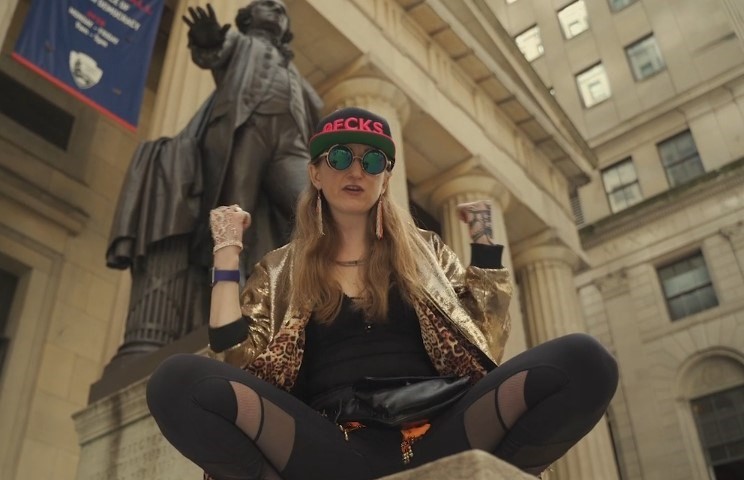
This is the saga of the queen of crypto hacking Heather Morgan, aka Razzlekhan, and the shameless tail chaser and phony public intellectual (is there any other kind) Nicholas Nassim Taleb. Just so we are clear about who is who here, Taleb, the bestselling author “The Black Swan” and “Antifragile” is the villain, and Morgan, who along with her husband is accused of pulling off the largest heist in human history ($4.5 billion dollars) is the heroine. Morgan was briefly a Twitter star in late February 2022 when her alleged crimes were revealed; however her stardom was not based on her hacking prowess, but rather on what was perceived (incorrectly) to be her world-historically awful rap videos, including, but not limited, her banger “Versace Bedouin,” in which, among other things, she names herself “the crocodile of Wall Street.” Here is a taste of her work (note that the real Heather Morgan appears to be in her early 30’s, and is certainly not a grandmother. Also, the video depicts Morgan rapping around the Wall Street district of New York City with three women “dancing” behind her, one wearing large green gardening gloves and carrying a flag with a design we are unable to clearly see for the entire video):

Razzlekhan’s the name/ the hot grandma you really wanna bang/ always run the gilf game/ ever since I was fif-taneee

I’m many things/ a rapper, an economist, a journalist, a writer, a CEO/ and a dirty dirty dirty dirty ho

Better than most writers/ creepier than most girls/ weirder than most rappers/ but I still rock pearls.

Alert listeners will note the apparent Liz Phair reference to Razz’s sexual maneuvering in her teens, suggesting that there may be at least a little guile to her lyrics. But what impresses me (and I’ll just state this right out-I think Razzlekhan is a misunderstood genius) is the straight ahead sincerity of the lyrics. I mean Versace Bedouin was released before Morgan was implicated in the crypto hack and here is her dedication at the top of the song:

Never forget, weirdest is the most original/ this song is for the entrepreneurs and hackers/ all the misfits and smart slackers.

The really hardcore music fan may pick up a possible Drugstore reference from “Say Hello”:

I say hello/ to all the junkies/ the sinners and the creeps/ I say hello to all the people in this place/ I say hello /to all the drug heads/ the prostitutes and freaks/ I say hello/ to all the people in the world!

But even I don’t think Morgan is a Drugstore fan, so the resemblance is most likely coincidental. What I love about Razz’s work here is that Versace Bedouin is a simple and totally sincere statement of intent. She tells the listener exactly who she is and what she’s about. She’s a weirdo and misfit, a hacker, a probable criminal, a business owner, and a dirty ho, and she is just letting the world know. She is, as the kids say, putting the motherfucking world on blast. Razzlekhan is coming for your bitcoin, baby, lock that shit down.

And the media loved it. The Guardian wrote a long (and pretty helpful) article on Morgan with the lead “Is this the new face of organized crime? Decoding Razzlekhan, the rapping bitcoin fraudster.”

“Who is this Bitcoin crime queen” they write breathlessly “and what does she tell us about the future of organized crime?” Well Mr. Guardian, that’s a good question that maybe I can shed some light on. Morgan and her husband (who, like the rest of the uncaring world didn’t care for her rap career-Heather I’m here for you man, just reach out) stole the money, allegedly, from the platform Bitfinix but were unable to convert much of into cash or liquid assets and had to settle for Walmart gift cards instead. So that might tell you something-I’m not sure how organized the pair was.

Mr. Guardian again:

“It is hard to articulate how it feels to be alive in an age of massive wealth disparity and multiple deregulatory lines of questionable crypto minting, but I think watching an alleged Bitcoin embezzler struggle through painful rap bars in a flat-billed cap that reads ‘0FCKS’ is a good summation of the overwhelming confusion.”

But it really isn’t hard to articulate at all-it feels great, because while Heather Morgan the journalist, CEO, and dirty ho may be facing a little legal trouble, Razzlekhan the artist, in my opinion, stands unbloodied and unbowed atop the pinnacle of outsider art along with Daniel Johnston, Mayo Thompson, and the handful of other transcendent geniuses so far ahead of their time they were subject to as much ridicule as they were celebration.

(My favorite piece of music criticism ever comes from a Pitchfork review which doesn’t seem to be online anymore of The Red Krayola’s 1989 album malefactor, ade-it must have been a re-release because Pitchfork wasn’t around in ’89 of course-where the critic accuses Mayo Thompson of “playing the guitar badly, on purpose.” And it’s pretty true. The Red Krayola is out there.)

Razz herself embraces the outsider role and speaks directly to her artistic origins and sensibilities in her artistic biography:

Razzlekhan is like Genghis Khan, but with more pizzazz… No one knows for sure where this rapper’s from — could be the North African desert, the jungles of Vietnam, or another universe. All that matters is she’s here to stick up for misfits and underdogs everywhere (…) Because Razz has synesthesia, her art often resembles something in between an acid trip and a delightful nightmare. Definitely not for the faint of heart or easily offended, Razz likes to push the limits of what people are comfortable with. Her style has often been described as “sexy horror-comedy,” because of her fondness for combining dark and disturbing concepts with dirty jokes and gestures. Just like her fearless entrepreneurial spirit and hacker mindset, Razz shamelessly explores new frontiers of art, pushing the limit of what’s possible. Whether that leads to something wonderful or terrible is unclear; the only thing that’s certain is it won’t be boring or mediocre.

To my knowledge, no major media outlet even gave Razzlekhan a fighting chance; however I invite you to read the above self-description again with care. She is not in the least bit joking around. She identifies variously as a Bedouin, Turkish, a nomad, and an alien. Later in the same piece she identifies her influences as: Die Antwoord, Tierra Whack, Mickey Avalon, Salvador Dali, Diane Arbus, Hunter S. Thompson, Roald Dahl, and Charles Bukowski. This is a consistent, real, list of artists that a true outsider might well identify with. At the Razzlekhan level, the distance between greatness and awfulness is razor thin, artistic merit being, like everything else really, a circle not a line. In any case, judge for yourself — pull up a Razzlekhan video on You Tube (they are still there) and see what you think.

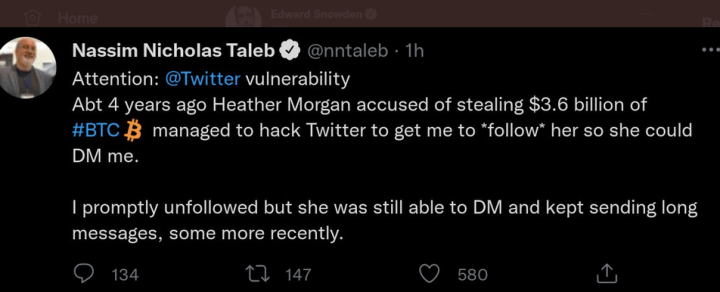
But what does any of this have to do with the author Nicholas Nassim Taleb? Well, it would have had nothing to do with him if our boy hadn’t chosen, with exquisitely poor judgment, to interject himself into the Heather Morgan/ Razzlekhan drama. Within hours of the heist news breaking, Mr. Taleb posted the following:

I have several things to say about this nonsense:

I. Check his use of “Attention” and the scare word “vulnerability.” Taleb thinks this message is super important and even urgent. He’s got to get it out there RIGHT NOW.

II. The story is obviously total BS. Taleb seems to have no sense of how Twitter works, and his narrative is so bizarre that he is basically begging us to roast him, which users in the hundreds did, of course.

III. Taleb gives no insight into why Morgan was DMing him. What did she want? Well, users, myself included, had a theory as to what might actually have occurred here. Occam’s Razor would suggest that at some point Morgan and Taleb began exchanging DMs, possibly on her initiative, as she was writing extensively for Business Insider and Forbes I believe, and maybe she wanted to ask Taleb something about one of his books. Taleb then pivoted into a bit of tail chasing, or, as one Twitter denizen put it slightly less crudely, he was looking for a little “bobs and vagine.” When Morgan was arrested, Taleb got spooked that somehow their DMs would leak, so he concocted a ridiculous cover story almost (but not quite) as stupid and unbelievable as Joy Reid’s claim that her fifteen year old blog with homophobic jokes and comments was hacked by Russians.

IV. The use of “some more recently” is a pure “tell.” Taleb’s bobs and vagineing has been going on for some time, it seems. But why in the world would Taleb think that the messages would leak just because Morgan was arrested (she was later released and her husband was held in custody, and I haven’t been able to get a status update on where she is today)? I mean there are really only two options: i) that the messages would be released by the FBI or something as pertinent to the case, in which case Taleb and Morgan would have been discussing her hacking. This seems highly unlikely; ii) Morgan would choose to release them herself in an effort to incriminate Taleb. But Nicholas baby, this is just not going to be a priority for Morgan after her arrest. I mean, she is accused of stealing 4.5 billion, and she’s got her rap career, and her husband is in prison. She has got stuff going on man; your DMs are way down the list.

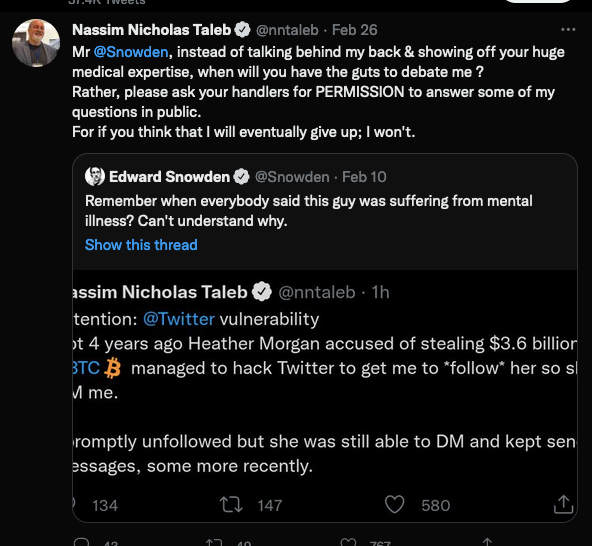
All and all, this message shows that Taleb is an idiot and a complete joke. And people took note, including Edward Snowden, piping up from Russia. Check this out:

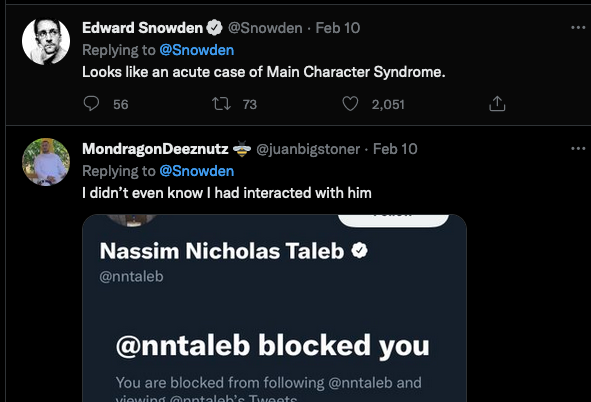
Snowden comes in with the savage take down here, and Taleb punches back with an offer to debate, what exactly? It’s not clear if this the debate challenge was issued prior by Taleb nor is it clear, at least to me, what is to be debated. Are they supposed to talk medical issues? Mental health? Hacking? Bobs and vagine? Taleb continues to make no sense, and Snowden let’s him know with another zinger:

Main Character Syndrome indeed. I would add Major Asshat Syndrome and Big Phony Fraud and Fragile Loser Syndrome as well. Because this is the guy who wrote Antifragile! Which is supposed to be about things that thrive during chaos, or in other words, things which are resilient. And nothing says resilient like faking a hacking narrative to cover your tail chasing, issuing an incomprehensible debate challenge to someone way out of your league, and tripling down with blocking random twitter users who question you. And I would know, because after I liked the bobs and vagine comment and added something like “Methinks Mr. Taleb doth protest too much,” the fucker blocked me too! Sadly that Twitter account is history so I can’t post a screenshot, however it was obvious that this huge baby was scrolling chats and mass blocking to distract from his disastrous piece of public relations. Honestly, the whole thing was super funny and Taleb showed his ass in the worst possible way.

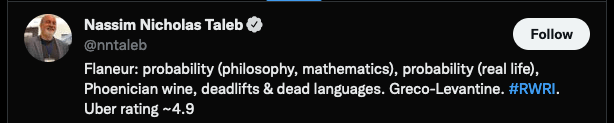
Taleb obviously thinks he is hotshit. Check out his Twitter bio.

What a poser. A flaneur is a French term for someone who walks the streets taking things in, and Walter Benjamin wrote extensively about the flaneur in his epic, and epically unfinished “Arcades Project.” Actually, a flaneur is a lot like a kibitzer. I am the Kyotokibbitzer (two b’s baby), and I love Benjamin’s work, including the Arcades Project. I bet Taleb is aware of Benjamin and fancies himself a fan. But he doesn’t know the first thing about Benjamin, because Benjamin was a humble guy who did great work and Taleb is a braggart, a tail chaser, and a bum. Deadlifts and dead languages my ass. Text is dead there Nicholas, at least your texts are, because you made a complete fool of yourself and you suck. Taleb exemplifies precisely why I dislike anyone who calls themselves a public intellectual or an expert. He is a poser and I’ll bet you 10 to 1 his ideas are stolen just like Neil DeGrasse Tyson’s, another total loser who piggybacks on people who know something to pump up his image. (A sure sign of a loser is a “public intellectual” who insists on using three names. What’s wrong with Nicholas Taleb or Neil Tyson? The only people who need three names are serial killers; I mean even public intellectual number one Malcolm Gladwell only uses two names. Gladwell is known to pilfer ideas as well, but The Tipping Point is a pretty good read and the dude genuinely knows a tremendous amount about the sport of running. And he doesn’t call himself “Malcolm Julius Gladwell” or whatever. This is because he’s just a writer and knows that using his middle name would make him a prat.) Anyway, it’s totally fine to fake it ’til you make it, and most of us do to a greater or lesser degree, but you can’t fake your way into being an expert. Never trust “experts,” full stop.

So that’s the story of Razzlehan, the misunderstood genius, and Nicholas Taleb, the big phony. And in case you are asking, yes I did ask Razz to get in touch with me above. I’d say “I can fix her,” but she needs no fixing. She can DM me all she wants, and she doesn’t even have to get the Russians involved.

Dedication:

For Razz. You rule baby. So damn hard.

The Days and Nights of My 50s I: 7/20/26, the Unwritten Libretto.

Author’s Note:

Five days ago, I made what may prove to be the most important professional decision of my life.

For months—years really—I had been thinking about giving up my teaching career and becoming a full-time writer. I have talked to many of my family and friends about this and taken several small steps in this direction. I recently published a novel, have written and published hundreds of essays, and written almost every day for eighteen years. I have hundreds of pages of dream records, journals and letters, some sent and some only in draft form. I am hard at work on the sequel to my first novel, and am currently working on five books with many more in the making.

Over this time I have also become very good at making excuses. School is too busy. Life is complicated. The timing isn’t quite right. Next month. Next term. Next year. One day. It was all true, and yet it barely matters. A few days ago, I finally admitted what had been staring me in the face for a long time: if I wanted to call myself a writer, I had to stop waiting for someone else to make that decision for me. Whether I eventually succeed or fail is almost beside the point. The decision itself changed something in me. I stopped thinking about the life I wished I had and started taking responsibility for the one I actually have.

Today wasn’t the happiest day of my life, nor the saddest. It wasn’t the day I got married, the day my son was born, the day I published my first book, or the day I realized my marriage was ending. Objectively speaking, it was an ordinary Monday in Osaka. I listened to music. I wandered the city. I shared dinner and my bed with a woman whose path happened to cross mine for a couple of hours before diverging forever. By tomorrow morning she would be somewhere else, and so would I. Yet somewhere between checking into a modest hotel, thinking about my future, and sitting alone quietly after she left, something finally clicked. My teaching career is rapidly coming to a close. The marriage that defined most of my adult life is over. The books I dream about haven’t been written yet. The cities I may someday call home are still only possibilities. The people who will matter most over the next twenty years are, at this moment, complete strangers.

For the first time since I was a young man, there is no obvious script. That realization is exhilarating. It is also terrifying. Most of all, it is deeply liberating.

So this seems as good a place as any to begin this series.

Epigraph:

Yesterday is history. Tomorrow is a mystery.

Anonymous

Anything could happen.

Bash and Pop

I: My General Situation As of Today

For the better part of thirty years, my life had possessed a remarkable amount of structure. I graduated from college. I moved to Japan. I found a teaching career almost by accident and stuck with it for a quarter of a century. I got married, and my wife and I bought a house together in Kyoto. We raised a wonderful son together who we both love more than words can say. We have paid bills, argued over groceries, worried about our dear dog Daisy, taken vacations when we could afford to, and slowly accumulated the ordinary rituals that eventually become a life. There were wonderful years and there were difficult ones, but there was almost always a next step waiting patiently in front of me. Whether I liked the script or not, there was a some kind of a script.

Then, almost imperceptibly at first, it disappeared.

My marriage ended not with a single dramatic explosion but with the gradual realization that two decent people could simply reach the end of the road together. My teaching career, once the defining feature of my adult identity, began to quietly recede into the background. Friends scattered across countries and continents. My parents grew older. I turned fifty-two without feeling especially old, but with the unmistakable sense that I had entered the second half of whatever story remained.

It is a peculiar thing to discover that freedom and uncertainty are twins. For years I imagined freedom as something uncomplicated. Finish work. Write books. Travel. Meet interesting people. Drink coffee in strange cities. Listen to music until two in the morning. Wake up whenever I pleased. Answer to no one.

There is truth in that fantasy. There is another truth as well.

Freedom also means that no one hands you tomorrow. No institution is waiting to promote you. No family obligation automatically determines your next decision. No invisible current carries you downstream. Every meaningful choice becomes your responsibility. Every success belongs to you. Every failure belongs to you too.

That realization can feel less like opening a door than standing on the edge of a cliff. You can step forward. Or you can spend the rest of your life admiring the view. Five days before the evening you’re about to read about, I decided I was done standing still.

I wasn’t retiring, not yet anyway. I wasn’t exactly reinventing myself. I wasn’t chasing some impossible dream. I was simply acknowledging something that had probably been true for twenty years. I am a writer. I feel like I was born to be one. Whether anyone else eventually agrees is, in many ways, beside the point. The work itself has become the destination. Everything else—the cities, the books, the women, the music, the bars, the victories, the humiliations, the friendships, the failures—is simply material for my work.

This series is an attempt to pay attention to the contours of my daily life, in whatever form the may take. And, perhaps for the first time in my life, to trust that the story doesn’t need an outline before it begins.

II: Osaka

Osaka has always felt different to me than Kyoto.

Kyoto is the city where I built my adult life. It is where I have worked, and lived for more than twenty years with my life and son. It is where the mortgage was paid and our dog was walked, where ordinary afternoons quietly accumulated slowly into decades. I know its rhythms inside and out. I know which coffee shops open early, which bridges are worth crossing at sunset, and where to stand beside the Kamogawa when I need to remember that almost everything eventually passes.

Osaka has always been to me something else entirely.

It has never asked me to be responsible. When I come here, I feel somehow lighter. Less like a teacher. Less like a husband. Less like the man who spent twenty-four years inside the same corporate institution. Osaka has always given me permission to become, if only for a day or two, a slightly different version of myself. Not a better man or a worse one. Just someone with fewer expectations resting on his shoulders.

Perhaps every city we visit has a role to play in our lives. Kyoto has been my home. Tokyo has often been a dream. Singapore has long been my favorite escape. Osaka, though, has become my intermission. A place where I can step off the stage for a little while before the next act begins. A place to just get away.

This Monday afternoon I checked into a small APA Hotel not far from Shinsaibashi Station, which I affectionally call Mr. Shin. Like most APA hotels, it is clean, efficient, and just a little too compact. The room isn’t exactly designed for lingering. It is designed for sleeping, showering, and moving on. My suitcase for neatly against one wall. The desk is barely large enough for my laptop and a cup of coffee. The large television in front of my bed I will barely use. It suits my current mood perfectly.

I took a taxi to the hotel from Shin-Osaka Station and arrived around 7:30 PM. I dropped my overnight bag on the floor, drew the curtains apart, and looked out over another slice of Osaka. Nothing spectacular. Just traffic, apartment buildings, and the quiet machinery of a city getting on with its day.

I remember thinking how strange it felt to have absolutely nowhere I needed to be. No lesson to prepare. No meeting to attend. No papers to grade. No one waiting for me at all.

That realization no longer frightened me the way it once might have. It felt… spacious. There are moments in life when freedom announces itself with fireworks. This wasn’t one of them. It arrived almost silently. Like an empty afternoon. Like a city that has never asked me to explain myself. My hotel room is simple. It is what I can afford.

Outside, Osaka continued exactly as it always had. Inside, almost without me realizing it, the next stage of my life had already begun.

III: Meeting Yuki

I should flash back briefly here to introduce my date for the evening. There are evenings that require months of planning. This was not one of them.

The plan, such as it was, consisted of very little. Conversation. Sex. Cigarettes. Dinner. That was enough. As I stepped out of the taxi, I saw her standing quietly on the street.

She was slightly built, dressed in a simple black skirt, and carried herself with the quiet confidence of someone accustomed to meeting complete strangers. There was no dramatic meeting, no cinematic slow motion, no instant thunderbolt. We smiled, introduced ourselves, and within a minute or two were walking side by side into the hotel through the warm Osaka evening as though we had agreed to meet as old friends rather than someone we had never laid eyes on before.

Her name was Yuki.

We went up to my room and made the sort of awkward conversation that strangers always make at first. Where are you from? Where do you live today? Had I been to Osaka often? Was I enjoying the summer?

Nothing remarkable. Which, in retrospect, was itself remarkable. There is something deeply comforting about ordinary conversation. For a little while, neither of us had to be anything more than two people just getting to know each other.

Eventually, because pretending otherwise would have been absurd, the reason we had met entered the conversation. She is thirty-six and works as an escort. I had hired her for the evening.

There is no point dressing those facts up in prettier language. They are neither the whole story nor something I feel any particular need to defend. They simply belong to it. Human lives are untidy. We make decisions for reasons that are sometimes noble, sometimes lonely, sometimes curious, and sometimes impossible even to explain to ourselves. This was one of mine.

I went into the bathroom to wash up, took my clothes off, and hung them neatly on the hangers on the wall. By the time I came out of the bathroom she was naked too. That was what we were there for. I put on one of my favorite bands Whiskeytown, lay back on the bed for a few minutes, listened hard, and let the sweet sweet sounds of Ryan Adams’ voice wash over me. I was, briefly, in heaven.

Then, inevitably, we began to kiss. She is a smoker and tasted like stale tobacco and faintly like green peas. I am a smoker too so I am sure I tasted the same. She unwrapped one of the condoms that I had bought earlier for occasions just like this and began to pleasure me with her mouth. While I do enjoy oral sex to some extent, it is far from my favorite sexual act and I have never been able to cum this way. Not for lack of trying, I simply find that the women who have performed the act on me can never sufficiently been able to get their teeth out of the way. It is not their fault at all, but it is just that simple.

Soon enough, I asked her to climb on top of me. My penis was already erect and she was slick as well, and I entered her cleanly and easily. After a little while, we flipped around and began to engage in the missionary position. I was on the urge of cumming when I pulled out, turned over on my back, and finished my self off with two hands. Nine times out of ten I finish this way if I finish at all. After all, I know my own equipment better than else, so to speak. Before we began to have sex I put on some porn. I chose very quickly as we were on the clock. I selected some perfectly nun priest porn, totally chalk. Of course we both barely watched it as our eyes were mostly closed. The moment I came I toweled off, shut off the porn, and immediately pressed play on the Whiskeytown video I had paused before sex.

Then a funny thing happened. During sex she had repeatedly asked me to turn down the porn and to shush in general. She said we were at a business hotel and that we were bothering the other guests. Although I love to be babied. I do not like to mothered at all. It is just not my thing, and I have written about this at some length here. I already knew that I would not book Yuki again, and this moment helped crystalize my decision. She is sweet and cool, and I am glad I met her for one night, however she is just not my jam. And also, nobody shushes my boy.

Anyway, she asked me to turn my music down. I just laughed and cranked it. Then she laughed too and the mood lifted and passed. Neither of us was yet in the mood for a shower, mostly because we were on the clock and by this point only had about 40 minutes left in our appointment. I did not feel like a round two, so I suggested we head down to the street to smoke for a smoke and then get a little dinner. Although we had less than an hour left and the hotel restaurant was a little busy, she agreed to have dinner with me.

We finished our cigarette and entered the first floor hotel restaurant. We sat down and briefly consulted the menu. The restaurant specializes in pasta, so I ordered tomato pasta with eggplant and she ordered the zucchini linguine. The food took a while to arrive, so halfway through the meal she asked for a doggie bag. I quickly finished my meal and we went upstairs so she could pack her bag.

The evening had never pretended to be anything it wasn’t. Neither of us confused it with romance. Neither of us imagined it was the beginning of some extraordinary love story. It was simply two lives crossing for a few hours before continuing in different directions. There is something quietly beautiful about that too.

Outside, Osaka was still very much alive. Trains rattled somewhere in the distance. Traffic rolled steadily beneath the hotel windows. Thousands of strangers were beginning nights that had nothing to do with ours. Ours, quietly and without complaint, was coming to an end.

I told her I was going to wash up for a minute. She said through the door that she had to leave. I said goodbye babes and she replied in the same fashion. When I came back out, she was already gone.

And I didn’t even kiss her goodbye.

IV: Coda

For most of my adult life, my future had always arrived with an outline. There was always another semester to teach. Another report to write. Another mortgage payment to make. Another family holiday to plan. Another school year waiting just over the horizon. Even when life became difficult, I almost always had a sense of what would come next. The details may change, but the broad shape of the story had already been sketched.

And now it hadn’t.

As I write this the marriage that defined nearly half my life has come to an end. My teaching career, after almost thirty years, is slowly coming to an end. My son is a grown man, trying his best making his own way in the world and earning his own money. My wife and I are immensely proud of him as well we should be. Our house of 19 years will soon belong to someone else. My life is rapidly becoming quite different and everything that had once seemed permanent has become part of the past.

This all may sound just a bit sad. Some of it may be, sure. It also happens to be exhilarating. Tomorrow I might wake up in Kyoto. Next month I might find myself in Singapore. A year from now I may be living in Osaka. Anything could happen.

Perhaps I’ll write ten more books. Perhaps no one will read them. Perhaps I’ll fall in love again. Perhaps I won’t. There will be close friends I haven’t made yet. There are cities I have not yet wandered. There are songs I haven’t fallen in love with, thank god.

There are mistakes waiting patiently for me. There are joys I cannot yet possibly imagine. For the first time since I was in my early twenties, the next chapter of my life has not yet been written.

As I stood there in that little Osaka hotel room, listening to Whiskeytown waft through the room, I finally understood what life had trying to tell me for days.

My life hadn’t fallen apart. It had, in fact, opened up. And somewhere beyond everything I thought I knew, waiting patiently for me, was the unfinished libretto.

Dedication:

For Yuki. Thanks for a lovely evening. I’ll never see you again, babe. Go with God.