On the Pre-Game (aka A Response to Neil Strauss’ The Game)

Note: This piece overlaps my three essays on my week with Isobel series (I–III), though it approaches that week from a different direction. Where those pieces follow the arc, this one lingers on the moment before it resolves—the pre-game, as I’ve come to understand it. It is also a direct response to the book The Game, by Neil Strauss. In what follows I don’t intend to rebut Strauss so much as correct what I see as a fundamental weakness in the subculture he dissects. The reader will judge whether I succeed.

Epigraph

“No one else could play that tune, you know it was up to me.”

— Bob Dylan, Up to Me


Part I: Ippei

I’m at Zaza, the club on Kiyamachi in Kyoto. It’s around 11 PM and just getting going. Zaza is a late night place. It doesn’t peak until well past midnight, and at this hour it’s still stretching, still finding its rhythm.

I’m there by myself, drinking a White Russian.

A Japanese guy comes up to me. He’s about fifty-five. No preamble, no easing into it. He introduces himself—let’s call him Ippei—and within seconds it’s on.

“See those two ladies over by the window,” he says. “Wanna help me pick them up?”

I’m intrigued. Not because I’m especially interested in the outcome, but because I’m a curious guy and I want to see what he’s doing.

“Ok,” I say. “What’s the play?”

He doesn’t hesitate.

“You’re my old friend from California. I haven’t seen you in twenty years. I just ran into you by chance here. Take it from there.”

That’s it. That’s the entire setup. Handed to me fully formed.

I ask him, just to check, “Is this going to work?”

He smiles, completely unbothered.

“Yeah,” he says. “I do this every night. Had a threesome last night.”

Well alright then.

We walk over. He starts talking immediately, in Japanese, smooth, fast, confident. “This is Matt, my best friend from California. Would you believe I just found him here?”

I met him five minutes ago.

It doesn’t matter.

In no time the two women are completely engaged. Smiling, leaning in, laughing. The story has landed. The reality has been accepted. They’re not being approached. They’ve been included.

And I’m there, but I’m not really there. I’m not trying to win anything. I’m not trying to escalate. I’m watching. Taking it in. The nightlife anthropologist, just observing the field.

After a while I step out to the balcony to smoke.

Twenty minutes pass.

When I come back down, he’s still there. Still going strong. Still inside the same story.

That’s when it clicks.

He didn’t need me.

He needed the role I filled.

He needed a premise.


Part II: Neil Strauss

Neil Strauss’ The game

That night at Zaza stuck with me, not because of what happened, but because of what it revealed.

There is a whole body of writing—call it a subculture, call it a system—that attempts to explain and formalize moments like that. The most famous version of it is The Game, by Neil Strauss, which I’ve read twice.

I want to be clear about something before I go any further.

I’m not anti–Neil Strauss. In fact, I respect him. He’s an elite investigator of subcultures, and I love subcultures. He embedded himself in a world, learned its language, mapped its hierarchies, and reported it out with real precision. That’s not easy to do. It’s a serious piece of work.

What follows is not a dismissal of Strauss.

It’s a response to what the game represents.

Because once you move from observing a system to adopting it, something changes.

At its core, the game assumes that attraction can be engineered. That with the right language, the right sequence, the right calibrated signals, you can break down a woman’s resistance and get to the desired outcome, which is of course bed.

It’s a kind of a linguistic technology and NLP at its worst. A system designed to move someone from one state to another.

And for me, that’s where I part ways.

For me The Game is a massive turnoff, because it flattens everything and kills any chance at romance.

It scripts what should be alive. It reduces seduction to a manual and turns something unpredictable into something repeatable. And in doing so, it drains it of the very thing that makes it worth pursuing in the first place.

There’s no space for real connection. No space for the unexpected. No space for the moment where something happens that neither person could have predicted. No space for the kind of encounter that might actually change your life.

And beyond that, it produces a life that I don’t want.

The guys in The Game end up living together in this kind of shared house—Mystery, Strauss, Courtney Love—surrounded by other guys, talking about women, thinking about women, analyzing women. It’s a sausage fest. And it’s not cool.

The Gamers think they’re players. I prefer to think of them as incel-adjacent. They’ve optimized the system, but they’ve lost the thing itself. They’ve mastered the game and stepped outside of life.


Part III: On Action

I’ve had a handful of sexual partners that I’ve gone all the way with. The precise number is under an NDA. I’ve made out with more. But I haven’t been especially active, at least not in the way the game would define it.

What I have done is, flirt with, connect with, and have crushes on dozens of women.

And the truth is, I enjoy it.

I actively enjoy the pre-game.

I enjoy getting close. The moment before something becomes something else. The tension. The ambiguity. The recognition that something might be there, and neither of you has named it yet.

The thrill of newness and the possibility of a spark. If it burns, great. If it flickers, that’s also good. For most men, the pre-game is a means to an end. For me, it’s the end.

And that’s the difference.


This doesn’t mean I’m not interested in action. I am. Very much so. In fact, I’m something of an action junkie. But I’m a highly specific kind of action junkie. Like Wittgenstein, who was said to have manufactured his own oxygen, I manufacture my own action.

I don’t chase it blindly. I don’t optimize for it. I don’t try to force it into existence through systems or scripts. I generate it. Selectively. Intentionally. And in moments where it actually means something.


Part III: Luna

I’m at Umineko with a friend—call him Mr. Editor. It’s early, maybe six in the evening. We’re mid-bar, having a beer, when I notice a woman sitting off to the side.

She’s stunning. And I HAVE to go talk to her. Not because I expect anything to happen. Not because I’ve calculated the odds. But because the moment demands it.

I tell Mr. Editor what I’m about to do. He nods. “Go for it,” he says. “I’ll watch.” I walk over and ask her name. She smiles. “Call me Luna.”

We speak in Japanese. The conversation flows. I bring everything I have to the moment—attention, presence, curiosity—and it lands. There’s a spark. Not forced. Not engineered. Just there.

We talk for a while. Long enough for the room to shift slightly around us. Eventually I ask for her Instagram. She gives it to me. I walk back to the bar and sit down next to Mr. Editor. I’m on Cloud 9. The next day, in the late afternoon, carefully timed, I send her a message but she doesn’t reply.

Failure? Not for the pre-gamer. Because the pre-gamer already got what he came for. The moment. The spark. The approach. The brief, electric possibility that something might happen. That was the action. That was the point. For the Strauss guys, the night ends when the text goes unanswered. For me, the night ended at the bar.


Up to this point, the pre-game is contained. Safe, even. A space where things can happen or not happen without consequence.

But sometimes it doesn’t stay that way.


Isobel Revisited:

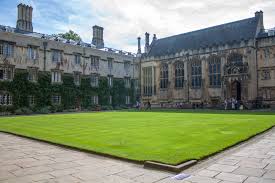
I have written about my week with Isobel extensively elsewhere, however part of that story is relevant to what we are discussing here. I met her at the Faculty of Astrological Studies, held at Exter College, Oxford, in late August 2018. We spent the week together and I fell in love. But I didn’t sleep with her. My choice. What follows is a light re-write from my essay “On My Week with Isobel: Part II”:

Wednesday.

I wake up early and we have breakfast together in the dining hall. By this point, people are noticing us. Comments here and there, snickers, sideways smiles.

Morning and lunch blur into one long conversation—the garden, the bench, a little grass, nothing hidden. We’re finishing each other’s thoughts. I’m in deeper than I’ve ever been.

We don’t attend much of anything.

In the afternoon break she goes to change. I go back to my room and put on The Mendoza Line with the full weight of obsession. She comes back after and tells me, without shame, that she had pleasured herself during the break. Just fucking states it.

This is a complication.

That night she changes again. A red dress. Short, but not careless. Stunning. We sit at dinner whispering, touching lightly, laughing against each other. Everyone knows by now.

After dinner there’s wine again, talking with the tutors, the long courtyard. I meet Darby Costello in person for the first time. She’s fully alive, drinking wine, holding the room effortlessly. I’m so happy she’s my astrologer. But I’m elsewhere.

We stay late. Clear the courtyard. Around two in the morning we part. Cheeks touched. No bedroom. No act. No close. Back in my room, lights low, Mendoza Line still in my ears, I lie on the narrow bed and I know exactly where I am standing.

I will keep going. I will see where this leads. But I will not sleep with her. I can’t.

It’s not that I don’t want to. I do. Totally and much more. But I can see it. The complications. For her, for me. The chain of events that would follow. I’m old enough to see it coming. And I know, standing there in the courtyard, with the last of the wine and a cigarette burning down, that it’s on me.

I have to be the one to say no. That’s the shape. That’s the decision.

=====

Up to this point, the pre-game has been something I could enter and exit at will. A space I could step into, generate action, feel the spark, and leave intact.

With Ippei, the action was scripted. With Strauss, it was systematized. With Luna, it was self-contained.

But there’s another version of the pre-game, and it’s the one that matters most. The one where the moment doesn’t stay light. The one where it deepens. Where the spark doesn’t just flicker—it starts to take shape. And at that point, something shifts. Because now it’s not just about whether something will happen. It’s about whether it should.

This is where the line from Dylan starts to carry real weight. No one else could play that tune. There’s no system here. No script. No borrowed language. No Ippei handing you a premise. There is only the moment as it actually exists, and your ability to see it clearly.

And then the second part. It was up to me. Not to escalate. Not to optimize. But to decide. The game ends when something happens. The pre-game ends when you decide it should.

Dedication

For pre-gamers everywhere. May you get a little action tonight baby.

Note: If you liked this piece, you may also like the following pieces that also take up the themes of romance and seduction.

On The Dubious Anna Delvey

Note: This essay reflects on the curious cultural figure of Anna Delvey, whose rise and fall in the New York art and social scene became one of the stranger morality plays of the late 2010s. Delvey—born Anna Sorokin in Russia—gained notoriety for presenting herself as a wealthy European heiress while attempting to secure loans and social capital for an ambitious but largely imaginary cultural venture known as the Anna Delvey Foundation.

The events described here draw on widely reported elements of the case: Delvey’s years moving through luxury hotels in Manhattan, her efforts to obtain financing for a private art and social club, the unraveling of her financial claims, and the now-famous trip to Dubai in which a friend—later a magazine writer documenting the experience—was left responsible for an enormous hotel bill after promised funds failed to appear.

The piece does not attempt investigative reporting. Instead, it approaches the story in a spirit of cultural anthropology. Cities like New York have always attracted individuals engaged in various forms of self-invention. The line between ambition, performance, exaggeration, and outright fraud can sometimes appear only after events have run their course. Delvey’s story is compelling partly because it dramatizes this thin boundary in unusually vivid form.

If the tone here sometimes drifts toward sympathy rather than condemnation, that is intentional. Many urban cultural scenes—especially art worlds—operate on the energy of strivers who are, in one way or another, attempting to become something slightly larger than their present circumstances allow. Most of them eventually succeed or quietly disappear. A very small number, like Delvey, collapse in public.

Their stories reveal something not only about themselves, but about the environments that briefly believed in them.

Epigraph

“For all the crazy people who can never get it right.”
— Drugstore


I. The Entrance

There is a certain kind of person who arrives in a city not merely to live there but to declare themselves into existence. Cities like New York attract them the way bright lights attract moths. They arrive with luggage, ideas, clothes that signal belonging, and an almost reckless confidence that the future will eventually arrange itself around their intentions.

Anna Delvey was one of these people.

When she appeared in the New York art scene, she seemed to possess the basic ingredients required for entry into that peculiar ecosystem: style, confidence, and an air of European mystery. She wore expensive-looking dresses and shoes. She wore aa lot of make up and had her hair done at expensive salons. She seemed for a while to ooze money. She spoke casually about ambitious cultural projects. She moved through hotels and restaurants as if she had always belonged to that world. In New York, that is often enough.

The city runs on confidence performances. Every ambitious young person who arrives there is, in some sense, performing the life they intend to have. The art world especially is full of people who are not yet what they claim to be but are working very hard to become it.

Delvey fit into that theater perfectly.


II. The Vision

The striking thing about Delvey was that she didn’t simply want to attend the art scene. She wanted to build something inside it. Her idea was the Anna Delvey Foundation: a kind of private cultural club and exhibition space in downtown Manhattan. It would combine gallery spaces, social rooms, events, artists, patrons, and the atmosphere of a private cultural salon. A place where the city’s creative and wealthy classes might gather.

The plan was grand. But it also had a strange plausibility. New York is full of institutions that began with the ambition of a single person who simply decided that something should exist and then spent years convincing others to believe in it.

Delvey spoke about the project with total conviction. She behaved like someone who already possessed the financial backing required to make such a thing happen. And because she behaved that way, many people assumed the money must exist somewhere.

This is one of the basic mechanics of social confidence. If someone carries themselves like a person whose financial arrangements have already been verified by someone else, most people will not ask too many questions.


III. Hotels

Hotels played a central role in the Delvey story.

Luxury hotels are perfect environments for people living inside ambitious performances. They operate on the assumption that their guests are legitimate. The bill will eventually be settled. The credit line exists somewhere. The guest’s presence itself is treated as evidence of solvency.

Delvey floated through some of New York’s most expensive hotels as if she were simply another wealthy European visitor temporarily residing there while arranging various cultural affairs. The lobbies, the restaurants, the rooms—all of it provided a stage set that reinforced the story she was telling.

Hotels also create a particular social atmosphere. Everyone is temporarily suspended between identities. People are traveling, negotiating, arriving, leaving. It is a place where someone can exist slightly outside the ordinary structures of verification.

For a while, the performance worked.


IV. The Father

Like many figures who construct elaborate new identities, Delvey carried with her a somewhat murky origin story.

She spoke of family wealth. Of connections. Of a background that seemed to hover somewhere between Russia and Germany, between modest beginnings and more glamorous narratives.

Her real childhood was more ambiguous. Her father had worked as a truck driver and later operated a heating and cooling business. It was a respectable, ordinary life. But it did not contain the European aristocratic wealth that sometimes appeared in Delvey’s stories.

This kind of ambiguity is not unusual among people attempting radical self-invention. The past becomes something flexible, something that can be rearranged slightly in order to support the person one intends to become.

In cities like New York, such reinvention is practically a tradition.


V. Dubai

The most extraordinary episode in the Delvey saga took place far from Manhattan, on a trip to Dubai. Delvey traveled there with a friend—a magazine writer who was documenting the glamorous world that Delvey seemed to inhabit. The trip was meant to be luxurious: private villas, elaborate dinners, the kind of extravagant travel that confirms a person’s social status.

For a few days everything unfolded according to the script. And then the bill arrived. The charges for the trip reached roughly $60,000. Delvey’s payment arrangements suddenly failed. The promised wire transfers did not appear. The hotel demanded settlement.

And the friend—the magazine writer who had been invited along for the ride—found herself responsible for the enormous bill. So Delvey left her there. Super bad business Anna baby.

It was a moment that perfectly captured the strange mechanics of confidence artistry. The performance works right up until the moment when reality insists on payment.

Someone, eventually, must pay the bill.


VI. Collapse

Once the financial machinery began to fail, the unraveling accelerated. Banks wanted documentation. Hotels wanted payment. Institutions that had briefly entertained the idea of supporting Delvey’s foundation began to ask more detailed questions about the supposed trust fund that would finance it.

The answers did not exist. The performance collapsed. Delvey was eventually arrested, tried, and convicted of fraud.


VII. The Strange Sympathy

And yet the Delvey story produced a strangely sympathetic public response. Perhaps it was because she had not simply been extracting money for luxury purchases. She had been trying, in her own improbable way, to create something. A cultural institution. A social space. A downtown hub for art and ambition.

The plan was impossible, but the ambition was recognizable. Many people—especially those drawn to cities like New York—understand the impulse to reinvent oneself, to construct a future through sheer force of belief. Delvey simply pushed that impulse far beyond the point where the arithmetic could sustain it.


VIII. Coda

In the end, the most interesting thing about Anna Delvey may not be that she fooled people. New York has always been full of people attempting improbable social performances. The interesting thing is that, for a moment, she came very close to building the life she imagined. And perhaps that is why stories like hers continue to fascinate us. They remind us that the line between visionary and impostor is often visible only in hindsight.

Dedication: For Anna baby (you’re hot BTW) and all the beautiful strivers out there. May your world-curated art spaces someday come true.

The Genius Razzlekhan and the Phony Nassim Nicholas Taleb

New Note: I really don’t have much to say about this essay, but I am happy to reprint it today as it has proven one of my most, possibly my most, controversial piece. Comments have ranged from: “The writer is a genius,” “to you’re a total idiot” and everything in between. This is the epic story of Razzlekhan and Nassim Nicholas Taleb. I hope you enjoy it.

I went home with a waitress/ the way I always do/ how was I to know/ she was with the Russians too.

Warren Zevon

This is the saga of the queen of crypto hacking Heather Morgan, aka Razzlekhan, and the shameless tail chaser and phony public intellectual (is there any other kind?) Nassim Nicholas Taleb. Just so we are clear about who’s who here, Taleb, the bestselling author of “The Black Swan” and “Antifragile” is the villain, and Morgan, who along with her husband is accused of pulling off the largest heist in human history, $4.5 billion dollars, is the heroine. Morgan was briefly a Twitter star in late February, 2022 when her alleged crimes were revealed; however her stardom was not based on her hacking prowess, but rather on what was perceived (incorrectly) to be her world-historically awful rap videos, including, but not limited to, her banger “Versace Bedouin,” in which names herself “the crocodile of Wall Street.” Here is a taste of her work (note that the real Heather Morgan appears to be in her early 30’s, and is certainly not a grandmother. Also, the video depicts Morgan rapping around the Wall Street district of New York City with three women “dancing” behind her, one wearing large green gardening gloves and carrying a flag with a design we are unable to clearly see for the entire video):

Razzlekhan’s the name/ the hot grandma you really wanna bang/ always run the gilf game/ ever since I was fif-taneee

I’m many things/ a rapper, an economist, a journalist, a writer, a CEO/ and a dirty dirty dirty dirty ho

Better than most writers/ creepier than most girls/ weirder than most rappers/ but I still rock pearls.

Alert listeners will note the apparent Liz Phair reference vis a vis Razz’s sexual maneuvering in her teens, suggesting that there may be at least a little guile to her lyrics. But what impresses me (and I’ll just state this right out–I think Razzlekhan is a misunderstood genius) is the straight ahead sincerity of the lyrics. I mean, Versace Bedouin was released before Morgan was implicated in the crypto hack and here is her dedication at the top of the song:

Never forget, weirdest is the most original/ this song is for the entrepreneurs and hackers/ all the misfits and smart slackers.

The really hardcore music fan may pick up a possible Drugstore reference from “Say Hello”:

I say hello/ to all the junkies/ the sinners and the creeps/ I say hello to all the people in this place/ I say hello /to all the drug heads/ the prostitutes and freaks/ I say hello/ to all the people in the world!

But even I don’t think Morgan is a Drugstore fan, so the resemblance is most likely coincidental. What I love about Razz’s work here is that Versace Bedouin is a simple and totally sincere statement of intent. She tells the listener exactly who she is and what she’s about. She’s a weirdo and misfit, a hacker, a probable criminal, a business owner, and a dirty ho, and she is just letting the world know. She is, as the kids say, putting the motherfucking world on blast. Razzlekhan is coming for your bitcoin, baby, lock that shit down.

And the media loved it. The Guardian wrote a long (and pretty helpful) article on Morgan with the lead “Is this the new face of organized crime? Decoding Razzlekhan, the rapping bitcoin fraudster.”

“Who is this Bitcoin crime queen” they write breathlessly “and what does she tell us about the future of organized crime?” Well Mr. Guardian, that’s a good question that maybe I can shed some light on. Morgan and her husband (who, like the rest of the uncaring world didn’t care for her rap career–Heather I’m here for you baby; just reach out) stole the money, allegedly, from the platform Bitfinix but were unable to convert much of into cash or liquid assets and had to settle for Walmart gift cards instead. So that might tell you something–I’m not sure how organized the pair was.

Mr. Guardian again:

“It is hard to articulate how it feels to be alive in an age of massive wealth disparity and multiple deregulatory lines of questionable crypto minting, but I think watching an alleged Bitcoin embezzler struggle through painful rap bars in a flat-billed cap that reads ‘0FCKS’ is a good summation of the overwhelming confusion.”

But it really isn’t hard to articulate at all–it feels great, because while Heather Morgan the journalist, CEO, and dirty ho may be facing a little legal trouble, Razzlekhan the artist, in my opinion, stands unbloodied and unbowed atop the pinnacle of outsider art along with Daniel Johnston, Mayo Thompson, and the handful of other transcendent geniuses so far ahead of their time they were subject to as much ridicule as they were celebration.

(My favorite piece of music criticism ever comes from a Pitchfork review which doesn’t seem to be online anymore of The Red Krayola’s 1989 album malefactor, ade–it must have been a re-release because Pitchfork wasn’t around in ’89 of course–where the critic accuses Mayo Thompson of “playing the guitar badly, on purpose.” And it’s pretty true. The Red Krayola is out there.)

Razz herself embraces the outsider role and speaks directly to her artistic origins and sensibilities in her artistic biography:

Razzlekhan is like Genghis Khan, but with more pizzazz… No one knows for sure where this rapper’s from — could be the North African desert, the jungles of Vietnam, or another universe. All that matters is she’s here to stick up for misfits and underdogs everywhere (…) Because Razz has synesthesia, her art often resembles something in between an acid trip and a delightful nightmare. Definitely not for the faint of heart or easily offended, Razz likes to push the limits of what people are comfortable with. Her style has often been described as “sexy horror-comedy,” because of her fondness for combining dark and disturbing concepts with dirty jokes and gestures. Just like her fearless entrepreneurial spirit and hacker mindset, Razz shamelessly explores new frontiers of art, pushing the limit of what’s possible. Whether that leads to something wonderful or terrible is unclear; the only thing that’s certain is it won’t be boring or mediocre.

To my knowledge, no major media outlet even gave Razzlekhan a fighting chance; however I invite you to read the above self-description again with care. She is not in the least bit joking around. She identifies variously as a Bedouin, Turkish, a nomad, and an alien. Later in the same piece she identifies her influences as: Die Antwoord, Tierra Whack, Mickey Avalon, Salvador Dali, Diane Arbus, Hunter S. Thompson, Roald Dahl, and Charles Bukowski. This is a consistent, real, list of artists that a true outsider might well identify with. At the Razzlekhan level, the distance between greatness and awfulness is razor thin, artistic merit being, like everything else really, a circle not a line. In any case, judge for yourself–pull up a Razzlekhan video on You Tube (they are still there) and see what you think.

But what does any of this have to do with the author Nassim Nicholas Taleb? Well, it would have had nothing to do with him if our boy hadn’t chosen, with exquisitely poor judgment, to interject himself into the Heather Morgan/ Razzlekhan drama. Within hours of the heist news breaking, Mr. Taleb posted the following:
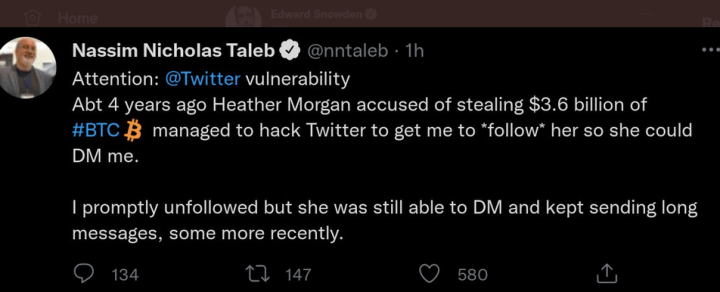
I have several things to say about this nonsense:

I. Check his use of “Attention” and the scare word “vulnerability.” Taleb thinks this message is super important and even urgent. He’s got to get it out there RIGHT NOW.

II. The story is obviously total BS. Taleb seems to have no sense of how Twitter works, and his narrative is so bizarre that he is basically begging for a roasting, which users in the hundreds did, of course.

III. Taleb gives no insight into why Morgan was DMing him. What did she want? Well, users, myself included, had a theory as to what might actually have occurred here. Occam’s Razor would suggest that at some point Morgan and Taleb began exchanging DMs, possibly on her initiative, as she was writing extensively for Business Insider and Forbes I believe, and maybe she wanted to ask Taleb something about one of his books. Taleb then pivoted into a bit of tail chasing, or, as one Twitter denizen put it slightly less crudely, he was looking for a little “bobs and vagine.” When Morgan was arrested, Taleb got spooked that somehow their DMs would leak, so he concocted a ridiculous cover story almost (but not quite) as stupid and unbelievable as Joy Reid’s claim that her fifteen year old blog with homophobic jokes and comments was hacked by Russians.

IV. The use of “some more recently” is a pure “tell.” Taleb’s bobs and vagineing has been going on for some time, it seems. But why in the world would Taleb think that the messages would leak just because Morgan was arrested (she was later released and her husband was held in custody, and I haven’t been able to get a status update on where she is today)? I mean there are really only two options:

i) that the messages would be released by the FBI or something as pertinent to the case, in which case Taleb and Morgan would have been discussing her hacking. This seems highly unlikely;

ii) Morgan would choose to release them herself in an effort to incriminate Taleb. But Nicholas baby, this is just not going to be a priority for Morgan after her arrest. I mean, she is accused of stealing 4.5 billion, and she’s got her rap career, and her husband is in prison. She has got stuff going on man; your DMs are way down the list.

All and all, this message shows that Taleb is an idiot and a complete joke. And people took note, including Edward Snowden, piping up from Russia. Check this out:
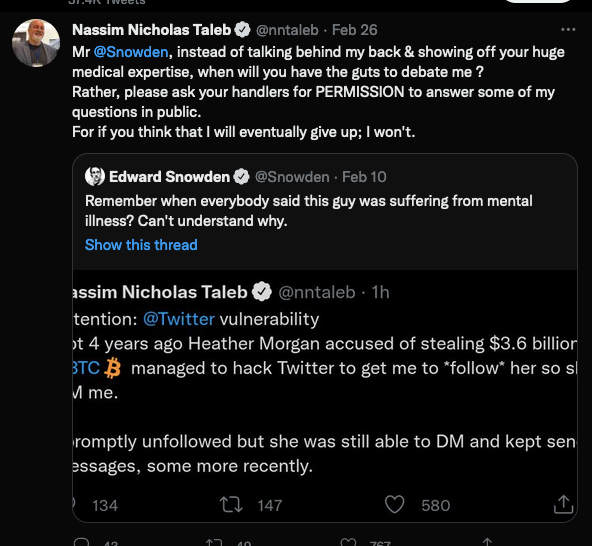
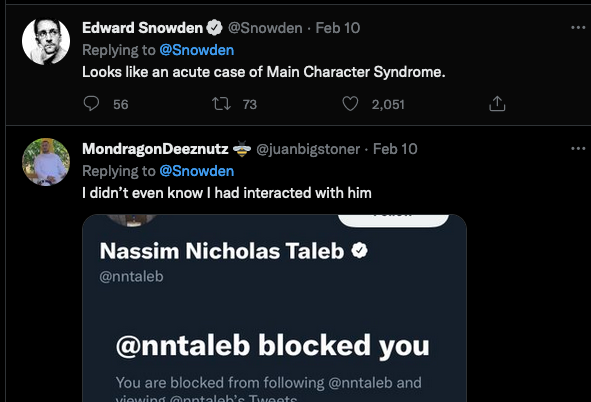
Snowden comes in with the savage take down here, and Taleb punches back with an offer to debate, what exactly? It’s not clear if this debate challenge was issued prior by Taleb nor is it clear, at least to me, what is to be debated. Are they supposed to talk medical issues? Mental health? Hacking? Bobs and vagine? Taleb continues to make no sense, and Snowden lets him know with another zinger:

Main Character Syndrome indeed. I would add Major Asshat Syndrome and Big Phony Fraud and Fragile Loser Syndrome as well. Because this is the guy who wrote Antifragile! Which is supposed to be about things that thrive during chaos, or in other words, things which are resilient. And nothing says resilient less than faking a hacking narrative to cover your tail chasing, issuing an incomprehensible debate challenge to someone way out of your league, and tripling down with blocking random twitter users who question you. And I would know, because after I liked the bobs and vagine comment and added something like “Methinks Mr. Taleb doth protest too much,” the fucker blocked me too! Sadly that Twitter account is history so I can’t post a screenshot, however it was obvious that this huge baby was scrolling chats and mass blocking to distract from his disastrous piece of public relations. Honestly, the whole thing was super funny and Taleb showed his ass in the worst possible way.

Taleb obviously thinks he is hotshit. Check out his Twitter bio.

What a poser. A flaneur is a French term for someone who walks the streets taking things in, and Walter Benjamin wrote extensively about the flaneur in his epic, and epically unfinished, “Arcades Project.” Actually, a flaneur is a lot like a kibitzer. I am the kyotokibbitzer (two b’s baby), and I love Benjamin’s work, including the Arcades Project. I bet Taleb is aware of Benjamin and fancies himself a fan. But he doesn’t know the first thing about Benjamin, because Benjamin was a humble guy who did great work and Taleb is a braggart, a tail chaser, and a bum. Deadlifts and dead languages my ass. Text is dead there Nicholas, at least your texts are, because you made a complete fool of yourself and you suck. Taleb exemplifies precisely why I dislike anyone who calls themselves a public intellectual or an expert. He is a poser and I’ll bet you 10 to 1 his ideas are stolen just like Neil DeGrasse Tyson, another total loser who piggybacks on people who know something to pump up his image. (A sure sign of a loser is a “public intellectual” who insists on using three names. What’s wrong with Nassim Taleb or Neil Tyson? The only people who need three names are serial killers; I mean even public intellectual number one Malcolm Gladwell only uses two names. Gladwell is known to pilfer ideas as well, but The Tipping Point is a pretty good read and the dude genuinely knows a tremendous amount about the sport of running. And he doesn’t call himself “Malcolm Julius Gladwell” or whatever. This is because he’s just a writer and knows that using his middle name would make him a prat.) Anyway, it’s totally fine to fake it ’til you make it, and most of us do to a greater or lesser degree, but you can’t fake your way into being an expert. Never trust “experts,” full stop.

So that’s the story of Razzlehan, the misunderstood genius, and Nassim Nicholas Taleb, the big phony. And in case you are asking, yes I did ask Razz to get in touch with me above. I’d say “I can fix her,” but she needs no fixing. She can DM me all she wants, and she doesn’t even have to get the Russians involved.

If you enjoyed this piece, you may also enjoy “Why It Is So Hard to Get Breakfast in Japan (with a dream cameo from the Gemini Donald Trump).” You can find that here.

On My Week with Isobel (aka London Girl) Part I

Subtitle: I didn’t sleep with her so I had to quit my job.

Mistakes were made tonight

The Mendoza Line

Note: This piece is about a single week in my life that reordered things for good. At a minimum it’s an interesting story; at maximum it is the hinge between two versions of myself. I do not pretend to be the hero of it, and I take full responsibility for everything contained here.

It begins with a dream I had in Bali at the very end of July 2018. I was the lead trainer for the IB Asia Pacific workshop leader and school visitor training — my first time in that role after five years of apprenticeship. At the same time I was working at Ritsumeikan Uji as shukan, a kind of junior administrator. By mid-2018 I was burnt out: long days, multiple roles stacked on top of one another, and, most of all, a boss I no longer trusted. I was scheduled to go to the Faculty of Astrological Studies (FAS) at Exeter College, Oxford at the end of August, and in the meantime I would attend John Innes’s wedding to his fiancee Kristi. All this occurred, and here is that dream.

PROLOGUE: DREAM I

7/29/2018:

The dream starts with an image of a large whisky bottle. The bottle is very fat and also ceremic. So in fact it looks nothing like a normal whisky bottle.  It is perhaps of Suntory brand. I know before I know that a story of some kind will unfold inside the bottle. I am reminded somehow of a ship inside a bottle.  Suddenly I am inside the bottle itself. There is a whole word here and all sorts of people in a cityscape. I come to understand that everyone lives in relative fear of a species or group of overlords. 

The overlords are both omni-present and also very distant. They rule by fear and have the power to rub out anyone at any time. Sort of. When a person is marked for removal their status is updated. Their status is displayed on a kind of glowing chip in their shoulder.  There are basically three types of statuses. First is “needing to have the life wrung out of them.”  There are marked people and their time is limited. Apparently they are political criminals, thought criminals. Oddly, even when marked these people continue to circulate and take part in oppositional activity. I never actually see one of them removed, although their actions do take on a greater sense of urgency. 

The second category is another worded status. This one is more ellitipcal and I forget the wording. Though safer than the  first, this is still a status to be avoided if possible. 

Third is a number.  A voice tells the city that statuses will be updated and that anything under 40000 is a safe score. I check my update with bated breath, fearing the dreaded worded status. My number is 49500.  Not bad I think—although not under 40000 this is perhaps for young people. 49500 seems reasonable for my age. 

Suddenly the view shifts and I can see into the bottle from the outside.  All of the people and various creatures and scrambling for the mouth of the body. The bottle begins to approach a wall into which is will soon merge. Here, the entrance to the bottle will be sealed. The I character in the dream is also scrambling for the exit although he doesn’t seem to stand much of a chance.  Creatures spill over one another and one baby creature somewhere between a human baby and a little mouse slips through the mouth of the bottle to the other side of the wall. The bottle snaps closed and I am once again staring at the large ceremony bottle from the beginning of the dream. I feel a sense of relief that the perfect creature has escaped. End of dream. 

This dream is about reincarnation. 

(The me on the treadmill does not survive. Dream group says whisky is a spirit which takes 50 years to mature.  That gives me a book deadline I guess-49.5 the book and the end of the provisional personality.)

PART I — Sunday → Wednesday

Sunday, late August 2018

I flew into London from Osaka and took a pre-arranged bus to Oxford, then walked to Exeter College. Check-in, dorm keys, linens. The halls smelled like old plaster and a little like soap — an old building. I carried my bag upstairs, opened the door to the room that would be mine for the week, and sat on the bed for a moment to locate myself. New country, new rhythm, no context yet.

I walked the campus — stone walls, grass cut low, shaded paths. The quad had that contained feeling of a place that already had its stories. I didn’t know I was about to enter one.

I went to dinner at a taco place just outside campus and had a beer or two. Back in the room I read a little astrology to warm up for the week and listened to the band The Mendoza Line. Little did I know they would end up playing a surprisingly large role in what followed.

Around 10 PM the fire alarm went off. Everyone in the building stumbled outside in pajamas and stood around talking for a few minutes. Odd, but fitting — a small communal disturbance to start the week off.


Monday

I woke up, showered and dressed and grabbed my notebook for the astrology sessions. At this time I was fully committed to attending sessions and making the most of them. Breakfast opened early and I liked that — fruit, eggs, strong coffee. The hall had a low hum, people still new to each other. I walked to the first seminar which was given by Ms. Claire Martin. Claire was in her 70s, and a very comforting presence. She’d been doing astrology forever and has a couple of books which are helpful. The seminar was on the first floor, window onto one of the gardens. The air had that mild, hopeful tone of a first session.

Claire spoke on the 1890s — fields of meaning, ectoplasm, etc. I offered something Jung-coded because that’s where my mind goes when the border between psyche and symbol starts to move. I didn’t know she was in the room yet, Isobel (not her real name), though she already was.

At one point Claire mentioned an Aries Moon. I said, simply, “I’m an Aries Moon.” Nothing loaded, nothing aimed. Lecture ended, chairs moved, and she came to me from the back of the room.

“I am an Aries Moon too.”

We walked to the next session together. That was it — no delay, no drift. We sat side-by-side for the rest of the day. Chatting between sessions, coffee break close but not touching, her chart in her bag. She showed me her own chart print-outs — hers and her fiancé’s — and we compared placements. Similarities everywhere.

Lunch in the dining hall. More sessions in the afternoon. Light talk, no electricity announced but already there. Monday night we ate with a group — tutors, a few new friends. We were beside each other the whole time, not hiding it. Later we drifted to the courtyard bar, opened wine bottles, and someone lit a cigarette. I hadn’t smoked more than a dozen cigarettes in sixteen years, but I took one with her, and then another. Not ceremony, more like instinct, more like inevitable.

We ended the night late. I walked back to the dorm alone and put on The Mendoza Line again. I already knew I was in trouble so in addition to “It’s a Long Line (But It Moves Quickly)” I was listening over and over again to “Mistakes Were Made” from which the epigraph comes. Sometimes you just know.


Tuesday

We had planned to have breakfast together, not at Exeter but at Pret, about an eight minute walk away. We both ate and she helped me pick my breakfast. We were acting like a couple already. We attended the morning sessions, seated right next to each other and then the day started to open. In the afternoon we did not attend sessions, instead we spent the time in one of the beautiful gardens. We sat close on the bench by the open window, listening to the session through the gap. I talked about muses and how I work best with one. She talked about photography, stalled career energy, her family, and Swiss-Russian split. Russian women, I reflected not for the first time, are a problem, and I knew deep down I was already in trouble.

Tuesday night the singer-songwriter Lucy Dacus was scheduled to play Oxford, and I had a ticket, but she canceled. Instead we went out for dinner, just the two of us, at an Indian restaurant near campus. We were already deep into our relationship, and everything came easy; I could feel it inside ten minutes. This was one of the best meals I have ever had for reasons bigger than taste. I told her about my two epiphanies, one when I was four years old and one when I was seventeen. The whole evening felt like a third epiphany.

Back at campus everyone was drinking in the courtyard again. There was Mystery and her daughter, tutors, people rotating. We stayed late, drank wine, smoked, and flirted like teenagers. I went to my room around 1:30 AM, playing The Mendoza Line over my headphones again. I was seeking their counsel, essentially, and they are a great band.


Wednesday

I woke up and this day we had breakfast at the dining hall. By this time, people were noticing us. Comments here and there, sideways smiles. Morning and lunch blurred into one long conversation — the garden, the bench, a little grass, nothing hidden. We were finishing each other’s thoughts, and I was in deeper than I had ever been. We didn’t attend much of anything. Afternoon break she went to change. I went back to my room and put on Mendoza Line with the full weight of obsession. She came back later and said, without shame, that she’d pleasured herself during the break — just stated it directly. This was a complication.

For dinner that night she changed again — a red dress, short but not careless. Stunning. Whispering at the table, touching lightly, laughing against each other. Everyone knew by then. After dinner was wine again, talking with the tutors, including the lovely Rod Chang and Mystery the long courtyard. I met Darby Costello in person for the first time. Darby is my astrologer and we had already had a number of phone consultations by this point. She was fully alive drinking wine, and talking like someone who knows how to hold a room. I was so happy that she was my astrologer. Isobel and I stayed late once more, and cleared the courtyard. Around two in the morning we parted, cheeks touched, no bedroom, no act.

Back in my room, lights low, I lay on the narrow bed with Mendoza Line in my ears. I knew exactly where I was standing:

I would keep going. I would see where this led. But I would not sleep with her. I couldn’t.

That was the shape. That was the decision. Wednesday ended on that line.

Everybody Tips

Note: There’s a Ryan Adams song that’s always felt like a quiet diagnosis. The emotional math is simple: people give you just enough tenderness to keep you upright, but never quite enough to really move you from wherever you are. It’s from “Oh My God, Whatever, Etc.” — track 5 on Easy Tiger (2007).

You find out you’ve been underpaid, in a sense, for years, not because anyone meant you harm, but because the default setting in some long-forgotten form was never double-checked. The system assumed it was correct. Everyone assumed it was correct. And the thing is, it makes sense—you look like the sort of person who doesn’t need tending. So you stand there with the revised numbers in your hand, not angry exactly, just noticing the symmetry of it all. This is the pattern: people offer small kindnesses, small gestures, small acknowledgments.


Everybody tips.

Just not quite enough to knock me over.

It reminded me of something from years ago at my little IB school here in Japan. Back then I was stretched thin in a way you can only be in your thirties—trying to prove something, mostly to myself. I’d rush through lunch like it was another task to complete. One day Scott, one of our English teachers and a high school homeroom teacher, watched me finish a meal in about two minutes and said, gently, almost to himself, “That’s not good.” It wasn’t an intervention. It wasn’t even advice. Just a small observation from someone who was paying attention in the limited way people do. A tip, not a gesture. A flicker of care that landed, and then the moment passed.

Looking back, I think that’s why the moment stayed with me. It was concern, yes, but it was also something rarer: someone catching a glimpse of the strain I kept tucked under the surface. I wasn’t used to that. Most people saw the polished version—competent, fast, self-sufficient—and adjusted their care accordingly. Scott’s comment didn’t rearrange my life, but it landed in that narrow space where a person can be briefly seen without being exposed. A small kindness with a little weight on it, though not enough to shift anything. Another tip.

When I think about it now, it wasn’t an isolated moment. My life is full of small gestures like that—light touches of concern, half-noticed details, people offering just enough care to register but not enough to alter the trajectory. It’s not their fault; it’s how most of us move through the world. We read surfaces. We assume competence means comfort. We assume steadiness means abundance. So what comes my way is always the manageable version of kindness, the soft-edged form that stays within social limits. It accumulates, in its way, but it never quite tips the balance.

And then there’s the other meaning of the word I keep circling. To tip isn’t only to offer a small gesture—it also means to wobble, to shift the weight of something just enough that it might tilt. In that sense, everybody does tip me. Every small kindness knocks me a little off balance, just not in the dramatic way Adams means. It’s more like a brief lean in the direction of connection, a momentary swerve in the steady line of the day. A soft recalibration, not a collapse. The world nudges, not crashes. It’s movement—just not the kind that bowls you over or forces a change. The cumulative effect is real, but subtle enough that you only notice it in retrospect.

Most days, that’s all life is: a series of micro-tilts. A colleague covering five minutes without comment. A student bowing an extra beat longer than expected. A friend sending a small message at the exact right moment without knowing why. They don’t change your direction, but they do alter your angle by a degree or two. You barely feel it while it’s happening. You just register that your emotional center shifts slightly—a soft lean, a subtle recalibration, the faintest sense of being moved without being moved on. These moments don’t rewrite your story; they just keep it from calcifying. They are the human version of a brushstroke: slight, necessary, almost invisible unless you stand back and look at the whole canvas.

Every once in a while, though, someone doesn’t just tilt you—they land with actual force. It’s rare, but every few years, if you’re lucky, someone steps forward with something closer to full human weight. No calibration, no optics, no politeness. Just the clean, unmistakable feeling of another person showing up without trimming the edges of what they mean. Those are the moments you remember because they interrupt the pattern. They don’t just adjust your angle; they reset your coordinates.

That’s what happened to me in 2018. I’ve told this story in my Bad Moves piece, however to re-state I’d been traveling to see the band Phosphorescent in New York, Boston, Philly, and D.C. I was moving through my own private fog, the kind you don’t mention to anyone because you don’t want to make a spectacle of it. I told the merch gal I’d flown in from Japan, not as a plea for anything, just as passing context. She passed it on to Matthew Houck, the lead singer. And he didn’t do the socially appropriate thing, the small nod or the quick thanks. He came down off the stage and hugged me. A real hug, the full weight of it, twice across two different nights. No hesitation. No half-gesture. He gave me the exact amount of human force the moment called for.

What stayed with me wasn’t the hug itself, but the certainty behind it. Most gestures come wrapped in hesitation or self-consciousness; people soften their own impact before they even reach you. Houck didn’t. And part of the weight was this: he’d been through it himself—not abstractly, not a decade removed, but in the very songs he wrote on Muchacho, the record he made after his own life had come apart. He’d talked about it publicly, openly, without varnish. So when he came down off the stage to hug me, it wasn’t fandom or performance or politeness. It was recognition—one human being who had already walked through his own fire seeing another who was still in it. And the thing about weight is that you feel it instantly. It bypasses the usual filters, lands somewhere deeper, rearranges whatever you were carrying. For a second, you’re not holding yourself up alone. Someone else is taking on a share, however briefly. That’s why I remember it. Not because it was dramatic, but because it was unmistakably real.

I still don’t expect the big gestures. Most people don’t have them to give, and institutions certainly don’t. But my little allowance situation reminded me of something I should probably stop forgetting: I can be steady without letting people assume I’m inexhaustible. I can be competent without accepting the bare minimum as my baseline. Everybody tips, and I do appreciate it. But that doesn’t mean I should be content with being underpaid, overlooked, or treated as some kind of default. The small gestures matter; they keep things from freezing over. They’re just not a substitute for fairness, or for the kind of presence that actually moves you.

And if I’m honest, before the Houck hugs the last time I got knocked over didn’t happen at a show, or in a meeting, or anywhere you could itemize on a form. It was one of those chance crossings where someone walks in at full voltage, doesn’t shrink themselves, and then carries on while you’re still quietly recalibrating. Nothing official changes. Your job is the same, your allowance is the same, your life on paper is the same. But now you know, in your body, what real weight feels like when it lands. And once you know that, it gets a lot harder to pretend that tips—however kind—are the whole story.


Dedication

For the White Russians — the ones who tilt the whole room just by arriving.

The Hired Hand, Part I: Azerbaijan, 1990

So you think you can tell/ heaven from hell

Pink Floyd

March 7th, 1990. Mitchell Grey waits at a make-shift roadblock on the Iranian side of the Iranian/ Azerbaijani border at Astara. The Azerbaijani populace has been on a 40 day general strike since a desperate and cornered Gorbachev ordered a crackdown on the citizens of Baku. Nerves on the border are stretched thin, to say the least. Grey takes his time, keeps his head down. He turned 30 in November, a mid-Sagittarius, born adventurer. Not that he’d had much choice. Of course, Grey is no more his name than it is yours, unless that is your name happens to be Grey.

Four or five people, all men, are processed and it is Grey’s turn. He turns over his passport for inspection. The customs officer looks it over, gingerly.

“What is your profession?” he asks, in perfectly inflected English.

“Engineer,” replies Grey.

He had settled on this option after much thought. Grey stands 5 foot 10, with clipped hair, three-day stubble, and work boots. He is operating on a $1500 advance paid three weeks ago in Milan by his handler whom he had met for 10 minutes. Precious little remains, and Grey is in no position, no mood to pretty himself up for the Astara crossing. He does not look like a businessman or financier, and is not about to take the risk of trying. Nor does he look like a writer, despite the capaciousness of that particular category. He looks like what he is, a hand for hire, a mercenary. Engineers are scientists, more or less, and he hoped that at least a patina of respect would be accorded his proffered status.

“Engineer of what? You are here to steal our oil, yes.”

Not a question. The border guard gives Grey a look somewhere between a sneer and a smirk. A game player, thought Grey, a patriot perhaps, but a game player first. This is usable information. Grey takes a low deep breath, forces himself to relax.

“A structural engineer. I specialize in basements and aqueducts,” he replies.

Grey hoped that the word “aqueduct” would escape the guard and that he would tire of the game soon. However the young man was not such an easy mark.

“Basements,” says the guard, with heavy sarcastic emphasis. He turns to the man to his right, an older man, long past fed up with the conversation. “You have business in our country about basements?”

It was time for Grey to fall back on the cover story. “I am not here on business. I am meeting an elderly couple in the countryside. They are passionate hunters, and we will be hunting your famous Caucasian snowcock. As well as of course quail and pheasant.”

“So you are on holiday,” askes the guard. “Holiday, now, after the brutal crackdown of the Russians, you are here to shoot birds on holiday.”

“That’s correct,” replies Grey.

He produces a letter of introduction to the couple, one Mr. and Mrs. Verlandier. There is indeed such a couple, extant, with a villa in the hills. They had received $500 through a cut-out of a cut-out of a friend of a friend. Essential plausibility, the first principal of trade craft. Now, a letter of introduction is just a piece of paper, as the border guard was well aware. Nonetheless, the scruffy looking traveler had produced paper, and paper suggests organization. And organization, well organization suggests friends. The Soviet Union was in tatters, matters were moving fast. Who knew who was with whom? The guard has no wish to inadvertently insert himself in a game any larger than hassling an apparent criminal drifter. Still, he can not resist making his feelings known to this Mr. Grey.

“That sounds like a very interesting pastime,” he says placidly. “I know a little bit about Caucasian cocks myself. In fact, I have a reputation of being able to spot them from hundreds of meters away. Just something people have said.”

Mr. Grey takes this in stride, nods, and thanks the man for his passport back. Eyes low and feet slow, he tells himself. Don’t fuck up; “go see the Verlandiers.” He crosses the border and takes his first steps on Azerbaijani soil. He has three hours before his appointment. Every minute matters.

to be continued…

Dedication: For Eric Ambler, the GOAT.

The Thin Man 0: The Man Under the Bridge

Everything’s thin. The Wire

Setting:

We open onto a large office in what looks to be Moscow.  It could be anywhere in the East however, anywhere from Petersburg to Potsdam.  The office appears busy; clerks filing, apprentices bustling, managers shouting instructions and reprimands that go generally unheard, not out of rebellion, nor compromised auditory canals, but rather because the generalized cacophony of the office space is such that the collective action set cannot but unfold without coordination or direction.

The office is draughty and usually cold, although an occasional over-active heat pipe burbles out a bit of local warmth for certain fortunate corners.  The walls are covered from floor to ceiling with filing cabinets; the major task of the office is simply to inspect, stamp, classify, and file an endless stream of nominally related documents.  It is mid-fall, nearly harvest season.  Summer’s bounty this year has been acceptable, and the local populace will have food for the holidays.  Inside, however, the mood is one of permanent resignation to circumstance.

Scene One: Morning

You found me on the other side of a loser’s winning streak/ where my thoughts all wander further than they should

Dawes

The office’s hierarchy is complex, following rules of its own.  Those at the bottom of the ladder are blissfully unseen and operate without oversight or sanction unless transgressing in a manner so egregious that the neighbours become involved.  Those in the middle-lower classes are a little more visible; their seating, for instance, is of great importance.  Members of this class are ever being told that their stool has been moved to another section of the office.  Reason is neither given nor sought.  Transience is the way of the world, and is widely accepted.

The scene opens in the morning, just after the workers arrive.  At a large oak table, two members of this class sit, within mere inches of one another.  One of these is a thin man–the other, a Teutonic Knight.  Both have piles of papers left over from the day before in their work spaces, spaces delineated by a crack in the oak.  One of the papers from the thin man’s zone has shifted by a fraction of an inch overnight, whether on account of the draft or the vagaries of the cleaning staff is unknown.

The Teutonic Knight turns to face the thin man.

“I think you forgot something in my space,” he says.

“I didn’t forget anything in your space,” replies the thin man, “if you are referring to this piece of paper, it has shifted marginally and is abutting the crack which separates my zone from yours.”

“You have forgotten something,” insists the Knight.  “Take it away.”

The thin man sighs and removes the paper.  Good money after bad, he thinks to himself, applying a concept from the card tables, tables which he has, perhaps, been frequenting a little more often than he might want to admit.  The Knight knows nothing of the gambler’s demi-monde, spending his evenings as he does in endless rows over minor matters with one of the succession of women he sees.  And the thin man, well he has at least managed to stay out of the clutches of the worst money-lenders and knee-cappers in the city thus far.  His taste, in the last analysis, may run more to the risque than to risk per se.  In any case, the skirmish over, the knight withdraws from the field of battle, content in his triumph.  The thin man looks at the clock.  These days, everything seems to take all morning.

Scene Two: A Few Days Later

Well I was drinkin’ last night with a biker/ and I showed him a picture of you/ I said “Pal get to know her, you’ll like her”/ seemed like the least I could do

The Dead

The office has a kind of canteen, an open space where weak tea and the occasional edible biscuit have been reported. Here lives another man, a man from the south. His status with the company is ambiguous–a matter of no little gossip. Tales are told of whirlwind romances, payments under the table, mutually compromising material. No one really knows. This southerner spends his days reading and drinking tea in a most relaxed fashion. Good work if you can get it, muses the thin man. The thin man and the southerner are allies of the kind that sometimes arise during wartime conditions. The details of his ally’s dalliances and contractual complexities are only of a general interest to the thin man, who is however curious what value the southerner is seen to be providing to the company. Literacy is good and all, but the filing by god, the filing waits for no man.

Sometime that fall, the southerner pulls the thin man aside, for a talk. His manner is furtive, his words oblique. The thin man’s time with the company is limited, he whispers. His number is up. Time to hit the bricks, pal.

The thin man takes this news in stride. The tables beckon and he’s met a woman, a lady of the evening, perhaps, yet classy–demure, yet perfectly capable of looking after her own interests. He has only seen her a few times, true, yet there are possibilities. Of course being sans salary is not likely to widen that particular possibility set. So when the southerner leans in and whispers low, the thin man listens close.

“There is a man, a man you may meet,” says the southerner. “You must not ever tell anyone I told you this. The man will be under a bridge on a high holiday. There will be revelry. He may make you an offer.”

Gambling man he may be, but the thin man is confused.

“What should I do?”

“Stay alert. Pay attention. I can say no more.”

Easy to say, harder to execute, thinks the thin man. Alert for what? A man under a bridge is easy enough to spot, however the southerner seemed to be referring to another matter, an occasion where attention would be needed to carry the day. The thin man files the conversation away, and resolves to stay open to a situation that appears to have elements of fluidity.  It seems like the least he can do.

Scene Three: A Few Weeks Later

In bar light/ she looked alright/ in day light/ she looked desperate

Hold Steady

The thin man waited out the fall, his gambling limited to the occasional dice game at the Metropole. The southerner’s sage advice, if not quite forgotten, had faded into the general background of the holiday season. The city filled with lights and good cheer, and the denizens of the office slipped into a gentle numbness even more pronounced than usual. The demure lass was deft enough to dangle enough hints and intimations to keep the thin man hooked. You get what you get, he mused, when were it ever otherwise?  A couple of hot streaks at the tables allowed him to further postpone thoughts of the future. He would buy a round or two for a barfly girl he knew–at least she was around. Eggnog, that was her tipple.

One day a upper-middle manager summoned the thin man into a meeting. Called him by name no less. The meeting started crisply.

“Thin man, as you know you number is up here at the company.”

Hit the bricks, pal.

“As a result, we won’t be renewing your employment next year.”

Uh huh…ok, eggnog time then.

“I want you to understand that you won’t be employed by the company next year.”

What was that? “Stay alert,” so said the southerner.

“You won’t be offered a contract with the company. Do you understand?”

Unnecessarily repetitive. Information is being underlined. Pay attention.

“I understand perfectly,” said the thin man. And he thought that he did.

Scene IV: The Next Day

It was in Pittsburgh, late one night/ lost my hat, got into a fight/ I rolled and I tumbled, ’til I saw the light/ went to the Big Apple, took a bite

Dylan

After receiving the news of his impending termination, the thin man felt he had relatively little to lose.  He spent the next day in the canteen talking with the southerner.  The Tutonic Knight still reigned supreme over the crack in the oak; there was no there there in any case.  The southerner read philosophy, remained on the payroll.

“I’m attending a holiday party,” said the southerner.  “It will be this Saturday.  Under a bridge in the dead center of town.”

Indeed.

“There will be a man there.  If you decide to come to the party, meet me on the street just above the bridge.  I will act as if our meeting was coincidence.  Then, I will take you to the man under the bridge.  He is waiting to meet you.”

The thin man had but one true weakness, a byproduct, perhaps, of over-indulgence in games of chance.  His weakness, he knew, was for the unexpected.  For the unplanned. For, essentially, the random.

“Sure.  What time Saturday.”

“18:30”

Military time.

“OK.  I will present myself on the street as instructed,” said the thin man.

Scene V: Saturday

I said hey Senorita that’s astute/ why don’t we get together and call ourselves an institute

Paul Simon

On Saturday, the thin man arrived on time as promised.  The southerner materialized on the street just then.

“Ah, thin man, what an amazing coincidence.  I was just heading down under this here bridge to see a man about a mule.  Perhaps you would like to join me.  He may have an extra one for sale.”

“A mule might help me get out of town in a hurry,” said the thin man.  “Let’s see what’s happening.”

Under an inky moon the two men descended, passing through waves of people, men and women, reveling in the moonlight and watching the circus.  It was cake they ate, cake it was.  The density of erotic micro-transactions formed an exact square to the paucity of actual action.  Such was the slightly unkind thought that ran through the head of the thin man as he navigated the pretty party people.  In any case, the locus of action was ever in motion.

They pushed on, through the crowd, and reached the lowest point of the city.  Here, a man with a coat of many colors stood, in pointed shoes and a tricorne.  The host with the most, he held court to a motley crew of the pockmarked and the lame–the beautiful people of our fair city.

“This is a thin man,” said the southerner to the tricorne.

The man with the tricorne folded the thin man into a close embrace.  “You will be my new best friend,” said he.

“Naturally,” said the thin man.  “I think we will be very good friends indeed.”

“Now,” said the tricorne, “I have a little talent business, providing the right kind of people to the company.  You are my new best friend.  I will provide you to the company.  As talent.  That I found.”

“Of course you will,” said the thin man.  “Wither the eggnog, si vous plais?”

Dedication: For the southern man. Thanks for putting up with my nonsense over all these years.