Note: Spokane, early 1983: minor league baseball, cheap seats, and kids living in the gaps between innings. This piece recalls Spokane Indians games, chasing balls during batting practice, and a strange collision of childhood mischief and adult volatility at the edge of the outfield fence. Sandy Alomar Jr.—then a local catcher on his way to a long MLB career—signs a baseball in handwriting so precise it feels like a signature on a future already underway, while a moment of chaos involving thrown persimmons and a furious adult named Mike Trowbridge becomes the kind of story that sticks far longer than the season itself.
Epigraph:
Do you know who you’re fucking with?/ You’re fucking with a stallion mange.
Ween
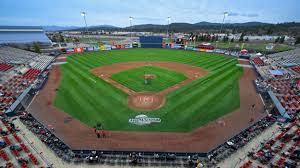
It was 1983 in Spokane, the kind of summer that felt permanently suspended in late light and dry heat, where the air at night still carried the dust of the day like it had nowhere else to go. We played Little League baseball in uniforms that never quite fit right, and then on weekends we graduated to something bigger and looser and more important: Spokane Indians games at the old stadium, Single A ball, where the dreams were real and still close enough to touch.
The Spokane Indians were a kind of civic promise back then. It was a small town, and in the early 1980s there wasn’t always a lot going on. The Indians were not quite big league, but not quite nothing. Just enough baseball to make you believe that something important was always one bus ride away. The seats were cheap, the beer cheaper, and the fences closer than they should have been. The whole place had that slightly improvised feel—like the city had built it thinking, this will do for now.
We didn’t go to games like spectators. We went like we belonged.
Behind the outfield wall during batting practice, kids gathered like scavengers. We chased homers, argued over balls, sprinted through patches of grass worn down by repetition. Sometimes we were the only ones back there. Sometimes there were older kids, or dads, or random locals who knew the angles better than we did. It was a loose territory. Not quite policed. Not quite ours. Something in between.
That summer, the Indians had a catcher everyone knew. Local kid. Quiet confidence. Clean mechanics. The kind of player adults already talked about like he had a future attached to him.
Sandy Alomar Jr. was that guy even then—before the long MLB career, before the All-Star years, before anyone outside Spokane would know the name properly. He was already different. You could see it in the way he stood when he wasn’t moving, like he was always half a second ahead of the next pitch.
I got his autograph once. It wasn’t dramatic. Just a moment after BP, when he signed a ball for a cluster of kids leaning too far over a rail. His handwriting was unexpectedly beautiful—controlled, deliberate, almost elegant in a way that didn’t match the dirt and sweat of the field. I remember thinking even then: this is what someone looks like when they’re going somewhere.
I kept that ball for years.
Because baseball wasn’t just baseball. It was a hierarchy you could see. You had the guys who were going to make it, the guys who might make it, and the rest of us orbiting the idea that proximity alone might transfer something.
Most of them wouldn’t go anywhere. That was obvious even then, though nobody said it out loud. But that day, none of that mattered yet. What mattered was the fence.
Our party was up high in the stands on the first base side, just beyond where the stadium fence met a thin strip of wild space. A tree had grown there—some kind of fruit tree, nobody was ever fully sure what it was. Persimmons, maybe. Something orange-red and heavy-looking, the kind of fruit that doesn’t look like it should be thrown but absolutely is.
Some kids started throwing them. Just kids, just fucking around. But they didn’t know who they were fucking with. Fuck with me and I’ll fuck with you.
The fruit flew. Not carefully. Not aimlessly either. More like experimentation. Testing distance. Testing reactions. Some of them were aiming at fans, others just launching them over the fence because it felt like something you could do if no one stopped you.
It was mildly funny at first. Then mildly annoying. Then mildly dangerous in a way that nobody fully acknowledged.
Because persimmons, if that’s what they were, aren’t soft. They hit like small decisions.
I remember one bouncing near a row of seats and rolling under a foot. Someone laughed. Someone else shouted. But nobody moved with urgency yet. It was still in the category of “kids being kids.”
Until Mike Trowbridge noticed.
Mike T was there with his kids—David Trowbridge and his sister Dawn. David had been a teammate of mine in Little League, a few years younger, outfield guy, quiet in the way younger kids sometimes are when they’re still deciding how loud they’re allowed to be. Dawn was just there in the background of everything, observing.
Their dad, Mike, was not background.
He was one of those adults you noticed before you understood why. Volatile energy. Tight posture. Goatee, black tank top, gold chains around his neck. A bit of a greaser; drove a Harley. Always slightly too close to losing his temper. He wasn’t a bad guy exactly—he could laugh, he could talk—but you always felt like there was a second version of him sitting just under the surface.
He saw the fruit being thrown. And something in him snapped into motion. He walked straight to the fence line, fast enough that it changed the temperature of the moment.
“Knock that shit off right now,” he yelled.
The kids paused. Not because they were scared exactly, but because the voice had weight.
Then one of them—small kid, maybe ten, sunburned confidence, the kind of kid who doesn’t fully understand consequences yet—looked up and said:
“Don’t pump me, man.”
It was such a strange sentence. Too casual for the situation. Too confident for the speaker. Like he had borrowed it from somewhere older and wasn’t sure how it fit yet.
There was a beat of silence where the entire stadium noise seemed to pull back slightly.
Mike T looked at him.
“Don’t pump me?” he said.
Then his voice shifted.
“You want me to pump you? I’ll pump you.”
And in that moment—this is the part that still feels unreal even now—he climbed the fence. Not slowly. Not theatrically. Just decisively. Like the boundary wasn’t a boundary at all.
Everything changed at once.
Me, David, Dawn—everyone nearby—we all froze in that wide-eyed way kids do when they realize the rules might not hold. It wasn’t comedy anymore. It wasn’t baseball anymore.
It was just: Mikey baby don’t kill that kid.
That’s what it felt like in my head. Not words were spoken, just panic translated into something almost verbal.
The kids scattered instantly. Full sprint. No hesitation. The fruit stopped mid-air and dropped forgotten. The stadium behind us suddenly felt far away, like it belonged to a different scene entirely.
Mike T took a step forward, still inside the fenced edge of this improvised battlefield, breathing hard, still locked in that strange overlap between anger and disbelief.
And then—somehow—it was over. No actual violence. No contact. Just the threat of it, large enough to erase the mischief that had caused it.
The kids were gone. The fruit stopped flying. The tree stood there like nothing had happened. Afterwards, the stadium noise came back slowly, like a system rebooting.
My dad, Ross, had seen the whole thing. He was laughing, hard. Not the kind of polite laugh adults do when they think they’re supposed to. This was involuntary. Almost helpless. The kind of laugh that tries to stay respectful but can’t quite hold the line.
Because it was funny. In that terrible, chaotic way childhood sometimes is when it brushes up against adult intensity and survives without breaking.
Ross would tell that story for years after. The kid. The fence. The persimmons. The line: don’t pump me man. He never stopped laughing at that part.
Neither did I.
But at the time, I just stood there thinking about Sandy Alomar Jr. somewhere on that field, already on his way to something else entirely, signing baseballs in beautiful handwriting, while right behind the stadium wall the rest of us were learning the difference between games and consequences in real time.
Most of us wouldn’t make it to the Bigs. But for one afternoon in 1983, it all felt like it might matter just the same.was 1983 in Spokane, the kind of summer that felt permanently suspended in late light and dry heat, where the air at night still carried the dust of the day like it had nowhere else to go.
But for one afternoon in 1983, it all felt like it might matter just the same.
Dedication:
For Mike T. And for the kid. You got balls young man, I’ll say that.