On Lou Reed and John Cale’s Album Songs for Drella (aka The Trouble With Classicists)

Note: This post takes up Songs for Drella (1990), Lou Reed and John Cale’s uneasy reunion album/biographical song-cycle about Andy Warhol, moving track by track through Warhol’s trajectory from Pittsburgh outsider to Factory-era icon to post-shooting isolation and mythic afterlife. Along the way it reads the record not just as tribute or elegy, but as a sustained meditation on work, style, and the thin boundary between populist gesture and aesthetic theory—especially in the pointed figure of “classicists” versus Warhol’s downtown anti-orthodoxy. What emerges is less a linear album review than a set of reflections on art, authorship, and cultural literacy, with Warhol as both subject and pretext for thinking about what it means to make anything count as art in the first place.

3

In 1990, Lou Reed and John Cale, formerly of the Velvet Underground, latterly famously not getting along, reunited to make Songs for Drella, a tribute/ musical biography of their first patron, Andy Warhol. Drella is a 15 song cycle which takes the listener through Andy’s life and career, from his early days in Pittsburgh, through success in New York, getting shot, latter-day isolation and and loneliness, and ending with an epitaph. The songs fit loosely together in chronological order. Here is the basic scheme: “Smalltown” sees Andy unhappy in Pittsburgh and dreaming of the big city; “Open House” describes the early days of the factory, when all and sundry stopped by and provided Andy with inspiration; “Style it Takes” gives an overview of some of Andy’s famous works and his working method; “Work” explains the considerable work ethic that underlay Warhol’s success; “Trouble with Classicists,” in what is presumably Andy’s voice, provides a series of opinions about “classicists”, “impressionists”, and “personalities”; “Starlight” appears to consider Andy’s flirtation with Hollywood, or Hollywood’s flirtation with him; “Faces and Names” kicks off the second section of the record and finds Andy in despair, something like a midlife crisis; “Images” details Andy’s philosophy of art and hits back at the critics of his method; “Slip Away,” “It Wasn’t Me,” and “I Believe” represent the nadir of the record in which Andy is warned about the people he associates with, confronts a junkie, and is shot by Valerie Solanis; “Nobody But You” sees Andy bereft of companionship hanging out and paying the price of dinner of a nobody; “A Dream” synthesizes all which has come before and puts Andy’s life into fuller perspective; “Forever Changed” sees Andy’s past slipping away; and “Hello It’s Me” represents Reed’s epitaph and apology to Warhol.

Some of the songs are better than others; specifically, I get comparatively little out of “Starlight,” “It Wasn’t Me” and “Forever Changed,” but every song has its place in the story of Warhol’s life and his influence on Reed and Cale, his circle, New York city, and the art world in general. This post will take up the first five songs as a bridge into a wider discussion of the meaning of “classicism” today. There may or may not be a part two to this post.

“Smalltown” is about leaving Pittsburgh, and introduces us to the fact that Andy was gay:

When you’re growing up in a small town
Bad skin, bad eyes – gay and fatty
People look at you funny
When you’re in a small town

New York is more to his liking, and provides a context for his art to flourish:

Where did Picasso come from
There’s no Michelangelo coming from Pittsburgh

I hate being odd in a small town
If they stare let them stare in New York City

The theme of small town boy (girl) made good in the big city is classic and well worn, of course, but Andy thrives in NYC, and soon “The Factory” is open to all comers (“Open House”):

Come over to 81st street I’m in the apartment above the bar
You know you can’t miss it, it’s across from the subway
and the tacky store with the Mylar scarves


Andy wants people around him, and this is one of the major themes of the record; his ability to work is dependent on company and inspiration from associates, peers, and even hangers-on:

It’s a Czechoslovakian custom my mother passed on to me
The way to make friends Andy is invite them up for tea

It’s a Czechoslovakian custom my mother passed on to me
Give people little presents so they remember me

Whereas “Smalltown” is loud and bracing, the music on “Open House” is soft, elegant, gentle even. But even in his halcyon early days in NYC Andy cannot entirely escape the demands of the market or of other people’s ideas of what he should be doing:

I think I got a job today they want me to draw shoes
The ones I drew were old and used
They told me — draw something new
Open house, open house 

You scared yourself with music, I scared myself with paint
I drew five-hundred fifty different shoes today
It almost made me faint
Open house, open house

Andy’s career takes off, and he clearly has something that people want–he has “The Style It Takes.”

You’ve got connections and I’ve got the art
You like attention and I like your looks
and I have the style it takes and you know the people it takes

I’ve got a Brillo box and I say it’s art
It’s the same one you can buy at any supermarket
‘Cause I’ve got the style it takes

Here, Reed and Cale delve into the perennial question of the definition of art–what’s good, what’s bad, and how do we know the difference? The answer which “Style It Takes” seems to offer is: the status of something as “art” is dependent upon someone with “style” telling so. This observation is at once banal (we know art is art because it hangs in a museum and because of the reverent hush of the patrons), and somehow inspiring (a kid from Pittsburgh, “bad skin, bad eyes – gay and fatty,” can take the New York art world by storm simply be possessing some quicksilver attribute called “style,” something so powerful that a simple box of soap pads becomes accepted as art less on its own merit and more on the strength of its association with Warhol, who by 1964 was rapidly ascending to the status of an icon). This song also sees the first appearance on the record of a little group called The Velvet Underground, who Andy “shows movies on.”

“I’ve got a Brillo box and I say it’s art”–is this a populist claim or an elitist one? Is it classical? Certainly not classically classical, but is there not a way in which Warhol’s “pop art”–which is often read as representing the “emptiness” of modern popular culture, is perfectly sincere and actually uninflected with irony? Another major theme of the record is Andy’s work ethic–he was a working artist on whose sweat the whole Factory scene was dependent. Andy’s work ethic, according to Reed and Cale, even had a religious aspect. “Work” starts with Andy in prayer, and despite the neat twist on the phrase “Protestant ethic” here, we are left with the strong feeling that Andy was no self-ironizing dilettante, and that his blue-collar background stuck with him throughout his life:

Andy was a Catholic,
the ethic ran through his bones
He lived alone with his mother,
collecting gossip and toys
Every Sunday when he went to church
He’d kneel in his pew and he’d say,
“It’s work,
all that matters is work.”

He was a lot of things,
what I remember most
He’d say, “I’ve got to bring home the bacon,
someone’s got to bring home the roast.”
He’d get to the factory early
If you asked him he’d told you straight out
It’s work 

In “Work,” Andy stresses quantity over quality; just as he had painted 550 different shoes in “Open House,” here he advises Reed to write like there is no tomorrow:

No matter what I did it never seemed enough
He said I was lazy, I said I was young
He said, “How many songs did you write?”
I’d written zero, I’d lied and said, “Ten.”
“You won’t be young forever
You should have written fifteen”
It’s work

But despite his working artist approach, Andy is not content to merely record the surface of what he sees. Neither, however, is he given to too much soul-searching or self-analysis about why he is who he is, or why he does what he does. “The Trouble with Classicists” is the central song on the record, the song where Reed and Cale get closest to defining Warhol’s attitude toward art. It is also here from which I was moved to take on the issue of classicism in our times:

The trouble with a classicist he looks at a tree
That’s all he sees, he paints a tree
The trouble with a classicist he looks at the sky
He doesn’t ask why, he just paints a sky

The trouble with an impressionist, he looks at a log
He doesn’t know who he is,
standing, staring, at this log {…}
That’s the trouble with impressionists 

If neither classicism nor impressionism, than who or what is Warhol drawn to? The answer is graffiti artists, of all things:

I like the druggy downtown kids who spray paint walls and trains
I like their lack of training, their primitive technique
I think sometimes it hurts you when you stay too long in school
I think sometimes it hurts you when you’re afraid to be called a fool
That’s the trouble with classicists

Let’s dig a little deeper. Cale, who sings “Classicists,” is himself famously a “classically trained” musician, who has drunk heavily of modernism and dissonance without surrendering what I still see as a fundamentally classical musical and aesthetic sensibility. Moreover, writing a song called “The Trouble with Classicists” in this day and age is in itself a classical act. This I think is a key point; whereas once upon a time a Romantic poet could have defined himself or herself in violent opposition to Classicism and made it stick, today, and perhaps even in Warhol’s day, the ability to criticize classicism as a form or style is evidence of a degree of learning and cultural literacy which can only be described as classical, and, yes, a little elitist.

Is this right? It sounds right, at least, and I would add the following: a) the vagueness with which I am approaching the question of a modern definition for classicism in these paragraphs is symptomatic of the generally pitiable state of true learning on that part of what Edward Said calls “the general intellectual”; b) Said’s general intellectual today tends also to be as Dean Williams has said a “profound modernist”–which is a nice way of saying someone who knows, and cares, very little about Western culture’s classical roots, very little about the Bible, very little about the great religion (at least in any fine grained way), probably very little about Shakespeare for that matter; c) today’s general intellectual knows very little about music compared with his 18th or 19th century counterpart. This is a point which Said makes in his chapter on Glenn Gould in On Late Style: “Today’s literary or general intellectual has little practical knowledge of music as an art, has hardly any experience playing an instrument or studying solfege or theory, and except for buying records or collecting a few names like Karajan and Callas, does not as a matter of course have a sustained literacy–whether that concerns being able to relate performance, interpretation, and style to one another, or recognizing the difference between harmonic and rhythmical characteristics in Mozart, Berg, and Messiaen–in the actual practice of music” (115). Any of my general intellectual readership care to take this argument on? If so, please produce 100 words on solfege without reference to Wikipedia before wading in.

My point, which is, I fear, on the verge of getting lost, is less that Warhol or for that matter Reed and Cale are in any specific way “classical,” but that because what Said calls the lack of “sustained literacy” in music on the part of the general intellectual is not confined to music, but extends to art, classical and great literature (how many of us who name drop Aristotle have actually spent any time reading him? how many of us who attempt to evince first-hand knowledge of Marx have actually broached Capital?), and philosophy. That is to say that the general intellectual today is apt not only to be a profound modernist, but also to be a profound generalist, who knows a miniscule amount about a huge number of things, a little bit about a few things, and knows almost nothing is any truly extensive or impressive detail. In this context, not only is “The Trouble with Classicists” deeply classical, not only is Classical Sympathies, by very virtue of its being and intent, classical, but any attempt to engage in a serious way with issues of aesthetic definition marks one out as both a classicist, and at least a minor elitist. Certainly Said, for all his “oppositional” stances and leftist politics, was both–but the question of how leftism and classicism can co-exist is best left for a latter date; it is time to stop work on this post and risk being called a fool.

On the Concept of “Role Drift” in Laud Humphrey’s The Tearoom Trade and the US Military and Paul the Apostle

Note: This piece is a wide-ranging meditation on Laud Humphreys’ notion of “role drift” in his book The Tearoom Trade, drawn outward into unexpected but structurally suggestive parallels with the historical conversion the Apostle Paul and lived military hierarchy through an interview with an ex-US solider. Beginning from Humphreys’ account of observational immersion and the tendency for participants and observers alike to “go over” through sustained proximity, the piece tracks how identity can be reshaped by exposure to institutional logics and repeated social frames. A military anecdote from the First Gulf War anchors the theory in lived experience, while the figure of Paul becomes an extreme historical case of allegiance reversal that tests the limits of the model. The result is a speculative sociology of affiliation and transformation, where roles are not merely performed but slowly internalized until the boundary between observer and participant, or “they” and “we,” begins to dissolve.

Epigraph:

I believe in this/ and it’s been tested by research/ that he who fucks nuns/ will later join the church.

The Clash

This post takes up that sexiest of subjects, “role-drift.”  In this post I will connect Laud Humphreys’ investigation of “the Tearoom Trade,” that is, casual homosexual encounters in public toilets, the initiation process in the United States military, and the conversion of Paul the Apostle.  Those easily offended by sociological explanations of religion, of sexual preference, or of the comradeship among soldiers should cease reading immediately.

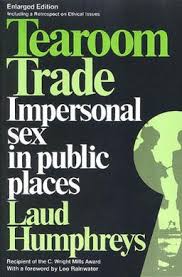
Recently, I finished reading a book–which, as my next post will detail, is a somewhat rare occurrence.  The book was Laud Humphreys’ “The Tearoom Trade,” published in 1970.  It concerns men hooking up with other men, usually strangers, in the public restroom facilities in St. Louis, and it is an eye-opening read.  The blurb on the book jacket pretty much tells the story: “Many American men seek impersonal sex in public restrooms.  Called ‘tearooms’ in the argot of the homosexual subculture, these restrooms are accessible to and easily recognized by those who wish to engage in anonymous sexual encounters {…} By passing as deviant, the author was able to engage in systematic observations of homosexual acts in public settings.  Methodologists will be interested {…} in this unusual application of participant-observation strategies.”  Indeed, methodologists everywhere, I can say without hesitation, were and are all ears.  But the odd thing is that Humphreys, married and purportedly straight when he conducted his research, later divorced his wife and came out as gay.

Now, it may not be considered particularly odd that someone, sociologist or no, who spends several months or years in public toilets observing “insertors” and “insertees” would himself come out eventually, and Humphreys’ persistent use of “us” and “we” to refer to the denizens of the restrooms of St. Louis appears, in retrospect, to be something of a “tell.”  Consider, for instance, sentences such as the following: “when a group of us were locked in a restroom and attacked by several youths, we spoke in defense and out of fear {…} This event ruptured the reserve among us and resulted in a series of conversations among those who shared this adventure for several days afterward” (12), and several other similar uses of plural pronouns.  (It may be of interest here that Humphreys and his study of tearooms enjoyed a brief week in the sun a few years ago when Senator Larry Craig of Idaho was arrested in an airport bathroom stall for foot-tapping–Humphreys covered this topic as well, making clear that foot-tapping was, in 1970, a well-established method of making contact from stall to stall, and already in use by police decoys so many decades ago (20, 87).)

Indeed, the whole study is fascinating, and peppered with wonderfully matter-of-fact passages such as: “There is a great deal of difference in the volumes of homosexual activity that these accommodations shelter.  In some, one might wait for months before observing a deviant act.  In others, the volume approaches orgiastic dimensions.  One summer afternoon, for instance, I witnessed twenty acts of fellatio is the course of an hour while waiting out a thunderstorm in a tearoom.  For one who wishes to participate in (or study) such activity, the primary consideration is one of finding where the action is” (6) (alert readers will recognize the influence of Erving Goffman here; Goffman’s study of gambling establishments is titled “Where the Action Is”).  But the passage which really caught my attention deals with what Humphreys calls “role instability” or “role drift.”  He makes two major points; i) those who start out pitching tend to end up catching; “It appears that, during the career of any one participant, the role of insertor tends to be transposed into that of insertee” (55) (Humphreys attributes this tendency to “the aging crisis” common to tearoom participants); ii) “If {straights} remain exposed ‘too long’ to the action, they cease to operate as straights” (56).  Humphreys here is not referring to men who one day, by accident, may wander into an operational tearoom, but rather to members of the parks department or vice squad who, over time, may be exposed to a wider swath of tearoom activity.  Here is the key passage:

“When some communication continues to exist, parents tend to be ‘turned on’ by their pot-smoking offspring.  Spectators tend to be drawn into mob action, and kibitzers into card games.  Even police may adopt the roles they are assigned to eliminate:

‘It is a well-known phenomenon that when officers are left too long on the vice-squad–the maximum allowable at  any one time being four to five years–they begin to ‘go over’, adopting the behaviorisms and mores 0f the criminals with whom they are dealing, and shifting their primary allegiance’” (Here, Humphreys is quoting from Elliot Liebow’s Tally’s Corner from 1967.  My emphasis).

It is a well-known phenomenon that when officers are left too long on the vice-squad they begin to ‘go over’. The moment I read this, having known of Humphreys’ own history before I read his book, I immediately recognized either a brilliant justification for future defection or an alternative, sociologically-based, theory for how sexual preference is formed.  After all, Humphreys himself spent several years researching and writing “The Tearoom Trade,” over which time he subjected himself to sufficient “action” to push him into shifting his primary allegiance, and to “go over.”  This theory, it goes without saying, flies in the face of the idea that sexual preference is genetic or established in the womb–and just as obviously it cannot explain all instances of same-sex attraction.  But, as a sociologically fascinating explanation for Humphreys own conversion, it remained in the back of my mind.

Several weeks later I was reading Robert Wright’s Atlantic article “One World, Under God,” about the relationship between religion and globalization.  Much of the article deals with the Apostle Paul, and I read something I had long known but never fully processed–Paul persecuted Christians right up until his conversion.  Here’s Wright: “The ‘Apostle Paul’ wasn’t one of Jesus’ 12 apostles.  Quite the opposite: after the Crucifixion he seems to have persecuted followers of Jesus.  According to the book of Acts, he was ‘ravaging the church by entering house after house: dragging off both men and women, he committed them to prison.’  But then, while on his way to treat Syrian followers of Jesus in this fashion, he underwent his ‘road to Damascus’ conversion.  He was blinded by the light and heard the voice of Jesus” (40).  The rest is history, of course, as Paul went on to establish ministries across the Near East, and, according to Wright, recast Jesus’ message as one of love and peace.  There are a couple of classic explanations for Paul’s conversion–first, as Wright says, that he heard the voice of Jesus or God and converted–simple enough.  Second, that Paul was epileptic and had a seizure in which he imagined he heard Jesus.  The first explanation is religious or mystical; the second medical.  But when I read this paragraph, the first thing I thought of was Humphreys–‘It is a well-known phenomenon that when officers are left too long on the vice-squad–the maximum allowable at any one time being four to five years–they begin to ‘go over’, adopting the behaviorisms and mores 0f the criminals with whom they are dealing, and shifting their primary allegiance.’” Had Paul spent too much time on the vice-squad exposed to this rogue new faith and fallen prone to “role-drift”?  This post is not a polemic, and I would not want to rule out religious, medical, or genetic explanations of human behavior–but the unifying thread excited me.

The general topic of role-drift has, in one form or another, been on my mind for several years, and I recently posted an extract of a conversation I had with my editor Dean Williams several years ago.  The narrow topic is how men in the military adapt to the culture–the wider topic is social adaptation and investment in an ideology over time.

===== =====

In the interview below “MT” is the author Matt Thomas and DW is Dean Williams, my editor, who served in the US military in the early 1990s during the First Gulf War.

MT: We’re here with U.S. army lieutenant Dean Williams, and he’s going to tell us a story from his military career. Dean, set the scene for us.

DW: OK, so I was a lieutenant back in the 19–early 90′s in Germany and there was an officer party. And a group of lieutenants, with me among them, we’re sitting next to a very famous general, his name was General Michael Kelly. And he was famous because he had become a one star general in a faster time than any other general in the signal corps. So we were very honored to be sitting there, and having a drink or two, with this kind of military celebrity.

MT: So you’d never talked to a one star general before in such a close setting?

DW: Yes, right, not a nice close setting. Not at a kind of a party where–he was being very open and honest with us, and we really got the sense that he had taken off his, kind of, stars, you know his general stars, he felt like more of a human being than is normally the case. And then I just, I felt this honesty and I felt it was a chance to tell him something that I had always felt in the last few years of being an officer and that was that you really got the sense that there was this vast, you know, impersonal, very powerful “they” that was above you; you had to do things, but “they” were up there controlling things, watching you, sometimes praising you, sometimes yelling at you, but they were there and you were here and there really wasn’t, there wasn’t much of a connection. And yet here was this general, he was part of the “they,” but here he was sitting right in front of us having a beer. And I said that to him; I said “so I really feel this gap between us so this is a good, you know, interesting chance,” and then I’ll never forget, he sat back and he put–he was smoking a cigar, by the way he was a very small man, like a lot of generals are…

MT: Were you smoking a cigar?

DW: No, I was not smoking a cigar ’cause I would have gotten sick, but he was a very small, but very dynamic and powerful guy, with piercing blue eyes, drinking his beer and just very animated and dynamic and energetic, and he leaned back and he actually put his cigar down, and he said “young lieutenant, let me tell you something,” he said “I’ve been in the army around thirty years, and I know exactly what you mean.” But he said, “and I went through as a lieutenant, in Vietnam, and did many many things, and I’ve done many field problems and solved many problems, and yelled and gotten yelled at, and in all my long career, as I went through, at some point, that “they” you speak of became a “we.” And now I feel that I am that “we.” And we were all very impressed with that, and I’ve never–I’ve forgotten many things from that evening; I’ve forgotten many things from the military…

MT: But not that? Not that moment?

DW: Yeah. It seems to me the most powerful statement of what it’s like to be part of an organization and to feel either powerless or have power…

MT: So what he meant is that over time, that you too would become part of that thing that you described as a “they,” you’d be part of it?

DW: Yeah…

MT: You would become it.

DW: You would, and as you spend time and invest in an organization, and as the organization gives you more power, more money, more reasons to stay, it doesn’t become–it gets nearer and nearer–it’s almost like some alien force but then it finally goes into you and you are part of it, actually, which is a very…at that time it was very positive. Now I’m more, I’m thinking was it positive or negative? For all of us.

===== =====

The vice-squad officer “goes over”

the straight becomes queer

the jailer of the faithful becomes an apostle of the faith

the hipster sells out

“every cheap hood makes a bargain with the world and ends up making payments on a sofa or a girl”

the would-be uncommitted passive intellectual confronts the realization that action is ideology and the personal is political

the they becomes a we

the world turns, stays pretty much the same.

Dedication:

For Puritano

Note; If you enjoyed this piece, you may also enjoy the pieces below which also deal with my editor, the Souther Man and one and only Motherfucking Dean Williams.

My 20 Favorite Songs of All Time With Commentary

Note: This list speaks for itself, it is simply my 20 favorite songs of all time that include lyrics. For this list I have included extended commentary on each song. When I first published this list it was 110 songs long, and I will publish a full 120 this time in 6 installments. With the first publication, several people let me know that they had discovered new songs from it, and honestly that is the best outcomes I could hope for. This list does not include ambient music or jazz, two genres I also love. This list is a product of nearly 40 years of intensive music listening, so it is, at a minimum, highly curated. Thank you for reading, and may you find a new favorite somewhere on this list.

1. Tulsa Queen — Emmylou Harris.

The greatest song of all time, and it’s not particularly close. I get full body chills and my eyes well up with tears every time I hear it. Emmylou is the greatest vocalist of all time by far, and this song is the clearest possible evidence—not because it’s flashy or showy, but because it is so perfectly, devastatingly controlled. She doesn’t overpower the song; she becomes it. When she starts—“I saw the train/ in the Tulsa night/ calling out my name/ looking for a fight”—it’s just pure magic. The phrasing, the restraint, the sense that the story is already in motion before you’ve even arrived—there is nothing like it. You’re not being introduced to a narrative; you’re being dropped into the middle of one that already feels lived-in, already carries weight.

What makes Tulsa Queen so overwhelming is that it distills everything that makes Emmylou Harris who she is as an artist across her entire career: the fusion of country, folk, and rock sensibilities; the emotional clarity; the ability to inhabit a character without ever losing the self; the sense that every line has been earned. From her earliest work through her later records, she has always been able to locate the emotional center of a song with uncanny precision, but here she doesn’t just locate it—she holds it, perfectly, for the entire duration. It exists in the same emotional universe as something like “Boulder to Birmingham”—another wonderful, better-known masterpiece—but Tulsa Queen goes deeper.

Where “Boulder” is open grief, expansive and communal, Tulsa Queen is interior, private, almost dangerous in how close it lets you get to the narrator’s unrest. It feels less like a performance and more like a confession you were never meant to overhear. There are no words in any language to fully describe the feeling of listening to Tulsa Queen. That’s not hyperbole; it’s recognition. The song operates at a level that bypasses explanation and goes straight to the nervous system. It doesn’t ask to be analyzed—it insists on being felt. The GOAT. Pure legend. Full stop.

2. A Bathtub in the Kitchen — Craig Finn.

My favorite of many possible Finn contendersBathtub is about friendship, guilt, redemption, betrayal, and mostly about thankfulness. It’s the greatest song ever written about New York City and also about moving to a big city in general. Finn compresses an entire early chapter of a life into a few lines—the arrival, the uncertainty, the desperation to be claimed by the city, and the friend who makes that possible by opening his door. That friend—Francis—is the emotional center of the song. Twenty years earlier, he’s the one who shows the narrator the ropes, lets him crash on the couch, gives him a foothold when he doesn’t have one. He is, in a very real sense, the reason the narrator makes it at all. And now, in the present of the song, Francis is down and out, struggling, a diminished version of the figure who once seemed stable and generous.

What makes the song hit so hard is the narrator’s response to that reversal. There’s hesitation, even avoidance. He tries, briefly, to pass the responsibility off—to suggest that someone else, someone more put-together, might be in a better position to help. It’s a small moment, almost throwaway, but it reveals everything: the discomfort, the guilt, the instinct to deflect when confronted with a debt that can’t really be repaid. Because that’s the truth the song circles around—some debts can’t be repaid. Not cleanly, not proportionally.

In the end, the narrator does give Francis money—two hundred bucks—but it lands with a kind of quiet insufficiency. It’s something, but it’s not enough, and it never could be. You can’t square that kind of ledger. You can only acknowledge it. And that’s where the thankfulness comes in. Not as a resolution, not as a way of tying things up neatly, but as a recognition that what was given mattered, even if what is returned will always fall short. Finn doesn’t offer redemption in the traditional sense. He offers something more honest: awareness, discomfort, and the attempt—however partial—to do right by someone who once did right by you. It’s a stunning, stunning song and an absolutely worthy number 2.

3,. Faded — Afghan Whigs.

The Afghan Whigs lead singer Greg Dulli does something remarkable here, which is blend swagger, menace, mystery, bravado, and also deep insecurity in one package. Seeing the Whigs play this as the encore at the Paradiso in Amsterdam in 2017 was one of the highlights of my life. It lands as an encore because it has to—it’s the only place a song like this can go. It doesn’t just end a set; it empties it out. Faded closes Black Love, which is not just an album but a fully realized world—cinematic, shadowy, saturated with urban crime, bad decisions, and the kind of late-night moral drift that never quite resolves.

Across the record, songs like Going to Town and Honky’s Ladder are all forward motion and attitude, pure swagger on the surface. But that swagger always feels a little overextended, like it’s covering something fragile underneath. By the time you get to Faded, the cover is gone. What’s been hinted at all along—doubt, damage, a kind of spiritual exhaustion—comes fully into view. There is no mystery as to why this has been the encore for every Whigs show for 30 years.

When Dulli asks to be lifted out of the night, to have someone look down and see the mess he’s in, it doesn’t feel performative. It feels exposed. The bravado is still there, but it’s cracked open, and what comes through is something far more human and far more dangerous. Not only is this the best Afghan Whigs song, Black Love is their best album by a mile. Everything they do well converges there—the mood, the storytelling, the tension between control and collapse—and Faded is the final, perfect release of that tension. He is a genius and the motherfucking man, and Faded is the best of many great Whigs songs. A worthy inclusion at number 3.

4. Every Grain of Sand — Bob Dylan. 

I first heard Every Grain of Sand at 6:30 in the morning on AM radio when Bootleg Series I–III dropped in 1991, and I rushed out to buy the box set—my first ever CD purchase. The song is perfect. It summarizes Dylan’s restless, intense, questioning of his faith and suggests both belief and doubt in a truly majestic way.

To get to a song like this, Dylan had to pass through a dozen different selves. The early pure folk troubadour, the protest voice of a generation, the electric poet of love and surrealism, the mid-period wanderer—all of it accumulates here. By the time he reaches the so-called Christian era, he’s already lived several artistic lives. You can hear the turbulence of that transition in records like Street-Legal, with its overproduction and relative lyrical sprawl, before the much cleaner, more direct Slow Train Coming sharpens the message into something more doctrinal, more certain. And yet Every Grain of Sand doesn’t sound certain at all. That’s what makes it extraordinary.

Even coming out of a period of apparent conversion—shaped, at least in part, by the orbit of his gospel-era collaborators and the intensity of that moment—it refuses to settle into simple testimony. It doesn’t preach. It wavers. It searches. The voice in the song is not anchored; it’s oscillating, moving between conviction and isolation, presence and absence.That tension is everything. Dylan is not resolving faith here—he’s inhabiting it, in all its instability. The sense that there might be something there, and the equally powerful sense that there might not be, coexist without canceling each other out. The song holds both, and in doing so, it becomes larger than any one phase or identity he’s ever occupied. Unbelievable.

The bootleg version—with the faint, accidental intrusion of a barking dog in the background—is far prettier and more soulful than the also great album version. It feels less finished, more human, more exposed—closer to whatever fragile truth the song is reaching toward. It’s 3 on the list, but 1 in my soul.

5. The Traitor — Leonard Cohen.

Cohen’s early career began not as a songwriter but as a poet and novelist—already established in literary circles before he ever stepped into popular music. When he moved into song, it wasn’t a reinvention so much as a translation. Early breakthroughs like Suzanne and later Bird on the Wire introduced a voice that felt unlike anything in contemporary pop: formally literary, emotionally restrained, but spiritually enormous.

Across a career that stretches from that early poetic minimalism to late-period gravity, Cohen repeatedly returned to the same emotional territory in different registers. Seems So Long Ago, Nancy carries quiet tragedy without spectacle. Death of a Ladies’ Man leans into chaos and contradiction. Alexandra Leaving and That Don’t Make It Junk show a late-career clarity—less ornament, more acceptance. And then, right at the end, The Night of Santiago from Thank You for the Dance—completed after his death by his son Adam—feels like a final echo rather than a conclusion, as if the voice is still resolving even after it has stopped.

But it is this passage that sits at the center of everything: “I told my mother, mother I must leave you / preserve my room and do not shed a tear / should rumor of a shabby ending reach you / it was half my fault and half the atmosphere.” Quite possibly the greatest verse ever set to paper.

There is something almost unbearable in its tenderness—the attempt to leave without destroying what you came from, to depart without turning departure into permanent damage. “Preserve my room” is not a realistic request; it is a desire for time to stop, for memory to remain untouched while the self moves forward into uncertainty, drift, and likely failure.

Cohen does something very few writers ever manage: he distributes responsibility without dissolving it. “Half my fault and half the atmosphere” is not an excuse—it is an ethics of existence. The self is accountable, but so is the world that formed it. There is guilt here, but no self-pity. There is clarity, but no absolution. He is naming the condition of being human with a precision that feels almost too large to hold. And what makes the song extraordinary is that it refuses resolution. Cohen never tries to solve the tension he has introduced. Instead, he inhabits it fully.

Across his work—from the early poetic breakthrough to the late songs of acceptance and erosion—he speaks to the quester, the striver, the poet, and the mystic in each of us. Not by offering answers, but by dignifying the act of searching itself. Leaving, longing, failing, seeking—these are not problems to resolve, but conditions to endure with awareness. His voice carries all of it: resignation, yearning, and a kind of quiet, unbreakable grace.

His best by a mile. Simply marvelous.

6. Thrasher — Neil Young.

There are so many great Neil Young songs that could go up here—On the BeachRoll Another Number for the RoadAlbuquerqueCortez the KillerPowderfinger. But it’s Thrasher that makes the list. This is a highly allusive, poetic, and suggestive song—TV, the Grand Canyon, diamonds—but it really feels like it’s about the aftermath of the 60s: its disillusionment, its lost promise, the slow realization that whatever was supposed to change didn’t quite change the way anyone thought it would. The idealism curdles, or maybe just hardens. What once felt fluid starts to set.

“They were lost in rock formations / they became park bench formations”—to me, that still reads as a shot across the bow at Crosby, Stills, Nash & Young. Young keeps moving, keeps shedding skins, while the others settle, calcify, become part of the landscape they once tried to reshape. But the line opens up beyond that. “Rock formations” suggests something vast, natural, even awe-inspiring—people absorbed into something larger than themselves. “Park bench formations” is smaller, static, almost resigned—people sitting still, watching instead of acting, becoming fixtures rather than forces. That shift—from movement to stasis, from formation to being formed—feels like the real subject of the song. Not just what happened to CSNY, but what happened to a whole generation that thought it was going to keep moving forever. And then there’s the title.

What the hell is a “Thrasher,” anyway? I mean a thresher is a machine that separates grain from chaff. Something that strips away the unnecessary to get at what’s essential. But a Thrasher? In any case, the song has that quality—it cuts, it reduces, it leaves you with something bare and slightly unsettling. It’s not nostalgic. It’s diagnostic. Young only played it live once, flubbed some lines, and never went back to it. That almost adds to the mystique. It feels like a song that wasn’t meant to be repeated too often, like it captured something too specific, too transitional, to comfortably revisit. The song is delivered in Young’s patented high-pitched voice, with a finely tuned acoustic guitar that gives it a kind of fragile clarity.

It’s a beautiful song and my favorite on a long, long list of great ones.

7. Cape Canaveral — Conor Oberst.

The most beautiful and striking song from Conor, who also wrote my number 13 favorite, Easy/Lucky/Free. The song uses the space program—those televised launches, the spectacle of rockets lifting off into the unknown—as a proxy for growing up in America in the latter part of the 20th century. It’s about distance, aspiration, and the strange way memory reshapes people and moments over time.

It is one of the most gorgeous American songs ever written. “I watched your face age backwards / changing shape in my memory / you told me victory’s sweet / even deep in the cheap seats.” That might be one of the prettiest passages ever set to music. Oberst is doing something subtle and devastating here—he’s taking the language of triumph and reframing it from the margins. Victory’s sweet even deep in the cheap seats is not a grand statement; it’s a salvaged one. It’s about making meaning from distance, from partial access, from watching instead of participating.

That’s what the whole song feels like: an attempt to construct something lasting out of fragments—TV images, half-remembered conversations, the emotional residue of growing up. The rockets go up, but the song stays grounded in what it felt like to watch them, to want something more without knowing exactly what that “more” was. Full body chills every time. Conor is my number 5 artist of all time, and this song is exactly why.

8. It’s Never Been a Fair Fight — Craig Finn.

I have written at great length about Fair Fight elsewhere, and this is the song that I have the most to say about. Mostly, this is because it is one of Finn’s, and music’s, most intellectual song and it takes up the somewhat unlikely theme of the rules and strictures of musical subcultures.

Craig Finn himself has commented on this song and says that “It’s Never Been A Fair Fight”: “Is about the extreme difficulty of staying true to the rigid rules of a subculture as you get older. The character in the song revisits an old peer and finds struggle and disappointment in the place he left behind.” The song sees the narrator describing his old stomping grounds with his ex-lover Vanessa, the purist who is the keeper of the rules of the subculture of hardcore, underground music scene, as well as Angelo and Ivan, fellow scenesters.

The song sees the narrator leaving the culture because he heard a song that he liked on the radio. Pop lusic is verboten in Vanessa’s world, but not in that of the narrator or Finn. Too many goddamn rules. The song closes with a. funeral and what sounds likea suicide, maybe Angelo, and Finn closes the song thusly: Yeah, I knew he was hurting I was not exactly walking in bright lights Yeah, I knew it could happen It’s never been a fair fight.” Life, for many of us, can feel like it’s not a fair fight. Making it in music, or in New York, probably doesn’t feel like a fair fight.

A lot of fights are not fair. Finn is a magician and this is one of his greatest magic tricks. 

9. Never Aim to Please — Tommy Stinson.

Tommy Stinson, the bassist from The Replacements—went on to have, in my opinion, an even better solo career than the band’s lead singer Paul Westerberg. And considering that Westerberg is a genius and an absolute legend, this is saying something.

Stinson was barely out of childhood when the Replacements were at their peak—a teenager holding down the low end in one of the most chaotic, brilliant bands of their era. That early immersion shows up everywhere in his later work: the instinct for melody, the looseness, the sense that a song should feel lived-in rather than perfected. But what’s striking about his post-Replacements career—through Bash & Pop and his solo records—is how much he refines that instinct. The pure thrash and glorious sloppiness of early Replacements material gives way to something sweeter, more polished, but never sanitized. The edges are still there; they’re just better framed.

Never Aim to Please comes from Bash & Pop’s first record, Friday Night Is Killing Me, and Stinson has alternated between Bash & Pop releases and solo records over the 35 years since the Replacements broke up. In the first verse, Stinson sings about the absence of a point of view, and that marvelous line always reminds me of Westerberg’s writing on “Someone Take the Wheel”—that same sense of dislocation, of trying to find footing in a world that keeps shifting under you. There’s a great anecdote from Westerberg that early on, the Replacements pretended to hate The Rolling Stones—it was part of the pose, the punk posture. But it was just that: a pose. They actually loved the Stones.

And you can hear that lineage clearly in Stinson’s work. For all of his originality, he’s very much working in that classic rock tradition—songcraft, groove, emotional directness—but he does it in the best possible way, without nostalgia or mimicry. It feels inherited, not borrowed. Stinson may not claim to have a point of view in this song, but he’s been a remarkable curator and keeper of the Replacements’ legacy, especially as Westerberg has retreated from the music scene over the last decade. There’s a quiet authority in that, a sense of continuity that runs through his work. And the song itself? It just fucking kicks. It hits me in all the feels every time, and it is a worthy number 9.

10. My Life Is Sweet — Simon Joyner.

“Met the drinker for a drink/ back when I was drinking everything but the kitchen sink”—and sure enough this song is about drinking, and drunks. Joyner’s friend is an alcoholic, and at the time of writing so is Joyner. They go to a bar and sit together, talking a little, mostly not, letting the night pass in that particular way that only two people who know each other well can manage.

Ultimately, this song is about male companionship, and how a quiet drink with a quiet friend can be life-saving when you really need it. Joyner takes a taxi home—drunk, or hungover, or somewhere in between—and collapses on the floor. And then the song ends with that extraordinary sequence where the city drops away, becomes something almost beautiful from a distance, and he arrives at that fragile, hard-won conclusion: my life is sweet. Anyone who is, or has been, a drinker will immediately recognize what Joyner is doing here—he is rationalizing the unrationalizable, but at the same time he’s not lying about it.

Is drinking so, so sweet? Yes and no, of course—and that tension is the point of this truly magnificent song. Part of what makes Joyner so compelling is how deeply rooted he is in the Omaha scene that would later produce Conor Oberst. Joyner is the elder figure there—born in 1971, a few years ahead of Oberst, who came up in the early ’80s generation—and his influence on Conor is both documented and unmistakable. Oberst has cited Joyner as a major influence, and you can hear it: the diaristic honesty, the willingness to let a song feel unfinished, the comfort with contradiction.

Joyner was mapping that terrain before it had a name, and before it had an audience beyond the local. He’s also massively underrated. He has other great songs—Fearful ManOne for the Catholic Girls—but My Life Is Sweet feels like the purest distillation of what he does best. There’s no artifice, no attempt to resolve the contradictions he’s living inside. Just a voice, a night, a friend, and the uneasy grace of getting through it. Anyone who’s been there knows: that’s more than enough.

11. Red River Shore — Bob Dylan.

I first heard Red River Shore the same way I heard a lot of Dylan that mattered to me—by accident, or what felt like accident at the time, buried in the sprawl of one of his Bootleg records. It didn’t announce itself. It just was, sitting there, waiting, and then suddenly it wasn’t just another outtake—it was the thing I couldn’t shake.

This is Dylan at his most haunted and most restrained. No overproduction, no grand gestures, no myth-making machinery humming in the background. Just a voice, a melody, and a memory that refuses to settle. If something like Street-Legal feels overstuffed and restless, and even the later Time Out of Mind leans into atmosphere as a kind of emotional amplifier, Red River Shore strips all of that away. It’s clean, but not simple. Bare, but not empty. The song circles around a figure—maybe a woman, maybe an idea, maybe a version of the self that no longer exists—and it never quite resolves what that figure is. That ambiguity is the whole point. Dylan doesn’t give you a stable object to hold onto; he gives you the feeling of reaching for something that keeps receding.

The “shore” itself feels less like a place and more like a threshold, somewhere between memory and myth, where the past is always just out of reach but never fully gone. And then there’s that extraordinary turn in the middle of the song, where he brings in the story of a man from long ago who could raise the dead—a clear echo of Jesus, or at least of the idea of miraculous restoration. Dylan had already passed through his overtly Christian phase by the time this surfaced, but what’s striking is how the language of that period never really leaves him. It just changes form. Here, it’s not testimony. It’s question. If that kind of power once existed—if something lost could be brought back—what does it mean that it doesn’t seem to happen anymore? That question lands hardest when he turns back inward, toward his own invisibility. There’s a line of thought that runs through the song: maybe nobody ever saw him at all, except for that one figure from the shore.

It’s devastating in its quietness. Not anger, not even sorrow exactly—just the possibility that a life can pass largely unrecognized, that meaning can hinge on a single encounter that may or may not have been real in the first place. What’s remarkable is how controlled the longing is. Dylan has written plenty of songs that ache, that burn, that lash out, but this one doesn’t do any of that. It waits. It moves at the pace of recollection, not desire. There’s a sense that whatever happened on that shore is no longer accessible in any direct way, and yet it exerts a gravitational pull on everything that comes after. The narrator isn’t trying to get back there—he knows he can’t. He’s trying to understand why it still matters.

And like the best Dylan songs, it resists interpretation even as it invites it. Is this about a lost love? A spiritual dislocation? A life not lived? Yes, and no. It holds all of those possibilities without collapsing into any one of them. It’s a song about memory as an unstable medium—how it distorts, preserves, elevates, and traps all at once. There’s a quietness to the performance that makes it feel almost private, like something not meant for a wide audience. That’s part of why it lands so hard. It doesn’t feel like a statement; it feels like a confession overheard, or maybe even a thought that slipped out before it could be edited.

Dylan has written hundreds of great songs across more phases than most artists could survive, but Red River Shore sits in a category of its own. It doesn’t rely on his persona, his legend, or even his voice at its most forceful. It relies on something deeper: his ability to inhabit uncertainty without trying to resolve it. That’s why it stays with you. Not because it explains anything, but because it refuses to.

12. April the 14th Part II— Gillian Welch.

I first heard April the 14th, Part II the way a lot of the best music enters your life—over the radio, half by accident, but not really. Conor Oberst had cited it as one of his favorites, and that was enough to lean in, but the song itself did the rest. It didn’t ask for attention; it quietly demanded it. Welch’s partnership with David Rawlings is one of the great creative pairings in American music—two artists so attuned to each other that the line between writer and interpreter almost disappears. Across an extraordinary catalog, they’ve built a sound that feels both ancient and immediate, rooted in tradition but never derivative. April the 14th, Part II sits right at the center of that achievement.

The song takes its title—and its loose conceptual grounding—from the date of Abraham Lincoln’s assassination, but it doesn’t approach history in a straightforward way. Instead, it fractures it, reframes it, turns it into something lived-in and contemporary. The past isn’t something to be preserved behind glass; it’s something that leaks into the present, reshaping it in ways that aren’t always obvious. Lincoln is there, but so are highways, bars, long drives, and the peculiar loneliness of being in motion for too long. That’s where Welch’s genius shows most clearly. She understands the continuity between those worlds—the mythic American past and the far less romantic present of touring musicians, late nights, and empty miles. When she drops a line about a girl passed out in the backseat, it doesn’t feel like an aside. It feels like evidence. She knows the road—not the idea of it, not the mythology, but the actual, grinding, disorienting reality of it. The song carries that knowledge without ever turning didactic.

There’s also something deeply American in how she holds all of this together. Not patriotic, not sentimental, but recognizably American in its contradictions—history and amnesia, ambition and exhaustion, beauty and wreckage. In that sense, she stands in a clear lineage with artists like Townes Van Zandt and Emmylou Harris, inheriting their sense of narrative, their attention to emotional truth, and their ability to let a song breathe without forcing it toward resolution. And yet she never feels like an imitator. The voice, the phrasing, the perspective—it’s all distinctly her own. A true American original. April the 14th, Part II doesn’t resolve its tensions. It lets them sit. History and the present, myth and reality, movement and stasis—they all coexist without collapsing into something neat. That’s what gives the song its weight. It’s not trying to tell you what America is. It’s showing you what it feels like to live inside it. And once you hear it, you don’t forget it

13. Easy / Lucky / Free — Bright Eyes.

I love Bright Eyes, but I love Conor Oberst solo even more—Cape Canaveral sits higher for me—but Easy / Lucky / Freeis a killer. It’s one of those songs that feels light on the surface—almost buoyant—but carries a depth that sneaks up on you. That’s a rare trick, and Oberst pulls it off without seeming to try. The song moves with an ease that belies how much is actually going on underneath. There’s reflection, acceptance, a kind of cautious optimism that never tips into naïveté. It feels like someone taking stock of a life that’s been messy, uncertain, sometimes self-destructive, and deciding—quietly—that it’s still worth something. Not in a grand, declarative way, but in a lived-in, almost offhand recognition.

Part of what makes the song endure is how open it is. It doesn’t force a meaning; it leaves space for you to step into it. That’s something Oberst has gotten better and better at over time. The earlier Bright Eyes records—I’m Wide Awake, It’s Morning, for instance—are incredible, but they’re more immediate, more raw in their expression. By the time you get to Digital Ash in a Digital Urn, which I think is the best Bright Eyes record, the songwriting has deepened. There’s more control, more subtlety, more willingness to let a song breathe. Easy / Lucky / Free sits right in that evolution. It’s not trying to overwhelm you; it’s trying to stay with you. And it does There’s also a great conversation around the song in its afterlife.

The Dawes cover is marvelous—faithful but expanded, bringing a different kind of warmth and clarity to it. And then there’s the reciprocal moment: Oberst covering Million Dollar Bill, Dawes’ best song, on their collaboration. It’s a perfect exchange—two artists who clearly hear each other, trading songs and making them their own. Oberst is my number five artist of all time, and it’s songs like this that make that ranking feel inevitable. The songwriting has only gotten deeper with time, more assured without losing that early vulnerability. And even though Cape might sit higher, Easy / Lucky / Free is right there, doing something just as difficult in a completely different register. So, so good.

14. Double — Michael Knott.

This song sits as part of a remarkable one-two punch in Knott’s catalog—Double at 14 and Rocket at 15. Rocket is the better-known, more frequently covered song, the one that tends to travel. But Double might actually be the deeper cut, the one that does more with less and lingers longer once it’s over. On its face, the song is almost disarmingly simple: a guy at a bar knocks over another guy’s drink at the pool table, offers to replace it, and the other guy asks for a double instead. The narrator digs out four bucks—his last—and buys it.

That’s the whole setup. It’s small, almost nothing. A minor act of compensation in a place where those transactions happen all the time. But Knott is never just writing the surface story. What unfolds underneath is something much heavier, something that shifts the song from anecdote to diagnosis. The bar becomes a threshold space—where the choices you make, even small ones, echo into the life waiting for you at home. The song moves forward and suddenly you’re not at the pool table anymore; you’re waking up in a house with responsibilities you can barely face. A child needs you. Your partner is trying to hold things together. There’s church, obligation, the faint outline of a life that’s supposed to be stable and meaningful, and the overwhelming sense that you are not meeting it.

And then Knott does something devastating: he reframes the entire situation through another failing marriage—the preacher, the supposed moral center, the guiding light for years, whose own life is unraveling. The implication lands hard and quietly: if even that doesn’t hold, what chance does anything else have? The song becomes about marriage—not in the sentimental or idealized sense, but in the lived reality of it. Fatigue, compromise, small resentments, moments of grace that don’t quite offset the weight of everything else. The double at the bar starts to feel like more than a drink—it’s a decision, a coping mechanism, a tiny tilt in a direction that’s already dangerous.

Knott’s work has always carried that edge of autobiography, that sense that he’s not writing about struggle so much as from within it. His battles with alcohol were real, long-standing, and central to both his life and his art—something he never fully resolved, only wrestled with in public through his songs. But while that struggle shaped him, it is not officially cited as the cause of his death, which remains undisclosed.  What makes Double so powerful is how much it trusts the listener. It doesn’t explain itself. It doesn’t moralize. It presents a series of moments—bar, home, church—and lets you connect them, lets you feel the throughline without being told what it is. And once you see it, you can’t unsee it. That’s why it might be Knott’s best song, even if Rocket gets the attention. Double doesn’t announce itself. It just sits there, quietly devastating, doing its work long after the song is over.

15. Rocket and a Bomb — Michael Knott.

This is Knott’s best-known—and, for many people, only known—song. It’s the one that traveled beyond the small, fractured world he spent his career navigating, the one that people who don’t know the rest of his catalog can still recognize. And that’s fitting, because it captures almost everything that made him singular. Knott never fit comfortably inside the Christian rock community that was supposed to be his home. He clashed with labels, bounced from one situation to another, tried repeatedly to start his own imprints just to maintain control of his work, and spent much of his career existing in the margins of an already marginal scene. There were too many expectations, too many rules about what a “Christian artist” was supposed to sound like, what he was supposed to say, how cleanly he was supposed to resolve things. Knott refused all of it.

You can hear the lineage—artists like Larry Norman laid some of the groundwork—but Knott is no inheritor in the traditional sense. He’s a total original. Where Norman and others often leaned toward proclamation, Knott leaned into contradiction, mess, unresolved tension. He wasn’t interested in presenting faith as an answer; he was interested in showing what it felt like to live inside it when the answers didn’t come.

His career reflects that restlessness. From the early chaos of Popsicle and Popsavers, through the darker, more aggressive phases of L.S. Underground and LSU, into his solo work and projects like Aunt Betty’s, Knott kept shifting forms, refusing to settle into anything that could be easily categorized. The sound changed, the bands changed, the labels changed—but the core impulse didn’t: tell the truth as he experienced it, even if it didn’t line up with what anyone wanted to hear. Rocket and a Bomb distills all of that into something deceptively simple. There’s humor in it, almost absurdity—“Mr. God, is there a Ms. God? Can she help me find a job?”—but it lands because it’s so nakedly real. This is a man of Christ who is also a man of the world, standing in the gap between those identities, not reconciling them but living them both at once. He’s not asking for salvation in the abstract; he’s asking for something immediate, practical, human. He just needs a goddam job.

That tension runs through everything he ever said and did. His line—“I know Christ. It doesn’t make me good; it doesn’t make me bad; it doesn’t make me anything. It just means I know Christ.”—might be the clearest articulation of his entire ethos. Faith is not a moral upgrade, not a solution, not a transformation you can point to and quantify. It’s a relationship, and relationships are messy. So what is a rocket and a bomb? They’re things most people don’t get to touch. Power, transcendence, impact—forces that exist beyond the everyday. The narrator wants a job, something stable, something achievable. But he also wants more. He wants access to something larger, something explosive, something that breaks the limits of an ordinary life. Knott lived that contradiction. He lived fast, pushed hard, refused to smooth out the edges that made him difficult to categorize or contain. He burned through systems that couldn’t hold him, left behind a body of work that feels both deeply personal and strangely universal. He had to.

16. There Must Be More Than Blood — Car Seat Headrest.

This is a tricky one, because it forces us to deal with a shift—not just in a song, but in an artist. My thesis is that this is Will Toledo going into a kind of relative hiding, and the song reads like a document of that transition in real time. His early work—from Beach Life-in-Death through Nervous Young Man to Sleeping with Strangers—was as direct, as exposed, as heart-on-the-sleeve as anything in the last decade of rock music. He wasn’t just confessional; he was incapable of not being confessional. He was the heart on his sleeve songwriter of his generation. You didn’t have to work to understand him—you just had to be willing to feel what he was feeling.

And then you put that next to someone like John Darnielle—super prolific, deeply lofi in his early approach, but always a little more mediated, a little more constructed. Darnielle throws his material against the wall and lets it accumulate into narrative. Toledo, at his best, just bleeds. So when Making a Door Less Open arrives, even the title signals a shift. Something is closing. Something is being sealed off. The masks—first the normal face coverings, then the Trait mask, then the gas mask—aren’t just stagecraft. They’re statements. The question isn’t “what is he hiding?” but “why does he suddenly feel the need to hide at all?” There Must Be More Than Blood sits right in the middle of that tension. You get these images of dislocation—of a life that used to feel rooted and now doesn’t. The delta, the shoreline, the houses stripped away—it doesn’t read like a literal disaster so much as an internal one. The sense of ground disappearing. Of structures—family, identity, whatever “home” used to mean—losing their coherence. He talks about wasting time, but you know that’s not true. He’s one of the most prolific songwriters around. What he’s really describing is a shift in how that time feels from the inside.

And then there’s the second movement—the red-eye flight, the self-recognition that barely qualifies as recognition at all. He sees himself, but only as an outline, a set of lines without substance. That’s the real break from the early work. The old Toledo was hyper-present, almost overwhelmingly so. This Toledo is thinning out, becoming harder even for himself to locate. So what do you do when you can’t see yourself clearly anymore? You disappear further. You become, in a sense, the Invisible Man. That’s what the masks start to feel like—not affectation, but adaptation. A way of dealing with a self that no longer feels stable enough to present directly. And if you follow that thread forward, you get to The Scholars—The Scholars—his most recent record. It’s even more oblique than Door. There are great songs there—Stay With Me (I Don’t Want to Be Alone)Equals—but they’re harder to parse, less immediately accessible. The emotional core is still there, but it’s buried deeper, refracted through more layers.

Part of that may simply be life catching up with him. Toledo dealt with serious health issues in the lead-up to that record—long COVID, histamine intolerance—and the process became more collaborative, less singularly driven. That alone changes the texture of the work. The lone voice becomes one voice among several. The signal diffuses.So There Must Be More Than Blood starts to feel like a hinge point. The moment where the old mode—pure exposure, pure immediacy—begins to give way to something more guarded, more fragmented, more difficult to access. But the core hasn’t disappeared. It’s just harder to reach. And that’s why the song matters. It captures an artist in the act of losing something essential—or at least transforming it into something less direct, less available, maybe even less comforting. Will Toledo is a mysterious guy. Deep, fragile, a little haunted, clearly carrying more than he lets on. He’s dealt with some tough stuff, and you can feel it in the way the work shifts over time. And for anyone still saying “rock is dead”—they can fuck off. There is still The Hold Steady and Car Seat Headrest making records that matter, records that wrestle with something real. You just have to be willing to meet them where they are now, not where they used to be.

17. Oh My Sweet Carolina — Ryan Adams.

One of the most beautiful and sad songs in modern American songwriting. The record Heartbreaker—Adams’ solo debut after his run fronting Whiskeytown—remains his peak for many listeners. It’s also the album where everything still feels unforced: the writing, the pacing, the emotional exposure. Later records like Gold brought wider recognition, and something like Chris gets close in flashes, but Heartbreaker has a coherence of mood that he never quite replicated.

What defines Oh My Sweet Carolina is its dual perspective. On the surface, it’s a travel song—young man on the road, drifting through cities like Cleveland, accumulating damage, spending energy and money with a kind of reckless momentum that feels both chosen and inevitable. But underneath that motion is something much older: a pull backward, toward origin, toward a place that isn’t just geographic but emotional. North Carolina isn’t just home—it’s coherence.

The Cleveland passages (So I went on to Cleveland and I ended up insane/ I bought a borrowed suit and learned to dance/ And I was spending money like the way it likes to rain/ Man, I ended up with pockets full of cane) carry that classic Ryan Adams contradiction: charm and collapse in the same breath. The narrator moves through instability with the confidence of someone still convinced that motion equals meaning, even as that belief is starting to fail him. It’s the sound of someone learning, mid-stream, that movement alone doesn’t resolve anything. And then the emotional center of the song reveals itself: (Oh mw sweet Carolina/ what compels me to go/ oh, my sweet disposition/ may you one day carry me home), the longing not just to return, but to be returned in one piece. Not improved, not transformed—just intact.

This is where the collaboration with Emmylou Harris matters. Her voice doesn’t decorate the song; it stabilizes it. It sounds like witness. Adams has written other songs that brush this same emotional territory—English Girls ApproximatelyOh My God, Whatever, Etc.Still a CageBirmingham—but none of them quite hold the same balance of youth and exhaustion, romance and reckoning. Oh My Sweet Carolina feels like a hinge between those states: a young man already speaking like he understands what the older version of himself will miss. It’s a debut record moment that feels strangely final. A song about going forward that only makes sense when you understand what it costs to leave things behind. A truly majestic entry—and a worthy entry here at 17.

18. Killer Parties — The Hold Steady.

Everything else is commentary. The band isn’t just a band; Finn isn’t just a frontman. The Hold Steady is a community, a lineage, a shared memory palace built out of long nights, near-misses, inside jokes, loud guitars, and people who actually want to be there. We are the Hold Steady. And Craig baby you are goddamn right, I am the Hold Steady. The Hold Steady is my favorite rock band of all time. I could make the case for a few others—The Velvet Underground, Grateful Dead, The Replacements, Car Seat Headrest—but for my money The Hold Steady most cleanly expresses what rock music is for. Not just sound, not just attitude, but shared experience turned into narrative.

Coming out of Lifter Puller, Finn was already writing in tight, clipped internal rhymes, dense alliteration, and nocturnal fragmentation. But with The Hold Steady the perspective opens up. The chaos is still there, but it’s filtered through memory and reflection. The language becomes more legible without losing its edge. Killer Parties, from the 2003 debut Almost Killed Me, is told from the perspective of someone older, someone who has already lived through the hardcore-to-indie-to-rave-up continuum and come out the other side. He’s been through Minneapolis basements, New York nights, Ybor City mythologies—the so-called party capital of America—and what remains is not nostalgia exactly, but accounting.

What did it cost, and what did it mean? It pairs naturally with Most People Are DJs (“I was a Twin City trash bin / I’d jam it all into my system”) and Soft in the Center (“And I’m just trying to tell the truth, kid / I’m just trying to tell the truth / You can’t get every girl / You get the ones you love the best”). Across these songs, Finn is already moving toward the older register he occupies now: less urgency, more reckoning. Like Faded in the Afghan Whigs canon, Killer Parties has remained a live staple—an encore song, a release valve, a communal shoutback. And its central refrain is exactly what it says it is: killer parties almost killed me.

No metaphor is needed beyond that. Finn has been there and done that. He has lived it, absorbed it, and returned from it with something closer to clarity than regret. And even in this early form, you can already hear the direction of travel: toward the reflective, grounded, older voice that defines him now. A truly great song—and a blueprint for what comes after the chaos stops being infinite.

19. Rock n Roll Singer— Mark Kozelek (AC/DC Cover).

The original Rock ’n’ Roll Singer is by AC/DC—a raw, early cut from T.N.T. (1975). It’s already got the skeleton of something great: the ambition, the defiance, the simple declaration of identity. But it’s also messy in that early AC/DC way—loose production, Bon Scott’s sardonic asides cutting across the sincerity, a kind of pub-rock sarcasm that slightly diffuses the emotional core instead of locking it in.

Kozelek hears it differently. And more importantly, he means it differently. Across multiple incarnations—solo, Red House Painters, and Sun Kil Moon—he’s returned to this song like it’s a personal doctrine. It’s not a cover so much as a repeated self-interrogation. The acoustic version strips everything down to confession; the Sun Kil Moon electric version adds weight and repetition; but it’s the live performance at The Chapel in San Francisco (Aug 19, 2017, on YouTube) that feels definitive. Electric guitar, but unpolished. Less mannered than the studio SKM version. More immediate. More exposed. And Kozelek just inhabits it.

The lyric isn’t complicated: working-class childhood, parental expectation, school, rebellion, long hair, refusal to conform. It’s the classic origin myth of rock music itself. But in Kozelek’s hands it becomes something more existential. Not just “I want to be a rock singer,” but this is the only coherent identity available to me that feels real. That chorus—repeated, rising, almost mantra-like—isn’t just aspiration. It’s fixation. He pushes it harder each time, voice tightening, almost ecstatic. There’s a strange joy in it, but also something like compulsion. This is not a person imagining a career. This is a person locking onto a destiny.

And then the darker undercurrent: the devil-in-the-blood logic of ambition. The sense that the desire itself has a cost baked into it. Kozelek doesn’t play that as metaphorical flourish; he plays it as recognition. If you want this badly enough, you don’t just chase it—you surrender something to it. That’s why it works as his thesis statement. Because Kozelek’s entire career is that tension stretched over decades. Early Red House Painters records gave him Have You Forgotten and Cruiser—songs of melodic melancholy and emotional clarity. Then the Sun Kil Moon era brings the breakthrough again with Benji (2014), an album that suddenly re-centers him in the conversation. “Ben’s My Friend” in particular catches that strange inversion of time and status—his connection to Ben Gibbard now reframed through shifting fame and distance, with that brutal line about the thin line between backstage access and feeling like an impostor in your own life.

From there, things expand—and fragment. The later Sun Kil Moon output becomes looser, more digressive: breakfast details, cats, long spoken passages, emotional drift that sometimes feels like composition and sometimes feels like overflow. The public persona starts to wobble. He writes songs like War on Drugs Can Suck My Cock after disputes over live volume at festivals. A collaboration with Jesuturns into extended monologue rather than song structure. He comments on audience demographics, once saying he used to play for “cute chicks” and now plays for “guys in tennis shoes.”

The self-mythology becomes unstable—at times self aggrandizing, at times self-undercutting, often both in the same breath. Then there are the controversies, the accusations that circulate without ever fully resolving into clean narrative closure. Combined with the relentless release schedule—multiple records a year, nearly impossible to track in full—it creates a figure who is always present and slightly out of phase with how he is being received. And yet. And yet he still lands inside my personal canon. Because at his core, Kozelek keeps returning to that original statement: I wanted to be a rock ’n’ roll singer, and I became one. Everything else—digression, controversy, excess, fatigue—is built on top of that irreducible core.

My great friend Ian (who thinks I’m nuts for still following him, despite also loving Red House Painters) isn’t alone in that reaction. Kozelek divides listeners precisely because he refuses to stabilize into a single, manageable artistic identity. But for me Singer remains clean. Not in execution, but in intent. A mantra. A declaration. A life chosen and lived, even when it gets strange. And that’s why it sits so high for me: not because it’s simple, but because it’s absolute.

20. Malibu Love Nest — Luna.

The simplest song in the top 20 and also the silkiest. First things first: Sean Eden, Luna’s long-time guitarist, is an absolute genius. His playing sits in that rare tier—alongside people like Mick Taylor or Mark Knopfler—where the instrument stops sounding like accompaniment and starts sounding like commentary. He doesn’t decorate the song; he inhabits it.

And by all accounts, he had to work for that role. In Dean Wareham’s memoir Black Postcards, there’s that wonderfully deadpan passage about Bryce reorganizing Sean’s process:
“Sean is a brilliant guitarist… but he is one of these people who equates the music-making process with a great deal of pain.”

That line captures something essential about Luna: the tension between ease and effort. The music feels effortless, but it absolutely isn’t. Once Eden joins the band, everything lifts. Luna becomes something more refined, more cinematic, more self-aware without losing its cool distance. Malibu Love Nest—from Rendezvous, which for my money is their best record (though Penthouse is right there)—is the clearest expression of that shift. It’s also my favorite Luna song by a distance, ahead of ChinatownTiger Lily, and Slash Your Tires.


On the surface, it’s almost disarmingly simple. Romantic imagery, luxury signifiers, travel, repetition of place-name refrain. A kind of dream-pop postcard written in real time. But Wareham is doing something subtler: he’s writing the fantasy while simultaneously showing you its constructedness.
The lyric moves through diamonds, bathrooms, planes, buses, trains, Italian magazines, streets, beaches—all the surfaces of a life that looks expensive and weightless from the outside. But the repetition of writing a name in all these places gives it away. This isn’t possession. It’s inscription. It’s someone trying to leave evidence inside a world that may not actually be theirs.

And that’s where Britta Phillips comes in—not just as bassist, but as tonal shift. Her presence gives the song its low-end pulse, that understated, sultry movement that turns the whole thing from detached dream into something bodily. Luna stops being just a guitar band and becomes something more fluid, more intimate, more ambiguous.

There’s also that Black Postcards anecdote about Wareham in therapy after his divorce, where he’s asked whether he’d prefer $200 or $150 per session and immediately says $150. It’s funny, but also perfectly revealing: the instinct toward practicality inside a life that otherwise drifts toward aesthetic distance. That’s Luna in miniature—romance always checked by cost, beauty always adjacent to accounting.

And then the final shift: “You will call me Robespierre…” Suddenly the dream cracks open into history, revolution, collapse, irony. The romantic fantasy is no longer just private—it’s unstable, politicized, slightly unmoored. The air changes.

That’s what makes Malibu Love Nest work. It’s not just a soft-focus love song or a beachside reverie. It’s a controlled drift between aspiration and awareness—between the life being imagined and the life quietly acknowledging it might never quite arrive. Silk on the surface. Restlessness underneath. A perfect Luna move.

My Time in Kumamoto Japan I: NOVA and Meeting Sachie

Note: This is the first entry in a new series about my time in Kumamoto, Japan between April of 1997 and December of 1998. What began as a recollection of a short, chaotic teaching stint but became an excavation of place, power, and early adult identity under surveillance. Set against the compressed social ecosystem of a small Japanese city in the late 1990s, the piece moves through NOVA’s glass-room culture, its porous rules, and the peculiar cast of lifers, bosses, and drifters who inhabited it. What emerges is not a complaint but a tonal study: of being watched, of improvising freedom within constraint, and of the quiet luck of finding something real—Sachie—amid a system that often felt artificial.

Epigraph:

Kim You Bore Me to Death

Grandaddy

I arrived in Kumamoto in April of 1997 to teach English at NOVA, which at the time felt like a pretty wild thing to be doing. Kumamoto is not Tokyo. It’s a smaller city, slower, and NOVA was right at the north end of the Shotengai, basically downtown. Everyone knew everyone, or at least knew of them, which I didn’t fully understand yet.

What I also didn’t fully understand was that I would be living with one of my bosses.

Her name was Sam. She was about 35, from Wales, and she had this story she loved to tell—more like boast—that Donovan had written a song for her mother. I never quite figured out which one. She was in the apartment with me and another teacher, Heather, and she was there all the time. Not just physically there, but present. Observing. Asking. Not in a relaxed roommate way, but in a way that felt like she was always slightly checking something.

NOVA had a loose rule about no fraternization between students and teachers. Loose being the key word. It happened all the time. Another teacher, Cameron, told me a lot of the young women came to find a boyfriend. Whether that was true or not, relationships were constant. There was this big izakaya on the Shotengai where everyone went, and it was basically understood that whatever the rule was, it wasn’t really enforced.

By early June I was seeing Sachie, who had been my student. She was my girlfriend then and is my wife now. I went to her house pretty early on. Her father, Tetsuyo, a gruff, older, very conservative Japanese dad, said he would meet me, but then he went to take a “bath” and didn’t. So I didn’t meet him for months. Her mother, Kazuko, was lovely then and is lovely now.

We couldn’t really spend time together at my place, obviously, so we’d drive around in her car. That was our space. We’d park wherever passed for lovers’ lane in Kumamoto, which, thankfully, was not the Zodiac. No Zodiac in Kyushu, thankfully. We’d sit there, windows cracked, the car quiet, the whole thing feeling both secret and completely ordinary at the same time. That was just how it worked.

At some point I told Joy, another teacher, that I was seeing Sachie, and I told her not to say anything because it was technically against the rules. She said of course. And then, of course, she immediately went and told John G., and from there it got around.

By that point it didn’t really matter. I had to leave, but I also wanted to leave. NOVA felt like a factory. The hours, the structure, the constant low-level supervision—it wasn’t for me. I gave my one month’s notice and in July of 1997 I moved to Washington. Better hours, easier gig, and a lot more freedom.


There were a couple of long-term guys at NOVA, both Brits, both lifers in a way I couldn’t really imagine.

Cameron was the more interesting of the two. We’d go to the big izakaya on the Shotengai—yakitori, big beers in frosty mugs, the usual—but his real place was Madam’s Bar, also on the Shotengai. Madam was the owner, a transvestite, and Cameron loved her. Absolutely loved her. He went there every night.

He took me a few times. It was small and dark, always smoky, with Queen playing on a loop. I drank White Russians and, for reasons that made sense at the time, felt like a bit of a stud. It had its own rules, though. You could feel that pretty quickly.

By Halloween of 1997 I was already at Washington, but I was still around Kumamoto a fair bit, still seeing people. The week before Halloween I went back to Madam’s with Cameron.

“Matty baby, T-shirt time,” Madam said. “You will buy the bar T-shirt. Halloween theme. ¥4000.”

¥4000 was a lot for me then.

“Madam baby, that’s a bit steep,” I said. “I’ve already got plenty of T-shirts. Maybe next year.”

She and Cameron had a quick whispered conversation off to the side. We finished our drinks and left. Outside, Cameron turned to me.

“Matty baby, there’s not going to be a next year. You’re banned. 86’d. Hit the bricks, pal. You’re out.”

“For not buying a T-shirt?”

“Oh yeah,” he said. “T-shirts are serious business.”

And that was it. Never went back.


Mark was the other lifer. Late thirties, married, one daughter. Solid guy. He loved his wife in a way that was both sincere and slightly odd in its phrasing.

“I can hack this job,” he’d say, “as long as I can go home each night to my little mouse’s ear.”

I never heard that expression before or since.

John E. was our boss, technically over Sam. He was always in and out—Osaka, Fukuoka, training sessions, that kind of thing. When he was around, though, he had a habit.

When we drank, he would smack Mark on the butt. All the time. Didn’t ask. Just did it. Mark would try to laugh it off.

“John E. baby, maybe not tonight,” he’d say.

Didn’t matter. It kept happening.

One night John E. turned to me. “Matty baby, can I smack your ass?”

“John E. baby, no way,” I said. “Thanks, but no thanks.”

At least he asked.


John G. was an anomaly. Everyone else was in their twenties or thirties; he was in his sixties. He said—said, mind you—that he had made and lost six fortunes, mostly in gold in South Africa. Maybe. By the time I met him he was broke as fuck.

He would fall asleep in class. Not subtly either. Full-on snoring, loud enough that you could hear it through the glass walls. And these were small classes, three or four students at most, everyone sitting there while he just drifted off. You could see it happen in real time.

John E. had a number of supervisory conversations with him. Nothing changed.


Then there was Paul, who wasn’t even at Kumamoto—he worked out of Osaka. I met him during training in late April of ’97, and he was a strange guy from the jump.

He told this whole story about growing up in Arkansas, parents who were abusive, into drugs, no money. Said he ran away at sixteen and found God on the road shortly after. Compared himself—without irony—to St. Paul on the road to Damascus. Claimed he made a living hustling poker, which might have been true, but there was something else in there too. Not exactly dishonest, but… flexible.

He wanted to convert me. That was clear immediately.

We walked all night. Ten hours, maybe more, all over Osaka. Through neighborhoods, through stations, at one point through a huge homeless encampment—post-bubble Japan, a lot of salarymen who had fallen hard. It stuck with me. Paul talked and listened in equal measure, which is its own kind of technique, but there was always one direction to it.

The goal was simple: Matty finds Jesus tonight, come hell or high water.

I didn’t.

A couple of months later he came down to visit Kumamoto. We went to the izakaya on the Shotengai, then another bar—not Madam’s. Different energy.

There was a girl there, Yoko, and she was very clearly interested in me. So she’s all over me and Young Mr. Johnson is getting, uh, perky. I’m kind of nuzzling her neck and all, and Sachie and I are barely dating, not exclusive yet. Cameron leans over.

“Uh, Matty baby, YMJ is looking a little perky there.”

“Ruh roh,” I said. “Gotta go.”

There were a few good reasons for that.

One, I wanted to date Sachie only. I wanted to be exclusive. I told her the next day what had happened and she was like, “Good. Let’s go exclusive then.” So that was that.

Two, Yoko was like nineteen and I was twenty-three, and she had tons and tons of pancake makeup, which just wasn’t my thing.

So I jetted. Walked fifteen minutes home.

On the way I passed Fumachi. Of course, “machi” means street in Japanese, so to me it read FU-machi, which I found hilarious. I tried to explain this to Sachie once and she was like, “Yeah, machi just means street.”

“Yeah, I know,” I said. “That’s why it’s funny.”

Didn’t really translate.

By the river, as always, hammered dudes were out there pissing into the water. Just part of the scenery.

I get home, it’s around eleven, I’m getting ready for bed, and a taxi pulls up.

Out step Paul and Yoko.

Ruh roh.

Paul’s staying over, sleeping on a futon in the living room, and I’m thinking, what’s the plan here—hook up with Yoko right there while me, Heather, and Sam are all in the apartment? Outta control. Maybe that’s just how he rolled.

Anyway, Yoko took one look at me and jets. She’s gone.

Paul shrugged it off.

“Easy come, easy go.”

We end up playing poker instead. For a little money. I’d played all through childhood, in college, figured I was about a B+.

He wiped the floor with me. Took all my lunch money and didn’t lose a hand.

That’s when I started to believe him.


Looking back, those first two months in Kumamoto feel both chaotic and oddly contained, like everything was happening all at once but also exactly as it was supposed to. NOVA was a factory, no doubt—bad bosses, strange rules, glass rooms, and the occasional existential crisis over whether a black turtleneck and a white short-sleeved shirt constituted a violation of “regs.” I smoked Mild Sevens like it was part of the job description, drifted between pool halls and izakayas, and tried to make sense of a place where everyone seemed to know more about what I was doing than I did. And in the middle of all that, somehow, I met Sachie. That part feels less like chance the older I get, more like the one thing that cut cleanly through all the noise.

It didn’t last long—April to July, just a couple of months—but it stuck. The people, the rhythms, the small absurdities, the feeling of being watched and not quite fitting and also not really caring. I left because I had to, and because I wanted to, and both things were true at the same time. Better hours, easier life, more freedom. But Kumamoto was the start of something, even if I didn’t know what at the time. I never did get that T-shirt.

Dedication:

For my wife Sachie. Glad I met ya baby.

Note: If you like this piece, you may like the pieces below, which take up my time just before moving from the US to Japan.

Scenes from Hamilton College VI: Junior Year in New Zealand

Note: This is Part VI of the Hamilton series. Part I, Part II, Part III, and Part IV and Part V are available.

Epigraph:

They all come and peep through a hole in the wall
Keep the bastards guessing
He likes to take the long way home,
It’s another fine decision

Peter Jefferies

I spent a full academic year, the second semester of my junior year and the first of my senior year, at The University of Otago in Dunedin, New Zealand. Otago is a pretty good university, but Dunedin is pretty small and kind of country. Overall, it was a good experience, but I was flat broke and not on a meal plan due to an oversight by I guess myself and my parents. More on that later.

After I landed, I spent one night at a hotel and bought a bottle of wine, for the first time in my life. I was of legal drinking age in New Zealand. I drank about three-quarters of it and was a little hungover the next day. At Hamilton people did not drink wine.

The first few days I was on a homestay in the country with a sheep farming family. The father spent the day watching cricket, and then would rouse and take the sheep out and move them around, with sheepdogs and all. I remember going to a local pub with two of his sons and their friends and we had five or six beers and they drove home. On the drive home they tried to run over rabbits on the road, and roared with delight when they got close. That was a scene.

Then, I went back to Dunedin, and met my roommates who were all in graduate school studying to be teachers. These were Tim, Ho (who was of Maori descent), Sharlene, and Donna. Tim was a musician and there was a large piano in his room. The roommates were good folks, however I think I disappointed them a little because they asked for an American roommate and were apparently expecting someone really flamboyant and loud. I was not that, and kept to myself much of the year. One time though that I lived up to their expectations was when Tim once again said “you’re from Washington D.C.” and I said “I’m not from fucking Washington D.C., I told you before I’m from Washington State!” Tim said to the roommates, “I told you rooming with an American would be fun.”

There were a number of other exchange students from the U.S. there and I got to know some of them a bit at first, but for some reason I was a little standoffish, and we didn’t hang out much after the first week or so. I was back into running, not smoking and barely drinking, although I did go out once with Ho and his Maori friends and got blasted. I would run 8-10 miles a day, sometimes more, and was in training for a marathon.

As I mentioned, my food situation was bad. We had neglected to put me on a meal plan, and I think my parents didn’t even know this, and at first I chipped in what I could to the communal roommate shopping. However, they ate very poor quality mutton all the time and I just couldn’t hack it. Mutton is pretty bad at the best of times, and cheap mutton is awful. So I went off the roommate plan and ate mostly trail mix for dinner. Trail mix, it turns out, is among the best value for money food around. I would buy raisins, peanuts, and carob chips and that’s what I ate at the flat. For lunch I would eat one apricot yoghurt bar and a cup of coffee, costing around $3.50 NZD. I would eat super slowly, taking about 45 minutes to finish the apricot bar and somehow this made me feel like I’d had a meal. I was living on about $7 NZD a day and was hungry all the time. With this and the running, I was also super thin.

At Otago I studied some more literature, and also a lot of Indian History, with a focus on Ghandi. I learned a great deal about Gandhi this year, and found him interesting. One incident I recall was in one class on Buddhism the professor assigned a paper on Zen. I had the bright idea to turn in an empty paper, which I thought would be symbolic, but the professor was a step ahead of me. “Don’t try and turn in an empty paper for this,” he said, “I’ve seen that move before.”

One more interesting thing that happened was when I was invited to the faculty club for drinks by my Australian literature professor. He was in his 60’s and was an Otago lifer. At first I was kind of flattered to be invited, however on arrival it was clear he had other motives. He started hitting on me in a most egregious manner, and it was obvious he had done this many, many times. I had two drinks and politely removed myself. To his credit this had no impact on how he treated me in class, and things went on as normal. I guess it was all par for the course.

The Otago campus was on the north side of town, and the south side was said to be pretty rough. “Don’t go down there,” I was told more than once, “it’s dangerous.” But I thought it couldn’t be that dangerous, so one day I walked down there by myself to check it out. There were a lot of industrial areas and such, and it was a little run-down, but I got home safe just fine. I suspected that “dangerous” in a New Zealand context might mean something a little different than in a U.S. context.

My roommate Sharlene had a friend who just had a breakup and Sharlene wanted us to get together. She invited us both to a party, and sure enough we started making out, under a table as I recall. It just lasted that one night, but Sharlene thought it was hilarious. “They were pashing,” she cried, “pashing away.” Pashing is apparently Kiwi slang for kissing, or maybe it was a Sharlene original.

Sharlene had a stepfather and I visited his house once. He had a nice car and complained on and on about how many tickets he would get from traffic cameras. Traffic cameras were on the scene in 1995. This appeared to be his only topic. He should have driven more carefully.

After the pashing incident, there was another girl who was interested in me. I forget her name, but it started with an M. M. was really into me, maybe because I read a lot and so did she. There was a kind of club place for students with TVs (I remember watching the O.J. Simpson car chase there), and I would hang out there. M. would come in and lob a snickers bar from over my shoulder for me and buy me a coke. This was really nice and super helpful because I needed all the calories I could get. M. wanted to get together, but I wasn’t into it. We did spend a fair amount of time together, at the club and going to the bookstore with another friend of hers.

As I mentioned, I was in good running shape this year and actually went out for a marathon. I was doing great through the first half, but started to fade really bad around the 20 mile mark. I had terrible blisters and pulled my groin and couldn’t imagine doing another 6 miles, so I pulled up. I asked a couple with a car for a ride to the finish line where there were buses, and they gave it to me but made it clear they were not impressed with me packing it in. I wasn’t impressed with myself either, but marathons hurt like hell.

In addition to running, and starving, I also went out for Aikido. Aikido is a Japanese martial art, and I was already well on my way to my Asian Studies minor and was getting into all things Asian. Aikido was taught by a white couple, and this was their life. They were ok teachers, but the atmosphere was just a little culty. Despite my father’s fears, I have never been amenable to cults-like scenes. I stuck with it for a number of months however, and managed to get my first belt.

I don’t remember listening to a lot of music that year because I don’t think I had a stereo in my room, however, one day on the radio I did hear a song I immediately fell in love with. This was “The Fate of the Human Carbine,” by a Dunedin artist called Peter Jefferies. It was spooky and weird and totally captivating. Cat Power would later cover it, and lines from this song serve as the epigraph for this piece.

One more thing that happened this year was that Jenny from Hamilton visited. I don’t think she came specifically to see me, but I’m not sure. I was traveling, with god knows what money, in the New Zealand Alps which are on the South Island there and are really lovely. Jenny and I stayed at a hostel, and hung out which was really cool. That’s the same trip when I went for a walk in deep snow and almost died when the snow suddenly came up to my neck. Deep snow is almost as dangerous as the ocean, it turns out.

Those are my memories of New Zealand. Despite being so broke I had to eat a 45 minute apricot bar, it was a good year and I got really good grades. My academic focus would fall off, however, when I got back to Hamilton, but that’s a story for the next post.

Dedication:

For apricot bars and trail mix. You literally saved my life.

Scenes from Hamilton College IV: Sophomore Year II: The Sports Show, Ann, Getting Fired

Note: This is Part IV of the Hamilton series. Part I, Part II and Part III are available. This post will take up my friendship with Ann, the Sports Show John Innes and friends had, and losing my job at the print short.

I was living in the delta
Wasting most of my time

Car Seat Headrest

I mentioned in Part III that I was on a sports talk show on the college radio station, WHCL. This was called Sports Corner. John Innes was the leader; it was his show. A friend of ours called Jeff Kingsley was on the show, as well as myself. Kingsley was a huge Buffalo Bills fan, and he stayed on top of the sports news, especially the NFL. Innes was always super prepared, and taped the shows which he would later play for his dad when we got back to Washington State. I sort of kept up with the sports scene, but I was mostly there for comic relief. I would crack jokes and make fun of stuff, but was definitely the third banana on the show.

The radio station didn’t have a lot of bandwidth so the listeners were mostly on campus and Clinton locals, but I recall Sports Corner having a number of regular listeners who would call in. From my point of view, the callers were the best part of the show. We treasured our listeners and gave them plenty of airtime. I never told any of them to “cold compress ma’am.” I was a regular as a sophomore and the first half of junior year until I went abroad to New Zealand. When I came back as a senior I think I just guested. I remember one show where Innes asked me what kind of sports were big in New Zealand. I said “marbles, marbles are really big.” I was just fucking around, but it was pretty funny. Although I was only marginally prepared, Sports Corner was a blast and Innes was a great host. He totally could have done it professionally.

I also talked in Part III about Ann. Ann was Ian’s girlfriend sophomore year, and I got to know her pretty well. Ann sort of took over where Rochelle left off in the mothering department, but she was really different from Rochelle. More intense. Ann didn’t like smoking and she tried to stop me from doing so, to no effect. I remember once, I think it was junior year actually, where at a dorm party she grabbed my cigarette from me and threw it out the window. I just shrugged and lit another one.

If Ann was intense, she thought I was. Innes and Ann and I were hanging out once and Innes said “M.A. (that was my nickname at college) is the chillest guy I know,” and Ann replied “I think he is the most intense.” Well, someone will maybe eventually get to the bottom of that one. One day I dropped by Ann’s room and there was a big jigsaw puzzle partially done. I started picking at it, and she stopped me. “That’s for me and Ian,” she said. Must have been some puzzle. Another time I went to Ann’s house with Ian and she tried, I guess, to pair me up with one of her friends. This wasn’t going to take, but we all did sleep, clothed, in the same bed that night. I don’t think I got a lot of sleep.

While some friends came and went at Hamilton, Ann I was close to sophomore, junior and senior year. After graduation she moved to the U.K. for a bit. I wrote about this elsewhere and will reprint it here.

“My friend Ann from Hamilton College went to England after graduation and she and I exchanged a few letters, back when people still wrote letters. She wrote me that she was drinking some, so I wrote a poem about my image of her over there. The original poem had two or three more verses, but they were terrible. Then a little while back I reconnected with Ann, which was great, and re-worked the poem, which wasn’t. It might have been a little better, but it was still bad. These two stanzas, on the other hand, are awesome, and maybe that’s all there ever needs to be said about Ann in England, you know?” Here is that poem fragment:

Ann belle princess of the isles
the orbs whisper your name even if you’ve gotten piles
or if you’re on the game

Buxom barmaid or bellicose barfly
begs the inevitable question
booze improves the poet’s eye. but ruins her digestion

I still like it.

Ann has read some of this blog, and even contributed a piece as a guest writer, which is not currently live.

The other big event sophomore year was when Deb fired me. I mentioned that as a freshman I skipped work some, and the next year this pattern was exacerbated. I still had no money, however work was becoming really tough. This was not Deb and Sally’s fault at all–I just couldn’t hack walking all the way up the hill just to collate. Instead, I spent time in the woods jumping off little cliffs and messing around in the late afternoon. No hard feelings; looking back I should have done things differently. I don’t remember exactly when I was fired, but I think it was about two thirds of the way through the year.

That’s it–this is a short one. There are a bunch of other things that may have happened this year or the next, so I’ll cover some of these in my upcoming junior year pieces.

Dedication: For Ann, the belle princess.

to be continued…

Scenes from Hamilton College III: Sophomore Year I (with cameos from Sonic the Hedgehog, Ani DiFranco, and Candle Time)

Note: In Part I and Part II of this series I wrote about my freshman year at Hamilton. Part III will take up sophomore year where I lived down the hill in Bundy Dorm.

All you ladies and gentlemen
Who made this all so probable

Big Star

After freshman year I returned back to Washington State for the summer. I have written glancingly about this period, suffice it to say I was not up to much. Still broke, I did have a short lived girlfriend but she dumped me mid-summer. I spent a few days moping around playing nerf golf at my parents’ house, then got over it. I don’t remember much else from that summer except that I got back in good running shape, and when I got back to campus in the fall I turned out, once again, for the running team.

One thing I neglected to mention in my pieces on freshman year is that I actually competed on the JV running team at Hamilton for a time and ran a few races. I was not in great shape that year, and JV was not that exciting. As I have written, I had other pursuits. Sophomore year, however, I was in better shape and had a shot at making the top five. The only other runner I recall was called Harry. I thought Harry lived in Sig, but Jake tells me he was in a frat called THX, about which I remember nothing. In any case, Jake knew him. Harry was a hardcore runner and scolded me about my lifestyle, wanting me to devote myself to the team. I was not going to do this, but I was able to run with Harry and the first team for a number of practices. In the long run though it didn’t work out–they ran mornings and afternoons, and my summer shape wasn’t going to carry me through a hyper-competitive season. I was a good runner, but I just didn’t have the drive. Sooner or later I left the team, this time for good. I look back fondly on Harry however–he was right; I was lazy and needed a kick in the rear.

As a sophomore I roomed in a double with John Innes (there were two John’s in my friend group, John Innes and John Slack), in a dorm halfway down the hill to Clinton called Bundy. Marc Campbell was also on our floor. Ian was living in his frat, but spent a lot of time in Bundy as he was dating Ann, someone who I became close with over the year as well. Jake was over at Sig and I didn’t see much of him, mostly for geographic reasons.

Bundy was a way different story than North. First, I spent a lot more time in my dorm room with John Innes. Innes would watch the soap opera Days of Our Lives and insist I watched it too. I could have cared less, but watched it to be a good friend. We also played Sega, almost exclusively Sonic the Hedgehog and Sega Hockey, at which John usually beat me (however not in the biggest matches, as I’ll get to later). Innes liked rap music and had a pretty good collection. I could get into some of the rap; I liked Public Enemy, KRS One, De La Soul, and a minor band called Basehead which wasn’t really rap. However I was by then deep into what would today be described as alternative or indie music, so Innes’ taste and mine mostly diverged. We were both good about sharing airtime though, so he got to know my music and I his.

The record I listened to the most, by far, that year was Big Star Third: Sister Lovers from the then mostly forgotten American band Big Star. I loved this record (which was on Rykodisc), and played it endlessly while trying to advance in Sonic the Hedgehog. I stuck my mattress in the closet and hung a tapestry over the door area so I had a little cubby to sleep in. Overall, the whole scene was much more domestic than the pretty chaotic North.

Other than Marc and John Innes, I don’t remember exactly who the other guys who were on our floor, but I’ve been reminded that John Slack was one of them. Ian and Jake were living in frats, and over the year I got to know a new crew of people, including several girls. These included firstly Jenny and Jen, who lived in the female area on our same floor (maybe the second floor? Innes will remember). Innes and I became very close to Jenny and Jen, and spent almost every evening hanging out in their room doing something called “Candle Time.” Candle Time was pretty much exactly what it sounds like–we would turn down the lights, light candles (which was probably against school rules) and talk for hours. We would talk about our days, people and goings on in the dorm, and just life in general. It was really wholesome and again, a major change from North.

Candle Time lasted, in my recollection, for a number of months, but not all through the year. Despite spending so much time together, there was no romantic involvement, although I believe Innes and Jen did get together later, and briefly; I’m not really sure. I think it was supposed by some that I myself had a crush on Jen; however although I liked her a lot this was not the case. I did have a little bit of a crush on Jenny, but she had other people who were interested in her and we all hung out so nothing ever happened. That was fine–it was actually really nice to just have close female friends with no expectations.

Jenny and Jen were both from the upstate New York area, broader Rochester as I recall. My guess is they came from relatively less money than many of our classmates, who came from preppier areas, and schools. I actually visited Jenny’s house once or twice, and I think a bunch of us slept over once and watched the film Glengarry Glen Ross. These included Amy Holland, who was one of the coolest chicks around. She was called “Red,” on account of her red hair, and was totally my speed. Everyone else fell asleep during the movie except Amy and I and as I recall she loved what is, to be fair, a pretty stereotypically male film.

Jenny’s house was nice, but seemed pretty middle-class and maybe that’s part of why we all bonded–the richer kids, although I obviously hung around with them a lot, had their own life ways to some extent. I remember one evening Jenny and I went to see the band The New Dylans on campus. I thought they were a good band, and had found their cassette at the campus radio station where John Innes and I had a sports talk show. Their record has a song I liked called “The Prodigal Son Returns Today.” They sounded kind of like a minor league Big Head Todd and the Monsters or something, and are kind of dated today if I’m honest, but I was excited for the show. At first it was pretty full, but people left little by little and by the end it was just me and Jenny. The band played their hearts out for the two of us, including encores! After the show, I joined them for a cigarette outside and chatted. I told them that I really liked the show and they said thanks and all with no mention of the fact that the venue was totally empty. That’s professionalism, I thought, and I imagined that as a band trying to break through playing small colleges and sending cassettes to radio stations they’d had their share of ups and downs. I doubt they are still around, but if so I’m rooting for you guys!

A bigger star that played Hamilton was Ani DiFranco. I saw Ani several times, both on campus and off, as she was pretty huge in New York State at the time. She had not yet released Dilate,” which came in 1996 and was her mainstream breakthrough to the extent she ever had one, but she was a star on campus, mostly with the women but with a lot of the guys too. Ani put on a great show, and I totally got the appeal. She was kind of the Jeff Rosenstock of the day I suppose.

Shawn Colvin also came, and I knew some of the people who were assigned to take care of her backstage. They reported that she was a total asshole, asked for coke, and generally threw her weight around big time. Shawn Colvin was OK, but no so great that she could act like a diva I don’t think. Full on divas are acceptable-like Joni Mitchell might be a diva and what are you going to do–but minor league divas pretty much suck.

Anyway, like I say over the year although we still saw each other, I saw less of Jenny and Jen, and more of other people like Ann, Amy, and Matt Thornton. I’m not sure where Matt lived, maybe Bundy and maybe not, and I don’t recall either how or when I met him, but we soon became fast friends. Matt was full speed ahead, and argumentative, but I can handle my own in an argument, and I really liked him. Matt ran with an interesting group of friends, including several Asian-Americans who I believe lived on the Kirkland side of campus. Hamilton used to be a guys’ school and Kirkland was the attached girls’ school. Then at some point they merged, but the Kirkland side and the old Hamilton side always felt distinct to me and were separated by a bridge.

One time we were talking about going to New York and Matt told me about some clubs for Asians that he was interested in. Matt’s friends told him that he (or I) could not go to these clubs because we would get the shit kicked out of us. Had to be at least half-Asian apparently. But I think Matt went to these kinds of clubs anyway and did not get beat up, because he just sort of rolled that way.

Matt and I and Ian did go to New York eventually, and spent a few days uptown at some person’s apartment where I commandeered a prime sleeping space and we ordered pizza three times a day. I believe this was actually after graduation, as Matt transferred before graduating from Hamilton.

As I mentioned in an earlier piece, this was also the year Ian and I went to Boston to see music shows. We went with a fellow called Cale who was a freshman. Cale was cool, and also we liked him because of his name, reminiscent of John Cale, violist for the Velvet Underground who Ian and I were both fans of. With Ian and Cale I felt like I was in good company–we were all very simpatico.

My academic performance sophomore year was just OK. I took more English classes, and also started to take some History classes including some Asian History with Tom Wilson. Tom Wilson was a good professor, but I think he was one of those guys who really saw himself at U. Chicago or Yale or something. A lot of academics are like that. Nevertheless, Tom was good–tough but fair–and pushed me to really deepen my research abilities. Outside of Tom’s class, my effort was a little mixed, and during the dead of winter I skipped some morning classes because the climb up the hill was just too tough. The winters in upstate New York are pretty brutal, and I preferred to stay local down in Bundy a lot of the time.

One more thing I remember from this year is starting, and then dropping, photography class. I had an old camera that barely worked, and was interested in learning how to develop film in a darkroom. However, photography class was really expensive because we had to regularly buy these huge rolls of film which cost like $50 at the school store. A classmate I’ll call C. to protect his identity told me, “just tuck your pants into your socks and drop the film down your pants and walk out. That’s what I do.” But I wasn’t going to steal film all year and there was no way I could pay the outrageous costs. On top of that, I wasn’t all that good–certainly my classmates outclassed me, crappy camera or not. So I dropped it after six weeks or so; however now that I think about it I may well have met Matt Thornton in that exact class. It’s a possibility.

Note: That will do it for Part III. In Part IV I’ll write more about my friendship with Ann as well as the Sports Talk Show we did on the Hamilton radio station.

Dedication: For the whole Bundy dorm, actually. It was a pretty chill year.

to be continued…

Scenes from Hamilton College II: Freshman Year Continued (with cameos from Honey, the Print Shop, and Billy Bragg)

Note: In Part I of this series I wrote about my freshman year at Hamilton, focusing on two friends, Ian and Jake. Part II will branch out and cover a fairly wide, and somewhat random, set of memories.

Epigraph:

I had an uncle who once played for Red Star Belgrade
He said some things are really best left unspoken
But I prefer it all to be out in the open

Billy Bragg

I have already written quite a bit about the characters who lived in the North Dorm freshman year at Hamilton, however there are a few more to cover. First were the first floor stoners. Basmo was a stoner, and he lived on my side of the dorm, but on the other side of the first floor lived the hardcore stoners. This consisted of a quad of guys whose names I don’t totally recall, but one was Peter Kimber, and who got baked at all waking hours and played Roger Waters’ Amused to Death solo on repeat. Next to them, in a double I believe, lived Keys. Keys’ actual name was Caleb, but everyone called him Keys because of the six to eight keys he had dangling from around his neck at all times. What on earth did he need all those keys for? One for the dorm, maybe one for a car (although he should not have been driving at all because he was the single biggest stoner in the dorm and perhaps on campus), what else? I can’t imagine.

Keys and I were not that close, but I did see a lot of him because we had the same job, which was in the school print shop. I don’t know if print shops still exist in the same form in this digital age, but back then the print shop was busy as. We held the campus down. There were two slightly older women who worked at the print shop full-time and three of us students helping out. The full-timers were Sally and Deb. Deb was the boss, and she was kind of motherly and kind to the students. Sally was nice too, but she could be tough. She would bark at us when we made mistakes, which was often because we were running large machines that would glitch pretty frequently. Sally was both the little sister to Deb and also the enforcer. I liked them both, even though Deb ended up firing me, which I’ll get to later.

So Keys would come in lit every day and sort of fumble through his work, which consisted mostly of stapling and collating. I was trusted more than Keys, with good reason, so I ran the machines, but I also did stapling and collating. We printed things for professors, menus for the dining halls, the school newsletter, and a bunch of other stuff. The third student was a girl whose name I don’t recall, and she was a super-hardcore feminist. Everything in the world that was wrong was men’s fault, and it was her only topic. She didn’t seem to dislike me so much as just want to lecture Keys and I all through work, which usually lasted two to three hours in the afternoon, about the ills of men. I was, and am, up for a little feminist theory but Keys was no help and I don’t even think he noticed her, so it was kind of just me and her. Serious feminism and collating are, perhaps, not best paired.

I didn’t originally want the print shop job. I needed work, and there was kind of an intake for all working students where you put your first choice. I put library, but didn’t get the gig. John Innes put audio/video and he got it, which meant he often had to get up early to set up videos for professor’s classes. I would not have been good at that. The print shop was more my speed, but eventually it got really repetitive and I started skipping work more and more. I would go walk in the woods behind campus, or just drink coffee with about a half cup of honey and hang around after class. I also improved as a student through the year, and took my English classes pretty seriously so I was spending more time in the library, although still not sleeping much.

My money situation was tight, although not as bad as it would later be during my junior year abroad in New Zealand where it was super tight. I had a little income from the print shop and my parents sent a small allowance once in a while, but I usually didn’t have more than about 15 bucks in my pocket at any one time. What money I did have went mostly to CDs, as many as I could afford. I had a dining hall pass, but the dining hall food was not really my style so I mostly lived on toast and coffee with honey. Then at night people would order pizza from a local shop, but that was too expensive for me so I would get “friend dough.” Fried dough is just what it sounds like–deep friend pizza dough with powdered sugar, and it cost about $1.50 for a big box. Not the best diet, but it was what I could afford.

One time the father of one of my classmates from high school visited for some reason; he must have been in the area. We met for lunch, and when he left he handed me $100 bucks. This was a serious windfall, and I immediately blew it on CDs, perhaps Neil Young’s Harvest Moon and others. My CD collection, although no rival to Ian’s was slowly increasing and I liked it.

Back in the dorm, in addition to the guys I have discussed, there were also girls, who lived on the second and fourth floor. I got to know the girls directly above us on the second floor pretty well, although not many of the others in the dorm. Among these was Rochelle, who was the girl I was closest to. Rochelle was, I think, from New York, and when she arrived on campus she made a big deal about having a boyfriend. This didn’t last long however, and although I didn’t want her to be my girlfriend I did like hanging out with her. She kind of mothered me a bit though, which I wasn’t so into, because I was going to do what I was going to do. I still have her contact, and I believe she might even read this piece! I think I also met Marie Bishko freshman year, and Marie is someone I thought was really cool.

I don’t really remember any us North guys hooking up with the second floor girls, but it must of happened. Another incident which occurred around this time had to do with my roommate B. and his girlfriend from high school. Like Rochelle, and even more so, he made a big deal of his girlfriend and told us all kind of semi-salacious details. Then one day he told us she was coming to visit and he wanted the three of us in the quad to go to a hotel for a night. I told him sure, if you pay, but he said no. He was dead serious but we told him to forget it, so sure enough she arrived and they hooked up while we all pretended to sleep. That only happened once, thankfully, and it still strikes me as pretty odd. He later broke up with her and fell in love with a Jewish girl, but that didn’t last either because he wasn’t Jewish.

I mentioned in Part I that Jake pledged the fraternity Sig. Ian and John Slack also pledged, Chi Psi (I had to Google the spelling). I spent some time at Chi Psi as well as, where I was alleged to sit on the steps in my trench coat, but I preferred Sig. There was another frat called Deke, and that was where the wildest, and the worst parties were. At Deke there was copious amounts of Milwaukee’s Best (the fabled Beast) and jungle juice. The parties were terrible, but there was a pool table which was a bonus. I didn’t drink much at college, mostly because I had no money, but I did drink some at Deke, with exactly the results you would imagine. I believe it was at Deke where Marc Campbell pulled off his famous pacification move. I didn’t pledge a frat, and I was and remain glad I didn’t. Greek life wasn’t for me.

One guy who I believe lived in North was called Gabe. Gabe was super popular at first in freshman year, and he played guitar on the grass outside the dorm. He was pretty good and he would play “Sexuality” by Billy Bragg which was surprisingly popular in 1992. People, including girls, would flock around him, but over time something seemed to happen to Gabe. He ran for class president and lost to a guy called Kerry who was African American. Kerry lived down the hill in a different part of campus, and he ran really hard for the job. I think Gabe’s ran mostly on a music ticket, and although he got a lot of votes I think he came in second. He may have taken this hard, because he kind of faded into the background, or maybe he just changed up his action. I think I voted, but may have voted for Kerry.

As I mentioned, Jake and I saw less of one another once he started pledging, however we still saw each other in English class and in the English building. We overlapped professors, although he knew some I did not. The two best professors in the English department were George Balkhe and Fred Wagner. Balkhe was still in his prime, maybe late 50’s, whereas Wagner was older and I believe in a semi-emeritus role. I wasn’t even sure I ever took a class from Wagner, but it’s been confirmed that I did, Modern British and American Drama, which makes sense. I didn’t much like 20th century American plays, as plays are mostly blueprints anyway. In any case, Mr. Wagner knew me early in the year because Balkhe praised my reading knowledge to him. Jake and I would go to Wagner’s house, also down the hill toward the town of Clinton (the closest town to Hamilton, about a 15 minute walk), and I recall once we played him the song “Marlene Dietrich’s Favorite Poem” by Peter Murphy, formerly of Bauhaus, with Peter Murphy murmuring “sad-eyed pearl and drop lips…”

Peter Murphy is super underrated by the way, and Wagner liked the song, which just showed how cool he was.

I took a few classes with Balkhe, and we studied poems, and novels–typical choices mostly. I enjoyed these and read most of them, even Faulkner who is really dense. For the ones I didn’t I just faked it. Like I said, Balkhe thought I was amazing because on the first day of class he asked for a list of books we had read and I listed like 200. These were mostly Agatha Christie and John LeCarre and such, but I guess it was good enough. Balhke liked the singer Donovan and the song “Mellow Yellow.”

Electrical banana
Is gonna be a sudden craze

(I later saw Donovan at a new age convention in Boston when I was visiting Ian after college, which I will recount later).

Wagner and Balkhe are both passed away now, so rest in peace to two great English teachers and mentors.

That’s about all I have on freshman year. The last thing is about the featured image for this post, which is the album cover for Bob Dylan’s Oh Mercy. I have written about The Pogues quite a bit, but the album I listened to most freshman year was Oh Mercy. After geology class had a break before lunch and would go back and semi-sleep to Oh Mercy. The quad was always empty at that time of day, and this was the best rest I would get. The album still makes me sleepy to this day, and features excellent production from the famed producer Daniel Lanois. So thank you Bob and Daniel.

Dedication: For Fred. And for George–I hope you are enjoying a little electrical banana up there in heaven.

to be continued…

Scenes from Hamilton College I: Meeting Ian and Jake

New Note: It’s been a while since I last posted this piece, and I’m glad to bring it back here as a republication. “Hamilton I” remains one of my favorite entries on the Kyoto Kibbitzer—an early chapter built around friendship, music, and the strange, formative textures of freshman year, especially the central presence of my good friends Ian and Jake, who shaped so much of that time. It’s also one of the more widely read pieces on the site, which I appreciate. Re-reading it now, I’m struck by how much of what came later was already there in embryo: the scenes, the sounds, the late nights, and the people who mattered. As always, thanks for reading.

And I recall the moment
More distant than it seems
When five green queens
On a black bin bag
Meant all the world to me

The Pogues

I attended Hamilton College, and managed to graduate–possibly in linen. At Hamilton I was an English major, and intended to be from when I enrolled. This was a decent choice; however both Hamilton and English were kind of my father’s choices. I also managed to cobble together an Asian Studies minor through the good auspices of my advisor who checked out my credits and told me I could put that together. This was a good call on his part, and even though I kind of stumbled into it, The Asian Studies minor was my choice.

I was pretty unprepared for college. Before going I was asked to fill out a kind of questionnaire to help the college place me with roommates. One of the questions was, are you clean, messy, or in the middle. I chose in the middle, which was sort of a mistake because it turns out men are pigs, and I was cleaner than most. At the same time though it wasn’t a mistake because if I had selected clean I may not have met Ian and Jake. Jake was my roommate, and we lived in a quad. The other two roommates were Brian and Geoff, and although I had a relationship of a sort with both of them freshman year, we were not really on the same page. Jake and I were. Ian was our next door neighbor, and he roomed with Marc Campbell, and two other people. Ian, Jake, and Marc are still in my life.

My parents came with me to upstate New York, and before I moved into the dorm we stayed for a few days in a hotel near campus. I was kind of apprehensive, and spent the days listening to The Pogues and quietly stressing. But when I moved into the quad things were fine. This was mostly because of Jake.

Jake was a bit of a wild character. He was from either New York or Connecticut as I recall, and I think he came from decent money. When I visited his house later that year it was very patrician, for lack of a better word. His father seemed like a super old-school WASP patriarch, and his mother didn’t work I don’t believe. His younger brother held right-wing political views at the time, while Jake was a lefty. This was a point of serious disagreement between the brothers, but other than that the family seemed pretty solid. I believe that his brother has since switched his political views.

I didn’t meet Jake’s family until Thanksgiving however, and got to know him first in the context of the quad. We lived in a dorm called North, on the first floor right by the door. (My buddy John Innes, who joined me at Hamilton from our high school lived in the neighboring dorm Kirkland, and next to that was South.) The door to North would be locked at night, and other dorm folks would regularly misplace their key and crawl through our always open window. Jake and I rarely slept, and I got in the habit of staying up until about five AM. After that I would get a little sleep before first period English class. Then I would attend Geology class, which satisfied some kind of Science graduation credit. For English class I was alert and on top of it, although I was still hand-writing my papers, which changed once I got in the habit of using the computers in the library. English class was small, maybe 12-15 people, whereas Geology was huge and held in a lecture hall. I would go lay down in the back in the aisle and try and sleep. I ended up getting As in almost all my English classes, and a C- in Geology, which was deserved to an extent because of the sleeping. However, the main question on the final was brutal and pretty unfair, which was to draw a seismograph. Literally, draw one, which we had never studied and I did cram for the final. Brutal action. Somehow I still made the honor roll that year, and every year, because of my performance in the humanities.

Jake was an English major as well as far as I recall, I kind of forget, but he knew a lot of the teachers I knew. In any case, we did not bond primarily in the classroom, but in the dorm and then at “Sig,” the frat he was associated with and later pledged. Sig was the alternative frat. I hung out there a bit, but when pledge season started they kind of cracked down on non-pledges attending parties. For Halloween, Jake snuck me in early, and although that night I got a few looks I was good with Jake’s blessing. That night I wore all black with a turtleneck and a paper sign on my back saying “No future for you.” As in the Sex Pistols. I was talking with an older guy, an alum (there were always some alums that hung at the frat parties at Sig) at the party and he said something to the effect of “I like you, but I don’t like your shirt.” OK dude.

That was the same night I believe that inspired the following little ditty I later shared with Jake:

I pissed in the toilet

He pissed in the sink

He said I haven’t got a god above

I haven’t got a drink

Jake later took umbrage with the lines, not the sink part, which was and remains credible, but the god part. I think he is, or was, a believer. In any case, he’s my friend and won’t sue.

I appreciated Jake showing me the ropes at Sig and elsewhere. In the dorm we would play his music–he was into the classics, Beatles and Stones, Kinks, Bowie. We would sing “The Ballad of John and Yoko,” and “Come Together,” mostly the former over and over, no doubt to the annoyance of our roommates. Jake also liked The Pogues, and this made me think even more highly of him.

Jake smoked, Marlboro Reds, and I soon started smoking too, the same brand. This was not out of a desire to be a smoker, but rather as a way to keep my hands occupied and look busy at parties, where I had some difficulty mixing. I picked up, or invented, a little trick where I would fold up the flaps of a cigarette pack so they looked like a paper airplane, and then lob the cigs around the room, usually to any girl that wanted one. This got me some attention and some affection, and I kind of became known for the move. It didn’t get me laid, but at least it was something. Jake and I were fast friends, and hung out a lot in the early part of the year, before he began to branch out. Once he started pledging Sig though I saw less of him, naturally enough I guess.

By the time Jake started pledging, and even before, I was spending more time with Ian. Ian was from Boston and his father was a medical doctor. He lived in a nice house in the suburbs–both Jake and Ian had quite a bit more money than I, a common feature at Hamilton where pretty much everyone had money expect me. I was on a pretty decent scholarship, despite my not so impressive high school record, and could not have afforded the school without the scholarship. I visited Ian once or twice I believe in college, and then stayed with his family for a few months in the fall after college, but that’s a story for a future post.

Ian had a massive record collection in his quad, next door to mine as I have said. I liked Jake’s music, especially “Rebel Rebel,” “Come Dancing,” and The Stones, however his selection was somewhat limited. Ian’s was capacious. He was into bands like The Stone Roses, The Charlatans, Ride, and a bunch of other British bands I didn’t know at the time. But he was really into everything. I spent hours in Ian’s room soaking up his music, and my association with him kind of took over where Dyche Alsaker’s left off. I think it was Ian who also introduced me to Luna, who was coming up at the time and is still one of my favorite bands to this day. Later, in senior year I think, Ian and I had a radio show together and one night we got to play records all night long when a few other people canceled suddenly. I would play The Replacements and the Pogues, and Ian would play his music, but I was also getting deep into the 4AD label and bands like Big Star, This Mortal Coil, and a little known band called The Binsey Poplars (who I’m not sure were even on 4AD), named after a Hopkins poem. But my favorite around that time was Nick Drake, who was on Rykodisc.

Drake is now pretty well known, mostly on the back of his song “Pink Moon,” which was featured on a Volkswagen commercial, but back then he was not well known outside serious music circles. I loved his song “Rider on the Wheel,” and was an evangelist for him, telling all and sundry to listen. Most people didn’t, of course, but the whole move was just odd enough to get a little attention, which I was definitely seeking. (Another friend from that time John mentioned to me a few years ago that I would sit on the front steps of his frat in my trench coat and read a book. I don’t really remember this, but if it’s true it was for sure for attention.) I remember one evening Ian had a kind of band that was playing and I “opened” for them. My act was simply talking about Nick Drake, painting him as a forgotten genius, which he was, and pleading with the crowd to listen. It went over pretty well, like I said probably just because it was different.

Later on, mostly the next year I think, Ian and I went to a few shows in Boston, including The Red House Painters, The Fall, and Love Spit Love. Ian would drive, and blast The Pogues with the window down to stay awake on the way home. Before one of these shows we managed to source a little green, which was enjoyable. We would park, illegally, in some lot Ian knew. In the lot, there were rats.

Jake and I were sort of on the same level–both semi-degenerate English majors–but Ian I looked up to. He was definitely the leader in the friendship, although he must have seen something in me because we hung out a fair bit. Ian was also friends with Marc, but he was perhaps closer to another group of guys who lived in two adjacent quads on the third floor. This included John and a guy called Will. I would go up there too, and Will would ask “what Dead do you want to listen to?” I always went with Reckoning because I liked the country-folk sound and the song “It Must Have Been the Roses.” I liked the third floor guys too, especially John.

Next door to Jake and my quad was Adam and Basmo. Adam and Basmo (a nickname) were seniors who for some reason decided to stay in what was basically a freshman dorm. Adam was cool, but pretty grown up. Basmo was still a kid, and loved to get high. Loved to get high. Early on in the year he would come over and ask “anyone want to get stoned and session?” A session, it turned out, was you would smoke, put on The Beatles, and watch Bugs Bunny or something with the sound down. The idea was the music would synch up with the cartoon and it would be hysterical. It totally worked, although I just liked to listen to music and bullshit rather than session. Real heads will remember the session. (Jake told me that sadly Basmo later took his own life as a result of the worsening effects of ef. That was really too bad because Basmo was just a pure open-hearted soul.) So basically we would get stoned when we could, smoke Reds, and stay up all night and listen to music, which was a pretty decent life all in all. Jake and Ian took me in, and made the first part of freshman year so much better in all ways than it would have been if I hadn’t known them.

Dedication: For Ian and Jake, for seeing something in me, and helping make me a little somebody.

to be continued…

Note: If you liked this piece, you may other like the other pieces below in the Hamilton series.

On Subcultures and Scenes in Craig Finn’s “It’s Never Been a Fair Fight”

New Note: It has been a little while since I last posted this piece, and I’m glad to bring it back into view. It remains my very favorite essay on the Kyoto Kibbitzer, and has continued to circulate far beyond what I ever expected, with many hundreds of reads over time. In an entirely unscientific but pleasingly persistent corner of the internet, it still seems to rank #2 in search results for the term “Katie Park Bad Moves,” just behind Wikipedia, which is pretty cool. I have no idea what to make of that, but I’m not complaining.

The piece itself—on Craig Finn’s “It’s Never Been a Fair Fight”—has always felt to me like one of the most complete things I’ve written about music, scenes, and subcultures, and I’m grateful for the continued readership and responses it has received. Reposting here in full for anyone who missed it the first time around, or wants to revisit it.

Original Note: This piece is about an absolutely amazing song by Craig Finn called “It’s Never Been a Fair Fight” released in 2020 on All These Perfect Crosses from Partisan Records. We will also expand on the song’s theme, which is how subcultures (and “scenes”) operate. Finn is, in my opinion, the greatest lyricist working today (not the greatest living lyricist, that’s still Dylan). I’ve written about about Finn before here, and here.

Craig Finn himself has commented on this song and says that “It’s Never Been A Fair Fight”:

“Is about the extreme difficulty of staying true to the rigid rules of a subculture as you get older. The character in the song revisits an old peer and finds struggle and disappointment in the place he left behind.”

In this case, the narrator had been part of the punk/hardcore scene in the 1980’s and 1990’s, has left the scene, and reflects on his time there and what it meant as he meets his old friend—and we suppose former lover—Vanessa. I’m not sure I understand the entire chronology of the song, as it engages in some apparent time jumps that can be a little hard to follow. Overall however, it is pretty clear what the song is about.

The opening verse sees the narrator (let’s call him C., because while we will grant Finn the understanding as an artist that his characters are characters, in this case the song feels pretty autobiographical) checking in with Vanessa. The song opens in the present day.

Finn has C. meet her “right in front of her building,” Vanessa “vague in taste and drowning,” telling him she’s “got a new man…in a new band,” and “they’ve got a new sound.”

We get the impression that C. has been out of the scene for a while, while Vanessa is very much still in it: new man, new band, new sound, same old place. Vanessa’s man, we assume, is in a hardcore band, and I believe it is the case that Finn came up through the hardcore scene before forming his first band Lifter Puller. Lifter Puller is not a hardcore band, and I don’t know if Finn was actually in a hardcore band or just in the scene.

Then comes one of Finn’s perfect little deadpan truths. C. shrugs that “hardcore’s in the eye of the beholder,” a funny line for a number of reasons (it also reminds me of the classic David Berman line: “punk rock died when the first kid said / punk’s not dead.”) The humor hits because it’s both self-aware and scene-aware.

After C. recalls his “broken heart from 1989,” Finn pivots the timeline. The song shifts back—back to when C. was attending hardcore shows, hot and sweaty, elbows in his eyes. The chronology bends, but the emotional logic stays firm.

Vanessa says there are “threads that connect us,” and “flags and wars we should never accept.” Angelo’s off seeing “snakes in the smoke” from someone’s cigarette. And Ivan? He isn’t concerned at all — for him it’s mostly just about “what you wear to the show.” C. admits he “heard a song…on the radio” that he liked, which we can assume violates at least one of Vanessa’s unwritten rules.

Finn is an absolute master of sketching characters in just a line or two. Here, he uses a sort of pointillistic approach to introduce us to two additional members of the scene, Angelo and Ivan. With just a few short verses we already understand a great deal about “the scene.” Here is what we can deduce:

i) All four members of the scene have very differently valenced loyalties. Put another way, they want different things from it. Vanessa is a purist; for her being part of the scene is like being part of an tribe, an army, and we take her to be a fierce protector of the in-group/ out-group aspects that tend to arise in subcultures. Angelo, it seems, is a little out there; he’s seeing snakes in the cigarette smoke and probably not all that interested in the ultimate nature or meaning of the scene. Ivan likes the t-shirts and jeans, likes the look. He’s not a purist either. And C., well he likes a little pop music, an inclination we assume is strictly verboten for folks like Vanessa.

ii) Probably because of the differences in ideas and ideologies between the scene members, C. sees things coming to an end, both with the scene and between he and Vanessa. Here we are reminded of the difficulty of keeping any kind of group together, whether a scene, a band, or just a group of friends. Everyone knows the feeling of having a group of friends who tell each other they will be tight forever, however life doesn’t usually work that way. The best film about this dynamic is Whit Stillman’s Metropolitan, which depicts a young group of friends in Manhattan who come together and then slowly, but inevitably, come apart over the course of a winter. There is a great moment in Metropolitan where the main character, Tom, looks around and realizes the scene is dead. Where did it go? It was here one day, gone the next. Scenes are like that, and this is what Finn is writing about.

iii) The inherent differences between people which make keeping the scene together are also something that Finn celebrates to a certain extent I think. One of the most salient features of Finn’s writing is his compassion. Finn has compassion for Angelo and his snakes, Ivan and his jeans, and for Vanessa, in all of her rigidity. As of the time of the song we know for sure that Vanessa is still in the scene and C. is not. I guess that neither Angelo nor Ivan is still around, however if only one of them is my money’s on Angelo, if he’s still alive.

Through the course of my own life, I have been involved, for a shorter or longer time, with a variety of subcultures. One category of subculture that I have frequented is what we could broadly call “new age.” My explorations of this category have been reasonably extensive. Back in my early 20s, I was involved for about 4–5 months with a Tibetan Buddhist group back in Washington State. I would get up at 4 AM, drive an hour across town to a beautiful old house on the hill, and meditate with the folks there. This group also organized some outings, such as mountain hiking.

I enjoyed the group and the meditation. The group leader, a slightly older woman who was lovely, asked me to pay like 6 dollars for a little book with chants in it, which I did. There was a total cross-section of people in the group of different ages and backgrounds, and all in all I liked it there. However, I peeled off from the group after a time for reasons very similar to those discussed by Finn. There were two specific things that led to me leaving. The second I’ll discuss a little later. The first was one day I was chatting with one of the members on the street outside after meditation. He was telling me how his daughter used to play chess, however he would no longer allow her to do so because it was interfering with her studies of Tibetan Buddhism. “There’s just not enough time,” he told me.

I had talked with this guy before and he was a perfectly nice guy, but I didn’t agree with his approach. I felt, in fact, that it was bad action. Now, I understood that people joined the group for different reasons and had different levels of investment. I was not looking to become a Tibetan Buddhist or anything—I was just “checking it out.” To circle back to Finn, the valence gap between this fellow’s take on the subculture and my own was vast, and his entire approach turned me off. This was the first step in my deciding to leave.

The next three verses of “It’s Never Been a Fair Fight” see C. trying to keep the door open to Vanessa even as he edges out of the scene. He wants to meet her and if she agrees he will know that she like him feels that “punk is not a fair fight.” Finn doesn’t say, but I’m guessing Vanessa doesn’t show.

If things change quickly/ just remember I still love you/ and I’ll circle ’round the block tonight/ between 9 and 10 o’clock tonight

If you’re still standing here, I’ll take that as a sign/ that you agree it was a sucker punch/ punk is not a fair fight/ it’s never been a fair fight

We said there weren’t any rules/ but there were so many goddamn rules/ we said that they’d be cool/ but then there were so many goddamn rules

Verse VII is the hinge-point of the song and basically its thesis. Finn’s point is straightforward: the appeal of the scene is the potential for freedom, exploration, rebellion, however once inside the subculture C. finds himself increasingly hemmed in by the strictures of that culture and the requirements necessary to remain within it. The very thing that drew C. to the subculture (flight from an over-determined social reality) is that thing that ultimately drives him away. “It’s Never Been a Fair Fight,” appears in two versions on All These Perfect Crosses; the main version is horn driven and upbeat, and there is also an acoustic version. On the main version, Finn, realizing perhaps that the repeated line is a bit poetically unorthodox, spits out a laugh on the “then” in “but then there were so many goddamn rules,” and in the process underlines the centrality of the sentiment to the song as a whole. It’s a great verse, and one which tells us something fundamental about C.’s nature: he likes the action, and as such needs to be free to pursue it wherever it may be. Action is not limited to the Minneapolis hardcore scene, after all.

Read more