TERMS AND CONDITIONS APPLY: A POEM

Epigraph:

Fuck the man.

Everybody

Note: This is a poem called Terms and Conditions Apply.

It started, as these things sometimes do, with a phrase that had annoyed me one too many times.

Terms and conditions apply.

Of course they do.

They apply at the bank. They apply at the pub. They apply on the train. They apply at the airport. They apply when the coffee machine steals your money. Apparently they apply to fathers, daughters, sperm banks, Houston, love, abandonment, driving home and every other human activity.

Eventually the phrase stopped sounding like corporate boilerplate and started sounding like a philosophy.

So I wrote it a song. Or a poem. Or whatever the hell this is.

The epigraph is by everybody. Fuck the man. Oh and also dude, fuck terms and conditions. Big time.

===== =====

I went down to the sperm bank

To make a little I

They said, “Terms and conditions apply.”

I gave up on my baby daughter because terms and conditions apply

I left my baby daughter in a pub I did spy

It just said, “Terms and conditions apply.”

I went in anyway and asked Mac behind the bar

Mac said, “Baby, what’s with the polo? Why oh why?”

As I chugged my second brewski

I knew I wouldn’t get that far

And Mac said, “Terms and conditions apply.”

I left the pub with my baby o’ mine

Caught the last slow train at a quarter to nine

The conductor punched my ticket and looked me dead in the eye

“Ride anywhere you want, baby

Still terms and conditions apply.”

I left my baby daughter down by the riverside.

I said, “Hon, honey bun—terms and conditions apply.”

She looked at me once and she looked at the sky.

Then she said, “Daddy, everybody leaves. They just tell you different reasons why.”

I went down to the airport. To Houston I would fly.

The stewardess was out of sorts. I never did learn why.

I said, “Baby, I’ve heard that all day. If I hear it again, I’m gonna cry.”

She said, “Well, there’s really nothing I can say except

terms and conditions apply.”

I landed down in Houston underneath a Texas sky.

Bought a coffee from a machine that took my money twice.

I kicked it once. It kicked me back. A little red light blinked nearby:

Terms and conditions apply

So I walked out toward the highway with no particular place in mind

My baby called from somewhere. I said, “Baby, are you all right?”

She said, “I’m fine. But if you’re coming home, you better come tonight.”

I said, “Baby, I’m coming.”

She said, “All right any yet”

Terms and conditions apply.

Of course they do dude. Always.

Habbibi Habbibi, You’re No Habbibi of Mine

“20th Century Habbibi.”
— Me, by way of T. Rex

“I’d go the whole wide world just to Habbibi.”
— Me, by way of Wreckless Eric

HABBIBI I:

There are Habbibis everywhere. This is one of the things I have learned.

There are Habbibis on trains. Habbibis behind counters.

Habibis smoking cigarettes outside convenience stores. Habbibis who give directions and Habbibis who give you cigarettes and Habbibis who cannot help you but seem genuinely sorry about it.

There are bank Habbibis, hotel Habbibis, street Habbibis, temporary Habbibis, provisional Habbibis and men who look extremely promising from fifty meters away but turn out, upon closer inspection, to be no Habbibi of mine.

Oh Habbibi Habbibi Habbibi you’re fine, but Habbibi you’re no Habbibi of mine.

Habibi is not a word anymore. I understand that it was a word before I got hold of it. It is now an all-purpose descriptor for people and things of all kind. I apologize in advance to Arabic.

It is now a lexical system.

A Habbibi is somebody who makes the world briefly less difficult.

That’s it.

You’re broke. You’re sweating. Your bankbook has betrayed you. Your hanko has vanished. You have dragged your suitcase halfway across Kyoto for reasons that seemed compelling three hours ago. You are beat.

You are hungry. You are thirsty. You need a cigarette. Bad.

You have reached that peculiar point in the day when every automatic door, ticket gate and escalator appears to have developed a personal grievance against you.

And then somebody does one decent thing.

Nothing enormous. He holds the door. She tells you where the elevator actually is.

The guy behind the counter understands your terrible Japanese and does not make a production of it.

Some glorious bastard gives you an entire pack of Marlboro Reds when you have almost no money.

Habibi

My Habbibi. You motherfucking Habbibi of mine. Be my Habbibi for all time.

You don’t earn Habbibi through greatness. Greatness might actually work against you. Nobody needs another great man. History is crawling with great men, and look what they’ve done to the place.

A Habbibi is smaller.

My Habibi is local.

A Habbibi is the guy who sees that you are having a bad day and, without knowing anything about you, makes it three percent better.

Three percent is enormous.

I know because some days I have been living on three percent.

Of course Habbibi status can be revoked just as quickly as it was granted. There is no tenure. No due process. No appeals court. One minute you are Habbibi, my Habbibi. The next you are not.

Habbibi Habbibi Habbibi this time…

You’re still no Habbibi of mine. Habbibi.

HABBIBI II:

There are other Habbibis.

Paul Westerberg, a.k.a. Pauly Paul the lead singer of the Replacements is a serious Habbibi. He’s is one glorious motherfucking Habbibi that’s for sure.

He had his moments of depression. He talked about suicide. Oh Habbibi. Before all shakedown, Habbibi stop it. Nevertheless, he carried on. Thank god Habbibi. Oh my Habbibi.

Give him his props, Habbibi. Habbibi.

Habbibis III-IV:

Lemmy Habbibi.

Mr. Motörhead himself. Oh Habbibi.

Now, I don’t know enough about Lemmy it’s true. That’s all right. You don’t have to know everything about a Habbibi to recognize one in the wild.

Lemmy looked like a Lemmy. And a Habbibi. RIP Habbibi my Habbibi. There was no second Lemmy. Nobody at the factory said, Yeah, give me another one of those. 

They made Lemmy, broke the mold, smoked whatever was left of the mold, plugged a Rickenbacker into an amplifier approximately the size of Luxembourg and got the fuck out of the way. Habbibi, play the ax my man.

Habbibi rip it up.

Habbibi had the mutton chops. The mole. The boots. The hat. The cigs. The bass slung over his shoulder like it was not a bass at all but some kind of industrial equipment he had been licensed to operate under an obscure British law. Habbibi. Chill.

And that voice.

Not a beautiful voice. A Lemmy voice.

That’s better. Habbibi you’re bizarre. Habbibi.

He was in Hawkwind. He got thrown out of Hawkwind. Fine. Habbibi. He went and made Motörhead. Better Habbibi. He spent decades making the music he wanted to make, at the volume he wanted to make it, which was fucking loud. Naturally. Habbibi crank that motherfucker up to 110. Good god Habbibi. Settle down.

And he kept going.

That’s the Habibi part.

Not because everything was good. Not because everything he did was admirable. Not because surviving automatically makes anybody wise.

Because the motherfucker remained unmistakably himself. Habbibi.

Paul Westerberg did too.

Different Habbibis, same genre.

Pauly could disappear into the basement, get sad, get strange, write something devastating, come back upstairs, fuck around with the Replacements and occasionally set the whole fucking building on fire.

Lemmy just seemed to be there.

Same Habbibi. Year after year. Decade after decade. The world changed. Lemmy kicked it. RIP.

Habbibi

HABBIBI IV:

Krispy Kreme Habbibi

Habbibi, Habbibi, Habbibi it’s fine

Habbibi you’re no Habbibi of mine

Shut the fuck up, Krispy Kreme.

Fuck you.

Fuck off, Krispy Kreme.

You’re too delicious. You’re too damn nice. You’re too damn tasty, baby.

There’s no reason for a doughnut to behave like this.

A doughnut should have some structural integrity. It should put up a fight. I should bite the doughnut and the doughnut should, at a minimum, acknowledge that an exchange has taken place.

Not you you punk.

You melt on my motherfucking tongue, Habbibi.

You’re barely food. You’re an event. A glazed little hallucination. Somebody took flour and sugar and oil and bad judgment and engineered a small edible pillow that disappears six seconds after entering the my mouth.

Habbibi

And the Original Glazed? That’s the one.

Fuck off.

Don’t put cereal on it. Don’t put a fucking candy bar on it. Don’t make it purple. Don’t make it Pokémon. Don’t put twelve additional Habbibis on top of the original Habbibi.

Give me a hot one.

Give me the glaze.

Give me that sweet, sweet cream. Powder cream, baby. Of course.. Nice one Habbibi.

And then you put twelve of the motherfuckers in a box.

Why twelve?

That is irresponsible.

Nobody needs twelve Krispy Kremes. Nobody has ever needed twelve Krispy Kremes. Twelve Krispy Kremes is not a food purchase. It is in fact an Habbibish situation. Whatever that means. Habbibi oh Habbibi you are a Habbbibi of mine. I guess.

Habbibi.

Dedication:

To each and every Habbibi around these days. You rule my Habbibi. And yes Habbibi, you are, after all, still my Habbibi. Habbibi.

My Favorite Songs of All Time: 1-20 With Commentary

Music motherfucking rules

Me

I hear the aged footsteps
Like a motion on the sea
Sometimes I turn there’s someone there
Other times it’s only me

Bob Dylan

They say that victory’s sweet
Even deep in the cheap seats

Conor Obrest

Note: This list speaks for itself, it is simply my 20 favorite songs of all time that include lyrics. For this list I have included extended commentary on each song. When I first published this list it was 110 songs long, and I will publish a full 250 this time in 5 installments. With the first publication, several people let me know that they had discovered new songs from it, and honestly that is the best outcomes I could hope for. This list does not include ambient music or jazz, two genres I also love. This list is a product of nearly 40 years of intensive music listening, so it is, at a minimum, highly curated. Thank you for reading, and may you find a new favorite somewhere on this list.

1. Cape Canaveral — Conor Oberst

For the first time since I began making versions of this list, I have a new number one. Conor Obrest’s Cape Canaveral has slowly, almost imperceptibly, worked its way past every other song I love. I didn’t exactly wake up one morning and decide that it was the greatest song ever. I simply noticed that I had already begun treating it that way. I return to it constantly, and it still gives me full-body chills and moves me to tears almost every time I hear it. After nearly forty years of obsessive music listening, Cape is as good of a number that I can come up with.

Conor is my number five artist of all time, and the fact that Cape Canaveral has become the song above all others that explains why. Number one. There it is. Man oh man. I didn’t see this one coming.

I have loved Cope for about eight years since I first heard it shorty after the release of the record it is on, Conor’s solo self titled debut from 2008. It is in my opinion his most beautiful and moving song. Conor also wrote my number 13 favorite song, Easy/Lucky/Free, which I write about below. Cape Canaveral uses the space program—those televised launches from decades ago, the spectacle of rockets lifting off into the unknown—as a proxy for growing up in America in the latter part of the 20th century. It’s about distance, aspiration, and the strange way in which memory reshapes people and moments over time.

It is one of the most gorgeous American songs ever written. “I watched your face age backwards / changing shape in my memory / you told me victory’s sweet / even deep in the cheap seats.” This is one of the loveliest passages ever set to music. Oberst is doing something subtle and devastating here—he’s taking the language of triumph and reframing it from the margins. Victory’s sweet even deep in the cheap seats is not a grand statement, however it is oddly triumphant. It’s about making meaning over time, with partial access, and moving from watching to participating.

That’s what the whole song feels like: an attempt to construct something lasting out of fragments—TV images, half-remembered conversations, the emotional residue of growing up. The rockets go up, but the song stays grounded in what it felt like to watch them, to want something more without knowing exactly what that “more” was. Full body chills every time. Conor is my number three artist of all time, and Cape Canaveral is exactly why.

2. Leaving LA — Father John Misty 

As of recently, “Leaving L.A.” is my second favorite song of all time. I first heard it when Father John Misty released Pure Comedy in 2017, and I can remember almost exactly where I was. I was walking after work, headphones on, going down the stairs at a train station on my way to a Starbucks. I have had exactly two genuine musical epiphanies in my life. The first came in the summer of 1991, when I heard Bob Dylan’s acoustic “Every Grain of Sand”—the famous barking-dog version—on The Bootleg Series Volumes 1–3. The second came walking down those stairs listening to “Leaving L.A.” The song absolutely fucking flooded me.

And it is a motherfucker of a song. Thirteen minutes long, mostly acoustic, essentially one enormous unfolding narrative, and utterly unconcerned with whether you have the patience to follow it. Misty moves through his accelerating fame and his profound ambivalence about the same; Los Angeles and the absurdity of being a successful singer-songwriter there; marriage; self-mythology; artistic pretension; mortality; and his own suspicion that perhaps writing a thirteen-minute acoustic song about all of this is itself ridiculous. He even takes a drive-by at Amy Grant and contemporary Christian music along the way. Nobody is safe, least of all Father John Misty.

One of the song’s funniest passages is his description of music that sounds like “dollar signs and Amy Grant,” part of a larger assault on commercially manufactured profundity. But the jokes never exist merely as jokes. Misty keeps using comedy to approach things he cannot quite approach straight on. The strangest and best example is his childhood story about nearly choking to death on watermelon candy while shopping with his mother. An apparently ridiculous memory suddenly opens onto mortality: the adult artist looking backward at the child who could simply have ceased to exist right there, before any of the fame, records, marriage, drinking, jokes, or bullshit ever happened.

That movement—from comic digression into something unexpectedly frightening or tender—is the song’s great trick. “Leaving L.A.” keeps wandering away from its subject only to reveal that the wandering is its subject. This is a song about the stories we construct around ourselves, and about the increasingly absurd position of a man becoming famous for constructing stories about himself while simultaneously distrusting the entire enterprise.

And then the song closes movingly by bringing all that sprawl back down to two people and the possibility of another life: he could quit drinking; she could write her script. Yeah, right. As of this writing, I have no real clue whether Father John Misty has quit drinking, and no idea whether his best girl ever wrote that script. I hope so. What matters inside the song is that for a moment another version of their lives becomes imaginable—less spectacular, perhaps, but also less ridiculous. After thirteen minutes spent exploding his own mythology, Misty ends with something remarkably small and human.

I keep this one beside me at all times. It is one of the handful of songs I love falling asleep to, partly because its length and pace allow me simply to disappear inside it. Sometimes I make it to the end and sometimes I don’t. It hardly matters. I love this song and every line in it.

“Leaving L.A.” is the towering centerpiece of Pure Comedy, and it is by some distance my favorite Father John Misty song. There are plenty of others I greatly enjoy—“I’m Writing a Novel,” “The Night Josh Tillman Came to Our Apt.,” “Hollywood Forever Cemetery Sings,” “Chateau Lobby #4 (in C for Two Virgins),” “Mr. Tillman,” and “Nancy From Now On” among them—but none has ever hit me remotely like this one.

Thirteen-minute acoustic songs are not generally how one goes about acquiring casual listeners. Fine. If you are a literate music fan with any tolerance at all for the long, digressive, dirge-like form, give it thirteen minutes and let the bastard work on you. It has been working on me since the first time I heard it walking down those train-station stairs.

Number two. Father John Misty fucking rules.

3. Cruiser — Red House Painters

“Cruiser” is my third favorite song of all time. It narrowly nudges out Whiskeytown’s glorious “Houses on the Hill” and Craig Finn’s absolutely amazing “It’s Never Been a Fair Fight.” Right now I have it placed just behind “Leaving L.A.,” but damn, is it close. Full-body goosebumps. Tears. The whole fucking thing.

Like “Leaving L.A.,” “Cruiser” is a long song, and it has absolutely no interest in hurrying. It seems to be about the singer’s love for, or fascination with, a Japanese woman living in Los Angeles. According to the song, she possesses the “biggest smile from Tokyo,” and she came out to Los Angeles five years earlier. So there we are: Kozelek, a recent Japanese transplant, Los Angeles, and a car. That is more than enough to build a world.

The song meanders and takes its time. Along the way we get a tour of Los Angeles as it existed when Kozelek wrote it: driving around, streets and neighborhoods passing by, the city experienced not as a collection of landmarks but from inside a moving car. That matters. “Cruiser” really does cruise. It has the strange floating quality of driving around a city with nowhere particularly urgent to be, when the person beside you and whatever is coming through the speakers become more important than the destination.

And naturally, music is part of the landscape. One of the things I have always loved about artists like Kozelek is that beneath all the songwriting, mythology, and accumulated weirdness, they remain genuine music fans. Kozelek has spent his entire career listening, absorbing, interpreting, and arguing with other people’s songs. He has covered AC/DC, Modest Mouse, John Denver, Kris Kristofferson, Paul McCartney, and many others, often transforming the source material so completely that the cover becomes a Kozelek song.

I especially love his version of AC/DC’s “Rock ’n’ Roll Singer.” The original is a little too goofy for me; Kozelek strips away the attempted humor and plays the thing completely straight. Under the Red House Painters name, he recorded an acoustic version, and later, under his Sun Kil Moon moniker, he returned to it electrically. Suddenly what had been a cocky young rock song becomes something closer to a statement of purpose: this is what I wanted to become, and this is what I became. His cover of Modest Mouse’s “Never Ending Math Equation” is similarly amazing. Kozelek is an incredible singer, but he is also an extraordinary interpreter of the rock-and-roll canon.

And that musical consciousness matters in “Cruiser,” because the song feels partly like Kozelek constructing his own little canon in real time: the woman, the car, Los Angeles, whatever is playing, memory already forming while the experience itself is still happening. The city becomes inseparable from the music, and the music becomes inseparable from the person sitting beside him.

There are many Kozelek songs I love, and several more will appear below. “Have You Forgotten,” “Michigan,” “Japanese to English,” “Rock ’n’ Roll Singer,” and others all have legitimate claims on me. But “Cruiser,” for my money, stands head and shoulders above the rest.

It is romantic without being sentimental, sprawling without becoming shapeless, and beautiful without seeming to work particularly hard at being beautiful. It just rolls along until somehow you realize it has completely fucking destroyed you.

Number three. My man.

4 (t). Houses on the Hill

“Houses on the Hill” appears on Whiskeytown’s 1997 masterpiece Strangers Almanac. Until about a month ago, I was convinced that Strangers Almanac was by far Whiskeytown’s best record. Their final album, Pneumonia, is great too, of course, and contains “Jacksonville Skyline” as well as the absolutely glorious and unbelievably beautiful ballad “My Hometown.” But recently I’ve been getting deep into their 1995 debut, Faithless Street, and today I consider it every bit as good as Strangers Almanac. Songs such as the title track, “Lo-Fi Tennessee Mountain Angel,” and “Mining Town” stand out, along with many others.

However, it is “Houses on the Hill” that remains my very favorite Whiskeytown song.

The lyric is simply wonderful. The song reaches backward into another generation and constructs an entire vanished life out of photographs, letters, houses, war, and memory. My favorite moment comes when the narrator describes a young man being sent off to World War II. He leaves behind the woman he loves and carries her picture with him when he goes ashore. That tiny sequence absolutely destroys me. Ryan Adams can toss off an image like that almost casually and suddenly an entire life—love, separation, war, mortality—is sitting there inside a couple of lines.

Motherfucking full-body goosebumps. Full-body tears.

A lot of songs make me cry, and “Houses on the Hill” is right near the top of the list. Part of its power is how little it insists upon itself. There is no giant emotional announcement. Adams and Caitlin Cary, who co-wrote the song, simply let these remnants of somebody else’s life accumulate until the emotional weight becomes almost unbearable. It is a song about what survives people: houses, photographs, letters, stories—and the people who come afterward trying to reconstruct what those objects once meant.

I especially love the live-in-the-studio version included with the deluxe Strangers Almanac. The studio version is great. I love the studio versions of virtually all my favorite songs, obviously. But for whatever reason, I tend to love live versions even more, and this one is no exception. The performance was recorded for KCRW in September 1997, and it opens the song up beautifully; even the instrumental ending seems to let some additional air into the story. 

Ryan Adams has gone on to have an almost absurdly prolific career. His official discography already runs to dozens of releases, beginning with his solo debut Heartbreaker in 2000 and continuing right through new music in 2026. Heartbreaker contains “Oh My Sweet Carolina,” another of my favorite Adams songs and one that appears later in this list. There are many, many others.

But for now, “Houses on the Hill” remains my favorite Whiskeytown/Ryan Adams song by a little ways.

It simply fucking rules. Stay tuned.

4 (t). It’s Never Been a Fair Fight

5. Tulsa Queen — Emmylou Harris.

For years, “Tulsa Queen” was my answer to the question “what is the greatest song ever.” It was number one I thought. Don’t bother asking me again. And then, eventually, Cape Canaveral by Conor Obrest slipped past it. Barely. This isn’t really a demotion so much as the smallest possible movement inside the topmost tier: Tulsa Queen remains one of the most overwhelming pieces of music I have ever heard, and Emmylou Harris remains, for my money, the greatest vocalist who ever lived.

Then straight into:

I get full body chills and my eyes well up with tears every time I hear it…

The existing conclusion needs the corresponding tiny adjustment. Instead of “The GOAT. Pure legend. Full stop,” which contradicts #2, I’d go:

For a very long time, Tulsa Queen was the GOAT. Now it is number five. Nothing about the song has changed. I did. It is still absolutely legendary. Always will be.

I get full body chills and my eyes well up with tears every time I hear Tulsa Queen. Emmylou is the greatest vocalist of all time by far, and Tulsa presents the clearest evidence—not because it’s flashy or showy, but because it is so perfectly, devastatingly controlled. She doesn’t overpower the song; she becomes it. The song starts—“I saw the train/ in the Tulsa night/ calling out my name/ looking for a fight”—and it’s just pure magic. Just unbelievable. The phrasing, the restraint, the sense that the story is already in motion before you’ve even arrived—there is nothing like it. You’re not being introduced to a narrative; you’re being dropped into the middle of one that already feels lived-in and already carries weight.

What makes Tulsa Queen so overwhelming is that it distills everything that makes Emmylou Harris who she is as an artist across her entire career: the fusion of country, folk, and rock sensibilities; the emotional clarity; the ability to inhabit a character without ever losing the self; the sense that every line has been earned. From her earliest work through her later records, she has always been able to locate the emotional center of a song with uncanny precision, but here she doesn’t just locate it—she holds it, perfectly, for the entire duration. It exists in the same emotional universe as something like “Boulder to Birmingham”—another wonderful, better-known masterpiece—but Tulsa Queen goes deeper.

Where “Boulder” is open grief, expansive and communal, Tulsa Queen is interior, private, almost dangerous in how close it lets you get to the narrator’s unrest. It feels less like a performance and more like a confession you were never meant to overhear. There are no words in any language to fully describe the feeling of listening to Tulsa Queen. That’s not hyperbole; it’s recognition. The song operates at a level that bypasses explanation and goes straight to the nervous system. It doesn’t ask to be analyzed—it insists on being felt. Emmylou baby you remain the GOAT.

6. Faded — Afghan Whigs.

The Afghan Whigs’ lead singer Greg Dulli does something remarkable of Faded, which is blend swagger, menace, mystery, bravado, and also deep insecurity in one package. Seeing the Whigs play this as the encore at the Paradiso in Amsterdam in 2017 was one of the highlights of my life. It lands as an encore because it has to—it’s the only place a song like this can go. It doesn’t just end a set; it empties it out. Faded closes Black Love, which is not just an album but a fully realized world—cinematic, shadowy, saturated with urban crime, bad decisions, and the kind of late-night moral drift that never quite resolves.

Across the record, songs like Going to Town and Honky’s Ladder are all forward motion and attitude, pure swagger on the surface. But that swagger always feels a little overextended, like it’s covering something fragile underneath. By the time you get to Faded, the cover is gone. What’s been hinted at all along—doubt, damage, a kind of spiritual exhaustion—comes fully into view. There is no mystery as to why this has been the encore for every Whigs show for 30 years.

When Dulli asks to be lifted out of the night, to have someone look down and see the mess he’s in, it doesn’t feel performative. It feels exposed. The bravado is still there, but it’s cracked open, and what comes through is something far more human and far more dangerous. Not only is this the best Afghan Whigs song, Black Love is their best album by a mile. Everything they do well converges there—the mood, the storytelling, the tension between control and collapse—and Faded is the final, perfect release of that tension. He is a genius and the motherfucking man, and Faded is the best of many great Whigs songs. A worthy inclusion at number seven.

7. My Life Is Sweet — Simon Joyner.

“Met the drinker for a drink/ back when I was drinking everything but the kitchen sink”—and sure enough this song is about drinking, and drunks. Joyner’s friend is an alcoholic, and at the time of writing so is Joyner. They go to a bar and sit together, talking a little, mostly not, letting the night pass in that particular way that only two people who know each other well can manage.

Ultimately, this song is about male companionship, and how a quiet drink with a quiet friend can be life-saving when you really need it. Joyner takes a taxi home—drunk, or hungover, or somewhere in between—and collapses on the floor. And then the song ends with that extraordinary sequence where the city drops away, becomes something almost beautiful from a distance, and he arrives at that fragile, hard-won conclusion: my life is sweet. Anyone who is, or has been, a drinker will immediately recognize what Joyner is doing here—he is rationalizing the unrationalizable, but at the same time he’s not lying about it.

Is drinking so, so sweet? Yes and no, of course—and that tension is the point of this truly magnificent song. Part of what makes Joyner so compelling is how deeply rooted he is in the Omaha scene that would later produce Conor Oberst. Joyner is the elder figure there—born in 1971, a few years ahead of Oberst, who came up in the early ’80s generation—and his influence on Conor is both documented and unmistakable. Oberst has cited Joyner as a major influence, and you can hear it: the diaristic honesty, the willingness to let a song feel unfinished, the comfort with contradiction.

Joyner was mapping that terrain before it had a name, and before it had an audience beyond the local. He’s also massively underrated. He has other great songs—Fearful ManOne for the Catholic Girls—but My Life Is Sweet feels like the purest distillation of what he does best. There’s no artifice, no attempt to resolve the contradictions he’s living inside. Just a voice, a night, a friend, and the uneasy grace of getting through it. Anyone who’s been there knows: that’s more than enough.

8. Never Aim to Please — Tommy Stinson

Tommy Stinson, the bassist from The Replacements—went on to have, in my opinion, an even better solo career than the band’s lead singer Paul Westerberg. And considering that Westerberg is a genius and an absolute legend, this is saying something.

Stinson was barely out of childhood when the Replacements were at their peak—a teenager holding down the low end in one of the most chaotic, brilliant bands of their era. That early immersion shows up everywhere in his later work: the instinct for melody, the looseness, the sense that a song should feel lived-in rather than perfected. But what’s striking about his post-Replacements career—through Bash & Pop and his solo records—is how much he refines that instinct. The pure thrash and glorious sloppiness of early Replacements material gives way to something sweeter, more polished, but never sanitized. The edges are still there; they’re just better framed.

Never Aim to Please comes from Bash & Pop’s first record, Friday Night Is Killing Me, and Stinson has alternated between Bash & Pop releases and solo records over the 35 years since the Replacements broke up. In the first verse, Stinson sings about the absence of a point of view, and that marvelous line always reminds me of Westerberg’s writing on “Someone Take the Wheel”—that same sense of dislocation, of trying to find footing in a world that keeps shifting under you. There’s a great anecdote from Westerberg that early on, the Replacements pretended to hate The Rolling Stones—it was part of the pose, the punk posture. But it was just that: a pose. They actually loved the Stones.

And you can hear that lineage clearly in Stinson’s work. For all of his originality, he’s very much working in that classic rock tradition—songcraft, groove, emotional directness—but he does it in the best possible way, without nostalgia or mimicry. It feels inherited, not borrowed. Stinson may not claim to have a point of view in this song, but he’s been a remarkable curator and keeper of the Replacements’ legacy, especially as Westerberg has retreated from the music scene over the last decade. There’s a quiet authority in that, a sense of continuity that runs through his work. And the song itself? It just fucking kicks. It hits me in all the feels every time, and it is a worthy number nine.

9. A Bathtub in the Kitchen — Craig Finn.

My favorite of many possible Finn contendersBathtub is about friendship, guilt, redemption, betrayal, and mostly about thankfulness. It’s the greatest song ever written about New York City and also about moving to a big city in general. Finn compresses an entire early chapter of a life into a few lines—the arrival, the uncertainty, the desperation to be claimed by the city, and the friend who makes that possible by opening his door. That friend—Francis—is the emotional center of the song. Twenty years earlier, he’s the one who shows the narrator the ropes, lets him crash on the couch, gives him a foothold when he doesn’t have one. He is, in a very real sense, the reason the narrator makes it at all. And now, in the present of the song, Francis is down and out, struggling, a diminished version of the figure who once seemed stable and generous.

What makes the song hit so hard is the narrator’s response to that reversal. There’s hesitation, even avoidance. He tries, briefly, to pass the responsibility off—to suggest that someone else, someone more put-together, might be in a better position to help. It’s a small moment, almost throwaway, but it reveals everything: the discomfort, the guilt, the instinct to deflect when confronted with a debt that can’t really be repaid. Because that’s the truth the song circles around—some debts can’t be repaid. Not cleanly, not proportionally.

In the end, the narrator does give Francis money—two hundred bucks—but it lands with a kind of quiet insufficiency. It’s something, but it’s not enough, and it never could be. You can’t square that kind of ledger. You can only acknowledge it. And that’s where the thankfulness comes in. Not as a resolution, not as a way of tying things up neatly, but as a recognition that what was given mattered, even if what is returned will always fall short. Finn doesn’t offer redemption in the traditional sense. He offers something more honest: awareness, discomfort, and the attempt—however partial—to do right by someone who once did right by you. It’s a stunning, stunning song and an absolutely worthy number nine.

10. Dreadful — The Violet Burning

“Dreadful” by The Violet Burning fucking slaps. That’s really all there is to it. It just slaps. So damn hard.

The song is only two minutes and twenty-eight seconds long, and it is just totally dialed in. There’s no wasted motion, no long setup, no attempt to turn itself into something grander than it needs to be. It comes in, kicks ass, and gets out. I spend a lot of time in hotels and if “Dreadful” is playing when I leave the room, I usually leave it playing as loud as I can for, as I like to say, my good angels. Angels rule. Why not?

The Violet Burning are a criminally underrated band. Basically nobody today knows who they are, but I do, and I have loved them for years. The band began around 1990 in Orange County, California, and from the beginning the central figure has been singer, guitarist, and songwriter Michael Pritzl. The musicians around him have changed repeatedly over the decades, but Pritzl has remained the constant—the voice, songwriter, guitarist, and creative mainspring of the whole enterprise. 

And what an enterprise it has been. Pritzl has made more than twenty albums, EPs, and live recordings under The Violet Burning and related names, toured relentlessly through the United States and Europe, and somehow maintained a fiercely loyal audience while remaining almost completely outside the mainstream. Their early sound drew from post-punk and alternative rock—The Cure, U2, Echo & the Bunnymen—and over time expanded into the huge, atmospheric guitar music that has over time became unmistakably theirs. 

The Violet Burning came out of the Christian alternative-rock world, although Pritzl has never exactly fit comfortably inside that box. That puts him in the same broad lineage as people like Larry Norman, Gene Eugene, and Michael Knott: artists for whom faith was part of the work but never sufficient to explain the work. The music is too strange, too wounded, too beautiful, and often simply too fucking loud for that. Pritzl himself has always seemed interested in the collision between devotion and doubt, beauty and damage, transcendence and straight-up rock and roll.

R.I.P. Gene Eugene, the man. And R.I.P. Michael Knott, the motherfucking badass of all badasses.

In addition to being hugely underrated, parts of The Violet Burning catalog remain frustratingly difficult to find on the major streaming services. That is a real shame, because this is precisely the sort of band that should be continually rediscovered. They built an enormous body of work without ever becoming remotely as famous as the quality of that work deserved. Even at their commercial peak they were essentially an independent proposition, building their audience through touring and word of mouth rather than anything resembling mainstream success. 

I wish more people knew The Violet Burning. I wish more people heard these songs.

My number two Violet Burning song is “Gorgeous,” which we’ll get to a little later. That song is enormous, emotional, and glorious in an entirely different way. But for now, “Dreadful” is the one.

Two minutes and twenty-eight seconds. Nothing wasted.

Number nine.

This bad boy fucking slaps.

11. The Traitor — Leonard Cohen

Cohen’s early career began not as a songwriter but as a poet and novelist—already established in literary circles before he ever stepped into popular music. When he moved into song, it wasn’t a reinvention so much as a translation. Early breakthroughs like Suzanne and later Bird on the Wire introduced a voice that felt unlike anything in contemporary pop: formally literary, emotionally restrained, but spiritually enormous.

Across a career that stretches from that early poetic minimalism to late-period gravity, Cohen repeatedly returned to the same emotional territory in different registers. Seems So Long Ago, Nancy carries quiet tragedy without spectacle. Death of a Ladies’ Man leans into chaos and contradiction. Alexandra Leaving and That Don’t Make It Junk show a late-career clarity—less ornament, more acceptance. And then, right at the end, The Night of Santiago from Thank You for the Dance—completed after his death by his son Adam—feels like a final echo rather than a conclusion, as if the voice is still resolving even after it has stopped.

But it is this passage that sits at the center of everything: “I told my mother, mother I must leave you / preserve my room and do not shed a tear / should rumor of a shabby ending reach you / it was half my fault and half the atmosphere.” Quite possibly the greatest verse ever set to paper.

There is something almost unbearable in its tenderness—the attempt to leave without destroying what you came from, to depart without turning departure into permanent damage. “Preserve my room” is not a realistic request; it is a desire for time to stop, for memory to remain untouched while the self moves forward into uncertainty, drift, and likely failure.

Cohen does something very few writers ever manage: he distributes responsibility without dissolving it. “Half my fault and half the atmosphere” is not an excuse—it is an ethics of existence. The self is accountable, but so is the world that formed it. There is guilt here, but no self-pity. There is clarity, but no absolution. He is naming the condition of being human with a precision that feels almost too large to hold. And what makes the song extraordinary is that it refuses resolution. Cohen never tries to solve the tension he has introduced. Instead, he inhabits it fully.

Across his work—from the early poetic breakthrough to the late songs of acceptance and erosion—he speaks to the quester, the striver, the poet, and the mystic in each of us. Not by offering answers, but by dignifying the act of searching itself. Leaving, longing, failing, seeking—these are not problems to resolve, but conditions to endure with awareness. His voice carries all of it: resignation, yearning, and a kind of quiet, unbreakable grace.

His best by a mile. Simply marvelous.

12. Gorgeous (live)— The Violet Burning

“Gorgeous” is gorgeous. It is gorgeous, as indicated by the title, and probably one of the most gorgeous songs ever recorded. This is my number two favorite Violet Burning song, as indicated in my discussion of “Dreadful” above. The Violet Burning is a criminally underrated band. I will never understand how they don’t have a bigger footprint. They deserve to be widely recognized and appreciated.

While Dreadful is almost certainly the slappiest song of all time, if that is a thing, Gorgeous is absolutely one of the sweetest. It starts with Michael Pritzl, the band’s lead singer and creative center, singing, “I swear it was the Fourth of July.” Oh yeah, Michael? Are you sure? Okay, baby, whatever you say. So yeah, it’s the Fourth of July: patriotism, mom and pop, apple pie, fireworks—the whole nine. But Pritzl immediately turns all of that American iconography into the language of romantic awe. The fireworks aren’t really the point. The person he is looking at is.

And then the song eventually delivers its payoff: baby, you’re so gorgeous.

Motherfucker.

Of course.

Gorgeous originally appeared on Demonstrates Plastic and Elastic, released in 2001, one of the strangest and more adventurous records in The Violet Burning catalog. The album moves between glam, alternative rock, electronics, enormous guitars, and quieter atmospheric material, with Gorgeous arriving towards the end. It is a perfect example of what makes Michael Pritzl such an unusual songwriter: underneath all the sonic experimentation is a deeply sincere romantic. He can build a wall of noise around a feeling, but he never seems embarrassed by the feeling itself.

Pritzl has described honesty and vulnerability—including honest conversations about God and ordinary human life—as central to what the band does. He specifically included Gorgeous among the songs on Demonstrates Plastic and Elastic that embody that impulse. That combination—spiritual yearning, romantic yearning, distortion, beauty—is basically the Violet Burning universe in miniature.

And Gorgeous has endured. It remained important enough to the band to appear late in sets and sometimes close them many years after its release. I particularly love the live versions because Pritzl can stretch the song outward until what begins as a simple declaration of attraction becomes something much larger. The sweetness survives the volume. If anything, the volume makes it sweeter.

That is also why I can put Dreadful and Gorgeous this high on the same list without feeling remotely repetitive. They represent opposite poles of what I love about this band. Dreadful fucking slaps. Gorgeous fucking glows. One makes me want to turn the stereo up until the walls shake; the other reminds me that sometimes the most effective thing a songwriter can do is look at another human being and say the simplest possible thing: you are gorgeous.

And Michael Pritzl makes me believe him every goddamn time.

13. Albuquerque Mark Kozelek (Neil Young Cover)

Well, they say that Santa Fe
Is less than ninety miles away
And I got time to roll another number and rent a car
Oh, Albuquerque.

Oh my God, Neil. What are you doing to me? Neil, baby, you’re breaking my heart. Neil, shut the fuck up.

“Albuquerque” appears on the back end of Neil Young’s 1975 record Tonight’s the Night, immediately before “New Mama.” “Roll Another Number (For the Road),” with which I constantly confuse it for reasons that will shortly become obvious, appears a few songs earlier. Tonight’s the Night, as many readers will remember, is Neil’s record most haunted by death. It was largely recorded in 1973 but held back until 1975, and the deaths of Crazy Horse guitarist, singer, and songwriter Danny Whitten and Young’s roadie Bruce Berry hang over the entire thing.

Berry is famously eulogized in the two versions of “Tonight’s the Night” that bookend the record: “Bruce Berry was a working man / He used to load that Econoline van.” Neil, my man.

Obviously Neil Young loved Bruce Berry and Danny Whitten. He basically wrote an entire record out of the grief that followed their deaths. Tonight’s the Night is consequently a strange, ragged, drunken, grief-stricken motherfucker of a record. It sounds at times as though everybody involved is barely holding the thing together, which is exactly why it works.

Tonight’s the Night also includes one of the first Neil Young songs I ever heard, “Tired Eyes,” with the stone-cold classic opening: “Well, he shot four men in a cocaine deal / And he left them lying in an open field / Full of old cars with bullet holes in the mirrors.”

Neil. Bullet holes in the mirrors? Really, baby? Again: oh my.

In any case, I often get “Albuquerque” and “Roll Another Number” confused, simply because “Albuquerque” itself contains the line, “So I’ll roll another number for the road / I feel able to get under any load.” Obviously Mr. Young was rolling his own during this period.

Probably other periods too.

But my favorite lines from “Albuquerque” are these: “So I’ll stop when I can / Find some fried eggs and country ham / I’ll find somewhere where they don’t care who I am.”

Motherfucker.

By 1975, Neil Young was already a global superstar. He was massive in his native Canada, massive in the United States, and increasingly massive around the world. In his wonderful song “Don’t Be Denied,” Young writes about reaching that point—record executives suddenly all over him and the band when all he really wanted to do was play rock and roll. Neil, fucking do it.

And that context is part of what makes “Albuquerque” so moving. This is a famous man singing about wanting to disappear. He doesn’t want the record company, the expectations, the mythology, or apparently anybody asking where the hell Neil Young is. He wants to get into a car, roll another number, eat some fried eggs and country ham, and go somewhere where nobody cares who he is. It is an almost comically modest fantasy of escape, which is precisely why it works.

And then there is Mark Kozelek. I love Neil Young’s original, obviously, but it is Kozelek’s cover that gets the spot on this list. Kozelek has always been a magnificent interpreter of other people’s songs—AC/DC, John Denver, Modest Mouse, Paul McCartney, Kris Kristofferson, and many others—and he understands exactly what makes “Albuquerque” work. He doesn’t try to improve Neil Young. He slows everything down, opens up the spaces between the words, and lets the loneliness that was already buried in the song come completely to the surface.

That is what the best covers do. They don’t replace the original; they reveal something that was already there. Neil Young wrote a great song about escape. Mark Kozelek heard the loneliness inside the escape and made it almost unbearably beautiful.

Fried eggs. Country ham. Nobody caring who you are. Sometimes that is the whole fucking dream.

Neil, my man. My god what an amazing song.

14. Oh My Sweet Carolina — Ryan Adams

One of the most beautiful and sad songs in modern American songwriting. The record Heartbreaker—Adams’ solo debut after his run fronting Whiskeytown—remains his peak for many listeners. It’s also the album where everything still feels unforced: the writing, the pacing, the emotional exposure. Later records like Gold brought wider recognition, and something like Chris gets close in flashes, but Heartbreaker has a coherence of mood that he never quite replicated.

What defines Oh My Sweet Carolina is its dual perspective. On the surface, it’s a travel song—young man on the road, drifting through cities like Cleveland, accumulating damage, spending energy and money with a kind of reckless momentum that feels both chosen and inevitable. But underneath that motion is something much older: a pull backward, toward origin, toward a place that isn’t just geographic but emotional. North Carolina isn’t just home—it’s coherence.

The Cleveland passages (“So I went on to Cleveland and I ended up insane/ I bought a borrowed suit and learned to dance/ And I was spending money like the way it likes to rain/ Man, I ended up with pockets full of cane”) carry that classic Ryan Adams contradiction: charm and collapse in the same breath. The narrator moves through instability with the confidence of someone still convinced that motion equals meaning, even as that belief is starting to fail him. It’s the sound of someone learning, mid-stream, that movement alone doesn’t resolve anything. And then the emotional center of the song reveals itself: (Oh mw sweet Carolina/ what compels me to go/ oh, my sweet disposition/ may you one day carry me home), the longing not just to return, but to be returned in one piece. Not improved, not transformed—just intact.

This is where the collaboration with Emmylou Harris matters. Her voice doesn’t decorate the song; it stabilizes it. It sounds like witness. Adams has written other songs that brush this same emotional territory—English Girls ApproximatelyOh My God, Whatever, Etc.Still a CageBirmingham—but none of them quite hold the same balance of youth and exhaustion, romance and reckoning. Oh My Sweet Carolina feels like a hinge between those states: a young man already speaking like he understands what the older version of himself will miss. It’s a debut record moment that feels strangely final. A song about going forward that only makes sense when you understand what it costs to leave things behind. A truly majestic entry—and a worthy entry here at fifteen.

15. (T) Montreal Rock Band Somewhere — Happyness

“Montreal Rock Band Somewhere” is totally out of control. Of course it is. What else can you say about a song that contains the lyric, “I’m wearing Win Butler’s hair / There’s a scalpless singer of a Montreal rock band somewhere”? Win Butler is, of course, the lead singer of Arcade Fire, who suck.

They suck.

Arcade Fire hit the big time with Funeral, released in 2004. I like Funeral okay, but I haven’t listened to it in more than a decade, and I probably never will again. It just isn’t my speed. It sounds to me like a concept record: operatic, overblown, and the production lets it down at every turn.

So yeah, I don’t like Arcade Fire.

However, Happyness is massively underrated. Other than The Violet Burning and maybe Daddy Issues, Happyness is, to my mind, the most underrated band of all time. And that is saying something.

“Montreal Rock Band Somewhere” runs 5:04, and it is a sprawling guitar workout that somehow feels much bigger than its running time. The Happyness boys can really fucking play. That sometimes gets obscured by how funny they are, and by the deliberately tossed-off quality of the whole operation. The songs can sound as though three guys wandered into a room, made each other laugh, picked up their instruments, and accidentally recorded something brilliant. But listen underneath the jokes: these guys know exactly what they are doing.

There is also some weird history surrounding the song’s placement. Weird Little Birthday was originally released in the UK in 2014 as a 13-song record without “Montreal Rock Band Somewhere.” The expanded 2015 release added four bonus songs, with “Montreal” coming immediately after what had originally been the album closer, “Monkey in the City.” That expanded record also contains “Orange Luz” and the wonderfully titled “Refrigerate Her,” but those were already part of the original album. 

I am fascinated by song order on records, and I spend a ridiculous amount of time thinking and writing about it. “Janie Jones” goes first. “Rocks Off” goes first. Some songs simply announce themselves as openers or closers. “Montreal Rock Band Somewhere” feels to me like a closer: sprawling, funny, strange, guitar-heavy, and just unresolved enough to leave the record hanging in the air after it ends.

There are plenty of other great songs on Weird Little Birthday, including the title track and “Leave the Party.” In “Leave the Party,” for example, the narrator proposes killing everyone at the party and then heading home.

Really, baby? You’re going to murder the whole party and just jet like that? Settle down. Take a shower. Think things through. Not the best move perhaps.

They followed the debut with Write In in 2017 and eventually Floatr in 2020, a much slower, denser, stranger record. I like Floatr, but it is not an easy record to get into. The immediacy and wiseass humor of Weird Little Birthday are still there in places, but everything feels more submerged. It is the sort of record that asks you to come toward it rather than coming toward you.

And maybe that helps explain why Happyness never really broke through. They were always slightly sideways to whatever might have made them commercially successful. They can write hooks, they can make enormous guitar noise, the songs are genuinely beautiful, and they are extremely funny. However for some reason they never seemed particularly interested in making things easy for their audience. Even their best songs tend to wander around, stop somewhere unexpected, make a joke, get sad, and then suddenly fucking explode.

“Montreal Rock Band Somewhere” contains almost the entire Happyness proposition in five minutes. It is funny without being a novelty song, melancholy without announcing itself as melancholy, and loose without actually being sloppy. Beneath the Win Butler joke is a genuinely beautiful piece of guitar music made by a band that understood exactly how much room a song sometimes needs.

They never became Arcade Fire. Good.

I’ll take Happyness every day of the week.

15. (T) Crushed Out — Bad Moves

17. Caribbean Wind — Bob Dylan

18. (T) Center of Asia — Paul Pena 

19. (T) Rocket and a Bomb — Michael Knott

This is Knott’s best-known—and, for many people, only known—song. It’s the one that traveled beyond the small, fractured world he spent his career navigating, the one that people who don’t know the rest of his catalog can still recognize. And that’s fitting, because it captures almost everything that made him singular. Knott never fit comfortably inside the Christian rock community that was supposed to be his home. He clashed with labels, bounced from one situation to another, tried repeatedly to start his own imprints just to maintain control of his work, and spent much of his career existing in the margins of an already marginal scene. There were too many expectations, too many rules about what a “Christian artist” was supposed to sound like, what he was supposed to say, how cleanly he was supposed to resolve things. Knott refused all of it.

You can hear the lineage—artists like Larry Norman laid some of the groundwork—but Knott is no inheritor in the traditional sense. He’s a total original. Where Norman and others often leaned toward proclamation, Knott leaned into contradiction, mess, unresolved tension. He wasn’t interested in presenting faith as an answer; he was interested in showing what it felt like to live inside it when the answers didn’t come.

His career reflects that restlessness. From the early chaos of Popsicle and Popsavers, through the darker, more aggressive phases of L.S. Underground and LSU, into his solo work and projects like Aunt Betty’s, Knott kept shifting forms, refusing to settle into anything that could be easily categorized. The sound changed, the bands changed, the labels changed—but the core impulse didn’t: tell the truth as he experienced it, even if it didn’t line up with what anyone wanted to hear. Rocket and a Bomb distills all of that into something deceptively simple. There’s humor in it, almost absurdity—“Mr. God, is there a Ms. God? Can she help me find a job?”—but it lands because it’s so nakedly real. This is a man of Christ who is also a man of the world, standing in the gap between those identities, not reconciling them but living them both at once. He’s not asking for salvation in the abstract; he’s asking for something immediate, practical, human. He just needs a goddam job.

That tension runs through everything he ever said and did. His line—“I know Christ. It doesn’t make me good; it doesn’t make me bad; it doesn’t make me anything. It just means I know Christ.”—might be the clearest articulation of his entire ethos. Faith is not a moral upgrade, not a solution, not a transformation you can point to and quantify. It’s a relationship, and relationships are messy. So what is a rocket and a bomb? They’re things most people don’t get to touch. Power, transcendence, impact—forces that exist beyond the everyday. The narrator wants a job, something stable, something achievable. But he also wants more. He wants access to something larger, something explosive, something that breaks the limits of an ordinary life. Knott lived that contradiction. He lived fast, pushed hard, refused to smooth out the edges that made him difficult to categorize or contain. He burned through systems that couldn’t hold him, left behind a body of work that feels both deeply personal and strangely universal. He had to.

20. There Must Be More Than Blood — Car Seat Headrest.

This is a tricky one, because it forces us to deal with a shift—not just in a song, but in an artist. My thesis is that this is Will Toledo going into a kind of relative hiding, and the song reads like a document of that transition in real time. His early work—from Beach Life-in-Death through Nervous Young Man to Sleeping with Strangers—was as direct, as exposed, as heart-on-the-sleeve as anything in the last decade of rock music. He wasn’t just confessional; he was incapable of not being confessional. He was the heart on his sleeve songwriter of his generation. You didn’t have to work to understand him—you just had to be willing to feel what he was feeling.

And then you put that next to someone like John Darnielle—super prolific, deeply lofi in his early approach, but always a little more mediated, a little more constructed. Darnielle throws his material against the wall and lets it accumulate into narrative. Toledo, at his best, just bleeds. So when Making a Door Less Open arrives, even the title signals a shift. Something is closing. Something is being sealed off. The masks—first the normal face coverings, then the Trait mask, then the gas mask—aren’t just stagecraft. They’re statements. The question isn’t “what is he hiding?” but “why does he suddenly feel the need to hide at all?” There Must Be More Than Blood sits right in the middle of that tension. You get these images of dislocation—of a life that used to feel rooted and now doesn’t. The delta, the shoreline, the houses stripped away—it doesn’t read like a literal disaster so much as an internal one. The sense of ground disappearing. Of structures—family, identity, whatever “home” used to mean—losing their coherence. He talks about wasting time, but you know that’s not true. He’s one of the most prolific songwriters around. What he’s really describing is a shift in how that time feels from the inside.

And then there’s the second movement—the red-eye flight, the self-recognition that barely qualifies as recognition at all. He sees himself, but only as an outline, a set of lines without substance. That’s the real break from the early work. The old Toledo was hyper-present, almost overwhelmingly so. This Toledo is thinning out, becoming harder even for himself to locate. So what do you do when you can’t see yourself clearly anymore? You disappear further. You become, in a sense, the Invisible Man. That’s what the masks start to feel like—not affectation, but adaptation. A way of dealing with a self that no longer feels stable enough to present directly. And if you follow that thread forward, you get to The Scholars—The Scholars—his most recent record. It’s even more oblique than Door. There are great songs there—Stay With Me (I Don’t Want to Be Alone)Equals—but they’re harder to parse, less immediately accessible. The emotional core is still there, but it’s buried deeper, refracted through more layers.

Part of that may simply be life catching up with him. Toledo dealt with serious health issues in the lead-up to that record—long COVID, histamine intolerance—and the process became more collaborative, less singularly driven. That alone changes the texture of the work. The lone voice becomes one voice among several. The signal diffuses.So There Must Be More Than Blood starts to feel like a hinge point. The moment where the old mode—pure exposure, pure immediacy—begins to give way to something more guarded, more fragmented, more difficult to access. But the core hasn’t disappeared. It’s just harder to reach. And that’s why the song matters. It captures an artist in the act of losing something essential—or at least transforming it into something less direct, less available, maybe even less comforting. Will Toledo is a mysterious guy. Deep, fragile, a little haunted, clearly carrying more than he lets on. He’s dealt with some tough stuff, and you can feel it in the way the work shifts over time. And for anyone still saying “rock is dead”—they can fuck off. There is still The Hold Steady and Car Seat Headrest making records that matter, records that wrestle with something real. You just have to be willing to meet them where they are now, not where they used to be.
Bill Simmons’ Half-Baked Ideas

Note: Free vasectomies. Sicario Fantasy Camp. Bring back dumbwaiters. These ideas are not fully baked. That is the point.

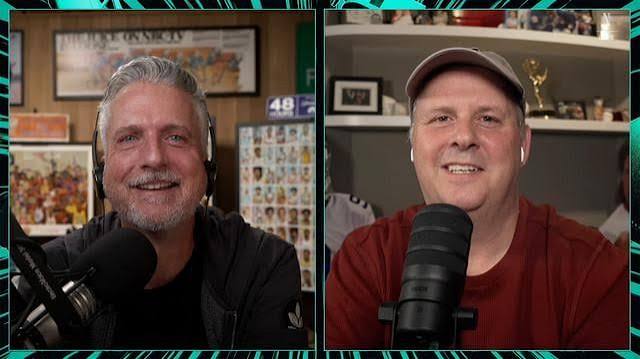
This piece represents my first attempt to come up with some of what Bill Simmons and Kevin Wildes call “Half-Baked Ideas.” Simmons is, of course, the longtime sportswriter and podcaster whom I have discussed elsewhere on The Kyoto Kibbitzer. I roasted him pretty good in that piece, but that’s okay. He can take it.

“Half-Baked Ideas” is not my very favorite of Simmons’ recurring bits, but Simmons and Wildes are always funny, and I enjoy the bit. So, of course, I decided to try to come up with some of my own.

This proved to be a little difficult. For Half-Baked Ideas, you really have to thread the needle between complete absurdity and partial plausibility. A Half-Baked Idea can’t simply be a terrible idea. It needs to sound just reasonable enough that somebody might listen to it and think, You know, that actually might work. Then, usually about ten seconds later, the whole thing should begin to fall apart.

For my version, Simmons will be joined by his old friend Cousin Sal. Why? Because I know Cousin Sal better, and this is my website.

Half-Baked Idea #1: Free Vasectomies

SAL: Dude, I think I got one. I think this is the definition of a Half-Baked Idea.

BILL: What’s that, Sal?

SAL: Free vasectomies. Every city in America. Several locations. But here’s the thing: they have to be immediately reversible.

BILL: Okay…

SAL: Because think about it, Billy. You got a hot date with Tracy. You think you’re gonna score. You don’t want to use a condom, obviously.

BILL: Obviously?

SAL: Come on, Billy. You’ve been known to pull the goalie from time to time.

BILL: Maybe.

SAL: So you stop in on the way to dinner. Get the snip. Boom. You and Tracy get down to business. Next morning, you go back and get it reversed. No problem.

Pause.

BILL: I kind of like it.

SAL: Right?

BILL: Except then you’re getting surgery before every date.

SAL: It’s not surgery, Billy. It’s the snip.

BILL: I think the snip is still surgery.

SAL: All right, whatever. That’s why they have several locations.

END SCENE.

Half-Baked Idea #2: Sicario Fantasy Camp

BILL: Okay, Sal, I think I got a good one too.

SAL: Okay. Hit me with it.

BILL: Dude. Picture this. It’s just called Sicario Fantasy Camp.

Pause.

SAL: Hmm. I guess it could work. But how?

BILL: Well, just think about it. You get to choose from five characters. You can be Matt Graver. You can be Benicio. You can be Kate. You can be Kate’s partner. Or you can be Ted, the cowboy guy who tries to kill Kate and pays the price.

SAL: Why would anybody pick Ted?

BILL: I don’t know. Somebody’s gotta be Ted.

SAL: Okay.

BILL: Then you spend the weekend doing Sicario things. You get the sunglasses. The tactical gear. You ride around in a convoy—

SAL: Where?

BILL: Arizona. Somewhere. And, Sal, get this.

SAL: What?

BILL: You get to fly a drone.

SAL: A real drone?

BILL: Yeah.

SAL: With missiles?

BILL: No, Sal. They’re not gonna give you missiles.

SAL: Well, then what am I doing with the drone?

BILL: Sicario things.

Pause.

SAL: I don’t know, Bill. Sounds a little complex. And the movie’s kinda old.

BILL: Come on, Sally. Everybody loves Sicario, right?

SAL: Yeah, Bill. You do, anyway.

Later, at the pitch meeting

Several executives sit across the table from Simmons.

EXECUTIVE: Okay, Bill. And what exactly do people do in Arizona for the whole weekend?

Pause.

BILL: Sicario things.

END SCENE.

Half-Baked Idea #3: Bring Back Dumbwaiters

BILL: Okay, Sal, we gotta wrap soon. What’s your last one?

SAL: Okay, Bill. I’ve been thinking about this one for a little while.

BILL: Okay.

SAL: I don’t have it fully worked out yet.

BILL: Great start.

SAL: But basically, it’s: bring dumbwaiters back.

BILL: Dumbwaiters?

SAL: Yeah.

BILL: Were they gone?

SAL: Exactly, Billy. That’s the problem. Nobody knows.

BILL: Okay, but that’s not quite what I meant.

SAL: Think about how much shit you carry around your house every day. Food. Drinks. Laundry. Amazon boxes. Whatever. Why am I carrying this stuff upstairs myself? It’s 2026.

BILL: So you want an elevator for your sandwich.

SAL: Not just the sandwich, Billy. Anything.

BILL: How big is this dumbwaiter?

SAL: I don’t know. Pretty big.

BILL: Can a person fit in it?

SAL: No.

Pause.

SAL: Maybe a kid.

BILL: Sal.

SAL: I’m not saying you put the kid in there. I’m saying technically the kid fits.

BILL: Okay, so now every house in America has this child-sized elevator going between floors.

SAL: Exactly.

BILL: That seems incredibly dangerous.

SAL: Well, we’ll put a sticker on it or something.

BILL: Okay, sure, Sal.

END SCENE.

And the drone is the next beat:

BILL: Then you spend the weekend doing Sicario things. You get the sunglasses, the tactical gear. You ride around in a convoy—

SAL: Where?

BILL: Arizona. Somewhere. And, Sal, get this.

SAL: What?

BILL: You get to fly a drone.

Pause.

SAL: A real drone?

BILL: Yeah.

SAL: With missiles?

BILL: No, Sal. They’re not gonna give you missiles.

SAL: Well, then what am I doing with the drone?

BILL: Sicario things

The Most Insane People of All Time (aka You’re Outta Control!): #4 Azalia Banks

I just wanna sip the punch with your peeps and
Sit in that lunch if you’re treatin’

— Azealia Banks, “212”

I. Introduction

In my opinion, Azealia Banks is the greatest rapper of all time.

I do not say this lightly.

These days, I don’t listen to much rap and hip-hop. I regret this a bit. However, life is short, there is a lot to do, and there is simply too much music to listen to. I am familiar with and enjoy a number of hip-hop artists, mostly from the late 1980s and 1990s: LL Cool J, Sir Mix-a-Lot, Wu-Tang Clan, KRS-One and A Tribe Called Quest, among others. I especially like A Tribe Called Quest’s “I Left My Wallet in El Segundo.”

Of course you did, dude. You went to El Segundo. You lost your fucking wallet. Naturally.

I also enjoy the more jazz-inflected end of the genre: De La Soul, Digable Planets and Basehead. Among later artists, I know Nas, Kendrick Lamar and Kanye West to varying degrees. Kanye is, of course, completely outta control. I do not believe I am alone at this point in saying that I do not care for Kanye West as a person. His flirtation with Nazi imagery and rhetoric is indefensible. Nevertheless, Kanye is certainly a talented artist, and I do like—or at least once liked—My Beautiful Dark Twisted Fantasy. Its lyrical density and imagination are something to behold.

However other than Azealia, my favorite rap group remains Public Enemy.

Public Enemy arrived when hip-hop was still a relatively young genre, and pushed it into territory that was denser, louder, angrier, more political and, to my ears anyway, considerably more interesting. I respect N.W.A. and their place in the tradition. I like “Fuck tha Police” well enough. Ice Cube obviously went on to enormous fame and fortune, and Eazy-E had a tough life. RIP. Nonetheless, for my money, Public Enemy is the more important and enjoyable group. “911 Is a Joke” is great. “Welcome to the Terrordome” is my favorite Public Enemy song. Terradome rules.

So I guess at the end of the day I do regard Chuck D as the greatest rap/hip-hop lyricist of all time. However, these days I don’t find myself listening to Public Enemy all that often. “212,” on the other hand, I listen to regularly.

And baby, here we go.

212

It only makes sense to start with “212.”

Azealia Banks released “212” in 2011, when she was twenty years old. It subsequently appeared on her four-song 1991 EP in 2012 and, eventually, on her debut album Broke with Expensive Taste in 2014. 

“212” is stuffed with the most amazing collection of rhymes, near-rhymes, internal rhymes and alliteration I have ever heard. I understand that hip-hop and rap lyrics depend on these techniques and that plenty of rappers have demonstrated extraordinary mastery of them.

Azealia, in my opinion, takes the whole thing to another level.

My favorite line in the song, by far, is not even one of the blue lines:

I just wanna sip that punch with your peeps and / Sit in that lunch if you’re treatin’

I love this line so very much, primarily because it establishes Azealia’s modus operandi when it comes to her business and career.

Azealia is on the come-up. She’s going places. She has designs on the crown. The girl has talent for days, and the industry is listening. But the second half is arguably even more essential to understanding how Azealia works.

She wants to sit in that lunch if you’re treatin’. Then or now, Azealia Banks is the last person who is ever going to pay for lunch.

This, incidentally, makes the eventual title Broke with Expensive Taste almost impossibly perfect.

And then we get this:

I’m the one today / I’m the new shit, boo / Young Rapunzel / Who are you, bitch? New lunch?

Followed, repeatedly, by this immortal threat:

I’ma ruin you, cunt.

Of course you are, Azealia. Of course you are.

The funny thing is that these lines would prove somewhat prophetic.

Azealia clearly thought she was the shit.

I agree.

“212” was an extraordinary announcement of a young artist who seemed capable of doing almost anything. Contemporary critics heard it too. When Pitchfork reviewed 1991 the following year, the publication was already emphasizing the slyness beneath Banks’s aggression and the enormous expectations surrounding her. 

And then Azealia started ruining people. For real.

I’ma Ruin You Cunt

Azealia Banks has been involved in so many public feuds that trying to compile a complete list would require an entirely separate essay.

This is not that essay. Instead we will take a few representative samples.

There was Zayn Malik. In 2016 Banks accused the former One Direction singer of copying her aesthetic. That dispute escalated into an extraordinarily ugly series of racist and homophobic attacks from Banks. Then the fourteen-year-old Disney actress Skai Jackson made the apparently catastrophic decision to tell Azealia to simmer down.

Baby no.

You do not tell Azealia Banks to simmer down. No one does. Azaalia does not settle. Period.

Banks promptly opened another front, this time against a fourteen-year-old girl. Sure babes, why not. Ruis her too. Just because. Twitter suspended her account, and a UK festival subsequently dropped her from its lineup. This is one of the places where we can move beyond speculation about whether Azealia’s behavior damaged her career. Here it plainly did. 

And then there was Grimes.

Oh my God. Baby take an aspirin. Now.

In 2018 Banks went to Los Angeles expecting to collaborate with Grimes and ended up at the house Grimes shared with Elon Musk. The proposed musical collaboration went nowhere. Obviously. Banks hung around for a bit and then things got weird. Real weird.

Banks began posting about the experience publicly, describing her time with Grimes and Elon as bizarre and increasingly hostile terms and making allegations about Musk and drug use. Musk denied the drug allegation. But somehow an aborted Azealia Banks/ Grimes recording session had become entangled with Musk’s already notorious “funding secured” Tesla tweet and the securities controversy surrounding it.

That’s the thing about Azealia.

She can start out trying to make a song with another musician and somehow end up adjacent to a federal securities investigation involving one of the richest men on Earth.

How?

Because she is Azealia Banks baby. And you are not. No other explanation required.

And these were hardly isolated incidents. She feuded with T.I. and Iggy Azalea. She attacked Perez Hilton. Of course. She criticized Pharrell, Baauer and Disclosure. Pitchfork noted as early as 2014 that some of these fights were no longer merely entertaining sideshows: they were costing her potentially valuable collaborators. She was hurting career for no apparent reasons. At all.

Azealia would gun down anybody. She does not give a single shit.

Men. Women. Musicians. Producers. Celebrities. Minor celebrities. People who were minding their own business. People who were very much not minding their own business. Teenagers. Whoever. Whatever. Funk em all Azealia. Fuck em all.

It didn’t matter.

I’ma ruin you, cunt.

And she did.

Broke with Expensive Taste

The tragedy—or comedy, depending on how you look at it—is that through all of this Azealia Banks remained enormously talented.

Her debut album, Broke with Expensive Taste, finally appeared in November 2014 after years of delays and a disastrous relationship with Interscope Records. Banks had gotten herself released from her deal and retained the rights to the recordings. The record finally came out on her terms. More or less. 

And the critics liked it. Quite a lot, actually.

The Guardian described a record luxuriating in sound and language, bouncing around among underground club music, house, garage and stranger territory. Pitchfork heard essentially the same thing: an artist jumping almost recklessly among genres, held together by Banks’s own voice and formidable technical ability. 

I recently listened to Broke with Expensive Taste again and really enjoyed it. Some of it runs a little long for me, but there is great stuff all over the record.

All this complicates the easy story.

It would be simple to say Azealia Banks destroyed her career because she couldn’t stop fighting with people. It would also be wrong.

The record industry contributed plenty to the mess. Her relationship with Interscope was dysfunctional. Banks believed the label simply did not understand the record she wanted to make. There is some evidence that she was right. Broke with Expensive Taste is a strange record. It is difficult to classify. It does not sound particularly interested in behaving like a conventional major-label rap debut.

Indeed, after Banks finally got out of the Interscope arrangement, she told Pitchfork that other labels liked the album but remained wary of her. Banks laughed about her reputation. 

So the record-company story and the Azealia story meet somewhere in the middle.

The industry didn’t know what to do with her. Azealia frequently didn’t know what to do with Azealia. She is, of course, totally outta control at all times.

And nobody knew what the fuck was going on.

The Prophecy

There is one more remarkable thing about “212.”

Amid all the obscenity, comedy, sexual swagger, threats and spectacular displays of technical skill, Banks suddenly turns the camera around.

She warns herself:

Why are you procrastinating? You have all this talent. Baby you’re wasting it. People are going to forget you, and when they do, ultimately you’ll have yourself to blame.

TIME noticed the eerie quality of this almost immediately when Broke with Expensive Taste finally appeared in 2014. What had sounded in 2011 like the self-motivation of an extraordinarily ambitious young artist three years later sounded like prophecy. 

That strikes me as much more interesting than another catalogue of Azealia Banks saying outrageous shit on the internet.

Because the talent is real. The promise is real. The record is real.

And this is why Azealia Banks drives me so nuts.

I don’t particularly care that she’s badly behaved. Plenty of great artists are badly behaved.

I care because she’s so fucking talented.

“212” remains an astonishing piece of writing. To me, the song feels as fresh today as it did when it was released. The rhymes and internal rhymes are off the hook. The alliteration is just nuts. The profanity is dialed to 11. And the song makes me crack up every single time I hear it.

Brother just listen to what this woman could do.

Baby told us in 2011.

I’ma ruin you, cunt.

Shut the fuck up Azealia. But I will say this: you certainly ruined a lot of people along the way.

But nobody ever did more damage to Azealia Banks than Azealia Banks.

Dedication:

For Azealia Banks. Baby, you’re completely out of all reasonable and rational control. And that’s why I love you so very, very much. Baby.

Beavis and Butthead Play Two

Note: A couple of months ago, I wrote my first play about the love of my life, Elodie. It is called Wayfarer. Today, I’m pleased to publish my first TV script.

The script is, of course, a Beavis and Butt-Head episode.

I’ve wanted to do one of these for the longest time, simply because Beavis and Butt-Head are completely fucking hysterical. I know the show is a bit old at this point, and one could argue that the humor is sophomoric. Probably so. But that’s the point.

For anyone who somehow missed them, Beavis and Butt-Head are Mike Judge’s two magnificently stupid teenage metal heads, unleashed on MTV in the early 1990s to watch music videos, insult everything and everything they encountered, misunderstand nearly everything happening around them, and occasionally stumble into something resembling wisdom. They are idiots, but they are very particular idiots. There is a strange precision to their stupidity, and after all these years their friendship remains weirdly endearing.

I love the Beavis and Butt-Head universe, and I plan to write several more of these. Stay tuned.

This first one sends the boys to Chicago for a Cubs doubleheader. There is a girl. There is a box of love letters. There is a Chevy Suburban outfitted for bass fishing. There is George Brett.

Naturally.

Epigraphs:

It’s a great day for a ball game; let’s play two!
— Ernie Banks

Change it Butthead.
— Beavis

Shut the fuck Beavis.
— Butthead

I: Beavis’ Birthday

PING-PONG.

Butt-Head looks toward the front door.

“No.”

“Beavis.”

“Beavis. Someone’s at the door. Go get it.”

“You get it, Butt-Head.”

“Okay, Beavis. Let’s go together.”

The boys get off the couch and approach the door.

Stuart is standing outside in his Winger T-shirt.

“Hey, guys. I heard it was Beavis’s birthday. You guys wanna hang out?”

“No,” Butt-Head says.

He begins to close the door.

“Wait a minute,” Beavis says.

Butt-Head stops.

“What?”

“He does have a point.”

“Really?”

“Yeah. It is my birthday, Butt-Head.”

“Yeah, dumbass. I know.”

Butt-Head pauses.

“But yeah. Happy birthday, Beavis.”

“Thanks, buddy.”

“Now shut up Beavis.”

Stuart is still standing outside.

“So you guys wanna hang out or what?”

“No,” Butt-Head says. “We have important stuff to do.”

“Yeah,” Beavis says. “Important birthday stuff.”

“We’re going to Chicago, Stuart.”

“Really?”

“Yeah. We’re going to see the Cubs tomorrow.”

“It’s a doubleheader,” Beavis says.

Stuart smiles.

“That sounds pretty cool.”

“Shut up, Stuart,” Butt-Head says.

He begins to close the door again.

“Wait,” Beavis says.

“What?”

“You forgot to tell him.”

“Tell him what?”

Beavis lowers his voice.

“Amanda.”

“Oh yeah.”

Stuart looks from Beavis to Butt-Head.

“Who’s Amanda?”

Beavis’s face changes.

“Amanda,” he says reverently.

“She’s a ball girl for the Cubs,” Butt-Head says.

“She’s hot,” Beavis says. “She wants me.”

“Shut the fuck up, Beavis. She doesn’t want you. She wants me.”

“No dude. She wants me. But whatever. Why do you think Butt-head that she wants you.”

“I saw her on TV.”

“You were on TV Butthead?”

“She was on TV, dumbass.”

“Oh yeah. I forget”

Stuart looks confused.

“What”s going on?” said Stewart “What’s a ball girl?”

The boys stare at him.

Butt-Head closes the door.

“Stuart, you need to leave.”


II: Uncle Ken

A Chevy Suburban rolls up outside the house.

It belongs to Beavis’ Uncle Ken, a Chevy dealer from greater Kansas City. The Suburban is outfitted for bass fishing and elk hunting. One of Ken’s major clients is George Brett, the former star of the Kansas City Royals.

Ken parks and gets out.

Beavis and Butt-Head are sitting shirtless in lawn chairs, drinking forties.

Improbably, the boys have found an extension cord and snaked it outside. A small black-and-white television sits between them, playing music videos.

Ken lights a Camel.

“You boys ready for your first ball game?”

“Yeah, Ken,” Butt-Head says. “I guess.”

“Thanks, Uncle Ken,” Beavis says. “You rule.”

“Ok. Let’s go.”

A few drops of rain begin to fall. Beavis picks up the television and puts it under the awning to protect it.

The boys leave the lawn chairs where they are. They climb into the Suburban, still shirtless.

They both sit in the back.

Ken passes them a bag containing sandwiches, chips, oranges and iced tea. Beavis looks inside.

“Thanks, Uncle Ken. You rule.”

Butt-Head lowers his voice.

“Beavis, your uncle may rule, but he also needs to shut the fuck up.”

“Why?”

“There’s not enough food to get us to Chicago.”

“Dumbass. We can stop on the way.”

“Oh yeah.”

Ken butts his cigarette in the front ashtray. The boys throw theirs out the window.

A few minutes later, Butt-Head leans forward.

“Hey, Ken.”

“Yeah?”

“Was this really George Brett’s Suburban?”

“Yeah, Butt-Head. It sure was.”

“Whoa.”

Beavis looks around the interior.

“George Brett played baseball.”

“Yeah, Beavis. Everybody knows that.”

“Oh yeah.”

Butt-Head leans farther toward the front seat.

“Hey, Ken.”

“What?”

His voice drops.

“But did George Brett score in here?”

Ken looks at him in the rearview mirror.

“I don’t know. Probably.”

The boys look at each other.

“Whoa dude”


III: The Motel 6

The rest of the drive passes without incident.

Around seven, Ken pulls into a roadside Motel 6. Beavis looks through the window at the motel.

“Butt-Head.”

“What?”

“It’s a motel.”

“Yeah.”

“We’re gonna score.”

“Oh yeah, Beavis. We’re gonna score all right.”

Ken overhears them from the front seat.

“Boys, if you’re really serious about scoring tonight, there’s a truck stop right over there.”

The boys look over.

“I don’t know for sure,” Ken continues, “but I’ve heard there are a lot of lot lizards around there at night.”

Beavis looks at Butt-Head.

“What the fuck is a lot lizard?”

“Shut up, Beavis. A lot lizard is just another word for a lady of the night.”

“Oh yeah.”

They eat chicken-fried steak at a diner beside the motel. By ten-thirty, Uncle Ken is asleep.

Beavis and Butt-Head are not.

They stand outside their motel room drinking two of Uncle Ken’s beers.

“Beavis.”

“Yeah?”

“You wanna go find those lizards?”

“Yeah. Heh heh.”

They walk across the parking lot toward the truck stop.

There are no lot lizards. There are, however, approximately forty trucks.

Beavis stops beside one.

“Butt-Head.”

“What?”

“Do you think George Brett ever drove a truck?”

“No, dumbass. George Brett played baseball.”

“Oh yeah.”

They continue walking.

After a moment Butt-Head stops.

“Although he did have a Suburban.”

“Yeah.”

They both consider this.

“Maybe he drove a truck.”

“Yeah, dude. Maybe.”

The boys return to the motel around eleven. Ken has his own room. Beavis and Butt-Head share a twin room.

Beavis sits on his bed.

“Butt-Head.”

“What?”

“We got the big game tomorrow.”

“Yeah.”

“Is tonight the night we finally cuddle?”

“Shut up, Beavis. I’m not gonna cuddle with you.”

“Why not?”

“Because you smell, Beavis.”

“Oh yeah.”

Butt-Head points to the bed by the wall.

“I’m sleeping on this one.”

“Fine, Butt-Head.”

“Good night, Beavis.”

“Good night, Butt-Head.”

Beavis turns out his light and prepares to go to sleep. Butt-Head leaves his light on.

He takes out a small box. Inside are twenty Xeroxed letters.

Beavis raises his head.

“What are you doing, Butt-Head?”

“I’m reading my letters to Amanda, dumbass.”

“Oh yeah. I guess you do that every night, huh, Butt-Head?”

“Yeah.”

“Why do you do that, Butt-Head?”

“Come off it, dude. I’m in love with her. What do you think?”

“Oh yeah.”


IV: The Cubs Game

The next morning, the three eat breakfast and continue to Chicago. By noon they are outside Wrigley Field. The boys are wearing their shirts again.

A man is standing over a barbecue grill surrounded by about a dozen people. This is George Brett.

“Ken.”

“George.”

They shake hands.

George looks at Beavis and Butt-Head.

“These the boys?”

“Yep.”

Butt-Head looks at George.

“Hey, George.”

“Hey.”

Beavis looks at the grill.

“Are those hamburgers?”

“Yeah.”

“Can I have one?”

“Sure.”

“Thanks, George. You rule.”

George hands him a hamburger.

Butt-head says “Hey, George.”

“Yeah?”

“Was that really your Suburban?”

“Yeah.”

“Sweet.”

Pause.

“I mean, did you ever score in it?”

George looks at him.

“Probably.”

The boys look at each other.

“Whoa.”


They have box seats on the first base line. Before entering the park, the boys put four beers from the Suburban into their pants. Improbably, this works.

The game starts, and Butt-Head immediately begins looking for Amanda.

“Beavis.”

“What?”

“There she is.”

“Where?”

“Down there, dumbass.”

Butt-Head points toward the field. Amanda is working along the first-base line.

Beavis stares at her.

“Whoa.”

“Yeah.”

“She’s hot.”

“Shut up, Beavis.”

“But she is.”

“I know. That’s why I’m in love with her.”

“Oh yeah.”

The game begins.

For most of the first three innings, neither boy watches it.

Every time Amanda moves, Butt-Head points her out.

“There she is.”

“I know, Butt-Head.”

“There she is again.”

“I know.”

“Dude. She just picked up a ball.”

“Whoa.”

“She rules.”

“Yeah.”

A foul ball comes toward their section.

Both boys stand.

“Whoa!”

The ball lands approximately twenty rows away.

They sit down.

“Baseball sucks,” Butt-Head says.

“Yeah, it does.”

During the seventh-inning stretch, George Brett leans toward Butt-Head.

“Hey, Butt-Head.”

“Yeah, George?”

“If you’re really serious about this Amanda chick, I can get you down there after the game.”

Butt-Head stares at him.

“No way.”

“Sure. I know some people. I can get you into the clubhouse.”

Beavis leans across Butt-Head.

“That would be awesome, George. You rule.”

“I know.”

Butt-Head looks back toward Amanda.

Just before the ninth inning, Beavis leans over and whispers in Butt-Head’s ear.

“Butt-Head.”

“What?”

“I gotta tell you something.”

“What?”

“Well, the thing is, I’ve been watching Amanda all game.”

“Yeah.”

“And I think I’m in love with her too.”

Butt-Head slowly turns toward him.

“Shut the fuck up, Beavis.”

“I’m serious.”

“You can’t be in love with Amanda. I’m in love with Amanda.”

“Yeah, but I’m in love with her too.”

“No, you’re not.”

“Yes, I am.”

“No, Beavis. You just think she’s hot.”

Beavis considers this.

“Yeah.”

A beat.

“But I also love her.”

“Dumbass. She’s mine.”

A few minutes later, Amanda looks toward their section.

“Dude,” Beavis says. “She looked up here.”

“She looked at me, Beavis.”

“She looked kind of to the left.”

“I’m to the left, dumbass.”

“No, I’m to your left.”

Butt-Head looks around.

“Oh yeah.”


V: Meeting Amanda

After the game, George takes Ken and the boys into a small lounge adjoining the clubhouse. Butt-Head is clutching his box of letters.

Beavis, improbably, has gone to the bathroom and washed his face. He is trying to look his best for Amanda.

Amanda enters the lounge. A couple of tables have been set up with drinks and snacks.

“Amanda,” George says. “This is Beavis and Butt-Head.”

“Hi, guys. Thanks for coming to the game today. Did you have a good time?”

Beavis speaks up.

“We had a great time, Amanda. And the best part was seeing you.”

“Shut up, Beavis.”

Butt-Head looks at Amanda.

“But yeah. He’s right. You’re super hot.”

Amanda blushes slightly.

“Why, thank you, guys.”

“Anytime,” Butt-Head says.

They sit down.

George, Ken and the boys crack beers. Amanda has a lime spritzer.

Beavis takes out his cigarettes.

“Butt-Head.”

“What?”

“Can we smoke in here?”

“No, dumbass.”

“Why not?”

Butt-Head looks around.

“I have no idea.”

“Oh yeah.”

Beavis puts his cigarettes away. After a while, George stands.

“Well, I guess it’s time for me to say goodbye.”

“George, do you really have to go?” Ken asks.

“Yeah, Ken. Busy day tomorrow.”

“Well, George, it was great seeing you.”

“Good seeing you too.”

Beavis looks at him.

“Yeah, George. It was great to meet you. You rule.”

Butt-Head nods.

“Yeah, George. You rule.”

“Thanks, guys.”

George Brett leaves. Ken and the boys crack another beer. Amanda is still working on her lime spritzer.

Butt-Head looks at her.

“Hey, Amanda.”

“Yeah?”

“Did you ever get my letters?”

“Yeah, Butt-Head. I saw one or two.”

Beavis leans forward.

“Well, he only wrote like a thousand.”

“Shut up, Beavis. I wrote twenty. I counted.”

Beavis looks at him.

“Butt-Head, you can count?”

“Shut up, Beavis. Yes, I can.”

“I’m just saying.”

Amanda smiles.

“I thought the letters were sweet.”

Butt-Head looks at Beavis.

“See, dumbass.”

He opens the box.

“I brought them.”

Amanda looks inside.

“All twenty?”

“Yeah.”

“Why?”

Butt-Head pauses.

“In case you forgot.”

“Oh.”

Beavis is getting impatient to speak to Amanda.

“Hey, Amanda.”

“Yeah?”

“I washed my face.”

“Nice.”

“Yeah.”

A beat.

“I did that for you.”

“Oh.”

“Yeah.”

Butt-Head looks at him.

“Dumbass.”

Amanda finishes her lime spritzer. She stands and stretches.

“Well, guys, I should probably get going.”

Butt-Head stands immediately.

“Yeah. Me too.”

Beavis stands.

“Yeah. Me too.”

“You guys have a good trip home.”

“Thanks, Amanda,” Beavis says.

“Yeah,” Butt-Head says. “Thanks.”

Amanda waves.

“Bye, guys.”

“Bye, Amanda.”

She leaves.

The boys remain standing. Beavis looks at Butt-Head.

“Did you score?”

“No.”

“Me neither.”

Another beat.

“Damn.”

“Yeah.”

Ken finishes his beer.

“You boys ready?”

“Yeah.”


VI

The cab pulls up outside the Hyatt.

Ken pays the driver. Beavis and Butt-Head climb out.

They walk toward the entrance.

“Hey, Butt-Head.”

“What?”

“I think we came pretty close.”

“No, we didn’t, Beavis.”

“Oh yeah.”

They enter the hotel.

Later, Ken says good night and retires to his room.

Beavis and Butt-Head return to theirs.

Butt-Head points to the bed by the wall.

“Beavis. That’s mine.”

“Yeah, Butt-Head. I know.”

The boys are tired from their long day. They crawl into bed and turn out the lights.

The television remains on.

“Hey, Butt-Head.”

“Yeah, Beavis?”

“We tried our best.”

“Shut up, Beavis.”

A beat.

“But yeah. I guess we did.”

They watch television.

“1979” by the Smashing Pumpkins is playing.

“Beavis.”

“Yeah?”

“Turn it down a little.”

Beavis turns it down a little.

“This song sucks.”

“Yeah.”

Beavis changes the channel.

Peter Gabriel’s “Red Rain” is playing.

Butt-Head looks at the television.

“Beavis.”

“Yeah?”

“Isn’t this that song from the movie?”

“What movie?”

Say Anything, dumbass. With John Cusack.”

“Oh yeah. He sucks.”

“Of course he sucks, Beavis. But he also rules a little bit.”

Beavis considers this.

“Yeah. Maybe.”

They watch a little longer.

“This song is lame,” Butt-Head says.

“I don’t know. I think it’s kinda sweet.”

Butt-Head turns toward him.

“Shut up, Beavis. This song sucks.”

FIN

On Conor Oberst’s “Cape Canaveral”: The Greatest Song of All Time

Note:

I have been working for several months on pretty challenging project: ranking my top 250 favorite songs of all time. Yeah I know. It’s a lot.

There are now nearly 500 songs under consideration for what I continue, somewhat inaccurately, to call my Top 250. Songs rise. Songs fall. Songs appear from nowhere and kick the living shit out of songs I have loved for thirty years.

And then something genuinely unexpected happened.

For the past decade of more, Emmylou Harris’s “Tulsa Queen” has been my favorite song of all time. I assumed it probably always would be.

I was wrong,

The new number one is Conor Oberst’s “Cape Canaveral.”

This essay is partly about that song and partly about the forty-plus years of listening that somehow brought me to it: childhood folk records, American musical history, Emmylou Harris, Bob Dylan, Craig Finn, Bright Eyes, Better Oblivion Community Center, Ryan Adams, live music, and the strange experience of discovering that a song you have known for years has suddenly become something else entirely.

Music rules, everybody.

Long live music.

Epigraphs:

Music rules
—Evervbody

I support the French Revolution
—Dean Wareham

I heard that victory’s sweet/ even deep in the cheap seats
—Conor Oberst

Introduction:

For the last several months on the Kyoto Kibbitzer, I’ve been working on a piece entitled “The Top 250 Songs of All Time.” This is, of course my list, and it is therefore entirely subjective. Nevertheless, it is the product of more than forty years of intensive, daily listening to music of all kinds.

“Cape Canaveral,” by Conor Oberst, recently displaced “Tulsa Queen” as my number-one song of all time.

This is no small thing. “Tulsa Queen” has been my favorite song for at least ten years, possibly longer. The first full album of hers that I fell in love with was the 2008 live record Spyboy. I knew of Emmylou before that, of course, and I especially liked “’Til I Gain Control Again,” which at that point I knew largely through the immaculate This Mortal Coil cover. I was also familiar with her connection to Gram Parsons, and knew how devastated she had been by his death. I knew songs like “Boulder to Birmingham,” and I may or may not have heard “Tulsa Queen” a time or two. I don’r know. It was all a long time ago.

In any case, it was Spyboy that really made me pay attention to Emmylou for the first time. I devoured the record and loved it. I still do.

Listening For Something

By the time I heard Spyboy, I had already listened intensively to hundreds and hundreds—probably thousands—of records. In fact, my relationship with music goes much farther back than that.

When I was six or seven, Joan Baez’s “The Sweet Sunny South” was the first song I truly fell in love with. It simply captivated me. About a year earlier, I had dug an old record of American folk songs out of what we called the “back closet,” which was actually the front closet. I forget the title. It was something straightforward, along the lines of The Greatest American Folk Songs.

The song I really fell in love with was “The Big Rock Candy Mountain.” This song contains the great verse:

In the Big Rock Candy Mountains
You never change your socks,
And the little streams of alcohol
Come a-trickling down the rocks

I understood the song, even then, to be a fantasy of escape: the mythical paradise of the hobo, where ordinary deprivation and misery have somehow been turned upside down.

American musical history fascinates me. In the mid-twentieth century, collectors such as Alan Lomax preserved thousands upon thousands of American folk performances that might otherwise have disappeared. Those archives remain an invaluable resource for musicians, critics, historians, and ordinary music fans alike.

I’ve poked around in archives like Lomax’s myself, and I find them endlessly fascinating. My primary musical preference remains American and British folk and Americana. I also love most forms of country music, although, to be honest, some popular country gets a little too saccharine and sappy for me.

I also love indie and alternative rock, especially the indie music of the 1990s and early aughts. As I’ve written elsewhere, I don’t keep up with new music these days as much as I probably should. I do try to keep up with new releases from favorite active artists: Conor Oberst, Craig Finn, Sun Kil Moon, Ryan Adams, Neil Young, and even Bob Dylan, who remarkably continues making music well into old age.

And this brings me back to “Cape Canaveral.”

When I finally fully appreciated the song, I realized something strange:

I had been listening for it my entire life.

Cape Canaveral

For my money, “Cape Canaveral” is primarily a song about escape.

It is also a song about the vicissitudes of patriotism, about being an American, about the Fourth of July, and the American space program. It is one of the sweetest songs I have ever heard. It is also super sad. Conor just has a way of breaking a guy’s heart.

There is one particular acoustic live performance on KCRW in 2014 that I particularly love. Conor introduces the song by talking casually to the audience about his big backyard in Omaha, being outside at night, looking up at the stars, and relaxing with whoever happens to be beside you. Then the first few notes hit, and the effect is devastating.

I love music. I love live music the most. I also love musicians introducing their songs. I’ve written about this at some length elsewhere. These little introductions can become almost as important to me as the songs themselves. They cement a song in a place and a moment. They also give you a little insight into the artistic process, which I find super cool.

And then the song starts.

What gets me first is the sound. “Cape Canaveral” is remarkably spare. Conor doesn’t overplay things. The acoustic guitar carries the song along gently, and his voice sounds simultaneously intimate and far away. The whole thing has the quality of somebody sitting outside late at night, thinking about his life while everyone else has gone to bed.

And then there are the images: rockets, orange groves, interstate highways, television, war movies, stars, cheap seats. The song keeps moving between the enormous and the ordinary: outer space and somebody’s backyard; American history and private memory; the grand technological dream of the space program and one lonely human being trying to understand where he is.

That scale is part of what makes the song so beautiful to me. The rocket goes up. The stars get smaller. Everything changes.

And then there is the line that just breaks my heart every time:

Victory’s sweet
Even deep in the cheap seats

FUCK YEAH CONOR. You know it, baby.

And underneath all of this, I hear escape.

That is the thread that connects “Cape Canaveral” to “The Big Rock Candy Mountain” for me. One song imagines a hobo’s paradise and the other looks toward rockets, highways, and the night sky, but both contain the same ancient human impulse: maybe there is somewhere else to go.

Maybe there is some kind of life beyond this one. Maybe if you keep moving long enough, something will finally open up for ya.

For now, anyway, “Cape Canaveral” is my favorite song of all time.

Is Conor Obrest My Favorite Songwriter?

As I write this today, when I really think about it, Conor Oberst may be my favorite songwriter of all time.

Actually, I have three favorite songwriters and a close fourth. My three are Conor Oberst, my current favorite; Bob Dylan, the historical champion; and Craig Finn.

Until very recently, I would have sworn to you that Finn was—and probably always would remain—my favorite songwriter. But it has now been a few weeks since I replaced “Tulsa Queen” with “Cape Canaveral,” and during that time I have probably listened to “Cape Canaveral” eighty or a hundred times. Sometimes I listen on Spotify. More often, I return to the live performance.

Conor first burst onto the scene as a teenage wunderkind with Bright Eyes. I like Bright Eyes a lot. I especially love “Easy/Lucky/Free” and “Gold Mine Gutted,” both from 2008’s Digital Ash in a Digital Urn. This is a curious and funny title, and I like it.

A lot of people also know I’m Wide Awake, It’s Morning. I like that record too, but it has never really floated my boat.

When it comes to Conor’s solo catalog, however—and then Better Oblivion Community Center, his collaboration with Phoebe Bridgers—the picture starts to shift.

In addition to “Cape Canaveral,” I love “Classic Cars,” and “A Little Uncanny,” which is totally out of control. I love “Next of Kin,” including this wonderfully deadpan line:

Yeah I met Lou Reed and Patty Smith
I didn’t make me feel different.

I liked these lines so much that I used them as an epigraph to an earlier piece.

I love “No One Changes,” one of Conor’s saddest songs. I love “I Don’t Want to Die (In the Hospital),” which is also extremely funny. I love “The Rockaways.” I love so many of his songs.

And then there is Better Oblivion Community Center.

When I first hear the record, the immediate standout was “Dylan Thomas.” I wrote about it almost immediately in an essay called “On the Song Dylan Thomas and Rhyme.”

I wrote that piece very fast—in ten or twelve minutes, as I recall—while standing on a train from Akasaka Station to Tokyo Station.

I’m proud of the piece. Quite improbably, it has also experienced a dramatic resurgence in readers recently.

I find all this very exciting. It makes me proud to be a writer and proud to have kept a near-daily blog for all these years. I love writing. I love reading. I love everything about them, and I always have.

There are many other great Conor and Bright Eyes songs I could name, but the list would tale up too much space. Suffice it to say that today I believe Conor Oberst and Craig Finn are the two greatest songwriters working, while Dylan remains the historical champion.

Ryan Adams

If Conor is my current favorite, Finn is tied or running a very close second, and Dylan remains the historical champion, I would be remiss not to mention Ryan Adams in the four spot.

There is one ugly episode in Conor’s history worth addressing first. In 2013, a woman publicly accused Oberst of raping her after a Bright Eyes concert years earlier. Oberst denied it. The woman subsequently retracted the accusation entirely apologized, and admitted that she had fabricated it.

Making a knowingly false accusation of rape is an appalling thing to do. It harms the falsely accused person, and it also makes life harder for actual victims of sexual violence. Rape is an atrocious crime. Deliberately inventing one is a different act with different consequences, and there is no reason for me to construct some kind of grand hierarchy here. The relevant point is simpler: the allegation against Oberst was withdrawn by the person who made it, who acknowledged that she had fabricated it.

Ryan Adams presents a messier case.

In 2019, multiple women, including his former wife Mandy Moore and Phoebe Bridgers, a then up and coming musician who toured with Ryan around this time, publicly accused Adams of manipulative or abusive behavior. Moore described psychologically controlling behavior, and said that Adams had not sufficiently helped to advance her music career. Specifically, she accused Adams of not giving her free studio time. At the time and still today, I find this accusation completely ridiculous. It is his studio. He can with it whatver he wants.

Bridgers, in turn, described a romantic and professional relationship that she said had became emotionally abusive. She finished the tour with Adams, and the two went their separate ways. Another accusation was more serious. Adams disputed significant portions of the reporting. As of this writing, Adams has never been arrested or charged for any of these incidents.

Whatever judgment one makes about Ryan Adams the man, none of this changes his greatness as a songwriter.

“Oh My Sweet Carolina,” “Damn, Sam (I Love a Woman That Rains),” and “Come Pick Me Up” are indelibly etched into the American folk-rock canon. Mandy Moore has had an successful career of her own, but she and Adams occupy very different musical territories, and comparing their importance as songwriters isn’t particularly helpful.

There is also a curious connection here. Bridgers later formed Better Oblivion Community Center with Conor Oberst, an older man like Adama. I have no idea whether Conor and Phoebe were ever lovers, however it is fun to ship them. I kind of hope they got together once or twice in the studio or at the hotel or something.

I’ll never know. And it’s none of my business.

Ryan therefore stays in the four spot: a difficult man by numerous accounts, a songwriter whose work has meant an enormous amount to me, and another tributary feeding the musical river that eventually brought me to “Cape Canaveral.”

The biography matters. The allegations matter. But this is an essay about listening.

And his songs are why Ryan Adams is here.

A New Number One

So that’s about it. I have a new favorite song, and it’s “Cape Canaveral.”

I don’t foresee it getting knocked out of the number-one spot anytime soon. Of course, I thought the same thing about “Tulsa Queen.”

And I was wrong.

Right now, “Leaving LA,” the glorious song by Father John Misty, is number two. “Cruiser” is number three. The totally slapping “Dreadful,” by The Violet Burning, is number four. And “Tulsa Queen” has now been bumped all the way down to number five.

Sorry, baby. You know I love you.

I continue to listen to music every day, often for several hours. I sleep to music. I wake up to music. I shower and brush my teeth to music. I read to music. I eat to music. I drink coffee and tea to music. I make love to music.

I love music more than almost anything in my life, except my son, of course. I love nearly every form of music, and I love live music most of all. The thrill of a great live concert is unequaled by almost any other experience under the sun.

I did get the chance to see Conor live in Osaka just a few months ago with my friend Jack. It was a small venue downtown. Conor was great. He opened with a few songs I knew and a few I had never heard before.

Although I was having a good time, unfortunately I was so zonked that I had to leave after only about twenty-five minutes. I was disappointed, but I was so tired that I simply had no choice.

Jack told me on the phone the next day that he had left only about five minutes after I did. I guess he too was beyond all help.

That night, anyway, we were completely out of control.

Long Live Music

Part of me wants “Cape Canaveral” to hold onto the number-one spot forever.

Another part of me hopes a new challenger emerges.

“Leaving LA” and “Cruiser” are the obvious contenders, with “Dreadful” right there too. “Tulsa Queen” has already fallen four places, so I don’t see her charging back to number one anytime soon.

But who knows?

The artists I listen to most frequently these days include Whiskeytown and The Jesus and Mary Chain. Both absolutely slap and totally rule. Whiskeytown occupies the folk/country side of my canon; The Jesus and Mary Chain occupy the alternative and early-indie side.

Other artists I play constantly include Craig Finn, Happiness, Daddy Issues, The Violet Burning, and Michael Knott, and many others.

R.I.P. Michael Knott. R.I.P. to a legend.

I listen to so many songs every day that I can hardly keep count. That is one reason I’ve taken to making these lists in the first place. The rankings change. The artists change. I change. Some song I’ve heard fifty times suddenly opens itself up on the fifty-first listen and becomes an entirely different thing.

That is part of the fun. That is part of the mystery. That is why I keep listening.

Long live music. Long live live music. Long live music fans.

Long live Conor Oberst. And long live “Cape Canaveral.”

Amen.


Dedication:

For musicians and music fans everywhere. I love you. And for Conor Oberst. You’re the fucking man, baby.

For Elodie, My Baby: A Love Poem

Note: I spent about a week with Elodie eight years ago. I fell madly, historically in love. Obviously. She is absolutely stunning and took my breath away. I was beyond gaga and remain so to this day.

She is my one and only baby. Naturally. My darling, my sweetheart, my lover my queen. My baby. I will never forget anything from that week. I remember the yellow she wore when we met. I remember Pret in the morning, wine before dinner, cigarettes, the park, the bridge, the chapel, the airport, the songs we sent each other, and a great many things that would be easier to have forgotten.

As if I could ever forget.

Since the years since I met her I have written six essays and a play about her. I know dude it’s a lot, So what? I am crazy in love with her and always will be. I will soon turn all of my Elodie material into a book. It will be good and I hope you like it. I know I will.

So in anticipation of that about I wrote her a love poem. Here it is:

Epigraphs:

“I didn’t know what I was in for when I set out for that run.”
— Better Oblivion Community Center

“Two suns in the sunset/ Didn’t know my race was run.”
— Pink Floyd, “Two Suns in the Sunset”

“Don’t stand so close to me.”
— The Police

Elodie, baby, I’m massively in love with you
I always have been, and I always will be.

I arrived on a Sunday. We met on Monday
You were wearing yellow, I recall
You touched my arm and said, “I’m an Aries moon too”
And that began my fall.

We walked lightly to the next session
I had no idea what I was in for
We compared charts and we matched
And I knew I was a goner before we even reached the door.

Before I even reached the door.

We sat side by side at the table
Elbows and hands touching tight
When your fingers clasped mine, I almost passed out
You were absolutely stunning, a total knockout.

At dusk we went to dinner
It was inside the main hall
There was turkey, there was gravy,
There was cranberry and all.

Before dinner, we drank wine
Red and white as you please
I bought a bottle with some money
I probably pulled out of my sleeve.

She may have been impressed that I had money
But she probably didn’t care
All I could think was, oh my god, this girl—
Look at her hair.

It was colored chestnut brown
And stretched halfway down her back
It was right about this moment
That I had a heart attack.

After dinner she broke out cigarettes
I’d had a dozen in sixteen years
I caved immediately, of course
I was the victim of all fears.

I feared a future without her
That was something I couldn’t stand
When I got back to my room
I knew I’d have to take matters into my hand.

I played “Mistakes Were Made” by the Mendoza Line
I had to call a spade a spade
The title sounded like some kind of sign
I wanted desperately to wank
There, I said it. Fine.

But at the same time, I had only one thought
Running around my brain
I’m massively in love with this girl
And I cannot stop this train.

I wanted to move to London
Would I? We would see
It probably wasn’t the best idea
But baby, you know me.

Tuesday morning we went to Pret
It was about a ten-minute walk
On the way there all we did
Was talk and talk and talk.

We split the cost of Pret
And walked back to the quad
We sat down in the back garden
I was feeling rather odd.

She had a hearty breakfast
She was at her eating peak
After that she mostly stopped
I was a little worried
She was looking rather weak.

We never went to another session.

I’d been thinking a lot about muses
And I cast her in that role
When she went along with this
I knew I was in a deep hole.

In turn she talked about her career
She was a photographer, you see
She was good at what she did
But she wasn’t making enough money.

She’d had a gig in Italy
With some famous movie stars
But her career was on the downside
She wasn’t getting very far.

She had a job photographing hand models
She didn’t like it at all
But she had to do it to make money
And through it all my girl stood tall.

Before dinner she said something
To change the course of the week
She said, “You’re super charming like my father.”
I knew then I was in deep.

She’d been abused when she was little
I’d been abused too
Fuck that guy. Fuck them all.
Fuck abusers too.

I couldn’t have sex with her. Why?
I just couldn’t say
It had something to do with what she’d said about her dad
I didn’t fully understand it, but I knew it was bad.

Deep inside my heart
I thought she might be conflating me with her abuser
I didn’t even know
Where to start.

As a result of my abuse
As a teenager, I thought I was gay.
I didn’t really think so
Things didn’t turn out that way.

I was crazy about women
Madly in love with girls
But her comment changed the conversation
We were in a whole new world.

Four years earlier I’d written an essay for my blog
Called “Reflections: On Coming Through”
Its epigraph came from Dylan before a song:
“This one goes out to someone watching out there tonight.
She knows who she is.”

I wanted something like that for her
I wanted her to be my twin
As it happens, I’m a Gemini.
I was ready to put a little skin in the game
And see what could take place.

I didn’t know where things were going
But I knew I wanted to run the race
To come in first, to break the tape
To be the champion of the day.

I turned back to Elodie
And tried to think of something to say.

I wanted to say, “Baby, let’s get married”
But there was very little chance
So I put the thought to bed
And kept it in my pants.

After dinner we talked like before
Very, very close
After dinner we had wine
Like every night before.

I got a little drunk
So I counted up the score
I thought I was down on the card
By just a point or two.

It was kind of hard to tell.
Everything was brand fucking new.

I was head over heels for my baby
And when she said she’d leave her guy
My heart went through the ceiling
And flew way up high.

Friday came without announcement
And we walked on back to Pret
After that we went to a park
It was real nice, I bet.

We’d fallen into a pattern
I was not an I
We were a we.

There was a little bridge in the park
She walked up to the top
She said, “Baby, this is my bridge”
I said, “Baby, you’re the boss.”

Then she started crying
Just sitting in the sun
I got a little worried
I said, “Babe, what’s up, hon?”

She said, “I’m so confused
I don’t know what to do
I love my fiancé
I love you too.”

I said, “Yeah, I guess that’s true.”

Then I said, “Look, honey, here’s the deal
I live a million miles away
I want to be with you forever
That’s all I’m gonna say.”

“But darling, as you know
I live in Japan and you are here
Maybe go back to your fiancé
And see how things go, my dear.”

She said, “Well, yeah, I’ll think about it.
I’ll stay in a hotel tonight.”

I said, “Where?”

She said, “London.”

I said, “That sounds about right.”

And then she said a line
I’ve never forgotten to this day:

“Baby, don’t sit so close to me.”

I said, “Just how far away?”

She said, “Just about an inch.”

I said, “Babes, that’s not that far.”

She said, “Well, that’s all I can handle.
I need you where you are.”

Then she fell into my arms.

The ambulances were blaring
Like the city was under attack
I was getting pretty tired
And I half carried her back.

We walked back to the campus
And she said she had to talk to Claire Martin
One of the tutors on the course.

I went down to the bookstore
There was a dude there, of course.

I browsed around and played Dylan on my phone,
“Red River Shore”
We sat there all alone.

Melanie Reinhart was sitting nearby
I went and sat beside her
I’m not really sure why.

I picked up a book on musical astrology
It was about famous musicians’ charts
I thought it looked pretty cool.

She said, “Don’t buy that one, baby.
Don’t be a silly fool.”

So I bought another book
And then we both stood up.

Melanie had to move out
So we went back upstairs
She had a couple heavy suitcases
So I got them out of there.

Then I went back to say goodbye to Elodie
And we walked into the chapel
I told her I wanted to know her
When she was an old woman.

She said I was very sweet
That made me smile.

I said, “Baby, you can’t be beat.”

And we sat there for a while.

Then we kissed goodbye
And I stepped out of the gate
I had to get some lunch
I was running a little late.

As I walked to my hotel
I was feeling pretty weird
I only had a little stubble
But I had to itch my beard.

At the restaurant I got bouillabaisse
And a lovely beer as well.
I texted Elodie Jason Molina’s “Leave the City.”

I said, “Baby, what the hell
Are we gonna do about our relationship?
Who are we gonna be?”

She said, “Baby, I have no idea
We’ll just have to wait and see.”

I said, “Yeah, I guess that’s right
There’s nothing we can do
I’ll see you when I see you, baby
I love you. I do.”

She said, “I love you too.”

I sent a couple more songs
And I’m happy to report
That after the conference
We still got along.

After lunch I was super tired
So I went to get some sleep
I knew once my head hit the pillow
I would sleep really deep.

I woke up the next morning
At four-thirty or so
My wife had to catch a bus
England isn’t the safest, you know.

So we stood there on the corner
Then she climbed onto the bus
In a different kind of way
I didn’t know what to do about us.

Then I hugged her quickly
And we said our goodbyes
And I took the short walk home
Under the English sky.

I jumped into the shower
I was glad I was all alone
I had a cab coming at eight
Pretty soon I’d be going home.

I packed up all my things
I didn’t know what the day would bring
In the cab the driver played the radio
I could barely hear a thing.

There was a story about the poor
And how there was very little housing around
But I couldn’t really dwell on that
That was somebody else’s deal.

I had to get to the airport
To make my final appeal.

On the plane I played Pink Floyd’s
“Two Suns in the Sunset”
And I cried a bit.

I thought about my son, of course
I swallowed
Took the hit.

I read Anthony Powell on my Kindle
And he kind of messed me up.
So I asked for peanuts and some wine
In a little paper cup.

I had the wine and then another.
I started to relax.
I understood then for sure
That I had to pay a heavy tax.

I knew my marriage was over
And my career probably as well
It was only a matter of time
Time is always quick to tell.

I landed in Osaka
And got a room across the street
It was too far to get back to Kyoto
Sometimes nearness can’t be beat.

I texted Elodie from the hotel, of course
It was just around nine her time
She said she was working in the park
On someone else’s dime.

I said, “Baby, that sounds awesome.
I wish I was there with you.”

She said, “Me too, baby,
But there’s nothing we can do.”

For the next few weeks
We texted and called almost every day
Then she had a dream and talked to her therapist
And then she mostly went away.

The dream took place in the woods
There was a fire of some kind
She said that I was there with her
I began to fall behind.

She said, “My therapist says I can’t talk to you.”

I said, “Baby, don’t say it’s true.”

She said, “Yeah, I don’t know yet.”

I said, “Baby, it’s up to you.”

After that we sent some letters
And some texts and things like that
I wrote her in March 2019
And that was pretty much that.

I was the last one to write
That was about seven years ago
I figured the door was still open
I emailed her a little while ago.

And whether or not she’s read it,
So far it hasn’t been a no.

Email doesn’t have read receipts,
So I don’t know if she saw it.
I’m betting that she did.
So I’ll just have to wait a bit.

She’ll answer or she won’t.
It’s pretty much all the same to me.
Our relationship was years ago.
It’s all history, you see.

But I know I’ll always love her.
That’ll always be a fact.
And I still think sometimes
About going back.

Going back to London
And trying to find her one fine day.
But if I actually found her,
I don’t know what I would say.

I guess I’d say, “Hey, baby,
Do you wanna get some pancakes,
Some coffee,
And hang out?”

She’d say yeah or she’d say no.
At least I would find out.

Then I’d go back to Kyoto,
Or maybe Thailand just for kicks.
Maybe move on down to Thailand,
Hit the beach and seek some bliss.

Thinking about Elodie
Has brought up old memories,
And I really need to chill.

Smoke some weed and drink some rum
Or I’m gonna get a little ill.

And sure, I’m ill.
I’ve been lovesick for Elodie
Since the first day I ran across her
In a seminar room on Monday.

I spent about a week with her,
And I’ll never forget a thing
That we said or did together.

I still want her to wear my ring.

I know that’s highly doubtful,
But a guy can dream a dream,
And God knows that I have to,
After all the things I’ve seen.

Elodie, baby, give me a call.
Honey, baby, don’t forget me.

I’ll never forget you at all.

Dedication:

For Elodie, my baby. I cannot describe how much I love you, baby. I miss you so much.

On Sacha Baron Cohen, the Big Hypocrite

Well, the neighborhood bully, he’s just one man / His enemies say he’s on their land.
— Bob Dylan, “Neighborhood Bully”

Shut the fuck up Sacha.
— Me

Let me get something out of the way first: Sacha Baron Cohen is incredibly fucking funny. He also needs to shut the fuck up.

The Borat movies are two of the funniest movies ever made. The first one is better than the second one, but the second one is also amazing. The Rudy Giuliani scene alone is almost impossible to believe. Maria Bakalova, who plays Borat’s daughter Tutar in Borat II, is fearless. Borat himself remains an extraordinary comic creation. “Throw the Jew Down the Well” is funny. The running antisemitism is funny. The grotesque sex jokes are funny. Ali G is hysterical. Cohen has done things on camera that almost nobody else would have the nerve, discipline, or sheer audacity to attempt.

I still don’t like him.

These are not contradictory positions.

I don’t hate Sacha Baron Cohen. I don’t detest him. I don’t want him canceled. I certainly don’t want his movies removed from circulation. I hope he keeps making comedy. But I don’t like the guy, and the biggest reason is that I think he is one of the great hypocrites of all time

Here’s why.

Not because he’s offensive per se. Rather because he seems to believe that Sacha Baron Cohen should be allowed to offend anybody he wants, while other people have walk on egg shells when the subject gets anywhere close to Sacha Baron Cohen or anything he actually cares about.

And what he cares about is Israel. Sacha is Jewish. So what. The Pope is Catholic and shits in the woods. Obviously. So does the bear. Naturally. And the bear is also Catholic because when he and the Pope were out ripping heaters together in the woods discussing last night’s Mets game for whatever reason the Pope laid the guilt trip of all guilt trips on our friend Mr. Bear and Bear caved. The Pope is one hell of an orator. This much is clear.

The Rules of the Game

I have a fairly simple rule about comedy:

A comedian can joke about anything. Anything.

Hitler. The Holocaust. Genocide. Dead babies. Disability. Race. Sex. Religion. Cancer. AIDS. September 11. Your mother. My mother. Whatever.

Anthony Jeselnik has built his entire career around constructing jokes whose premises make the audience think, surely this motherfucker isn’t going there, immediately before he goes there. Gilbert Gottfried made incredibly offensive jokes sometimes the offensiveness seemed to be the joke. Joan Rivers would joke about disabled people and then when she was lightly booed tell the audience to shut the fuck up cause her daughter was disabled. Whatever Joan. Get a grip. But yeah Joan is super fucking funny too. She just is.

Fine. Tell the joke.

And I retain the right to think your joke sucks.

That’s the bargain.

There is another old rule of comedy that matters here: punch up rather than down. I don’t regard this as an inviolable either. Sometimes you can punch down. But if you’re going to punch down, the most elegant ways to do it is to turn the fucking gun around and shoot yourself before anybody has time to complain.

Shane Gillis understands this beautifully.

Gillis has a routine about Downs syndrome in his family. As he approached the joke you can feel the audience tense because they know exactly where Shane is heading. And then comes the turn: Downs syndrome, he says, “took a shot at me and missed.”

Pause.

“But it nicked me.”

There it is.

Mic drop.

The joke suddenly isn’t look at these people. The joke is Shane Gillis. He has placed himself inside the blast radius.

That’s how you fucking do it.

Take notes, Sacha.

Kazakhstan

The central problem with Borat isn’t that the character is a monster.

The character is supposed to be a monster.

He’s misogynistic. He’s antisemitic. He’s ignorant. He talks about women as property. He says unspeakable things about his family. The comedy depends upon his being so extravagantly horrible that the Americans around him sometimes reveal things about themselves while trying to accommodate him.

Cohen has explained this himself. After the first movie provoked outrage in Kazakhstan, he said he was surprised because he assumed audiences would understand that the Kazakhstan of Borat was effectively fictional. More revealingly, he explained why he had chosen Kazakhstan in the first place: it was somewhere his intended audience knew so little about that he could exploit whatever vague stereotypes they possessed about an obscure former Soviet republic.

Read that again.

He chose Kazakhstan because people didn’t know much about Kazakhstan.

That’s my entire objection.

Kazakhstan wasn’t powerful enough in the Western imagination to fight back against the joke. It was a blank space. Cohen could write whatever he wanted onto it.

And what did he write?

Incest. Prostitution. Sex slavery. Antisemitism. Primitive stupidity. Misogyny. General barbarism.

The real Kazakhstan is hardly a liberal-democratic paradise. Its government has an ugly record on political and religious freedom, including restrictions on religious groups and expression. But the United States State Department describes a secular constitutional system containing multiple religious communities—not the insane antisemitic hellscape Cohen invented.

Cohen’s answer was essentially: guys, you’re missing the joke.

He said Borat’s antisemitism was designed to expose the antisemitism of others. He trusted intelligent viewers to understand that the character’s beliefs were delusional. Indeed, Borat’s supposedly Kazakh language is largely Hebrew, an enormous inside joke aimed directly at Jewish and Israeli audiences.

I understand the joke. I even laugh at the joke. I just think Kazakhstan is entitled to say: Why the fuck did you have to make it us?

Make up a country.

Boratistan.

There. Done. Same jokes. Same movie. Same character. Same America. Same satirical mechanism. Nobody loses anything.

Instead Cohen picked an actual country precisely because his audience knew almost nothing about it, filled the vacuum with the most grotesque shit imaginable, and then informed the people who actually lived there that sophisticated viewers would understand.

That’s punching down.

It’s also pretty fucking convenient.

The Sacha Baron Cohen Exception

Here is where Cohen really begins to bother me.

Because Sacha Baron Cohen understands context better than almost anybody alive when Sacha Baron Cohen needs context.

Don’t take Borat literally. Understand the character. Understand the satire. Understand the intention. Understand the irony.

Understand that saying something antisemitic can actually be a means of attacking antisemitism. Understand that an offensive representation of a group isn’t necessarily an attack upon that group.

I agree with every word of that.

But Cohen has also become a prominent advocate for restricting the amplification of hateful speech online. In his celebrated 2019 Anti-Defamation League speech, he attacked social-media companies for spreading antisemitism and other forms of hate and argued, in the formulation subsequently popularized by the ADL, that freedom of speech does not entail “freedom of reach.

There is a serious argument there. Facebook is not the First Amendment. TikTok doesn’t have a constitutional obligation to recommend Nazi propaganda to fifteen million teenagers.

Fine.

But notice how dramatically the moral vocabulary changes.

Suddenly representation has consequences.

Suddenly words can hurt actual populations. Suddenly the intentions of the speaker aren’t everything. Suddenly the distribution mechanism matters. Suddenly we have to consider what stupid people might believe after encountering offensive material.

Where the fuck was this standard when Kazakhstan was telling you that millions of people who knew nothing about their country were learning about it from Borat?

That doesn’t mean Cohen is wrong about online antisemitism.

It means the principle has to travel.

“The Biggest Antisemitic Movement Since the Nazis”

Then, after October 7, Cohen went considerably further.

During a 2023 meeting with TikTok executives, he accused the platform of creating “the biggest antisemitic movement since the Nazis.” People participating in the meeting cited genuinely vile material directed at Jews—comments praising Hitler and invoking Anne Frank—and Cohen told TikTok executives, “Shame on you.”

Let’s be very clear.

“Hitler was right” is antisemitism. Threatening Jews is antisemitism. Celebrating the murder of Jews because they’re Jews is antisemitism.

There is no difficulty here whatsoever. Fuck those people.

But Israel is not Judaism. The Israeli government is not the Jewish people. Benjamin Netanyahu is not the Jewish people. The IDF is not the Jewish people.

And criticism of the conduct of the Israeli state is not inherently antisemitic any more than criticism of Saudi Arabia is inherently anti-Muslim or criticism of Kazakhstan is inherently anti-Kazakh.

That distinction matters enormously, particularly during a time in which people are arguing simultaneously about terrorism, civilian deaths, occupation, hostages, settlements, military proportionality, national self-determination and the conduct of one of the most powerful armed forces in the region.

Israel can defend itself.

Literally.

It is a nuclear-armed state by widespread assessment, possesses an extraordinarily sophisticated military, and has enjoyed immense diplomatic, military and financial backing from the United States for decades.

Israel is not Borat’s Kazakhstan.

And it certainly isn’t Borat.

Bob Dylan once called Israel the “Neighborhood Bully.” What exactly Dylan meant in that bizarre song on Infidels is between Bob Dylan and whatever collection of ghosts, Biblical figures and card players happened to be occupying Bob Dylan’s skull in 1983. Good luck getting a straight answer.

But the phrase is useful.

A neighborhood bully can still get attacked. A neighborhood bully can still have legitimate fears. A neighborhood bully can even sometimes be right. He’s still the neighborhood bully.

Power matters.

The Borat Test

So here is the test I would apply to Cohen.

I call it the Borat Test. Whenever somebody says something provocative about Israel, Zionism or Jewish political power, ask whether Cohen is willing to grant that speaker the same interpretive tools Cohen demands for himself.

What’s the context? Who is actually being attacked? Is this literal or rhetorical? Is the speaker criticizing Jews or criticizing Israel?

Could an ugly formulation nevertheless be attempting to expose a legitimate problem? Should an entire argument be reduced to its most offensive sentence? Does intention matter? Does irony matter? Does satire matter?

Does the intelligence of the audience matter?

These aren’t tricks. They’re Sacha Baron Cohen’s own defenses.

If those principles are good enough to explain why a Jewish comedian can stand in an Arizona bar singing an antisemitic song called “Throw the Jew Down the Well,” then they’re good enough to use before declaring somebody an antisemite because he said something nasty about Israel.

Same rules. That’s all I’m asking.

Same fucking rules.

Sacha Being Jewish Doesn’t Change This

Cohen is Jewish. He’s proud of being Jewish. He speaks Hebrew. His mother was born in Israel. He spent time on a kibbutz. His Jewish identity clearly matters enormously to him.

Good. None of that bothers me.

It explains why antisemitism gets under his skin. If anything, it makes his concern more understandable.

But everybody has a thing that gets under his skin. Everybody has a sacred cow.

The real test of a comedian’s commitment to transgression isn’t what happens when he transgresses somebody else’s sacred boundary.

It’s what happens when somebody transgresses his. That’s the test Cohen keeps failing for me.

He wants Kazakhs to understand. He wants gay people to understand Brüno. He wants religious people to understand. He wants women to understand. He wants Americans humiliated by Borat to understand. He wants everybody to understand that outrageous speech can have another layer underneath it.

OK

Dave Chappelle Has the Same Problem

Dave Chappelle occasionally irritates me for a related reason.

Not because he jokes about trans people. Joke about trans people.

I don’t give a fuck.

But when a hugely wealthy, hugely famous comedian spends years repeatedly returning to a tiny and comparatively vulnerable minority, eventually “I’m allowed to make these jokes” stops answering the criticism.

Of course you’re allowed. Nobody asked.

The question is whether you’re punching down.

And telling us afterward that you had a trans friend doesn’t magically resolve the question. Chappelle’s story about his friendship with the late trans comedian Daphne Dorman may be sincere and moving. It still doesn’t operate as a universal permission slip for everything else he says.

Again: tell the jokes. And everybody else gets to tell you whether they suck.

That’s comedy too.

Don’t Cancel Him

I don’t want Sacha Baron Cohen canceled. I don’t want Chappelle canceled.

I thought Shane Gillis getting fired from Saturday Night Live over a podcast barely anybody listened to was ridiculous. The subsequent trajectory of Gillis’s career suggests that cancellation wasn’t exactly fatal anyway.

Good for him.

Let everybody work. Let everybody talk. Let everybody offend everybody.

Then let everybody else answer.

This is the part of contemporary culture I increasingly can’t stand: everybody wants free speech for his own side and a fucking tribunal for the other guy.

No.

Sacha gets Borat. Kazakhstan gets to say Sacha is an asshole. Chappelle gets his trans jokes. Trans people get to say Chappelle is full of shit. Shane Gillis gets his jokes. People offended by Shane Gillis get their boos. Israel gets its defenders. Palestinians get theirs. Jews get to identify antisemitism.

Everybody else gets to tell them when they think criticism of Israel is being incorrectly conflated with antisemitism.

That’s the game.

Is Sacha Baron Cohen an Asshole?

Apparently I’m not the only person who has asked his.

Rebel Wilson devoted a chapter of her memoir Rebel Rising to Cohen and publicly called him a “massive asshole.” She alleged that her experience working with him on The Brothers Grimsby left her feeling bullied and humiliated and described disputes over sexual material she says he wanted her to perform.

Cohen has categorically denied her allegations. His representatives called them “demonstrably false” and said they were contradicted by documents, footage and witnesses. Portions of Wilson’s account were subsequently redacted from British editions of the memoir for legal reasons.

I wasn’t there. I don’t know.

I’m not convicting Sacha Baron Cohen of anything on Rebel Wilson’s testimony. I merely note that she doesn’t appear to have enjoyed the experience.

Neither, apparently, did Kazakhstan.

The Big Hypocrite

And so we return to the charge.

Sacha Baron Cohen is not a hypocrite because he’s Jewish. He’s not a hypocrite because he worries about antisemitism. He’s not a hypocrite because he defends Israel. He’s not a hypocrite because he’s offended by something.

He’s a hypocrite because, in my view: he demands a degree of interpretive generosity for his own provocations that he does not consistently extend to everybody else’s.

That’s the fuckin’ thing.

You cannot spend twenty years telling people to understand the sophisticated mechanism underneath offensive speech and then suddenly become Officer Sensitive when the offending speech approaches your own house.

You cannot tell Kazakhstan that everyone understands your Kazakhstan isn’t really Kazakhstan when you specifically chose Kazakhstan because nobody knew anything about Kazakhstan.

You cannot build one of the greatest comedy careers of the century by exploiting ambiguity, disguise, deception, grotesque stereotypes and deliberately offensive speech and then behave as though context becomes secondary when the subject matters personally to you.

Or, rather, you can.

You’re Sacha Baron Cohen. Do whatever the fuck you want.

And I’ll do what I want. I’ll call you on it.

That’s the other half of free expression.

Because the comedian has the right to joke about absolutely anything. And the audience has the right not to laugh.

The target has the right to be pissed off. The critic has the right to say the comedian is punching down.

And if you’ve spent your career demanding that everybody else take the joke, you had better be prepared, every once in a while, to take the fucking joke yourself.

Bob Dylan called Israel the neighborhood bully.

Maybe Dylan meant it. Maybe he didn’t. It’s Dylan baby. Who the fuck knows.

But even the neighborhood bully gets made fun of.

Settle down, Sacha. Shut the fuck up.

Did My Grandfather Tom Thomas Kill a Man in Japan in 1941?

Note: This essay is based on a story my grandfather told me when I was thirteen years old, my surviving memories of that story thirty-eight years later, and the limited historical context I have so far been able to establish. Throughout, I have tried to distinguish between what I know, what I remember, what I merely suspect, and what may simply have become family legend.

That distinction matters. Earlier today I acquired Tom’s complete Naval records, which have filled in a number of gaps in the chronology.

In addition, when I called my mother she said that she thought the biology of TomThomas that I wrote in 1988 was still in a box somewhere. The original cassette tapes are almost certainly gone.

If the biography does surface, we will know more and I will update this piece.

Epigraphs:

“The past is a foreign country: they do things differently there.”
—L. P. Hartley, The Go-Between

It’s been a long time, mama, since I heard you call my name
Ah, been a long time since I heard you call my name
I got to see my Colorado girl again
—Townes Van Zandt, “Colorado Girl”

I. Introduction

My grandfather Tom Thomas once told me that he killed a man in Japan just before World War II.

I was thirteen years old when he told me this. I believed him. Thirty-eight years later, I am no longer entirely sure. I have been wanting to write this story for many years. The story has remained lodged somewhere between family history, childhood memory, and legend: an extraordinary story told to a boy by his grandfather and preserved, imperfectly, across nearly four decades.

Today I would like to know what actually happened.

II. The Family Autobiography

In the spring of 1988, when I was in eighth grade at St. George’s School outside Spokane, Washington, my social studies teacher, Laura Pierce, assigned us a family autobiography project.

Laura was a nice woman and a good social studies teacher. I was friends with her son Ben, who was a year or two older than I was. The Pierces lived in a modest suburban home about twelve minutes north of St. George’s. My parents, my brothers, and I lived a little farther north in Wayside, Washington, which in those days was far out in the country.

When my brothers and I were younger, we sometimes went to the Pierces’ neighborhood for Halloween. This was in the early to mid 1980s, and it was the era of panic about tainted candy on Halloween. My feeling today is that this panic was largely, if not entirely, overblown. Nevertheless, we checked our candy haul for razors carefully. We never found any.

Wayside was not much good for trick-or-treating unless you were prepared to hike half a mile between houses. The Pierces had neighbors.

These are some memories of my time. I mention them here because I am trying to establish what I know, what I remember, and what I merely think I remember.

I believe Laura assigned the autobiography project sometime around March 1988. I cannot today establish this date with any degree of certainty. The project took some time, and we finished eighth grade in early June. Four years later, twenty-eight of us graduated from St. George’s together, so I guess my eighth-grade class would have been roughly the same size.

For my project, I chose to interview my paternal grandfather, Tom Thomas. I sent him a list of questions, and he kindly sent back about half a dozen tapes. On the tapes he talked about his whole life, with a focus on his time in World War II. Tom was a career Navy man who also served in the Korean War. I believe he served valiantly, and he told me that he shot in the leg on one of the islands off of Guam; I believe in 1944. He leg healed and he went on to a successful real estate career in Healdsberg CA, just outside of Napa Valley. I believe that he did quite well for himself, and by the time I was little he was already retired. Gin was a lifelong housewife. I was born in 1974, so my first memories of him and his wife Virginia (Gin) would have been around 1977.

My parents Ross and Claudia and my younger brother Mike visited Tom and Gin almost every summer until the late 1980s. We called them Moo Grandpa and Moo Nana because they owned cows. My mother’s parents Bill and Barbara were Regular Grandpa and Regular Nana as they lived in the city of Santa Clara.

We would usually start just three or four days with Tom and Gin, and often a week or two with Bill and Barbara. At this remove, I am not exactly sure why this was, however it may have been the fact that Tom was not, at least of the time, the nicest man. Tom died in 2001 and Gin in 1996, so RIP to two real ones. There is no avoiding the fact, however, that Tom had a bit of a mean streak.

Looking back today, I fully understand why this was. He grew up in rural Colorado in the early part of the 20th century. He was born in 1916 to a homesteader family, and he told me for the biography that his own father was a drinker and had a mean streak too. I believed this and still do. Tom and Gin liked to drink too, and I remember every evening at 5 PM sharp that would make martinis in what I then saw as a pretty swank cocktail set.

Tom would have maybe two martinis before dinner as I recall, while Gin would usually have just one. He probably had a few more drinks with dinner. I don’t ever remember him drinking beer or wine, so my guess is he stuck with martinis. I myself have inherited a taste for alcohol, and today I would describe myself as a managed drinker. I have also had periods of my life where I drank more, however that is a subject for another day.

In addition to having a bit of a mean streak, Tom could also be very generous. My parents bought a house in the country somewhere north of Spokane, WA in I believe 1980 or 1981 and it turned out to be a bit of a con job as the house had no water. This was a problem because everyone needs water, and also because my parents had zero money at the time. My dad was just starting his teacher career at St. George’s School in Spokane, one of the two most prestigious private school in the city. Prestigious though it may have been, it did not pay well/ Spokane only had about a quarter of million people at that time. It probably has more today, but I am note sure as I have not been back for 25 years. I never really cared for Spokane, however I do have fond memories overall of growing up there.

In any case, my folks needed to get out of the house with no water pronto and Tom kindly paid the entire down payment on a new house, in Wayside. Wayside was also north of Spokane, however it was much closer to school, just about a 17 minute drive. I can state this with certainly because we made the drive every school day for the 13 years I attended St. George’s.

III. The Yokohama Incident

As mentioned above, Tom Thomas served in the United States Navy for about 20 years. At one point in the late 1930s, he said, he was a military policeman. At this juncture I am not going to convert rather vague memories into historical fact just to make the story cohere. What follows is the story as I remember Tom telling it to me.

He told me that he was stationed in Japan sometime in the very 1930’s and perhaps into the early 1940’s. As I will go into in more detail below, when I ran this story by my good friend Sergio Mandiola a few weeks ago he said a US Navy man would absolutely not have been stationed in Japan in 1941 at all. I in addition he said that it was also quite unlikely to have happened in 1940. He went on to say that if indeed such a took place, it may have occurred in 1938 or 1939 when US Japan relations were still at least on reasonably good terms.

My present recollection places him in Yokohama, although I do not want to claim more precision than the available evidence permits. For many years I have remembered the incident as occurring in 1941—more specifically around October 1941.

This date may be wrong. It is almost certainly is.

The location may be wrong, although I am confident that Tom did tell me that he stationed in Yokohama at some point.

In any case, Tom told me was that he was off duty one night and drinking in a bar with some of his fellow servicemen somewhere in Yokohama. A Japanese man came into the establishment extremely drunk and began causing trouble.

Tom intervened, and the man left the bar, only to come back several hours later with a knife. By this point, Tom said, it was very late, and we can assume that everybody had been drinking. As Tom exited the bar, the man came at him with the knife and Tom defended himself. Tom was not a tall man, however he was quite well built. Things went his way, and he tossed the man off a small cliff his death.

Again, I want to be careful here. I don’t remember whether Tom said that his position as a military policeman formally obligated him to intervene, whether he simply felt some responsibility for maintaining order, or whether he was a young sailor who decided that somebody needed to throw a drunk out of a bar and that somebody was going to be him.

I want to make this distinction clear because thirty-eight years is a long time and memory has a habit of polishing its own edges.

I do not merely remember Tom inferring that the man died. I remember my he telling me that he did.

IV. Aftermath

According to Tom, this was not the end of the matter.

He told me that the killing caused some degree of difficulty between the United States and Japan. This is understandable, as the two countries were, at the time, on anything but good terms. My recollection is that he said the whole thing became a minor diplomatic incident.

I also remember Tom telling me that he was imprisoned afterward, and my recollection was that he spent several months in a Navy prison or brig in Japan.

That is one of the details I now strongly suspect to be wrong.

Perhaps Tom said he was imprisoned somewhere else. Perhaps thirteen-year-old me misunderstood. Perhaps I have unconsciously moved the prison back to Japan in order to make the story narratively tidy.

And this is where my friend Mandiola enters the story.

V. Mandiola Objects

As mentioned above, when I told Mandiola the story some he told me “dude no way.”

He didn’t buy the date.

Mandiola is one of the smartest people I know and knows more history than anyone I have ever met. When I told him that my recollection placed Tom in Yokohama in October 1941, his reaction was immediate.

No way in hell.

Mandiola did not necessarily doubt that some version of the incident could have happened. His objection was to my chronology and to some of the surrounding circumstances. He thought an earlier date—perhaps 1938 or 1939—was considerably more plausible.

I agreed.

After all, it would be foolish of me to regard a date remembered from a recording in 1988 as incontrovertible evidence. But I also don’t want to correct the record before I have investigated it fully. For now, therefore, I am leaving 1941 on the board.

VI. Why the Date Matters

The relationship between the United States and Japan changed significantly during the years immediately preceding the Pacific War.

Japan seized Manchuria in 1931 and established the puppet state of Manchukuo the following year. Full-scale war between Japan and China erupted in 1937. The United States and other Western powers increasingly objected to Japanese expansion in China, and Washington gradually moved from diplomatic opposition toward economic pressure.

The confrontation intensified considerably in 1940 and 1941.

Japan joined Germany and Italy in the Tripartite Pact in September 1940. The United States began to restrict exports of strategically important materials to Japan while increasing support for China. Japanese expansion into French Indochina further worsened relations. In July 1941, after Japan moved into southern French Indochina, the Roosevelt administration froze Japanese assets in the United States. In practice, the resulting restrictions threatened Japan’s access to the imported oil upon which both its economy and military depended. Japan consequently faced a severe strategic problem.

However it would be misleading to reduce the road to Pearl Harbor to a simple story in which the United States surrounded an innocent Japan and cut off its oil, leaving Japan no alternative but war. The economic pressure did not emerge from nowhere. It developed in response to years of Japanese military expansion in Asia. Japanese leaders nevertheless increasingly perceived themselves as being strategically contained and economically strangled.

Negotiations between Washington and Tokyo continued through 1941 even as both sides prepared for the possibility of war.

Then, on December 7, 1941, Japan bombed Pearl Harbor.

This is why the date in my grandfather’s story matters so much.

1938 is not 1941. Neither is 1939.

An altercation involving an American serviceman and a Japanese civilian would have existed within a substantially different political environment depending on in which year it occurred. so the question becomes:

Was Tom Thomas actually in Japan when he said this happened?

This ought to be knowable.

VII. Opening the Case

Mandiola suggested that if I really wanted to investigate the story, I should look for American records from the time.

He mentioned the U.S. Chamber of Commerce. Having looked into the matter further, I suspect the National Archives and military records will be more useful.

This is where the story stops being merely a family anecdote and becomes an investigation. First, I would to get my hands on Tom’s Navy service record.

I want to know when he enlisted, where he was stationed, his rank in the Navy, the ships or shore posts to which he was assigned, and—most importantly—where he was during the years immediately before Pearl Harbor.

If Tom was sitting in San Diego throughout 1938, 1939, 1940, and 1941, we then have a problem.

If, on the other hand, he appears in naval records connected to Japan or Yokohama during this period, we have something considerably more interesting.

Then there is the alleged imprisonment.

If in fact Tom killed a Japanese civilian, was arrested or detained, and spent some time in military confinement, I would expect at least the possibility of a documentary trail. There may be disciplinary records. There may be court-martial material. There may be official correspondence of some kind. And with luck I may be able to track it down.

And then there are the Japanese records.

I have a distinct recollection that Tom told me the incident made the Japanese papers. I am less certain of this memory than I am of the killing itself. However if a Japanese newspaper did report the death of a Japanese man following an altercation with an American sailor, this would, at a minimum, have been news.

It is even possible that the still exists to be diplomatic correspondence if Tom is right that the affair caused some degree of friction between the two countries.

Or there could be no records of any kind.

This would tell us something too.

VIII. Memory Is Not an Archive

Here are the facts that I want to establish:

i) What actually happened in Japan nearly ninety years ago?

ii) How accurate is Tom’s version of events?

iii) In turn, how accurate are my own recollections of what he told in 1988?

Memory does not operate like a filing cabinet. We lose things. We combine them. We unconsciously embellish chronology. Details that once carried periods eventually acquire question marks.

Sometimes families do this collectively. An event becomes an anecdote. An anecdote becomes a story. The story gets told often enough that eventually nobody remembers which pieces belonged to the event and which pieces belonged to the telling.

Maybe Tom killed a man. Maybe he fought a man who survived and the story grew in telling over the years. Maybe the basic event happened but I have misremembered some of the facts. Maybe my grandfather was bullshitting his grandson with a magnificent sailor’s yarn.

At thirteen, none of these possibilities occurred to me. My grandfather told me something. I wrote it down.

At fifty-two, I simply want more evidence.

IX. Why Now?

This raises the question: Why am I doing this now?

I originally went to graduate school to study history. In January 1999, I enrolled at Northern Arizona University (NAU) intending to complete a master’s degree in Asian history within two years.

I almost made it.

I wrote approximately twenty-five pages of the first chapter of my thesis, which I still have in print form, and accumulated perhaps another hundred pages of notes in various stages of usefulness. For somewhat complex reasons that I have discussed elsewhere, I never finished the thesis.

I left NAU in August of 2001.

Within two months, I was back in my wife’s hometown of Kumamoto, Japan, teaching English to preschoolers. Not long afterward I joined Ritsumeikan Uji Senior High School in South Kyoto. I have now worked there for twenty-four years.

Teaching is a good profession. It has been my profession for a very long time however, and I am past ready to do something else.

I have written blogs with varying degrees of regularity since 2008, and now write almost daily for my current blog the Kyoto Kibbitzer. I think I am a good writer. At a minimum, I have considerable range. And I am trying, with more seriousness than before, to professionalize my writing.

Writing is, unfortunately, a challenging way to make a living.

J.K. Rowling and Dan Brown have made fortunes from it. Although I consider myself a better writer than both of these people, I have zero expectation of reaching anything remotely resembling their fame or fortune.

I would settle for quite a bit less.

If I can patch together a modest living through writing, online tutoring, and perhaps another job or two here and there, I can imagine selling my house and moving somewhere cheaper. Perhaps downtown Kyoto. Perhaps Osaka.

Increasingly, however, I find myself thinking about Thailand.

Bangkok is too large, crowded, and noisy for me. Pattaya, on the other hand, attracts me, and I am hoping to visit there soon if my financial circumstances cooperate. If I do manage to get there this summer, I will assess its suitability as a place to live.

All of this may seem some ways away from a Japanese bar in the years just prior to World War II.

To me it isn’t.

I am trying to decide what kind of writer I want to be during the next part of my life. I write about music. I write fiction. I am working on my memoirs. I write about education, sex, dreams, politics, bars, cities, relationships, and whatever else happens to interest me on a particular day.

I would also like to return to history, at to least modest extent.

And if I am serious about becoming a little of an historian again, then I owe this story more than the version I have been carrying around since I was thirteen.

I owe Tom more than that too.

X. The Open Case

I am going to try to find out what happened in 1941, or whenever it happened, if anything happened at all.

This mother I asked my mother if she still has the family biography. She said she thought in was a box somewhere, and she would try to find it soon.

Then, when I have the time, I will send an email to the National Archives.

If I can establish Tom’s military assignments, I can establish whether his story is even plausible. If I can establish this, I can begin narrowing down the dates. If I can pin point the date and location with reasonably accuracy, I may be able to consult Japanese newspaper archives from the time. If Tom really was imprisoned in Japan, which I now regard as unlikely, there may also a disciplinary record somewhere.

And perhaps, somewhere deep in an archive in Japan or the United States, there is another man’s name.

This possibility changes the story.

For nearly forty years the man Tom said he killed that night in Yokohama has existed in my mind only a legend

If he existed, he was more than that.

He had a name. He probably had a family. He had a life that began long before he allegedly walked into a bar drunk one night and encountered a young American sailor named Tom Thomas.

I would like to know who he was.

Maybe the records will vindicate my grandfather’s story.

Maybe they won’t.

My suspicion is that the truth will be more interesting. That perhaps somewhere beneath eighty-five years of history, forty years of storytelling, and thirty-eight years of my own imperfect memory, there is an actual event that gradually became the story I know of today.

But that’s only my suspicion.

For now, all I have is a deceased grandfather, an eighth-grade autobiography for 1988 that I hope to acquire soon, and an imperfect memory. And in any case, I have one hell of a family story.

That is enough to begin with.

Nearly ninety years after whatever happened happened, I am now determined to get to the bottom of it.

Stay tuned.

Dedication:

For my grandfather, Tom Thomas. Although we had our ups and downs over the years, I still love you very much grandpa.