My Craig Finn Inspired Song “Problematic to the Max”

Note: Craig Finn is my favorite songwriter, and this song is directly inspired by him. This is my first time to write a Finn style song and I have done my best. I am not trying to imitate Finn exactly, or pretend that I can write exactly as he does. What I have tried to borrow from him is something more essential: his attention to people on the edges of the night, his gift for compressed narrative, his affection for damaged characters, his understanding that bars and diners contain entire moral universes, and above all his ability to make a song feel simultaneously funny, sad, dangerous, and deeply humane. If this song is any good it is because of Mr. Finn.

She came stepping out the club in her heels
She was problematic to the max
She had someone else’s cigarettes
And someone else’s jacket on her back
She said, “Don’t start asking questions
You ain’t gonna like the facts”
Then she laughed and checked her lipstick
In the window of a Cadillac

There were boys outside the pizza place
Trying hard to look relaxed
There were girls discussing exes
And all the ways they’d get them back
There was someone crying by the cash machine
Someone calling for a cab
She said, “Everyone wants forgiveness
No one wants to give it back”

And I said:

Baby, we can leave right now
Let’s just stop playing games
There’s a place that pours till morning
And the barkeep knows my name

We’ll stumble out at sunrise
See the bums shaking their cans
With the smoke still in our eyes
And the popo in their vans

She said she’d recently been seeing
A guy who worked in stocks
At first it felt quite freeing
But she was looking at the clock
He kept talking ’bout the markets
While she stared into her drink
She said, “A man can make a million
And still not know a fuckin’ thing”

We walked east along the river
Past the churches and the cranes
She said everybody loves you
Til they learn your middle name
Then she took my hand and said
Like she’d suddenly recalled
Though we were very good in bed
We weren’t having fun at all

And she said:

Honey, don’t get sentimental
That’s how everyone gets hurt
First you say you understand me
Then you start discussing worth

I’ve been good and I’ve been awful
Mostly somewhere in between
And I’m sick of getting judged
By the folks behind their screens

At four we found a diner
With the chairs turned upside down
The waitress poured us coffee
While I tried not to check her out
She said, “You two look exhausted”
We said, “That’s probably correct”
Then my friend began explaining
Why exhaustion gets respect

She said:


No one trusts in happy people
They assume they’ve missed a trick
Everything was going fine
Til she said “baby you’re a prick”

So I keep a couple bruises
And some stories in the back
Just in case somebody doubts me
When I say it’s been like that

The morning started leaking
Through the alleys by the tracks
She had kicked away her heels
And slipped into her slingbacks
There were punters there were pigeons
There were handbills in the street
There were people dreading Sunday
There were people starting weeks

At the corner she got quiet
Then she kissed me on the cheek
Said, “Don’t make this into something
When it’s barely been a week”
Then she climbed into a taxi
And she never once looked back

She came stepping out the club in her heels.
She was problematic to the max

On Cheating at Golf (featuring cameos by my grandfather Bill Kolb and my Aunt’s Second Husband Jerry)

New Note:

At lot of people play golf. Most of them cheat. In this piece we will take a look at several varieties of golf cheating, taking as examples my maternal grandfather Bill Kolb and my aunt’s second husband Jerry.

My grandfather played golf for the entire time I knew him. Besides his family, golf was probably his passion. Bill was a so-so golfer at best. He could hit the ball pretty straight but never more than about 150 yards. His short game was better than his long game, and he liked to say “I just need to get it on the dance floor” (by which he meant the green.) Bill’s lack of distance played into an incident once where we were backed up behind a slower group who was messing about around the green. We were about 230 yards out, and I was planning on hitting a 5 wood approach. Bill told me to go ahead and hit, and I said I needed to wait because I might “get it there.” Bill said there was no way, and if I did he’d buy me a new pair of golf shoes. So I took out my 5 wood and smashed it right up into the group. Bill, to his credit, said “I’ll be darned,” and sure enough bought me a brand new pair of white golf shoes the next day that I kept for years. Bill’s power, naturally, receded even more as he got older, however his overall game stayed about the same. I’d guess that on your average U.S. public course his actual score would have been in the low 100s, give or take.

Now any golfer knows that a score in the low 100s, while certainly not great, is where a lot of golfers will land if they were to play every shot clean. However, very few golfers play every shot clean. Here is a non-comprehensive list of how golfers trim strokes off their total score. Some of these methods are outright cheating, while others may be agreed upon among the players before hand.

1. “Improving one’s lie.” This is a very common method of cheating that involves subtly, or not so subtly, adjusting the ball to a better lie (position) on the ground. This may include shifting the ball from wet grass to drier grass, nudging the ball out from behind a tree, moving the ball a few feet from an out-of-bounds position to an in-bounds one, pulling the ball out of shallow water onto dry land, and many other moves. In golf, a lie adjustment of just a few inches can sometimes make a huge difference, and can often be accomplished without another player seeing.

2. Flat out shaving strokes off your reported score. This rather brazen method is also quite common and simply involves lying about how many shots you hit. Players basically never do this when they played a good hole, for example a player will almost never claim to have scored a 4 on a par 4 when they actually scored a 5. This is because a 5, for an amateur player, is still a fine score. However, when a player scores let’s say an 8 (“a snowman”), or a 10 or 11 (“sticks”), the reported score may drop a few. Group mates usually know or suspect that cheating is happening, however if another player took 11 strokes this means they hit a bunch of grounders or something and it can be hard to keep track of everyone’s shots. In my experience, a cheating player may be asked “really, you scored a 7 there huh?” and may come back with “yeah 7 for me,” or the classic “oh yeah, I forgot one. It was an 8.” Basically everyone knows the cheating player is BSing, and sometimes a fellow player will call him or her on it. “That wasn’t a 7, come on dude.” But most of the time, especially if the game is not for money, people will let a few strokes here or there slide.

3. Shaving strokes by pretending certain swings were “practice.” This is most commonly seen when a player has landed in a sand trap (or “bunker”) and has taken 3 or 4 strokes to get out of there. Sand traps are great for cheating because many of them are sunk several feet into the ground, and it is often difficult for other players to tell what’s going on down there. Therefore, a player who hits a few balls into the wall of the sand trap in front of him can just fall back on the “those were just practice swings” move. If another player saw the swings, well the ball didn’t really move and it can be hard to tell. This move only really works in sand traps through because otherwise it becomes too overt.

4. Hitting the ball back in bounds from out of bounds. This is a move that I myself have pulled off many a time. I don’t respect out of bounds markers. Now, I understand that it’s not great to be crossing a busy road to get to a wayward drive and then hitting the ball back across said road. However, such thoroughfares aside I feel like a golfer should be able to chose to play any ball she can find. Nonetheless, although it is morally acceptable, this move is also technically cheating as you are supposed to take a penalty stroke or two.

5. Dropping a new ball on the ground when unable to find a lost ball. This is another very common move famously depicted in the James Bond movie Goldfinger and also I think a favorite of the Trumpster. In fact, that Trump probably stole this move from Goldfinger. A player pulls out this move when her drive or long iron has gone into the long grass or trees and after poking around, cannot be found. Here, the player will have a ball at the ready in a pocket and just casually drop the ball in a decent lie while calling out “I found it.” This move works well, and I recommend it to the golf cheater who wants to build a little subtlety into their repertoire.

6. Taking a “gimme.” A “gimme” is a shortish putt that instead of putting out the player just picks up and “counts.” Now I think this is actually against the spirit of golf in many ways because any golfer knows short putts are far from easy. In fact, short putts are fucking difficult. A two or three foot putt that a lot of players may take as gimmies are anything but, and can be extremely nerve-racking. A gimme player may shave 3–6 strokes easy over the course of a round from gimmes along. Gimme players suck, but they are everywhere, and many foursomes will just allow gimme play in the interest of speeding up the game and lowering scores. If a group is going to be a gimme group, they should really establish what this means. For example, a lot of putters have a leather grip of between one to two feet or so, and some people will play “gimmes inside the leather.” Putts inside the leather are still totally missable, however at least this is a standard. There is nothing worse than some dude looking at a 5 foot putt and just saying “I’m taking that.” Yeah, you’re taking it cause you’re missing it brother.

7. Taking a mulligan. This is only borderline cheating because it can only really be done by mutual agreement. A mulligan is when a golfer drives the ball into the water or the woods and just takes a do over. Some groups will give every player one mulligan per nine holes. I don’t really mind mulligan play, although it can reduce a total score by about 5. Mulligans are cheating, but they are civilized cheating.

8. Playing to one’s “handicap.” This is the most bizarre method of cheating, which I will explain a little later through the lens of my aunt’s second husband Jerry.

So my grandfather Bill Kolb, as you will already have ascertained, cheated at golf. He cheated at golf so religiously in fact that it was mentioned in his eulogy. Bill favored method #2 above. He might have taken a gimmie here and there, and maybe improved his lie a bit, but his go-to was just to cap his score on any given hole at 7. So if he scored a 7, he’d report a 7. If he scored a snowman, that’d be a 7 too. Sticks? Another 7. For a so-so player, capping scores at 7 is not a bad play, however it sometimes looks ridiculous. The 8>7 move is one thing, but if a player takes double digits to get the ball in the cup, his group mates are going to be aware. Bill’s devotion to the 7 cap though was tough to crack because he was absolutely consistent with it and it happened so often that one’s ability to resist was worn down and wilted. Through his 7 cap and a few other measures, Bill would usually be able to shave several strokes off his score and report in the 90s, a much more respectable outcome than low 100s. Everyone knew this, but no one could or wanted to do anything about it. He was the patriarch, he was beloved, and his cheating at golf over time became part of the reason people loved him.

My aunt’s second husband Jerry though is another matter. He favored cheating method #8, which is the most egregious and infuriating by a long shot. The dude would “play to his handicap” by playing every shot straight and scoring what he scored on each hole. Then, let’s say he made a 95 overall, we would say “hey there Jerry, 95 today?” and he’d say, “nope, 84. I played to my handicap.” What did this mean? It meant that he had recorded somewhere in a database or something that his handicap, or average score, was 84. This handicap was the purported result of an aggregated average of his rounds from some earlier point in time. Now, everyone on earth understands that just because you shot an once 84 five years ago you are not guaranteed to shoot an 84 today, or ever again actually. Dr. J used to be able to soar in the air and pull off 360 dunks, and today he can barely edge the ball over the rim. Time is a bitch, and in any case you can’t just claim an 84 because of some number in a database. It’s completely absurd. However, this was his move, every time.

I would play with Jerry and my dad and bothers, and because I have a big mouth sometimes, I would push back on his 84. “Hey man, you didn’t actually take an 84 though, you took a 95. So how is it that you got an 84.” “That’s my handicap,” he’d say, “I can’t score over my handicap.” What? Can’t score over my handicap? Yeah buddy, that’s like saying I can’t weigh over 164 pounds because I weighed that once. That’s absurd. But it didn’t matter. Dude was taking the 84 regardless. After all, he made one once.

The “play to my handicap” move bears no resemblance to how professional golfers deal with their handicap of course, nor does it track with any other sport in the world to my knowledge. No basketball player after a tough loss says, “now actually we didn’t lose because although the final score had us down by 6 my scoring average is 32 and although I only scored 17 tonight, I get +15 because it’s my average so we win by 9.” That player would rightly be seen as insane. No figure skater says, “well I fell twice tonight, but I usually don’t fall, so my score goes up by 1.2” or whatever. Golfers are full of it, I guess, and can get away with this kind of nonsense around their handicap.

Looking back, although I found both methods of cheating, the 7 cap and the play to my handicap move, annoying at the time the first remains far more forgivable than the second. The 7 cap is relatable — no one wants to see those high numbers on their card, and when done with a little joie de vivre comes across as very human. The handicap move is still pretty aggravating though. It’s like the handicap player is playing some kind of intellectual game, like they think they are smarter than you or something. Jerry is not a bad golfer per se, but he’s a 95 not an 84, and just needs to deal with it.

Dedication: For Bill Kolb, a great man but a mediocre golfer.

The Days and Nights of My 50s, Part V. 7/27/25-8/3/25. Eight Transition Days: Money, Women, My House Fails To Sell, and I Wave My Dick All Around Japan, Apparently.

Epigraphs:

Baka. You are waving your dick all around Japan. What am I going to do with you?

Litz

I wanna know girls, don’t wanna know men.

Superchunk

Roll another number for the road/ I feel able to get under any road.

Neil Young

Something’s going to happen. Something always does.

Billions

Author’s Note:

I recently fell eight days behind on this series and briefly considered abandoning the missing week altogether. Reconstructing every hour would have been impossible, and pretending otherwise would have produced eight dutiful but lifeless entries. So I have produced something different: one long, thematic account of the money, marriage, women, music, writing, travel plans, ordinary routines, and general weirdness that comes with it all.

What surprised me during the edit was that the piece had a story after all. Much of the week was spent trying to persuade banks, apps, lenders, and machines that I existed. They rejected my address, my identification, my telephone number, and at one memorable point the year 1974 altogether. Elsewhere the people who matter most came through. Sachie called me by my old name. Zach understood the central point of my marriage essay. Readers found an eight-year-old piece buried in the archive. And my son stayed on the telephone with me for nearly two hours and called me Papa. I cried The chronology fell apart. Life did not.

===== =====

I fell behind.

There is no good explanation for this. I did not deliberately fracture chronology in order to interrogate the instability of memory. I was not experimenting with form. I simply stopped keeping up. My last completed diary entry was July 26, and by the time I looked up again it was August 3. Eight days had passed, the material had multiplied, and reconstructing every morning, afternoon, evening, cigarette, loan application, woman, walk, song, meal, nap, argument, and minor technological catastrophe in order would have required another eight days.

So this is the compressed version.

Eight days. Several dozen financial institutions. More women than I can count. One marriage at its end, one house waiting to be sold, one son suddenly talking to me for nearly two hours, four packs of Camels briefly representing unimaginable wealth, and a song essay from eight years ago inexplicably climbing above Wikipedia on Google.

Chronology can take the week off.

I. Money

Money has dominated my days of late.

There are plenty of other stories—love, marriage, sex, music, family, writing—but every one of them existed beneath the same low-pressure front. Could I get downtown? Could I get back? Could I buy cigarettes? Could I put money on an my ICOCA card? Could I book a hotel, board a train, eat something other than eggs and pasta, or convert one of the many theoretical financial instruments surrounding me into actual currency?

The strange thing was that money always seemed to be coming.

A card was coming. A transfer was coming. A lender was reviewing. A bank was processing. An email was imminent. A cheque was in transit. A customer-information update had been accepted. A human being somewhere was allegedly examining at my file.

Money was everywhere except in my pocket.

I applied to ACOM, AIFUL, Seven Bank, Promise, Mobit, Resona, Sony, PayPay, Prestia, Rakuten, SBI, and enough regional banks to constitute a tour of Japan. Chiba. Fukuoka. Nagoya. Kyoto. Every fucking prefecture appeared to have a bank and every bank appeared to have designed its website specifically not to work

The applications followed a familiar pattern. First came the promise of speed.

Approval today.

Simple online procedure.

Borrow whenever you need it.

Then came the reality.

Photograph your residence card. No, not like that. Turn it slightly. Move closer. Dude move farther away. Fuck you and fuck your face.

Use better lighting. Take a selfie. Turn your head. Hold up a handwritten note. Hold up the ID beside your face. Enter the address in full-width katakana. Enter the address in half-width numbers, whatever that means. Enter your employer’s telephone number. Not that telephone number. Another. Your birthday is invalid. 1974 does not exist. Yeah right. 1974 existed because I had personally was there. Fuck you again my friend. Fuck your face while you are at it.

Yeah. OK.

At ACOM I eventually reached a human being, which seemed promising until she informed me, with a little apologetic shrug, that the AI had said no. She could not explain why. The AI had spoken. The oracle had issued its judgment. Go home. Take a shower. God knows at this point I needed one

Lake allowed me to progress through the most Byzantine application of all time before deciding I was apparently the wrong category of foreign resident. Whatever. PayPay refused to read my ID card. Rakuten could not process Ritsumeikan’s address and telephone number despite twenty attempts. JCB rejected my birthday. Really dude? Yeah really. Kyoto Bank briefly sent me into a branch-selection circle in which code 142 somehow transformed into code 566. And back. And back again. I entered 142 again. The system contemplated this information and returned me to the beginning. Fuck.

The great Acropolis of Japanese consumer finance has many staircases and no entrance. It’s like the Winchester House of something.

The worst moment came with a lender that appeared near the top of the Google search results claimed that 1 million yen already been deposited into my online wallet. 1 million yen. The wallet showed a magnificent balance. Cold hard digital cash. All I had to do was transfer it to Kyoto Bank. Great. Fucking finally.

Then came the request. Pay ten percent of the loan first. There it was.

The scam unveiled itself with all the elegance of a man opening his raincoat on a subway platform. They had invented the loan, invented the wallet, invented the balance, and now wanted real money to release the imaginary money. I closed the window. There would be no ten percent. There would be no transfer. The million yen would continue its rich fictional life without me.

Meanwhile, actual life became an exercise in microscopic accounting.

A handful of coins. A few hundred yen on one card. Perhaps twenty or thirty dollars on another.

Enough for one round trip downtown, maybe. Four packs of Camel Blues. A dozen eggs and coffee. For a few hours I was rich.

Then I was broke again.

I. My House

Behind the immediate cash crisis sat the larger financial fact of my house.

My wide and I bought it in 2007 for roughly $380,000 after she negotiated it down from about $400,000. Good work by her. The house is around 110 years old, in Sakyo Ward, two minutes from the beautiful Kamogawa river, near houses worth millions, supermarkets, restaurants, a mall, a police station, and all the ordinary conveniences that make a neighborhood viable.

It also shares a structural exterior wall with the neighboring house. This is the problem.

The wall is concrete, substantial, and old. The two houses appear to have been constructed together, and the neighbor is in his mid-nineties, assuming he is still alive. I have not seen him or his wife in years. His adult son, who once came regularly with groceries and dealt with the practical business of keeping two elderly people alive in an old house, has also disappeared from view.

The neighboring garden had gone wild. Ours is hardly Versailles, but theirs looks as though nature had filed a successful adverse-possession claim.

Could a developer demolish our house without demolishing theirs? Probably. Kyoto carpenters have dealt with harder problems than an attached wall. Would the wall reduce the number of buyers? Almost certainly. Would it make the property impossible to sell? I don’t think so. The location is good. The land is desirable. Experienced builders know how to solve structural problems when the numbers make sense.

Still, the wall remains, silent, forbidding, concrete, holding up both houses and complicating our futures.

I began to do the math.

Sell for $380,000. Lose perhaps $60,000 to commissions, taxes, and associated costs. Net $320,000. Split evenly: $160,000 each.

Except it is not that simple.

I have paid the entire mortgage since 2007. I have paid the utilities, the internet, three cell-phone bills over twenty years, appliances, most of the groceries, much of Daisy’s food, and well over $400,000 for Hugh’s education from kindergarten through university. The house is in my name.

I could build a case in my head. I did build a case. I built it for hours.

But marriage is not a civil trial conducted by a man lying naked in bed with green tea, four packs of Camels, and a calculator.

A few weeks, after thinking about it for a while, I told Sachie I would give her half. She said she wanted nothing. I suggested $50,000, and she agreed.

This was the last conversation on the matter, about three weeks ago.

The ethical question is not whether I can prove that I have paid more. I have. The question is what I want the final act of a twenty-seven year marriage to look like.

For now, the answer is simple: honor our most recent agreement. Figure out what the house is actually worth. Sell the house. Divide whatever money comes in money.

There will be time enough to decide when the wall, the buyer, the agent, the taxes, and the actual sale price stop being theoretical and finally become real.

II. Sachie, Marriage, and the End of an Era

The financial accounting and the emotional accounting were different books.

This became clear while I was writing On Meeting My Wife Sachie, the first piece of a planned longer series about the marriage and divorce. I wanted to begin at the beginning because the end may be overshadow everything that came before it. Sachie is not merely the woman leaving our house, refusing the proceeds from the sale, arguing over our garden, or moving back toward her parents.

She was once a young woman whom I loved. I was once a young man she loved. The line Zach later singled out was: This essay belongs to two young people on the cusp of life. That is the heart of it.

And now she is my ex-wife, a fact I find both funny and sad in equal measure.

Before resentment, accounting, separation, and twenty-five years of accumulated evidence for the prosecution, there were two people at the beginning of something. I want to give those people their due.

During these last eight days, we argued. We negotiated. She gave me ¥3,000, then another ¥3,000. She bought coffee filters but not bread or butter. She handled a cheque in a way I initially found incomprehensibly complex. I cursed, breathed in, calmed down. I listened to her explanation, and realized she was not intentionally trying to be difficult. She is just outta control.

Sachie is preparing to leave for Kumamoto in two weeks. Boxes accumulate. The house begins to feel less like a home than a staging area. We discuss bills, the garden, Daisy, our son, money owed, money promised, and who would keep which possessions.

There are moments of old intimacy in the language. I recently started calling her Sachan again. She calls me Machan. For just a minute we are back in 1997. It feels great. But it will not last.

Last week there was another earthquake in Kumamoto where my wife’s parents live. They were safe after the earthquake, and when I heard I felt a rush of relief. Her father Tetsuo is ninety-one and her mother Kazuko is ninety. I have known them for decades. Whatever has happened between Sachie and me, Kazuko still loves me. I love her too.

And I will probably never see her again. This is sad. Divorce does not merely separate two people. It closes a a whole chapter.

There are roads you no longer travel, houses you no longer own, nicknames you no longer use, relatives who become former relatives. Sometimes nothing dramatic happens. A door closes quietly, and one day you realize the entire geography of your life is now somewhere else

Still, Sachie and I talk. We make practical arrangements. We lend each other small amounts of money. We love the same child and the same dog. We can, at the best of times anyway, remind ourselves that neither of us is the villain of the piece.

The villain is time. As usual.

III. Hugh

Yesterday Hugh called. We spoke for an hour and fifty-three minutes.

This was almost certainly the longest telephone conversation we had ever had, and perhaps the longest uninterrupted conversation of its kind in years. Usually Hugh has ten minutes, twenty if I am lucky. He juggles work, plans, friends, screens, trains, a life. I am busy too. This time he had nearly two hours because he had just quit his soccer influencer job

On the phone he told me that was done.

He still likes football. He just does not want to spend sixteen hours a day editing football videos anymore. He had reached the same point with editing that I have reached with teaching: not dislike exactly, more like completion. That chapter has delivered everything it was going to deliver. It is now closed.

He had been doing most of the work while someone else took took a higher percentage. He agreed to this. Tolerated it for a while. But no more.

I told him I understood. And I did.

He is already freelancing, DJing trip-hop and electronic music, building something that is actually his. He is planning to move to Tokyo and eventually to buy a house. He casually told me he has saved about $50,000.

Fifty thousand dollars. At twenty-two. I have spent the last week trying to extract enough money from the Japanese banking system to buy a few packs of cigarettes and get downtown. My son had quietly assembled a down payment. I am so damn proud of him.

He told me he would come home tomorrow to pick up Daisy and keep her for a month or so while Sachie gets settled in Kumamoto. Later he told me he couldn’t come after all.

Typical. Hugh is a wonderful young man but he cannot keep a schedule for the life of him. Oh well. That’s just Hugh I guess.

Before that he said something that broke me open. He said in the next month he would bring Daisy back by a few times.

Just a day trip. A small kindness. An adult son anticipating the emotional needs of his father without being asked.

“You’re the man,” I told him.

“I love you, Papa,” he said.

“I love you too.”

There it was. The emotional center of the week.

Not the loans. Not Pattaya. Not the women, the house, Google, or the endless packs of cigarettes.

A son on the phone. One call. Two hours. My only son. Fuck.

We talked about Wise. I have an account somewhere but can not remember the password, naturally. He said he would refer me, earn a small bonus, and help me set up another path for my money.

We talked as two adults. Feels great.

I remember the boy, of course. Fathers always do. But the person on the phone is not a boy. He is a young a man, making decisions, leaving a job he no longer wants to do, moving to Tokyo, saving money, taking responsibility for Daisy, making time for me, building a life. What a deal..

IV. Women, Dating, and Sex

These last days there have been many women. Many many women. I find this pretty remarkable.

This is not a boast so much as a statement of fact. The apps multiply: Sugo, Tinder, Tapple, Thai Friendly, OkMeet, French sites with competent translation, text-only sex sites, and others whose names I forget. Free sites, cheap sites, sites that cost an arm and a leg. I started to develop lists. The Thailand list alone has maybe sixty names. More women than I could possibly meet. Tokyo has another half dozen. I began scheduling women the way a conference organizer schedules panels, except the conference was in Pattaya and the keynote address was sex.

At the center of all this chaos remains Litz.

Litz is real in the way the some of the others are not. Although no longer a couple, Litz and I still talk several times a day and text all the time. She knows my jokes, the invented women, her fake rivals Cindy and Julie. I tell her that Cindy is in bed with me and Julie is waiting her turn. She responds as though this ridiculous betrayal required serious adjudication. She says “baka you are waving your dick all over Japan. What am I going to do with you?” She is super funny. She is also, as many women are, totally outta control. Many men, myself included, are outta control too, however it is my experience that women are just that little bit extra outta control. For some reason.

Then there was Yua who I met online about a week ago. She has spent most of the last week, several hours a day, attempting to obtain a ¥5,000 Apple gift card, later negotiating it down to ¥3,000 so she could supposedly keep her “siblings” occupied with video games while she comes over for sex. She is 28. How young could her siblings be? I do not believe they exist at all, and are in fact just an elaborate cover for this increasing bizarre and tendential scheme of hers to fleece me for 50 bucks. For a solid week. Outta control.

Her commitment to the bit is almost admirable. Day after day she returns to the same small objective with the determination of a director of an intelligence service. Five thousand yen. Three thousand yen. Whatever I can afford. Baby what?

I began to admire the sheer disproportion between effort and reward. Either she liked me on some level, or she is perpetrating the least efficient scam in history. No rational person works six days for a ¥3,000 gift card. Yua, therefore, is not rational.

I thought of the Poison song Every Rose Has Its Thorn. Over time I have found this to be true. In this case, I reflected, every Yua has its thorn. And she is a thorny one that’s for sure. And yet I still talk to her. Go figure. I guess I am just weak this way.

Clara said she would come over from Osaka She got dressed. Maybe. She prepared. Perhaps. She vanished. Maybe she is real. Maybe she is not. Maybe she is a ghost. Maybe somewhere in Kyoto a beautiful woman is wandering around looking for me. God speed baby.

The two Lisas occupy separate jurisdictions.

One is the Yubari melon chick from Tokyo, beautiful enough that I continue to entertain her somewhat extravagant request for two extraordinarily expensive melons. I find this almost respectable compared with Yua’s ridiculous Apple gift cards. She is also extremely cute with her melons and all. At least Yubari melon exist.

Two melons for love. There are worse dowries.

The other Lisa lives in Amsterdam and floats somewhere in the broader international cloud of flirtation and scheduling.

Masha is my little Turkish bird. She communicates in stickers, goddesses, magic, feathers, and strange little fantasies. She asked for relatively small digital gifts and remains charming enough that I kept allowing for her many eccentricities. She is, of course, totally outta control. She could be an AI, a woman using AI, a woman pretending to be a bird, or an actual bird with excellent English. She could be anything really.

Then there are the many “UN nurses” imporbably stationed in combat zones. Three in five days. Donbas. Yemen. The Ukraine. Refugees. Humanitarian missions. Canadian surgeons wearing scrubs. Major Aaron. Whatever baby. You are a scammer and I don’t believe a single word you say. Oh well. Just one of the hazards of modern online dating I guess. Seen it all before. Bin.

Meanwhile Good Old Mr. Wank (oh yeah baby you know exactly who I mean) has remained the most dependable member of the cast.

He requires no gift cards, no airfare, no melons, no hotels, no flirtation, and never fails to appear when summoned. Mr. Wank rules.

Underneath this baroque carnival lies deep loneliness. I sometimes feel that sex is barely the point anymore. All I really want is to lie beside a woman, kiss her goodnight, and hold her until she falls asleep. Eventually I will sleep. If I’m lucky. That’s just the way things go as a lifelong night owl.

I love women.

V. My Writing

My writing this last week has been interesting.

My new daily series has begun to find readers. The first entry remains the leader among the new pieces. The essays on Litz and Sachie are about tied. My bisexuality piece is trailing a bit, which surprises me. Can’t always predict these things I guess.

Then my Dylan Thomas essay exploded.

The essay is eight years old, and I had redated and reposted it in 2024. For years the reliable traffic leaders at Kyoto Kibbitzer have been my Kris Kristofferson essay, Trump Gemini Dream, and my Razzlekhan essay.

Then, about six weeks earlier, On the Song “Dylan Thomas” and Comments on Rhyme began climbing. And climbing.

No campaign on my part. No new angle. No obvious news hook. It simply rose beyond all expectations.

In thirty days it received hundreds of views, blowing past every other piece on my site. I searched the eassy title and found it above Genius.com, radio stations, videos, and—amazingly—Wikipedia. Amazing. Dude what is going on? Something.

The piece still holds up. It examins the song’s clever AABCCB rhyme scheme, its near-rhymes, and its general alternation between political anxiety and private hedonism. “Corset” and “Corvette.” The general and the king. Dylan Thomas dying on the barroom floor. A shower at the Bates Motel. The world collapsing while the narrators search for another drink. It is a great song and I am happy the essay is doing so well.

The success of Dylan Thomas sent me back into the archive. I reposted My Brother Mike’s Bad Book, the Mariners story in which Mike, drunk and rowdy but morally precise, heard someone defending a man shouting gay slurs and replied with four perfect words:

“That’s a bad book.”

I fuckin’ love my brother Mike.

The Razzlekhan essay disappeared from Word Press recently. I have no idea why. Something. I found a copy on Medium where I used to cross-post many of my pieces. I copied it into Word Press and republished it. Thank god.

Zach sent me a thoughtful note about my essay about meeting my wife. He understood piece immediately, especially the line about two young people on the cusp of life. He invited me to English Mass and told me he had begun a new essay called A Summer Day. I would be traveling, so I declined the Mass, but I am glad he is writing again. He is an excellent writer,

The archive was not dead. It had merely been in hibernation.

VI. Summer

Summer currently exists in the future tense.

Tokyo. Bangkok Pattaya. Hydra. Athens. The Czech Republic. Busan. New York, briefly, before its hotel prices restored sanity. Yeah right. I wish.

Every destination seems possible. None are booked.

I will go to Bangkok, Pattaya, and Hydra as soon as my money kicks in.

Get high as blazes. drink Pina Coladas on the beach, wear my sunnies, try to avoid a sunburn, rail women for days, spend too much money, get laid. Thank god. What a life man. What a life.

Pattaya is going to be outta control. Lovely Harmony for three nights. Matteneee for another. Jenny on my last night in town. Jenny and Matteneee are both escorts. I asked them both if we could have anal sex and if they were on birth control so I could cum inside them. They both said yes. Condoms are a necessarily evil but do suck. Hard.

Bar girls, freelancers, the beach, weed, fruity drinks with umbrellas, swimming pools. All the metier of a recently divorced middle aged man going through a soft mid-life crisis. I make absolutely no apologies for any of this. It is what it is. Life goes on.

VII. Music

Music did not sit beneath the week. It carried it.

The Grateful Dead on my long walk into town: Catfish John, Must Have Been the Roses, and Black Muddy River. Jerry rules like no other. God does he rule.

Neil Young arrived.

Unknown Legend, Crime in the City, Cortez the Killer, Thrasher, Albuquerque with the great Mark Kozelek cover, Roll Another Number for the road. Songs became routes through the day, places to stand while everything else moved.

David Lowery’s Fathers, Sons and Brothers showed up and kicked ass, predictably. He rules too. He rules beyond all things. God I love David.

Then came the Drive-By Truckers/ Jason Isbell Patterson Hood song draft with my friend chat. I love to draft with chat, although he is and remains a big fat nabber. Oh well. It is still great fun.

We left Cover Me Up off the board, which was either courageous or simply malpractice.

Our list included “Dress Blues,” “Relatively Easy,” “Outfit,” “Birthday Boy,” “Speed Trap Town,” “The Day John Henry Died,” “Goddamn Lonely Love,” “Elephant,” “Carl Perkins’ Cadillac,” “The Righteous Path,” “Buford Stick,” “Decoration Day,” “Children of Children,” “Alabama Pines,” “Codeine,” and “Super 8.”

“Super 8” nearly broke the whole draft open:

Don’t wanna die in a Super 8 motel/ just because somebody’s evening didn’t go so well.

COME ON dude. Jesus Jason. Easy buddy.

Their combined catalog is not merely Southern rock. It is a curriculum in adulthood: fathers, sons, dead friends, drinking, divorce, work, small towns, the left behind, bad decisions, dignity, memory, hope, and the impossible notion of getting another chance after you have already used several.

Patterson Hood writes the people history forgets. Jason Isbell writes the ones who survive themselves. Mike Cooley walks in every third song, drops a perfect line, and checks out to hit the bar. The band simply rules. They all do.

I reflected on minor musical questions. Is Lucinda Willaims’ cover of Tom Petty’s Southern Accents better than the original. It’s tough but I think so. I listened several times to The Pixies absolutely shredding on Jesus and Mary Chain’s “Head On.” I put on Phosphorescent’s glorious cover of Corpus Christi Bay. Seam covering Breaking Circus’ Driving the Dynamite Truck. Nobody remembers Breaking Circus today. Nobody. Their version of Dynamite is marred by typical crappy 80s production which the Seam version cleans up. Whoever happened to these guys? No one knows. They are simply lost to the sounds of time, as we all will be one day.

The Mountain Goats have a new album coming out in just two days. Ryan Adams has a new one too that I am getting into.

Music is the best, and the world remained blessedly worth living in because of it.

VIII. Ordinary Days

Between the financial drama, romantic sub plots, and musical drafts, and my increasingly outta control mother my days slid by as usual.

Coffee. Green tea. Cigarettes on the balcony. Lying naked in bed half the day my PC propped up on my knees, writing. My buggy AC. Two fans on high. Porn. Phone calls. Existential angst. Sleep.

The second floor landing off the stairs remains a death trap. I toss laundry and dishes there and don’t dare step on the wooden boards lest I fall to my death. I am not remotely joking. From an actuarial perspective, the landing remains the most likely way for me to meet my final demise. I should take out insurance.

The area beside the bed improved. I removed most of the chocolate wrappers, cigarette packs, bottles, and general archaeological evidence of recent life. Beneath this material my residence card remained missing. Fuck.

A dozen voice-recording apps failed in different ways. I rely on text-to-speech apps for my writing and most of them suck. Of course. I finally found one that works well enough. They want $11.99 per year. No brainer.

I sleep in short blocks: an hour, two, four max. I woke, drank water, urinate off the balcony, smoke and do it all over again. It is, as the Feelies say, only life after all.

My body complains. Knees. Back. Ribs. Balls. My eyeballs burn from the cigarette smoke.

Sunburn across my stomach and shoulders after my five-mile walk beside the river in the sun. I look like a lobster. Oh well. It will pass,

I take several painkillers a day, trying to stay on dose, Why? No reason really. Just everything fucking hurts. I’m 52. What are you gonna do?

I’ve been slowly sipping a bottle of Napoleon Brandy for two weeks. It is too warm and I keep forgetting to get ice for it. Of course. I am just out it these days I guess.

My bicycle still scares me a little half a year after my winter crash. The roads are dry now, the heat intense, no ice to be seen, but my body remembered the crash. I remain skittish.

IX. Comedy

Life, among other things. is invariably funny.

Rainbolt, the GeoGuessr madman, who sees one sepia utility pole for half aa second along wth a patch of Polish grass, and calmly and corrently announces that we are twenty-two and a half miles west of Kraków. Make it make sense.You cannot. Rainbolt is just outta control. He’s some kind of savant I guess.

I want to re-watch the Joan Rivers documentary “Piece of Work” but I keep putting it off. Joan is hysterical. RIP to a real one.

Randy Quaid remains generally Randy Quaid. Obviously. He is insane. He just is. Dude the CIA gets up to some shit sure, but they are not in fact bugging your mind from an implant somehow magically implanted in your tooth.This is not a thing my friend. It is just not. Get a life. You’re outta control.

I remember Will Smith fucking slapping the shit outta Chris Rock at the Oscars over a totally tame G.I. Jane joke and then returning to his seat as though live global television had briefly become his living room. What a bizarre more. Will what are you doing my friend? Unbelievable.

Christian Dreyer sent a minimalist cartoon of two people in a car approaching an enormous fork lying across the road.

“It’s lunchtime!”

Totally bizarre. Dreyer is weird. No notes.

My mind drifted for some reason to the 70’s. TV shows like The Newlywed GameThe Love Boat, and The Dating Game, where an actual serial killer once appeared as a contestant, won the date, and was rejected afterward because the woman found him creepy. I was too young to watch these shows, however I am aware of them through the zeitgeist. Outta control.

The JonBenét Ramsey ransom note remains one of the strangest documents in American criminal history. The parents ate guilt as sin. They just are. It is a fact.

The alleged Trump Moscow hotel pee tape on the other hand remains unproven, although a remarkably well put together fake video circulated a few years ago because someone, somewhere, for some unknown reason, invested real time and effort into manufacturing the world’s most notorious and probably nonexistent pee video. Why? Reasons of their own. We will never know.

I began an essay called Was Donald Trump Peed On in Moscow? The likely conclusion: I do not know. Neither do you. That is the point, This does not prevent anyone from having absolute confidence one way or the other. Whatever dude. It was years ago. It’s just a little pee. So what? Let’s move on.

===== =====

Overall it has been a funny week. Then there was the Japanese loan interface informing me that 1974 never existed. Yeah right guy. Get a grip.

Then the three “UN nurses” purportedly in combat zones. Come on lady. You are a big fat clip-jointer. You know it. I know it. Everybody knows it. Get over yourself. Get.a real job lady. Sit this one out.

Yua’s six-day campaign for ¥3,000.

The price of two Yubari melons standing between me and love.

The phrase “crap on a cross,” followed by the reasonable question of how the crap actually got up there.

This was life, basically.

Outta control.

X. Eight Transition Days

This last week did not really resolve. That is the fact.

No big loan arrived. The house did not sell. Sachie had not yet moved out. Thailand is somewhere down the line. Greece too. I cannot wait to hit the road again. I love to travel. I just do.

But something has shifted.

The archive woke up. The Sachie and Litz essays are doing well. The dailies are off to a good start. My son called. It is too hot. My AC doesn’t work. Damn.

That was the week.

Everything else—the lenders, women, cards, trains, cigarettes, apps, travel sites, melons, war-zone nurses, Greek islands, shared walls, Google rankings, impossible birthdays, all the rest—spin around this fact.

Something’s gonna happen.

It always does.

Dedication:

For Litz. You can take this D anytime you like baby.

The Genius Razzlekhan and the Phony Nassim Nicholas Taleb

I went home with the waitress/ the way I always do/ how was I to know/ she was with the Russians too.

Warren Zevon

Author’s Note:

Some essays begin with a thesis. This one began with me laughing so hard I nearly fell out of my chair.

When Heather Morgan—better known as Razzlekhan—was accused of participating in what was then described as the largest cryptocurrency heist in history, nearly every media outlet converged on the same joke: look how terrible her rap videos are. I saw something different. Behind all the memes was someone making deeply strange, completely sincere outsider art. Whether you think it’s brilliant, awful, or somehow both at once, there is no mistaking its originality. I have always had a soft spot for artists who refuse to color inside the lines.

The surprise, though, was Nicholas Nassim Taleb. He wandered into the story for reasons best known to himself and, in my opinion, emerged looking far sillier than the alleged crypto queen ever did. Years later I still think the real story wasn’t the memes. It was how quickly the internet decided who deserved ridicule—and how often it picked the wrong target. Razzlekhan may have been the weirdest person in the room, but weird has never bothered me. Poseurs always have. This is their story.

===== =====

This is the saga of the queen of crypto hacking Heather Morgan, aka Razzlekhan, and the shameless tail chaser and phony public intellectual (is there any other kind) Nicholas Nassim Taleb. Just so we are clear about who is who here, Taleb, the bestselling author “The Black Swan” and “Antifragile” is the villain, and Morgan, who along with her husband is accused of pulling off the largest heist in human history ($4.5 billion dollars) is the heroine. Morgan was briefly a Twitter star in late February 2022 when her alleged crimes were revealed; however her stardom was not based on her hacking prowess, but rather on what was perceived (incorrectly) to be her world-historically awful rap videos, including, but not limited, her banger “Versace Bedouin,” in which, among other things, she names herself “the crocodile of Wall Street.” Here is a taste of her work (note that the real Heather Morgan appears to be in her early 30’s, and is certainly not a grandmother. Also, the video depicts Morgan rapping around the Wall Street district of New York City with three women “dancing” behind her, one wearing large green gardening gloves and carrying a flag with a design we are unable to clearly see for the entire video):

Razzlekhan’s the name/ the hot grandma you really wanna bang/ always run the gilf game/ ever since I was fif-taneee

I’m many things/ a rapper, an economist, a journalist, a writer, a CEO/ and a dirty dirty dirty dirty ho

Better than most writers/ creepier than most girls/ weirder than most rappers/ but I still rock pearls.

Alert listeners will note the apparent Liz Phair reference to Razz’s sexual maneuvering in her teens, suggesting that there may be at least a little guile to her lyrics. But what impresses me (and I’ll just state this right out-I think Razzlekhan is a misunderstood genius) is the straight ahead sincerity of the lyrics. I mean Versace Bedouin was released before Morgan was implicated in the crypto hack and here is her dedication at the top of the song:

Never forget, weirdest is the most original/ this song is for the entrepreneurs and hackers/ all the misfits and smart slackers.

The really hardcore music fan may pick up a possible Drugstore reference from “Say Hello”:

I say hello/ to all the junkies/ the sinners and the creeps/ I say hello to all the people in this place/ I say hello /to all the drug heads/ the prostitutes and freaks/ I say hello/ to all the people in the world!

But even I don’t think Morgan is a Drugstore fan, so the resemblance is most likely coincidental. What I love about Razz’s work here is that Versace Bedouin is a simple and totally sincere statement of intent. She tells the listener exactly who she is and what she’s about. She’s a weirdo and misfit, a hacker, a probable criminal, a business owner, and a dirty ho, and she is just letting the world know. She is, as the kids say, putting the motherfucking world on blast. Razzlekhan is coming for your bitcoin, baby, lock that shit down.

And the media loved it. The Guardian wrote a long (and pretty helpful) article on Morgan with the lead “Is this the new face of organized crime? Decoding Razzlekhan, the rapping bitcoin fraudster.”

“Who is this Bitcoin crime queen” they write breathlessly “and what does she tell us about the future of organized crime?” Well Mr. Guardian, that’s a good question that maybe I can shed some light on. Morgan and her husband (who, like the rest of the uncaring world didn’t care for her rap career-Heather I’m here for you man, just reach out) stole the money, allegedly, from the platform Bitfinix but were unable to convert much of into cash or liquid assets and had to settle for Walmart gift cards instead. So that might tell you something-I’m not sure how organized the pair was.

Mr. Guardian again:

“It is hard to articulate how it feels to be alive in an age of massive wealth disparity and multiple deregulatory lines of questionable crypto minting, but I think watching an alleged Bitcoin embezzler struggle through painful rap bars in a flat-billed cap that reads ‘0FCKS’ is a good summation of the overwhelming confusion.”

But it really isn’t hard to articulate at all-it feels great, because while Heather Morgan the journalist, CEO, and dirty ho may be facing a little legal trouble, Razzlekhan the artist, in my opinion, stands unbloodied and unbowed atop the pinnacle of outsider art along with Daniel Johnston, Mayo Thompson, and the handful of other transcendent geniuses so far ahead of their time they were subject to as much ridicule as they were celebration.

(My favorite piece of music criticism ever comes from a Pitchfork review which doesn’t seem to be online anymore of The Red Krayola’s 1989 album malefactor, ade-it must have been a re-release because Pitchfork wasn’t around in ’89 of course-where the critic accuses Mayo Thompson of “playing the guitar badly, on purpose.” And it’s pretty true. The Red Krayola is out there.)

Razz herself embraces the outsider role and speaks directly to her artistic origins and sensibilities in her artistic biography:

Razzlekhan is like Genghis Khan, but with more pizzazz… No one knows for sure where this rapper’s from — could be the North African desert, the jungles of Vietnam, or another universe. All that matters is she’s here to stick up for misfits and underdogs everywhere (…) Because Razz has synesthesia, her art often resembles something in between an acid trip and a delightful nightmare. Definitely not for the faint of heart or easily offended, Razz likes to push the limits of what people are comfortable with. Her style has often been described as “sexy horror-comedy,” because of her fondness for combining dark and disturbing concepts with dirty jokes and gestures. Just like her fearless entrepreneurial spirit and hacker mindset, Razz shamelessly explores new frontiers of art, pushing the limit of what’s possible. Whether that leads to something wonderful or terrible is unclear; the only thing that’s certain is it won’t be boring or mediocre.

To my knowledge, no major media outlet even gave Razzlekhan a fighting chance; however I invite you to read the above self-description again with care. She is not in the least bit joking around. She identifies variously as a Bedouin, Turkish, a nomad, and an alien. Later in the same piece she identifies her influences as: Die Antwoord, Tierra Whack, Mickey Avalon, Salvador Dali, Diane Arbus, Hunter S. Thompson, Roald Dahl, and Charles Bukowski. This is a consistent, real, list of artists that a true outsider might well identify with. At the Razzlekhan level, the distance between greatness and awfulness is razor thin, artistic merit being, like everything else really, a circle not a line. In any case, judge for yourself — pull up a Razzlekhan video on You Tube (they are still there) and see what you think.

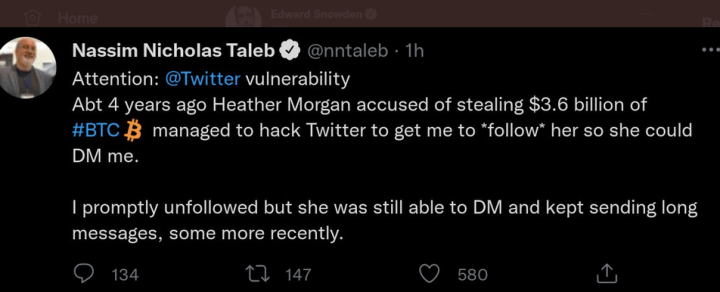
But what does any of this have to do with the author Nicholas Nassim Taleb? Well, it would have had nothing to do with him if our boy hadn’t chosen, with exquisitely poor judgment, to interject himself into the Heather Morgan/ Razzlekhan drama. Within hours of the heist news breaking, Mr. Taleb posted the following:

I have several things to say about this nonsense:

I. Check his use of “Attention” and the scare word “vulnerability.” Taleb thinks this message is super important and even urgent. He’s got to get it out there RIGHT NOW.

II. The story is obviously total BS. Taleb seems to have no sense of how Twitter works, and his narrative is so bizarre that he is basically begging us to roast him, which users in the hundreds did, of course.

III. Taleb gives no insight into why Morgan was DMing him. What did she want? Well, users, myself included, had a theory as to what might actually have occurred here. Occam’s Razor would suggest that at some point Morgan and Taleb began exchanging DMs, possibly on her initiative, as she was writing extensively for Business Insider and Forbes I believe, and maybe she wanted to ask Taleb something about one of his books. Taleb then pivoted into a bit of tail chasing, or, as one Twitter denizen put it slightly less crudely, he was looking for a little “bobs and vagine.” When Morgan was arrested, Taleb got spooked that somehow their DMs would leak, so he concocted a ridiculous cover story almost (but not quite) as stupid and unbelievable as Joy Reid’s claim that her fifteen year old blog with homophobic jokes and comments was hacked by Russians.

IV. The use of “some more recently” is a pure “tell.” Taleb’s bobs and vagineing has been going on for some time, it seems. But why in the world would Taleb think that the messages would leak just because Morgan was arrested (she was later released and her husband was held in custody, and I haven’t been able to get a status update on where she is today)? I mean there are really only two options: i) that the messages would be released by the FBI or something as pertinent to the case, in which case Taleb and Morgan would have been discussing her hacking. This seems highly unlikely; ii) Morgan would choose to release them herself in an effort to incriminate Taleb. But Nicholas baby, this is just not going to be a priority for Morgan after her arrest. I mean, she is accused of stealing 4.5 billion, and she’s got her rap career, and her husband is in prison. She has got stuff going on man; your DMs are way down the list.

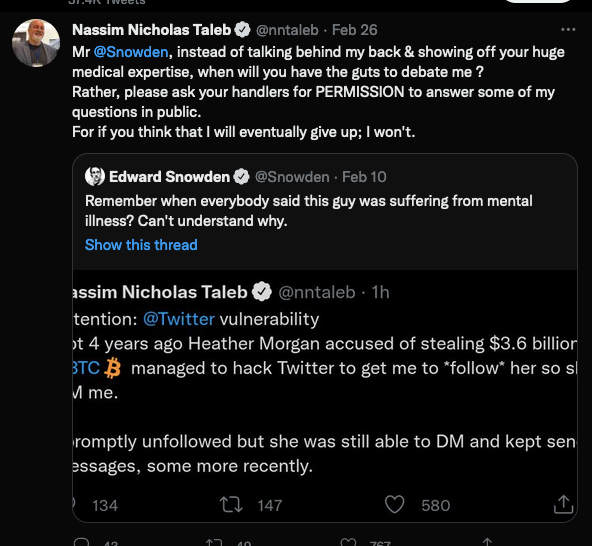
All and all, this message shows that Taleb is an idiot and a complete joke. And people took note, including Edward Snowden, piping up from Russia. Check this out:

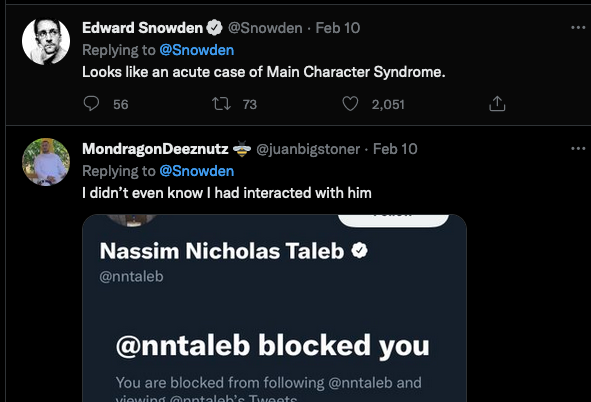
Snowden comes in with the savage take down here, and Taleb punches back with an offer to debate, what exactly? It’s not clear if this the debate challenge was issued prior by Taleb nor is it clear, at least to me, what is to be debated. Are they supposed to talk medical issues? Mental health? Hacking? Bobs and vagine? Taleb continues to make no sense, and Snowden let’s him know with another zinger:

Main Character Syndrome indeed. I would add Major Asshat Syndrome and Big Phony Fraud and Fragile Loser Syndrome as well. Because this is the guy who wrote Antifragile! Which is supposed to be about things that thrive during chaos, or in other words, things which are resilient. And nothing says resilient like faking a hacking narrative to cover your tail chasing, issuing an incomprehensible debate challenge to someone way out of your league, and tripling down with blocking random twitter users who question you. And I would know, because after I liked the bobs and vagine comment and added something like “Methinks Mr. Taleb doth protest too much,” the fucker blocked me too! Sadly that Twitter account is history so I can’t post a screenshot, however it was obvious that this huge baby was scrolling chats and mass blocking to distract from his disastrous piece of public relations. Honestly, the whole thing was super funny and Taleb showed his ass in the worst possible way.

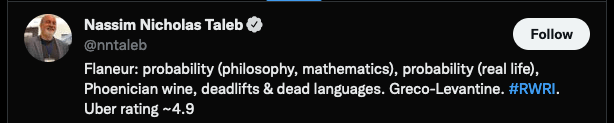
Taleb obviously thinks he is hotshit. Check out his Twitter bio.

What a poser. A flaneur is a French term for someone who walks the streets taking things in, and Walter Benjamin wrote extensively about the flaneur in his epic, and epically unfinished “Arcades Project.” Actually, a flaneur is a lot like a kibitzer. I am the Kyotokibbitzer (two b’s baby), and I love Benjamin’s work, including the Arcades Project. I bet Taleb is aware of Benjamin and fancies himself a fan. But he doesn’t know the first thing about Benjamin, because Benjamin was a humble guy who did great work and Taleb is a braggart, a tail chaser, and a bum. Deadlifts and dead languages my ass. Text is dead there Nicholas, at least your texts are, because you made a complete fool of yourself and you suck. Taleb exemplifies precisely why I dislike anyone who calls themselves a public intellectual or an expert. He is a poser and I’ll bet you 10 to 1 his ideas are stolen just like Neil DeGrasse Tyson’s, another total loser who piggybacks on people who know something to pump up his image. (A sure sign of a loser is a “public intellectual” who insists on using three names. What’s wrong with Nicholas Taleb or Neil Tyson? The only people who need three names are serial killers; I mean even public intellectual number one Malcolm Gladwell only uses two names. Gladwell is known to pilfer ideas as well, but The Tipping Point is a pretty good read and the dude genuinely knows a tremendous amount about the sport of running. And he doesn’t call himself “Malcolm Julius Gladwell” or whatever. This is because he’s just a writer and knows that using his middle name would make him a prat.) Anyway, it’s totally fine to fake it ’til you make it, and most of us do to a greater or lesser degree, but you can’t fake your way into being an expert. Never trust “experts,” full stop.

So that’s the story of Razzlehan, the misunderstood genius, and Nicholas Taleb, the big phony. And in case you are asking, yes I did ask Razz to get in touch with me above. I’d say “I can fix her,” but she needs no fixing. She can DM me all she wants, and she doesn’t even have to get the Russians involved.

Dedication:

For Razz. You rule baby. So damn hard.

On the Song “Dylan Thomas” and Comments on Ryhme

Author’s Note:

This essay is now eight years old, and I honestly have no idea what happened.

For years the traffic champions around here were predictable: my Kris Kristofferson essay, Trump’s Gemini Dream, and the piece on Razzlekhan all traded places at the top of the charts. Then, about six weeks ago, this old essay on a Better Oblivion Community Center song simply… took off. No promotion. No rewrite. No obvious reason. Somehow it climbed past everything else on the site and, at least for many searches, now even appears ahead of Wikipedia and the major lyric sites for “Dylan Thomas.” I remain completely mystified by it.

I’m certainly not complaining. This piece has always been one of my favorites because it isn’t really a review at all. It’s an excuse to talk about rhyme, structure, near-rhymes, politics, hedonism, Dylan Thomas, Paul Westerberg, Conor Oberst, Phoebe Bridgers, and why some songs continue revealing themselves long after you’ve memorized every word. Eight years later I’m still hearing new things in it—and apparently, somehow, so are a surprising number of other people. I’ll happily take the mystery.

=====

This post is about the song “Dylan Thomas” from the first Better Oblivion Community Center record. For the uninitiated (which is probably everyone reading this–recently a friend texted me a funny article from The Onion entitled “Study: No Two People Have Listened To Same Band Since 2003”), Better Oblivion Community Center is Conor Oberst and Phoebe Bridgers. “Dylan Thomas” is the single, if singles still existed. You still won’t know them.

I want to write about the song because it has a killer structure and is awesome. The structure is based around a neat rhyme scheme with fabulous use of “near rhymes” and also around a see-saw in the verses between fairly pointed political commentary and apolitical hedonism. As with all interpretation, I can’t be sure that what I hear was intended, but what the hell–communication is what the listener does after all.

Now, a lot of songs, most, rhyme. That’s obvious. But not too many songs really hold up on the page as well, as poetry. I think “Dylan Thomas” does and I’d like to explore why.

Verse I:

It was quite early one morning/ hit me without warning/ I went to hear the general speak/ I was standing for the anthem/ banners all around him/ confetti made it hard to see

So the first verse clearly alludes to our political moment–it appears politically engaged to some extent. The reference to “the general” is redolent of South American politics (I am reminded of the fabulous Drugstore song “El President”). The rhyme scheme is tricky–it’s AABCC(D), where (d) “see” almost rhymes with “speak” in the delivery although the words don’t actually rhyme, instead being only vaguely alliterative.

Verse II:

Put my footsteps on the pavement/ starved for entertainment/ four seasons of revolving doors/ so sick of being honest/ I’ll die like Dylan Thomas/ a seizure on the bathroom floor

Verse II sees a clear shift from the political to the personal, the hedonistic, the depraved. While Thomas is famous for his “rage against the dying of the light,” Better Oblivion taps the seedier side of Thomas’ legacy–the singers (most of the songs on the album including “Dylan Thomas” are duets) in verse II are seeking pleasure and there is no hint of the macro picture here. So, verse I=macro, verse II=micro.

The rhyme scheme shifts to AABCCB, with a definite rhyme between “doors” and “floor.” “Entertainment” and “pavement” I would consider near-rhymes, and the slightly off-kilter near-rhymes are for me what really make this song stand out as a piece of writing.

Chorus:

I’m getting greedy with this private hell/ I’ll go it alone, but that’s just as well

Hard to say exactly what “this private hell” refers to, however we get a sense of doubling down on the dissolute–in for a penny in for a pound as they say.

Verse III:

These cats are scared and feral/ the flag pins on their lapels/ the truth is anybody’s guess/ these talking heads are saying/ “The king is only playing/ a game of four dimensional chess”

Verse III is clearly political again, setting up a 1 for 1 see-saw (so far). “Cats” here cuts both ways–on the one hand “people” with flag pins in the era of truthiness, on the other, well real cats are feral. It’s a very clever, subtle move. Is the general from verse I the king from verse III? Probably. We live in an era where world leaders are not in the business of leading, but rather of playing elaborate, endless games.

The rhyme scheme here is a AABCCB where the second C and the second B are part of a single quote. Very nicely done.

Verse IV:

There’s flowers in the rubble/ the weeds are gonna tumble/ I’m lucid but I still can’t think/ I’m strapped into a corset/ climbed into your corvette/ I’m thirsty for another drink

This is where the song really comes into its own as a mini-masterpiece. On its own, this verse is nakedly apolitical and local–I am reminded of one of my favorite lines of all time from the final Replacements album. The song is “Someone Take the Wheel” and the line goes: “they’re fighting again in some fuckin’ land/ ah throw in another tape man.”

In 1990, Paul Westerberg didn’t give a shit about the Iraq War and wanted nothing more than to listen to music on the road. That’s an understandable point of view on the level of the human individual. What I love about what Oberst and Bridgers do with this song is how they alternate verses between the macro and the micro, the engaged and the depraved. The same conceit is used on the first song of the record, “Didn’t Know What I Was In For”:

I didn’t know what I was in for/ when they took my belt and strings/ they told me I’d gone crazy/ my arms are strapped in a straight jacket/ so I couldn’t save those TV refugees

I get this sentiment. Seriously I do. If we zoom out a bit on our world situation these days, we could easily say that every person with even a patina of ethical conscience ought to be on the front lines in one way or another. And then I look at myself and…well, I chose Medicine Sans Frontiers as the charity that gets some small percentage of my Amazon purchases. Will the future see me as a head in the sand hedonist? Probably, and with some justification.

The rhyme scheme in verse IV is again a clear AABCCB with near-rhymes (probably the first time in history “corset” has been rhymed with “corvette”), in fact the same scheme as limericks. I f***ing love AABCCB. God bless it. Also, the line “I’m lucid but I still can’t think” pretty much summarizes my entire life to date.

Verse V:

If advertised, we’ll try it/ and buy some peace and quiet/ and shut up at the silent retreat/ they say you’ve gotta fake it/ at least until you make it/ that ghost is just a kid in a sheet

AABCCB again, the scheme which carries the song with the striking exception on verse I. Verse V alludes to the theme of the record–Better Oblivion Community Center is some kind of partially defined wellness retreat–and kind of splits the difference between the political and the personal, the macro and the micro. It also serves as a commentary on the commercialization of “wellness” and is a cheeky meta-comment on the cover of Bridgers 2017 debut:

Is this a shot at some critics? A self-aware reference to a DIY cover? I don’t know, and I love the line.

Following the logic of this piece, we have a kind of scheme of the verses as well. Let’s call is ABABC where A=political, B=apolitical, and C splits the difference.

Verse VI/ Outro:

I’m getting used to these dizzy spells/ I’m taking a shower at the Bates Motel/ I’m getting greedy with this private hell/ I’ll go it alone, but that’s just as well

It’s a simple AABB with the outro calling back the chorus from mid-song. The see-saw between the personal the political sort of resolves itself in the killer couplet. “I’m getting used to these dizzy spells” suggests acclimatization to the altitude–metabolization of the fear. “I’m taking a shower at the Bates Motel” is an amazingly effective counterpoint line–we are living at the knife point of maniacs. Ah well, let’s hit the bar. I’m thirsty for another drink.

Seriously, check out “Dylan Thomas” and the whole record. I know no one listens to anything I listen to, but still.

Postscript: So Mr. Spotify seems to have decided that “Dylan Thomas” is my very favorite song, and cues it up time after time after I’ve finished listening to whatever I have selected. I do love this song, by Mr. Spotify there is almost making me tired of it. Change it up there Mr. Spotify please.

My Brother Mike’s Bad Book

Subtitle: A Mariners game, a rowdy night, and the moment my brother defined himself with four perfect words.

Author’s Note:

Some stories stay with you because of what happened. Others stay with you because of what they revealed. This one has always belonged to the second category. It started as a funny night at a Mariners game and ended as one of those moments where a person’s character becomes perfectly clear in the space of a single sentence.

I’ve written a lot over the years about family, friendship, and the people who quietly shape us. This remains one of my favorite examples. Mike has always been capable of making a room louder, funnier, and occasionally more chaotic. But beneath all of that is a remarkably reliable moral compass. Four words—“That’s a bad book.”—told me everything I already knew. I still smile every time I think about them.


Several years ago I attended a Seattle Mariners baseball game with my bother Mike. The Mariners were playing the Toronto Blue Jays, and we went out for a few drinks before the game right next to the stadium. I was amazed by just how many Blue Jays fans there were in town for the game. They were all over the place.

Now, although I grew up in a baseball family, as I got older I kind of lost interest. The games are just too long and there are too many of them. However, going to a game in person is pretty cool. Mike is still a hardcore Mariner fan, which I respect. On this night the Mariner’s star pitcher Felix Hernandez was pitching, and the Mariners won the game. However, the result is far from the most memorable aspect of that night.

Our seats were pretty good, right next to, but not actually in, the “K Zone” where the Hernandez heads were. Over the course of the first few innings, Mike downed several more beers and he got a little rowdy, as he sometimes does. Mike, in Freudian terms, has more than a little “id” in him. As I mentioned, there were a lot of Blue Jays fans in town and Mike, as a good Seattleite, took this as a challenge. As the game went on he began calling out, loudly, various Canadian cities.

“Calgary suuuucks…Winnipeg suuuucks…Lethbridge suuuucks.” Like that.

I found this all pretty amusing, if a little unorthodox. It wasn’t how I would chose to enjoy the game, but this was Mike’s style. As the Mariners built a lead Mike’s chants started to escalate, and some Blue Jays fans began to take offense. Probably this was the point. These dudes were looking at Mike, pointing, saying things. There was no real risk of a fight; however Mike was mixing it up no doubt.

Around the 5th inning or so another dude in a Shawn Kemp jersey started making noise of his own. (Shawn Kemp was a star player for the Seattle SuperSonics back in the day before some asshole stole the franchise and moved them to Oklahoma City. Fuck that guy.) At first this was all fine, because anyone in a Sonics jersey was OK with Mike. However the Sonics fan started getting a little out of line and dropping the f***** slur.

“Look at this fucking f*****. Fuck this f*****,” stuff like that.

As far as I could tell there was no reason that this guy had to target an individual in this fashion. The difference, as I saw it, between his action and Mike’s was that Mike was basically operating in good humor and calling out all the Blue Jays fans present in the spirit of friendly competition, while the Sonics fan was picking on an individual, and using a slur. Although the exact nuances of the difference are perhaps debatable, the dude was definitely out of line.

Mike noticed this guy and didn’t like what he saw. He began saying so, and someone not in our group took notice. This other guy, in regards to the Sonics fan, said something to the effect of “he’s ok in my book.” Mike didn’t miss a beat at he uttered the classic line, one I will never forget.

“That’s a bad book,” he said.

That’s all he said; he didn’t challenge the guy to a fight or anything, didn’t even directly address him. The Sonics fan was getting so abusive that someone called security, and he was escorted out.

“That’s a bad book,” reminds me of my friend from high school Cameron Turner who liked to say of something he didn’t approve “that’s sick, and wrong.” Both of these are super memorable phrases, and highly redolent of the person behind them. Mike was a little lit. Mike was razzing Blue Jays fans as a collective. Mike was attracting attention. At the same time he felt that there was no need for gratuitous gay slurs. And he was right.

One of my favorite phrases in the world is “that’s some bad action.” Mike was speaking in the same vein with “that’s a bad book.” I’ve never been prouder of anyone in my life than when Mike called this guy out.

I fuckin’ love my brother Mike.

Postscript: Just a little while ago Mike and his fiancee had a baby, Felix. Named, of course, after the pitcher. So that’s pretty cool. I just hope he doesn’t grow up to be a Blue Jays fan.