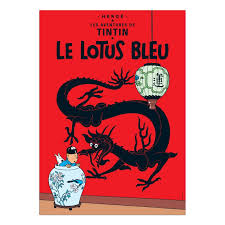
Note: This essay takes up my personal four favorite books from the marvelous Adventures of Tintin series. I make no claim for these to be the best, and the list omits the very popular Moon books, however this is the list as it stands. I hope you enjoy Tintin as much as I do, and as always, thank you for reading.
Epigraph:
I have climbed highest mountain
I have run through the fields
Only to be with you
U2
First Encounter
I first encountered Tintin in Grade 5, checking two slim volumes out of my elementary school library: The Blue Lotus and Tintin in America. I remember the physicality of them—the glossy covers, the bright blocks of color, the uncanny clarity of the drawings. They felt different from the other books on the shelf. Most children’s adventure stories required you to imagine the action. Tintin showed it to you panel by panel, with a confidence that made the whole world feel precise and alive.
Even before I fully understood the stories, I had the sense that I had stumbled onto something like treasure. The pages moved quickly. Cars skidded across city streets, gangsters hid in back rooms, deserts stretched into the distance. Tintin himself was fearless and tireless, a boy reporter who seemed capable of appearing anywhere in the world with little more than a notebook, a trench coat, and his small white dog.
But even at ten years old it was clear that the two books belonged to the same universe but not quite the same stage of its development. Tintin in America was energetic and funny but also loose and episodic, closer to a cartoon chase story than a carefully constructed narrative. The Blue Lotus, by contrast, felt deeper. The stakes seemed real. The world seemed larger and more dangerous. The book hinted at forces—politics, empire, war—that I could not yet name but could somehow feel moving behind the story.
Before going further, it’s worth acknowledging briefly the long-running controversy surrounding the politics of Tintin’s creator, Hergé. Some of the early Tintin stories reflect the colonial assumptions and stereotypes common in Europe during the interwar period, and Hergé himself worked for a newspaper in German-occupied Belgium during World War II. These facts have generated decades of debate. They are real and worth knowing. But they are also only one part of a much larger story. Over time Hergé’s work grew more humane, more attentive to other cultures, and more morally complex. For the purposes of this essay, it is enough to acknowledge the controversy and then move on to the books themselves, which remain among the most remarkable achievements in modern popular storytelling.
Mr Dreyer’s Class, 7th Grade:
Even before I took his class, I was aware that Mr. Dreyer was, let’s say, a different sort of fellow. He liked to tell a story about his brother who lived on a massive contour map of the San Francisco Bay area. The map was located in an enclosed structure that hung under a bridge in Oakland or something. And his brother just chilled there full time, so the story went. So Mr. Dreyer, apparently, was the normal one in his family.
(I remember Mr. Dreyer talking to me about John Lennon one day as well. This was maybe when I was taking his class, but I think it might have been before that. “John Lennon’s assassination was really sad,” he said, “he was just starting to put his life back together.” I had heard of John Lennon but at that time knew nothing of the circumstances of his death. And I certainly didn’t know about his ups and downs in the 1970s. Mr. Dreyer must have been a Lennon fan though, and wanted to tell me about it.)
In any case, when I got to middle school I was assigned Mr. Dreyer, as mentioned. Mr. Dreyer wore a mustache that looked pretty Frenchy to me—maybe that’s why I kind of thought he was a French native. There were also a number of the Tintin books in French on a shelf in the back of the room. I had read most of the Tintin books in English by then, so it was fun to browse the French versions and take in some of the action from a new lens.
The Blue Lotus
If the early Tintin books were clever adventure cartoons, The Blue Lotus was the moment the series entered history.
The story takes place in Shanghai during the turbulent 1930s, amid Japanese expansion and international intrigue. What distinguishes the book is not simply the exotic setting but the sudden moral seriousness that runs through it. Tintin is no longer merely chasing criminals. He is navigating a world shaped by imperial ambition, propaganda, and cultural misunderstanding.
Central to this shift is the introduction of Chang Chong-Chen. Chang’s friendship with Tintin humanizes the story in a way earlier books never attempted. Through Chang, the reader glimpses the everyday life of Chinese citizens caught between foreign powers and internal turmoil. The relationship is warm, sincere, and quietly revolutionary for its time.
One sequence has stayed with me since childhood: Tintin being smuggled into an opium den hidden inside barrels. As a child I read the scene simply as a thrilling act of infiltration. As an adult it evokes something darker—the lingering shadow of the opium trade and the colonial exploitation that shaped China’s nineteenth and early twentieth centuries. Even if young readers do not consciously grasp the historical weight behind it, they feel that something serious is at stake.
With The Blue Lotus, Tintin steps out of the cartoon world of early adventure stories and into a recognizably historical landscape. The hero is still brave and resourceful, but the world around him has grown more complicated.
The Crab with the Golden Claws
If The Blue Lotus deepened Tintin’s world morally, The Crab with the Golden Claws transformed it emotionally. The reason can be summed up in a single name: Captain Haddock.
Before Haddock appears, Tintin himself is almost too perfect. He is brave, clever, and incorruptible. Admirable, yes—but also somewhat distant. Haddock brings chaos into this orderly universe. When we first meet him he is a drunken wreck aboard a cargo ship, bullied by the crew and prone to bursts of confused outrage. In his introduction scene he is literally knocked around by events, bonked on the head and stumbling through the narrative like a man who has wandered into the wrong story.
Yet Haddock quickly becomes indispensable. His flaws—his temper, his drinking, his explosive vocabulary—make him recognizably human. Over the course of the series he evolves into the lord of Marlinspike Hall, a man readers root for not because he is flawless but because he struggles, blunders, and ultimately proves loyal beyond measure.
The mystery at the heart of the story—those curious tins of crab that conceal a narcotics smuggling ring—is classic Hergé plotting. An ordinary object becomes the gateway to a hidden criminal network. But what readers remember most is Haddock: the lovable rogue who changes the emotional chemistry of Tintin forever.
Land of the Black Gold
Land of Black Gold is one of the most unusual Tintin stories, blending geopolitical intrigue with comic delirium.
The plot centers on sabotage of the world’s gasoline supply, drawing Tintin into a web of international conspiracies in the Middle East. Yet what makes the book memorable is its sense of narrative labyrinth. The trader and raconteur Oliveira da Figueira talks endlessly, spinning stories within stories, improvising explanations that seem to circle back on themselves. His rambling style mirrors the complicated, byzantine nature of the intrigue unfolding around Tintin.
At the same time, chaos erupts in the form of the child Abdullah, whose relentless practical jokes push everyone toward exasperation.
And then there is the unforgettable desert sequence in which Thomson and Thompson pursue mirages while unknowingly driving in circles along their own tire tracks. The scene borders on hallucination. Heat, confusion, and comic misunderstanding combine to create one of the series’ most surreal episodes.
Where The Blue Lotus introduced moral depth and Crab introduced emotional warmth, Black Gold revels in controlled absurdity—the sense that the modern world is a maze of conspiracies, misunderstandings, and comic misadventures.
The Calculus Affair
By the time we reach The Calculus Affair, Tintin has entered an entirely new landscape: the Cold War.
The story begins with the kidnapping of Professor Calculus, whose research has attracted the interest of rival governments. Tintin and Haddock pursue him across borders, into secret fortresses and heavily guarded territories.
What makes this adventure distinctive is the absence of a clear moral center. Earlier Tintin stories often feature obvious villains. Here the lines blur. Rival states compete for technological advantage, intelligence services manipulate events, and even the heroes seem slightly overwhelmed by the scale of the intrigue surrounding them.
Tintin and Haddock are no longer simply solving a mystery. They are wandering into the murky machinery of international espionage.
Yet Hergé never abandons humor. The action sequences—helicopter pursuits, roadblocks, sticky-tape tricks, and frantic car chases—are thrilling while remaining faintly absurd. The tension builds like a spy thriller, but the comic timing prevents the story from becoming grim.
The result is perhaps the most sophisticated Tintin adventure: a tale in which suspense, humor, and geopolitical intrigue coexist in perfect balance.
Why Tintin Endures
Across these four books we can see the remarkable evolution of Tintin.
The Blue Lotus brings the series into history.
The Crab with the Golden Claws introduces human imperfection through Haddock.
Land of the Black Gold revels in the comic chaos of modern intrigue.
The Calculus Affair confronts the morally ambiguous world of Cold War espionage.
Through it all, Hergé’s storytelling remains astonishingly clear. Each panel advances the narrative. Each scene unfolds with the precision of a well-designed machine.
Tintin may begin as a boy adventurer, but over time he becomes something else: a traveler moving through the complicated landscape of the twentieth century. History deepens, friendships form, conspiracies multiply, and the world grows ever more ambiguous.
Yet the clarity of the storytelling never falters. That combination—simplicity of form paired with depth of experience—is the secret of Tintin’s endurance.
For many readers, the journey begins exactly as it did for me: a small book taken from a library shelf, opened with curiosity, and discovered to contain an entire world.
Dedication:
For Grade School libraries everywhere.