Matt texts the Thin Man before he has even fully decided to.
There is a kind of threshold in sending a message like that, where intention arrives slightly after action. The screen shows the name and then the words appear as if they were always going to exist.
Found her.
There is no immediate reply.
Matt goes to the hotel rooftop pool instead, because the body refuses to remain still when the mind is doing work it cannot complete. The city below is a port city, functional rather than beautiful, ships moving like punctuation marks across water that does not care about narrative.
He swims slowly. Not exercise. Just repetition. Something to keep him inside himself.
The Thin Man arrives without announcement.
Matt sees him later in the lobby, as if he has always been there and only now decided to become visible. There is nothing theatrical about his movement. He is dressed simply, unremarkable in a way that only becomes noticeable after you have already started paying attention.
They do not greet each other like friends. They never have. They greet each other like continuity.
Matt watches him cross the space and feels, not for the first time, that proximity to him changes the temperature of events.
LUCÍANA
The café is near the port, where the air carries salt and fuel in equal measure. Luciana arrives slightly early, not because she is nervous, but because she is efficient. She chooses a table where she can see the entrance without appearing to be watching it.
When Niko arrives, she recognizes him immediately, though recognition does not translate into welcome. Time has done what time does, which is soften edges without removing structure. He is older now, but not unfamiliar in the way she expects him to be unfamiliar.
They sit.
For a long moment, neither of them performs memory. When they finally speak, it is careful, almost formal. He asks about her life. She answers without inviting him into it. There is warmth in her tone, but it is bounded. Controlled.
She tells him about their son. He listens without interrupting.
“He is in Dubai,” she says after a time. “He is working in media. Content. Travel. He is doing well for himself.”
Niko nods once. No visible reaction beyond that. But something in the air shifts slightly, as if a long thread has been acknowledged without being pulled.
Luciana continues. She has a daughter now. A marriage. A life that has moved forward without apology. When Niko asks nothing more, and she is briefly grateful. Then she tells him, clearly and without cruelty, that this is not something she wants reopened.
He understands. He does not argue. He never argues with time.
MATT THOMAS AT THE HOTEL
I am still at the hotel when he returns. He does not look like a man who has just been refused something. He looks like a man who has confirmed a hypothesis and chosen not to act on it. There is a difference, and I am beginning to understand it.
I ask him if he saw her. He says yes.
I ask what she said. He does not answer immediately. Then he tells me about Dubai, about the son, about the fact that life has continued in a direction that does not require his permission.
I wait for more. There is no more.
That is when I realize how little I actually know about him, even now. Later that night, I finally ask the question I have been circling since Tokyo.
“What is your real name?”
He does not look surprised.
He never looks surprised.
He says he is from Georgia. That his name is Niko. That he was born in 1977.
Nothing more.
And somehow that is enough to change the entire shape of what I thought I was holding.
CODA — MATT THOMAS IN KOYTO
I am back in Kyoto, but I am not fully back in anything that resembles ordinary life. The school still exists. I still teach. I still perform the version of myself that can explain narrative voice to students who are mostly thinking about lunch. I have had readings now—one in Kyoto, one in Tokyo—and people are starting to treat me as if I might become something recognizable.
It does not go to my head. But the Thin Man does. He’s always there.
We talk on Signal in fragments. Nothing structured. No schedule. Just interruptions in time that feel more real than the rest of the day. I sit in shisha places after work and try to write, but what I am actually doing is waiting for the next message.
Book II is already taking shape in my head.
I am just not sure yet whether I am writing it is writing me.
Before I got on the place for Costa Rica the school was still trying to pretend this was still a normal conversation.
Vice Principal Nakata-san called me into the office with the kind of politeness that always signals something is already decided. The room was too bright, the air-conditioning too strong, the framed notices on the wall insisting on order. I sat down expecting administrative concern and got something closer to procedural disbelief.
“If you leave during term time,” Nakata-san said carefully, “your employment status may be affected.”
I nodded as if this was news I could process. Inside my mind was pure white. I said I understood. but I was going anyway.
There was a pause after which neither of us spoke.
“I am not firing you,” Nakata-san added, almost gently. “But you are… on thin ice.”
I thanked him, which felt like the wrong response but also felt like the only one available. When I left the office I was not thinking about consequences in the way institutions intend. I was thinking about distance, and how quickly it can become irreversible.
The flight to Costa Rica felt like a correction rather than a journey.
I watched the map on the screen and thought about how absurd it was all becoming. Somewhere over the Pacific, I opened my laptop and tried to write some notes, but nothing useful formed. Everything kept collapsing back into the same name.
Luciana Solís.
I did not yet know what I was looking for. I only knew that stopping now would mean admitting the shape of the obsession too clearly.
San José arrived humid and unceremonious. Costa Rica did not announce itself so much as absorb you. I moved through it with the slightly displaced awareness of someone who has read too many fragments of a story before seeing the whole thing.
I started where any amateur investigator starts: public record offices, municipal archives, online registries that are barely maintained but still technically alive. Marriage records, birth records, civic logs that feel like they were designed to discourage curiosity rather than enable it.
The work was slow and unglamorous. Most of it was administrative noise.
And then, on the third day, something aligned. A record. A name. Luciana Solís.
It is not dramatic when I found it. There was no cinematic recognition, no surge of certainty. Just a quiet moment where the page refused to behave like a coincidence.
I sat back from the screen and realized that my hands were slightly cold.
That is when I knew I was no longer guessing. This was the Thin Man’s son’s mother.
Well everyone, today is the day. My first novel, The Adventures of the Thin Man and Andrea is now available on Amazon and wherever books are sold.
This one took a while—written in fits and starts, in bars and hotel lobbies here in Kyoto—but it finally found its shape. More than anything, today I just want to thank all the readers of The Kyoto Kibbitzer, wherever you hail from; I’ve always thought of this as an ongoing conversation, and a lot of this book grew out of that exchange.
If you do pick it up, I hope you enjoy the ride—and if it lands for you, a quick review on Amazon would mean a great deal. Thank you, as always, for reading.
Note: I’ve always found airports to be oddly compelling spaces — calmer than airplanes, yet charged with their own atmospheres, rhythms, and small absurdities. Despite their surface similarity, airports differ in subtle but meaningful ways: some feel tranquil and almost utopian (Singapore), others disorienting in their 24-hour casino glow (Dubai), some quietly efficient (Tampa), and others defined by faded infrastructure, endless construction, or simple forgettability. This piece, On Some Airports, is a deliberately unsystematic and anecdotal wander through a handful of terminals I’ve passed through over the years — less a ranking than a record of mood, memory, and the curious emotional geography of transit spaces that we occupy only briefly yet somehow remember for years.
I spend too much time in airplanes
Eating peanuts and getting high.
Dean Wareham
Generally speaking, airports are more pleasant than airplanes. I don’t mind airports. And despite my once upon a time claim that all airports are essentially the same space, well, that’s more of a metaphysical than a practical contention. Practically speaking the experience of airports does differ. What follows is a totally unsystematic, entirely anecdotal, non-ranking of some airports I’ve been to.
U.S. Airports:
LaGuardia (LGA) in New York is actually a pleasant surprise. Clean, minimal but sufficient food options, phone chargers in the seats, proximal to Manhattan. The folks at the coffee stand messed up like 15 orders in a row, but that’s OK. I forgive them.
Verdict: LGA is fine.
Newark Airport (EWR), on the other hand, is terrible. If I had the choice of sleeping in an outhouse or spending a day at EWR, I’d take EWR. But not by much. It’s a pit.
Verdict: EWR is terrible.
Seattle Airport (SEA) is poorly run. There’s been news about it. Compared to Portland (PDX), and admittedly smaller airport that is solid, or even San Francisco (SFO), an operation of greater complexity, SEA struggles. Maybe they’ve turned things around, but I doubt it.
Verdict: SEA sucks. PDX is solid. SFO is decent but could be cleaner.
The best experience I’ve had at a U.S. airport is Tampa (TPA). Now this is not a major hub, however I found it super convenient. I stayed in a hotel right in the terminal, security was a breeze, everything was efficient and sound. When folks say that U.S. airports suck, relatively speaking they are correct. Omit TPA from the list though. I like it.
Verdict: TPA is excellent.
O’Hare International Airport (ORD) in Chicago exemplifies the fall of the U.S. Basically. It’s not BAD, it’s just faded. Faded glory. U.S. public infrastructure is weak and everyone knows it. ORD is a case in point, but it’s survivable.
Verdict: ORD is OK.
The Los Angeles Airport (LAX) was under construction for like two decades. It’s probably still under construction. LAX is far from everything. It is not a destination airport, although it is major.
Verdict: LAX is f***ing far.
Airports Outside the U.S.:
Let’s get out of Milwaukee and we’ll talk about it.
Michael Clayton
The Singapore Airport (SIN) is everything it is cracked up to be. Singaporeans have a great deal of pride in their airport, but it’s totally justified. I find SIN tranquil in the extreme. They’ve got butterflies. The’ve got Indian food. They’ve got a great attached hotel. They’ve got nap rooms, showers, a gym. Security is omnipresent and unfelt. Sure you can call Singapore a soft-authoritarian state if you like. I could care.
Verdict: SIN is the best.
The Bangkok Airport (DMK), on the other hand, is not pleasant. Sinage is bad. Information is thin. Food options are minimal. It’s simultaneously packed and cavernous. I have not enjoyed my time here.
Verdict: DMK is bad.
The Dubai Airport (DXB) is strange. It’s a serious hub and runs 24/7 (as does DMK). Unlike DMK however, DXB has ample food and drink options and is pretty comfortable. The customs staff moves at their own pace, to say the least. The dichotomy between an (apparently) efficient and gleaming modern airport and a snail’s pace customs experience is interesting. DXB is lit and feels kind of like a casino in the sense that 3:30 AM feels like mid-afternoon. I have found DXB to be disconcerting in this respect, but otherwise perfectly pleasant.
Verdict: DXB is big and better than most.
Osaka’s Kansai International Airport (KIX) is decent before security and weak after. My buddy Doug loathes the neon lighting of the airport–this bothers me less. My issue is the food options after security leave a lot to be desired. Since this is my home airport, I am not in a position to give an objective reading. Security lines can get super long during peak hours, but usually it’s fine.
Verdict: KIX is so-so.
Osaka’s Itami Airport (ITM) has recently had a facelift. It’s marginally improved. Just because you have a Wolfgang Puck’s pizza place doesn’t mean you’ve got it made, baby. Wolfgang Puck is f***ing overrated. Also, you almost have to take a bus to get anywhere from ITM. Buses sucks.
Verdict: ITM is fair at best.
I’ve been to the airport in Kuala Lumpur (KUL) several times but I forget everything about it.
Verdict: KUL is unmemorable.
The Shanghai Pudong Airport (PVG) has super high ceilings. Obviously a lot of money has gone into it. There is a super long train ride from customs to the gates. And, you are most likely to get delayed or re-routed because of weather or something. The airport itself is fine.
Verdict: Prepare to be delayed from PVG.
The Adelaide Airport (ADL) is in Adelaide, Australia. I went there once. The restaurants in my hotel were closed because it was a Sunday. There was nowhere to eat in the whole city and only stoner kids were on the street. The next morning the streets were packed. Adelaide is super strange. I have no idea what the airport was like.
Verdict: Pack a lunch.
That’s all the airports I have off the top of my head. Obviously there are more. If you agree or disagree or want to pitch an airport for my consideration, please leave a comment!
Note: If you found this piece interesting, you may also enjoy “On Some Things I Find Interesting.” Available below.
“All we need is just a little patience.” — Guns N’ Roses
I. Leaving Anyway
The wedding was in June, which was just a little inconvenient for me. School was still in session, and I had to miss work to go. I remember wishing that it had been in August. But once I decided I was going, the resistance fell away. I locked it in, and then I was genuinely excited—mostly to see my family.
I hadn’t seen my mom, Mike, or Pat since January 2018, before COVID. I hadn’t seen my dad since October of that year. That mattered more to me than the logistics or the calendar. So my wife Sachie and I flew from Japan to Seattle, and my son Hugh flew in separately from New Zealand, via Auckland and Los Angeles.
We landed at Sea-Tac and cleared international arrivals quickly. We had a few hours before my parents arrived to pick us up. They had rented a van, partly because it was a three-day event and partly because they were making breakfast on the last morning, which required supplies. While we waited, Sachie and I sat in the only open area we could find outside arrivals. We both needed a cigarette, so we took turns—one of us watching the bags while the other smoked. We bought two Starbuckscoffees, which cost sixteen dollars. I ordered an extra shot in each, not realizing the Americanos already contained doubles.
While we were there, a man nearby was clearly overdosing—probably fentanyl, maybe heroin. He was nodding, drooling. The police came first, then EMTs. They all knew him by name. Sylvester. After about an hour, they took him away on a stretcher. No one around reacted much. It felt routine. I was just sad, thinking about how much damage fentanyl has done in the U.S.
I texted my mom. They were running late. Hugh arrived through domestic customs and joined us. When my parents finally came, they looked good—just older, of course. We hugged and walked back through the airport to the van. My dad had forgotten where he’d parked it, so that took a while too.
Once we got moving, things settled. Sachie, Hugh, and I loaded into the van and drove north to Anacortes, about two and a half hours. It was mid-afternoon. Hugh slept most of the way. Conversation came easily. It felt natural, like time hadn’t broken anything, just stretched it.
We had an early dinner at a restaurant on the water in Anacortes. Pat and Sarah drove up from Portland with their three girls and joined us. John Innes and Kristi had been invited but were tired from the drive and didn’t come. I had raw oysters, another seafood dish, and a margarita. My dad ordered one beer and then told the server, “Please bring another one in exactly twelve minutes.” He always does this. He usually has two beers this way; that day he had a third later. I find the whole thing very funny.
I ordered a second drink—a Negroni, which wasn’t on the menu. The waitress said she thought the bartender could figure it out. It arrived with no ice. I considered sending it back but she was busy, so I let it go.
It was sunny. I sat in the sun so Sachie could have the shade. After dinner, Pat, Hugh, the two older girls, and I walked down over some stones to the water for a while. Then we went to a supermarket for beer, wine, and light provisions. I wasn’t sure how I’d sleep—I don’t always sleep well when traveling—so I bought a bottle of wine just in case.
We drove to the lodge where we were staying. It was really nice. Sachie, Hugh, and I had our own apartment. I took a walk behind the lodge to sneak a cigarette. Sachie probably found somewhere to smoke too, but I’m not sure.
Later that evening, we went down to Pat’s room for beers. The girls played on the lawn outside, and Pat chased them around until they were breathless and laughing. Watching him with them, I was struck again by what a great dad he is. I drank wine instead of beer—I was still dealing with a lingering COVIDhangover and a newer gluten intolerance—and eventually drifted off and fell asleep on the couch.
That was the first night.
II. Crossing Over
In the morning, I woke first. No one else was up yet. Eventually my mom got up too, and we drove back to the supermarket for coffee. She bought me a pair of sunglasses—nothing fancy, just functional—and it was good to have time with her, talking at length. The coffee place sold Turkish coffee and tried to upsell me on baklava, which I regretted again not being able to eat because of gluten.
We all had breakfast later. It was underwhelming. I had yogurt. Around eleven, we drove out to the ferry terminal and got into a long line of cars. Sarah handed me one of those popular sparkling drinks in the U.S.—sweet, artificial—and I couldn’t finish it. The wrong kind of sweet.
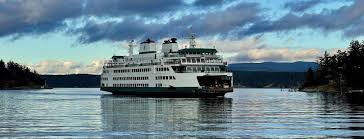
On the ferry, I fell asleep. People were working on puzzles at tables. My parents stood outside because my mom has vertigo and gets dizzy. When we arrived at Friday Harbor, we went straight to the supermarket. There was no food at the camp except the rehearsal dinner and the wedding dinner, so I stocked up: hummus, corn chips—my mom handed me a huge bag of them—cheese, olives. I also had some soup at the market, which was excellent. I tried to get as much as I could because I knew options would be limited. I also bought wine.
The drive to the camp was supposed to be ten minutes, but the sign was tiny and we missed it. We overshot the turn and had to double back using Google Maps. We arrived mid-afternoon.
The camp was down a dirt road off the highway and much larger than I expected. There was a main lodge, a big lawn, a collection of cabins in different shapes and sizes, a barn where the wedding would be held, and a garden set up for the rehearsal dinner. We used metal push carts to haul our things from the parking lot to the cabins.
My parents were staying in the main lodge. Our cabin was about 150 meters away, next to Pat’s family. It was clean but very small: a tiny kitchen, a bedroom, a cramped closet you could barely move around in, a loft for Hugh, and a bathroom awkwardly placed between the kitchen and the bedroom. Kelly, his wife Courtney, and their kids Jacob and Ang were in another cabin. John and Kristi were nearby as well. Mason was staying in some kind of shared space. Between our cabin and Pat’s was a fire pit, and Sarah had already hung laundry over the chairs.
Smoking was allowed, but only at a few designated ashtrays—those tall black plastic ones on poles. The signs said that if you littered, the fine was one thousand dollars per cigarette butt.
I was a little concerned about whether the food I’d bought would last. I ate chips and hummus. Sachie went into the woods to smoke and put her cigarette butts on top of our garbage can. I told her about the rule and asked her to use the ashtray instead. She did.
Later, we gathered at the lodge. I brought wine. One of the camp staff asked if we wanted to hear the house rules. Mike said, “Lay them on us.” The rule was one open drink at a time in the lodge. It closed at ten, but we could use the nearby fire pits and deck afterward. I put my bottle of wine out of sight. Mike responded to the rule with a polite “Uh-huh, sure,” and I got the impression he had no intention of following it.
My dad, Hugh, and I drove back into town to pick up pizza for dinner. I ordered a cauliflower-crust pizza because of my gluten intolerance. We ordered too much—one pizza each plus one for my mom and Sachie—but that was fine. We ate, talked, and I drank wine. Mike, Colleen, and Felix were there. Colleen took Felix to bed. Later, Sachie asked me to go back to the cabin to get a bottle of white wine. I did, and we drank it. The rule wasn’t enforced. It was a relaxed evening.
That was also when I saw Eric Hillyard for the first time.
III. The FIRST NIGHT AND NEXT MORNING
Eric Hillyard is a character and a half. He’s one of Mike’s good friends from high school at Saint George’s, and one of only two people from that era who were there. The other was Dan Clarke—known as Jerry—who was officiating the wedding. Eric didn’t have a formal role. He didn’t need one.
I gave Eric a big hug when I saw him. I hadn’t seen him since high school. He razzes Mike like nobody else, but he was polite and warm with me and bowed to Sachie. He was drinking quite a bit. After ten, my parents went to bed, and Eric, Mike, and I gathered around the fire pit between the cabins.
Eric smoked a cigarette. I smoked two. We tossed them into the fire pit. Later, back at the cabin, it occurred to me that the cigarettes probably wouldn’t burn up completely. I was pretty cooked, but I walked back in the dark with my phone light, dug around in the ashes, found all three cigarette butts, and put them in the ashtray. I figured I’d just saved Mike and Colleen three thousand dollars.
Eric had told a joke that landed too close to home with Mike. Mike said it went too far. I got the impression this wasn’t the first time. It didn’t blow up, but it didn’t land well either.
I went to bed. Sachie and Hugh were already asleep. I slept fine.
The next morning I woke up first again. I ate more hummus and corn chips and went down to the lodge for coffee to see who was around. Free coffee was available. It was rehearsal day.
I don’t remember much of the day before the rehearsal itself. Earlier, when Hugh and I had gone into town on the pizza run, we’d stopped at a hardware store and bought a frisbee. Hugh played with the little kids—Colleen’s brother’s kids and others—on the lawn. I mostly hung around. Food was running low, and I was looking forward to dinner, which was scheduled for around five.
Before dinner there were family pictures, but before that something happened that I didn’t witness directly. Mike told me about it afterward.
They had hired a photographer, a makeup artist, and a band. All freelancers. The food was provided by the camp staff. Colleen was getting her makeup done and had asked for it to be light. Apparently it wasn’t. Mike saw it and said, “Babe, she pancaked you.” Colleen initially wanted to let it go, but they talked and then fired the makeup artist on the spot. Mike told me about it calmly and said that decision was kind of on him.
I didn’t judge it. What I found myself wondering was how much of her fee she got paid. I didn’t ask. I assumed she was paid for the day. The photographer had traveled a long way. I didn’t know whether the makeup artist was local. I hoped she was.
That evening, people gathered in the garden. Both sides of my family were there, along with Eric, Jerry, Mason, Kelly, John Innes, and others, as well as Colleen’s friends and family. The mood was good. But John was in bad shape.
By his own admission, John was pretty depressed. Both his parents had died, and something unresolved involving his father had happened before his death. He hadn’t been able to say goodbye properly. He’d had to have a few just to get ready to come to dinner and face people.
John and Kristi left early and Mason and I walked to the parking lot for a cigarette. There were ashtrays there, and I didn’t want to risk a fine. Colleen’s friends were smoking weed cigarettes back in the garden. Mason told me about a recent breakup that had been serious. He said he’d been immature for a long time and that the relationship and life had forced him to grow up. From his demeanor, it was clear that was true.
That night I also saw my Uncle Jeff’s third wife for the first time—she is from Mexico. Hugh talked with Jeff about his soccer influencer work. Jeff was impressed and invited Hugh to stay at his place in California anytime, for any length of time. Hugh was flattered and grateful.
Things wrapped up early. There was no repeat of the fire pit scene from the night before. I talked a lot with Amy, but mostly I was with Mason. Then we went back to the cabin and went to bed.
IV. DAN CLARKE/ BILL CLARKE DREAM
Wedding day morning felt like more of the same. I was low on cigarettes. I ate more corn chips and hummus from the seemingly endless bag and got coffee in the lodge and waited. Jerry was around. We talked. He’s had an interesting life—some wildness there—and I could see why Mike likes him so much.
Dan Clarke’s father is Bill Clarke, brother of Janet Mann and brother-in-law of Paul Mann. All Saint George’s power brokers. My dad and Bill Clarke were friendly once, but it went sideways. After that, my dad would complain about him endlessly in the car to my mom. Typical Ross behavior at the time, although I never understood the core issue
At some point that morning I thought about a dream I had years earlier, one that has stuck with me. I’m including it here as I wrote it at the time.
2/27/18:
Two intersecting and yet separate dreams about Bill Clark. These will take some unpacking.
I. I am with my father and someone else in a car on a rainy day. We are parked and Bill Clark is there. He looks like the real Bill Clark as I remember him, overweight and not too smooth. Bill Clark was an intermittent arch-enemy and then sometimes ally of my father at Saint George’s in the 90s. The encounter in the car is the culmination of several encounters with Bill in the dream and some of these have been just he and I. Bill is telling me through these encounters how much he admires our IB program and what I am doing with it. He stresses how important it is that I keep going. At the car, he does this again and looks a little desperate. Because he is so clearly sincere even my father who was his enemy gives him the space to say his piece. For my part, I am grateful for his kind words however the car kind of needs to get moving. I thank him from the window. I think he is about to get wet from the rain.
II. I am meeting with Bill Clark again, however a very different looking Bill Clark. Here he is trim with a wire grey beard cut short and a nice suit. He looks very distinguished and a little intimidating. This Bill Clark is also supportive however is much more firm with me. He tells me that I need to get on my hands and knees and beg and plead for resources. Somehow I get the image of a turtle on its back, open to the sky. This is the posture I need to adopt according to Bill. Nothing can be taken for granted and I have to beg. He is quite clear and I understand the wisdom in what he says.
Comment: This is a super interesting dream that bears unpacking. The two Bill Clarks are polar opposites and the second one is more regal and correct in every way. Why the former enemy of my father? This dream is so packed with symbolism.
Not long after that, it was time to shift gears and get ready for the ceremony.
V. The Ceremony
Before the ceremony began, I practiced rope-tying with Colleen’s brother and Pat. I hadn’t mentioned it earlier, but I had been enlisted to help tie Mike and Colleen’s hands together at the end of the ceremony. I was nervous. I had to go first, and as with the e. e. cummings poem years earlier at Mike’s first weeding, I had limited information. Mike told me it would be fine. Colleen’s brother Kevin and I made a joke of it together. Don’t fuck the whole wedding, bro. We got on well.
The rope was thin. There were several strands, intertwined.
Around four, people gathered again at the lodge. Only certain people had drinks. The rehearsal had gone smoothly. We had a clear walk-out order. My family walked out right after Mike and Colleen so I could be in the front row and step forward when it was my turn.
Everyone took their places. Jerry gave a classic, funny speech about being unprepared. Mike’s vows were sincere. Colleen received a huge round of applause when she walked out.
The ceremony was short. The moment came quickly. I stepped forward and did the tying. The ropes were longer than I expected and hung down toward the ground. I stumbled and nearly tripped over them, but I didn’t fall. Thank God.
The ceremony ended, and we moved directly into the barn for dinner.
VI. The WEDDING DINNER
Dinner started with oysters and a watermelon margarita, which I passed on. I drank red wine and hit it pretty hard. Dinner proper was pasta with sauce made by Colleen’s dad. I couldn’t eat it. I was hungry and ate oysters until there were literally none left. I got the last ones.
I spent some time standing outside with Kelly and his kids, Jacob and Ang. We talked. Inside, I sat with family. Hugh had the pasta and then went over to Colleen’s father to thank him for the sauce, which was a classy move.
After dinner, Kelly, Mason, Sachie, and I went out back for a cigarette. I was out and bummed one from Sachie, and it was the first time I’d ever seen Kelly smoke. I got to know Jacob, who was almost done with high school, and Ang, who was a couple of years younger.
I was wiped and left early. Sachie and Hugh came back later. Colleen’s dad gave a speech. My dad didn’t. Katie—my cousin through Amy—gave a great speech. Katie has Down syndrome, and everyone applauded.
That was the night.
VII. Dispersal
The next morning my parents were making breakfast, and the relatives who had stayed in town came back for it. My mom was prepping food. Amy brought gluten-free bagels. I had half a bagel, some fruit, and coffee and talked with people as they moved in and out. Breakfast was a performance, and it justified the van rental entirely.
We packed up and said goodbye to Mike, Colleen, and Felix. They were heading to a nearby island for a short honeymoon. From there, we drove first to the rental house where Pam and Steve were staying. I did laundry while everyone else went whale watching. I was keyed up about it—laundry had accumulated, and I don’t like traveling with dirty clothes. The door was left open, so I walked to the market for more soup and found my way back.
That evening we went back to the same pizza place. I had another cauliflower-crust pizza, a gluten-free beer that was just okay, and a glass of wine. I sat with Amy, her husband David, Sachie, Hugh, and Katie. I paid attention to Katie—she’s been developing early-onset dementia and I wanted to see how she was doing. My mom paid for dinner, which I appreciated.
We stayed at a hotel five minutes away that my parents had pre-booked. It was a large suite. Sachie and I took one room, my parents took the other, and Hugh slept on a cot in the living room. Hugh, my dad, and I played shuffleboard downstairs. I won. It was very relaxed. I had what was left of a small bottle of vodka, drank some, and poured the rest out.
The next morning we went to the ferry terminal. We ran into Jeff’s family again. My parents talked with them while Sachie, Hugh, and I got coffee and bought chocolates as omiyage. On the ferry back, a young naturalist gave a talk about whales. I listened and didn’t fall asleep this time.
Once we reached Anacortes, we drove the wrong way for about half an hour before my dad realized it. We turned around and headed toward Sea-Tac, staying near the airport. I was starving. We said goodbye to my parents. I cried a little. My mom did too.
At three in the afternoon we went straight to a steakhouse. I had steak, fries, and a Negroni. Hugh and Sachie ate as well. We sat in the regular dining section, not the bar, because Hugh was still twenty. We slept early.
The next morning we took a bus to the airport. Hugh left earlier, and Sachie went with him while I tried to sleep. At the airport, Sachie wanted to buy a specific bottle of whisky as a gift. The plane was already boarding. She ran off and made it back just in time. I was anxious, but she made it.
We flew back to Japan. I went back to work the next day and thanked everyone for covering for me while I was gone.
Dedication
For my family, with love and gratitude.
Note: If you enjoyed this piece, you may also enjoy the pieces below which also take up the topic of weddings.