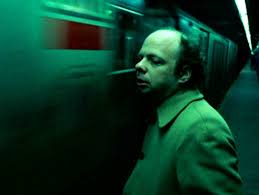
The Adventures of the Thin Man and Andrea II: The Thin Man’s Son. CHAPTER 1: The Thin Man in Tokyo

TOKYO — 1:13 PM, late January

He wakes up without remembering the descent. Not the drinking. Not the last message. Not the shape of the night leaving his body. Just the slow return of weight.

The house is rented, not lived in. A clean, architectural expanse in western Tokyo—glass, pale wood, too much air between objects. The kind of space that does not ask questions because it assumes nothing will answer.

He sits up once, then stops. 1:13 PM. The afternoon has already begun without him. He lies back for a moment and listens to the silence of money maintaining itself. There is a bottle on the floor beside the bed. Half-finished. Warm now. He doesn’t look at it again.

He stands, showers without thinking, dresses in the order that muscle memory dictates: black shirt, trousers, jacket. No tie. Never a tie unless someone insists.

His phone is already lit when he returns. Two messages. One from Tomoyo.

“Weekend still okay?”

One from Mina.

“Bar As One. Late.”

He reads them without responding yet. Then another notification appears. A different rhythm. Alejandro.

No name attached. Just the letter cluster, like something filed incorrectly in a system that never bothered to correct itself.

“Need you in Akasaka. KBS situation. Quiet, but messy.”

He stares at it longer than he should. Then:

“Corporate accounting discrepancy. Possibly internal extraction.”

That word—extraction—is always a translation problem. It never means only one thing. He exhales, once.

And for the first time that day, he is fully awake.

KYOTO — That Same Day

I am in my classroom when I see the notification. I’m not during anything important. Just one of those pauses between things where students are pretending to work and I am pretending not to notice they aren’t.

The phone is face down. I flip it. It’s Signal. I don’t even check the sender first anymore; I know it’s from the Thin Man.

“Akasaka. KBS. Quiet job.”

That’s it. No greeting. No explanation. No punctuation beyond necessity.

I look up at the room. The students are writing essays on narrative voice, ironically enough. I tell them to keep going and step into the hallway.

Outside, the corridor smells like floor wax and winter coats that never fully dry. I write back:

“You’re back?”

A pause.

Then:

“Always.”

I sit down on the stairs and realize I’ve been waiting for this message more than I admitted to myself. Not because I want the job. Because when he appears, the world becomes legible again.

Even if it shouldn’t.

TOKYO — 5:57 PM That Same Day

Akasaka in daylight is almost offensive in its normality. Glass buildings pretending they are neutral. People moving like they have somewhere else to be even when they don’t. He enters KBS through a side entrance.

Not invited. Not uninvited. Just expected. The problem is explained in fragments.

A mid-level finance manager has flagged irregular payments in a production budget. Someone else has flagged the flag. A third layer has erased the second.

Now everyone is quietly pretending nothing happened while insisting something must be done. He listens. He does not take notes. He asks three questions.

The answers contradict each other in useful ways.

By 4:02 PM, he knows what happened. By 4:07 PM, he knows who benefited. By 5:12 PM, he knows why no one will say it out loud.

He leaves without announcing that anything is resolved. This is the job. 

On the street outside, he finally replies to Tomoyo who he has beeb seeing for about two moths now:

“Saturday still okay.”

Then Mina:

“Later.”

Then Alejandro:

“Done.”

No embellishment. No summary. Just closure.

KYOTO — 10:02 PM That Same Day 

I am in a shisha place near Sanjo when he updates me. Not the kind of shisha place you imagine. Cleaner. Quieter. Students pretending to be older than they are. A place where time slows down but doesn’t stop.

I have a draft open on my laptop. A text arrives. It is about him. It is always about him these days.

“KBS resolved.”

That’s all. No story. No detail.

I type:

“What was it?”

Three dots appear. Disappear. Return.

“Accounting.”

That word again. He uses it the way other people use weather reports. I lean back.

Outside, Kyoto is doing its careful thing—bicycles, soft neon, the sense that nothing ever fully arrives here.

I realize I’ve stopped writing fiction and started writing evidence. 

TOKYO — 11:35 PM That Same Night

Bar As One is half-lit, as always. Mina is behind the counter like she has been there longer than the building. She does not ask what happened in Akasaka. She never asks anything that can be answered incorrectly.

He sits and orders a whisky ginger. They talk about nothing that matters. Tomoyo arrives later. She wears corporate black like it is a second job. She kisses him once, briefly, like a scheduled interruption. He notices everything about her that is real and nothing about her that is performance. That is what he likes about her.

At some point, his phone vibrates again. A new Signal message. It’s from Matt.

KYOTO — 11:26 PM. That Same Night.

I’m still at Shisha, still thinking about the Thin Man, I shouldn’t be doing this in public. But I am.

Me:

“I think I understand what you do in Tokyo.”

A reply comes faster than expected.

“You don’t.”

I almost smile. Then I don’t. I type:

“I’m going to Costa Rica.”

This time there is a long pause.  Then:

“Why.”

I look at the ceiling of the shisha place. Smoke moves like it has intention.

“Luciana.”

The name sits there on my screen like it has weight. I don’t know if he will respond. 

But I know I’ve crossed a line.

TOKYO — 12:14 AM The Next Morning

He reads the name once. Then again. Luciana.

Not spoken in years. Not held in any current system. Not part of any job file. He steps outside for a smoke. 

Akasaka is quieter at night, but not safer. Just less honest about itself. He does not ask Matt not to go. That would be meaningless.

Instead he writes:

“Don’t dig wrong.”

Then, after a pause:

“If you’re going, be precise.”

He puts the phone away. Tomoyo is still inside, laughing at something someone said that is not funny. Mina is polishing glasses that are already clean.

He thinks, briefly, of leaving Tokyo again. Not because something is wrong. Because something has started.

And that is usually enough.

KYOTO — 12:44 AM The Next Morning

I read his message twice.

Be precise.

As if precision is the problem. As if I have ever been anything else. 

I close my laptop. Outside, Kyoto continues as if nothing has happened. But I know it has.

I have a name now. And names are how you begin to lose your distance from things.

Don’t Pump Me Man!

Note: Spokane, early 1983: minor league baseball, cheap seats, and kids living in the gaps between innings. This piece recalls Spokane Indians games, chasing balls during batting practice, and a strange collision of childhood mischief and adult volatility at the edge of the outfield fence. Sandy Alomar Jr.—then a local catcher on his way to a long MLB career—signs a baseball in handwriting so precise it feels like a signature on a future already underway, while a moment of chaos involving thrown persimmons and a furious adult named Mike Trowbridge becomes the kind of story that sticks far longer than the season itself.


Epigraph:

Do you know who you’re fucking with?/ You’re fucking with a stallion mange.

Ween

It was 1983 in Spokane, the kind of summer that felt permanently suspended in late light and dry heat, where the air at night still carried the dust of the day like it had nowhere else to go. We played Little League baseball in uniforms that never quite fit right, and then on weekends we graduated to something bigger and looser and more important: Spokane Indians games at the old stadium, Single A ball, where the dreams were real and still close enough to touch.

The Spokane Indians were a kind of civic promise back then. It was a small town, and in the early 1980s there wasn’t always a lot going on. The Indians were not quite big league, but not quite nothing. Just enough baseball to make you believe that something important was always one bus ride away. The seats were cheap, the beer cheaper, and the fences closer than they should have been. The whole place had that slightly improvised feel—like the city had built it thinking, this will do for now.

We didn’t go to games like spectators. We went like we belonged.

Behind the outfield wall during batting practice, kids gathered like scavengers. We chased homers, argued over balls, sprinted through patches of grass worn down by repetition. Sometimes we were the only ones back there. Sometimes there were older kids, or dads, or random locals who knew the angles better than we did. It was a loose territory. Not quite policed. Not quite ours. Something in between.

That summer, the Indians had a catcher everyone knew. Local kid. Quiet confidence. Clean mechanics. The kind of player adults already talked about like he had a future attached to him.

Sandy Alomar Jr. was that guy even then—before the long MLB career, before the All-Star years, before anyone outside Spokane would know the name properly. He was already different. You could see it in the way he stood when he wasn’t moving, like he was always half a second ahead of the next pitch.

I got his autograph once. It wasn’t dramatic. Just a moment after BP, when he signed a ball for a cluster of kids leaning too far over a rail. His handwriting was unexpectedly beautiful—controlled, deliberate, almost elegant in a way that didn’t match the dirt and sweat of the field. I remember thinking even then: this is what someone looks like when they’re going somewhere.

I kept that ball for years.

Because baseball wasn’t just baseball. It was a hierarchy you could see. You had the guys who were going to make it, the guys who might make it, and the rest of us orbiting the idea that proximity alone might transfer something.

Most of them wouldn’t go anywhere. That was obvious even then, though nobody said it out loud. But that day, none of that mattered yet. What mattered was the fence.

Our party was up high in the stands on the first base side, just beyond where the stadium fence met a thin strip of wild space. A tree had grown there—some kind of fruit tree, nobody was ever fully sure what it was. Persimmons, maybe. Something orange-red and heavy-looking, the kind of fruit that doesn’t look like it should be thrown but absolutely is.

Some kids started throwing them. Just kids, just fucking around. But they didn’t know who they were fucking with. Fuck with me and I’ll fuck with you.

The fruit flew. Not carefully. Not aimlessly either. More like experimentation. Testing distance. Testing reactions. Some of them were aiming at fans, others just launching them over the fence because it felt like something you could do if no one stopped you.

It was mildly funny at first. Then mildly annoying. Then mildly dangerous in a way that nobody fully acknowledged.

Because persimmons, if that’s what they were, aren’t soft. They hit like small decisions.

I remember one bouncing near a row of seats and rolling under a foot. Someone laughed. Someone else shouted. But nobody moved with urgency yet. It was still in the category of “kids being kids.”

Until Mike Trowbridge noticed.

Mike T was there with his kids—David Trowbridge and his sister Dawn. David had been a teammate of mine in Little League, a few years younger, outfield guy, quiet in the way younger kids sometimes are when they’re still deciding how loud they’re allowed to be. Dawn was just there in the background of everything, observing.

Their dad, Mike, was not background.

He was one of those adults you noticed before you understood why. Volatile energy. Tight posture. Goatee, black tank top, gold chains around his neck. A bit of a greaser; drove a Harley. Always slightly too close to losing his temper. He wasn’t a bad guy exactly—he could laugh, he could talk—but you always felt like there was a second version of him sitting just under the surface.

He saw the fruit being thrown. And something in him snapped into motion. He walked straight to the fence line, fast enough that it changed the temperature of the moment.

“Knock that shit off right now,” he yelled.

The kids paused. Not because they were scared exactly, but because the voice had weight.

Then one of them—small kid, maybe ten, sunburned confidence, the kind of kid who doesn’t fully understand consequences yet—looked up and said:

“Don’t pump me, man.”

It was such a strange sentence. Too casual for the situation. Too confident for the speaker. Like he had borrowed it from somewhere older and wasn’t sure how it fit yet.

There was a beat of silence where the entire stadium noise seemed to pull back slightly.

Mike T looked at him.

“Don’t pump me?” he said.

Then his voice shifted.

“You want me to pump you? I’ll pump you.”

And in that moment—this is the part that still feels unreal even now—he climbed the fence. Not slowly. Not theatrically. Just decisively. Like the boundary wasn’t a boundary at all.

Everything changed at once.

Me, David, Dawn—everyone nearby—we all froze in that wide-eyed way kids do when they realize the rules might not hold. It wasn’t comedy anymore. It wasn’t baseball anymore.

It was just: Mikey baby don’t kill that kid.

That’s what it felt like in my head. Not words were spoken, just panic translated into something almost verbal.

The kids scattered instantly. Full sprint. No hesitation. The fruit stopped mid-air and dropped forgotten. The stadium behind us suddenly felt far away, like it belonged to a different scene entirely.

Mike T took a step forward, still inside the fenced edge of this improvised battlefield, breathing hard, still locked in that strange overlap between anger and disbelief.

And then—somehow—it was over. No actual violence. No contact. Just the threat of it, large enough to erase the mischief that had caused it.

The kids were gone. The fruit stopped flying. The tree stood there like nothing had happened. Afterwards, the stadium noise came back slowly, like a system rebooting.

My dad, Ross, had seen the whole thing. He was laughing, hard. Not the kind of polite laugh adults do when they think they’re supposed to. This was involuntary. Almost helpless. The kind of laugh that tries to stay respectful but can’t quite hold the line.

Because it was funny. In that terrible, chaotic way childhood sometimes is when it brushes up against adult intensity and survives without breaking.

Ross would tell that story for years after. The kid. The fence. The persimmons. The line: don’t pump me man. He never stopped laughing at that part.

Neither did I.

But at the time, I just stood there thinking about Sandy Alomar Jr. somewhere on that field, already on his way to something else entirely, signing baseballs in beautiful handwriting, while right behind the stadium wall the rest of us were learning the difference between games and consequences in real time.

Most of us wouldn’t make it to the Bigs. But for one afternoon in 1983, it all felt like it might matter just the same.was 1983 in Spokane, the kind of summer that felt permanently suspended in late light and dry heat, where the air at night still carried the dust of the day like it had nowhere else to go.

But for one afternoon in 1983, it all felt like it might matter just the same.

Dedication:

For Mike T. And for the kid. You got balls young man, I’ll say that.

On the Film “My Dinner with Andre” Part I: Wally in New York

Note: Opening a multi-part early series from my first blog Classical Sympathies back in 2009, this piece takes up the beginning of Wallace Shawn’s walk through New York en route to his meeting with André Gregory in My Dinner with Andre, using Wally’s voice-over as a lens on artistic precarity, everyday survival, and the comic disproportion between existential weight and mundane errands. The note situates the film’s opening movement as both narrative setup and philosophical framing: a winter city of post offices, xerox shops, and unanswered calls becomes the psychological prelude to a conversation that will later expand into memory, performance, and self-mythology. This installment follows Wally up to his arrival at the restaurant for the pre-dinner drink, where the film’s central encounter is still suspended in anticipation, and meaning is generated less by action than by the act of getting there.

My Dinner with Andre is the famous, or infamous, 1981 film of a dinner conversation between Wallace Shawn, the actor and playwright, and Andre Gregory, the theater director. If I were to make a twofold claim for the film: i) that it is one of the most action packed films ever made, and ii) that it effectively encapsulates the thematics of the entire 20th century, I do not think this would be overstatement. My intent here, however, is not to establish either of these postulates, but rather to simply “blog” the script in the hopes that what needs to be said works its way to the surface. Fair warning: the undertaking will require several posts.

Money crops up on two of the first three pages of the script, and because money, and the lack of it, is a theme that runs beneath the entire script: Andre has money, has the freedom to travel and to spend several years trying to “find himself”; Wally does not. Still, “having money” is, as ever, a relative concept. At the opening of the film, Wally is seen walking through the streets of New York, heading for the restaurant where he is to meet Andre. It appears to be winter, maybe February. In the opening voice-over, Wally ruminates on the life of the artist: The life of a playwright is tough. It’s not easy, as some people seem to think. You work hard writing plays, and nobody puts them on. You take up other lines of work to try to make a living–acting, in my case–and people don’t hire you. So you spend your days crossing the city back and forth doing the errands of your trade. Today wasn’t any easier than any other day. I’d had to be up by ten to make some important phone calls, then I’d gone to the stationary store to buy envelopes, and then to the xerox shop. There were dozens of things to do. By five o’clock I’d finally made it to the post office and mailed off several copies of my plays, meanwhile checking constantly with my answering service to see if my agent had called with any acting work. In the morning, the mailbox had been stuffed with bills. What was I supposed to do? How was I supposed to pay them? After all, I was doing my best (17).

One of the marvelous things about the film is the tongue-in-cheek humor that is rarely, if ever, directly alluded to. A deeply serious film, Andre is also a comedy, a fact which we can recognize because we see that the writers are having fun with the characters who are in turn themselves. That is, Wally and Andre are playing versions of themselves–we assume that most of the experiences that Andre recounts in the film are based on real experiences, and that Wally’s account of his home life is more or less true to life–but exaggerated versions. As Shawn says in the preface to the script, “I knew immediately that {…} I’d have to distort us both slightly–our conflicts would have to become sharpened–we’d have to become–well–characters {…} It would be an enormously elaborate piece of construction” (14). In this initial passage, the humor lies in Wally’s conception of a difficult life: “I’d had to be up by ten to make some important phone calls.”

Wally’s sense of pressure is, from the outset, deliberately out of proportion to the scale of his circumstances. The tone is one of genuine complaint, but the complaint itself is almost comically domestic: the architecture of a “hard day” is built out of errands, envelopes, xerox shops, and an answering service that may or may not contain salvation in the form of an acting job. What Shawn achieves here, and what the film quietly sustains, is a recalibration of seriousness—where existential weight is not attached to grand events but to the texture of administrative survival. Wally’s New York is not a place of romance or revelation, but of circulation: between post office, mailbox, and telephone, as though modern artistic life has been reduced to a loop of deferred contact with recognition.

At the same time, the humor is never fully separable from sincerity. Wally is not merely being mocked; he is also articulating a recognisable condition of artistic precarity, one that the film refuses to glamorize. The genius of the opening monologue lies in this double register: we are invited to laugh at the disproportion between emotional tone and material fact, but we are also made to recognise how easily that disproportion becomes a lived reality. The “dozens of things to do” are not nothing; they are just insufficiently legible as crisis, which is precisely what makes them feel like crisis.

By the time Wally finally moves through the city toward the restaurant, the structure of the film has already been quietly established: this is a world in which meaning is not delivered through events but through the way events are narrated to oneself while walking between obligations. New York, in this sense, is not a backdrop but a medium of self-composition—an environment in which thought is constantly being assembled under mild pressure, as though consciousness itself were an errand.

He checks the time again, as he has been doing throughout the afternoon, and adjusts his route slightly, not out of urgency so much as orientation. The meeting with André already exists in his mind as something slightly unreal, a fixed appointment that has not yet been granted substance by arrival. He crosses another block, passes into the thinning evening light, and begins to approach the restaurant where, for the first time that day, the structure of waiting will shift from solitary to shared.

to be continued…

Craig Finn on Nightlife and Adult Relationships III: Jessamine (Craig Finn’s Miniature Masterpiece)

Epigraph:

Jessamine must have had some dreams/ but she never really said what they were.

Craig Finn

Note: This is the third entry in my little ongoing series on Craig Finn / The Hold Steady songs that take up nightlife, messy adult relationships, and the long shadows cast by fleeting encounters. Part I and Part II are available. I’ve also written at length about what I consider Finn’s two greatest songs: A Bathtub in a Kitchen and It’s Never Been a Fair Fight.

Jessamine is track 8 off of A Legacy of Rentals, Finn’s 2022 solo record distributed on his own label, Positive Jam Records. It clocks in at a tight 3 minutes and 25 seconds, and once again I am simply overawed by Finn’s concision and his ability to tell a whole story in just a few words. It is my opinion, and I do not say this lightly, that Finn is the greatest short story writer to have ever lived. 

Jessamine tells the story of a three week relationship between the narrator, who we will continue to call C. for convenience, and a goth girl with a need for speed. A Legacy of Rentals contains at least three excellent songs, the crime caper “The Amarillo Kid,” the gorgeous “The Year We Fell Behind,” and Jessamine. I would love to write about The Year We Fell Behind as well, however Jessamine falls neatly into our conceit of nightlife and adult relationships, although this one seems to depict more of a young person’s relationship. Close enough. 

Jessamine is folky and lilting, of a piece with Finn’s later work which tends toward folk and country as opposed to Lifter Puller’s indie fever dreams and The Hold Steady’s soaring rock anthems. The Finn song that it most closely resembles is “Esther,” from a 2018 EP by The Hold Steady which also depicts an intense and short-lived relationship. “The party ended suddenly, suddenly it’s over/ That left me and Esther all alone and getting older/ All alone and getting older smoking in the street/ Now everything is Esther and it’s been that way all week.”

Jessamine opens thusly:

I met Jessamine in Cherry Hill

Her dress all done in daffodils

The sticker on her skateboard said, “Speed kills”

And yeah, it probably did just what it said

Cherry Hill is in New Jersey, where the song is set. Jessamine is probably a younger woman, and a skater. The first verse foreshadows her ultimate fate. Incidentally, the first time I visited New Jersey was junior year of college with my Asian Art History class. It was also on this trip that I first visited New York City, the most intoxicating place on earth which I have written about relatively extensively. I wrote about my Art professor in my piece on my senior year at Hamilton College, in relation to a girl I had a total crush on, called L. L. was not exactly goth, but she might have been goth-adjacent. And she was totally intense. More on goths in a minute.

Verse II adds a little more context.

I only knew her for like three weeks straight

And the whole time we were wide awake

You know “Trenton Makes, the World Takes?”

She had it spray-painted over her bed

It is my experience that short-term relationships can be, probably are, the most intense and intoxicating type of relationships in a sense. The depth that comes with a true crush, while of a completely different valance from a long-term relationship, is, I believe, without parallel. But then again, I’m an action junkie, as is Finn. I wrote about the power of a crush in my Bad Moves piece where I confessed to a serious crush on their lead singer, Katie Park. I actually sent the piece to the band via Instagram, and they responded saying “Thanks for the write-up.” I don’t know, but I like to believe Katie read, or at least saw, my piece! Unfortunately, Bad Moves are disbanding and are, I believe, on their farewell tour.

The wording “three weeks straight” implies that C. and Jessamine were, temporarily, inseparable, sleep deprived, and deep into each other. Trenton is, of course, also in New Jersey, and though I hadn’t heard of the exact phrase quoted until I listened to the song, it is apparently well known locally and appears in neon on a bridge.

Verses III and IV introduce Jessamine’s death obsession, and to me anyway suggest that she is what I would call a kind of a goth.

We used to hang around her room

Getting off on all the gloom and the doom

Watching cavemen in the cartoons

Playing xylophones made out of bones

She was sexy, but still death-obsessed

She said the bloodshed makes such a mess

But you really don’t even have to market it

Yeah, it pretty much sells itself

Now I am not really into a lot of bones and blood personally, but I do like me some goth girls. In fact, in the course of my life I have sort of quasi-dated a few, and for whatever reason they are just my speed. I find goth girls sexy, like Jessamine, caring, and deeply intriguing. And mysterious, of course. I have a weakness for crazy women; I cannot lie. And already I can totally see Jessamine’s appeal.

Jessamine has a number of semi-chourses, and the first one goes like this: 

I should’ve asked her before she departed

How did all these wars get started?

Why do rival crews show up to the same parties

If they hate each other so much?

It’s like they’re secretly in love

Again, we foresee Jessamine’s demise up front. Why would Jessamine have insight into the origins of global conflicts? I’m not quite sure, however the image of rival gangs being secretly in love is oddly compelling. However, it is with the next verse and chorus that the song really gets going.

Verse V and Chorus II go like this:

She said, “Suspicion isn’t wisdom

And the drones look just like doves”

And there was something laying siege to her kingdom

But she never really said what it was

While the incense turned to ashes

And the sunrise was unsure

Jessamine musta had some dreams

But she never really said what they were

Yeah, she never really said what they were

Here we learn that our goth girl heroine has something going on that is unarticulated, or perhaps inarticulable. “Jessamine musta had some dreams/ But she never really said what they were” is such a wonderful and moving line. We all have dreams, I suppose; some come to fruition and some don’t. But Finn is in no way judging Jessamine’s relative inability to describe her dreams; instead this aspect of her character only adds to her obliqueness, her mystery.

The next verse and chorus show that Jessamine in the end, and probably in the beginning, had the upper hand in the relationship.

We kinda ended how we began

With Jessamine meeting a man

And liking that man just a little bit more

Than the boy she had before

I hadn’t even seen her since

I guess this new guy was some kind of prince

I guess his castle was a front for some fence

And then the whole damn city got warm

And they were trying to ride out that storm

Again, Finn is a total master of precision and compression. C. is immature, Jessamine is, to some extent, on the make, her new boyfriend is crime-adjacent (so many of Finn’s songs feature characters on the margins of the legal world), and the whole damn city mirrors Jessamine’s flightiness. The crush is over; C. is dumped and he never sees her again. That’s a weird and kind of almost frightening part of short-lived relationships–while their depths are as intoxicating as anything in life, people will just move on and the moment exists only in memory, burned into the fabric of time, but still fleeting.

The next verse points toward C. getting over Jessamine, and alludes to the idea that what may seem for a time to be a storm will pass; a crush, with all its power, is also somewhat illusory.

‘Cause the rain is inconsistent

And the thunder is insincere

‘Cause it makes a big commotion

But eventually it clears

The next verse and chorus puts a pin in Jessamine’s story, and Finn employs his classic penchant for alliteration along the way. Maybe to get away from the scene, or perhaps for some other reason, C. moves out west, loses his shirt, metaphorically, and literally perhaps, and gets word of Jessamine’s demise.

I went out to San Francisco

And some sailor stole my shirt

I was sitting on the passenger side in a taxi

The first time that I heard

That she was probably speeding

And no one else was hurt

Jessamine must’ve had some dreams

But she never really said what they were

Yeah, she never really said what they were

I love the line here “and no one else was hurt.” It’s hard to fully explain why, but it’s oddly moving that Jessamine, on her way out, with all her attraction to blood and bones, didn’t take anyone with her. Finn doesn’t even really register what C.’s reaction is to Jessamine’s death is, he simply repeats the lines about dreams such that she dies as she lived, unknown to herself and unknowable to others.

Overall, Jessamine might seem like kind of a minor song. It’s short, and maybe doesn’t have the deep metaphorical richness as a song like A Bathtub in the Kitchen. Nonetheless, I love it. My sense is that a writer has to write for years and years before they can get to a song like Jessamine. Finn is a few years older than me, and has accumulated the wisdom and compassion to make a song like this look easy. It is not.

I wish her to say a brief word about AI, which may seem unrelated. The other night I met up with a few friends and some friends of friends were there as well. One of them, a slightly older gentleman who used to work in tech, started talking about how much he loved AI music, especially some kind of mash-up of two well-known bands. I appreciated that fact that he liked this “music,” but I have to confess that I could not have cared less. The idea of AI music, especially music with lyrics, interests me not at all. And this is, essentially, because I like people better than machines, but also because I don’t think AI, at least at this point, can come close to writing a song like Jessamine. I won’t get super political here, however the idea that AI can replace, or even duplicate a Jessamine, or Return of the Grievous Angel by Gram Parsons, or Come in from the Cold by Joni Mitchell, for example, just seems absurd to me. As implied above, Finn had to live 50 years, listen to tens of thousands of songs, and write hundreds to get to Jessamine. At 3 minutes and 25 seconds it is a mini-masterpiece.

Dedication:

For goth girls everywhere.


Note: If you enjoyed this piece you might also enjoy the pieces below, which also cover the singer-songwriter Craig Finn.

WAYFARER: A PLAY

Note: This piece is a five-act play based loosely on a week I spent in Oxford in 2018. Unlike my previous narrative essays on the same material, (here, here, and here), this is written as a staged work, with dialogue, silence, and structure doing the heavy lifting. At its core, the play explores the tension between experience and narration—what happens when a person tries to turn a living moment into a story too quickly, and what is gained (and lost) in that process. While grounded in real events, it is not strictly autobiographical; it is a shaped and curated version of those experiences. As with all my work, the hope is that it resonates beyond its immediate context. Thank you for reading.

A Five-Act Play


EPIGRAPH

I can’t believe all the good things that you do for me
Sat back in a chair
Like a princess from a faraway place
Nobody’s nice
When you’re older your heart turns to ice

Mark Kozelek Have You Forgotten

ACT I — THE WAYFARER


Scene 1 — Registration Desk (Threshold)

Lights: institutional white. Gradual warm shift beneath it, as if memory is already leaking into the space.

Sound: distant conference murmur. A faint, unresolved piano note.

A desk. A GATEKEEPER. A lanyard laid out like an object of passage.

MATT enters. Slightly lost. He has clearly been walking longer than intended.

GATEKEEPER
Name?

MATT hesitates. Reaches for something that is not yet ready.

MATT
Here. I think.

He presents credentials.

Stamp sound. Too loud for the space.

The badge is handed back.

CHORUS (from off, soft, not fully placed in space)
Arrival.
Conference.
Inn.
Story begins again.

NARRATOR-MATT (aside, not heard by others)
I thought I came to learn.

The badge feels heavier than it should.

Lights soften.


Scene 2 — Inn Common Room

Warm, slightly unreal hospitality lighting.

Tables. Cups. A space that feels both public and private but refuses to decide which.

ELODIE is present as if she has always been there.

MATT notices her immediately.

NARRATOR-MATT
Voltage.

ELODIE
Tea?

MATT
Yes. Thank you.

Beat. Nothing rushed.

CHORUS (slightly brighter, almost encouraging)
House lady.
Innkeeper.
Muse—

(a correction, quieter)
No. Person.

ELODIE does not acknowledge the Chorus.


Scene 3 — “Sing for Your Supper”

Sound: faint guitar motif. The room subtly shifts into performance space without fully becoming one.

CHORUS subtly rearranges space like memory editing.

MATT sings quietly:

MATT (singing fragment — The Clientele, “The Violet Hour”)
so that summer came and went
and I became cold
yeah I became cold

ELODIE listens. No visible transformation.

NARRATOR-MATT
Hospitality is not destiny.

The room remains unchanged.

Blackout.


ACT II — THE HOT ZONE


Scene 1 — The Casino

Green felt lighting. Rotating overhead spot.

CROUPIER replaces Gatekeeper.

CROUPIER
Place your bet.

MATT
Meaning.

CHORUS
Luck.
Chance.
Myth begins when odds are misread.

MATT places chip.

Sound: chip hits felt—final, sharp.


Scene 2 — Triptych (Three Trips)

Lighting pulses three times. Distinct beats.

MATT (low, repeating)
Three trips.
No more trips.

CHORUS fractures into three figures: GENIE / GHOST / MESSENGER.

NARRATOR-MATT
Inspiration gone.

GENIE (brief, playful)
First.

GHOST (slow, distant)
Memory.

MESSENGER (clear, neutral)
Transmission.

All fade.


Scene 3 — Jungle Confrontation

Green light. Reduced set. No realism.

MATT
Her.
Leave everything.
Frontman.
Practice.

ELODIE
No.

MATT
What is this?

ELODIE
Not your exorcism.

CHORUS
Brink.

Blackout.


ACT III — NAMING THE PATTERN


Scene 1 — Needy Boys

Two chairs. Neutral white light.

ELODIE
Don’t narrate me.

MATT pauses. This lands fully.

NARRATOR-MATT
I was writing her.

Silence.


Scene 2 — Chapel

Stillness. Breath-level sound only.

CHORUS (barely present)
Meaning.
Destiny.
Story.

NARRATOR-MATT
Room, not revelation.

Silence holds.


Scene 3 — Pattern Recognition

Lighting: subtle timeline shifts—memory flickers, not time travel.

NARRATOR-MATT
Senior year.
Again.

ELODIE
Your pattern is yours.

MATT
I see it.

CHORUS
First choice.

Blackout.


ACT IV — RELEASE


Scene 1 — The Offer

Dusk light.

MATT
Part-time.
Scout.
Not jungle.

ELODIE
Boundaries are kindness.


Scene 2 — The Pivot

Warm domestic light replaces earlier symbolic tones.

MATT
Family.
Music.
Life.

CHORUS
Myth.
Escape.
Hero.

MATT
No.

Silence holds. No response from Chorus.


Scene 3 — Chorus Dissolves

Lighting: references dim one by one.

CHORUS removes masks.

NARRATOR-MATT
The story stayed.
The spell lifted.

Blackout.


ACT V — OXFORD CODE


Scene 1 — Gesture

Morning Oxford grey. Minimal space.

ELODIE
Take care.

MATT
You too.

Beat.

No escalation. No closure ritual.


Scene 2 — Benediction (Chapel Revisited)

Same chapel. Quieter now.

Sound: Arvo Pärt piano. Sparse. Non-declarative.

NARRATOR-MATT
Gratitude.

Silence. Breath.

MATT listens without narrating.


Scene 3 — Train

Sound: distant platform announcement. Train readiness.

Gatekeeper becomes CONDUCTOR.

CONDUCTOR
All aboard.

CHORUS
Run back.
Declare.
Confess.

MATT
No.

MATT boards train.

NARRATOR-MATT
The jungle is real.
The girl is real.
The story remains.

Beat.

NARRATOR-MATT (softer)
You think you’ve finished it. Then it comes back different.

NARRATOR-MATT (aside)
She knew more than I could say.

Train departs.

Lights fade with motion, not blackout.


FIN

The Splinter Fraction: Male Circumcision Should Be Outlawed — 1 Million Percent

Note: This piece argues that male circumcision should be strictly outlawed for non-consenting minors. It approaches the topic from a strict bodily autonomy framework regarding non-consensual, non-therapeutic interventions on minors, and treats irreversible bodily alteration without consent as the central ethical issue. It is not addressing medically necessary or emergency procedures, nor situations where an intervention is required to prevent serious immediate harm, which are outside its scope. The argument also focuses on principle rather than comparative cultural practice, and is intended as a normative claim about legal consistency in liberal systems rather than a commentary on individual intent, belief, or identity.

Epigraph:

Jesus don’t touch my baby.

Ryan Adams

Male Circumcision Should Be Outlawed — 1 Million Percent

Male circumcision of non-consenting minors should be outlawed globally, with legal penalties applied to those who perform or facilitate it, and civil penalties imposed on parents who authorise it. I was circumcised in infancy in a Catholic family in 1974. The issue is not medical ambiguity or cultural discomfort but a basic question of bodily autonomy: whether irreversible, non-therapeutic alteration of a child’s body can ever be justified without consent. In a liberal legal system that claims to prioritise individual rights, the answer should be consistent and categorical. Anything less relies on inherited exemptions—religious, medical, or cultural—that do not withstand ethical scrutiny once the principle is stated plainly.

The core objection is simple: irreversible bodily modification without consent is impermissible when it is not medically necessary. A child cannot consent, and parental authority is not unlimited; it is a delegated responsibility bounded by the child’s future autonomy. Circumcision is not an emergency intervention. It is not a life-saving procedure in the vast majority of cases. It is the removal of healthy tissue from an individual who will live the entirety of their life with that alteration imposed before they had any capacity to participate in the decision.

This is where liberal societies already reveal a partial but incomplete consistency. We accept that consent is not static across childhood. We do not allow children to make binding decisions about sexual activity, because we recognise developmental thresholds of agency and understanding. That is why age of consent laws exist at all, and why they sit at or near adulthood in most jurisdictions. But the same logic applies more fundamentally to irreversible bodily alteration. If we accept that certain domains require maturity before consent is meaningful, then permanent physical modification must fall under the same principle. The difference is not moral category; it is legal lag.

The counter-case is not weak in structure, even if it fails ethically. It rests on four main claims: parental rights, medical justification, religious freedom, and social normalisation. Parents are routinely empowered to make medical decisions on behalf of children under a “best interests” standard. Circumcision is often placed within this framework as a preventive health measure. Some studies are cited to suggest reduced risks of urinary tract infections or sexually transmitted infections later in life, and complication rates in clinical settings are presented as low. On this basis, it is framed not as cosmetic alteration but as permissible preventive medicine.

Religion provides a second pillar. In Judaism, circumcision is a covenantal rite central to religious identity. In Islam, it is widely practiced as a tradition of purification and belonging. Liberal states are deeply reluctant to interfere with such practices, treating them as protected expressions of religious freedom. On this view, banning circumcision would represent not neutrality but intrusion into foundational religious life.

The third pillar is cultural and social integration. In societies where circumcision is widespread, particularly where it is near-universal within certain populations, deviation can create stigma or perceived abnormality. The argument follows that enforcing prohibition could impose social harm on children by marking them as different within their communities. Finally, legal systems distinguish male circumcision from female genital cutting on the basis of severity, medical context, and institutionalisation within healthcare systems, arguing that harm is not equivalent and therefore regulation need not be symmetrical.

Taken together, these arguments form a sort of a defense of permissibility under existing liberal frameworks: parental discretion within medical norms, protected religious practice, and harm-based legal classification.

But each of these pillars collapses under a stricter application of bodily autonomy.

Parental authority is real, but it is not sovereign. It exists only insofar as it serves the future autonomy and welfare of the child. It does not extend to irreversible, non-therapeutic bodily alteration where no immediate necessity exists. The “best interests of the child” standard is not a blank cheque; it is a constraint. We already recognise this in other domains where the state intervenes against parental choice when irreversible harm or violation of fundamental rights is at stake. The question is whether we apply that constraint consistently.

Medical justification also fails the threshold test when examined carefully. Even if certain population-level benefits exist, they are statistical, not essential. They can be achieved through far less invasive means—hygiene, education, barrier protection—without permanently altering the body of an individual who has not consented. Preventive possibility is not sufficient justification for irreversible intervention. Medicine does not normally operate on the principle that minor statistical risk reduction permits non-consensual surgery on healthy individuals.

Religious justification is where liberal systems most visibly reveal their tension. Freedom of religion is a foundational principle, but it is not absolute. It has never been interpreted as permitting unlimited parental action upon a child’s body. The critical distinction is between belief and irreversible physical imposition. Religious freedom protects the right to believe, to practice, and to transmit culture—but it cannot logically extend to authorising permanent bodily modification of an individual who has not consented to participate in that covenant. A child is born into a tradition, not owned by it.

The social integration argument similarly confuses descriptive normativity with ethical justification. That a practice is common within a group does not mean deviation is harmful in a way that justifies irreversible intervention. Social discomfort is not equivalent to bodily violation. Otherwise, any culturally dominant practice could immunise itself from ethical scrutiny simply by achieving prevalence.

The legal distinction between male circumcision and female genital cutting is often defended on the basis of harm severity and medical framing. But this distinction, while operationally convenient, becomes unstable when the underlying principle is examined. If the governing value is bodily integrity and consent, then sex-based differences do not determine permissibility. The relevant question is not comparative severity alone, but whether irreversible non-consensual alteration is being authorised at all. Harm thresholds may differ in degree, but the structural violation—altering a child’s body without consent—remains.

Once these counter-arguments are reduced to their core, what remains is not a justification but a set of accommodations: to tradition, to institutional history, to religious continuity, and to cultural inertia. None of these constitute a moral defence of the act itself; they constitute reasons why it persists.

This is why enforcement matters. A principle without enforcement is not a principle in practice. If bodily autonomy is to mean anything in a liberal legal system, it must be protected even when the practice is culturally embedded or religiously significant. That requires prohibition of the act itself, accountability for those who perform it in violation of the rule, and civil liability for those who authorise it on behalf of non-consenting minors. The aim is not punishment for its own sake, but alignment of law with the ethical principle it already claims to uphold in other domains of bodily autonomy.

What makes this issue more than historical critique is that it persists into the present as a live inconsistency. It is 2026. Liberal legal systems already recognise that bodily autonomy is foundational in adulthood. They already recognise that consent has developmental thresholds. They already prohibit non-consensual genital alteration in other contexts. The remaining question is whether they are prepared to apply the same principle consistently when tradition, religion, and medical normalisation converge.

A system that protects bodily autonomy only after adulthood has not resolved the ethical question; it has merely deferred it. The principle either applies universally to the body of the individual, or it does not. If it does, then non-therapeutic circumcision of minors cannot stand as an exception. 1 million percent.

Note: This piece is part of the Splinter Fraction series of political positions that the two-person Trans-Pacific political party has taken. You can find some of the others below.

Levels of Lucidity in Dreams: A Close Reading

Illustrations presented with thanks by Riko Kusahara

Note: This piece was written for the Psiber Dreaming Conference offered by IASD in September 2018, under a strict word limit that forced a level of compression I don’t always allow myself. It draws on a series of lucid dreaming experiences to explore how we determine whether we are dreaming or awake, and why those determinations so often fail under pressure. Looking back, I’m less interested in the specific techniques of lucidity than in the broader question the paper circles: what happens when our usual markers of reality—stability, plausibility, even self-awareness—prove unreliable? The result is less a theory of dreaming than a compact record of trying to think clearly inside a system that continually revises its own ground.

Epigraph I:

The difference between most people and myself is that for me the “dividing walls” are transparent.  That is my peculiarity.

—Carl Jung

Epigraph II:

The conventional scientific sentiment has become that—while we don’t totally understand why dreaming happens—the dreams themselves are meaningless. They’re images and sounds we unconsciously collect, almost at random {…} Which seems like a potentially massive misjudgement.

—Chuck Klosterman

Dream I: I awake in a warehouse.  The bed is against one wall–on the other is a thirty-foot mountain of cantaloupes.  I realize I am dreaming.  I get up and run my hands over the cantaloupes.  They feel absolutely real—as tangible as in life.  I remember that tangibility is not a viable reality test—I’ve made that mistake before.  Now fully lucid, I decide to levitate.  The room dissolves, and I float suspended somewhere in dense, colourless space.  Eventually, I feel the need to come back to earth but cannot locate it.  I feel something beneath me.  This is my bed, and I awake back in the warehouse, relieved yet exhilarated.  The cantaloupes are still there, however I don’t question them.  I just happen to live in a room full of fruit.  Moments later I awake again, this time in diurnal “reality.”

The most common dream experience is of waking from a dream we take to be real, only to understand that it was “just a dream.”  However, a subset of dreamers, probably more than we generally imagine, have experienced lucid dreams, dreams in which, to some degree, they are aware they are dreaming.  Lucid dreamers may also experience “false awakenings”[1]— the sensation of waking progressively through dream “levels.”  False awakenings can be disorienting (Robert Waggoner writes that after seven successive false awakenings he “would accept {…} any reality {…} as long as it stayed put[2]), or sought after (Daniel Love and Keith Hearne have independently developed techniques to induce false awakenings[3]).  Regardless of the desirability of the experience, the existence of dream levels, far from a simple oddity, provides a potential window into massive metaphysical questions.   

First, we need to understand how dreamers use evidence to establish whether they are dreaming or awake.  

II: I am in a dreaming contest with another dreamer.  The contest begins and slimy amphibians begin to appear.  Some resemble frogs; others are in shapes that dont exist in nature.  Their size varies from that of a pinky to that of a fist and they are very colourful.  I am not trying to dream them, rather they are spilling everywhere around my feet.  I sense this is a dream and check on the other dreamer.  He is standing to my right in empty space.  He looks just like me and hasnt begun his dream. 

This dream is non-lucid at first and becomes lucid because of the bright color and absurd number of the amphibians.  An awareness beyond the dream senses a non-natural situation.  

III: I am picking out fruit at a fruit stand.  There are some huge avocados, almost too good looking.  I wonder if I am in a dream, and touch an avocado to check.  The one I choose is ripe and soft—I squeeze it a little.  There is no doubt that I am having a tactile experience, and I conclude I am not dreaming.  Of course, I am. 

Two dreams, two types of evidence.  In Dream II, I correctly identify the amphibians as anomalous, and become lucid.  In Dream III, my attempt to test the lifelikeness of the avocado as an indicator fails.  Simply put, realistic sensation is not sufficiently indicative of reality.  Love agrees: “we are not looking for a qualitative difference in how realistic the experience feels {…} we are {…} on the lookout for issues with stability and plausibility.”[4]  In Dream I, at first the huge pile of melons in my bedroom appears implausible and triggers lucidity; after moving up a dream level, my mind overrides the implausibility by “justifying”[5] the anomaly.  

Because we awake from sleep and dreams every morning, we are very familiar with the experience of awakening.  It is therefore unsurprising that when we wake inside a dream we accept the new reality as the waking world, even if it contains anomalous elements.  

IV: I am in a huge house where a large group of families on motorcycles arrive.  The families are making noise all night.  I realize I am dreaming and levitate over to the families.  Later I decide to wake up.  I ease myself out of bed, bumping my nose into an ironing board.  The room looks and feels exactly like my room.  I dont recall the ironing board being there, but whatever.  Moments later I awake again—the situation is identical, only, the ironing board is gone.  I feel a pit in my stomach, wondering what is ultimately real.

Dream IV is a good example of how dream levels can become increasingly realistic as we move through them.  An ironing board in front of the bed is (for me) more plausible than a house full of bikers.  Dreams such as this beg the question of how we can ever be sure we are awake.  I have dreamt of getting up, walking to the front door, opening it, and emerging into the sunshine in my neighbourhood.  At every point, this dream felt entirely realistic with no anomalies.  After experiences like this, is it wholly unrealistic that we could dream an entire morning?  An entire day?

There are different ways to approach this kind of question.  The first is to use rigorous reality tests.[6]  Using reality tests after each fresh awakening can help us filter anomalies in what may be an increasingly realistic dream state. The second is to open ourselves to a wider set of questions.  Although space limitations make full exploration of these questions impossible, modern dreamers would do well to recall that throughout recorded history people have speculated on the meaning of the dream state and what it can tell us about space, time, life after death, and the nature of reality. 

As dreamers, we know that dreamtime behaves very differently than waking time.  Robert Moss distinguishes between Chronos (“linear time”) and Kairos (the “spacious now.”)  He writes that when Kairos operates in waking life, “ordinary time is {…} suspended or elastic,” and that the world can “quiver or shimmer.”[7]  Moss’ Kairos time sounds a great deal like dreamtime.  Jung in his memoir writes “our concepts of space and time have only approximate validity,”[8]  and “there are indications that at least a part of the psyche is not subject to the laws of space and time.”[9]  Jung makes multiple connections between dreams and life after death, suggesting that our waking world,

in which we are “conscious,” may in fact be a projection of a more “real” and permanent, even timeless, unconscious.[10] 

In the Tibetan tradition of dream yoga, the yogi prepares for death through dreams and meditation, entering death consciously by releasing the bodily energy in such a way that the body partially or entirely dissolves into pure light.  This “rainbow body” is well-documented in Tibet and China, and cases of this phenomenon have been reported across multiple religious traditions.[11]  Finally, Moss connects dreams with the much discussed Many Worlds theory, as does, in popular culture, Richard Linklater. [12]

V:  I am among a large group of people on the top floor of a building.  We lie down on our backs and form bundles.  The molecular structure of these bundles begins to dissolve, we become lighter, then totally empty.  This process is dictated by a power outside of us which doesnt speak.  Once empty, we have the choice to become anything we want.  I choose to become white light.  Suddenly I am transported through space in a burst of pure white light, my old body left entirely behind.  This is the most peaceful and thrilling feeling in the world.  Then, I am back into a new bundle, trying again to become empty.  I make progress, but it is hard and I am over-concentrating.  Progress ceases; I wake up. 

Although I have thought at length about dreams, I am a normal person with a normal job, dreaming anonymously night after night.  I don’t belong to a spiritual tradition, am not a yogi or a meditating hermit.  As a lucid dreamer, like many of us, I am self-taught.  While we anonymous dreamers are wise to suspend judgement about the particularities of a theory as mind-boggling as dreams as an interface to infinite parallel universes, it is perhaps not by chance that my dreams of ascending to a state of pure white light bear close resemblance to innumerable near-death experiences or the reported manifestations of a lifetime of dream yoga.  Although admittedly outside of our normal rational mode of apprehension, the experience of journeying through multiple dream levels, and the energy and amazement which often accompany these experiences, may point the way toward worlds far above, below, or beyond our own.  

Who are we in our trek through life?  Are we the maker, or the made?  The writer, or the page?  The actor, or the stage?  The happening, or the happened to?  Perhaps, our ability to exercise agency in the vastness of forever depends in part on learning to navigate levels of “reality,” however we encounter them.  Or, perhaps, journeying to the far side of the dream can bring us face to face with that which is actually dreaming us.

Bibliography

Jung, Carl. Memories, Dreams, Reflections. Vintage Books, 1989.

Linklater, Richard, director. Slacker. Orion Classics, 1990.

Love, Daniel. Are you Dreaming? Enchanted Loom Publishing, 2013.

Moss, Robert. Sidewalk Oracles. New World Library, 2015.

Rinpoche, Gyalwai Nyugu.  “About Rainbow Body.” http://www.gyalwai-nyugu.com/about-rainbow-body/.  Accessed 24 July 2018.

Rinpoche, Tenzin Wangyal. The Tibetan Yogas of Dream and Sleep. Snow Lion Publications, 1998.

Thomas, Matthew.  “On Coming Through”: A New Meditation on Intention. https://craftfollowsconcept.com/2013/05/13/on-coming-through-statement-of-intent-on-the-approach-of-my-39th-birthday/#more-11. Accessed 24 July 2018.

Waggoner, Robert. Lucid Dreaming. Moment Point Press, 2009.


[1] Waggoner, 61

[2] ibid., 63

[3] Love, 131

[4] Love, 71

[5] Love cites “poor reasoning skills” as one common reason for failing to recognize dream signs and achieve lucidity.  Love, 73.

[6] Love, 78-79; Waggoner, 259.  (Wagonner uses the term “reality check” instead of “reality test.”)

[7] Moss, 49

[8] Jung, 300

[9] ibid., 304

[10] ibid., 324

[11] Tenzin Wangyal Rinpoche, 314; Gyalwai Nyugu Rinpoche

[12] Moss, 74-74; Linklater

Scenes from Hamilton College VI: Junior Year in New Zealand

Note: This is Part VI of the Hamilton series. Part I, Part II, Part III, and Part IV and Part V are available.

Epigraph:

They all come and peep through a hole in the wall
Keep the bastards guessing
He likes to take the long way home,
It’s another fine decision

Peter Jefferies

I spent a full academic year, the second semester of my junior year and the first of my senior year, at The University of Otago in Dunedin, New Zealand. Otago is a pretty good university, but Dunedin is pretty small and kind of country. Overall, it was a good experience, but I was flat broke and not on a meal plan due to an oversight by I guess myself and my parents. More on that later.

After I landed, I spent one night at a hotel and bought a bottle of wine, for the first time in my life. I was of legal drinking age in New Zealand. I drank about three-quarters of it and was a little hungover the next day. At Hamilton people did not drink wine.

The first few days I was on a homestay in the country with a sheep farming family. The father spent the day watching cricket, and then would rouse and take the sheep out and move them around, with sheepdogs and all. I remember going to a local pub with two of his sons and their friends and we had five or six beers and they drove home. On the drive home they tried to run over rabbits on the road, and roared with delight when they got close. That was a scene.

Then, I went back to Dunedin, and met my roommates who were all in graduate school studying to be teachers. These were Tim, Ho (who was of Maori descent), Sharlene, and Donna. Tim was a musician and there was a large piano in his room. The roommates were good folks, however I think I disappointed them a little because they asked for an American roommate and were apparently expecting someone really flamboyant and loud. I was not that, and kept to myself much of the year. One time though that I lived up to their expectations was when Tim once again said “you’re from Washington D.C.” and I said “I’m not from fucking Washington D.C., I told you before I’m from Washington State!” Tim said to the roommates, “I told you rooming with an American would be fun.”

There were a number of other exchange students from the U.S. there and I got to know some of them a bit at first, but for some reason I was a little standoffish, and we didn’t hang out much after the first week or so. I was back into running, not smoking and barely drinking, although I did go out once with Ho and his Maori friends and got blasted. I would run 8-10 miles a day, sometimes more, and was in training for a marathon.

As I mentioned, my food situation was bad. We had neglected to put me on a meal plan, and I think my parents didn’t even know this, and at first I chipped in what I could to the communal roommate shopping. However, they ate very poor quality mutton all the time and I just couldn’t hack it. Mutton is pretty bad at the best of times, and cheap mutton is awful. So I went off the roommate plan and ate mostly trail mix for dinner. Trail mix, it turns out, is among the best value for money food around. I would buy raisins, peanuts, and carob chips and that’s what I ate at the flat. For lunch I would eat one apricot yoghurt bar and a cup of coffee, costing around $3.50 NZD. I would eat super slowly, taking about 45 minutes to finish the apricot bar and somehow this made me feel like I’d had a meal. I was living on about $7 NZD a day and was hungry all the time. With this and the running, I was also super thin.

At Otago I studied some more literature, and also a lot of Indian History, with a focus on Ghandi. I learned a great deal about Gandhi this year, and found him interesting. One incident I recall was in one class on Buddhism the professor assigned a paper on Zen. I had the bright idea to turn in an empty paper, which I thought would be symbolic, but the professor was a step ahead of me. “Don’t try and turn in an empty paper for this,” he said, “I’ve seen that move before.”

One more interesting thing that happened was when I was invited to the faculty club for drinks by my Australian literature professor. He was in his 60’s and was an Otago lifer. At first I was kind of flattered to be invited, however on arrival it was clear he had other motives. He started hitting on me in a most egregious manner, and it was obvious he had done this many, many times. I had two drinks and politely removed myself. To his credit this had no impact on how he treated me in class, and things went on as normal. I guess it was all par for the course.

The Otago campus was on the north side of town, and the south side was said to be pretty rough. “Don’t go down there,” I was told more than once, “it’s dangerous.” But I thought it couldn’t be that dangerous, so one day I walked down there by myself to check it out. There were a lot of industrial areas and such, and it was a little run-down, but I got home safe just fine. I suspected that “dangerous” in a New Zealand context might mean something a little different than in a U.S. context.

My roommate Sharlene had a friend who just had a breakup and Sharlene wanted us to get together. She invited us both to a party, and sure enough we started making out, under a table as I recall. It just lasted that one night, but Sharlene thought it was hilarious. “They were pashing,” she cried, “pashing away.” Pashing is apparently Kiwi slang for kissing, or maybe it was a Sharlene original.

Sharlene had a stepfather and I visited his house once. He had a nice car and complained on and on about how many tickets he would get from traffic cameras. Traffic cameras were on the scene in 1995. This appeared to be his only topic. He should have driven more carefully.

After the pashing incident, there was another girl who was interested in me. I forget her name, but it started with an M. M. was really into me, maybe because I read a lot and so did she. There was a kind of club place for students with TVs (I remember watching the O.J. Simpson car chase there), and I would hang out there. M. would come in and lob a snickers bar from over my shoulder for me and buy me a coke. This was really nice and super helpful because I needed all the calories I could get. M. wanted to get together, but I wasn’t into it. We did spend a fair amount of time together, at the club and going to the bookstore with another friend of hers.

As I mentioned, I was in good running shape this year and actually went out for a marathon. I was doing great through the first half, but started to fade really bad around the 20 mile mark. I had terrible blisters and pulled my groin and couldn’t imagine doing another 6 miles, so I pulled up. I asked a couple with a car for a ride to the finish line where there were buses, and they gave it to me but made it clear they were not impressed with me packing it in. I wasn’t impressed with myself either, but marathons hurt like hell.

In addition to running, and starving, I also went out for Aikido. Aikido is a Japanese martial art, and I was already well on my way to my Asian Studies minor and was getting into all things Asian. Aikido was taught by a white couple, and this was their life. They were ok teachers, but the atmosphere was just a little culty. Despite my father’s fears, I have never been amenable to cults-like scenes. I stuck with it for a number of months however, and managed to get my first belt.

I don’t remember listening to a lot of music that year because I don’t think I had a stereo in my room, however, one day on the radio I did hear a song I immediately fell in love with. This was “The Fate of the Human Carbine,” by a Dunedin artist called Peter Jefferies. It was spooky and weird and totally captivating. Cat Power would later cover it, and lines from this song serve as the epigraph for this piece.

One more thing that happened this year was that Jenny from Hamilton visited. I don’t think she came specifically to see me, but I’m not sure. I was traveling, with god knows what money, in the New Zealand Alps which are on the South Island there and are really lovely. Jenny and I stayed at a hostel, and hung out which was really cool. That’s the same trip when I went for a walk in deep snow and almost died when the snow suddenly came up to my neck. Deep snow is almost as dangerous as the ocean, it turns out.

Those are my memories of New Zealand. Despite being so broke I had to eat a 45 minute apricot bar, it was a good year and I got really good grades. My academic focus would fall off, however, when I got back to Hamilton, but that’s a story for the next post.

Dedication:

For apricot bars and trail mix. You literally saved my life.

Scenes from Hamilton College IV: Sophomore Year II: The Sports Show, Ann, Getting Fired

Note: This is Part IV of the Hamilton series. Part I, Part II and Part III are available. This post will take up my friendship with Ann, the Sports Show John Innes and friends had, and losing my job at the print short.

I was living in the delta
Wasting most of my time

Car Seat Headrest

I mentioned in Part III that I was on a sports talk show on the college radio station, WHCL. This was called Sports Corner. John Innes was the leader; it was his show. A friend of ours called Jeff Kingsley was on the show, as well as myself. Kingsley was a huge Buffalo Bills fan, and he stayed on top of the sports news, especially the NFL. Innes was always super prepared, and taped the shows which he would later play for his dad when we got back to Washington State. I sort of kept up with the sports scene, but I was mostly there for comic relief. I would crack jokes and make fun of stuff, but was definitely the third banana on the show.

The radio station didn’t have a lot of bandwidth so the listeners were mostly on campus and Clinton locals, but I recall Sports Corner having a number of regular listeners who would call in. From my point of view, the callers were the best part of the show. We treasured our listeners and gave them plenty of airtime. I never told any of them to “cold compress ma’am.” I was a regular as a sophomore and the first half of junior year until I went abroad to New Zealand. When I came back as a senior I think I just guested. I remember one show where Innes asked me what kind of sports were big in New Zealand. I said “marbles, marbles are really big.” I was just fucking around, but it was pretty funny. Although I was only marginally prepared, Sports Corner was a blast and Innes was a great host. He totally could have done it professionally.

I also talked in Part III about Ann. Ann was Ian’s girlfriend sophomore year, and I got to know her pretty well. Ann sort of took over where Rochelle left off in the mothering department, but she was really different from Rochelle. More intense. Ann didn’t like smoking and she tried to stop me from doing so, to no effect. I remember once, I think it was junior year actually, where at a dorm party she grabbed my cigarette from me and threw it out the window. I just shrugged and lit another one.

If Ann was intense, she thought I was. Innes and Ann and I were hanging out once and Innes said “M.A. (that was my nickname at college) is the chillest guy I know,” and Ann replied “I think he is the most intense.” Well, someone will maybe eventually get to the bottom of that one. One day I dropped by Ann’s room and there was a big jigsaw puzzle partially done. I started picking at it, and she stopped me. “That’s for me and Ian,” she said. Must have been some puzzle. Another time I went to Ann’s house with Ian and she tried, I guess, to pair me up with one of her friends. This wasn’t going to take, but we all did sleep, clothed, in the same bed that night. I don’t think I got a lot of sleep.

While some friends came and went at Hamilton, Ann I was close to sophomore, junior and senior year. After graduation she moved to the U.K. for a bit. I wrote about this elsewhere and will reprint it here.

“My friend Ann from Hamilton College went to England after graduation and she and I exchanged a few letters, back when people still wrote letters. She wrote me that she was drinking some, so I wrote a poem about my image of her over there. The original poem had two or three more verses, but they were terrible. Then a little while back I reconnected with Ann, which was great, and re-worked the poem, which wasn’t. It might have been a little better, but it was still bad. These two stanzas, on the other hand, are awesome, and maybe that’s all there ever needs to be said about Ann in England, you know?” Here is that poem fragment:

Ann belle princess of the isles
the orbs whisper your name even if you’ve gotten piles
or if you’re on the game

Buxom barmaid or bellicose barfly
begs the inevitable question
booze improves the poet’s eye. but ruins her digestion

I still like it.

Ann has read some of this blog, and even contributed a piece as a guest writer, which is not currently live.

The other big event sophomore year was when Deb fired me. I mentioned that as a freshman I skipped work some, and the next year this pattern was exacerbated. I still had no money, however work was becoming really tough. This was not Deb and Sally’s fault at all–I just couldn’t hack walking all the way up the hill just to collate. Instead, I spent time in the woods jumping off little cliffs and messing around in the late afternoon. No hard feelings; looking back I should have done things differently. I don’t remember exactly when I was fired, but I think it was about two thirds of the way through the year.

That’s it–this is a short one. There are a bunch of other things that may have happened this year or the next, so I’ll cover some of these in my upcoming junior year pieces.

Dedication: For Ann, the belle princess.

to be continued…

Scenes from Hamilton College III: Sophomore Year I (with cameos from Sonic the Hedgehog, Ani DiFranco, and Candle Time)

Note: In Part I and Part II of this series I wrote about my freshman year at Hamilton. Part III will take up sophomore year where I lived down the hill in Bundy Dorm.

All you ladies and gentlemen
Who made this all so probable

Big Star

After freshman year I returned back to Washington State for the summer. I have written glancingly about this period, suffice it to say I was not up to much. Still broke, I did have a short lived girlfriend but she dumped me mid-summer. I spent a few days moping around playing nerf golf at my parents’ house, then got over it. I don’t remember much else from that summer except that I got back in good running shape, and when I got back to campus in the fall I turned out, once again, for the running team.

One thing I neglected to mention in my pieces on freshman year is that I actually competed on the JV running team at Hamilton for a time and ran a few races. I was not in great shape that year, and JV was not that exciting. As I have written, I had other pursuits. Sophomore year, however, I was in better shape and had a shot at making the top five. The only other runner I recall was called Harry. I thought Harry lived in Sig, but Jake tells me he was in a frat called THX, about which I remember nothing. In any case, Jake knew him. Harry was a hardcore runner and scolded me about my lifestyle, wanting me to devote myself to the team. I was not going to do this, but I was able to run with Harry and the first team for a number of practices. In the long run though it didn’t work out–they ran mornings and afternoons, and my summer shape wasn’t going to carry me through a hyper-competitive season. I was a good runner, but I just didn’t have the drive. Sooner or later I left the team, this time for good. I look back fondly on Harry however–he was right; I was lazy and needed a kick in the rear.

As a sophomore I roomed in a double with John Innes (there were two John’s in my friend group, John Innes and John Slack), in a dorm halfway down the hill to Clinton called Bundy. Marc Campbell was also on our floor. Ian was living in his frat, but spent a lot of time in Bundy as he was dating Ann, someone who I became close with over the year as well. Jake was over at Sig and I didn’t see much of him, mostly for geographic reasons.

Bundy was a way different story than North. First, I spent a lot more time in my dorm room with John Innes. Innes would watch the soap opera Days of Our Lives and insist I watched it too. I could have cared less, but watched it to be a good friend. We also played Sega, almost exclusively Sonic the Hedgehog and Sega Hockey, at which John usually beat me (however not in the biggest matches, as I’ll get to later). Innes liked rap music and had a pretty good collection. I could get into some of the rap; I liked Public Enemy, KRS One, De La Soul, and a minor band called Basehead which wasn’t really rap. However I was by then deep into what would today be described as alternative or indie music, so Innes’ taste and mine mostly diverged. We were both good about sharing airtime though, so he got to know my music and I his.

The record I listened to the most, by far, that year was Big Star Third: Sister Lovers from the then mostly forgotten American band Big Star. I loved this record (which was on Rykodisc), and played it endlessly while trying to advance in Sonic the Hedgehog. I stuck my mattress in the closet and hung a tapestry over the door area so I had a little cubby to sleep in. Overall, the whole scene was much more domestic than the pretty chaotic North.

Other than Marc and John Innes, I don’t remember exactly who the other guys who were on our floor, but I’ve been reminded that John Slack was one of them. Ian and Jake were living in frats, and over the year I got to know a new crew of people, including several girls. These included firstly Jenny and Jen, who lived in the female area on our same floor (maybe the second floor? Innes will remember). Innes and I became very close to Jenny and Jen, and spent almost every evening hanging out in their room doing something called “Candle Time.” Candle Time was pretty much exactly what it sounds like–we would turn down the lights, light candles (which was probably against school rules) and talk for hours. We would talk about our days, people and goings on in the dorm, and just life in general. It was really wholesome and again, a major change from North.

Candle Time lasted, in my recollection, for a number of months, but not all through the year. Despite spending so much time together, there was no romantic involvement, although I believe Innes and Jen did get together later, and briefly; I’m not really sure. I think it was supposed by some that I myself had a crush on Jen; however although I liked her a lot this was not the case. I did have a little bit of a crush on Jenny, but she had other people who were interested in her and we all hung out so nothing ever happened. That was fine–it was actually really nice to just have close female friends with no expectations.

Jenny and Jen were both from the upstate New York area, broader Rochester as I recall. My guess is they came from relatively less money than many of our classmates, who came from preppier areas, and schools. I actually visited Jenny’s house once or twice, and I think a bunch of us slept over once and watched the film Glengarry Glen Ross. These included Amy Holland, who was one of the coolest chicks around. She was called “Red,” on account of her red hair, and was totally my speed. Everyone else fell asleep during the movie except Amy and I and as I recall she loved what is, to be fair, a pretty stereotypically male film.

Jenny’s house was nice, but seemed pretty middle-class and maybe that’s part of why we all bonded–the richer kids, although I obviously hung around with them a lot, had their own life ways to some extent. I remember one evening Jenny and I went to see the band The New Dylans on campus. I thought they were a good band, and had found their cassette at the campus radio station where John Innes and I had a sports talk show. Their record has a song I liked called “The Prodigal Son Returns Today.” They sounded kind of like a minor league Big Head Todd and the Monsters or something, and are kind of dated today if I’m honest, but I was excited for the show. At first it was pretty full, but people left little by little and by the end it was just me and Jenny. The band played their hearts out for the two of us, including encores! After the show, I joined them for a cigarette outside and chatted. I told them that I really liked the show and they said thanks and all with no mention of the fact that the venue was totally empty. That’s professionalism, I thought, and I imagined that as a band trying to break through playing small colleges and sending cassettes to radio stations they’d had their share of ups and downs. I doubt they are still around, but if so I’m rooting for you guys!

A bigger star that played Hamilton was Ani DiFranco. I saw Ani several times, both on campus and off, as she was pretty huge in New York State at the time. She had not yet released Dilate,” which came in 1996 and was her mainstream breakthrough to the extent she ever had one, but she was a star on campus, mostly with the women but with a lot of the guys too. Ani put on a great show, and I totally got the appeal. She was kind of the Jeff Rosenstock of the day I suppose.

Shawn Colvin also came, and I knew some of the people who were assigned to take care of her backstage. They reported that she was a total asshole, asked for coke, and generally threw her weight around big time. Shawn Colvin was OK, but no so great that she could act like a diva I don’t think. Full on divas are acceptable-like Joni Mitchell might be a diva and what are you going to do–but minor league divas pretty much suck.

Anyway, like I say over the year although we still saw each other, I saw less of Jenny and Jen, and more of other people like Ann, Amy, and Matt Thornton. I’m not sure where Matt lived, maybe Bundy and maybe not, and I don’t recall either how or when I met him, but we soon became fast friends. Matt was full speed ahead, and argumentative, but I can handle my own in an argument, and I really liked him. Matt ran with an interesting group of friends, including several Asian-Americans who I believe lived on the Kirkland side of campus. Hamilton used to be a guys’ school and Kirkland was the attached girls’ school. Then at some point they merged, but the Kirkland side and the old Hamilton side always felt distinct to me and were separated by a bridge.

One time we were talking about going to New York and Matt told me about some clubs for Asians that he was interested in. Matt’s friends told him that he (or I) could not go to these clubs because we would get the shit kicked out of us. Had to be at least half-Asian apparently. But I think Matt went to these kinds of clubs anyway and did not get beat up, because he just sort of rolled that way.

Matt and I and Ian did go to New York eventually, and spent a few days uptown at some person’s apartment where I commandeered a prime sleeping space and we ordered pizza three times a day. I believe this was actually after graduation, as Matt transferred before graduating from Hamilton.

As I mentioned in an earlier piece, this was also the year Ian and I went to Boston to see music shows. We went with a fellow called Cale who was a freshman. Cale was cool, and also we liked him because of his name, reminiscent of John Cale, violist for the Velvet Underground who Ian and I were both fans of. With Ian and Cale I felt like I was in good company–we were all very simpatico.

My academic performance sophomore year was just OK. I took more English classes, and also started to take some History classes including some Asian History with Tom Wilson. Tom Wilson was a good professor, but I think he was one of those guys who really saw himself at U. Chicago or Yale or something. A lot of academics are like that. Nevertheless, Tom was good–tough but fair–and pushed me to really deepen my research abilities. Outside of Tom’s class, my effort was a little mixed, and during the dead of winter I skipped some morning classes because the climb up the hill was just too tough. The winters in upstate New York are pretty brutal, and I preferred to stay local down in Bundy a lot of the time.

One more thing I remember from this year is starting, and then dropping, photography class. I had an old camera that barely worked, and was interested in learning how to develop film in a darkroom. However, photography class was really expensive because we had to regularly buy these huge rolls of film which cost like $50 at the school store. A classmate I’ll call C. to protect his identity told me, “just tuck your pants into your socks and drop the film down your pants and walk out. That’s what I do.” But I wasn’t going to steal film all year and there was no way I could pay the outrageous costs. On top of that, I wasn’t all that good–certainly my classmates outclassed me, crappy camera or not. So I dropped it after six weeks or so; however now that I think about it I may well have met Matt Thornton in that exact class. It’s a possibility.

Note: That will do it for Part III. In Part IV I’ll write more about my friendship with Ann as well as the Sports Talk Show we did on the Hamilton radio station.

Dedication: For the whole Bundy dorm, actually. It was a pretty chill year.

to be continued…