The Adventures of the Thin Man and Andrea II: The Thin Man’s Son. CHAPTER 1: The Thin Man in Tokyo

TOKYO — 1:13 PM, late January

He wakes up without remembering the descent. Not the drinking. Not the last message. Not the shape of the night leaving his body. Just the slow return of weight.

The house is rented, not lived in. A clean, architectural expanse in western Tokyo—glass, pale wood, too much air between objects. The kind of space that does not ask questions because it assumes nothing will answer.

He sits up once, then stops. 1:13 PM. The afternoon has already begun without him. He lies back for a moment and listens to the silence of money maintaining itself. There is a bottle on the floor beside the bed. Half-finished. Warm now. He doesn’t look at it again.

He stands, showers without thinking, dresses in the order that muscle memory dictates: black shirt, trousers, jacket. No tie. Never a tie unless someone insists.

His phone is already lit when he returns. Two messages. One from Tomoyo.

“Weekend still okay?”

One from Mina.

“Bar As One. Late.”

He reads them without responding yet. Then another notification appears. A different rhythm. Alejandro.

No name attached. Just the letter cluster, like something filed incorrectly in a system that never bothered to correct itself.

“Need you in Akasaka. KBS situation. Quiet, but messy.”

He stares at it longer than he should. Then:

“Corporate accounting discrepancy. Possibly internal extraction.”

That word—extraction—is always a translation problem. It never means only one thing. He exhales, once.

And for the first time that day, he is fully awake.

KYOTO — That Same Day

I am in my classroom when I see the notification. I’m not during anything important. Just one of those pauses between things where students are pretending to work and I am pretending not to notice they aren’t.

The phone is face down. I flip it. It’s Signal. I don’t even check the sender first anymore; I know it’s from the Thin Man.

“Akasaka. KBS. Quiet job.”

That’s it. No greeting. No explanation. No punctuation beyond necessity.

I look up at the room. The students are writing essays on narrative voice, ironically enough. I tell them to keep going and step into the hallway.

Outside, the corridor smells like floor wax and winter coats that never fully dry. I write back:

“You’re back?”

A pause.

Then:

“Always.”

I sit down on the stairs and realize I’ve been waiting for this message more than I admitted to myself. Not because I want the job. Because when he appears, the world becomes legible again.

Even if it shouldn’t.

TOKYO — 5:57 PM That Same Day

Akasaka in daylight is almost offensive in its normality. Glass buildings pretending they are neutral. People moving like they have somewhere else to be even when they don’t. He enters KBS through a side entrance.

Not invited. Not uninvited. Just expected. The problem is explained in fragments.

A mid-level finance manager has flagged irregular payments in a production budget. Someone else has flagged the flag. A third layer has erased the second.

Now everyone is quietly pretending nothing happened while insisting something must be done. He listens. He does not take notes. He asks three questions.

The answers contradict each other in useful ways.

By 4:02 PM, he knows what happened. By 4:07 PM, he knows who benefited. By 5:12 PM, he knows why no one will say it out loud.

He leaves without announcing that anything is resolved. This is the job. 

On the street outside, he finally replies to Tomoyo who he has beeb seeing for about two moths now:

“Saturday still okay.”

Then Mina:

“Later.”

Then Alejandro:

“Done.”

No embellishment. No summary. Just closure.

KYOTO — 10:02 PM That Same Day 

I am in a shisha place near Sanjo when he updates me. Not the kind of shisha place you imagine. Cleaner. Quieter. Students pretending to be older than they are. A place where time slows down but doesn’t stop.

I have a draft open on my laptop. A text arrives. It is about him. It is always about him these days.

“KBS resolved.”

That’s all. No story. No detail.

I type:

“What was it?”

Three dots appear. Disappear. Return.

“Accounting.”

That word again. He uses it the way other people use weather reports. I lean back.

Outside, Kyoto is doing its careful thing—bicycles, soft neon, the sense that nothing ever fully arrives here.

I realize I’ve stopped writing fiction and started writing evidence. 

TOKYO — 11:35 PM That Same Night

Bar As One is half-lit, as always. Mina is behind the counter like she has been there longer than the building. She does not ask what happened in Akasaka. She never asks anything that can be answered incorrectly.

He sits and orders a whisky ginger. They talk about nothing that matters. Tomoyo arrives later. She wears corporate black like it is a second job. She kisses him once, briefly, like a scheduled interruption. He notices everything about her that is real and nothing about her that is performance. That is what he likes about her.

At some point, his phone vibrates again. A new Signal message. It’s from Matt.

KYOTO — 11:26 PM. That Same Night.

I’m still at Shisha, still thinking about the Thin Man, I shouldn’t be doing this in public. But I am.

Me:

“I think I understand what you do in Tokyo.”

A reply comes faster than expected.

“You don’t.”

I almost smile. Then I don’t. I type:

“I’m going to Costa Rica.”

This time there is a long pause.  Then:

“Why.”

I look at the ceiling of the shisha place. Smoke moves like it has intention.

“Luciana.”

The name sits there on my screen like it has weight. I don’t know if he will respond. 

But I know I’ve crossed a line.

TOKYO — 12:14 AM The Next Morning

He reads the name once. Then again. Luciana.

Not spoken in years. Not held in any current system. Not part of any job file. He steps outside for a smoke. 

Akasaka is quieter at night, but not safer. Just less honest about itself. He does not ask Matt not to go. That would be meaningless.

Instead he writes:

“Don’t dig wrong.”

Then, after a pause:

“If you’re going, be precise.”

He puts the phone away. Tomoyo is still inside, laughing at something someone said that is not funny. Mina is polishing glasses that are already clean.

He thinks, briefly, of leaving Tokyo again. Not because something is wrong. Because something has started.

And that is usually enough.

KYOTO — 12:44 AM The Next Morning

I read his message twice.

Be precise.

As if precision is the problem. As if I have ever been anything else. 

I close my laptop. Outside, Kyoto continues as if nothing has happened. But I know it has.

I have a name now. And names are how you begin to lose your distance from things.
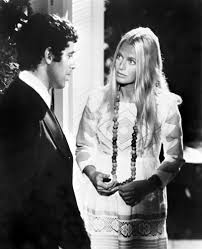
On Nina Van Pallandt: Muse, Witness, Residual Character, and Her Own Woman

Note: Nina Van Pallandt moves through this piece as a kind of drifting hinge figure between art and biography, cinema and scandal, half-real and half-mythologised: from her striking, uncanny presence in Robert Altman’s The Long Goodbye—where she plays the abused, luminous spouse of Roger Wade and becomes, briefly, a kind of muse/anima figure for Philip Marlowe—to her earlier life in the Danish pop duo The Baronets, through her entanglement with Clifford Irving and the great Howard Hughes hoax that later reverberates through Orson Welles’ F for Fake, and onward into the quieter aftermath of fame, reinvention, and partial retreat. The essay follows her not as a stable “character” but as a site where male-authored narratives—Hollywood noir, literary fraud, journalistic myth-making—keep trying (and failing) to fix her meaning, while she keeps slipping free in ways that are at once accidental and oddly deliberate. In the end she becomes something like a case study in cinematic and cultural afterlives: a woman repeatedly written by others, occasionally complicit, sometimes resistant, and finally legible only as a residue of performance, gossip, and unfinished stories that refuse to settle.

I first became aware of Nina Van Pallandt the way most people probably do: not through biography, but through atmosphere—specifically Robert Altman’s The Long Goodbye (1973, The Long Goodbye), a film that feels less like a narrative than a slow collapse of narrative reliability itself. It is a film in which people drift through scenes as if they have forgotten whether they are supposed to be characters or witnesses, and Nina arrives inside it already slightly misfiled, already too composed for the emotional weather she is asked to endure.

She plays Roger Wade’s wife, but “plays” is almost the wrong verb. Altman’s casting logic is not psychological realism in the classical sense; it is something closer to behavioral residue. People are dropped into the frame and asked not to perform identity but to inhabit proximity—to money, to violence, to desire, to failure. Nina’s presence has that peculiar Altman quality: she does not dominate the scene, but she stabilizes it just enough to make everything else look unstable.

Roger Wade (the blocked writer, the alcoholic genius-in-decline) is already collapsing before the plot admits it. Nina is the counterweight that never quite becomes balance. She is care without resolution, intimacy without clarity, the kind of emotional presence that suggests there is a story somewhere but refuses to confirm what it is. And then there is Marlowe, Elliott Gould’s version of Marlowe—half-stoned, half-wandering, permanently a few seconds behind the moral implications of what he is witnessing.

The film keeps staging small ruptures in epistemology. One of the most famous arrives early and feels almost accidental in its perfection: Terry Lennox appearing at 4 AM, asking for a ride to Tijuana. There is a moment—“Tijuana now?”—where Gould’s Marlowe is briefly jolted out of his procedural fog into genuine surprise, as if even he cannot believe how far the plot is willing to drift from explanation. That tonal instability is the world Nina inhabits as well, except she does not get Marlowe’s ironic distance. She gets consequence.

There is a domestic sequence—one of the film’s most disarming—that feels almost out of register with the noir frame: Nina cooking, the soft logic of food and attention, a candlelit dinner shared with Marlowe, where violence and absence are temporarily suspended by something as ordinary as butter and chicken. It is precisely the kind of scene that should resolve emotional ambiguity, but in Altman it does the opposite: it deepens it. Intimacy here is not revelation; it is another form of deferral.

What the film keeps doing, quietly and persistently, is refusing to assign stable moral weight to anyone. Roger Wade is both victim and self-destroyer. Marlowe is both agent and sleepwalker. Nina is both witness and participant, but never allowed the comfort of explanation. Even her suffering—when it arrives—is not narratively sanctified; it is simply another event in a world where events do not accumulate into meaning.

And this is where Nina becomes interesting beyond the film itself. Because she does not resolve into a character arc, she persists as something else: a figure who has been “used” by multiple narrative systems without ever fully belonging to them. In a conventional noir, she would be femme fatale or redemption object or tragic spouse. In Altman, she is none of these cleanly. She is what remains when genre stops enforcing coherence.

What begins to emerge, if one steps back slightly from her, is that she belongs to a broader category of women who are not simply “in” cultural narratives but are written into them by proximity to men who are doing the narrating. The pattern is subtle but persistent: women become legible to the public through the structural gravity of male projects—films, scandals, bands, memoirs—while simultaneously attempting, with varying degrees of success, to assert an interior life that resists that formatting.

It is difficult not to think here of Marianne Faithfull, who occupies a parallel register in the British version of the same phenomenon. Marianne Faithfull is initially rendered publicly intelligible through association—romantic, cultural, chemical—with the Rolling Stones orbit, and specifically through a media ecosystem eager to translate her into a kind of emblem: muse, fallen angel, tragic accessory to male genius. But what is striking about her trajectory is not the initial inscription but the long, stubborn insistence on rewriting it from within.

In both cases—Faithfull and Van Pallandt—the question is not simply “agency” in the abstract liberal sense, but something more structurally constrained: how does a person reassert authorship of self once they have already been written as a function in someone else’s story? Faithfull does this through survival, reinvention, and the eventual authority of her own voice as an artist. Nina does it more quietly, less performatively, by simply not continuing to cooperate with the demand that her life be endlessly narrativized into legible arcs.

And this is where Nina stops being just a cinematic presence and becomes entangled with a second, more volatile narrative system: the world of Clifford Irving and manufactured truth. I remain, in a slightly persistent way, puzzled by Clifford Irving—not in the sense that his actions are obscure, but in the sense that the scale of the gamble still feels oddly disproportionate to the era in which it occurred. Clifford Irving occupies that 1970s threshold where narrative fraud still had room to breathe: before the internet, before instantaneous archival correction, before every claim arrived already cross-checked by a thousand invisible clerks. The rope, in other words, was longer. Not infinitely elastic—but long enough that someone could plausibly believe they might walk it all the way across.

What he did, of course, was fabricate the authorized autobiography of Howard Hughes and briefly convince a publishing system that this fiction was fact. And one cannot quite shake the sense that this sits in a parallel register to Orson Welles’ late-career meditation on forgery and authorship, F for Fake, where the art forger is not simply a criminal but a kind of metaphysical irritant—someone who reveals how fragile the category of “authenticity” already is, even before it is attacked. In Welles’ world, the faker is almost honest about the fact that everyone is faking something. In Irving’s world, the system briefly forgets to notice.

The irony, of course, is that Irving’s fraud depended on a very pre-digital faith in paper trails, intermediaries, and the general slowness of institutional verification. Today it feels almost quaintly physical: forged documents, publishing contracts, phone calls that had to be believed in real time. One can imagine the same scheme now collapsing within hours, not because people are more moral, but because the feedback loops are instantaneous.

And then there is prison. Irving did time—real time, not narrative time—and emerged into a world that had already moved on to other, faster deceptions. Yeah, I mean what did you expect, dude. The arc compresses there in a way that feels almost unsatisfying: scandal, exposure, incarceration, partial reinvention. One wants something more operatic, but what you get is the bureaucratic version of consequence.

The interesting part is not that he was punished, but that for a brief historical window the system was even buildable enough that his plan could function as a kind of temporary reality. That is the shared atmosphere he has with Nina Van Pallandt: not guilt, not innocence, but proximity to narrative systems that were still slow enough to be fooled by their own assumptions.

In later life, Nina becomes harder to place in any of the familiar compartments that earlier decades tried to assign her. The cinematic afterglow fades into cult memory, and the Irving episode recedes into archival texture. What remains is a quietness that feels deliberate rather than accidental—not disappearance, but refusal of continued amplification. She does not convert notoriety into permanent self-mythology in the way later media ecosystems would almost require. Instead, she settles into a lower frequency of visibility: remembered, cited, intermittently revived, but no longer authored by the same pressures that once pulled her forward.

And here the comparison widens again, because what she resembles is not a “sidekick” at all—that word is too structurally comic, too dependent on hierarchy—but something closer to an attendant presence: a figure whose job, in other people’s stories, is to make emotional or moral instability legible without ever fully resolving it.

There is a related category, more neutral and slightly more precise: the faithful interlocutor. Not in the devotional sense, but in the structural one—the person who remains close enough to the main character’s instability to render it speakable, without ever becoming fully absorbed into its explanatory system. Nina performs this function in The Long Goodbyewithout being granted interpretive authority over it.

And there is another: the witness who does not testify cleanly. Not unreliable, but resistant to conversion into stable narrative fact.

We all make mistakes; that much is banal. The more interesting question is what kind of cultural weather those mistakes occur in, and how much agency is genuinely available inside it. Nina Van Pallandt seems, in retrospect, to have lived inside a period when men were still doing a great deal of the writing—of scripts, scandals, explanations—and women were often expected to appear inside those scripts as if they had authored them themselves. Her resistance to that framing is not always loud or declarative. Sometimes it is simply a matter of stepping out of the demand to be continuously interpretable.

And in that sense, what she ultimately carved out is not a grand public myth but something more modest and, arguably, more durable: a minor legacy, lightly held, slightly resistant to over-definition. Not central, not erased, not simplified—just there, in a way that feels unexpectedly intact.

I really like Nina Van Pallandt. In The Long Goodbye, and in the shadow of the Clifford Irving story, it is impossible not to root for her—not because she is resolved, but because she is never fully reducible. She drifts through systems built by men who are busy writing meaning onto the world, and she does not quite consent to being finalized inside any of them. We all make mistakes. She was written into a few. She was also, quietly, a drifter inside Hollywood’s narrative machinery, and what she ultimately leaves behind is a minor but distinct and instinctively cool legacy: not the center of anyone’s story, but one of the few figures who never fully became owned by it.

On the Film “My Dinner with Andre” Part I: Wally in New York

Note: Opening a multi-part early series from my first blog Classical Sympathies back in 2009, this piece takes up the beginning of Wallace Shawn’s walk through New York en route to his meeting with André Gregory in My Dinner with Andre, using Wally’s voice-over as a lens on artistic precarity, everyday survival, and the comic disproportion between existential weight and mundane errands. The note situates the film’s opening movement as both narrative setup and philosophical framing: a winter city of post offices, xerox shops, and unanswered calls becomes the psychological prelude to a conversation that will later expand into memory, performance, and self-mythology. This installment follows Wally up to his arrival at the restaurant for the pre-dinner drink, where the film’s central encounter is still suspended in anticipation, and meaning is generated less by action than by the act of getting there.

My Dinner with Andre is the famous, or infamous, 1981 film of a dinner conversation between Wallace Shawn, the actor and playwright, and Andre Gregory, the theater director. If I were to make a twofold claim for the film: i) that it is one of the most action packed films ever made, and ii) that it effectively encapsulates the thematics of the entire 20th century, I do not think this would be overstatement. My intent here, however, is not to establish either of these postulates, but rather to simply “blog” the script in the hopes that what needs to be said works its way to the surface. Fair warning: the undertaking will require several posts.

Money crops up on two of the first three pages of the script, and because money, and the lack of it, is a theme that runs beneath the entire script: Andre has money, has the freedom to travel and to spend several years trying to “find himself”; Wally does not. Still, “having money” is, as ever, a relative concept. At the opening of the film, Wally is seen walking through the streets of New York, heading for the restaurant where he is to meet Andre. It appears to be winter, maybe February. In the opening voice-over, Wally ruminates on the life of the artist: The life of a playwright is tough. It’s not easy, as some people seem to think. You work hard writing plays, and nobody puts them on. You take up other lines of work to try to make a living–acting, in my case–and people don’t hire you. So you spend your days crossing the city back and forth doing the errands of your trade. Today wasn’t any easier than any other day. I’d had to be up by ten to make some important phone calls, then I’d gone to the stationary store to buy envelopes, and then to the xerox shop. There were dozens of things to do. By five o’clock I’d finally made it to the post office and mailed off several copies of my plays, meanwhile checking constantly with my answering service to see if my agent had called with any acting work. In the morning, the mailbox had been stuffed with bills. What was I supposed to do? How was I supposed to pay them? After all, I was doing my best (17).

One of the marvelous things about the film is the tongue-in-cheek humor that is rarely, if ever, directly alluded to. A deeply serious film, Andre is also a comedy, a fact which we can recognize because we see that the writers are having fun with the characters who are in turn themselves. That is, Wally and Andre are playing versions of themselves–we assume that most of the experiences that Andre recounts in the film are based on real experiences, and that Wally’s account of his home life is more or less true to life–but exaggerated versions. As Shawn says in the preface to the script, “I knew immediately that {…} I’d have to distort us both slightly–our conflicts would have to become sharpened–we’d have to become–well–characters {…} It would be an enormously elaborate piece of construction” (14). In this initial passage, the humor lies in Wally’s conception of a difficult life: “I’d had to be up by ten to make some important phone calls.”

Wally’s sense of pressure is, from the outset, deliberately out of proportion to the scale of his circumstances. The tone is one of genuine complaint, but the complaint itself is almost comically domestic: the architecture of a “hard day” is built out of errands, envelopes, xerox shops, and an answering service that may or may not contain salvation in the form of an acting job. What Shawn achieves here, and what the film quietly sustains, is a recalibration of seriousness—where existential weight is not attached to grand events but to the texture of administrative survival. Wally’s New York is not a place of romance or revelation, but of circulation: between post office, mailbox, and telephone, as though modern artistic life has been reduced to a loop of deferred contact with recognition.

At the same time, the humor is never fully separable from sincerity. Wally is not merely being mocked; he is also articulating a recognisable condition of artistic precarity, one that the film refuses to glamorize. The genius of the opening monologue lies in this double register: we are invited to laugh at the disproportion between emotional tone and material fact, but we are also made to recognise how easily that disproportion becomes a lived reality. The “dozens of things to do” are not nothing; they are just insufficiently legible as crisis, which is precisely what makes them feel like crisis.

By the time Wally finally moves through the city toward the restaurant, the structure of the film has already been quietly established: this is a world in which meaning is not delivered through events but through the way events are narrated to oneself while walking between obligations. New York, in this sense, is not a backdrop but a medium of self-composition—an environment in which thought is constantly being assembled under mild pressure, as though consciousness itself were an errand.

He checks the time again, as he has been doing throughout the afternoon, and adjusts his route slightly, not out of urgency so much as orientation. The meeting with André already exists in his mind as something slightly unreal, a fixed appointment that has not yet been granted substance by arrival. He crosses another block, passes into the thinning evening light, and begins to approach the restaurant where, for the first time that day, the structure of waiting will shift from solitary to shared.

to be continued…

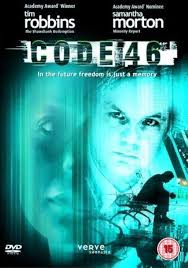
Review of the Film Code 46

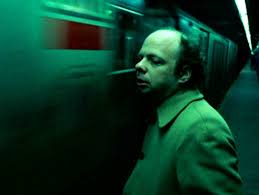
Note: We don’t do a lot of film reviews here, but Code 46 earns the exception—partly because Michael Winterbottom is one of my very favorite directors, and still wildly underrated, and partly because this film quietly seeps into you in a way that feels unshakable; set in a world that is clearly not ours but just similar enough to be discomforting—real Shanghai that isn’t quite real, deserts that feel earned, a system of “cover” and genetic law that replaces freedom without ever announcing itself—the film follows William, a kind of intuitive investigator who lives more than feels, and Maria, who works in a bureaucratic “fate factory” and senses, before she knows, that something is already off; their connection unfolds in fragments—interrogation as flirtation, impulse as rebellion, intimacy as violation—until the central truth emerges: in a world where memory can be edited and biology legislated, even love itself can be illegal; the genius of the film is its restraint.

Tim Robbins and Samantha Morton don’t overwhelm you with chemistry, which actually makes the relationship feel more provisional, more real, more doomed—and by the time the system reasserts itself (memory erased, lives restored, Maria exiled with the burden of remembering), you realize the film hasn’t been building to a climax so much as a quiet erasure; it’s less than 90 minutes, barely announces its futurism beyond small details (languages blending, empathy viruses, low-fi surveillance), and yet it lingers in a way much louder films don’t; it also clearly fed into the DNA of the Thin Man—this idea of movement through controlled spaces, of intuition over evidence, of relationships that feel both fated and structurally impossible—and in that sense it’s not just a film I admire, it’s one that got under the skin and stayed there.

Michael Winterbottom’s Code 46 is less a conventional sci-fi film than a drifting, half-lucid meditation on love, control, and memory. It runs under 90 minutes, but it feels strangely elongated—like a dream you keep slipping back into.

The hero, William (Tim Robbins), isn’t exactly living—he’s existing. A kind of insurance investigator, a “driver” moving through a world defined by pollution, restriction, and bureaucratic control. This isn’t the neon overload of something like Blade Runner—Shanghai here feels real, but off. The deserts outside the cities are harsh and empty; if people can’t get “cover” to move, there’s a reason. The world is closed, stratified, quietly oppressive.

William is established early as compassionate—at a checkpoint, he shows a kind of human softness that marks him apart. But he’s also slippery. He bluffs and charms his way through situations, his “cunning” explicitly noted as one of his professional tools. He doesn’t rely on evidence so much as intuition: “It’s intuition you’re paying for.”

Maria (Samantha Morton) narrates parts of the film, grounding it in something more intimate and unstable. Her sense of time is fractured—lucid dreaming, recurring visions, a sense that something is about to happen. “Every year I have this dream… is this the night I wake?” There’s a constant feeling that fate is closing in. She works in what is essentially a “fate factory,” issuing the cover documents that determine where people can go and what they can do. In this world, fate substitutes for freedom.

When William meets Maria, there’s an immediate sense of déjà vu—she feels she’s met him before. Their early interactions blend interrogation and flirtation. The dynamic is unusual: older man, younger woman, but the aesthetic—her shaved head, the stripped-down environments—blunts the cliché. Their connection feels tentative, exploratory. She tests him; he reads her. There’s attraction, but it’s not fully trusted on either side.

Their relationship develops in fragments: subway encounters, shared meals, small rule-breaking gestures. William knows she’s impulsive—she admits it. The film introduces the idea of engineered “viruses” that alter human ability—perfect pitch, empathy. It’s a strange, understated sci-fi touch that reinforces how mediated everything is, even emotion.

There’s a looseness to their chemistry. Robbins and Morton don’t generate overwhelming heat, but that actually works. The relationship feels uncertain, provisional—two people circling something they don’t fully understand. Their intimacy is uneven, sometimes tentative, sometimes urgent. Maria seems to need William more than he needs her, or at least she feels the stakes more sharply.

The world around them continues to intrude. There are hints of smuggling, of bureaucratic corruption, of quiet desperation. Maria has lived “outside” for ten years—without cover, presumably—which raises questions the film never fully answers. William’s moral stance, when it emerges, feels weak, almost performative.

When he returns home, he tries to reassert control—rejecting Maria, then calling her back. But the narrative destabilizes. A colleague dies; William is sent back to investigate. The technology—video links, surveillance—feels oddly low-fi, as if the future never quite fully arrived.

As William digs deeper, the film’s central taboo emerges. Maria has violated Code 46—a genetic restriction law. Through fragments of dialogue and investigation, William pieces together the truth: they are biologically too similar. A “50% match.” Worse, her mother was a clone—one of many. The implications are quietly devastating.

Maria’s past is altered—an illegal pregnancy erased, along with the associated “memory cluster.” Identity itself becomes unstable. Memory, love, and experience can all be edited, removed, rewritten.

Their attempts to escape—to flee together, to build something outside the system—feel almost doomed from the start. The idea of Jebel Ali, drawn from her father’s stories, becomes a kind of imagined refuge. But the system closes in. A car crash. Memory erasure. Reintegration.

In the end, William is returned home, restored to his life, his wife, his routine. Covered for. Maria, by contrast, is exiled—sent out into the desert with her memories intact. She becomes the one who remembers, who carries the weight of what happened.

The final note is pure loss. Lost love, stripped of even the possibility of reunion. Maria staring out into the distance, holding onto something the world has decided should not exist.

Code 46 is not a perfect film. It’s uneven, sometimes opaque, and emotionally muted in ways that can frustrate. But its ideas linger. It captures something rare: a future where control is soft but absolute, where love is possible but prohibited, and where memory itself becomes the final battleground.

It doesn’t hit you all at once. It seeps in.

Levels of Lucidity in Dreams: A Close Reading

Illustrations presented with thanks by Riko Kusahara

Note: This piece was written for the Psiber Dreaming Conference offered by IASD in September 2018, under a strict word limit that forced a level of compression I don’t always allow myself. It draws on a series of lucid dreaming experiences to explore how we determine whether we are dreaming or awake, and why those determinations so often fail under pressure. Looking back, I’m less interested in the specific techniques of lucidity than in the broader question the paper circles: what happens when our usual markers of reality—stability, plausibility, even self-awareness—prove unreliable? The result is less a theory of dreaming than a compact record of trying to think clearly inside a system that continually revises its own ground.

Epigraph I:

The difference between most people and myself is that for me the “dividing walls” are transparent.  That is my peculiarity.

—Carl Jung

Epigraph II:

The conventional scientific sentiment has become that—while we don’t totally understand why dreaming happens—the dreams themselves are meaningless. They’re images and sounds we unconsciously collect, almost at random {…} Which seems like a potentially massive misjudgement.

—Chuck Klosterman

Dream I: I awake in a warehouse.  The bed is against one wall–on the other is a thirty-foot mountain of cantaloupes.  I realize I am dreaming.  I get up and run my hands over the cantaloupes.  They feel absolutely real—as tangible as in life.  I remember that tangibility is not a viable reality test—I’ve made that mistake before.  Now fully lucid, I decide to levitate.  The room dissolves, and I float suspended somewhere in dense, colourless space.  Eventually, I feel the need to come back to earth but cannot locate it.  I feel something beneath me.  This is my bed, and I awake back in the warehouse, relieved yet exhilarated.  The cantaloupes are still there, however I don’t question them.  I just happen to live in a room full of fruit.  Moments later I awake again, this time in diurnal “reality.”

The most common dream experience is of waking from a dream we take to be real, only to understand that it was “just a dream.”  However, a subset of dreamers, probably more than we generally imagine, have experienced lucid dreams, dreams in which, to some degree, they are aware they are dreaming.  Lucid dreamers may also experience “false awakenings”[1]— the sensation of waking progressively through dream “levels.”  False awakenings can be disorienting (Robert Waggoner writes that after seven successive false awakenings he “would accept {…} any reality {…} as long as it stayed put[2]), or sought after (Daniel Love and Keith Hearne have independently developed techniques to induce false awakenings[3]).  Regardless of the desirability of the experience, the existence of dream levels, far from a simple oddity, provides a potential window into massive metaphysical questions.   

First, we need to understand how dreamers use evidence to establish whether they are dreaming or awake.  

II: I am in a dreaming contest with another dreamer.  The contest begins and slimy amphibians begin to appear.  Some resemble frogs; others are in shapes that dont exist in nature.  Their size varies from that of a pinky to that of a fist and they are very colourful.  I am not trying to dream them, rather they are spilling everywhere around my feet.  I sense this is a dream and check on the other dreamer.  He is standing to my right in empty space.  He looks just like me and hasnt begun his dream. 

This dream is non-lucid at first and becomes lucid because of the bright color and absurd number of the amphibians.  An awareness beyond the dream senses a non-natural situation.  

III: I am picking out fruit at a fruit stand.  There are some huge avocados, almost too good looking.  I wonder if I am in a dream, and touch an avocado to check.  The one I choose is ripe and soft—I squeeze it a little.  There is no doubt that I am having a tactile experience, and I conclude I am not dreaming.  Of course, I am. 

Two dreams, two types of evidence.  In Dream II, I correctly identify the amphibians as anomalous, and become lucid.  In Dream III, my attempt to test the lifelikeness of the avocado as an indicator fails.  Simply put, realistic sensation is not sufficiently indicative of reality.  Love agrees: “we are not looking for a qualitative difference in how realistic the experience feels {…} we are {…} on the lookout for issues with stability and plausibility.”[4]  In Dream I, at first the huge pile of melons in my bedroom appears implausible and triggers lucidity; after moving up a dream level, my mind overrides the implausibility by “justifying”[5] the anomaly.  

Because we awake from sleep and dreams every morning, we are very familiar with the experience of awakening.  It is therefore unsurprising that when we wake inside a dream we accept the new reality as the waking world, even if it contains anomalous elements.  

IV: I am in a huge house where a large group of families on motorcycles arrive.  The families are making noise all night.  I realize I am dreaming and levitate over to the families.  Later I decide to wake up.  I ease myself out of bed, bumping my nose into an ironing board.  The room looks and feels exactly like my room.  I dont recall the ironing board being there, but whatever.  Moments later I awake again—the situation is identical, only, the ironing board is gone.  I feel a pit in my stomach, wondering what is ultimately real.

Dream IV is a good example of how dream levels can become increasingly realistic as we move through them.  An ironing board in front of the bed is (for me) more plausible than a house full of bikers.  Dreams such as this beg the question of how we can ever be sure we are awake.  I have dreamt of getting up, walking to the front door, opening it, and emerging into the sunshine in my neighbourhood.  At every point, this dream felt entirely realistic with no anomalies.  After experiences like this, is it wholly unrealistic that we could dream an entire morning?  An entire day?

There are different ways to approach this kind of question.  The first is to use rigorous reality tests.[6]  Using reality tests after each fresh awakening can help us filter anomalies in what may be an increasingly realistic dream state. The second is to open ourselves to a wider set of questions.  Although space limitations make full exploration of these questions impossible, modern dreamers would do well to recall that throughout recorded history people have speculated on the meaning of the dream state and what it can tell us about space, time, life after death, and the nature of reality. 

As dreamers, we know that dreamtime behaves very differently than waking time.  Robert Moss distinguishes between Chronos (“linear time”) and Kairos (the “spacious now.”)  He writes that when Kairos operates in waking life, “ordinary time is {…} suspended or elastic,” and that the world can “quiver or shimmer.”[7]  Moss’ Kairos time sounds a great deal like dreamtime.  Jung in his memoir writes “our concepts of space and time have only approximate validity,”[8]  and “there are indications that at least a part of the psyche is not subject to the laws of space and time.”[9]  Jung makes multiple connections between dreams and life after death, suggesting that our waking world,

in which we are “conscious,” may in fact be a projection of a more “real” and permanent, even timeless, unconscious.[10] 

In the Tibetan tradition of dream yoga, the yogi prepares for death through dreams and meditation, entering death consciously by releasing the bodily energy in such a way that the body partially or entirely dissolves into pure light.  This “rainbow body” is well-documented in Tibet and China, and cases of this phenomenon have been reported across multiple religious traditions.[11]  Finally, Moss connects dreams with the much discussed Many Worlds theory, as does, in popular culture, Richard Linklater. [12]

V:  I am among a large group of people on the top floor of a building.  We lie down on our backs and form bundles.  The molecular structure of these bundles begins to dissolve, we become lighter, then totally empty.  This process is dictated by a power outside of us which doesnt speak.  Once empty, we have the choice to become anything we want.  I choose to become white light.  Suddenly I am transported through space in a burst of pure white light, my old body left entirely behind.  This is the most peaceful and thrilling feeling in the world.  Then, I am back into a new bundle, trying again to become empty.  I make progress, but it is hard and I am over-concentrating.  Progress ceases; I wake up. 

Although I have thought at length about dreams, I am a normal person with a normal job, dreaming anonymously night after night.  I don’t belong to a spiritual tradition, am not a yogi or a meditating hermit.  As a lucid dreamer, like many of us, I am self-taught.  While we anonymous dreamers are wise to suspend judgement about the particularities of a theory as mind-boggling as dreams as an interface to infinite parallel universes, it is perhaps not by chance that my dreams of ascending to a state of pure white light bear close resemblance to innumerable near-death experiences or the reported manifestations of a lifetime of dream yoga.  Although admittedly outside of our normal rational mode of apprehension, the experience of journeying through multiple dream levels, and the energy and amazement which often accompany these experiences, may point the way toward worlds far above, below, or beyond our own.  

Who are we in our trek through life?  Are we the maker, or the made?  The writer, or the page?  The actor, or the stage?  The happening, or the happened to?  Perhaps, our ability to exercise agency in the vastness of forever depends in part on learning to navigate levels of “reality,” however we encounter them.  Or, perhaps, journeying to the far side of the dream can bring us face to face with that which is actually dreaming us.

Bibliography

Jung, Carl. Memories, Dreams, Reflections. Vintage Books, 1989.

Linklater, Richard, director. Slacker. Orion Classics, 1990.

Love, Daniel. Are you Dreaming? Enchanted Loom Publishing, 2013.

Moss, Robert. Sidewalk Oracles. New World Library, 2015.

Rinpoche, Gyalwai Nyugu.  “About Rainbow Body.” http://www.gyalwai-nyugu.com/about-rainbow-body/.  Accessed 24 July 2018.

Rinpoche, Tenzin Wangyal. The Tibetan Yogas of Dream and Sleep. Snow Lion Publications, 1998.

Thomas, Matthew.  “On Coming Through”: A New Meditation on Intention. https://craftfollowsconcept.com/2013/05/13/on-coming-through-statement-of-intent-on-the-approach-of-my-39th-birthday/#more-11. Accessed 24 July 2018.

Waggoner, Robert. Lucid Dreaming. Moment Point Press, 2009.


[1] Waggoner, 61

[2] ibid., 63

[3] Love, 131

[4] Love, 71

[5] Love cites “poor reasoning skills” as one common reason for failing to recognize dream signs and achieve lucidity.  Love, 73.

[6] Love, 78-79; Waggoner, 259.  (Wagonner uses the term “reality check” instead of “reality test.”)

[7] Moss, 49

[8] Jung, 300

[9] ibid., 304

[10] ibid., 324

[11] Tenzin Wangyal Rinpoche, 314; Gyalwai Nyugu Rinpoche

[12] Moss, 74-74; Linklater

The Adventures of the Thin Man and Andrea Available Now!

Well everyone, today is the day. My first novel, The Adventures of the Thin Man and Andrea is now available on Amazon and wherever books are sold.

This one took a while—written in fits and starts, in bars and hotel lobbies here in Kyoto—but it finally found its shape. More than anything, today I just want to thank all the readers of The Kyoto Kibbitzer, wherever you hail from; I’ve always thought of this as an ongoing conversation, and a lot of this book grew out of that exchange.

If you do pick it up, I hope you enjoy the ride—and if it lands for you, a quick review on Amazon would mean a great deal. Thank you, as always, for reading.

Matt

On The X-Files: The Paranoid Style of 1990s Television

Note: This reflection comes out of a long-standing fascination with The X-Files, one of the most distinctive television shows of the 1990s. When it first aired, the series managed to occupy a strange and compelling middle ground between science fiction, horror, conspiracy culture, and something closer to philosophical inquiry. Week after week the show asked the same unsettling question from slightly different angles: what if the world is not quite as stable or intelligible as we assume?

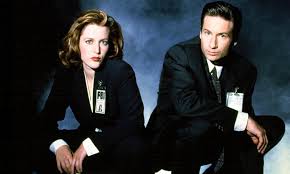
What made the series especially effective was the dynamic between Fox Mulder and Dana Scully. Mulder represented the pull of belief, intuition, and pattern-seeking; Scully stood for skepticism, evidence, and scientific restraint. The tension between those two orientations created a kind of philosophical engine that powered the show for many seasons.

The major episode discussed here is one of the early “mythology-adjacent” stories that sits near the boundary between the show’s monster-of-the-week format and its deeper conspiratorial arc. Watching it again years later, what stands out is not only the eerie storytelling but also the way the series captured a particular cultural mood of the 1990s — a time when technology was expanding rapidly, institutions were increasingly distrusted, and the possibility of hidden systems operating beneath the surface of ordinary life felt strangely plausible.

In that sense, The X-Files was never just about aliens or government cover-ups. It was about uncertainty itself — the uneasy space between explanation and mystery.

Epigraph:

“Autorerotic asphyxiation is not a pleasant way to go, Mr. Mulder.”

Clyde Bruckman, The X-Files

The X-Files is my second favorite television show of all time, behind only The Wire, and it’s not close.

That may sound like a bold claim given the sheer amount of television produced over the past thirty years, but for those of us who came of age in the 1990s the show hit a nerve that very few cultural artifacts ever have. It wasn’t just entertaining. It was atmospheric. It was unsettling. It felt like it was plugged directly into the cultural nervous system of the time.

To understand why, you have to begin with a simple generational fact. I was born in 1974, just eleven short years after the assassination of John F. Kennedy. That event cast a shadow that lingered for decades. My parents’ generation and my grandparents’ generation were deeply scarred by it in ways that people my age never fully understood. Something in the national psyche broke that day. Trust in institutions never really recovered.

Historians later described this cultural mood as “The Paranoid Style of American Politics,” borrowing the famous phrase from the essay by Richard Hofstadter. Whether one agreed with Hofstadter or not, the phrase stuck because it captured a very real undercurrent in American life: the suspicion that unseen forces were operating behind the scenes.

The genius of The X-Files was that it leaned directly into that atmosphere. It didn’t treat paranoia as pathology. It treated it as narrative fuel.


Discovering the Show

I was an early adopter.

The show premiered in 1993, and by 1994 I was already watching it in the dorms at Hamilton College with a group of friends. If possible we’d get a little baked first, which in hindsight may have been perfect. The X-Files is a show that rewards slightly altered states of perception.

At first it was something of a cult discovery. A few people watched it religiously while others barely knew it existed. But by the time the second and third seasons rolled around it had become a communal ritual. Thursday nights meant Mulder and Scully.

The chemistry between the leads was immediately apparent.

David Duchovny and Gillian Anderson had what we would now call “shipping chemistry,” although that term didn’t really exist yet. We simply knew that something electric was happening on screen. The characters worked because they embodied opposing ways of understanding the world. Mulder believed everything. Scully was more skeptical. Between them the truth hovered in an unresolved middle ground.

The show was also disciplined enough to hold that tension for years. In an era before streaming algorithms and social-media speculation, viewers waited week to week to see how the relationship evolved.

Hovering over them was their boss, the enigmatic Walter Skinner. For several seasons it was impossible to tell whether Skinner was helping Mulder and Scully or quietly managing them on behalf of darker forces. That ambiguity was one of the show’s greatest pleasures.

In a delightful twist of pop-culture irony, the actor Mitch Pileggi was at one point named TV’s Sexiest Man by a glossy magazine. Which is hilarious when you remember that Skinner is essentially a bald FBI bureaucrat in a gray suit. Such was the cultural power of the show.


The Smoking Man

Then there was the figure lurking in the shadows.

The Cigarette Smoking Man is one of the great villains in television history. Played with eerie understatement by William B. Davis, he appeared whenever the conspiracy thickened.

He looks exactly like the kind of man who would be at the center of a decades-long government cover-up. Three packs a day. Cheap cologne. A lingering Jameson hangover. The sense that he spends most of his time in dim Washington parking garages and windowless offices and only emerges from his crypt when the conspiracy requires it.

It’s a performance so physical that you can almost smell the character through the screen.


Three Essential Episodes

Every long-running show has defining episodes, and The X-Files produced dozens. But three in particular illustrate what made the series so special.

The first is the pilot itself, which introduces Mulder investigating mysterious disappearances in the Oregon woods. A key moment occurs when the agents experience missing time on a dark forest road. The scene establishes the tone immediately: eerie, ambiguous, and faintly plausible.

The second is Fallen Angel, an early classic that introduces the lovable conspiracy obsessive Max Fenig. Max’s jittery paranoia captures the spirit of the show perfectly. When he remarks that “someone’s always watching, Mr. Mulder,” it feels less like dialogue than like a thesis statement.

The third is the masterpiece of dark humor, Clyde Bruckman’s Final Repose, written by the great Darius Morgan. In it, a weary insurance salesman named Clyde Bruckman discovers that he can foresee the exact circumstances of people’s deaths. Played beautifully by Peter Boyle, the character delivers a hilarious and oddly touching performance. It is Bruckman who also delivers the immortal line that also gives us our epigraph: “Autorerotic asphyxiation is not a pleasant way to go, Mr. Mulder.” Run roh. Take that belt off Fox baby.

What makes the episode remarkable is that it gently mocks the show’s own hero. Mulder spends the entire series searching for hidden meaning in the universe. Clyde Bruckman, by contrast, believes life is largely arbitrary and tragic.

His prediction of Mulder’s death—immortalized in the epigraph above—is both absurd and strangely profound. It’s also a sign that by Season Three the show had gained enough confidence to poke fun at itself.


When the Mythology Expanded

Like many successful serialized shows, The X-Files eventually struggled under the weight of its own mythology. One of the central narrative engines involved Mulder’s missing sister, Samantha Mulder. Early on, the mystery added emotional depth to Mulder’s obsession with the paranormal.

But as the seasons progressed the storyline became increasingly convoluted. Samantha might have been abducted by aliens, or replaced by a clone, or transformed into something else entirely. Meanwhile the conspiracy expanded to include frozen alien ships in Siberian ice, shadowy government syndicates, and the infamous black-oil virus that seemed capable of possessing human hosts.

At a certain point the mythology began to chase its own tail.

Then, as the final blow, David Duchovny left the show. Gillian Anderson remained excellent, but The X-Files was always fundamentally a two-hander. Without Mulder and Scully together the balance of the series shifted in ways it never fully recovered from.


Why It Still Matters

And yet, for all the narrative tangles of the later seasons, the early years of The X-Files remain extraordinary television.

The show captured a very particular moment in cultural history: the twilight of the pre-internet era, when conspiracy theories spread through late-night radio programs, photocopied newsletters, and whispered conversations rather than social media feeds.

It was a time when the idea that powerful institutions might be hiding enormous secrets still felt plausible rather than merely exhausting.

For a few seasons in the 1990s, Thursday nights belonged to the weirdest, smartest, most paranoid show on television.

The truth, as Mulder kept reminding us, was out there

Dedication

For Dana and Fox. You know we still want to know what went down in that motel room baby.

Note: If you enjoyed this essay you may also enjoy the two essays below, both of which, in different ways, take up themes of intrigue and mystery.

On Four Adventures of Tintin

Note: This essay takes up my personal four favorite books from the marvelous Adventures of Tintin series. I make no claim for these to be the best, and the list omits the very popular Moon books, however this is the list as it stands. I hope you enjoy Tintin as much as I do, and as always, thank you for reading.

Epigraph:

First Encounter

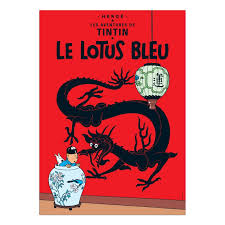
I first encountered Tintin in Grade 5, checking two slim volumes out of my elementary school library: The Blue Lotus and Tintin in America. I remember the physicality of them—the glossy covers, the bright blocks of color, the uncanny clarity of the drawings. They felt different from the other books on the shelf. Most children’s adventure stories required you to imagine the action. Tintin showed it to you panel by panel, with a confidence that made the whole world feel precise and alive.

Even before I fully understood the stories, I had the sense that I had stumbled onto something like treasure. The pages moved quickly. Cars skidded across city streets, gangsters hid in back rooms, deserts stretched into the distance. Tintin himself was fearless and tireless, a boy reporter who seemed capable of appearing anywhere in the world with little more than a notebook, a trench coat, and his small white dog.

But even at ten years old it was clear that the two books belonged to the same universe but not quite the same stage of its development. Tintin in America was energetic and funny but also loose and episodic, closer to a cartoon chase story than a carefully constructed narrative. The Blue Lotus, by contrast, felt deeper. The stakes seemed real. The world seemed larger and more dangerous. The book hinted at forces—politics, empire, war—that I could not yet name but could somehow feel moving behind the story.

Before going further, it’s worth acknowledging briefly the long-running controversy surrounding the politics of Tintin’s creator, Hergé. Some of the early Tintin stories reflect the colonial assumptions and stereotypes common in Europe during the interwar period, and Hergé himself worked for a newspaper in German-occupied Belgium during World War II. These facts have generated decades of debate. They are real and worth knowing. But they are also only one part of a much larger story. Over time Hergé’s work grew more humane, more attentive to other cultures, and more morally complex. For the purposes of this essay, it is enough to acknowledge the controversy and then move on to the books themselves, which remain among the most remarkable achievements in modern popular storytelling.


Mr Dreyer’s Class, 7th Grade:

Even before I took his class, I was aware that Mr. Dreyer was, let’s say, a different sort of fellow. He liked to tell a story about his brother who lived on a massive contour map of the San Francisco Bay area. The map was located in an enclosed structure that hung under a bridge in Oakland or something. And his brother just chilled there full time, so the story went. So Mr. Dreyer, apparently, was the normal one in his family.

(I remember Mr. Dreyer talking to me about John Lennon one day as well. This was maybe when I was taking his class, but I think it might have been before that. “John Lennon’s assassination was really sad,” he said, “he was just starting to put his life back together.” I had heard of John Lennon but at that time knew nothing of the circumstances of his death. And I certainly didn’t know about his ups and downs in the 1970s. Mr. Dreyer must have been a Lennon fan though, and wanted to tell me about it.)

In any case, when I got to middle school I was assigned Mr. Dreyer, as mentioned. Mr. Dreyer wore a mustache that looked pretty Frenchy to me—maybe that’s why I kind of thought he was a French native. There were also a number of the Tintin books in French on a shelf in the back of the room. I had read most of the Tintin books in English by then, so it was fun to browse the French versions and take in some of the action from a new lens.


The Blue Lotus

If the early Tintin books were clever adventure cartoons, The Blue Lotus was the moment the series entered history.

The story takes place in Shanghai during the turbulent 1930s, amid Japanese expansion and international intrigue. What distinguishes the book is not simply the exotic setting but the sudden moral seriousness that runs through it. Tintin is no longer merely chasing criminals. He is navigating a world shaped by imperial ambition, propaganda, and cultural misunderstanding.

Central to this shift is the introduction of Chang Chong-Chen. Chang’s friendship with Tintin humanizes the story in a way earlier books never attempted. Through Chang, the reader glimpses the everyday life of Chinese citizens caught between foreign powers and internal turmoil. The relationship is warm, sincere, and quietly revolutionary for its time.

One sequence has stayed with me since childhood: Tintin being smuggled into an opium den hidden inside barrels. As a child I read the scene simply as a thrilling act of infiltration. As an adult it evokes something darker—the lingering shadow of the opium trade and the colonial exploitation that shaped China’s nineteenth and early twentieth centuries. Even if young readers do not consciously grasp the historical weight behind it, they feel that something serious is at stake.

With The Blue Lotus, Tintin steps out of the cartoon world of early adventure stories and into a recognizably historical landscape. The hero is still brave and resourceful, but the world around him has grown more complicated.


The Crab with the Golden Claws

If The Blue Lotus deepened Tintin’s world morally, The Crab with the Golden Claws transformed it emotionally. The reason can be summed up in a single name: Captain Haddock.

Before Haddock appears, Tintin himself is almost too perfect. He is brave, clever, and incorruptible. Admirable, yes—but also somewhat distant. Haddock brings chaos into this orderly universe. When we first meet him he is a drunken wreck aboard a cargo ship, bullied by the crew and prone to bursts of confused outrage. In his introduction scene he is literally knocked around by events, bonked on the head and stumbling through the narrative like a man who has wandered into the wrong story.

Yet Haddock quickly becomes indispensable. His flaws—his temper, his drinking, his explosive vocabulary—make him recognizably human. Over the course of the series he evolves into the lord of Marlinspike Hall, a man readers root for not because he is flawless but because he struggles, blunders, and ultimately proves loyal beyond measure.

The mystery at the heart of the story—those curious tins of crab that conceal a narcotics smuggling ring—is classic Hergé plotting. An ordinary object becomes the gateway to a hidden criminal network. But what readers remember most is Haddock: the lovable rogue who changes the emotional chemistry of Tintin forever.


Land of the Black Gold

Land of Black Gold is one of the most unusual Tintin stories, blending geopolitical intrigue with comic delirium.

The plot centers on sabotage of the world’s gasoline supply, drawing Tintin into a web of international conspiracies in the Middle East. Yet what makes the book memorable is its sense of narrative labyrinth. The trader and raconteur Oliveira da Figueira talks endlessly, spinning stories within stories, improvising explanations that seem to circle back on themselves. His rambling style mirrors the complicated, byzantine nature of the intrigue unfolding around Tintin.

At the same time, chaos erupts in the form of the child Abdullah, whose relentless practical jokes push everyone toward exasperation.

And then there is the unforgettable desert sequence in which Thomson and Thompson pursue mirages while unknowingly driving in circles along their own tire tracks. The scene borders on hallucination. Heat, confusion, and comic misunderstanding combine to create one of the series’ most surreal episodes.

Where The Blue Lotus introduced moral depth and Crab introduced emotional warmth, Black Gold revels in controlled absurdity—the sense that the modern world is a maze of conspiracies, misunderstandings, and comic misadventures.


The Calculus Affair

By the time we reach The Calculus Affair, Tintin has entered an entirely new landscape: the Cold War.

The story begins with the kidnapping of Professor Calculus, whose research has attracted the interest of rival governments. Tintin and Haddock pursue him across borders, into secret fortresses and heavily guarded territories.

What makes this adventure distinctive is the absence of a clear moral center. Earlier Tintin stories often feature obvious villains. Here the lines blur. Rival states compete for technological advantage, intelligence services manipulate events, and even the heroes seem slightly overwhelmed by the scale of the intrigue surrounding them.

Tintin and Haddock are no longer simply solving a mystery. They are wandering into the murky machinery of international espionage.

Yet Hergé never abandons humor. The action sequences—helicopter pursuits, roadblocks, sticky-tape tricks, and frantic car chases—are thrilling while remaining faintly absurd. The tension builds like a spy thriller, but the comic timing prevents the story from becoming grim.

The result is perhaps the most sophisticated Tintin adventure: a tale in which suspense, humor, and geopolitical intrigue coexist in perfect balance.


Why Tintin Endures

Across these four books we can see the remarkable evolution of Tintin.

The Blue Lotus brings the series into history.
The Crab with the Golden Claws introduces human imperfection through Haddock.
Land of the Black Gold revels in the comic chaos of modern intrigue.
The Calculus Affair confronts the morally ambiguous world of Cold War espionage.

Through it all, Hergé’s storytelling remains astonishingly clear. Each panel advances the narrative. Each scene unfolds with the precision of a well-designed machine.

Tintin may begin as a boy adventurer, but over time he becomes something else: a traveler moving through the complicated landscape of the twentieth century. History deepens, friendships form, conspiracies multiply, and the world grows ever more ambiguous.

Yet the clarity of the storytelling never falters. That combination—simplicity of form paired with depth of experience—is the secret of Tintin’s endurance.

For many readers, the journey begins exactly as it did for me: a small book taken from a library shelf, opened with curiosity, and discovered to contain an entire world.

Dedication:

For Grade School libraries everywhere.

Are There Aliens In Our Oceans? An Objective Investigation

Note: This essay is written in the spirit of amused inquiry rather than firm conclusion. Human history is filled with reports of strange visions, unexplained lights, divine visitations, and unidentified aerial phenomena. The interpretation of such experiences has tended to shift with the cultural vocabulary of the time. Medieval Europeans often described encounters with saints or angels. In the twentieth century the language of extraterrestrials became available.

The psychologist Carl Jung famously suggested that UFO sightings may function partly as modern mythologies—symbolic attempts by societies to understand mysterious experiences in technological terms. Jung also observed, with characteristic dry humor, that UFOs often appear to be “somehow not photogenic.”

The present investigation was prompted by my brother Mike, who recently asserted via text message that extraterrestrials are currently residing in Earth’s oceans. His wife Coleen agreed. “They are everywhere,” she said. While this claim remains unverified, the oceans themselves are vast, poorly explored, and capable of sustaining a wide range of speculative hypotheses.

The purpose of the essay is therefore not to prove or disprove the existence of extraterrestrial life in the ocean. Rather, it is to examine why such ideas persist, how they resemble earlier historical visions—from medieval religious phenomena to modern UFO culture—and why the possibility continues to feel strangely plausible to otherwise reasonable adults.

Epigraph

There are aliens in our midst.

Wussy

The Jung Problem

At this point in the investigation one is reminded of a dry observation by the Swiss psychiatrist Carl Jung.

Jung noted that UFOs possess a curious property: they are “somehow not photogenic.” Sightings multiply, witnesses speak with conviction, yet the documentation remains just slightly blurry.

Jung’s larger argument was that such phenomena often behave like modern myths. They appear at moments when societies are under stress, technological change is accelerating, and people are searching for new symbolic explanations of the world.

In other words, the sky fills with things.


Medieval Precedents

This pattern is not entirely new.

During certain periods of medieval Europe, particularly when grain supplies were contaminated by the fungus ergot, communities reported vivid religious visions: glowing figures in the sky, saints appearing in fields, the Virgin Mary materializing in unexpected places.

Ergot poisoning, now understood scientifically, can produce powerful hallucinations. But to the people experiencing them the visions were not chemical side effects. They were divine manifestations.

Entire crowds could witness miraculous shapes in the heavens or detect holy images in the crust of bread. A modern observer might diagnose environmental intoxication or collective suggestion. The participants experienced revelation.

The important point is that the content of the vision reflected the cultural vocabulary available at the time.

Medieval Europe saw saints. Modern America sees aliens.

One can see this dynamic clearly in the case of Joan of Arc. Joan reported hearing voices and receiving instructions from heavenly figures whom she identified as saints.

Historians generally accept that Joan sincerely believed these visions were divine communications.

But it is difficult not to notice that saints were the most advanced category of non-human intelligence available in fifteenth-century France. The conceptual vocabulary for extraterrestrials would not be invented for several hundred years.

Had Joan lived in the late twentieth century, it is at least possible that the same experience might have been interpreted somewhat differently.

She might have reported a craft.


The Cold War Sky

By the late 1940s the heavens had acquired a new cast of characters.

The famous incident near Roswell occurred in 1947, just as the Cold War was beginning to reorganize the world’s imagination. Reports of flying saucers multiplied. The mysterious visitors were described with increasing consistency: small grey beings with large heads and enormous eyes.

The explanation most often offered by the authorities was considerably less glamorous.

Weather balloons.

Strange objects falling from the sky during the early Cold War often turned out to be classified surveillance equipment. Unfortunately, the phrase “weather balloon” never fully satisfied the public imagination.

Aliens, after all, are much more interesting than meteorology.


The Mulder Doctrine

By the 1990s the entire mythology had been carefully systematized by American television.

The X-Files:

In the series, FBI agent Fox Mulder dedicates his career to investigating extraterrestrial activity after his sister Samantha is abducted from their home during childhood.

The abduction occurs at night. A strange light fills the room. The sister disappears.

Mulder spends the rest of his life attempting to prove that what he witnessed was real.

His partner, Dana Scully, is assigned to bring scientific skepticism to the enterprise. Their relationship gradually becomes one of the most beloved partnerships in television history, built on the productive tension between belief and doubt.

Entire generations of viewers absorbed the idea that somewhere in the sky—or possibly beneath the ocean—extraterrestrial activity might be quietly unfolding.


A Modern Lens

Seen from a slightly greater distance, the pattern begins to look familiar.

Medieval villagers saw saints because saints were the explanatory language available to them. Cold War Americans saw aliens because aliens had become the new vocabulary of the unknown.

Both phenomena may reflect the same basic human impulse: when confronted with mysterious experiences, we populate the heavens with the most compelling figures our culture provides.

Which brings us back to Mike.


So Are There Aliens In Our Oceans?

It must be admitted that if an advanced civilization from another planet wished to observe humanity without attracting attention, the deep ocean would offer several practical advantages. The environment is dark, difficult to access, and rarely visited by surface-dwelling primates equipped with submarines that can only remain operational for limited periods of time.

From a strategic standpoint, it would be an excellent hiding place.

This possibility has occurred to more than one observer, including my friend Mason, who recently suggested that a technologically sophisticated off-world civilization might simply have decided that the bottom of the ocean was the most convenient place to avoid the rest of us.

Provisional Conclusions

My brother Mike believes there are aliens in the ocean.

Carl Jung might have suggested that mysterious phenomena often adopt the symbolic clothing of their era. The Middle Ages had saints. The twentieth century produced extraterrestrials.

Mike has simply moved the story offshore.

The oceans remain vast and poorly explored. The woods remain dark and occasionally unsettling at night. Both environments have the correct atmospheric conditions for unexpected encounters.

If extraterrestrials are present, they may well prefer the sea.

But it would be a mistake to rule out the woods.

In either case, it seems wise to remain polite.

Footnote: The Ocean Logic

It must be admitted that if extraterrestrials wished to establish a long-term observational presence on Earth, the ocean would offer several advantages. Humans rarely visit the deep sea, and when we do we tend to leave fairly quickly due to crushing pressure, darkness, and the general inconvenience of breathing water.

From the perspective of an advanced extraterrestrial civilization attempting to avoid unnecessary interaction with our species, the ocean may therefore represent the single most sensible real estate on the planet.

Mike may, in other words, be thinking strategically.

POSTSCRIPT: Supplemental Testimony

Shortly after the investigation began, the primary witness—my brother Mike—provided additional clarification regarding his position.

According to Mike, extraterrestrial life has not only visited Earth’s oceans but has been present there for a considerable period of time. The aliens, he explained, appear to prefer the environment and have constructed bases beneath the sea.

When asked for supporting evidence, Mike cited the well-known Navy pilot videos showing unidentified aerial objects performing unusual maneuvers.

These videos—often referred to as the “Tic Tac” incidents—have circulated widely in recent years and are frequently interpreted as evidence of advanced technology of unknown origin.

Mike considers them decisive.

A second observer, his wife Colleen, agreed with this general assessment while expanding the hypothesis somewhat.

In her view, extraterrestrials may not be confined to the ocean at all. Rather, they may be present around us at all times.

According to Colleen, it is entirely possible that aliens walk among us.

At this stage of the investigation, these claims remain under review.

Dedication: For my brother Mike. I love you bro, but I still thinks them shits are in the woods.

Note: If you liked this piece, you may also like the pieces below, which also discuss the famous psychologist Carl Jung.

On George Santos (aka The Fabulous Kitara)

Note: This piece uses the figure of George Santos as a kind of cultural parable. The story of Santos—his improbable congressional run on Long Island, the famous unraveling of his résumé (including the legendary and totally outta control Baruch volleyball claim), the rapid collapse of political support from fellow New York Republicans, his eventual expulsion from Congress, and his strange second act as a Cameo celebrity—forms one of the more surreal public morality plays of recent American politics.

The apartment story that frames the essay is not meant as a literal equivalence. Kitara is not Santos, and roommates are not members of Congress. The comparison operates at the level of archetype: the charismatic figure who arrives full of sunshine, quickly becomes central to a small social world, and then—through one small but revealing detail—forces everyone around them to confront the uneasy coexistence of charm and opportunism.

The name “Kitara,” Santos’ drag name from back in Brazil where he if from (Santos is gay of course) is used here in the spirit of narrative shorthand rather than biography. Anyone who has lived with roommates long enough will recognize the basic situation. Shared apartments are small republics built on trust, improvisation, and the quiet hope that everyone involved is playing roughly the same game. Most of the time that hope is justified. Occasionally it is not.

If the tone of the piece drifts toward amusement, and even affection, rather than outrage, that is deliberate. Characters like Santos—and the occasional fabulous roommate—have a peculiar ability to provoke both exasperation and reluctant admiration. The performance can be infuriating. But it can also be oddly entertaining.

Such people rarely disappear completely. They simply move on to the next stage. Sometimes that stage is Congress. Sometimes it is Cameo (get that scratch Georgie baby!). And sometimes it is just the memory of a roommate who once seemed almost too good to be true.

Epigraph

“People seldom do what they believe in.
They just do what is convenient, then repent.”

— Bob Dylan


I. The Fabulous Roommate

Every apartment has its mythology.

The quiet one who never emerges from his room except to microwave things at strange hours. The earnest one who tries to establish chore charts that everyone pretends to follow for about ten days. The one who adopts pets with a confidence that suggests the rest of the household has already agreed to care for them.

And then, once in a while, there is the fabulous roommate. Kitara was that roommate.

She arrived with the sort of personality that immediately rearranges the emotional furniture of a place. Cheerful without being cloying. Social without being exhausting. Organized without being smug about it. She seemed to understand, instinctively, the delicate social contract of shared living: when to chat, when to disappear, when to clean something quietly so no one felt guilty.

Visitors loved her. Friends who came by would inevitably say some version of the same thing: “Your roommate is amazing.”

And she was. At least at first.

She was the sort of person who made the apartment feel like a small, cheerful republic. There were occasional dinners, occasional drinks, occasional pets that appeared temporarily in the orbit of the household. Nothing dramatic. Just the easy, slightly improvised domestic life that happens when a handful of semi-adults share a roof and try to keep the machinery of living running smoothly.

There are people who move through life like that—people who bring lightness with them. People who make small environments work better simply by being present. You think, when you meet someone like this: what a lucky break.


II. The Sunshine Personality

There is another category of person, however, that resembles the fabulous roommate from a distance. These people also arrive with sunshine. They are charming. They are energetic. They seem to know how to move through rooms with effortless confidence. They shake hands warmly. They remember names. They tell stories. They radiate the sort of friendliness that makes everyone feel briefly like a co-conspirator in something cheerful.

The difference is subtle, and it often takes time to notice. These are not merely charming people.

These are the performers. And, one of the most remarkable recent examples of this type in American public life was George Santos.

Santos appeared, seemingly out of nowhere, in the political ecosystem of Long Island. His run for Congress was, at least initially, improbable in the way that many modern political stories can be. The district had long been competitive, but his rise through the local Republican apparatus was unusually smooth. There was little serious opposition within the party. The campaign itself unfolded with the sort of confident momentum that often accompanies candidates who seem, at least on paper, to possess a compelling life story.

And what a life story it was.

Santos presented himself as the son of immigrants who had risen through the financial world, a man with an impressive résumé and a philanthropic sensibility. He spoke of professional success, cultural fluency, and various achievements that painted a portrait of upward mobility and cosmopolitan competence.

The voters of Long Island sent him to Congress. And then, almost immediately, the details began to unravel.


III. The Volleyball Player

The first cracks appeared through the ordinary mechanism of local journalism. Reporters from Long Island newspapers began to do what reporters traditionally do: verify things.

The résumé turned out to be an imaginative document. The professional history did not quite match reality. The educational claims were questionable. Various details that had seemed impressive during the campaign began to dissolve under scrutiny.

One of the most memorable revelations involved an oddly specific athletic claim. Santos had described himself as a standout volleyball player during his time at Baruch College. Not merely a participant, but something close to a star—someone whose record-setting performance had been part of his biography.

There was just one problem. Baruch College had no record of him playing volleyball. None at all. Outta control. The story collapsed on that small detail. It is often the small details that do that.

A résumé can contain many large claims, and those claims can hover in a kind of vague plausibility for a surprisingly long time. But one precise, checkable fact—the volleyball team roster, the game statistics, the athletic department archives—can puncture an entire narrative.

The reporters pulled the thread and the sweater unraveled.


IV. The Grifter Archetype

Once the unraveling began, it accelerated. Claims about employment at major financial firms proved dubious. Educational credentials evaporated. Personal history mutated in various directions depending on which previous statement one examined.

Soon the story had migrated from the political pages into the broader theater of American spectacle. Late-night comedians noticed. Cable news panels convened. Social media filled with the strange, almost baroque details of the saga. Members of his own party began to distance themselves.

Several Republican members of the New York congressional delegation—figures who had initially welcomed a new colleague—publicly called for him to resign as the scope of the fabrications became clear. The situation became untenable. The House of Representatives eventually voted to expel him, a rare and historically notable step.

It was a dramatic fall.

And yet even during the collapse, Santos retained something remarkable.

Charm.

He gave interviews. He sparred with reporters. He adopted, at times, an almost mischievous tone about the entire affair. There was a faint air of theatricality to the proceedings, as though the story had become a kind of performance art about the boundaries of credibility.

The grifter archetype has a peculiar resilience. Even when the illusion collapses, the performer often remains oddly entertaining.


V. The Apartment

Watching the Santos saga unfold, I found myself thinking more about Kitara.

Because the thing about grifters is not simply that they deceive.

It is that they charm.

They charm their way into rooms, into institutions, into social networks. They radiate warmth. They build small communities of goodwill around themselves. And for quite a while, everything feels perfectly normal.

Until one day something small happens. Something missing.

In the apartment it was GM’s silver. Not a vast treasure. Not an heirloom of historic significance. Just a small, familiar object that lived in a particular drawer and had always lived there.

One morning it was gone. The initial reaction in situations like this is always practical. Maybe you moved it. Maybe it fell behind something. Maybe someone borrowed it.

The mind runs through a series of benign explanations, each one slightly less convincing than the last.

And then a thought appears.

Quietly.

Oh shit.


VI. The Knowledge You Don’t Want

Roommate life operates on a fragile form of trust.

You share space. You share kitchens. Sometimes you share pets, groceries, furniture, phone bills, music, stories. The arrangement functions because everyone tacitly agrees not to test the boundaries of that trust too aggressively.

When something disappears, the entire structure trembles.

But there is another complication.

Sometimes you realize what probably happened. And you also realize that confirming it would destroy the social equilibrium of the apartment.

So you do a strange psychological maneuver.

You know. But you decide not to know.

Life continues.

The dishes are washed. Conversations occur. The roommate remains charming. The apartment continues to function as a small republic of semi-functional adults.

But a hairline crack now runs through the arrangement.


VII. The Fall

For Santos the crack widened into a canyon.

The congressional investigation intensified. Ethical questions multiplied. Party support evaporated. Eventually the House voted to expel him, ending one of the most surreal political tenures in recent memory.

Yet even after the fall, Santos demonstrated a familiar trait of the charismatic grifter.

He adapted. He appeared on podcasts. He commented on political scandals involving others. He expressed a certain moral indignation about the ethical lapses of fellow politicians—including members of his own party—sometimes with a tone that was almost hilariously sanctimonious given the circumstances.

The performer remained on stage. And then came the truly modern twist.

Santos joined Cameo. And he’s fucking great on it!

For a fee, he would record personalized video messages: birthday greetings, congratulations, small performances of his peculiar brand of post-scandal celebrity.

The internet, as it often does, embraced the absurdity.


VIII. The Cameo

At some point I watched a few of his videos.

There he was, smiling warmly into the camera, delivering a cheerful greeting to a stranger somewhere in America. The tone was friendly, relaxed, slightly mischievous.

And I laughed.

Because the performance was genuinely funny. The charm, infuriatingly, still worked. It reminded me of the old fable about the scorpion and the frog.

The scorpion asks for a ride across the river. The frog hesitates, noting that scorpions have a reputation for stinging frogs. The scorpion assures him that such a thing would be irrational; if he stung the frog mid-crossing, both of them would drown.

The frog agrees.

Halfway across the river the scorpion stings him.

“Why?” the frog asks as they sink.

“I can’t help it,” the scorpion replies. “It’s my nature.”

The scorpion cannot help himself.

But every now and then the scorpion also sends someone a birthday message on Cameo, smiling warmly and wishing them a fantastic year ahead.

And you find yourself laughing anyway.

The truth about characters like Santos—and perhaps about certain roommates—is that their charm is not an illusion.

It’s real.

The trouble is that it coexists quite comfortably with everything else.

Dedication:

For Kitara. May you make a fucking mint on Cameo and look totally gorgeous while doing it.

Note: If you enjoyed this story, you might also enjoy these other pieces about American grifters.