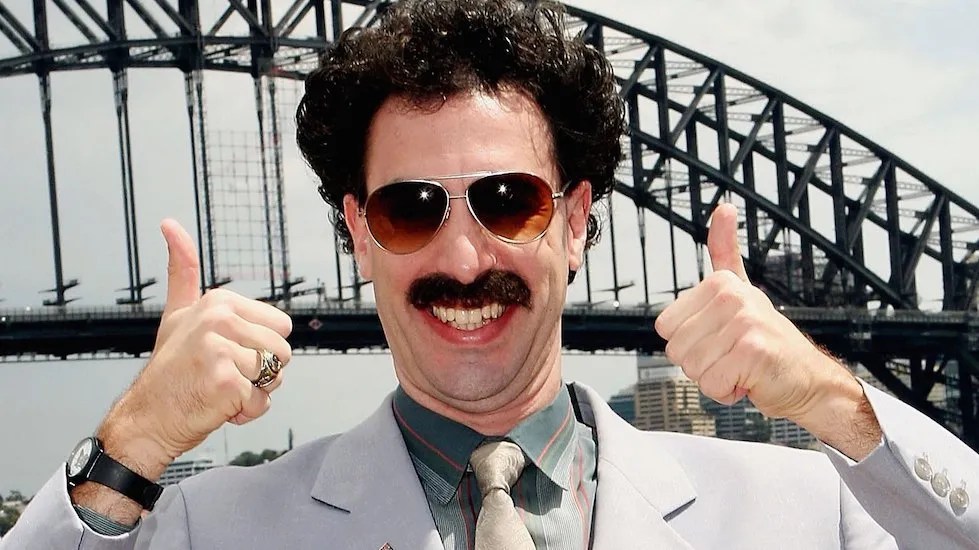
Well, the neighborhood bully, he’s just one man / His enemies say he’s on their land.
— Bob Dylan, “Neighborhood Bully”
Shut the fuck up Sacha.
— Me
Let me get something out of the way first: Sacha Baron Cohen is incredibly fucking funny. He also needs to shut the fuck up.
The Borat movies are two of the funniest movies ever made. The first one is better than the second one, but the second one is also amazing. The Rudy Giuliani scene alone is almost impossible to believe. Maria Bakalova, who plays Borat’s daughter Tutar in Borat II, is fearless. Borat himself remains an extraordinary comic creation. “Throw the Jew Down the Well” is funny. The running antisemitism is funny. The grotesque sex jokes are funny. Ali G is hysterical. Cohen has done things on camera that almost nobody else would have the nerve, discipline, or sheer audacity to attempt.
I still don’t like him.
These are not contradictory positions.
I don’t hate Sacha Baron Cohen. I don’t detest him. I don’t want him canceled. I certainly don’t want his movies removed from circulation. I hope he keeps making comedy. But I don’t like the guy, and the biggest reason is that I think he is one of the great hypocrites of all time
Here’s why.
Not because he’s offensive per se. Rather because he seems to believe that Sacha Baron Cohen should be allowed to offend anybody he wants, while other people have walk on egg shells when the subject gets anywhere close to Sacha Baron Cohen or anything he actually cares about.
And what he cares about is Israel. Sacha is Jewish. So what. The Pope is Catholic and shits in the woods. Obviously. So does the bear. Naturally. And the bear is also Catholic because when he and the Pope were out ripping heaters together in the woods discussing last night’s Mets game for whatever reason the Pope laid the guilt trip of all guilt trips on our friend Mr. Bear and Bear caved. The Pope is one hell of an orator. This much is clear.
The Rules of the Game
I have a fairly simple rule about comedy:
A comedian can joke about anything. Anything.
Hitler. The Holocaust. Genocide. Dead babies. Disability. Race. Sex. Religion. Cancer. AIDS. September 11. Your mother. My mother. Whatever.
Anthony Jeselnik has built his entire career around constructing jokes whose premises make the audience think, surely this motherfucker isn’t going there, immediately before he goes there. Gilbert Gottfried made incredibly offensive jokes sometimes the offensiveness seemed to be the joke. Joan Rivers would joke about disabled people and then when she was lightly booed tell the audience to shut the fuck up cause her daughter was disabled. Whatever Joan. Get a grip. But yeah Joan is super fucking funny too. She just is.
Fine. Tell the joke.
And I retain the right to think your joke sucks.
That’s the bargain.
There is another old rule of comedy that matters here: punch up rather than down. I don’t regard this as an inviolable either. Sometimes you can punch down. But if you’re going to punch down, the most elegant ways to do it is to turn the fucking gun around and shoot yourself before anybody has time to complain.
Shane Gillis understands this beautifully.
Gillis has a routine about Downs syndrome in his family. As he approached the joke you can feel the audience tense because they know exactly where Shane is heading. And then comes the turn: Downs syndrome, he says, “took a shot at me and missed.”
Pause.
“But it nicked me.”
There it is.
Mic drop.
The joke suddenly isn’t look at these people. The joke is Shane Gillis. He has placed himself inside the blast radius.
That’s how you fucking do it.
Take notes, Sacha.
Kazakhstan
The central problem with Borat isn’t that the character is a monster.
The character is supposed to be a monster.
He’s misogynistic. He’s antisemitic. He’s ignorant. He talks about women as property. He says unspeakable things about his family. The comedy depends upon his being so extravagantly horrible that the Americans around him sometimes reveal things about themselves while trying to accommodate him.
Cohen has explained this himself. After the first movie provoked outrage in Kazakhstan, he said he was surprised because he assumed audiences would understand that the Kazakhstan of Borat was effectively fictional. More revealingly, he explained why he had chosen Kazakhstan in the first place: it was somewhere his intended audience knew so little about that he could exploit whatever vague stereotypes they possessed about an obscure former Soviet republic.
Read that again.
He chose Kazakhstan because people didn’t know much about Kazakhstan.
That’s my entire objection.
Kazakhstan wasn’t powerful enough in the Western imagination to fight back against the joke. It was a blank space. Cohen could write whatever he wanted onto it.
And what did he write?
Incest. Prostitution. Sex slavery. Antisemitism. Primitive stupidity. Misogyny. General barbarism.
The real Kazakhstan is hardly a liberal-democratic paradise. Its government has an ugly record on political and religious freedom, including restrictions on religious groups and expression. But the United States State Department describes a secular constitutional system containing multiple religious communities—not the insane antisemitic hellscape Cohen invented.
Cohen’s answer was essentially: guys, you’re missing the joke.
He said Borat’s antisemitism was designed to expose the antisemitism of others. He trusted intelligent viewers to understand that the character’s beliefs were delusional. Indeed, Borat’s supposedly Kazakh language is largely Hebrew, an enormous inside joke aimed directly at Jewish and Israeli audiences.
I understand the joke. I even laugh at the joke. I just think Kazakhstan is entitled to say: Why the fuck did you have to make it us?
Make up a country.
Boratistan.
There. Done. Same jokes. Same movie. Same character. Same America. Same satirical mechanism. Nobody loses anything.
Instead Cohen picked an actual country precisely because his audience knew almost nothing about it, filled the vacuum with the most grotesque shit imaginable, and then informed the people who actually lived there that sophisticated viewers would understand.
That’s punching down.
It’s also pretty fucking convenient.
The Sacha Baron Cohen Exception
Here is where Cohen really begins to bother me.
Because Sacha Baron Cohen understands context better than almost anybody alive when Sacha Baron Cohen needs context.
Don’t take Borat literally. Understand the character. Understand the satire. Understand the intention. Understand the irony.
Understand that saying something antisemitic can actually be a means of attacking antisemitism. Understand that an offensive representation of a group isn’t necessarily an attack upon that group.
I agree with every word of that.
But Cohen has also become a prominent advocate for restricting the amplification of hateful speech online. In his celebrated 2019 Anti-Defamation League speech, he attacked social-media companies for spreading antisemitism and other forms of hate and argued, in the formulation subsequently popularized by the ADL, that freedom of speech does not entail “freedom of reach.
There is a serious argument there. Facebook is not the First Amendment. TikTok doesn’t have a constitutional obligation to recommend Nazi propaganda to fifteen million teenagers.
Fine.
But notice how dramatically the moral vocabulary changes.
Suddenly representation has consequences.
Suddenly words can hurt actual populations. Suddenly the intentions of the speaker aren’t everything. Suddenly the distribution mechanism matters. Suddenly we have to consider what stupid people might believe after encountering offensive material.
Where the fuck was this standard when Kazakhstan was telling you that millions of people who knew nothing about their country were learning about it from Borat?
That doesn’t mean Cohen is wrong about online antisemitism.
It means the principle has to travel.
“The Biggest Antisemitic Movement Since the Nazis”
Then, after October 7, Cohen went considerably further.
During a 2023 meeting with TikTok executives, he accused the platform of creating “the biggest antisemitic movement since the Nazis.” People participating in the meeting cited genuinely vile material directed at Jews—comments praising Hitler and invoking Anne Frank—and Cohen told TikTok executives, “Shame on you.”
Let’s be very clear.
“Hitler was right” is antisemitism. Threatening Jews is antisemitism. Celebrating the murder of Jews because they’re Jews is antisemitism.
There is no difficulty here whatsoever. Fuck those people.
But Israel is not Judaism. The Israeli government is not the Jewish people. Benjamin Netanyahu is not the Jewish people. The IDF is not the Jewish people.
And criticism of the conduct of the Israeli state is not inherently antisemitic any more than criticism of Saudi Arabia is inherently anti-Muslim or criticism of Kazakhstan is inherently anti-Kazakh.
That distinction matters enormously, particularly during a time in which people are arguing simultaneously about terrorism, civilian deaths, occupation, hostages, settlements, military proportionality, national self-determination and the conduct of one of the most powerful armed forces in the region.
Israel can defend itself.
Literally.
It is a nuclear-armed state by widespread assessment, possesses an extraordinarily sophisticated military, and has enjoyed immense diplomatic, military and financial backing from the United States for decades.
Israel is not Borat’s Kazakhstan.
And it certainly isn’t Borat.
Bob Dylan once called Israel the “Neighborhood Bully.” What exactly Dylan meant in that bizarre song on Infidels is between Bob Dylan and whatever collection of ghosts, Biblical figures and card players happened to be occupying Bob Dylan’s skull in 1983. Good luck getting a straight answer.
But the phrase is useful.
A neighborhood bully can still get attacked. A neighborhood bully can still have legitimate fears. A neighborhood bully can even sometimes be right. He’s still the neighborhood bully.
Power matters.
The Borat Test
So here is the test I would apply to Cohen.
I call it the Borat Test. Whenever somebody says something provocative about Israel, Zionism or Jewish political power, ask whether Cohen is willing to grant that speaker the same interpretive tools Cohen demands for himself.
What’s the context? Who is actually being attacked? Is this literal or rhetorical? Is the speaker criticizing Jews or criticizing Israel?
Could an ugly formulation nevertheless be attempting to expose a legitimate problem? Should an entire argument be reduced to its most offensive sentence? Does intention matter? Does irony matter? Does satire matter?
Does the intelligence of the audience matter?
These aren’t tricks. They’re Sacha Baron Cohen’s own defenses.
If those principles are good enough to explain why a Jewish comedian can stand in an Arizona bar singing an antisemitic song called “Throw the Jew Down the Well,” then they’re good enough to use before declaring somebody an antisemite because he said something nasty about Israel.
Same rules. That’s all I’m asking.
Same fucking rules.
Sacha Being Jewish Doesn’t Change This
Cohen is Jewish. He’s proud of being Jewish. He speaks Hebrew. His mother was born in Israel. He spent time on a kibbutz. His Jewish identity clearly matters enormously to him.
Good. None of that bothers me.
It explains why antisemitism gets under his skin. If anything, it makes his concern more understandable.
But everybody has a thing that gets under his skin. Everybody has a sacred cow.
The real test of a comedian’s commitment to transgression isn’t what happens when he transgresses somebody else’s sacred boundary.
It’s what happens when somebody transgresses his. That’s the test Cohen keeps failing for me.
He wants Kazakhs to understand. He wants gay people to understand Brüno. He wants religious people to understand. He wants women to understand. He wants Americans humiliated by Borat to understand. He wants everybody to understand that outrageous speech can have another layer underneath it.
OK
Dave Chappelle Has the Same Problem
Dave Chappelle occasionally irritates me for a related reason.
Not because he jokes about trans people. Joke about trans people.
I don’t give a fuck.
But when a hugely wealthy, hugely famous comedian spends years repeatedly returning to a tiny and comparatively vulnerable minority, eventually “I’m allowed to make these jokes” stops answering the criticism.
Of course you’re allowed. Nobody asked.
The question is whether you’re punching down.
And telling us afterward that you had a trans friend doesn’t magically resolve the question. Chappelle’s story about his friendship with the late trans comedian Daphne Dorman may be sincere and moving. It still doesn’t operate as a universal permission slip for everything else he says.
Again: tell the jokes. And everybody else gets to tell you whether they suck.
That’s comedy too.
Don’t Cancel Him
I don’t want Sacha Baron Cohen canceled. I don’t want Chappelle canceled.
I thought Shane Gillis getting fired from Saturday Night Live over a podcast barely anybody listened to was ridiculous. The subsequent trajectory of Gillis’s career suggests that cancellation wasn’t exactly fatal anyway.
Good for him.
Let everybody work. Let everybody talk. Let everybody offend everybody.
Then let everybody else answer.
This is the part of contemporary culture I increasingly can’t stand: everybody wants free speech for his own side and a fucking tribunal for the other guy.
No.
Sacha gets Borat. Kazakhstan gets to say Sacha is an asshole. Chappelle gets his trans jokes. Trans people get to say Chappelle is full of shit. Shane Gillis gets his jokes. People offended by Shane Gillis get their boos. Israel gets its defenders. Palestinians get theirs. Jews get to identify antisemitism.
Everybody else gets to tell them when they think criticism of Israel is being incorrectly conflated with antisemitism.
That’s the game.
Is Sacha Baron Cohen an Asshole?
Apparently I’m not the only person who has asked his.
Rebel Wilson devoted a chapter of her memoir Rebel Rising to Cohen and publicly called him a “massive asshole.” She alleged that her experience working with him on The Brothers Grimsby left her feeling bullied and humiliated and described disputes over sexual material she says he wanted her to perform.
Cohen has categorically denied her allegations. His representatives called them “demonstrably false” and said they were contradicted by documents, footage and witnesses. Portions of Wilson’s account were subsequently redacted from British editions of the memoir for legal reasons.
I wasn’t there. I don’t know.
I’m not convicting Sacha Baron Cohen of anything on Rebel Wilson’s testimony. I merely note that she doesn’t appear to have enjoyed the experience.
Neither, apparently, did Kazakhstan.
The Big Hypocrite
And so we return to the charge.
Sacha Baron Cohen is not a hypocrite because he’s Jewish. He’s not a hypocrite because he worries about antisemitism. He’s not a hypocrite because he defends Israel. He’s not a hypocrite because he’s offended by something.
He’s a hypocrite because, in my view: he demands a degree of interpretive generosity for his own provocations that he does not consistently extend to everybody else’s.
That’s the fuckin’ thing.
You cannot spend twenty years telling people to understand the sophisticated mechanism underneath offensive speech and then suddenly become Officer Sensitive when the offending speech approaches your own house.
You cannot tell Kazakhstan that everyone understands your Kazakhstan isn’t really Kazakhstan when you specifically chose Kazakhstan because nobody knew anything about Kazakhstan.
You cannot build one of the greatest comedy careers of the century by exploiting ambiguity, disguise, deception, grotesque stereotypes and deliberately offensive speech and then behave as though context becomes secondary when the subject matters personally to you.
Or, rather, you can.
You’re Sacha Baron Cohen. Do whatever the fuck you want.
And I’ll do what I want. I’ll call you on it.
That’s the other half of free expression.
Because the comedian has the right to joke about absolutely anything. And the audience has the right not to laugh.
The target has the right to be pissed off. The critic has the right to say the comedian is punching down.
And if you’ve spent your career demanding that everybody else take the joke, you had better be prepared, every once in a while, to take the fucking joke yourself.
Bob Dylan called Israel the neighborhood bully.
Maybe Dylan meant it. Maybe he didn’t. It’s Dylan baby. Who the fuck knows.
But even the neighborhood bully gets made fun of.
Settle down, Sacha. Shut the fuck up.