On the Film “My Dinner with Andre” Part I: Wally in New York

Note: Opening a multi-part early series from my first blog Classical Sympathies back in 2009, this piece takes up the beginning of Wallace Shawn’s walk through New York en route to his meeting with André Gregory in My Dinner with Andre, using Wally’s voice-over as a lens on artistic precarity, everyday survival, and the comic disproportion between existential weight and mundane errands. The note situates the film’s opening movement as both narrative setup and philosophical framing: a winter city of post offices, xerox shops, and unanswered calls becomes the psychological prelude to a conversation that will later expand into memory, performance, and self-mythology. This installment follows Wally up to his arrival at the restaurant for the pre-dinner drink, where the film’s central encounter is still suspended in anticipation, and meaning is generated less by action than by the act of getting there.

My Dinner with Andre is the famous, or infamous, 1981 film of a dinner conversation between Wallace Shawn, the actor and playwright, and Andre Gregory, the theater director. If I were to make a twofold claim for the film: i) that it is one of the most action packed films ever made, and ii) that it effectively encapsulates the thematics of the entire 20th century, I do not think this would be overstatement. My intent here, however, is not to establish either of these postulates, but rather to simply “blog” the script in the hopes that what needs to be said works its way to the surface. Fair warning: the undertaking will require several posts.

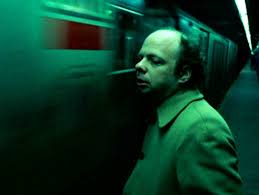
Money crops up on two of the first three pages of the script, and because money, and the lack of it, is a theme that runs beneath the entire script: Andre has money, has the freedom to travel and to spend several years trying to “find himself”; Wally does not. Still, “having money” is, as ever, a relative concept. At the opening of the film, Wally is seen walking through the streets of New York, heading for the restaurant where he is to meet Andre. It appears to be winter, maybe February. In the opening voice-over, Wally ruminates on the life of the artist: The life of a playwright is tough. It’s not easy, as some people seem to think. You work hard writing plays, and nobody puts them on. You take up other lines of work to try to make a living–acting, in my case–and people don’t hire you. So you spend your days crossing the city back and forth doing the errands of your trade. Today wasn’t any easier than any other day. I’d had to be up by ten to make some important phone calls, then I’d gone to the stationary store to buy envelopes, and then to the xerox shop. There were dozens of things to do. By five o’clock I’d finally made it to the post office and mailed off several copies of my plays, meanwhile checking constantly with my answering service to see if my agent had called with any acting work. In the morning, the mailbox had been stuffed with bills. What was I supposed to do? How was I supposed to pay them? After all, I was doing my best (17).

One of the marvelous things about the film is the tongue-in-cheek humor that is rarely, if ever, directly alluded to. A deeply serious film, Andre is also a comedy, a fact which we can recognize because we see that the writers are having fun with the characters who are in turn themselves. That is, Wally and Andre are playing versions of themselves–we assume that most of the experiences that Andre recounts in the film are based on real experiences, and that Wally’s account of his home life is more or less true to life–but exaggerated versions. As Shawn says in the preface to the script, “I knew immediately that {…} I’d have to distort us both slightly–our conflicts would have to become sharpened–we’d have to become–well–characters {…} It would be an enormously elaborate piece of construction” (14). In this initial passage, the humor lies in Wally’s conception of a difficult life: “I’d had to be up by ten to make some important phone calls.”

Wally’s sense of pressure is, from the outset, deliberately out of proportion to the scale of his circumstances. The tone is one of genuine complaint, but the complaint itself is almost comically domestic: the architecture of a “hard day” is built out of errands, envelopes, xerox shops, and an answering service that may or may not contain salvation in the form of an acting job. What Shawn achieves here, and what the film quietly sustains, is a recalibration of seriousness—where existential weight is not attached to grand events but to the texture of administrative survival. Wally’s New York is not a place of romance or revelation, but of circulation: between post office, mailbox, and telephone, as though modern artistic life has been reduced to a loop of deferred contact with recognition.

At the same time, the humor is never fully separable from sincerity. Wally is not merely being mocked; he is also articulating a recognisable condition of artistic precarity, one that the film refuses to glamorize. The genius of the opening monologue lies in this double register: we are invited to laugh at the disproportion between emotional tone and material fact, but we are also made to recognise how easily that disproportion becomes a lived reality. The “dozens of things to do” are not nothing; they are just insufficiently legible as crisis, which is precisely what makes them feel like crisis.

By the time Wally finally moves through the city toward the restaurant, the structure of the film has already been quietly established: this is a world in which meaning is not delivered through events but through the way events are narrated to oneself while walking between obligations. New York, in this sense, is not a backdrop but a medium of self-composition—an environment in which thought is constantly being assembled under mild pressure, as though consciousness itself were an errand.

He checks the time again, as he has been doing throughout the afternoon, and adjusts his route slightly, not out of urgency so much as orientation. The meeting with André already exists in his mind as something slightly unreal, a fixed appointment that has not yet been granted substance by arrival. He crosses another block, passes into the thinning evening light, and begins to approach the restaurant where, for the first time that day, the structure of waiting will shift from solitary to shared.

to be continued…
Scenes from Hamilton College II: Freshman Year Continued (with cameos from Honey, the Print Shop, and Billy Bragg)

Note: In Part I of this series I wrote about my freshman year at Hamilton, focusing on two friends, Ian and Jake. Part II will branch out and cover a fairly wide, and somewhat random, set of memories.

Epigraph:

I had an uncle who once played for Red Star Belgrade
He said some things are really best left unspoken
But I prefer it all to be out in the open

Billy Bragg

I have already written quite a bit about the characters who lived in the North Dorm freshman year at Hamilton, however there are a few more to cover. First were the first floor stoners. Basmo was a stoner, and he lived on my side of the dorm, but on the other side of the first floor lived the hardcore stoners. This consisted of a quad of guys whose names I don’t totally recall, but one was Peter Kimber, and who got baked at all waking hours and played Roger Waters’ Amused to Death solo on repeat. Next to them, in a double I believe, lived Keys. Keys’ actual name was Caleb, but everyone called him Keys because of the six to eight keys he had dangling from around his neck at all times. What on earth did he need all those keys for? One for the dorm, maybe one for a car (although he should not have been driving at all because he was the single biggest stoner in the dorm and perhaps on campus), what else? I can’t imagine.

Keys and I were not that close, but I did see a lot of him because we had the same job, which was in the school print shop. I don’t know if print shops still exist in the same form in this digital age, but back then the print shop was busy as. We held the campus down. There were two slightly older women who worked at the print shop full-time and three of us students helping out. The full-timers were Sally and Deb. Deb was the boss, and she was kind of motherly and kind to the students. Sally was nice too, but she could be tough. She would bark at us when we made mistakes, which was often because we were running large machines that would glitch pretty frequently. Sally was both the little sister to Deb and also the enforcer. I liked them both, even though Deb ended up firing me, which I’ll get to later.

So Keys would come in lit every day and sort of fumble through his work, which consisted mostly of stapling and collating. I was trusted more than Keys, with good reason, so I ran the machines, but I also did stapling and collating. We printed things for professors, menus for the dining halls, the school newsletter, and a bunch of other stuff. The third student was a girl whose name I don’t recall, and she was a super-hardcore feminist. Everything in the world that was wrong was men’s fault, and it was her only topic. She didn’t seem to dislike me so much as just want to lecture Keys and I all through work, which usually lasted two to three hours in the afternoon, about the ills of men. I was, and am, up for a little feminist theory but Keys was no help and I don’t even think he noticed her, so it was kind of just me and her. Serious feminism and collating are, perhaps, not best paired.

I didn’t originally want the print shop job. I needed work, and there was kind of an intake for all working students where you put your first choice. I put library, but didn’t get the gig. John Innes put audio/video and he got it, which meant he often had to get up early to set up videos for professor’s classes. I would not have been good at that. The print shop was more my speed, but eventually it got really repetitive and I started skipping work more and more. I would go walk in the woods behind campus, or just drink coffee with about a half cup of honey and hang around after class. I also improved as a student through the year, and took my English classes pretty seriously so I was spending more time in the library, although still not sleeping much.

My money situation was tight, although not as bad as it would later be during my junior year abroad in New Zealand where it was super tight. I had a little income from the print shop and my parents sent a small allowance once in a while, but I usually didn’t have more than about 15 bucks in my pocket at any one time. What money I did have went mostly to CDs, as many as I could afford. I had a dining hall pass, but the dining hall food was not really my style so I mostly lived on toast and coffee with honey. Then at night people would order pizza from a local shop, but that was too expensive for me so I would get “friend dough.” Fried dough is just what it sounds like–deep friend pizza dough with powdered sugar, and it cost about $1.50 for a big box. Not the best diet, but it was what I could afford.

One time the father of one of my classmates from high school visited for some reason; he must have been in the area. We met for lunch, and when he left he handed me $100 bucks. This was a serious windfall, and I immediately blew it on CDs, perhaps Neil Young’s Harvest Moon and others. My CD collection, although no rival to Ian’s was slowly increasing and I liked it.

Back in the dorm, in addition to the guys I have discussed, there were also girls, who lived on the second and fourth floor. I got to know the girls directly above us on the second floor pretty well, although not many of the others in the dorm. Among these was Rochelle, who was the girl I was closest to. Rochelle was, I think, from New York, and when she arrived on campus she made a big deal about having a boyfriend. This didn’t last long however, and although I didn’t want her to be my girlfriend I did like hanging out with her. She kind of mothered me a bit though, which I wasn’t so into, because I was going to do what I was going to do. I still have her contact, and I believe she might even read this piece! I think I also met Marie Bishko freshman year, and Marie is someone I thought was really cool.

I don’t really remember any us North guys hooking up with the second floor girls, but it must of happened. Another incident which occurred around this time had to do with my roommate B. and his girlfriend from high school. Like Rochelle, and even more so, he made a big deal of his girlfriend and told us all kind of semi-salacious details. Then one day he told us she was coming to visit and he wanted the three of us in the quad to go to a hotel for a night. I told him sure, if you pay, but he said no. He was dead serious but we told him to forget it, so sure enough she arrived and they hooked up while we all pretended to sleep. That only happened once, thankfully, and it still strikes me as pretty odd. He later broke up with her and fell in love with a Jewish girl, but that didn’t last either because he wasn’t Jewish.

I mentioned in Part I that Jake pledged the fraternity Sig. Ian and John Slack also pledged, Chi Psi (I had to Google the spelling). I spent some time at Chi Psi as well as, where I was alleged to sit on the steps in my trench coat, but I preferred Sig. There was another frat called Deke, and that was where the wildest, and the worst parties were. At Deke there was copious amounts of Milwaukee’s Best (the fabled Beast) and jungle juice. The parties were terrible, but there was a pool table which was a bonus. I didn’t drink much at college, mostly because I had no money, but I did drink some at Deke, with exactly the results you would imagine. I believe it was at Deke where Marc Campbell pulled off his famous pacification move. I didn’t pledge a frat, and I was and remain glad I didn’t. Greek life wasn’t for me.

One guy who I believe lived in North was called Gabe. Gabe was super popular at first in freshman year, and he played guitar on the grass outside the dorm. He was pretty good and he would play “Sexuality” by Billy Bragg which was surprisingly popular in 1992. People, including girls, would flock around him, but over time something seemed to happen to Gabe. He ran for class president and lost to a guy called Kerry who was African American. Kerry lived down the hill in a different part of campus, and he ran really hard for the job. I think Gabe’s ran mostly on a music ticket, and although he got a lot of votes I think he came in second. He may have taken this hard, because he kind of faded into the background, or maybe he just changed up his action. I think I voted, but may have voted for Kerry.

As I mentioned, Jake and I saw less of one another once he started pledging, however we still saw each other in English class and in the English building. We overlapped professors, although he knew some I did not. The two best professors in the English department were George Balkhe and Fred Wagner. Balkhe was still in his prime, maybe late 50’s, whereas Wagner was older and I believe in a semi-emeritus role. I wasn’t even sure I ever took a class from Wagner, but it’s been confirmed that I did, Modern British and American Drama, which makes sense. I didn’t much like 20th century American plays, as plays are mostly blueprints anyway. In any case, Mr. Wagner knew me early in the year because Balkhe praised my reading knowledge to him. Jake and I would go to Wagner’s house, also down the hill toward the town of Clinton (the closest town to Hamilton, about a 15 minute walk), and I recall once we played him the song “Marlene Dietrich’s Favorite Poem” by Peter Murphy, formerly of Bauhaus, with Peter Murphy murmuring “sad-eyed pearl and drop lips…”

Peter Murphy is super underrated by the way, and Wagner liked the song, which just showed how cool he was.

I took a few classes with Balkhe, and we studied poems, and novels–typical choices mostly. I enjoyed these and read most of them, even Faulkner who is really dense. For the ones I didn’t I just faked it. Like I said, Balkhe thought I was amazing because on the first day of class he asked for a list of books we had read and I listed like 200. These were mostly Agatha Christie and John LeCarre and such, but I guess it was good enough. Balhke liked the singer Donovan and the song “Mellow Yellow.”

Electrical banana
Is gonna be a sudden craze

(I later saw Donovan at a new age convention in Boston when I was visiting Ian after college, which I will recount later).

Wagner and Balkhe are both passed away now, so rest in peace to two great English teachers and mentors.

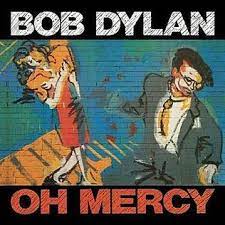
That’s about all I have on freshman year. The last thing is about the featured image for this post, which is the album cover for Bob Dylan’s Oh Mercy. I have written about The Pogues quite a bit, but the album I listened to most freshman year was Oh Mercy. After geology class had a break before lunch and would go back and semi-sleep to Oh Mercy. The quad was always empty at that time of day, and this was the best rest I would get. The album still makes me sleepy to this day, and features excellent production from the famed producer Daniel Lanois. So thank you Bob and Daniel.

Dedication: For Fred. And for George–I hope you are enjoying a little electrical banana up there in heaven.

to be continued…