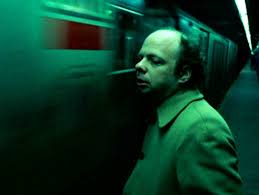
Review of the Film Code 46

Note: We don’t do a lot of film reviews here, but Code 46 earns the exception—partly because Michael Winterbottom is one of my very favorite directors, and still wildly underrated, and partly because this film quietly seeps into you in a way that feels unshakable; set in a world that is clearly not ours but just similar enough to be discomforting—real Shanghai that isn’t quite real, deserts that feel earned, a system of “cover” and genetic law that replaces freedom without ever announcing itself—the film follows William, a kind of intuitive investigator who lives more than feels, and Maria, who works in a bureaucratic “fate factory” and senses, before she knows, that something is already off; their connection unfolds in fragments—interrogation as flirtation, impulse as rebellion, intimacy as violation—until the central truth emerges: in a world where memory can be edited and biology legislated, even love itself can be illegal; the genius of the film is its restraint.

Tim Robbins and Samantha Morton don’t overwhelm you with chemistry, which actually makes the relationship feel more provisional, more real, more doomed—and by the time the system reasserts itself (memory erased, lives restored, Maria exiled with the burden of remembering), you realize the film hasn’t been building to a climax so much as a quiet erasure; it’s less than 90 minutes, barely announces its futurism beyond small details (languages blending, empathy viruses, low-fi surveillance), and yet it lingers in a way much louder films don’t; it also clearly fed into the DNA of the Thin Man—this idea of movement through controlled spaces, of intuition over evidence, of relationships that feel both fated and structurally impossible—and in that sense it’s not just a film I admire, it’s one that got under the skin and stayed there.

Michael Winterbottom’s Code 46 is less a conventional sci-fi film than a drifting, half-lucid meditation on love, control, and memory. It runs under 90 minutes, but it feels strangely elongated—like a dream you keep slipping back into.

The hero, William (Tim Robbins), isn’t exactly living—he’s existing. A kind of insurance investigator, a “driver” moving through a world defined by pollution, restriction, and bureaucratic control. This isn’t the neon overload of something like Blade Runner—Shanghai here feels real, but off. The deserts outside the cities are harsh and empty; if people can’t get “cover” to move, there’s a reason. The world is closed, stratified, quietly oppressive.

William is established early as compassionate—at a checkpoint, he shows a kind of human softness that marks him apart. But he’s also slippery. He bluffs and charms his way through situations, his “cunning” explicitly noted as one of his professional tools. He doesn’t rely on evidence so much as intuition: “It’s intuition you’re paying for.”

Maria (Samantha Morton) narrates parts of the film, grounding it in something more intimate and unstable. Her sense of time is fractured—lucid dreaming, recurring visions, a sense that something is about to happen. “Every year I have this dream… is this the night I wake?” There’s a constant feeling that fate is closing in. She works in what is essentially a “fate factory,” issuing the cover documents that determine where people can go and what they can do. In this world, fate substitutes for freedom.

When William meets Maria, there’s an immediate sense of déjà vu—she feels she’s met him before. Their early interactions blend interrogation and flirtation. The dynamic is unusual: older man, younger woman, but the aesthetic—her shaved head, the stripped-down environments—blunts the cliché. Their connection feels tentative, exploratory. She tests him; he reads her. There’s attraction, but it’s not fully trusted on either side.

Their relationship develops in fragments: subway encounters, shared meals, small rule-breaking gestures. William knows she’s impulsive—she admits it. The film introduces the idea of engineered “viruses” that alter human ability—perfect pitch, empathy. It’s a strange, understated sci-fi touch that reinforces how mediated everything is, even emotion.

There’s a looseness to their chemistry. Robbins and Morton don’t generate overwhelming heat, but that actually works. The relationship feels uncertain, provisional—two people circling something they don’t fully understand. Their intimacy is uneven, sometimes tentative, sometimes urgent. Maria seems to need William more than he needs her, or at least she feels the stakes more sharply.

The world around them continues to intrude. There are hints of smuggling, of bureaucratic corruption, of quiet desperation. Maria has lived “outside” for ten years—without cover, presumably—which raises questions the film never fully answers. William’s moral stance, when it emerges, feels weak, almost performative.

When he returns home, he tries to reassert control—rejecting Maria, then calling her back. But the narrative destabilizes. A colleague dies; William is sent back to investigate. The technology—video links, surveillance—feels oddly low-fi, as if the future never quite fully arrived.

As William digs deeper, the film’s central taboo emerges. Maria has violated Code 46—a genetic restriction law. Through fragments of dialogue and investigation, William pieces together the truth: they are biologically too similar. A “50% match.” Worse, her mother was a clone—one of many. The implications are quietly devastating.

Maria’s past is altered—an illegal pregnancy erased, along with the associated “memory cluster.” Identity itself becomes unstable. Memory, love, and experience can all be edited, removed, rewritten.

Their attempts to escape—to flee together, to build something outside the system—feel almost doomed from the start. The idea of Jebel Ali, drawn from her father’s stories, becomes a kind of imagined refuge. But the system closes in. A car crash. Memory erasure. Reintegration.

In the end, William is returned home, restored to his life, his wife, his routine. Covered for. Maria, by contrast, is exiled—sent out into the desert with her memories intact. She becomes the one who remembers, who carries the weight of what happened.

The final note is pure loss. Lost love, stripped of even the possibility of reunion. Maria staring out into the distance, holding onto something the world has decided should not exist.

Code 46 is not a perfect film. It’s uneven, sometimes opaque, and emotionally muted in ways that can frustrate. But its ideas linger. It captures something rare: a future where control is soft but absolute, where love is possible but prohibited, and where memory itself becomes the final battleground.

It doesn’t hit you all at once. It seeps in.

Craig Finn on Nightlife and Adult Relationships III: Jessamine (Craig Finn’s Miniature Masterpiece)

Epigraph:

Jessamine must have had some dreams/ but she never really said what they were.

Craig Finn

Note: This is the third entry in my little ongoing series on Craig Finn / The Hold Steady songs that take up nightlife, messy adult relationships, and the long shadows cast by fleeting encounters. Part I and Part II are available. I’ve also written at length about what I consider Finn’s two greatest songs: A Bathtub in a Kitchen and It’s Never Been a Fair Fight.

Jessamine is track 8 off of A Legacy of Rentals, Finn’s 2022 solo record distributed on his own label, Positive Jam Records. It clocks in at a tight 3 minutes and 25 seconds, and once again I am simply overawed by Finn’s concision and his ability to tell a whole story in just a few words. It is my opinion, and I do not say this lightly, that Finn is the greatest short story writer to have ever lived. 

Jessamine tells the story of a three week relationship between the narrator, who we will continue to call C. for convenience, and a goth girl with a need for speed. A Legacy of Rentals contains at least three excellent songs, the crime caper “The Amarillo Kid,” the gorgeous “The Year We Fell Behind,” and Jessamine. I would love to write about The Year We Fell Behind as well, however Jessamine falls neatly into our conceit of nightlife and adult relationships, although this one seems to depict more of a young person’s relationship. Close enough. 

Jessamine is folky and lilting, of a piece with Finn’s later work which tends toward folk and country as opposed to Lifter Puller’s indie fever dreams and The Hold Steady’s soaring rock anthems. The Finn song that it most closely resembles is “Esther,” from a 2018 EP by The Hold Steady which also depicts an intense and short-lived relationship. “The party ended suddenly, suddenly it’s over/ That left me and Esther all alone and getting older/ All alone and getting older smoking in the street/ Now everything is Esther and it’s been that way all week.”

Jessamine opens thusly:

I met Jessamine in Cherry Hill

Her dress all done in daffodils

The sticker on her skateboard said, “Speed kills”

And yeah, it probably did just what it said

Cherry Hill is in New Jersey, where the song is set. Jessamine is probably a younger woman, and a skater. The first verse foreshadows her ultimate fate. Incidentally, the first time I visited New Jersey was junior year of college with my Asian Art History class. It was also on this trip that I first visited New York City, the most intoxicating place on earth which I have written about relatively extensively. I wrote about my Art professor in my piece on my senior year at Hamilton College, in relation to a girl I had a total crush on, called L. L. was not exactly goth, but she might have been goth-adjacent. And she was totally intense. More on goths in a minute.

Verse II adds a little more context.

I only knew her for like three weeks straight

And the whole time we were wide awake

You know “Trenton Makes, the World Takes?”

She had it spray-painted over her bed

It is my experience that short-term relationships can be, probably are, the most intense and intoxicating type of relationships in a sense. The depth that comes with a true crush, while of a completely different valance from a long-term relationship, is, I believe, without parallel. But then again, I’m an action junkie, as is Finn. I wrote about the power of a crush in my Bad Moves piece where I confessed to a serious crush on their lead singer, Katie Park. I actually sent the piece to the band via Instagram, and they responded saying “Thanks for the write-up.” I don’t know, but I like to believe Katie read, or at least saw, my piece! Unfortunately, Bad Moves are disbanding and are, I believe, on their farewell tour.

The wording “three weeks straight” implies that C. and Jessamine were, temporarily, inseparable, sleep deprived, and deep into each other. Trenton is, of course, also in New Jersey, and though I hadn’t heard of the exact phrase quoted until I listened to the song, it is apparently well known locally and appears in neon on a bridge.

Verses III and IV introduce Jessamine’s death obsession, and to me anyway suggest that she is what I would call a kind of a goth.

We used to hang around her room

Getting off on all the gloom and the doom

Watching cavemen in the cartoons

Playing xylophones made out of bones

She was sexy, but still death-obsessed

She said the bloodshed makes such a mess

But you really don’t even have to market it

Yeah, it pretty much sells itself

Now I am not really into a lot of bones and blood personally, but I do like me some goth girls. In fact, in the course of my life I have sort of quasi-dated a few, and for whatever reason they are just my speed. I find goth girls sexy, like Jessamine, caring, and deeply intriguing. And mysterious, of course. I have a weakness for crazy women; I cannot lie. And already I can totally see Jessamine’s appeal.

Jessamine has a number of semi-chourses, and the first one goes like this: 

I should’ve asked her before she departed

How did all these wars get started?

Why do rival crews show up to the same parties

If they hate each other so much?

It’s like they’re secretly in love

Again, we foresee Jessamine’s demise up front. Why would Jessamine have insight into the origins of global conflicts? I’m not quite sure, however the image of rival gangs being secretly in love is oddly compelling. However, it is with the next verse and chorus that the song really gets going.

Verse V and Chorus II go like this:

She said, “Suspicion isn’t wisdom

And the drones look just like doves”

And there was something laying siege to her kingdom

But she never really said what it was

While the incense turned to ashes

And the sunrise was unsure

Jessamine musta had some dreams

But she never really said what they were

Yeah, she never really said what they were

Here we learn that our goth girl heroine has something going on that is unarticulated, or perhaps inarticulable. “Jessamine musta had some dreams/ But she never really said what they were” is such a wonderful and moving line. We all have dreams, I suppose; some come to fruition and some don’t. But Finn is in no way judging Jessamine’s relative inability to describe her dreams; instead this aspect of her character only adds to her obliqueness, her mystery.

The next verse and chorus show that Jessamine in the end, and probably in the beginning, had the upper hand in the relationship.

We kinda ended how we began

With Jessamine meeting a man

And liking that man just a little bit more

Than the boy she had before

I hadn’t even seen her since

I guess this new guy was some kind of prince

I guess his castle was a front for some fence

And then the whole damn city got warm

And they were trying to ride out that storm

Again, Finn is a total master of precision and compression. C. is immature, Jessamine is, to some extent, on the make, her new boyfriend is crime-adjacent (so many of Finn’s songs feature characters on the margins of the legal world), and the whole damn city mirrors Jessamine’s flightiness. The crush is over; C. is dumped and he never sees her again. That’s a weird and kind of almost frightening part of short-lived relationships–while their depths are as intoxicating as anything in life, people will just move on and the moment exists only in memory, burned into the fabric of time, but still fleeting.

The next verse points toward C. getting over Jessamine, and alludes to the idea that what may seem for a time to be a storm will pass; a crush, with all its power, is also somewhat illusory.

‘Cause the rain is inconsistent

And the thunder is insincere

‘Cause it makes a big commotion

But eventually it clears

The next verse and chorus puts a pin in Jessamine’s story, and Finn employs his classic penchant for alliteration along the way. Maybe to get away from the scene, or perhaps for some other reason, C. moves out west, loses his shirt, metaphorically, and literally perhaps, and gets word of Jessamine’s demise.

I went out to San Francisco

And some sailor stole my shirt

I was sitting on the passenger side in a taxi

The first time that I heard

That she was probably speeding

And no one else was hurt

Jessamine must’ve had some dreams

But she never really said what they were

Yeah, she never really said what they were

I love the line here “and no one else was hurt.” It’s hard to fully explain why, but it’s oddly moving that Jessamine, on her way out, with all her attraction to blood and bones, didn’t take anyone with her. Finn doesn’t even really register what C.’s reaction is to Jessamine’s death is, he simply repeats the lines about dreams such that she dies as she lived, unknown to herself and unknowable to others.

Overall, Jessamine might seem like kind of a minor song. It’s short, and maybe doesn’t have the deep metaphorical richness as a song like A Bathtub in the Kitchen. Nonetheless, I love it. My sense is that a writer has to write for years and years before they can get to a song like Jessamine. Finn is a few years older than me, and has accumulated the wisdom and compassion to make a song like this look easy. It is not.

I wish her to say a brief word about AI, which may seem unrelated. The other night I met up with a few friends and some friends of friends were there as well. One of them, a slightly older gentleman who used to work in tech, started talking about how much he loved AI music, especially some kind of mash-up of two well-known bands. I appreciated that fact that he liked this “music,” but I have to confess that I could not have cared less. The idea of AI music, especially music with lyrics, interests me not at all. And this is, essentially, because I like people better than machines, but also because I don’t think AI, at least at this point, can come close to writing a song like Jessamine. I won’t get super political here, however the idea that AI can replace, or even duplicate a Jessamine, or Return of the Grievous Angel by Gram Parsons, or Come in from the Cold by Joni Mitchell, for example, just seems absurd to me. As implied above, Finn had to live 50 years, listen to tens of thousands of songs, and write hundreds to get to Jessamine. At 3 minutes and 25 seconds it is a mini-masterpiece.

Dedication:

For goth girls everywhere.


Note: If you enjoyed this piece you might also enjoy the pieces below, which also cover the singer-songwriter Craig Finn.

WAYFARER: A PLAY

Note: This piece is a five-act play based loosely on a week I spent in Oxford in 2018. Unlike my previous narrative essays on the same material, (here, here, and here), this is written as a staged work, with dialogue, silence, and structure doing the heavy lifting. At its core, the play explores the tension between experience and narration—what happens when a person tries to turn a living moment into a story too quickly, and what is gained (and lost) in that process. While grounded in real events, it is not strictly autobiographical; it is a shaped and curated version of those experiences. As with all my work, the hope is that it resonates beyond its immediate context. Thank you for reading.

A Five-Act Play


EPIGRAPH

I can’t believe all the good things that you do for me
Sat back in a chair
Like a princess from a faraway place
Nobody’s nice
When you’re older your heart turns to ice

Mark Kozelek Have You Forgotten

ACT I — THE WAYFARER


Scene 1 — Registration Desk (Threshold)

Lights: institutional white. Gradual warm shift beneath it, as if memory is already leaking into the space.

Sound: distant conference murmur. A faint, unresolved piano note.

A desk. A GATEKEEPER. A lanyard laid out like an object of passage.

MATT enters. Slightly lost. He has clearly been walking longer than intended.

GATEKEEPER
Name?

MATT hesitates. Reaches for something that is not yet ready.

MATT
Here. I think.

He presents credentials.

Stamp sound. Too loud for the space.

The badge is handed back.

CHORUS (from off, soft, not fully placed in space)
Arrival.
Conference.
Inn.
Story begins again.

NARRATOR-MATT (aside, not heard by others)
I thought I came to learn.

The badge feels heavier than it should.

Lights soften.


Scene 2 — Inn Common Room

Warm, slightly unreal hospitality lighting.

Tables. Cups. A space that feels both public and private but refuses to decide which.

ELODIE is present as if she has always been there.

MATT notices her immediately.

NARRATOR-MATT
Voltage.

ELODIE
Tea?

MATT
Yes. Thank you.

Beat. Nothing rushed.

CHORUS (slightly brighter, almost encouraging)
House lady.
Innkeeper.
Muse—

(a correction, quieter)
No. Person.

ELODIE does not acknowledge the Chorus.


Scene 3 — “Sing for Your Supper”

Sound: faint guitar motif. The room subtly shifts into performance space without fully becoming one.

CHORUS subtly rearranges space like memory editing.

MATT sings quietly:

MATT (singing fragment — The Clientele, “The Violet Hour”)
so that summer came and went
and I became cold
yeah I became cold

ELODIE listens. No visible transformation.

NARRATOR-MATT
Hospitality is not destiny.

The room remains unchanged.

Blackout.


ACT II — THE HOT ZONE


Scene 1 — The Casino

Green felt lighting. Rotating overhead spot.

CROUPIER replaces Gatekeeper.

CROUPIER
Place your bet.

MATT
Meaning.

CHORUS
Luck.
Chance.
Myth begins when odds are misread.

MATT places chip.

Sound: chip hits felt—final, sharp.


Scene 2 — Triptych (Three Trips)

Lighting pulses three times. Distinct beats.

MATT (low, repeating)
Three trips.
No more trips.

CHORUS fractures into three figures: GENIE / GHOST / MESSENGER.

NARRATOR-MATT
Inspiration gone.

GENIE (brief, playful)
First.

GHOST (slow, distant)
Memory.

MESSENGER (clear, neutral)
Transmission.

All fade.


Scene 3 — Jungle Confrontation

Green light. Reduced set. No realism.

MATT
Her.
Leave everything.
Frontman.
Practice.

ELODIE
No.

MATT
What is this?

ELODIE
Not your exorcism.

CHORUS
Brink.

Blackout.


ACT III — NAMING THE PATTERN


Scene 1 — Needy Boys

Two chairs. Neutral white light.

ELODIE
Don’t narrate me.

MATT pauses. This lands fully.

NARRATOR-MATT
I was writing her.

Silence.


Scene 2 — Chapel

Stillness. Breath-level sound only.

CHORUS (barely present)
Meaning.
Destiny.
Story.

NARRATOR-MATT
Room, not revelation.

Silence holds.


Scene 3 — Pattern Recognition

Lighting: subtle timeline shifts—memory flickers, not time travel.

NARRATOR-MATT
Senior year.
Again.

ELODIE
Your pattern is yours.

MATT
I see it.

CHORUS
First choice.

Blackout.


ACT IV — RELEASE


Scene 1 — The Offer

Dusk light.

MATT
Part-time.
Scout.
Not jungle.

ELODIE
Boundaries are kindness.


Scene 2 — The Pivot

Warm domestic light replaces earlier symbolic tones.

MATT
Family.
Music.
Life.

CHORUS
Myth.
Escape.
Hero.

MATT
No.

Silence holds. No response from Chorus.


Scene 3 — Chorus Dissolves

Lighting: references dim one by one.

CHORUS removes masks.

NARRATOR-MATT
The story stayed.
The spell lifted.

Blackout.


ACT V — OXFORD CODE


Scene 1 — Gesture

Morning Oxford grey. Minimal space.

ELODIE
Take care.

MATT
You too.

Beat.

No escalation. No closure ritual.


Scene 2 — Benediction (Chapel Revisited)

Same chapel. Quieter now.

Sound: Arvo Pärt piano. Sparse. Non-declarative.

NARRATOR-MATT
Gratitude.

Silence. Breath.

MATT listens without narrating.


Scene 3 — Train

Sound: distant platform announcement. Train readiness.

Gatekeeper becomes CONDUCTOR.

CONDUCTOR
All aboard.

CHORUS
Run back.
Declare.
Confess.

MATT
No.

MATT boards train.

NARRATOR-MATT
The jungle is real.
The girl is real.
The story remains.

Beat.

NARRATOR-MATT (softer)
You think you’ve finished it. Then it comes back different.

NARRATOR-MATT (aside)
She knew more than I could say.

Train departs.

Lights fade with motion, not blackout.


FIN

My Time in Kumamoto Japan I: NOVA and Meeting Sachie

Note: This is the first entry in a new series about my time in Kumamoto, Japan between April of 1997 and December of 1998. What began as a recollection of a short, chaotic teaching stint but became an excavation of place, power, and early adult identity under surveillance. Set against the compressed social ecosystem of a small Japanese city in the late 1990s, the piece moves through NOVA’s glass-room culture, its porous rules, and the peculiar cast of lifers, bosses, and drifters who inhabited it. What emerges is not a complaint but a tonal study: of being watched, of improvising freedom within constraint, and of the quiet luck of finding something real—Sachie—amid a system that often felt artificial.

Epigraph:

Kim You Bore Me to Death

Grandaddy

I arrived in Kumamoto in April of 1997 to teach English at NOVA, which at the time felt like a pretty wild thing to be doing. Kumamoto is not Tokyo. It’s a smaller city, slower, and NOVA was right at the north end of the Shotengai, basically downtown. Everyone knew everyone, or at least knew of them, which I didn’t fully understand yet.

What I also didn’t fully understand was that I would be living with one of my bosses.

Her name was Sam. She was about 35, from Wales, and she had this story she loved to tell—more like boast—that Donovan had written a song for her mother. I never quite figured out which one. She was in the apartment with me and another teacher, Heather, and she was there all the time. Not just physically there, but present. Observing. Asking. Not in a relaxed roommate way, but in a way that felt like she was always slightly checking something.

NOVA had a loose rule about no fraternization between students and teachers. Loose being the key word. It happened all the time. Another teacher, Cameron, told me a lot of the young women came to find a boyfriend. Whether that was true or not, relationships were constant. There was this big izakaya on the Shotengai where everyone went, and it was basically understood that whatever the rule was, it wasn’t really enforced.

By early June I was seeing Sachie, who had been my student. She was my girlfriend then and is my wife now. I went to her house pretty early on. Her father, Tetsuyo, a gruff, older, very conservative Japanese dad, said he would meet me, but then he went to take a “bath” and didn’t. So I didn’t meet him for months. Her mother, Kazuko, was lovely then and is lovely now.

We couldn’t really spend time together at my place, obviously, so we’d drive around in her car. That was our space. We’d park wherever passed for lovers’ lane in Kumamoto, which, thankfully, was not the Zodiac. No Zodiac in Kyushu, thankfully. We’d sit there, windows cracked, the car quiet, the whole thing feeling both secret and completely ordinary at the same time. That was just how it worked.

At some point I told Joy, another teacher, that I was seeing Sachie, and I told her not to say anything because it was technically against the rules. She said of course. And then, of course, she immediately went and told John G., and from there it got around.

By that point it didn’t really matter. I had to leave, but I also wanted to leave. NOVA felt like a factory. The hours, the structure, the constant low-level supervision—it wasn’t for me. I gave my one month’s notice and in July of 1997 I moved to Washington. Better hours, easier gig, and a lot more freedom.


There were a couple of long-term guys at NOVA, both Brits, both lifers in a way I couldn’t really imagine.

Cameron was the more interesting of the two. We’d go to the big izakaya on the Shotengai—yakitori, big beers in frosty mugs, the usual—but his real place was Madam’s Bar, also on the Shotengai. Madam was the owner, a transvestite, and Cameron loved her. Absolutely loved her. He went there every night.

He took me a few times. It was small and dark, always smoky, with Queen playing on a loop. I drank White Russians and, for reasons that made sense at the time, felt like a bit of a stud. It had its own rules, though. You could feel that pretty quickly.

By Halloween of 1997 I was already at Washington, but I was still around Kumamoto a fair bit, still seeing people. The week before Halloween I went back to Madam’s with Cameron.

“Matty baby, T-shirt time,” Madam said. “You will buy the bar T-shirt. Halloween theme. ¥4000.”

¥4000 was a lot for me then.

“Madam baby, that’s a bit steep,” I said. “I’ve already got plenty of T-shirts. Maybe next year.”

She and Cameron had a quick whispered conversation off to the side. We finished our drinks and left. Outside, Cameron turned to me.

“Matty baby, there’s not going to be a next year. You’re banned. 86’d. Hit the bricks, pal. You’re out.”

“For not buying a T-shirt?”

“Oh yeah,” he said. “T-shirts are serious business.”

And that was it. Never went back.


Mark was the other lifer. Late thirties, married, one daughter. Solid guy. He loved his wife in a way that was both sincere and slightly odd in its phrasing.

“I can hack this job,” he’d say, “as long as I can go home each night to my little mouse’s ear.”

I never heard that expression before or since.

John E. was our boss, technically over Sam. He was always in and out—Osaka, Fukuoka, training sessions, that kind of thing. When he was around, though, he had a habit.

When we drank, he would smack Mark on the butt. All the time. Didn’t ask. Just did it. Mark would try to laugh it off.

“John E. baby, maybe not tonight,” he’d say.

Didn’t matter. It kept happening.

One night John E. turned to me. “Matty baby, can I smack your ass?”

“John E. baby, no way,” I said. “Thanks, but no thanks.”

At least he asked.


John G. was an anomaly. Everyone else was in their twenties or thirties; he was in his sixties. He said—said, mind you—that he had made and lost six fortunes, mostly in gold in South Africa. Maybe. By the time I met him he was broke as fuck.

He would fall asleep in class. Not subtly either. Full-on snoring, loud enough that you could hear it through the glass walls. And these were small classes, three or four students at most, everyone sitting there while he just drifted off. You could see it happen in real time.

John E. had a number of supervisory conversations with him. Nothing changed.


Then there was Paul, who wasn’t even at Kumamoto—he worked out of Osaka. I met him during training in late April of ’97, and he was a strange guy from the jump.

He told this whole story about growing up in Arkansas, parents who were abusive, into drugs, no money. Said he ran away at sixteen and found God on the road shortly after. Compared himself—without irony—to St. Paul on the road to Damascus. Claimed he made a living hustling poker, which might have been true, but there was something else in there too. Not exactly dishonest, but… flexible.

He wanted to convert me. That was clear immediately.

We walked all night. Ten hours, maybe more, all over Osaka. Through neighborhoods, through stations, at one point through a huge homeless encampment—post-bubble Japan, a lot of salarymen who had fallen hard. It stuck with me. Paul talked and listened in equal measure, which is its own kind of technique, but there was always one direction to it.

The goal was simple: Matty finds Jesus tonight, come hell or high water.

I didn’t.

A couple of months later he came down to visit Kumamoto. We went to the izakaya on the Shotengai, then another bar—not Madam’s. Different energy.

There was a girl there, Yoko, and she was very clearly interested in me. So she’s all over me and Young Mr. Johnson is getting, uh, perky. I’m kind of nuzzling her neck and all, and Sachie and I are barely dating, not exclusive yet. Cameron leans over.

“Uh, Matty baby, YMJ is looking a little perky there.”

“Ruh roh,” I said. “Gotta go.”

There were a few good reasons for that.

One, I wanted to date Sachie only. I wanted to be exclusive. I told her the next day what had happened and she was like, “Good. Let’s go exclusive then.” So that was that.

Two, Yoko was like nineteen and I was twenty-three, and she had tons and tons of pancake makeup, which just wasn’t my thing.

So I jetted. Walked fifteen minutes home.

On the way I passed Fumachi. Of course, “machi” means street in Japanese, so to me it read FU-machi, which I found hilarious. I tried to explain this to Sachie once and she was like, “Yeah, machi just means street.”

“Yeah, I know,” I said. “That’s why it’s funny.”

Didn’t really translate.

By the river, as always, hammered dudes were out there pissing into the water. Just part of the scenery.

I get home, it’s around eleven, I’m getting ready for bed, and a taxi pulls up.

Out step Paul and Yoko.

Ruh roh.

Paul’s staying over, sleeping on a futon in the living room, and I’m thinking, what’s the plan here—hook up with Yoko right there while me, Heather, and Sam are all in the apartment? Outta control. Maybe that’s just how he rolled.

Anyway, Yoko took one look at me and jets. She’s gone.

Paul shrugged it off.

“Easy come, easy go.”

We end up playing poker instead. For a little money. I’d played all through childhood, in college, figured I was about a B+.

He wiped the floor with me. Took all my lunch money and didn’t lose a hand.

That’s when I started to believe him.


Looking back, those first two months in Kumamoto feel both chaotic and oddly contained, like everything was happening all at once but also exactly as it was supposed to. NOVA was a factory, no doubt—bad bosses, strange rules, glass rooms, and the occasional existential crisis over whether a black turtleneck and a white short-sleeved shirt constituted a violation of “regs.” I smoked Mild Sevens like it was part of the job description, drifted between pool halls and izakayas, and tried to make sense of a place where everyone seemed to know more about what I was doing than I did. And in the middle of all that, somehow, I met Sachie. That part feels less like chance the older I get, more like the one thing that cut cleanly through all the noise.

It didn’t last long—April to July, just a couple of months—but it stuck. The people, the rhythms, the small absurdities, the feeling of being watched and not quite fitting and also not really caring. I left because I had to, and because I wanted to, and both things were true at the same time. Better hours, easier life, more freedom. But Kumamoto was the start of something, even if I didn’t know what at the time. I never did get that T-shirt.

Dedication:

For my wife Sachie. Glad I met ya baby.

Note: If you like this piece, you may like the pieces below, which take up my time just before moving from the US to Japan.

Levels of Lucidity in Dreams: A Close Reading

Illustrations presented with thanks by Riko Kusahara

Note: This piece was written for the Psiber Dreaming Conference offered by IASD in September 2018, under a strict word limit that forced a level of compression I don’t always allow myself. It draws on a series of lucid dreaming experiences to explore how we determine whether we are dreaming or awake, and why those determinations so often fail under pressure. Looking back, I’m less interested in the specific techniques of lucidity than in the broader question the paper circles: what happens when our usual markers of reality—stability, plausibility, even self-awareness—prove unreliable? The result is less a theory of dreaming than a compact record of trying to think clearly inside a system that continually revises its own ground.

Epigraph I:

The difference between most people and myself is that for me the “dividing walls” are transparent.  That is my peculiarity.

—Carl Jung

Epigraph II:

The conventional scientific sentiment has become that—while we don’t totally understand why dreaming happens—the dreams themselves are meaningless. They’re images and sounds we unconsciously collect, almost at random {…} Which seems like a potentially massive misjudgement.

—Chuck Klosterman

Dream I: I awake in a warehouse.  The bed is against one wall–on the other is a thirty-foot mountain of cantaloupes.  I realize I am dreaming.  I get up and run my hands over the cantaloupes.  They feel absolutely real—as tangible as in life.  I remember that tangibility is not a viable reality test—I’ve made that mistake before.  Now fully lucid, I decide to levitate.  The room dissolves, and I float suspended somewhere in dense, colourless space.  Eventually, I feel the need to come back to earth but cannot locate it.  I feel something beneath me.  This is my bed, and I awake back in the warehouse, relieved yet exhilarated.  The cantaloupes are still there, however I don’t question them.  I just happen to live in a room full of fruit.  Moments later I awake again, this time in diurnal “reality.”

The most common dream experience is of waking from a dream we take to be real, only to understand that it was “just a dream.”  However, a subset of dreamers, probably more than we generally imagine, have experienced lucid dreams, dreams in which, to some degree, they are aware they are dreaming.  Lucid dreamers may also experience “false awakenings”[1]— the sensation of waking progressively through dream “levels.”  False awakenings can be disorienting (Robert Waggoner writes that after seven successive false awakenings he “would accept {…} any reality {…} as long as it stayed put[2]), or sought after (Daniel Love and Keith Hearne have independently developed techniques to induce false awakenings[3]).  Regardless of the desirability of the experience, the existence of dream levels, far from a simple oddity, provides a potential window into massive metaphysical questions.   

First, we need to understand how dreamers use evidence to establish whether they are dreaming or awake.  

II: I am in a dreaming contest with another dreamer.  The contest begins and slimy amphibians begin to appear.  Some resemble frogs; others are in shapes that dont exist in nature.  Their size varies from that of a pinky to that of a fist and they are very colourful.  I am not trying to dream them, rather they are spilling everywhere around my feet.  I sense this is a dream and check on the other dreamer.  He is standing to my right in empty space.  He looks just like me and hasnt begun his dream. 

This dream is non-lucid at first and becomes lucid because of the bright color and absurd number of the amphibians.  An awareness beyond the dream senses a non-natural situation.  

III: I am picking out fruit at a fruit stand.  There are some huge avocados, almost too good looking.  I wonder if I am in a dream, and touch an avocado to check.  The one I choose is ripe and soft—I squeeze it a little.  There is no doubt that I am having a tactile experience, and I conclude I am not dreaming.  Of course, I am. 

Two dreams, two types of evidence.  In Dream II, I correctly identify the amphibians as anomalous, and become lucid.  In Dream III, my attempt to test the lifelikeness of the avocado as an indicator fails.  Simply put, realistic sensation is not sufficiently indicative of reality.  Love agrees: “we are not looking for a qualitative difference in how realistic the experience feels {…} we are {…} on the lookout for issues with stability and plausibility.”[4]  In Dream I, at first the huge pile of melons in my bedroom appears implausible and triggers lucidity; after moving up a dream level, my mind overrides the implausibility by “justifying”[5] the anomaly.  

Because we awake from sleep and dreams every morning, we are very familiar with the experience of awakening.  It is therefore unsurprising that when we wake inside a dream we accept the new reality as the waking world, even if it contains anomalous elements.  

IV: I am in a huge house where a large group of families on motorcycles arrive.  The families are making noise all night.  I realize I am dreaming and levitate over to the families.  Later I decide to wake up.  I ease myself out of bed, bumping my nose into an ironing board.  The room looks and feels exactly like my room.  I dont recall the ironing board being there, but whatever.  Moments later I awake again—the situation is identical, only, the ironing board is gone.  I feel a pit in my stomach, wondering what is ultimately real.

Dream IV is a good example of how dream levels can become increasingly realistic as we move through them.  An ironing board in front of the bed is (for me) more plausible than a house full of bikers.  Dreams such as this beg the question of how we can ever be sure we are awake.  I have dreamt of getting up, walking to the front door, opening it, and emerging into the sunshine in my neighbourhood.  At every point, this dream felt entirely realistic with no anomalies.  After experiences like this, is it wholly unrealistic that we could dream an entire morning?  An entire day?

There are different ways to approach this kind of question.  The first is to use rigorous reality tests.[6]  Using reality tests after each fresh awakening can help us filter anomalies in what may be an increasingly realistic dream state. The second is to open ourselves to a wider set of questions.  Although space limitations make full exploration of these questions impossible, modern dreamers would do well to recall that throughout recorded history people have speculated on the meaning of the dream state and what it can tell us about space, time, life after death, and the nature of reality. 

As dreamers, we know that dreamtime behaves very differently than waking time.  Robert Moss distinguishes between Chronos (“linear time”) and Kairos (the “spacious now.”)  He writes that when Kairos operates in waking life, “ordinary time is {…} suspended or elastic,” and that the world can “quiver or shimmer.”[7]  Moss’ Kairos time sounds a great deal like dreamtime.  Jung in his memoir writes “our concepts of space and time have only approximate validity,”[8]  and “there are indications that at least a part of the psyche is not subject to the laws of space and time.”[9]  Jung makes multiple connections between dreams and life after death, suggesting that our waking world,

in which we are “conscious,” may in fact be a projection of a more “real” and permanent, even timeless, unconscious.[10] 

In the Tibetan tradition of dream yoga, the yogi prepares for death through dreams and meditation, entering death consciously by releasing the bodily energy in such a way that the body partially or entirely dissolves into pure light.  This “rainbow body” is well-documented in Tibet and China, and cases of this phenomenon have been reported across multiple religious traditions.[11]  Finally, Moss connects dreams with the much discussed Many Worlds theory, as does, in popular culture, Richard Linklater. [12]

V:  I am among a large group of people on the top floor of a building.  We lie down on our backs and form bundles.  The molecular structure of these bundles begins to dissolve, we become lighter, then totally empty.  This process is dictated by a power outside of us which doesnt speak.  Once empty, we have the choice to become anything we want.  I choose to become white light.  Suddenly I am transported through space in a burst of pure white light, my old body left entirely behind.  This is the most peaceful and thrilling feeling in the world.  Then, I am back into a new bundle, trying again to become empty.  I make progress, but it is hard and I am over-concentrating.  Progress ceases; I wake up. 

Although I have thought at length about dreams, I am a normal person with a normal job, dreaming anonymously night after night.  I don’t belong to a spiritual tradition, am not a yogi or a meditating hermit.  As a lucid dreamer, like many of us, I am self-taught.  While we anonymous dreamers are wise to suspend judgement about the particularities of a theory as mind-boggling as dreams as an interface to infinite parallel universes, it is perhaps not by chance that my dreams of ascending to a state of pure white light bear close resemblance to innumerable near-death experiences or the reported manifestations of a lifetime of dream yoga.  Although admittedly outside of our normal rational mode of apprehension, the experience of journeying through multiple dream levels, and the energy and amazement which often accompany these experiences, may point the way toward worlds far above, below, or beyond our own.  

Who are we in our trek through life?  Are we the maker, or the made?  The writer, or the page?  The actor, or the stage?  The happening, or the happened to?  Perhaps, our ability to exercise agency in the vastness of forever depends in part on learning to navigate levels of “reality,” however we encounter them.  Or, perhaps, journeying to the far side of the dream can bring us face to face with that which is actually dreaming us.

Bibliography

Jung, Carl. Memories, Dreams, Reflections. Vintage Books, 1989.

Linklater, Richard, director. Slacker. Orion Classics, 1990.

Love, Daniel. Are you Dreaming? Enchanted Loom Publishing, 2013.

Moss, Robert. Sidewalk Oracles. New World Library, 2015.

Rinpoche, Gyalwai Nyugu.  “About Rainbow Body.” http://www.gyalwai-nyugu.com/about-rainbow-body/.  Accessed 24 July 2018.

Rinpoche, Tenzin Wangyal. The Tibetan Yogas of Dream and Sleep. Snow Lion Publications, 1998.

Thomas, Matthew.  “On Coming Through”: A New Meditation on Intention. https://craftfollowsconcept.com/2013/05/13/on-coming-through-statement-of-intent-on-the-approach-of-my-39th-birthday/#more-11. Accessed 24 July 2018.

Waggoner, Robert. Lucid Dreaming. Moment Point Press, 2009.


[1] Waggoner, 61

[2] ibid., 63

[3] Love, 131

[4] Love, 71

[5] Love cites “poor reasoning skills” as one common reason for failing to recognize dream signs and achieve lucidity.  Love, 73.

[6] Love, 78-79; Waggoner, 259.  (Wagonner uses the term “reality check” instead of “reality test.”)

[7] Moss, 49

[8] Jung, 300

[9] ibid., 304

[10] ibid., 324

[11] Tenzin Wangyal Rinpoche, 314; Gyalwai Nyugu Rinpoche

[12] Moss, 74-74; Linklater

Scenes from Hamilton College VII: Senior Year at Hamilton

Note: This is the final part of the Hamilton series. Part I, Part II, Part III, Part IV, Part V and Part VI are available.

Epigraph:

There’s something between us
And it’s changing my words

His Name is Alive

After I got back to Hamilton from New Zealand I was in a pretty good place mentally and physically, but re-entering the Hamilton matrix with a side of senioritis would change that pretty quickly. I was set to room with John Innes, Jonathan Cooper (who was also from Washington), and one more guy who I think was also from Washington. I was fine with this arrangement, as I loved Innes and Cooper, but circumstances would quickly put an end to this configuration.

Possibly the very first night I was back on campus I met up with Ian and we went to a party in the woods. There I met Elana, and maybe also her roommate Kate. Kate and Elana were freshman, and Elana and Ian were tight, although it was kind of hard to say what the exact parameters of their relationship was. In any case I didn’t know any of that yet, and simply found Elana completely captivating. She was from Russia and I believe her father was related to the diplomatic service in some way, although I’m not totally sure.

This first night there may or may not have been a bonfire, as there were several bonfire parties that term. I remember at one of these several people got super drunk, predictably, and the President of the College had to issue a statement to the school newspaper. He said something like, “after investigation, we believe there may have been alcohol provided to minors in the woods.” May have been. Just possibly. Anyway, that was a different night. This night I met Elana, hung out with her for a while, and then lost track of her, which can happen in the woods. I spent the rest of the night searching for her, going from quad to quad on the Kirkland side of the campus (where I was set to live) asking after her. It just so turned out that she spent that same night looking for me.

I was so captivated by Elana, and also Kate and their whole set, that I left the Innes/ Cooper rooms and moved onto Ian’s couch, who was rooming with Miche back on the older side of campus. Innes and Cooper had a whole different set of friends by this time, and there wasn’t going to be a lot of overlap, so I essentially moved out. This was kind of a shitty thing to do, but I did what I did, and another guy who wanted the room just sort of took it over.

The group of people I was running with were basically “co-op” people. In addition to the fraternities and sororities on campus, there was a co-op which was full of alternative types. It was kind of a reverse frat, with vegans, druggies, environmentalists, LGBT folks and the like. At that time in my life I was sort of that ilk and gravitated heavily. One other girl who was around the scene was Nadine. I wrote about her a bit before and will re-print that here:

When I was in university I was trying to hang around some artsy chicks, and was lucky enough to know a few. One day I was hanging out with them and a few girls I didn’t know came over. One of them was called Nadine. These new girls were super cool, and Nadine in particular was so cool as to be a little intimidating. She was from Eastern Europe. I definitely wanted to hang out with Nadine, and sure enough she invited me, right away, to accompany them all somewhere. I hesitated, for some reason. Maybe I didn’t know the first rule of improvisational theater, which is “yes and…” Yes and means, basically, follow the person that goes before you. I would have followed Nadine pretty much anywhere, however I said “I don’t really know you guys,” I said. “Well,” she replied, “this is how you get to know us.”

(The Nadine incident confirms one aspect of my social relations. I’m a Gemini sun with Mars in Leo in my 10th house. I am, basically speaking, not afraid of people. At the same time, I must admit that there is a certain class of beautiful women whom were I to meet them it might take me a second or two to find my tounge. This would include Brit Marling, actress and creator of The OA, Emily Haines, lead singer of Metric, and Kristin Stewart, actress in Personal Shopper. Nadine was not quite in this stratosphere, however she was pretty close.)

Nadine was right of course; I just wasn’t used to making friends quite so quickly. I came to my senses and went with Nadine and the crew. That was a good move.

I find Nadine’s approach to new people fantastic. It can be a little risky to apply it all the time, but in general it’s a good starting point.

It was at this first meeting with Nadine that we all watched about 25 minutes of The Little Toaster, which was the very favorite movie of one of the girls. The Little Toaster is the story of a brave toaster who leads a group of appliances across the country to reunite with the family that left them behind when they moved. The Little Toaster is a trip.

Another girl I met early that semester was Francine. Francine was actually someone I think I met though Innes (Innes and I still hung out and I guested on his sports talk show, as I have mentioned). She was a lesbian, and had a hip-hop radio show on WHCL. Francine kind of hung out with the co-op people too now that I think about it, so I guess there was more friend crossover than I thought. Francine was also a freshman and was really cool. I would later re-encounter Francine when I visited Hamilton after graduation, which I’ll get to later.

One day in the campus coffee shop on the Kirkland side (which I think was new senior year), I picked up a book by the Polish writer Bruno Schulz. I happened to liberate it, and Schulz became my very favorite writer for a time as I read all of his works and his biography as well.

I mentioned that Ian and Elana had a kind of equivocal relationship, and this is true. I won’t go into too much of the details to, for once, respect people’s privacy, however it was equivocal enough that I felt I could seek out time with Elana, at least as a friend. I think I came on a little too strong though, because although we did hang out, she also periodically pushed me away. I was listening quite a lot to a band called His Name is Alive, and their record Home Is In Your Head. The band’s leader, Warren Defever, is from Livonia, Michigan, however their record first came out on 4AD in the U.K. in 1991 and was re-issued on Rykodisc in 1992 in the U.S. HNIA is art pop, very abstract and very good. The have a song called “There’s Something Between Us,” and the lyrics go like this: “There’s something between us/ And it’s changing my words/ Please don’t listen/ It’s not what I mean to say.” I was often kind of tongue-tied with Elana and I felt a lot like the narrator of “There’s Something Between Us.”

To take a break from all that action, I would take Chris’ car which I mentioned in my junior year piece and drive to clear my head. One day I got stuck in the deep mud on some farm and spent an hour trying to extract myself. I think it was not long after this that Chris finally got fed up and took away my key privileges. This was overdue; I was overdoing it. Nonetheless, I was pretty bummed because for reasons passing understanding I really loved borrowing his car.

I did help L. though with her art class, which I have written about elsewhere. Here is that story, slightly edited from the original.

At university I was a pretty good student, but I was sometimes lazy or preoccupied and didn’t always finish my papers on time. When this happened, I would write, or just talk to, my professor and spin an elaborate tale. My style was not to make anything up, not to lie about a sick grandmother or anything like that, but rather to take whatever kernel or truth applied (for example I wanted to talk a long walk in the woods instead of studying), and build it up. This might sound something like:

“I started working on your paper, and got a good way into it, but then I remembered when we were looking at Thoreau and I got really inspired. I needed to get out of my head and into the woods, just like Thoreau. As I was walking so many ideas came into my head and I just couldn’t help but write them down, and that started to become this whole long thing that kind of displaced your essay. I’m really sorry about that, and I think I can maybe apply some of my Thoreau thinking to the essay and come up with something really good.”

Something like this would usually buy me a week or two. College professors, it turns out, don’t really give a damn and enjoy a good story as much as the next person. So I leaned into this, and, to give myself a little credit, usually delivered on the essay in the end. Anyway, word got around that I was pretty good at getting extensions, and other students started coming to me asking me to write excuses for them. I said sure—the ghostwriter instinct was in place early—and would ask them “what excuse do you want to go with?” They would feed me something and I’d spin a one or two page tale out of it. “Go with this,” I’d tell them, and it usually worked.

There was one female student that I had a crush on and would basically have done anything for. And it turned out that she was taking a class in Art History from a woman professor I had also studied with. This professor was a little prickly, but cared about her subject and liked me for some reason. I knew this, and used it. My girl friend (sadly not girlfriend) was dealing with some personal issues and I had already written a few elaborate excuses for her. The shelf-life on these guys was running out however, and she asked me if I would speak with the professor in person on her behalf. Although I was not currently a student in the professor’s class, I agreed and went to the professor’s office. I went with something like this:

“As you know, my friend ‘L.’ has had a lot going on and has had a hard time meeting her deadlines. She feels really bad about this and knows she needs to get back up to speed with your class soon. I remember well what an interesting and enlivening class you teach, and know that L. feels the same. We are just looking for a little more flexibility so that she get can things sorted out and get all her work done. Do you think there is anything we can do about this?”

Of course the professor said sure, she can have all the time she needs.

I pulled a related move to the extension begging in Political Theory class, which was a freshman class I had to take as a senior for graduating credit. The professor was called David, and he had on-his-sleeve ambitions to be President of the College. He talked about it openly, and regularly, which I thought was interesting. He never made it, but he give it his all.

Now I mentioned I had a bit of senioritis, and this is true. After excelling at Otago, suddenly classes were the last thing on my mind. But for some reason David interested me and I would often go to his office hours and chat. There, he told me more about his political ambitions, and we kind of became buds. To his great credit he recognized that I was a senior moonlighting in a freshman class and cut me a lot of slack. For the final presentation we were assigned a group and it was like 25% percent of the grade, or even more. It was supposed to be an in-class presentation worked on over weeks on an aspect of political theory, and I was partnered with one poor freshman guy who was in over his head with me. I told David we were not going to do the presentation in the classroom, and we weren’t going to do a traditional presentation at all.

Instead, I said we would present on Gandhi’s theory of non-violence through a demonstration. As I mentioned in my New Zealand piece, I had read a lot of Gandhi and could pretty much talk off the cuff. So on the appointed day, I took the whole class to a kind of semi-outdoor amphitheater area and somehow procured a dog and a knife. I rattled on about Gandhi for a bit and then handed the knife to my partner and said “now he could stab the dog with the knife if he was in a dire emergency and starving, but Gandhian non-violence teaches us that even in that circumstance not to use violence.” The whole thing was totally absurd and I was milking my friendship with David, but he gave me an A-, which was pretty much the fairest piece of grading I’ve ever received. I was and remain grateful to David for probably saving my honor roll status and for seeing me for who and what I was at the time.

The actual President of Hamilton at this time was called Eugene Tobin. I didn’t really know Eugene, and from my perspective he didn’t have a big impact on my time at Hamilton. The president when I enrolled was a guy called Hank Payne, and I thought he was kind of a suit, but I didn’t really have strong feelings one way or the other. President Hank later threw himself out a window in New York City I believe, so he some issues I didn’t know about and his sad ending gives me some perspective, and compassion, for him. Anyway, after graduation, as I have mentioned, I came back to visit and saw Francine. She was embroiled in an issue where someone had allegedly carved an anti-gay slur into the door of an LGBT person on campus, and she and others felt Eugene was not doing anything about it. She took me to a town hall where we staged a kind of protest and someone directly called him out on his lack of action. He replied with a highly hedged statement that between the lines made clear he did not believe the story. This did give me pause, because I had to admit I was just visiting and did not know all the facts.

Anyway, with the help of David and my advisor I got through the semester and was set to graduate. Mason Anderson visited just before graduation and he and I drove up to Montreal. This time we did not visit a gentleman’s club, but we did drop in at a pub and request the house band to play The Pogues. They kind of laughed at us, but then broke out a decent version of Dirty Old Town. This was the same trip that I got my one and only speeding ticket, driving John Innes’ car “The Grabber.” I got pulled over at the bottom of a massive downhill where the cop was hiding in the bushes. He totally ambushed me and I told him so. “My radar just got checked,” he said, which I’m sure was true but was not the point. Then, it turned out that The Grabber was uninsured, probably as a result of lack of funds on Innes’ part, and I thought I was in real trouble. The cop though waived the insurance thing and just wrote me a speeding ticket–presumably because he knew he had pulled a fast one with the downhill trick. So I guess I got off easy.

At graduation I wore a little purple flower in my hair and a photographer from the local paper took a picture and ran it. Innes says I graduated in linen of course, but that may or may not be true. For better or worse there are a lot of fables floating around about my time at Hamilton.

Overall, I had a good time at Hamilton. If I had had more money I would have liked to go to NYC or Boston, Emerson perhaps, but that would have been pretty useless given my lack of funds. I met a lot of great people, Ian and Jake, Marc Campbell and John Slack, Brett and Miche, L. and Kate, Jen and Jenny, Nadine and Francine, Ann and Rochelle, Jonathan Cooper, and many more. For some high school years are the best, for some college–I sort of muddled through both sets of years but there are many memories that stick with me still. I hope I have done justice to a few of these in this little series.

Dedication: For Hamilton. I was an early decision admit (probably the only way I was getting it), and it wasn’t too bad of a decision.

Scenes from Hamilton College VI: Junior Year in New Zealand

Note: This is Part VI of the Hamilton series. Part I, Part II, Part III, and Part IV and Part V are available.

Epigraph:

They all come and peep through a hole in the wall
Keep the bastards guessing
He likes to take the long way home,
It’s another fine decision

Peter Jefferies

I spent a full academic year, the second semester of my junior year and the first of my senior year, at The University of Otago in Dunedin, New Zealand. Otago is a pretty good university, but Dunedin is pretty small and kind of country. Overall, it was a good experience, but I was flat broke and not on a meal plan due to an oversight by I guess myself and my parents. More on that later.

After I landed, I spent one night at a hotel and bought a bottle of wine, for the first time in my life. I was of legal drinking age in New Zealand. I drank about three-quarters of it and was a little hungover the next day. At Hamilton people did not drink wine.

The first few days I was on a homestay in the country with a sheep farming family. The father spent the day watching cricket, and then would rouse and take the sheep out and move them around, with sheepdogs and all. I remember going to a local pub with two of his sons and their friends and we had five or six beers and they drove home. On the drive home they tried to run over rabbits on the road, and roared with delight when they got close. That was a scene.

Then, I went back to Dunedin, and met my roommates who were all in graduate school studying to be teachers. These were Tim, Ho (who was of Maori descent), Sharlene, and Donna. Tim was a musician and there was a large piano in his room. The roommates were good folks, however I think I disappointed them a little because they asked for an American roommate and were apparently expecting someone really flamboyant and loud. I was not that, and kept to myself much of the year. One time though that I lived up to their expectations was when Tim once again said “you’re from Washington D.C.” and I said “I’m not from fucking Washington D.C., I told you before I’m from Washington State!” Tim said to the roommates, “I told you rooming with an American would be fun.”

There were a number of other exchange students from the U.S. there and I got to know some of them a bit at first, but for some reason I was a little standoffish, and we didn’t hang out much after the first week or so. I was back into running, not smoking and barely drinking, although I did go out once with Ho and his Maori friends and got blasted. I would run 8-10 miles a day, sometimes more, and was in training for a marathon.

As I mentioned, my food situation was bad. We had neglected to put me on a meal plan, and I think my parents didn’t even know this, and at first I chipped in what I could to the communal roommate shopping. However, they ate very poor quality mutton all the time and I just couldn’t hack it. Mutton is pretty bad at the best of times, and cheap mutton is awful. So I went off the roommate plan and ate mostly trail mix for dinner. Trail mix, it turns out, is among the best value for money food around. I would buy raisins, peanuts, and carob chips and that’s what I ate at the flat. For lunch I would eat one apricot yoghurt bar and a cup of coffee, costing around $3.50 NZD. I would eat super slowly, taking about 45 minutes to finish the apricot bar and somehow this made me feel like I’d had a meal. I was living on about $7 NZD a day and was hungry all the time. With this and the running, I was also super thin.

At Otago I studied some more literature, and also a lot of Indian History, with a focus on Ghandi. I learned a great deal about Gandhi this year, and found him interesting. One incident I recall was in one class on Buddhism the professor assigned a paper on Zen. I had the bright idea to turn in an empty paper, which I thought would be symbolic, but the professor was a step ahead of me. “Don’t try and turn in an empty paper for this,” he said, “I’ve seen that move before.”

One more interesting thing that happened was when I was invited to the faculty club for drinks by my Australian literature professor. He was in his 60’s and was an Otago lifer. At first I was kind of flattered to be invited, however on arrival it was clear he had other motives. He started hitting on me in a most egregious manner, and it was obvious he had done this many, many times. I had two drinks and politely removed myself. To his credit this had no impact on how he treated me in class, and things went on as normal. I guess it was all par for the course.

The Otago campus was on the north side of town, and the south side was said to be pretty rough. “Don’t go down there,” I was told more than once, “it’s dangerous.” But I thought it couldn’t be that dangerous, so one day I walked down there by myself to check it out. There were a lot of industrial areas and such, and it was a little run-down, but I got home safe just fine. I suspected that “dangerous” in a New Zealand context might mean something a little different than in a U.S. context.

My roommate Sharlene had a friend who just had a breakup and Sharlene wanted us to get together. She invited us both to a party, and sure enough we started making out, under a table as I recall. It just lasted that one night, but Sharlene thought it was hilarious. “They were pashing,” she cried, “pashing away.” Pashing is apparently Kiwi slang for kissing, or maybe it was a Sharlene original.

Sharlene had a stepfather and I visited his house once. He had a nice car and complained on and on about how many tickets he would get from traffic cameras. Traffic cameras were on the scene in 1995. This appeared to be his only topic. He should have driven more carefully.

After the pashing incident, there was another girl who was interested in me. I forget her name, but it started with an M. M. was really into me, maybe because I read a lot and so did she. There was a kind of club place for students with TVs (I remember watching the O.J. Simpson car chase there), and I would hang out there. M. would come in and lob a snickers bar from over my shoulder for me and buy me a coke. This was really nice and super helpful because I needed all the calories I could get. M. wanted to get together, but I wasn’t into it. We did spend a fair amount of time together, at the club and going to the bookstore with another friend of hers.

As I mentioned, I was in good running shape this year and actually went out for a marathon. I was doing great through the first half, but started to fade really bad around the 20 mile mark. I had terrible blisters and pulled my groin and couldn’t imagine doing another 6 miles, so I pulled up. I asked a couple with a car for a ride to the finish line where there were buses, and they gave it to me but made it clear they were not impressed with me packing it in. I wasn’t impressed with myself either, but marathons hurt like hell.

In addition to running, and starving, I also went out for Aikido. Aikido is a Japanese martial art, and I was already well on my way to my Asian Studies minor and was getting into all things Asian. Aikido was taught by a white couple, and this was their life. They were ok teachers, but the atmosphere was just a little culty. Despite my father’s fears, I have never been amenable to cults-like scenes. I stuck with it for a number of months however, and managed to get my first belt.

I don’t remember listening to a lot of music that year because I don’t think I had a stereo in my room, however, one day on the radio I did hear a song I immediately fell in love with. This was “The Fate of the Human Carbine,” by a Dunedin artist called Peter Jefferies. It was spooky and weird and totally captivating. Cat Power would later cover it, and lines from this song serve as the epigraph for this piece.

One more thing that happened this year was that Jenny from Hamilton visited. I don’t think she came specifically to see me, but I’m not sure. I was traveling, with god knows what money, in the New Zealand Alps which are on the South Island there and are really lovely. Jenny and I stayed at a hostel, and hung out which was really cool. That’s the same trip when I went for a walk in deep snow and almost died when the snow suddenly came up to my neck. Deep snow is almost as dangerous as the ocean, it turns out.

Those are my memories of New Zealand. Despite being so broke I had to eat a 45 minute apricot bar, it was a good year and I got really good grades. My academic focus would fall off, however, when I got back to Hamilton, but that’s a story for the next post.

Dedication:

For apricot bars and trail mix. You literally saved my life.

Scenes from Hamilton College V: Junior Year I: Sega Battles, Reading Dates, Jake Leaves, and a Little Sacrifice Bunt

Note: This is Part V of the Hamilton series. Part I, Part II, Part III, and Part IV are available. This post will look at the first semester of junior year.

Tiger lily girl
Standin’ cross-eyed in the corner
Tiger lily girl
Standin’ toungue tied in the corner

Luna

Whereas in the summer before my sophomore year I got in good running shape in order to go out for the cross-country team, the summer before my junior year is a blur. At some point around there however I applied to go abroad for a year. I chose New Zealand, but only after my father rejected Nepal. He thought I might join a cult or something, but he didn’t really have an understanding of my interest in Asia, what it consisted of and what it did not. New Zealand was the next best thing.

I believe I was lined up to go to New Zealand before beginning junior year, so I knew that I’d only be at Hamilton for the first term. Junior year I roomed in Carnegie dorm, which was just across from North, back on the main part of campus near the English building. I lived with Kevin, Brett, and Chris. Brett and Chris I had known since freshman year and Kevin was Chris’ friend from childhood. In the room next door were Ian, John Innes, Marc Campbell, and Miche. All of us were close since first year as well, so it was kind of getting the gang back together. Although we were in separate rooms, both rooms were kind of communal and we all hung out.

The quads in Carnegie were quite a bit bigger than those of North, and the living situation was much improved. People had sort of settled down as well by then, and the situation was much more contained than North. I liked Carnegie and liked my roommates. We were all pretty easy going.

Chris had a car, a blue one, and I got in the habit of borrowing it. A lot. It got so I actually had his keys because I used it more than he did. I don’t really remember where I would go, mostly just drive around and such, but one incident sticks out as memorable regarding the car. This had to do with a girl called Meryem.

I had met Meryem maybe the year before at a dance at Sig. She danced very provocatively, was tall and lithe, and, well, she turned me on. Meryem was from Turkey and had a bad relationship with her father, which was a common topic for her. Although we only saw each other a few times as sophomores I think, we somehow reconnected as juniors. I took her for a drive in Chris’ car and although I had no money I think I managed to treat her to a meal. I was so low on money that we had to get gas and I faked filling the tank and just put in enough to get home. I didn’t want to be seen as skint, although I was.

Meryem talked a lot about her father on that drive, but we talked about other stuff too and listened to Robbie Robertson’s excellent album Music for the Native Americans. I recited her some of my poetry and talked about Leonard Cohen. The drive, sort of a date I suppose, went well enough, and I’m not exactly sure what I expected, not to go all the was certainly, and I was pretty satisfied with the result.

At the end of the night I got up the courage at the end of it to ask her out again. She said yes, but said why don’t we do reading dates. “What are reading dates?” I asked. She said a reading date is when she would come to my room and we would read next to one another on the couch, and then I would go to her room and do the same. This was not exactly what I had in mind, but it was kind of interesting, so we did a home and home set of reading dates. My roommates came in during our date and asked, “what in the world are you two doing?” We explained the reading date and they laughed. It was a live and let live culture and I think they were happy if I was happy.

Overall, I didn’t get all the way around the bases with Meryem, but I did, at least, get a sacrifice bunt. The runner was advanced.

We only had those three dates, and then I lent her the Robbie Robertson CD and never got it back. I saw her again briefly senior year, but the spark had dimmed. Overall, it was an interesting interlude.

One of the big events of that first semester of junior year was the Sega Hockey championship match with Innes. As I mentioned earlier, Innes usually schooled me. He would play the Calgary Flames (he disputes this, and my memory may be fault here I admit. He also disputes ever even losing at Sega Hockey, which of course ranks high on his list of absurd fables along with me allegedly climbing into a bell tower (?!?) at Hamilton and also graduating in Linen. Linen! He’s totally outta control of course, and everybody knows it) and I would play the Detroit Red Wings, as I recall. But I was getting better and thought I could take him in a best of set of games. I don’t remember how many games it was, maybe just three, and everyone from the dorm gathered round to watch. It was all tied going into the last game, and then Innes’ water on the elbow kicked in and I beat him in the rubber match, either 2-1 or 3-2. Innes complained and complained, whining that it wasn’t fair, but it was fair and I beat him fair and square. I retired from Sega Hockey after that–why not go out on top?

That year Marc Campbell was deep into Luna’s 1994 album Bewitched, and although I was already familiar with their Lunapark album, Bewitched was better. I fell in love with that album, and the band, and have been a big fan ever since. They are in my top five bands of all time.

Another incident that I believe happened this year was a trip to Montreal with Brett, Miche, and I believe John Slack. Innes did not come for some reason. I rode with Brett in his car, and we spent a day or two there. While there, we visited a gentleman’s club at Miche’s insistence. Now there were wealthy people at Hamilton and then there was Miche. Miche was loaded, from a Cambodian-Swiss background. I knew he had money, but at the club he spent it like water, ordering dance after dance and dropping c-notes left and right. I paid the $15 or so to get in and could afford nothing else so I just stood there, like a dweeb. As a group though, we paid our way that night. I got even closer to Brett that trip and realized how much we had in common.

One other thing from junior year was club basketball. I had considered going out for the Hamilton basketball team as a freshman but chose cross-country instead. So we all played club basketball and Kevin was super competitive. I would always wear a Shane MacGowan shirt with an intentionally offensive lyric on it. I won’t quote it, but you can perhaps look it up. It’s from his first solo record. Anyway, a player on another team told me, “I like you but I don’t like your shirt” (echoing by the way exactly with the Sig alum told me at the freshman Halloween party). But that was exactly the point; I wanted to rile up the competition. We got to the final of the club championship and lost by a bucket. Kevin took this hard.

After one semester I was off to New Zealand, so the next piece will take up that experience. However, one bit of business that needs to be addressed is Jake leaving. He actually left at the end of junior year, and came back after I graduated and graduated himself. I didn’t know why he left, and still don’t. Also, I don’t want to get too graphic in my speculations, so here are some possibilities, humorously rendered.

Speculations on Jake Leaving Hamilton:

So why did Jake leave? Here are some speculations:

i) He left to pursue a quixotic quest to reunite the living Beatles. He always did love them. Perhaps Ringo Starr was involved.

ii) He was abducted by Irish leprechauns. Jake’s last name is Irish, and I think he may have identified with the Irish. Shane MacGowan likely had something to do with it.

iii) He may have been hanging a little too much with ol’ Funky Donny Fritz. Curtis John Tucker had a lot to do with it.

iv) Jake was always deep into British fiction such as P.G. Wodehouse and Evelyn Waugh. He could quote these books from memory to an astounding degree. Bertie Wooster and Charles Ryder definitely got involved.

v) He could have had health issues of one kind or another. The Cleveland Clinic may have played a part.

vi) A woman. There is always the possibility of a woman, man’s greatest weakness. Marlene Dietrich’s granddaughter may have had a cameo.

vii) Could he have been in a cult, and been involved in a group wedding of some kind? The Moonies may have had an oblique role.

Those are some ideas. No doubt there are wide of the mark, however the fact is, Jake left and Hamilton was the lessor without him.

That’s a wrap on junior year at Hamilton. It was a good, but brief term and New Zealand would bring a wealth of experiences, and also the most money-crunched year of my life.

Dedication: For Meryem, with whom I went on three dates. I hope you enjoyed the CD.

to be continued…

Scenes from Hamilton College IV: Sophomore Year II: The Sports Show, Ann, Getting Fired

Note: This is Part IV of the Hamilton series. Part I, Part II and Part III are available. This post will take up my friendship with Ann, the Sports Show John Innes and friends had, and losing my job at the print short.

I was living in the delta
Wasting most of my time

Car Seat Headrest

I mentioned in Part III that I was on a sports talk show on the college radio station, WHCL. This was called Sports Corner. John Innes was the leader; it was his show. A friend of ours called Jeff Kingsley was on the show, as well as myself. Kingsley was a huge Buffalo Bills fan, and he stayed on top of the sports news, especially the NFL. Innes was always super prepared, and taped the shows which he would later play for his dad when we got back to Washington State. I sort of kept up with the sports scene, but I was mostly there for comic relief. I would crack jokes and make fun of stuff, but was definitely the third banana on the show.

The radio station didn’t have a lot of bandwidth so the listeners were mostly on campus and Clinton locals, but I recall Sports Corner having a number of regular listeners who would call in. From my point of view, the callers were the best part of the show. We treasured our listeners and gave them plenty of airtime. I never told any of them to “cold compress ma’am.” I was a regular as a sophomore and the first half of junior year until I went abroad to New Zealand. When I came back as a senior I think I just guested. I remember one show where Innes asked me what kind of sports were big in New Zealand. I said “marbles, marbles are really big.” I was just fucking around, but it was pretty funny. Although I was only marginally prepared, Sports Corner was a blast and Innes was a great host. He totally could have done it professionally.

I also talked in Part III about Ann. Ann was Ian’s girlfriend sophomore year, and I got to know her pretty well. Ann sort of took over where Rochelle left off in the mothering department, but she was really different from Rochelle. More intense. Ann didn’t like smoking and she tried to stop me from doing so, to no effect. I remember once, I think it was junior year actually, where at a dorm party she grabbed my cigarette from me and threw it out the window. I just shrugged and lit another one.

If Ann was intense, she thought I was. Innes and Ann and I were hanging out once and Innes said “M.A. (that was my nickname at college) is the chillest guy I know,” and Ann replied “I think he is the most intense.” Well, someone will maybe eventually get to the bottom of that one. One day I dropped by Ann’s room and there was a big jigsaw puzzle partially done. I started picking at it, and she stopped me. “That’s for me and Ian,” she said. Must have been some puzzle. Another time I went to Ann’s house with Ian and she tried, I guess, to pair me up with one of her friends. This wasn’t going to take, but we all did sleep, clothed, in the same bed that night. I don’t think I got a lot of sleep.

While some friends came and went at Hamilton, Ann I was close to sophomore, junior and senior year. After graduation she moved to the U.K. for a bit. I wrote about this elsewhere and will reprint it here.

“My friend Ann from Hamilton College went to England after graduation and she and I exchanged a few letters, back when people still wrote letters. She wrote me that she was drinking some, so I wrote a poem about my image of her over there. The original poem had two or three more verses, but they were terrible. Then a little while back I reconnected with Ann, which was great, and re-worked the poem, which wasn’t. It might have been a little better, but it was still bad. These two stanzas, on the other hand, are awesome, and maybe that’s all there ever needs to be said about Ann in England, you know?” Here is that poem fragment:

Ann belle princess of the isles
the orbs whisper your name even if you’ve gotten piles
or if you’re on the game

Buxom barmaid or bellicose barfly
begs the inevitable question
booze improves the poet’s eye. but ruins her digestion

I still like it.

Ann has read some of this blog, and even contributed a piece as a guest writer, which is not currently live.

The other big event sophomore year was when Deb fired me. I mentioned that as a freshman I skipped work some, and the next year this pattern was exacerbated. I still had no money, however work was becoming really tough. This was not Deb and Sally’s fault at all–I just couldn’t hack walking all the way up the hill just to collate. Instead, I spent time in the woods jumping off little cliffs and messing around in the late afternoon. No hard feelings; looking back I should have done things differently. I don’t remember exactly when I was fired, but I think it was about two thirds of the way through the year.

That’s it–this is a short one. There are a bunch of other things that may have happened this year or the next, so I’ll cover some of these in my upcoming junior year pieces.

Dedication: For Ann, the belle princess.

to be continued…

Scenes from Hamilton College III: Sophomore Year I (with cameos from Sonic the Hedgehog, Ani DiFranco, and Candle Time)

Note: In Part I and Part II of this series I wrote about my freshman year at Hamilton. Part III will take up sophomore year where I lived down the hill in Bundy Dorm.

All you ladies and gentlemen
Who made this all so probable

Big Star

After freshman year I returned back to Washington State for the summer. I have written glancingly about this period, suffice it to say I was not up to much. Still broke, I did have a short lived girlfriend but she dumped me mid-summer. I spent a few days moping around playing nerf golf at my parents’ house, then got over it. I don’t remember much else from that summer except that I got back in good running shape, and when I got back to campus in the fall I turned out, once again, for the running team.

One thing I neglected to mention in my pieces on freshman year is that I actually competed on the JV running team at Hamilton for a time and ran a few races. I was not in great shape that year, and JV was not that exciting. As I have written, I had other pursuits. Sophomore year, however, I was in better shape and had a shot at making the top five. The only other runner I recall was called Harry. I thought Harry lived in Sig, but Jake tells me he was in a frat called THX, about which I remember nothing. In any case, Jake knew him. Harry was a hardcore runner and scolded me about my lifestyle, wanting me to devote myself to the team. I was not going to do this, but I was able to run with Harry and the first team for a number of practices. In the long run though it didn’t work out–they ran mornings and afternoons, and my summer shape wasn’t going to carry me through a hyper-competitive season. I was a good runner, but I just didn’t have the drive. Sooner or later I left the team, this time for good. I look back fondly on Harry however–he was right; I was lazy and needed a kick in the rear.

As a sophomore I roomed in a double with John Innes (there were two John’s in my friend group, John Innes and John Slack), in a dorm halfway down the hill to Clinton called Bundy. Marc Campbell was also on our floor. Ian was living in his frat, but spent a lot of time in Bundy as he was dating Ann, someone who I became close with over the year as well. Jake was over at Sig and I didn’t see much of him, mostly for geographic reasons.

Bundy was a way different story than North. First, I spent a lot more time in my dorm room with John Innes. Innes would watch the soap opera Days of Our Lives and insist I watched it too. I could have cared less, but watched it to be a good friend. We also played Sega, almost exclusively Sonic the Hedgehog and Sega Hockey, at which John usually beat me (however not in the biggest matches, as I’ll get to later). Innes liked rap music and had a pretty good collection. I could get into some of the rap; I liked Public Enemy, KRS One, De La Soul, and a minor band called Basehead which wasn’t really rap. However I was by then deep into what would today be described as alternative or indie music, so Innes’ taste and mine mostly diverged. We were both good about sharing airtime though, so he got to know my music and I his.

The record I listened to the most, by far, that year was Big Star Third: Sister Lovers from the then mostly forgotten American band Big Star. I loved this record (which was on Rykodisc), and played it endlessly while trying to advance in Sonic the Hedgehog. I stuck my mattress in the closet and hung a tapestry over the door area so I had a little cubby to sleep in. Overall, the whole scene was much more domestic than the pretty chaotic North.

Other than Marc and John Innes, I don’t remember exactly who the other guys who were on our floor, but I’ve been reminded that John Slack was one of them. Ian and Jake were living in frats, and over the year I got to know a new crew of people, including several girls. These included firstly Jenny and Jen, who lived in the female area on our same floor (maybe the second floor? Innes will remember). Innes and I became very close to Jenny and Jen, and spent almost every evening hanging out in their room doing something called “Candle Time.” Candle Time was pretty much exactly what it sounds like–we would turn down the lights, light candles (which was probably against school rules) and talk for hours. We would talk about our days, people and goings on in the dorm, and just life in general. It was really wholesome and again, a major change from North.

Candle Time lasted, in my recollection, for a number of months, but not all through the year. Despite spending so much time together, there was no romantic involvement, although I believe Innes and Jen did get together later, and briefly; I’m not really sure. I think it was supposed by some that I myself had a crush on Jen; however although I liked her a lot this was not the case. I did have a little bit of a crush on Jenny, but she had other people who were interested in her and we all hung out so nothing ever happened. That was fine–it was actually really nice to just have close female friends with no expectations.

Jenny and Jen were both from the upstate New York area, broader Rochester as I recall. My guess is they came from relatively less money than many of our classmates, who came from preppier areas, and schools. I actually visited Jenny’s house once or twice, and I think a bunch of us slept over once and watched the film Glengarry Glen Ross. These included Amy Holland, who was one of the coolest chicks around. She was called “Red,” on account of her red hair, and was totally my speed. Everyone else fell asleep during the movie except Amy and I and as I recall she loved what is, to be fair, a pretty stereotypically male film.

Jenny’s house was nice, but seemed pretty middle-class and maybe that’s part of why we all bonded–the richer kids, although I obviously hung around with them a lot, had their own life ways to some extent. I remember one evening Jenny and I went to see the band The New Dylans on campus. I thought they were a good band, and had found their cassette at the campus radio station where John Innes and I had a sports talk show. Their record has a song I liked called “The Prodigal Son Returns Today.” They sounded kind of like a minor league Big Head Todd and the Monsters or something, and are kind of dated today if I’m honest, but I was excited for the show. At first it was pretty full, but people left little by little and by the end it was just me and Jenny. The band played their hearts out for the two of us, including encores! After the show, I joined them for a cigarette outside and chatted. I told them that I really liked the show and they said thanks and all with no mention of the fact that the venue was totally empty. That’s professionalism, I thought, and I imagined that as a band trying to break through playing small colleges and sending cassettes to radio stations they’d had their share of ups and downs. I doubt they are still around, but if so I’m rooting for you guys!

A bigger star that played Hamilton was Ani DiFranco. I saw Ani several times, both on campus and off, as she was pretty huge in New York State at the time. She had not yet released Dilate,” which came in 1996 and was her mainstream breakthrough to the extent she ever had one, but she was a star on campus, mostly with the women but with a lot of the guys too. Ani put on a great show, and I totally got the appeal. She was kind of the Jeff Rosenstock of the day I suppose.

Shawn Colvin also came, and I knew some of the people who were assigned to take care of her backstage. They reported that she was a total asshole, asked for coke, and generally threw her weight around big time. Shawn Colvin was OK, but no so great that she could act like a diva I don’t think. Full on divas are acceptable-like Joni Mitchell might be a diva and what are you going to do–but minor league divas pretty much suck.

Anyway, like I say over the year although we still saw each other, I saw less of Jenny and Jen, and more of other people like Ann, Amy, and Matt Thornton. I’m not sure where Matt lived, maybe Bundy and maybe not, and I don’t recall either how or when I met him, but we soon became fast friends. Matt was full speed ahead, and argumentative, but I can handle my own in an argument, and I really liked him. Matt ran with an interesting group of friends, including several Asian-Americans who I believe lived on the Kirkland side of campus. Hamilton used to be a guys’ school and Kirkland was the attached girls’ school. Then at some point they merged, but the Kirkland side and the old Hamilton side always felt distinct to me and were separated by a bridge.

One time we were talking about going to New York and Matt told me about some clubs for Asians that he was interested in. Matt’s friends told him that he (or I) could not go to these clubs because we would get the shit kicked out of us. Had to be at least half-Asian apparently. But I think Matt went to these kinds of clubs anyway and did not get beat up, because he just sort of rolled that way.

Matt and I and Ian did go to New York eventually, and spent a few days uptown at some person’s apartment where I commandeered a prime sleeping space and we ordered pizza three times a day. I believe this was actually after graduation, as Matt transferred before graduating from Hamilton.

As I mentioned in an earlier piece, this was also the year Ian and I went to Boston to see music shows. We went with a fellow called Cale who was a freshman. Cale was cool, and also we liked him because of his name, reminiscent of John Cale, violist for the Velvet Underground who Ian and I were both fans of. With Ian and Cale I felt like I was in good company–we were all very simpatico.

My academic performance sophomore year was just OK. I took more English classes, and also started to take some History classes including some Asian History with Tom Wilson. Tom Wilson was a good professor, but I think he was one of those guys who really saw himself at U. Chicago or Yale or something. A lot of academics are like that. Nevertheless, Tom was good–tough but fair–and pushed me to really deepen my research abilities. Outside of Tom’s class, my effort was a little mixed, and during the dead of winter I skipped some morning classes because the climb up the hill was just too tough. The winters in upstate New York are pretty brutal, and I preferred to stay local down in Bundy a lot of the time.

One more thing I remember from this year is starting, and then dropping, photography class. I had an old camera that barely worked, and was interested in learning how to develop film in a darkroom. However, photography class was really expensive because we had to regularly buy these huge rolls of film which cost like $50 at the school store. A classmate I’ll call C. to protect his identity told me, “just tuck your pants into your socks and drop the film down your pants and walk out. That’s what I do.” But I wasn’t going to steal film all year and there was no way I could pay the outrageous costs. On top of that, I wasn’t all that good–certainly my classmates outclassed me, crappy camera or not. So I dropped it after six weeks or so; however now that I think about it I may well have met Matt Thornton in that exact class. It’s a possibility.

Note: That will do it for Part III. In Part IV I’ll write more about my friendship with Ann as well as the Sports Talk Show we did on the Hamilton radio station.

Dedication: For the whole Bundy dorm, actually. It was a pretty chill year.

to be continued…