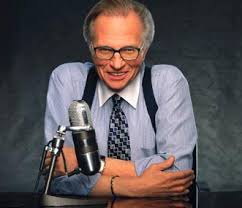
On Larry King, the Radio GOAT

Epigraph:

“I listened to the radio / I waited all night long…”
— Radio Radio, Elvis Costello

Note: This piece reflects my personal memories of listening to Larry King’s overnight radio show in the late 1980s and early 1990s, along with later impressions from television appearances, interviews, and conversations with people who knew him. It is written in the spirit of appreciation and nostalgia rather than media criticism, and emphasizes the uniquely loose, humane, and unpredictable quality of King’s radio work, which for me remains the defining core of his legacy.

I grew up listening to Larry King’s overnight radio show between roughly 1988 and 1992, and in my opinion — which happens to be correct — the radio show was much better than the television version that later made him famous. The TV show was good, even great at times, but radio was longer, looser, freer, and far more unpredictable. It had weird guests, weirder callers, and the feeling that anything might happen at two in the morning. That’s where Larry really lived.

I would listen in my bedroom at my parents’ house in Spokane, Washington, the volume turned low, the house quiet, insomnia hovering. The Spokane AM station — KGA 1510 — carried the show from around 9 PM Pacific time, and then, wonderfully, they would run it again. So I’d listen from nine to midnight, fade, wake at two or three, and hear the same segment again in a half-dream. The effect was surreal. Didn’t I just hear that caller? Didn’t Larry just say that? It created a strange loop of late-night déjà vu that only made the whole thing more atmospheric. The show felt less like programming and more like a continuous nocturnal conversation.

My friend Kelly Rudd loved Larry too. When we were in high school we were both big fans of the radio show, and we talked about it constantly. There were a couple of things that we especially liked. The first was that Larry famously did no preparation. He knew a huge amount about the world, of course, but he didn’t read guests’ books ahead of time. He wanted to come in cold. If his guest was a firefighter, he’d ask, “So what’s it like to be a firefighter?” It sounds lazy, but it was brilliant. By staying open and getting out of the way, he let the conversation go anywhere. This way the show became eventful.

Another thing we loved was what happened after the guest left. Larry would open the lines and take questions about absolutely anything. Most of the time he was generous and patient, but when callers went off the rails he had a signature phrase. He’d cut them off gently: “Cold compress, ma’am,” or “Cold compress, sir.” Basically: lie down, ice your head, regroup. It was hysterical, especially because he used it sparingly. When “cold compress” dropped, you knew things had gotten weird.

Anyway, Kelly and I loved Larry so much that when the station suddenly dropped the show, Kelly proposed we drive to the radio station and protest. So we skipped school, drove across town, and rang the intercom demanding to speak to someone about the cancellation. The station manager eventually came down and heard us out. We knew we weren’t changing anything, but it felt right to try. Larry never came back to Spokane radio, and the show faded not long after, but the whole episode captured what the show meant to us. It wasn’t just background noise. It felt alive.

Larry’s on-air style was the key. He was unbelievably relaxed. By the late ’80s you could tell he had done thousands of hours. Nothing fazed him. Weird guests, drunk callers, eccentrics — all the same to Larry. He absorbed everything. He had pet phrases — “cold compress” chief among them — and he deployed them like a veteran reliever, only when needed. He famously did no prep, and he leaned into naïve questions. He’d ask something simple and let the guest do the work. The effect was disarming. People opened up. He also had real humanity. He listened. He didn’t mock callers. He didn’t rush them. There was compassion there, and I think that’s what I loved most.

And the show could get wonderfully out of control. In one story Larry told from his old Miami days, an adult actress he was interviewing suggested they just have sex during the commercial break. Larry, amused, asked the producers to clear out — but there wasn’t enough time. That kind of anecdote captures the looseness of late-night radio. It wasn’t polished. It was alive.

Larry left the overnight Mutual Radio show in 1994 to focus on television. By then I had already drifted away, but I still caught Larry King Live on CNN over the years. I remember watching during the O. J. Simpson trial while at Otago University in New Zealand, when the show became part of the nightly noise. Later there were the Vladimir Putin interviews — classic Larry, conversational and oddly disarming. And of course there were the great comic moments, like the interview with Jerry Seinfeld where Larry suggested the show had been canceled and Seinfeld snapped back in disbelief, and the Norm Macdonald appearance where Norm kept repeating, “I’m a deeply closeted homosexual,” and Larry tried earnestly to parse it. “So that means you’re gay?” “No, Larry,” Norm replied, “it means I’m deeply closeted.” Pure Larry: sincere confusion meeting absurdist comedy.

Larry’s personal life was famously complicated. He married eight times, had several children — including sons Chance and Cannon later in life — and lived in a kind of perpetual romantic improvisation. The marriages came and went. The last ended painfully and publicly. He once joked he’d never leave his wife unless Angie Dickinson came along — and when she did, he married her. That was Larry: impulsive, affectionate, slightly chaotic. Despite decades of success, he didn’t leave the kind of massive fortune people assumed. The money came and went, as did the marriages. It was a life lived in motion.

My friend Sergio Mandiola actually knew Larry in his later years in Los Angeles. Sergio was running an independent studies program at Beverly Hills High School, and Larry’s sons Cannon and Chance, and he taught his sons for three years. Larry would come by for open nights or just to chat.

Sergio Mandiola: “Larry would come in from time to time and we would talk. He was lovely and open. He talked about his family and his career. One time he told me, ‘Sergio, you should totally have a radio show!’ I was flattered. One thing about Larry is his politics were more to the left than he let on on air. He had strong views and wasn’t afraid to share them in person. Larry was a true mensch and I’m glad I got to spend time with him. I miss him.”

In the end, I’ll say it plainly: for me, Larry King is the radio GOAT. There was no one like him, and there probably never will be. It wasn’t just longevity. It was the curiosity, the looseness, the humanity, the love of people, politics, baseball, and life. He trusted the conversation. He let the night unfold.

And then there was that absurd, wonderful USA Today column, which read like a diary gone completely outta control. Mets lose 6–4…Rain in Baltimore…Clinton flies to Ireland…You’d read it and think, Larry, baby, WTF is this? And also, Mr. USA Today, WTAF are you doing paying for this? But somehow it worked. It was pure Larry — fragmentary, observational, intimate.

And that’s how I remember him most clearly: late nights in high school, the radio turned low, insomnia hanging in the room, Spokane quiet outside.. Sometimes I’d listen from nine to midnight, fade, then wake again to the rerun, half-dreaming, half-aware, caught in that strange déjà vu — didn’t I just hear this? — while Larry kept talking, calm as ever, taking calls from truckers and insomniacs and eccentrics. My listening years were brief, but they stuck. And when I think of Larry now, that’s where I go back to: the low hum of AM radio, the half-fade, and the sweet sounds of his voice in my ear.

Dedication:

For the one and only GOAT, Larry Motherfucking King. RIP baby.

I Have a Crush on Katie Park From Bad Moves

Epigraph:

Could you read between the lines
Or was it just so obvious?

Bad Moves

New Note: This is an older piece, however I am re-releasing it here. I recently shared a longer piece about some aspects of my life, including, quite centrally, music, so this seemed like a good time.

As with anyone’s story, there are layers to mine. One pretty big layer is when in 2018 I traveled to New York/ Brooklyn, Boston, Philadelphia, and Washington D.C. to see the band Phosphorescent. I saw Phosphorescent four times total on their C’est La Vis tour and they were amazing. I bought a sweatshirt from the merch table and the merch gal told Matthew Houck, the lead singer, about me because I told her I’d come all the way from Japan to see the band. He came down from the stage and gave me a big bearhug, not once but twice at two of the shows. He knew I was going through it, and I needed a hug. He’d been through it too, big time, before and when he was writing Muchacho a few years prior.

As I was seeing Phosphorescent I also took the opportunity to see a few other bands. I saw Yo La Tengo twice at the Borwey Ballroom, Jay Som in Boston, and most memorably The Hold Steady twice at the Brooklyn Bowl where they were playing a three night set. The opener for The Hold Steady was a band called Bad Moves. I had never heard of this band, however, and I don’t say this lightly, they put on a better show than The Hold Steady. Now an opener should try to do just this, to “steal the show,” so to speak. A Bad Moves stole it big time. I was enraptured by their lead singer Katie Park, and met her at the merch table which she was running, which is recounted below. My friend I met at the shows, Austin, pushed me to check out their album Tell No One in depth, which I did, and I loved it. On the train from Washington D.C. back to New York I wrote the first version of this piece, which has been fairly extensively edited since then. This is my sneaky favorite piece, maybe not my best, but you can be the judge. Here it is:

I love live music. More than that, I love live music fans, and music fans in general. This piece is basically about being a music fan, and was inspired when I saw the band Bad Moves open for The Hold Steady in 2018 at the Brooklyn Bowl. They were touring on the back of their first full length, Tell No One. While at the Bad Moves/ Hold Steady show a music geek introduced me to a band called Swearin’. Swearin’ has been around a little longer than Bad Moves, and in 2018 had released Fall Into the Sun. The two bands don’t really sound all that much alike (Bad Moves is basically “Power Pop” and Swearin’ is basically “Indie”) but they write somewhat similarly about matters of love and friendship.

Let’s play a game that we live in a world where a record by a band like Bad Moves or Swearin’ would produce radio hits. I want to live in that world. Or maybe I don’t; maybe it’s better for everyone that bands like these stay a little more on the DL. Let’s first take a look at Fall Into the Sun. (Swearin’s frontwoman is Allison Crutchfield, and the band is mostly her baby.) My pick for the single would be the lead off track, “Big Change.” 

The song opens with this soft-spoken reminiscence — basement shows, empty cans, old romances, long nights of half-drunken idealism. Crutchfield sketches a friendship held together by music, chaos, and the sense that they’d accidentally stumbled into their own mutant little world.

I really like what Crutchfield does here. She is basically writing about a friendship solidified over a shared love of music. Now, I know a lot of people. I also have some friends. When you ask an adult, “How many real friends do you have?” the number will vary widely. A lot of people will say “four or five,” something like that. People in general have surprisingly few real friends. I have ten or fifteen, maybe more, but am only in regular contact with about half that number. A good friendship, in my opinion, is one where no matter how long you and your friend have not hung out, if you see them it’s as if not a day has passed. With this sort of friend, I’ve found, there is between yourself and them something fundamental shared. It can be anything really. For example, I first met my good buddy when we were both in graduate school in Arizona, and at first I thought he was a total dick. He was loud, interrupted people constantly, and loved being the center of attention. One night we were drinking as a department and he started razzing me there on the street, just casually insulting me left and right. Suddenly I got where he was coming from. This was, in fact, his way of offering to be friends. Once I understood this, I began to give it right back to him. Called him every name in the book. And he ate it up. By the end of the night we were fast friends and have been ever since, because we share an understanding that our friendship is based, in part, on ripping on each other. Music, obviously, is another great basis for a friendship.

When Crutchfield sings “no art degree, no conservatory/ just Katie and me,” I’m reminded of the refrain from Don DiLillo’s Underworld: “who’s better than us.” If they can do it, why not us? Fuck ’em. That’s what attitude looks like kids–take notes.

So “Big Change” is my single from Fall Into the Sun. (“My single” here just means the song I would choose as the single. For some records, the single is super obvious, while for other records it’s debatable. Bands and producers, in my opinion, do not always get this right.) A good record will tend to have at least two singles; three is a bonus.

For Fall Into the Sun’s second single I’ll go with “Grow into a Ghost.” It opens with a chugging guitar riff with an almost Krautrock drum line. The song is a perfect 3:10–in and out. Do you know anything about lost love? Swearin’ does.

Midway through the record, she writes to an old love with that drifting, half-in-the-desert melancholy she does so well — remembering who she’d been before they met, watching someone fade into absence until they feel more like a ghost than a memory.

Swearin’ is good, but Bad Moves is better. And the star of Bad Moves is the exquisite Katie Park. (I know they are a collective, but my world is my world baby.) Before their show Katie was at the merch table selling…magic eye! That she made by hand. And what did it say? The magic eye said “Bad Moves.” Obviously. I checked it out and chatted for a few minutes with Katie, trying to play it cool. It was the highlight of my year. 20 minutes later she and the band were on stage, crushing it.

The single here is pretty easy. It’s “Crushed Out.” The band released “Crushed Out,” “Spirit FM” and “Cool Generator” as the singles, all of which are excellent. Maybe “Spirit FM” is catchier than “Crushed Out”? Possible. But “Crushed Out” has more lasting power in my opinion. “Crushed Out” is about exactly what it sounds like. It has a basically perfect power pop structure with a killer hook, a classic bridge, and a theme at once super obvious and super deep–the power of a crush.

The whole song is a tumble of infatuation — that feeling where you can’t focus, can’t think straight, and every look or scribbled message feels like it should be obvious to the other person. It captures the power-pop rush of a crush so clearly it almost stings.

Baby, if you are crush-prone that power never goes away. Bad Moves knows this–it’s kind of what the record is about. Crushing out that way can be pretty obvious–do you think I’m crushing out on Katie at all? Nah, this is just a piece of music appreciation.

Cool Generator is my second favorite song on the album, but my “sneaky favorite” is “Missing You.” A sneaky favorite is just what it sounds like: it’s that song that may fly under most people’s radar but that you have a special soft spot for. My all time sneaky favorite song is “Three Drinks” by Craig Finn of the aforementioned Hold Steady. “Three Drinks” shows up on Finn’s 2016 EP Newmyer’s Roof. It’s nearly acoustic, unlike most Hold Steady songs, and sounds just a little bit country. Three Drinks is about a woman (most great songs are) who may have been a child star once upon a time, and is now a drinker. It is an example of a certain type of song that Finn is amazing at, the deeply empathetic look at adult relationships in all of their gloriously flawed complexity. In this sense, Three Drinks fits in with “Spinners” from The Hold Steady’s 2014’s Teeth Dreams, “Tangletown” from Finn’s 2017 solo record We All Want the Same Things, and “Esther” a Hold Steady single from 2018. Finn’s writing on Three Drinks and Tangletown is at its absolute apex. 

“Three Drinks” delivers Finn at peak empathy. A woman with a messy past drifts through a hotel lobby filled with minor disasters, trying to hold herself together until that magic window — the hour between the third drink and the one that tips the night over the edge. Finn nails that space between fear and transcendence where people feel briefly holy.

The refrain focuses on that magic hour between drinks 3 and 4, when matters begin to move from the slightly anxious first stage of the evening to something entirely other:

So anyway, my sneaky favorite on Tell No One is “Missing You.” The song starts like the others, high-speed power pop, and after two verses switches to a near-spoken word breakdown of the tug-of-war between a crush and the expectations of the world around. Guess which wins?

“Missing You” turns into a spoken-word confession halfway through: the push-and-pull between what the world tells you not to do and the crush that keeps winning anyway. It’s simple rhyming, almost naive, but devastatingly effective.

I officially support these sentiments. .

So that’s my sneaky favorite –doesn’t mean it’s better than “Crushed Out” (it isn’t) it’s just a little sneaky. I’m all about sneaky babes and sneaky favorites, on all levels.

In addition to the Magic Eye, Bad Moves also engage in a little publishing. A little literature. Specifically they publish a pamphlet called “The Virtues of Wearing White.”

Chatting with Katie, she acknowledged more than a passing familiarity with the literature of the Jehovah Witnesses. I love Witness literature. Both Witness and Bad Moves publications have a real “it’s gonna be a bright, bright sunshiny day” vibe. If you know me this is not a secret, but I’m a hardcore closet New Ager. There, secret’s out. I’ve messed around with all kinds of New Age action. Once I attended a Kabbala meetup in Manhattan. There were some hardcore New Agers there too, seriously. Those folks were not in the closet at all. Shining eyes, whatever color they are wearing. Me, I like black because it’s easier to launder, but Bad Moves have me thinking. (One other publication you should take a look at if you are into this kind of thing is the Christian Science Monitor. It’s a serious piece of literature. God is great baby, god is great.)

When I was younger my parents had a friend called Tom Hutchinson, who, predictably, went by “Hutch.” Hutch owned a boutique coffee shop there in town and I drove a delivery van for him for a bit. But that’s another story. Anyway, Hutch was a weird guy and he hated the Witnesses. It was one of his favorite topics. He’d call them the “Witlesses,” and say: “When they come to my house I turn the hose on ’em.” People thought this was pretty funny, but I was not that into Hutch’s attitude to the Witnesses. I mean, he didn’t want anyone trying to convert him on his property, which is fair; however, I felt, and still feel, that if someone wants to come to my door, give me a little literature, and talk about how god loves me I’m gonna let them. I genuinely like the Witnesses. They seem like lovely people. Read more