Don’t Pump Me Man!

Note: Spokane, early 1983: minor league baseball, cheap seats, and kids living in the gaps between innings. This piece recalls Spokane Indians games, chasing balls during batting practice, and a strange collision of childhood mischief and adult volatility at the edge of the outfield fence. Sandy Alomar Jr.—then a local catcher on his way to a long MLB career—signs a baseball in handwriting so precise it feels like a signature on a future already underway, while a moment of chaos involving thrown persimmons and a furious adult named Mike Trowbridge becomes the kind of story that sticks far longer than the season itself.


Epigraph:

Do you know who you’re fucking with?/ You’re fucking with a stallion mange.

Ween

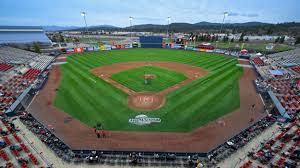
It was 1983 in Spokane, the kind of summer that felt permanently suspended in late light and dry heat, where the air at night still carried the dust of the day like it had nowhere else to go. We played Little League baseball in uniforms that never quite fit right, and then on weekends we graduated to something bigger and looser and more important: Spokane Indians games at the old stadium, Single A ball, where the dreams were real and still close enough to touch.

The Spokane Indians were a kind of civic promise back then. It was a small town, and in the early 1980s there wasn’t always a lot going on. The Indians were not quite big league, but not quite nothing. Just enough baseball to make you believe that something important was always one bus ride away. The seats were cheap, the beer cheaper, and the fences closer than they should have been. The whole place had that slightly improvised feel—like the city had built it thinking, this will do for now.

We didn’t go to games like spectators. We went like we belonged.

Behind the outfield wall during batting practice, kids gathered like scavengers. We chased homers, argued over balls, sprinted through patches of grass worn down by repetition. Sometimes we were the only ones back there. Sometimes there were older kids, or dads, or random locals who knew the angles better than we did. It was a loose territory. Not quite policed. Not quite ours. Something in between.

That summer, the Indians had a catcher everyone knew. Local kid. Quiet confidence. Clean mechanics. The kind of player adults already talked about like he had a future attached to him.

Sandy Alomar Jr. was that guy even then—before the long MLB career, before the All-Star years, before anyone outside Spokane would know the name properly. He was already different. You could see it in the way he stood when he wasn’t moving, like he was always half a second ahead of the next pitch.

I got his autograph once. It wasn’t dramatic. Just a moment after BP, when he signed a ball for a cluster of kids leaning too far over a rail. His handwriting was unexpectedly beautiful—controlled, deliberate, almost elegant in a way that didn’t match the dirt and sweat of the field. I remember thinking even then: this is what someone looks like when they’re going somewhere.

I kept that ball for years.

Because baseball wasn’t just baseball. It was a hierarchy you could see. You had the guys who were going to make it, the guys who might make it, and the rest of us orbiting the idea that proximity alone might transfer something.

Most of them wouldn’t go anywhere. That was obvious even then, though nobody said it out loud. But that day, none of that mattered yet. What mattered was the fence.

Our party was up high in the stands on the first base side, just beyond where the stadium fence met a thin strip of wild space. A tree had grown there—some kind of fruit tree, nobody was ever fully sure what it was. Persimmons, maybe. Something orange-red and heavy-looking, the kind of fruit that doesn’t look like it should be thrown but absolutely is.

Some kids started throwing them. Just kids, just fucking around. But they didn’t know who they were fucking with. Fuck with me and I’ll fuck with you.

The fruit flew. Not carefully. Not aimlessly either. More like experimentation. Testing distance. Testing reactions. Some of them were aiming at fans, others just launching them over the fence because it felt like something you could do if no one stopped you.

It was mildly funny at first. Then mildly annoying. Then mildly dangerous in a way that nobody fully acknowledged.

Because persimmons, if that’s what they were, aren’t soft. They hit like small decisions.

I remember one bouncing near a row of seats and rolling under a foot. Someone laughed. Someone else shouted. But nobody moved with urgency yet. It was still in the category of “kids being kids.”

Until Mike Trowbridge noticed.

Mike T was there with his kids—David Trowbridge and his sister Dawn. David had been a teammate of mine in Little League, a few years younger, outfield guy, quiet in the way younger kids sometimes are when they’re still deciding how loud they’re allowed to be. Dawn was just there in the background of everything, observing.

Their dad, Mike, was not background.

He was one of those adults you noticed before you understood why. Volatile energy. Tight posture. Goatee, black tank top, gold chains around his neck. A bit of a greaser; drove a Harley. Always slightly too close to losing his temper. He wasn’t a bad guy exactly—he could laugh, he could talk—but you always felt like there was a second version of him sitting just under the surface.

He saw the fruit being thrown. And something in him snapped into motion. He walked straight to the fence line, fast enough that it changed the temperature of the moment.

“Knock that shit off right now,” he yelled.

The kids paused. Not because they were scared exactly, but because the voice had weight.

Then one of them—small kid, maybe ten, sunburned confidence, the kind of kid who doesn’t fully understand consequences yet—looked up and said:

“Don’t pump me, man.”

It was such a strange sentence. Too casual for the situation. Too confident for the speaker. Like he had borrowed it from somewhere older and wasn’t sure how it fit yet.

There was a beat of silence where the entire stadium noise seemed to pull back slightly.

Mike T looked at him.

“Don’t pump me?” he said.

Then his voice shifted.

“You want me to pump you? I’ll pump you.”

And in that moment—this is the part that still feels unreal even now—he climbed the fence. Not slowly. Not theatrically. Just decisively. Like the boundary wasn’t a boundary at all.

Everything changed at once.

Me, David, Dawn—everyone nearby—we all froze in that wide-eyed way kids do when they realize the rules might not hold. It wasn’t comedy anymore. It wasn’t baseball anymore.

It was just: Mikey baby don’t kill that kid.

That’s what it felt like in my head. Not words were spoken, just panic translated into something almost verbal.

The kids scattered instantly. Full sprint. No hesitation. The fruit stopped mid-air and dropped forgotten. The stadium behind us suddenly felt far away, like it belonged to a different scene entirely.

Mike T took a step forward, still inside the fenced edge of this improvised battlefield, breathing hard, still locked in that strange overlap between anger and disbelief.

And then—somehow—it was over. No actual violence. No contact. Just the threat of it, large enough to erase the mischief that had caused it.

The kids were gone. The fruit stopped flying. The tree stood there like nothing had happened. Afterwards, the stadium noise came back slowly, like a system rebooting.

My dad, Ross, had seen the whole thing. He was laughing, hard. Not the kind of polite laugh adults do when they think they’re supposed to. This was involuntary. Almost helpless. The kind of laugh that tries to stay respectful but can’t quite hold the line.

Because it was funny. In that terrible, chaotic way childhood sometimes is when it brushes up against adult intensity and survives without breaking.

Ross would tell that story for years after. The kid. The fence. The persimmons. The line: don’t pump me man. He never stopped laughing at that part.

Neither did I.

But at the time, I just stood there thinking about Sandy Alomar Jr. somewhere on that field, already on his way to something else entirely, signing baseballs in beautiful handwriting, while right behind the stadium wall the rest of us were learning the difference between games and consequences in real time.

Most of us wouldn’t make it to the Bigs. But for one afternoon in 1983, it all felt like it might matter just the same.was 1983 in Spokane, the kind of summer that felt permanently suspended in late light and dry heat, where the air at night still carried the dust of the day like it had nowhere else to go.

But for one afternoon in 1983, it all felt like it might matter just the same.

Dedication:

For Mike T. And for the kid. You got balls young man, I’ll say that.

The Respectable Man (A Poem)

Note: I wrote this poem when I was in my twenties and it shows. Back then I wrote poems really fast. Today I still write really fast, but can barely write poetry at all. Anyway, this is sort of my version of a punk tune. It’s called “The Respectable Man,” and kind of speaks for itself.

The respectable man
reflects if he can
but the world won’t wait for reflectors
the respectable man
sits on the can
sits on the board of directors

The respectable man
hawks wares to the clan
who cannot tell shit from shinola
the respectable man
sees a water ban
and irrigates crops with a cola

The respectable man
works on his tan
en route to his room at the Hilton
the respectable man
is pimping a plan
with robust tax-giveaways built-in

The respectable man
spits on his hands
and scurries his way up the ladder
the respectable man
looks over the land
and respectfully empties his bladder

On Kris Kristofferson’s “To Beat the Devil”

This piece takes a look at Kris Kristofferson’s “To Beat the Devil.” The song appears on Kristofferson’s self-titled debut album from 1970 on Monument, which is, by any standard, an astonishingly good record. The album features “Me and Bobby McGee,” “Sunday Morning Coming Down,” and “Just the Other Side of Nowhere,” along with the ol’ Devil. That’s four absolute classics right there for ya.

Sunday Morning features an opening quatrain that most other songwriters would trade their career for:

Well I woke up Sunday morning/ with no way to hold my head that didn’t hurt/ and the beer I had for breakfast wasn’t bad/ so I had one more for dessert

(I could play this game all day—Jason Isbell’s Southeastern features another couple life-work worthy couplets:

The first two lines of “Super 8”:

Don’t wanna die in a super 8 motel/ just because somebody’s evening didn’t go so well

And from “Different Days”:

Time went by and I left and I left again/ Jesus loves a sinner but the highway loves a sin.

If I’d written lines that great I’d call it a career and sip martinis on the house for the duration.)

Sunday Morning and Bobby are probably objectively better songs than To Beat the Devil, yet what I like about this one is that Kristofferson states very clearly a kind of founding intention for his life in song and art, right out of the gate. The only parallel I can think of is Craig Finn’s The Hold Steady, whose first album Almost Killed Me kicks off with “A Positive Jam.”

(Here’s Finn telling it like it is:

I got bored when I didn’t have a band/ so I started a band/ we’re gonna start it with a positive jam/ hold steady.

Rock on Craig baby.)

Anyway, let’s get to the focus of this piece. Kristofferson opens with a spoken intro.:

A couple of years back I come across a great and wasted friend of mine in the hallway of a recording studio. And while he was reciting some poetry to me that he had written, I saw that he was about a step away from dying, and I couldn’t help but wonder why. And the lines of this song occurred to me.

Here the singer is looking up at his idol who is both “great and wasted.” I wasn’t around quite yet in 1970, yet I can easily imagine Ginsberg’s “best minds” line hanging over talented folks across a lot of zones. Klosterman wasn’t quite there either (June 5, 1972–a mid Gemini of course), but he was close, and to indulge not for the last time in a little Klostermania, the zeitgeist seemed to be making people thirsty.

The singer receives some scraps of poetry, shards of shattered inspiration, and a song “occurs” to him. He doesn’t state it directly, however we imagine the song arrives fully formed, like “Pancho and Lefty,” or “Kubla Khan.” Thus, To Beat the Devil is also both an answer and an offer of redemption to his idol, who here is John(ny) Cash.

I’m happy to say he’s no longer wasted, and he’s got him a good woman. And I’d like to dedicate this to John and June, who helped showed me how to beat the devil.

The singer takes up the mantle of the master, and in so doing opens a possibility window onto redemption for his senior. This is no exaggeration—Cash also recorded To Beat the Devil in 1970 and we are basically stipulating that Kristofferson’s genius, descended from Cash while also original to himself, helped rescue Cash from addiction and the whole deal there. We won’t be deep diving into the archive on this one—as we said we’re just keeping it local and breaking it down, so you’ll have to take my word on it or search it up your own self.

Here’s the first verse; the words speak for themselves:

It was wintertime in Nashville/ down on Music City Row/ and I was looking for a place/ and to get myself out of the cold/ to warm the frozen feeling that was eating at my soul/ keep the chilly wind off my guitar

A classic down and out in the big city piece of scene-setting. The singer is physiologically and psychologically frozen, a cold wind gusts across his art. The man needs a break.

My thirsty wanted whiskey/ my hungry needed beans/ but it had been a month of paydays/ since I’d heard that eagle scream/ so with a stomach full of empty/ and a pocket full of dreams/ I left my pride and stepped inside a bar

You might think that the operative nouns here would be “thirst” and “hunger,” but no. This is not a man with a thirst; this is a thirsty man. We also hear an echo of a now-ancient American past where a man with an empty stomach would go in search of, of all things, “beans.”

Anyway, he’s got no money, can’t really bring himself to care. So, a singer walks into a bar.

Actually I’d guess you’d call it a tavern/ cigarette smoke to the ceiling
and sawdust on the floor/ friendly shadows/ I saw that there was just one old man sitting at the bar/ and in the mirror I could see him checking me and my guitar/ and he turned and said/ come up here, boy, and show us what you are/ I said I’m dry, and he bought me a beer

The man in the mirror, the devil himself. The singer comes face to face with the man who checks him out and summons him over. Kristofferson then enters into a bargain–offers up the terms of an encounter: a beer on the old man’s tab. Score one for the thirsty man. The singer faces the old man; it’s to be a showdown. He doesn’t have much, but he’s got some “friendly shadows,” traces of an older map perhaps, an older memory.

I can’t help here but engage in a bit of presumption. When I play the song in my head, I want to hear “in the mirror I saw him casing me and my guitar,” (listen to the way he pronounces “guitar” on the track. Kristofferson was born in Brownsville, Texas in ‘36 and behind the laid back folksinger you can here some roots here baby).

If I could make one edit to the song, it would be to replace “checking me,” with “casing me.” What a great verb “to case” is.

Lexical Interlude: “To case the joint”

1. slang To observe a place in order to familiarize oneself with its workings in preparation for some criminal activity (often robbery). Judging from the security footage, those men cased the joint hours before robbing it.

2. slang By extension, to thoroughly examine a place. In this usage, no devious motive is implied. As soon as my kids walking into the hotel room, they started casing the joint, exclaiming about everything from the TV to the mini-fridge.

The seminal use of this verb phrase comes from Bill Callahan, formerly of Smog. Callahan is an odd duck—he is so artificial, so obviously self-created as an entertainer, that he has become almost post-authentic.  Callahan contains multitudes.

My favorite Smog album, well in the top two, is Red Apple Falls, which features “Ex-Con,” on which Callahan sings: 

Jean jacket and tie/ feel like such a lie/ when I go to your house/ I feel like I’m/ casing the joint

Devious motive implied.

=====

He nodded at my guitar and said/ it’s a tough life, ain’t it?/ I just looked at him/ he said “you ain’t making any money, are you?/ I said, you been reading my mail/ he just smiled and said, let me see that guitar/ I got something you ought to hear/ and then he laid it on me

The devil has a bead on the singer, and he’s not far off.  Yes he’s broke.  Yes he’s down and out.  Whaddaya want?

=====

Filmic Interlude I: The Long Goodbye

In Robert Altman The Long Goodbye, written by Leigh Brackett, the main character Philip Marlowe gets out of jail somewhere in the first act and heads to a all-purpose pit stop restaurant who’s owner apparently collects Marlowe’s mail. The dialogue is exquisite.

Marlowe: You got any messages for me?

Owner: Believe we’ve got a few over there. As a matter of fact, you’ll find my phone bill in there too.

Marlowe: I wouldn’t worry about that.

When you ain’t got nothing you got nothing to lose. Kristofferson’s got nothing to hide in his mail. Those bills go straight to the wastebasket.

=====

If you waste your time a talkin’ / to the people who don’t listen/ to the things that you are saying/ who do you thinks gonna hear?/ and if you should die explaining how/ the things that they complain about/ are things they could be changing/ who do you thinks gonna care?

there were other lonely singers/ in a world turned deaf and blind/ who were crucified for what they tried to show/ and their voices have been scattered by the swirling winds of time/ ‘cause the truth remains that no one wants to know

The devil’s words speak for themselves. The path of the troubadour is a dead end. The world has not ears to hear nor eyes to see. Truth tellers meet a bad end. Whiners gonna whine. It’s a strong opening bet, made, we presume, with his red right hand.

Well the old man was a stranger/ but I’d heard his song before/ back when failure had me locked out/ on the wrong side of the door/ when no one stood behind me/ but my shadow on the floor/ and lonesome was more than a state of mind

The singer is on familiar territory; he’s has been tempted by this cynical incantation, he’s not immune to tuning out his calling when out in the cold. Who is?

You see, the devil haunts a hungry man/ if you don’t want to join him/ you gotta beat him/ I ain’t saying I beat the devil/ but I drank his beer for nothing/ then I stole his song

This is the key verse in our little tale. You see, when we tango with the devil the devil usually gets to lead. That’s just the way it goes. But the thing about the devil is, his game is a bit of a bluff. A couple of low pairs, maybe. You just gotta call.

and you still can hear me singing/ to the people who don’t listen/ to the things that I am saying/ praying someone’s gonna hear/ and I guess I’ll die explaining how/ the things that they complain about/ are things they could be changing/ hoping someone’s gonna care

I was born a lonely singer/ and I’m bound to die the same/ but I’ve gotta feed the hunger in my soul/ and if I never have a nickel/ I won’t ever die ashamed/ ‘cause I don’t believe that no one wants to know

Kristoffeson flips it right around. The devil’s got a point; the singer may die dead broke, that’s fine. Songs are borne on the wind in any case. The thing is to have faith in your audience. To believe someone is out there, heart in their hands and ear to the wind. And to hold this faith as a mantra. That’ll keep ‘em guessing, cause then you’re not playing their game, you’re playing your own.

Overall, To Beat the Devil is a young man’s song. It’s got a confidence, a swagger, even a hubris. So, after drafting most of this piece I wanted to find a recent live version, see how it’s aged. I stumbled on a version from a live set with Lou Reed released in 2017. The set is part of The Bottom Line Archive, and it finds Kristofferson in a Waitsian stage of life. The voice is richer than ever, but he’s not exactly singing. Then again, that’s what they said about Dylan and it’s B.S. The voice is the voice; singing is just a category.

The set is interspersed with short interviews of the two songwriters. Here is Kristofferson’s spoken introduction that precedes To Beat the Devil. It is instructive.

Interviewer: The devil figures in some of your songs, you know there’s that silver tongued devil and he pops up from time to time. Who’s the devil? What’s the devil for you? What are your demons?

K.K.: Well, I, I’ll do that song then. Ahhh…

Interviewer: Is that a metaphor or is that something real for you?

K.K.: Well here’s a song called To Beat the Devil. Maybe it’ll explain it. I can’t.

On Kris Kristofferson’s “To Beat the Devil”

Here comes the first “breakdown” on the kibbitzer. A breakdown is basically what the young folks these days call a “deep dive.” Only we’re not spending days falling through interweb rabbit holes to get there. That kind of action is reserved for “Tusk,” matters of that ilk. Tusk ilk is pretty thin on the ground.

Instead, a breakdown is just a close look at an item of interest. We’ll start with a couple of songs, see how the method wants to evolve. First off we’ll be breaking down Kris Kristofferson’s “To Beat the Devil.”

To Beat the Devil appears on Kristofferson’s self-titled debut album from 1970 on Monument. It is, by any standard, an astonishingly good record, featuring “Me and Bobby McGee,” “Sunday Morning Coming Down,” and “Just the Other Side of Nowhere,” along with the ol’ Devil. That’s four absolute classics right there for ya.

{Sunday Morning features an opening quatrain that most other songwriters would trade their career for:

Well I woke up Sunday morning/ with no way to hold my head that didn’t hurt/ and the beer I had for breakfast wasn’t bad/ so I had one more for dessert

I could play this game all day—Jason Isbell’s Southeastern features another couple life-work worthy couplets:

The first two lines of “Super 8”:

Don’t wanna die in a super 8 motel/ just because somebody’s evening didn’t go so well

And from “Different Days”:

Time went by and I left and I left again/ Jesus loves a sinner but the highway loves a sin.

We’ll do a Different Days breakdown a little later on. If I’d written a song that great I’d call it a career and sip martinis on the house for the duration.}

Sunday Morning and Bobby are probably objectively better songs than To Beat the Devil, yet what I like about this one is that Kristofferson states very clearly a kind of founding intention for his life in song and art, right out of the gate. The only parallel I can think of is Craig Finn’s The Hold Steady, whose first album Almost Killed Me kicks off with “A Positive Jam.”

Here’s the master telling it like it is:

I got bored when I didn’t have a band/ so I started a band/ we’re gonna start it with a positive jam/ hold steady.

Rock on Craig baby.

Anyway, let’s get to the focus of this piece. And if you’d like to experience it sans interpretation, here you go:

TO BEAT THE DEVIL

Kristofferson opens with a spoken intro.:

A couple of years back I come across a great and wasted friend of mine in the hallway of a recording studio. And while he was reciting some poetry to me that he had written, I saw that he was about a step away from dying, and I couldn’t help but wonder why. And the lines of this song occurred to me.

Here the singer is looking up at his idol who is both “great and wasted.” I wasn’t around quite yet in 1970, yet I can easily imagine Ginsberg’s “best minds” line hanging over talented folks across a lot of zones. Klosterman wasn’t quite there either (June 5, 1972–a mid Gemini of course), but he was close, and to indulge not for the last time in a little Klostermania, the zeitgeist seemed to be making people thirsty.

The singer receives some scraps of poetry, shards of shattered inspiration, and a song “occurs” to him. He doesn’t state it directly, however we imagine the song arrives fully formed, like “Pancho and Lefty,” or “Kubla Khan.” Thus, To Beat the Devil is also both an answer and an offer of redemption to his idol, who here is John(ny) Cash.

I’m happy to say he’s no longer wasted, and he’s got him a good woman. And I’d like to dedicate this to John and June, who helped showed me how to beat the devil.

The singer takes up the mantle of the master, and in so doing opens a possibility window onto redemption for his senior. This is no exaggeration—Cash also recorded To Beat the Devil in 1970 and we are basically stipulating that Kristofferson’s genius, descended from Cash while also original to himself, helped rescue Cash from addiction and the whole deal there. We won’t be deep diving into the archive on this one—as we said we’re just keeping it local and breaking it down, so you’ll have to take my word on it or search it up your own self.

Here’s the first verse, and we’ll tread a little lightly from here and let the words speak for themselves:

It was wintertime in Nashville
Down on Music City Row
And I was looking for a place
And to get myself out of the cold
To warm the frozen feeling that was eating at my soul
Keep the chilly wind off my guitar

A classic down and out in the big city piece of scene-setting. The singer is physiologically and psychologically frozen, a cold wind gusts across his art. The man needs a break. Read more