Subtitle: I didn’t sleep with her so I had to quit my job.
Mistakes were made tonight
The Mendoza Line
Note: This piece is about a single week in my life that reordered things for good. At a minimum it’s an interesting story; at maximum it is the hinge between two versions of myself. I do not pretend to be the hero of it, and I take full responsibility for everything contained here.
It begins with a dream I had in Bali at the very end of July 2018. I was the lead trainer for the IB Asia Pacific workshop leader and school visitor training — my first time in that role after five years of apprenticeship. At the same time I was working at Ritsumeikan Uji as shukan, a kind of junior administrator. By mid-2018 I was burnt out: long days, multiple roles stacked on top of one another, and, most of all, a boss I no longer trusted.I was scheduled to go to the Faculty of Astrological Studies (FAS) at Exeter College, Oxford at the end of August, and in the meantime I would attend John Innes’s wedding to his fiancee Kristi. All this occurred, and here is that dream.
PROLOGUE: DREAM I
7/29/2018:
The dream starts with an image of a large whisky bottle. The bottle is very fat and also ceremic. So in fact it looks nothing like a normal whisky bottle. It is perhaps of Suntory brand. I know before I know that a story of some kind will unfold inside the bottle. I am reminded somehow of a ship inside a bottle. Suddenly I am inside the bottle itself. There is a whole word here and all sorts of people in a cityscape. I come to understand that everyone lives in relative fear of a species or group of overlords.
The overlords are both omni-present and also very distant. They rule by fear and have the power to rub out anyone at any time. Sort of. When a person is marked for removal their status is updated. Their status is displayed on a kind of glowing chip in their shoulder. There are basically three types of statuses. First is “needing to have the life wrung out of them.” There are marked people and their time is limited. Apparently they are political criminals, thought criminals. Oddly, even when marked these people continue to circulate and take part in oppositional activity. I never actually see one of them removed, although their actions do take on a greater sense of urgency.
The second category is another worded status. This one is more ellitipcal and I forget the wording. Though safer than the first, this is still a status to be avoided if possible.
Third is a number. A voice tells the city that statuses will be updated and that anything under 40000 is a safe score. I check my update with bated breath, fearing the dreaded worded status. My number is 49500. Not bad I think—although not under 40000 this is perhaps for young people. 49500 seems reasonable for my age.
Suddenly the view shifts and I can see into the bottle from the outside. All of the people and various creatures and scrambling for the mouth of the body. The bottle begins to approach a wall into which is will soon merge. Here, the entrance to the bottle will be sealed. The I character in the dream is also scrambling for the exit although he doesn’t seem to stand much of a chance. Creatures spill over one another and one baby creature somewhere between a human baby and a little mouse slips through the mouth of the bottle to the other side of the wall. The bottle snaps closed and I am once again staring at the large ceremony bottle from the beginning of the dream. I feel a sense of relief that the perfect creature has escaped. End of dream.
This dream is about reincarnation.
(The me on the treadmill does not survive. Dream group says whisky is a spirit which takes 50 years to mature. That gives me a book deadline I guess-49.5 the book and the end of the provisional personality.)
PART I — Sunday → Wednesday
Sunday, late August 2018
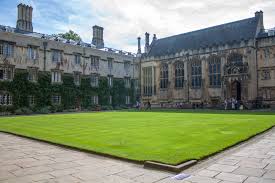
I flew into London from Osaka and took a pre-arranged bus to Oxford, then walked to Exeter College. Check-in, dorm keys, linens. The halls smelled like old plaster and a little like soap — an old building. I carried my bag upstairs, opened the door to the room that would be mine for the week, and sat on the bed for a moment to locate myself. New country, new rhythm, no context yet.
I walked the campus — stone walls, grass cut low, shaded paths. The quad had that contained feeling of a place that already had its stories. I didn’t know I was about to enter one.
I went to dinner at a taco place just outside campus and had a beer or two. Back in the room I read a little astrology to warm up for the week and listened to the band The Mendoza Line. Little did I know they would end up playing a surprisingly large role in what followed.
Around 10 PM the fire alarm went off. Everyone in the building stumbled outside in pajamas and stood around talking for a few minutes. Odd, but fitting — a small communal disturbance to start the week off.
Monday
I woke up, showered and dressed and grabbed my notebook for the astrology sessions. At this time I was fully committed to attending sessions and making the most of them. Breakfast opened early and I liked that — fruit, eggs, strong coffee. The hall had a low hum, people still new to each other. I walked to the first seminar which was given by Ms. Claire Martin. Claire was in her 70s, and a very comforting presence. She’d been doing astrology forever and has a couple of books which are helpful. The seminar was on the first floor, window onto one of the gardens. The air had that mild, hopeful tone of a first session.
Claire spoke on the 1890s — fields of meaning, ectoplasm, etc. I offered something Jung-coded because that’s where my mind goes when the border between psyche and symbol starts to move. I didn’t know she was in the room yet, Isobel (not her real name), though she already was.
At one point Claire mentioned an Aries Moon. I said, simply, “I’m an Aries Moon.” Nothing loaded, nothing aimed. Lecture ended, chairs moved, and she came to me from the back of the room.
“I am an Aries Moon too.”
We walked to the next session together. That was it — no delay, no drift. We sat side-by-side for the rest of the day. Chatting between sessions, coffee break close but not touching, her chart in her bag. She showed me her own chart print-outs — hers and her fiancé’s — and we compared placements. Similarities everywhere.
Lunch in the dining hall. More sessions in the afternoon. Light talk, no electricity announced but already there. Monday night we ate with a group — tutors, a few new friends. We were beside each other the whole time, not hiding it. Later we drifted to the courtyard bar, opened wine bottles, and someone lit a cigarette. I hadn’t smoked more than a dozen cigarettes in sixteen years, but I took one with her, and then another. Not ceremony, more like instinct, more like inevitable.
We ended the night late. I walked back to the dorm alone and put on The Mendoza Line again. I already knew I was in trouble so in addition to “It’s a Long Line (But It Moves Quickly)” I was listening over and over again to “Mistakes Were Made” from which the epigraph comes. Sometimes you just know.
Tuesday
We had planned to have breakfast together, not at Exeter but at Pret, about an eight minute walk away. We both ate and she helped me pick my breakfast. We were acting like a couple already. We attended the morning sessions, seated right next to each other and then the day started to open. In the afternoon we did not attend sessions, instead we spent the time in one of the beautiful gardens. We sat close on the bench by the open window, listening to the session through the gap. I talked about muses and how I work best with one. She talked about photography, stalled career energy, her family, and Swiss-Russian split. Russian women, I reflected not for the first time, are a problem, and I knew deep down I was already in trouble.
Tuesday night the singer-songwriter Lucy Dacus was scheduled to play Oxford, and I had a ticket, but she canceled. Instead we went out for dinner, just the two of us, at an Indian restaurant near campus. We were already deep into our relationship, and everything came easy; I could feel it inside ten minutes. This was one of the best meals I have ever had for reasons bigger than taste. I told her about my two epiphanies, one when I was four years old and one when I was seventeen. The whole evening felt like a third epiphany.
Back at campus everyone was drinking in the courtyard again. There was Mystery and her daughter, tutors, people rotating. We stayed late, drank wine, smoked, and flirted like teenagers. I went to my room around 1:30 AM, playing The Mendoza Line over my headphones again. I was seeking their counsel, essentially, and they are a great band.
Wednesday
I woke up and this day we had breakfast at the dining hall. By this time, people were noticing us. Comments here and there, sideways smiles. Morning and lunch blurred into one long conversation — the garden, the bench, a little grass, nothing hidden. We were finishing each other’s thoughts, and I was in deeper than I had ever been. We didn’t attend much of anything. Afternoon break she went to change. I went back to my room and put on Mendoza Line with the full weight of obsession. She came back later and said, without shame, that she’d pleasured herself during the break — just stated it directly. This was a complication.
For dinner that night she changed again — a red dress, short but not careless. Stunning. Whispering at the table, touching lightly, laughing against each other. Everyone knew by then. After dinner was wine again, talking with the tutors, including the lovely Rod Chang and Mystery the long courtyard. I met Darby Costello in person for the first time. Darby is my astrologer and we had already had a number of phone consultations by this point. She was fully alive drinking wine, and talking like someone who knows how to hold a room. I was so happy that she was my astrologer. Isobel and I stayed late once more, and cleared the courtyard. Around two in the morning we parted, cheeks touched, no bedroom, no act.
Back in my room, lights low, I lay on the narrow bed with Mendoza Line in my ears. I knew exactly where I was standing:
I would keep going. I would see where this led. But I would not sleep with her. I couldn’t.
That was the shape. That was the decision. Wednesday ended on that line.
Our former principal Shiozaki sensei retired at the end of the 2011–2012 school year. He left on time, at sixty, having overseen just one International School Festival (ISF), in February 2012, and then stepping away. His departure was orderly, expected, and clean.
Not long after, my colleague Tomoko Wano and I were called into the small room next to the IB office by Mr. Higashitani, who was my direct supervisor at the time. I was still DPC then, not yet formally on the administration, though much of my work already extended beyond that role.
Higashitani told us the next principal would be Charles Fox, a literature professor from Ritsumeikan University. Then, almost casually, he added that Fox would be taking the first two weeks of the April term off to travel to the Ogasawara Islands to help his son with a documentary film.
Higashitani paused. “Is this going to work with this guy?” he asked.
It was not really a question. The decision had already been made. Fox was close to the Chancellor, and with the IB programme growing, it had been decided that it was time for a foreign principal. The appointment carried symbolic weight.
Fox arrived in April 2012.
That first year, I saw him several times a week. I went to his office regularly with issues, proposals, and requests. He came less often to the IB office, but he was visible, present, and accessible. Compared to later years, he felt engaged.
We were still very much in a building phase. Questions were fundamental rather than cosmetic: whether to bring Economics online as an IB subject, how to structure growth, how to manage staffing, how to align IB operations with a larger Japanese institution that had not fully internalized what the IB actually demanded.
Fox was generally supportive. When I raised ideas, he rarely opposed them outright. But he almost always deferred decisions upward. In practice, that meant deferring to Higashitani occasionally, but increasingly to Vice Principal Nishikawa, who was locked in a long, escalating struggle with Higashitani for control of the soul of the school. That battle would define the institution for years.
Two small things I noticed early on.
The first was small but persistent. When Fox felt pressed, uncertain, or cornered, he would drop into a performative Texas drawl: “I’m just a good old boy…I don’t know…I’m new here…” Week one, maybe. Month one, even. But it went on for months. It began to feel less like humility and more like evasion.
The second was subtler. When Fox gave speeches—opening ceremonies, graduations, addresses to the IB community—he often began by explaining that he would speak in both English and Japanese, and why. “Today I will speak in both English and Japanese. There is a reason for that. The reason is that we are a bilingual school.” He would frame bilingualism as a principle rather than simply inhabiting it.
This bothered me in a way I couldn’t quite fully articulate. Later, I would understand it clearly: real bi-cultural schools don’t justify bilingualism. They operationalize it. They have bilingual admissions, bilingual HR support, bilingual communications, bilingual crisis protocols. We had none of those things. Bilingualism existed largely at the level of speech, not structure.
The first real test came with the February 2012 ISF.
Shiozaki had spearheaded the 2011 ISF, and it had been a success. Fox was enthusiastic about repeating it, but he largely stepped back and allowed me and my team to run it. The school green-lit the budget again, and I decided to push hard—to expand, improve, and professionalize the event.
We housed everyone at Ritsumeikan BKC: our students, overseas students, overseas chaperones, Tomoko, Hashizume from our office, and myself—around 150 people in total. Some seniors had smaller rooms, but most students were housed in large shared dorm rooms: one for boys, one for girls.
It was a mistake. An obvious one, in retrospect.
Alcohol made its way in. Boundaries failed. Tomoko and I were housed in another wing entirely, and we had effectively left the students unchaperoned overnight.
The next morning, seniors came to us immediately with a full report. We called Scott, the seniors’ homeroom teacher, at six in the morning. He drove to BKC right away.
We triaged. Scott and Tomoko lectured the seniors while I ran the open mic. We separated students where we had to, called the relevant parents. Tomoko warned me that if the school heard too much too fast, they might shut the entire event down. That felt impossible to me, so we managed carefully. We called Higashitani and Fox at school around nine. Higashitani came immediately. Fox did not. He came only for the opening and closing ceremonies.
The incident was handled. There was a discipline process. Several students were suspended at the very end of term. Fox signed off on the outcome.
But I was underwhelmed. The failure had been predictable, and leadership was thin where it mattered.
By the end of 2012, the IB programme moved from an effectively open budget to a fixed annual one. I was writing policy constantly, with Tomoko translating. Documents were often finalized hours before steering meetings. Higashitani scrambled to understand them and asked for revisions between noon and four every week.
It was exhausting for everyone.
In 2013, mostly to help Higashitani, I was promoted to shukan, the junior most position on the senior administration. That year, I had two dreams—one about a train line I couldn’t quite navigate, another about being pinned inside a roller coaster that led not to thrill but to scrutiny. At the time, I read them as anxiety dreams. Later, I would recognize them as early diagnostics.
II. Competence Without Authority (2014–2015)
2014
By 2014, the rhythms of my work were established.
OD was fully in place as DPC. I traveled extensively for IBEN and with Higashitani and Fox. We were deep in negotiations with KIS over a range of matters that required patience, translation, and careful calibration. Much of the work took place in airports, hotel lobbies, and conference rooms where decisions were floated, withdrawn, and reshaped.
The pace was familiar now. Demanding, but no longer novel.
That year, Fox, Tim Chanecka, and I traveled together to OACAC in Tampa. It was a routine professional trip in the way such things often are: panels, receptions, conversations that blurred together by the second evening. The work itself wasn’t remarkable. What stayed with me happened in transit.
On the flight from Tampa to Washington, D.C., a situation developed that required de-escalation. A man—angry, agitated, and self-certain—was fixated on another passenger he described as a “long-haired liberal.” The grievance was incoherent but intense. It carried the unmistakable energy of someone looking for permission to act.
I intervened.
Not dramatically. Not heroically. I spoke to him, listened long enough to drain the pressure, redirected the conversation, and kept things moving. The moment passed. The flight landed. Nothing happened.
I’ve written about that encounter elsewhere, in Good and Great Talkers, because it captures something I’ve learned over time: that institutions, like planes, often rely on informal actors to maintain order when formal authority is either absent or ill-suited to the moment.
That was 2014.
The work continued. The travel continued. The system functioned. And once again, responsibility lived in the spaces between roles, titles, and official scripts.
2015
From the outside, 2015 looked like continuity.
OD announced in July that he would be leaving, though his departure would stretch on quietly into the following year. In the meantime, the work continued much as before. I remained shukan. Meetings accumulated. Travel continued. IBEN assignments filled gaps in the calendar. We were still deep in negotiations with KIS and other external partners. Nothing felt broken.
At the same time, a new part-time role was added to support a sensitive function. The intent was reasonable. The arrangement informal. Oversight was assumed rather than specified. No one believed this was risky. There was no sense of urgency around it, no raised voices, no formal concern. It entered the system quietly and was treated as such.
That year, David Stubbs was promoted internally to DPC. At the time, it seemed like a good move. I supported it and gave my blessing. Continuity mattered, and internal promotions suggested stability. OD’s long exit thinned leadership gradually rather than dramatically, but again, nothing yet appeared out of order.
The IBEN work continued to provide a counterpoint. Most engagements went as expected. One did not.
It was a pre-authorization engagement with Eton House in China—one of those schools grafted onto an English name without a substantive institutional connection to it. From the beginning, the situation was fragile. The designated DPC, Georgina, was out of her depth. She tried, but early Skype calls revealed fundamental gaps in understanding. The Principal micro-managed aggressively while showing little grasp of IB philosophy or process. A capable Vice Principal carried most of the operational load.
On one scheduled Skype call, I arrived ten minutes late. It was my fault. By the time I logged on, they had already left. A complaint followed. I apologized.
Shortly afterward, Georgina took the unusual step of traveling to Kyoto to seek my guidance in person. We met at a restaurant. She explained that her situation was impossible. Money was tight. Every expenditure required approval from a board chair who was rarely present. I sympathized. I gave her everything I could—practical advice, institutional context, and clarity.
The process continued. I raised concerns about funding and received pushback, but the school agreed to give Georgina limited autonomy over small expenditures. Then a more serious issue surfaced: there was no class schedule. The school had an idea of offerings but no timetable. I told them plainly that this would result in a Matter to Be Addressed—the strongest possible language in a pre-authorization report.
The Principal and Georgina said producing a schedule was impossible. The Vice Principal stopped the conversation and said he could do it overnight. He did.
With a schedule in place, the authorization eventually went through. Georgina left, likely before teaching began. Later, the school complained about me to the IB. I heard about it unofficially and acknowledged that it had been a difficult assignment. The system absorbed the friction. Life moved on.
That summer, my psyche was working as hard as I was.
On August 15, 2015, I had a dream:
I am in college (probably) or at least in a position to have a dorm room. This room is shared and I have a second room which is mine alone and in another building. Whether or not I really should have the second room is not clear, and perhaps because of this I cherish the private room. I have had this kind of set up in dreams before. The private room is well apportioned and clean. I go in and out a few times, and then one time I enter the room next door by accident. My key opens the door and immediately I realize this is not my room. The room is sparse. I leave and enter my room.
There is a new bed in the room and some of my things have been moved around. There are at first two people, an African guy maybe in his early twenties and another guy. The second guy explains that the African has been assigned to this room and that he is a refugee from the genocide in Ghana. There doesn’t seem to be a lot I can say to this so I suggest some changes to the room layout that they had set up and we make the changes. I am not happy about having a roommate however realize that this feeling is selfish in the situation and resolve to make the best of it and welcome the newcomer.
However, when I turn around deeper in the room there are two more people, Americans, a guy and a girl, on the floor eating. They are beginning to generate some garbage which they are throwing on the floor. I bend down to pick up the garbage, smiling an apology that I like to keep things neat. I do not want them to be there and don’t know where they came from.
Back toward the door the African is sitting next to a man from Albania who is shooting heroin. He may be a Roma, which for some reason I know will make stopping him more difficult. Over and over, slowly and competently. This is not good and I start strategizing how to move him out of my room. He is talking and is charismatic, however I am anxious about what will happen if he keeps taking the drug and also anxious that my African roommate will become influenced by him and start using. The whole situation seems to be verging out of my control. I consider the alternative of just ditching the room.
I didn’t analyze the dream at the time. I didn’t need to. I kept working.
Nothing yet appeared out of order.
III. Peak Without Leadership (2016–Mid-2017)
2016
In 2016, the school appeared to be thriving.
The part-time counselor was fully embedded and doing the job as defined. There were no formal complaints, no escalations, no indications that anything was wrong. Looking back, there were clues—but they were faint, contextual, and easily explained away at the time. Nothing rose to the level of alarm.
For me, the year was defined by expansion elsewhere.
My IBEN work intensified significantly. By this point I was working closely with Gill Pressland, who had become the IBEN manager for Asia-Pacific and had effectively taken over my portfolio from Avi Nanda. Avi worked in a different section of the IB organization; Gill was IBEN proper. Around this time, the IB underwent a global restructuring, and IBEN—by extension Gill—emerged with considerably more influence.
Gill was a force. Decisive, demanding, and deeply competent.
Within three years of joining IBEN, I was promoted to Lead Educator for the International Baccalaureate, one of only a handful in the region. I worked frequently with Duan Yorke, and together we handled a large volume of Diploma Programme assignments. Through this work I came to know—directly or indirectly—hundreds of IB educators. My professional network widened rapidly, and my authority in those spaces was clear and functional.
The contrast with home was increasingly stark.
Back at Ritsumeikan Uji, the long-running struggle between Nishikawa and Higashitani finally resolved. Nishikawa won. Power consolidated decisively. From that point on, the school ran flat out, with virtually every decision flowing through him.
Nishikawa was a strong leader. He worked relentlessly. He also had too much to do, and some decisions became personalized by necessity rather than design. The system no longer absorbed pressure; it transmitted it downward.
By then, Fox had become largely ceremonial. Even his speeches were written elsewhere. He attended functions, delivered remarks, and fulfilled representational duties, but operational authority no longer resided with him in any meaningful way. He felt, increasingly, like an afterthought.
We held our final International School Festival in February 2016, closing out the prior academic cycle. After that, there was no budget for me to develop or run future iterations. The festival ended not with conflict, but with quiet disappearance.
Outside the school, my life continued to widen.
I was active in the global Enneagram community and attended at least one conference that year. I was also involved with the International Mental Health Professionals of Japan, and despite not being a trained counselor, I became vice-president of the organization—another example of being entrusted with responsibility in spaces where clarity and judgment mattered more than formal credentialing.
That year, my son entered Ritsumeikan Uji as a seventh grader.
This changed my vantage point. I became more attuned to the junior high school and the International Preparatory Stream. My son did well academically, but his cohort experienced social and behavioral turbulence. I stayed lightly involved, careful to avoid even the appearance of a conflict of interest. I watched more than I intervened.
The year ended smoothly. We graduated one of our largest IB cohorts to date. The programme was booming. Outcomes were strong. On paper, the institution was succeeding.
And yet, by the end of 2016, something essential had shifted.
2017 (Before the Break)
From the outside, 2017 looked like a peak year.
The programme was doing exceptionally well. Both the high school and junior high school streams were booming. Applications outpaced available spaces. We had decisively outperformed our nearest competitor, DISK — not marginally, but structurally — in outcomes, coherence, and momentum. Internally, this was understood. I had written about it. The data supported it.
There was no sense of institutional fragility. If anything, the opposite.
By this point, Fox had receded almost entirely into the background. He continued to fulfill ceremonial duties — speeches, appearances, the visible rhythms of a principal — and he looked the part. But operationally, he was absent. He took long lunches with the other vice principal (not Nishikawa), read the paper, and watched Texas Rangers games at work. From my vantage point, he had checked out.
What struck me was not his disengagement, but its invisibility. No one else seemed to register it. The institution continued to function smoothly enough that absence did not yet register as absence.
In practice, Nishikawa ran the school outright. Every meaningful decision flowed through him. This had been the case for some time, and by 2017 I had fully adapted to it. I took issues to him directly. He decided. The system was centralized, efficient, and under constant load.
I continued to travel extensively for the IB, working closely with Gill Pressland and handling a heavy slate of IBEN assignments. It would not have been inaccurate to say that I was holding two full-time roles simultaneously: one inside the school, one across the region. Both demanded attention. Both relied on judgment rather than formal authority.
And still, nothing appeared wrong.
The counselor role functioned as designed. There were no complaints, no escalations, no formal concerns. In hindsight, there were clues — small irregularities, moments that now read differently — but at the time they did not cohere. They were explainable. They were ignorable. They did not trigger alarms.
The system was succeeding. Leadership was diffuse but intact. Results were strong.
Which is precisely why what came next was so destabilizing.
IV. Rupture, Silence, Exit (Late 2017–2018)
The break arrived as confusion first.
Late one night in October 2017, I received a panicked call that made no sense. The next days revealed something far worse than anything we had imagined. Documentation removed ambiguity. The counselor was dismissed immediately and barred from further contact.
I issued the announcement myself—an error I recognize now.
In December, I learned she was still contacting students. Fox had promised to intervene directly if that happened. He did not. Partial measures followed.
January–April 2018 (V)
By January, our options were limited.
We hired a new university counselor, Nina, who had been working at an IB school in Nagoya. She eased into the role gradually. Tomoko and I did what we could to mentor her. She managed the relational aspects of the job reasonably well, but struggled with formal written communication in both English and Japanese. As a result, I remained deeply involved in university counseling.
The work continued.
When the new school year began in April, the pressure shifted.
A group of parents complained — not about outcomes, but about process. They argued that we had failed to protect the former counselor from what they described as an unreasonable parent, and questioned what was being done about university counseling more broadly.
I told Fox that we had already held a comprehensive meeting in January. All deadlines and procedures had been reviewed. There was no scheduled group meeting for April because nothing new needed to be communicated.
Fox said the parents needed reassurance and asked that we meet them anyway.
We did.
Fox and I drafted a set of twenty talking points together. They reiterated what had already been said in January. They clarified that families were free to work with external counselors, with one explicit exception. They also stated that the former counselor had agreed, as a condition of her departure, not to meet with students.
I read the talking points word for word.
The parents recorded the meeting. The recording was sent to the compliance department of the Ritsumeikan Trust, along with a request that Tomoko and I be dismissed.
At that point, the asymmetry was complete. I was constrained by institutional responsibility and confidentiality. The former counselor was not. Her version of events circulated freely. Mine could not.
I was formally notified of the complaint by Fox.
I was upset — not by the existence of a complaint, which I understood as an occupational risk — but by what it represented. I told him plainly that we had drafted the talking points together, that I had followed them exactly, and that I had repeatedly been placed on the front line at his request while he remained absent.
I told him that it was time for him to speak up for me.
He said there was nothing he could do. That the matter was now in the hands of compliance. That we would have to wait and see what happened.
That was the moment our relationship ended.
Not because of disagreement, but because of abdication.
What remained after that was procedural. Whatever trust had existed between us did not recover.
In late July, I served as lead trainer at a major IBEN engagement in Bali. It went extremely well. Whatever insecurity I had had about the IBEN role dissolved.
In August I went to John Innes’ wedding in the United States and after that I went to the Faculty of Astrological Studies (FAS) Summer School at Exeter College in Oxford. While there I met Isobel and everything just cracked open. Everything I had been carrying surfaced at once.
I returned to Japan and submitted a resignation letter to Fox stating plainly that I could not work under leadership that did not prioritize child safety. He buried it.
I stepped down in practice. I moved my desk. I stopped attending meetings. I began writing. This blog was born.
In October, early decision chaos erupted again. Fox ordered another teacher to verify deadlines already confirmed. I lost my temper—twice. It was the lowest point of my professional life.
After early admissions, I stopped counseling. In November, I stopped teaching. In December, I traveled to the U.S. and breathed again.
In February, I accepted a position at Ritsumeikan Suzaku. It wasn’t a teaching position, and I was not happy there, a story I’ll tell later.
The Fox era, for me, was over.
Coda and Reflection
Here’s the thing. I wanted to respect Dr. Fox. I really did.
He was my senpai—the one who came before. Like me, he arrived in Japan young and built a life here. I don’t know his full context. What was possible? What was unsayable? Those questions remain.
I don’t doubt that he cared or worked hard at times. But by 2016 at the latest, he was a man out of time. His mental map no longer matched the territory, and he did not do the work to update it.
Schools are living systems. Leadership requires vigilance, reflection, and relentless self-critique. Willingness is not readiness.
My hope—my prayer—is that when my own time comes, I do better than my senpai. That I reflect. That I adjust. That I remember the map is not the territory. And if I can’t, that I step aside.
That is the standard I now hold myself to.
Dedication: For all those who came before.
Note: If you enjoyed this piece you may also enjoy my piece on my former Principal, Dr. Fox. It touches on some of the same themes of institutional malpractice. You can read it here.
New Note: I’m republishing Keeganisms for colleagues and friends in the IB world. The piece grew out of my early years in international education, when I was trying to understand not just what we teach, but how adults actually grow, change, and make meaning inside institutions.
Readers interested in my time working at Ritsumeikan Uji and for the IB may also enjoy this piece on great and good talkers, and this one, a tougher piece, on being badly overworked in 2012.
This piece remains one of the clearest statements I’ve written about adult development, leadership, and the limits—and possibilities—of institutional life.
Finally, I am happy to report that the great Stephen Keegan is alive and well. Rock on, sir.
Note: This piece is a re-write of my very first piece of linguistic ethnography. For a fuller explanation of linguistic ethnography check out On “Dude” Usage. A “Keeganism” here is simply a notable phrase used by the former head of the IB Diploma Program for Asia-Pacific Stephen Keegan. Keegan was based out of the Singapore office, which was at the time one of three “hub” offices around the world.
Although fitting in with my other efforts at linguistic ethnography, in this piece I approach Keeganisms as if they are a rare species, like a certain kind of elusive salamander or something. If this little conceit if effective, as it hope it is, this is only because the Keeganisms under investigation are themselves so glorious.
Introduction:
When Stephen Keegan spoke, dozens listened.I was one of them. Darwin sailed around on the Beagle, ran across some turtles in the Galapagos, and his investigation of all that changed the world. While I don’t pretend that my little survey of Keeganisms will change the world, I would not be able to forgive myself if the species was simply lost to time.
Keeganisms were known to flourish between the years 2008-2013, in and around the greater Pacific Rim. Without being able to definitively establish the evolutionary arc of the species, naturalists suspect an increasingly florid progression over the years. For my own part, I was marginally aware of the species in 2008-2009, but did not realize the bounty that Keeganisms provided the scientific community until 2010. What follows is an analysis of some of the most common variants of the species as I was able to observe. All of these instances were found at IB events where Keegan was speaking in public.
Keeganism #1:
Here is Keegen in 2010 describing what the IB provides to its schools in the way of services: “We are not special. I mean, of course we are unique and special in many ways.”
Keegan is making the point that there is a consistency across high quality high school curricula and programs, and that the IB is not somehow in a wholly different category. The first sentence, “we are not special” is a bald statement to this effect. Keegan immediately realizes, however, that this is possibly an infelicitous soundbite, and qualifies with a politician’s cover “I mean, of course we are unique and special in many ways.”
Why is it a Keeganism? The classic form common to the first type of a true Keeganisms can be expressed as (A+D=A>D) where A (Affirmation)=a statement that shows an aspect of Keegan’s actual feelings or opinions about a given matter, and D (Denial)=a qualification which serves to qualify and reduce the sting of the truth-telling in A, but which does not fully counterbalance or neutralize the sentiment of A, thus A>D.
In this case, “I mean, of course we are unique and special in many ways,” gets Keegan off the hook for his heresy, however it is rather obviously a cliched cover (although one does appreciate the “in many ways.”) From a formal point of view, then, this is a classic Keeganism, perhaps the prototype; from a content point of view we can find better.
Keeganism #2:
And we did find better later that year or the next at a meeting of East Asian IB Diploma Coordinators. Here, Keegan is commenting on one of two commercially available software products which were competing for market share for IB schools at that time. “I am not promoting their product. I am promoting the concept of their product (….) They are the future. Of course the future will take many forms.”
In this case Keegan has an opinion about which product if preferable, however in his capacity as an IB employee he cannot state this outright. Instead, he gives an extended tribute to one of the competing companies before making clear that he is “not promoting their product.” Likewise, when he catches himself saying that their product “is the future,” he hastens to make sure we understand that multivalent nature of said future. Thus, he is again “covered.”
“I am not promoting their product. I am promoting the concept of their product” is actually a structural reversal of the classic Keeganism, which reappears in “they are the future. Of course the future will take many forms.” In the first, Keegan’s true opinion comes second, the denial first. Matters are further complicated by the introduction of the word “concept.” While it may be the case that a concept at times can be a free floating entity, in this case Keegan’s semantic distinction is taken, as it is probably intended, with a large measure of salt. Thus again a key feature of the species–the “denial” is consistently underweighted as compared to the affirmation: D+A=D<A.
With Keegan’s statement about the future, the classic structure is back, with a twist. The sentence “of course the future will take many forms” is so nebulous, so frankly metaphysical in its lineaments, that it verges on absurdity. It is also highly arguable, as while it may be true that the characteristics of the future will vary from place to place, it is at least possible to argue that the future will take precisely the form it takes: not a plurality of forms, but exactly one. Of more direct relevance is the point that if the future will take many forms, and in only one of those forms are “they” that future, then why are they “the future” at all? Of course, this is precisely the genius of this particular Keeganism; the “denial” is so slippery that is dissolves almost entirely, assuming instead a purely formal aspect (f). A+D=A(f).
Keeganism #3:
Not all Keeganisms have such an overt affirmation/ denial or denial/ affirmation structure, however. Others slip their denial/ qualification into the body of the affirmation itself. For example: “This alternative is being described as a valid reliable assessment.”
This Keeganism came at an IB conference for the Asian region, Keegan is describing highly contentious changes to the IB Visual Arts curriculum, which at the time the IB was defending against continued protests from art teachers (a fractious bunch when agitated it turns out). An advanced degree in communication theory is not required in order to parse this Keeganism; simply put the addition of “is being described as” shifts the locus of affirmation to some distant body doing the describing and away from Keegan, who is instead stating an unimpeachable fact–somebody somewhere is describing the assessment as reliable. Nonetheless, Keegan is not entirely distancing himself from the affirmation. In fact, there is no counter-affirmation present here, simply a qualification that insulates Keegan from a bald statement of validity and reliability.
Keeganism #4:
Here is Keegan at his final public appearance in Japan before his resignation: “We are delighted to be part of a global organization with global requirements.”
With this one, structurally we are in similar territory, but the valence differs. Keegan is describing some recent “rationalization” of IB services around the world, a change which would reduce some of the autonomy of the Asia Pacific regional office. In fact over the next few years the IB Asia Pacific office, and all of the “hub” offices, would be downgraded from essentially autonomous power centers with a Head of Office of their own to simply branches of the global organization with no clearly assigned leadership of their own. The acute listener will understand that Keegan’s loyalty is more to the region than the global organization; with some justice he feels that Asia-Pacific is the model region. This point has to be borne in mind when approaching this particular Keeganism.
On the face of it this is a fairly simple piece of sarcasm directed at the global infrastructure. However, there are a few complicating factors. First, Keegan uses the plural pronoun–thereby implicating his fellow presenter, and, perhaps, his entire regional office. Of course, the singular here would be far too “on the nose”; still, the “we” puts his colleagues in an interesting position. Second, the repetition of “global” here confers the style we have come to expect from a true Keeganism. Third, there is perhaps more ambiguity here than we might as first suspect. Keegan actually does understand the drive to standardize the regions and the need for global requirements, and he can explain this need in unironic terms. One suspects that an aspect of heart versus head is present here as well. In practice, however, on the communication front lines, Keegan has difficulty standing fully behind the ramifications of certain of these global requirements.
Here is where it gets tricky–the affection with which Keegan was held around the region was in large part a result of his ability to walk a very fine line between representing his employer and representing the region, its Diploma Coordinators, and its Heads of School. In order to sustain this somewhat ambiguous position, Keegan had to be able to ironize, even ridicule, the larger organization. However, were he to cross too far into irony or counter-statements he would risk losing credibility even as he gained affection. Keegan was aware of the bend of this curve, which is why his most overtly heretical affirmations were always immediately qualified. In essence, Keegan was excellent at “triangulating,” and in so doing, it could be argued, simply doing his job.
Keeganism(s) #5:
Then there are a set of statements that fit neither of the above types, but nonetheless qualify as Keeganisms on account of their peculiar word choice/ structure. As the following examples were all taken from a single presentation, one suspects that this category was in fact pretty capacious. Naturalists to this day do not entirely agree as to what counts as a true Keeganism, and there will always be a certain degree of controversy on this point. Here are a couple of examples of these disputed Keeganisms (IB Answers was a kind of help center which would answer stakeholders questions online or by phone):
“Will we be absolutely consistent in absolutely all areas? Absolutely not.”
“IB Answers has provided some answers. They specialize in answers, so it was easy to do.”
First, these enter the realm of possible Keeganisms on account of the repetition of a keyword across sentences. In the first instance, we can imagine the a more normal construction (e.g. a non-Keeganism): “Will we be absolutely consistent in all areas? Probably not.” The meaning here would be similar, however, the addition of the second “absolutely” moves us away from a mere admission of occasional inconsistency to something closer to a statement of purpose. Keegan is not simply stating that inconsistency will occur, he is celebrating it. I believe this to be a Keeganism.
As for the second, one has the suspicion that it may be a standard line, or at least to be making a repeat appearance. A minor area of controversy, of whispered side conversations among modern linguists, is to what extent all Keeganisms are original to their moment. While we have not in fact been able to prove the charge, a line like “they specialize in answers” does raise the antenna of the more conspiratorially minded among us.
Keeganism #6:
Here is Keegan again on IB Answers, which sometimes struggled to get their story straight: “You really have to have more effective answers. It’s a world that really has to be refined.”
The beauty of this Keeganism once again lies in the details. Were we to hear: “You really have to have more effective answers. It’s a process that really has to be refined,” this would account for nothing more than an honest admission of an area of the IB infrastructure that bears improvement. For anyone who knows Keegan, it would be completely unremarkable, as the steps by which an answer is generated through IB Answers are easily imagined as a process. But is IB Answers a “world”? One thinks of Tolkien, of the Wizard of Oz, of the books of Tintin–these are “worlds.” The construction is so odd, so specific, so suggestive of depths and complications unimagined and unimaginable to the listener, that we are swept up in the possibilities, and are once again in the presence of a genuine Keeganism.
Keeganism(s) #7:
“Global PD really has moved in a different way.”
“There is so much happening of a very intriguing nature around the world.”
In this final type of Keeganism we have the apparent qualifier which, under closer examination, turns out to be essentially contentless. After remaking on some recent changes to the IB’s professional development (PD) structure, Keegan’s “global PD really has moved in a different way” is possibly a compliment; however, the use of “different,” instead of any one of a large number of possible alternatives, “better,” “more effective,” “preferable,” etc., so obviously leaves the whole question open that we recognize a stealthy, if minor Keeganism. It is almost as if Keegan, so accustomed to hedging and jousting with language, finds himself here incapable of giving forth a bald, uninflected, statement of praise. From contextual clues we may be able to glean which way Keegan is leaning; on the face of it the sentence could mean absolutely anything.
As for, “there is so much happening of a very intriguing nature around the world,” but of course there is. There is so very much happening that we might almost be tempted to conclude that the future will take many forms.
Dedication: For Steve, thank you for your service.
“All we need is just a little patience.” — Guns N’ Roses
I. Leaving Anyway
The wedding was in June, which was just a little inconvenient for me. School was still in session, and I had to miss work to go. I remember wishing that it had been in August. But once I decided I was going, the resistance fell away. I locked it in, and then I was genuinely excited—mostly to see my family.
I hadn’t seen my mom, Mike, or Pat since January 2018, before COVID. I hadn’t seen my dad since October of that year. That mattered more to me than the logistics or the calendar. So my wife Sachie and I flew from Japan to Seattle, and my son Hugh flew in separately from New Zealand, via Auckland and Los Angeles.
We landed at Sea-Tac and cleared international arrivals quickly. We had a few hours before my parents arrived to pick us up. They had rented a van, partly because it was a three-day event and partly because they were making breakfast on the last morning, which required supplies. While we waited, Sachie and I sat in the only open area we could find outside arrivals. We both needed a cigarette, so we took turns—one of us watching the bags while the other smoked. We bought two Starbuckscoffees, which cost sixteen dollars. I ordered an extra shot in each, not realizing the Americanos already contained doubles.
While we were there, a man nearby was clearly overdosing—probably fentanyl, maybe heroin. He was nodding, drooling. The police came first, then EMTs. They all knew him by name. Sylvester. After about an hour, they took him away on a stretcher. No one around reacted much. It felt routine. I was just sad, thinking about how much damage fentanyl has done in the U.S.
I texted my mom. They were running late. Hugh arrived through domestic customs and joined us. When my parents finally came, they looked good—just older, of course. We hugged and walked back through the airport to the van. My dad had forgotten where he’d parked it, so that took a while too.
Once we got moving, things settled. Sachie, Hugh, and I loaded into the van and drove north to Anacortes, about two and a half hours. It was mid-afternoon. Hugh slept most of the way. Conversation came easily. It felt natural, like time hadn’t broken anything, just stretched it.
We had an early dinner at a restaurant on the water in Anacortes. Pat and Sarah drove up from Portland with their three girls and joined us. John Innes and Kristi had been invited but were tired from the drive and didn’t come. I had raw oysters, another seafood dish, and a margarita. My dad ordered one beer and then told the server, “Please bring another one in exactly twelve minutes.” He always does this. He usually has two beers this way; that day he had a third later. I find the whole thing very funny.
I ordered a second drink—a Negroni, which wasn’t on the menu. The waitress said she thought the bartender could figure it out. It arrived with no ice. I considered sending it back but she was busy, so I let it go.
It was sunny. I sat in the sun so Sachie could have the shade. After dinner, Pat, Hugh, the two older girls, and I walked down over some stones to the water for a while. Then we went to a supermarket for beer, wine, and light provisions. I wasn’t sure how I’d sleep—I don’t always sleep well when traveling—so I bought a bottle of wine just in case.
We drove to the lodge where we were staying. It was really nice. Sachie, Hugh, and I had our own apartment. I took a walk behind the lodge to sneak a cigarette. Sachie probably found somewhere to smoke too, but I’m not sure.
Later that evening, we went down to Pat’s room for beers. The girls played on the lawn outside, and Pat chased them around until they were breathless and laughing. Watching him with them, I was struck again by what a great dad he is. I drank wine instead of beer—I was still dealing with a lingering COVIDhangover and a newer gluten intolerance—and eventually drifted off and fell asleep on the couch.
That was the first night.
II. Crossing Over
In the morning, I woke first. No one else was up yet. Eventually my mom got up too, and we drove back to the supermarket for coffee. She bought me a pair of sunglasses—nothing fancy, just functional—and it was good to have time with her, talking at length. The coffee place sold Turkish coffee and tried to upsell me on baklava, which I regretted again not being able to eat because of gluten.
We all had breakfast later. It was underwhelming. I had yogurt. Around eleven, we drove out to the ferry terminal and got into a long line of cars. Sarah handed me one of those popular sparkling drinks in the U.S.—sweet, artificial—and I couldn’t finish it. The wrong kind of sweet.
On the ferry, I fell asleep. People were working on puzzles at tables. My parents stood outside because my mom has vertigo and gets dizzy. When we arrived at Friday Harbor, we went straight to the supermarket. There was no food at the camp except the rehearsal dinner and the wedding dinner, so I stocked up: hummus, corn chips—my mom handed me a huge bag of them—cheese, olives. I also had some soup at the market, which was excellent. I tried to get as much as I could because I knew options would be limited. I also bought wine.
The drive to the camp was supposed to be ten minutes, but the sign was tiny and we missed it. We overshot the turn and had to double back using Google Maps. We arrived mid-afternoon.
The camp was down a dirt road off the highway and much larger than I expected. There was a main lodge, a big lawn, a collection of cabins in different shapes and sizes, a barn where the wedding would be held, and a garden set up for the rehearsal dinner. We used metal push carts to haul our things from the parking lot to the cabins.
My parents were staying in the main lodge. Our cabin was about 150 meters away, next to Pat’s family. It was clean but very small: a tiny kitchen, a bedroom, a cramped closet you could barely move around in, a loft for Hugh, and a bathroom awkwardly placed between the kitchen and the bedroom. Kelly, his wife Courtney, and their kids Jacob and Ang were in another cabin. John and Kristi were nearby as well. Mason was staying in some kind of shared space. Between our cabin and Pat’s was a fire pit, and Sarah had already hung laundry over the chairs.
Smoking was allowed, but only at a few designated ashtrays—those tall black plastic ones on poles. The signs said that if you littered, the fine was one thousand dollars per cigarette butt.
I was a little concerned about whether the food I’d bought would last. I ate chips and hummus. Sachie went into the woods to smoke and put her cigarette butts on top of our garbage can. I told her about the rule and asked her to use the ashtray instead. She did.
Later, we gathered at the lodge. I brought wine. One of the camp staff asked if we wanted to hear the house rules. Mike said, “Lay them on us.” The rule was one open drink at a time in the lodge. It closed at ten, but we could use the nearby fire pits and deck afterward. I put my bottle of wine out of sight. Mike responded to the rule with a polite “Uh-huh, sure,” and I got the impression he had no intention of following it.
My dad, Hugh, and I drove back into town to pick up pizza for dinner. I ordered a cauliflower-crust pizza because of my gluten intolerance. We ordered too much—one pizza each plus one for my mom and Sachie—but that was fine. We ate, talked, and I drank wine. Mike, Colleen, and Felix were there. Colleen took Felix to bed. Later, Sachie asked me to go back to the cabin to get a bottle of white wine. I did, and we drank it. The rule wasn’t enforced. It was a relaxed evening.
That was also when I saw Eric Hillyard for the first time.
III. The FIRST NIGHT AND NEXT MORNING
Eric Hillyard is a character and a half. He’s one of Mike’s good friends from high school at Saint George’s, and one of only two people from that era who were there. The other was Dan Clarke—known as Jerry—who was officiating the wedding. Eric didn’t have a formal role. He didn’t need one.
I gave Eric a big hug when I saw him. I hadn’t seen him since high school. He razzes Mike like nobody else, but he was polite and warm with me and bowed to Sachie. He was drinking quite a bit. After ten, my parents went to bed, and Eric, Mike, and I gathered around the fire pit between the cabins.
Eric smoked a cigarette. I smoked two. We tossed them into the fire pit. Later, back at the cabin, it occurred to me that the cigarettes probably wouldn’t burn up completely. I was pretty cooked, but I walked back in the dark with my phone light, dug around in the ashes, found all three cigarette butts, and put them in the ashtray. I figured I’d just saved Mike and Colleen three thousand dollars.
Eric had told a joke that landed too close to home with Mike. Mike said it went too far. I got the impression this wasn’t the first time. It didn’t blow up, but it didn’t land well either.
I went to bed. Sachie and Hugh were already asleep. I slept fine.
The next morning I woke up first again. I ate more hummus and corn chips and went down to the lodge for coffee to see who was around. Free coffee was available. It was rehearsal day.
I don’t remember much of the day before the rehearsal itself. Earlier, when Hugh and I had gone into town on the pizza run, we’d stopped at a hardware store and bought a frisbee. Hugh played with the little kids—Colleen’s brother’s kids and others—on the lawn. I mostly hung around. Food was running low, and I was looking forward to dinner, which was scheduled for around five.
Before dinner there were family pictures, but before that something happened that I didn’t witness directly. Mike told me about it afterward.
They had hired a photographer, a makeup artist, and a band. All freelancers. The food was provided by the camp staff. Colleen was getting her makeup done and had asked for it to be light. Apparently it wasn’t. Mike saw it and said, “Babe, she pancaked you.” Colleen initially wanted to let it go, but they talked and then fired the makeup artist on the spot. Mike told me about it calmly and said that decision was kind of on him.
I didn’t judge it. What I found myself wondering was how much of her fee she got paid. I didn’t ask. I assumed she was paid for the day. The photographer had traveled a long way. I didn’t know whether the makeup artist was local. I hoped she was.
That evening, people gathered in the garden. Both sides of my family were there, along with Eric, Jerry, Mason, Kelly, John Innes, and others, as well as Colleen’s friends and family. The mood was good. But John was in bad shape.
By his own admission, John was pretty depressed. Both his parents had died, and something unresolved involving his father had happened before his death. He hadn’t been able to say goodbye properly. He’d had to have a few just to get ready to come to dinner and face people.
John and Kristi left early and Mason and I walked to the parking lot for a cigarette. There were ashtrays there, and I didn’t want to risk a fine. Colleen’s friends were smoking weed cigarettes back in the garden. Mason told me about a recent breakup that had been serious. He said he’d been immature for a long time and that the relationship and life had forced him to grow up. From his demeanor, it was clear that was true.
That night I also saw my Uncle Jeff’s third wife for the first time—she is from Mexico. Hugh talked with Jeff about his soccer influencer work. Jeff was impressed and invited Hugh to stay at his place in California anytime, for any length of time. Hugh was flattered and grateful.
Things wrapped up early. There was no repeat of the fire pit scene from the night before. I talked a lot with Amy, but mostly I was with Mason. Then we went back to the cabin and went to bed.
IV. DAN CLARKE/ BILL CLARKE DREAM
Wedding day morning felt like more of the same. I was low on cigarettes. I ate more corn chips and hummus from the seemingly endless bag and got coffee in the lodge and waited. Jerry was around. We talked. He’s had an interesting life—some wildness there—and I could see why Mike likes him so much.
Dan Clarke’s father is Bill Clarke, brother of Janet Mann and brother-in-law of Paul Mann. All Saint George’s power brokers. My dad and Bill Clarke were friendly once, but it went sideways. After that, my dad would complain about him endlessly in the car to my mom. Typical Ross behavior at the time, although I never understood the core issue
At some point that morning I thought about a dream I had years earlier, one that has stuck with me. I’m including it here as I wrote it at the time.
2/27/18:
Two intersecting and yet separate dreams about Bill Clark. These will take some unpacking.
I. I am with my father and someone else in a car on a rainy day. We are parked and Bill Clark is there. He looks like the real Bill Clark as I remember him, overweight and not too smooth. Bill Clark was an intermittent arch-enemy and then sometimes ally of my father at Saint George’s in the 90s. The encounter in the car is the culmination of several encounters with Bill in the dream and some of these have been just he and I. Bill is telling me through these encounters how much he admires our IB program and what I am doing with it. He stresses how important it is that I keep going. At the car, he does this again and looks a little desperate. Because he is so clearly sincere even my father who was his enemy gives him the space to say his piece. For my part, I am grateful for his kind words however the car kind of needs to get moving. I thank him from the window. I think he is about to get wet from the rain.
II. I am meeting with Bill Clark again, however a very different looking Bill Clark. Here he is trim with a wire grey beard cut short and a nice suit. He looks very distinguished and a little intimidating. This Bill Clark is also supportive however is much more firm with me. He tells me that I need to get on my hands and knees and beg and plead for resources. Somehow I get the image of a turtle on its back, open to the sky. This is the posture I need to adopt according to Bill. Nothing can be taken for granted and I have to beg. He is quite clear and I understand the wisdom in what he says.
Comment: This is a super interesting dream that bears unpacking. The two Bill Clarks are polar opposites and the second one is more regal and correct in every way. Why the former enemy of my father? This dream is so packed with symbolism.
Not long after that, it was time to shift gears and get ready for the ceremony.
V. The Ceremony
Before the ceremony began, I practiced rope-tying with Colleen’s brother and Pat. I hadn’t mentioned it earlier, but I had been enlisted to help tie Mike and Colleen’s hands together at the end of the ceremony. I was nervous. I had to go first, and as with the e. e. cummings poem years earlier at Mike’s first weeding, I had limited information. Mike told me it would be fine. Colleen’s brother Kevin and I made a joke of it together. Don’t fuck the whole wedding, bro. We got on well.
The rope was thin. There were several strands, intertwined.
Around four, people gathered again at the lodge. Only certain people had drinks. The rehearsal had gone smoothly. We had a clear walk-out order. My family walked out right after Mike and Colleen so I could be in the front row and step forward when it was my turn.
Everyone took their places. Jerry gave a classic, funny speech about being unprepared. Mike’s vows were sincere. Colleen received a huge round of applause when she walked out.
The ceremony was short. The moment came quickly. I stepped forward and did the tying. The ropes were longer than I expected and hung down toward the ground. I stumbled and nearly tripped over them, but I didn’t fall. Thank God.
The ceremony ended, and we moved directly into the barn for dinner.
VI. The WEDDING DINNER
Dinner started with oysters and a watermelon margarita, which I passed on. I drank red wine and hit it pretty hard. Dinner proper was pasta with sauce made by Colleen’s dad. I couldn’t eat it. I was hungry and ate oysters until there were literally none left. I got the last ones.
I spent some time standing outside with Kelly and his kids, Jacob and Ang. We talked. Inside, I sat with family. Hugh had the pasta and then went over to Colleen’s father to thank him for the sauce, which was a classy move.
After dinner, Kelly, Mason, Sachie, and I went out back for a cigarette. I was out and bummed one from Sachie, and it was the first time I’d ever seen Kelly smoke. I got to know Jacob, who was almost done with high school, and Ang, who was a couple of years younger.
I was wiped and left early. Sachie and Hugh came back later. Colleen’s dad gave a speech. My dad didn’t. Katie—my cousin through Amy—gave a great speech. Katie has Down syndrome, and everyone applauded.
That was the night.
VII. Dispersal
The next morning my parents were making breakfast, and the relatives who had stayed in town came back for it. My mom was prepping food. Amy brought gluten-free bagels. I had half a bagel, some fruit, and coffee and talked with people as they moved in and out. Breakfast was a performance, and it justified the van rental entirely.
We packed up and said goodbye to Mike, Colleen, and Felix. They were heading to a nearby island for a short honeymoon. From there, we drove first to the rental house where Pam and Steve were staying. I did laundry while everyone else went whale watching. I was keyed up about it—laundry had accumulated, and I don’t like traveling with dirty clothes. The door was left open, so I walked to the market for more soup and found my way back.
That evening we went back to the same pizza place. I had another cauliflower-crust pizza, a gluten-free beer that was just okay, and a glass of wine. I sat with Amy, her husband David, Sachie, Hugh, and Katie. I paid attention to Katie—she’s been developing early-onset dementia and I wanted to see how she was doing. My mom paid for dinner, which I appreciated.
We stayed at a hotel five minutes away that my parents had pre-booked. It was a large suite. Sachie and I took one room, my parents took the other, and Hugh slept on a cot in the living room. Hugh, my dad, and I played shuffleboard downstairs. I won. It was very relaxed. I had what was left of a small bottle of vodka, drank some, and poured the rest out.
The next morning we went to the ferry terminal. We ran into Jeff’s family again. My parents talked with them while Sachie, Hugh, and I got coffee and bought chocolates as omiyage. On the ferry back, a young naturalist gave a talk about whales. I listened and didn’t fall asleep this time.
Once we reached Anacortes, we drove the wrong way for about half an hour before my dad realized it. We turned around and headed toward Sea-Tac, staying near the airport. I was starving. We said goodbye to my parents. I cried a little. My mom did too.
At three in the afternoon we went straight to a steakhouse. I had steak, fries, and a Negroni. Hugh and Sachie ate as well. We sat in the regular dining section, not the bar, because Hugh was still twenty. We slept early.
The next morning we took a bus to the airport. Hugh left earlier, and Sachie went with him while I tried to sleep. At the airport, Sachie wanted to buy a specific bottle of whisky as a gift. The plane was already boarding. She ran off and made it back just in time. I was anxious, but she made it.
We flew back to Japan. I went back to work the next day and thanked everyone for covering for me while I was gone.
Dedication
For my family, with love and gratitude.
Note: If you enjoyed this piece, you may also enjoy the pieces below which also take up the topic of weddings.
New Note: I am republishing this piece for two reasons: First it’s been three years since I wrote it and it is one of my all time favorites. Second, as the title shows the politician Rahm Emmanuel makes a cameo and there is at least a possibility that he will run for President in 2028. This is a funny piece and it totally speaks for itself. I hope you like it.
Note: This is a piece about a guy called Whit. Over the past little while I’ve run into this guy in a couple of craft beer pubs in North and Central Kyoto. In a sense, it’s faithful to the original intention of thekyotokibbitzer—to check stuff out around the local area. Naturally, “local” is a highly fungible term, which is what makes it so excellent, but it feels good to get back to basics.
Interested readers may also want to revisit my earlier piece about my North Kyoto run-in with musician Damon Krukowski—currently a prominent critic of Spotify’s business practices, but formerly a dick to my face.
I met this guy called Whit at a Kyoto pub we’ll call T’s. T’s is owned and operated, naturally enough, by T. It’s a pretty nice place, although not everyone thinks T is a nice guy. He and I, though, rub along fine. T likes to wear sandals. So do I.
T’s seats about twenty-odd and lets people stand around without a chair, so it can get crowded. On the night I met Whit, though, it wasn’t. There was just me at the L-shaped corner near the entrance, Whit and three male friends at a table, a lone woman mid-bar, and a few other strays.
Whit and his buddies were winding things down, and before they paid, Whit sidled up to the lone woman.
“Genki desu ka?” he asked.
To understand what’s happening here, you need a little context on the phrase. Literally it means “are you cheerful?” but in practice it’s “how are you?” — a totally standard, everyday greeting. It is also, however, a classic Japanese pick-up line. Both the pickup artist and the garden-variety sleazeball deliver their “genki desu ka” with a little extra—an undertone, a wink, a leer.
This guy called Whit, I could see immediately, was leaning heavily into the leer.
I have no idea of how this guy called Whit would have fared with his approach if it had been allowed to develop because T himself came flying around the bar and snapped at Whit (in Japanese) “don’t talk to her, get away from her.” As a mere observer to the developing situation this seemed excessive, especially because T’s is the kind of place where fairly easy conversational congress between the sexes is not only tolerated but actually encouraged. T and his crew will proactively introduce men to women and women to men on the regular. Later in the evening, all sorts of events may transpire at T’s. So this was out of character for sure.
This guy called Whit was taken aback, and soft-pleaded with T to let him join the woman, however T was firm. “If you don’t go back to your table you will have to leave. If she comes to talk to you you can talk to her. Not before.” Again, I cannot stress enough how out of character this is for T’s, so naturally I was curious. I am not normally nosy, however when curious I can be. Whit took the L and slunk back to his table. His friends didn’t seem to have noticed the action, but I did, so I said to him, “hey man, that was pretty crazy. What did you do?” “Nothing,” said Whit, “I just wanted to talk to the lady.” “Yeah,” I said, “I’ve never seen T react that way.” “He just doesn’t like me,” said Whit, “maybe I’ll never come back here.”
Whit and his crew left shortly after and I asked T what was going on. “Whit always hits on women,” he explained, “I don’t like it.” “What about Philip?” I asked (“Philip” here being someone T and I both know), “Philip is always hitting on women too.” “Case by case,” said T, “case by case.” Case by case arguments are very hard to rebut as they index in advance their non-adherence to norms of “fairness” or “consistency.” Also, I knew nothing about Whit and was in no way invested in manning his corner. T and Whit have a history, I supposed, and T would not kick a customer out just because. Such was my first meeting with this guy called Whit.
Not long after this first meeting I was with a friend at a pub we will call K’s, which is in Central Kyoto. K’s is smaller than T’s, seating only about 8-10 inside with some flexible outdoor space as well. Unlike T’s, at K’s there is not much flirting and the like as the space just doesn’t really allow for it. I was there with a buddy and who should come in but this guy called Whit. Now I didn’t mention that at T’s Whit had an American accent. (I later learned he is from Philadelphia by way of San Fransciso.) However he rolled into K’s rocking a full-on British accent, and not a bad one at that. He was standing right next to me, and I did a double take. “That’s that guy called Whit,” I thought, “but it can’t be, Whit’s American.” I looked again. Definitely Whit.
So I asked him, “hey guy called Whit, what’s with the British accent?” He slipped back to his American accent, “oh yeah mate, that’s just something I do sometimes.” OK. We chatted a bit and it was clear that he didn’t recognize me. I reminded him of our meeting at T’s, and he recalled the incident. But I could tell he wouldn’t remember my name next time. He left K‘s after one beer.
My buddy hadn’t met this guy called Whit before, however I had already told him the story of his getting shit-canned at T’s. “That was the guy,” I told him, “the guy called Whit.” “What was with the British accent?”my buddy asked. “I don’t know, some kind of affectation. Maybe he lays it on when he tries to pick up women.” Just a guess on my part, but a pretty good one considering later events.
A few weeks later I was at a pub we will call M’s, also in North Kyoto with another friend we shall call “Philippe” in order to easily differentiate him from “Philip.” It was just before seven in the evening, when who should walk in but the guy called Whit with none other than the newly appointed United States Ambassador to Japan Rahm Emanuel and his wife Ann. They just strolled on in and it was clear that Whit was somehow chaperoning them. I stared over at Rahm Emanuel for a bit and then said “hey there Mr. Rahm Emanuel.” Rahm Emanuel (or just Rahm, as I like to call him) acknowledged his identity and he and I started chatting. At the same time Ann was chatting with old Philippe there at the bar. Before I said hello to Rahm I wondered what on earth he was doing with Whit. And then I thought well, I know Whit doesn’t have a job, he seems to frequent pubs all the time, probably he has some money somewhere, tech money or something. Maybe he’s some kind of VC and the Rahmster has gone out of his way to meet him in Kyoto. Implausible as this scenario seemed, I didn’t know what another explanation for this threesome could be. However, I was off-base.
Had this guy called Whit in fact been a prominent VC it would have added layers to my understanding of him for certain. So I asked him, “hey there guy called Whit, how do you know Rahm Emanuel?” “I just met him,” he replied, “across the street at L’s. We got to talking and I brought him over here.” (L’s is a cocktail bar I have never been too, which is 15 feet from K’s.) It turned out that Rahm and Ann were in Kyoto en route to Hiroshima where they were to visit the Hiroshima Peace Museum with none other than the Prime Minister of Japan. In the meantime here they were, hanging with Whit. Rahm explained the situation thusly: “here in Kyoto my minders let us off the leash so we can walk around freely. This would never happen in Tokyo, because we have security around us all the time.” He seemed genuinely happy to be minderless, and was as relaxed as could be at the bar. In no time he was dropping f-bombs, dapping up the waitresses, and asking me how to say things in Japanese. Rock and roll Rahm baby.
(As promised in the title, Rahm is only supposed to have a cameo in this story, however I have to recount our brief conversation about politics. After I introduced myself, Rahm asked me “are you on the team?” I understood him to mean was I a Democrat. I replied that I was basically on the team, but that I was kind of a left libertarian. “No such thing,” said Rahm. “Well then you’re looking at a unicorn baby,” said I.)
In any case, once I had gotten a bit of a feel for my new buddy Rahm I had to fill him in on something. “Hey Rahm, you know this guy called Whit likes to go into bars and put on a fake British accent?” Rahm didn’t miss a beat as he turned to Whit and, I swear, elbowed him in the ribs, saying “did that help you score buddy? Did you get across the finish line?” Rahm Emanuel, former chief of staff to President Obama, former Mayor of Chicago, and presently the honorable ambassador to Japan, had already grasped the essential nature of this guy called Whit. And he, for one anyway, had no issues with it.
“Wake me up before California Darling boy I’ve never known ya”
— Annie Hardy
1. Periscope (2018): Ambient Human Contact
In the fall of 2018, before TikTok Live and before Instagram learned how to professionalize everything, there was Periscope.
It was a live-video app owned by Twitter, but it never really felt like social media. It felt more like radio—with pictures. You could open it and see who was live anywhere in the world, zoom in on a city, drop into a stream, leave, move on. The scale was small enough that you could more or less take in the entire active population at any given moment. There was no sense of infinite scroll. The world was navigable.
It was also completely unpoliced. People streamed whole songs, movie clips, televisions playing in the background, themselves half-asleep or wandering around or doing nothing at all. No one cared. There were no warnings, no copyright bots, no friction. It was a free-for-all in the literal sense: free time, free speech, free form.
What Periscope allowed—what it uniquely allowed—was time. Long stretches of it. Silence. Repetition. Boredom. People would just sit there and talk, or not talk, or smoke on their porch and complain about their day. That kind of stream simply does not exist on Instagram Live. Instagram demands a reason. Periscope didn’t.
I loved it because it matched my temperament. I wasn’t looking to build anything. I wasn’t trying to grow an audience or perform a version of myself. I liked cursing around on the app, listening, occasionally speaking back. It was ambient human contact: voices moving through time, present but not demanding anything in return.
Most people didn’t want that. Periscope never offered a ladder—no clear path to recognition, no reliable virality, no payoff for effort. It didn’t protect users from themselves, and it didn’t compress experience into highlights. For most people, that felt pointless. For a few of us, it felt like oxygen.
I didn’t think of it as important while it was happening. It was just there, like a short-lived commons where people killed time together. Looking back, I’m amazed it existed at all.
2. Time, Leave, and the Split Feed
From September 2018 through February 2019, I was on leave from my school. The reasons sit elsewhere and don’t need explaining here. What mattered was that, for once, I had time—real time, not time carved out between obligations. I was based in Kyoto, and in October and November I spent long stretches staying in a hotel in Akasaka, moving back and forth between the two cities.
At the same moment Periscope entered my life, I started a new blog, The Kyoto Kibbitzer. The original idea was simple: walk around, notice things, write about bars, art, neighborhoods. Periscope became a sister project—not an escape from writing, but a parallel way of paying attention. One was private and slow; the other was live and provisional. They fed each other.
I quickly settled into two distinct kinds of streams.
During the day, I walked. Downtown Kyoto, north Kyoto, sometimes Tokyo. I talked, observed, played music, responded to comments. I never put my face on camera—not once. The camera always faced outward, toward streets, storefronts, light, movement. I got a simple phone holder so I could film without fuss. The stream wasn’t about me; it was about what I was seeing.
At night, I streamed from my desk in the upstairs room of my house. I usually stood, like a DJ or a lecturer, sitting only when I was reading something. The night streams were almost entirely art: music, films, writing. I’d play songs and talk about them, read long passages from essays or movie reviews, sometimes even play sections of films on my laptop and film the screen. It was all technically a grey area, but Periscope didn’t care, and neither did anyone watching.
Once I read an entire Roger Ebert essay on air—an interview he’d done with Lee Marvin—and laughed out loud the whole way through. “If I want to be an icon I’ll do it my own way, baby,” Marvin said. Mostly, that was the night feed: attention without urgency, commentary without stakes. Occasionally I’d take it back outside to a bar, or, early on, stay up all night wandering and streaming, the phone dying fast enough that I had to carry two battery packs. But those were exceptions. The form settled quickly.
The split mattered. Day feeds faced the world. Night feeds faced ideas. Both were ways of being present without self-display. Together, they created a rhythm that made Periscope feel less like a platform and more like a place of its own.
3. A Small World with Names
The audience was small, but it existed.
A few people watched consistently. My friend Andrew, who lives in Japan but not Kyoto, would sometimes tune in live or catch the replay later. John Innes watched as much as he could, and sometimes his wife, Kristi, would drop in too. When John commented, I’d usually stop whatever I was doing and talk with him at length. Conversation mattered because it was rare.
There were others who hovered at the edges. A French guitarist would sometimes watch silently for long stretches. Later, Mela would too, though I watched her far more than she watched me—mostly because she streamed for even longer than I did. And then there were the Periscope regulars: people who drifted in and out, stayed for a few minutes, disappeared, reappeared weeks later. That was the rhythm.
Periscope allowed replays, which changed the feel of everything. Not all attention was synchronous. A stream could be watched hours later, like a letter someone opened when they had time. It softened the sense of performance. You weren’t always talking to people; sometimes you were just sending something out into the day.
What mattered wasn’t numbers. Most streams—mine included—had only a handful of viewers at any given time. Even the people who seemed central to the platform often streamed to three or four names. The world was small enough that you could recognize it. You learned who was usually awake when you were. You noticed when someone stopped streaming altogether.
Because of that scale, recognition carried weight. When someone you knew appeared in the comments, it felt like a real arrival. The back-and-forth could stretch without interruption. There was no pressure to keep things moving, no sense that you were losing an audience if you paused to respond.
It didn’t feel lonely in the usual way. It felt communal in miniature. A village square that never got crowded enough to become anonymous.
4. Killing Time Together
I was somewhat lonely during that period, and looking for human companionship. Not intensity, not rescue—just being awake with other people. Periscope worked because it was like radio, only you could talk back. You could toggle around the world and find whatever level of interaction you wanted, then move on without consequence.
Some streams were playful and I would play along. There was a beautiful Russian woman who spoke mostly in Russian and replied to my comments in halting English. She’d do things like eat honey off a spoon, theatrically, and I’d type something juvenile and she’d play along too. It sounds silly, and it was, but it was also light. Once we talked longer and she told me she wanted to go to medical school but couldn’t afford it. I’d guess she was in her mid-to-late twenties. After that, I drifted away. The language barrier was real; the connection couldn’t sustain itself. That was normal.
There was a French guitarist I watched early on. He was very good—technically accomplished, friendly—and he seemed to have infinite time. He’d sit in my stream silently for long stretches, just there. Periscope people had time; that was one of the defining traits. After a few weeks I stopped watching him. Not because anything was wrong, but because it was all one thing. Skill without movement. No arc. Attention drifted, and that was allowed.
Other streams were even more minimal. I remember a woman in Oklahoma who would sit on her porch, rip bongs, and talk about her day. That was it. No premise, no performance. Just presence. That kind of stream doesn’t exist on Instagram Live. Periscope tolerated people doing nothing in public.
There was also Max, a trans woman from eastern Canada. She complained about her mother, about being broke. She usually had no viewers. Every time I came into her stream she lit up. Once I sent her fifty dollars for an art commission, and she reacted like she’d won the lottery. It wasn’t about the money. It was about being seen. On Periscope, small gestures carried disproportionate weight because the economy of attention was so thin.
People weren’t looking for transformation. They were killing time. Talking. Waiting. Passing hours together across time zones. The platform allowed that without apology. It was so free-form that it’s hard to explain now without it sounding unreal.
But that was the baseline. That was what “normal” looked like.
5. Mela: Process Recognizes Process
I didn’t find Mela right away. It wasn’t until mid-October that her stream appeared on my map. By then I already knew how Periscope worked—what it rewarded, what it ignored, what kinds of attention lasted.
The first stream I remember, she was just walking around New York City. Not driving. Walking. Taking stairs. Cutting through neighborhoods. Letting the city decide the route. Almost immediately I felt a shock of recognition: she’s me. Not biographically, not emotionally—procedurally. We were using the same method.
She would ask, “left or right?” I’d type “left,” and she’d take a left. That was it. No drama. No explanation. A shared orientation, moment to moment. I’d stay with her for hours, wandering the city together at walking speed.
People who showed up looking for something else—someone conventionally attractive to perform, flirt, deliver a payoff—would drift off. The stream filtered itself. What remained was patient, non-demanding attention. Process over outcome.
She was in her mid-to-late thirties and had worked in film props on sets around New York. At the time she was on sick leave after a back injury, which explained the free time. She streamed from her apartment, sometimes from a friend’s place she was house-sitting, and often from the streets and trains. The life context was legible. Nothing felt invented for the stream.
Eventually we connected on Instagram, but that’s not the story here. What mattered was simpler: real, undemanding, non-sexual attention feels good. In a micro-attention economy, it feels enormous.
Mela mattered because she showed that Periscope could sustain healthy, lateral connection—companionship without escalation, presence without claim. That mattered later, because it proved the platform itself wasn’t the problem. It was capable of holding something gentle and durable.
That made what came next easier to recognize as different.
6. Giant Drag (Came Late, Stayed Forever)
I came to Giant Drag late.
I first heard them sometime around 2015, years after their debut. The song was “Kevin Is Gay,” and I heard it on All Things Considered on NPR. I remember stopping short. It sounded like shoegaze, but with attitude—guitars that rang and crunched at the same time, a voice that was sharp, funny, unsentimental. I thought: who on earth is this woman?
I bought the CD immediately. The record was Hearts and Unicorns. There was “This Isn’t It,” “Slayer,” and a sense that this wasn’t a novelty discovery. It didn’t feel like a phase. It felt like something I’d been missing and had finally caught up to. Ten years later, the music is still with me.
Learning afterward that the album came out in 2005 only clarified things. I hadn’t encountered Giant Drag as part of a moment or a scene. There was no social reinforcement, no sense of being early or late. The music arrived on its own terms and stayed because it deserved to. It became part of my listening life in a quiet, durable way.
That matters here, because when Annie Hardy later appeared on Periscope, she didn’t arrive as a stranger or as “a streamer.” Her voice was already familiar to me. Not biographically, not personally—but aesthetically. I knew the intelligence. I knew the precision. I knew the attitude. What I didn’t expect was where or how I’d encounter it again.
At the time, none of this felt connected. It only looks that way in retrospect. Back then, Giant Drag was just music I loved, and Periscope was just a place people killed time together. I had no reason to think those two tracks would ever overlap.
Then they did.
7. Band Car → Band House
Because the number of active streams was limited, as I have said, I spent a lot of time just cruising around the map. One night in September 2018, I landed on Annie Hardy without looking for her. The stream was called Band Car, which turned out to be exactly what it sounded like.
She was driving. Talking. Rapping. Singing into some kind of vocoder or effects chain. Swearing at other drivers. There was no Giant Drag material, no backstory, no explanation. She’d say, “Give me three words,” and then build a rap off whatever came in. I gave her words. Over and over. It never went stale. The language was filthy—relentlessly so—but also precise. The filth wasn’t sloppy; it landed because it was aimed.
I watched every day. She streamed every day. She had no job and very little money, and she drove for hours, talking, rapping, improvising, stopping occasionally to run into Home Depot or some other errand. I’d wait. Dead air didn’t bother me. This was how Periscope worked.
Sometimes she used gay slurs, and I balked internally. That wasn’t my thing at all. But the space itself was unfiltered by design, and she used every word under the sun. I didn’t intervene or moralize. I noted it and stayed. Admiration and discomfort existed side by side.
I talked about her on my own stream. I told people she was the best thing on Periscope. I couldn’t believe I had such unfettered, generous access to a high-level artist just living inside her process. There were others watching too, but not many. I was probably her biggest fan, or one of a few. In a micro-attention economy, that mattered.
One night, very late in Los Angeles, I’d been with her for hours. The audience thinned until it was just me. She parked the car, got out, and said, almost casually, “Do you want to do band house?” It was a first. I said of course.
She went into her garage, then into a music room. There was a piano. She asked, “What do you want to hear?” I said how about After the Gold Rush. She sat down without ceremony and played the entire song. No sheet music. No warm-up. She hit the high parts cleanly. Musicians have an astonishing memory for songs, and she had it in full.
It was the greatest musical moment of my life, bar none. The only thing that comes close is hearing Spencer Krug play “Julia with Blue Jeans On” at Urbanguild in Kyoto. This was different. This was private, unadvertised, unrepeatable. When she finished, she said, “Okay, that’s band house,” and wrapped it up.
No encore. No processing. Just the sound, then silence.
That was the miracle. And it was already complete.
8. Running Its Course
In December, I used Periscope again in New York and Boston, mostly with Mela. The rhythm was familiar by then—long stretches of time, nothing urgent, companionship without demands. One night in a Boston hotel room, where I was staying to see Phosphorescent and Jay Som, I streamed the entire film Michael Clayton from my laptop. It was a grey area, as everything on Periscope was. She watched the whole thing with me, commenting occasionally—“bad guy, ooh”—the way someone does when they’re present but not trying to perform being present. It was fun. That was enough.
After that, things ended. Not abruptly. Not painfully. Periscope had simply ran its course.
Mela moved to Oklahoma and stopped streaming. I stopped too. The app thinned out. People disappeared. The small world became smaller and then, effectively, gone. There was no sense of loss that needed narrating, no aftermath to dramatize. The conditions that made Periscope feel possible—time, openness, a tolerance for doing nothing in public—shifted. Life resumed its usual density.
Looking back, what remains isn’t a lesson or a warning. It’s a memory of a brief commons where attention wasn’t monetized and presence didn’t have to justify itself. A place where someone could play a song once, perfectly, for one person, and then stop. And that could be enough.
That was Periscope. And then it wasn’t.
Dedication:
For the micro-attention economy. I had a total blast. And for Annie and Mela. Babes I love you both is very much.
I flew back to Japan in early December ’99, eleven months after Flagstaff, twenty six years ago today.
My girlfriend — soon to be my wife — met me in Kumamoto and before we went anywhere near a city office we took a bus tour of Kyushu. One of those packaged trips where the landscape is real but the schedule isn’t — temples, viewpoints, souvenir shops engineered into the route because somebody is getting a cut. I’ve never liked bus tours. Too passive. Too commercial. A landscape you watch instead of inhabit.
The first night in the hotel we were intimate for the first time in a year. It was good enough — tentative, self-conscious on my part, like we were remembering choreography rather than improvising. It would all come back pretty quickly.
After the tour we stayed with her parents in Uto City — small house, tatami floors, her childhood bedroom upstairs. We shared a single futon where she had slept alone as a girl. I remember the narrowness of it, two adults lying in a past built for one. The walls thin, the air still, her parents downstairs, in their own world.
.We went to the city office the first week of December and signed the papers — no ceremony, no white dress, no crowd, just bureaucracy, and permanence I suppose. A moment small in appearance and enormous in consequence. One pen stroke and we weren’t dating across continents anymore — we were married.
I flew back to Arizona before the semester resumed. I was a married man. Small ring. Big life. My cold room waiting.
That was the hinge — Japan in winter, Flagstaff in spring, and me between two homes that I didn’t yet know they would trade places for good.
NAU Year Two — Term One
I flew back to Spokane that winter the same way I had the year before — no plan except back to NAU and see what I could do. The red Toyota pickup was waiting for me, still running, still mine, connecting Washington and Arizona. I drove south again — long highways, cheap motels, maps instead of GPS, how I knew what I was doing I have no idea.
Flagstaff was colder that winter, or maybe I had just forgotten what dry cold felt like. I didn’t keep the old room near campus, and I didn’t want to. I spent two nights in a budget hotel, stretching my graduate-tutor income across meals and rent in my head. Still — I was back, and that is what mattered.
A classmate pointed me toward a woman named Bev who had a room for rent. She lived twelve minutes from campus. She has a big house — divorce settlement money, and a shoo downtown that sold wood furniture she built by hand. The furniture was bad, and she told had sold exactly zero pieces. That alone told me she was operating on a different financial zone than the rest of us.
I moved in. My own room, my own bathroom, access to the kitchen, $700 a month. Not luxury, not struggle — just workable. I drove to campus every day, which meant less drinking, more structure. Only once did I drive home drunk, and it scared me enough to make sure it stayed a single incident. Mostly, I left the truck downtown and taxied home, or I didn’t drink at all.
Academically, the rhythm was set — Said, Ray Huang’s 1587, Braudel, Portelli, more Bourdieu when I could manage it. The hardest class was Bob Baron’s Marx seminar. Everything else felt manageable, maybe even easy when I had momentum. My friendship with Mandiola deepened that semester — sharper, closer, more real — the two outsiders orbiting the same department.
That was also when I noticed Sonia. First as a presence — around campus, then behind the counter at the organic market I could barely afford. The book van outside sold $1 paperbacks, and I bought more of those than groceries. We exchanged looks — recognition, curiosity — but nothing more. Later I realized she was an undergrad in the Post-War German History class I lectured in. That alone helped keep the boundary clean.
By late fall the loneliness was real. I was married, but alone. She missed me. I missed her. She was thriving at work — promoted to Head Nurse at 24 — and still, distance was beginning to feel like erosion rather than opportunity. So we made a plan:
So in the Fall of 2000 my wife would come to Flagstaff and take part-time English classes. We would be in the same place again.
Around that same time the last of my Hamilton debt — $17,000 — was paid off by her or by her mother. I’m still not certain which. Either way, relief arrived quietly. I would repay it not as a transaction but by building a life — covering everything from 2002 onward.
And that was the first term of year two. Cold roads, heavy reading, a quiet spark at the edge of ethics, and the decision that distance had served its purpose.
I found Rocket and a Bomb the way you sometimes meet the most important things in your life: by accident, with no money, in a used bin on Division in Spokane, during a summer when nothing was happening and I had no idea who I was supposed to become.
It was 1994, the summer before junior year. I wasn’t working — not out of rebellion or laziness, but because I somehow never got pushed into getting a job. My parents were juggling one car between them, sometimes borrowing a second from St. George’s, and when that second car was free, I took it and drifted through Spokane.
I had a circuit — three places I visited almost every day, like a loop I barely knew I was running.
1. A random coffee shop off Division They knew me as the quiet kid who ordered the same thing, sat alone, and had a half-crush on the barista for reasons I couldn’t articulate even then. I wasn’t flirting. I was just alive in her direction. It gave the day a shape.
2. A used bookstore in North Spokane Le Carré, Christie, metaphysics, philosophy, sci-fi, old paperbacks with cracked spines. Books were two to five dollars, and the older woman behind the counter would chat with me as if I were a real adult. I was still in my 150-books-a-year phase. It felt like productivity disguised as escape — or maybe escape disguised as productivity.
3. A used CD store up Division All used, because I was broke. Rows of mid-’90s detritus: dozens of copies of August and Everything After, inexplicable imports, promo discs dumped by radio stations. I’d flip through crates like a prospector searching for gold in a river everyone else had given up on.
And one day I found something.
I pulled a CD I’d never heard of: Rocket and a Bomb by Michael Knott. The cover art — drawn by Knott — was strange and specific. The title was perfect. And for reasons I couldn’t explain, the whole thing felt special. Buried treasure. A private signal.
It was used. It was cheap. It felt like it had been waiting for me. I took it home, slid it into my boombox, and played it straight through. And something opened. Not revelation. Not identity. Not insight. Pure recognition.
The recognition that someone, somewhere, had lived inside a hallway-world that felt eerily close to my own. That someone understood the drift, the observation, the stasis, the human weirdness. This essay is about that record.
Jan the Weatherman
“Jan the Weatherman” was the first sign that Rocket and a Bomb wasn’t just another used-bin curiosity. The song opens with a portrait so sharp it bypasses metaphor entirely:
“Jan, Jan the weatherman Lives across the hall in an old beer can.”
It’s not symbolic. It’s not poetic. It’s literal. It’s Knott standing in a hallway in Hollywood, looking across at a neighbor, and writing down exactly what he sees. No interpretation. No commentary.
Then the details:
— A stick and a pan. — Sandwiches from questionable sources. — A kid sister who could use a tan. — Jan wanting to “join the band.”
Absurd and intimate at the same time.
I played the whole record constantly that Spokane summer. One afternoon, I was in the kitchen with my younger brother Pat, listening to “Jan the Weatherman” on the boombox. Pat — not a music obsessive — liked it immediately. At the same time, I was trying to get him to read Paul Auster’s New York Trilogy. In the first story, characters are named by colors: Mr. White, Mr. Black, Mrs. Blue.
While we were talking about that, the rotary phone rang.
One of us answered.
A man on the other end asked:
“May I speak to Mr. White?”
Pat froze, then fell backward onto the couch like he had been shot. It was uncanny. A Knott moment invading our Spokane kitchen. A micro-portrait becoming real.
John Barrymore Jr.
If Jan is the doorway, “John Barrymore Jr.” is the moment you step inside the building and realize what kind of place you’re in.
The title alone shocks you: Yes, it is that Barrymore — the son of the actor, the father of Drew, apparently. A man who once lived inside Hollywood mythology now wanders Knott’s hallway wearing golf shoes with the spikes still inside.
Knott gives the greatest couplet in the neighbor cosmos:
“John Barrymore, Jr. A weird guy Wearing golf shoes down the hall With the spikes still inside.”
It’s funny, and not funny at all. Funny because the image is ridiculous. Not funny because this is what happens when a life collapses out of frame. Knott doesn’t say “tragic,” or “fallen,” or “addict.” He doesn’t inflate or sanitize him.
Just:
“A weird guy.”
That’s compassion. That’s honesty. That’s Knott’s entire ethic. Barrymore isn’t elevated. He isn’t judged. He isn’t explained. He’s just a neighbor — one of the many ghosts drifting through the building.
Bubbles
“Bubbles” is where the neighbor songs turn dangerous.
Bubbles is a junkie. A rich man takes him into the hills in a limo. Bubbles gets beaten. He sleeps in the park. Knott reports the whole incident without emotion, elevation, or commentary. There is no moral, no sermon, no interpretation.
And the crucial detail — one of the most important on the album: Knott does not take Bubbles in.
No savior complex. No rescue fantasy. No sentimental lie.
His compassion is observational, not interventionist. He sees clearly, cares sincerely, and knows the limits of his own ability.
And then — astonishingly — the song becomes a banger. The ending is practically joyous. The dissonance is intentional.
Bubbles is still sleeping in the park. And the world keeps going. This is Knott’s ethics: attention without illusion.
Kitty
“Kitty” is the rumor song — the sharpest, most volatile one in the neighbor sequence. And it gives you almost nothing:
A pot. A missing husband. A whisper that Kitty cooked him.
That’s it.
Knott doesn’t shape the rumor. He doesn’t validate it. He doesn’t sanitize it. He doesn’t enlarge it. He repeats what people say in buildings like these when they shouldn’t be saying anything.
It’s uncomfortable because it’s overt. A little too cooked, literally and figuratively. But it belongs. Because every hallway has a rumor threshold.
Skinny Skins
“Skinny Skins” has always been my favorite neighbor portrait — the one that shows Knott’s true position in the ecosystem.
The sketch begins with flat humor:
“When he turns sideways, he disappears.”
A man thin enough to be mistaken for absence. The kind of description you only make about someone you see daily, someone who exists in your peripheral vision.
Then:
“When he beats that drum, it hurts my ears.”
It’s affectionate exasperation — the exhaustion of living near someone inconsistent but familiar.
Then the key line:
“A fifth of gin will let him win.”
Meaning: the only way he can function is by numbing himself.
And then the reveal:
“I owe him money.”
This is the moment the whole neighbor cosmos locks into place. Knott is not an observer. He is inside the system. He owes. He receives. He participates.
The cello underneath everything — bowed, heavy, grounding — prevents the song from tipping into caricature. It gives the portrait gravity. It insists this man is real.
Then the hammer:
“If that’s him knocking, don’t let him in. Let him in.”
That contradiction is the most human thing on the album.
You don’t want him in. You let him in. Because that’s what life is like in buildings full of people who can’t quite get it together but are still yours.
Skinny Skins is the final neighbor not because he is the strangest, but because he is the closest. He is the person Knott cannot shut out.
Jail
“Jail” is the first moment Knott points the camera inward. The entire song revolves around one line:
“I’m gonna meet the judge — She don’t care.”
That’s the whole spiritual and emotional architecture of the album in eight words. The world is indifferent. You are accountable anyway.
He follows it with:
“What am I supposed to learn? I haven’t learned it yet.”
Not rebellion. Not enlightenment.
Just the recognition that nothing about this system — legal, moral, spiritual — is designed to teach you anything.
And then there’s the public defender scratching a hundred-dollar bill with his ear — a line so strange and specific it has to be real. “Jail” is where the hallway turns into a mirror.
Serious
“Serious” used to be one of my favorites on the record, and it still holds a crucial position. It’s the first time Knott lets the internal crisis show without metaphor or disguise.
The plea:
“Someone get me a gun, someone get me a shotgun.”
Delivered not theatrically, but flatly — almost bored. Like someone reporting the content of a mind in disrepair.
But the real center is:
“I wanna end it if I can’t learn to supply.”
Not love. Not hope. Not purpose. Supply.
He’s afraid he cannot be counted on. That he cannot provide what others need. That he cannot hold up his end of any relational economy. This isn’t melodrama. It’s inadequacy.
“Serious” is the sound of someone realizing he may not be equipped for the life he’s in.
Make Me Feel Good
“Make Me Feel Good” is the quietest of the confession tracks, but one of the most psychologically precise.
“When you’re down No one wants you around.”
Not bitter. Not angry. Just a flat report of how people behave around the depressed or unstable. And then the devastating line:
“When you scream It’s easier to be seen But it’s harder to be missed.”
You get attention — but not presence. Visibility without care. Recognition without support. It’s the social physics of emotional collapse. This song is the exhale before the real reckoning.
Train
“Train” is the confession song that belonged to me long before I understood why.
Two lines define it:
“Maybe I won’t be on the list.” “Maybe I’ll just drink like a sieve.”
“Maybe I won’t be on the list” isn’t a theological fear — it’s existential. It’s the fear of irrelevance, of invisibility, of not being counted. It’s the Spokane summer feeling I lived inside:
Not a crisis. Not ambition. Just suspension.
And “Maybe I’ll just drink like a sieve” is the fallback — the low door one walks through when the higher door doesn’t feel real.
That was the emotional geometry of that Spokane summer:
No job. No movement. Late-night Law & Order. Random drives. A sense of being off any meaningful list. The quiet pull toward dissolution, but not enough recklessness to act on it.
“Train” didn’t teach me anything. It acknowledged something inside me long before I could name it.
The Summer in Spokane
It wasn’t a crisis summer. It was a suspended summer.
Days drifting through bookstores and CD crates. Nights washed in the glow of crime procedurals. A sense of time passing without accumulating.
My father shoved me once — the only time — out of frustration that I was doing nothing, going nowhere, stuck in an unlit room with reruns. It wasn’t symbolic. It wasn’t trauma. It was pressure hitting stasis.
I told him never again. He never did, and we never talked about it.
Rocket and a Bomb became the shape of that summer. Not just a soundtrack. A mirror.
Rocket and a Bomb
Then comes the title track — the cathedral of the album. The central contradiction:
“A good job and some bus fare And a rocket and a bomb.”
He wants nothing. He wants everything. He wants stability. He wants detonation. This is one of the most honest lines in American songwriting.
And then the pivot that makes Knott impossible to classify:
“Mr. God, is there a Mrs. God? Could she help me find a job…?”
It’s not blasphemy. It’s not a joke. It’s bleak sincerity.
Knott said in an interview he “knows Jesus,” and that doesn’t make him good, bad, saved, or functional. It just means he recognizes the presence. It doesn’t help.
This is not Christian rock. This is hallway theology — the kind where god is less a deity than a neighbor, and maybe his wife is the one responsible for the job-search department.
Knott kept re-recording this song because it wasn’t a hit. It was his self-portrait. And for a drifting kid in Spokane, it was the first real articulation of the contradiction I didn’t know had a name:
I want a simple life. And I want to blow it up.
Closing: Buried Treasure
I found Rocket and a Bomb for five dollars in a used bin. I didn’t know the name. I didn’t know the scene. I didn’t know the man. But I knew the feeling before I knew the language.
What stayed with me all these years wasn’t the stories, or the craft, or the persona. It was the attention without illusion. The way Knott saw people in hallways — and the way I felt like I was in one myself.
This album didn’t guide me. It didn’t rescue me. It didn’t fix me. It recognized me.
It saw the drift, the fear, the contradiction, the waiting. It saw the life before the life. It saw the hallway I didn’t yet have a vocabulary for.
It was buried treasure — not because it was rare, but because I was.
Dedication
To Michael Knott, Libra sun — whose songs moved with the restless, twin-voiced brilliance of a Gemini mind, and whose hallway portraits taught me how to see without illusion.
From a Libra rising who recognized the air in your work — the balance forever chased, the contradiction forever held, the drift that becomes a doorway.
Epigraph: Where is my nurse, my nurse with the pills? — Ryan Adams
When the world is too sharp, too fast, too opinionated, I do not go to bars. I go underground.
Down the low-lit stairs in Gion — where tourists drift past overhead and never notice the door — there is a basement shisha den that looks closed even when it isn’t. Noon to 3:00 a.m. daily, 5:00 a.m. on weekends. A place you would miss unless you were meant to find it. Shoes off at the threshold. Warm air, low music, no urgency of any kind. Just couches — three of them — a handful of curtained recesses where people lie fully horizontal like monks or patients or dreamers, and a second floor with several cubbies up steep wooden stairs.
I take a couch, the one I always take — long enough to fully stretch out. Because I am a serious regular, the staff will bump me ahead of others in line to make sure I get my couch. I never asked for this privilege; the staff simply decided on my behalf.
Shisha here is not an accessory; it is the medium. A cappuccino-cinnamon-berry bowl — number four, Turkish — smooth draw, no burn, warmed through cassis if I want the smoke heavier on the lungs. One gin and tonic, maybe two over the course of a session and a glass of water. After thirty minutes, I’m steady. After two hours, I am gone — dissolved but aware, body slow, mind open like a lens on long exposure. Six hours is half a day and feels like two minutes.
This is how I work. I write here. I talk on the phone here. Parallel processing is possible here in a way the world never allows — one half of the brain in conversation, the other spilling sentences into the phone notes without friction. Time softens. Thoughts move without edges. I do not come here to escape the world. I come here to metabolize it.
And always — there are Shisha Girls, and occasionally Shisha Boys.
The girls are not bartenders. They are not hostesses. They are ritual nurses, the so-called nurse with the goods.
The first one I met — call her B. — recognized me early as a serious regular. Light build, hair tied back, barefoot, comfortable like someone who lives inside her own body without apology. She bends into the couch alcove, refills the charcoal, and takes two or three tester pulls through the mouthpiece she wears on a lanyard. That detail matters: they share your bowl to tend it properly. Their breath meets your breath. Their lungs judge the temperature. They diagnose by inhalation.
No plastic tips if you don’t want them — the gold mouthpiece direct to mouth, warm, personal, intimate in the way only unspoken trust is intimate.
K. is older — early thirties — and the one who opens at precisely noon. I give her three or four minutes to descend the stairs and switch on the lights. She’s the quiet boss, not by authority, but by ritual competence. She alone recommended berry + cinnamon when I asked for something special. She knows my bowl, my drink, my couch, my tempo. When she works, I settle in with the confidence of someone returning to a familiar bed in a hotel room booked under a different name.
There are Shisha Boys too. One rotates charcoal with the same practiced inhalation, hair slicked back, present but not overly personal. Another is stationed at the front like soft-security — staff-adjacent — always smoking, rarely speaking, cashing out customers with a nod. They do not socialize. They do not pitch stories. They do not extract biography. You might visit for years and never know their names, and this is deliberate.
In bars, the first currency traded is information: What’s your name?Where are you from?What do you do? Identity is the entry ticket; personality is the product.
But shisha does not trade identity. Shisha trades nervous systems.
You don’t bond through story —you bond through shared respiration.
The intimacy is somatic, not verbal. They watch breath, not face. They regulate heat, not conversation. They calibrate you the way a nurse adjusts an IV — quietly, competently, without inserting themselves. Bars escalate. Shisha deepens. Bars push energy outward. Shisha draws it inward like a tide at night. In bars, you hold yourself up. In Shisha, the room holds you.
After three or six hours, only one thing pulls me back to the surface — nicotine. Shisha gives without demanding, but you are not allowed to smoke a cigarette. A single drawback. So I rise, shoes on, payment made, nod to K. or B. or whichever quiet caretaker tended the bowl. I climb the dim stairs and push into daylight or dark, immediately searching for a legal ashtray on the street.
The re-entry cigarette is the punctuation mark. Shisha is the sentence.
Why do I go? Because here I can chill, dissolve, write, speak, breathe. Because every part of the ritual feels earned — the bowl, the gin, the charcoal refreshes taken communally through their own mouthpieces. Because I belong here in a way that requires nothing.
They are not my friends. They are not therapists. They are not bartenders.
They are my extended other family of lungs and smoke, a household without biography, without narrative — only breath.
Dedication: For B. and K., sneaky babes both of them.
Note: This is Part II of my series on my time at Northern Arizona University between 1999-2001. This post takes up the other graduate students in the History Department. Part I, Decision and Arrival, can be found here.
NAU — The Graduate Students
The History Building was located near the northeast of campus, and as I mentioned in Part I it was mere minutes for where I was staying in my first year of the program. There was one graduate office on the second floor — a narrow room with four aging computers, a stubborn printer, and more bodies than desks. Some students shared chairs. Some wrote standing up. You could hear arguments through the walls, even with the door closed. It wasn’t glamorous, but it was the whole ecosystem: every thesis, every grudge, every friendship, every theory, all pressed into what was a pretty small space.
Cindy
The center of the room was Cindy. Early thirties, beautiful, charming, half-brilliant and fully aware of her own gravity. She studied the Southwest like almost everyone else in the cohort, but she made scholarship look like a party you had to be invited to. Men tried. None succeeded. She never dated within the department, but she flirted like a form of cultural exchange — a compliment, a smirk, a dismissal, repeat.
A number of us would go bowling from time to time, and when I bowled a clean 200 one night (still my best score ever) she called me Zen — partly for Japan, partly for the way I moved through things without forcing them.
As mentioned, Cindy flirted lightly with all the single guys in the department, and she and Mandiola had a particular dynamic going on. More on that below.
Lance and Gretchen
Orbiting Cindy were Lance and Gretchen, a long-term unmarried couple renting a big place in the low hills behind campus. Lance was military reserve — rigid posture, some money behind him. Gretchen was smart and generous; they held Thanksgiving at their house and the whole department came. It was clear to me, however, that she lived in Cindy’s shadow a fair bit.
Their relationship read like a stable table with a crack underneath. They had been together for a while at that point, though I don’t believe it ultimately survived.
Dave Diamond, Patrick, and Gary
At the other end of the room sat three men who could fill a bar with argument, and did.
Dave Diamond — mid-fifties, blue-collar history etched into him. Fishing boats, oil platforms, mines. He smoked dope daily like other people drink coffee. His thesis was on one apple orchard. Not agriculture policy in general — one orchard. He traced labor, yield, frost, policy, immigration, machinery, exploitation and renewal through a single patch of earth. That was Diamond: narrow focus, infinite depth. He was grumpy in the best possible tradition, and as I’ll mention later hooked me up with a little green from time to time, and I liked him.
Patrick was about twenty-two, a conservative, and worshipped Ronald Reagan. He believed the free market solved more problems than it created. Diamond thought Reagan had gutted the working class and could give footnotes from memory. They shouted at each other constantly, sometimes in the office, more often over drinks— full volume, full conviction — then they would move on like nothing had happened. They weren’t enemies. They were the ongoing argument.
Gary stood between them philosophically but never took the middle. Libertarian, Western-minded, big on personal risk and responsibility. Motorcycle helmets should be optional, ICU bills be damned. A man should be free to crack his skull if he wants to. You couldn’t move him. His logic was dry and clean. I wrote about Gary and his helmet policy at length here, and here is an excerpt:
Later that year Gary’s brother, also a biker, died in a motorcycle accident on a New Mexico mountain. It was a sad day for the department and for Gary. His brother was a biker and a cop, and I happened to walk past the church where the funeral was being held. There were dudes in Hell’s Angels jackets and cops in dress uniform side by side. Gary came by the graduate student office a day or two later. Yeah, he said, a funeral like that is the only time you’ll see bikers and cops side by side. He talked about his brother and how much he loved his motorcycle. I offered my condolences, but then curiosity got the better of me, as per usual.
“Gary, I have to ask, was your brother wearing a helmet?”
“Of course not. He died like he lived, free.”
“Does the accident make you think any differently about helmet laws?”
“If anything, it makes me more opposed to them. The right to ride without a helmet is what makes a biker a biker. Without that, we have nothing. My brother would feel the same.”
The three of them — Diamond, Patrick, Gary — were a triangle of conflict that never quite resolved. I liked them all in different ways and they all added color to the department.
Scott Fritz
Then there was Scott Fritz — early thirties, soft-spoken, spaced-out, gentle. Loved Las Vegas with an almost devotional sincerity. Not for gambling. For cocktails at 3 a.m. in glass palaces of light. He was in line for a major scholarship until Mandiola took it out from under him. I’m not sure what Scott was studying, but probably the American Southwest as well.
Mandiola
Mandiola and I were the outsiders. Not Southwest scholars. He was studying semiotics. I was studying Asia, oral history, and collective memory.
He was born in Chile, raised in LA, carried two languages without ceremony. His mind was fast — too fast in many ways. He had been married, and at this time was seeing P., an English professor who was at NAU on sabbatical. I met her twice; once over pizza with other members of the department and once more. We didn’t like each other at all, which Mandiola found hysterical. That was him: always drawn to drama — either generating it or laughing at it.
He was the loudest voice in the room. His banter with Cindy dominated the grad office for weeks — compliments tangled with insults. It wasn’t romantic. It was force meeting force, and they both held their ground. I also wrote about becoming friends with Mandiola in my piece I Have a Crush on Katie Park of the Bad Moves; here is a little bit of that:
A good friendship, in my opinion, is one where no matter how long you and your friend have not hung out, if you see them it’s as if not a day has passed. With this sort of friend, I’ve found, there is between yourself and them something fundamental shared. It can be anything really. For example, I first met my good buddy when we were both in graduate school in Arizona, and at first I thought he was a total dick. He was loud, interrupted people constantly, and loved being the center of attention. One night we were drinking as a department and he started razzing me there on the street, just casually insulting me left and right. Suddenly I got where he was coming from. This was, in fact, his way of offering to be friends. Once I understood this, I began to give it right back to him. Called him every name in the book. And he ate it up. By the end of the night we were fast friends and have been ever since, because we share an understanding that our friendship is based, in part, on ripping on each other.
Me
I was twenty-four, newly returned from Japan, married but alone in Flagstaff. I ran most mornings, didn’t drink in my tiny freezing room, and wanted to get straight As. And I got them, with just one A- to keep me honest I guess.
Summary
Cindy had presence.
Lance and Gretchen had the house on the hill.
Fritz had Vegas dreams.
Patrick had Reagan.
Gary had principles made of stone.
Diamond had an orchard.
And Mandiola and I — for all our differences — were the sharpest minds in the room, and it is he that I would spend the most time with and remember the best.