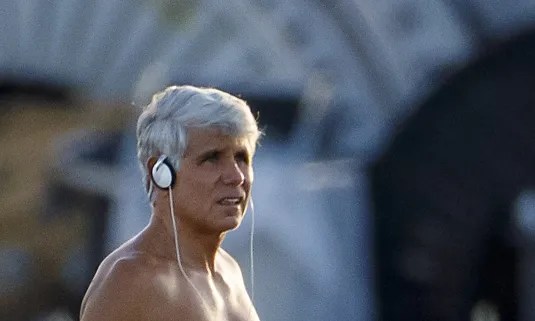
On Comebacks and Failed Comebacks V: Rod Blagojevich

Note: This essay concludes the small series “On Comebacks and Failed Comebacks.” The earlier pieces explored several very different kinds of returns: the moral vindication of Kofi Annan, the sly tactical persistence of Joe Nash of the Seattle Seahawks, the tragic artistic authenticity of Amy Winehouse, and the mythic public legend surrounding Muhammad Ali.


The story of Rod Blagojevich introduces a different category altogether: the shameless comeback.

Unlike the other figures in the series, Blagojevich’s return to public life does not depend on moral vindication, heroic persistence, or cultural myth. Instead it illustrates something more peculiar about contemporary politics and media. In an age of fragmented audiences and constant attention cycles, a disgraced figure may sometimes reappear simply by refusing to leave the stage.

Whether one sees Blagojevich’s re-emergence as comic, absurd, or oddly instructive, it provides a fitting final example for the series. Not every comeback is admirable, but each one reveals something about the strange ways public life allows stories to continue.

Not all comebacks are noble.

Some are heroic, like the moral vindication of Kofi Annan. Some are tactical, like the sly fourth-quarter returns engineered by Joe Nash of the Seattle Seahawks. Some exist somewhere between tragedy and authenticity, like the brief blazing career of Amy Winehouse. And some, like the legend of Muhammad Ali, grow into something close to myth.

But there is another type of comeback altogether.

The shameless comeback.

For that, it is difficult to find a more perfect case than Rod Blagojevich, the former governor of Illinois whose political career once appeared to have ended in spectacular disgrace.

The original scandal is by now familiar. In 2008 federal investigators revealed that Blagojevich had been recorded on FBI wiretaps discussing how he might profit from appointing a replacement to the U.S. Senate seat vacated by President-elect Barack Obama. The recordings were devastating. In one of the most memorable lines in modern American political scandal, Blagojevich described the Senate seat as something valuable that he was reluctant to give away for nothing.

The fallout was swift. Blagojevich was impeached and removed from office by the Illinois legislature. Later he was convicted on multiple corruption charges and sentenced to federal prison. For most politicians, this sequence would represent the end of the story.

Disgrace. Prison. Silence.

But American public life has always contained another possibility: the comeback powered not by redemption but by spectacle.

Even before his imprisonment, Blagojevich seemed instinctively drawn toward the theatrical dimension of his situation. He appeared on television talk shows, launched media interviews, and treated the unfolding scandal almost as if it were a strange kind of reality program in which he remained the central character.

His appearance on The Celebrity Apprentice, hosted by Donald Trump, felt less like an attempt to restore dignity than a recognition that modern politics and entertainment had already merged.

Then came the commutation.

In 2020 Trump commuted Blagojevich’s prison sentence, releasing him after several years behind bars. The decision itself was controversial, but the effect was unmistakable: the stage was suddenly open again.

And Blagojevich, to his credit—or perhaps to his creditlessness—walked right back onto it.

The most striking feature of his post-prison public life has been the absence of embarrassment. Many disgraced politicians attempt some form of contrition when they re-enter the public conversation. Apologies are issued. Lessons are discussed. A tone of humility is adopted.

Blagojevich chose a different path.

Instead he embraced a kind of shameless persistence, appearing in conservative media outlets, repositioning himself politically, and speaking about his case with the tone of someone who believes the whole episode was misunderstood or exaggerated. The ideological shift from Democrat to Republican was particularly striking, not because party changes are unheard of but because in Blagojevich’s case it seemed less like a conversion than a strategic recalibration.

It was, in other words, a comeback powered by the modern media ecosystem.

In an earlier era, a corruption scandal of this magnitude might have consigned a politician to permanent obscurity. But the fragmented media landscape of the twenty-first century offers a different possibility. There is always another audience somewhere, another platform, another narrative waiting to be constructed.

Blagojevich appears to understand this instinctively.

Which is why his story belongs in a series about comebacks, even if the comeback itself is of a peculiar variety. Unlike the moral return of Annan or the mythic return of Ali, Blagojevich’s version depends less on redemption than on endurance.

The secret of the shameless comeback is simple.

You refuse to leave the stage.

You keep talking. You keep appearing. You keep telling your version of the story until, slowly but inevitably, the scandal itself begins to blur into just another chapter in the larger spectacle of American politics.

In that sense Rod Blagojevich may represent a distinctly modern form of comeback: not heroic, not tragic, but theatrical.

And in the strange carnival of contemporary public life, theatrical persistence can sometimes be enough.

On Comebacks and Failed Comebacks I: Kofi Annan

Note: This piece begins a small series I’m calling “On Comebacks and Failed Comebacks.” Political and public life are full of attempted returns. Leaders lose elections, wars, or moral arguments and then try to reclaim the stage. Most of these efforts fail. The moment has passed, the audience has moved on, and what once felt urgent has dissolved into what might be called moral fatigue. Yet every so often a different pattern appears. Occasionally someone loses the immediate battle but remains present long enough for history itself to shift. When that happens, what first looked like defeat begins to resemble something closer to a delayed victory. Kofi Annan provides a particularly interesting case. His opposition to the Iraq War did not stop the invasion, and at the time it appeared that the argument had been decisively lost. Yet as the years passed and the consequences of the war became clearer, the moral judgment he articulated gained increasing weight.
In that sense, the story of Annan’s career suggests a useful distinction: some comebacks succeed not because the player reclaims the moment, but because the argument itself eventually catches up with history. Future pieces in this series will look at other figures—some who managed remarkable returns, and others whose comebacks never quite arrived.

Political life especially produces them in abundance. A leader loses a battle—an election, a war, a moral argument—and disappears into the quiet margins where yesterday’s figures slowly fade. The public moves on. The moral urgency of the moment dissolves into what might be called moral fatigue. Outrage that once seemed unstoppable becomes background noise. A new crisis appears, and the world’s attention shifts.

Once this fatigue sets in, comebacks are difficult. The audience that once cared has already drifted elsewhere. The stage has changed. Most players who attempt to return find that the moment that once belonged to them has passed.

Yet every so often a different pattern appears.

Occasionally a figure loses the immediate battle but remains present long enough for the moral tide itself to turn. When that happens, what looked like defeat begins to resemble something else entirely.

Kofi Annan offers one of the most intriguing examples of this phenomenon.

In 2003 the United States and the United Kingdom invaded Iraq. The invasion was justified by a mixture of strategic arguments, intelligence claims, and moral rhetoric about tyranny and liberation. In Washington and London the momentum of the moment was overwhelming. The war was framed as both necessary and inevitable.

The United Nations, by contrast, found itself sidelined. Annan, then serving as Secretary-General, watched as the institution he led was bypassed by the coalition preparing for war. The moment belonged to the advocates of intervention—particularly the group of American policy thinkers who had spent years arguing for the removal of Saddam Hussein.

At the time, it was not at all clear who would ultimately win the argument. What was clear was that the United Nations had lost the immediate struggle for influence. The invasion proceeded without explicit UN authorization, and the diplomatic machinery that Annan represented appeared powerless to prevent it.

The moral emergency that had animated the debate quickly hardened into geopolitical reality.

Then, in September 2004, Annan said something remarkable. In a BBC interview he stated plainly that the invasion of Iraq was illegal under international law.

It was an extraordinary declaration. Rarely does a sitting Secretary-General of the United Nations describe the actions of the world’s most powerful government in such blunt terms. Yet the statement did not produce the dramatic reversal one might imagine. The war continued. Washington and London dismissed the criticism. The machinery of global politics moved forward largely unchanged.

In the short term, Annan had lost the battle.

And the personal toll of that moment appears to have been considerable. In his biography there is a striking image from this period: Annan alone in his darkened living room, unable for a time to rise from the floor. The room itself reportedly kept in near darkness. It was not exactly depression, at least not in the clinical sense, but something close to exhaustion after a prolonged moral struggle that had failed to alter events.

It is a haunting scene. One of the most powerful diplomats in the world sitting on the floor of a dark room, confronting the limits of his influence.

At that moment, the story of Kofi Annan could easily have ended as the story of a failed comeback. A leader who tried to reassert the moral authority of international law and found that the world had already moved on.

But history has a way of rearranging the meaning of certain moments.

As the years passed, the Iraq War came to be widely regarded as a profound strategic and humanitarian mistake. The claims that had justified the invasion collapsed. The war itself destabilized the region and reshaped global politics in ways that few of its original advocates had anticipated.

Gradually, the moral argument that Annan had made—quietly but firmly—became the prevailing historical judgment.

After leaving the United Nations, Annan did not retreat entirely from public life. Instead he reappeared in a different role as a member of The Elders, a group of former statesmen attempting to exert moral influence outside formal political structures.

It was a curious transformation. No longer the head of the UN, Annan had less formal power than he once possessed. Yet his voice now carried a different kind of authority—the authority of someone who had remained in the arena long enough for events to vindicate his judgment.

By the end of his life, the moral verdict on the Iraq War had shifted decisively. Few serious observers still defended the intervention with the confidence that characterized the early years of the conflict. The consensus had moved, slowly but unmistakably, toward the position Annan had articulated when it mattered least.

In this sense, his career offers an unusual example in the history of comebacks.

He lost the battle.
But he may have won the argument.

That distinction matters.

Most political figures attempt comebacks by trying to reclaim the exact moment they once dominated. They want the same stage, the same audience, the same authority. When the moment has passed, the comeback fails.

Annan’s story suggests a different possibility. Sometimes the moral argument itself continues moving through history long after the political battle appears settled. If a leader remains present long enough, the tide may eventually turn.

Which leads to a simple but revealing observation about great players in any arena.

A truly great player is never entirely out of the game.

The moment may pass. The audience may drift away. But if the underlying argument proves sound, history itself has a way of reopening the field.

And when it does, the comeback is already underway.

On My Week with Isobel (aka London Girl) Part III: Aftermath

Note: This is the third of a three part series. Part I is here and Part II is here.

Oh my sentimental fool

Lloyd Cole

Was the risk I sent to you received?

Metric

SECTION I — Leaving Oxford / Returning to Japan

I walked the five minutes back to the hotel after the bus pulled away. My wife was going on to visit friends in Germany and I would have about five days alone in Kyoto after I got back to Japan. At the hotel I couldn’t get back to sleep, so I said a small prayer to the angels asking for grace to get through the day, showered, packed my things, and waited for the 8 AM car pickup.

The driver arrived on time and we drove not to Heathrow but to Luton. We made light conversation and listened to the radio. One segment was about the rising number of homeless families in the UK, and I remember thinking, not for the first time, how every country carries its own version of difficulty and imbalance.

At the airport I bought breakfast — fruit and coffee — and found a quiet place to sit. I downloaded volumes four through six of Anthony Powell’s A Dance to the Music of Time onto my Kindle. I wanted something emotionally steady for the flight, something with continuity and shape. Then I texted Isobel.

She wrote back immediately. We exchanged messages for twenty or thirty minutes. It felt natural and easy, as if the channel between us was already established and didn’t need warming up. I was happy to hear from her and, again, I had the feeling that our connection was somehow fated — not in a grand cosmic sense, but in the simpler way that some meetings feel unavoidable once they happen. The exchange grounded me. It made the idea of returning to Japan feel manageable.

On the plane I read some Powell and listened to music. I remember playing “Two Suns in the Sunset” by Pink Floyd and being unexpectedly moved by it. I was in an emotional state — not overwhelmed, but open and exposed — and the flight passed quietly. I landed at Kansai Airport in the afternoon.

I took the Haruka train back toward Kyoto. The wide seats and generous legroom made me feel welcomed back into my country of choice. Much as I had enjoyed England, I felt real relief in returning. There is a particular comfort in Japanese transit — the order, the space, the quiet efficiency — and my body recognized it immediately.

I arrived home and unpacked slowly. I was due at work the day after next for heat index monitoring duty, part of my administrative role during the summer. At that point everything still felt relatively normal. I was in contact with Isobel. I had several days to myself — my son was on a school trip to Australia — and I was mentally preparing to return to school.

I had no sense of impending crisis. No awareness that within three days I would walk into my principal’s office and offer my resignation

SECTION II — First Days Back

On my first full day back I did laundry and in the late afternoon went to Takumiya, a pub in north central Kyoto near Karasuma Oike. I don’t remember whether I texted or called Isobel that day, but I almost certainly did. At Takumiya I ordered sashimi and had a few craft beers from their rotating selection. I stayed longer than planned, talking lightly with whoever happened to be sitting nearby.

Later I walked to Before 9, a smaller beer and sake bar in the same area. There was a cat there. It came up to me and nuzzled my leg. The bartender put his arm around me briefly and gave me a small, friendly pat on the back. At the time it struck me that I was in an unusually open and fluid state. People — and even animals — seemed to register it instinctively. It felt as if they wanted to take care of me without knowing exactly why.

The next day was Tuesday and I went to work as scheduled. I checked the heat index readings as part of my summer administrative duties. Dr. Fox was on campus. Seeing him immediately shifted the emotional temperature of the day.

I have written elsewhere about my problems with Dr. Fox and I won’t revisit them in detail here. What matters for this story is that by that point I felt he had betrayed me and failed to show up when I most needed institutional support. Trust had already been damaged. Seeing him again after Oxford brought all of that to the surface at once.

We spoke briefly. Before I left, he asked me to come in the following day to help prepare a presentation he was scheduled to give to an alumni group. I had ghostwritten material for him many times before. Under normal circumstances I would have said yes without hesitation. This time I agreed anyway, even though I was already internally unstable and emotionally saturated.

It would not turn out well

Oh my sentimental fool…

Lloyd Cole

PART III — Return to Japan + The Actual Consequence

Saturday, after the bus pulled away, I walked back to the hotel alone. The distance was short — five minutes at most — but it felt longer, as if the space between departure and arrival had stretched in subtle ways that were difficult to measure. When I entered the room and closed the door behind me, the click sounded sharper than usual. It carried a faint sense of finality, though I couldn’t yet say what exactly had ended.

I did not rush. Packing became a deliberate act, almost ritualistic in its pacing. I folded shirts one at a time, placed my notebook carefully into my bag, slipped the Tintin postcard between pages so it would not bend. Sue Tompkins went in next, followed by the charger, the toothbrush, the small practical objects that restore a sense of order after emotional disturbance. The room itself was modest — functional, forgettable in most respects — yet it felt oddly expanded, as if some invisible event had occurred there despite the absence of anything outwardly dramatic. Something had shifted in me, and the room seemed to hold the echo of that shift.

At the desk, I laid everything out for a moment, not to organize but simply to gather myself. The Mendoza Line was no longer playing, but the music had already done its work. The emotional charge it helped ignite remained present, circulating quietly beneath the surface. There was nothing to heighten or prolong; the effect was already internalized.

Around eight, the hire car arrived. The driver was polite, efficient, the kind of professional whose calm competence creates a reassuring neutrality. He helped with my bag, and we exchanged small talk as we pulled into traffic — London housing costs, wages, the persistent difficulty young people face in trying to establish themselves. On the radio, a news segment discussed the rising number of homeless families and children across the UK. Normally, such stories register as troubling but abstract statistics. That morning, however, the report landed differently. I found myself thinking about untethered lives, about how fragile the structures that hold people together can be, and how sometimes the tether itself is the only thing preventing a deeper psychological unraveling.

Traffic was light, and we arrived at the airport mid-morning. Inside, I purchased a simple breakfast — fruit, yogurt, coffee — and found a seat removed from the main flow of travelers. Airports are environments of constant movement, but solitude can still be carved out within them if one chooses carefully. I opened my Kindle and downloaded volumes four through six of Anthony Powell’s A Dance to the Music of Time. It was not an act of escapism so much as orientation. I wanted narrative continuity, a long arc where identity unfolds gradually rather than collapsing under sudden pressure. Powell’s world offered lineage, structure, and a reassuring sense of temporal patience.

I texted Isobel. She responded almost immediately, and what followed was a long, bright thread of conversation carried across airport Wi-Fi. There was no sense of emotional comedown, no awkward reentry into ordinary distance — only continuation. The connection felt intact, natural, as if the meeting had established a channel that did not require reinforcement to remain open.

When boarding was called, the transition felt procedural rather than dramatic. The flight passed in a quiet blur of clouds, Molina songs, Powell’s prose, and intermittent thought. Beneath it all was a subtle ache under the ribs — not pain, not longing in any acute sense, but effect. A residual emotional state that did not demand resolution, only acknowledgment.

I landed in Japan first. My wife continued on to Germany to visit friends, and my son was in Australia on a school trip. The house, when I entered it, was silent in a way that felt tangible. I carried that silence with unusual care, as if it were made of glass and might shatter if handled abruptly. Solitude is often restorative, but this solitude had an amplifying quality, heightening rather than settling internal experience.

That evening, I went to Takumiya, a pub in north central Kyoto. I ordered food and three craft beers and spoke casually with whoever happened to be nearby. Conversations were light, unstructured, yet I sensed an unusual responsiveness from people around me — as though I possessed a slightly elevated emotional voltage that others could detect without understanding its source. Even animals seemed to register it. Cats approached me with a familiarity that felt less coincidental than intuitive, as if some form of static had gathered on the soul.

I returned to Takumiya each night that week. There was comfort in being present in public spaces while remaining largely anonymous. The balance allowed me to exist among others without the demands of deeper recognition. Meanwhile, at five in the evening Japan time — nine in the morning in London — Isobel and I spoke daily. The calls were not brief check-ins but sustained conversations lasting anywhere from thirty minutes to an hour and a half. Often she walked through a park while we spoke, and I imagined her surroundings as she described them, the geographical distance softened by conversational continuity.

During one of these calls, I told her that I wanted to write a book. Not about her specifically, but about the chain of experiences that led to meeting her and the clarity that encounter unexpectedly revealed. She understood immediately. More than that, she expressed a quiet appreciation for being part of that moment of ignition — not as subject matter but as catalyst.

At the same time, unresolved resentment toward Dr. Fox did not dissipate with distance. Instead, it sharpened. The baseball heatstroke issue lingered at the margins of thought, alongside a broader accumulation of professional frustrations: moments of perceived disrespect, ambiguous expectations, and a decade of service that increasingly felt like professionalism without true partnership. None of these tensions were new, but the emotional openness of the week amplified their weight. Background noise began to feel like pressure.

By Friday, when I walked into school, I was not consciously planning a decisive action, yet I sensed a degree of internal instability that made ordinary interactions feel precarious. When Dr. Fox called me into his office to request assistance with a presentation — a familiar pattern, a non-work day expectation framed as routine — the moment crystallized something that had been building long before Oxford. I resigned. The decision belonged to a larger narrative, but this story carries its immediate emotional context.

As the reality of resignation settled into my body, a quiet clarity followed. I knew I needed to speak with my wife. The conversation would not revolve around specifics — call durations, text counts, or the mechanics of connection — but around truth in its broader emotional sense.

She returned home Saturday night. With her presence, the house regained its weight: history, shared furniture, a past that possessed shape and gravity. We sat together without wine or any conversational buffer. The moment did not invite performance or gradual disclosure; it required directness.

“I quit,” I said. “And I met someone.”

She asked only one question.

“Did you sleep with her?”

“No.”

She nodded, her response quiet and measured.

“Okay. Have fun on the phone.”

Nothing fractured dramatically in that moment. There was no raised voice, no immediate emotional rupture. Yet something subtle shifted — an alteration not of structure but of atmosphere. The past remained intact, but the future carried a slightly different texture. Nothing broke, but nothing stayed exactly the same.

Saturday and Sunday:

Saturday and Sunday arrived with a quietness that felt disproportionate to the events of the preceding week. For the first time in months, there was no alarm set for early administrative duties, no email requiring immediate response, no expectation of presence within the institutional rhythms that had long structured my days. I was off work — not merely for the weekend, but in a more consequential sense that I could not yet fully absorb. I would not return until 2022. The long-term ramifications of what had unfolded were already in motion, though at that moment they existed more as a distant horizon than as a lived reality whose contours could be clearly seen.

The weekend therefore carried a strange dual quality. On the surface, it resembled any other stretch of unstructured time: coffee in the morning, small household tasks, the slow pacing of hours unburdened by schedules. Beneath that surface, however, ran a persistent awareness that something fundamental had shifted. The scaffolding of daily life — work expectations, professional identity, habitual responsibilities — had loosened, and with its absence came both relief and a faint, almost disorienting spaciousness.

At five o’clock sharp Japan time, which was nine in the morning in the UK, I called Isobel. The timing became instinctive, a daily point of orientation that anchored the day before it fully began. She answered as she was waking, her voice carrying that soft mixture of sleep and recognition that collapses distance instantly. We picked up exactly where we had left off, as if conversation were a continuous thread rather than a sequence of separate exchanges. We talked and laughed easily, moving between subjects without effort — music, muses, love, the nature of intimacy, and the broader textures of life that surface when two people feel unexpectedly understood.

The calls possessed a quality that felt, at the time, almost transcendent. I experienced a heightened emotional state that bordered on euphoria, a sense of expansion difficult to articulate without risking exaggeration. There was an unmistakable feeling of being lifted beyond ordinary emotional gravity, as if the connection existed in a space slightly removed from daily constraint. For brief stretches, I felt powerful in a way that had little to do with control and everything to do with aliveness — the psychological equivalent of standing in clear light after months of muted color.

Yet even within that intensity, I carried a quiet awareness that such states are rarely sustainable. The experience felt too vivid, too precise in its timing, to belong to permanence. I understood, somewhere beneath the exhilaration, that what we were inhabiting was a moment granted rather than guaranteed. For the time being, however, there was a mutual permission to exist within that space without prematurely interrogating its future. We allowed the conversations to unfold fully, accepting their immediacy without insisting on outcome.

The rest of the weekend unfolded around those calls like a soft frame. I moved through ordinary activities — brief walks, small household routines, moments of shared quiet with my wife — with an undercurrent of emotional intensity that did not demand expression but remained unmistakably present. Silence felt less empty than suspended, as though the days themselves were pausing before the arrival of consequences not yet visible.

What remained most striking about that weekend was not any single event but the emotional totality it carried. The combination of resignation, solitude, reconnection, and emerging uncertainty produced a state that was both exhilarating and fragile. I was aware, even then, of the paradox inherent in the experience: the joy of discovery intertwined with the inevitability of complication, the brightness of connection shadowed by the knowledge of its precariousness.

That was the weekend. In its quiet span, I found myself inhabiting an emotional condition that was at once expansive and difficult, sustaining and destabilizing. I was, deeply and undeniably, in love — not in a settled or declarative sense, but in the raw, immediate way that accompanies sudden recognition. The feeling carried power and tenderness in equal measure, along with a subtle ache that suggested awareness of its limits even as it unfolded.

The Rest of September:

The rest of September passed with a quality that is difficult to reconstruct in precise sequence. Days did not feel discrete or individually memorable; instead, they merged into a continuous emotional field in which time moved forward without the usual markers of routine. The absence of work removed one of the primary structures that normally segments experience, and without that scaffolding the month acquired a dreamlike texture. Moments were vivid while they occurred, yet quickly dissolved into the broader atmosphere of the period.

Isobel and I remained in frequent contact. We spoke most days and exchanged messages with a familiarity that no longer required initiation or explanation. The connection persisted, but the intensity that had defined the immediate aftermath of Oxford began, subtly, to dim. This was not a collapse or a dramatic withdrawal — rather, a gentle tapering, the natural adjustment that follows emotional peaks once they settle into the rhythm of distance and everyday life. The calls remained warm, often intimate, and still carried laughter and shared curiosity, but the sense of suspended transcendence that characterized the earlier weeks softened into something more ordinary.

My days were largely unstructured. Without professional obligations, I devoted time to my blog, experimenting with longer reflections and shorter fragments that attempted to capture the evolving emotional landscape. I also began broadcasting on Periscope, drawn to the immediacy of speaking into a space where audience and solitude coexist in curious balance. These activities did not replace work so much as fill the temporal vacuum it left behind, offering forms of expression that required presence without imposing rigid expectation.

Later in the month, I briefly reentered the professional sphere when I accompanied my senior students to a university fair at Canadian Academy. The experience felt almost surreal in its normalcy — a reminder of institutional rhythms that continued independently of my altered position within them. It was the only direct work engagement I undertook during that period, and its brevity reinforced the sense that September existed outside the usual professional narrative.

Toward the end of the month, I traveled for a significant assignment: serving as lead evaluator for the Diploma Programme at Western Academy of Beijing. The responsibility was substantial, and I approached it with an intention to perform at the level expected despite the internal shifts that characterized the preceding weeks. The visit, however, was complicated by dynamics within the evaluation team. The MYP leader’s preference for extended, often unfocused meetings created an atmosphere of fatigue, and Ashish, the Head from IB Singapore, lacked either the authority or inclination to redirect those discussions effectively. Evenings stretched late into the night. We ordered Indian food, reviewed documentation, and navigated the procedural demands of the evaluation with a professionalism that felt increasingly mechanical.

During one of those evenings, after the meetings had ended and the day’s formal responsibilities were complete, I called Isobel. We spoke at length, as had become our habit, but the conversation carried a different quality. She told me about a dream — one involving a fire and a cabin in the forest. In the dream, I was present. She mentioned that she had shared the dream with her therapist, a detail that suggested the experience held significance beyond casual narrative. Yet when I asked about it, she hesitated. She did not want to recount the dream in full. The partial disclosure introduced an ambiguity that I could not immediately interpret but nonetheless felt.

The moment did not register as conflict or withdrawal. There was no overt tension, no articulated concern. Yet something subtle shifted in the emotional atmosphere between us. The change was nearly imperceptible, detectable less through words than through absence — a slight alteration in tone, a new reticence where openness had previously been instinctive. It was not dramatic enough to prompt confrontation, but it carried the unmistakable sensation of movement beneath the surface.

As September drew to a close and October approached, our communication began to thin. Calls became less frequent, messages shorter, pauses between exchanges longer. The transition unfolded gradually, without a definitive turning point, but its trajectory felt clear. What had once been continuous conversation now required renewed initiation, and the ease that had defined our early exchanges gave way to a quieter, more tentative rhythm.

In retrospect, September stands as an interlude — a period suspended between ignition and resolution. The connection with Isobel remained meaningful and emotionally resonant, yet the conditions that had sustained its earlier intensity were shifting. October would bring both culmination and conclusion, the apex of the relationship’s emotional arc and, simultaneously, its quiet dissolution.

October:

October arrived without ceremony, yet the emotional atmosphere surrounding it was markedly different from the suspended haze of September. I was not working at all during that month, and the absence of professional structure began to feel less like pause and more like rupture. Relations with my Principal, Dr. Fox, had deteriorated to an all-time low, and what had once been a strained but functional working relationship now carried open hostility.

We had two phone calls that month about university counseling, both of them angry and vitriolic. The topic itself — university advising — should have been procedural, collaborative, even routine. Instead, it became a flashpoint that exposed a deeper accumulation of mistrust and frustration. From my perspective, he was mishandling critical processes and creating unnecessary stress for students and staff alike, and I felt a growing sense of professional indignation that was difficult to contain. I shouted at him on the phone twice: once while walking along the river, my voice carrying across the water in a way that felt disproportionate to the setting, and once from a hotel bar in Osaka, where the contained intimacy of the space made the confrontation feel even more exposed. The bartenders glanced at me with a mixture of curiosity and quiet concern, clearly aware that they were witnessing a private eruption in a public place. Still, they allowed the moment to pass without interference, serving drinks and processing the bill with the practiced discretion that characterizes hospitality in Japan.

In mid-October, I traveled to Singapore for another IB training. This assignment positioned me as lead trainer for the Diploma Programme, with Duan Yorke serving as my deputy. Duan was excellent — steady, competent, and easy to work alongside — providing a professional counterbalance to the internal instability I carried with me. Yet despite the outward success of the training’s first day, something felt off internally. The emotional residue of the previous weeks, combined with the unresolved professional tensions, manifested as a quiet but unmistakable dissonance. On the second day, I found myself unable to maintain the expected level of engagement and withdrew temporarily to visit an esoteric healer. The visit itself belongs to another narrative thread, one that requires its own context, but its occurrence reflected the broader sense that I was searching for equilibrium in unconventional ways.

I returned and completed the training successfully, fulfilling my responsibilities with the professionalism the role demanded. Afterward, I remained in Singapore for an additional three days, using the time to decompress in a city that had long felt both familiar and emotionally neutral. The extended stay provided space for quiet reflection, casual wandering, and the gradual release of accumulated tension. Professionally, my obligations were minimal. I completed a handful of recommendation letters for early decision applicants — necessary work, given that our new counselor was struggling with the process — but beyond that, my professional identity remained largely suspended.

During this period, Isobel and I spoke only once. The call carried an unmistakable clarity: whatever had sustained the connection through September was no longer present. Whether the shift stemmed from the dream she had mentioned earlier, the simple realities of distance, or the natural fading that accompanies emotionally intense encounters, the result was the same. The spark had dissipated. What struck me most was the absence of dramatic heartbreak. I did not feel shattered or undone. Instead, I experienced a dull void — a quiet ache occupying the space where my love for her had briefly lived. It was less a wound than an absence, the emotional equivalent of a room that had been furnished and then emptied.

Singapore became the final location in which we spoke. After that call, the connection ended without formal closure, dissolving into silence rather than conflict.

When I returned to Japan, I settled back into writing and Periscoping with a renewed sense of creative urgency. Singapore itself had already played a role in that shift. In a billiards bar there, I drafted the first installment of The Thin Man, capturing fragments of narrative that would later expand into a larger project. The act of writing felt less like discipline and more like necessity — a way of metabolizing the preceding months and translating emotional experience into narrative form. Back in Japan, I continued this process through a series of essays that month, each exploring different facets of the transitional period.

October also introduced another unexpected connection. That month I met Mela, a woman from New York City in her thirties who was on medical leave from her work as a props assistant in film production. She was housesitting at the time and occupied her days in ways that mirrored my own state of suspended routine: scrolling Tinder, investigating potential matches with a mixture of curiosity and humor, and broadcasting extensively on Periscope. We connected easily, moving from initial interaction to Instagram texts and eventually long phone calls. Neither of us had pressing daily commitments, and the absence of structure created space for conversations that extended for hours — sometimes entire afternoons — ranging across music, film, personal history, and the broader philosophical questions that surface when time is abundant and emotional stakes feel low.

Months later, in December, I would meet her in person during a museum visit in Queens. The day unfolded quietly: exploring exhibits, browsing the bookstore, and sharing soup in the café. At one point, descending a staircase, she leaned into me in a way that felt intentional — a brief physical gesture that carried a hint of performative vulnerability. She said, “you saved me,” a remark delivered with ambiguity that allowed interpretation without demanding it. The moment marked the closest we came to flirtation, and even that remained understated, more symbolic than consequential.

Yet the defining emotional endpoint of October remained tied to Isobel. Singapore had been the final setting of our conversation, and with its conclusion, that chapter closed without spectacle. The month that began with professional conflict and emotional residue ended in creative ignition, quiet acceptance, and the emergence of new but less charged connections. October stood as both apex and dissolution — the culmination of an emotional arc that had begun in Oxford and the gentle fading that followed its brief, luminous peak.

Conclusion:

Looking back on it now, the question that naturally arises is what, if anything, can be concluded from the experience. Memory has a way of smoothing edges while preserving emotional truths, and the passage of time introduces perspective without necessarily dissolving ambiguity. What remains is not a tidy narrative with a clear moral, but a series of impressions that continue to carry meaning long after the events themselves have receded.

Was I in love with Isobel? The answer, for me, is uncomplicated. Yes — absolutely. The feeling was immediate, powerful, and unmistakable in its emotional clarity. It was not rooted in fantasy or projection so much as in recognition: the sudden awareness that another person had seen and engaged parts of me that often remain peripheral or unarticulated. The connection possessed both intellectual and emotional intimacy, creating a sense of alignment that felt rare and therefore significant.

Whether she was in love with me is less certain. That question remains open, and perhaps necessarily so. Love does not always manifest symmetrically, nor does it require identical emotional timelines. What I do believe is that she was deeply drawn to me — enamored with qualities she named explicitly: my maturity, my openness, my willingness to explore symbolic and esoteric frameworks such as astrology, and what she described as my confirmed oddness. These were not superficial points of attraction but aspects of identity that shape how one moves through the world and forms connection. In response, she opened herself in ways that felt unprecedented in my experience with other women. The openness was emotional, conversational, and psychological, revealing vulnerabilities and reflections that suggested a level of trust both genuine and meaningful.

Yet that openness stopped short of the one dimension that often defines romantic relationships in conventional terms. Physical consummation never occurred. And still, I remain convinced that it might have — that the night of the red dress, that Wednesday evening suspended in quiet possibility, carried the potential for that final step had I not withdrawn. The decision to pull back was not rooted in lack of desire but in an instinctive recognition of complexity and consequence, a moment where restraint felt simultaneously protective and destabilizing.

At the beginning of this narrative, I wrote the line: “I did not sleep with her, so I had to quit my job.” On its surface, the statement reads as paradoxical or even absurd. Yet in a literal and emotional sense, it reflects the truth as I experienced it. Something that transpired between us disrupted my internal equilibrium in a way that extended far beyond the boundaries of romantic encounter. The experience did not create professional dissatisfaction where none existed; rather, it crystallized tensions that had long been present but insufficiently confronted. In the altered emotional state that followed Oxford, I could no longer compartmentalize or tolerate dynamics that had gradually eroded trust and professional fulfillment. The decision to resign emerged not as a reaction to Isobel but as a response made possible by the clarity her presence inadvertently catalyzed.

What, then, did Isobel have to do with that decision? It is a question without a definitive answer, and perhaps one that resists definitive resolution. Objectively, professional circumstances and romantic encounter belong to separate domains, each governed by distinct motivations and consequences. Yet subjective experience does not always honor such boundaries. In my mind and in my heart, the two remain inextricably linked. The emotional awakening precipitated by our connection illuminated aspects of my life that had grown untenable, accelerating a reckoning that might otherwise have unfolded more gradually.

In this sense, Isobel did not cause the decision but revealed the conditions that made it inevitable. The encounter functioned as catalyst rather than origin, exposing fractures already present and clarifying the need for change. The love I felt for her, whether reciprocated in equal measure or not, became intertwined with a broader transformation — one that encompassed identity, professional alignment, and creative direction.

Ultimately, the experience resists reduction to a singular meaning. It was neither tragedy nor triumph, neither mistake nor destiny. It was an encounter marked by intensity, ambiguity, and consequence, leaving behind a residue of insight rather than closure. If anything can be said with certainty, it is that the connection altered the trajectory of my life in subtle but enduring ways. The emotional truth of that alteration persists, even as the specifics of the relationship have receded into memory.

And perhaps that is the most accurate conclusion available: that some relationships are defined not by duration or outcome but by the clarity they introduce, the decisions they precipitate, and the self-recognition they make possible. In that sense, Isobel remains both part of my past and part of the internal landscape through which I continue to move — a presence whose significance lies less in what occurred than in what it revealed.

Coda:

What remains, after the noise has faded and the chronology has settled into memory, is not regret but recognition. Isobel was never meant to be a permanent figure in my life; she was a moment of ignition, a flare that illuminated terrain I had been walking blindly for years. Loving her did not undo me — it clarified me. It revealed fault lines in my professional life, deepened my awareness of emotional possibility, and reminded me that connection can arrive without warning and depart without resolution while still altering everything that follows. Some encounters are not chapters but catalysts, and their power lies precisely in their brevity. I did not leave Oxford with a lover, but I left with a truth that could no longer be ignored, and that truth reshaped the decisions that defined the months and years ahead.

So the story does not end with loss but with transformation. The quiet house in Kyoto, the late-night calls across time zones, the resignation spoken into an office heavy with history, the essays written in the wake of confusion and clarity — all of it forms a single arc whose meaning resides not in permanence but in awakening. Isobel remains a presence not because of what we became, but because of what her existence made visible: that love, even when fleeting, carries the capacity to reorder a life. And in that sense, the experience stands complete. Not a tragedy, not a triumph, but a moment of rare and incandescent alignment — a brief crossing of paths that left behind warmth, ache, and an enduring knowledge that sometimes the most consequential relationships are the ones that arrive, burn bright, and quietly pass into memory while continuing to shape the person who remembers them.

Note: If you linked this piece, you may also like my short story Simona. You can read it here.

The Process Has a Point of View: A Poem

Author’s Note: This little ditty comes from my first blog, which was called “Classical Sympathies.” When I started Sympathies, I didn’t really know what I was doing. I still don’t.

the process has a point of view

the process has a plan

it consecrates opinion

of the group or of the man

the process can be tampered with

but one must take great pains

to regard the ghouls which process fronts for

ghouls weighted down with chains

when we wantonly with process toy

one chain process doth loose

if the ghouls become untethered

we have ourselves cooked goose

blood rites, human sacrifice, motions carried

parliamentary procedures of every kind

serve well to prettify men’s base designs

yet their rigidity may insult the mind

so make your end run around the process

subvert the stated order, bring fresh thinking

but beware the ghouls of process

whichll claim their pound of flesh

or better yet submit to process, to “the rules”

establish your credentials and sanctify intent

until you see that form is but an empty suit

and process, when respected, can be bent

Note: If you like this poem, you may also like “Some Things I’ve Learned: A Poem.” You can find that here.

Keeganisms in the Wild: An Exploration

New Note: I’m republishing Keeganisms for colleagues and friends in the IB world. The piece grew out of my early years in international education, when I was trying to understand not just what we teach, but how adults actually grow, change, and make meaning inside institutions.

Readers interested in my time working at Ritsumeikan Uji and for the IB may also enjoy this piece on great and good talkers, and this one, a tougher piece, on being badly overworked in 2012.

This piece remains one of the clearest statements I’ve written about adult development, leadership, and the limits—and possibilities—of institutional life.

Finally, I am happy to report that the great Stephen Keegan is alive and well. Rock on, sir.

Note: This piece is a re-write of my very first piece of linguistic ethnography. For a fuller explanation of linguistic ethnography check out On “Dude” Usage. A “Keeganism” here is simply a notable phrase used by the former head of the IB Diploma Program for Asia-Pacific Stephen Keegan. Keegan was based out of the Singapore office, which was at the time one of three “hub” offices around the world.

Although fitting in with my other efforts at linguistic ethnography, in this piece I approach Keeganisms as if they are a rare species, like a certain kind of elusive salamander or something. If this little conceit if effective, as it hope it is, this is only because the Keeganisms under investigation are themselves so glorious.

Introduction:

When Stephen Keegan spoke, dozens listened. I was one of them. Darwin sailed around on the Beagle, ran across some turtles in the Galapagos, and his investigation of all that changed the world. While I don’t pretend that my little survey of Keeganisms will change the world, I would not be able to forgive myself if the species was simply lost to time.

Keeganisms were known to flourish between the years 2008-2013, in and around the greater Pacific Rim. Without being able to definitively establish the evolutionary arc of the species, naturalists suspect an increasingly florid progression over the years. For my own part, I was marginally aware of the species in 2008-2009, but did not realize the bounty that Keeganisms provided the scientific community until 2010. What follows is an analysis of some of the most common variants of the species as I was able to observe. All of these instances were found at IB events where Keegan was speaking in public.

Keeganism #1:

Here is Keegen in 2010 describing what the IB provides to its schools in the way of services: “We are not special. I mean, of course we are unique and special in many ways.”

Keegan is making the point that there is a consistency across high quality high school curricula and programs, and that the IB is not somehow in a wholly different category. The first sentence, “we are not special” is a bald statement to this effect. Keegan immediately realizes, however, that this is possibly an infelicitous soundbite, and qualifies with a politician’s cover “I mean, of course we are unique and special in many ways.”

Why is it a Keeganism? The classic form common to the first type of a true Keeganisms can be expressed as (A+D=A>D) where A (Affirmation)=a statement that shows an aspect of Keegan’s actual feelings or opinions about a given matter, and D (Denial)=a qualification which serves to qualify and reduce the sting of the truth-telling in A, but which does not fully counterbalance or neutralize the sentiment of A, thus A>D.

In this case, “I mean, of course we are unique and special in many ways,” gets Keegan off the hook for his heresy, however it is rather obviously a cliched cover (although one does appreciate the “in many ways.”) From a formal point of view, then, this is a classic Keeganism, perhaps the prototype; from a content point of view we can find better.

Keeganism #2:

And we did find better later that year or the next at a meeting of East Asian IB Diploma Coordinators. Here, Keegan is commenting on one of two commercially available software products which were competing for market share for IB schools at that time. “I am not promoting their product. I am promoting the concept of their product (….) They are the future. Of course the future will take many forms.

In this case Keegan has an opinion about which product if preferable, however in his capacity as an IB employee he cannot state this outright. Instead, he gives an extended tribute to one of the competing companies before making clear that he is “not promoting their product.” Likewise, when he catches himself saying that their product “is the future,” he hastens to make sure we understand that multivalent nature of said future. Thus, he is again “covered.”

“I am not promoting their product. I am promoting the concept of their product” is actually a structural reversal of the classic Keeganism, which reappears in “they are the future. Of course the future will take many forms.” In the first, Keegan’s true opinion comes second, the denial first. Matters are further complicated by the introduction of the word “concept.” While it may be the case that a concept at times can be a free floating entity, in this case Keegan’s semantic distinction is taken, as it is probably intended, with a large measure of salt. Thus again a key feature of the species–the “denial” is consistently underweighted as compared to the affirmation: D+A=D<A.

With Keegan’s statement about the future, the classic structure is back, with a twist. The sentence “of course the future will take many forms” is so nebulous, so frankly metaphysical in its lineaments, that it verges on absurdity. It is also highly arguable, as while it may be true that the characteristics of the future will vary from place to place, it is at least possible to argue that the future will take precisely the form it takes: not a plurality of forms, but exactly one. Of more direct relevance is the point that if the future will take many forms, and in only one of those forms are “they” that future, then why are they “the future” at all? Of course, this is precisely the genius of this particular Keeganism; the “denial” is so slippery that is dissolves almost entirely, assuming instead a purely formal aspect (f). A+D=A(f).

Keeganism #3:

Not all Keeganisms have such an overt affirmation/ denial or denial/ affirmation structure, however. Others slip their denial/ qualification into the body of the affirmation itself. For example: “This alternative is being described as a valid reliable assessment.”

This Keeganism came at an IB conference for the Asian region, Keegan is describing highly contentious changes to the IB Visual Arts curriculum, which at the time the IB was defending against continued protests from art teachers (a fractious bunch when agitated it turns out). An advanced degree in communication theory is not required in order to parse this Keeganism; simply put the addition of “is being described as” shifts the locus of affirmation to some distant body doing the describing and away from Keegan, who is instead stating an unimpeachable fact–somebody somewhere is describing the assessment as reliable. Nonetheless, Keegan is not entirely distancing himself from the affirmation. In fact, there is no counter-affirmation present here, simply a qualification that insulates Keegan from a bald statement of validity and reliability.

Keeganism #4:

Here is Keegan at his final public appearance in Japan before his resignation: “We are delighted to be part of a global organization with global requirements.

With this one, structurally we are in similar territory, but the valence differs. Keegan is describing some recent “rationalization” of IB services around the world, a change which would reduce some of the autonomy of the Asia Pacific regional office. In fact over the next few years the IB Asia Pacific office, and all of the “hub” offices, would be downgraded from essentially autonomous power centers with a Head of Office of their own to simply branches of the global organization with no clearly assigned leadership of their own. The acute listener will understand that Keegan’s loyalty is more to the region than the global organization; with some justice he feels that Asia-Pacific is the model region. This point has to be borne in mind when approaching this particular Keeganism.

On the face of it this is a fairly simple piece of sarcasm directed at the global infrastructure. However, there are a few complicating factors. First, Keegan uses the plural pronoun–thereby implicating his fellow presenter, and, perhaps, his entire regional office. Of course, the singular here would be far too “on the nose”; still, the “we” puts his colleagues in an interesting position. Second, the repetition of “global” here confers the style we have come to expect from a true Keeganism. Third, there is perhaps more ambiguity here than we might as first suspect. Keegan actually does understand the drive to standardize the regions and the need for global requirements, and he can explain this need in unironic terms. One suspects that an aspect of heart versus head is present here as well. In practice, however, on the communication front lines, Keegan has difficulty standing fully behind the ramifications of certain of these global requirements.

Here is where it gets tricky–the affection with which Keegan was held around the region was in large part a result of his ability to walk a very fine line between representing his employer and representing the region, its Diploma Coordinators, and its Heads of School. In order to sustain this somewhat ambiguous position, Keegan had to be able to ironize, even ridicule, the larger organization. However, were he to cross too far into irony or counter-statements he would risk losing credibility even as he gained affection. Keegan was aware of the bend of this curve, which is why his most overtly heretical affirmations were always immediately qualified. In essence, Keegan was excellent at “triangulating,” and in so doing, it could be argued, simply doing his job.

Keeganism(s) #5:

Then there are a set of statements that fit neither of the above types, but nonetheless qualify as Keeganisms on account of their peculiar word choice/ structure. As the following examples were all taken from a single presentation, one suspects that this category was in fact pretty capacious. Naturalists to this day do not entirely agree as to what counts as a true Keeganism, and there will always be a certain degree of controversy on this point. Here are a couple of examples of these disputed Keeganisms (IB Answers was a kind of help center which would answer stakeholders questions online or by phone):

“Will we be absolutely consistent in absolutely all areas? Absolutely not.”

“IB Answers has provided some answers. They specialize in answers, so it was easy to do.”

First, these enter the realm of possible Keeganisms on account of the repetition of a keyword across sentences. In the first instance, we can imagine the a more normal construction (e.g. a non-Keeganism): “Will we be absolutely consistent in all areas? Probably not.” The meaning here would be similar, however, the addition of the second “absolutely” moves us away from a mere admission of occasional inconsistency to something closer to a statement of purpose. Keegan is not simply stating that inconsistency will occur, he is celebrating it. I believe this to be a Keeganism.

As for the second, one has the suspicion that it may be a standard line, or at least to be making a repeat appearance. A minor area of controversy, of whispered side conversations among modern linguists, is to what extent all Keeganisms are original to their moment. While we have not in fact been able to prove the charge, a line like “they specialize in answers” does raise the antenna of the more conspiratorially minded among us.

Keeganism #6:

Here is Keegan again on IB Answers, which sometimes struggled to get their story straight: “You really have to have more effective answers. It’s a world that really has to be refined.”

The beauty of this Keeganism once again lies in the details. Were we to hear: “You really have to have more effective answers. It’s a process that really has to be refined,” this would account for nothing more than an honest admission of an area of the IB infrastructure that bears improvement. For anyone who knows Keegan, it would be completely unremarkable, as the steps by which an answer is generated through IB Answers are easily imagined as a process. But is IB Answers a “world”? One thinks of Tolkien, of the Wizard of Oz, of the books of Tintin–these are “worlds.” The construction is so odd, so specific, so suggestive of depths and complications unimagined and unimaginable to the listener, that we are swept up in the possibilities, and are once again in the presence of a genuine Keeganism.

Keeganism(s) #7:

“Global PD really has moved in a different way.”

“There is so much happening of a very intriguing nature around the world.”

In this final type of Keeganism we have the apparent qualifier which, under closer examination, turns out to be essentially contentless. After remaking on some recent changes to the IB’s professional development (PD) structure, Keegan’s “global PD really has moved in a different way” is possibly a compliment; however, the use of “different,” instead of any one of a large number of possible alternatives, “better,” “more effective,” “preferable,” etc., so obviously leaves the whole question open that we recognize a stealthy, if minor Keeganism. It is almost as if Keegan, so accustomed to hedging and jousting with language, finds himself here incapable of giving forth a bald, uninflected, statement of praise. From contextual clues we may be able to glean which way Keegan is leaning; on the face of it the sentence could mean absolutely anything.

As for, “there is so much happening of a very intriguing nature around the world,” but of course there is. There is so very much happening that we might almost be tempted to conclude that the future will take many forms.

Dedication: For Steve, thank you for your service.

On Why I Don’t Think People Are Stupid

Epigraphs

“The self… is something that one does.”
— Erving Goffman

“Most people are running on less air than they admit.”
— Myself


I’m was at my local, ING bar in Kyoto, on a Friday night recently. The bar was half-full and I was sitting at the bar facing Haku, the Master. The Master has a very specific role in Japanese bar culture, which I will write about in more detail at.a future point. At one point a large Australian guy with a goofy necktie and shorts (!) got up to use the bathroom and started talking to me on his way back to his table. He turned out to be a massive music geek — the kind who could rattle off entire discographies, sub-genres, bootlegs, and obscure side projects without stopping for breath. This guy was off-the-hook, in a good way.

And every time he mentioned a name I didn’t recognize — and there were some — I heard myself say, “I don’t know that one.” Which was true. But right behind the truth, like a soft pressure behind the teeth, was the pull of a different line:

I might have heard of that.

The little social maneuver that keeps you from losing footing in a conversation. A tiny verbal hedge — not to appear smarter, but simply to avoid looking out of the loop.

I didn’t use it. Not that night. But I could feel the pull of it.


And this is where the issue comes in. We see moments like that, other moments too — the small hedges, the conversational feints, the soft dodges — and we assume the other person is being evasive or dim. It’s a common enough misread. The sociologist Erving Goffman would say we’re mistaking the face-work for the face, the performance for the person. Most of adult life is a choreography of tiny adjustments meant to preserve dignity in rooms that are, in a way, more pressurized than they appear.

I’ve misread people this way too, more often than I’d like to admit. It’s easy to do. You walk into a bar, a meeting, a lobby, a dinner, and you start tracking the surface behavior — the deflections, the little pauses, the canned lines — without registering the pressures underneath. You forget that everyone else is doing what you’re doing: trying not to look foolish, trying not to fall behind the conversation, trying not to reveal how little air they may be running on. And if you’re honest with yourself, you’ve probably made the same mistake once or twice — assuming so-called stupidity where there’s really just someone trying to keep their footing.


Once you start thinking in terms of air, psychologically speaking, a lot of human behavior kind of snaps into place. Most adults are operating in rooms—literal and metaphorical—that feel tighter than they look. Workplaces that punish hesitation. Relationships where honesty has a cost. Conversations where losing face feels like falling off a cliff. You can watch people brace themselves against these pressures: the fixed smile, the extra sentence, the too-quick agreement, the sudden laugh that doesn’t quite match the moment. These aren’t signs of stupidity. They’re evidence of someone rationing whatever psychological oxygen they’ve got left. A person with plenty of air moves freely. A person with none moves with constriction. And nearly everyone you meet is somewhere in between.


You can see this most clearly in smoking areas — those little outdoor, and sometimes indoor, pockets where the smokers step out, but so do the people who “just need a minute.” It’s one of the last places in adult life where the frontstage drops almost instantly. Nobody is performing out there. They’re too cold, too tired, too frankly over it to keep the act going. You get fragments of real conversation in those spaces: the outward complaint about a boss, the unguarded revelation about a relationship, the offhand confession that would never surface elsewhere. Goffman would have called this a protected frame, a place where the stakes are low enough that a person can breathe without the threat of losing face. Laud Humphreys found something similar in his own research: when the public stage gets too tightly patrolled, people create hidden rooms off to the side — not because they’re deceptive, but because they need air. Smokers know this intuitively. Most adults do. If you want to see who people are, you don’t watch them inside. You watch them in the places they go to recover themselves.


The trouble is that we’ve built a culture where it’s far too easy to write people off as stupid. Someone fumbles a point, misreads a question, overplays a joke, reaches for a half-remembered fact — and we take it as evidence of a deficient mind. It’s a convenient explanation, but it’s also a lazy one. Most of the time, what you’re seeing isn’t a lack of intelligence at all. It’s someone managing their oxygen, protecting their face, doing the quiet calculations that let them stay inside the conversation without falling through the floor. People aren’t idiots; they’re just compressed a lot of the time. And when you’re compressed, you behave in ways that look strange from the outside but make perfect sense from the inside. If you’ve ever felt that tightness in your own chest — and you have — then you know exactly what I mean.


If you look closely, most of what gets labeled “stupidity” in adult life is something else entirely. People hesitate, double back, second-guess themselves, or let a thought trail off — not because they don’t understand, but because they’re scanning the room for consequences. They’re gauging tone, adjusting for status, trying not to embarrass themselves or anyone else. That slight wobble you see isn’t ignorance; it’s self-preservation. Most confusion is just caution in disguise. I’m reminded of this every time I step into a smoking room — those little unofficial classrooms where waiters, consultants, cops, hotel staff, bartenders, and people, perhaps, on both sides of the law gather for a minute of air. People talk plainly in those spaces. You can learn more about intelligence, pressure, and human behavior in five minutes in a smoking area than in a week of formal conversation. Once you see people that way — not as idiots, but simply as adults trying to survive tight rooms — you read them differently. You read them with more depth, and more accuracy.

Coda

I’ve seen this play out in real time. Years ago, at a large student event I was helping to run, a few kids pushed just past the edge of the rules. It wasn’t chaos — but it was enough that you could feel the room tense in that particular way adults do when something might become a problem. We didn’t have the usual layer of senior oversight that day; it was just us, reading and reacting to the situation as best we could. And once you’ve been responsible for a big, delicate event, you learn how differently people perceive the same moment — how something that feels technically alarming can be, in practice, entirely survivable if you stay calm.

What stood out to me wasn’t the misstep itself, but the speed with which the narrative around it could have hardened into something much darker. In the absence of context, adults often reach for the most dramatic interpretation available — not out of malice, but out of reflex. Yet when you’re close to the ground, when you actually know the students and the rhythm of the event, you can see the difference between a moment that needs steady hands and one that needs alarm bells. I won’t pretend it’s always an easy call — it isn’t — but it’s a call worth taking the time to consider in real time. We’re much better about these judgments today, much more attentive to context and the whole field, but I sometimes wonder if a little controlled rebellion doesn’t still exist, and for reasons that are, frankly, understandable.

You realize, in moments like that, how rarely adolescent behavior is actually about ignorance. The students weren’t trying to sabotage anything; they were trying to navigate the tension between who they felt themselves becoming and the structures that still treated them as children in so many ways. What looks like recklessness from a distance often reads, up close, as an awkward attempt at agency — a signal that they want to be trusted with the real world, not the simplified version institutions hand them. And that’s something institutions rarely have the courage to provide.

I think about those in-between spaces a lot. Not the conference halls or the meeting rooms, but the five-minute pockets on the margins where people finally let their real face surface. Adults and students both. You can see the pressure lines ease, the performance drop half an inch, the truth of what they’re trying to navigate flicker through. Those moments tell you more than any official report ever will. W.H. Auden once wrote that from murals and statues we glimpse what the Old Ones bowed down to — but never the situations where they blushed or shrugged their shoulders. It’s the same for modern institutions: they’re good at capturing ideals as concepts, less so at catching people’s actual humanity. Those liminal pockets remind me that everyone in the room — kid or grown-up — is doing the same basic thing: trying to stay upright in a tight space without losing who they are. That’s why I never read these episodes as stupidity. They’re just people showing their real face for a second, in a place where they feel safe enough to do it.


Dedication

For those who learned to survive the tight rooms —
and for those who taught me where the doors really are.

On Good Talkers and Great Talkers (featuring my friends Kelly Rudd and Marc Campbell)

New Note: I am republishing this piece on the back of a recent exchange in our group chat with Kelly Rudd. As detailed below, Kelly is a great talker, and like many a great talkers he is also periodically full of it. We were reminiscing about a trip to the Selkirk Mountains in 1992 with Kelly, Mason Anderson, Richard Barkley, and myself. We were supposed to spend about a week up in the mountains, however a big storm came in. We had to shelter in place, and then left the next day. Kelly was responsible for the tent situation, and had only packed a tarp–no tent. So we struggled to put up the tarp in the rain and then I said I would sleep in the car rather than under the tarp. The whole area was already soaked, “pre-soaked” in Kelly’s questionable formulation, because at the end of the day, soaked is soaked.

In any case, after I said I would sleep in the car Kelly came up with the immortally absurd formulation: “Well you will actually get just as wet because of the condensation.” Uh huh. I slept in the car and was, predictably, bone dry and the boys were pre-soaked, regular soaked, and post-soaked. We drove on to Wyoming and had a great trip, but the condensation episode has stuck with me ever since.

This piece also features my friend from Hamilton College, Marc Campbell, as well as some fast talking by me. I hope you enjoy it.

I think I’m a pretty good talker. But I’m not a great talker. The reason I know this is because my friend Kelly is a great talker. And I can’t hold a candle to him.

In this piece I want to explore what makes a good talker good and a great talker great. Here, our conclusion can be partially stated upfront: a good talker will almost always also be a good BSer. Everyone knows what BS is, of course, and the term is usually used pejoratively, more or less, for example in phrases such as “oh that’s a bunch of BS,” or “come on dude, cut the BS.” However, BS is clearly also an essential element of the talker’s toolkit (from now on we will simply use the term “talker” unless specifically delineating between a good and a great talker). BS alone though does not a great talker make. There has to be something else involved. Let’s see if we can figure out what this might be.

We will start with an example from my professional life. I work in a high school in Japan, and it’s a fairly complex place. Although a Japanese school, it also features two different international courses and over time we have welcomed a wide variety of visitors from around the world for various reasons. A few years back, we hosted a group of educators from Abu Dhabi, including at least one representative of the Abu Dhabi Ministry of Education. My boss at the time was a Japanese gentlemen who spoke decent, but not phenomenal, English. He was set to give a welcome speech to this group, and my boss loved, absolutely loved, networking and hosting visitors at our school. It was his singular passion. The higher ranked or more “prestigious” they were the better. A visiting teacher from Elton College would be treated like the Pope, accorded all of the pomp and ceremony of a royal visit. Although an inveterate networker, my boss was not a natural public speaker, and he was uncomfortable making such an important speech in English, so he asked me to write something for him. Some people might have found this request to be annoying or even insulting, but I relished it. The role of the ghostwriter is one I greatly enjoy, because it gives me a chance to slip a few little things in there just for me. I have a bit of a weakness for inside jokes.

The Abu Dhabi visit was in early April, just in time for cherry blossom season in Japan. A few places around the world, including Washington D.C., celebrate cherry blossom season; however, in Japan it’s huge. People come from around the world to see the blossoms, and there’s even a special type of event called the hanami where folks from salarymen to universities students and everyone in between will set up tarps or blankets by the river or in a park under the cherry blossoms and get blasted. The Japanese refer to the cherry blossoms as sakura. So, I thought, what would be more natural than to open the speech with a reference to the sakura?

I don’t remember much about the speech, but I do remember the first few lines. They went like this:

It is my great pleasure to offer you a very warm welcome to Japan and (school name). We are deeply honored to receive such a prestigious group from the wonderful country of Abu Dhabi. And indeed, you have fortunately come at the perfect time to see the famous Japanese cherry blossoms, the sakura.

Now this might not sound too out of the ordinary, however for me the genius lay in the last comma. In my head I heard a deep and pregnant pause between “the famous Japanese cherry blossoms” and “the sakura.” As I like to say, it was funny to me. I sent the speech to my boss and we didn’t really have time to go over it, so I just hoped for the best. Now my boss wasn’t much of a writer, but he was, in his own way, a showman. He had clearly spent time practicing the speech, and when he spoke these first lines his delivery exceeded even my wildest expectations. Not only was the pregnant pause there, it was deeper and more profound than I had dreamed. He has perfectly grasped the import of the comma. This dude fucking nailed it.

What does this have to do with BS? Well, when I wrote the lines above, in my own way I was BSing. I knew my boss’s taste for VIPs ran deep and so made sure to lay it on pretty thick (“great pleasure,” “very warm welcome,” “wonderful country,” etc.). Also, the comma, in its own way, was total BS. And the fact that my boss killed his delivery meant that he not only understood BS on an elemental level, he relished it too.

Later on during that same meeting with the Abu Dhabi folks my boss presented about some English vocabulary system our school was using as part of the English curriculum. This was a software program designed by my boss’ buddy that the school had paid an absurd amount of money to lease. It was, predictably, a piece of trash. However, my boss built it up as the greatest piece of educational tech since whatever, and showed a little of it on an overhead screen. The visitors were no dummies though, and one of them asked a sensible question: “why did you decide to go with this essentially handmade program where there are a lot of well-known and tested commercial programs available?” My boss wasn’t going to touch that one, so he turned it over to me. Now, I knew this thing was complete garbage; however, I also recognized, in addition to the need to save face, the opportunity to lay on a little BS. So I said something like:

“Well, that’s a really good question (always start with this when BSing an answer because it gives you time to think)

we chose this program after looking carefully at the alternatives (not true—we had looked at no alternatives)

and we felt in the end that this program best met the very specific needs of Japanese learners (also total nonsense—there is nothing so specific about Japanese learners that a software program needs to be so tailored).

In all our experience working with Japanese students, we felt like we needed something bespoke and fit-for-purpose, and we are really happy with our choice… (when BSing it is advised to throw around words like “bespoke” and “fit-for-purpose” in the hopes of throwing your listener(s) off the scent).

I probably went on some more, but you get the idea. The questioner thanked me and we moved on, however I knew that I had not in fact thrown him off the scent. He knew that I was BSing; I knew that he knew that I was BSing; and I like to think that maybe he knew that I knew that he knew that I was BSing. If so, he played his part in our little production to a T as well.

How did I feel about packing so much BS into one afternoon? I felt great about it. In the long history of bullshit corporate communications, the exaggerations and white lies I told that day rank pretty low down the list in terms of negative externalities if you will, and our visitors went away feeling welcomed and catered to, BS vocabulary programs aside. I guess in this instance I was a “pretty good talker.” However a great talker needs to do more than smooth over an awkward question in an education meeting. A great talker needs to prove it when there is substantially more on the line. To explicate this point, let’s take a look at an incident where my friend Kelly talked some dude out of murdering us.

My friend Kelly is a great talker. Ever since I’ve known him, he’s been a serial exaggerator, however, far from being a limitation to his conversational ability, it’s a huge asset. This is because, unlike another type of exaggerator who exaggerates their own role or place in a story (let’s call this the “narcissistic exaggerator,”) Kelly instead downplays his own role while simultaneously boosting usually one other player into comic, even mythic heights (let’s call this the “comic exaggerator”). Kelly is a lawyer, and if he’s telling a story about a country lawyer he’s run across, for instance, this fellow gets built up and built up, his every mannerism and turn of phrase turned up to 11, until we have not just a comic figure, but a heroic one. As for Kelly’s own role in whatever drama he is recounting, that gets dismissed with an “aw shucks, I was just kind of there” wave of his metaphorical hand. Kelly has had this ability forever, and has honed it to an art form. I have good reason to think that his abilities as a talker are instinctual, rather than learned, however, because of an instance where he had to draw on skills far different than his normal style.

One time my friend Kelly and I decided (well he decided and I went along) to walk from suburban Spokane where he lived all the way up to a kind of resort/ lodge place high up on Mount Spokane. The walk was about 20 miles, and would take all day. Now, a 20 mile hike is one thing—that’s pretty long—however hikes can be quite pleasant for those so inclined. This was not a hike though, as the whole thing was on public roads, most of them out in the middle of nowhere. All in all, this was not the best plan Kelly ever came up with, however we set out and were about 10 or 12 miles into the trek, outside of town, when a reddish car came flying down the hill in front of us. The driver saw us and swerved right at us. This, unfortunately, is something that sometimes happens in the U.S. for reasons passing understanding. This dude though didn’t just swerve toward us a bit, he full on tried to take us out. So much so in fact that his car went perpendicular to the road and halfway into the ditch and got stuck.

This seemed bad, and my instinct was to run with Kelly into the nearby field. Kelly, however, had other ideas. The guy got out of the car and started yelling at us: “you fucking kids…, fuck you…, etc.” Not very creative, but still pretty worrying. Kelly though had the situation in hand from the get-go. He walked right over to the guy (who was at least 10 or 15 years older than us) and started talking to him:

Hey buddy, what’s going on? You having a bad day man? Anything I can do? Looks like your car get a bit stuck there—that’s OK, my friend and I will help dig you out.

Now I knew Kelly pretty well and knew he was a good talker from way back as mentioned. But this was another level. And the effect on the irate driver was incredible. In no time at all the guy was apologizing to Kelly, telling him his woes, and asking how we could get his car out together. Sure enough a few minutes later we were all three pushing and pulling his car out of the ditch and he went on his way.

What was going on here? Kelly must have realized somehow that the driver didn’t bear any specific ill-will toward us and was just engaging in a little road-rage because he was an angry about something or other. Also, the guy’s car was truly stuck, and neither Kelly nor I are small dudes, so he might not have liked his odds if it came to a fight. But there was just something about the way Kelly approached and disarmed him so quickly that I couldn’t really wrap my mind around. I realized then that my friend Kelly was not just a good talker, he was a great talker.

Although I’ve never seen anyone else pull off what Kelly did on that day, the general form of what he did I have seen before. In fact, a very similar, but slightly lower-stakes, incident happened when I was in university and attended a fraternity party. I was not in a fraternity and didn’t want to be. I did go to some fraternity parties just because that was what people did. Occasionally these parties could be creative, but mostly usually they were every bit as cliched as you might imagine—bros broing out and trying to get laid, women doing whatever the female equivalent of broing out might be, drunk billiards in the basement, people passing out on jungle juice, etc. Not only do these sound like terrible parties now, they were pretty terrible even back then. Nonetheless, I was at one, along with some friends from my dorm including Marc Campbell. Marc is maybe not the purest form of great talker that Kelly is, but he’s pretty darn good. While Kelly’s style is often oratorical (and BS laden—more on that in a moment), Marc’s style is smoother and has more of a cool jazz feel. Where Kelly goes for the comedically dramatic exaggeration, Marc stays more in the realm of gentle patter. Both talkers though achieve a sort of hypnotic effect through their respective styles, and Marc’s patter came in handy at this particular party.

We were a group of about five, and had barely entered the door when some guy I didn’t know came up and started getting in our face for no apparent reason. He was directing his attention to another member of our group—maybe they had run into each other before? It wasn’t clear, but what was clear is that this guy was itching for a fight right out of the gate. Now I have been in plenty of situations where I have had to try to defuse something or someone from kicking off, and have some skills in this arena. However, most people’s instincts, my own included, still tend to be a little defensive. Most people, even if committed to defusal, might say something like: “hey dude, settle down. There’s no need to be so aggro man. Just chill.” This kind of approach can work, however there is no guarantee that it will. Sometimes people who are looking to pick a fight will fall back on a kind of bizarre and unwarranted self-righteousness, coming back with something like “I’m not gonna fucking chill man—don’t tell me what to do. You wanna see aggro, I’ll give you aggro.” So the “dude settle down” approach is a bit hit or miss. Marc Campbell could do better.

Instead of telling the guy to chill, Marc Campbell pulled out a Kelly-like move. Although he was not the direct object of the guy’s ire, he went right over to the guy and stuck his hand out. “Hi I’m Marc,” he said “nice to meet you. What’s your name?” Just like that. Marc didn’t even reference the fact that this guy was acting like a total ass-clown for no reason at all—in fact he acted like he didn’t even notice it. The effect on this guy was exactly the same as with the angry driver. The guy calmed down immediately and he and Marc started rapping. In no time at all the situation was completely defused and everyone was friends.

Read more

Scenes from St. George’s VII: Senior Year II and Coda (with cameos by Bill Gates, Soft-Water, and Twin Peaks)

I used to be free/ I used to be seventeen

Sharon Van Etten

Never said a word, I never had to/ it was my attitude/ that you thought was rude

The Replacements

Long may you run

Neil Young

Note: This is the last in our series about Saint George’s, the school I attended from Grade 1 through Grade 12. You can find the other parts here: Part I, Part II, Part III, Part IV, Part V, Part VI. Thank you to everyone who read this series.

Senior Year II, and After:

It’s time to wrap up the Scenes from St. George’s series, as I’ve said most of what I want to say about that time and place. Before I finish, I want to write a bit about the very end of senior year and the summer after graduation as well as the first winter vacation back from college, and add a short coda.

After a number of us seniors got busted for drinking on our senior trip, things were pretty much winding down. Because we were a smallish class, everyone pretty much got along and there weren’t many cliques, however it is true that the two or three-season athletes, myself included, lived in a slightly different world than those students who mostly didn’t play sports. After baseball season of senior year whatever remaining barriers between classmates crumbled, and sometime around here I finally got a driver’s license. As a result, I spent a bit of time out at Dyche Alsaker’s house. Dyche and I were not all that close, but I liked him for a couple of reasons. One was, although his family certainly had more money than mine, and a bigger house, he never acted like some kind of alpha, which was cool. He just seemed happy to have people over (his parents never seemed to be home) and to go with the flow. I was as well. Dyche’s house was in “the valley” (do all towns have a valley?), which was really just the open space between Eastern Washington and Western Idaho. Most of the real rich folks at St. George’s lived on the South Hill, so maybe there was something about the Valley that was a little more “beta” than the South Hill. At that point in time, as now, I was more than happy to hang with some beta-males, or at least in a circumstance where such ridiculous distinctions no longer obtained.

Dyche loved the band the Replacements and their lead singer Paul Westerberg, and I caught onto his passion for this band. Actually, I may have discovered them on my own first, as their single “Merry Go Round” played a lot on VH1 and at that time I was a regular viewer of their music video program. “Merry Go Round” is the lead off track on the band’s final record All Shook Down, which was released in 1990 and is still by far my favorite “Mats” album. I bought the record and played it over and over in my room as “rock music” was kind of verboten in the main part of the house for reasons passing understanding. I remember one specific day where we drove out to a lake, probably in Idaho, and Dyche boated us around while drinking and listening to Westerberg’s first solo record 14 Songs. 14 Songs is pretty good and has a catchy single “Knocking’ on Mine,” but it’s no All Shook Down. As for drunk boating, while not advisable, it is somewhat preferable to drunk driving because there is simply more space, and Westerberg made the perfect companion for such an outing.

Although I was already into a lot of music at the time, including Dylan, R.E.M., Fine Young Cannibals, and Dire Straits (this list holds up pretty well actually), I was impressed with Dyche’s deeper level of fandom and aspired to know more about my favorite bands. By the time I got to university I had a better idea of what it meant to be a music fan, and this was in no small part because of Dyche. Out at Dyche’s house, there was a predictable amount of drinking and hooking up; the first interested me a little, the second more, although I was still having a bit of a tough time getting anything going in that area. Drinking was easier. One night I drank most of a bottle of whiskey in the hot tub there, and people came to think I had a high tolerance, which wasn’t really true. I also remember commandeering a bed at his house one night when a classmate came in with a girl I did not know. Can we have the bed, they asked–we are stuck on the trampoline. This was not my problem I felt, however they persisted and I gave way. I suppose they needed it more than I did.

As I mentioned, there didn’t seem to be much parental presence at Dyche’s house, which was a positive, but things never got too crazy. People came over, enjoyed the trampoline and the hot tub, and stayed the night instead of driving impaired. It was, all in all, a reasonably healthy developmental zone. This action lasted for a few weeks after graduation, and then kicked off again during the first winter after we went off to college. During that break there was a party at another classmate’s house–similar vibe, no parents, booze, and hooking up. I attended, and the next morning found myself with a girlfriend of sorts. This was a positive. What I recall about that night was, I watched the film The Graduate, walked away with a girlfriend, and smoked a cigar. Decent action, good action, bad action. Two out of three ain’t bad, baby.

Like all scenes of this sort, it didn’t last, nor did my girlfriend. I didn’t really know how to have a girlfriend, so to speak, and although we wrote letters from our respective colleges that spring the relationship had faded by summer. Nonetheless, the whole period, bisected by a few semesters of college, stands out as a crucial, if brief, interlude between high school and “real life.”

Coda:

Disclaimer: This section is pieced together from things I know and things I think probably happened. This is not meant to serve as a strict historical record of events that, for whatever reason, my parents have barely shared with me–and even if they had, this would only be one side of the story. Thus, in historical terms, this is kind of a reconstruction, so take it for what it’s worth.

St. George’s at this point should have been in the rear view mirror, and it mostly was. I came back as an alum, hung around a little, and moved on to the next thing, which turned out to be Japan. However, it was not entirely behind me because my parents still worked there, and my father, after I left, got sucked deeper and deeper into school politics. I wish to tread lightly here because there is so much about this murky period that I still don’t totally understand, however the basic facts as I know them are as follows:

i) After George Swope, who had a cameo in Part VI of this series, St. George’s had a new principal called Jonathan Slater. My father had wanted the job, and didn’t get it.

ii) At first, my father and Slater were fast friends, but I think this was a mutually cynical political relationship in a sense. My father was the head teacher and a power in the school, and Slater would have come in knowing this. They bonded under the auspices that Slater would give way at some point to my father, but this was never going to happen. I knew this, even if my parents did not. At first Slater would invite my family to Thanksgiving and such, and my father praised him to the skies. That changed however, and the two men became bitter enemies. This enmity led eventually to my father leaving the school.

Now St. George’s was an interesting place, and it was pretty much run by the rich folks that sent their kids there. There was some kind of board that pushed the principals around, and this was mostly made up of folks from the South Hill, who tended to be a little on the stuck up side–not terribly in most instances, but somewhat for sure. Also, by the time in question here Dyche’s father was on it, as I understand. I guess Dyche’s dad was the token Vallyer on the basically South Hill board, but then the school got a big donation from the Gates Foundation and I think Bill Gates’ sister came onto the board, or at least into the zone. In essence this was Western Washington doing a little light colonization of Eastern Washington, the red-headed stepchild of that state. Eastern and Western Washington are divided by the Cascades mountains, where Twin Peaks is set. Twin Peaks is in this piece.

Now I don’t know much about Bill Gates, but I suspect he’s not a great guy. In fact, I think he’s pedophile-adjacent. But I know that Bill Gates is not a force for good in the world for a different reason, which has to do with my struggles with my Skype password a few years back. Back before Zoom came along and ate Skype’s lunch six ways to Sunday, I used the service and had a password for it which worked fine. Then Microsoft took it over or something and all the sudden I had to provide a Microsoft password to “get through” to Skype for some reason. This was terrible, because I try to avoid Microsoft at all costs and I didn’t even know if I had a Microsoft password. Certainly I didn’t want one.

But for weeks I could not get anywhere near Skype because of this password issue, and it was driving me nuts. I needed Skype for work and it just wasn’t coming through. In marketing terms, this is a “process” issue. Process is one of the 7 Ps of the marketing mix in business, and basically it refers to how easy, or hard, it is for the customer to access your good or service. Amazon’s one-click check-out is an example of good process. Microsoft’s multi-step, super frustrating, password labyrinth is the opposite. I got so fed up with this whole situation, and by extension Gates, that I even ranted about it and him on the short lived, but awesome, Periscope platform–which Twitter later bought and then killed.

So like I say, Microsoft sucks, Periscope rocks, Skype sucks and deserves its fate, and Bill Gates, in my opinion, also sucks. I don’t know anything about his sister, but her arrival was, I think, the catalyst for my father’s removal.

(By the way, the Skype password issue reminds me of the soft-water issue. When I was a teenager I would frequently see soft-water trucks driving around, and I wondered what in the world soft-water was. I am basically a huge fan of the prefix “soft” and wrote about it here. The only soft-prefixed phrase I don’t like is soft-water. That’s because, trucks and aggressive marketing aside, soft-water is terrible. It’s marketed as some kind of improvement over “hard-water,” which I guess is supposed to be full of minerals or something. However, soft-water is completely terrible. The absence of minerals means that it is totally ineffective at getting soap off your skin, so after a soft-water shower you walk around all day with a patina of soap residue stuck to you. Soft-water is awful and a total scam, just like orthodontists. There is no real connection between Microsoft passwords and soft-water, except both totally suck. I bet you Bill Gates is a big soft-water guy–he does look a little soapy.)

In any case, my father was friendly with the rich folks on the South Hill, and as a result we spent a lot of time at their various big houses. I was less enamored with the South Hill crowd as a whole, as I have made clear, although I did have friends who lived there, however my father was political so he kind of had to suck up a bit. But I don’t think he really loved this sort of hobnobbing–he never seemed really at home in these settings. My overall sense is that at St. George’s my father was mostly on the right side of history, but his shortcomings as a politician were his Achilles Heel.

So, the relationship with Slater was going south for a while, and then the principal’s little predilections started to become basically public knowledge. I don’t know if Slater is still alive–if he is he’d be pretty old, but I think it is a matter of record that if George Edwards liked him some beach babes, Jonathan Slater there was more interested in babes in the cradle, so to speak. Again, just something I’ve heard, but I’ve been hearing it more and more these days. The rumor was that Slater would spend time in, I guess they were, basically sex clubs in downtown Spokane, and his tastes ran as young as possible, staying, perhaps, just this side of legal. Spokane is not that big of a city, and with something of that nature, well word does get around.

So let’s use a little Occam’s Razor on this situation. Just looking at it, here’s what I guess happened. This dude Jonathan Slater was principal for a while and was good at raising money. He was also, like Bill Gates, pedophile-adjacent and Spokane is a small town. While his money raising skills gave him space to engage in some borderline bad action there in downtown Spokane and to cover for a few bad actor friends of his on campus for a while, over time tongues talked and whispers became louder and Slater had to go. My father (who is named Ross) ran point on this effort from within in terms of rallying the teachers to oppose Slater, and at the same time Ross was perhaps positioning himself to get nominated as principal, but I’m not really sure. However, the board didn’t want Ross to be principal because they recognized that he would be a “teacher’s principal” (like a player’s coach in a sense). Board opposition to Ross probably had a few aspects, some more flattering to the board, some less.

One aspect was probably that the board as a whole (I don’t mean any one board member individually, but as a collective over time) had covered for Slater a bit even when his little peccadillos were, or should have been, becoming apparent, and when they came to the conclusion finally that he had to go they wanted to do it quietly. Ross’ involvement was making that difficult. This aspect of the situation is not in the board’s favor. A second aspect is perhaps that the board realized that not only did Slater have to go but the school as a whole, the teaching staff and the administration, needed more accountability and standards, and having a teacher’s principal in place would, in their view, not advance this goal. This is more in the board’s favor.

I am not suggesting that Ross was anti-standards, quite the opposite in many respects, however it is true, in my view, that he was very much driven by personal relationships and by who was on his team. In this sense he approached school administration like he did coaching. And while there are positive aspects to this approach to administration, there are also drawbacks, which the board must have been aware of. Another factor here is that for someone who had serious political aspirations within education for several decades, Ross was in many ways still a limited politician. Although he associated with the wealthy class that ran the school, attended their parties, ate their food, and, at times, flattered them, he was, as I mentioned, at heart not comfortable in these spaces and indexed this in multiple ways. His other weakness, in my opinion, was a tendency to vilification, which as I say started with Slater a while before all the action came to a head. In this case though, I think the vilification was justified. All in all, in the immortal words of The Mendoza Line, mistakes were made.

Somehow the Gates sister got deep in the mix, and the board summarily fired Ross’ best-friend and right hand man. Ostensibly this was, I believe, for not updating his teaching credential, and/or for being habitually late for work (which he was), but in actuality this was a shot at Ross, whom they felt they could not fire. Ross did not take the firing well, and started to raise holy hell, using the Slater business as leverage. There was some kind of teacher revolt that was shut down, and then Ross was pushed out–fired, or left, I’m still not quite sure. Then, Ross sued the school (again, I heard this but my parents never really told me about any of it, but I believe they did eventually get some money), and the Slater business may have made the papers. The Spokane papers don’t have great archives (unlike the South Florida Sun-Sentinel), so I don’t know this for sure, but the basic narrative is along these lines, I believe.

With Slater and Ross both gone, the school moved on and probably the Gates sister installed her own puppet, and that was that for my family’s association with the school. Ross’ relationship with the South Hillers was pretty much shattered, and for some reason he took special issue with the role of Dyche’s dad (who he never had had a relationship with). I didn’t really know Dyche’s dad much, and when I did meet him he seemed pretty chill, so I’m guessing there might have been a bit of projection there. In any case, all those doors closed.

Years later however, one of the rich families who Ross used to be close with must have thought that having Ross back in the fold would be a good idea, and they decided to use me in a roundabout way to try and re-open the door. I was already pretty well along in my IB career here in Asia, and St. George’s was in the process of, or had become, an IB school as well. I got a message asking me if I wanted to come and consult with the school, and although I could totally handle a little consulting, this was a bit odd because I was based in Asia and surely they could get someone more local to give advice. I got the feeling that what was really going on though was the consulting gig was being dangled as a way get to Ross, but maybe it was in good faith, in which case cool. I told my parents about the offer and my mother was horrified that I would even consider it. That’s how bad matters were left with the school. But consider it I did, because if someone wants to fly me somewhere and pay me for my time, I’m probably gonna take it.

The offer fell through though, I’m guessing because the powers-that-were figured out that whatever they were angling for Ross to do wasn’t going to happen and they never really wanted me to consult anyway. I felt a little used, but not really–it was just politics.

Ross moved on to become principal of a Catholic school in Oregon, and was able to implement his team-based approach there and I think he did a great job. He is, I believe, a retired principal in good standing there, and he was widely liked, except by those that he let go. My father is a good man, and a moral one, but he was also a little tough and if he didn’t like the way things were going with a staff member he’d cut the cord. I understand this, and sometimes you gotta do it, but myself take a little longer term view of trying to get people to pull their weight. People are different.

The epigraph for this piece is from the Replacements, of course, from the song “Attitude” off All Shook Down. My two favorite songs on the record are “Someone Take the Wheel” (“I see we’re fighting again/ in some fucking land/ aw throw in another tape man,”) and “Attitude.” All in all I think I’m an alright fellow much of the time, but some people have said I have a little attitude myself. Well, if so I probably picked it up from the Mats.

And Mr. St. George’s, if your IB program is dragging a little or if you are looking for a little consultation in pretty much any area, hit me up. I’ll be there and it won’t even cost you that much. After all, I’ve always been a cheap date.

Dedication: For Dyche. Getting to know you was way more interesting than any subsequent politics. Thanks for the Mats. And for my father. Long may you run.

Scenes from St. George’s, Part VI: Teacher Quality/ Senior Year I

Don’t get sued.

My Readers

Note: This is Part VI of Scenes From St. George’s. You can find the earlier parts here: Part I, Part II, Part III, Part IV, Part V. I want to make just a few comments here about the direction of this series. I had originally planned to do only five of these pieces, and this is already number six. This is mostly because of the positive reception the pieces have gotten, which has been great, and I have been prompted by the many pieces of feedback I have gotten from readers to expand the scope of the series slightly. Nonetheless, the narrative arc of this series is nearing a close, and I don’t expect to write more than one or two more of these.

High School Chinese History Class, High School Computer Class

In this series I have already talked a bit about teacher quality at St. George’s, as well as suggesting that student quality, for lack of a better term, is also related to the perception of teacher effectiveness. For example, I wrote that E.T. was a “mediocre” science teacher, however he was in fact a good science teacher for students who wanted to learn Physics. He just wasn’t the best at controlling a large science lab where only 20% or so of the class had an interest in learning on a given day. In contrast, I wrote that C.F. was a good teacher for 5th graders despite being somewhat lazy. I’m not sure the lazy part of this is fair or not actually–all in all he managed to control what I’m sure was a pretty unruly classroom and left me with some memorable learning points, so maybe he was actually a good teacher until he peaced out. In any case, teacher quality is often pretty subjective. However I think I can state unequivocally that Betty Barber was a good teacher, and that this guy called J.G. was a bad one. Both Betty and J.G. taught me in high school; Betty taught Chinese History as a senior elective and J.G. taught English mainly I think, but I had him for computer class. Overall, Betty’s Chinese History class was the most important I ever took and was central to establishing my life course, and J.G.’s computer class was an unmitigated disaster.

Let’s start with the bad. J.G. was a pretty young guy, bearded, who had a serious hippie vibe. He came to school as part of a “teaching couple” with a woman called V., however I don’t believe that arrangement lasted very long. A lot of schools like to hire teaching couples; my own experience leads me to suggest giving them a miss, by and large. J.G. told us he had walked through Japan on foot with next to no money staying with people he met all along the way, and overall he seemed like an alright dude. However, his computer class was terrible.

What I recall was, we had basically one assignment all term which was to make a white ball that was sitting at the bottom of the screen move and bounce off the other sides of the screen. It was like we were re-making the game Pong or something. In order to make the ball move, we were supposed to do some coding, I guess. And this might have been possible, however J.G. gave us no instructions, no hints, no information or data of any kind about how to move the freaking ball. This was around 1990, so it wasn’t like we could cruise over to You Tube and figure it out. So we would ask J.G. “hey there J.G. dude, could you give us some pointers on where to start with this here ball movement?” And J.G. would answer “no. That’s the whole idea of learning something. You have to figure it out for yourself.”

Now I don’t know a lot about learning theory, but I know a little bit, and I don’t think this is really right. The learning theory that makes the most general sense to me is called “The Zone of Proximal Development.” If you are in education, or even if you are not, you might be familiar with the Zone of Proximal Development, or ZPD for short. In this theory, there is stuff the learner can already do, stuff they can do with help (that’s the zone of proximal development itself), and stuff they currently are not going to be able to do (stuff that is developmentally non-proximal so to speak). So in computer class in 1990 stuff we students could already do might include: turn on the computer and open an application, or whatever passed for an application in 1990; play a video game; and probably compose an essay or report on a writing program. For me, in any case, stuff I could handle most certainly did not include coding a white ball to bounce around. I had literally no idea where to start, not even the hint of a “coding language” or anything from J.G. there.

So, if a student such as myself is bouncing-white-ball-challenged, ZPD theory says they need to be shown the way toward acquiring the new skill through scaffolding. Scaffolding is just what it sounds like; it is giving the student sufficient steps to be able to get to a point where they can expand their ZPD like a balloon and incorporate the new skill in their repertoire. For the bouncing white ball, in my estimation, this would at an absolute minimum have required showing us how to access the coding section of the computer or program or whatever we were supposed to be doing, giving us some information about what kind of code we needed to write, and giving us some of the elements of the coding language. At a minimum. I mean as a freshman in university I took Latin, and my first semester Latin teacher had us reading Cicero by October, which was ambitious, but at least he gave us six weeks of verbs first. I can’t speak for others, but I needed six weeks, or at least six days, of coding language to begin to move the ball. But we didn’t get it, so after about 30 minutes of messing around with the computer the boys started to do other things such as compose dirty limericks and make jokes about other people’s mothers. The girls, I am sure, were more productive. I mean, what else were we supposed to do in the face of such incompetent instruction? Here is one little ditty I composed at the time–I apologize in advance, but it does contain some American History knowledge:

A pious reformer named Mather

Was frequently known to blather

About the great judgement hour

But the word from the shower

Was that Mather knew his way around lather

This should not be in print. In any case, eventually, some student figured out how to move the ball and told everyone else, and J.G. just sat there and watched, and we all passed the assignment. Was this the point? Was this all some elaborate exercise in collaboration? Here are the possibilities as I see them, from most generous to least generous to J.G.:

i) J.G. was giving us a lesson in working together when faced with a hard problem and the class went just like he intended.

ii) J.G. actually gave us a little more information than I am recalling, and it was enough for the better computer students to work things out and we all learned by osmosis. Sort of a ib) actually.

iii) J.G. believed in the learning method he stated–namely that the point of learning is to do everything yourself. Although I believe this to be an ineffective learning theory most of the time, it is at least a theory.

iv) J.G. had no idea how to code the ball to move either and was just hoping a student could solve it. In the meantime, he knew the challenge would take a while, and was killing class time so he didn’t have to teach any more computer.

v) J.G. resented having to teach computer class, which, as a penniless hippie, he knew nothing about, and intentionally sabotaged the class.

All and all I’m guessing a combination of iii) and iv) that was in play here, with maybe just a bit of ii). But I legit do not remember him teaching us a single thing or me learning a single thing in a whole term of class. So I’d have to say, he was a pretty bad teacher.

Betty Barber, on the other hand, was a great Chinese History teacher. Prior to taking this as a senior elective as I mentioned, I had taken World History from Betty as a sophomore or junior. I did pretty well in this class, but my maturity level was still only slightly higher than that of Mason Anderson, so Mason and I would take turns trying to steal each other’s wallets from the pocket of our letter jackets for much of the class. Pick-pocketing, I am sure, is one of the world’s oldest professions, and I’m sure my skills in this arena exceeded my computer skills, but still I didn’t exactly distinguish myself. In Chinese History, things were different. Betty had taken student groups to China in the very early 1980’s, just after the country opened up for tourists after the death of Mao and the Gang of Four era, and had a deep knowledge of the topic. Most of our high school teachers, I would say, were competent enough in their subject, with the notable exception of J.G., however Betty was really an expert in Chinese History, and I don’t use that term lightly.

Part of what made her a good Chinese History teacher for me and the class a good class was undoubtedly that it was an elective. In other words, I was there by choice. The second thing was, she knew the subject in great detail and relished sharing it with us. And third, as I mentioned above, she had been to China at an absolutely critical time in history in the early Deng Xiaoping era and had a view of events informed by real life knowledge and experience. She told us that she expected us to take the class seriously. We read a range of challenging texts, delved deeply into pre and post-WWII Chinese politics, and I personally was finally mature enough by this time to grasp and respect the depth of Betty’s knowledge and passion. As a result, and for the first time in my life, I worked my ass off. I wrote a super long, properly researched, if rose-colored glasses influenced, paper on The Long March, and developed a desire to visit China and Tibet (I eventually made it to China, though have yet to get to Tibet, which is just a little more challenging even though I have ample Yeti theory all ready to go). When it came time to chose classes at university, although I was an English Literature major, I gravitated to classes in Asian Art, Asian History, and Asian Politics, and ended up with the much coveted (or at least somewhat unusual) Asian Studies minor. And within ten months of graduating university I was living in Asia. There is no way any of this would have happened if it hadn’t been for senior year Chinese History.

So Betty was a good teacher because she just was, but also because I was a good student. Was J.G. a good teacher to someone who just happened to crush the Pong reboot? If you dear reader are that student, please do get in touch. But I seriously doubt it. I think J.G. sucked. (Don’t get sued Matty baby.) One way to look at the matter is, how would the respective teaching strategies hold up today? Well, the white ball issue would be solved in 10 minutes on someone’s phone, while Betty could teach the exact same class and it would still be excellent.

I could say a lot more about teachers, good bad and in-between, however I have probably commented more than enough on the professional skills, or lack thereof, of people who may be in my extended Facebook audience, so I will desist. And Betty if you happen to see this, thank you dude. You rock.

The School Credit System and My Senior Year Part I:

One odd feature of SGS in the early 90’s was its very generous credit system. Private schools generally have less oversight on their credit system, less oversight in general much of the time, and either no administrator there chose to focus on the credit system or something had just slipped through the cracks, because my senior year classes, in their totality, included: English Class, Chinese History, Knowledge Bowl. That was it. I also took statistics at night a few times a week with K.R. and J.S. at a local college for college credit.

(K.R. and J.S. and I had been in the advanced Math class since 7th grade with one other student, and we had had John Nord as our teacher from 8th grade through junior year of high school. How I was placed into advanced math, I have no idea because although I could hack the algebra alright, I was a poor geometry student and an even worse calculus student. I passed junior year calculus only because K.R. gave me her, beautiful, notes (thanks K.R.), and I just faked it on the basis of these notes. Anyway, I got a 1 on the Calculus A.P.–the worst score–yet this was still good enough for Mr. Nord to vote for me for student of the year, based on the fact that I read Catch 22 in my spare time. As much as I appreciated the confidence, Joseph Heller didn’t help me a whit with derivatives.)

The odd thing is, I think my senior year class load was only slightly lighter than my classmates, as some of them still had in-school math to complete. As a result, we had tons of time to mess around, play street hockey, skip school because of trick knees, regional basketball games, or any other excuse, etc. The credit system was really bizarre, and I wonder why.

I’ll tell one story here that probably happened senior year because my friends all had drivers’ licenses already, and which I incorporated in my essay on good and great talkers. When I was in high school my friend Kelly Rudd and I were both big fans of Larry King’s radio show. For those who don’t remember, King had a late night radio show for years before, and briefly concurrent with, his TV show on CNN. I liked Larry’s CNN show, however the radio show was way better. There were a couple of features of the show that I especially liked. The first was that King famously did no preparation for his guests. He knew a huge amount about the world of course, however he never read the guests’ book ahead of time or anything like that.

Now, this might sound lazy, but King explained that it was because he wanted to come in totally open. He’d say “if my guest is a firefighter, my first question will be ‘so what’s it like to be a firefighter?’” This was his style—open-ended and non-directive. King was perhaps a “lazy” interviewer, but in the best possible sense. By making the guest do almost all the work, King got himself out of the way, and as a result guests might go in any direction and the show became “eventful.” Another thing I loved was, after the main guest left King would take questions on absolutely anything. Most of the time he would give full, generous answers to his listeners, however sometimes a caller would be really weird or inappropriate. In these cases, King would fall back on a singular phrase. He’d cut off the conversation by saying “cold compress ma’am” or “cold compress sir.” Basically, he was telling them to lie down and ice their head. Which is hysterical.

Anyway, Kelly and I loved Larry, and Kelly even lent me Larry’s books, which were, predictably, about talking. King’s show was broadcast in Spokane from around 9 PM Pacific time and then re-run immediately after, and I would listen to him before falling asleep only to wake up in the middle of the night with the re-run playing. (Like many male teenagers, I had trouble sleeping, and still do). And then, all of the sudden, King’s show was dropped from the AM radio station in town. Now, you might think this was something we had no ability to do anything about, however Kelly didn’t see it that way. He proposed we drive down to the radio station and stage a protest. This seemed to me just bizarre enough to be exciting, so I said sure, let’s go. So Kelly and me and another friend piled into Kelly’s car, skipping out of school mid-morning, and drove the 45 minutes or so to the station. We had no appointment, and were just three high school kids with no leverage of any kind. When we got to the front door it was locked and there was a kind of intercom. Kelly, naturally, nominated himself to do the talking, and started to explain over the intercom why we had come.

“Do you have an appointment?” they asked?

“No.”

“Who are you?”

“We are high school students and we are Larry King fans. We think it’s outrageous that your station recently cancelled his show and we want to talk to someone about it.”

Kelly’s approach was pretty brazen, and at first it didn’t get the job done. We remained shut out of the station. However he kept going, and going, and sooner or later the person on the other end caved. “OK,” she said, “we’ll send someone down.” Sure enough, the station manager himself came down and let us into the hallway. Kelly pleaded his case, and I backed him up to the best of my ability. The station manager, to his great credit, heard us out. “I understand you guys were big fans, and I’m sorry about the cancellation. We love Larry too, and we’d like to bring him back.” And so on. The station manager was BSing us, of course, and we knew it, however it was nice to get a hearing. We left after a while, knowing we hadn’t changed policy but that we had, at least, given it our best shot. Then we drove back to school.

By the time we got back to school it was after lunch and we were late for English class. The teacher eyed us as we walked and said something like “there’d better be a story.” And Kelly said, “why yes there is,” and proceeded to recount the whole incident in his patented comic manner. This was obviously more than enough for the teacher who laughed and folded us into the class. King never came back on the Spokane airwaves, and his radio show gave way to TV pretty soon after in any case, however I learned from Kelly that day. What I learned was, social “rules” are often pretty fungible with the right amount of conversational lubricant. As I understood it, Kelly was essentially creating his own reality by “re-framing” the Larry King situation. We kids had no standing to protest the show’s cancellation, however his insistence that we were passionate fans and therefore deserved a hearing carried the day. Likewise, although we were late for class, Kelly delivered a funny story that won over the teacher and gave us a little grace.

The Larry King incident was just one in a senior year full of off-the-clock shenanigans and foolishness. I would drive out with friends to the dog tracks in Idaho, possibly during school time, with the idea that I could use my hard-won statistics knowledge to “beat the track.” Yeah right. Dog track odds are stacked against you, just in case you hadn’t guessed. But I never would have figured that out if the school hadn’t given me so much time to undertake an independent study in dog racing, so I guess I owe SGS a thank you there. Thanks dude. You rock. Ish.

to be continued…

Scenes from St. George’s, Part II: Scorekeeping, the Sandhills, and a Would Be Yearbook Heart

Note: This is the second installment of scenes from St. George’s. The first installment contains a little more context about this series. Joan Dideon says that a writer is always selling somebody out. I’m not sure I agree with this exactly, but I have taken the liberty of using some real names and some realish initials. These scenes are written with love more or less, however if I do seem to be selling anyone out I guess I feel like the statute of limitations has pretty much expired.

Gary Leinhart and My Father Forget How to Count

Gary Leinhart was another one of our middle school teachers and he also coached boys basketball for a time. He was no Mr. Dreyer, however he was a decent teacher and pretty well liked. He was not a great basketball coach, but he did like to play a little himself. I guess Gary was in his early to mid-thirties around this time but I’m not really sure.

A few miscellaneous things about Gary:

i) he was minus a finger, I think a pinky, from an accident with a saw one time, but you never really noticed it. I guess you don’t really need your pinkies all that much.

ii) he once made a citizens arrest with his friend who was also a teacher at Saint George’s.

iii) After Saint George’s I believe he moved to Alaska.

Now when Gary first came to the school he and my father (who I think was still teaching in the middle school at that time) seemed to get along fine. In fact, my father and I played in Gary’s fantasy baseball league where I was assigned to be the commissioner. Fantasy baseball is impossible at the best of times, and pre-internet it was super impossible, so the league was short-lived. Nonetheless, things were fine there for a while.

As I mentioned above, Gary was the high school boys basketball coach, and my father coached the girls. At some point there must have been some issues, because Gary and my father started to seriously dislike each other. I don’t know what was going on actually, but I’m guessing it was basketball related. Like I said, Gary was a good, if easy-going, teacher, maybe just a bit lazy. My classmate L.W. recently reminded me of some story involving Gary, an air raid siren, and J.T., but I don’t really remember this. The point is, Gary seemed to me be a pretty good guy, except on the basketball floor where he became hyper-competitive.

Around this time I was the lead scorekeeper for the high school basketball games. This involved running the game clock and the shot clocks and keeping the game score correct on the score board. It was a pretty involved job, and I loved it. I threw myself into being every day and in every way the best scorekeeper I could be, and it was a pretty big responsibility for a young fellow. J.T. was my assistant; I think he did the shot clocks. Our school played in a league with schools from all over Eastern Washington, and there were a few schools up near the Canadian border that were a bit rough. Their fans, parents of players mostly and some others, would drive down. There was a visitor section and a home section, as with most gyms. One day some dude from up north must have come to the game a little lit, or a lot lit, and after the game (which SGS won at the last second) he came charging over to the scorers’ table from the visitor’s section. He started accusing me of cheating by giving the home team extra seconds at the end of the game (e.g. not starting the clock when the ball was inbounded). I had done no such thing; and he was drunk, which I helpfully pointed out to him. I think he wanted to punch my lights out, and probably some adults had to intervene.

In any case, I was a good scorekeeper and one day my father and Gary Leinhart were playing basketball against each other with mixed teams of other teachers and students. They had chosen teams I guess and the teams were pretty balanced. My father has never been a great basketball player, but once upon a time he could play a little, and Gary was also decent. The students were all on the basketball team so the game should have been close. And it was. I should know because I was keeping score. However for what was essentially an intramural game we were not using the scoreboard, and I think I was just using a piece of paper or keeping score in my head. The game began, and both teams started scoring. As I recall, the score was 14-12 in favor of my father’s team when the trouble started. Gary’s team scored a basket and he took it on himself to try and usurp my position.

“12-0 us,” he called.

Now this was completely ridiculous because it was a two point lead for my father’s team, not a 12 point lead for Gary Leinhart’s. Before I could correct the score, my father yelled back:

“It’s not 12-0. It’s 15-2 us!”

This was equally ridiculous. As I have made clear, the score was 14-12. As any pick-up basketball player will know, it’s totally possible to lose track of the score of a game as you are playing and miss a basket here and there. This is why, as a matter of fact, there are scorekeepers to begin with. So I did my best:

“Hey guys,” I called, “the score is 14-12 red team.”

“There’s no way they have 14,” said Gary.

“There’s no way we are only up by two,” said my father.

“Yeah, the score is 14-12.”

But unfortunately my efforts to settle the matter were for naught. Gary and my father started screaming at each other and fighting about the score like little children. This was awkward and after a bit people just sort of checked out of the game space and the game ground to a halt, never to be re-started. I guess there was no way to bridge the collective 25 point gap in score perception.

Looking back at this incident, it still boggles my mind. I’ve played quite a bit of pick-up, and I’ve never seen anything quite like this. I wonder what the core issue was.

The Sandhill and Points West

Back in the day Saint George’s had something called “the Sandhill.” There were actually two Sandhills, which were predictably called “the Little Sandhill” and “the Big Sandhill.” These were conjoint, and located behind the baseball field at the back end of the school property.

The Sandhills, especially the big one, were super tough to climb, but they were both great for jumping off. With a running start, one could fly twenty or thirty feet in the air off the Little Sandhill and land safely near the bottom. When I was first at the school the Big Sandhill actually had a rope swing attached to a tree at the top, and you could run, grab the rope swing, and fly way out in the air. This was a much larger fall than jumping off the Little Sandhill, but it was basically safe. It was also a blast.

In addition to the Sandhill swing, the school had another swing which swung over the Little Spokane river. This is the river that the fabulist John Innes claims I used to throw people in. In any case, the river swing survived longer than the Sandhill swing, because a few years after I first got there the school took the Sandhill swing down. Too dangerous. This was basically a terrible decision and was probably made by someone who had never been on a swing in their life. School bureaucracy sucks sometimes.

So although many of my future classmates at the school never got to experience the glories of the Sandhill swing, there was plenty more to explore back in the woods up behind the Sandhill to the west. Several hundred meters back there was a set of rocks which had little climbing routes naturally built into them. These were not hardcore rock climbs by any means, but they were sufficiently testing for us students and generally pretty good action. Our school had a cross-country team, and the cross-country course turned around just before these rocks. One day a female student who was a few years my senior was running the course by herself and came across a guy on a bicycle completely nude just chilling by the rocks. She came back and reported the situation. What did you do, she was asked? I just turned around and kept running, she replied. Smart move.

There was all kinds of action, both good and bad, up in those hills. My friend J.T. and others whom I will not name would go up into the hills and start fires. Now I understand that young boys like to start fires—it’s an age old pastime—but I was not that into fires. First, they seemed dangerous, and second, and more importantly, they just seemed unnecessary. I was in the minority on this point though; fires were set.

One day I went climbing on the rocks with my friend Kelly and his half-brother who was a few years older. Kelly’s father is Art Rudd, and he had had two children with his first wife over in Seattle or something before moving out and coming to Spokane. Kelly’s older brother was interesting and I got the feeling like he had already seen a lot in his life. Art Rudd was a dentist, and was in fact my dentist. Art Rudd was a garrulous individual and also tried to talk to you when you were in the dentist chair as if you could just chat right back. Overall, Art Rudd was an OK dentist I guess, but I also think he was running a scam. And this scam is not, I think, unique to Art Rudd. I think this scam is widespread, insidious, and bad.

I didn’t have serious dental issues, but I did seem to go to the dentist a lot, which may have been its own scam, however when I was twelve or thirteen Art Rudd suddenly started talking my mother into the concept of me getting braces. Now braces may be important for some certain people with teeth that are like seriously out of alignment, I don’t know, but that was not the case with me. My teeth were totally fine. Nonetheless, the braces conversation was initiated, and kept up, until my mother caved and I was referred to an “orthodontist” friend of Art Rudd’s. “Orthodontists,” I believe, are all basically scammers, and I am totally sure that Art Rudd was getting kick backs there from this “orthodontist.”

I went to see the “orthodontist,” who was a portly and cheerful fellow (he ought to be with all his braces money), and he said sure enough looks like you need some braces. Now I was attuned enough to BS even then to know that this dude was full of it. But I was stuck on a train I couldn’t get off of. I ended up getting braces, which did nothing, and then they came off. Scam, all the way.

Anyway, that’s beside the point. The point is, the Sandhills were awesome and whoever took down that swing is an asshole.

I Fail to Draw a Heart in R.s Yearbook

I wrote in the second scene of this series about drawing a solid sun for N.C. when I was in the lower school. What I didn’t mention is that there were actually two lower schools—the one up on the hill for Grades 1-3 and another one down by the river for Grades 4-6. When I was attending the second lower school a new girl joined our class. She was called R. Now I didn’t have a crush on R. of anything like the intensity of my crush on N.C., however I did kind of like her, and at the end of 6th grade when students were writing in each other’s yearbooks, I resolved to make my big move. I would sign her yearbook, I thought, and draw a nice little heart as well. My successful sun drawing was in the books and everything, and I thought the heart would be easy.

Sure enough, R. asked me to write something in her yearbook, so I wrote something anodyne, and then went in for the heart move. I had practiced this in my head several times, because when you get nervous sometimes you mess stuff up and I didn’t want to choke and draw a bad heart. So I took a deep breath, and went for it. And I couldn’t get close. What came out looked nothing like a heart, nothing like a sun, it looked in fact like some kind of undefinable blob. This was bad, and I had precious little time to salvage the situation. In fact, I had no time, because R. must have seen the heart coming, and she asked “what’s that?” in a fake innocent voice that made it clear to me that she knew exactly what was going on.

“Nothing,” I replied. “Just drawing something.”

I tried to improve the heart to no avail, and then scratched it out and tried again. No luck. If anything the second heart was worse than the first. I had no idea how to draw a heart, had no idea at all what one was even supposed to look like. Suddenly, I was the Steve Sax of heart rendering.

“Never mind,” I said finally. “Just read my message.” My message was not the point though—it was the heart that tied the whole presentation together. And I had blown it, badly.

Thinking back on it, it was probably inevitable that I would choke on the heart for R. I mean, this was the last day of lower school and here I was attempting a heart for a girl other than N.C. I was a faithless individual, a turncoat, and the heart was never going to materialize as my own heart was still back up on the hill with N.C. in Science class. And, come to think of it, it still is.

to be continued…