Note: This essay is not intended as a blanket endorsement of Reddit. The platform has many well-documented flaws: trolling, pile-ons, misinformation, and a general tendency toward chaos. Much of its reputation as one of the rougher corners of the internet is entirely deserved.
The point here is narrower.
Despite its disorder, Reddit also preserves something that has become rarer elsewhere on the modern web: large, open conversations among people who possess small but real pockets of knowledge about highly specific subjects. When these fragments accumulate—through correction, argument, memory, and curiosity—they can occasionally produce surprisingly informative results.
The examples in this essay range from the internal royalty disputes of Jane’s Addiction to a map of alleged sightings compiled by the Bigfoot Field Researchers Organization. In both cases the same phenomenon appears: individuals contributing small pieces of cultural memory that gradually assemble into something resembling a collective understanding.
This is the limited claim of the essay. Reddit is frequently messy and unreliable, but it also functions as a peculiar kind of public knowledge commons—one where curiosity, enthusiasm, and the occasional obsessive hobbyist can still combine to produce insights that might otherwise remain scattered or forgotten.
Everyone knows that Reddit is terrible.
It is chaotic. It is full of profanity, bad jokes, half-informed opinions, and the occasional theory that appears to have been typed at three in the morning by someone who has not slept since the Clinton administration. Entire careers have been built explaining why Reddit represents the worst tendencies of the modern internet.
And yet.
The other day I was reading a thread about the latest implosion of Jane’s Addiction, the once-great Los Angeles group whose internal tensions have been simmering since roughly the Reagan administration. The immediate subject was the collapse of a reunion tour following an onstage altercation involving frontman Perry Farrell. The comments were exactly what one would expect from Reddit: profanity, gallows humor, and several variations of “this band has been breaking up since 1991.”
But as the thread continued something interesting happened.
Between the jokes and one-line reactions, the users began reconstructing the band’s internal history. Someone noted that Jane’s had already declared itself finished several times across the decades. Someone else pointed out that the early sound of the band had been shaped heavily by bassist Eric Avery. Another commenter raised the eternal rock-band problem: royalties.
And this, as it turns out, is where the story becomes interesting.
Money has a way of dissolving even the most inspired musical partnerships. Bands begin as small utopian experiments—four or five people creating something new together—and then the checks begin to arrive. Once that happens, questions emerge that are almost impossible to resolve cleanly. Who wrote the song? Who contributed the riff? Who deserves the lion’s share of the publishing?
Rock history is essentially a graveyard of groups destroyed by arguments over fractions of ownership.
In the thread I was reading, one user mentioned a detail I had not known: a claim that Avery at one point wore or promoted merchandise suggesting a 51 percent stake in the band’s identity. Whether literally true or not, the anecdote captured something fundamental about how these disputes unfold. Creative partnerships may begin democratically, but the distribution of credit rarely stays that way.
The remarkable part was that I had learned all of this not from a music journalist or a band biography, but from a chaotic conversation among strangers.
Which brings me to the modest defense of Reddit.
The platform’s reputation is built on its worst features: trolling, argument, and endless bad takes. All of those things exist, of course. But what critics often miss is that Reddit also contains something else: an enormous micro-density of cultural knowledge.
The process is messy. Someone posts a half-remembered fact. Someone else corrects it. Another person adds a detail from an interview they once read fifteen years ago. Gradually, through the collision of dozens of small contributions, something resembling a coherent picture emerges.
It is not elegant. It is rarely authoritative in the traditional sense. But it is often surprisingly informative.
What Reddit does, at its best, is something the modern media ecosystem sometimes struggles to replicate: it gathers together thousands of people who care obsessively about very specific things. Musicians. Gearheads. Amateur historians. Programmers. Aviation nerds. Movie buffs. Backyard astronomers.
And when those people start talking, knowledge begins to accumulate.
The phenomenon becomes even clearer when the subject matter becomes absurd.
Consider a thread from the cryptozoology corner of Reddit devoted to a map of Bigfoot sightings. At first glance the discussion appears to be pure nonsense. The premise itself—tracking sightings of a large unidentified forest creature—is hardly the sort of topic one expects to produce serious information.
And yet the map itself is strangely compelling.
People immediately begin checking their regions. Someone from Maine wonders why Bigfoot seems to avoid the state despite its endless forests. Another user proposes that two “alpha Bigfoots” are fighting for territorial dominance between Maine and Canada. Someone else links to the sightings database maintained by the Bigfoot Field Researchers Organization. A commenter from rural Illinois notices that two reported sightings occurred along the same river that runs behind his property and proceeds to describe the terrain—swampy woods surrounded by miles of farmland where, he notes, something large might plausibly remain hidden.
The subject is ridiculous.
The conversation, however, is oddly informative.
You learn about geography. You learn about folklore. You learn where people live, how they interpret the landscapes around them, and how stories circulate through local communities. What begins as a joke about Bigfoot gradually becomes something like amateur field anthropology.
This is the strange virtue of Reddit.
The platform functions as a kind of digital commons in which thousands of small fragments of knowledge collide in public. No single commenter possesses the full story. But collectively they often assemble something larger than any individual source might provide.
Which leads to the modest conclusion of this essay.
If you want perfectly verified information delivered in polished and authoritative form, Reddit is not the place to go. But if you want to watch curiosity, memory, obsession, and local knowledge combine in unpredictable ways, it can be surprisingly useful.
It turns out that when enough ordinary people gather in one place to talk about the things they care about—even Jane’s Addiction royalty disputes or the migratory patterns of an imaginary forest giant—they occasionally produce something that the official channels of culture struggle to replicate.
Note: This essay concludes the small series “On Comebacks and Failed Comebacks.” The earlier pieces explored several very different kinds of returns: the moral vindication of Kofi Annan, the sly tactical persistence of Joe Nash of the Seattle Seahawks, the tragic artistic authenticity of Amy Winehouse, and the mythic public legend surrounding Muhammad Ali.
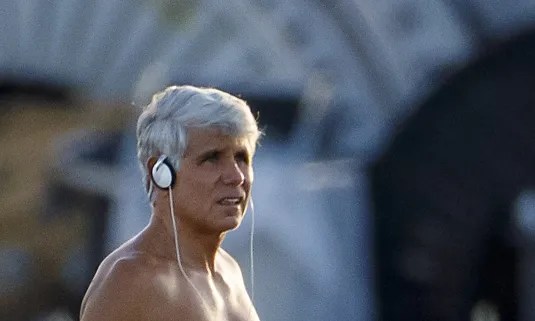
The story of Rod Blagojevich introduces a different category altogether: the shameless comeback.
Unlike the other figures in the series, Blagojevich’s return to public life does not depend on moral vindication, heroic persistence, or cultural myth. Instead it illustrates something more peculiar about contemporary politics and media. In an age of fragmented audiences and constant attention cycles, a disgraced figure may sometimes reappear simply by refusing to leave the stage.
Whether one sees Blagojevich’s re-emergence as comic, absurd, or oddly instructive, it provides a fitting final example for the series. Not every comeback is admirable, but each one reveals something about the strange ways public life allows stories to continue.
Not all comebacks are noble.
Some are heroic, like the moral vindication of Kofi Annan. Some are tactical, like the sly fourth-quarter returns engineered by Joe Nash of the Seattle Seahawks. Some exist somewhere between tragedy and authenticity, like the brief blazing career of Amy Winehouse. And some, like the legend of Muhammad Ali, grow into something close to myth.
But there is another type of comeback altogether.
The shameless comeback.
For that, it is difficult to find a more perfect case than Rod Blagojevich, the former governor of Illinois whose political career once appeared to have ended in spectacular disgrace.
The original scandal is by now familiar. In 2008 federal investigators revealed that Blagojevich had been recorded on FBI wiretaps discussing how he might profit from appointing a replacement to the U.S. Senate seat vacated by President-elect Barack Obama. The recordings were devastating. In one of the most memorable lines in modern American political scandal, Blagojevich described the Senate seat as something valuable that he was reluctant to give away for nothing.
The fallout was swift. Blagojevich was impeached and removed from office by the Illinois legislature. Later he was convicted on multiple corruption charges and sentenced to federal prison. For most politicians, this sequence would represent the end of the story.
Disgrace. Prison. Silence.
But American public life has always contained another possibility: the comeback powered not by redemption but by spectacle.
Even before his imprisonment, Blagojevich seemed instinctively drawn toward the theatrical dimension of his situation. He appeared on television talk shows, launched media interviews, and treated the unfolding scandal almost as if it were a strange kind of reality program in which he remained the central character.
His appearance on The Celebrity Apprentice, hosted by Donald Trump, felt less like an attempt to restore dignity than a recognition that modern politics and entertainment had already merged.
Then came the commutation.
In 2020 Trump commuted Blagojevich’s prison sentence, releasing him after several years behind bars. The decision itself was controversial, but the effect was unmistakable: the stage was suddenly open again.
And Blagojevich, to his credit—or perhaps to his creditlessness—walked right back onto it.
The most striking feature of his post-prison public life has been the absence of embarrassment. Many disgraced politicians attempt some form of contrition when they re-enter the public conversation. Apologies are issued. Lessons are discussed. A tone of humility is adopted.
Blagojevich chose a different path.
Instead he embraced a kind of shameless persistence, appearing in conservative media outlets, repositioning himself politically, and speaking about his case with the tone of someone who believes the whole episode was misunderstood or exaggerated. The ideological shift from Democrat to Republican was particularly striking, not because party changes are unheard of but because in Blagojevich’s case it seemed less like a conversion than a strategic recalibration.
It was, in other words, a comeback powered by the modern media ecosystem.
In an earlier era, a corruption scandal of this magnitude might have consigned a politician to permanent obscurity. But the fragmented media landscape of the twenty-first century offers a different possibility. There is always another audience somewhere, another platform, another narrative waiting to be constructed.
Blagojevich appears to understand this instinctively.
Which is why his story belongs in a series about comebacks, even if the comeback itself is of a peculiar variety. Unlike the moral return of Annan or the mythic return of Ali, Blagojevich’s version depends less on redemption than on endurance.
The secret of the shameless comeback is simple.
You refuse to leave the stage.
You keep talking. You keep appearing. You keep telling your version of the story until, slowly but inevitably, the scandal itself begins to blur into just another chapter in the larger spectacle of American politics.
In that sense Rod Blagojevich may represent a distinctly modern form of comeback: not heroic, not tragic, but theatrical.
And in the strange carnival of contemporary public life, theatrical persistence can sometimes be enough.
Note: This essay is the third entry in the series “On Comebacks and Failed Comebacks.” The earlier pieces looked at very different kinds of returns: the moral vindication of Kofi Annan and the small, tactical in-game comebacks engineered by Joe Nash of the Seattle Seahawks.
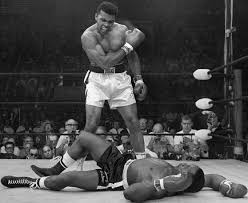
The story of Muhammad Ali operates on a much larger stage. Ali’s exile from boxing after refusing the Vietnam draft and his eventual return to the championship ranks is one of the most famous comebacks in sports history. But the episode described here—the Los Angeles suicide rescue in 1981—is a smaller and stranger moment.
The event appears to have genuinely occurred, yet it also carries the faint aura of legend that often surrounds Ali’s public life. The champion arrives, speaks to a desperate man at a window, and the crisis resolves itself. It is almost too perfectly aligned with the myth of Muhammad Ali not to raise a few questions about performance, storytelling, and the way public figures sometimes inhabit the roles the world expects them to play.
In that sense the episode captures something essential about Ali’s comeback. By the time his boxing career entered its final chapters, he had become more than an athlete. He had become a figure whose life continually generated stories that felt larger than ordinary events.
Whether one treats the Los Angeles episode as simple heroism, public theater, or some mixture of the two, it remains a fascinating illustration of how Ali’s legend continued to grow long after the great fights were over.
Some comebacks are measured in championships.
Others are measured in stories.
The career of Muhammad Ali contains both. His return to boxing after the long exile of the late 1960s is one of the great sporting comebacks of the twentieth century. Stripped of his title for refusing induction into the Vietnam War, banned from the ring during what should have been his athletic prime, Ali eventually returned to reclaim the heavyweight championship and cement his place as the most famous boxer on earth.
But the Ali comeback is not just about boxing.
Long before the exile and the triumphant return, the story had already begun to take on mythic dimensions. In 1964 a young fighter from Louisville named Cassius Clay stunned the world by defeating Sonny Liston for the heavyweight title. Soon afterward he announced that Cassius Clay was a “slave name” and that he would henceforth be known as Muhammad Ali.
The change was shocking to much of the American public at the time. Ali aligned himself with the Nation of Islam, spoke openly about race and politics, and quickly became one of the most controversial athletes in the country.
Then came the draft.
In 1967 Ali refused induction into the U.S. Army during the Vietnam War. The consequences were immediate and severe. He was stripped of his heavyweight title, banned from boxing, and faced the possibility of prison. For several years the greatest fighter in the world was not allowed to step into the ring.
The exile transformed him.
When Ali eventually returned to boxing in the early 1970s, he was no longer merely a talented heavyweight with a flair for poetry and bravado. He had become something larger: a political figure, a symbol of resistance, a man whose name carried moral and cultural weight far beyond the sport.
The comeback fights that followed helped cement that transformation. In 1974 Ali traveled to Zaire to face George Foreman in the legendary The Rumble in the Jungle. Foreman was younger, stronger, and widely expected to win easily.
Instead Ali introduced the world to the “rope-a-dope,” leaning back against the ropes and absorbing Foreman’s punches until the younger champion exhausted himself. In the eighth round Ali knocked him out.
It was one of the great theatrical moments in sports history: the exiled champion returning to reclaim the crown.
But somewhere along the way Ali’s comeback had begun to operate on another level entirely.
He had become something more than a boxer. Part athlete, part moral figure, part living myth. And like all myths, the Ali story eventually began to generate episodes that feel almost too perfectly suited to the character.
One of the strangest of these occurred in Los Angeles in 1981.
A man was threatening to jump from the ledge of a ninth-floor building. Police had been negotiating for hours. Crowds gathered below, watching the terrible drama unfold at a distance.
Then Muhammad Ali arrived.
Accounts differ slightly in the details, but the basic outline is consistent. Ali spoke to the man from a nearby window, urging him not to jump. Eventually the man climbed back inside the building with Ali beside him. Photographs exist of the moment, and police officers later confirmed the story.
By all reasonable accounts, Ali helped save the man’s life.
And yet the story carries a faint aura of improbability.
Not because it didn’t happen—it clearly did—but because it feels so perfectly aligned with the Ali persona that one can’t help wondering about the role of performance in the moment.
Ali had always understood something most athletes do not: that being Muhammad Ali was itself a kind of public art.
From the beginning he blurred the line between competition and theater. The rhymes, the predictions, the playful insults directed at opponents—all of it was part of a larger performance. Ali didn’t simply fight boxers. He performed the role of the greatest boxer in the world.
By the early 1980s that role had evolved even further. Ali was no longer just the heavyweight champion. He had become a global cultural figure, a symbol of resilience after exile, a man whose public presence carried moral weight.
So when the story of the suicide rescue circulated, it seemed less like an unexpected episode and more like the natural continuation of the legend.
Of course Muhammad Ali would appear at the window.
Of course Muhammad Ali would talk the man down.
Of course the cameras would be there.
None of this means the moment was insincere. Ali may well have acted from genuine compassion. But it is also possible—one suspects just slightly—that he understood something about the scene as it unfolded: that the story would become another chapter in the larger narrative of Muhammad Ali.
If so, it was a brilliant instinct.
Because the image of the champion talking a desperate man back from the ledge captures something essential about the Ali comeback. After the long years of controversy and exile, Ali returned not merely as a boxer but as a figure people wanted to believe in.
The story may be small compared with the great fights—the Rumble in the Jungle, the Thrilla in Manila. Yet in its own strange way it may be just as revealing.
A champion reclaiming his title is impressive.
A champion stepping to a window and becoming, for a moment, exactly the hero the world expects him to be—that is something else entirely.
And Muhammad Ali, more than anyone, always understood the power of the moment.
Note: This piece begins a small series I’m calling “On Comebacks and Failed Comebacks.” Political and public life are full of attempted returns. Leaders lose elections, wars, or moral arguments and then try to reclaim the stage. Most of these efforts fail. The moment has passed, the audience has moved on, and what once felt urgent has dissolved into what might be called moral fatigue. Yet every so often a different pattern appears. Occasionally someone loses the immediate battle but remains present long enough for history itself to shift. When that happens, what first looked like defeat begins to resemble something closer to a delayed victory. Kofi Annan provides a particularly interesting case. His opposition to the Iraq War did not stop the invasion, and at the time it appeared that the argument had been decisively lost. Yet as the years passed and the consequences of the war became clearer, the moral judgment he articulated gained increasing weight. In that sense, the story of Annan’s career suggests a useful distinction: some comebacks succeed not because the player reclaims the moment, but because the argument itself eventually catches up with history. Future pieces in this series will look at other figures—some who managed remarkable returns, and others whose comebacks never quite arrived.
Political life especially produces them in abundance. A leader loses a battle—an election, a war, a moral argument—and disappears into the quiet margins where yesterday’s figures slowly fade. The public moves on. The moral urgency of the moment dissolves into what might be called moral fatigue. Outrage that once seemed unstoppable becomes background noise. A new crisis appears, and the world’s attention shifts.
Once this fatigue sets in, comebacks are difficult. The audience that once cared has already drifted elsewhere. The stage has changed. Most players who attempt to return find that the moment that once belonged to them has passed.
Yet every so often a different pattern appears.
Occasionally a figure loses the immediate battle but remains present long enough for the moral tide itself to turn. When that happens, what looked like defeat begins to resemble something else entirely.
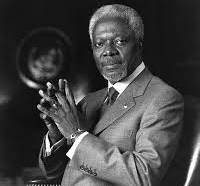
Kofi Annan offers one of the most intriguing examples of this phenomenon.
In 2003 the United States and the United Kingdom invaded Iraq. The invasion was justified by a mixture of strategic arguments, intelligence claims, and moral rhetoric about tyranny and liberation. In Washington and London the momentum of the moment was overwhelming. The war was framed as both necessary and inevitable.
The United Nations, by contrast, found itself sidelined. Annan, then serving as Secretary-General, watched as the institution he led was bypassed by the coalition preparing for war. The moment belonged to the advocates of intervention—particularly the group of American policy thinkers who had spent years arguing for the removal of Saddam Hussein.
At the time, it was not at all clear who would ultimately win the argument. What was clear was that the United Nations had lost the immediate struggle for influence. The invasion proceeded without explicit UN authorization, and the diplomatic machinery that Annan represented appeared powerless to prevent it.
The moral emergency that had animated the debate quickly hardened into geopolitical reality.
Then, in September 2004, Annan said something remarkable. In a BBC interview he stated plainly that the invasion of Iraq was illegal under international law.
It was an extraordinary declaration. Rarely does a sitting Secretary-General of the United Nations describe the actions of the world’s most powerful government in such blunt terms. Yet the statement did not produce the dramatic reversal one might imagine. The war continued. Washington and London dismissed the criticism. The machinery of global politics moved forward largely unchanged.
In the short term, Annan had lost the battle.
And the personal toll of that moment appears to have been considerable. In his biography there is a striking image from this period: Annan alone in his darkened living room, unable for a time to rise from the floor. The room itself reportedly kept in near darkness. It was not exactly depression, at least not in the clinical sense, but something close to exhaustion after a prolonged moral struggle that had failed to alter events.
It is a haunting scene. One of the most powerful diplomats in the world sitting on the floor of a dark room, confronting the limits of his influence.
At that moment, the story of Kofi Annan could easily have ended as the story of a failed comeback. A leader who tried to reassert the moral authority of international law and found that the world had already moved on.
But history has a way of rearranging the meaning of certain moments.
As the years passed, the Iraq War came to be widely regarded as a profound strategic and humanitarian mistake. The claims that had justified the invasion collapsed. The war itself destabilized the region and reshaped global politics in ways that few of its original advocates had anticipated.
Gradually, the moral argument that Annan had made—quietly but firmly—became the prevailing historical judgment.
After leaving the United Nations, Annan did not retreat entirely from public life. Instead he reappeared in a different role as a member of The Elders, a group of former statesmen attempting to exert moral influence outside formal political structures.
It was a curious transformation. No longer the head of the UN, Annan had less formal power than he once possessed. Yet his voice now carried a different kind of authority—the authority of someone who had remained in the arena long enough for events to vindicate his judgment.
By the end of his life, the moral verdict on the Iraq War had shifted decisively. Few serious observers still defended the intervention with the confidence that characterized the early years of the conflict. The consensus had moved, slowly but unmistakably, toward the position Annan had articulated when it mattered least.
In this sense, his career offers an unusual example in the history of comebacks.
He lost the battle. But he may have won the argument.
That distinction matters.
Most political figures attempt comebacks by trying to reclaim the exact moment they once dominated. They want the same stage, the same audience, the same authority. When the moment has passed, the comeback fails.
Annan’s story suggests a different possibility. Sometimes the moral argument itself continues moving through history long after the political battle appears settled. If a leader remains present long enough, the tide may eventually turn.
Which leads to a simple but revealing observation about great players in any arena.
A truly great player is never entirely out of the game.
The moment may pass. The audience may drift away. But if the underlying argument proves sound, history itself has a way of reopening the field.
And when it does, the comeback is already underway.
Note: This short reflection began as an observation at professional conferences, where some of the most generative conversations seemed to occur just outside the official program — in hallways, cafés, and improvised gatherings that quietly relocated the center of action. Over time, the idea of the “unconference” grew into something more suggestive: a small window onto how human beings negotiate where meaning, authority, and agency actually reside.
Though the piece does not engage explicitly with Julian Jaynes, readers familiar with his work may detect an affinity. The “unconference” can be read as a micro-site of consciousness in action — a space where participants shift from receiving prescribed structures of engagement to collaboratively generating their own. In that sense, “unconferencing” is less about conferences than about a recurring human impulse: the desire to manufacture intellectual oxygen when the authorized environment feels thin.
This essay remains intentionally provisional. Its aim is not to settle the concept but to open it, inviting readers to notice where unofficial zones of action emerge in their own institutional, professional, and personal lives.
I. Introducing “Unconferencing”
When attending a professional conference these days one may encounter small groups of conference goers congregating in a lobby or coffee shop during the “official” speeches or workshops. When queried, such people may advise you that they are engaged in the “un-conference” (n.) or that they are “un-conferencing” (v.). For the purposes of this piece we shall refer these folks as “un- conferencers” (n.).
Un-conferencing is qualitatively different from when a conferencer slips up to her room for a quick nap or to the pool for a swim. In these cases, the attendee is simply checking out of the conference entirely. They are abdicating any claim to conference action. Un-conferencers, on the other hand, are attempting to establishing a rival zone of conference-related activity. They are, to borrow from Goffman, attempting to shift the locus of the action.
The philosopher Ludwig Wittgenstein, who worked at Cambridge, once advised a colleague to leave the university as there was “no oxygen” to be had there. Upon being asked why then he, Wittgenstein, stayed, the philosopher is said to have replied: “It doesn’t matter…I manufacture my own oxygen.” Inspired by Wittgenstein, we could say that those who involve themselves in unconferences are “manufacturing their own action.”
I suspect that were we to analyze the types of persons who would drop in on an unconference, partake of a loosely specified conference-related activity which exists at a tangent to, or even off the grid of, the main conference, we would find certain similarities in outlook and disposition. I believe we would find people who are, both individually and collectively, attracted to action.
It has been my observation that the large majority of attendees at a conference simply take the conference program at face value. That is, they expect the action to be that which is listed, prescribed, and pre-defined as such. “What’s happening this morning?” “So and so is speaking.” “Great, I’ve been looking forward to this part of the conference since I saw the schedule!” The planned and authorized conference activities are “on stage,” and the audience is invited to partake of the action either passively or through relatively minimal contribution in the form of question and answer or discussion. The locus of action, however, is usually taken as unproblematic, given.
The unconferencer, on the other hand, takes upon him or herself the responsibility, the grave responsibility, of creating and sustaining an alternative set of activities that they purport, though their ironic self-definition, to be action. By issuing an invitation to the unconference, they are in effect saying to the invitee that shifting loyalty from the authorized main activity to the rogue fringe will result in a better, hipper, more effective, enlightening, and action-packed experience.
For the action junkie, the draw of the unconference is unmistakable; the eternal suspicion that the grass is always greener wherever we are not is married to the thrill of involving oneself with an alternate action locus which is cheekily, even brazenly, set up as an overt challenge to the “mass” action that the majority of the junkie’s peers regard as “given.” The very fact that the majority of conference goers are unaware of the existence of the unconference, much less the existential challenge it suggests, makes engagement with this floating, edge-bound, impermanent, and unrecorded body deeply appealing to a certain segment of folks.
While the unconference may appear at first blush to be a relatively minor aspect of an essentially modern and class-specific activity, I would put forth that it actually sheds light on the very essence of how we understand action. The existence of the unconference suggests that action, far from occurring in a single, easily identified, and authorized location, is in fact a floating term subject not only to instantaneous and frequent relocation within a given activity frame but also to subjective definitions particular to individuals with varying temperaments and appetites for both the creation and consumption of action. I believe, in short, that the unconference, modest as it may seem, in fact opens doors to much wider theoretical considerations that may take us back to the very origin of human consciousness.
II. The Unconference and the Inner Voice
If the unconference shifts the locus of action outwardly — from stage to hallway, from keynote to coffee shop — it also performs a quieter relocation within the individual. What changes is not merely where activity occurs, but how participants come to understand their role in producing it. The official conference asks attendees to receive action: to listen, absorb, and occasionally respond within predetermined boundaries. The unconference, by contrast, invites a subtler responsibility — the task of deciding where the action is and, more provocatively, whether it exists at all until one participates in creating it.
This shift is not trivial. For many conference-goers, the program functions as a kind of external voice, an authoritative script that dictates where meaning will unfold and how attention should be allocated. To follow the schedule is to outsource judgment about significance. The unconferencer, however, suspends this outsourcing. In stepping away from the authorized frame, they implicitly claim a right that is both liberating and burdensome: the right to narrate the action for themselves.
What emerges in such spaces is less a rival conference than a laboratory of agency. Conversations drift, topics mutate, and legitimacy is negotiated moment by moment. No one can point to a stage and say, with certainty, this is where it happens.Instead, action becomes a floating construct sustained through collective attention and mutual recognition. The unconference does not replace the official program so much as reveal that the program’s authority was always contingent — dependent on shared belief rather than intrinsic necessity.
This relocation of authority mirrors a broader human pattern. In many domains of life, individuals operate within inherited structures that quietly define where significance resides: classrooms, offices, institutions, rituals. Yet moments arise when these structures feel oxygen-poor, prompting participants to improvise alternative spaces where engagement feels more immediate, more alive. The unconference is one such improvisation, a small but telling instance of how people generate meaning when prescribed channels no longer suffice.
To participate in an unconference, then, is to practice a form of narrative self-authorship. Attendees do not merely attend; they interpret, select, and frame the experience as action. The hallway conversation becomes the keynote because someone decides it is. The coffee shop gathering acquires legitimacy because participants treat it as consequential. Action, in this sense, is less discovered than constructed — an emergent property of attention rather than a fixed feature of the environment.
This does not render official structures irrelevant. Conferences still provide scaffolding, shared reference points, and opportunities for encounter that make unconferencing possible in the first place. But the existence of the unconference suggests that action is never fully captured by authorized spaces. It leaks, migrates, and reconstitutes itself wherever individuals perceive the possibility of meaningful exchange. The unconferencer’s quiet rebellion, therefore, is not against the conference itself but against the assumption that significance must be centrally located and formally sanctioned.
Seen in this light, unconferencing becomes less a quirky professional habit than a microcosm of consciousness in action — a demonstration of how individuals negotiate the tension between external scripts and internal narratives. By manufacturing their own zones of engagement, unconferencers reveal that the question “Where is the action?” is inseparable from the deeper question “Who gets to decide?”
III. Third Places and the Geography of Action
If unconferencing represents a temporary relocation of action within professional space, third places extend this phenomenon into everyday life. Bars, cafés, karaoke rooms, shisha lounges, and hotel lobbies function as informal arenas where meaning and agency are negotiated outside the structures that ostensibly organize our days. These environments rarely announce themselves as sites of significance. They lack stages, programs, and formal hierarchies. Yet participants often experience them as unusually alive — spaces where conversation deepens, identities loosen, and unexpected narratives emerge.
What distinguishes these third places is not their recreational character but their ambiguity. Unlike workplaces or classrooms, they carry no fixed expectations about performance or outcome. This ambiguity produces a subtle psychological freedom: participants are not merely enacting roles but improvising them. In such environments, the question of where the action resides becomes open-ended, contingent upon attention, mood, and relational chemistry rather than institutional design.
The figure of the Thin Man — drifting through cities, bars, and late-night conversations — embodies this geography of floating action. His world is structured less by formal events than by encounters whose significance becomes clear only in retrospect. A casual exchange at a bar may eclipse a planned meeting; a karaoke duet may reveal more about a relationship than hours of scheduled conversation. In these moments, action is not given but discovered through participation, mirroring the unconference’s quiet redefinition of legitimacy.
Third places also highlight the internal dimension of this shift. Just as unconferencers manufacture intellectual oxygen when official conference spaces feel thin, individuals in third places practice a form of narrative authorship. Freed from explicit scripts, they must decide what matters, which conversations to pursue, and how to interpret the unfolding interaction. The authority to define significance moves inward, transforming everyday environments into laboratories of consciousness where meaning is collaboratively constructed rather than externally prescribed.
This dynamic helps explain why third places often feel disproportionately memorable. Their significance is not preauthorized but emergent, generated through a confluence of attention, vulnerability, and improvisation. Participants sense that something unscheduled is occurring, even if its contours remain indistinct at the time. The experience resembles unconferencing at a social scale: an unofficial gathering that quietly competes with, and sometimes surpasses, the legitimacy of structured events.
Yet the relationship between formal and informal spaces remains symbiotic rather than oppositional. Conferences create the conditions for unconferencing; workplaces generate the need for after-work conversations; institutions provide the scaffolding against which third places acquire their freedom. Action migrates across these environments, revealing itself as less a fixed destination than a shifting field sustained through perception and engagement.
In this sense, third places extend the unconference’s insight into a broader philosophy of everyday life. They suggest that action is rarely where it is supposed to be and frequently where no one thought to look. The bar conversation, the karaoke room, the quiet shisha lounge — these spaces operate as unofficial stages where individuals renegotiate identity, intimacy, and understanding. What appears peripheral may, in fact, be central, not because of intrinsic qualities but because participants collectively decide to treat it as such.
The unconferencer and the Thin Man, though inhabiting different settings, share a common impulse: a refusal to accept prescribed boundaries around significance. Both figures navigate environments with an attunement to emergent action, trusting that meaning can be generated wherever attention and curiosity converge. Their movements illustrate a subtle but pervasive truth — that consciousness itself is partly defined by this capacity to relocate action, to manufacture oxygen in spaces where none was promised.
IV. Returning to the Conference
Seen through this wider lens, the unconference no longer appears as a quirky professional habit but as a small instance of a broader human pattern. Conferences, with their schedules and stages, represent one attempt to stabilize action — to locate significance in designated rooms, at designated times, under designated authorities. Such structures are not arbitrary; they provide coherence, shared reference points, and opportunities for encounter that might not otherwise occur. Without them, the unconference itself would lack the context that renders it meaningful.
Yet the existence of the unconference reveals the limits of this stabilization. Action resists containment. It drifts into hallways, cafés, late-night gatherings, and impromptu conversations where participants sense that something more immediate is unfolding. The official program may announce where action is supposed to be, but participants continuously renegotiate this claim through their attention, curiosity, and relational impulses. The conference, in this sense, becomes less a fixed locus of action than a field across which action migrates.
This migration does not invalidate the conference’s authority so much as complicate it. The keynote may still matter; the workshop may still illuminate. But their significance is mediated by a parallel network of informal interactions that shape interpretation, deepen understanding, and generate new connections. The unconference operates within this network as both supplement and critique, reminding participants that legitimacy is not solely conferred by formal designation but also by lived experience.
To notice the unconference is therefore to recognize that action is never singularly located. It is distributed across spaces, moments, and narratives that participants collectively construct. The attendee who slips into a hallway conversation is not abandoning the conference but participating in its expansion, contributing to a decentralized ecology of engagement that cannot be fully captured by the official program. In this ecology, meaning emerges through movement rather than adherence, through improvisation rather than prescription.
What remains, then, is a modest but suggestive insight: the question “Where is the action?” is less empirical than interpretive. Conferences provide one answer, but participants continuously generate others, manufacturing intellectual oxygen wherever they perceive the possibility of meaningful exchange. The unconference embodies this generative impulse, illustrating how individuals negotiate the tension between structured environments and emergent agency without fully resolving it.
In the end, the unconference may be best understood not as a rival conference but as a reminder — a quiet demonstration that action is partly a matter of attention and belief. The stage, the hallway, the coffee shop, and the late-night conversation each become potential centers of significance depending on how participants inhabit them. Conferences, like the broader environments of everyday life, offer frameworks within which action might occur. But the decision to treat any moment as consequential remains, ultimately, a shared and ongoing act of interpretation.
And so the unconference persists, floating at the edges of formal gatherings, manufacturing oxygen where it is needed and relocating action where it feels most alive. Its lesson is neither rebellious nor dismissive but gently subversive: that meaning cannot be fully scheduled, legitimacy cannot be entirely centralized, and the most vital conversations often unfold just beyond the reach of the program.
Provisional Conclusion:
The Unconference endures as a quiet proof that action is never simply where it is announced, but wherever consciousness decides to breathe.
to be continued…
Note: If you like this piece, you may also like this one hereon the nature of events.
Note: This is the third of a three part series. Part I is here and Part II is here.
Epigraph I:
Oh my sentimental fool
Lloyd Cole
Epigraph II:
Was the risk I sent to you received?
Metric
Leaving Oxford / Returning to Japan
I walked the five minutes back to the hotel after the bus pulled away. My wife was going on to visit friends in Germany and I would have about five days alone in Kyoto after I got back to Japan. At the hotel I couldn’t get back to sleep, so I said a small prayer to the angels asking for grace to get through the day, showered, packed my things, and waited for the 8 AM car pickup.
I did not rush. Packing became a deliberate act, almost ritualistic in its pacing. I folded shirts one at a time, placed my notebook carefully into my bag, slipped the Tintin postcard between pages so it would not bend. Sue Tompkins went in next, followed by the charger, the toothbrush, the small practical objects that restore a sense of order after emotional disturbance. The room itself was modest — functional, forgettable in most respects — yet it felt oddly expanded, as if some invisible event had occurred there despite the absence of anything outwardly dramatic. Something had shifted in me, and the room seemed to hold the echo of that shift.
At the desk, I laid everything out for a moment, not to organize but simply to gather myself. The Mendoza Line was no longer playing, but the music had already done its work. The emotional charge it helped ignite remained present, circulating quietly beneath the surface. There was nothing to heighten or prolong; the effect was already internalized.
Around eight, the hire car arrived. The driver was polite, efficient, the kind of professional whose calm competence creates a reassuring neutrality. He helped with my bag, and we exchanged small talk as we pulled into traffic — London housing costs, wages, the persistent difficulty young people face in trying to establish themselves. On the radio, a news segment discussed the rising number of homeless families and children across the UK. Normally, such stories register as troubling but abstract statistics. That morning, however, the report landed differently. I found myself thinking about untethered lives, about how fragile the structures that hold people together can be, and how sometimes the tether itself is the only thing preventing a deeper psychological unraveling.
Traffic was light, and we arrived at the airport mid-morning. Inside, I purchased a simple breakfast — fruit, yogurt, coffee — and found a seat removed from the main flow of travelers. Airports are environments of constant movement, but solitude can still be carved out within them if one chooses carefully. I opened my Kindle and downloaded volumes four through six of Anthony Powell’s A Dance to the Music of Time. It was not an act of escapism so much as orientation. I wanted narrative continuity, a long arc where identity unfolds gradually rather than collapsing under sudden pressure. Powell’s world offered lineage, structure, and a reassuring sense of temporal patience.
I texted Isobel. She responded almost immediately, and what followed was a long, bright thread of conversation carried across airport Wi-Fi. There was no sense of emotional comedown, no awkward reentry into ordinary distance — only continuation. The connection felt intact, natural, as if the meeting had established a channel that did not require reinforcement to remain open.
When boarding was called, the transition felt procedural rather than dramatic. The flight passed in a quiet blur of clouds, Molina songs, Powell’s prose, and intermittent thought. Beneath it all was a subtle ache under the ribs — not pain, not longing in any acute sense, but effect. A residual emotional state that did not demand resolution, only acknowledgment.
On the plane I read some Powell and listened to music. I remember playing “Two Suns in the Sunset” by Pink Floyd and being unexpectedly moved by it. I was in an emotional state — not overwhelmed, but open and exposed — and the flight passed quietly. I landed at Kansai Airport in the afternoon.
I landed in Japan first. My wife continued on to Germany to visit friends, and my son was in Australia on a school trip. I took the Haruka train back toward Kyoto. The wide seats and generous legroom made me feel welcomed back into my country of choice. Much as I had enjoyed England, I felt real relief in returning. There is a particular comfort in Japanese transit — the order, the space, the quiet efficiency — and my body recognized it immediately.
The house, when I entered it, was silent in a way that felt tangible. I carried that silence with unusual care, as if it were made of glass and might shatter if handled abruptly. Solitude is often restorative, but this solitude had an amplifying quality, heightening rather than settling internal experience.
That evening, I went to Takumiya, a pub in north central Kyoto. I ordered food and three craft beers and spoke casually with whoever happened to be nearby. Conversations were light, unstructured, yet I sensed an unusual responsiveness from people around me — as though I possessed a slightly elevated emotional voltage that others could detect without understanding its source. Even animals seemed to register it. Cats approached me with a familiarity that felt less coincidental than intuitive, as if some form of static had gathered on the soul.
I had no sense of impending crisis. No awareness that within three days I would walk into my principal’s office and offer my resignation
First Days Back
On my first full day back I did laundry and in the late afternoon went to Takumiya, a pub in north central Kyoto near Karasuma Oike. I don’t remember whether I texted or called Isobel that day, but I almost certainly did. At Takumiya I ordered sashimi and had a few craft beers from their rotating selection. I stayed longer than planned, talking lightly with whoever happened to be sitting nearby.
The next day was Tuesday and I went to work as scheduled. I checked the heat index readings as part of my summer administrative duties. Dr. Fox was on campus. Seeing him immediately shifted the emotional temperature of the day.
I have written elsewhere about my problems with Dr. Fox and I won’t revisit them in detail here. What matters for this story is that by that point I felt he had betrayed me and failed to show up when I most needed institutional support. Trust had already been damaged. Seeing him again after Oxford brought all of that to the surface at once.
We spoke briefly. Before I left, he asked me to come in the following day to help prepare a presentation he was scheduled to give to an alumni group. I had ghostwritten material for him many times before. Under normal circumstances I would have said yes without hesitation. This time I agreed anyway, even though I was already internally unstable and emotionally saturated.
It would not turn out well.
I returned to Takumiya each night that week. There was comfort in being present in public spaces while remaining largely anonymous. The balance allowed me to exist among others without the demands of deeper recognition. Meanwhile, at five in the evening Japan time — nine in the morning in London — Isobel and I spoke daily. The calls were not brief check-ins but sustained conversations lasting anywhere from thirty minutes to an hour and a half. Often she walked through a park while we spoke, and I imagined her surroundings as she described them, the geographical distance softened by conversational continuity.
During one of these calls, I told her that I wanted to write a book. Not about her specifically, but about the chain of experiences that led to meeting her and the clarity that encounter unexpectedly revealed. She understood immediately. More than that, she expressed a quiet appreciation for being part of that moment of ignition — not as subject matter but as catalyst.
At the same time, unresolved resentment toward Dr. Fox did not dissipate with distance. Instead, it sharpened. The baseball heatstroke issue lingered at the margins of thought, alongside a broader accumulation of professional frustrations: moments of perceived disrespect, ambiguous expectations, and a decade of service that increasingly felt like professionalism without true partnership. None of these tensions were new, but the emotional openness of the week amplified their weight. Background noise began to feel like pressure.
By Friday, when I walked into school, I was not consciously planning a decisive action, yet I sensed a degree of internal instability that made ordinary interactions feel precarious. When Dr. Fox called me into his office to request assistance with a presentation — a familiar pattern, a non-work day expectation framed as routine — the moment crystallized something that had been building long before Oxford. I resigned. The decision belonged to a larger narrative, but this story carries its immediate emotional context.
As the reality of resignation settled into my body, a quiet clarity followed. I knew I needed to speak with my wife. The conversation would not revolve around specifics — call durations, text counts, or the mechanics of connection — but around truth in its broader emotional sense.
She returned home Saturday night. With her presence, the house regained its weight: history, shared furniture, a past that possessed shape and gravity. We sat together without wine or any conversational buffer. The moment did not invite performance or gradual disclosure; it required directness.
“I quit,” I said. “And I met someone.”
She asked only one question.
“Did you sleep with her?”
“No.”
She nodded, her response quiet and measured.
“Okay. Have fun on the phone.”
Nothing fractured dramatically in that moment. There was no raised voice, no immediate emotional rupture. Yet something subtle shifted — an alteration not of structure but of atmosphere. The past remained intact, but the future carried a slightly different texture. Nothing broke, but nothing stayed exactly the same.
Saturday and Sunday
Saturday and Sunday arrived with a quietness that felt disproportionate to the events of the preceding week. For the first time in months, there was no alarm set for early administrative duties, no email requiring immediate response, no expectation of presence within the institutional rhythms that had long structured my days. I was off work — not merely for the weekend, but in a more consequential sense that I could not yet fully absorb. I would not return until 2022. The long-term ramifications of what had unfolded were already in motion, though at that moment they existed more as a distant horizon than as a lived reality whose contours could be clearly seen.
The weekend therefore carried a strange dual quality. On the surface, it resembled any other stretch of unstructured time: coffee in the morning, small household tasks, the slow pacing of hours unburdened by schedules. Beneath that surface, however, ran a persistent awareness that something fundamental had shifted. The scaffolding of daily life — work expectations, professional identity, habitual responsibilities — had loosened, and with its absence came both relief and a faint, almost disorienting spaciousness.
At five o’clock sharp Japan time, which was nine in the morning in the UK, I called Isobel. The timing became instinctive, a daily point of orientation that anchored the day before it fully began. She answered as she was waking, her voice carrying that soft mixture of sleep and recognition that collapses distance instantly. We picked up exactly where we had left off, as if conversation were a continuous thread rather than a sequence of separate exchanges. We talked and laughed easily, moving between subjects without effort — music, muses, love, the nature of intimacy, and the broader textures of life that surface when two people feel unexpectedly understood.
The calls possessed a quality that felt, at the time, almost transcendent. I experienced a heightened emotional state that bordered on euphoria, a sense of expansion difficult to articulate without risking exaggeration. There was an unmistakable feeling of being lifted beyond ordinary emotional gravity, as if the connection existed in a space slightly removed from daily constraint. For brief stretches, I felt powerful in a way that had little to do with control and everything to do with aliveness — the psychological equivalent of standing in clear light after months of muted color.
Yet even within that intensity, I carried a quiet awareness that such states are rarely sustainable. The experience felt too vivid, too precise in its timing, to belong to permanence. I understood, somewhere beneath the exhilaration, that what we were inhabiting was a moment granted rather than guaranteed. For the time being, however, there was a mutual permission to exist within that space without prematurely interrogating its future. We allowed the conversations to unfold fully, accepting their immediacy without insisting on outcome.
The rest of the weekend unfolded around those calls like a soft frame. I moved through ordinary activities — brief walks, small household routines, moments of shared quiet with my wife — with an undercurrent of emotional intensity that did not demand expression but remained unmistakably present. Silence felt less empty than suspended, as though the days themselves were pausing before the arrival of consequences not yet visible.
What remained most striking about that weekend was not any single event but the emotional totality it carried. The combination of resignation, solitude, reconnection, and emerging uncertainty produced a state that was both exhilarating and fragile. I was aware, even then, of the paradox inherent in the experience: the joy of discovery intertwined with the inevitability of complication, the brightness of connection shadowed by the knowledge of its precariousness.
That was the weekend. In its quiet span, I found myself inhabiting an emotional condition that was at once expansive and difficult, sustaining and destabilizing. I was, deeply and undeniably, in love — not in a settled or declarative sense, but in the raw, immediate way that accompanies sudden recognition. The feeling carried power and tenderness in equal measure, along with a subtle ache that suggested awareness of its limits even as it unfolded.
The Rest of September
The rest of September passed with a quality that is difficult to reconstruct in precise sequence. Days did not feel discrete or individually memorable; instead, they merged into a continuous emotional field in which time moved forward without the usual markers of routine. The absence of work removed one of the primary structures that normally segments experience, and without that scaffolding the month acquired a dreamlike texture. Moments were vivid while they occurred, yet quickly dissolved into the broader atmosphere of the period.
Isobel and I remained in frequent contact. We spoke most days and exchanged messages with a familiarity that no longer required initiation or explanation. The connection persisted, but the intensity that had defined the immediate aftermath of Oxford began, subtly, to dim. This was not a collapse or a dramatic withdrawal — rather, a gentle tapering, the natural adjustment that follows emotional peaks once they settle into the rhythm of distance and everyday life. The calls remained warm, often intimate, and still carried laughter and shared curiosity, but the sense of suspended transcendence that characterized the earlier weeks softened into something more ordinary.
My days were largely unstructured. Without professional obligations, I devoted time to my blog, experimenting with longer reflections and shorter fragments that attempted to capture the evolving emotional landscape. I also began broadcasting on Periscope, drawn to the immediacy of speaking into a space where audience and solitude coexist in curious balance. These activities did not replace work so much as fill the temporal vacuum it left behind, offering forms of expression that required presence without imposing rigid expectation.
Later in the month, I briefly reentered the professional sphere when I accompanied my senior students to a university fair at Canadian Academy. The experience felt almost surreal in its normalcy — a reminder of institutional rhythms that continued independently of my altered position within them. It was the only direct work engagement I undertook during that period, and its brevity reinforced the sense that September existed outside the usual professional narrative.
Toward the end of the month, I traveled for a significant assignment: serving as lead evaluator for the Diploma Programme at Western Academy of Beijing. The responsibility was substantial, and I approached it with an intention to perform at the level expected despite the internal shifts that characterized the preceding weeks. The visit, however, was complicated by dynamics within the evaluation team. The MYP leader’s preference for extended, often unfocused meetings created an atmosphere of fatigue, and Ashish, the Head from IB Singapore, lacked either the authority or inclination to redirect those discussions effectively. Evenings stretched late into the night. We ordered Indian food, reviewed documentation, and navigated the procedural demands of the evaluation with a professionalism that felt increasingly mechanical.
During one of those evenings, after the meetings had ended and the day’s formal responsibilities were complete, I called Isobel. We spoke at length, as had become our habit, but the conversation carried a different quality. She told me about a dream — one involving a fire and a cabin in the forest. In the dream, I was present. She mentioned that she had shared the dream with her therapist, a detail that suggested the experience held significance beyond casual narrative. Yet when I asked about it, she hesitated. She did not want to recount the dream in full. The partial disclosure introduced an ambiguity that I could not immediately interpret but nonetheless felt.
The moment did not register as conflict or withdrawal. There was no overt tension, no articulated concern. Yet something subtle shifted in the emotional atmosphere between us. The change was nearly imperceptible, detectable less through words than through absence — a slight alteration in tone, a new reticence where openness had previously been instinctive. It was not dramatic enough to prompt confrontation, but it carried the unmistakable sensation of movement beneath the surface.
As September drew to a close and October approached, our communication began to thin. Calls became less frequent, messages shorter, pauses between exchanges longer. The transition unfolded gradually, without a definitive turning point, but its trajectory felt clear. What had once been continuous conversation now required renewed initiation, and the ease that had defined our early exchanges gave way to a quieter, more tentative rhythm.
In retrospect, September stands as an interlude — a period suspended between ignition and resolution. The connection with Isobel remained meaningful and emotionally resonant, yet the conditions that had sustained its earlier intensity were shifting. October would bring both culmination and conclusion, the apex of the relationship’s emotional arc and, simultaneously, its quiet dissolution.
October
October arrived without ceremony, yet the emotional atmosphere surrounding it was markedly different from the suspended haze of September. I was not working at all during that month, and the absence of professional structure began to feel less like pause and more like rupture. Relations with my Principal, Dr. Fox, had deteriorated to an all-time low, and what had once been a strained but functional working relationship now carried open hostility.
We had two phone calls that month about university counseling, both of them angry and vitriolic. The topic itself — university advising — should have been procedural, collaborative, even routine. Instead, it became a flashpoint that exposed a deeper accumulation of mistrust and frustration. From my perspective, he was mishandling critical processes and creating unnecessary stress for students and staff alike, and I felt a growing sense of professional indignation that was difficult to contain. I shouted at him on the phone twice: once while walking along the river, my voice carrying across the water in a way that felt disproportionate to the setting, and once from a hotel bar in Osaka, where the contained intimacy of the space made the confrontation feel even more exposed. The bartenders glanced at me with a mixture of curiosity and quiet concern, clearly aware that they were witnessing a private eruption in a public place. Still, they allowed the moment to pass without interference, serving drinks and processing the bill with the practiced discretion that characterizes hospitality in Japan.
In mid-October, I traveled to Singapore for another IB training. This assignment positioned me as lead trainer for the Diploma Programme, with Duan Yorke serving as my deputy. Duan was excellent — steady, competent, and easy to work alongside — providing a professional counterbalance to the internal instability I carried with me. Yet despite the outward success of the training’s first day, something felt off internally. The emotional residue of the previous weeks, combined with the unresolved professional tensions, manifested as a quiet but unmistakable dissonance. On the second day, I found myself unable to maintain the expected level of engagement and withdrew temporarily to visit an esoteric healer. The visit itself belongs to another narrative thread, one that requires its own context, but its occurrence reflected the broader sense that I was searching for equilibrium in unconventional ways.
I returned and completed the training successfully, fulfilling my responsibilities with the professionalism the role demanded. Afterward, I remained in Singapore for an additional three days, using the time to decompress in a city that had long felt both familiar and emotionally neutral. The extended stay provided space for quiet reflection, casual wandering, and the gradual release of accumulated tension. Professionally, my obligations were minimal. I completed a handful of recommendation letters for early decision applicants — necessary work, given that our new counselor was struggling with the process — but beyond that, my professional identity remained largely suspended.
During this period, Isobel and I spoke only once. The call carried an unmistakable clarity: whatever had sustained the connection through September was no longer present. Whether the shift stemmed from the dream she had mentioned earlier, the simple realities of distance, or the natural fading that accompanies emotionally intense encounters, the result was the same. The spark had dissipated. What struck me most was the absence of dramatic heartbreak. I did not feel shattered or undone. Instead, I experienced a dull void — a quiet ache occupying the space where my love for her had briefly lived. It was less a wound than an absence, the emotional equivalent of a room that had been furnished and then emptied.
Singapore became the final location in which we spoke. After that call, the connection ended without formal closure, dissolving into silence rather than conflict.
When I returned to Japan, I settled back into writing and Periscoping with a renewed sense of creative urgency. Singapore itself had already played a role in that shift. In a billiards bar there, I drafted the first installment of The Thin Man, capturing fragments of narrative that would later expand into a larger project. The act of writing felt less like discipline and more like necessity — a way of metabolizing the preceding months and translating emotional experience into narrative form. Back in Japan, I continued this process through a series of essays that month, each exploring different facets of the transitional period.
October also introduced another unexpected connection. That month I met Mela, a woman from New York City in her thirties who was on medical leave from her work as a props assistant in film production. She was housesitting at the time and occupied her days in ways that mirrored my own state of suspended routine: scrolling Tinder, investigating potential matches with a mixture of curiosity and humor, and broadcasting extensively on Periscope. We connected easily, moving from initial interaction to Instagram texts and eventually long phone calls. Neither of us had pressing daily commitments, and the absence of structure created space for conversations that extended for hours — sometimes entire afternoons — ranging across music, film, personal history, and the broader philosophical questions that surface when time is abundant and emotional stakes feel low.
Months later, in December, I would meet her in person during a museum visit in Queens. The day unfolded quietly: exploring exhibits, browsing the bookstore, and sharing soup in the café. At one point, descending a staircase, she leaned into me in a way that felt intentional — a brief physical gesture that carried a hint of performative vulnerability. She said, “you saved me,” a remark delivered with ambiguity that allowed interpretation without demanding it. The moment marked the closest we came to flirtation, and even that remained understated, more symbolic than consequential.
Yet the defining emotional endpoint of October remained tied to Isobel. Singapore had been the final setting of our conversation, and with its conclusion, that chapter closed without spectacle. The month that began with professional conflict and emotional residue ended in creative ignition, quiet acceptance, and the emergence of new but less charged connections. October stood as both apex and dissolution — the culmination of an emotional arc that had begun in Oxford and the gentle fading that followed its brief, luminous peak.
Conclusion
Looking back on it now, the question that naturally arises is what, if anything, can be concluded from the experience. Memory has a way of smoothing edges while preserving emotional truths, and the passage of time introduces perspective without necessarily dissolving ambiguity. What remains is not a tidy narrative with a clear moral, but a series of impressions that continue to carry meaning long after the events themselves have receded.
Was I in love with Isobel? The answer, for me, is uncomplicated. Yes — absolutely. The feeling was immediate, powerful, and unmistakable in its emotional clarity. It was not rooted in fantasy or projection so much as in recognition: the sudden awareness that another person had seen and engaged parts of me that often remain peripheral or unarticulated. The connection possessed both intellectual and emotional intimacy, creating a sense of alignment that felt rare and therefore significant.
Whether she was in love with me is less certain. That question remains open, and perhaps necessarily so. Love does not always manifest symmetrically, nor does it require identical emotional timelines. What I do believe is that she was deeply drawn to me — enamored with qualities she named explicitly: my maturity, my openness, my willingness to explore symbolic and esoteric frameworks such as astrology, and what she described as my confirmed oddness. These were not superficial points of attraction but aspects of identity that shape how one moves through the world and forms connection. In response, she opened herself in ways that felt unprecedented in my experience with other women. The openness was emotional, conversational, and psychological, revealing vulnerabilities and reflections that suggested a level of trust both genuine and meaningful.
Yet that openness stopped short of the one dimension that often defines romantic relationships in conventional terms. Physical consummation never occurred. And still, I remain convinced that it might have — that the night of the red dress, that Wednesday evening suspended in quiet possibility, carried the potential for that final step had I not withdrawn. The decision to pull back was not rooted in lack of desire but in an instinctive recognition of complexity and consequence, a moment where restraint felt simultaneously protective and destabilizing.
At the beginning of this narrative, I wrote the line: “I did not sleep with her, so I had to quit my job.” On its surface, the statement reads as paradoxical or even absurd. Yet in a literal and emotional sense, it reflects the truth as I experienced it. Something that transpired between us disrupted my internal equilibrium in a way that extended far beyond the boundaries of romantic encounter. The experience did not create professional dissatisfaction where none existed; rather, it crystallized tensions that had long been present but insufficiently confronted. In the altered emotional state that followed Oxford, I could no longer compartmentalize or tolerate dynamics that had gradually eroded trust and professional fulfillment. The decision to resign emerged not as a reaction to Isobel but as a response made possible by the clarity her presence inadvertently catalyzed.
What, then, did Isobel have to do with that decision? It is a question without a definitive answer, and perhaps one that resists definitive resolution. Objectively, professional circumstances and romantic encounter belong to separate domains, each governed by distinct motivations and consequences. Yet subjective experience does not always honor such boundaries. In my mind and in my heart, the two remain inextricably linked. The emotional awakening precipitated by our connection illuminated aspects of my life that had grown untenable, accelerating a reckoning that might otherwise have unfolded more gradually.
In this sense, Isobel did not cause the decision but revealed the conditions that made it inevitable. The encounter functioned as catalyst rather than origin, exposing fractures already present and clarifying the need for change. The love I felt for her, whether reciprocated in equal measure or not, became intertwined with a broader transformation — one that encompassed identity, professional alignment, and creative direction.
Ultimately, the experience resists reduction to a singular meaning. It was neither tragedy nor triumph, neither mistake nor destiny. It was an encounter marked by intensity, ambiguity, and consequence, leaving behind a residue of insight rather than closure. If anything can be said with certainty, it is that the connection altered the trajectory of my life in subtle but enduring ways. The emotional truth of that alteration persists, even as the specifics of the relationship have receded into memory.
And perhaps that is the most accurate conclusion available: that some relationships are defined not by duration or outcome but by the clarity they introduce, the decisions they precipitate, and the self-recognition they make possible. In that sense, Isobel remains both part of my past and part of the internal landscape through which I continue to move — a presence whose significance lies less in what occurred than in what it revealed.
Coda
What remains, after the noise has faded and the chronology has settled into memory, is not regret but recognition. Isobel was never meant to be a permanent figure in my life; she was a moment of ignition, a flare that illuminated terrain I had been walking blindly for years. Loving her did not undo me — it clarified me. It revealed fault lines in my professional life, deepened my awareness of emotional possibility, and reminded me that connection can arrive without warning and depart without resolution while still altering everything that follows. Some encounters are not chapters but catalysts, and their power lies precisely in their brevity. I did not leave Oxford with a lover, but I left with a truth that could no longer be ignored, and that truth reshaped the decisions that defined the months and years ahead.
So the story does not end with loss but with transformation. The quiet house in Kyoto, the late-night calls across time zones, the resignation spoken into an office heavy with history, the essays written in the wake of confusion and clarity — all of it forms a single arc whose meaning resides not in permanence but in awakening. Isobel remains a presence not because of what we became, but because of what her existence made visible: that love, even when fleeting, carries the capacity to reorder a life. And in that sense, the experience stands complete. Not a tragedy, not a triumph, but a moment of rare and incandescent alignment — a brief crossing of paths that left behind warmth, ache, and an enduring knowledge that sometimes the most consequential relationships are the ones that arrive, burn bright, and quietly pass into memory while continuing to shape the person who remembers them.
Dedication:
For Isobel (aka Elodie). You completely changed my life. You are amazing. I will never forget you.
Note: If you linked this piece, you may also like my short story Simona below.
Note: Today I’m revisiting a travel vignette about hierarchy, ritual, and the strange ways institutions manufacture “events.” It features a Big Man, a flawless flunky, Jung on surrealist art, and a ceremonial poster board signing that may or may not have meant anything at all. A quiet question lingered long after the ceremony ended. As always, judge for yourself.
If you enjoy this piece, you may enjoy my analysis of the underground rapper and crypto-hacker, Razzlekhan. You can find it here.
Yeah, I met Lou Reed and Patty Smith
It didn’t make me feel different
Conor Oberst
I visited China a number of years ago with a highly ranked member of my university structure and a flunky. My own participation was last-minute as I was filling in for someone else. I guess in a way I was a flunky too. Certainly it was the big man’s show from start to finish.
We visited a number of schools and also met with a business guy who was working very hard to transact with our group something so complex that I never even began to grasp the shape of it despite sitting in multiple meetings around the matter.
The trip was interesting for a number of reasons. The big man barely spoke to me for the first few days despite spending all day together. The schedule was brutal. I was reading Jung On Art on my phone as I was enrolled in on online course I never finished. Jung On Art is great and spends a lot of time on the surrealist painter Yves Tanguy. Finally the big man took a long look at me and said (in Japanese) “you read a lot, don’t you?” I confirmed this, and after that he spoke to me a little more.
The flunky was an archetype of the species. He handled the schedule, made the trains run on time. He did nothing else and deferred to the big man on absolutely every non-schedule related matter. My own strongest contribution to the proceedings was occupying the attention of a friend of the business man during an excruciatingly protracted whisky drinking session so that the business guy and the big man could talk turkey. I am not a great whisky drinker for some reason and making sensible small talk for three or four hours over whisky took a truly heroic effort.
The business guy had a kind of a house in a kind of a hotel, it was hard to say. A full staff was on hand to serve us a full course Chinese meal with white and red wine. This was before the whisky. It was a scene, all the way.
Anyway, all of that is context. I want to write about a specific incident that occurred when we visited one school. The principal who received us knew the big man and we were received by a group of about eight people. We got the school tour. Now, school tours are an occupational hazard in my line of work, and I have trained myself to be a durable recipient. But I don’t really like them. We went through the formalities, which predictably took forever. I daydreamed about Yves Tanguy and bed.
Toward the end of the tour we reached a wall with the school name or emblem on it. Here, the principal paused and asked the big man to write some Chinese characters on some poster board. This was to mark his visit, to consecrate it in a sense. The whole group fanned out into a kind of semi-circle and the big man went through a series of highly performative grimaces to index his deep thought. Or maybe he just didn’t know what to write. I certainly wouldn’t have. Finally he took the pen and with the pomposity of a South American dictator wrote a few characters. The message, to my recollection, was underwhelmingly anodyne. Basic. Or maybe it was gnomic and brilliant. In either case the audience made appropriately awed sounds. I murmured my own supposed appreciation–the role of the acolyte was there to be filled after all. The poster board was then displayed with a flourish on the wall.
At first blush I found the entire episode both deeply interesting and deeply narcissistic. However, the big man was invited to contribute some characters and he did so, so in that sense fair enough. Let’s zoom out a little before rushing to judgment.
You know how some restaurants and bars will have signed pictures of famous people that visited on their walls? Mickey Mantle, Bob Hope, Stallone, whatever. In these cases the visit of the celebrity was an event in the life of the establishment. It merited consecration across time. I understand this. But the big man was not a celebrity in any real sense. He was a university bureaucrat with a taste for acting like a big shot.
But maybe I’m seeing this all wrong. Because there was actually a hint of the classical in the occasion. A host had received an honored guest. The honored guest was asked to bestow words of wisdom and afforded space to do so. The whole performance was approached with apparent complete sincerity by all involved. I was probably the only one not acting in good faith. My feelings at the time were the same as they are now; on the one hand the whole thing was super pompous, on the other hand it had an old-world ceremony that I am not exactly against. An event should be eventful–my little motto–may at times create an unrealistically high bar for situations to rise to. Still, I have a nagging feeling that this visit was not of a sufficiently high caliber or general import to require consecration in kanji.
You know how in the old days a person would take a letter of introduction with them when visiting a new country and would receive an audience on the basis of this kind of letter? That’s probably an almost entirely lost art. When you presented someone with a letter of introduction, as I imagine it, you were then received. Your visit was authorized and elevated into a thing, an event. The eventification of aspects of life is important, even vital, however maybe we are going about the equation backwards. I go to see a lot of live music and at the end of the show the band will often gather at a table to sign merchandise and such. The opportunity to meet the band, if offered, is cool–I’m all behind it. However I myself often skip these lines, even if I love the band. This is because the chance to meet the band and have an experience of doing so is a built-in aspect of the entire evening and therefore pre-eventified so to speak. It’s still cool, but I’m not sure pre-eventified events are best positioned to be eventful. The true event takes place without being pre-planned. The true event emerges and cannot be structured. Most of the time when I see a supposed event transpire, an opening ceremony of some event for example that has been obviously rehearsed, I can barely suppress a yawn. In the immortal words of The Replacements, “color me impressed.”
The epigraph for this piece is from Conor Obrest’s 2016 song “Next of Kin.” It’s a jaded coda to a meeting that we might have supposed would have been eventful, and also a wry recognition that whatever happens to us we are always left with ourselves again. I saw a man sign a poster board. It didn’t make me feel different.
Note: If you enjoyed this piece, you may also enjoy “On the Centrality of the No Helmet Law.” Available below.
New Note: I’m republishing Keeganisms for colleagues and friends in the IB world. The piece grew out of my early years in international education, when I was trying to understand not just what we teach, but how adults actually grow, change, and make meaning inside institutions.
Readers interested in my time working at Ritsumeikan Uji and for the IB may also enjoy this piece on great and good talkers, and this one, a tougher piece, on being badly overworked in 2012.
This piece remains one of the clearest statements I’ve written about adult development, leadership, and the limits—and possibilities—of institutional life.
Finally, I am happy to report that the great Stephen Keegan is alive and well. Rock on, sir.
Note: This piece is a re-write of my very first piece of linguistic ethnography. For a fuller explanation of linguistic ethnography check out On “Dude” Usage. A “Keeganism” here is simply a notable phrase used by the former head of the IB Diploma Program for Asia-Pacific Stephen Keegan. Keegan was based out of the Singapore office, which was at the time one of three “hub” offices around the world.
Although fitting in with my other efforts at linguistic ethnography, in this piece I approach Keeganisms as if they are a rare species, like a certain kind of elusive salamander or something. If this little conceit if effective, as it hope it is, this is only because the Keeganisms under investigation are themselves so glorious.
Introduction:
When Stephen Keegan spoke, dozens listened.I was one of them. Darwin sailed around on the Beagle, ran across some turtles in the Galapagos, and his investigation of all that changed the world. While I don’t pretend that my little survey of Keeganisms will change the world, I would not be able to forgive myself if the species was simply lost to time.
Keeganisms were known to flourish between the years 2008-2013, in and around the greater Pacific Rim. Without being able to definitively establish the evolutionary arc of the species, naturalists suspect an increasingly florid progression over the years. For my own part, I was marginally aware of the species in 2008-2009, but did not realize the bounty that Keeganisms provided the scientific community until 2010. What follows is an analysis of some of the most common variants of the species as I was able to observe. All of these instances were found at IB events where Keegan was speaking in public.
Keeganism #1:
Here is Keegen in 2010 describing what the IB provides to its schools in the way of services: “We are not special. I mean, of course we are unique and special in many ways.”
Keegan is making the point that there is a consistency across high quality high school curricula and programs, and that the IB is not somehow in a wholly different category. The first sentence, “we are not special” is a bald statement to this effect. Keegan immediately realizes, however, that this is possibly an infelicitous soundbite, and qualifies with a politician’s cover “I mean, of course we are unique and special in many ways.”
Why is it a Keeganism? The classic form common to the first type of a true Keeganisms can be expressed as (A+D=A>D) where A (Affirmation)=a statement that shows an aspect of Keegan’s actual feelings or opinions about a given matter, and D (Denial)=a qualification which serves to qualify and reduce the sting of the truth-telling in A, but which does not fully counterbalance or neutralize the sentiment of A, thus A>D.
In this case, “I mean, of course we are unique and special in many ways,” gets Keegan off the hook for his heresy, however it is rather obviously a cliched cover (although one does appreciate the “in many ways.”) From a formal point of view, then, this is a classic Keeganism, perhaps the prototype; from a content point of view we can find better.
Keeganism #2:
And we did find better later that year or the next at a meeting of East Asian IB Diploma Coordinators. Here, Keegan is commenting on one of two commercially available software products which were competing for market share for IB schools at that time. “I am not promoting their product. I am promoting the concept of their product (….) They are the future. Of course the future will take many forms.”
In this case Keegan has an opinion about which product if preferable, however in his capacity as an IB employee he cannot state this outright. Instead, he gives an extended tribute to one of the competing companies before making clear that he is “not promoting their product.” Likewise, when he catches himself saying that their product “is the future,” he hastens to make sure we understand that multivalent nature of said future. Thus, he is again “covered.”
“I am not promoting their product. I am promoting the concept of their product” is actually a structural reversal of the classic Keeganism, which reappears in “they are the future. Of course the future will take many forms.” In the first, Keegan’s true opinion comes second, the denial first. Matters are further complicated by the introduction of the word “concept.” While it may be the case that a concept at times can be a free floating entity, in this case Keegan’s semantic distinction is taken, as it is probably intended, with a large measure of salt. Thus again a key feature of the species–the “denial” is consistently underweighted as compared to the affirmation: D+A=D<A.
With Keegan’s statement about the future, the classic structure is back, with a twist. The sentence “of course the future will take many forms” is so nebulous, so frankly metaphysical in its lineaments, that it verges on absurdity. It is also highly arguable, as while it may be true that the characteristics of the future will vary from place to place, it is at least possible to argue that the future will take precisely the form it takes: not a plurality of forms, but exactly one. Of more direct relevance is the point that if the future will take many forms, and in only one of those forms are “they” that future, then why are they “the future” at all? Of course, this is precisely the genius of this particular Keeganism; the “denial” is so slippery that is dissolves almost entirely, assuming instead a purely formal aspect (f). A+D=A(f).
Keeganism #3:
Not all Keeganisms have such an overt affirmation/ denial or denial/ affirmation structure, however. Others slip their denial/ qualification into the body of the affirmation itself. For example: “This alternative is being described as a valid reliable assessment.”
This Keeganism came at an IB conference for the Asian region, Keegan is describing highly contentious changes to the IB Visual Arts curriculum, which at the time the IB was defending against continued protests from art teachers (a fractious bunch when agitated it turns out). An advanced degree in communication theory is not required in order to parse this Keeganism; simply put the addition of “is being described as” shifts the locus of affirmation to some distant body doing the describing and away from Keegan, who is instead stating an unimpeachable fact–somebody somewhere is describing the assessment as reliable. Nonetheless, Keegan is not entirely distancing himself from the affirmation. In fact, there is no counter-affirmation present here, simply a qualification that insulates Keegan from a bald statement of validity and reliability.
Keeganism #4:
Here is Keegan at his final public appearance in Japan before his resignation: “We are delighted to be part of a global organization with global requirements.”
With this one, structurally we are in similar territory, but the valence differs. Keegan is describing some recent “rationalization” of IB services around the world, a change which would reduce some of the autonomy of the Asia Pacific regional office. In fact over the next few years the IB Asia Pacific office, and all of the “hub” offices, would be downgraded from essentially autonomous power centers with a Head of Office of their own to simply branches of the global organization with no clearly assigned leadership of their own. The acute listener will understand that Keegan’s loyalty is more to the region than the global organization; with some justice he feels that Asia-Pacific is the model region. This point has to be borne in mind when approaching this particular Keeganism.
On the face of it this is a fairly simple piece of sarcasm directed at the global infrastructure. However, there are a few complicating factors. First, Keegan uses the plural pronoun–thereby implicating his fellow presenter, and, perhaps, his entire regional office. Of course, the singular here would be far too “on the nose”; still, the “we” puts his colleagues in an interesting position. Second, the repetition of “global” here confers the style we have come to expect from a true Keeganism. Third, there is perhaps more ambiguity here than we might as first suspect. Keegan actually does understand the drive to standardize the regions and the need for global requirements, and he can explain this need in unironic terms. One suspects that an aspect of heart versus head is present here as well. In practice, however, on the communication front lines, Keegan has difficulty standing fully behind the ramifications of certain of these global requirements.
Here is where it gets tricky–the affection with which Keegan was held around the region was in large part a result of his ability to walk a very fine line between representing his employer and representing the region, its Diploma Coordinators, and its Heads of School. In order to sustain this somewhat ambiguous position, Keegan had to be able to ironize, even ridicule, the larger organization. However, were he to cross too far into irony or counter-statements he would risk losing credibility even as he gained affection. Keegan was aware of the bend of this curve, which is why his most overtly heretical affirmations were always immediately qualified. In essence, Keegan was excellent at “triangulating,” and in so doing, it could be argued, simply doing his job.
Keeganism(s) #5:
Then there are a set of statements that fit neither of the above types, but nonetheless qualify as Keeganisms on account of their peculiar word choice/ structure. As the following examples were all taken from a single presentation, one suspects that this category was in fact pretty capacious. Naturalists to this day do not entirely agree as to what counts as a true Keeganism, and there will always be a certain degree of controversy on this point. Here are a couple of examples of these disputed Keeganisms (IB Answers was a kind of help center which would answer stakeholders questions online or by phone):
“Will we be absolutely consistent in absolutely all areas? Absolutely not.”
“IB Answers has provided some answers. They specialize in answers, so it was easy to do.”
First, these enter the realm of possible Keeganisms on account of the repetition of a keyword across sentences. In the first instance, we can imagine the a more normal construction (e.g. a non-Keeganism): “Will we be absolutely consistent in all areas? Probably not.” The meaning here would be similar, however, the addition of the second “absolutely” moves us away from a mere admission of occasional inconsistency to something closer to a statement of purpose. Keegan is not simply stating that inconsistency will occur, he is celebrating it. I believe this to be a Keeganism.
As for the second, one has the suspicion that it may be a standard line, or at least to be making a repeat appearance. A minor area of controversy, of whispered side conversations among modern linguists, is to what extent all Keeganisms are original to their moment. While we have not in fact been able to prove the charge, a line like “they specialize in answers” does raise the antenna of the more conspiratorially minded among us.
Keeganism #6:
Here is Keegan again on IB Answers, which sometimes struggled to get their story straight: “You really have to have more effective answers. It’s a world that really has to be refined.”
The beauty of this Keeganism once again lies in the details. Were we to hear: “You really have to have more effective answers. It’s a process that really has to be refined,” this would account for nothing more than an honest admission of an area of the IB infrastructure that bears improvement. For anyone who knows Keegan, it would be completely unremarkable, as the steps by which an answer is generated through IB Answers are easily imagined as a process. But is IB Answers a “world”? One thinks of Tolkien, of the Wizard of Oz, of the books of Tintin–these are “worlds.” The construction is so odd, so specific, so suggestive of depths and complications unimagined and unimaginable to the listener, that we are swept up in the possibilities, and are once again in the presence of a genuine Keeganism.
Keeganism(s) #7:
“Global PD really has moved in a different way.”
“There is so much happening of a very intriguing nature around the world.”
In this final type of Keeganism we have the apparent qualifier which, under closer examination, turns out to be essentially contentless. After remaking on some recent changes to the IB’s professional development (PD) structure, Keegan’s “global PD really has moved in a different way” is possibly a compliment; however, the use of “different,” instead of any one of a large number of possible alternatives, “better,” “more effective,” “preferable,” etc., so obviously leaves the whole question open that we recognize a stealthy, if minor Keeganism. It is almost as if Keegan, so accustomed to hedging and jousting with language, finds himself here incapable of giving forth a bald, uninflected, statement of praise. From contextual clues we may be able to glean which way Keegan is leaning; on the face of it the sentence could mean absolutely anything.
As for, “there is so much happening of a very intriguing nature around the world,” but of course there is. There is so very much happening that we might almost be tempted to conclude that the future will take many forms.
Dedication: For Steve, thank you for your service.
I’ve been trying, lately, to understand the early spaces in my life where safety and memory intersect — the brief rooms in time that opened something in me before I even had language for it. Some moments don’t turn into stories, but they still leave a shape. This is one of those moments.
The Christmas Dance wasn’t held in the high school that year at all. It was downtown, in one of those Spokane venues that tried to look older than the city around it — chandeliers, carpeted floors, bathrooms with real mirrors. We had been dancing all night, the kind of teenage drifting where everyone is shy and bold by turns. And then it was over, and people were peeling away, breaking into rides and carpools and winter air.
She and I ended up in the hallway.
We were already wrapped into each other — that soft, accidental teenage cuddle that feels both unplanned and absolutely right. The near-near kiss wasn’t something either of us aimed for. It was just the way our faces happened to be turned, the warmth, the pause, the sense that one more inch would have turned the moment into something else entirely. Instead it stayed suspended, held in the exact shape it needed to take.
Her name was Blythe.
I used to say I wrote poems “for girls who told me they were pearls,” but that was just self-mythology. In truth, I only ever wrote for one girl. And she never asked for anything.
Most of the real fun we had wasn’t during dances at all. It was in the gym at Saint George’s in Spokane. For high school games, boys and girls, the gym would be packed, and during the boys games she would sit in the front-row, and every single time I did anything even vaguely ok — a decent pass, a shot that actually went in, a little rebound — I’d look over mid-play and smile, and she’d already be smiling. She was in my corner before I understood what that meant. She didn’t push. She didn’t need to. She just stayed.
There was a suspended electricity in those years — innocent, unclaimed, lightly glowing. We never really dated. We never made a move beyond the moment that almost happened and didn’t. But she calibrated me. She was my corner girl. And that mattered.
The ending came the way some endings do when you’re young — clean as scissors. She graduated. Life tilted. The season shifted. Nothing dramatic, nothing painful. Just a quiet snap. A door that didn’t slam but simply shut.
I miss what we could have been, but I don’t regret a thing. Some connections aren’t meant to become stories. They’re meant to become orientation.
I don’t go back to that time for longing. I go back because that was the first time safety arrived before desire — and because that pattern stayed with me. It’s how I know when something is real.
I don’t need anyone to remind me how it ends. A hallway, a graduation, a clean break. What I keep going back for isn’t the ending anyway. It’s the part before — the girl in my corner, the room that opened in front of me, the feeling I carried forward.
Dedication
For Blythe, who stood in my corner before I even understood what that meant.
Note: If you enjoyed this piece, you might also enjoy the ones below which take up somewhat similar themes.
New Note: I am republishing this piece on the back of a recent exchange in our group chat with Kelly Rudd. As detailed below, Kelly is a great talker, and like many a great talkers he is also periodically full of it. We were reminiscing about a trip to the Selkirk Mountains in 1992 with Kelly, Mason Anderson, Richard Barkley, and myself. We were supposed to spend about a week up in the mountains, however a big storm came in. We had to shelter in place, and then left the next day. Kelly was responsible for the tent situation, and had only packed a tarp–no tent. So we struggled to put up the tarp in the rain and then I said I would sleep in the car rather than under the tarp. The whole area was already soaked, “pre-soaked” in Kelly’s questionable formulation, because at the end of the day, soaked is soaked.
In any case, after I said I would sleep in the car Kelly came up with the immortally absurd formulation: “Well you will actually get just as wet because of the condensation.” Uh huh. I slept in the car and was, predictably, bone dry and the boys were pre-soaked, regular soaked, and post-soaked. We drove on to Wyoming and had a great trip, but the condensation episode has stuck with me ever since.
This piece also features my friend from Hamilton College, Marc Campbell, as well as some fast talking by me. I hope you enjoy it.
I think I’m a pretty good talker. But I’m not a great talker. The reason I know this is because my friend Kelly is a great talker. And I can’t hold a candle to him.
In this piece I want to explore what makes a good talker good and a great talker great. Here, our conclusion can be partially stated upfront: a good talker will almost always also be a good BSer. Everyone knows what BS is, of course, and the term is usually used pejoratively, more or less, for example in phrases such as “oh that’s a bunch of BS,” or “come on dude, cut the BS.” However, BS is clearly also an essential element of the talker’s toolkit (from now on we will simply use the term “talker” unless specifically delineating between a good and a great talker). BS alone though does not a great talker make. There has to be something else involved. Let’s see if we can figure out what this might be.
We will start with an example from my professional life. I work in a high school in Japan, and it’s a fairly complex place. Although a Japanese school, it also features two different international courses and over time we have welcomed a wide variety of visitors from around the world for various reasons. A few years back, we hosted a group of educators from Abu Dhabi, including at least one representative of the Abu Dhabi Ministry of Education. My boss at the time was a Japanese gentlemen who spoke decent, but not phenomenal, English. He was set to give a welcome speech to this group, and my boss loved, absolutely loved, networking and hosting visitors at our school. It was his singular passion. The higher ranked or more “prestigious” they were the better. A visiting teacher from Elton College would be treated like the Pope, accorded all of the pomp and ceremony of a royal visit. Although an inveterate networker, my boss was not a natural public speaker, and he was uncomfortable making such an important speech in English, so he asked me to write something for him. Some people might have found this request to be annoying or even insulting, but I relished it. The role of the ghostwriter is one I greatly enjoy, because it gives me a chance to slip a few little things in there just for me. I have a bit of a weakness for inside jokes.
The Abu Dhabi visit was in early April, just in time for cherry blossom season in Japan. A few places around the world, including Washington D.C., celebrate cherry blossom season; however, in Japan it’s huge. People come from around the world to see the blossoms, and there’s even a special type of event called the hanami where folks from salarymen to universities students and everyone in between will set up tarps or blankets by the river or in a park under the cherry blossoms and get blasted. The Japanese refer to the cherry blossoms as sakura. So, I thought, what would be more natural than to open the speech with a reference to the sakura?
I don’t remember much about the speech, but I do remember the first few lines. They went like this:
It is my great pleasure to offer you a very warm welcome to Japan and (school name). We are deeply honored to receive such a prestigious group from the wonderful country of Abu Dhabi. And indeed, you have fortunately come at the perfect time to see the famous Japanese cherry blossoms, the sakura.
Now this might not sound too out of the ordinary, however for me the genius lay in the last comma. In my head I heard a deep and pregnant pause between “the famous Japanese cherry blossoms” and “the sakura.” As I like to say, it was funny to me. I sent the speech to my boss and we didn’t really have time to go over it, so I just hoped for the best. Now my boss wasn’t much of a writer, but he was, in his own way, a showman. He had clearly spent time practicing the speech, and when he spoke these first lines his delivery exceeded even my wildest expectations. Not only was the pregnant pause there, it was deeper and more profound than I had dreamed. He has perfectly grasped the import of the comma. This dude fucking nailed it.
What does this have to do with BS? Well, when I wrote the lines above, in my own way I was BSing. I knew my boss’s taste for VIPs ran deep and so made sure to lay it on pretty thick (“great pleasure,” “very warm welcome,” “wonderful country,” etc.). Also, the comma, in its own way, was total BS. And the fact that my boss killed his delivery meant that he not only understood BS on an elemental level, he relished it too.
Later on during that same meeting with the Abu Dhabi folks my boss presented about some English vocabulary system our school was using as part of the English curriculum. This was a software program designed by my boss’ buddy that the school had paid an absurd amount of money to lease. It was, predictably, a piece of trash. However, my boss built it up as the greatest piece of educational tech since whatever, and showed a little of it on an overhead screen. The visitors were no dummies though, and one of them asked a sensible question: “why did you decide to go with this essentially handmade program where there are a lot of well-known and tested commercial programs available?” My boss wasn’t going to touch that one, so he turned it over to me. Now, I knew this thing was complete garbage; however, I also recognized, in addition to the need to save face, the opportunity to lay on a little BS. So I said something like:
“Well, that’s a really good question (always start with this when BSing an answer because it gives you time to think)
we chose this program after looking carefully at the alternatives (not true—we had looked at no alternatives)
and we felt in the end that this program best met the very specific needs of Japanese learners (also total nonsense—there is nothing so specific about Japanese learners that a software program needs to be so tailored).
In all our experience working with Japanese students, we felt like we needed something bespoke and fit-for-purpose, and we are really happy with our choice… (when BSing it is advised to throw around words like “bespoke” and “fit-for-purpose” in the hopes of throwing your listener(s) off the scent).
I probably went on some more, but you get the idea. The questioner thanked me and we moved on, however I knew that I had not in fact thrown him off the scent. He knew that I was BSing; I knew that he knew that I was BSing; and I like to think that maybe he knew that I knew that he knew that I was BSing. If so, he played his part in our little production to a T as well.
How did I feel about packing so much BS into one afternoon? I felt great about it. In the long history of bullshit corporate communications, the exaggerations and white lies I told that day rank pretty low down the list in terms of negative externalities if you will, and our visitors went away feeling welcomed and catered to, BS vocabulary programs aside. I guess in this instance I was a “pretty good talker.” However a great talker needs to do more than smooth over an awkward question in an education meeting. A great talker needs to prove it when there is substantially more on the line. To explicate this point, let’s take a look at an incident where my friend Kelly talked some dude out of murdering us.
My friend Kelly is a great talker. Ever since I’ve known him, he’s been a serial exaggerator, however, far from being a limitation to his conversational ability, it’s a huge asset. This is because, unlike another type of exaggerator who exaggerates their own role or place in a story (let’s call this the “narcissistic exaggerator,”) Kelly instead downplays his own role while simultaneously boosting usually one other player into comic, even mythic heights (let’s call this the “comic exaggerator”). Kelly is a lawyer, and if he’s telling a story about a country lawyer he’s run across, for instance, this fellow gets built up and built up, his every mannerism and turn of phrase turned up to 11, until we have not just a comic figure, but a heroic one. As for Kelly’s own role in whatever drama he is recounting, that gets dismissed with an “aw shucks, I was just kind of there” wave of his metaphorical hand. Kelly has had this ability forever, and has honed it to an art form. I have good reason to think that his abilities as a talker are instinctual, rather than learned, however, because of an instance where he had to draw on skills far different than his normal style.
One time my friend Kelly and I decided (well he decided and I went along) to walk from suburban Spokane where he lived all the way up to a kind of resort/ lodge place high up on Mount Spokane. The walk was about 20 miles, and would take all day. Now, a 20 mile hike is one thing—that’s pretty long—however hikes can be quite pleasant for those so inclined. This was not a hike though, as the whole thing was on public roads, most of them out in the middle of nowhere. All in all, this was not the best plan Kelly ever came up with, however we set out and were about 10 or 12 miles into the trek, outside of town, when a reddish car came flying down the hill in front of us. The driver saw us and swerved right at us. This, unfortunately, is something that sometimes happens in the U.S. for reasons passing understanding. This dude though didn’t just swerve toward us a bit, he full on tried to take us out. So much so in fact that his car went perpendicular to the road and halfway into the ditch and got stuck.
This seemed bad, and my instinct was to run with Kelly into the nearby field. Kelly, however, had other ideas. The guy got out of the car and started yelling at us: “you fucking kids…, fuck you…, etc.” Not very creative, but still pretty worrying. Kelly though had the situation in hand from the get-go. He walked right over to the guy (who was at least 10 or 15 years older than us) and started talking to him:
Hey buddy, what’s going on? You having a bad day man? Anything I can do? Looks like your car get a bit stuck there—that’s OK, my friend and I will help dig you out.
Now I knew Kelly pretty well and knew he was a good talker from way back as mentioned. But this was another level. And the effect on the irate driver was incredible. In no time at all the guy was apologizing to Kelly, telling him his woes, and asking how we could get his car out together. Sure enough a few minutes later we were all three pushing and pulling his car out of the ditch and he went on his way.
What was going on here? Kelly must have realized somehow that the driver didn’t bear any specific ill-will toward us and was just engaging in a little road-rage because he was an angry about something or other. Also, the guy’s car was truly stuck, and neither Kelly nor I are small dudes, so he might not have liked his odds if it came to a fight. But there was just something about the way Kelly approached and disarmed him so quickly that I couldn’t really wrap my mind around. I realized then that my friend Kelly was not just a good talker, he was a great talker.
Although I’ve never seen anyone else pull off what Kelly did on that day, the general form of what he did I have seen before. In fact, a very similar, but slightly lower-stakes, incident happened when I was in university and attended a fraternity party. I was not in a fraternity and didn’t want to be. I did go to some fraternity parties just because that was what people did. Occasionally these parties could be creative, but mostly usually they were every bit as cliched as you might imagine—bros broing out and trying to get laid, women doing whatever the female equivalent of broing out might be, drunk billiards in the basement, people passing out on jungle juice, etc. Not only do these sound like terrible parties now, they were pretty terrible even back then. Nonetheless, I was at one, along with some friends from my dorm including Marc Campbell. Marc is maybe not the purest form of great talker that Kelly is, but he’s pretty darn good. While Kelly’s style is often oratorical (and BS laden—more on that in a moment), Marc’s style is smoother and has more of a cool jazz feel. Where Kelly goes for the comedically dramatic exaggeration, Marc stays more in the realm of gentle patter. Both talkers though achieve a sort of hypnotic effect through their respective styles, and Marc’s patter came in handy at this particular party.
We were a group of about five, and had barely entered the door when some guy I didn’t know came up and started getting in our face for no apparent reason. He was directing his attention to another member of our group—maybe they had run into each other before? It wasn’t clear, but what was clear is that this guy was itching for a fight right out of the gate. Now I have been in plenty of situations where I have had to try to defuse something or someone from kicking off, and have some skills in this arena. However, most people’s instincts, my own included, still tend to be a little defensive. Most people, even if committed to defusal, might say something like: “hey dude, settle down. There’s no need to be so aggro man. Just chill.” This kind of approach can work, however there is no guarantee that it will. Sometimes people who are looking to pick a fight will fall back on a kind of bizarre and unwarranted self-righteousness, coming back with something like “I’m not gonna fucking chill man—don’t tell me what to do. You wanna see aggro, I’ll give you aggro.” So the “dude settle down” approach is a bit hit or miss. Marc Campbell could do better.
Instead of telling the guy to chill, Marc Campbell pulled out a Kelly-like move. Although he was not the direct object of the guy’s ire, he went right over to the guy and stuck his hand out. “Hi I’m Marc,” he said “nice to meet you. What’s your name?” Just like that. Marc didn’t even reference the fact that this guy was acting like a total ass-clown for no reason at all—in fact he acted like he didn’t even notice it. The effect on this guy was exactly the same as with the angry driver. The guy calmed down immediately and he and Marc started rapping. In no time at all the situation was completely defused and everyone was friends.