On the Safe Space (aka Corner Girl)

Epigraph:

Heather, remind me how this ends

Dolorean

I’ve been trying, lately, to understand the early spaces in my life where safety and memory intersect — the brief rooms in time that opened something in me before I even had language for it. Some moments don’t turn into stories, but they still leave a shape. This is one of those moments.

The Christmas Dance wasn’t held in the high school that year at all. It was downtown, in one of those Spokane venues that tried to look older than the city around it — chandeliers, carpeted floors, bathrooms with real mirrors. We had been dancing all night, the kind of teenage drifting where everyone is shy and bold by turns. And then it was over, and people were peeling away, breaking into rides and carpools and winter air.

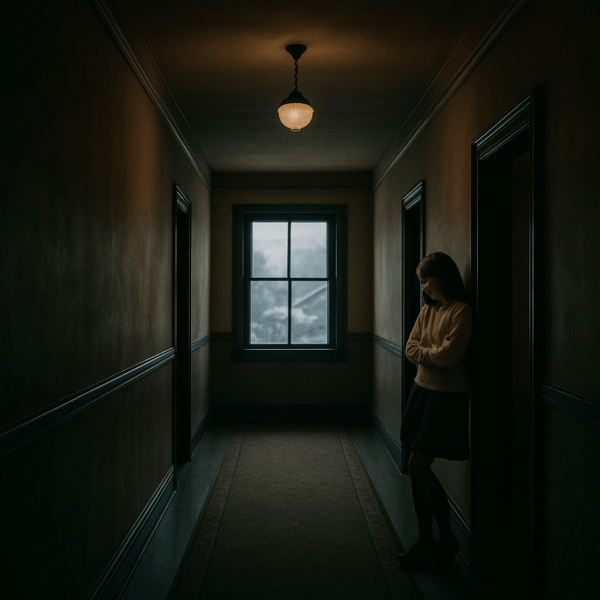
She and I ended up in the hallway.

We were already wrapped into each other — that soft, accidental teenage cuddle that feels both unplanned and absolutely right. The near-near kiss wasn’t something either of us aimed for. It was just the way our faces happened to be turned, the warmth, the pause, the sense that one more inch would have turned the moment into something else entirely. Instead it stayed suspended, held in the exact shape it needed to take.

Her name was Blythe.

I used to say I wrote poems “for girls who told me they were pearls,” but that was just self-mythology. In truth, I only ever wrote for one girl. And she never asked for anything.

Most of the real fun we had wasn’t during dances at all. It was in the gym at Saint George’s in Spokane. For high school games, boys and girls, the gym would be packed, and during the boys games she would sit in the front-row, and every single time I did anything even vaguely ok — a decent pass, a shot that actually went in, a little rebound — I’d look over mid-play and smile, and she’d already be smiling. She was in my corner before I understood what that meant. She didn’t push. She didn’t need to. She just stayed.

There was a suspended electricity in those years — innocent, unclaimed, lightly glowing. We never really dated. We never made a move beyond the moment that almost happened and didn’t. But she calibrated me. She was my corner girl. And that mattered.

The ending came the way some endings do when you’re young — clean as scissors. She graduated. Life tilted. The season shifted. Nothing dramatic, nothing painful. Just a quiet snap. A door that didn’t slam but simply shut.

I miss what we could have been, but I don’t regret a thing.
Some connections aren’t meant to become stories.
They’re meant to become orientation.

I don’t go back to that time for longing. I go back because that was the first time safety arrived before desire — and because that pattern stayed with me. It’s how I know when something is real.

I don’t need anyone to remind me how it ends.
A hallway, a graduation, a clean break.
What I keep going back for isn’t the ending anyway.
It’s the part before — the girl in my corner,
the room that opened in front of me,
the feeling I carried forward.


Dedication


For Blythe, who stood in my corner before I even understood what that meant.

Note: If you enjoyed this piece, you might also enjoy the ones below which take up somewhat similar themes.

https://thekyotokibbitzer.com/2026/02/10/simona/

On Childhood Abuse

Epigraph I:

Well it’s always been my nature/ to take chances/ my left hand drawn back/ while my left hand advances.

Bob Dylan, Angelina

Epigraph II:

I’m glad I did it all then you know that I didn’t listen/ glad I went and got it all outta my system.

My Morning Jacket, Outta My System

Epigraph III:

It’s never been a fair fight.

Craig Finn. It’s Never Been a Fair Fight

Note: What follows is a direct and somewhat graphic account of my experience of being badly abused as a child. The abuse happened at the hands of my aunt’s (father’s side) first husband when I was six and seven years old in the very early 1980s. As I will recount, the abuse had deep and lasting impacts on me and it took me years, decades, to process and understand what it did to me.

I make absolutely no claim to be an expert on childhood abuse or to speak to anyone else’s experience of this all too common problem. My experience is my own, and that’s all I can really speak to. In addition, although he conducted what I consider to be vicious abuse of my brother, I understand that anyone impacted by abuse may categorize events in different ways. Therefore, I will allude only glancingly to these aspects, and only through the lens of how this impacted me personally. I will, inevitably, make reference to the role of my parents and my aunt in the events, and as I mention below when I began to fully process the abuse I directed a certain degree of anger at these adults. As time has passed, however, I have come to understand that although they were not able, for whatever reason, to stop the abuse, and although it was conducted, at least in my case, in their direct view, the primary responsibility lies with the abuser himself.

In early 2024 I did seek out legal advice from a firm that specializes in childhood sexual abuse, and they gave me a professional and compassionate hearing, however in the end declined to take up my case and directed me instead to the Washington State public system. I will detail those events below. I am not currently pursuing legal avenues, and instead am hoping that by making this public I can finally fully exorcise the lasting damage that was done to me. I take full responsibility for the content of this piece.

I was born in South Bend, Indiana in June of 1974. My father was pursuing a master’s degree at the University of Notre Dame at the time, however when I was around six months old my parents moved back to Santa Clara, California, where my mother’s parents were living. My father did not finish his master’s at Notre Dame because of some issue with the faculty there, however I believe that he did later finish at Santa Cruz University in California. In an interesting side note I also pursued a master’s degree, in History at the University of Northern Arizona in the late 1990s, and did not finish because of a conflict, or disagreement, with my thesis advisor. Life has a funny way of repeating itself.

We lived in Santa Clara until I was, I believe, two years old, and then my parents moved us to Gig Harbor, Washington. My understanding is that my father wanted to move to Washington State to be closer to his sister, Nancy (Nan) Thomas. Nancy is my father’s younger sister and it was she, I believe, that introduced my father to my mother, who was Nancy’s friend when they all attended Santa Clara University.

It just so happened that Nancy was then married to a man who would become my abuser. My first memory of this guy, just some fucking guy as far as I’m concerned, is also my first real memory in life (Note: This has since been revised to happier memories when I was two in California. I will detail these at a later date). It goes like this:

When I was very small, two going on three, (I know I was three in Gig Harbor because my brother Mike was born there in June of 1977), we lived in a small house right next to the Pacific Ocean. What I recall about this time was, we had a dog. My father was working at a nearby lumberyard which I occasionally visited, and, I think, was sort of seeking what would be the next stage of his life. My parents had no money, but I didn’t understand this at the time.

My first vivid memory is of playing a game called “Shovelman” on the beach of the Pacific Ocean right by our house. I don’t remember the rules of Shovelman, but it involved a frisbee. However I do recall, with absolute precision, that one time the frisbee was thrown out into the ocean, which, in western Washington, was very cold. This guy ordered me to swim for the frisbee, and when, predictably, I struggled mightily to reach the frisbee in the freezing water and came out gasping for breath, he laughed and laughed, like a total sadist. Of course I didn’t know what a sadist was at the time, but I recognized his essential nature even then. I knew for sure at that moment that he was a bad guy. Now I don’t fully know if my father and mother liked this guy or considered him a friend. All I know is, he was around some. I later learned that my uncle Kim did not like him. Hated him in fact. Kim has had an interesting and varied life, and is my godfather. I love Kim, and salute him here for his instincts.

While my first memory is a negative one, presaging as we will see later events, I also have positive memories from this time. I recall right around this time the days after my brother was born that some of my mother’s family visited us including her mother Barbara and her youngest sister Leslie. My mother has nine siblings, all, fortunately, still alive and all wonderful people. Leslie was quite young at the time and is only a few years older than myself I believe. Anyway, I looked up to Leslie and thought she was cool, so when we all went to a restaurant I sneaked under the table and pulled on her leg, like little children do. I wanted her attention, but I’m not sure if I got it. As I mentioned above, I also recall visiting my father at the lumberyard and thinking he also was cool and had a cool job. I don’t know if he would remember that line of work the same way or not.

In any case, my family did not stay in Gig Harbor very long, and pretty soon we were back in California, this time in Palo Alto, which is a town adjacent to Santa Clara. These days, Palo Alto, Santa Clara, and the nearby San Jose are well known for being sort of the heart of Silicon Valley, but back then they were not really on the map in that way. My mother was working as a swim coach at Stanford University and my father was working at a school in town. This was a wonderful period of my life as I spent time at Stanford hanging around the pool while my mother was coaching which was a total blast. I may recount this time in more detail at a later date. Suffice it to say I was an outgoing, curious, and happy child, eager to see what the world had in store for me. As I will detail below, I believe I was at this time essentially an extravert, and the primary, from my perspective, impact of the later abuse would be to turn me into a somewhat serious introvert. Over and above all other impacts of the abuse, this is the one I resent the most. It is my belief that my natural extraversion, my interest in and ability to trust and like people, was deeply damaged by the actions of my abuser. I will never fully get over this aspect of the situation, and have had to work very, very hard to overcome what I see as a kind of inversion of my essential nature.

In the year 1980 my family moved once again, this time to Spokane, Washington. And again, this was, as I understand it, for my father to be closer to his sister who was by that time working as a young lawyer in the same city. My abuser was also, I believe, a lawyer. It is certainly true that, although younger, Nancy was on the upswing of her career much more quickly than my father. Other than that I don’t know the exact reasons for this following of his sister, however my father found a teaching job at St. George’s school in Spokane WA. I would attend St. George’s from grade 1 through 12, and have written rather extensively about my time there. Interested readers can find these pieces on this blog.

St. George’s was great, and overall, although my parents were still broke, I had a good childhood. However, there was one dark aspect, which was we would regularly visit Nancy and this guy at their home on the South Hill in Spokane. On occasion, but much less regularly, this couple would visit us at our house on the outskirts of the city. I believe that all of the incidents recounted below occurred in 1980 and 1981. I know this for a couple of reasons, first of all because the volcano Mount Saint Helens erupted in 1980 and at Nancy’s house in the backyard there was a big craggly rock which had pockets of ash residue from the eruption and this event was a big topic at the time. Secondly, I know that I was enrolled in first grade at St. George’s so I must have been six. My brother Mike then would have been three going on four. I wrote about my wonderful brother Mike before here.

The action at the Thomas household there was not all bad–there was the ash and a nearby park called Cannon Hill Park which was pretty cool. The house on the South Hill was pretty large, certainly larger than our own, and I got to know my cousins, both of whom were even younger than myself. I would say we visited dozens of times over the course of a year or two, and I remember the house and its environs well. In any case, ash and parks aside, the main event at the Thomas house turned out to be regular and vicious abuse from this guy which was conducted in full view of everyone in the living room of the house. After a little dinner or whatever, he would “tickle” myself, my brother, for extended periods of time, 20-30 minutes at a time or so or more. This “tickling” was not in any form playing; it was, instead, a totally vicious fully body attack.

It was absolutely excruciating and horrible, and he would touch every single part of my body and dig his fingers in as deep as possible and screw them around. At first I didn’t know what to make of this or what to do, but overtime I came to hate this so much that I began to fight back. My bother Mike, at three, was obviously in no position to do so, and so he, in my recollection, absolutely got the worst of this. The amazing thing, amazing to me to this day, is that the three other adults, my mother and father and this guy’s wife, would just stand there and watch. There is something deeply sad about adults that cannot, for whatever reason, stand up to a bully.

Later, much later, I would confront my mother about all this, and she has since said that her inability to intervene is one of her deepest regrets.

What I think happened was, when I began to fight back he gave up on abusing me. Also, I suspect, from my understanding of abuser psychology, that I had, essentially, “aged out” of whatever his mindframe was. My sense is that he preferred his victims to be as helpless and defenseless as possible, and I was no longer fitting the bill.

Now I should note that I don’t know what his problem was or what he thought he was getting out of this abuse. And, I don’t wish to research it really, because I would prefer to spend as little time as possible engaging with people of this sort. What I know for certain is that in the early 1980s he was a brutal man. That’s a flat fact.

I will detail what I understand to be the effects on myself and some of the later repercussions of his abuse a little later, but first of all I will recount my attempts to engage with the legal system over this issue, as well as indicate, in a compressed form, how I came to process and understand the abuse. Now I wish to tread carefully here because I do not want to get sucked into a discussion of, or really even take a position on, what is known as repressed memory. I understand that this topic is highly controversial, with strong opinions on all sides. Although I have read a lot, I am not an expert on psychology, much less a topic as fraught as this. What I will say is that I never repressed the memory of the abuse; if you had asked me at any given time in my life if I was brutally attacked by this guy, in full view of other adults, I would have said absolutely yes, that happened. However, what took time was to fully work out how deeply and negatively it impacted me, and in what ways. I think I always intuited it, however it took a some very difficult life experiences to get to the bottom of it.

The first of these was in 2010, when I was already 36 years old. It was at that time that I began spiraling into my memories and trying to uncover some kind of nugget that would unlock a range of issues that I was encountering at the time. In this year, and on a few other occasions after, I would, somewhat obsessively, go over events from my sixth and seventh year, always centering around my aunt Nancy, her house, and what I perceived to be my essential ambidexterity. More on this point later. At some point I intuited, in some way, that Nancy may have had a miscarriage before the birth of her first child. My mother, when I asked her, confirmed that this had taken place, and asked how I knew it. I didn’t, but somehow worked it out, just because I was spending so much time thinking this constellation of issues. It was also during this times that I was also trying to get to the bottom of my sexuality, my introversion, and my inability to learn to play the piano because of seriously weak left hand. I will detail these, and other aspects of the situation, later.

In any case, it was in 2022 that I fully worked out the effects that the abuse had had on me over time, and began, for the first time, to identify as a sexual abuse survivor. This was not something that I wanted to have to incorporate into my personal narrative, however it became inevitable. I looked into the law in Washington State, and as I recall, as I understood it at the time, the statute of limitations was three years which began at the moment that the victim became fully aware of their injury. From my point of view, I became fully aware of my injury in 2022, and therefore, after thinking about it, I contacted a law firm in Washington State in early 2024. This firm specialized in sexual abuse cases, however they were pretty high-powered and I got the impression from their website that they specialized in suing institution, schools, churches, and the like. On this basis I felt that it was somewhat unlikely they would take up my case–there was probably just not enough percentage in it. Nonetheless, their website indicated that they meant business, so I contacted them and a little while later had a call with an associate from the firm. He told me that all the lawyers were all in court, but gave me a full and proper hearing and said that he believed my story. He also asked me an interesting question, which was, did the abuse happen more or less than 20 times? I said my recollection was that yes, it was over 20 times, and he took a note of this. My impression was that for a case like mine, 20 times was some kind of legal threshold.

A few weeks later the associate got back to me via email. As mentioned above, he said that the firm would decline to take my case, and recommended I pursue the public legal system. He also said that he hoped that I got justice. I thanked him in response, and was not overly disappointed because it was clear that their focus was on institutions and I had done my best.

Now I should mention that before I contacted the law firm, I did Google this fucking guy to see what came up. It is true that I didn’t want to, and still don’t really want to, research this guy, however I wanted to see at a minimum what internet footprint he had. It turned out that he had a website where he described himself as some kind of elite international mediator and the site had a picture of him climbing a mountain.

So I guess he leveraged his legal background into some kind of mediation role, which is guess is all related. And I have no idea, he may have had success as a mediator. In actual fact, it is not even my intention to comment at any length on who or what he is today (I do believe he is still alive). Is it possible that he cleaned himself up in some respect? Maybe. But actually I doubt it. It is my opinion that someone as twisted as he was in his early adulthood doesn’t really get over that. I can forgive a lot of things–for example taking a life when drunk driving or something of that nature. Mistakes are made, and mistakes of that sort are basically unintentional. However, this guy, with his Shovelman action and his subsequent brutality, in my estimation, doesn’t really ever get better. Am I being unfair? Perhaps. It’s really hard to say.

In any case, although the firm turned me down, reaching out to them was one of the best decisions I have ever made. By attempting to work through the legal system I had engaged, fairly and properly, with the available channels, and I felt immeasurably better about the whole thing. I did not at that time decide to pursue the public option, because I am not located in Washington State, and I didn’t feel that taking this route any further would be feasible. Instead, I thought about using the only real platform I have, my blog, to discuss my thoughts on the matter. Aside from the legal system, this seemed to me to be the next best thing. And so here we are.

In what follows I wish to enumerate what I understand to be the long-term effects of my abuse. I will, in the interest of my own privacy and that of others, somewhat undersell these, and it is not my intention to burden the reader with my own issues over time. In addition, I would like to make clear that my encounter with the legal system as well as my somewhat long-gestating decision to go public with my story and my conversations with a few trusted friends, has ameliorated, to a significant degree, the effects of my personal abuse. In any case, here is what I feel:

From my earliest memories I wanted to play the piano. When I was in first or second grade I asked my mother to enroll me in piano lessons, and she declined, saying that she had no money. A few years later my brother Mike was allowed to take cello lessons, and he became very good very fast. I would wait in the car while my brother and my mother attended cello lessons there on the South Hill in Spokane. Naturally, I never held this against my brother, who was an awesome musician and I was proud of him, however I did resent, for a very long time, being denied the opportunity to pursue music. It is my understanding that although people can learn music at different times in life, the earlier the better. I have subsequently tried to learn the keyboard by myself, and somehow was able to play “Ocean Rain” by Echo and the Bunnymen and “Someone I Care About” by the Modern Lovers. I didn’t dominate Ocean Rain, but it was least passable. But I still can’t really read or play music. I wish, beyond almost anything, that I would have had the chance to learn music at an early age.

However, my strong feeling, underlined by years of reflection and memory spiraling, is that the abuse from this guy essentially crippled my left hand. I don’t know exactly how I know this, but I have always known it. So I probably wouldn’t have been that great at piano anyway, because the left hand is pretty important. And, the destruction of my left hand is intimately and directly connected to my crippled ambidexterity, the inversion of my extraversion, as well as my somewhat ambiguous sexuality. I will take up these issues in turn.

First, as mentioned above, there was as a result of the abuse, a long-term impact on my left hand. When I was very young, maybe four, I learned to swim in the pool at Stanford, and my strong memory is that I was developing a certain ambidexterity. Ambidexterity is related in some respects to dyslexia, which I also have a very mild case of, however it also has some salubrious aspects, for example in sports and music. I understand this intuitively and experientially, that I could have been a good piano player if I had been able to take lessons and if I had not been, essentially, crippled from the repeated abuse. Thus, the epigraph from Dylan at the top. It’s been forty-five years since I was first abused by this guy, and only now is my left hand, so to speak, advancing.

Second, as mentioned above, I was an extravert until I was six years old when I suddenly turned into a pretty serious introvert. Now, I absolutely don’t wish to imply at all that one orientation is better than another–both have great strengths. However, the issue here is that I was one thing, and then became another. And this corresponded to, and was directly triggered by, the abuse that I suffered. Somehow, the repeated and protracted abuse turned me inward. I no longer trusted people, essentially, and although I still liked, and still do, many people, something went off track. This is the reality.

Third, I know for an absolute fact that my sexuality was deeply damaged by this guy. I can’t speak to any other form of abuse, however my case of male on male abuse, which I experienced (and yes I absolutely categorize my experience as sexual abuse because he violated every part of my body including my genitals) led to a situation where it became for me, once I hit puberty, somewhat difficult to work out what my sexuality was and in what direction it ran. I was, without doubt, attracted to girls, however in the back of my mind there was some kind of lingering, and for me uncomfortable, ambiguity, as well as a distinct inability to approach women. Now, I fully understand that the inability to approach women is a pretty normal aspect of heterosexual teenagers, who are awkward at the best of times, but I always sort of knew that there was something else going on. And what was going on was, my genitalia was first touched, without my consent obviously, for lack of a better term, by an adult male when I was six years old. And that damaged me.

In essence, and again I know instinctively this to be the case, the abuse was so brutal and so protracted that it in essence re-wired my brain. As with repressed memory, I don’t wish to take a strong position on the issue of the left-brain and the right-brain, although I have read and deeply integrated the book The Master and His Emissary, by Iain McGilchrist, which goes into this matter in far greater detail, and with far greater insight, than I will ever achieve. What I know is the connections within my brain were compromised, indeed fractured, by the abuse. Although it took years for me to fully work this out, I have absolutely no doubt that this is the case. It was, in my belief, something about the pure digging of his fingers that did the damage. Some light tickling would not, I think, have had this effect, however the intensity and depth of his action were, I know, of a completely different level.

Basically, I have been dealing with long-term PTSD from his attacks, dealing with it for 45 years in one way or another, and 15 years more intensely. And you might say “hey there Matty baby, how do you know that your supposed ambidexterity, for example, was so compromised by this guy’s actions?” In answer to that I wish to make an analogy to the trans issue. Now I understand that the trans issue is highly political, and, I guess, pretty complex. However my basic stance is as follows: I do not believe that people who experience feelings of transsexuality or gender dysphoria, basically, are “making it up.” A few may be for various reasons, however I believe that, generally speaking, the set of feelings they experience are real, and also because I have never had them, I cannot speak to them with any authority. Such it is with sexual abuse. The feelings and understandings of sexual abuse victims are, I believe, valid and need to be understood in the context of they know best what the effects of the abuse were. While I cannot perhaps fully explain how I know what I know, I know.

I have a few final thoughts. The first is, as mentioned above and now underlined, my bother also received similar treatment from this guy. I mention this only because I have, ever since, suffered from a great degree of guilt for my inability to protect my brother at that time. Indeed, it was primarily this aspect of the situation, more so than the damage to myself alone, that caused me to direct my anger at my abuse to my mother, and by extension my father and Nancy. I still carry this guilt, and don’t suppose I will ever really get over it. Once again, there is a good deal more to the story, but that’s all I really wish to say at this point.

The second refers to what I described above as the re-wiring of my entire mind and body. Perhaps there is a more clinical term for this, and I think that psychologically alert readers will be able add understanding around this, however this is the best description I can offer. As the second quote at the top of this piece alludes to, the life we have led has been what it has been. I strongly wish I had never suffered the abuse that I did, and have had as a consequence, some of the most painful imaginable situations, however the mere fact that I cannot turn back the clock means that the life I have lived will have to stand, in all of its glory and messiness. This is true, I think, for everyone.

Finally, and I am in no way being facetious, I want to express my deep indebtedness to the great Craig Finn. Craig Finn is the lead singer and songwriter from the bands Lifter Puller and The Hold Steady, and has also had a substantial solo career. One of my very favorite songs of all time is “It’s Never Been a Fair Fight,” by Finn, which I have written about at some length here, and from which the third epigraph for this piece comes from. I am not exaggerating when I say that Finn saved my life, probably more than once, and has, over time, helped me overcome the damage done by my abuse. Thank you Mr. Finn sir. I love you.

I will choose to close this narrative here. As alluded to above, there is a lot more to the story, however in the interest of the privacy of a range of people, not the least of which myself, I will desist. What I would like to say at the end of the day is, abusing a child is never a fair fight. And so I am deploying the only real tool that I have at my disposal, my pen. Thank you for reading.

Dedication:

For all my friends and family who have taken such good care of me over the years. I wouldn’t be here without you. And for Spencer Krug, the greatest piano player I am aware of.

Note: It you enjoyed this piece, you may also enjoy the other pieces below which take up somewhat similar themes.

On Kris Kristofferson’s “To Beat the Devil”

This piece takes a look at Kris Kristofferson’s “To Beat the Devil.” The song appears on Kristofferson’s self-titled debut album from 1970 on Monument, which is, by any standard, an astonishingly good record. The album features “Me and Bobby McGee,” “Sunday Morning Coming Down,” and “Just the Other Side of Nowhere,” along with the ol’ Devil. That’s four absolute classics right there for ya.

Sunday Morning features an opening quatrain that most other songwriters would trade their career for:

Well I woke up Sunday morning/ with no way to hold my head that didn’t hurt/ and the beer I had for breakfast wasn’t bad/ so I had one more for dessert

(I could play this game all day—Jason Isbell’s Southeastern features another couple life-work worthy couplets:

The first two lines of “Super 8”:

Don’t wanna die in a super 8 motel/ just because somebody’s evening didn’t go so well

And from “Different Days”:

Time went by and I left and I left again/ Jesus loves a sinner but the highway loves a sin.

If I’d written lines that great I’d call it a career and sip martinis on the house for the duration.)

Sunday Morning and Bobby are probably objectively better songs than To Beat the Devil, yet what I like about this one is that Kristofferson states very clearly a kind of founding intention for his life in song and art, right out of the gate. The only parallel I can think of is Craig Finn’s The Hold Steady, whose first album Almost Killed Me kicks off with “A Positive Jam.”

(Here’s Finn telling it like it is:

I got bored when I didn’t have a band/ so I started a band/ we’re gonna start it with a positive jam/ hold steady.

Rock on Craig baby.)

Anyway, let’s get to the focus of this piece. Kristofferson opens with a spoken intro.:

A couple of years back I come across a great and wasted friend of mine in the hallway of a recording studio. And while he was reciting some poetry to me that he had written, I saw that he was about a step away from dying, and I couldn’t help but wonder why. And the lines of this song occurred to me.

Here the singer is looking up at his idol who is both “great and wasted.” I wasn’t around quite yet in 1970, yet I can easily imagine Ginsberg’s “best minds” line hanging over talented folks across a lot of zones. Klosterman wasn’t quite there either (June 5, 1972–a mid Gemini of course), but he was close, and to indulge not for the last time in a little Klostermania, the zeitgeist seemed to be making people thirsty.

The singer receives some scraps of poetry, shards of shattered inspiration, and a song “occurs” to him. He doesn’t state it directly, however we imagine the song arrives fully formed, like “Pancho and Lefty,” or “Kubla Khan.” Thus, To Beat the Devil is also both an answer and an offer of redemption to his idol, who here is John(ny) Cash.

I’m happy to say he’s no longer wasted, and he’s got him a good woman. And I’d like to dedicate this to John and June, who helped showed me how to beat the devil.

The singer takes up the mantle of the master, and in so doing opens a possibility window onto redemption for his senior. This is no exaggeration—Cash also recorded To Beat the Devil in 1970 and we are basically stipulating that Kristofferson’s genius, descended from Cash while also original to himself, helped rescue Cash from addiction and the whole deal there. We won’t be deep diving into the archive on this one—as we said we’re just keeping it local and breaking it down, so you’ll have to take my word on it or search it up your own self.

Here’s the first verse; the words speak for themselves:

It was wintertime in Nashville/ down on Music City Row/ and I was looking for a place/ and to get myself out of the cold/ to warm the frozen feeling that was eating at my soul/ keep the chilly wind off my guitar

A classic down and out in the big city piece of scene-setting. The singer is physiologically and psychologically frozen, a cold wind gusts across his art. The man needs a break.

My thirsty wanted whiskey/ my hungry needed beans/ but it had been a month of paydays/ since I’d heard that eagle scream/ so with a stomach full of empty/ and a pocket full of dreams/ I left my pride and stepped inside a bar

You might think that the operative nouns here would be “thirst” and “hunger,” but no. This is not a man with a thirst; this is a thirsty man. We also hear an echo of a now-ancient American past where a man with an empty stomach would go in search of, of all things, “beans.”

Anyway, he’s got no money, can’t really bring himself to care. So, a singer walks into a bar.

Actually I’d guess you’d call it a tavern/ cigarette smoke to the ceiling
and sawdust on the floor/ friendly shadows/ I saw that there was just one old man sitting at the bar/ and in the mirror I could see him checking me and my guitar/ and he turned and said/ come up here, boy, and show us what you are/ I said I’m dry, and he bought me a beer

The man in the mirror, the devil himself. The singer comes face to face with the man who checks him out and summons him over. Kristofferson then enters into a bargain–offers up the terms of an encounter: a beer on the old man’s tab. Score one for the thirsty man. The singer faces the old man; it’s to be a showdown. He doesn’t have much, but he’s got some “friendly shadows,” traces of an older map perhaps, an older memory.

I can’t help here but engage in a bit of presumption. When I play the song in my head, I want to hear “in the mirror I saw him casing me and my guitar,” (listen to the way he pronounces “guitar” on the track. Kristofferson was born in Brownsville, Texas in ‘36 and behind the laid back folksinger you can here some roots here baby).

If I could make one edit to the song, it would be to replace “checking me,” with “casing me.” What a great verb “to case” is.

Lexical Interlude: “To case the joint”

1. slang To observe a place in order to familiarize oneself with its workings in preparation for some criminal activity (often robbery). Judging from the security footage, those men cased the joint hours before robbing it.

2. slang By extension, to thoroughly examine a place. In this usage, no devious motive is implied. As soon as my kids walking into the hotel room, they started casing the joint, exclaiming about everything from the TV to the mini-fridge.

The seminal use of this verb phrase comes from Bill Callahan, formerly of Smog. Callahan is an odd duck—he is so artificial, so obviously self-created as an entertainer, that he has become almost post-authentic.  Callahan contains multitudes.

My favorite Smog album, well in the top two, is Red Apple Falls, which features “Ex-Con,” on which Callahan sings: 

Jean jacket and tie/ feel like such a lie/ when I go to your house/ I feel like I’m/ casing the joint

Devious motive implied.

=====

He nodded at my guitar and said/ it’s a tough life, ain’t it?/ I just looked at him/ he said “you ain’t making any money, are you?/ I said, you been reading my mail/ he just smiled and said, let me see that guitar/ I got something you ought to hear/ and then he laid it on me

The devil has a bead on the singer, and he’s not far off.  Yes he’s broke.  Yes he’s down and out.  Whaddaya want?

=====

Filmic Interlude I: The Long Goodbye

In Robert Altman The Long Goodbye, written by Leigh Brackett, the main character Philip Marlowe gets out of jail somewhere in the first act and heads to a all-purpose pit stop restaurant who’s owner apparently collects Marlowe’s mail. The dialogue is exquisite.

Marlowe: You got any messages for me?

Owner: Believe we’ve got a few over there. As a matter of fact, you’ll find my phone bill in there too.

Marlowe: I wouldn’t worry about that.

When you ain’t got nothing you got nothing to lose. Kristofferson’s got nothing to hide in his mail. Those bills go straight to the wastebasket.

=====

If you waste your time a talkin’ / to the people who don’t listen/ to the things that you are saying/ who do you thinks gonna hear?/ and if you should die explaining how/ the things that they complain about/ are things they could be changing/ who do you thinks gonna care?

there were other lonely singers/ in a world turned deaf and blind/ who were crucified for what they tried to show/ and their voices have been scattered by the swirling winds of time/ ‘cause the truth remains that no one wants to know

The devil’s words speak for themselves. The path of the troubadour is a dead end. The world has not ears to hear nor eyes to see. Truth tellers meet a bad end. Whiners gonna whine. It’s a strong opening bet, made, we presume, with his red right hand.

Well the old man was a stranger/ but I’d heard his song before/ back when failure had me locked out/ on the wrong side of the door/ when no one stood behind me/ but my shadow on the floor/ and lonesome was more than a state of mind

The singer is on familiar territory; he’s has been tempted by this cynical incantation, he’s not immune to tuning out his calling when out in the cold. Who is?

You see, the devil haunts a hungry man/ if you don’t want to join him/ you gotta beat him/ I ain’t saying I beat the devil/ but I drank his beer for nothing/ then I stole his song

This is the key verse in our little tale. You see, when we tango with the devil the devil usually gets to lead. That’s just the way it goes. But the thing about the devil is, his game is a bit of a bluff. A couple of low pairs, maybe. You just gotta call.

and you still can hear me singing/ to the people who don’t listen/ to the things that I am saying/ praying someone’s gonna hear/ and I guess I’ll die explaining how/ the things that they complain about/ are things they could be changing/ hoping someone’s gonna care

I was born a lonely singer/ and I’m bound to die the same/ but I’ve gotta feed the hunger in my soul/ and if I never have a nickel/ I won’t ever die ashamed/ ‘cause I don’t believe that no one wants to know

Kristoffeson flips it right around. The devil’s got a point; the singer may die dead broke, that’s fine. Songs are borne on the wind in any case. The thing is to have faith in your audience. To believe someone is out there, heart in their hands and ear to the wind. And to hold this faith as a mantra. That’ll keep ‘em guessing, cause then you’re not playing their game, you’re playing your own.

Overall, To Beat the Devil is a young man’s song. It’s got a confidence, a swagger, even a hubris. So, after drafting most of this piece I wanted to find a recent live version, see how it’s aged. I stumbled on a version from a live set with Lou Reed released in 2017. The set is part of The Bottom Line Archive, and it finds Kristofferson in a Waitsian stage of life. The voice is richer than ever, but he’s not exactly singing. Then again, that’s what they said about Dylan and it’s B.S. The voice is the voice; singing is just a category.

The set is interspersed with short interviews of the two songwriters. Here is Kristofferson’s spoken introduction that precedes To Beat the Devil. It is instructive.

Interviewer: The devil figures in some of your songs, you know there’s that silver tongued devil and he pops up from time to time. Who’s the devil? What’s the devil for you? What are your demons?

K.K.: Well, I, I’ll do that song then. Ahhh…

Interviewer: Is that a metaphor or is that something real for you?

K.K.: Well here’s a song called To Beat the Devil. Maybe it’ll explain it. I can’t.