The Adventures of the Thin Man and Andrea Available Now!

Well everyone, today is the day. My first novel, The Adventures of the Thin Man and Andrea is now available on Amazon and wherever books are sold.

This one took a while—written in fits and starts, in bars and hotel lobbies here in Kyoto—but it finally found its shape. More than anything, today I just want to thank all the readers of The Kyoto Kibbitzer, wherever you hail from; I’ve always thought of this as an ongoing conversation, and a lot of this book grew out of that exchange.

If you do pick it up, I hope you enjoy the ride—and if it lands for you, a quick review on Amazon would mean a great deal. Thank you, as always, for reading.

Matt

On the Long Cut: The COVID Years (2019–2022)

Note: This essay forms part of a longer series recounting my professional life in and around the International Baccalaureate program at Ritsumeikan Uji. It follows earlier pieces concerning the Dr. Fox years and the gradual evolution of the IB program there, and covers the period roughly from late 2018 through the early months of 2022.

The years described here coincided with the global COVID-19 pandemic, which disrupted institutions and routines in ways both large and small. The narrative therefore moves between several overlapping threads: my temporary assignment at the Suzaku campus, a prolonged period of leave and personal drift, the strange half-life of Kyoto’s bar culture during the pandemic years, and finally my gradual return to teaching and the IB program at Uji.

As with other pieces in this series, some names and identifying details have been adjusted or omitted where appropriate. The goal of the essay is not to settle institutional scores but to record the texture of a particular stretch of life—its confusions, absurdities, and small recoveries of purpose.

Readers encountering this piece independently may wish to consult earlier essays in the series, including those on the Dr. Fox period and related institutional episodes, for additional context.

Epigraph

“If you wanna take the long cut / we’ll get there eventually.”
— Uncle Tupelo


I. Return

On December 20, 2018, I landed at Kansai International Airport after a twenty-two-day music trip along the American East Coast. I had seen bands in New York, Boston, and Philadelphia, spent too much money, and generally had the time of my life. That journey has been written about elsewhere, so I won’t linger on it here. What matters for this story is simply that I came back to Japan exhilarated and somewhat unmoored.

The first thing I did upon landing was send an email to Dr. Fox. I told him that although I still carried some anger about how things had ended at Ritsumeikan Uji, I appreciated his help securing a temporary role for me at Suzaku beginning in March. Both statements were true. What I did not yet know was how miserable that position would become.

I had two months before the job began. They were among the freest weeks I had experienced in years.

I wrote constantly. I worked on the early sections of Thin Man: Singapore and drafted essays that would later become EventificationHelmet Laws, and On Zone Defense. I was about to begin the St. George’s School series. Periscope had faded from my life, partly because the platform had run its course and partly because a particular person who had made it interesting to me was no longer there.

I spent some time with Philip, though he was busy with his own life and his relationship with his wife seemed temporarily on the mend. Mostly I wandered between Tokyo and Kyoto, writing and drinking coffee and enjoying the strange luxury of being at loose ends.

In the third week of January I attended a Drunk Poets open mic in a small bar near Shibuya. I arrived absurdly early because I didn’t know the neighborhood. While waiting in the stairwell I met a woman who introduced herself using her poetry name. We talked for nearly an hour before the reading began. She was a veteran of the open-mic circuit and showed me how the evening worked. I read first after the break; she followed me.

It was a pleasant night. I had no idea at the time that the conversation we began that evening would extend, mostly by phone, for more than two years.


II. Suzaku

My assignment at Suzaku began on March 1, 2019.

There were no students.

Technically the building housed graduate programs, but they lived on lower floors and we might as well have been ships passing in the night. My office was on the fifth floor, a large open room filled with perhaps forty people: a mix of temporary teachers like myself and permanent administrative staff.

It was, in a word, dreary.

I commuted each morning to Karasuma Oike, walked down to the Suzaku campus, sat at my desk, and tried to look busy until five o’clock. Sometimes a consultant whose job seemed to consist mainly of visiting other campuses would take me on excursions to places like OIC or the original Ritsumeikan High School. These trips were well-intentioned but clarified nothing. No one quite knew why I was there, least of all me.

Within days I began to feel something I had never really experienced before: the creeping onset of depression. The problem was not that the work was difficult. It was that there was no work at all.

By April I had started leaving the office early. By May I was appearing only sporadically. The remarkable thing was that no one seemed to notice.


III. Drift

If I was not at Suzaku, where was I?

Mostly at home.

During the day I played chess online, usually on Chess.com or Lichess. I climbed to around 1250 on the former and somewhat higher on the latter, though the Lichess ratings were clearly inflated. My openings were solid, my middlegame acceptable, and my endgame play atrocious. I squandered many promising positions by failing to convert them.

I watched instructional streams from Levy Rozman and occasionally from Hikaru Nakamura, though Levy was the better teacher. His explanations were clear and energetic, and I learned a great deal.

When I wasn’t playing chess I listened to podcasts. The rotation included nearly every program produced by Bill Simmons and the broader Ringer network, followed by an increasingly large catalog of true-crime shows. What fascinated me most were disappearance cases—stories in which someone simply vanished and left investigators grasping for explanations.

Meanwhile the phone conversations that had begun in the stairwell in Shibuya continued. They were long conversations—sometimes five hours a day—covering everything from literature to relationships to increasingly elaborate stories about future plans and imagined fortunes. At first the exchanges were exciting; over time they became exhausting, though we kept talking.

In the evenings I left the apartment and walked to the bars near Karasuma Oike. Takumiya and its sister bar Takanoya became regular stops. Eventually I found myself most often at a tiny machiya bar called Before 9.


IV. Before 9

Before 9 was small even by Kyoto standards. Downstairs there was room for perhaps five or six people around the bar; upstairs another half dozen could sit beneath the original wooden beams of the converted house. Jazz or ambient music played quietly while large black-and-white films—Seven SamuraiCasablanca—were projected silently on the wall.

The bartender most nights was Miyuki.

Philip and I nicknamed her “the Ice Queen,” though not to her face. She could be sharp-tongued and intimidating, yet occasionally revealed flashes of warmth that suggested a softer personality underneath. Regulars were greeted with a curt “What do you want?” delivered with theatrical indifference.

She wore black almost exclusively and carried herself with the confidence of someone who knew exactly how striking she looked. I developed a mild crush on her, though it was clear from the beginning that the feeling would remain entirely one-sided.

During the pandemic the bar officially closed at eight in the evening, though the rule was treated with some creativity. One night two inspectors arrived precisely at closing time. Miyuki announced “last call” in an exaggerated voice, served them a beer they never drank, watched them leave, pulled down the shutters, and then reopened the bar for the regulars.

That was the culture for several years.


V. Leave

In October 2019 the situation at Suzaku was finally addressed. A supervisor called me in and gently suggested that it might be best if I took leave. I agreed immediately. Beginning in November I was officially on leave—a status that would last until October 2021.

Oddly, I felt relieved.


VI. The World Changes

Early in 2020 I read a brief news report about a virus outbreak in Wuhan. At first the story seemed distant and provisional. Within weeks it dominated every headline in the world.

The pandemic years blurred together. Bars closed early, then reopened, then closed again. Conversations moved onto phones and screens. Life contracted into smaller and smaller spaces.

Yet the routines I had developed continued: chess, podcasts, the evening walk to Oike, the occasional drink with Philip or Mackenzie.


VII. Return

In October 2021 an unexpected opportunity appeared.

Andy Meichtry needed to take extended leave after a family emergency. His timetable included several sections of a class called Academic Research in the International Program. VP Nishikawa, who had always been supportive of my return to IB, suggested that I fill the gap.

So I put the uniform back on and returned to Ritsumeikan Uji.

The first challenge was that no one could tell me what the Academic Research course actually entailed. The teacher who normally handled it was on extended medical leave, and the only materials available were a handful of PowerPoint slides sent without explanation.

In the spirit of William Ian Miller, I decided to fake it until I made it.

The students—seniors working on research projects related to the Sustainable Development Goals—were relaxed, good-natured, and only months from graduation. We muddled through together, and somehow two months passed quickly.


VIII. Administrative Comedy

During this period a new principal, Dr. Joseph Hicks, made an impression.

The IB morning briefing was designed to last three minutes and cover the day’s essential information. Dr. Hicks instead preferred to open with extended digressions on topics such as the reproductive habits of moles. After a week I suggested that perhaps the zoology lectures could be postponed. To his credit, he stopped immediately.

Later, during my annual teacher meeting—normally a brief conversation about contracts and responsibilities—he spent most of the time explaining the virtues of traditional Polish music.

I left better informed about Eastern European folk traditions but none the wiser about my job.


IX. Reinstatement

Administrative reshuffling followed later that year, and by January 2022 I was formally reinstated in the International Baccalaureate program.

My roles included IB1 head, CAS coordinator, and student council advisor, along with a single section of Higher Level Business Management.

After the drifting years, stepping back into a classroom felt like a jolt of electricity.

The students were lively and engaged, but one in particular stood out: Karin Sayama, whose enthusiasm for the course reminded me why I had chosen this profession in the first place. Watching her and her classmates rediscover the subject gave me a renewed sense of purpose.

For the first time in years I felt genuinely happy to be at work.

The long cut had taken its time.

But eventually it brought me home.


Dedication

For Karin.
With deep appreciation.

Note:

On the Strange Geography of Conferences

Note: This essay began with a memory from an IB Global Conference in Singapore sometime in the mid-2010s, when I first began to notice that large professional gatherings possess a kind of unofficial geography. The official conference—the keynote halls, breakout rooms, and printed program—forms only one map of the event. Running alongside it is a second map composed of bars, lobby couches, dinner tables, and long conversations that drift well past the scheduled sessions.

Years earlier I had written a short reflection on what I called unconferencing, the quiet relocation of intellectual “action” from the formal program to these improvised spaces around it. The present essay grows out of that earlier observation but shifts attention from theory to terrain. Rather than asking why unconferencing occurs, it asks where it tends to happen and how participants gradually learn to navigate those unofficial zones.

Readers interested in the conceptual background may wish to consult the earlier essay on unconferencing, which explores the phenomenon through the lens of Erving Goffman and the broader question of how individuals negotiate the locus of action within institutional environments.

As with many pieces on the Kibbitzer, the goal here is less to offer a definitive theory than to describe a pattern that, once noticed, becomes difficult to unsee. Conferences, like many human systems, operate simultaneously on two levels: the one announced in the program and the one discovered by those who know how to find the action.

“The locus of action is always in motion.”
— Erving Goffman


I arrived a day late to the conference.

This was in Singapore sometime around 2014 or 2015, at one of the IB Global Conferences for the Asia–Pacific region. The event was being held in a large glass hotel near the river, not far from Chinatown and just south of Raffles Place if memory serves. The keynote room alone seated something like eleven or twelve hundred people. The conference program was thick with panels, workshops, and presentations that began early in the morning and ran straight through the afternoon.

My suitcase had arrived before I had. I had been in China the day before running another IBEN training, and while the conference itself was already underway, I was still in transit. By the time I checked in and made my way downstairs, the official proceedings were well established: keynote speakers, crowded sessions, conference badges swinging from lanyards, the whole apparatus of professional gathering fully in motion.

At the time I was only about a year into my work with IBEN. My regional manager was Avi Nanda, who was excellent in many respects but not especially hard-charging as a networker. Gill Pressland, who later became a formidable presence in the region, was not yet in the picture. I knew a few people, most importantly Steve Keegan in Australia, who had become a kind of mentor to me. I also knew Ed Lawless, who had previously overseen a great deal of the professional development work in the region.

Ed had once joked to me, only half joking, that his job had become little more than “wedding planning.” Conferences, workshops, schedules, logistics—endless coordination. Eventually he burned out on it entirely and moved on, first to Pamoja, the online curriculum company, and later into a somewhat undefined role at an IB school in Tokyo that seemed to blend management, marketing, and development. Such trajectories are not uncommon in the IB ecosystem. People drift through roles that are part educational, part organizational, part entrepreneurial.

In any case, arriving late to the Singapore conference had the curious effect of placing me immediately at its margins rather than at its center. The keynote sessions were already underway, but instead of rushing directly into the large ballroom where most of the attendees were gathered, I began encountering people in the spaces just outside it: the lobby, the cafés, and eventually the hotel bars.

One of the first people I reconnected with was Darlene Fischer from Australia. Darlene was in her early sixties at the time and something of a force of nature. She had the sort of presence that made conversations reorganize themselves around her. Through Darlene I soon met two others who would become central figures in what I later came to think of as the conference’s unofficial inner circle: Sue Richards and Gerald Conlin.

Gerald was in his mid-sixties then, a slight man with white hair and an almost theatrical grin. His professional life consisted largely of consulting work connected to education programs, particularly the wave of hybrid master’s degrees in education that universities around the world had begun launching. Institutions like Tsukuba in Japan and Bath in the UK were building these programs, often with cohorts of twenty or so students, and Gerald had carved out a niche as the person who could authorize and evaluate them. He was also constantly presenting, constantly researching, constantly moving through the conference circuit.

Within about five minutes of meeting me he decided that I would make the perfect number two for his MA authorization work. It was flattering, though I suspected there might be additional motives behind his enthusiasm. Gerald was an openly and exuberantly gay man, and his warmth toward me carried a certain theatrical flair. He had a habit of calling me “my boy,” delegating tasks such as selecting restaurants or ordering drinks, and occasionally resting a hand on my upper thigh while speaking with great intensity about some educational development or other. None of this particularly disturbed me; conferences are full of strong personalities, and I was by then quite capable of navigating such dynamics.

Sue Richards, meanwhile, functioned as Gerald’s counterpart and amplifier. Where Gerald was slightly reserved and professorial, Sue was outgoing, energetic, and socially strategic. She worked directly for the IB at the time and moved easily through the conference environment, introducing Gerald before presentations, praising his work with extravagant enthusiasm, and generally acting as a kind of corner person for his professional persona. If Gerald was the fighter in the ring, Sue was the one shouting encouragement from the ropes.

The two of them formed a kind of traveling intellectual unit, and through them I began spending more time not in the conference sessions themselves but in the hotel’s bars and restaurants.

There were perhaps four or five of us in total who fell into this pattern. What struck me fairly quickly was that these individuals rarely attended the conference sessions unless they were running them. The keynote speeches, the panels, the carefully scheduled workshops—these seemed largely directed at newcomers or first-time attendees. The veterans, by contrast, moved through the conference in a completely different way.

They ran the unconference.

By this I mean something slightly more specific than simply skipping sessions. Years ago I wrote an essay about what I called “unconferencing,” referring to the parallel conference that emerges quietly around the official one. What interests me here is less the theory of unconferencing than its geography: the physical spaces through which these unofficial conversations travel.

At the Singapore conference, that geography quickly became clear.

There was the large ballroom where the official keynote addresses were delivered to more than a thousand people. But there were also the bars—two of them in particular—where smaller groups gathered throughout the afternoon and evening. There were the restaurant tables where dinner conversations stretched for hours. There were the lobby seating areas where people drifted in and out between sessions.

And there were the walks.

Within a day or two I began to see that the conference operated according to two distinct maps. The first map was the one printed in the program: rooms, times, speakers, sessions. The second map was entirely informal, emerging through patterns of conversation and social gravity.

The keynotes were for the newbies.

The action was at the bar and at dinner.

I was somewhat ambitious at that stage in my career, eager to establish myself in the region and become a respected trainer. Because of this ambition I paid close attention to where energy seemed to accumulate. It did not take long to realize that the most consequential conversations were happening far from the podium.

In the bars and restaurants people spoke more candidly about the IB, about institutional politics, about emerging programs, about who was doing interesting work and who was not. Opportunities were floated, collaborations proposed, rumors exchanged. Careers, in small ways, were advanced.

The official conference continued to run its scheduled course upstairs, but the real motion of the event—the circulation of ideas, alliances, and opportunities—took place elsewhere.

Seen in this light, conferences begin to resemble temporary cities with two overlapping infrastructures. The official infrastructure is highly visible: lecture halls, keynote rooms, printed programs, registration desks. The unofficial infrastructure is quieter and more fluid: bars, café tables, hallways, and late-night dinners.

Participants gradually learn to navigate both maps.

Some remain primarily within the official one, moving dutifully from session to session. Others develop an instinct for the second map, drifting toward the places where conversation gathers and where the boundaries between formal roles begin to loosen.

It is in these spaces that the unconference unfolds.

The term itself is slightly tongue-in-cheek, but the phenomenon is real. Once a small group of experienced participants begins congregating in a particular location—usually a bar or restaurant—others start to appear. Conversations splinter and recombine. Someone joins for twenty minutes before leaving for dinner. Someone else arrives with news from another corner of the conference.

Over time the group becomes a kind of floating node within the larger event, a place where information circulates rapidly and where participants feel unusually free to explore ideas that might never make their way into a formal presentation.

In retrospect, what struck me most about that Singapore conference was not any particular keynote or panel discussion but the realization that conferences possess a strange and dynamic geography. Action is rarely confined to the places where organizers expect it to occur. Instead it migrates across the built environment of the event, settling temporarily wherever people feel the oxygen is richest.

The ballroom may host the official performance, but the bar hosts the conversation about what the performance actually means.

And so the conference proceeds along two parallel tracks: the one announced in the program, and the one discovered by those who know how to find the action.

The unconferencers simply learn to follow the latter.

Dedication:

For all those who know how to find the action.

Note: If you enjoyed this essay, you may also enjoy the essays linked below, all of which also take up the fascinating theme of professional conferences.

On One Evening in Adelaide

Note: This recollection dates to June 2010, when I traveled to Adelaide, Australia for my first IB Theory of Knowledge workshop. At the time our school’s governing body, officially Ritsumeikan, but semi-affectionately known around town as “Keichimeikan,” (the cheap school) had begun investing heavily in International Baccalaureate training, and for a brief but memorable stretch I found myself traveling widely across the Asia-Pacific region attending workshops and conferences. Adelaide happened to be the first stop on that circuit.

The encounter described here took place midway through that week. Like many moments that occur while traveling, it was both ordinary and oddly memorable — a short conversation, a near-comic personal embarrassment narrowly avoided, and then a small gap in memory that I still cannot fully explain.

For privacy I refer to the person involved simply as “M.”, and a few identifying details have been softened. The strange behavior of my phone afterward — messages arriving out of sequence and the device occasionally insisting it was in Adelaide or Nagoya — was quite real, though I have never had a satisfying explanation for it.

In Japanese there is a phrase that captures the mood of such moments perfectly: cho fushigi — very mysterious.

Epigraph

Half hours on earth

What are they worth?

I don’t know.

David Berman


I. Adelaide

I was in Adelaide for my first IB Theory of Knowledge workshop, sometime around June of 2010. In those years our principal had suddenly decided that IB travel was a worthwhile investment, and so for a brief and glorious period I was dispatched all over the Asia-Pacific region like a slightly rumpled educational attaché. Workshops in Singapore, Hong Kong, Kuala Lumpur, and, in this case, Adelaide.

The school hosting the workshop was one of those extremely well-appointed Australian private schools — immaculate rugby grounds, manicured lawns, a cafeteria that would have put many universities to shame. The workshop itself was perfectly pleasant. TOK people tend to be reflective types and reasonably good company, though after two days of epistemology everyone is usually ready for a drink.

Which is how, on the second evening, a small group of us ended up at a bar a few minutes from the hotel.


II. M.

At some point the table thinned out until it was just the two of us talking. She was from San Francisco. Let’s call her M.

We were sitting close, leaning in the way people do in bars when the music is slightly too loud and the conversation slightly too interesting to abandon. I told her about my small blog, Classical Sympathies, which at the time was still young and full of ambition. She told me she wrote long travel essays and posted them on Facebook where, she said with a shrug, they had gathered a modest but loyal readership.

Like a complete peon, I offered to host them on my site.

She smiled politely and said she’d probably keep them where they were for now.

Which was entirely reasonable.

The conversation moved on. We started talking about family — fathers, specifically — and the strange emotional weather that tends to gather around that subject. It was one of those unexpectedly intimate bar conversations that sometimes appear between near-strangers and then vanish again.


III. A Minor Emergency

There was, however, a complication.

Let us say that during the course of this conversation Young Mr. Johnson began to make his presence known.

Nothing dramatic. But enough that standing up suddenly would have created a situation. So I employed the classic defensive maneuver familiar to men everywhere: crossed legs, careful posture, strategic angles.

A small but significant crisis was unfolding beneath the table.

Eventually the situation resolved itself through patience and good fortune. When the moment seemed safe, I made my exit with what I hoped was dignity intact. We exchanged Facebook information, said our goodbyes, and I stepped out into the alley behind the bar on the way back to the hotel.

At that moment I felt something close to relief.

By the grace of God, I had narrowly avoided making a spectacular fool of myself.


IV. The Missing Ten Minutes

And then something strange happened.

I remember stepping into the alley.

The next thing I remember is being back in my hotel room.

Fully clothed. Completely sober. The evening still early — maybe ten-thirty, eleven at the latest.

What I did not remember was the ten minutes in between.

No walk back to the hotel. No elevator ride. No keycard in the door.

Just a small, clean gap in the record.


V. The Phone

The truly odd part came later.

For the next year and a half my phone behaved as though it had lost its grip on reality.

Texts appeared months after they had supposedly been sent. Messages from April surfaced in October. Time stamps were wrong. Location data wandered.

Sometimes the phone seemed to believe it was still in Adelaide.

More often it insisted it was in Nagoya, a city I had visited only once for a consulting visit to a school in the hills.

It was never anything dramatic — just enough small glitches to make me raise an eyebrow every now and then.


VI. Cho Fushigi

I never saw M. again.

We remained distant Facebook acquaintances for a while. She became, I believe, an English teacher back in San Francisco. Her essays continued to appear occasionally in the feed, and then eventually they stopped.

The phone eventually sorted itself out as well.

Technology, like memory, tends to repair its own small fractures over time.

Still, every once in a while I think about that short walk down the Adelaide alley and the ten missing minutes afterward.

And the only phrase that really fits is the one the Japanese use for such things.

Cho fushigi.

Very mysterious

Dedication:

For Molly. Thanks for the half hour baby.

Note: If you enjoyed this essay, you may enjoy the two essays linked below, both of which take up similar themes or charged, fleeting, and romantic encounters.

On the Other City

Note: This piece grew out of a long fascination of mine with what might be called the “night economy” — the network of bartenders, servers, managers, taxi drivers, and late-shift workers who keep a city alive after most people have gone home. If the daytime city is governed by office hours and commuter rhythms, the nighttime city runs on a different clock entirely.

The two figures mentioned here, Haku and Haru, are part of that world in Kyoto. Haku runs the bar at ING and seems to operate on a schedule that would puzzle most daylight citizens, opening in the evening and closing well into the small hours while somehow producing food, music, and atmosphere in a space not much larger than a good-sized living room. Haru manages a shisha lounge in eastern Gion and moves easily between the daytime and nighttime rhythms of that neighborhood, which has its own distinct ecosystem of bars, touts, and late-night wanderers.

The small bar Ishimaru Shoten, tucked down an alley off Pontocho in the Kiyamachi district, serves in the essay as a kind of neutral ground — one of those places where the various inhabitants of the nocturnal city briefly cross paths once their shifts end.

The central idea is simple enough: most cities contain two cities. The first is the one that tourists and office workers see during the day. The second comes into view only after midnight, when the people who keep the lights on, the drinks pouring, and the plates spinning begin their own quieter rounds.

Epigraph:

Last night, I told a stranger all about you
They smiled patiently with disbelief
I always knew you would succeed no matter what you tried
And I know you did it all
In spite of me

Morphine, In Spite of Me


Most people believe a city goes to sleep around midnight. This is not true. Around that time a city simply changes populations.

The day city winds down: office workers, shopkeepers, commuters heading home, lights switching off floor by floor. But another population wakes up. The bartenders. The shisha managers. The taxi drivers. The people who work the strange hours when the streets are quieter but the human drama is often louder.

This is the other city.

If you spend enough nights wandering around it, you begin to recognize its citizens. They are the people who actually know how the place works after midnight.

One of them is Haku.

Haku runs the bar at ING. He opens around seven in the evening and closes somewhere between three and four in the morning. Prep starts around six. By the time the first customers wander in, the night has already begun for him.

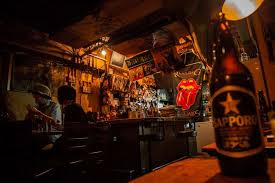
He has long greying hair and rotates through a collection of Rolling Stones T-shirts, something like twenty-eight of them. I have never seen him wear anything else. He smokes constantly, drinks Sapporo if he is drinking at all, and otherwise survives on black coffee.

Somehow he produces a full menu in a kitchen that appears to consist primarily of a Bunsen burner and sheer stubbornness.

Haku’s bar has rules. No Japanese music is the main one. The other rule is that the bar itself is reserved for singles. Groups can sit elsewhere. The bar is for individuals who have come out into the night alone.

But Haku’s real gift is music. He reads the room the way a card player reads a table.

If the crowd is German he might throw on Rammstein. If Scandinavians wander in the speakers might suddenly fill with black metal. Australians get The Saints. If I’m there he might put on My Morning Jacket. The world rotates through the speakers depending on who happens to be occupying the stools that night.

Simply and totally the original man.

Another citizen of the other city is Haru.

Haru manages the shisha lounge in eastern Gion, a part of town where the nightlife becomes a little more ambiguous. The streets there are full of micro-touts, men and women both, gently trying to guide passersby into Thai or Japanese dancer clubs. Small space heaters glow outside doorways and mama-sans smile from behind them like patient spiders.

I never go into those places, though the invitations are often persuasive.

Haru opens the shisha lounge most days at noon sharp. If she is not there, someone named B. or a long-haired young guy handles things until she arrives. She tends the charcoal, mixes my Malibu Milk, and quietly extends the session when the official time runs out.

She knows my habits well enough by now that when I head up the stairs she doesn’t assume I am leaving. She knows I am just stepping outside to smoke.

For a long time she existed in my mind simply as the shisha girl, one of the many figures who keep the other city functioning. But then one night I ran into her somewhere unexpected.

The place was Ishimaru Shoten, a tiny late-night bar down an alley just west of Pontocho in the heart of Kiyamachi. Outside the entrance hang bright red, green, and blue lamps that glow like a small carnival in the dark.

I first discovered the place at four in the morning on a very long night. I was broke that evening, absolutely skint, and there was a very aggressive Japanese guy at the bar who clearly believed the entire establishment belonged to him.

The bar woman, who is about forty-five and still hot as blazes, was batting her eyes at me with what seemed like professional enthusiasm. Meanwhile I realized with growing clarity that I did not actually have the money to pay for the large bottle of beer I had just ordered.

But men are predictable creatures.

I understood immediately that if I played my cards right the territorial guy would buy the drink for me. So I joked with him, gave him a friendly punch on the shoulder, made it clear I recognized him as the reigning emperor of the room. He razzed me a little but saw that I was no threat to his throne.

Sure enough, he covered the beer.

I stumbled home to the Royal Park Hotel on Sanjo Street as the sky was turning pale, crashing into bed around five-thirty in the morning.

Weeks later I returned to Ishimaru and found Haru sitting there.

I teased her gently about sometimes opening the shisha lounge five or ten minutes late when she bikes over from home. I suggested she must be hungover. She laughed, not the polite laugh people sometimes use for customers but a bright, real laugh.

She said she was happy to see me.

And that was when I learned her name. Haru.

We talked for a while. I drank a White Russian and ate dashi maki while she sipped something that might have been shochu or nihon-shu. I felt a strange rush of adrenaline the whole time, those goosebumps that run up both arms when the night suddenly opens into possibility.

Not necessarily romantic possibility. Just the larger sense that anything could happen.

Anything can come.

After twenty or thirty minutes she said goodnight and promised we would meet there again sometime. We did run into each other once more about a week and a half later, though the evening remained just as light and brief as the first.

But something had shifted.

She was no longer simply the shisha worker in my mental map of the city. She was Haru, a fellow traveler in the other city.

And that is the thing about the people who live their lives after midnight. They know parts of the city the rest of us never really see. They watch the celebrations and the arguments, the flirtations and the quiet breakdowns. They see who walks home alone and who finds someone to share the long dark streets.

Every city has two maps.

The one everyone uses during the day.

And the other one that only appears after midnight.

Dedication:

For the men and women of the night. Who keep the drinks coming and the plates spinning. It’s a rocky world, and you rock it baby.

Note: If you enjoyed this essay, you may also enjoy the two essays below, which also feature Kyoto and Osaka nightlife in all it’s beautiful glory.

The Night of Fucking Adam

Note: This piece is part of an informal series of essays and stories about nights out in Japan that begin innocently enough and gradually drift into something closer to accidental anthropology. The settings vary—Kyoto bars, Osaka clubs, late-night taxis, shotengai corridors—but the structure is often the same: a few friends meet for drinks, the evening unfolds without much planning, and somewhere along the way the ordinary rules of social behavior begin to loosen.

The events described here took place during a long evening wandering through Osaka, eventually ending in the nightclub district of Shinsaibashi. Like many such nights, it contained a mixture of small cultural misunderstandings, unexpected friendships, minor chaos, and the strange solidarity that sometimes develops among strangers in bars after midnight.

The character known here as “Adam” was a young British traveler we met that evening and never saw again. The nickname “Fucking Adam” reflects the affectionate exasperation with which the phrase was used throughout the night rather than any serious judgment about the person himself. Anyone who has spent time traveling, drinking in unfamiliar cities, or navigating the unpredictable social ecosystems of late-night nightlife will likely recognize the type.

The intention of the piece is not to document a perfectly accurate timeline of events—after fifteen or so drinks spread across many hours, accuracy becomes a flexible concept—but rather to capture the texture of a particular kind of night: the slow drift from casual afternoon drinks into the surreal territory that sometimes appears around two or three in the morning when strangers collide and small incidents escalate into memorable stories.

In that sense, Adam becomes less an individual than a type. Every city has them. Every traveler eventually meets one. Occasionally, if the night runs long enough, we become one ourselves.

Epigraph:

“A ruinous eyesore, oh what is a mind for?
Just a knife in a lake, just an arrow in space.”
—The Swans

We met around four in the afternoon near Osaka Station, the three of us: Philip, Jack, and me. The plan, such as it was, was simple—have a few drinks and see where the night took us. Osaka is good for that. The city doesn’t require much in the way of planning. If you just start walking and follow the lights, something eventually happens.

Our first stop was a subterranean craft beer joint somewhere beneath the station complex. One of those places down a set of anonymous stairs where the ceiling is low, the taps are numerous, and everyone looks faintly conspiratorial, like they’ve all agreed to drink underground together.

We had a couple rounds there and then drifted through the shotengai behind the Hilton. Early evening shoppers were moving through with that unhurried Osaka pace. Nothing felt like the beginning of a legendary night. It just felt like a pleasant afternoon.

From there we crossed over to a classic American hamburger joint opposite the station. Vinyl booths, neon beer signs, and a bartender who had tattoos running down both forearms like vines. American rock played softly in the background. It felt like a movie set version of America dropped into central Osaka.

We ate burgers, drank more beer, and talked about absolutely nothing of consequence.

At some point Philip announced that what he really wanted that night was to go to a middle-aged club. To be clear, Philip was not shy about his intentions. He was, as he put it, “looking for MILFs.”

So we took a taxi down to Shinsaibashi.

The middle-aged club, unfortunately, was closed. It was only about eight and apparently the MILF scene doesn’t really get going until later.

So we did what you do in that situation: we wandered.

For the next four and a half hours we drifted around Shinsaibashi, moving from bar to bar in that loose, happy way nights sometimes unfold. By midnight we had covered a lot of territory. Between the three of us we had consumed something like fifteen drinks over thirteen hours. And yet only Philip seemed even remotely affected by them.

Around 1:30 we arrived at Sam and Dave’s, a legendary dive of a nightclub tucked into the chaos of Shinsaibashi. The security guy at the door looked us over and shrugged.

“Maybe dead now,” he said. “But gets good later.”

Inside it was a haze of smoke and terrible techno beats pounding from the speakers. The crowd was an odd mixture of people who were extremely drunk and people who appeared to be completely sober and studying the situation with curiosity. It was cooking by one-thirty.

Somewhere along the way we met a jovial twenty-year-old British guy named Adam.

Adam and Jack bonded almost immediately. They were trading insults in that cheerful British way—“you tosser,” “you old wanker,” that sort of thing—and it seemed harmless enough.

Meanwhile a group of Filipino girls had arrived, one of whom—Beverly—was extremely drunk and getting progressively more chaotic. Her friends were trying, without much success, to keep things under control.

At this moment Philip stepped in.

Philip has a well-developed instinct for white-knighting in situations where white-knighting is absolutely not required. He began talking to Beverly, which quickly escalated into something resembling a full-scale courtship right there on the dance floor.

Meanwhile Jack and Adam had begun dancing.

The problem was that they gradually migrated off the dance floor and onto a small raised stage that contained a drum kit and various musical equipment.

Within seconds drums were tipping over. Tables were sliding. A cymbal crashed onto the floor.

Security arrived immediately.

They pushed Jack aside and dragged Adam feet-first off the stage and into what appeared to be a small holding room behind the bar where, judging by the noises coming out of it, Adam was receiving a fairly vigorous beating.

Things deteriorated quickly after that.

Philip decided to treat everyone to Irish car bombs. Unfortunately the bartender had no idea how to make one, so Philip instructed him. The Guinness component somehow disappeared from the process and we ended up with small glasses of Baileys and Jameson.

Adam drank one.

At this point Adam completely lost his mind. He began loudly explaining how terrible the UK was, how he wanted to die, how the American guy earlier had stolen the chesty nurse he loved, and a variety of other philosophical positions.

Security eventually threw us out with minimal ceremony.

Outside the situation became even stranger.

Philip was pouring champagne into Beverly’s mouth near the elevator while her increasingly frantic friends asked me if he was a good person. Jack was trying to figure out where Adam was staying so he could get him into a taxi.

Adam responded by pushing Jack into a decorative pond.

Then he began throwing a water bottle at him like he was Bob Gibson pitching in the World Series.

At this point it was around five in the morning.

Philip abruptly announced he was leaving to meet some Brazilians. Adam remained in the pond shouting curses about our mothers. Jack climbed out, soaking wet.

We left.

Mackenzie took a taxi back to his hotel by the river. I caught the first train home from Shinsaibashi as the sun was coming up, completely exhausted.

And that was the night of Fucking Adam.

We never saw him again.

Dedication:

For Fucking Adams everywhere.
Long may you burn.

Note: if you like this essay, you may also like the essay below. It covers a similar slice of nightlife, this time in Kyoto.

Tuesday Kyoto Bar Crawl

Note: A Tuesday crawl in Kyoto carries a different texture from the weekend version: looser expectations, smaller crowds, conversations that wander rather than perform. The city feels slightly off-schedule, which is exactly what makes it fertile ground for observation, connection, and the quiet serendipity that defines third-place culture.

These midweek circuits are less about excess and more about continuity — checking in with familiar rooms, familiar faces, and the evolving micro-narratives that accumulate across bars, balconies, and late-night sidewalks. The crawl becomes a moving vantage point on the city’s emotional topography: moments of laughter, fragments of confession, the soft choreography of strangers becoming temporary companions.

In that sense, the Tuesday crawl isn’t a deviation from routine but a ritual of perspective. It reminds the wanderer that urban nightlife is not only spectacle but ecology — a network of spaces where stories intersect briefly before dissolving back into the Kyoto night.

For the crawler, the goal is simple: move lightly, notice everything, and leave each room exactly as it was found, carrying only the residue of atmosphere and the promise of return.

Epigraph
“Is there room enough for two / if I don’t have a point of view?”
— Tommy Stinson

Dedication
For the people who made a night by simply being themselves.


I. Umineko

Early evening began without urgency, the way a proper crawl should. Umineko held the kind of atmosphere that makes arrival feel less like an event and more like a gradual settling — low light, gentle conversation, bodies occupying space without demanding attention. Nothing theatrical, nothing curated for spectacle. Just people existing alongside one another, sharing a small pocket of warmth before the night found its pace.

I took a seat and allowed the room to reveal itself slowly. Watching first, speaking later. Listening without the pressure to respond. The posture was closer to observation than participation, not out of distance but out of respect for rhythm. A crawl does not begin with energy; it begins with calibration. I was not collecting stories yet, not assigning meaning or searching for narrative threads. I was tuning my frequency, aligning with the environment until the subtle shift in atmosphere signaled readiness.

When the bar moved from fullness toward thinning, the message was clear without needing articulation. Crawls are not forced forward by intention; they move according to instinct and current. I stepped back into the night air, carrying nothing but presence, following momentum without destination.


II. ING

ING felt like stepping into a room anchored by a still point. Haku stood behind the bar wearing a Rolling Stones shirt, perfectly unconcerned with audience or approval. His presence created an equilibrium that defined the space more than any décor or playlist could. I took the center seat — ideal angle, clear sound, good conversational acoustics — and ordered a Negroni, marking the transition from arrival into engagement.

A White Russian followed, not out of necessity but out of curiosity. Choice itself becomes part of the method on nights like these. Drinks are less about intoxication and more about pacing, punctuation marks in a narrative unfolding in real time.

Haku mentioned, almost casually, that Jimmy Cliff was not Rasta. The comment carried no agenda, only observation. I responded in kind. He played Cliff anyway, and the neutrality of the exchange underscored something important: truth in these spaces does not require resolution. Dead or alive, category or contradiction, the music persists independent of classification.

Later, Haku slipped into what could only be described as algorithm mode. The Grateful Dead followed Joy Division, which then dissolved into Blink-182. The sequence was unpredictable yet internally coherent, a playlist guided by instinct rather than performance. Bars like ING do not curate for approval; they curate for honesty. The expectation is not participation but presence.

Some bars ask for energy.
ING asks only that one remain authentic within its walls.

After a time, movement arrived not through boredom but through instinct. I finished my drink, nodded to Haku, and stepped back into the night once more.


III. Mafia Bar

The entrance to Mafia Bar announced itself through indifference: narrow doorway, plastic sheeting, a quiet DGAF energy that discouraged pretense. Inside, the dynamic was already established — Master, sub-bartender, and Satsuki forming a triangle of familiarity that neither required nor excluded me.

I ordered a gin and tonic, lit a clove cigarette, and allowed proximity to substitute for conversation. Master smoked and drank with the ease of long habit, while Satsuki vaped and scrolled through photos on his phone, their heads occasionally leaning close in shared amusement. The intimacy belonged to them; my role was to witness without intrusion.

A brief choreography unfolded when the sub-bartender excused himself for the bathroom. Another stepped in seamlessly, maintaining rhythm until the first returned moments later, laughing about his inability to hold it and wiping his hand absentmindedly on Satsuki’s jacket. Her gentle scolding carried affection rather than irritation. The moment passed as ordinary within their ecosystem, a reminder that interpretation is often unnecessary.

Three London men arrived — Dan, Joe, and another Joe — consultants and a commercial artist navigating unfamiliar territory. I recommended Concrete, a suggestion offered lightly but accepted gratefully. Participation, not intervention. Guidance without ownership.

I remained roughly thirty-five minutes, absorbing both atmosphere and lore. The story circulated quietly: the owner had once taken the fall for a crime he did not commit, serving twenty years in silence before emerging to receive this bar as recompense from the underworld that owed him. Whether factual or mythic mattered little. Stories gain legitimacy through repetition, and truth is often secondary to resonance.

I left on foot, crossing the river with the sense that each stop was less a destination than a waypoint.


IV. Stinboat

Arrival at 9:02 p.m., two minutes after opening, placed me inside a room still forming its identity for the night. Rickey stood behind the bar alongside the evening’s performer, both moving through preparatory gestures that transform an empty space into a living environment.

I asked about glasses I had left behind on Saturday. Rickey produced a pair, though not mine. The exchange felt inconsequential yet oddly grounding, a reminder that memory and objects rarely align perfectly.

A Negroni in hand, I settled into observation as the room awakened. A visitor from Kuwait approached with curiosity, asking whether a bunny show would occur. He mistook me for staff, and I redirected him gently toward Rickey. Ambiguity satisfied him enough to remain.

At 9:20, the room shifted from potential to presence. Nine guests entered — among them an older man with a younger girlfriend and a cluster of Japanese patrons whose arrival created density without chaos. I took the microphone early, choosing Common People as an opening statement. The performance landed not as a home run but as a solid triple, establishing footing without overreach. I became part of the environment rather than an observer at its edge.

The performer navigated the bar through a series of micro-interactions, brief pockets of attention resembling miniature dates, popcorn intimacy distributed evenly across the room. I followed with Honky Tonk Women, drawing visible delight from the older man and his partner.

Preparation for Tiny Dancer involved a brief retreat with headphones — aligning tempo, breath, and emotional landing. As I sang, activity continued around me, including a staged whipping performance in the back that unfolded without disrupting the song’s internal narrative. Presence required maintaining focus amid spectacle, allowing parallel realities to coexist without competition.

The evening progressed through pole performance, enthusiastic audience participation, and ritualized tipping. I followed established protocol, understanding that the moment belonged to the performer’s choreography rather than personal interpretation.

Later, I Fought the Law brought collaborative energy: the older man on drums, eye contact establishing tempo and trust, his girlfriend filming with increasing engagement. Rickey eventually joined on drums, a younger guitarist delivered a brief but intense solo, and a spontaneous vocalist in his mid-fifties erupted into a single song before departing. Applause and hoots carried communal warmth rather than performance judgment.

As the crowd thinned, what remained was intimacy without spectacle: Rickey, the performer, the older man and girlfriend, Sari, a couple, and myself. Fairytale of New York unfolded with Sari joining briefly before drifting into her own narrative with the older man. I continued singing, neutral observer and participant simultaneously.

The set concluded with Miley Cyrus, We Will Rock You, and finally Take It Easy — a closing song chosen less for nostalgia than for resolution. Afterward, physical exhaustion arrived cleanly, the kind that follows completion rather than depletion. Brief hugs, a playful belly rub offered as pure joy, and a ¥4500 bill that felt symbolically insufficient to measure the night’s experiential value.

Stinboat held the evening’s center of gravity, and I left without loose emotional threads.


V. Concrete Bar

The walk back across the river lasted roughly eight minutes, a transitional corridor between intensity and closure. Concrete greeted me with understated calm, a space designed less for spectacle and more for lingering conversation.

Leon from Wales occupied a stool, unfamiliar with the phrase “detox and retox.” I bought him a Cocalero anyway, and we spoke in the gentle cadence of end-of-night strangers — exchanging warmth rather than biography, presence rather than personal history. These conversations carry their own authenticity precisely because they resist permanence.

I sensed no need for additional experiences. The crawl had delivered what it intended.


VI. Taxi → Home

At 1:30 a.m., a taxi waited at the stand as if anticipating completion. There was no negotiation, no wandering, no hesitation. Just entry, transit, and the quiet satisfaction of closure.

Back home, I read half of Zach’s new piece in bed and texted immediate feedback. He prefers responses unfiltered and alive, preserving the energy of first impression before reflection cools interpretation.

Sleep followed naturally.

A crawl complete — not dramatic, not moralized, not engineered for narrative payoff. Simply observed, recorded, and experienced through presence. I did not judge the night, and the night did not demand judgment. I entered it, and in its quiet generosity, it allowed me to belong within it for a few hours before releasing me back into ordinary time.

Note: If you like this essay, you may also like “On Touts and Micro-Touts: Japan Observations.” You can find it here.


The Thin Man in Singapore Part I: Washing Ashore

Note: This is the first chapter of my upcoming novel, The Adventures of the Thin Man and Andrea. You can read a later chapter about the Thin Man’s romance with Vivian in Rome here:

The Thin Man in Rome, Part IV: Departing the Group, Vivian, Sex in the Shower

It’s predicted to rain on landing/ I predict we’ll have a drink

Paul Westerberg

Dateline Singapore: Late October

This little country, such an unlikely success story, such a strange winding of forces. The thin man has been on land for five weeks after his latest gig on the cruise ship, and though his stomach is still in limbo his sea legs have mostly subsided.

Now there is nothing more that the thin man wanted after washing up here earlier in the season then a long weekend. Say, five years. Five years in the hammock, five years frolicing with the lovely ladies at the bar. The occasional speedboat ride, a flyer or two over in Macau. Five years out of the swim of modern capitalism, if you can even call it that. Five years clean. That was the dream. Five weeks on land though and the thin man is looking for work, the money gone in a haze of long days and longer nights. Wine, women, song, and a speedboat ride or two will add up quick. C’est la vie partner. That’s what comes from burning holes up to heaven.

Still, the thin man has a few dollars in his pocket as he walks into a bar just outside of Chinatown. Halloween is approaching, and the proverbial Spooky Lady’s Sideshow is in full effect. The barmaids are Eyes and Baby, or is she Baby Blue? In any case, the thin man and Eyes make eyes, in an innocent way, so the story is told.

The thin man orders a Cognac and ambles over to the pool table where the nine ball is always on. Eyes sizes him up quick, guesses he can play a bit. A game is proposed, a game for two players.

But of course no game is really ever between two players alone. Baby’s watching—tough to tell her rooting interest. And, after Eyes breaks and a few balls fall, the bar as a whole starts tuning in to the frequencies of the game as the regulars make small talk and the travelers weak-tea passes at the local girls. Local girls are no push-over; sometimes folks get the wrong idea on that end. The thin man always did like the locals; heck, it’s part of the travelers’ creed. After all, everybody is a local somewhere. Certainly Eyes and Baby could take care of themselves.

Eyes missed and the thin man was able to sink a few easy balls before Eyes surged back, she’d been around more than she looked. She was an expert at drinking what the punter was drinking. That’s a key part of the art of the barmaid, an underrated profession at the best of times.

The game is nine ball, what else? Eight ball is for rookies, a southerners game. The thin man hails from the north; he knows a thing or two about sequencing. You see, the thin man had had a bit of a specialized role onboard the cruise ship where he had worked as a dealer in the casino. As a result, he also possesses some of the skills of a card shark, a mechanic. Sequencing goes with the territory of a mechanic, after all.

Mid-game and the thin man is beginning to fade a bit–the combination of Eyes’ eyes, and a cheeky Cognac or three is taking its toll. Eyes sinks the 8 and only the 9 ball is left. It’s a touch and go situation. The skeletons muse over the action with as much interest as they can muster from beyond the great blue veil. The couple on the rail stops sniffing whatever they are sniffing, and ask the thin man to join them for a round. No time for that. Cheeky Cognacs and beady cat eyes aside, a game is a game.

A couple of desultory shots bounce about as the players size each other up. Baby leans in; the skeletons whisper sweet somethings, even the bartender sneaks a peek. Everyone is getting paid, except the thin man. He is just there for the action.

Eyes edges the nine right up to the pocket, leaving the thin man a clean shot. He leans in from the left and drops it, silky smooth like. Baby claps and Eyes bats. Game over, though the thin man knows that Eyes could have had him the whole time. She was just being hospitable. A good host for a weary traveler.

The game over, the thin man’s thoughts turned to more practical considerations. He needs a place to stay, and though the nine ball had brought them all together, he didn’t think Eyes or Baby would necessarily take him in. He’d probably need to establish himself as a bit of a regular first before having a shot at any of that action. But the thin man is a gamer, constitutionally unable to categorize situations as problems. No problemo senor, no worries mate. He does, however, have a few issues, the first being he is unemployed and pretty much out of cash. So, he’s asked around, kept his ear to the wind. A fellow traveler there on the ship had turned him onto a broker of services of sorts, the kind of individual who specializes in assisting upstanding institutions with their shining mission statements and their CSR campaigns navigate the grey areas of competition and market position. He has the number for this broker in his pocket, and asks to use the bar phone to give him a call.

The broker picks up right away, saying “yeah, your buddy mentioned you might be looking for a little work. I think I can put something together.”

“That’s good,” says the thin man. “Any chance of a hotel for the night in the meantime?”

“Sure, said the broker. Head over to the 1887 in Chinatown. They’ll have a room in your name. What is it, by the way?”

“Let’s go with ‘Jack Bishop.'”

“That’ll work. I’ll meet you at breakfast at 8.”

The 1887 sounds incredible, thinks the thin man. Rock n’ roll.

to be continued…

Dedication: For Eyes. Long may you bat baby.

Mariko

NOTE: This is the second short story in my upcoming collection. The first is here. This is a work of fiction.

I met Mariko on a cold January night in Tokyo. I had subscribed to Meetup.com, though I wasn’t using it much at the time. That night I did. A local band was playing — popular in their own right, and they sang in English. That detail mattered. It meant the room would be mixed: expats, bilingual Japanese, wanderers, people hovering between worlds.

I went to the bar, hung up my coat, and grabbed a vodka. The crowd was mingling before the show. I learned more about the band. They had hardcore followers — the kind who know every lyric, who close their eyes during certain songs, who treat a small venue like a cathedral.

Then there was Mariko.

I met her on the dance floor and we hit it off immediately. She was 32, lived in Tokyo, and worked in a corporate job she didn’t like. She spoke pretty good English, so we communicated in that language. It was easy. It felt as if I’d known her forever. I was into her. More than that, I wanted her.

Shortly after we started talking, another guy tried to make a move on her. I guess I really liked her because I was not going to let some blasted interloper come between me and her. I said, “Thank you, dude, but we’re talking,” and that was that. He buzzed off. She was essentially my date for the evening.

The band played and they were good. Mariko and I danced — close but not too close — and talked more during the breaks. There was another girl there, Saki, and a young American guy who had been talking with her a bit. We all decided to go to a second bar. It was still earlyish.

We found a wine bar nearby, but the young people thought it was too expensive. I offered to pay, feeling like it couldn’t be that much. We ordered a bottle and shared it. The bottle came to ¥12,000.

We talked and all got along well. Saki was younger, graceful and attractive, just starting her career. The young man was clearly into Saki, and Mariko and I were into each other, so it worked well. Mariko and I talked deep and soulfully, staring into one another’s eyes. We stayed about an hour and a half on the one bottle.

When we left, Mariko and I were on the same train — me back to my hotel, her back home. We talked and exchanged Line. As her stop approached, I said, “I’ll see you again,” and gave her a little kiss on the top of the head. It was a good night.

A few weeks later I was back in Tokyo. I was somewhat at a loose end in my job at the time and had a lot of spare time. I texted Mariko and we agreed to meet at a craft beer bar near my hotel in Shibuya.

We met, drank beer, and I ate tacos from the taco truck outside. That same feeling of familiarity was there right away. After that, we moved to a small, quaint wine bar. The woman running it asked for our music suggestions.

I chose Nina Simone’s “Black Gold.”

Mariko chose “Who Knows Where the Time Goes,” and then “To Be Young, Gifted, and Black.”

There was only one question between us: would we sleep together?

We did not sleep together that night, or any other night.

We wrapped up at the wine bar and headed to Shibuya Station. She said, “kairitakunai,” which means “I don’t want to go home.” That’s about as green a light as a guy is going to get.

I read her as meaning she wanted to go home with me.

But life is timing, as they say. Maybe I was faded. Maybe I had something else on my mind. The spotlight came on and I was backstage getting ready. Instead of inviting her back to my hotel — the objectively right move — I gave her a little kiss on the lips and said good night.

That was that for that evening.

Two weeks later I was back in Tokyo again and I met her again. We drank and had a good time, but something was not quite the same. We had had our window, and in that micro-moment I had blown my lines.

We parted at the train station again. This time I didn’t kiss her.

A little while later my phone died, and for various reasons I didn’t get a new one right away. When I did get a new phone, Line — the app we had been using to communicate — ate her contact along with a bunch of others. She was gone. I could not have reached her if I wanted to.

In a way, it was a clean break. No drama. No mess. Just a corporation fucking with the program. Life moved on and I didn’t think much about Mariko.

A year or two later I went back through all my Line chats just hoping, but no dice.

We ended as we began — strangers in the night.

Craig Finn on Nightlife and Adult Relationships II: Killer Parties

Killer Parties (Live) — Nights That Almost Killed Us, Nights That Made Us

Note: This is the second part of our series on songs of The Hold Steady that take up the intertwined themes of nightlife and the complexities of adult relationships. Part I is available. This piece will deal with “Killer Parties,” specifically the live version from A Positive Rage.

“Killer Parties,” written by Craig Finn, closes Almost Killed Me (2003) and provides its title line. But the 2008 live version is the definitive one for me — a 10-minute slow burn that opens not with guitars but with an invocation. Finn’s spoken intro sets the terms for who this band is, who the audience is, and why these communal nights matter.


I. The Invocation

Before a single lyric, Finn does what Finn does: greets the tribe.

He jokes, he rambles, he self-deprecates, he misdirects — and then he lands it:

There’s so much joy in what we do up here. Thank you for sharing that joy with us.

That’s the thesis of The Hold Steady.
Everything else is commentary.

The band isn’t just a band; Finn isn’t just a frontman. The Hold Steady is a community, a lineage, a shared memory palace built out of long nights, near-misses, inside jokes, loud guitars, and people who actually want to be there.

When I saw them twice at the Brooklyn Bowl in 2018, I wrote:

Hold Steady fans are pretty much fanatics… They were super possessive of their space, they all seemed to know each other. One guy sized me up and said, “I want to not like you, but there’s some kind of aura around you, man.”

That’s the thing: the fans are a little cliquey, but the band itself is radically welcoming. Finn means it when he thanks people. He means it when he says he’s met half the room. He means it when he collapses the distinction between performer and audience:

“We are, and you are, The Hold Steady.”

That’s what the spoken intro really says.


II. Charlemagne and the Unsaid

The song opens with a classic Finn move — an elliptical report of something that happened, but we’re not going to get the details:

If they ask about Charlemagne,
be polite and keep it vague —
another lover lost to the restaurant raids.

Charlemagne is the old recurring character, drug-dealer-adjacent, always on the edge of calamity. Did he OD? Get busted? Get swallowed by his own myth?
Finn doesn’t tell you. He protects the dignity of the fallen.

This is identical in spirit to the opening of “A Bathtub in a Kitchen.”

I’ve known people like this. You’ve known people like this. Someone falls off the map, and when they resurface, it’s a new person in the same body. The specifics get blurry; the compassion gets sharper.


III. Leaving, Loving, Running

The next verses broaden out:

We left because we were young and in love.
We left because we needed space.
We left because we heard about this mythical country called the United States.

When Finn sings that line, he’s not being literal — he’s describing the classic American story: the pilgrimage to the realbig city. The wide open possibility. The idea that somewhere else — New York, especially — is where the real life is.

I relate.
I left my hometown and moved halfway across the world.
Finn moved from Minneapolis to New York; I moved from Spokane to Asia.
And like him, I sometimes feel pangs for what I missed.

But I needed space. I needed something bigger.


IV. Killer Parties

Then we hit the geography of sin:

Virginia for lovers.
Philly for brotherhood.
Pensacola for pills.
Ybor City for the nights that go too far.

And then the line we can quote directly:

“Killer parties almost killed me.”

Finn doesn’t romanticize this. He’s looking back at the nights that were ecstatic and dangerous at the same time. Nights that reshaped his body chemistry. Nights that made him who he is.

I’ve had my run at nightlife — nothing like Finn’s, but enough to understand the way one night can rewrite your wiring, for better or worse.


V. The Blur and the Transcendence

The final verses repeat themselves, because that’s how memory works:

We partied (I think?).
We departed from our bodies.
We woke up in Ybor City.

The nights are a blur — Finn partied but gets the details secondhand. What he does remember is the transcendence, the weightless moment when the body gives out and the self floats somewhere above it. And then the long, punishing hangover that follows.

For me, Ybor City has always functioned like El Dorado — the mythical endpoint of the American night. Maybe Finn has been there; maybe he hasn’t. Maybe you can only reach it by running the gauntlet of long days and longer nights. Maybe you can only get there by losing yourself a little too fully.

I’m not sure Ybor City would be good for me.


VI. The Ex-Introvert Who Still Wants the Night

And here’s where my story threads into the song:

I am an ex-introvert reinvented as an extrovert — something I’ve talked about with several friends. I’m too old for some of the clubbing I once did, but I still love the nightlife, still love running around, talking to strangers, seeing where the night wants to take me.

And it takes you to strange places.

I think this is the real theme of “Killer Parties”:
the appeal of the night, the call of the road, and the deep human need to leave the known world and find out what’s waiting elsewhere.

I return to this song in all kinds of circumstances — when I miss the road, when I need a reminder that the self is porous, when I want to remember what it felt like to be new somewhere.


VII. The Circle Closes: Community

And yet — for all the mythology and all the escapism — Finn always brings it back to community.

The Hold Steady isn’t just Finn narrating the lives of misfits. It’s Finn saying:

We survived the killer nights.
We made it home.
We found each other.

The live intro becomes the retrospective moral:

There’s so much joy in what we do up here.
Thank you for sharing that joy with us.

And so the whole arc — the wandering, the leaving, the nightlife, the blurring of memory, the near-death nights — ends where it must:

With the people who showed up.
The people who stayed.
The people in front of the stage.
The people who are, themselves, The Hold Steady.