On Subcultures and Scenes in Craig Finn’s “It’s Never Been a Fair Fight”

New Note: It has been a little while since I last posted this piece, and I’m glad to bring it back into view. It remains my very favorite essay on the Kyoto Kibbitzer, and has continued to circulate far beyond what I ever expected, with many hundreds of reads over time. In an entirely unscientific but pleasingly persistent corner of the internet, it still seems to rank #2 in search results for the term “Katie Park Bad Moves,” just behind Wikipedia, which is pretty cool. I have no idea what to make of that, but I’m not complaining.

The piece itself—on Craig Finn’s “It’s Never Been a Fair Fight”—has always felt to me like one of the most complete things I’ve written about music, scenes, and subcultures, and I’m grateful for the continued readership and responses it has received. Reposting here in full for anyone who missed it the first time around, or wants to revisit it.

Original Note: This piece is about an absolutely amazing song by Craig Finn called “It’s Never Been a Fair Fight” released in 2020 on All These Perfect Crosses from Partisan Records. We will also expand on the song’s theme, which is how subcultures (and “scenes”) operate. Finn is, in my opinion, the greatest lyricist working today (not the greatest living lyricist, that’s still Dylan). I’ve written about about Finn before here, and here.

Craig Finn himself has commented on this song and says that “It’s Never Been A Fair Fight”:

“Is about the extreme difficulty of staying true to the rigid rules of a subculture as you get older. The character in the song revisits an old peer and finds struggle and disappointment in the place he left behind.”

In this case, the narrator had been part of the punk/hardcore scene in the 1980’s and 1990’s, has left the scene, and reflects on his time there and what it meant as he meets his old friend—and we suppose former lover—Vanessa. I’m not sure I understand the entire chronology of the song, as it engages in some apparent time jumps that can be a little hard to follow. Overall however, it is pretty clear what the song is about.

The opening verse sees the narrator (let’s call him C., because while we will grant Finn the understanding as an artist that his characters are characters, in this case the song feels pretty autobiographical) checking in with Vanessa. The song opens in the present day.

Finn has C. meet her “right in front of her building,” Vanessa “vague in taste and drowning,” telling him she’s “got a new man…in a new band,” and “they’ve got a new sound.”

We get the impression that C. has been out of the scene for a while, while Vanessa is very much still in it: new man, new band, new sound, same old place. Vanessa’s man, we assume, is in a hardcore band, and I believe it is the case that Finn came up through the hardcore scene before forming his first band Lifter Puller. Lifter Puller is not a hardcore band, and I don’t know if Finn was actually in a hardcore band or just in the scene.

Then comes one of Finn’s perfect little deadpan truths. C. shrugs that “hardcore’s in the eye of the beholder,” a funny line for a number of reasons (it also reminds me of the classic David Berman line: “punk rock died when the first kid said / punk’s not dead.”) The humor hits because it’s both self-aware and scene-aware.

After C. recalls his “broken heart from 1989,” Finn pivots the timeline. The song shifts back—back to when C. was attending hardcore shows, hot and sweaty, elbows in his eyes. The chronology bends, but the emotional logic stays firm.

Vanessa says there are “threads that connect us,” and “flags and wars we should never accept.” Angelo’s off seeing “snakes in the smoke” from someone’s cigarette. And Ivan? He isn’t concerned at all — for him it’s mostly just about “what you wear to the show.” C. admits he “heard a song…on the radio” that he liked, which we can assume violates at least one of Vanessa’s unwritten rules.

Finn is an absolute master of sketching characters in just a line or two. Here, he uses a sort of pointillistic approach to introduce us to two additional members of the scene, Angelo and Ivan. With just a few short verses we already understand a great deal about “the scene.” Here is what we can deduce:

i) All four members of the scene have very differently valenced loyalties. Put another way, they want different things from it. Vanessa is a purist; for her being part of the scene is like being part of an tribe, an army, and we take her to be a fierce protector of the in-group/ out-group aspects that tend to arise in subcultures. Angelo, it seems, is a little out there; he’s seeing snakes in the cigarette smoke and probably not all that interested in the ultimate nature or meaning of the scene. Ivan likes the t-shirts and jeans, likes the look. He’s not a purist either. And C., well he likes a little pop music, an inclination we assume is strictly verboten for folks like Vanessa.

ii) Probably because of the differences in ideas and ideologies between the scene members, C. sees things coming to an end, both with the scene and between he and Vanessa. Here we are reminded of the difficulty of keeping any kind of group together, whether a scene, a band, or just a group of friends. Everyone knows the feeling of having a group of friends who tell each other they will be tight forever, however life doesn’t usually work that way. The best film about this dynamic is Whit Stillman’s Metropolitan, which depicts a young group of friends in Manhattan who come together and then slowly, but inevitably, come apart over the course of a winter. There is a great moment in Metropolitan where the main character, Tom, looks around and realizes the scene is dead. Where did it go? It was here one day, gone the next. Scenes are like that, and this is what Finn is writing about.

iii) The inherent differences between people which make keeping the scene together are also something that Finn celebrates to a certain extent I think. One of the most salient features of Finn’s writing is his compassion. Finn has compassion for Angelo and his snakes, Ivan and his jeans, and for Vanessa, in all of her rigidity. As of the time of the song we know for sure that Vanessa is still in the scene and C. is not. I guess that neither Angelo nor Ivan is still around, however if only one of them is my money’s on Angelo, if he’s still alive.

Through the course of my own life, I have been involved, for a shorter or longer time, with a variety of subcultures. One category of subculture that I have frequented is what we could broadly call “new age.” My explorations of this category have been reasonably extensive. Back in my early 20s, I was involved for about 4–5 months with a Tibetan Buddhist group back in Washington State. I would get up at 4 AM, drive an hour across town to a beautiful old house on the hill, and meditate with the folks there. This group also organized some outings, such as mountain hiking.

I enjoyed the group and the meditation. The group leader, a slightly older woman who was lovely, asked me to pay like 6 dollars for a little book with chants in it, which I did. There was a total cross-section of people in the group of different ages and backgrounds, and all in all I liked it there. However, I peeled off from the group after a time for reasons very similar to those discussed by Finn. There were two specific things that led to me leaving. The second I’ll discuss a little later. The first was one day I was chatting with one of the members on the street outside after meditation. He was telling me how his daughter used to play chess, however he would no longer allow her to do so because it was interfering with her studies of Tibetan Buddhism. “There’s just not enough time,” he told me.

I had talked with this guy before and he was a perfectly nice guy, but I didn’t agree with his approach. I felt, in fact, that it was bad action. Now, I understood that people joined the group for different reasons and had different levels of investment. I was not looking to become a Tibetan Buddhist or anything—I was just “checking it out.” To circle back to Finn, the valence gap between this fellow’s take on the subculture and my own was vast, and his entire approach turned me off. This was the first step in my deciding to leave.

The next three verses of “It’s Never Been a Fair Fight” see C. trying to keep the door open to Vanessa even as he edges out of the scene. He wants to meet her and if she agrees he will know that she like him feels that “punk is not a fair fight.” Finn doesn’t say, but I’m guessing Vanessa doesn’t show.

If things change quickly/ just remember I still love you/ and I’ll circle ’round the block tonight/ between 9 and 10 o’clock tonight

If you’re still standing here, I’ll take that as a sign/ that you agree it was a sucker punch/ punk is not a fair fight/ it’s never been a fair fight

We said there weren’t any rules/ but there were so many goddamn rules/ we said that they’d be cool/ but then there were so many goddamn rules

Verse VII is the hinge-point of the song and basically its thesis. Finn’s point is straightforward: the appeal of the scene is the potential for freedom, exploration, rebellion, however once inside the subculture C. finds himself increasingly hemmed in by the strictures of that culture and the requirements necessary to remain within it. The very thing that drew C. to the subculture (flight from an over-determined social reality) is that thing that ultimately drives him away. “It’s Never Been a Fair Fight,” appears in two versions on All These Perfect Crosses; the main version is horn driven and upbeat, and there is also an acoustic version. On the main version, Finn, realizing perhaps that the repeated line is a bit poetically unorthodox, spits out a laugh on the “then” in “but then there were so many goddamn rules,” and in the process underlines the centrality of the sentiment to the song as a whole. It’s a great verse, and one which tells us something fundamental about C.’s nature: he likes the action, and as such needs to be free to pursue it wherever it may be. Action is not limited to the Minneapolis hardcore scene, after all.

Read more

On the Eventfulness of Pre-Eventified Incidents

Note: Today I’m revisiting a travel vignette about hierarchy, ritual, and the strange ways institutions manufacture “events.” It features a Big Man, a flawless flunky, Jung on surrealist art, and a ceremonial poster board signing that may or may not have meant anything at all. A quiet question lingered long after the ceremony ended. As always, judge for yourself.

If you enjoy this piece, you may enjoy my analysis of the underground rapper and crypto-hacker, Razzlekhan. You can find it here.

Yeah, I met Lou Reed and Patty Smith

It didn’t make me feel different

Conor Oberst

I visited China a number of years ago with a highly ranked member of my university structure and a flunky. My own participation was last-minute as I was filling in for someone else. I guess in a way I was a flunky too. Certainly it was the big man’s show from start to finish.

We visited a number of schools and also met with a business guy who was working very hard to transact with our group something so complex that I never even began to grasp the shape of it despite sitting in multiple meetings around the matter.

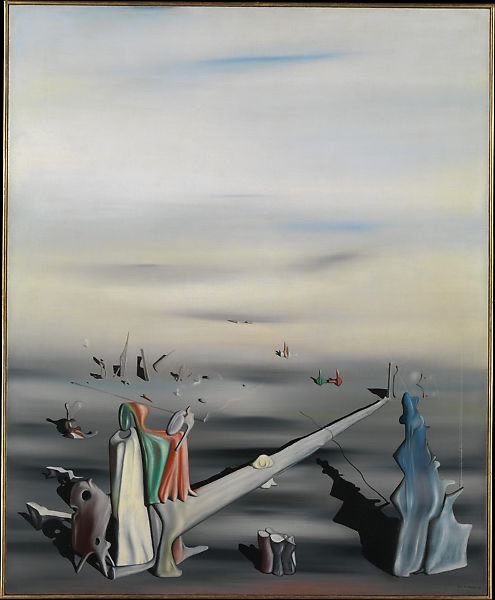
The trip was interesting for a number of reasons. The big man barely spoke to me for the first few days despite spending all day together. The schedule was brutal. I was reading Jung On Art on my phone as I was enrolled in on online course I never finished. Jung On Art is great and spends a lot of time on the surrealist painter Yves Tanguy. Finally the big man took a long look at me and said (in Japanese) “you read a lot, don’t you?” I confirmed this, and after that he spoke to me a little more.

The flunky was an archetype of the species. He handled the schedule, made the trains run on time. He did nothing else and deferred to the big man on absolutely every non-schedule related matter. My own strongest contribution to the proceedings was occupying the attention of a friend of the business man during an excruciatingly protracted whisky drinking session so that the business guy and the big man could talk turkey. I am not a great whisky drinker for some reason and making sensible small talk for three or four hours over whisky took a truly heroic effort.

The business guy had a kind of a house in a kind of a hotel, it was hard to say. A full staff was on hand to serve us a full course Chinese meal with white and red wine. This was before the whisky. It was a scene, all the way.

Anyway, all of that is context. I want to write about a specific incident that occurred when we visited one school. The principal who received us knew the big man and we were received by a group of about eight people. We got the school tour. Now, school tours are an occupational hazard in my line of work, and I have trained myself to be a durable recipient. But I don’t really like them. We went through the formalities, which predictably took forever. I daydreamed about Yves Tanguy and bed.

Toward the end of the tour we reached a wall with the school name or emblem on it. Here, the principal paused and asked the big man to write some Chinese characters on some poster board. This was to mark his visit, to consecrate it in a sense. The whole group fanned out into a kind of semi-circle and the big man went through a series of highly performative grimaces to index his deep thought. Or maybe he just didn’t know what to write. I certainly wouldn’t have. Finally he took the pen and with the pomposity of a South American dictator wrote a few characters. The message, to my recollection, was underwhelmingly anodyne. Basic. Or maybe it was gnomic and brilliant. In either case the audience made appropriately awed sounds. I murmured my own supposed appreciation–the role of the acolyte was there to be filled after all. The poster board was then displayed with a flourish on the wall.

At first blush I found the entire episode both deeply interesting and deeply narcissistic. However, the big man was invited to contribute some characters and he did so, so in that sense fair enough. Let’s zoom out a little before rushing to judgment.

You know how some restaurants and bars will have signed pictures of famous people that visited on their walls? Mickey Mantle, Bob Hope, Stallone, whatever. In these cases the visit of the celebrity was an event in the life of the establishment. It merited consecration across time. I understand this. But the big man was not a celebrity in any real sense. He was a university bureaucrat with a taste for acting like a big shot.

But maybe I’m seeing this all wrong. Because there was actually a hint of the classical in the occasion. A host had received an honored guest. The honored guest was asked to bestow words of wisdom and afforded space to do so. The whole performance was approached with apparent complete sincerity by all involved. I was probably the only one not acting in good faith. My feelings at the time were the same as they are now; on the one hand the whole thing was super pompous, on the other hand it had an old-world ceremony that I am not exactly against. An event should be eventful–my little motto–may at times create an unrealistically high bar for situations to rise to. Still, I have a nagging feeling that this visit was not of a sufficiently high caliber or general import to require consecration in kanji.

You know how in the old days a person would take a letter of introduction with them when visiting a new country and would receive an audience on the basis of this kind of letter? That’s probably an almost entirely lost art. When you presented someone with a letter of introduction, as I imagine it, you were then received. Your visit was authorized and elevated into a thing, an event. The eventification of aspects of life is important, even vital, however maybe we are going about the equation backwards. I go to see a lot of live music and at the end of the show the band will often gather at a table to sign merchandise and such. The opportunity to meet the band, if offered, is cool–I’m all behind it. However I myself often skip these lines, even if I love the band. This is because the chance to meet the band and have an experience of doing so is a built-in aspect of the entire evening and therefore pre-eventified so to speak. It’s still cool, but I’m not sure pre-eventified events are best positioned to be eventful. The true event takes place without being pre-planned. The true event emerges and cannot be structured. Most of the time when I see a supposed event transpire, an opening ceremony of some event for example that has been obviously rehearsed, I can barely suppress a yawn. In the immortal words of The Replacements, “color me impressed.”

The epigraph for this piece is from Conor Obrest’s 2016 song “Next of Kin.” It’s a jaded coda to a meeting that we might have supposed would have been eventful, and also a wry recognition that whatever happens to us we are always left with ourselves again. I saw a man sign a poster board. It didn’t make me feel different.

Note: If you enjoyed this piece, you may also enjoy “On the Centrality of the No Helmet Law.” Available below.

On the Centrality of the No Helmet Law

On the Song “Dylan Thomas” and Comments on Ryhme

This post is about the song “Dylan Thomas” from the first Better Oblivion Community Center record. For the uninitiated (which is probably everyone reading this–recently a friend texted me a funny article from The Onion entitled “Study: No Two People Have Listened To Same Band Since 2003”), Better Oblivion Community Center is Conor Oberst and Phoebe Bridgers. “Dylan Thomas” is the single, if singles still existed. You still won’t know them.

I want to write about the song because it has a killer structure and is awesome. The structure is based around a neat rhyme scheme with fabulous use of “near rhymes” and also around a see-saw in the verses between fairly pointed political commentary and apolitical hedonism. As with all interpretation, I can’t be sure that what I hear was intended, but what the hell–communication is what the listener does after all.

Now, a lot of songs, most, rhyme. That’s obvious. But not too many songs really hold up on the page as well, as poetry. I think “Dylan Thomas” does and I’d like to explore why.

Verse I:

It was quite early one morning/ hit me without warning/ I went to hear the general speak/ I was standing for the anthem/ banners all around him/ confetti made it hard to see

So the first verse clearly alludes to our political moment–it appears politically engaged to some extent. The reference to “the general” is redolent of South American politics (I am reminded of the fabulous Drugstore song “El President”). The rhyme scheme is tricky–it’s AABCC(D), where (d) “see” almost rhymes with “speak” in the delivery although the words don’t actually rhyme, instead being only vaguely alliterative.

Verse II:

Put my footsteps on the pavement/ starved for entertainment/ four seasons of revolving doors/ so sick of being honest/ I’ll die like Dylan Thomas/ a seizure on the bathroom floor

Verse II sees a clear shift from the political to the personal, the hedonistic, the depraved. While Thomas is famous for his “rage against the dying of the light,” Better Oblivion taps the seedier side of Thomas’ legacy–the singers (most of the songs on the album including “Dylan Thomas” are duets) in verse II are seeking pleasure and there is no hint of the macro picture here. So, verse I=macro, verse II=micro.

The rhyme scheme shifts to AABCCB, with a definite rhyme between “doors” and “floor.” “Entertainment” and “pavement” I would consider near-rhymes, and the slightly off-kilter near-rhymes are for me what really make this song stand out as a piece of writing.

Chorus:

I’m getting greedy with this private hell/ I’ll go it alone, but that’s just as well

Hard to say exactly what “this private hell” refers to, however we get a sense of doubling down on the dissolute–in for a penny in for a pound as they say.

Verse III:

These cats are scared and feral/ the flag pins on their lapels/ the truth is anybody’s guess/ these talking heads are saying/ “The king is only playing/ a game of four dimensional chess”

Verse III is clearly political again, setting up a 1 for 1 see-saw (so far). “Cats” here cuts both ways–on the one hand “people” with flag pins in the era of truthiness, on the other, well real cats are feral. It’s a very clever, subtle move. Is the general from verse I the king from verse III? Probably. We live in an era where world leaders are not in the business of leading, but rather of playing elaborate, endless games.

The rhyme scheme here is a AABCCB where the second C and the second B are part of a single quote. Very nicely done.

Verse IV:

There’s flowers in the rubble/ the weeds are gonna tumble/ I’m lucid but I still can’t think/ I’m strapped into a corset/ climbed into your corvette/ I’m thirsty for another drink

This is where the song really comes into its own as a mini-masterpiece. On its own, this verse is nakedly apolitical and local–I am reminded of one of my favorite lines of all time from the final Replacements album. The song is “Someone Take the Wheel” and the line goes: “they’re fighting again in some fuckin’ land/ ah throw in another tape man.”

In 1990, Paul Westerberg didn’t give a shit about the Iraq War and wanted nothing more than to listen to music on the road. That’s an understandable point of view on the level of the human individual. What I love about what Oberst and Bridgers do with this song is how they alternate verses between the macro and the micro, the engaged and the depraved. The same conceit is used on the first song of the record, “Didn’t Know What I Was In For”:

I didn’t know what I was in for/ when they took my belt and strings/ they told me I’d gone crazy/ my arms are strapped in a straight jacket/ so I couldn’t save those TV refugees

I get this sentiment. Seriously I do. If we zoom out a bit on our world situation these days, we could easily say that every person with even a patina of ethical conscience ought to be on the front lines in one way or another. And then I look at myself and…well, I chose Medicine Sans Frontiers as the charity that gets some small percentage of my Amazon purchases. Will the future see me as a head in the sand hedonist? Probably, and with some justification.

The rhyme scheme in verse IV is again a clear AABCCB with near-rhymes (probably the first time in history “corset” has been rhymed with “corvette”), in fact the same scheme as limericks. I f***ing love AABCCB. God bless it. Also, the line “I’m lucid but I still can’t think” pretty much summarizes my entire life to date.

Verse V:

If advertised, we’ll try it/ and buy some peace and quiet/ and shut up at the silent retreat/ they say you’ve gotta fake it/ at least until you make it/ that ghost is just a kid in a sheet

AABCCB again, the scheme which carries the song with the striking exception on verse I. Verse V alludes to the theme of the record–Better Oblivion Community Center is some kind of partially defined wellness retreat–and kind of splits the difference between the political and the personal, the macro and the micro. It also serves as a commentary on the commercialization of “wellness” and is a cheeky meta-comment on the cover of Bridgers 2017 debut:

Is this a shot at some critics? A self-aware reference to a DIY cover? I don’t know, and I love the line.

Following the logic of this piece, we have a kind of scheme of the verses as well. Let’s call is ABABC where A=political, B=apolitical, and C splits the difference.

Verse VI/ Outro:

I’m getting used to these dizzy spells/ I’m taking a shower at the Bates Motel/ I’m getting greedy with this private hell/ I’ll go it alone, but that’s just as well

It’s a simple AABB with the outro calling back the chorus from mid-song. The see-saw between the personal the political sort of resolves itself in the killer couplet. “I’m getting used to these dizzy spells” suggests acclimatization to the altitude–metabolization of the fear. “I’m taking a shower at the Bates Motel” is an amazingly effective counterpoint line–we are living at the knife point of maniacs. Ah well, let’s hit the bar. I’m thirsty for another drink.

Seriously, check out “Dylan Thomas” and the whole record. I know no one listens to anything I listen to, but still.

Postscript: So Mr. Spotify seems to have decided that “Dylan Thomas” is my very favorite song, and cues it up time after time after I’ve finished listening to whatever I have selected. I do love this song, by Mr. Spotify there is almost making me tired of it. Change it up there Mr. Spotify please.