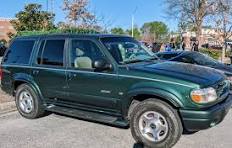
Note: This piece takes place in Spokane, Washington in the fall of 1991, during our senior year at St. George’s School. CDs were still a relatively new luxury item for teenagers, Zip’s runs counted as real excursions across town, and a hunter green Explorer in the school parking lot could serve as the center of an entire small social world.
Epigraph:
Out with the posse on a night run
Girls on the corner, so let’s have some fun
Donald asked one if she was game
Back Alley Sally was her name
She moved on the car and moved fast
On the window pressed her ass
All at once we heard a crash
Donald’s dick had broke the glass
Ice T
Seth drove a green Ford Explorer, which meant two things: he was always the driver, and John Innes almost always called shotgun.
Ours was a class of twenty-eight boys at St. George’s School, which meant the social landscape was less a battlefield than a small archipelago of cliques. Everyone knew everyone, and everyone more or less supported everyone else. Still, there were natural groupings. Seth, Innes, and I spent a good deal of time together, with Kelly sometimes orbiting the car and Richard Barkley frequently around as well.
The Explorer usually lived in the SGS parking lot behind the lower school. During the day it sat there waiting for the moment seniors could leave campus, which we could do whenever we wanted. When that moment came, Seth’s Jeep became a kind of small republic on wheels.
There were rules, or something close to rules. Seth drove. Innes called shotgun. He cared about it the most and therefore usually got it. Occasionally Barkley or I would challenge him, which would inevitably produce an argument about whether the call had been made properly or whether the timing had been unfair. The exact legal framework of shotgun was never fully settled, but the outcomes were usually predictable.
Inside the Explorer there were CDs everywhere. Not in a messy way—Seth kept the car pretty well—but there were dozens of them, probably stored in one of those large CD wallets that seemed to exist in every car in the early nineties. Seth would sometimes come back from Hastings with six or eight discs at a time. I remember watching those purchases with something close to disbelief. I could rarely afford a CD myself, so when I did manage to acquire something like Tindersticks or Billy Bragg’s Spy vs. Spy, it was a very big deal.
The music rotation in the Explorer was remarkably tolerant. Seth tended to favor Judas Priest and Metallica, while Innes leaned toward Ice-T. Joe Tyllia loved Cat Stevens and so Cat Stevens appeared frequently. I personally preferred Dire Straits at the time, which never quite made the regular rotation, so I generally waited for Warren Zevon or Cat Stevens to come back around. Nobody vetoed anyone else’s music. Whatever disc was in play generally stayed there.
The Explorer had a few regular destinations. State B basketball games were one. Another was Zip’s on the north side of town. Seniors could leave campus whenever they liked, and sometimes that meant simply deciding that a run across Spokane for burgers was necessary. Seth’s house was another stop, as was Hastings, where the CD acquisitions occurred.
Occasionally the driving extended further into the South Hill at night. Sometimes we would pass near Manito Park, though I remember doing those wandering drives more often with a slightly different crew—Dyche, Jonah, Karin, and Lisa. Once that group went to a show by They Might Be Giants, and afterward Kelly reported that the band had stiffed the opening act and paid them only ten dollars. Kelly knew this because his cousin was in the opening band.
The one time I ever took shotgun from John Innes without calling it came on the ride home from the state cross-country meet during our senior year. Our team had finished second by a single point, which felt at the time like the most unfair outcome imaginable. James Johnson had been our first runner, Cam Turner second, and I was third.
When we piled into the Explorer for the three-hour drive back to Spokane, I simply grabbed the seat. No call. No discussion. Just took it. And for that ride home I ran the decks.
For a while Seth’s Explorer was simply part of the landscape of our lives. It sat behind the lower school during the day, appeared at the Coleman house west of the South Hill at night, and carried us between games, fast-food runs, music stores, and wherever else we decided to go.
Then, like most small countries of teenage life, it quietly disappeared
Dedication: For my homies.