
Craig Finn on Nightlife and Adult Relationships IV: “Soft in the Center”

Note: This piece will take up “Soft in the Center,” track 2 on Heaven is Whenever (Vagrant Records, 2010) by The Hold Steady. This one will be a little different for a couple of reasons. First, Heaven is Whenever was the first Hold Steady record after the departure of their keyboard player Franz Nicolay, and Nicolay was (and is, because he rejoined in 2016) a huge part of the Hold Steady sound. Therefore, I will look briefly at the personal dynamics of the band, insofar as they’ve been made public. Second, I will take up song order, something I intend to return to in future pieces. Third—and maybe most importantly—I am using this piece to set an intention. A serious one.

Epigraph:

You can’t tell people what they want to hear

If you also want to tell the truth

Craig Finn

I want to be a music writer.

I have always wanted to play music, and I remain fascinated with the role of the frontman or frontwoman. There are so many great ones—Finn, Mick Jagger, Bret Michaels (I really just want to perform “Shelter Me”), Joan Jett, Cherie Currie, and many others. But I am not, at this moment, a songwriter or a singer, and I am still working on understanding songwriting from the inside.

So my goal is simpler and, in some ways, harder: to be the best music writer that I can be.

I don’t think I can be as good as Chuck Klosterman, who is amazing, and I am not really a reviewer. I don’t write reviews; I write analysis. I’m less interested in telling you whether something is good than in understanding what it is doing—how it works, what it reveals, and what it becomes when placed next to a life.

So I’m not competitive with Klosterman, and I’m not competitive with reviewers generally. But I am competitive with myself, and in a narrower sense, I am competitive with myself to be the best Craig Finn analyst around. Finn has, in my opinion, leveled up his songwriting several times across his career, and I want to level up alongside him as a writer.

That’s the goal. Let’s take up “Soft in the Center.”


The Hold Steady’s on and off again keyboardist Franz Nicolay joined The Hold Steady in 2005, after the release of 2004’s Almost Killed MeAlmost Killed Me may be my personal favorite Hold Steady record, but it is also true that the band’s sound took a major step forward with Nicolay. Some of their most iconic songs depend on his presence as much as on Finn’s voice.

There isn’t a great deal of publicly available detail about Nicolay’s departure in 2010. Compared to famously volatile bands—Jane’s Addiction, The Rolling Stones, Galaxie 500—this one seems almost restrained. Finn described it as amicable. Nicolay described it as a “closed book.” Both statements feel composed, even careful, which in itself tells you something about the people involved.

What matters for our purposes is the effect. Without Nicolay, the band’s sound on Heaven is Whenever is leaner. The keys are still there, but diminished, less central, less cinematic. There is more space, and that space exposes Finn a bit more.

For a long time, I misheard this record. I thought the highlights were the obvious ones—“The Weekenders,” “Sweet Part of the City.” Recent listening corrected that. My favorite, by a ways, is “Soft in the Center,” with “Our Whole Lives” in second place. The latter contains the line, “We’re good guys, but we can’t be good all the time,” which could stand as a thesis for much of Finn’s writing.

The fact that I missed both songs initially is not trivial. It suggests that some of Finn’s best work doesn’t announce itself immediately. It waits.


Which brings us to song order.

“Soft in the Center” is, to my ear, the best song on the record and one of its most immediate. I tend to favor leading with your strongest statement, and I think there’s a case that it should have opened the album. There is a long tradition of bands doing exactly that—“Janie Jones” by The Clash, “Teenage Riot” by Sonic Youth, “Rocks Off” by The Rolling Stones. These are not just songs; they are openings that define tone and intent.

Finn has acknowledged that “Soft in the Center” has a certain built-in audience response, particularly around its chorus. He can feel when a line is going to land, when a certain type of listener is going to raise a fist. That’s not calculation so much as familiarity—he understands the emotional economy of his audience because he helped build it.


The song itself unfolds as a conversation, and more specifically, as advice. It is an older voice speaking to a younger one. In that sense, it mirrors earlier Hold Steady material like “Killer Parties,” but from the opposite side. In those earlier songs, Finn is inside the chaos, narrating in real time. Here, he stands outside it, looking back, trying—gently, imperfectly—to intervene.

The opening image is stark: a young man leaving a hospital, returning to a city that has not changed. The implication is clear without being over-explained. Something went wrong—an overdose, an accident, a night that tipped too far. And yet the conditions that produced that moment are all still in place. The city remains. The temptations remain. The system resets.

Finn’s great line—“You can’t tell people what they want to hear / if you also want to tell the truth”—lands here as a kind of thesis. It is a statement about songwriting, but also about mentorship, about friendship, about any attempt to guide someone who is not yet ready to be guided. The truth, in Finn’s world, is rarely what anyone wants to hear in the moment.

When he follows it with a direct address—“I’m just trying to tell the truth, kid”—the dynamic becomes explicit. He is the older figure now. Not removed, not sanctimonious, but positioned. He has been through something. He has survived something. And survival, in Finn’s writing, tends to confer not authority exactly, but a certain obligation to speak.


The chorus distills the advice into something almost disarmingly simple: you can’t have everything; you learn to love what you have. Finn himself has noted that he knows lines like this will hit. They scan as universal, almost cliché at first glance. But in context, they are not glib. They are corrective. They push back against a younger worldview built on accumulation—of experiences, of people, of intensity.

This is one of Finn’s recurring moves: to take a sentiment that could sound obvious and place it in a context that makes it necessary.


The second verse introduces the song’s central metaphor: the frozen lake. Finn, being from Minnesota, grounds it in lived experience—“a place with lots of lakes”—but the image does more than local color. It becomes diagnostic.

On the surface, everything looks stable. Solid. Safe. But “sometimes they get soft in the center,” and that center is “a dangerous place.”

This is the song’s title, and its key. The “center” here is not just the literal middle of the lake; it is the middle of the action, the heart of the scene, the dead center of the city, the place where things feel most alive. It is also the place where the structure is weakest. The danger is not at the edges, where you might expect it, but at the point of maximum immersion.

That is a sophisticated inversion, and it maps cleanly onto the nightlife world Finn has chronicled for years from his albums with his first bands Lifter Puller through to today. The parties, the drugs, the endless nights—they are not dangerous because they are marginal. They are dangerous because they are central, because they feel like the point.

Finn frames the young man’s situation with unusual generosity: “you can probably do anything, if you can get yourself right.” This is not moralizing. It is not even particularly prescriptive. It is conditional. The possibility is there, but it depends on an internal realignment that the speaker cannot perform for the listener.

There is also, quietly, autobiography here. Finn writes in the great song “Most People Are DJs” about his own youthful excess—“I was a Twin Cities trash bin/ I’d jam it all into my system”—and the process of pulling back from that edge. What matters is not just that he got himself right, but that he remembers what it was like not to be.


From there, the song largely reiterates its central ideas, but with increasing insistence. The chorus returns. The advice is repeated. And then comes the bridge: “I know what you’re going through / I had to go through that too.”

This is where the song earns its authority. Not in the cleverness of its lines, or even in the sharpness of its metaphors, but in its identification. Finn is not speaking from above. He is speaking from experience. The distance between the older voice and the younger listener is real, but it is not absolute.

And yet—and this is crucial—that identification does not guarantee transmission. The younger figure may still ignore the advice. He may return to the city, to the center, to the unsafe ice. Finn knows this. The song does not resolve that tension. It simply articulates it.


What makes “Soft in the Center” so effective is its clarity. Finn is not being coy about the theme. He is saying, in essence: the action is real, the lights are bright, and the pull is powerful. You will want to stay in it as long as you can. But there are costs. There are limits. There is time.

You age. You win and lose people. You push your system until it pushes back. You end up in rooms—hospitals, apartments, empty bars—where the energy has drained out and something quieter, and less negotiable, remains.

“Take your time,” the song seems to say, but also: think it through.

That balance—between permission and warning, between empathy and clarity—is where Finn’s later songwriting lives. It is a long way from the breathless immediacy of Lifter Puller, but it is not a rejection of it. It is a reframing. The same world, seen from a different distance.

“Soft in the Center” is, to my ear, the best song on Heaven is Whenever and one of the strongest in Finn’s catalog. It is direct without being simplistic, reflective without losing momentum, generous without losing edge.

Simply marvelous.

Note: If you enjoyed this piece, you may also like the pieces below which also deal with the songs of Craig Finn.

On the Song Prince Hal’s Dirge: Confidence, Reformation, and the Politics of Self-Making

Note: This short essay takes Loudon Wainwright III’s song “Prince Hal’s Dirge” as a lens through which to revisit Shakespeare’s Prince Hal in Henry IV, focusing on the idea of self-fashioning across time. It reads Hal’s apparent debauchery and later reform not simply as moral transformation, but as a theory of confidence—either consciously staged, in Shakespeare’s version, or more instinctively internalized in Wainwright’s. Moving between text and song, the piece explores how both versions hinge on the same underlying question: what kind of inner structure allows a self to pass through disorder, delay, and social misreading without collapsing, and to reconstitute itself as effective action when the moment arrives.

Epigraph:

Take me to the ale house
Take me to the whorehouse.
If I vomit, keep me off of my back.

Loudon Wainwright

This piece takes as its source the song “Prince Hal’s Dirge” by Loudon Wainwright III, itself based on Shakespeare’s character Prince Hal from Henry IV. The figure of Hal is one of Shakespeare’s most carefully constructed political selves: a young man who deliberately inhabits disorder in order to make his eventual reformation into kingship appear all the more legitimate, even necessary.

In Henry IV, Hal openly announces this strategy to Falstaff and the other tavern companions:

I know you all, and will awhile uphold
The unyoked humor of your idleness.
Yet herein will I imitate the sun,
Who doth permit the base contagious clouds
To smother up his beauty from the world,
That, when he please again to be himself,
Being wanted, he may be more wondered at
By breaking through the foul and ugly mists
Of vapors that did seem to strangle him.

And again:

So when this loose behavior I throw off
And pay the debt I never promised,
By how much better that my word I am,
By so much shall I falsify men’s hopes;
And, like bright metal on a sullen ground,
My reformation, glitt’ring o’er my fault,
Shall show more goodly and attract more eyes
Than that which hath no foil to set it off.
I’ll so offend to make offense a skill,
Redeeming time when men think least I will.

Hal’s logic is explicit: he will cultivate disorder as a kind of aesthetic and political foil. His apparent immersion in low company is not failure but strategy. Falstaff and the tavern world become, in effect, instruments in the staging of legitimacy.

Paraphrased, Hal is saying: I will live among you for a time, but only in order to abandon you later in a way that maximizes my transformation into kingship. He is a political animal who understands reputation as something staged across time.

Loudon Wainwright III’s “Prince Hal’s Dirge” takes up this same figure, but shifts the emphasis in a revealing way. Wainwright—still best known to many for novelty songs like “Dead Skunk,” though his broader body of work is far more substantial—reimagines Hal less as calculating strategist and more as self-contained performer of confidence within disorder.

The song opens in full immersion in debauchery:

Give me a capon
And some roguish companion,
A wench and a bottle of sack.
Take me to the ale house
Take me to the whorehouse.
If I vomit, keep me off of my back.

Here Hal is not yet strategy, but appetite. The political mask is absent; what remains is the world of consumption, drink, sex, and collapse.

But Wainwright then pivots:

My father, he thinks I’m a good for nothing
that I won’t amount to much.
But he’s not aware of my secret weapon.
I can count on myself in the clutch.

This is the key transformation. Shakespeare’s Hal is self-consciously future-oriented: he plans his reformation as spectacle. Wainwright’s Hal, by contrast, carries an interiorized assurance that he will simply “come through.” The emphasis shifts from calculation to instinctive resilience.

This continues in the song’s martial register:

Show me a breach,
I’ll once more unto it.
I’ll be ready for action any day.
I’ll straighten up, and fly most righteous.
In a fracas, I’ll be right in the fray.
I can drink you under twenty-five tables,
Fight and be a ladies man.
But all this will change,
When I’m good and ready,
To become the king of this land.

The phrase “any day” is doing important work here. It carries the rhetoric of readiness without commitment to timing. It suggests immediacy while quietly deferring it indefinitely. The transformation is always available, never enacted.

What emerges is a different psychological structure from Shakespeare’s original. Shakespeare gives us a political actor who consciously engineers perception over time. Wainwright gives us a man who believes in a durable inner core of competence—someone who can be disordered without being undone.

And yet both versions converge on the same underlying mechanism: confidence as political force. Whether staged (Shakespeare) or internalized (Wainwright), Hal’s power rests on the belief that identity can survive its own contradictions and ultimately reorganize them into legitimacy.

Singing “Prince Hal’s Dirge” before work, I find myself struck less by the irony of Hal’s transformation than by the necessity of something like an unbreakable interior core—something sealed enough to survive fluctuation, failure, and delay, but still flexible enough to return to action when required.

That, ultimately, is what both Shakespeare and Wainwright are circling: not morality, not reform, but the strange political psychology of self-belief under time pressure.

Dedication:

For my father, the biggest Shakespeare lover I know.

Note: If you liked this piece, you may also like the pieces below which also take up various literary works.

Scenes from Hamilton College II: Freshman Year Continued (with cameos from Honey, the Print Shop, and Billy Bragg)

Note: In Part I of this series I wrote about my freshman year at Hamilton, focusing on two friends, Ian and Jake. Part II will branch out and cover a fairly wide, and somewhat random, set of memories.

Epigraph:

I had an uncle who once played for Red Star Belgrade
He said some things are really best left unspoken
But I prefer it all to be out in the open

Billy Bragg

I have already written quite a bit about the characters who lived in the North Dorm freshman year at Hamilton, however there are a few more to cover. First were the first floor stoners. Basmo was a stoner, and he lived on my side of the dorm, but on the other side of the first floor lived the hardcore stoners. This consisted of a quad of guys whose names I don’t totally recall, but one was Peter Kimber, and who got baked at all waking hours and played Roger Waters’ Amused to Death solo on repeat. Next to them, in a double I believe, lived Keys. Keys’ actual name was Caleb, but everyone called him Keys because of the six to eight keys he had dangling from around his neck at all times. What on earth did he need all those keys for? One for the dorm, maybe one for a car (although he should not have been driving at all because he was the single biggest stoner in the dorm and perhaps on campus), what else? I can’t imagine.

Keys and I were not that close, but I did see a lot of him because we had the same job, which was in the school print shop. I don’t know if print shops still exist in the same form in this digital age, but back then the print shop was busy as. We held the campus down. There were two slightly older women who worked at the print shop full-time and three of us students helping out. The full-timers were Sally and Deb. Deb was the boss, and she was kind of motherly and kind to the students. Sally was nice too, but she could be tough. She would bark at us when we made mistakes, which was often because we were running large machines that would glitch pretty frequently. Sally was both the little sister to Deb and also the enforcer. I liked them both, even though Deb ended up firing me, which I’ll get to later.

So Keys would come in lit every day and sort of fumble through his work, which consisted mostly of stapling and collating. I was trusted more than Keys, with good reason, so I ran the machines, but I also did stapling and collating. We printed things for professors, menus for the dining halls, the school newsletter, and a bunch of other stuff. The third student was a girl whose name I don’t recall, and she was a super-hardcore feminist. Everything in the world that was wrong was men’s fault, and it was her only topic. She didn’t seem to dislike me so much as just want to lecture Keys and I all through work, which usually lasted two to three hours in the afternoon, about the ills of men. I was, and am, up for a little feminist theory but Keys was no help and I don’t even think he noticed her, so it was kind of just me and her. Serious feminism and collating are, perhaps, not best paired.

I didn’t originally want the print shop job. I needed work, and there was kind of an intake for all working students where you put your first choice. I put library, but didn’t get the gig. John Innes put audio/video and he got it, which meant he often had to get up early to set up videos for professor’s classes. I would not have been good at that. The print shop was more my speed, but eventually it got really repetitive and I started skipping work more and more. I would go walk in the woods behind campus, or just drink coffee with about a half cup of honey and hang around after class. I also improved as a student through the year, and took my English classes pretty seriously so I was spending more time in the library, although still not sleeping much.

My money situation was tight, although not as bad as it would later be during my junior year abroad in New Zealand where it was super tight. I had a little income from the print shop and my parents sent a small allowance once in a while, but I usually didn’t have more than about 15 bucks in my pocket at any one time. What money I did have went mostly to CDs, as many as I could afford. I had a dining hall pass, but the dining hall food was not really my style so I mostly lived on toast and coffee with honey. Then at night people would order pizza from a local shop, but that was too expensive for me so I would get “friend dough.” Fried dough is just what it sounds like–deep friend pizza dough with powdered sugar, and it cost about $1.50 for a big box. Not the best diet, but it was what I could afford.

One time the father of one of my classmates from high school visited for some reason; he must have been in the area. We met for lunch, and when he left he handed me $100 bucks. This was a serious windfall, and I immediately blew it on CDs, perhaps Neil Young’s Harvest Moon and others. My CD collection, although no rival to Ian’s was slowly increasing and I liked it.

Back in the dorm, in addition to the guys I have discussed, there were also girls, who lived on the second and fourth floor. I got to know the girls directly above us on the second floor pretty well, although not many of the others in the dorm. Among these was Rochelle, who was the girl I was closest to. Rochelle was, I think, from New York, and when she arrived on campus she made a big deal about having a boyfriend. This didn’t last long however, and although I didn’t want her to be my girlfriend I did like hanging out with her. She kind of mothered me a bit though, which I wasn’t so into, because I was going to do what I was going to do. I still have her contact, and I believe she might even read this piece! I think I also met Marie Bishko freshman year, and Marie is someone I thought was really cool.

I don’t really remember any us North guys hooking up with the second floor girls, but it must of happened. Another incident which occurred around this time had to do with my roommate B. and his girlfriend from high school. Like Rochelle, and even more so, he made a big deal of his girlfriend and told us all kind of semi-salacious details. Then one day he told us she was coming to visit and he wanted the three of us in the quad to go to a hotel for a night. I told him sure, if you pay, but he said no. He was dead serious but we told him to forget it, so sure enough she arrived and they hooked up while we all pretended to sleep. That only happened once, thankfully, and it still strikes me as pretty odd. He later broke up with her and fell in love with a Jewish girl, but that didn’t last either because he wasn’t Jewish.

I mentioned in Part I that Jake pledged the fraternity Sig. Ian and John Slack also pledged, Chi Psi (I had to Google the spelling). I spent some time at Chi Psi as well as, where I was alleged to sit on the steps in my trench coat, but I preferred Sig. There was another frat called Deke, and that was where the wildest, and the worst parties were. At Deke there was copious amounts of Milwaukee’s Best (the fabled Beast) and jungle juice. The parties were terrible, but there was a pool table which was a bonus. I didn’t drink much at college, mostly because I had no money, but I did drink some at Deke, with exactly the results you would imagine. I believe it was at Deke where Marc Campbell pulled off his famous pacification move. I didn’t pledge a frat, and I was and remain glad I didn’t. Greek life wasn’t for me.

One guy who I believe lived in North was called Gabe. Gabe was super popular at first in freshman year, and he played guitar on the grass outside the dorm. He was pretty good and he would play “Sexuality” by Billy Bragg which was surprisingly popular in 1992. People, including girls, would flock around him, but over time something seemed to happen to Gabe. He ran for class president and lost to a guy called Kerry who was African American. Kerry lived down the hill in a different part of campus, and he ran really hard for the job. I think Gabe’s ran mostly on a music ticket, and although he got a lot of votes I think he came in second. He may have taken this hard, because he kind of faded into the background, or maybe he just changed up his action. I think I voted, but may have voted for Kerry.

As I mentioned, Jake and I saw less of one another once he started pledging, however we still saw each other in English class and in the English building. We overlapped professors, although he knew some I did not. The two best professors in the English department were George Balkhe and Fred Wagner. Balkhe was still in his prime, maybe late 50’s, whereas Wagner was older and I believe in a semi-emeritus role. I wasn’t even sure I ever took a class from Wagner, but it’s been confirmed that I did, Modern British and American Drama, which makes sense. I didn’t much like 20th century American plays, as plays are mostly blueprints anyway. In any case, Mr. Wagner knew me early in the year because Balkhe praised my reading knowledge to him. Jake and I would go to Wagner’s house, also down the hill toward the town of Clinton (the closest town to Hamilton, about a 15 minute walk), and I recall once we played him the song “Marlene Dietrich’s Favorite Poem” by Peter Murphy, formerly of Bauhaus, with Peter Murphy murmuring “sad-eyed pearl and drop lips…”

Peter Murphy is super underrated by the way, and Wagner liked the song, which just showed how cool he was.

I took a few classes with Balkhe, and we studied poems, and novels–typical choices mostly. I enjoyed these and read most of them, even Faulkner who is really dense. For the ones I didn’t I just faked it. Like I said, Balkhe thought I was amazing because on the first day of class he asked for a list of books we had read and I listed like 200. These were mostly Agatha Christie and John LeCarre and such, but I guess it was good enough. Balhke liked the singer Donovan and the song “Mellow Yellow.”

Electrical banana
Is gonna be a sudden craze

(I later saw Donovan at a new age convention in Boston when I was visiting Ian after college, which I will recount later).

Wagner and Balkhe are both passed away now, so rest in peace to two great English teachers and mentors.

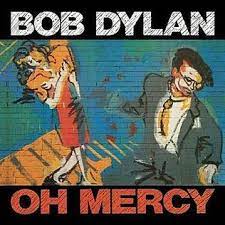
That’s about all I have on freshman year. The last thing is about the featured image for this post, which is the album cover for Bob Dylan’s Oh Mercy. I have written about The Pogues quite a bit, but the album I listened to most freshman year was Oh Mercy. After geology class had a break before lunch and would go back and semi-sleep to Oh Mercy. The quad was always empty at that time of day, and this was the best rest I would get. The album still makes me sleepy to this day, and features excellent production from the famed producer Daniel Lanois. So thank you Bob and Daniel.

Dedication: For Fred. And for George–I hope you are enjoying a little electrical banana up there in heaven.

to be continued…