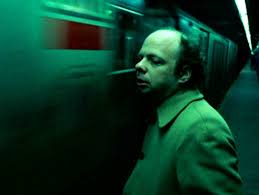
Note: Opening a multi-part early series from my first blog Classical Sympathies back in 2009, this piece takes up the beginning of Wallace Shawn’s walk through New York en route to his meeting with André Gregory in My Dinner with Andre, using Wally’s voice-over as a lens on artistic precarity, everyday survival, and the comic disproportion between existential weight and mundane errands. The note situates the film’s opening movement as both narrative setup and philosophical framing: a winter city of post offices, xerox shops, and unanswered calls becomes the psychological prelude to a conversation that will later expand into memory, performance, and self-mythology. This installment follows Wally up to his arrival at the restaurant for the pre-dinner drink, where the film’s central encounter is still suspended in anticipation, and meaning is generated less by action than by the act of getting there.
My Dinner with Andre is the famous, or infamous, 1981 film of a dinner conversation between Wallace Shawn, the actor and playwright, and Andre Gregory, the theater director. If I were to make a twofold claim for the film: i) that it is one of the most action packed films ever made, and ii) that it effectively encapsulates the thematics of the entire 20th century, I do not think this would be overstatement. My intent here, however, is not to establish either of these postulates, but rather to simply “blog” the script in the hopes that what needs to be said works its way to the surface. Fair warning: the undertaking will require several posts.
Money crops up on two of the first three pages of the script, and because money, and the lack of it, is a theme that runs beneath the entire script: Andre has money, has the freedom to travel and to spend several years trying to “find himself”; Wally does not. Still, “having money” is, as ever, a relative concept. At the opening of the film, Wally is seen walking through the streets of New York, heading for the restaurant where he is to meet Andre. It appears to be winter, maybe February. In the opening voice-over, Wally ruminates on the life of the artist: The life of a playwright is tough. It’s not easy, as some people seem to think. You work hard writing plays, and nobody puts them on. You take up other lines of work to try to make a living–acting, in my case–and people don’t hire you. So you spend your days crossing the city back and forth doing the errands of your trade. Today wasn’t any easier than any other day. I’d had to be up by ten to make some important phone calls, then I’d gone to the stationary store to buy envelopes, and then to the xerox shop. There were dozens of things to do. By five o’clock I’d finally made it to the post office and mailed off several copies of my plays, meanwhile checking constantly with my answering service to see if my agent had called with any acting work. In the morning, the mailbox had been stuffed with bills. What was I supposed to do? How was I supposed to pay them? After all, I was doing my best (17).
One of the marvelous things about the film is the tongue-in-cheek humor that is rarely, if ever, directly alluded to. A deeply serious film, Andre is also a comedy, a fact which we can recognize because we see that the writers are having fun with the characters who are in turn themselves. That is, Wally and Andre are playing versions of themselves–we assume that most of the experiences that Andre recounts in the film are based on real experiences, and that Wally’s account of his home life is more or less true to life–but exaggerated versions. As Shawn says in the preface to the script, “I knew immediately that {…} I’d have to distort us both slightly–our conflicts would have to become sharpened–we’d have to become–well–characters {…} It would be an enormously elaborate piece of construction” (14). In this initial passage, the humor lies in Wally’s conception of a difficult life: “I’d had to be up by ten to make some important phone calls.”
Wally’s sense of pressure is, from the outset, deliberately out of proportion to the scale of his circumstances. The tone is one of genuine complaint, but the complaint itself is almost comically domestic: the architecture of a “hard day” is built out of errands, envelopes, xerox shops, and an answering service that may or may not contain salvation in the form of an acting job. What Shawn achieves here, and what the film quietly sustains, is a recalibration of seriousness—where existential weight is not attached to grand events but to the texture of administrative survival. Wally’s New York is not a place of romance or revelation, but of circulation: between post office, mailbox, and telephone, as though modern artistic life has been reduced to a loop of deferred contact with recognition.
At the same time, the humor is never fully separable from sincerity. Wally is not merely being mocked; he is also articulating a recognisable condition of artistic precarity, one that the film refuses to glamorize. The genius of the opening monologue lies in this double register: we are invited to laugh at the disproportion between emotional tone and material fact, but we are also made to recognise how easily that disproportion becomes a lived reality. The “dozens of things to do” are not nothing; they are just insufficiently legible as crisis, which is precisely what makes them feel like crisis.
By the time Wally finally moves through the city toward the restaurant, the structure of the film has already been quietly established: this is a world in which meaning is not delivered through events but through the way events are narrated to oneself while walking between obligations. New York, in this sense, is not a backdrop but a medium of self-composition—an environment in which thought is constantly being assembled under mild pressure, as though consciousness itself were an errand.
He checks the time again, as he has been doing throughout the afternoon, and adjusts his route slightly, not out of urgency so much as orientation. The meeting with André already exists in his mind as something slightly unreal, a fixed appointment that has not yet been granted substance by arrival. He crosses another block, passes into the thinning evening light, and begins to approach the restaurant where, for the first time that day, the structure of waiting will shift from solitary to shared.
to be continued…