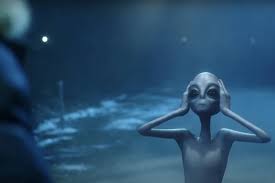
Note: This essay is written in the spirit of amused inquiry rather than firm conclusion. Human history is filled with reports of strange visions, unexplained lights, divine visitations, and unidentified aerial phenomena. The interpretation of such experiences has tended to shift with the cultural vocabulary of the time. Medieval Europeans often described encounters with saints or angels. In the twentieth century the language of extraterrestrials became available.
The psychologist Carl Jung famously suggested that UFO sightings may function partly as modern mythologies—symbolic attempts by societies to understand mysterious experiences in technological terms. Jung also observed, with characteristic dry humor, that UFOs often appear to be “somehow not photogenic.”
The present investigation was prompted by my brother Mike, who recently asserted via text message that extraterrestrials are currently residing in Earth’s oceans. His wife Coleen agreed. “They are everywhere,” she said. While this claim remains unverified, the oceans themselves are vast, poorly explored, and capable of sustaining a wide range of speculative hypotheses.
The purpose of the essay is therefore not to prove or disprove the existence of extraterrestrial life in the ocean. Rather, it is to examine why such ideas persist, how they resemble earlier historical visions—from medieval religious phenomena to modern UFO culture—and why the possibility continues to feel strangely plausible to otherwise reasonable adults.
Epigraph
There are aliens in our midst.
Wussy
The Jung Problem
At this point in the investigation one is reminded of a dry observation by the Swiss psychiatrist Carl Jung.
Jung noted that UFOs possess a curious property: they are “somehow not photogenic.” Sightings multiply, witnesses speak with conviction, yet the documentation remains just slightly blurry.
Jung’s larger argument was that such phenomena often behave like modern myths. They appear at moments when societies are under stress, technological change is accelerating, and people are searching for new symbolic explanations of the world.
In other words, the sky fills with things.
Medieval Precedents
This pattern is not entirely new.
During certain periods of medieval Europe, particularly when grain supplies were contaminated by the fungus ergot, communities reported vivid religious visions: glowing figures in the sky, saints appearing in fields, the Virgin Mary materializing in unexpected places.
Ergot poisoning, now understood scientifically, can produce powerful hallucinations. But to the people experiencing them the visions were not chemical side effects. They were divine manifestations.
Entire crowds could witness miraculous shapes in the heavens or detect holy images in the crust of bread. A modern observer might diagnose environmental intoxication or collective suggestion. The participants experienced revelation.
The important point is that the content of the vision reflected the cultural vocabulary available at the time.
Medieval Europe saw saints. Modern America sees aliens.
One can see this dynamic clearly in the case of Joan of Arc. Joan reported hearing voices and receiving instructions from heavenly figures whom she identified as saints.
Historians generally accept that Joan sincerely believed these visions were divine communications.
But it is difficult not to notice that saints were the most advanced category of non-human intelligence available in fifteenth-century France. The conceptual vocabulary for extraterrestrials would not be invented for several hundred years.
Had Joan lived in the late twentieth century, it is at least possible that the same experience might have been interpreted somewhat differently.
She might have reported a craft.
The Cold War Sky
By the late 1940s the heavens had acquired a new cast of characters.
The famous incident near Roswell occurred in 1947, just as the Cold War was beginning to reorganize the world’s imagination. Reports of flying saucers multiplied. The mysterious visitors were described with increasing consistency: small grey beings with large heads and enormous eyes.
The explanation most often offered by the authorities was considerably less glamorous.
Weather balloons.
Strange objects falling from the sky during the early Cold War often turned out to be classified surveillance equipment. Unfortunately, the phrase “weather balloon” never fully satisfied the public imagination.
Aliens, after all, are much more interesting than meteorology.
The Mulder Doctrine
By the 1990s the entire mythology had been carefully systematized by American television.
The X-Files:
In the series, FBI agent Fox Mulder dedicates his career to investigating extraterrestrial activity after his sister Samantha is abducted from their home during childhood.
The abduction occurs at night. A strange light fills the room. The sister disappears.
Mulder spends the rest of his life attempting to prove that what he witnessed was real.
His partner, Dana Scully, is assigned to bring scientific skepticism to the enterprise. Their relationship gradually becomes one of the most beloved partnerships in television history, built on the productive tension between belief and doubt.
Entire generations of viewers absorbed the idea that somewhere in the sky—or possibly beneath the ocean—extraterrestrial activity might be quietly unfolding.
A Modern Lens
Seen from a slightly greater distance, the pattern begins to look familiar.
Medieval villagers saw saints because saints were the explanatory language available to them. Cold War Americans saw aliens because aliens had become the new vocabulary of the unknown.
Both phenomena may reflect the same basic human impulse: when confronted with mysterious experiences, we populate the heavens with the most compelling figures our culture provides.
Which brings us back to Mike.
So Are There Aliens In Our Oceans?
It must be admitted that if an advanced civilization from another planet wished to observe humanity without attracting attention, the deep ocean would offer several practical advantages. The environment is dark, difficult to access, and rarely visited by surface-dwelling primates equipped with submarines that can only remain operational for limited periods of time.
From a strategic standpoint, it would be an excellent hiding place.
This possibility has occurred to more than one observer, including my friend Mason, who recently suggested that a technologically sophisticated off-world civilization might simply have decided that the bottom of the ocean was the most convenient place to avoid the rest of us.
Provisional Conclusions
My brother Mike believes there are aliens in the ocean.
Carl Jung might have suggested that mysterious phenomena often adopt the symbolic clothing of their era. The Middle Ages had saints. The twentieth century produced extraterrestrials.
Mike has simply moved the story offshore.
The oceans remain vast and poorly explored. The woods remain dark and occasionally unsettling at night. Both environments have the correct atmospheric conditions for unexpected encounters.
If extraterrestrials are present, they may well prefer the sea.
But it would be a mistake to rule out the woods.
In either case, it seems wise to remain polite.
Footnote: The Ocean Logic
It must be admitted that if extraterrestrials wished to establish a long-term observational presence on Earth, the ocean would offer several advantages. Humans rarely visit the deep sea, and when we do we tend to leave fairly quickly due to crushing pressure, darkness, and the general inconvenience of breathing water.
From the perspective of an advanced extraterrestrial civilization attempting to avoid unnecessary interaction with our species, the ocean may therefore represent the single most sensible real estate on the planet.
Mike may, in other words, be thinking strategically.
POSTSCRIPT: Supplemental Testimony
Shortly after the investigation began, the primary witness—my brother Mike—provided additional clarification regarding his position.
According to Mike, extraterrestrial life has not only visited Earth’s oceans but has been present there for a considerable period of time. The aliens, he explained, appear to prefer the environment and have constructed bases beneath the sea.
When asked for supporting evidence, Mike cited the well-known Navy pilot videos showing unidentified aerial objects performing unusual maneuvers.
These videos—often referred to as the “Tic Tac” incidents—have circulated widely in recent years and are frequently interpreted as evidence of advanced technology of unknown origin.
Mike considers them decisive.
A second observer, his wife Colleen, agreed with this general assessment while expanding the hypothesis somewhat.
In her view, extraterrestrials may not be confined to the ocean at all. Rather, they may be present around us at all times.
According to Colleen, it is entirely possible that aliens walk among us.
At this stage of the investigation, these claims remain under review.
Dedication: For my brother Mike. I love you bro, but I still thinks them shits are in the woods.
Note: If you liked this piece, you may also like the pieces below, which also discuss the famous psychologist Carl Jung.