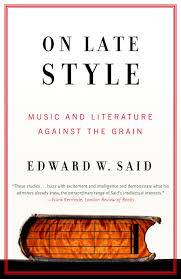
Note: This piece takes up On Late Style, the posthumously published and deliberately unfinished work by Edward Said on what he, following Theodor Adorno, calls “lateness”—not serenity or resolution at the end of a career, but tension, contradiction, and a refusal to reconcile. It’s a short book that opens out into large questions, and this will be less a full treatment than an attempt to think alongside it, particularly around the strange fact that a book about unresolvedness arrives in a form that is itself, in some essential way, unresolved.
Edward Said’s On Late Style is as rich a book as an unfinished work can be. Published posthumously, On Late Style expands on Theodor Adorno’s concept of “late works.” Late works are works with fall toward the end of an artist’s career, but not those like The Winter’s Tale or The Tempest which “reflect a special maturity, a new spirit of reconciliation and serenity often expressed in terms of a miraculous transfiguration of common reality” (6), but those like Beethoven’s Missa Solemnis or Lampedusa’s The Leopard–works which, in Adorno’s words are “devoid of sweetness, bitter and spiny, they do not surrender themselves to mere delectation,” or, in Said’s phrasing, are “uncoopted by a higher synthesis: they do not fit any scheme, and they cannot be reconciled or resolved” (12).
Said died in September 2003, before On Late Style was completed. In the foreward, his wife, Miriam writes of how Said was planning to get to work and get it done: “{In late August} he said to me as we were having breakfast that morning, ‘Today I will write the acknowledgments and preface to Humanism and Democratic Criticism {…} The introduction to From Oslo to Iraq and the Road Map I’ll finish by Sunday. And next week I’ll concentrate on completing On Late Style, which will be finished by December” (vii). He didn’t make it, and the little quote is a moving reminder that we never know how much time we have left. But Michael Wood, who arranged the various fragments Said had written on the topic of late style into this nearly seamless finished product, says that he doesn’t believe that Said ever wanted to finish the book: “Or rather, he wanted to finish it but was waiting for a time that would perhaps never have come. There would have been a time for this book about untimeliness, but this time was always: not quite yet” (xvi-xvii).
What does Adorno, and Said, mean by “late style,” and why would Said perhaps have not wanted to finish his work on this topic? Again, to understand what the term means we need to understand that late style is not simply synonomous with work accomplished late in life. Wood puts it this way, the “type of lateness {that Said was interested in} is quite different {…} from the unearthly serenity we find in the last works of Sophocles and Shakespeare. Oedipus at Colonus, The Tempest, and The Winter Tale are late enough in their way, but they have settled their quarrel with time” (xiii). In other words, these works are transcendent yet resigned–the author, knowing perhaps that death is coming to claim them, moves to preempt death by surrendering his grasp on reality and moving in the direction of a “higher synthesis,” and in the process attaining “a remarkable holiness and sense of resolution” (6). Said has nothing against such works at peace with themselves and with time, but these are not his subject. Lateness here seems to take its raison d’etre from Dylan Thomas; it rages against the dying of the light. As Said puts it, “Late style is what happens if art does not abdicate its rights in favor of reality” (9) and is “a form of exile” (8).
But if late style finds its power in a righteous rage against resignation, senescence, and serenity, it is at the same time complicit with disintegration and ultimately with death. In other words, an artist can embrace lateness in Said’s conception of the term, but can never be quit of it. Said writes: “For Adorno, lateness is the idea of surviving beyond what is acceptable and normal; in addition, lateness includes the idea that one cannot really go beyond lateness at all, cannot transcend or lift oneself out of lateness, but can only deepen the lateness” (13). Here, we understand why it was the Said, though he worked on the idea of lateness for over a decade, was not able to finish off what at only 160 pages is still a relatively slight work–only death itself can put a period on lateness. Wood writes: “for all his deep interest in lateness {…} Said was not attracted by the idea of a late, dissolving self. {…} Said wanted to continue with the self’s making, and if we divide a life into early middle, and late periods, he was still in the middle when he died at the age of sixty-seven {…} Still a little too early, I think he would have said, for real lateness” (xviii).
Another reason why On Late Style cannot exactly be classified as a “late” work is the urbane depth of its learning and its lightness of touch. Though deeply serious, Said in On Late Style wears his learning lightly, as only a true elitist can. For the fact is that despite its topic the book is oddly comforting; I can open it to any page in the moments before sleep and feel a rush of almost narcotic satisfaction and harmony. This effect is obtained not because Said takes an oppositional stance to his topic but because the extent of his learning is so colossal that it seems to achieve “a remarkable holiness and sense of resolution” based on its own gravitational force, even though acting in opposition to Said’s own thesis.
Thus, although we have only begun to scratch the surface of what Said has to say about lateness, it is already clear that while the relation between late style and classicism must for the moment remain unresolved, On Late Style as a text is a deeply classical enterprise, and this classicism is rooted in the remarkable range and depth of Said’s mind. Wood reminds us that being in opposition need not always mean manning the barricades–and this at least sets up the question raised in an earlier post about the ability of leftism and classicism to co-exist: “It is part of the generosity of Said’s critical imagination that he sees ‘amusement’ as a form of resistance. He can do this because amusement, like pleasure and privacy, does not require reconciliation with a status quo or a dominant regime” (xiv).
So perhaps On Late Style is complete in the only way a book about lateness can be. It circles, it deepens, it resists arriving. Edward Said writes against resolution, and the book quietly enacts that refusal, never quite allowing itself the satisfaction of a final statement. There is something fitting in this. Lateness, as he and Theodor Adorno understand it, is not a stage one passes through and exits, but a condition one can only move further into. Said, still “in the middle” by his own reckoning, never closed the circle. And so the book remains open—not unfinished in the sense of lacking something, but unfinished because its subject will not permit an end.

