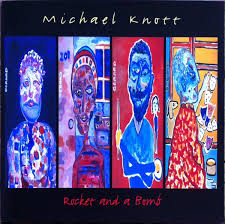
“Mr. God, is there a Mrs. God?
Michael Knott
Origin Story
I found Rocket and a Bomb the way you sometimes meet the most important things in your life: by accident, with no money, in a used bin on Division in Spokane, during a summer when nothing was happening and I had no idea who I was supposed to become.
It was 1994, the summer before junior year. I wasn’t working — not out of rebellion or laziness, but because I somehow never got pushed into getting a job. My parents were juggling one car between them, sometimes borrowing a second from St. George’s, and when that second car was free, I took it and drifted through Spokane.
I had a circuit — three places I visited almost every day, like a loop I barely knew I was running.
1. A random coffee shop off Division
They knew me as the quiet kid who ordered the same thing, sat alone, and had a half-crush on the barista for reasons I couldn’t articulate even then. I wasn’t flirting. I was just alive in her direction. It gave the day a shape.
2. A used bookstore in North Spokane
Le Carré, Christie, metaphysics, philosophy, sci-fi, old paperbacks with cracked spines. Books were two to five dollars, and the older woman behind the counter would chat with me as if I were a real adult. I was still in my 150-books-a-year phase. It felt like productivity disguised as escape — or maybe escape disguised as productivity.
3. A used CD store up Division
All used, because I was broke. Rows of mid-’90s detritus: dozens of copies of August and Everything After, inexplicable imports, promo discs dumped by radio stations. I’d flip through crates like a prospector searching for gold in a river everyone else had given up on.
And one day I found something.
I pulled a CD I’d never heard of: Rocket and a Bomb by Michael Knott. The cover art — drawn by Knott — was strange and specific. The title was perfect. And for reasons I couldn’t explain, the whole thing felt special. Buried treasure. A private signal.
It was used. It was cheap. It felt like it had been waiting for me. I took it home, slid it into my boombox, and played it straight through. And something opened. Not revelation. Not identity. Not insight. Pure recognition.
The recognition that someone, somewhere, had lived inside a hallway-world that felt eerily close to my own. That someone understood the drift, the observation, the stasis, the human weirdness. This essay is about that record.
Jan the Weatherman
“Jan the Weatherman” was the first sign that Rocket and a Bomb wasn’t just another used-bin curiosity. The song opens with a portrait so sharp it bypasses metaphor entirely:
“Jan, Jan the weatherman
Lives across the hall in an old beer can.”
It’s not symbolic. It’s not poetic. It’s literal. It’s Knott standing in a hallway in Hollywood, looking across at a neighbor, and writing down exactly what he sees. No interpretation. No commentary.
Then the details:
— A stick and a pan.
— Sandwiches from questionable sources.
— A kid sister who could use a tan.
— Jan wanting to “join the band.”
Absurd and intimate at the same time.
I played the whole record constantly that Spokane summer. One afternoon, I was in the kitchen with my younger brother Pat, listening to “Jan the Weatherman” on the boombox. Pat — not a music obsessive — liked it immediately. At the same time, I was trying to get him to read Paul Auster’s New York Trilogy. In the first story, characters are named by colors: Mr. White, Mr. Black, Mrs. Blue.
While we were talking about that, the rotary phone rang.
One of us answered.
A man on the other end asked:
“May I speak to Mr. White?”
Pat froze, then fell backward onto the couch like he had been shot. It was uncanny. A Knott moment invading our Spokane kitchen. A micro-portrait becoming real.
John Barrymore Jr.
If Jan is the doorway, “John Barrymore Jr.” is the moment you step inside the building and realize what kind of place you’re in.
The title alone shocks you:
Yes, it is that Barrymore — the son of the actor, the father of Drew, apparently. A man who once lived inside Hollywood mythology now wanders Knott’s hallway wearing golf shoes with the spikes still inside.
Knott gives the greatest couplet in the neighbor cosmos:
“John Barrymore, Jr.
A weird guy
Wearing golf shoes down the hall
With the spikes still inside.”
It’s funny, and not funny at all. Funny because the image is ridiculous. Not funny because this is what happens when a life collapses out of frame. Knott doesn’t say “tragic,” or “fallen,” or “addict.” He doesn’t inflate or sanitize him.
Just:
“A weird guy.”
That’s compassion. That’s honesty. That’s Knott’s entire ethic. Barrymore isn’t elevated. He isn’t judged. He isn’t explained. He’s just a neighbor — one of the many ghosts drifting through the building.
Bubbles
“Bubbles” is where the neighbor songs turn dangerous.
Bubbles is a junkie. A rich man takes him into the hills in a limo. Bubbles gets beaten. He sleeps in the park. Knott reports the whole incident without emotion, elevation, or commentary. There is no moral, no sermon, no interpretation.
And the crucial detail — one of the most important on the album: Knott does not take Bubbles in.
No savior complex.
No rescue fantasy.
No sentimental lie.
His compassion is observational, not interventionist. He sees clearly, cares sincerely, and knows the limits of his own ability.
And then — astonishingly — the song becomes a banger. The ending is practically joyous. The dissonance is intentional.
Bubbles is still sleeping in the park. And the world keeps going. This is Knott’s ethics:
attention without illusion.
Kitty
“Kitty” is the rumor song — the sharpest, most volatile one in the neighbor sequence. And it gives you almost nothing:
A pot. A missing husband. A whisper that Kitty cooked him.
That’s it.
Knott doesn’t shape the rumor. He doesn’t validate it. He doesn’t sanitize it. He doesn’t enlarge it. He repeats what people say in buildings like these when they shouldn’t be saying anything.
It’s uncomfortable because it’s overt. A little too cooked, literally and figuratively. But it belongs. Because every hallway has a rumor threshold.
Skinny Skins
“Skinny Skins” has always been my favorite neighbor portrait — the one that shows Knott’s true position in the ecosystem.
The sketch begins with flat humor:
“When he turns sideways, he disappears.”
A man thin enough to be mistaken for absence. The kind of description you only make about someone you see daily, someone who exists in your peripheral vision.
Then:
“When he beats that drum, it hurts my ears.”
It’s affectionate exasperation — the exhaustion of living near someone inconsistent but familiar.
Then the key line:
“A fifth of gin will let him win.”
Meaning: the only way he can function is by numbing himself.
And then the reveal:
“I owe him money.”
This is the moment the whole neighbor cosmos locks into place. Knott is not an observer. He is inside the system. He owes. He receives. He participates.
The cello underneath everything — bowed, heavy, grounding — prevents the song from tipping into caricature. It gives the portrait gravity. It insists this man is real.
Then the hammer:
“If that’s him knocking, don’t let him in.
Let him in.”
That contradiction is the most human thing on the album.
You don’t want him in. You let him in. Because that’s what life is like in buildings full of people who can’t quite get it together but are still yours.
Skinny Skins is the final neighbor not because he is the strangest, but because he is the closest. He is the person Knott cannot shut out.
Jail
“Jail” is the first moment Knott points the camera inward. The entire song revolves around one line:
“I’m gonna meet the judge —
She don’t care.”
That’s the whole spiritual and emotional architecture of the album in eight words. The world is indifferent. You are accountable anyway.
He follows it with:
“What am I supposed to learn?
I haven’t learned it yet.”
Not rebellion. Not enlightenment.
Just the recognition that nothing about this system — legal, moral, spiritual — is designed to teach you anything.
And then there’s the public defender scratching a hundred-dollar bill with his ear — a line so strange and specific it has to be real. “Jail” is where the hallway turns into a mirror.
Serious
“Serious” used to be one of my favorites on the record, and it still holds a crucial position. It’s the first time Knott lets the internal crisis show without metaphor or disguise.
The plea:
“Someone get me a gun,
someone get me a shotgun.”
Delivered not theatrically, but flatly — almost bored. Like someone reporting the content of a mind in disrepair.
But the real center is:
“I wanna end it if I can’t learn to supply.”
Not love. Not hope. Not purpose. Supply.
He’s afraid he cannot be counted on. That he cannot provide what others need. That he cannot hold up his end of any relational economy. This isn’t melodrama. It’s inadequacy.
“Serious” is the sound of someone realizing he may not be equipped for the life he’s in.
Make Me Feel Good
“Make Me Feel Good” is the quietest of the confession tracks, but one of the most psychologically precise.
“When you’re down
No one wants you around.”
Not bitter. Not angry. Just a flat report of how people behave around the depressed or unstable. And then the devastating line:
“When you scream
It’s easier to be seen
But it’s harder to be missed.”
You get attention — but not presence. Visibility without care. Recognition without support. It’s the social physics of emotional collapse. This song is the exhale before the real reckoning.
Train
“Train” is the confession song that belonged to me long before I understood why.
Two lines define it:
“Maybe I won’t be on the list.”
“Maybe I’ll just drink like a sieve.”
Separate, they’re sharp. Together, they’re devastating.
“Maybe I won’t be on the list” isn’t a theological fear — it’s existential. It’s the fear of irrelevance, of invisibility, of not being counted. It’s the Spokane summer feeling I lived inside:
Not a crisis. Not ambition. Just suspension.
And “Maybe I’ll just drink like a sieve” is the fallback — the low door one walks through when the higher door doesn’t feel real.
That was the emotional geometry of that Spokane summer:
No job. No movement. Late-night Law & Order. Random drives. A sense of being off any meaningful list. The quiet pull toward dissolution, but not enough recklessness to act on it.
“Train” didn’t teach me anything. It acknowledged something inside me long before I could name it.
The Summer in Spokane
It wasn’t a crisis summer. It was a suspended summer.
Days drifting through bookstores and CD crates. Nights washed in the glow of crime procedurals. A sense of time passing without accumulating.
My father shoved me once — the only time — out of frustration that I was doing nothing, going nowhere, stuck in an unlit room with reruns. It wasn’t symbolic. It wasn’t trauma. It was pressure hitting stasis.
I told him never again. He never did, and we never talked about it.
Rocket and a Bomb became the shape of that summer. Not just a soundtrack.
A mirror.
Rocket and a Bomb
Then comes the title track — the cathedral of the album. The central contradiction:
“A good job and some bus fare
And a rocket and a bomb.”
He wants nothing. He wants everything. He wants stability. He wants detonation. This is one of the most honest lines in American songwriting.
And then the pivot that makes Knott impossible to classify:
“Mr. God, is there a Mrs. God?
Could she help me find a job…?”
It’s not blasphemy. It’s not a joke. It’s bleak sincerity.
Knott said in an interview he “knows Jesus,” and that doesn’t make him good, bad, saved, or functional. It just means he recognizes the presence. It doesn’t help.
This is not Christian rock. This is hallway theology — the kind where god is less a deity than a neighbor, and maybe his wife is the one responsible for the job-search department.
Knott kept re-recording this song because it wasn’t a hit. It was his self-portrait. And for a drifting kid in Spokane, it was the first real articulation of the contradiction I didn’t know had a name:
I want a simple life. And I want to blow it up.
Closing: Buried Treasure
I found Rocket and a Bomb for five dollars in a used bin. I didn’t know the name. I didn’t know the scene. I didn’t know the man. But I knew the feeling before I knew the language.
What stayed with me all these years wasn’t the stories, or the craft, or the persona. It was the attention without illusion. The way Knott saw people in hallways — and the way I felt like I was in one myself.
This album didn’t guide me. It didn’t rescue me. It didn’t fix me. It recognized me.
It saw the drift, the fear, the contradiction, the waiting. It saw the life before the life. It saw the hallway I didn’t yet have a vocabulary for.
It was buried treasure — not because it was rare, but because I was.
Dedication
To Michael Knott, Libra sun —
whose songs moved with the restless, twin-voiced brilliance of a Gemini mind, and whose hallway portraits taught me how to see without illusion.
From a Libra rising who recognized the air in your work — the balance forever chased, the contradiction forever held, the drift that becomes a doorway.

