On Of Montreal’s The Past is a Grotesque Animal

Note: A reflective piece on an Of Montreal track and a cluster of other listening moments where music stopped being background and became something closer to intervention. Starting in a cramped, overheated apartment in Furano, Hokkaido, on New Year’s Day 2006, the essay moves through a snowbound walk soundtracked by Kevin Barnes’ The Past is a Grotesque Animal, then branches outward to two other formative listening experiences—Bob Dylan on a half-awake AM radio morning, and Father John Misty in mid-career exhaustion on a city commute. It is less about music as taste than music as rupture: the way certain songs bypass interpretation and reorganize the inner self in real time, leaving the listener briefly unarmoured, and then altered.

Furano, New Year’s Day, 2006.

Outside, Hokkaido is doing what it does in winter when it stops pretending to be habitable: the air is an exposed blade, the snow hard-packed and granular underfoot, everything outside reduced to distance, glare, and breath. Inside Ken and Eri’s small apartment it is the opposite problem—heat pushed to excess, a sealed, overcompensating warmth that turns the room into a kind of shared pressure chamber. We are all in it together: Ken, serving in the Japanese army and posted up here in Furano; Eri, quietly and expertly holding the domestic center; their son Shinya, one year younger than our son Hugh; and the four of us effectively folded into one cramped sleeping arrangement that collapses night into proximity. It is kind, it is hospitable, it is also inescapably too much. The bed feels like it belongs to no one and everyone at once.

I remember wanting, with a clarity that felt almost physical, to go home. Not anywhere abstract—Kyoto specifically. My own bed. My own thermostat. The ability to set the heater somewhere between restraint and comfort rather than Arctic evacuation or sauna collapse. Kyoto’s winter is mild enough to forgive you for being human. Furano’s winter is not.

It is late afternoon on New Year’s Day. The holiday has that particular suspended quality: nothing is open, nothing is moving, and even time seems to have adopted local weather conditions. I have just discovered I have lost my wallet—ID, credit cards, the small administrative skeleton of a life—and I am trying not to let it tip everything further off balance. Eri will later find it, of course, lodged under the couch cushions, and post it back as if this is just another minor adjustment to the day’s equilibrium. At the time, though, it feels like the world tightening a little further around me.

So I go for a walk.

It is not a decision so much as a pressure release. I put on headphones, step out into the cold, and immediately the winter reasserts itself with total authority. No negotiation. Just air, snow, and the sound of my shoes biting into frozen ground. I am wearing sneakers instead of boots, which already feels like a small error in judgment that will have consequences.

And then I press play.

The Past is a Grotesque Animal arrives like a system taking over the system. Of Montreal, Kevin Barnes—whatever name you want to use for the person or force behind it—unfolding a twelve-minute architecture of confession, excess, fragmentation, and emotional overexposure that does not so much accompany the walk as overwrite it.

I do not listen once.

I walk for an hour in circles, or near-circles, or something that becomes circular by repetition. The song loops again and again—four times, maybe more—and each return feels less like repetition and more like deepening. The cold sharpens, the snow crunches, my breathing becomes part of the rhythm. At some point I am no longer fully tracking direction. I am just in motion inside the sound.

And I am crying.

Not the polite kind of emotional leakage you can disguise as weather or fatigue, but something closer to surrender. Barnes is doing something too exposed, too unguarded, too structurally unstable to defend against. It is not just lyrics—it is tone, duration, refusal of containment. The line lands like a fracture: you know things could be different / but they’re not.

That is the moment. Not because it is the most complex line, but because it is the simplest possible articulation of something I am already carrying without knowing it.

Ken and Eri are not the problem. In-laws are not the problem. Furano is not the problem. The problem is the accumulation: ambition just starting to harden into structure (new full-time role at Rits Uji after years of part-time teaching), the sense of trajectory toward IB, the pressure of becoming legible professionally, and underneath it all the quieter, more persistent anxiety about language, about my son’s future English, about whether proximity is enough when communication is not yet guaranteed.

Hugh is three. He doesn’t yet speak English in any sustained way. He will, later—Kyoto International School, gradual unfolding—but at this moment it feels like a future I am trying to pre-pay emotionally, as if worry could accelerate outcome.

And so the walk becomes something else entirely: a cold, repetitive loop through snow and sound, a private weather system synchronized to a song that refuses to stay at a safe emotional distance. I am half-lost in it, half-anchored by it. At some point I stop thinking in sentences.

When I finally turn back, the house is still there, still too warm, still intact. The ordinary world resumes its shape as if nothing has happened. Dinner will happen, conversation will happen, the night will pass.

But something has already been displaced.

That walk, that loop, that song—those remain as a fixed point. Not resolution, not transformation exactly. More like an encounter with a register of feeling I did not previously have language for, but which now exists and cannot be removed.

Barnes did not explain anything.

He just got through.

Kevin Barnes, the lead singer of Of Montreal, is one of those contemporary indie figures who refuses the clean categories people like to file musicians into. What’s known, in fairly plain terms, is that Barnes has moved over time into an openly fluid understanding of gender and sexuality—identifying in recent years as non-binary and queer, using multiple pronouns, and explicitly framing earlier work (including the Georgie Fruit persona) as something they now see as a problematic, overextended act of identification and performance. That matters because it retroactively clarifies what was already visible in the live persona you’re describing: drag-inflected glamour, exaggerated femininity/masculinity, theatrical self-invention as method rather than costume.

The deeper pattern is that Barnes’ sexuality and identity have never been “announced” in a single stable form so much as continuously staged—worked through performance, breakdown, and reinvention. The turbulence people sometimes read as “issues” (depression, relationship collapse, manic productivity, alter-egos like Georgie Fruit) sits less in the register of scandal than in the register of aesthetic method: self as unstable material. Albums like Hissing Fauna… are basically internal monologues set on fire, where romantic relationships, identity, and chemical imbalance are all entangled rather than separated into neat clinical categories. 

Barnes sits in a lineage of glam and art-pop performers (Bowie is the obvious shadow) where gender play is not commentary on identity but the medium through which identity is continuously rewritten. The result is that the work feels emotionally confessional even when the persona is highly stylised: the sincerity and the artifice are not opposites; they are fused, sometimes uncomfortably so.

In short: Barns does not have a fixed sexuality, and lives t a life in which sexuality, gender, and performance are permanently entangled, and where his “issues” are inseparable from the creative engine itself.

Grotesque Animal arrives less like a track than like a prolonged exposure to someone thinking out loud with no filter, no editing instinct, and no interest in letting the listener rest. The Past is a Grotesque Animal begins with a kind of conceptual detonation: the past is no longer memory or narrative continuity, but something bodily and misbegotten, an organism that looks back at you with the capacity to reveal not just error, but total epistemic miscalibration. The emotional register is already unusual here—this is not nostalgia, but retrospective humiliation at the fact of having ever thought you were right about anything.

From there the song folds into a second movement that is almost aggressively self-conscious: desire framed through embarrassment, attraction filtered through cultural overreach, intimacy mediated by theory. The encounter with a “cute girl” is not allowed to remain simple; it immediately drags in philosophical reference points, as if feeling itself requires justification through external intellectual scaffolding. What should be direct becomes over-determined, and the over-determination is precisely the point: the narrator cannot experience attraction without simultaneously watching himself experience it. Even love becomes something like a performance being observed in real time.

Then comes the pivot where the track sharpens into something more brutal. The language shifts from reflection to collapse—academic failure, emotional disintegration, the recognition of being “gone” while simultaneously narrating that disappearance. The crucial gesture here is not despair but authorship: the insistence that even breakdown is self-produced. That phrase—“authoring disaster”—is doing a great deal of work. It removes the possibility of passive suffering and replaces it with something more modern and more punishing: agency inside collapse. One is not simply breaking; one is composing the form of one’s breaking as it happens.

By the time the song reaches its midsection, it has abandoned restraint entirely. What had been psychological becomes infrastructural. The fantasy of tearing things apart—houses, bodies, structures of containment—is not really about violence in a literal sense, but about the release from moderation. It is a desire for total unbinding, for a condition in which limits no longer apply and intensity can proceed without correction. It feels adolescent in energy but philosophically adult in implication: if order is already failing, why not accelerate the collapse and inhabit it consciously? “Let’s tear our fucking bodies apart.” Indeed.

What prevents the song from becoming mere excess is its final register shift into intimacy as circuitry rather than refuge. The closing idea is not reconciliation but connection as transmission—human relation imagined as something like hidden wiring beneath visible separation. Two people are not joined by resolution or understanding, but by something involuntary and continuous, an electrical sympathy that persists even when emotional coherence has dissolved. Love here is not stabilising; it is conductive. It carries instability rather than resolving it.

That is what makes the piece so unusual over its length. It does not progress toward clarity or resolution; it deepens a single proposition through repetition and escalation: that consciousness is unstable, self-authored, and perpetually aware of its own failure to stabilise. And yet, paradoxically, that awareness itself becomes the form of continuity. The song does not resolve the grotesque past—it learns to live inside its ongoing presence.

I like Of Montreal, but I don’t love them, and the distinction has mostly to do with form rather than intent. A lot of the catalogue is deliberately baroque—dense production, shifting textures, long runtimes that feel less like songs than elaborately staged environments you’re expected to inhabit rather than enter. There’s a kind of aesthetic overgrowth to it: too many surfaces, too many internal modulations, too much happening at once for easy emotional access. It’s not background music, and it doesn’t really want to be. The cost of that ambition, for me, is that it can be hard to get inside the songs in a way that feels immediate or bodily. You end up listening at them more than through them.

Which is why The Past is a Grotesque Animal feels so different. It breaks the pattern entirely. It is still maximal, still structurally excessive, still willing to stretch time, but it has a strange internal clarity that most of the other material doesn’t. There’s no sense of ornamental distraction or sonic clutter for its own sake. Instead, everything feels metabolised into a single forward-moving emotional logic. It doesn’t feel like it’s demonstrating complexity; it feels like it’s trapped inside it.

And crucially, it has no filler energy whatsoever. Even at length, it maintains pressure. It doesn’t meander—it accumulates. Each section feels necessary to the psychological arc it is tracing, even when the content is volatile or self-cancelling. That’s the paradox: it is expansive but not indulgent, long but not diffuse. It behaves less like a composition and more like a sustained state of consciousness that refuses to close.

That’s why it stands apart. In a catalogue where density sometimes becomes opacity, this one remains piercingly legible. It is maximal, but it is also focused. It doesn’t just add material—it tightens around an emotional core until it becomes unavoidable.

The final movement of this piece is really about how certain songs don’t just soundtrack life, they puncture it and then rearrange the internal furniture. I don’t have many of these, but I have a few, and they tend to arrive at moments when I am not exactly looking for them.

One is Bob Dylan’s “Every Grain of Sand,” heard half-awake at around 6:30 in the morning on AM radio, sometime in my late teens. I hadn’t slept properly in years—there was a long adolescent stretch where nights just bled into mornings—and the room was that grey-blue pre-dawn wash where nothing feels fully solid. I remember lying there with the radio still on from the night before, drifting through news bulletins, late-night voices, static, and then this song arriving like a kind of moral weather system. It doesn’t announce itself so much as settle in. Something in it made the world feel both unbearable and forgiven at the same time. I stayed in bed longer than I intended, not because I was tired, but because getting up felt like leaving something important unfinished.

Another is much later, in 2017, walking down the steps toward a Starbucks after work, head full of obligations, deadlines, the general low-grade administrative pressure of being a functioning adult in motion. On comes Father John Misty’s “Leaving LA” from Pure Comedy, and I just stop. Not dramatically—no cinematic pause—but enough that I find myself going up and down the steps again, as if I’ve temporarily forgotten what the destination was supposed to be. The song is slow, almost patient with its own despair, and it carries that peculiar tone of someone who has both succeeded and slightly lost the plot in the process. There’s a line of thinking in it about authorship, irony, and being turned into something by other people’s projections—about how the self becomes a kind of public object. And it landed at exactly the wrong/right time, which is to say: it landed perfectly.

And then there is the Of Montreal experience, specifically Kevin Barnes’ “The Past is a Grotesque Animal.” I like Of Montreal, but I don’t love them in general. The songs are often too baroque, too long, too densely wired to immediately enter; they resist casual listening in a way that can feel like work. But this one is different. It is not just long, it is internally necessary. It moves through regret, desire, self-destruction, erotic confusion, intellectual posturing, collapse, and a kind of exhausted self-awareness that never quite resolves. The refrain—“things could be different, but they’re not”—is almost banal on paper, but in the context of the song it becomes something closer to a philosophical statement about adulthood itself. There is no exit ramp offered. Only repetition, escalation, and admission.

What ties these three moments together is not genre or mood, but exposure. Each of them removes a layer of insulation. Dylan makes meaning feel too large to comfortably contain. Misty makes authorship feel slightly embarrassing, slightly external, as if the self has already been narrated elsewhere. Barnes, in the Of Montreal track, does something more aggressive: he refuses to simplify anything at all, and in doing so forces the listener into a kind of emotional honesty that is hard to sustain.

These are not “favourite songs” in any simple sense. They are more like points of contact where life briefly becomes too legible, and then continues anyway.

Dedication:

For Kevin. I know you’ve been through it baby. I’ve been through it too and I can hear it dude. 100. You rock baby.

Note: If you ilke this piece you may also like the pieces about music below.

A Direct Challenge to the Idea of the Direction of Disintegration or Stress Point in the Enneagram

Note: The disintegration model in Enneagram theory is often presented as a stable directional map—types “move” under stress into predictable neighboring patterns. But in lived experience, this model can become overly schematic and psychologically flattening.

What it risks missing is that what looks like “disintegration” is often not a movement into another type, but a loss of functional integration across multiple systems at once: attention, affect regulation, impulse control, social adaptation, and narrative coherence do not shift in a single vector. They fragment unevenly.

In practice, what gets labeled as disintegration may include: regression into earlier learned coping strategies rather than type-specific movement; situational adaptation under constraint (not structural change); nervous system overload presenting as behavioral inconsistency; or simply fatigue states misread as typological drift.

The model also assumes a kind of psychological symmetry between integration and disintegration paths that is not always empirically supported. Integration often feels like increased flexibility and coherence, but “disintegration” can be indistinguishable from stress, grief, substance effects, sleep deprivation, or environmental pressure.

The core critique is therefore structural: The disintegration pathway is better understood as a metaphor for destabilization under load, not a reliable map of personality transformation.

Which means its value is poetic and heuristic, but limited as a diagnostic or predictive framework for actual human behavior over time.

Epigraph

These days I feel immune
To all the sadness and the gloom
If things fall into place
Get onto the right side of grace


— The Jesus and Mary Chain


Introduction and Thesis

This paper takes a direct and critical look at the Enneagram concept of the “direction of disintegration,” more recently reframed as the “stress point.” While various authors and teachers—including Don Richard Riso and Russ Hudson—have attempted to soften or reinterpret this terminology, the underlying assumption remains largely intact: that movement in one direction represents growth, while movement in the other reflects regression under stress.

This paper challenges that assumption directly. I argue that if one of the central aims of Enneagram work is to evolve through the full set of connecting points (for example, 5–8–2–4–1–7), then the so-called “direction of disintegration” cannot coherently be understood as purely regressive. On the contrary, it may represent a necessary and even ultimate phase of development—one that completes the circuit rather than deviating from it.

More specifically, I propose that what is commonly termed “disintegration” is better understood as the destabilizing emergence of previously repressed or underdeveloped capacities. Movement along these lines—particularly under conditions of stress—may therefore appear chaotic or maladaptive in the short term, while in fact reflecting the early stages of a deeper and more comprehensive integration. In this sense, the concept of “disintegration” does not merely mislabel the process; it obscures its developmental significance.

This perspective may be further illuminated by comparison with cyclical models of development, including certain strands of Buddhist thought, in which the movement from undifferentiated being through structured identity and back toward a more integrated state is understood as a continuous process. From this vantage point, the so-called “direction of disintegration” may be interpreted not as a fall from development, but as a return toward a more foundational mode of experience—one that has been obscured, rather than lost, in the formation of personality.


Personal and Theoretical Grounding

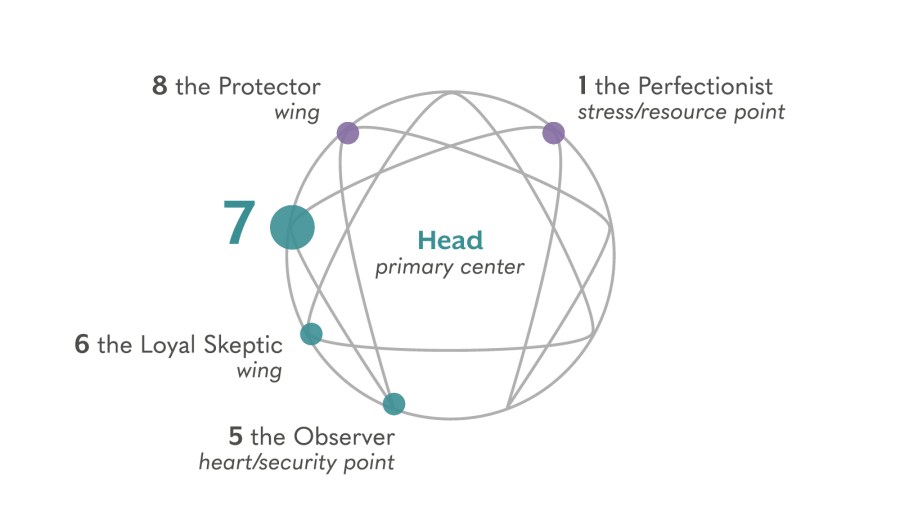
My interest in this question is not purely theoretical. From the outset, I found the concept of “disintegration” difficult to reconcile with lived experience—particularly in relation to my own type, Type 5. In the standard model, the Five is said to disintegrate toward Type 7, exhibiting scattered, excessive, or escapist tendencies under stress. While I recognize the descriptive accuracy of this account at certain levels of functioning, it does not fully capture the experiential reality of the movement.

In my own case, the movement toward 7 has not been merely regressive. On the contrary, it has often represented access to states that feel more expansive, embodied, and alive than the constrained intellectualism of the core Five structure. This raises a fundamental question: if the experiential quality of this movement can be described as more “whole” rather than less, in what sense can it be understood as disintegration?

One possible answer lies in the developmental origins of type itself. If personality structure is understood, as Don Richard Riso and Russ Hudson suggest, as a provisional adaptation formed in early childhood, then it is reasonable to ask what precedes that adaptation. It is at least conceivable that what emerges in the movement toward the so-called disintegration point is not simply dysfunction, but the reactivation of capacities that were present prior to the consolidation of type—capacities that were subsequently repressed in the service of psychological survival.

In this light, the apparent instability of “disintegration” may reflect not breakdown, but overload: the sudden return of domains of experience—such as sensation, spontaneity, or emotional intensity—that the personality has not yet learned to integrate. What appears as regression is, in this sense, the difficulty of expansion. The task is not to avoid this movement, but to engage it consciously, such that what begins as turbulence may ultimately become integration.


Literature Review: The Problem of Directionality in Enneagram Theory

The question of directional movement along the Enneagram’s lines of connection remains one of the least resolved and most inconsistently articulated aspects of the system. While widely taught using the language of “integration” and “disintegration,” there is no clear consensus in the literature regarding the precise meaning, function, or developmental significance of these movements. A review of major contributors to the field reveals a pattern of partial reformulation without full theoretical resolution.

The most influential articulation of directional movement appears in the work of Don Richard Riso and Russ Hudson, particularly in Personality Types (1987/1996) and The Wisdom of the Enneagram(1999). In this model, each type is understood to move along two lines: one toward “integration” (growth) and one toward “disintegration” (stress). Movement in the direction of integration is said to require conscious effort and corresponds to psychological health, while movement toward disintegration is described as automatic, reactive, and associated with declining levels of functioning.

However, this model contains an important and often overlooked tension. Riso and Hudson also suggest that the broader aim of Enneagram development is to move “around the circle,” integrating the positive capacities of all types over time. This implies that the points reached via the so-called direction of disintegration are not inherently pathological, but form part of a larger developmental sequence. The result is a structural ambiguity: movement toward a given point may be framed as regressive in one context and developmental in another, depending on whether it is understood locally (single-step movement) or globally (full-cycle integration). This inconsistency has not been fully resolved within their framework.

Subsequent authors have attempted to refine or reframe this model, often by softening the negative connotations of “disintegration” without fundamentally altering the underlying directional asymmetry. Sandra Maitri, for example, rejects the terminology of stress and disintegration and instead proposes an “inner flow” governed by what she describes as a “logic of the soul.” In her model, forward movement along the lines is driven by a search for fulfillment that ultimately proves unsatisfying, while backward movement leads toward what she terms the “heart point,” associated with a deeper layer of the self or “soul child.” While this approach usefully destabilizes the purely negative interpretation of one directional line, it replaces it with a different asymmetry, privileging backward movement as more essential to growth. Moreover, the conceptual basis of this model remains insufficiently specified, particularly in its account of how and why one direction should be considered developmentally primary.

Beatrice Chestnut builds on and systematizes aspects of Maitri’s approach, offering a more structured reinterpretation of the lines of connection. In her model, movement along both lines can be either constructive or maladaptive, depending on the level of awareness and integration involved. Terms such as “growth through stress” and “security point” attempt to capture the complexity of these dynamics, acknowledging that development may occur through challenge as well as stability. While this represents a significant advance in clarifying the bidirectional potential of the lines, it nevertheless retains an implicit directional logic and does not fully resolve the question of whether one direction should be considered primary, or whether the distinction itself is theoretically necessary.

Other contributors, including Tom Condon, have explicitly questioned the stability of unified directional models. Condon argues that individuals routinely access both connecting points under a range of conditions and that attempts to impose a single, consistent directional pathway oversimplify what is, in practice, a complex and dynamic psychological process. From this perspective, the notion of a fixed “direction of disintegration” becomes increasingly difficult to sustain, as both lines appear capable of expressing high and low functioning depending on context.

Across successive editions and public teachings, Russ Hudson has made a clear and commendable effort to soften the language surrounding the Enneagram’s directional model. Terms such as “disintegration” have increasingly been reframed as “stress,” and there is greater emphasis on the idea that no movement within the system is wholly negative. This shift toward more “warm” and less judgmental language reflects a broader maturation within the field and has undoubtedly made the system more accessible and psychologically usable.

At the same time, this evolution in terminology has not been matched by a corresponding clarification of the underlying theory. The central asymmetry—where one direction is implicitly associated with growth and the other with regression—remains largely intact, even as the language used to describe it has become more neutral. As a result, the model continues to carry an unresolved tension: it acknowledges that all points contain both higher and lower expressions, yet continues to treat movement toward certain points as fundamentally stress-based rather than developmentally necessary.

As other contributors have begun to explore more symmetrical and developmentally integrated interpretations of the lines, the persistence of the traditional asymmetry begins to feel less like a settled conclusion and more like an inherited assumption that has yet to be fully re-examined.

In this respect, the field appears to have reached a transitional stage. The vocabulary has evolved, the teaching has broadened, and important correctives have been introduced. Yet the underlying structure of the model—particularly with respect to directional movement—remains theoretically underdeveloped. For a system that places such emphasis on precision of language and clarity of inner dynamics, this gap is not insignificant. It suggests that what has often been treated as a foundational principle of the Enneagram may, in fact, remain an open question—one that calls for more direct and systematic reconsideration.


Applications: Reconsidering the Nine Directional Movements

If the preceding analysis is correct, then the implications must be demonstrated concretely across the system itself. What follows is a re-examination of each of the nine directional movements traditionally described as “disintegration.” In each case, I argue that what has been labeled regression can be more accurately understood as the activation of a higher function—a necessary but often turbulent phase of integration.


Type 1 → Type 4: Emotional Depth as Higher Function

In the conventional model, Type 1 “disintegrates” to Type 4, becoming moody, self-absorbed, and emotionally volatile. The principled, rule-oriented One—committed to order and correctness—appears to lose stability and fall into irrational feeling states.

However, this interpretation overlooks the rigidity inherent in the One’s structure. Ones tend to operate within strict internal frameworks, often fearing deviation from what is “right.” This can produce clarity and integrity, but also emotional constriction and black-and-white thinking.

Movement toward Type 4 introduces a necessary counterbalance: emotional depth, nuance, and subjectivity. The Four’s capacity for feeling, imagination, and romantic engagement allows the One to move beyond mere correctness into lived experience. What appears as instability may, in fact, be the early and uneven integration of emotional life. A One who cannot access this domain risks becoming brittle and overly moralistic. The 1 → 4 movement, properly integrated, expands the One’s humanity.


Type 2 → Type 8: Assertion as Higher Function

Type 2 is traditionally understood to “disintegrate” to Type 8, becoming aggressive, domineering, and self-centered. The caring, other-oriented Two is seen to abandon empathy in favor of force.

Yet the Two’s structure often involves excessive attunement to others at the expense of the self. Twos may defer, accommodate, and seek approval, losing touch with their own needs and convictions.

Movement toward Type 8 activates the capacity for directness, strength, and self-assertion. The Eight’s willingness to say “this is what I think” or “this is what I need” is precisely what the Two lacks when overextended. While this shift may initially appear abrupt or even confrontational, it represents a critical step toward autonomy. The 2 → 8 movement allows the Two to embody their own authority rather than living exclusively through others.


Type 3 → Type 9: Grounded Presence as Higher Function

In the standard model, Type 3 “disintegrates” to Type 9, becoming disengaged, complacent, and apathetic. The driven, success-oriented Three is seen to lose momentum and fall into inertia.

However, the Three’s relentless focus on achievement can lead to over-identification with external validation and performance. The constant pursuit of success may obscure deeper questions of meaning, connection, and being.

Movement toward Type 9 introduces stillness, acceptance, and presence. The Nine’s capacity to step out of striving and into being offers a necessary counterweight to the Three’s forward drive. This shift can soften the ego’s edge, allowing the individual to reconnect with others and with themselves beyond performance. What appears as loss of ambition may, at a higher level, represent the integration of humility and peace—qualities often observed in mature leaders who transition from personal success to collective contribution.


Type 4 → Type 2: Relational Engagement as Higher Function

Type 4 is said to “disintegrate” to Type 2, becoming needy, dependent, and overly focused on others for validation. The introspective, emotionally rich Four appears to lose depth and become externally fixated.

Yet the Four’s structure can incline toward solipsism—an intense inward focus on personal identity, feeling, and uniqueness. This can limit engagement with others and reinforce a sense of separation.

Movement toward Type 2 opens the Four to relational connection. The Two’s outward orientation—its attentiveness to the needs and feelings of others—provides a pathway out of self-absorption. While this may initially manifest as dependency, it also represents the development of empathy, generosity, and shared experience. The 4 → 2 movement enables the Four to participate in relationship rather than merely reflect upon it.


Type 5 → Type 7: Embodiment and Expansion as Higher Function

Type 5 “disintegrates” to Type 7 in the traditional model, becoming scattered, impulsive, and escapist. The focused, analytical Five is seen to lose coherence and retreat into distraction.

In practice, however, the Five’s core challenge lies in over-withdrawal into the mind. The Five often privileges thought over experience, constructing elaborate internal systems while remaining detached from immediate reality.

Movement toward Type 7 activates sensation, spontaneity, and engagement with life. The Seven’s openness to experience allows the Five to step out of abstraction and into embodied presence. In my own experience, this movement has not been merely destabilizing but profoundly enlivening—an entry into states of being that feel more whole and integrated than the Five’s default stance. The initial excesses of this shift reflect the difficulty of integrating long-repressed domains, not their inherent dysfunction.


Type 6 → Type 3: Self-Confidence and Agency as Higher Function

Type 6 is said to “disintegrate” to Type 3, becoming competitive, image-conscious, and arrogant. The loyal, cautious Six appears to abandon its grounded nature in favor of performance.

However, the Six’s strengths—commitment, vigilance, and reliability—can become limiting when accompanied by self-doubt and over-reliance on external validation. Sixes may hesitate to act decisively, seeking reassurance rather than asserting direction.

Movement toward Type 3 introduces confidence, initiative, and forward momentum. The Three’s capacity to act, to lead, and to project capability is precisely what the Six requires to move beyond hesitation. While this may initially appear as overcompensation, it represents the development of self-trust. The 6 → 3 movement allows the Six to step into authority rather than continually deferring it.


Type 7 → Type 1: Structure and Discipline as Higher Function

Type 7 “disintegrates” to Type 1, becoming critical, rigid, and constrained. The free-spirited, pleasure-seeking Seven is seen to lose joy and become moralistic.

Yet the Seven’s pursuit of experience can lead to fragmentation—constant movement without depth or completion. Avoidance of discomfort may prevent sustained engagement with reality.

Movement toward Type 1 provides structure, discipline, and ethical grounding. The One’s capacity for focus and follow-through allows the Seven to channel its energy into meaningful action. While this shift may feel restrictive at first, it enables coherence and purpose. Real-life trajectories often reflect this movement, as individuals transition from restless seeking to grounded commitment, finding stability where previously there was only motion.


Type 8 → Type 5: Reflection and Restraint as Higher Function

Type 8 is said to “disintegrate” to Type 5, becoming withdrawn, secretive, and overly cerebral. The powerful, action-oriented Eight appears to retreat into isolation.

However, the Eight’s strength can become overextended, leading to dominance and a lack of reflection. Constant outward force may limit the ability to process experience or consider alternative perspectives.

Movement toward Type 5 introduces introspection, analysis, and restraint. The Five’s capacity to step back allows the Eight to refine its actions with insight. This shift does not diminish strength but deepens it, transforming immediate power into considered leadership. The 8 → 5 movement enables the Eight to lead with both force and understanding.


Type 9 → Type 6: Engagement and Commitment as Higher Function

Type 9 “disintegrates” to Type 6, becoming anxious, reactive, and worried. The calm, accommodating Nine appears to lose peace and stability.

Yet the Nine’s desire for harmony can lead to passivity and avoidance. By minimizing conflict, the Nine may disengage from necessary challenges and from their own priorities.

Movement toward Type 6 activates engagement, vigilance, and commitment. The Six’s attentiveness to potential problems encourages the Nine to confront rather than avoid difficulty. While this may introduce anxiety, it also fosters responsibility and active participation. The 9 → 6 movement transforms passive peace into engaged stability, grounded in awareness rather than avoidance.

Conclusion

This paper does not claim to offer a final or definitive resolution to the question of directional movement within the Enneagram. The system itself remains, by the admission of its most influential contributors, a work in progress. What has been offered here is a more limited but, I would argue, necessary intervention: a direct challenge to the prevailing assumption that one line of connection represents “integration” while the other represents “disintegration” or regression under stress.

The analysis presented suggests that this distinction, while historically influential, is conceptually unstable and developmentally incomplete.At a broader level, the persistence of this framework points to a certain hesitation within the field. There remains, at times, a noticeable deference to the foundational formulations of Don Richard Riso and Russ Hudson—a deference that is understandable given their substantial contributions, but which may also inhibit more direct re-examination of their assumptions.

Foundational work deserves respect; it does not require preservation in its original form. In a living field, even the most influential models must remain open to revision where they no longer adequately account for observed experience.The evidence considered here—both theoretical and experiential—suggests that movement along the so-called “direction of disintegration” is not inherently regressive, but often represents the activation of underdeveloped capacities essential for full psychological integration. While this movement may initially appear chaotic or destabilizing, it is better understood as the early phase of expansion rather than contraction. To continue to frame it primarily in terms of breakdown risks obscuring one of the Enneagram’s most valuable insights: that growth frequently occurs through precisely those domains the personality has learned to avoid.If this paper has a broader aim, it is simply to encourage a more direct and less deferential conversation about this aspect of Enneagram theory.

The language of “integration” and “disintegration” has had a long and influential run, but its limitations are increasingly apparent. All theoretical systems, if they are to remain vital, must be willing to outgrow their earlier formulations. It is in that spirit that this argument is offered—not as a final word, but as a contribution toward moving the discussion forward.

Dedication.:

For Tom Condon, the GOAT. And for Lynn.

Note: If you enjoyed this piece you may also like the piece below which also takes up the topic of the Enneagram.

Final Reflections on My Time With Isobel

Epigraph:

I wrote all night
Like the fire of my words could burn a hole up to heaven
I don’t write all night burning holes up to heaven no more

Phosphorescent

Note:These reflections were written in March 2019, in the immediate aftermath of a personal experience that destabilized me more than anything I had previously encountered. They were never intended for publication and have not been revised.I’m sharing them now as a record of that moment—not as a finished account, but as a document of what it felt like to be inside it: heightened, contradictory, and often unclear even to myself.

I have written at length about my experiences with the woman I am calling Isobel. You can find the narrative series here, here, and here. You can also find the play I wrote about this time here.

3/28/19:

I went too far.  I cannot tell if I went too far on purpose; certainly I pushed and pushed until I came to the end of the line.  Like an explorer bent on reaching the furthest possible point, I pushed my mind and body until they could take no more.  Now, the wind has gone out of my sails, for how long I cannot say.  Perhaps for a long time.  Yet I am not at peace, not yet, not now.  “I came so far for beauty/ I left so much behind.”  

Why was it that I had to roam so far out?  What was I running from?  Why did I lock my heart up so tightly that it had to explode in order to feel?  Was there a point at which I could have taken another turn, or was it all slated to occur just as it did?  You can ask why forever and get nowhere.  This I know.

So I met a woman and this shook me up.  She shook me up.  She wasn’t trying to, but she did.  My carefully balanced psyche, assembled and jury-rigged over decades, came apart in a matter of days.  Anything could have happened, and by the grace of god I was able to retain some kind of governing function, however weak, which helped me stay safe.  Over seven weeks everything that could be thrown at me was.  I was under massive physical and psychological strain and only my years of amateur study of consciousness and the unconsciousness saved me from succumbing entirely.  If I could do it over again (a terrifying notion), I would do almost nothing the same.  However, I understand why I made the choices I did.  There is little point, really, in interrogating the choices that we made in the light of the circumstances that were in place.  Things were, and I reacted to them as I did.  There is no getting around this.  

Still, I made every mistake in the book.  A classic mid-life crisis.  Stereo-fucking-typical, scripted to the t.  The funny thing is, I knew all about the blueprint and it still happened.  “My Dinner with Andre” was a foundation text.  I’d read Jung and James Hollis on midlife, extensively.  Paradoxically perhaps, the very knowledge of the blueprint may have helped bring the symptoms into being.  Or not, maybe I was semi-consciously gathering resources with the implicit foreknowledge that one day they would be needed.  Either way, advance information about the terrain only allowed me to stay on my feet—it did not allow me to change course.  

I was a Gemini warrior on a private quest, one unseeable from the outside and barely even discernible to myself.  So many windmills, so much striving for the grail.  To what end?  A window seat—a temporary sinacure—and a chance to draw breath at sea level.  That’s about it.  Can I learn to live as it seems others do, with a little less metaphysical strum und drang, present in the world of the senses, just living?  I don’t know what it is like not to live in my head and don’t remember when I started living this way.  What I know now though it, it’s a trap.  A mire.  An maze with no exit.  A road to nowhere.

In five years time will this all seem to have been necessary—just part of the process of being a human?  God I hope so.  That’s what the literature says—the final stage is acceptance.  How I am doing with that?  I accept that what happened happened.  I accept that I made choices that made sense in the moment.  I accept that that my personality was in large part a construct and that I am better off without a lot of it.  And, I accept the possibility of a silver lining somewhere down the line.  The magnitude of the experience and its ripple effects, these are things I am still coming to terms with.

I have seen some things that many will never see.  Beautiful and fantastic things, awful things.  As a result, I am shaken and somewhat unsteady.  That’ll happen when you stray too close to the light.  But those things are not mine—they do not belong to me.  They have their own location, their own zone, at the edges of the known.  I was granted, or gained, access to a sliver of another realm, yet I do not know how deep or how wide that realm is.  Right now it is enough to know that it is there, more than enough.  Both climbers and divers may feel sick when returning to sea level.  I don’t know if I have been climbing or diving or, somehow, both, and in the end it does not matter.  Leonard Cohen’s ladies man dies again and again throughout the ages.  “It’s like a visit to the moon or to that other star/ I guess you’d go for nothing/ if you really want to go that far.”  I didn’t want to go that far, not really, but I did anyway.  

===== =====

3/29/19:

Why did I give up on my job?  Because let’s face it, I gave up.  Let’s get some things out in the open.  I managed my energy very poorly for a long time.  I was using shortcuts and papering over energetic issues to keep going at the pace I was working.  For the last three or four years I was also withdrawing bit by bit—taking more half days off, shrugging more off, and putting off longer term planning that was necessary for the program.  I was basically exhausted on an energetic level and this led to taking more time for myself and spending too much money just to get a space to reset—to feel something.  

What was it that was so exhausting?  As I’ve spoken about to many, the constant pushing of the stone uphill, the constant battle to get needs listened to, was certainly tiring.  The feeling that it was really just me, a middle man, at the top of a huge operation and I didn’t have the tools or the power to do the things I needed to.  The feeling that there were so many program areas that were not as good as they could be.  The growing gap in my marriage which allowed me to seek feeling connections recklessly and a little randomly.  

After a while, my psyche was being held together by string, by a thread.  I was carrying deep wounds from the past which I hardly knew existed, had hardly ever looked at.  I was an unitegrated personality in many ways and have no real root here in Japan.  The sense of being included in an extended family that existed when I met my wife was long gone.  My dream life was giving me warnings and maybe I could have done something with them.  I was primed for a crack-up.  

What was it about Elodie that enraptured me so entirely?  I think it was the combination and sexuality and motherliness, her openness, her painful past which she was so open about, and some kind of deep inherent similarity that we both felt, and proceeded to blow out of all proportion.  And she wanted to spend every minute with me!  I was around the bend about her within a day.  There are funny parts to the story—man I knew I was in trouble.  That’s why I was listening to the Mendoza Line non-stop.  “Mistakes were made tonight” indeed.  I recognized that I was right on the edge and programmed myself not to step over it on the conference.  And then I got on the plane and proceeded to step right off the cliff in another way.  Long term, I guess it was a better cliff but how I thought I was in the right frame of mind to make that kind of decision, I’ll never understand.  The correct move I made was to put people around me to keep me safe.  The mistake I made was to recruit them into my plan to leave my job when I should have sought advice and depended on them to guide my decisions.

I feel like I want to say this—school leadership was poor.  My decision to leave was not a direct result of the lack of leadership; it was a result of a massive energy change/ charge that took my system by storm and caused me to lose all perspective.  However, the energy issues were in many ways a result of stress and repression of anger and frustration over how things were being handled, both over the short and the longer term.  The issues were deep—still today my body is not right.  I’m fragile, I’m weak, I’m a shell of my former self.  

“This is the new not normal”—I’m listening to the new Lambchop album.  It’s good of course, but kind of all sounds the same.  That’s OK though.  How can I get used to this new not normal at this office?  There is nothing to do.  Maybe that will change, and maybe I can make it change.  Right now I am the definition of a clock-watcher.  I know I put myself in this position and I’ll endure, but at what cost?  Something needs to change, but I know I can’t push myself back into a bunch of old patterns even if I could.  Maybe I was acting like an INTP—maybe feeling was the most buried function of all.  This is probable.  

My damage is deep, generational.  If I am right in imagining that for some bizarre reason I had a role to play in clearing up or shouldering this burden and sort of resolving it, well that’s something I did.  I certainly felt this way last fall, and that sense, that notion is still present.  And now what?  I am not special just because I have begun to own up to my damage.  The best thing I can do now is to pass on as little as I can to my son—to be as present as I can with him as often as I can.  

I also need to extend my working lifespan.  This is a priority, and I need to be realistic about this.  However, I’ve been stressing myself out to figure this out like today and that I can’t do.  My priorities have to be: i) to minimize spending and pay the bills; ii) to cut way back on drinking; iii) to network and think positively about the future little by little.  Anything can come.  Tell yourself, anything can come.  Anything can come.  

FIN        

===== =====

3/30/19:

There is no point in trying to write well right now.  I am writing just to pass the time and continue to process my guilt and my heartache.  The sense that somehow I was wired wrong is persistent, despite people who care about me trying to tell me otherwise.  I mean, I have not been practical, have not made ordered decisions about securing my life and that of my family.  I have made ordered decisions in so many other areas, not this one.  How could that even be?  I have no real answer to this—magical thinking, arrogance, the feeling that I could somehow tread water forever. I don’t know.

Ann wrote that I might have a form of PTSD from the collision with Elodie.  This rings true.  Meeting her shook up my mind and body at a core level.  The ideas of animating archetypes are not just ideas.  They are real.  When Elodie and I fell into one another, I lost all sense of self.  I wanted to give everything and anything to her, falling over myself to do so, to explain, to unburden myself.  She was attracted and fascinated by some of this, but was also overwhelmed by the extent and speed of it all.  On my end, I was overwhelmed too, overwhelmed by the depth of the attraction and how far I fell into her.  We talked, and I could not figure out was this an ascent or a descent.  So strange that it could be both.  It was more a trip into the infinite.  A trip for sure.  I exited London and I was undone.  I was terrified and thought I was bulletproof at the same time.  I should have leaned more into the terror—I should have slowed down and assessed.  This I did not do.

Calling Lynn and getting the idea of the kundalini was helpful.  This was another juncture I could have turned for the better—tried to get grounded in a more appropriate way.  Like the runner I once was, I just thought I could run the energy to ground.  In the end I did, too late and with too much cost.  So here I sit in a purgatory of my own making, bereft.  Is this what I was destined to have to deal with—the emptiness, the total lack of self without the worldly tasks that were set me?  I am having new thoughts—thoughts about the break up of extended families and that this is one of the core problems in modern life, perhaps the core one.  Loneliness is probably an epidemic, almost certainly.  

For a moment there was music, there was dance and movement, there was sexual confidence, there was bravodo.  No longer.  Why can’t those feelings, those urges, be regulated and controlled?  I suppose they can, with practice.  Apply myself, that’s something I’ve always had difficulty doing toward a skill.  Variety seeking—always on the lookout to change direction.  How boring.  

I know I need to focus on my health, but how can I do that with these days stretching in front of me like this?  I am in a tough situation.  This is a fact.  I can’t write my way out of this.  What am I supposed to be learning?  What is it even possible to learn here?  Patience, humility?  Patience for what, for reinstatement to the culture that pushed me over the edge?  I read about principles under stress in Australia and no one wanting the job.  I can understand why.  I never wanted to be that high up either—really didn’t.  I only accepted it because I was apparently the best person.  What could have been different?  I did all I could to delegate, well, I tried.  I felt guilt over my classes being below-par, could not stop working on the weekend, got worn down.  

There has to be a silver lining.  Well, one is the conference lifestyle is over.  That had to end, and an end was forced on me.  That’s a net positive.  I may be able to address my habits.  This is going to be super hard because of the sleep and because I gain pleasure from the pub.  Can I keep the pub and drop the rest?  That has to be the goal.  

Dedication:

For Elodie. I love you.

=====

Note: If you liked this piece, you may also like the pieces below which also take up the difficulties of modern romance.

On Why I Told the World to Fuck Off for 36 Hours

Subtitle: And Saved My Life in the Process

So I called you a cab and they called you a hearse,
and I knew what they were talking about.

— The Mendoza Line, “It’s a Long Line (But It Moves Quickly)”

Note: This piece pairs naturally with my recent essay On the Safe Space (aka Corner Girl). Both pieces are about the small moments that hold us together when we are breaking apart. You can read that piece here.

By 2012 I finally understood what I had been circling back in 2008 without fully naming: the business hotel wasn’t just a neutral space — it was a controlled dissociation chamber. A place where my mind could flatten without collapsing. A room where the world muted itself into CNN-colored soft focus, where time thinned out, where nothing asked anything of me. I didn’t know it then, but all those mid-range rooms — the bland art, the sealed windows, the gentle hum of an air conditioner tuned to the exact frequency of psychic anesthesia — were teaching me a skill I would need later: how to disappear just long enough to come back intact.

So when the pressure finally broke, when I had been working thirty straight thirteen-hour days and felt myself sliding toward the edge of something unnamed, I took the Shinkansen to Tokyo, checked into a business hotel, turned my phone off, and told the world — or most of it — to fuck off for thirty-six hours. And the shocking thing wasn’t that it worked. The shocking thing was realizing I had been preparing for it years earlier, in those identical rooms where the towels were always clean, the windows always closed, and 9-ball was always on.

So I ducked into the nearest konbini and bought a latte from the machine — the one small ritual that still made sense. The warm cup in my hand steadied me just enough to get through the turnstiles. Kyoto Station felt too bright, too full of intersecting lives and needs, the air full of other people’s urgency. I didn’t have the bandwidth to absorb anyone else’s story; I barely had enough for my own. All I knew was that the next Shinkansen to Tokyo was leaving in eleven minutes, and if I didn’t get on it, something in me would snap in a way I wouldn’t be able to walk back. The latte was cooling fast, my hands were shaking, and every part of my body was saying the same thing: Go. Now. Before you say yes to one more thing you don’t have the energy to carry.

Once the room was arranged — bag on the stand, shoes lined up by the door, Pocari Sweat sweating slightly on the desk next to the bottle of red — my whole system downshifted into something like relief. Not joy. Not peace. Just the quiet recognition that, for the next thirty-six hours, my time belonged to me and no one else. I didn’t have to speak. I didn’t have to answer. I didn’t have to hold anything together. All I needed to do was sit on the bed, take a long drink of Pocari, a short drink of wine, and let my body loosen by degrees. It wasn’t dramatic. It wasn’t cinematic. It was just freedom in the smallest, most essential sense: I get to be here, in this room, alone, and the world can wait.

After the first wave of relief, the question always arrived: Do I go out?

Tokyo was right there.

Akasaka-Mitsuke humming five floors beneath me, restaurants lit up like little stages, the crossing full of men in suits walking fast enough to convince you they knew exactly where they were going. I never did. So I’d sit on the bed and pull up the map — not to plan, but to orient. Izakaya here, ramen there, a bar tucked down some side street with red lanterns and a name I couldn’t pronounce. Nothing fancy. Nothing difficult. Just food, warmth, and maybe one drink that wasn’t red wine from a convenience store. I wasn’t looking for a night out. I was looking for simple movement, the kind that doesn’t require performance or decision-making. A walk, a meal, a seat at a counter. A single beer poured by someone who didn’t know my name and didn’t need to.
That was the whole question every time: stay in the bubble, or slip into the Tokyo night just long enough to remember I was a person.

Stepping out into Akasaka-Mitsuke wasn’t lonely — it was liberating. The air felt different the second the sliding doors breathed me out into the crosswalk light. I wasn’t hiding from anyone. I wasn’t avoiding anything. I was simply off the clock in a way that almost never happened in my real life. No one knew where I was, and for the first time in weeks, that fact didn’t carry a threat or a stain of guilt. It felt clean. It felt earned. I wasn’t missing; I was saving my own damn life by giving it a night without responsibility. The freedom wasn’t dramatic. It was simply this: I could walk in any direction, and every direction was allowed.

Out in the Akasaka night, I felt like the version of myself that gets buried under work and obligation — the real me, the one who just wants to wander and see who’s out, what’s open, what energy the city is holding. I wasn’t searching for anything dramatic. I wasn’t looking for revelation or escape. I was just checking things out — the izakaya with the red lantern, the alley with the quiet bar, the group of people laughing too loud on the corner. Dabbling. Moving lightly. Letting Tokyo show me whatever it wanted to show, without needing to make a night out of it. It was the simplest, purest freedom: explore until something feels right, and stop when it doesn’t.

I walked the Akasaka backstreets the way I always do when I’m in this mode — cutting down alleys, taking long cuts and shortcuts that don’t make geographic sense but feel right in my body. Tokyo is a city you navigate by instinct, not logic. You follow energy. You drift. You take the turn that looks interesting, then the one that feels safe, then the one that’s pulsing with life. Sometimes I’d follow the Google map to the place I thought I wanted to eat, only to walk past it and keep going. Other times I’d catch a glimpse of something through a noren curtain — warm light, the sound of laughter, a chef moving with the right kind of ease — and that would be the signal. It was never about the spot itself. It was about finding the right spot, the one that matched the night’s frequency. And over the course of the evening, I usually did both: follow the algorithm, then abandon it; trust the map, then trust myself.

Eventually I found the place — an oyster bar tucked behind one of those half-lit alleys where Akasaka feels a little European and a little dreamlike. Warm light, wood counter, the soft clatter of shells, and a chef who moved with the kind of quiet competence that settles you the moment you sit down. This was exactly my jam: an oyster platter arranged like a small geography, cold and briny and perfect, a bowl of clam chowder steaming in front of me, and a carafe of white wine that I poured slowly, deliberately, one glass at a time. Spendy, sure — but in this mode spendy isn’t excess. Spendy is permission. Spendy is dignity. Spendy is saying to yourself: I get to take my time with this. I get to have a meal that cares for me back. And in that moment, slurping an oyster with the city humming outside, I could feel the night open around me in the cleanest way.

The white wine hit me in that way good pairings do — not as a buzz, but as a reminder of how people take care of themselves when they’re not drowning. White wine and oysters belong together; everyone knows that, and sitting there I felt myself re-enter that understanding. The pairing wasn’t fancy. It was human. It was the kind of small, civilized pleasure most people allow themselves without thinking, and I’d been so buried under work and obligation that I’d forgotten what that felt like. The red I’d had earlier had already warmed me, softened the hard edges, and now the white layered over it, sharpening the night just enough to make everything shimmer. I was slightly buzzed and buzzing — not out of control, not hiding, just finally aligned with myself again.

I left the oyster bar with that warm, gentle buzz humming through me — the kind that makes Tokyo feel lit from within — and walked until I found the sort of place I always look for on these nights. A spendy cocktail bar: dim lights, bottles arranged like small works of art, a bartender in a crisp vest moving with that Japanese mix of precision and grace that makes you feel taken care of without being noticed. I took a high seat at the counter and ordered something I never drink in real life — a proper cocktail, layered, balanced, spendy. Spendy was the point. Spendy meant: I am worth slowing down for. Spendy meant: no one is waiting, no one is watching, no one needs anything from me. I sipped slowly, letting the night stretch out in front of me like a long exhale, feeling myself settle into the version of me that only Tokyo brings out — curious, quiet, open, free.

The bar I ended up in wasn’t some sleek Tokyo cocktail temple — it was better. Two bartenders from Nepal were working the counter, the kind of guys who’ve lived ten different lives before landing in Japan, commuting in from way out because Akasaka rent is a joke. We talked the way travelers talk when no one is trying to impress anyone — about where they were from, how far they lived, what Kathmandu feels like in winter. I wasn’t performing, just listening, rapping with them in that easy drift that happens when you’re slightly buzzed and buzzing in a foreign city. I ordered red wine — not more cocktails — because that was the right shape for the night, and when I finished my glass one of them poured me another, full to the brim, “for the gentleman.” It wasn’t flirtation. It wasn’t special treatment. It was the small grace of the night saying: You came to the right place. You came at the right time. And you’re not carrying anyone else’s weight right now.

When I stepped back out into the night after the second glass of wine, the whole neighborhood felt like it belonged to me. Not in a macho way, not in a performative way — just in that rare, private way where the city’s pace matches your own and you fall into step with its pulse. Akasaka was quiet but lit, humming but not crowded, and for five or six blocks I felt like I owned a slice of it. My slice. The alleys, the crosswalk glow, the last trains whispering underneath the city — all of it moved around me without touching me. I wasn’t hiding. I wasn’t disappearing. I was just walking back to my faded little hotel in a state of clean, earned sovereignty, knowing the world wasn’t tracking me for once. And for those fifteen minutes, Tokyo wasn’t a megacity. It was mine — exactly the size of the person I was in that moment.

Back in the room — my little faded Akasaka hideout five or six blocks from the bar — I didn’t overthink a thing. I drank more red wine, chased it with Pocari, stripped down to my boxers, and let my body fall exactly where it wanted to fall. There was nothing left to hold, nothing left to manage, nothing left to translate. I slept like a baby — a full, unbroken twelve hours, eleven to eleven — the kind of sleep that only arrives when you’ve been carrying too much for too long and finally set it all down in a room no one else can enter. No dreams, no interruptions, no alarms. Just the deep, uncomplicated sleep of someone who gave himself thirty-six hours of mercy and actually took them.

When I woke up around eleven, I felt clear-eyed and ready for more of exactly what the night had been—a continuation of me time. No urgency, no guilt, no one waiting on anything. Just hunger in my stomach and calm in my body. I didn’t rush. I stayed in the room for hours, drifting between the bed and the window, drinking instant coffee, sipping a little more Pocari, scrolling nothing, letting the quiet stretch. I could go out or stay in—either was fine. The whole point was that the day was mine to waste or spend however I wanted. After twelve hours of baby-level sleep, I wasn’t reborn—I was simply functional again. Hungry, steady, grounded, and free.

The next day I was set to return to Kyoto. When it’s time to go, it’s time to go — and the Thin Man cleans up quick. I showered, shaved, packed my bag with the same neat ritual I’d used the night before, and stepped back out into Akasaka like someone who had never been tired in the first place. Before heading to the station I picked up omiyage — the small gesture that makes the return feel seamless — something for the office, something for home. It wasn’t guilt; it was continuity. A way of saying: I left for a day and a half, and now I’m back in the world with all the edges smoothed. By the time I boarded the Shinkansen back to Kyoto, I was already shifting into IB mode — the coordinator, the problem-solver, the guy who keeps the whole thing moving. But now the engine was clean again. The reset had worked. Thirty-six hours alone in a faded Tokyo hotel, oysters, wine, a long sleep, a morning that belonged only to me — and suddenly I could re-enter at full tilt. Not as a martyr. Not as a runaway. Just as myself, restored enough to carry everything again.

Dedication:

For Akasaka — whoever designed that little slice of urban order also re-ordered my mind in the best possible way. Thanks there, baby.