On Some Meetings and Close Encounters with Musicians II

Note: This is the second piece in our series “On Some Meetings and Close Encounters with Musicians.” You can find the first installment here.

The encounters described here span more than thirty years and several cities — from a first arena concert in Pullman, Washington in 1991 to small club shows in Cambridge, Osaka, and Kyoto over the decades that followed. As with many memories of live music, the exact setlists and dates blur, but the rooms themselves — the sounds, the atmosphere, the strange and fleeting meetings between artists and audiences — remain vivid. These sketches attempt to capture a few of those moments as they were experienced at the time.

Epigraph

No fears alone at night she’s sailing through the crowd

In her ears the phones are tight and the music’s playing loud

— Dire Straits, “Skateaway”

Live music produces strange meetings. Sometimes you meet the musicians themselves. More often you meet a moment — a room, a sound, a feeling that sticks with you for decades while entire years of ordinary life quietly disappear.

Here are a few such encounters.


I. Initiation

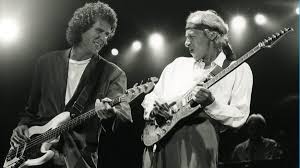
My first real concert was the On Every Street tour in 1991.

The band was Dire Straits, the venue was Pullman, Washington, and the company was the usual Spokane crew: Seth, Innes, Kelly.

I was the biggest fan in the car by far. The others liked the band well enough but I was the one who had studied the records, who knew the guitar parts, who was ready for the moment when the lights dropped and the first notes hit the arena. This was the On Every Street tour, which turned out to be their final record.

They played everything: Money for Nothing, Walk of Life, Sultans of Swing. It was a great show, and one of their last before retirement, though at the time I had no real way to judge such things. It was simply enormous — lights, volume, spectacle. I bought the black and blue tour shirt and wore it for five years.

At the time I thought concerts were supposed to be like that: huge, polished, and far away.

I would later learn otherwise.


II. Revelation

Several years later, during the Hamilton years, I saw Red House Painters at the Middle East in Cambridge.

I went with Ian. The room was small, maybe a few hundred people at most. Nothing about it resembled the arena in Pullman. And then, near the end of the set, Mark Kozelek began playing “Little Drummer Boy.” It lasted nine minutes. You could hear a pin drop in the room.

No spectacle. No lights. Just absolute concentration from everyone present. When the final notes faded the silence lingered for a moment before the applause came.

Afterward Ian and I drove back toward New York through the cold night with the windows cracked open, heaters flying out into the darkness, and Hell’s Ditch blasting through the car stereo to keep us awake.

That was the night I realized concerts could be something else entirely.


III. Chaos

Not every show produces reverence.

I once saw The Fall with Ian as well. The band’s leader, Mark E. Smith, seemed to be operating in his traditional mode of total hostility. The set was short — twenty-eight minutes by my estimate. Ian later checked the official record and insisted it was forty-three. Either way it felt brief and volatile. Smith barked into the microphone, glared at the band, and treated the entire enterprise with the air of someone barely tolerating the existence of the audience.

Which, to be fair, was exactly what many people had come to see.


IV. Theatre

The strangest performance I ever witnessed may have been Cat Power at Club Quattro in Osaka.

The evening began badly. An opening act — a woman in what appeared to be a fairy costume — sat at the piano and played for what felt like an eternity. Forty-five minutes at least. Perhaps longer. By the end of it the audience was openly confused.

Then Cat Power appeared.

Or rather she refused to appear in the conventional sense. Instead of remaining on the stage she wandered through the venue with a handheld microphone, singing and rapping while walking amongst the crowd, occasionally placing an arm around a patron or leaning against the bar.

At one point she came right up to where I was standing near the back rail and sang a line or two before drifting off again into the room.

The entire show felt less like a concert than a piece of improvised theatre.


V. Ritual

A few years later I saw Damo Suzuki at Club Metro in Kyoto. Damo had once fronted the legendary German band CAN, but this night bore no resemblance to those recordings. Nothing recognizable from the catalog appeared. And here he stood, just a few feet away from the audience with long black-and-grey hair flowing, bellowing and chanting over a constantly shifting improvisational band.

It was less a performance than a ritual.

Damo passed away not long ago. RIP and prayers up. I’m grateful I saw him when I did.


VI. Canada Night

Not all memorable shows are mystical.

Sometimes they’re simply loud.

One such evening occurred at Club Quattro in Osaka when Broken Social Scene and Death From Above 1979 came through town.

The Canadian ambassador was present and delivered a brief speech before the set explaining that Death From Above 1979 represented a fine example of Canadian enterprise because they were “only two men making so much noise.”

The room was packed with Canadian expats and the atmosphere was celebratory chaos. The ambassador was probably correct.


VII. Breakdown

Not every concert goes well.

I once saw Bonnie ‘Prince’ Billy at the small Kyoto venue Taku Taku. Something had clearly gone wrong with the lineup. The guitarist appeared to be brand new and could barely navigate the chords.

Will Oldham tried to push through but quickly grew frustrated and began openly calling the guitarist out from the stage. It was uncomfortable for everyone involved.

The show never recovered.


VIII. Redemption

Fortunately the story has a better ending.

Some years later I saw Bonnie “Prince” Billy again, this time at the beautiful Kyoto venue Urbanguild and everything worked great. Low benches and tables filled the room, Heartland beer bottles glowed green under the lights, and the band played a relaxed, confident set drawn mostly from the Bonnie “Prince” Billy catalog with a few Palace songs mixed in.

Opening the evening was an instrumental group called Bitchin Bajas whose sound reminded me faintly of early Phosphorescent if Phosphorescent had chosen to make instrumental records. After the show I found myself talking with three members of the band while they drank beer and ate fries. They were humble, friendly, and slightly surprised that anyone in Kyoto knew who they were. We talked for a while about touring and the constant challenge of trying to make a living as working musicians. Eventually the conversation drifted off and the room began to empty.

The music was over. The musicians were just people again, finishing their drinks and preparing to move on to the next city. And that, in the end, may be the most interesting encounter of all

Dedication

For live music fans everywhere. My true people. I love you baby.


Note: If you enjoyed this essay, you may also enjoy the essay below on the four time I met Yo La Tengo. Happy reading!

In Defense of Mark Kozelek

Note: This essay addresses the artistic approach of Mark Kozelek as a songwriter. It does not attempt to evaluate or adjudicate the various personal controversies that have circulated around him in recent years, many of which remain publicly disputed and complex.

The focus here is narrower: how Kozelek’s long-form, diaristic songwriting works as a musical method — particularly in songs like “Ali/Spinks II,” where ordinary details accumulate into something emotionally larger. Whatever one thinks of the artist as a person, the question of how the music itself functions remains worth examining on its own terms.

For several years now it has been fashionable to treat Mark Kozelek as something like an exhausted case: a brilliant songwriter who wandered too far into self-absorption, whose songs became too long, too diaristic, too willing to linger on the small debris of daily life. Even some longtime listeners have adopted the shorthand. Early records were masterpieces; later ones were indulgent. The verdict sounds tidy. But like most tidy verdicts in music, it collapses as soon as you start listening again.

The basic complaint about Kozelek’s later work is well known. The songs stretch past ten minutes. The lyrics catalog ordinary events: hotel rooms, meals, airports, old friends, television shows, half-remembered conversations. The narrator seems to be narrating his own day in real time, occasionally pausing to note a basketball score or a passing cloud of melancholy. To critics raised on the discipline of verse-chorus songwriting, this can sound like navel-gazing elevated to an art form.

But the strange thing about Kozelek’s music is that the minutiae are not actually the point. They are the atmosphere. His songs work less like traditional compositions and more like extended walks through consciousness. The grocery lists, the memories of old bands, the stray anecdotes about touring musicians — all of it forms the texture through which something else slowly emerges. A mood. A sense of time passing. The feeling of being a person moving through an ordinary day while carrying decades of memory.

The best way to understand this approach is to listen carefully to “Ali/Spinks II,” one of the central tracks from Benji. The song begins almost casually, recounting the death of Kozelek’s cousin and drifting through fragments of memory connected to that loss. There is no obvious structure, no chorus that arrives to organize the material. Instead the narrative moves the way memory moves: sideways, unpredictably, circling back on itself. The details accumulate slowly until the emotional core of the story becomes unavoidable. What begins as a series of seemingly unrelated observations eventually reveals itself as a meditation on grief, family history, and the strange ways tragedy ripples through ordinary life. The song is long, messy, and digressive — and it works precisely because of those qualities. “Ali/Spinks II” is not merely an example of Kozelek’s method; it is the test case. If the listener accepts the logic of that song, the entire later catalog suddenly makes sense.

This approach did not come out of nowhere. Kozelek has always been a writer drawn to the long arc of a song. Even in the early days of Red House Painters, the music moved at a patient pace, letting chords hang in the air while the lyrics circled around regret, nostalgia, and quiet observation. What changed later was not the impulse but the level of exposure. The lens moved closer. The songs stopped pretending to be about characters and admitted they were about the singer himself.

For some listeners that shift felt like a loss of mystery. But there is another way to hear it. Kozelek’s later records are essentially field recordings of a mind at work. They capture the strange mixture of memory, boredom, humor, irritation, and melancholy that makes up ordinary consciousness. Most songwriters edit this material down to the highlights. Kozelek leaves it mostly intact. The result is less like reading a poem and more like sitting beside someone during a long drive while they talk about whatever crosses their mind.

The famous outbursts that circulate online tend to obscure this. Kozelek has never been particularly careful about public performance of personality, and that roughness often dominates the narrative around him. When he released the song “War on Drugs: Suck My Dick,” a public feud with The War on Drugs instantly became the headline. The track was petty, funny, abrasive, and entirely unnecessary — which is to say it was perfectly consistent with the same impulsive candor that fuels his songwriting. Kozelek has never seemed particularly interested in polishing the public version of himself.

But the deeper argument about his music usually centers on the accusation of self-indulgence. Why should listeners care about the details of a songwriter’s daily routine? Why should a song wander through anecdotes about hotels, meals, or aging friends? Why should anyone sit through ten or twelve minutes of conversational narrative when a tight three-minute composition could deliver the emotional payload more efficiently?

Kozelek himself once answered that question in a line that perfectly captures his stubborn philosophy: he said he liked playing shows for “dudes in tennis shoes.” The phrase sounds casual, almost dismissive, but it carries a small manifesto inside it. He is not writing for critics parsing lyrical elegance or for industry tastemakers deciding what counts as proper songcraft. He is writing for ordinary listeners who recognize the shape of everyday life — the boredom, the odd digressions, the strange humor that creeps into conversation when people talk long enough.

In that sense Kozelek’s songs resemble a certain kind of late-night storytelling more than traditional music. Imagine someone sitting across the table recounting a memory that begins in one place, wanders through several unrelated details, circles back to a childhood story, and eventually lands somewhere unexpectedly moving. The emotional impact arrives not through compression but through accumulation. You spend time inside the story until its meaning quietly surfaces.

The length of the songs, which so many critics treat as evidence of indulgence, is actually central to the effect. Time itself becomes part of the composition. The listener settles into the rhythm of the narration. Small details begin to gather weight simply because they have been allowed to exist long enough. By the time the song ends, the ordinary events that seemed trivial at the beginning have become part of a larger emotional landscape.

This is not the only way to write songs, and it is certainly not the most efficient one. But efficiency has never been Kozelek’s artistic goal. His music belongs to a tradition of artists who treat the everyday as worthy of sustained attention. The diary becomes the canvas. The passing moment becomes the subject. Instead of distilling experience into a polished metaphor, the songwriter simply records the experience itself and trusts that meaning will accumulate over time.

If that approach sometimes borders on excess, it also produces moments that feel uncannily real. A stray observation about a friend can suddenly open into a meditation on aging. A casual mention of a hotel room can turn into a reflection on the strange loneliness of touring musicians. The emotional truth arrives sideways, hidden among the details of ordinary life.

Which brings us back to the central criticism: that the songs are too long, too detailed, too inward. All of that is true. But it may also be precisely why they matter. Kozelek’s music asks listeners to do something that modern culture rarely encourages anymore — to slow down, to sit with the flow of another person’s thoughts, to accept that meaning often appears gradually rather than in a neatly packaged chorus.

Not every listener will have patience for that. But for those willing to spend time inside the songs, the reward is a strangely intimate experience: the feeling of inhabiting someone else’s memory stream for a while. The tennis shoes crowd, in other words, may understand something that critics occasionally miss. Sometimes the most honest art does not arrive in the form of a perfectly shaped statement. Sometimes it arrives as a long conversation that refuses to end too quickly.

In Defense of Ryan Adams

Note: This essay is not an attempt to defend Ryan Adams the person. It’s an attempt to defend the continued seriousness of the music. The distinction matters, even if our cultural conversations sometimes pretend it doesn’t. Also, I fucking love Ryan Adams. He is the motherfucking man.

Epigraph:

“When the stars go blue.”
— Ryan Adams

For several years now it has been socially safer to treat Ryan Adams as a closed case: talented songwriter, personal flaws, cultural exile. The outline is familiar enough that most people no longer bother to revisit the work itself. But the strange thing about Adams is that the songs refuse to cooperate with the narrative. They remain stubbornly alive — hundreds of them scattered across albums, demos, and late-night recordings — carrying the same bruised intelligence that first made people pay attention twenty-five years ago. At some point the question stops being whether Ryan Adams is an admirable person. The real question becomes harder and less comfortable: what do we do with an artist whose flaws are obvious but whose music continues to tell the truth in ways very few writers can manage?

Part of the problem is that Ryan Adams belongs to an older model of songwriting — the kind where the emotional life of the artist is inseparable from the work. The songs are confessional without being literal, personal without being autobiographical in any simple way. From the early Whiskeytown albums, to his solo debut Heartbreaker, on to today, Adams has always written like someone sitting in the wreckage of his own choices and trying to understand what just happened. That voice — raw, impulsive, often heartbroken, sometimes self-pitying, often painfully perceptive — was never tidy. It wasn’t supposed to be. The appeal of Adams at his best has always been that the songs arrive before the moral cleanup crew.

When the accusations against him surfaced in 2019, the cultural machinery moved quickly. Adams’s shows were cancelled for a while, he was dropped from projects, and reclassified overnight as an artist whose work had become morally contaminated. Some listeners stopped listening immediately. Others quietly kept listening but stopped talking about it in public. The silence that followed was oddly complete. In a culture that usually thrives on argument, the Ryan Adams conversation simply evaporated.

That disappearance is revealing. It suggests that many people were less interested in wrestling with the complexity of the situation than in resolving it as quickly as possible. Once the story had a clear villain, the cultural instinct was to move on.

But the songs remain.

Listen again to Come Pick Me Up, and you hear a man cataloguing his own emotional incompetence with surgical clarity. Oh My Sweet Carolina still carries that strange mixture of homesickness and resignation that only a handful of songwriters ever capture. Later work — Ashes & FirePrisoner, Chris, the better moments of the sprawling archive that followed — continues the same project: the slow documentation of a person trying, often unsuccessfully, to live with himself.

None of this absolves Adams of anything. It doesn’t erase the accounts of people who describe him as manipulative, volatile, or worse. If anything, the songs themselves suggest that those accounts are not entirely surprising. Adams has been writing about his own volatility for decades. The records are full of it — jealousy, insecurity, emotional chaos, the constant sense of someone struggling to regulate the intensity of his own personality.

What the songs also reveal, though, is a rare level of self-awareness about his own condition. Adams’ best work doesn’t present him as a romantic hero. It presents him as part of the problem.

And that distinction matters.

One of the stranger habits of contemporary cultural criticism is the belief that the value of a work of art should track the moral cleanliness of the person who made it. This is a comforting idea, but it collapses under the slightest historical pressure. Much of the art people still revere emerged from personalities that were messy, selfish, unstable, or worse. Songwriters, perhaps more than most artists, tend to write directly from the fault lines of their own lives.

If we demanded perfect character from every songwriter whose music we admire, the history of popular music would shrink dramatically.

The more interesting question is not whether Ryan Adams deserves redemption. That is not something critics or listeners are qualified to grant. The question is whether the songs themselves still carry meaning once the mythology surrounding the artist has been stripped away.

In Adams’ case, the answer seems to be yes.

The songs are still precise. The emotional details still land. Lines that once felt like romantic exaggeration now sound more like documentation — the sound of a man who understands, perhaps too late, the patterns that keep repeating in his life.

There is something oddly honest about that.

The best Ryan Adams songs have always sounded like dispatches from someone who knows he is partly responsible for the wreckage he is describing. They are not pleas for sympathy so much as attempts at recognition — moments where the singer steps outside himself long enough to see the pattern clearly.

That is why the music persists even when the cultural narrative surrounding it has hardened.

The songs were never about innocence. They were about self-knowledge.

And self-knowledge, even when it comes from flawed people, is still one of the things art is uniquely good at revealing.


Dedication

For Ryan, one of the five greatest songwriters ever and the motherfucking man. I love you baby.

Note: If you like this essay, you may like these others in the same “In Defense Of” series.