Note: This piece collects observations gathered across decades of nights out in Japan — moments that, taken individually, felt minor but over time revealed a coherent social pattern. The essay is not intended as a warning against nightlife, nor as an indictment of any particular place or person. Rather, it is an attempt to understand the subtle choreography that unfolds in urban night economies, where invitation, performance, and commerce intersect in ways that are rarely dramatic but often instructive.
The distinction between macro-touts and micro-touts emerged gradually. It reflects less a rigid taxonomy than a traveler’s growing sensitivity to atmosphere, tone, and the shifting boundaries between hospitality and transaction. Most encounters described here were neither dangerous nor traumatic; they were moments of mild disorientation that ultimately sharpened perception and deepened appreciation for the social intelligence required to navigate unfamiliar environments.
Japan remains one of the safest and most generous countries in the world to explore at night. The experiences recounted here are offered not as cautionary tales but as small pieces of ethnography — reminders that every city contains micro-economies of possibility, and that learning to read their signals is part of the quiet education that travel provides.
If there is a broader lesson, it is simply this: nightlife is built on invitations, and the skill of the traveler lies not in accepting or rejecting them categorically, but in recognizing the scripts they carry and choosing, with awareness, when to participate.
Part I — Kumamoto, Japan, Summer 1997
「どこの社長ですか?」
I was twenty-three and new to Japan — not just geographically new, but existentially new, the kind of new that leaves you unable to distinguish between hospitality and performance, sincerity and choreography. At that age you carry a quiet belief that experience will organize itself around you, that invitations are destiny, and that uncertainty is merely the prelude to belonging.
Kumamoto summer did nothing to challenge this illusion. The humidity hung in the air like a second shirt, streets shimmering with heat that seemed less meteorological than emotional. I met a couple of guys at a bar — friendly in that easy, late-night way where language fragments are enough and tone carries meaning. Half English, half Japanese, and entirely good-natured, they asked if I wanted to join their baseball team. I said yes immediately, not because I had any intention of playing, but because at twenty-three you rarely decline the promise of future identity.
The baseball team never materialized. But the invitation served its purpose. It opened the bridge.
They told me they wanted to show me real Japan. A phrase that should always raise questions but rarely does when you’re young and curious. “We know a place,” they said, the universal preface to experiences that exist somewhere between revelation and mild financial education.
That is how I entered my first hostess club.
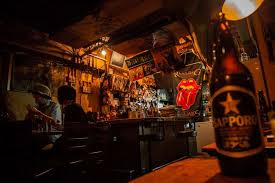
It was not the neon spectacle I might have imagined. No polished decadence, no velvet rope theatrics. Instead: low lighting, carpet that seemed older than the Heisei era, and furniture whose best days had passed quietly without ceremony. Yet the room possessed its own gravitational pull, created not by décor but by orbit — women rotating from table to table with practiced ease, their presence transforming a modest environment into something that felt improbably expensive.
Mama-san presided with the quiet authority of someone who understood both mathematics and psychology. Her hair lacquered into permanence, her gaze sharp as accounting software, she functioned as conductor of a carefully orchestrated social economy. The women, each moving with subtle intentionality, carried scripts composed of compliments, curiosity, and gentle physical proximity.
Whisky mizuwari arrived with ritual precision, poured slowly as if time itself were being measured in diluted amber. The drink tasted ordinary. The price did not.
I was not uncomfortable — only aware of my own lack of schema. A foreigner equipped with politeness but not context, seated inside a room where intimacy operated as currency and identity functioned as flexible fiction. The women laughed easily, touched my arm, leaned close enough to suggest familiarity without commitment.
I did not interpret this as romance. I interpreted it as welcome.
Then came the line — delivered with effortless certainty and a smile that contained neither irony nor doubt:
「どこの社長ですか?」
Which company are you president of?
Not if.
Which.
Because the hostess club does not deal in biography. It deals in possibility. Within its walls, the boundaries of self dissolve gently. You arrive as yourself but are encouraged to inhabit a more generous narrative: company president, successful entrepreneur, patron of refined pleasures, bearer of an inexhaustible wallet. Identity becomes costume, worn lightly for the duration of the evening.
I understood that markup existed. What I did not yet understand was the degree to which markup could inhabit fantasy.
The bill arrived — perhaps thirty thousand yen. Not ruinous, not outrageous, but enough to sting the uninitiated and sharpen awareness. Before embarrassment could surface or negotiation begin, the friends who had invited me paid without ceremony. A wink, a casual next time, and the implicit understanding that this particular version of me — baseball player, future regular, provisional shachō — would remain confined to that evening.
I left lighter, though not poorer.
Not scammed.
Initiated.
The lesson did not arrive as resentment but as clarity:
Flattery has a price.
Fantasy carries a tab.
Sometimes you do not pay it directly — but you still learn the cost.
Part II — Kyoto: Rub-a-Dub and Bar Colors
Rub-a-Dub felt like oxygen.
A basement reggae bar where the air seemed shared rather than owned, bodies pressed into temporary community, music operating less as entertainment than as connective tissue. Tommy, as always, orbiting the jukebox with missionary zeal, attempting to convert the room to his playlist while flirting with the bar girl in ways that were equal parts hopeful and theatrical.
I stood with a Red Stripe, jacket discarded somewhere behind me, already drifting toward the kind of night where White Russians become plausible and conversation loosens into anecdote. Sweat, laughter, strangers whose names evaporate but whose presence remains — the familiar ingredients of third-place belonging.
Two men approached. One Jamaican, ponytail, voice thick with authority that seemed rooted in lived reggae culture rather than performance. The other younger, bilingual, improvising rap verses that moved seamlessly between Japanese and English with real talent. Not novelty talent — actual fluency. Conversation flowed easily. Fifteen, twenty minutes of exchange that lowered the drawbridge of suspicion.
Then the invitation:
“Let’s go to Bar Colors.”
I had seen the sign before. A reggae logo, unobtrusive, upstairs somewhere near Kiyamachi. Nothing alarming, nothing clandestine. Just another bar in a district defined by possibility.
We followed.
Three floors up — a vertical ascent that subtly altered the power geometry. Rub-a-Dub’s crowded warmth replaced by a smaller room with thinner oxygen. No dance floor, just music and seating. I chose the seat nearest the door, an instinctive habit that rarely announces itself consciously but persists nonetheless. Tommy relaxed into the environment with characteristic ease, while the rapper transitioned seamlessly into microphone performance, his skill functioning as social anesthesia.
We ordered beers — two each. Six hundred yen apiece. Simple arithmetic, comforting in its predictability. Safety often disguises itself as math.
Then came the disruption.
The Jamaican leaned in, tone shifting just enough to register as discordant:
“Who will pay the bill?”
The question felt misplaced. The wrong person asking, the wrong moment, the wrong authority. I responded with obvious clarity: we would pay for our drinks. He shook his head dramatically and launched into a loud, performative argument with the bartender — defending us against an unseen injustice, positioning himself as ally.
The performance was transparent once recognized. Theater designed to manufacture gratitude. Gratitude designed to justify inflated cost.
This is how micro-predation operates in Kyoto: not through threat but choreography.
When the bill arrived, it totaled five thousand yen. Double expectation. Not devastating, merely disorienting. Enough to create tension between principle and convenience.
I stood — full height, voice calm:
“I know what you’re doing. It’s bullshit. We came here in good faith.”
No escalation. No anger. Just refusal to participate in the narrative assigned.
We paid — not capitulation but calculation. Peace sometimes costs less than confrontation. Exit achieved without drama, wallets lighter but awareness sharpened.
Not victims.
Not victors.
Just awake.
The deeper lesson was not financial but perceptual: danger rarely announces itself loudly in Kyoto. It appears as suggestion, invitation, relational choreography. You do not need to be taken to understand the mechanics of being taken.
Rub-a-Dub had offered warmth.
Bar Colors offered clarity.
Some nights you dance.
Some nights you pay to leave.
Part III — The Kiyamachi Ecology of Micro-Touts
If Kumamoto introduced fantasy and Bar Colors revealed choreography, Kiyamachi provided taxonomy.
Kyoto’s nightlife economy operates differently from more overt red-light districts. There is little aggressive solicitation, no carnival barking, no theatrical insistence. Instead, micro-signals populate liminal spaces: a man standing slightly too still near a stairwell, a laminated menu with vague promises, a bilingual conversation that begins casually and ends directionally.
The micro-tout does not sell forcefully. He offers possibility.
And possibility is harder to refuse.
Micro-touting thrives in moments of uncertainty — the pause between bars, the lull between conversations, the question of where the night continues. The invitation arrives not as proposition but as continuity.
“Just one drink.”
“I know a place.”
“Special price.”
“Members bar but I can get you in.”
The language is intentionally thin. Curiosity performs the heavy lifting.
Unlike macro-touting, where spectacle clarifies the transaction, micro-touting relies on relational ambiguity. Trust precedes the offer. Conversation establishes provisional safety. Only then does the invitation appear.
You are not pressured.
You are positioned.
And positioning is the mechanism.
Part IV — Macro-Touts and Micro-Touts: A Taxonomy
Macro-touts belong to visible red-light economies. Their pitches are explicit, directional, and theatrical. Customers understand the transactional nature immediately. Kabukicho hosts calling from sidewalks, Osaka promoters guiding tourists toward neon staircases — these figures operate through spectacle.
Micro-touts function differently.
They blend into ordinary social environments: musicians, patrons, casual acquaintances, language exchange partners. Their authority derives from relational proximity rather than territorial control. They do not sell a product but offer narrative continuation.
Macro-touting relies on volume.
Micro-touting relies on timing.
Macro-touting demands attention.
Micro-touting waits for uncertainty.
Japan’s cultural emphasis on politeness and conflict avoidance creates fertile ground for micro-touting. The customer hesitates to confront, the operator anticipates this, and civility becomes economic leverage.
The genius of micro-touting lies in its invisibility. It rarely crosses legal boundaries and seldom escalates into overt harm. Instead, it extracts modest margins through social choreography.
Not robbery.
Repositioning.
Part V — The Ethics of Almost
What remains from these encounters is not resentment but recognition.
Both Kumamoto and Kyoto experiences share structural similarities: voluntary participation in constructed realities. The hostess club invites fantasy; the micro-tout offers narrative continuation. In each case, the individual is not coerced but positioned within an unfolding script.
The moment of realization rarely arrives as crisis. It appears as subtle awareness — a bill exceeding expectation, a tonal shift, a fragment of choreography revealing itself as performance.
Travel rarely educates through catastrophe. More often, it educates through near-misses — the ethics of almost.
You almost believed.
You almost overpaid.
You almost escalated.
You almost became the character the room was preparing.
Micro-touts teach attention rather than fear.
Part VI — Return to the Street
Kiyamachi after midnight remains a pedestrian theater of extraordinary subtlety. Music spills from doorways, cigarettes glow like punctuation, laughter dissolves into river air. Within this ordinary magic, micro-touts continue their quiet labor — neither villains nor heroes, simply participants in the nocturnal economy of possibility.
Nightlife is built on invitations.
Some lead to connection.
Some to illusion.
Some to modest financial education.
But all reveal the architecture of the city that issues them.
Kumamoto taught me fantasy has a tab.
Kyoto taught me ambiguity has a margin.
Neither felt like loss.
Both felt like tuition.
Because travel, like nightlife, is rarely about destinations. It is about learning to read the scripts unfolding around you — and recognizing that sometimes the most instructive figures in any city are the ones whose invitations you decline with gratitude.
Part I — Kumamoto, Japan, Summer 1997
「どこの社長ですか?」
I was twenty-three and new to Japan — not just geographically new, but existentially new, the kind of new that leaves you unable to distinguish between hospitality and performance, sincerity and choreography. At that age you carry a quiet belief that experience will organize itself around you, that invitations are destiny, and that uncertainty is merely the prelude to belonging.
Kumamoto summer did nothing to challenge this illusion. The humidity hung in the air like a second shirt, streets shimmering with heat that seemed less meteorological than emotional. I met a couple of guys at a bar — friendly in that easy, late-night way where language fragments are enough and tone carries meaning. Half English, half Japanese, and entirely good-natured, they asked if I wanted to join their baseball team. I said yes immediately, not because I had any intention of playing, but because at twenty-three you rarely decline the promise of future identity.
The baseball team never materialized. But the invitation served its purpose. It opened the bridge.
They told me they wanted to show me real Japan. A phrase that should always raise questions but rarely does when you’re young and curious. “We know a place,” they said, the universal preface to experiences that exist somewhere between revelation and mild financial education.
That is how I entered my first hostess club.
It was not the neon spectacle I might have imagined. No polished decadence, no velvet rope theatrics. Instead: low lighting, carpet that seemed older than the Heisei era, and furniture whose best days had passed quietly without ceremony. Yet the room possessed its own gravitational pull, created not by décor but by orbit — women rotating from table to table with practiced ease, their presence transforming a modest environment into something that felt improbably expensive.
Mama-san presided with the quiet authority of someone who understood both mathematics and psychology. Her hair lacquered into permanence, her gaze sharp as accounting software, she functioned as conductor of a carefully orchestrated social economy. The women, each moving with subtle intentionality, carried scripts composed of compliments, curiosity, and gentle physical proximity.
Whisky mizuwari arrived with ritual precision, poured slowly as if time itself were being measured in diluted amber. The drink tasted ordinary. The price did not.
I was not uncomfortable — only aware of my own lack of schema. A foreigner equipped with politeness but not context, seated inside a room where intimacy operated as currency and identity functioned as flexible fiction. The women laughed easily, touched my arm, leaned close enough to suggest familiarity without commitment.
I did not interpret this as romance. I interpreted it as welcome.
Then came the line — delivered with effortless certainty and a smile that contained neither irony nor doubt:
「どこの社長ですか?」
Which company are you president of?
Not if.
Which.
Because the hostess club does not deal in biography. It deals in possibility. Within its walls, the boundaries of self dissolve gently. You arrive as yourself but are encouraged to inhabit a more generous narrative: company president, successful entrepreneur, patron of refined pleasures, bearer of an inexhaustible wallet. Identity becomes costume, worn lightly for the duration of the evening.
I understood that markup existed. What I did not yet understand was the degree to which markup could inhabit fantasy.
The bill arrived — perhaps thirty thousand yen. Not ruinous, not outrageous, but enough to sting the uninitiated and sharpen awareness. Before embarrassment could surface or negotiation begin, the friends who had invited me paid without ceremony. A wink, a casual next time, and the implicit understanding that this particular version of me — baseball player, future regular, provisional shachō — would remain confined to that evening.
I left lighter, though not poorer.
Not scammed.
Initiated.
The lesson did not arrive as resentment but as clarity:
Flattery has a price.
Fantasy carries a tab.
Sometimes you do not pay it directly — but you still learn the cost.
Part II — Kyoto: Rub-a-Dub and Bar Colors
Rub-a-Dub felt like oxygen.
A basement reggae bar where the air seemed shared rather than owned, bodies pressed into temporary community, music operating less as entertainment than as connective tissue. Tommy, as always, orbiting the jukebox with missionary zeal, attempting to convert the room to his playlist while flirting with the bar girl in ways that were equal parts hopeful and theatrical.
I stood with a Red Stripe, jacket discarded somewhere behind me, already drifting toward the kind of night where White Russians become plausible and conversation loosens into anecdote. Sweat, laughter, strangers whose names evaporate but whose presence remains — the familiar ingredients of third-place belonging.
Two men approached. One Jamaican, ponytail, voice thick with authority that seemed rooted in lived reggae culture rather than performance. The other younger, bilingual, improvising rap verses that moved seamlessly between Japanese and English with real talent. Not novelty talent — actual fluency. Conversation flowed easily. Fifteen, twenty minutes of exchange that lowered the drawbridge of suspicion.
Then the invitation:
“Let’s go to Bar Colors.”
I had seen the sign before. A reggae logo, unobtrusive, upstairs somewhere near Kiyamachi. Nothing alarming, nothing clandestine. Just another bar in a district defined by possibility.
We followed.
Three floors up — a vertical ascent that subtly altered the power geometry. Rub-a-Dub’s crowded warmth replaced by a smaller room with thinner oxygen. No dance floor, just music and seating. I chose the seat nearest the door, an instinctive habit that rarely announces itself consciously but persists nonetheless. Tommy relaxed into the environment with characteristic ease, while the rapper transitioned seamlessly into microphone performance, his skill functioning as social anesthesia.
We ordered beers — two each. Six hundred yen apiece. Simple arithmetic, comforting in its predictability. Safety often disguises itself as math.
Then came the disruption.
The Jamaican leaned in, tone shifting just enough to register as discordant:
“Who will pay the bill?”
The question felt misplaced. The wrong person asking, the wrong moment, the wrong authority. I responded with obvious clarity: we would pay for our drinks. He shook his head dramatically and launched into a loud, performative argument with the bartender — defending us against an unseen injustice, positioning himself as ally.
The performance was transparent once recognized. Theater designed to manufacture gratitude. Gratitude designed to justify inflated cost.
This is how micro-predation operates in Kyoto: not through threat but choreography.
When the bill arrived, it totaled five thousand yen. Double expectation. Not devastating, merely disorienting. Enough to create tension between principle and convenience.
I stood — full height, voice calm:
“I know what you’re doing. It’s bullshit. We came here in good faith.”
No escalation. No anger. Just refusal to participate in the narrative assigned.
We paid — not capitulation but calculation. Peace sometimes costs less than confrontation. Exit achieved without drama, wallets lighter but awareness sharpened.
Not victims.
Not victors.
Just awake.
The deeper lesson was not financial but perceptual: danger rarely announces itself loudly in Kyoto. It appears as suggestion, invitation, relational choreography. You do not need to be taken to understand the mechanics of being taken.
Rub-a-Dub had offered warmth.
Bar Colors offered clarity.
Some nights you dance.
Some nights you pay to leave.
Part III — The Kiyamachi Ecology of Micro-Touts
If Kumamoto introduced fantasy and Bar Colors revealed choreography, Kiyamachi provided taxonomy.
Kyoto’s nightlife economy operates differently from more overt red-light districts. There is little aggressive solicitation, no carnival barking, no theatrical insistence. Instead, micro-signals populate liminal spaces: a man standing slightly too still near a stairwell, a laminated menu with vague promises, a bilingual conversation that begins casually and ends directionally.
The micro-tout does not sell forcefully. He offers possibility.
And possibility is harder to refuse.
Micro-touting thrives in moments of uncertainty — the pause between bars, the lull between conversations, the question of where the night continues. The invitation arrives not as proposition but as continuity.
“Just one drink.”
“I know a place.”
“Special price.”
“Members bar but I can get you in.”
The language is intentionally thin. Curiosity performs the heavy lifting.
Unlike macro-touting, where spectacle clarifies the transaction, micro-touting relies on relational ambiguity. Trust precedes the offer. Conversation establishes provisional safety. Only then does the invitation appear.
You are not pressured.
You are positioned.
And positioning is the mechanism.
Part IV — Macro-Touts and Micro-Touts: A Taxonomy
Macro-touts belong to visible red-light economies. Their pitches are explicit, directional, and theatrical. Customers understand the transactional nature immediately. Kabukicho hosts calling from sidewalks, Osaka promoters guiding tourists toward neon staircases — these figures operate through spectacle.
Micro-touts function differently.
They blend into ordinary social environments: musicians, patrons, casual acquaintances, language exchange partners. Their authority derives from relational proximity rather than territorial control. They do not sell a product but offer narrative continuation.
Macro-touting relies on volume.
Micro-touting relies on timing.
Macro-touting demands attention.
Micro-touting waits for uncertainty.
Japan’s cultural emphasis on politeness and conflict avoidance creates fertile ground for micro-touting. The customer hesitates to confront, the operator anticipates this, and civility becomes economic leverage.
The genius of micro-touting lies in its invisibility. It rarely crosses legal boundaries and seldom escalates into overt harm. Instead, it extracts modest margins through social choreography.
Not robbery.
Repositioning.
Part V — The Ethics of Almost
What remains from these encounters is not resentment but recognition.
Both Kumamoto and Kyoto experiences share structural similarities: voluntary participation in constructed realities. The hostess club invites fantasy; the micro-tout offers narrative continuation. In each case, the individual is not coerced but positioned within an unfolding script.
The moment of realization rarely arrives as crisis. It appears as subtle awareness — a bill exceeding expectation, a tonal shift, a fragment of choreography revealing itself as performance.
Travel rarely educates through catastrophe. More often, it educates through near-misses — the ethics of almost.
You almost believed.
You almost overpaid.
You almost escalated.
You almost became the character the room was preparing.
Micro-touts teach attention rather than fear.
Part VI — Return to the Street
Kiyamachi after midnight remains a pedestrian theater of extraordinary subtlety. Music spills from doorways, cigarettes glow like punctuation, laughter dissolves into river air. Within this ordinary magic, micro-touts continue their quiet labor — neither villains nor heroes, simply participants in the nocturnal economy of possibility.
Nightlife is built on invitations.
Some lead to connection.
Some to illusion.
Some to modest financial education.
But all reveal the architecture of the city that issues them.
Kumamoto taught me fantasy has a tab.
Kyoto taught me ambiguity has a margin.
Neither felt like loss.
Both felt like tuition.
Because travel, like nightlife, is rarely about destinations. It is about learning to read the scripts unfolding around you — and recognizing that sometimes the most instructive figures in any city are the ones whose invitations you decline with gratitude.
Note: If you like this essay, you may like “Tuesday Kyoto Bar Crawl.” You can find it here.